
By Dr. Pellumb Kabashi, DBA, MBA, CES, CFE, EA
Founder, Tax Expert Today LLC · Tax advisors, enrolled agents, CPAs, and attorneys · Serving clients in all 50 states
Quick Answer: The California other state tax credit, claimed on Schedule S with credit code 187, offsets California tax on income that another state also taxed. Residents claim it for tax paid to the state where the income was sourced; nonresidents claim it only if they live in Arizona, Guam, Oregon or Virginia. In a move year, which return carries the credit depends on where you moved. Call (239) 441-2005 for a free consultation.
What Is the California Other State Tax Credit?
The California other state tax credit is a nonrefundable credit against California net tax for net income tax that another state or a U.S. possession imposed on the same income. It is figured on Schedule S, one schedule per state, and claimed with credit code 187 on Form 540, Form 540NR or Form 541.
- Statutes: R&TC sections 18001 to 18011 make up Chapter 12, Credit for Taxes Paid.
- Form: Schedule S, Other State Tax Credit, attached to the California return.
- Credit code: 187, the code the Franchise Tax Board uses on Form 540 and Form 540NR.
- Who it covers: individuals, estates, trusts, resident beneficiaries, partners, LLC members and S corporation shareholders.
- Core limit: the credit is the smaller of two proportional amounts, one built from California tax and one built from the other state tax.
The purpose of the California other state tax credit is simple to state. When two states both tax the same dollar of income, one of them usually gives way, so the taxpayer does not pay full tax twice. California gives way in some cases and expects the other state to give way in others. The FTB other state tax credit page puts it in one line: the credit offsets the taxes paid to the other state, so you are not paying taxes twice. The same page adds the sentence that drives most of the planning in this guide: you do not qualify if the other state gives you a credit.
That second sentence is the reason the California other state tax credit is not a universal fix. Two states can each decide that the other one should give the credit, and the rules each state applies to decide where income comes from can disagree. When that happens, the taxpayer can end up paying both states in full on part of the income. Most of the hard questions about the credit come down to three things: which state is the resident state, where the income is sourced under California rules, and whether the other state has a credit of its own.
This guide is written for people leaving California, and in particular for those moving to Naples, Florida and the rest of Southwest Florida. For many of them the credit turns out not to matter, because Florida has no personal income tax and there is no second state tax to credit. For others, especially people who worked in other states while they lived in California, people who own pieces of multistate businesses, and people who move to a state with an income tax, the credit is one of the largest numbers on the move-year return. Our guide to the California part-year resident tax return covers Form 540NR as a whole; this page owns Schedule S.
| Feature | California rule | Source |
|---|---|---|
| Form | Schedule S, Other State Tax Credit, one per state | 2025 Schedule S |
| Credit code | 187 | Schedule S, line 12 |
| Residents | Credit for tax paid to the state where the income is sourced, if that state gives no credit | R&TC 18001 |
| Nonresidents | Credit only for tax paid to the state of residence, and only for Arizona, Guam, Oregon and Virginia | R&TC 18002; Schedule S instructions, D |
| Part-year residents | Resident rules for the resident period, nonresident rules for the rest | Schedule S instructions, E |
| Refundable | No; applied against net tax less other credits | Schedule S instructions, B |
| Against California AMT | Not allowed | R&TC 18001(a)(4) |
All line references in this guide come from the 2025 Schedule S and its instructions, which are the most recent complete set the Franchise Tax Board has published as of November 17, 2026. The 2026 version of Schedule S had not been posted when this guide was checked. The statute behind the credit has been stable for decades; the last substantive amendment to section 18001 took effect on January 1, 2003, so the core mechanics described here should carry into the 2026 form.
Who Can Claim the California Other State Tax Credit?
California residents, nonresidents who live in Arizona, Guam, Oregon or Virginia, part-year residents for the matching part of the year, resident estates and trusts, resident beneficiaries of those estates and trusts, and owners of partnerships, LLCs and S corporations for their share of tax the entity paid can claim the credit when the statutory conditions are met.
- Residents: the largest group, under R&TC section 18001.
- Nonresidents: a narrow group, under R&TC section 18002, tied to the state of residence.
- Part-year residents: split the year and apply each set of rules to its own period.
- Estates and trusts: under sections 18003 and 18004, including dual-resident trusts.
- Pass-through owners: under section 18006, for taxes the entity paid.
The FTB credit page lists the classes of taxpayers the credit applies to: individuals, estates, trusts, resident beneficiaries of estates and trusts, partners of partnerships, members of limited liability companies classified as partnerships, and shareholders of S corporations. Being in one of those classes is only the first step. Each class has its own conditions in the statute, and those conditions decide whether the credit is available at all.
For an individual, the key fact is residency for the part of the year when the income was earned or received. California taxes a resident on income from all sources, and taxes a nonresident only on income from California sources. Those two rules are the reason two states can tax the same dollar in the first place. A California resident who performs services in another state can be taxed by that state as a nonresident and by California as a resident. A former Californian who receives income sourced to California after moving can be taxed by California as a nonresident and by the new home state as a resident.
Residency itself is a separate question that this guide does not try to answer. The Franchise Tax Board explains its approach in FTB Publication 1031, Guidelines for Determining Resident Status, and our guide to a California residency audit covers how the Franchise Tax Board tests a claimed move. For Schedule S purposes, the residency answer is an input: once it is settled, the credit rules follow.
| Taxpayer | Credit available? | Which tax is credited | Statute |
|---|---|---|---|
| California resident individual | Yes, for listed states | Tax paid to the state where the income has its source | R&TC 18001 |
| Nonresident living in Arizona, Guam, Oregon or Virginia | Yes | Tax paid to the state of residence | R&TC 18002 |
| Nonresident living anywhere else | No | Not applicable | Schedule S instructions, D |
| Part-year resident | For each period separately | Resident rules, then nonresident rules | Schedule S instructions, E |
| Dual-resident estate or trust | Yes, with its own limits | Tax paid to the other state of residence | R&TC 18004 |
| Resident beneficiary | Yes | Tax the estate or trust paid to another state | R&TC 18005 |
| Partner or LLC member | Yes | Pro rata share of net income tax the entity paid | R&TC 18006(a) |
| S corporation shareholder | Yes, if conditions met | Pro rata share of net and gross income tax the S corporation paid | R&TC 18006(b) |
One class is missing from that table on purpose. A California resident cannot claim the credit for income tax paid to a foreign country. California has no foreign tax credit for individuals, and the Schedule S line 7 instructions tell filers not to include taxes paid to any foreign country. Our guide to filing a nonresident state tax return after a move covers the domestic side of that problem.
Which States Qualify for the California Other State Tax Credit for Residents?
A California resident can claim the credit for net income tax paid to most income tax states, the District of Columbia in limited cases, Puerto Rico, the Virgin Islands and American Samoa. The main exclusions are Arizona, Oregon and Virginia, the reverse credit states, where the credit is generally claimed on the other state return instead, except for dual-resident Virginia filers.
- Included: about forty states and possessions, listed in General Information C of the instructions.
- Special cases: the District of Columbia, New Hampshire, Tennessee and Virginia appear with conditions.
- Indiana: treated as an ordinary credit state for taxable years beginning on or after January 1, 2017.
- Excluded: Arizona and Oregon, and Virginia except for dual residents.
- No tax to credit: Florida, Texas, Nevada, Washington (wage income), and the other states without a broad personal income tax.
The list in General Information C of the 2025 Schedule S instructions is the operative list for a California resident. It includes Alabama, American Samoa, Arkansas, Colorado, Connecticut, Delaware, the District of Columbia (unincorporated business tax and income tax, the latter for dual residents only), Georgia, Hawaii, Idaho, Illinois, Indiana, Iowa, Kansas, Kentucky, Louisiana, Maine, Maryland, Massachusetts, Michigan, Minnesota, Mississippi, Missouri, Montana, Nebraska, New Hampshire (business profits tax), New Jersey, New Mexico, New York, North Carolina, North Dakota, Ohio, Oklahoma, Pennsylvania, Puerto Rico, Rhode Island, South Carolina, Tennessee (excise tax only), Utah, Vermont, the Virgin Islands, Virginia (dual residents), West Virginia and Wisconsin.
The reason those states are on the list is the second condition in R&TC section 18001(a)(2): the credit is not allowed if the other state allows residents of California a credit against its own tax for California tax paid. Most states give a credit only to their own residents. Their nonresidents, including California residents who earn income there, get no credit from them. California therefore steps in for its residents. The handful of states that do give California residents a credit against their nonresident tax are the reverse credit states, and California will not credit the same tax a second time.
| State or possession | Status for a California resident | Notes from the instructions |
|---|---|---|
| New York, New Jersey, Illinois, Massachusetts and most income tax states | Credit allowed on Schedule S | Income must have a source in that state under California rules |
| District of Columbia | Limited | Unincorporated business tax, and income tax for dual residents only |
| New Hampshire | Limited | Business profits tax |
| Tennessee | Limited | Excise tax only |
| Virginia | Dual residents only | Resident of California under California law and of Virginia under Virginia law |
| Arizona and Oregon | Not on the resident list | Reverse credit states; group nonresident returns are a narrow exception |
| Indiana | Credit allowed since 2017 | No longer treated as a reverse credit state |
| Puerto Rico, Virgin Islands, American Samoa | Credit allowed | Listed U.S. possessions |
Two practical points follow from the list. First, a California resident who earns income in Arizona or Oregon should look to the Arizona or Oregon nonresident return for relief, because California will not give it. Second, the list changes rarely but it does change, as Indiana shows. The instructions state that for taxable years beginning on or after January 1, 2017, Indiana is no longer treated as a reverse credit state, so California residents with Indiana source income can claim the California credit, and California nonresidents living in Indiana cannot.
Group nonresident returns get their own sentence in the instructions. California residents included in a group nonresident return filed with a listed state, or with Arizona, Oregon or Virginia, may claim a credit for their share of income tax paid on that return, unless the state allows a credit for California tax on the group return. They attach a statement and a schedule showing their share. This matters for partners in professional firms that file composite returns in many states.
What Counts as a Net Income Tax for Schedule S?
Only a tax imposed on net income qualifies. Since January 1, 2024, California Code of Regulations, title 18, section 18001-1 treats a tax as a net income tax only if its base is net income alone. A tax whose base includes other items, such as gross receipts, does not qualify, even if a particular taxpayer happens to be taxed only on net income.
- Qualifies: ordinary state personal income taxes on wages, business income and investment income.
- Does not qualify: gross receipts taxes, franchise taxes measured by something other than net income, and minimum taxes.
- S corporation exception: shareholders may count their share of gross income taxes an S corporation paid.
- Excluded always: local taxes, federal tax, foreign taxes and AMT-type taxes.
- Regulation: Cal. Code Regs., tit. 18, section 18001-1, amended effective January 1, 2024.
The phrase “net income tax” appears throughout section 18001 and section 18002, and the Franchise Tax Board tightened its meaning by regulation. The 2025 Schedule S instructions summarize the amendment: a tax is a net income tax only where it is imposed on only net income. A tax imposed on items that include amounts other than net income is not a net income tax, even though in particular instances the items taxed include net income in whole or in part. If the tax base includes items other than net income for all taxpayers, the tax is not a tax on net income, regardless of whether an individual taxpayer would only be taxed on net income.
The practical effect is to rule out credits for state taxes that look like income taxes from the taxpayer’s chair but are built on a different base. A state business tax measured by gross receipts or by a margin computed from gross revenue is the classic example. On our reading of the regulation, a tax whose statutory base begins with gross revenue and subtracts only some items would not be a net income tax even for a business that has no gross receipts beyond its net income. Each tax has to be tested against the regulation on its own terms, and where a state has recently created a new levy on a particular kind of income, it is worth confirming how the Franchise Tax Board treats it before the credit is claimed.
The statute also carves out alternative minimum taxes. Section 18001(a) excludes “any preference, alternative, or minimum tax comparable to the tax imposed by Section 17062,” which is California’s own alternative minimum tax. The line 7 instructions repeat the exclusion and add several more: taxes paid to any local government, such as a city or county; taxes paid to the federal government; taxes paid to any foreign country; tax on net passive income; built-in gains tax; gross income tax, except for S corporation shareholders claiming their share of the S corporation’s tax; and any special tax that is not measured by net income.
| Tax paid to the other jurisdiction | Creditable on Schedule S? | Reason |
|---|---|---|
| State personal income tax on wages or business income | Yes, if other conditions met | Net income tax |
| City or county income tax, such as a municipal wage tax | No | Local government tax, line 7 instructions |
| State alternative minimum tax | No | Comparable to R&TC 17062 |
| State tax measured by gross receipts | No | Not a tax on net income only, Reg. 18001-1 |
| S corporation gross income tax, shareholder share | Yes, for the shareholder | R&TC 18001(b) and 18006; line 7 instructions |
| Federal income tax | No | Federal government tax |
| Foreign country income tax | No | Foreign country tax |
The local tax exclusion surprises people who work in cities with their own income taxes. A California resident who spends part of the year working in a city that imposes a separate wage or income tax can get a credit only for the state portion, not the city portion. The same is true in reverse for a former Californian who moves to such a city: California will not give any credit for the city tax, and as a nonresident of California living outside the four listed jurisdictions there is no California credit at all.
Why Does California Use Its Own Sourcing Rules for the Credit?
Because the statute says so. Section 18001(c) defines income derived from sources within the other state by applying California’s own nonresident sourcing rules in R&TC sections 17951 and following. If California would not treat the income as sourced in the other state, a resident gets no credit, even when the other state taxed it in full under its own rules.
- Wages: sourced where the services were performed.
- Independent contractor income: sourced where the benefit of the services is received.
- Real and tangible property: sourced where the property is located.
- Interest and dividends: generally sourced where the owner resides.
- Business income: sourced where the benefit of the services is received, under the Schedule S instructions.
The first condition in section 18001(a)(1) limits the resident credit to taxes paid on income derived from sources within the other state, which is taxable under its laws irrespective of the residence or domicile of the recipient. Subdivision (c) then says that “income derived from sources within that state” is determined by applying the nonresident sourcing rules California uses for income from sources within California, as specified in Chapter 11, beginning with section 17951, and the regulations under it.
In other words, California looks at the other state through its own lens. General Information H of the Schedule S instructions says so directly: California’s nonresident sourcing principles apply even though the results may be contrary to the other state’s principles. The instructions then list the rules. Compensation for services rendered by employees has a source where the services are performed. Compensation for services rendered by independent contractors has a source where the benefit of the services is received. Income from tangible personal property and real estate has a source where the property is located. Income from intangible personal property, such as interest and dividends, generally has a source where the owner resides. Business income has a source where the benefit of the services is received.
When the two states agree on sourcing, nothing interesting happens. A California resident who spends three weeks on a project in Chicago earns wages that both California and Illinois treat as Illinois source, and the credit works as designed. When the states disagree, the resident can be left with tax in both places. The best known example is a rule some states apply to remote employees of in-state employers, which treats days worked from home outside the state as in-state days unless the work from home was required by the employer. California sources those same wages to California, where the services were physically performed. Our guide to the convenience of the employer rule explains the other side of that disagreement, and a later section of this guide shows the result on Schedule S.
| Type of income | California source rule used for the credit | Typical disagreement with other states |
|---|---|---|
| Employee wages | Where the services were performed | Remote work rules that source home days to the employer state |
| Independent contractor fees | Where the benefit of the services is received | States that source to where the work is done |
| Rent and gain on real property | Where the property is located | Rarely disputed |
| Interest and dividends | Where the owner resides | Business situs claims by the other state |
| Business income from a pass-through | Where the benefit of the services is received, and apportionment rules | Different apportionment formulas |
| Stock option and RSU compensation | Allocated by workdays between grant and exercise or vest | Different allocation periods or methods |
One group is exempt from the source requirement. Section 18001(a)(1) does not apply to residents to whom subdivision (b) of section 17014 applies: holders of federal elective office, certain presidential appointees and congressional staff members who are treated as California residents. They may base the credit on income taxed by the other state regardless of its source. For everyone else, California’s sourcing rules are the gate.
Our guide to California source income covers those sourcing rules in detail from the nonresident side. The same rules, turned around, decide which income a California resident can put in Part I of Schedule S.
How Is the Schedule S Credit Calculated Line by Line?
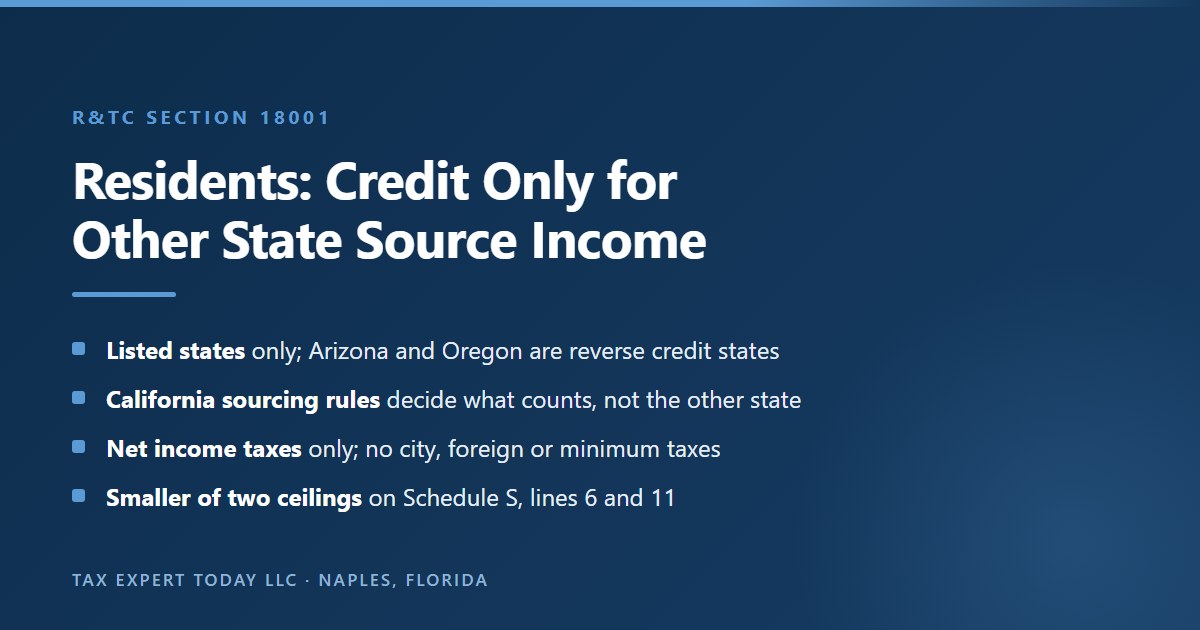
Schedule S computes the California other state tax credit from two numbers and allows the smaller. Line 6 is California tax multiplied by the share of California income that was double taxed. Line 11 is the other state tax multiplied by the share of the other state income that was double taxed. Line 12, the credit, is the smaller of line 6 or line 11.
- Part I: lists each double-taxed income item, with the California amount and the other state amount.
- Lines 2 to 6: the California side, a ceiling based on California tax.
- Lines 7 to 11: the other state side, a ceiling based on tax actually paid there.
- Line 12: the smaller of the two, entered with credit code 187.
- Ratios: lines 5 and 10 are capped at 1.0000.
The 2025 Schedule S is a single page. Part I asks for a breakdown of double-taxed income by item, with the amount taxable by California in column (b) and the amount taxable by the other state in column (c). Part II turns those totals into the credit. The structure follows the statute: section 18001(a)(3) caps the resident credit at the proportion of California net tax that the double-taxed income bears to the taxpayer’s entire income taxed by California, and the form adds the second ceiling so the credit never exceeds the tax actually paid to the other state on that income.
| Line | What it asks for | Where the number comes from |
|---|---|---|
| 1 | Total double-taxed income, columns (b) and (c) | Part I items |
| 2 | California tax liability | Form 540, line 48, or Form 540NR, line 63, before this credit and the PTE credit |
| 3 | Double-taxed income taxable by California | Line 1, column (b) |
| 4 | California adjusted gross income | Form 540, line 17, or Form 540NR, line 32, plus certain lump-sum amounts |
| 5 | Line 3 divided by line 4 | Not more than 1.0000 |
| 6 | Line 2 multiplied by line 5 | California ceiling |
| 7 | Income tax liability paid to the other state | Other state return, net of its credits |
| 8 | Double-taxed income taxable by the other state | Line 1, column (c) |
| 9 | Adjusted gross income taxable by the other state | Residents: items taxed there; nonresidents: total AGI taxed there |
| 10 | Line 8 divided by line 9 | Not more than 1.0000 |
| 11 | Line 7 multiplied by line 10 | Other state ceiling |
| 12 | Other state tax credit | Smaller of line 6 or line 11, code 187 |
Here is a hypothetical example for a single California resident who spent part of 2026 on an engagement in Colorado. Assume California adjusted gross income of $250,000, of which $40,000 is wages for days physically worked in Colorado. Assume California tax on Form 540, line 48, of $18,000 before credits, and Colorado nonresident tax of $1,700 on the $40,000. The California side gives line 5 of $40,000 divided by $250,000, or 0.1600, and line 6 of $18,000 multiplied by 0.1600, or $2,880. The Colorado side gives line 9 of $40,000, the only item Colorado taxed, line 10 of 1.0000 and line 11 of $1,700. Line 12 is the smaller amount, $1,700.
| Hypothetical line | Amount |
|---|---|
| Line 2, California tax | $18,000 |
| Line 3, double-taxed income for California | $40,000 |
| Line 4, California AGI | $250,000 |
| Line 5, ratio | 0.1600 |
| Line 6, California ceiling | $2,880 |
| Line 7, tax paid to Colorado | $1,700 |
| Line 8 and line 9 | $40,000 and $40,000 |
| Line 10, ratio | 1.0000 |
| Line 11, other state ceiling | $1,700 |
| Line 12, credit | $1,700 |
In this example the taxpayer pays Colorado $1,700 and receives a $1,700 California credit, so the Colorado tax is fully offset. California still collects $1,180 of its own tax on the Colorado wages, because California’s average rate on that slice of income was higher than Colorado’s. That is the normal pattern when a California resident earns income in a lower-tax state: the credit removes the double tax but the higher California rate still applies to the difference. The California numbers in the example are assumptions for illustration, not a computation from the rate tables.
What Goes in Part I, Double-Taxed Income?
Part I lists each item of income that both California and the other state taxed, with the amount California taxed in column (b) and the amount the other state taxed in column (c). For a resident, an item belongs in Part I only if California would treat it as sourced in the other state. The two columns often differ.
- Column (a): a short description, such as wages earned in another state while a California resident.
- Column (b): the amount of that item taxed by California.
- Column (c): the amount of that item taxed by the other state.
- Nonresidents: column (b) is limited to amounts in Schedule CA (540NR), Part II, line 27, column E.
- Line 1: the column totals, carried to lines 3 and 8.
The Schedule S instructions define double-taxed income as income taxed by California and the other state, and give examples for column (a): wages earned in another state while a California resident, gain on sale of real estate, and a partnership’s ordinary income. The instructions then repeat the source rule for residents: the income taxed by the other state must also have a source in the other state.
The two columns differ more often than people expect. California and the other state may compute the same item differently because of depreciation, conformity to federal changes, the treatment of a particular deduction, or a different allocation method for compensation that spans several years. Part I is designed to capture that difference rather than force the two numbers to match. Each column is the amount actually taxed by that jurisdiction, and each ratio on Part II uses its own column.
| Example item | Column (b), California | Column (c), other state | Why the amounts differ |
|---|---|---|---|
| Wages for days worked in Illinois | $22,000 | $22,000 | Same workday count |
| Gain on sale of a rental house in North Carolina | $95,000 | $110,000 | Different depreciation history, so different basis |
| Partnership ordinary income apportioned to New Jersey | $31,000 | $28,500 | Different apportionment and addback rules |
| Stock option compensation allocated to Massachusetts | $18,000 | $21,000 | Different allocation period |
The figures in that table are hypothetical illustrations. They show why the Part I columns should be built from the two returns as filed, not from one return copied to the other. A common error is to enter the other state’s number in both columns, which overstates or understates the California ratio on line 5.
For a nonresident claiming the credit, the instructions add a restriction on each column. Column (b) should include only the amount of double-taxed income included in Schedule CA (540NR), Part II, line 27, column E, which is the California column. Column (c) should include only the amount of double-taxed income included in the adjusted gross income taxed by the state of residence. In a part-year return, those restrictions keep the resident-period items and the nonresident-period items from being mixed.
Items of income that only one state taxed do not belong in Part I at all. Interest on a brokerage account that California taxed because the owner lived in California, and that the other state did not tax, is not double-taxed income. Neither is a gain on property in California that the other state exempted. Those items still affect the credit indirectly, because they are part of California adjusted gross income on line 4 and so they dilute the California ratio, but they are not listed as double-taxed.
| Item | Belongs in Part I? | Reason |
|---|---|---|
| Wages for work physically done in the other state | Yes | Sourced there under California rules and taxed by both |
| Wages for work done at home in California for an out-of-state employer | No for a resident | California sources it to California even if the other state taxes it |
| Dividends on a brokerage account | Usually no | Sourced to the state of residence |
| Rent from a property in the other state | Yes | Sourced where the property is located |
| K-1 income the other state taxed on a composite return | Yes, through the group return rules | Schedule S instructions, C |
Why Is the Credit the Smaller of Two Fractions?
The two ceilings protect each state’s revenue. Line 6 stops the credit from exceeding the California tax attributable to the double-taxed income, and line 11 stops it from exceeding the other state tax attributable to that income. The taxpayer ends up paying roughly the higher of the two states’ average rates on the double-taxed income.
- Line 6 binds: when the other state’s average rate on the income is higher than California’s.
- Line 11 binds: when California’s average rate is higher, which is common.
- Result: the credit removes the overlap, not the higher rate.
- Statute: section 18001(a)(3) supplies the California ceiling for residents; section 18002(a)(3) and (4) supply both for nonresidents.
The proportional limit in section 18001(a)(3) is the heart of the resident credit. It says the credit shall not exceed the proportion of California net tax payable as the income subject to tax in the other state and also taxable in California bears to the taxpayer’s entire income upon which California net tax is imposed. That is line 6. The second ceiling, on line 11, reflects the plain point that the credit is for taxes paid: it cannot exceed the share of the other state tax that relates to the double-taxed income.
The nonresident statute writes both ceilings out. Section 18002(a)(3) allows credit only for the proportion of the taxes paid to the state of residence that the income taxable in California and also subject to tax in the state of residence bears to the entire income upon which the state of residence imposed its tax. Section 18002(a)(4) then caps the credit at the proportion of California net tax that the same income bears to the entire income taxable in California.
Here is a hypothetical example in which the California ceiling is the smaller number. A married California couple filing jointly reports California adjusted gross income of $400,000 and California tax on line 48 of $20,000, which assumes substantial itemized deductions and other credits. During the year one spouse earned $100,000 for work performed in New York, and New York imposed $6,500 of nonresident tax that relates entirely to that income. Line 5 is $100,000 divided by $400,000, or 0.2500, and line 6 is $5,000. Line 11 is $6,500. The credit is $5,000, so $1,500 of New York tax is not offset.
| Hypothetical case | Line 6, California ceiling | Line 11, other state ceiling | Credit | Tax not offset |
|---|---|---|---|---|
| Colorado wages, from the previous example | $2,880 | $1,700 | $1,700 | None; California keeps $1,180 of its own tax |
| New York wages, couple with large deductions | $5,000 | $6,500 | $5,000 | $1,500 of New York tax |
| Rental gain in North Carolina, high California income | $8,400 | $4,950 | $4,950 | None |
The figures are hypothetical and the tax amounts are assumptions, not results from either state’s rate tables. The pattern they show is general. When California’s average rate on the double-taxed income is higher than the other state’s, the credit equals the other state’s tax and the taxpayer pays California’s rate overall. When the other state’s average rate is higher, the credit equals the California tax on that income and the taxpayer pays the other state’s rate overall. In both cases the overlap disappears.
The fractions use average rates, not marginal rates, which can surprise high earners. Because line 4 and line 9 are whole adjusted gross income figures and line 2 and line 7 are whole tax figures, the credit spreads each state’s progressive tax evenly across all the income it taxed. A large deduction or a large block of income taxed at a low rate in one state can therefore change the result noticeably, even if the double-taxed income itself did not change.
One more detail matters for joint filers with very uneven incomes. The California tax on line 2 is the joint tax on both spouses’ income, and line 4 is joint adjusted gross income. If one spouse earned all the double-taxed income, the ratio on line 5 still measures it against the couple’s combined income. That is the statute working as written, not an error, but it is one reason the credit for a two-earner household can look smaller than the other state’s tax bill.
What Is a Reverse Credit State?
A reverse credit state is a state that gives California residents a credit against its own nonresident tax for California tax paid, instead of leaving the credit to California. The 2025 Schedule S instructions treat Arizona, Oregon and Virginia this way for California residents, so a California resident generally seeks relief on the Arizona, Oregon or Virginia return.
- For California residents: Arizona, Oregon and Virginia are not on the resident credit list, except Virginia for dual residents.
- For California nonresidents: Arizona, Guam, Oregon and Virginia are the only places whose residents can claim the California credit.
- Statutory basis: section 18001(a)(2) and section 18002(a)(1) and (2).
- Indiana: removed from reverse credit treatment beginning in 2017.
The phrase does not appear in the statute, but the Schedule S instructions use it when they explain the change for Indiana. The idea is that most states give their own residents a credit for taxes paid elsewhere and give nonresidents nothing. A few states turn that around for California residents and allow them a credit against the nonresident tax for the tax California charges. When a state does that, section 18001(a)(2) switches off the California resident credit, because the double tax has already been addressed by the other state.
The same states appear on the nonresident side for the mirror image reason. Section 18002(a)(1) allows the nonresident credit only if the state of residence either does not tax California residents on income from sources within that state or allows California residents a credit for California tax. Section 18002(a)(2) then denies the credit for taxes paid to a state that allows its own residents a credit for California tax. Applying both conditions leaves the short list in General Information D of the instructions: Arizona, Guam, Oregon and Virginia.
| Situation | Where the credit is generally claimed |
|---|---|
| California resident with Oregon source wages | On the Oregon nonresident return, not on Schedule S |
| California resident with Arizona source rental income | On the Arizona nonresident return, not on Schedule S |
| Oregon resident with California source wages | On California Schedule S attached to Form 540NR |
| Arizona resident who sells California real property | On California Schedule S attached to Form 540NR |
| Virginia resident with California source income | On California Schedule S attached to Form 540NR |
| New York resident with California source income | On the New York resident return, not on Schedule S |
The table describes the general pattern under the California rules. Each of the other states has its own statute, forms and conditions, and those control the other state’s side. Our role on a California return is to apply the California rules correctly and coordinate with the other state return so the credit is claimed once, on the right return, for the right amount.
The reverse credit rule is the main reason a move to Arizona or Oregon produces a different result from a move to New York or New Jersey. For the first group, a former Californian who still has California source income claims the California credit on Form 540NR. For the second group, the former Californian looks to the new home state for relief, and California keeps its full nonresident tax.
Can a Nonresident Claim the California Other State Tax Credit?
Only in a narrow set of cases. A nonresident may claim the credit only for net income tax paid to the state of residence, only if that state is Arizona, Guam, Oregon or Virginia, and only on income California also taxed. Residents of every other state, including former Californians in New York or New Jersey, cannot claim the credit on Form 540NR.
- Eligible: residents of Arizona, Guam, Oregon and Virginia.
- Not eligible: residents of all other states and possessions.
- Florida, Texas and Nevada residents: no home state income tax, so there is nothing to credit.
- Group returns: the credit is not allowed on a California group nonresident return.
- Form: Schedule S attached to Form 540NR, with the home state return.
General Information D of the 2025 Schedule S instructions states the rule in two sentences. California nonresident individuals, estates or trusts that are residents of Arizona, Guam, Oregon or Virginia and paid a net income tax to that state or possession on income that is also taxed by California may claim the other state tax credit. California nonresidents who are residents of any state or U.S. possession not listed may not claim this credit.
For most people who leave California, the nonresident version of the California other state tax credit is therefore not available, and it does not need to be. A Florida or Texas resident pays no home state income tax on California source income, so there is no double tax. A New York, New Jersey or Massachusetts resident does pay home state tax on the same income, but the home state generally gives its own resident credit for California tax. New York, for example, offers Form IT-112-R, and its IT-112-R instructions describe a resident credit for income sourced to and taxed by another state while the taxpayer was a New York resident.
| New home state | Home state income tax on California source income? | California nonresident credit on Form 540NR? | Usual relief |
|---|---|---|---|
| Florida | No | No | None needed |
| Texas, Nevada, Tennessee, Wyoming, South Dakota | No broad personal income tax | No | None needed |
| Washington | No tax on wages | No | Test any Washington tax separately |
| Arizona, Oregon, Virginia, Guam | Yes | Yes | California Schedule S |
| New York, New Jersey, Massachusetts, Illinois and most others | Yes | No | Home state resident credit |
The nonresident version of the computation has one twist on line 9. For residents, line 9 includes only those items of adjusted gross income taxed by the other state. For nonresidents, line 9 is total adjusted gross income taxed by the state of residence, because the state of residence taxes everything. That makes line 10 a smaller fraction for a nonresident, which reflects the fact that the home state tax is spread across all of the home state income.
If you are planning a move and the destination is not settled, the nonresident credit rules are worth a few minutes. Ongoing California source income after the move, such as rent from a California property, a K-1 from a California business or deferred compensation for California work, will be taxed by California regardless of where you live. Whether that income is also taxed by your new state, and which state gives the credit, depends on the destination. Our guide to moving from California to Florida taxes covers the broader comparison.
How Does the Credit Work for Part-Year Residents in the Move Year?
A part-year resident applies the resident rules to income from the resident period and the nonresident rules to income from the nonresident period. In the year you leave California, Schedule S can therefore allow a credit for some items, such as wages earned in another state before the move, and deny it for others, such as income taxed by your new state after the move.
- Resident period: credit for tax paid to the state where the income was sourced, if that state is on the resident list.
- Nonresident period: credit only if the new home state is Arizona, Guam, Oregon or Virginia.
- Return: Form 540NR with Schedule CA (540NR) and Schedule S.
- Line 2: Form 540NR, line 63, before this credit and the PTE credit.
- Not prorated: the Form 540NR exemption credit percentage does not apply to this credit.
General Information E of the Schedule S instructions gives the part-year rule in two lines: follow the instructions for residents for the part of the year that you were a California resident, and follow the instructions for nonresidents for the part of the year that you were a nonresident. In practice, that means each double-taxed item is tested against the rule for the period in which California taxed it.
The move year is also the year when the California return itself changes shape. Instead of Form 540, the part-year resident files Form 540NR. California computes tax on total income as if the taxpayer had been a resident all year, then applies the ratio of California taxable income to total taxable income. The 2025 Form 540NR booklet explains that the exemption credit percentage on line 38 does not apply to the other state tax credit, among a few others, and FTB Publication 1100 says the same: California allows those credits in full.
| Move-year item | California treatment | Schedule S result |
|---|---|---|
| Wages for work in Illinois in March, while a California resident | Taxed as resident income | Resident credit for Illinois tax, if sourced there |
| California wages after moving to Florida | Taxed as California source | No credit needed; Florida has no income tax |
| California wages after moving to Oregon | Taxed as California source | Nonresident credit for Oregon tax on the same wages |
| California wages after moving to New York | Taxed as California source | No California credit; relief comes from New York |
| Dividends after moving anywhere | Not taxed by California | Not double taxed |
The part-year return is where most errors in the California other state tax credit occur, because tax software tends to treat the credit as a single annual computation. A careful preparer builds the Part I list item by item, notes which period each item belongs to, and checks the matching rule. For a move to Florida, the exercise usually confirms that only resident-period items from other states belong on Schedule S, and the new home state contributes nothing.
The part-year return also uses the same California adjusted gross income figure on line 4 as Form 540NR, line 32, which includes only California-taxed income. That makes the California ratio on line 5 larger than it would be for a full-year resident with the same double-taxed income, and so the California ceiling on line 6 is not as tight as it may look at first glance.
Which Return Gets the Credit When You Move From California to New York?
Generally the New York return, for income taxed by New York as a resident after the move, and the California return, for income earned in New York while you were still a California resident. California gives New York residents no nonresident credit, so after the move New York’s resident credit is the usual relief for California source income.
- Before the move: New York source wages earned as a California resident get a California resident credit on Schedule S.
- After the move: California source income taxed by both states gets relief on New York Form IT-112-R, under New York’s rules.
- Not on Schedule S: any New York City tax, because local taxes are excluded.
- Watch: compensation that spans the move, such as RSUs, bonuses and deferred pay.
New York sits on the California resident list in General Information C of the Schedule S instructions but not on the nonresident list in General Information D. That single fact decides most move-year questions. Before the move, a California resident who earns wages for work physically performed in New York is taxed by New York as a nonresident on that income and can claim a California credit for the New York tax. After the move, a New York resident who still has California source income is taxed by California as a nonresident and by New York as a resident, and California offers no credit.
New York, for its part, offers a resident credit. The IT-112-R instructions say a full-year or part-year New York resident may claim the credit for income sourced to and taxed by another state, and that the credit is allowable only for the portion of the tax that applies to income sourced to and taxed by the other taxing authority while the taxpayer was a New York resident. New York uses its own sourcing rules for that purpose, and the instructions note that New York gives no credit for tax on interest and dividends from intangible assets unless they are connected with a business in the other jurisdiction.
| Hypothetical item, move from San Francisco to New York on July 1, 2026 | Taxed by California? | Taxed by New York? | Which return carries the credit |
|---|---|---|---|
| Wages for a March business trip to New York | Yes, as a resident | Yes, as New York source | California Schedule S |
| Wages for September work in New York | No | Yes, as a resident | Not double taxed |
| Final California bonus paid in August for first-half work in California | Yes, as California source | Yes, as a resident | New York Form IT-112-R, under New York rules |
| RSU vest in September, part of the vesting period worked in California | Yes, on the California workday share | Yes, as a resident | New York Form IT-112-R, under New York rules |
| Rent from a Sacramento condominium in November | Yes, as California source | Yes, as a resident | New York Form IT-112-R, under New York rules |
The table is a simplified hypothetical. Each of the New York answers depends on New York’s own rules about sourcing and accrual for part-year residents, which can treat items differently from California. The point for the California return is narrower and firm: in the nonresident period, nothing goes on Schedule S for New York tax, because New York is not one of the four jurisdictions whose residents can claim the California credit.
The New York City personal income tax adds a separate layer. It is a local tax, so it is excluded from Schedule S under the line 7 instructions even in the resident period. Former Californians moving to the city should expect the city tax to be a net addition to their overall burden on any income it reaches, without a California offset.
What Happens When You Move From California to Florida or Texas?
After a move to Florida or Texas there is no second state income tax on your income, so the California other state tax credit has nothing to offset in the nonresident period. California still taxes its own source income in full on Form 540NR, and Schedule S is used only for resident-period income that a third state taxed before you left.
- No home state tax: Florida imposes no personal income tax, and Texas has none either.
- California keeps its tax: California source income after the move is taxed at California rates without any offset.
- Schedule S still possible: for wages or other income earned in a third state before the move.
- No double tax to fix: but no relief from California either.
- Proof of the move: Florida domicile documents support the residency change itself.
For most people moving from California to Naples, Florida, this is the short answer, and it is a reassuring one. Double taxation by two states is mainly a problem when both states have an income tax. Florida does not tax personal income, so once a former Californian becomes a Florida resident, the only state income tax on most income is California’s tax on California source items. There is no Florida tax to credit, and therefore no Schedule S for the nonresident period.
That also means there is no relief to look for. A Florida resident who receives a California bonus, an RSU vest partly earned in California, a severance payment for California services, or a gain on California real property pays California tax on the California share at California rates. The credit does not reduce that tax, because the credit only exists to prevent two states from taxing the same income. Our guide to the California bonus tax rate covers the withholding side of that income, and our guide to California nonresident withholding covers payments that come with California tax withheld at the source.
| Income after a move to Florida | California tax? | Florida income tax? | Schedule S? |
|---|---|---|---|
| Florida wages for work in Florida | No | No | No |
| Final California paycheck for California work | Yes, California source | No | No |
| RSU vest with California workdays in the vesting period | Yes, on the California share | No | No |
| Rent from California property | Yes | No | No |
| Interest, dividends and stock gains | Generally no | No | No |
| IRA and qualified pension distributions | No, under 4 U.S.C. 114 | No | No |
Schedule S can still appear on the move-year Form 540NR for the resident period. Suppose a hypothetical Bay Area consultant moved to Naples on May 1, 2026, and in February, while still a California resident, spent two weeks working on site for a client in Massachusetts. Massachusetts taxed those wages as a nonresident. California taxed them too, because a resident is taxed on all income. Massachusetts is on the resident list, and the wages are Massachusetts source under California’s rule for employee compensation, so the consultant claims a California credit on Schedule S for that slice of the year.
The residency change itself has to hold up for any of this to work. Florida provides a formal declaration of domicile, described in Florida Statutes section 222.17, which lets a person who has established a domicile in Florida file a sworn statement with the clerk of the circuit court. The declaration is useful evidence, but it is one fact among many in a California review. Our guides to how to establish Florida residency and the Florida residency audit questions that follow a move cover the residency side.
Texas works the same way for Schedule S purposes. A former Californian living in Austin or Dallas has no Texas personal income tax to credit, so California’s tax on California source income stands alone. Our guide to Texas versus Florida taxes compares the two destinations on the taxes that do exist in each state.
What About a Move to Arizona, Oregon or Virginia?
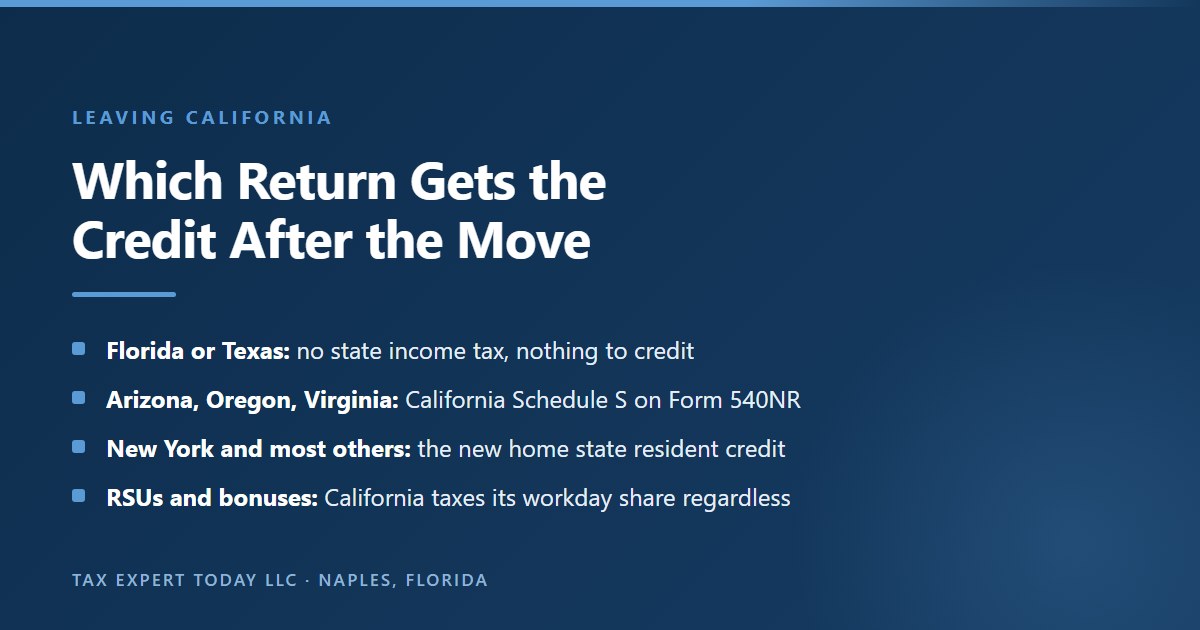
These are the moves where the nonresident form of the California other state tax credit applies. A former Californian who becomes a resident of Arizona, Oregon or Virginia, or of Guam, and pays home state tax on income California also taxes, claims the California other state tax credit on Schedule S attached to Form 540NR, subject to the two ceilings.
- Who claims: the former Californian, on the California nonresident return.
- Which income: California source income that the new home state also taxed.
- Line 9: total adjusted gross income taxed by the state of residence.
- Attachment: a copy of the home state return.
- Result: the combined tax on the double-taxed income approaches the higher of the two average rates.
The nonresident list in General Information D of the Schedule S instructions is short for a reason grounded in section 18002. These are the states whose own rules leave the credit to California for their residents. For a former Californian who moves to Phoenix, Portland or Richmond and still has California source income, the California nonresident credit is the main way to avoid paying both states in full.
Here is a hypothetical example. A single engineer moves from San Diego to Phoenix on July 1, 2026. Later that year an RSU tranche vests, and $60,000 of the vest is allocated to California under the workday method. Arizona taxes the whole vest as a resident. Assume total adjusted gross income taxed by Arizona for the year of $150,000 and Arizona tax of $3,750. Assume California tax on Form 540NR, line 63, of $9,000 and California adjusted gross income on line 32 of $140,000, which includes the first-half wages and the California share of the RSU.
| Hypothetical line | Amount |
|---|---|
| Line 2, California tax (Form 540NR, line 63) | $9,000 |
| Line 3, double-taxed income for California | $60,000 |
| Line 4, California AGI (Form 540NR, line 32) | $140,000 |
| Line 5, ratio | 0.4286 |
| Line 6, California ceiling | $3,857 |
| Line 7, tax paid to Arizona | $3,750 |
| Line 8, double-taxed income for Arizona | $60,000 |
| Line 9, total AGI taxed by Arizona | $150,000 |
| Line 10, ratio | 0.4000 |
| Line 11, other state ceiling | $1,500 |
| Line 12, credit | $1,500 |
In the example, Arizona’s tax attributable to the double-taxed RSU income is $1,500, and California credits all of it. California still collects the rest of its tax on the California share. The numbers are hypothetical assumptions for illustration and are not computed from either state’s rate schedule. The structure is what matters: the move to Arizona produces a California credit that a move to Florida never needs and a move to New York never receives.
Virginia carries an extra wrinkle. On the resident side, it appears only for dual residents, meaning someone who is a California resident under California law and a Virginia resident under Virginia law. On the nonresident side, it appears without that limit. A person who has fully left California for Virginia uses the nonresident rules; a person whom both states treat as a resident uses the dual-resident rule. Dual residency is its own subject, covered in our guide to the dual state residency tax trap.
How Is an RSU Vest Taxed by Two States in the Move Year?
California taxes the share of an RSU vest allocated to California workdays between grant and vest, even after you move. The new home state may tax the whole vest as resident income. Whether a credit applies, and on which return, depends on the new state: none is needed for Florida, California gives it for Arizona or Oregon, and New York generally gives it on its own return.
- Allocation: California workdays from grant to vest divided by total workdays in that period.
- Source: compensation for services, sourced where the services were performed.
- FTB guidance: Publication 1004 lists RSUs with the note “possible other state tax credit.”
- Withholding: employers often withhold for both states, which is not the same as owing both.
- Move-in case: a resident on the vest date pays California on the whole vest, with a possible credit for the prior state.
Equity compensation is the most common source of a move-year question about the California other state tax credit, because the income is earned over several years and recognized on one day. The Franchise Tax Board’s Publication 1004, Stock Option Guidelines, describes the allocation it treats as reasonable: California workdays from the grant date to the exercise or vest date, divided by total workdays in the same period, multiplied by the income. For RSUs, the publication says that on the vesting date California will tax the wage income to the extent services were performed in California from the grant date to the vesting date, and it adds a short note: possible other state tax credit.
The note is a pointer, not a promise. Whether a credit is actually available depends on who taxed the income and the residency rules described above. FTB Publication 1100 gives the base rule for nonresidents: California taxes the wage income received by a nonresident from employee stock options on a source basis, whether the person was always a nonresident or was formerly a California resident.
| Hypothetical: 1,000 workdays grant to vest, 800 in California, vest of $100,000 after the move | California taxes | New state taxes | Credit |
|---|---|---|---|
| Moved to Florida | $80,000 | Nothing | None needed |
| Moved to Texas | $80,000 | Nothing | None needed |
| Moved to Arizona | $80,000 | Generally the whole vest as a resident | California Schedule S on Form 540NR |
| Moved to Oregon | $80,000 | Generally the whole vest as a resident | California Schedule S on Form 540NR |
| Moved to New York | $80,000 | Generally the whole vest as a resident, under New York rules | New York Form IT-112-R, not Schedule S |
The reverse direction matters for people who came to California from another state before they leave again. Publication 1004 gives an example in which a person granted options while a Michigan resident later exercises them as a California resident. California taxes the whole spread, because the person is a resident when the income is recognized, and if Michigan also taxed the wage income allocated to Michigan workdays, California allows a credit for the Michigan tax on the double-taxed income. Michigan is on the resident list, so the credit goes on Schedule S.
Employers add confusion by withholding. A payroll system that sees California workdays and a new home address in another state may withhold for both. Withholding is a prepayment, not a final tax, and the returns sort it out. The California Form 540NR reports the California share and claims the California withholding; the home state return reports what it taxes. If too much was withheld for either state, the excess comes back as a refund on that state’s return. Our guide to California RSU tax when you leave the state walks through the allocation in more detail, and our guide to dividing stock options in divorce covers a related allocation problem.
One caution on the workday count. California’s count and the new state’s count can differ, because the states may define the allocation period differently, treat holidays and vacation days differently, or treat days spent working from home in a different way. When the counts differ, Part I of Schedule S should show each state’s own figure in its own column.
How Do Deferred Compensation and Severance Interact With the Credit?
California taxes deferred compensation, bonuses and severance paid after a move to the extent they are compensation for services performed in California, unless federal law exempts the payment. When a new home state with an income tax also taxes the payment, the same Schedule S rules decide whether California or that state gives the credit.
- Final paychecks and bonuses: California source if earned by California services, even when paid after the move.
- Severance: generally allocated to the state where the services that earned it were performed.
- Nonqualified deferred compensation: taxable by California as California source, unless 4 U.S.C. 114 applies.
- Qualifying installment plans: some long-period payments are protected by federal law from source taxation.
- Credit: needed only if the new home state also taxes the payment.
The basic rule is the same one that drives the RSU analysis. Publication 1100 gives the example of a person who worked in California, retired on December 31 and moved to Nevada on January 1, then received a final paycheck on January 10. California taxes the paycheck, because the income has a source in California, where the services were performed. The same reasoning reaches a year-end bonus for California work, a payout of accrued paid time off, and severance tied to California employment.
Federal law changes the answer for one category. 4 U.S.C. section 114 provides that no state may impose an income tax on any retirement income of an individual who is not a resident or domiciliary of that state. The definition of retirement income covers qualified plans, IRAs, 403(b) and governmental plans, eligible 457 plans, and, for certain nonqualified arrangements, payments made in substantially equal periodic installments over the life of the recipient or a period of not less than 10 years. When a payment falls inside that definition, California cannot tax it after the move, and the credit question disappears.
| Payment received after the move | California source taxation | Schedule S relevance |
|---|---|---|
| Final paycheck for California work | Taxable | Only if the new home state also taxes it |
| Annual bonus for a California service year | Taxable on the California share | Only if the new home state also taxes it |
| Severance tied to California employment | Generally taxable on the California share | Only if the new home state also taxes it |
| Nonqualified deferred compensation in a lump sum | Generally taxable on the California share | Only if the new home state also taxes it |
| Nonqualified plan paid in 10-year or longer installments that qualify | Protected by 4 U.S.C. 114 | Not applicable |
| 401(k), IRA and qualified pension distributions | Protected by 4 U.S.C. 114 | Not applicable |
The difference between a lump sum and qualifying installments can be large for an executive with a deferred compensation balance. Whether a particular plan meets the federal definition depends on its terms and on the elections made under it, and those elections are often fixed years before the move. Our guide to nonqualified deferred compensation covers the plan rules, and our guide to Florida domicile for executives covers the residency planning around large payouts.
For a move to a state with an income tax, the credit analysis follows the same map as the RSU section. A former Californian in Oregon who receives California source severance claims the California credit for the Oregon tax on it. A former Californian in New Jersey looks to New Jersey for relief. A former Californian in Florida pays only California tax on the California share and needs no credit at all.
Does the Credit Apply to Pensions and IRA Distributions After the Move?
Usually the question never arises. Federal law in 4 U.S.C. section 114 bars California from taxing a nonresident’s IRA distributions, qualified pension payments and other defined retirement income, so after the move only the new home state can tax them and there is no double tax for Schedule S to address.
- Protected: qualified plans, IRAs, SEP plans, 403(a) and 403(b) annuities, governmental plans and eligible 457 plans.
- Also protected: qualifying nonqualified plan payments over life or at least 10 years.
- California rule: Publication 1100 confirms California does not tax a nonresident’s IRA and qualified pension distributions.
- Before the move: distributions received while a California resident are fully taxable by California.
Retirees moving from California to Southwest Florida often ask whether California can keep taxing a pension earned during a California career. Under 4 U.S.C. section 114, it cannot, once the retiree is no longer a California resident or domiciliary. Publication 1100 states the California side directly: California does not tax the IRA distributions, qualified pension, profit sharing and stock bonus plans of a nonresident.
Timing still matters in the move year. Publication 1100 also gives the mirror-image rule for residents: California taxes residents on all income regardless of source, and its example of a person who moved into California and received a pension from a former Florida employer confirms that a pension received while a resident is taxable by California. For someone leaving, a distribution taken in January while still a California resident is taxable by California, and a distribution taken in June after becoming a Florida resident is not.
| Retirement payment | Received while a California resident | Received after becoming a Florida resident |
|---|---|---|
| Traditional IRA distribution | Taxable by California | Not taxable by California |
| Roth conversion | Taxable by California | Not taxable by California |
| Qualified pension payment | Taxable by California | Not taxable by California |
| 401(k) distribution | Taxable by California | Not taxable by California |
| Qualifying long-period nonqualified installment | Taxable by California | Not taxable by California |
Schedule S comes back into play only in unusual cases, such as a retiree who is treated as a resident by two states at once, or a California resident who received a retirement payment that another state taxed on some other basis. Those cases turn on residency, not on the credit computation. Our guide to retiring to Florida taxes covers the retirement side of the move in more depth.
For a planned move, the practical step is to time discretionary retirement income, such as a Roth conversion or a large IRA withdrawal, for after the residency change if the other facts support it. That is planning around the source rules, not around the credit, and it should be considered alongside the residency evidence.
What Does the New York Convenience of the Employer Rule Do to the Credit?
It can leave a California resident who works from home for a New York employer without a California credit. California sources the wages to California, where the work was performed, so they are not New York source for Schedule S. If New York taxes them under its convenience rule, the same wages can be taxed in full by both states.
- California rule: employee wages are sourced where the services are physically performed.
- New York rule: days worked outside New York for the employee’s convenience can be treated as New York days.
- Schedule S: the credit requires New York source under California’s rules, which is missing.
- Result: possible full double tax on the home-office days.
- Exception: days spent working away from New York out of the employer’s necessity, under New York’s own tests.
The problem is a direct result of section 18001(c). Because California tests the other state’s income with its own sourcing rules, and California sources employee wages to the place where the services were performed, wages earned at a desk in Palo Alto are California source in California’s eyes no matter where the employer is based. When New York treats some of those days as New York days under its convenience of the employer rule, New York taxes the wages as a nonresident and California refuses the credit, because under California rules the wages did not come from New York.
The Schedule S instructions make the general point in General Information H: California’s nonresident sourcing principles apply even though the results may be contrary to the other state’s principles. That sentence is the reason double tax on remote work days is not fixed by Schedule S. Our guide to the convenience of the employer rule covers how New York applies it, and our guide to California remote work tax after moving covers the reverse situation of a former Californian who keeps a California employer.
| Hypothetical: California resident employed by a New York firm, 220 workdays | Days | California taxes | New York may tax | California credit |
|---|---|---|---|---|
| Days physically worked in the New York office | 30 | Yes, as a resident | Yes, New York source | Yes, on Schedule S |
| Days worked at home in California by choice | 190 | Yes, as a resident | Possibly, under the convenience rule | No, California source under California rules |
The hypothetical shows the trap. The credit works for the 30 office days because both states agree they are New York days. For the 190 home days, New York’s position, if it applies, and California’s sourcing rules point in opposite directions, and Schedule S follows California’s rules. The fix, where one exists, is on the New York side: showing that the home-office days were required by the employer, or arranging the work so the convenience rule does not reach it, under New York’s own tests.
The rule matters in the move year too. A Californian who keeps a New York employer after moving to Florida is no longer taxed by California on Florida workdays, but may still face New York tax on those days under the same rule. That is outside California’s credit entirely, because the person is no longer a California resident and Florida has no tax. It is one more reason the move-year return for a remote worker deserves a careful day-by-day log.
How Do S Corporation and Partnership Owners Claim the Credit?
Partners and LLC members treat their pro rata share of net income tax the entity paid to another state as if they paid it. S corporation shareholders do the same for net and gross income taxes, but only if the other state does not allow S elections or taxes S corporations and the company elected S status there. The owner attaches the K-1 and a schedule of the share.
- Partners: section 18006(a), pro rata share of net income taxes the partnership paid.
- LLC members: treated like partners when the LLC is classified as a partnership.
- S corporation shareholders: section 18006(b), with two alternative conditions.
- Gross income taxes: creditable only for S corporation shareholders.
- Attachments: Schedule K-1 (100S, 565 or 568) and a schedule showing the share of tax.
Section 18006 extends the credit through the entity. For a partnership, subdivision (a) lets a member treat its pro rata share of net income taxes paid to another state by the partnership as if the partner had paid them directly. For an S corporation, subdivision (b) gives the shareholder the same treatment, but subdivision (b)(2) adds a condition: either the state imposing the tax does not allow corporations to elect S status, or the state taxes S corporations and the corporation elected S status in that state.
General Information G of the Schedule S instructions restates the rule and tells owners what to attach: a copy of Schedule K-1 (100S, 565 or 568) and a schedule showing the owner’s share of the net income tax paid to the other state. The line 7 instructions then make the one exception to the gross income tax exclusion: an S corporation shareholder may count its pro rata share of the S corporation’s gross income tax.
| Owner and entity | Tax paid by the entity | Creditable share? | Condition |
|---|---|---|---|
| Partner in a partnership | Net income tax to another state | Yes | Pro rata share; usual source rules for residents |
| Member of an LLC taxed as a partnership | Net income tax to another state | Yes | Distributive share |
| S corporation shareholder | Net income tax | Yes | State does not allow S elections, or S election made there |
| S corporation shareholder | Gross income tax | Yes | Same S condition; line 7 exception |
| Partner | Gross receipts tax | No | Not a net income tax |
For a California resident who owns part of a business that operates in several states, the entity-level and owner-level taxes can stack. The owner may pay nonresident tax directly in some states, be included in composite returns in others, and bear a share of entity-level taxes in still others. Each state gets its own Schedule S, and each needs its own Part I list of the items taxed there. Our guide to California LLC versus S corporation choices covers the entity side of this decision.
The source rule still applies to the owner. A California resident can claim the credit only on income that California’s own rules treat as sourced in the other state. For business income, the instructions say business income has a source where the benefit of the services is received, and California’s apportionment rules decide how much of a multistate business’s income is attributed to each state. When the other state uses a different apportionment formula and taxes a larger share, the extra share is not double-taxed income for Schedule S.
A former Californian who keeps an interest in a California business after moving to Florida meets the same rules from the other side. California taxes the California source share of the K-1 as a nonresident, the Florida resident pays no state income tax on it, and no credit is involved. The California entity may also have nonresident withholding obligations on distributions to that owner, which our guide to partnership withholding touches on from the federal side.
How Does the California PTET Change the California Other State Tax Credit?
When an owner also claims the California pass-through entity elective tax credit, the California tax used on Schedule S is increased by the PTET credit that reduced net tax. The instructions say line 2 is California tax before the other state tax credit and the PTE credit, so the PTET credit does not shrink the California ceiling on line 6.
- 2022 to 2026: R&TC 17052.10(f) increases net tax for sections 18001 and 18002.
- 2026 to 2030: R&TC 17052.11(f) carries the same adjustment for the new regime.
- Line 2: California tax without the other state tax credit and the PTE elective tax credit.
- Ordering: the PTET credit is applied after the other state tax credit.
- Effect: owners do not lose part of the other state credit because they also elected PTET.
The California pass-through entity elective tax lets a qualified entity pay California tax at the entity level, giving owners a California credit and the entity a federal deduction. Without an adjustment, the PTET credit would reduce California net tax and therefore reduce the California ceiling on Schedule S, which would cut the other state credit for exactly the owners the program was meant to help. The Legislature fixed that in the statute. Section 17052.10(f) says that, for purposes of sections 18001 and 18002, net tax payable is increased by the amount of PTET credit that reduced net tax in that year, for taxable years beginning on or after January 1, 2022, and before January 1, 2027.
The 2026 to 2030 regime created by Senate Bill 132 has a parallel credit section with the same rule. Section 17052.11 allows the credit for taxable years beginning on or after January 1, 2026, and before January 1, 2031, and its subdivision (f) repeats the net tax adjustment for sections 18001 and 18002. The section is written to operate only if the federal limitation on the state and local tax deduction in IRC section 164(b)(6) is extended; our guide to the California PTET covers that condition and the 2026 regime in full.
| Hypothetical owner | Without the adjustment | With the statutory adjustment |
|---|---|---|
| California tax before credits | $40,000 | $40,000 |
| PTET credit | $15,000 | $15,000 |
| Tax used on Schedule S, line 2 | $25,000 | $40,000 |
| Line 5 ratio (double-taxed income share) | 0.2000 | 0.2000 |
| Line 6, California ceiling | $5,000 | $8,000 |
| Line 11, other state ceiling (assumed) | $7,000 | $7,000 |
| Other state tax credit | $5,000 | $7,000 |
The figures are hypothetical. They show why the adjustment matters for an owner whose business pays tax in several states: without it, the PTET election would have quietly reduced the other state credit. The Schedule S instructions build the adjustment into the form by defining line 2 as California tax without the other state tax credit and the PTE elective tax credit, and they note in General Information G that the calculation changed for taxable years beginning on or after January 1, 2022. The Franchise Tax Board’s pass-through entity elective tax page collects the program guidance.
The ordering rule completes the picture. The PTET credit is applied after the other state tax credit, so the owner takes the other state credit first and the PTET credit reduces what remains. Software generally handles this automatically when both credits are entered, but a manual review is worthwhile in the first year an entity elects, and in any year an owner moves out of California partway through.
Can You Claim the Credit for Another State’s PTET?
Possibly. Many states now have their own elective pass-through entity taxes that can feed the California other state tax credit, and the Schedule S instructions say an owner may be eligible for the California credit for a pro rata share of those taxes, provided the requirements of R&TC sections 18001 and 18006 are met. Whether a particular state’s elective tax qualifies depends on how it is structured.
- Rule: another state’s PTET can be creditable if sections 18001 and 18006 are satisfied.
- Net income tax test: the tax must be imposed on net income under Reg. 18001-1.
- S corporation condition: the S election requirement in section 18006(b) still applies.
- Source test: the income must be sourced in that state under California rules for a resident owner.
- Reverse credit states: the resident list still controls.
The 2025 Schedule S instructions address other states’ elective taxes in General Information G. Many states have implemented PTE elective taxes, under which qualified entities may elect to pay an entity-level tax and owners generally receive personal income tax credits. A partner, member or shareholder may be eligible for the California other state tax credit for a pro rata share of the PTE elective taxes paid, provided the statutory requirements of sections 18001 and 18006 are met.
That conditional wording matters. Each state’s elective tax has its own base and its own owner credit, and some are computed in ways that may not fit California’s definition of a net income tax or the S corporation condition in section 18006(b). The analysis is state by state and year by year. Where another state’s elective tax produces a credit on that state’s own personal return for nonresident owners, the condition in section 18001(a)(2) also has to be considered, because California does not credit tax that the other state has already relieved.
| Question for another state’s PTET | Why it matters on Schedule S |
|---|---|
| Is the tax imposed only on net income? | Reg. 18001-1 test for a net income tax |
| Is the entity a partnership or an S corporation? | Section 18006(a) or (b) applies |
| If an S corporation, did it elect S status in that state? | Section 18006(b)(2) condition |
| Does that state give the California resident owner a credit for the PTET? | Section 18001(a)(2) denies a duplicate credit |
| Is the underlying income sourced in that state under California rules? | Section 18001(a)(1) and (c) |
| Is the state on the resident list? | Arizona and Oregon are not |
New York’s own treatment shows how the states mirror each other. Its IT-112-R instructions say a New York resident owner will be allowed a resident credit for any pass-through entity tax paid to another jurisdiction by an electing partnership or S corporation that is substantially similar to New York’s own, and require a matching addition modification. California’s approach is less specific in its form instructions, which is why the statutory tests carry the weight.
For a business owner planning a move out of California, the PTET elections of the businesses involved belong on the move-year checklist. The California election, the other states’ elections and the owner’s residency on each income date interact, and the answer for one state does not carry to the next. Our guide to the Georgia pass-through entity tax shows how one other state structures its election.
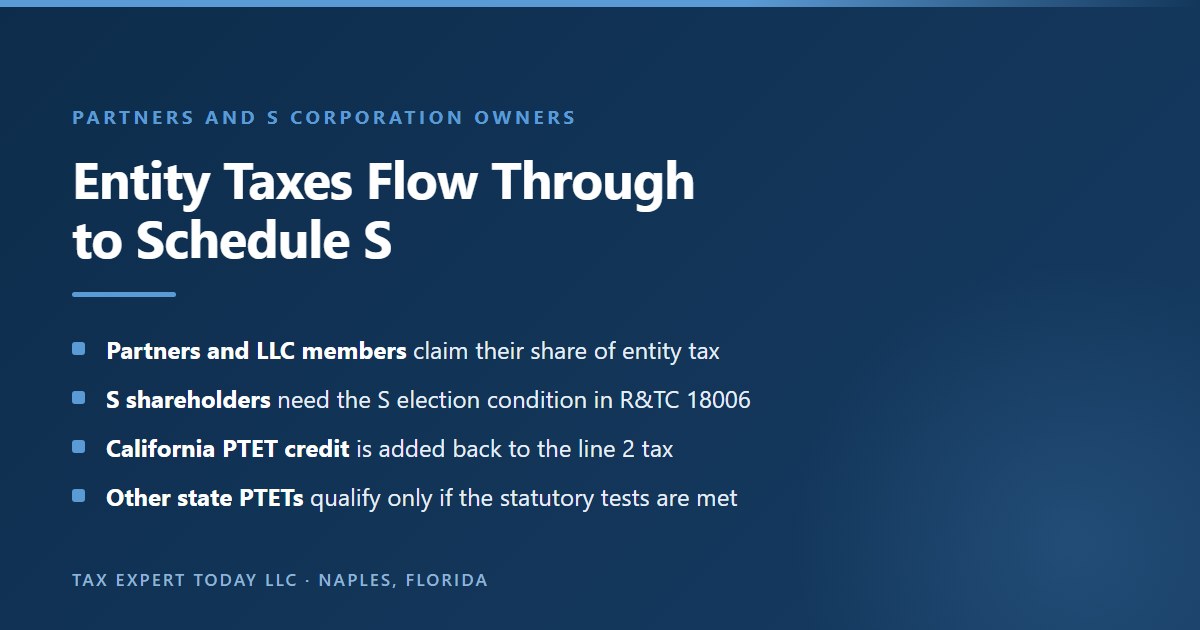
Can Estates, Trusts and Beneficiaries Claim the Credit?
Yes. An estate or trust is a resident of any state that taxes it on its net income regardless of source, so a trust can be a resident of two states. A dual-resident estate or trust gets a credit under section 18004 with two proportional limits, and a California resident beneficiary can claim a credit under section 18005 for tax the estate or trust paid to another state.
- Residence of a trust: defined for this chapter by section 18003.
- Dual-resident trust: credit under section 18004, notwithstanding sections 18001 and 18002.
- Resident beneficiary: credit under section 18005 for tax the trust paid on income taxed to the beneficiary.
- Form: Schedule S attached to Form 541 for the estate or trust.
- Attachments: Schedule K-1 (541) and a schedule of the beneficiary’s share.
Trusts follow their own residency rules, and those rules make dual residency more common than it is for individuals. Section 18003 says that, for this chapter, an estate or trust is a resident of the state that taxes its income irrespective of whether the income is derived from sources within that state. A trust with a California fiduciary and a grantor or trustee connection to another state can be taxed as a resident by both.
For that case, section 18004 allows a credit notwithstanding the limitations in sections 18001 and 18002, so the reverse credit and source rules that bind individuals do not block it. The credit is limited to the proportion of the tax paid to the other state that the double-taxed income bears to the entire income taxed by the other state, and it cannot exceed the proportion of the California tax that the double-taxed income bears to the entire income taxed by California. General Information F of the Schedule S instructions restates both limits.
| Trust situation | Credit | Statute |
|---|---|---|
| Trust taxed as a resident by California and another state | Dual-resident credit on Form 541 | R&TC 18004 |
| California resident trust with income sourced in another state | Ordinary resident rules | R&TC 18001 |
| California resident beneficiary of a trust that paid tax to another state | Beneficiary credit on the beneficiary return | R&TC 18005 |
| Nonresident beneficiary | Generally no California credit | R&TC 18002 limits |
The beneficiary credit in section 18005 covers a resident beneficiary who is taxable on trust income under California’s fiduciary rules, when the trust paid tax to another state on that income. The credit is limited to the proportion of the trust’s other state tax that the income taxed to the beneficiary and to the trust in the other state bears to the trust’s entire income taxed there, and to the proportion of the beneficiary’s California tax that the same income bears to the beneficiary’s entire income taxed by California. The beneficiary attaches Schedule K-1 (541) and a schedule of the share.
Trust residency is a frequent planning topic for families moving to Florida, because the move of a trustee or a beneficiary can change which states treat the trust as resident. Our guides to trust situs after moving to Florida and California Form 541 cover the fiduciary return, and our guide to NING trusts covers a structure designed around state trust taxation.
What Taxes Paid to Other States Can Never Be Claimed on Schedule S?
The line 7 instructions exclude taxes paid to a city or county, federal tax, foreign country taxes, any tax comparable to California’s alternative minimum tax, tax on net passive income, built-in gains tax, gross income tax other than an S corporation shareholder’s share, and any special tax not measured by net income. Local income taxes are the most common surprise.
- Local taxes: city, county and school district income or wage taxes.
- Federal tax: never part of the state credit.
- Foreign taxes: California has no foreign tax credit for individuals.
- Minimum taxes: anything comparable to R&TC 17062.
- Entity-level special taxes: net passive income and built-in gains taxes.
The exclusion list comes from the line 7 instructions in the 2025 Schedule S instructions, which tell filers to enter the income tax liability, net of all credits, paid to the other state, and not to include any of the listed taxes. The statute supports each item. Section 18001 is a credit for taxes paid to “another state,” not to its subdivisions, and it repeatedly excludes any preference, alternative or minimum tax comparable to California’s own.
| Excluded tax | Typical example | Practical effect |
|---|---|---|
| Local government income or wage tax | A city personal income tax or a municipal earned income tax | Full cost, no California offset |
| Federal income tax | Form 1040 liability | Never a state credit |
| Foreign country income tax | Tax paid to a foreign government on foreign wages | No California credit; federal rules only |
| State alternative minimum tax | A state AMT computed alongside the regular tax | Exclude from line 7 |
| Tax on net passive income or built-in gains | S corporation entity-level taxes | Exclude from line 7 |
| Gross income or gross receipts tax | A tax measured by revenue | Exclude, except an S shareholder’s share of gross income tax |
Line 7 also asks for the other state tax “net of all credits.” If the other state allowed credits of its own, such as a credit for taxes paid to a third state or a business incentive credit, the Schedule S figure is the tax after those credits. Using the gross tax before the other state’s credits overstates line 7 and can overstate line 11.
The foreign tax exclusion is worth stressing for globally mobile executives and for anyone with foreign investment income. California does not follow the federal foreign tax credit, and Schedule S cannot be used for foreign taxes. A California resident with foreign wages or foreign dividends pays California tax on them without any foreign offset at the state level. Our guide to Form 1040-NR covers the federal nonresident side of cross-border income.
How Does the Credit Interact With the California AMT and Other Credits?
The California other state tax credit is applied against California net tax less other credits, and it cannot reduce California alternative minimum tax. It is not refundable and has no carryover in the statute, so any amount above the available net tax is lost for that year. Tax software applies the statutory ordering of credits.
- Against: California net tax, as defined in section 17039.
- Not against: California alternative minimum tax under section 17062.
- Not refundable: the credit cannot create a refund by itself.
- No carryover: the chapter contains no carryover for unused credit.
- PTET: applied after the other state tax credit.
The Schedule S instructions say in General Information B that the credit is applied against California net tax, less other credits, and cannot be applied against California alternative minimum tax. Section 18001(a)(4) and section 18002(a)(5) say the same in statutory terms: no credit shall be allowed for any tax imposed by section 17062.
That interaction can matter for high earners with large incentive stock option exercises or other AMT preference items. If the tentative minimum tax exceeds the regular tax, California collects the difference as AMT, and the other state tax credit does not reduce it. Our guide to the California AMT covers the computation, including how the minimum tax applies to nonresidents and part-year residents.
| Feature | Other state tax credit | Source |
|---|---|---|
| Applied against | Net tax less other credits | Schedule S instructions, B |
| Against California AMT | Not allowed | R&TC 18001(a)(4), 18002(a)(5) |
| Refundable | No | Nonrefundable credit |
| Carryover of unused credit | None provided in Chapter 12 | R&TC 18001 to 18011 |
| Proration on Form 540NR | Not prorated by the exemption credit percentage | 2025 Form 540NR booklet, line 38 |
| Relationship to PTET credit | Applied first; PTET credit adjusts the computation | R&TC 17052.10(f), 17052.11(f) |
The Form 540NR treatment is favorable for movers. Most California credits on the nonresident return are reduced by the exemption credit percentage on line 38, which is California taxable income divided by total taxable income. The 2025 Form 540NR booklet lists the other state tax credit among the credits to which that percentage does not apply, so a part-year resident gets the full Schedule S amount rather than a prorated share.
Because the credit has no carryover, timing mismatches between the two states can cost money. If the other state taxes an item in one year and California taxes it in another, the credit is still available, because the instructions say the other state taxes do not have to be paid in the same year as long as they relate to the same transaction. But if California tax in the year the credit belongs to is too small to absorb it, the excess does not carry forward. Planning the year in which a large multistate item is recognized can therefore matter.
How Do Joint and Separate Returns Change the Credit?
On a joint California return, the full tax paid to the other state counts toward the credit no matter which spouse or registered domestic partner paid it, and whether the other state return was joint or separate. When the other state return is joint but the California returns are separate, the credit is divided in proportion to the income on each California return.
- Joint in California: all of the other state tax can be used, regardless of who paid it.
- Joint elsewhere, separate in California: the credit follows each spouse’s share of income.
- Registered domestic partners: treated the same way as spouses for California.
- Move-year couples: spouses who move on different dates may have different residency periods.
General Information B of the Schedule S instructions covers filing status in two sentences. When a joint tax return is filed in California, the entire amount of tax paid to the other state may be used in figuring the credit, regardless of which spouse or RDP paid the other state tax or whether a joint or separate tax return is filed in the other state. When a joint tax return is filed in the other state and separate tax returns are filed in California, the credit is allowed in proportion to the income reported on each California tax return.
The rule is friendly to couples who file jointly in California, which most do. It avoids a mismatch when one spouse earned all of the other state income and filed there alone. It does, however, interact with the ratio on line 5, which measures the double-taxed income against the couple’s combined California income. A high-earning spouse whose income is entirely California source dilutes the ratio for the other spouse’s out-of-state wages.
| California filing | Other state filing | Credit rule |
|---|---|---|
| Joint | Joint | Use the full other state tax |
| Joint | Separate, one spouse only | Use the full other state tax |
| Separate | Joint | Divide the credit in proportion to income on each California return |
| Separate | Separate | Each spouse uses the tax on their own other state return |
Couples who move in stages create the hardest version of this question. If one spouse moves to Florida in March and the other follows in August, California may treat them as residents for different parts of the year. California generally requires spouses to use the same filing status they used federally, with limited exceptions, and a joint Form 540NR then reports each spouse’s resident and nonresident income separately within the joint computation. Schedule S has to follow the same split. Our guide to snowbird taxes in year one covers the first-year filing questions that come with a staged move.
Community property adds one more layer for California couples. Income earned by one spouse during marriage while domiciled in California is generally community property, so half belongs to each spouse for California tax purposes. When a couple moves and the community property rules stop applying to new earnings, the allocation of income between spouses changes, and so can the allocation of double-taxed income on separate returns. Most couples avoid that complexity by filing jointly.
What Must You Attach to Claim Credit Code 187?
Attach a completed Schedule S for each state and a copy of each other state return you filed. Pass-through owners add the Schedule K-1 and a schedule of their share of the entity’s tax; beneficiaries add Schedule K-1 (541); members of group nonresident returns add a statement of their share. Enter the credit with code 187.
- Schedule S: one per state, with Part I and Part II complete.
- Other state return: a copy of the return as filed.
- Pass-through owners: Schedule K-1 (100S, 565 or 568) and a schedule of the share of tax.
- Beneficiaries: Schedule K-1 (541) and a schedule of the share of tax.
- Composite returns: a statement and schedule of the share of tax paid on the group return.
The FTB other state tax credit page lists the filing steps: file the California income tax return; attach Schedule S, using a separate schedule for each state credit claimed; and attach the income tax return or returns from the other state or states. The Schedule S instructions add that the taxpayer should retain a copy of the other state returns along with a copy of the form.
When a credit comes from more than one state, the instructions say to figure each credit separately on its own Schedule S, then add the line 12 amounts and enter the total on the return with credit code 187. The 2025 Form 540NR booklet and the 2025 Form 540 booklet list code 187 in their credit charts as the other state tax credit for net income tax paid to another state or a U.S. possession on income also taxed by California.
| Taxpayer | Attach | Instruction reference |
|---|---|---|
| Any individual claiming the credit | Schedule S per state and the other state return | FTB credit page; Schedule S instructions |
| Partner, LLC member or S corporation shareholder | Schedule K-1 (565, 568 or 100S) and a schedule of the share of tax | General Information G |
| Beneficiary of an estate or trust | Schedule K-1 (541) and a schedule of the share of tax | General Information F |
| Member of a group nonresident return | Statement and schedule of the share of tax | General Information C |
| Amended claim after the other state refunds tax | Revised Schedule S and Schedule X | General Information B |
Electronic filing does not remove the attachment requirement. Software that supports Schedule S generally includes the other state return as a PDF attachment to the California e-file. If the attachment is missing, the Franchise Tax Board can deny the credit until it receives the other state return, which delays any refund.
The other state return should be the return as actually filed, including any amendments. If the other state later adjusts the tax, the Schedule S figure has to follow, which is the subject of the next two sections.
What Is the Deadline to Claim a Refund for the Credit?
Under R&TC section 19311.5, a claim for refund based on the California other state tax credit may be filed within one year from the date the tax was paid to the other state, or within the general refund period in section 19306, whichever expires later. The rule applies to taxes paid to another state on or after January 1, 2009.
- Special period: one year from payment to the other state.
- General period: the ordinary statute of limitations for refund claims under section 19306.
- Which applies: whichever period expires later.
- Effective: taxes paid to another state on or after January 1, 2009.
- Why it exists: other state audits and amended returns often finish after California’s period closes.
Section 19311.5 reads, in substance: if any taxes paid to another state result in an allowable credit under sections 18001 through 18006, a claim for credit or refund of an overpayment attributable to that credit may be filed within one year from the date tax is paid to the other state or within the period provided in section 19306, whichever period expires later. The Schedule S instructions repeat the rule at the top of General Information.
The special period solves a real problem. Another state may audit a nonresident return years after the original filing and assess more tax, or a taxpayer may discover years later that a nonresident return was required and file it late. Without section 19311.5, the matching California credit could be barred by the ordinary refund period. With it, the taxpayer has at least one year from the payment date to the other state to claim the California credit, even if the general period has run.
| Hypothetical timeline | Date | California claim deadline |
|---|---|---|
| 2022 California return filed on time | April 2023 | General period under section 19306 |
| Other state audits the 2022 nonresident return | 2026 | |
| Additional other state tax paid | March 10, 2027 | March 10, 2028, if later than the general period |
| Amended California 2022 return with revised Schedule S | Before March 10, 2028 | Within the one-year window |
The timeline is hypothetical. The practical lesson is to track the payment date for any additional tax paid to another state and calendar the one-year window. The claim is made on an amended California return for the year to which the income relates. Our guide to the California amended tax return covers the mechanics of Schedule X and the amended Form 540 or Form 540NR.
The rule also helps people who did not realize they had a filing obligation in another state. A California resident who worked in another state and never filed there may file the late nonresident return, pay the tax, and then claim the California credit within a year of that payment. The other state’s own penalties and interest are separate, and they are not creditable on Schedule S, because they are not a net income tax.
What Happens if the Other State Refunds Tax After You Claim the Credit?
You must report it to the Franchise Tax Board immediately. Section 18007 requires the report, section 18008 makes a tax equal to the excess credit due on notice and demand, and section 18009 charges interest from the date the credit was allowed. The instructions direct a revised Schedule S on an amended California return with Schedule X.
- Trigger: any credit or refund of other state tax that supported the California credit.
- Duty: report immediately under section 18007.
- Tax due: on notice and demand under section 18008.
- Interest: from the date the credit was allowed, under section 18009.
- Method: revised Schedule S with an amended Form 540, 540NR or 541 and Schedule X.
The credit is for tax actually paid to the other state, so when that tax goes down, the credit has to go down with it. Section 18007 says that if any taxes paid to another state for which a credit has been allowed are at any time credited or refunded, the taxpayer shall immediately report that fact to the Franchise Tax Board. Section 18008 makes a tax equal to the credit allowed for the refunded taxes due and payable on notice and demand, and section 18009 charges interest at the adjusted annual rate from the date the credit was allowed to the date of payment.
General Information B of the Schedule S instructions describes the procedure. If, after paying tax to the other state, you get a refund or credit due to an amended return, a computation error, an audit or similar event, report it immediately by preparing a revised Schedule S and attaching it to an amended Form 540 or Form 540NR, with the amended box checked and Schedule X attached, or to an amended Form 541.
| Event in the other state | California consequence | Statute |
|---|---|---|
| Amended other state return lowers tax | Report and revise Schedule S | R&TC 18007 |
| Other state audit refunds tax | Report; tax equal to excess credit due on demand | R&TC 18007, 18008 |
| Other state credit carried to a later year | Treated as a credit of the earlier tax; report | R&TC 18007 |
| Delay in reporting | Interest from the date the credit was allowed | R&TC 18009 |
The common real-world trigger is an amended nonresident return in the other state, filed to correct a workday allocation or to claim a deduction missed on the original. If that amendment reduces the other state tax, the California credit shrinks too, and the California amendment should go in at the same time. Filing both together keeps the two returns consistent and limits interest.
The rule runs in one direction only. If the other state increases the tax, the taxpayer may claim more California credit within the section 19311.5 window, but nothing in Chapter 12 forces the claim. Claiming it is the taxpayer’s choice; reporting a decrease is a duty.
Can You Claim the Credit on an Amended California Return?
Yes. A missed or understated California other state tax credit can be claimed on an amended Form 540 or Form 540NR with Schedule X and a revised Schedule S, within the general refund period or, for later payments to the other state, within one year of that payment. Amended claims are reviewed like original claims, so the other state return must be attached.
- Form: amended Form 540 or Form 540NR, with the amended box checked.
- Explanation: Schedule X, California Explanation of Amended Return Changes.
- Support: revised Schedule S and the other state return.
- Deadline: section 19306, or section 19311.5 if later.
- Interest: refunds carry interest under California’s overpayment rules.
Missed credits are common in a few patterns: a California resident who worked a few weeks in another state and filed a nonresident return there but never claimed the California credit; a K-1 owner whose composite return share was not picked up; and a move-year filer whose software applied nonresident rules to the whole year. Each can be corrected by amendment if the refund period is open.
The amended claim follows the same form and attachment rules as an original claim. The Schedule S instructions name Schedule X as the explanation form to attach to an amended Form 540 or Form 540NR, and the explanation should identify the state, the income items and the source of the other state tax figure.
| Common missed credit | Fix | Typical deadline |
|---|---|---|
| Nonresident return filed in another state, no Schedule S in California | Amended California return with Schedule S | Section 19306 period |
| Composite return share not claimed | Amended return with a statement of the share | Section 19306 period |
| Late nonresident return filed in another state years later | Amended California return after paying the other state | One year from payment, if later |
| Other state audit assessment paid | Amended California return with revised Schedule S | One year from payment, if later |
An amendment can also run the other way. If Schedule S was claimed for a state on the reverse credit list, or for a local tax, or for income that California sources to California, the credit was overstated and the amended return should remove it. Correcting the return before the Franchise Tax Board finds the error limits interest, and our guide to the California late payment penalty covers the penalty side of a balance due.
For anyone unsure whether an old credit was right, the starting point is the two returns side by side: the California return with its Schedule S, and the other state return. Part I should be rebuildable from those two documents and the residency dates.
How Does the FTB Review Other State Tax Credit Claims?
The Franchise Tax Board checks that a Schedule S and the other state return are attached, that the state is on the correct list for the filer’s residency, that the income is sourced in the other state under California rules, and that line 7 reflects tax actually paid. Unsupported or overstated credits are typically adjusted by a notice of proposed assessment.
- Attachment check: missing other state returns are a common cause of denial.
- List check: reverse credit states and nonresident filers outside the four jurisdictions.
- Source check: work-from-home days and intangible income claimed as other state income.
- Tax check: local taxes, AMT and gross tax before credits on line 7.
- Response: a notice of proposed assessment can be protested.
Most problems with the California other state tax credit are mechanical and show up in the first review of the return. A missing attachment, a credit claimed for Oregon by a California resident, or a nonresident claiming a credit for New York tax are all visible on the face of the return. Source problems take more work to find, because the Franchise Tax Board has to compare the income items in Part I with California’s sourcing rules and the taxpayer’s workday or apportionment records.
When the Franchise Tax Board reduces the credit, it generally issues a notice of proposed assessment explaining the change. The taxpayer can pay, or protest within the period stated on the notice. Our guide to the FTB notice of proposed assessment covers the protest process, and our guide to the FTB power of attorney covers how to authorize a representative to deal with the Franchise Tax Board on your behalf.
| Review issue | What the FTB looks for | Records that answer it |
|---|---|---|
| Missing attachment | Copy of the other state return | The return as filed |
| Wrong list | Residency of the filer and the state claimed | Residency dates; Schedule S instructions C and D |
| Source dispute | Where wages were earned, where property sits | Workday calendar, travel records, property deeds |
| Overstated line 7 | Tax net of credits, without local or AMT amounts | The other state return and any notices |
| Ratio errors | Correct AGI figures on lines 4 and 9 | Both returns, line by line |
The quality of the workday record decides most source disputes. A calendar kept during the year that shows where each workday was spent, supported by travel records and employer data, is far stronger than a reconstruction made after a notice arrives. For anyone who travels for work, the log is worth keeping even in years when no credit is claimed.
If an adjustment becomes a balance due, the usual collection options apply. Our guide to the FTB installment agreement covers payment plans for California balances.
Does the California Other State Tax Credit Matter in a Residency Audit?
It can. Claiming the resident credit on Form 540 is consistent with California residency, while claiming another state’s resident credit on that state’s return is consistent with residency there. Inconsistent positions across the two returns invite questions, and when two states both claim you as a resident, the credit rarely removes the double tax in full.
- Consistency: the residency position on each return should match the facts and each other.
- Dual residency: the resident credit still requires other state source income, outside the narrow exceptions.
- Intangible income: interest and dividends rarely qualify when both states claim residency.
- Timing: the move date drives which period each item falls in.
- Evidence: the returns themselves become part of the residency record.
A residency audit tests whether a claimed move really happened, and the returns filed in each state are part of the evidence. A taxpayer who files a Florida-centered life on paper but claims a California resident credit for another state’s tax on a full-year Form 540 is sending mixed signals. Our guide to the California residency audit covers how the Franchise Tax Board weighs contacts and evidence, and FTB Publication 1031 lists the factors.
The credit is a weak protection when two states both claim the same person as a resident. Under section 18001(a)(1), a California resident gets a credit only for tax on income sourced in the other state, under California rules. Salary earned in California, and interest and dividends sourced to the owner’s California residence, do not qualify. If the other state also taxes all of that income as a resident, much of it can be taxed twice. Virginia dual residents and federal officials under section 17014(b) are the narrow exceptions written into the instructions.
| Position on the returns | What it signals | Credit consequence |
|---|---|---|
| Full-year Form 540 with Schedule S for another state | California resident all year | Resident credit for other state source income |
| Form 540NR part-year with a clear move date | Residency ended on that date | Resident rules before, nonresident rules after |
| Resident return in another state plus Form 540NR as nonresident | Resident of the other state | Credit generally from the other state |
| Resident returns in both states | Dual residency claimed or accepted | Credit limited to other state source income; risk of double tax |
Dual residency claims are the territory of our guide to the dual state residency tax trap, which covers how snowbirds end up treated as residents of two states. This guide only adds the Schedule S consequence: the credit is not designed to unwind a dual residency outcome, so the better course is to avoid the outcome by making the move clear and well documented.
For a planned move from California to Naples, the practical point is to keep the returns aligned with the facts. File the move-year Form 540NR as a part-year resident with the correct date, report only California source income in the nonresident period, and use Schedule S only for resident-period items from states on the resident list.
What Mistakes Do People Make With the California Other State Tax Credit?
The most common mistakes are claiming the credit for a reverse credit state, claiming it as a nonresident of a state outside the four listed jurisdictions, including local or minimum taxes on line 7, treating work-from-home days as other state income, copying one state’s income figure into both Part I columns, and forgetting to report a later refund.
- Wrong list: Oregon or Arizona tax claimed on a California resident return.
- Wrong residency: New York or New Jersey tax claimed on Form 540NR after a move.
- Wrong tax: city tax, state AMT or gross tax before credits on line 7.
- Wrong source: remote days at a California desk treated as out-of-state wages.
- Wrong follow-up: other state refund never reported to the Franchise Tax Board.
Most of these errors come from treating the California other state tax credit as automatic. Software will compute Schedule S from whatever is entered, and it cannot see where a workday was spent or which state taxed an item as a resident. The rules themselves are clear once the residency dates and the sourcing are settled; the mistakes come from skipping those two steps.
| Mistake | Rule it breaks | Source |
|---|---|---|
| Resident claims credit for Oregon or Arizona tax | Reverse credit states are not on the resident list | Schedule S instructions, C; R&TC 18001(a)(2) |
| Former Californian in New York claims credit on Form 540NR | Nonresident credit only for Arizona, Guam, Oregon, Virginia | Schedule S instructions, D; R&TC 18002 |
| City income tax included on line 7 | Local taxes excluded | Line 7 instructions |
| Home-office days for an out-of-state employer claimed | California sources wages where services are performed | R&TC 18001(c); General Information H |
| Same income figure in columns (b) and (c) | Each column shows that state’s own taxed amount | Part I instructions |
| Gross other state tax used before its credits | Line 7 is tax net of all credits | Line 7 instructions |
| Credit claimed against California AMT | No credit against the tax imposed by section 17062 | R&TC 18001(a)(4) |
| Other state refund not reported | Immediate report required, tax and interest due | R&TC 18007 to 18009 |
| Other state return not attached | Attachment required | FTB credit page |
Several of these mistakes work in the taxpayer’s favor on the original return and against the taxpayer later, when interest has built up. Others leave money on the table, such as a missed credit for a short work trip or a composite return share. A review of Schedule S in the year of a move, when the rules shift halfway through the year, is the most efficient time to catch both kinds.
What Records Should You Keep for Schedule S?
Keep every other state return and notice, a workday calendar for any year with out-of-state work, the Schedule K-1 packages and composite return statements for pass-through interests, payroll records showing state allocations for bonuses and equity, and your residency dates with supporting evidence. Keep them at least as long as either state can still adjust the year.
- Other state returns: as filed and as amended, with proof of payment.
- Workday log: location of each workday, with travel records.
- Equity records: grant, vest and exercise dates and each state’s allocation.
- Pass-through records: K-1s, composite return statements and entity tax payments.
- Residency evidence: move date, Florida declaration of domicile and related documents.
The Schedule S instructions tell filers to retain a copy of the other state returns along with a copy of the form. That is the minimum. Because section 19311.5 can keep a refund claim open for a year after a late payment to another state, and because section 18007 requires a report whenever the other state refunds tax, the records for a Schedule S year can stay relevant for longer than the ordinary California period.
| Record | Why it matters | Suggested retention |
|---|---|---|
| Other state returns and payment proof | Line 7 and the attachment requirement | Until both states can no longer adjust the year |
| Workday calendar and travel records | Source of wages under California rules | Same |
| Equity award statements | Workday allocation for RSUs and options | Until the last share from the award is sold and the years close |
| Schedule K-1s and composite statements | Pass-through share of other state tax | Same as the returns |
| Residency documents | Which rules apply to which period | Several years after the move |
A simple digital folder per tax year, with one subfolder per state, is usually enough. What matters is that the documents behind each line of Part I can be produced quickly if either state asks.
California Other State Tax Credit Help in Naples & Southwest Florida
California other state tax credit help Naples FL: Tax Expert Today LLC serves clients from our office at 11983 Tamiami Trail N, Naples FL 34110, in Naples, Florida. We are a multidisciplinary firm of tax advisors, enrolled agents, CPAs and attorneys handling state residency and tax matters nationwide, and we prepare California Form 540NR returns, Schedule S computations and the matching nonresident returns in other states for people who have moved from California to Southwest Florida. Call (239) 441-2005, Monday through Friday, 10:00 to 5:00 Eastern Time.
- Move-year Schedule S review: resident and nonresident periods tested item by item.
- Multistate equity and bonus allocation: workday counts for each state in their own columns.
- Pass-through owners: K-1 shares, composite returns and PTET coordination.
- Amended claims: missed credits and refunds reported under sections 18007 and 19311.5.
- FTB notices: responses when a credit is reduced or denied.
California returns are filed electronically with the Franchise Tax Board, so the work does not require a California office. Many of the people we help left the Bay Area, Los Angeles or San Diego for Naples, Bonita Springs, Marco Island or Fort Myers, and still have California source income, out-of-state K-1s or a final year of multistate wages to sort out. Our Naples, FL tax planning page and our California tax services page describe the broader engagements, and our Fort Myers tax advisor page covers clients in Lee County.
Local FAQ: I moved from Los Angeles to Naples in 2026, and my company withheld California tax on an RSU vest after the move. Do I need Schedule S? Probably not for the period after the move. Florida has no personal income tax, so no second state taxed the vest and there is nothing to credit. California still taxes the share of the vest allocated to your California workdays on Form 540NR, and the withholding is applied against that tax. Schedule S matters only if, while you were still a California resident, you earned income that a third state taxed, such as wages for a work trip to New York. Bring your equity statements and travel calendar to our Naples office and we can sort each item into its period.
When to Engage a Professional
The California other state tax credit is straightforward when a California resident earns a small amount of wages on a short trip to one state on the resident list. It becomes a professional question in any of the following situations, because the answer depends on residency dates, sourcing and the other state’s own rules.
- You moved out of California this year or last year and had income in a third state, or you moved to a state with an income tax.
- You received RSUs, options, a bonus or deferred compensation earned partly in California and partly elsewhere.
- You own part of a business that files in several states, joins composite returns or makes PTET elections.
- You worked from home in California for an employer in a state that taxes remote days.
- Another state audited, amended or refunded a nonresident return that supported a California credit.
- You received an FTB notice reducing or denying a Schedule S credit.
Our role is to apply the published rules correctly, document how each figure was built, and file returns in each state that agree with each other. We do not promise any particular tax result, and the examples in this guide are hypothetical illustrations of the published rules, not descriptions of any client’s situation. To start, gather your California and other state returns for the last three years, any equity award statements, and the date your California residency ended, and contact us through our contact page or at (239) 441-2005.
For broader planning around the move, see our guides to leaving California taxes, the California exit tax proposals, and moving to Florida before selling a business.
Frequently Asked Questions
What is the California other state tax credit?
It is a nonrefundable credit against California net tax for net income tax that another state or a U.S. possession imposed on the same income. It is figured on Schedule S, one schedule per state, under R&TC sections 18001 to 18011, and claimed with credit code 187 on Form 540, Form 540NR or Form 541.
Can California residents claim the credit for every state?
No. The credit is allowed for the states and possessions listed in General Information C of the Schedule S instructions. Arizona and Oregon are not on the resident list, and Virginia appears only for dual residents, because those states give California residents their own credit. The income must also be sourced in the other state under California rules.
Can a nonresident claim the California other state tax credit?
Only a nonresident who lives in Arizona, Guam, Oregon or Virginia, for net income tax paid to that home state on income California also taxed. Residents of every other state, including New York and New Jersey, cannot claim it on Form 540NR and generally look to their home state for relief.
How is the Schedule S credit calculated?
Line 6 multiplies California tax by the share of California AGI that was double taxed. Line 11 multiplies the other state tax by the share of the other state AGI that was double taxed. The credit on line 12 is the smaller of the two, so it removes the overlap but not the higher state rate.
Do I need Schedule S after moving from California to Florida?
Usually not for the period after the move. Florida has no personal income tax, so there is no second state tax to credit. California still taxes its own source income on Form 540NR. Schedule S can still apply to resident-period income that a third state taxed before you left.
Is New York City tax creditable on California Schedule S?
No. The Schedule S line 7 instructions exclude taxes paid to any local government, such as a city or county. Only the state income tax counts, and only when the other conditions are met. City taxes remain a full additional cost without a California offset.
Does the credit apply to work-from-home days for an out-of-state employer?
Generally no for a California resident. Section 18001(c) applies California sourcing rules, and California sources employee wages to the place where the services were performed. Days worked at a California home are California source, so a tax another state imposes on them is not creditable.
How does the California PTET affect the other state tax credit?
California tax used on Schedule S is increased by the PTET credit that reduced net tax, under R&TC 17052.10(f) and 17052.11(f). The instructions define line 2 as tax before the other state tax credit and the PTE credit, so the PTET election does not shrink the California ceiling.
What is the deadline to claim the credit on an amended return?
Under R&TC section 19311.5, a claim may be filed within one year from the date the tax was paid to the other state or within the general period in section 19306, whichever expires later, for taxes paid to another state on or after January 1, 2009.
Can a Naples, Florida advisor prepare my California Schedule S?
Yes. California returns, including Form 540NR and Schedule S, are filed electronically with the Franchise Tax Board, so the preparer does not need to be in California. A Naples, Florida advisor can build Part I item by item, coordinate the other state return and attach it to the California filing.
This guide is general information about California tax rules as published by the Franchise Tax Board and the California Legislature as of November 17, 2026, using the 2025 Schedule S and its instructions. It is not tax or legal advice for any specific situation. All examples are hypothetical. Tax Expert Today LLC is a multidisciplinary firm of tax advisors, enrolled agents, CPAs and attorneys.
Published November 17, 2026 by Dr. Pellumb Kabashi « Back to Learning Center
Have a question this article touches on?
Tax Expert Today LLC, based in Naples, Florida and serving clients across the United States.
Schedule a Consultation (239) 441-2005