
By Dr. Pellumb Kabashi, DBA, MBA, CES, CFE, EA
Founder, Tax Expert Today LLC · Tax advisors, enrolled agents, CPAs, and attorneys · Serving clients in all 50 states
This California estimated tax penalty calculator estimates the Franchise Tax Board (FTB) penalty you may owe for paying your 2026 California estimated taxes too slowly. California runs its own underpayment penalty under Revenue and Taxation Code §19136, reported on FTB Form 5805, and it works differently from the federal version. Use the calculator below, then read on for the California rules that trip people up.
Quick answer: California charges an estimated tax penalty when your timely payments fall short of the smaller of 90% of your current year tax or 100% of your prior year tax (110% if your California AGI was over $150,000). The penalty is interest at the FTB rate, currently 7% per year for the period that began July 1, 2026. Unlike the IRS, California front loads the installments at 30%, 40%, 0%, and 30%, and taxpayers with California AGI of $1,000,000 or more must use the 90% current year figure. Call (239) 441-2005 for a free consultation.
Published: June 2, 2026
Primary sources
Estimate your 2026 California FTB underpayment penalty, results update as you type
Estimate only. This tool applies the FTB Form 5805 regular method with California’s 30/40/0/30 weighting and the current 7% rate (period beginning July 1, 2026), and assumes any shortfall stays unpaid through the April 15, 2027 filing deadline. It does not apply the annualized income method or every special rule. Your actual penalty is determined by the FTB. Confirm the current rate on the FTB rates page and see the disclaimer below.
How to use this California estimated tax penalty calculator
Enter your projected 2026 California tax, your California withholding, the estimated payments you made on the April, June, and January due dates, and your 2025 California tax. The California estimated tax penalty calculator applies the FTB Form 5805 weighting and the current 7% rate, then estimates your penalty as you type. Check the two boxes if they apply, because the $150,000 and $1,000,000 California AGI thresholds change which safe harbor you can use.
What is the California estimated tax penalty?
The California estimated tax penalty is interest the Franchise Tax Board charges when you pay your state income tax too slowly during the year. It is authorized by Revenue and Taxation Code §19136 and computed on FTB Form 5805. Like the IRS version, it is not a flat fine. The FTB applies its interest rate to each period’s shortfall for the time it stays unpaid. That rate is currently 7% per year for the period that began July 1, 2026, and the FTB resets it twice a year.
Why California’s quarterly schedule is different (30/40/0/30)
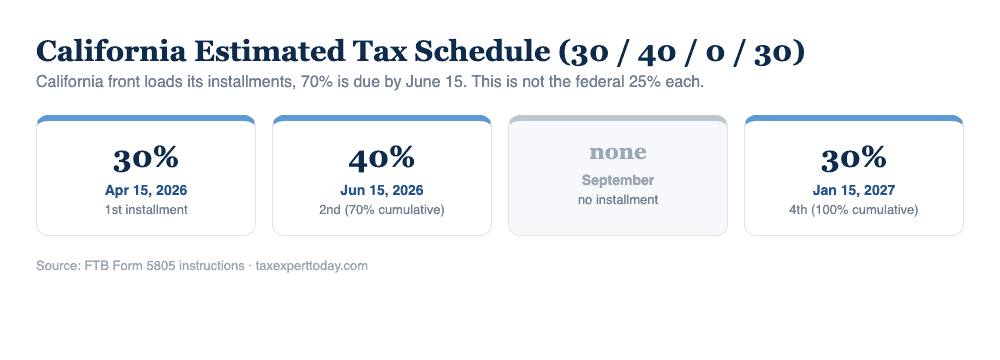
This is the rule that surprises people who only know the federal system. California does not split the year into four equal installments. Instead, the required payments are front loaded: 30% by April 15, 40% by June 15, nothing in September, and 30% by January 15. By the June due date, California expects 70% of your required annual payment. Someone who spreads payments evenly, as they would for the IRS, can underpay the first two California installments and trigger a penalty even though their total for the year looks fine.
- 1st installment, due April 15, 2026: 30% of the required annual payment
- 2nd installment, due June 15, 2026: 40% (70% cumulative)
- 3rd installment, September 2026: none required
- 4th installment, due January 15, 2027: 30% (100% cumulative)
What is FTB Form 5805, and who has to file it?
FTB Form 5805, Underpayment of Estimated Tax by Individuals and Fiduciaries, is the California worksheet that tests whether you underpaid an installment and computes the penalty if you did. Most taxpayers never file it: the Franchise Tax Board figures the penalty itself and bills you after the return is processed. Call (239) 441-2005 for a free consultation.
That last point surprises people who come looking for the form. The Form 5805 instructions state plainly that generally you do not have to complete the form, because the FTB computes the penalty and sends a bill, and that the bill must be paid within 15 days to avoid additional interest. The form becomes mandatory only when you answer Yes to any question in Part I, which is where the reasons to file live.
- You want the annualized income method. Filing Form 5805 lets you show that income arrived unevenly across the year, which is the main reason a taxpayer files voluntarily. Consultants, business sellers, and anyone with a single large fourth quarter event usually pay less this way than under the default assumption of even income.
- You are requesting a waiver. Two grounds appear in the instructions. The first is an underpayment caused by casualty, disaster, or other unusual circumstance where imposing the penalty would be against equity and good conscience. The second is retirement after age 62 or becoming disabled, where the underpayment was due to reasonable cause. Both are requested by checking Yes on Part I, Question 1 and attaching an explanation.
- You are a fiduciary. The form covers estates and trusts as well as individuals, and estates and trusts follow the separate directions at General Information E.
- You are below the filing floor. Estimated payments are required only if you expect to owe at least $500 for the year, or $250 if married or in a registered domestic partnership filing separately. If your prior year liability after credits was under those amounts, the underpayment penalty does not apply at all.
Two further items feed the calculation and are easy to miss. Alternative minimum tax is included in the estimated tax figure, and the California Behavioral Health Services Act tax, the additional 1 percent on taxable income above $1,000,000, is included as well. A taxpayer who budgeted only for regular tax can be short on every installment without ever having missed a payment date.
On form years: the Franchise Tax Board posts Form 5805 for a tax year after that year closes, so the current published version is the 2025 Form 5805 with its 2025 instructions. A 2026 form is not yet available, which is expected rather than a problem. The installment percentages and the safe harbor rules described on this page are what govern the 2026 year, and the calculator above applies them.
How do you fill out FTB Form 5805 using the 2025 instructions?
To fill out FTB Form 5805 for 2025, answer the Part I questions, figure the required annual payment in Part II, then compute the underpayment with the short method or the regular method on Worksheet II, adding Part III if you use the annualized income method. Attach the form and check the box on Form 540 line 113. Call (239) 441-2005 for a free consultation.
The 2025 Form 5805 instructions lay the form out in a fixed sequence, and most errors come from skipping a step rather than from the arithmetic.
- Part I. Answer the questions first. A Yes to the waiver, annualized income, or estates and trusts questions is what makes filing the form mandatory.
- Part II, lines 1 to 6. Line 1 is the 2025 tax, line 5 is the 2024 tax (110% of it if 2024 California AGI exceeded $150,000, or $75,000 married or RDP filing separately), and line 6 is the smaller required annual payment. At California AGI of $1,000,000 or more ($500,000 married or RDP filing separately) the prior year figure is replaced by 90% of the 2025 tax.
- Short method or regular method. The short method is available only to calendar year filers who made no estimated payments other than withholding, or who paid on the due dates, and it is not available if any payment was late. Everyone else uses Worksheet II, which tests each installment separately.
- Part III. Use the annualized income installment method when income arrived unevenly. If it is used for one due date, it must be used for all of them.
- Waiver. Compute the penalty without the waiver first, write the amount you want waived in parentheses next to Part II line 13 (Worksheet II line 14 on the regular method), and subtract it.
- File it. Check the box on Form 540 line 113, Form 540NR line 123, or Form 541 line 45, and attach Form 5805 to the back of the return.
| 2025 computation period | FTB estimate penalty rate |
|---|---|
| April 15, 2025 through June 30, 2025 | 8% |
| July 1, 2025 through April 15, 2026 | 7% |
Two details from the instructions are easy to miss. Filing the 2025 return before February 1, 2026 and paying the full balance replaces the January 15 installment, and a penalty is figured separately for each due date, so a later payment does not cure an earlier shortfall. The estimate penalty is also separate from the FTB late payment penalty charged when the balance is not paid by the return due date.
California safe harbors, and the $1 million rule
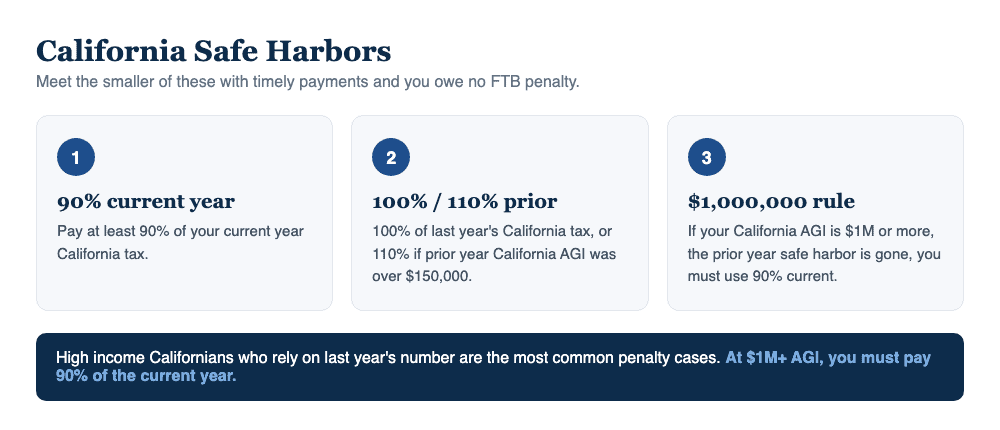
You avoid the penalty if your timely payments meet the smaller of 90% of your current year tax or 100% of your prior year tax (110% if your prior year California AGI was over $150,000, or $75,000 if married filing separately). California adds one trap the IRS does not have: if your California AGI is $1,000,000 or more ($500,000 if married filing separately), you cannot use the prior year safe harbor at all and must pay 90% of the current year tax. High income California residents who rely on last year’s number are the most common penalty cases.
2026 California estimated tax due dates
- 1st payment (30%): due April 15, 2026
- 2nd payment (40%): due June 15, 2026
- 3rd payment: none (California has no September installment)
- 4th payment (30%): due January 15, 2027
How do I avoid the California penalty?
Match California’s schedule rather than the federal one. Take your required annual payment, then pay 30% in April, 40% in June, and 30% in January. If your income is uneven, the annualized income installment method on Form 5805 can lower the penalty by matching required payments to when you actually earned the income. California withholding is treated as paid evenly across the year, so increasing withholding late in the year can still help. Note that California requires estimated payments once you expect to owe at least $500 ($250 if married filing separately), a lower threshold than the federal $1,000.
Can the FTB penalty be waived?
Sometimes. The FTB can waive the estimated tax penalty where the underpayment was due to reasonable cause and not willful neglect, or because of a casualty, disaster, or other unusual circumstance, and there is relief tied to retirement after age 62 or disability. You explain the circumstances with Form 5805. Waivers are fact specific, and documentation matters.
California vs. federal estimated tax penalties
The two systems run in parallel, and you can owe both. The federal penalty uses four equal installments and a different interest rate, while California uses the 30/40/0/30 schedule, the 7% FTB rate, and the $1,000,000 rule. If you owe California estimated tax, you very likely owe federal estimated tax too. Estimate the federal side with our IRS underpayment penalty calculator, and remember that the two penalties are calculated separately on different forms.
Frequently asked questions
What is the California estimated tax penalty rate for 2026?
The FTB estimate penalty rate is 7% per year for the period that began July 1, 2026 and runs through December 31, 2026. The FTB sets the rate twice a year, so confirm the current figure on the FTB interest and estimate penalty rates page before relying on it.
Why does California want 70% by June?
California front loads its installments at 30% in April and 40% in June, so 70% of the required annual payment is due by June 15. This differs from the federal schedule of four equal 25% installments, and it is the most common reason California taxpayers owe a penalty even when their year end total looks adequate.
Do high income Californians lose the prior year safe harbor?
Yes. If your California AGI is $1,000,000 or more ($500,000 if married filing separately), you must base your payments on 90% of the current year tax. The 100% or 110% prior year safe harbor is not available at that income level.
Is the California penalty deductible?
For individuals, no. The FTB estimated tax penalty is a personal, nondeductible charge. Businesses should consult a tax professional, as treatment can vary by entity type.
Do I have to file Form 5805 with my California return?
Usually no. The FTB computes the underpayment penalty and bills you after processing the return, and that bill is payable within 15 days to stop further interest. You must attach Form 5805 only if you answer Yes to a Part I question, which covers requesting a waiver and using the annualized income installment method.
Where can I get help with a California estimated tax penalty in Naples, FL?
California estimated tax help Naples: Tax Expert Today LLC is based at 11983 Tamiami Trail N, Naples, Florida 34110 and serves clients in California and all 50 states. Our team of Enrolled Agents, CPAs, and tax attorneys helps with multistate estimated tax planning, Form 5805 review, and tax resolution. Call (239) 441-2005 to discuss your situation.
Get help with California and federal estimated taxes
California’s front loaded schedule and the $1,000,000 rule catch high earners, business owners, and anyone with a big capital gain. Tax Expert Today helps individuals and business owners set safe harbor payment plans across both California and federal systems, apply the annualized income method, and pursue waivers when a penalty has already been assessed. You can also re-run the California estimated tax penalty calculator above any time your income or withholding changes.
Call (239) 441-2005 or schedule a consultation to review your California and federal exposure. Tax advisors, enrolled agents, CPAs, and attorneys serving clients in all 50 states.
Disclaimer: This calculator and article are provided for general educational purposes only and produce estimates, not a determination of tax owed. They do not constitute tax, legal, or financial advice, and using them does not create a client relationship. California penalty rules under RTC §19136 are fact specific, FTB rates change, and your actual liability is determined by the Franchise Tax Board based on your complete return. Consult a qualified tax professional about your situation. See our full disclaimer.
Published June 2, 2026 by Dr. Pellumb Kabashi « Back to Learning Center
Have a question this article touches on?
Tax Expert Today LLC, based in Naples, Florida and serving clients across the United States.
Schedule a Consultation (239) 441-2005