
By Dr. Pellumb Kabashi, DBA, MBA, EA, CFE, CES
Founder, Tax Expert Today LLC · Tax advisors, enrolled agents, CPAs, and attorneys · Serving clients in all 50 states
Quick Answer
The Georgia pass through entity tax allows an S corporation or partnership to elect to pay Georgia income tax at the entity level, converting a capped personal deduction into a fully deductible business expense on the federal return. The rate is the applicable statutory rate, which the Department of Revenue states is 4.99 percent for 2026, not the 5.75 percent still published across most guidance. The election is annual, irrevocable, and binding on every owner. Call (239) 441-2005 for a free consultation.
What Is the Georgia Pass Through Entity Tax?
The Georgia pass through entity tax is an optional entity-level income tax that an S corporation or partnership may elect to pay on its Georgia apportioned income. It exists to work around the federal limit on the individual deduction for state and local taxes. When the entity pays the tax, the payment becomes an ordinary business deduction on the federal return rather than a personal itemized deduction subject to a dollar cap, and the owners then subtract the same income from their Georgia returns.
- Statutory home. The election sits in O.C.G.A. § 48-7-21 for S corporations and O.C.G.A. § 48-7-23 for partnerships, implemented by Ga. Comp. R. & Regs. R. 560-7-3-.03.
- Effective years. The regulation applies to taxable years beginning on or after January 1, 2022.
- Federal blessing. IRS Notice 2020-75 confirms the entity-level payment is deductible by the entity, which is the whole reason the structure works.
- Georgia uses subtraction, not credit. Owners do not claim a Georgia credit for the entity-level tax. They remove the income from their own return instead.
- It is a yearly decision. Nothing carries forward automatically. The entity chooses again every filing season.
The mechanism is worth stating plainly because most published summaries blur it. Georgia does not give the owner a credit for tax the entity paid. Under Ga. Comp. R. & Regs. R. 560-7-3-.03(9)(a), the owner starts with federal adjusted gross income and then subtracts the share of income that was apportioned and allocated to Georgia at the entity level. If the entity has a loss, the owner adds the share of that loss back. The Department of Revenue assigns specific descriptions to these entries on Form 500 Schedule 1: the allocable share of income taxed at the entity level is entered on Line 12 with the description PTEDED, and the allocable share of loss is entered on Line 5 with the description PTEADD.
That subtraction mechanic is what makes the election clean at the state level and what makes it dangerous when it is handled by someone who assumes it works like every other state. A credit state and a subtraction state behave differently when the entity has credits, when the entity has a loss, and when the owner lives somewhere other than Georgia. Each of those situations is covered below.
What Is the Current Georgia Pass Through Entity Tax Rate?
The rate is the applicable statutory income tax rate for the year, not a fixed 5.75 percent. The Department of Revenue states the Georgia income tax rate has been reduced to a flat 4.99 percent for 2026, and the rate that applied for 2025 was 5.19 percent. The widely republished 5.75 percent figure is the original 2022 rate, and it now survives in the regulation only inside one narrow estimated-payment penalty calculation.
- The regulation is self-updating. Ga. Comp. R. & Regs. R. 560-7-3-.03(6)(c) directs the entity to multiply entity-level income by “5.75 percent or, if subsequently changed, the applicable statutory income tax rate.”
- The corporate rate tracks the individual rate. O.C.G.A. § 48-7-21 imposes tax at the same rate as the individual rate under O.C.G.A. § 48-7-20(a.1) for the corresponding year.
- 2026 rate. The Department of Revenue Important Tax Updates page states a flat rate of 4.99 percent.
- 2025 rate. 5.19 percent, which the Department still displays on its own partnership tax page.
- Where 5.75 percent legitimately remains. Only in the prior-year safe harbor computation described below.
This is the single most consequential error in the public record on this topic. A live reading of the search results for this subject shows the generated answer summary stating that the tax “is applied at a flat rate of 5.75% on Georgia taxable income,” sourced to commentary written in 2021. Several accounting firm pages ranking on the same query repeat it. The Department of Revenue FAQ, which ranks first, never states a current rate at all, which is very likely why the stale figure keeps propagating downstream.
The practical effect of using 5.75 percent on a 2026 return is an overpayment of roughly 15 percent of the entity-level tax. On an entity with $1,000,000 of Georgia apportioned income, the correct 2026 tax is $49,900 and the stale-rate figure is $57,500. The entity would eventually recover the difference, but it would have funded the state for a year and the owners would have subtracted the correct income either way, so nothing about the overpayment improves the federal deduction.
| Tax year | Applicable Georgia rate | Tax on $1,000,000 of Georgia apportioned income |
|---|---|---|
| 2025 | 5.19 percent | $51,900 |
| 2026 | 4.99 percent | $49,900 |
| Stale figure still published widely | 5.75 percent | $57,500 |
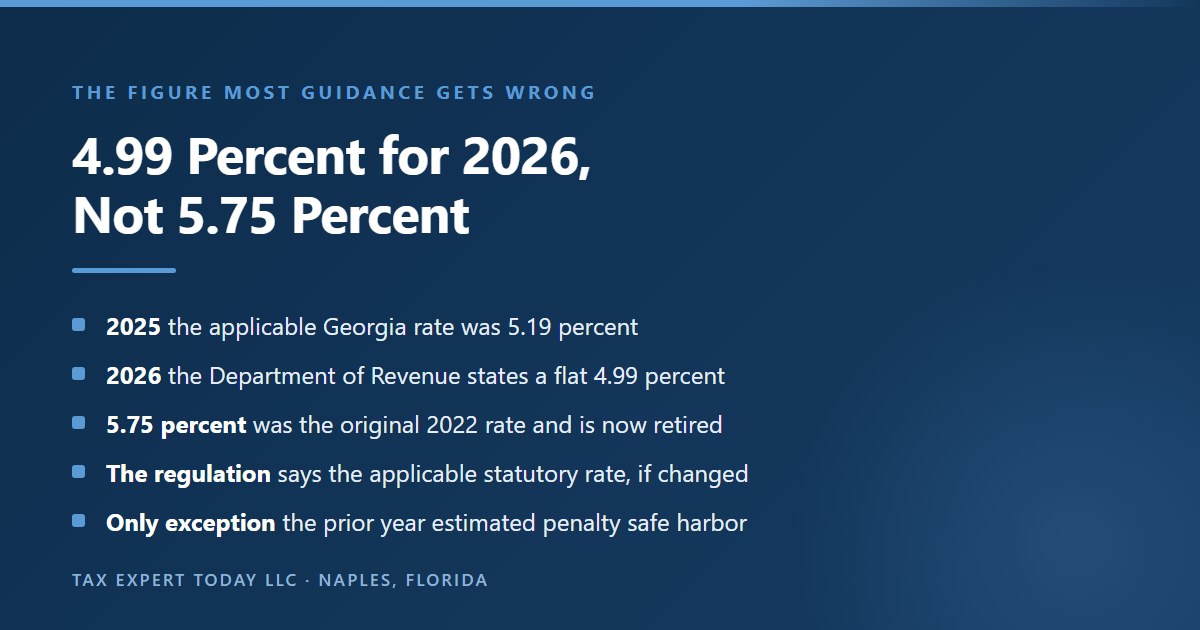
The one place 5.75 percent still governs is narrow and easy to miss. Under Ga. Comp. R. & Regs. R. 560-7-3-.03(5)(e), an entity that did not elect in the prior year has no prior-year Georgia tax liability to measure a safe harbor against. To use the 100 percent of prior year exception, the entity must compute the penalty on Form 600 UET assuming the prior year tax equaled 5.75 percent of the prior year income. That is a fictional rate used for one penalty test. It is not the rate on the return, and treating it as the rate on the return is the mistake that has spread across most of the published guidance.
Which Entities May Make the Georgia Pass Through Entity Tax Election?
S corporations must be 100 percent directly owned and controlled by persons eligible to be S corporation shareholders under IRC section 1361. Partnerships faced the same ownership test originally, but the Department of Revenue states that for taxable years beginning on or after January 1, 2023, all partnerships may elect regardless of who owns or controls them. Single-member limited liability companies not taxed as a partnership or S corporation may never elect.
- Eligible persons. The Department notes that “persons” can include certain estates and grantor trusts.
- Disregarded entities. A disregarded single member LLC or qualified Subchapter S subsidiary cannot elect on its own, but a regarded owner may elect for itself and all of its disregarded entities.
- Tiered structures. Where a pass through entity is owned by another pass through entity, the owner entity may elect for itself if it independently qualifies.
- LLCs taxed as partnerships. Treated as partnerships for this purpose.
- Consent. Each entity decides how to obtain owner consent, but once made the election binds every owner.
There is a documentation gap worth flagging here, because it changes the answer for a large class of partnerships. The regulation text at subsection (3)(a) still recites the 100 percent eligible-shareholder ownership test with no partnership carve-out. The Department of Revenue FAQ states the broader partnership rule for 2023 and later years. Where an agency FAQ and an unamended regulation describe different rules, the statute controls and the agency position published on its own website is the administrative guidance a filer is entitled to rely on. A partnership with a corporate partner, a partnership partner, or a foreign partner should confirm its specific facts before relying on the broader rule, because the regulation has not been conformed and the two documents can be read against each other.
| Entity type | May it elect? | Governing condition |
|---|---|---|
| S corporation | Yes, if it qualifies | 100 percent directly owned and controlled by persons eligible to be S corporation shareholders under IRC section 1361 |
| Partnership, tax years 2023 and later | Yes | Department of Revenue states all partnerships are eligible regardless of who owns or controls the partnership |
| LLC taxed as a partnership or S corporation | Yes, on the same terms | Treated as a partnership or S corporation for this purpose |
| Single member LLC not taxed as a partnership or S corporation | No | Expressly ineligible |
| Disregarded entity or qualified Subchapter S subsidiary | Not on its own | A qualifying regarded owner may elect for itself and all of its disregarded entities |
| Pass through entity owned by another pass through entity | The owner entity may elect for itself | Only if the owner entity independently qualifies |
The ownership test is where most S corporations that want to elect actually fail. An S corporation whose shares are held by an ineligible person is not an S corporation for federal purposes at all, so in practice the binding constraint is the word “directly.” A structure that inserts a holding entity between the individual and the operating S corporation can break direct ownership even when every ultimate owner is an eligible person. Confirm the ownership chain before assuming the election is available.
How Is the Georgia Pass Through Entity Tax Election Made?
The election is made on the return itself, by checking the election box and completing the applicable schedules on Form 600S for an S corporation or Form 700 for a partnership. It must be made by the due date of the return including extensions, and it becomes irrevocable once that date passes. No separate election form, registration, or advance notice is filed with the Department of Revenue.
- Form 600S. S corporation return, with Schedule 1 completed for the election.
- Form 700. Partnership return, with Schedules 1 and 3 completed for the election.
- Deadline. Original or extended due date of the entity return.
- Opting out later. If the entity decides not to elect in a later year, no notice is required.
- Do not complete the schedules without electing. This is a live processing trap.
That last point deserves emphasis because it produces a bill rather than a rejection. The Department of Revenue states that when the election is not made, Schedule 1 on Form 600S and Schedules 1 and 3 on Form 700 should not be completed, and that if information is entered into any of these schedules the return will receive a balance due once processed. An entity that fills in the schedules out of caution, or whose software populates them by default, will be assessed entity-level tax it never intended to owe. The correction requires an amended return.
The irrevocability is genuine and it runs in one direction only. Once the extended due date passes, an entity that elected cannot unwind the election for that year, and an entity that did not elect cannot go back and make it. That asymmetry is why the analysis belongs at extension time rather than at filing time. Georgia grants the entity until the extended due date, which is a meaningful planning window, and it is the last moment at which the modeling described in the next section can still change the outcome.
Does the Georgia Pass Through Entity Tax Election Still Pay in 2026?
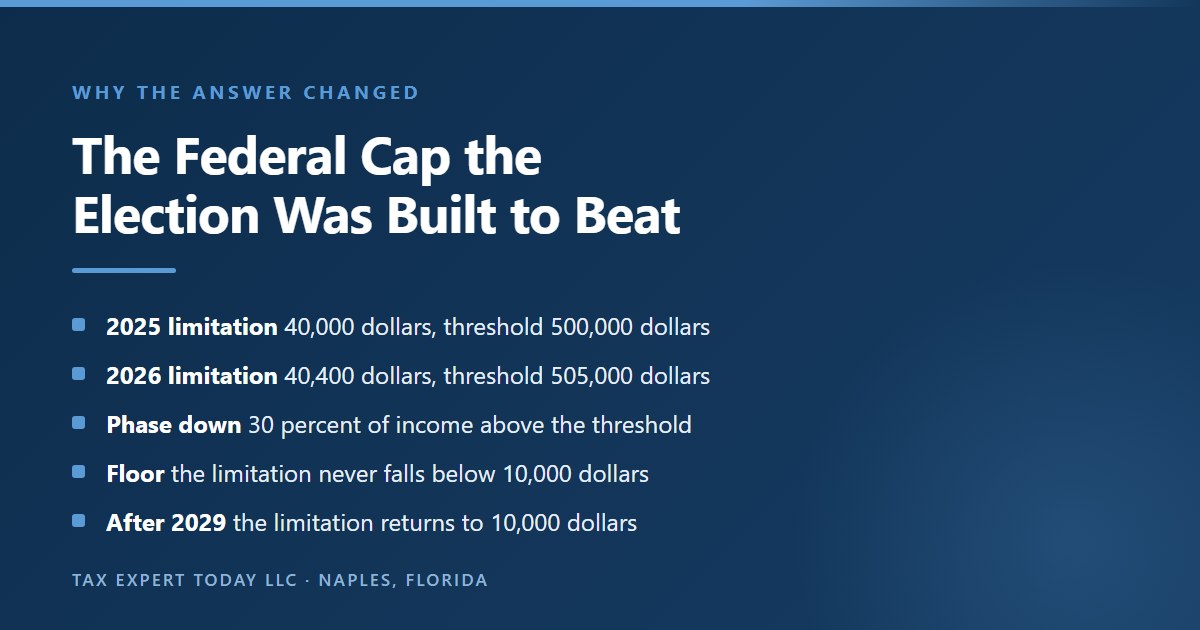
The election is worth materially less than it was, because the federal cap it was designed to defeat has been raised. The individual limitation is $40,000 for 2025 and $40,400 for 2026 under IRC section 164(b)(7), phasing down by 30 percent of modified adjusted gross income above $500,000 and $505,000 respectively, with a floor of $10,000. For high-income owners the phase-down restores most of the original benefit, so the election still pays. For moderate-income owners it may no longer pay at all.
- 2025 limitation. $40,000, threshold $500,000.
- 2026 limitation. $40,400, threshold $505,000.
- 2027 through 2029. Both figures increase to 101 percent of the prior year amount.
- After 2029. The limitation returns to $10,000.
- Floor. The phase-down cannot reduce the limitation below $10,000.
None of the pages currently ranking for this topic address this, because nearly all of them were written in 2021 and 2022 when the cap was a flat $10,000 for everyone. The arithmetic has changed and the recommendation has to change with it.
Consider a Georgia S corporation owner with $250,000 of modified adjusted gross income and $200,000 of Georgia apportioned business income. Georgia tax on that income at 4.99 percent is $9,980. Because that owner is below the $505,000 threshold, the full $40,400 limitation is available in 2026, and the owner also has property taxes and other state and local taxes to fit under it. If the total of all such taxes stays under $40,400, the personal deduction was never actually limited, and electing produces no federal benefit at all while adding an entity return, entity estimated payments, and entity penalties. In that fact pattern the election is administrative cost without a corresponding advantage.
Now consider an owner with $1,500,000 of modified adjusted gross income. The excess over the $505,000 threshold is $995,000, and 30 percent of that is $298,500, which exceeds the $40,400 limitation, so the limitation drops to the $10,000 floor. That owner is in substantially the position the workaround was built for, and moving the Georgia tax to the entity level converts a deduction that is capped at $10,000 into a full business deduction. For this owner the election continues to be valuable.
| Owner modified adjusted gross income (2026) | Applicable limitation after phase-down | Practical read on the election |
|---|---|---|
| Below $505,000 | $40,400 | Often no federal benefit if total state and local taxes stay under the limitation |
| $505,000 to roughly $606,000 | Between $10,000 and $40,400 | Benefit depends on the owner’s other state and local taxes; model it |
| Above roughly $606,000 | $10,000 floor | Election generally retains its original value |
| Any income, tax year 2030 and later | $10,000 under current law | Election value returns to its pre-2025 posture unless Congress acts |
The threshold figures above are the statutory amounts, and the phase-down is mechanical, but the conclusion in the third column is not. It turns on the rest of the owner’s state and local tax picture, on whether the owner itemizes at all, and on whether the entity has other owners whose positions differ. An election binds every owner, so a structure with one high-income owner and several moderate-income owners can help one and hurt the others. That conflict has no clean answer in the statute and it is best resolved before the return is prepared rather than after.
What Does an Electing Partnership Give Up at the Entity Level?
An electing partnership computes its Georgia taxable income as though it were a C corporation, which strips out every deduction that exists because a taxpayer is a natural person. The regulation specifically disallows the personal exemptions, the standard deduction, the Georgia retirement exclusion, deductions based on self-employment, self-employed health insurance, Keogh and SEP deductions, and the IRC section 743(b) basis adjustment at the entity level.
- No personal-status deductions. O.C.G.A. § 48-7-26 exemptions and O.C.G.A. § 48-7-27 standard deductions are unavailable at the entity level.
- No retirement exclusion. The Georgia age-based exclusion is a natural-person provision and cannot be applied by the entity.
- Section 743(b). Disallowed at the entity level, though the adjustment remains available at the owner level.
- No deduction for income taxes. The entity cannot deduct taxes based on or measured by gross or net income in computing its Georgia taxable income.
- Federal limits apply as if a C corporation. Charitable contributions, the section 179 deduction, and other limited deductions are capped at the C corporation amount.
The retirement exclusion point matters more than it appears. Georgia allows a substantial age-based subtraction of retirement income, and a share of partnership income can qualify for it in the right circumstances. An older partner who has been relying on that subtraction loses the benefit of it on the entity-taxed income, because the income never reaches the individual return where the subtraction lives. Our guide to the Georgia retirement income exclusion walks through the per-person ceilings and the earned income sublimit that decide how much of that subtraction is actually available.
There is a related carve-out that no competing page appears to cover. Ga. Comp. R. & Regs. R. 560-7-3-.03(8) addresses an electing entity with a pension plan that pays qualified retirement income to retired owners, typically as a guaranteed payment, where federal law allows only the retiree’s state of residence to tax it. The entity subtracts that guaranteed payment from Georgia income before apportionment, the retiree’s home state taxes it, and the retiree is then excluded from the owner subtraction for that share. For a partnership with retired partners living outside Georgia, this provision decides whether the election creates a Georgia tax on income Georgia was never permitted to reach.
What Happens to Credits and Net Operating Losses When the Entity Elects?
Tax attributes follow the entity, not the owners. Credits and net operating losses generated in an election year are earned, claimed, and used the way a C corporation would use them, and they stay with the entity if it stops electing in a later year. Attributes from non-election years stay with the owners and cannot be moved into the electing entity. An electing entity may make a separate irrevocable election to pass credits through, with three specific exceptions.
- Election-year attributes. Generated and used at the entity level, on C corporation principles.
- Non-election-year attributes. Remain with the owners and are not transferable to the entity.
- Stopping the election. Attributes do not fall out to the owners; they remain with the entity.
- Credit pass-through election. Made on the credit allocation to owners schedule on an original or amended Form 600S or Form 700.
- Net operating losses. Treated as for C corporations under Regulation 560-7-3-.06, with Form IT-552 used for eligible carrybacks.
The three excepted credits are the ones allowed by O.C.G.A. §§ 48-7-29.16, 48-7-29.20, and 48-7-29.21, which cover the qualified education expense credit, the qualified education donation credit, and the qualified rural hospital organization expense credit. Credits in those three categories earned by an electing entity never pass through to owners. An owner may still separately earn them, but only with respect to income that passed through and was not taxed at the entity level in Georgia. In determining the Georgia income on which the owner actually paid tax, the owner must exclude any income subtracted because the entity paid the tax.
That interaction traps a specific and fairly common taxpayer: a Georgia business owner who makes an annual preapproved contribution to a rural hospital or a student scholarship organization and who has always sized the contribution against the Georgia tax on business income. Electing at the entity level removes that income from the owner’s Georgia base, which can reduce or eliminate the amount the owner is permitted to generate. The regulation carries a further rule for an entity that was preapproved and made the contribution while intending to elect and then did not elect, allowing a pass-through computed as if the election had been made, with any excess over the generation limits disallowed entirely.
Entities carrying transferable Georgia credits should think about ordering. Our explanation of how a buyer claims a purchased Georgia film tax credit covers the transferee side of that market, and an electing entity holding such a credit uses it against entity-level tax rather than routing it to owners.
Does an Electing Entity Still File a Composite Return or Withhold on Nonresident Owners?
No on both counts, and this is one of the strongest practical arguments for the election. The Department of Revenue states that a composite return for nonresident owners should not be filed if the election is made, because the election is binding on all owners including those who would otherwise be on the composite return. The regulation separately provides that an electing entity is not required to withhold tax under O.C.G.A. § 48-7-129.
- Composite return. Not filed for the election year.
- Nonresident withholding. Not required under O.C.G.A. § 48-7-129.
- Form 600S-CA. Not required for any year in which the election is made.
- Prior consents survive. An S corporation that filed effective consent agreements before an election year does not have to obtain them again if it later stops electing.
- Composite overpayments do not follow. This is the trap described below.
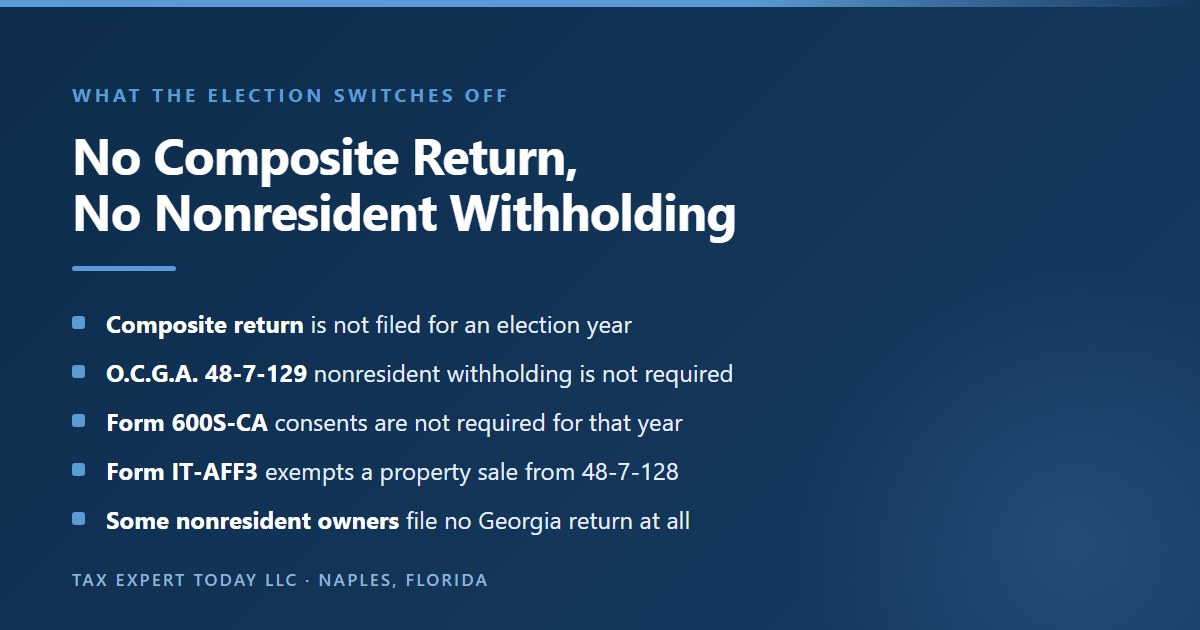
For an entity with a scattered nonresident ownership group, this is often the real reason to elect. A composite return forces the entity into Option 1 or Option 2 mechanics and each owner into a set of compromises about deductions and other-state credits. Our comparison of the Georgia composite return against nonresident withholding and individual filing lays out what a composite filer actually gives up. The pass through entity election collapses all three of those paths into a single entity return, and Ga. Comp. R. & Regs. R. 560-7-3-.03(9)(d) goes further: if a nonresident owner’s only source of Georgia income is income that was taxed at the entity level, that owner is not required to file a Georgia return at all.
| Question | Entity-level election | Composite return | Nonresident withholding |
|---|---|---|---|
| Who pays Georgia tax | The entity, on all owners’ shares | The entity, on participating nonresidents | The entity remits, the owner still files |
| Nonresident owner Georgia return | Not required if entity-taxed income is the only Georgia income | Not required for participants | Required |
| Form 600S-CA consents | Not required for the election year | Not applicable | Required for S corporations |
| Federal deduction of the Georgia tax | Deductible by the entity under Notice 2020-75 | Treated as the owner’s tax | Treated as the owner’s tax |
| Binding on owners | Yes, on every owner | Participation is generally elective per owner | Applies to nonresident owners |
The trap sits in the transition. If a composite return produced an overpayment credit and the entity elects in the following year, the Department of Revenue states that the overpayment credit cannot be claimed on the electing entity’s income tax return. It can be refunded on request, but it does not carry across. An entity that rolls a composite overpayment forward on the assumption that a credit is a credit will find the electing return short by that amount and will owe underpayment penalties on the shortfall.
What Estimated Payments Does an Electing Pass Through Entity Owe?
An electing entity makes estimated payments in the same manner as a C corporation, on the same due dates, using Form 602-ES or the Georgia Tax Center, and it is subject to the C corporation failure to pay estimated income tax penalties. Estimated payments the owners made personally cannot be transferred to the entity. Partnerships must have a registered Georgia Tax Center account, because they cannot make quick payments outside one.
- Form 602-ES. The estimated payment form, or electronic submission through the Georgia Tax Center where required.
- Partnership registration. The partnership account must be registered on the Georgia Tax Center to make estimated payments.
- Owner payments do not transfer. Owners must claim a refund of their own overpayment on their own return.
- UET Annualization Exception. The entity may check that box on Form 600S or Form 700 and compute the penalty on Form 600 UET as if it had the owners’ payments, credits, or attributes.
- Prior-year safe harbor. Computed at 5.75 percent of prior year income when there was no election in the prior year.
The cash flow consequence of the non-transfer rule is the item most likely to hurt a first-year electing entity. Owners who have been making Georgia individual estimated payments against business income continue to hold those payments personally. The entity starts from zero. Unless the entity funds its own estimates on the C corporation schedule, it will underpay, and the owners will simultaneously be overpaid and waiting on refunds. The UET Annualization Exception exists precisely to soften this, allowing the penalty to be computed as though the owners’ payments had been made by the entity, but it is an option the preparer must affirmatively invoke on the return.
The reverse situation has its own rule. Under Ga. Comp. R. & Regs. R. 560-7-3-.03(5)(g), an entity that makes estimated payments and then does not elect may not transfer those payments to its owners and must claim a refund of the overpayment. It may, however, contact the Department and direct that the payments be transferred to its composite estimated tax account or its nonresident withholding tax account. That is a useful escape hatch for an entity that funded estimates in anticipation of an election it ultimately decided against, and it is not mentioned anywhere in the general guidance on this topic. If penalties are already in play, our Georgia estimated tax penalty calculator shows how the underpayment charge is computed.
What Happens When an Electing Entity Sells Georgia Real Property?
An electing entity that sells property certifies to the buyer on Form IT-AFF3 that it qualifies for and has made or will make the entity-level election, and that certification exempts the seller from the withholding otherwise required by O.C.G.A. § 48-7-128. Without that certification, a nonresident seller of Georgia real property faces withholding computed on the purchase price rather than on gain.
- Form IT-AFF3. The seller’s certification of exemption, delivered to the buyer.
- Statutory hook. O.C.G.A. § 48-7-128, the nonresident real property withholding provision.
- Timing. The certification is a closing-table document, not a filing-season document.
- Entities are covered. The nonresident definition reaches entities and trusts, not only individuals.
- The election must be real. The certification states the entity has made or will make the election.
This is a closing risk rather than a return risk, and it is missed because the person handling the closing is rarely the person handling the entity return. A closing attorney working from a standard checklist will look for the residency affidavit and, finding none, will withhold. The money is recoverable on the return, but it is out of the seller’s hands until then, and on a substantial commercial sale that can be a meaningful working capital problem. The certification costs nothing and takes one document, provided somebody knows to prepare it. Our article on Georgia capital gains tax covers the parallel affidavits used by sellers who are not electing entities.
What Happens if the IRS Audits an Electing Partnership?
A partnership audited at the federal level must report and pay the resulting Georgia tax at the entity level for any reviewed year in which the election was made. The Georgia partnership audit adjustment regulation does not apply. Instead the partnership files an amended Georgia return, reports the adjustments, and pays tax or claims a refund on the rules that normally apply to C corporations.
- Reviewed year controls. The treatment follows whether the election was in place for the year under review, not the current year.
- Regulation 560-7-3-.11 is displaced. The ordinary partnership adjustment mechanism does not govern.
- Amended entity return. The vehicle for reporting and paying.
- Department audits work the same way. An entity audited by the Department of Revenue also settles at the entity level.
- Amended returns are available generally. Subject to the applicable statute of limitations.
The consequence is a liability that outlives the ownership group. A partner who exits in 2027 may have been a partner in a 2026 reviewed year, and the Georgia tax on any adjustment to that year is paid by the entity, funded by whoever owns it when the assessment lands. Partnership agreements written before the pass through entity election existed frequently allocate state tax adjustments to the partners who held interests in the reviewed year, and that allocation no longer matches how Georgia collects. This is worth reading against the agreement rather than assuming, particularly for entities that expect ownership turnover.
One item sits outside the election altogether and is worth checking separately. The entity level election moves Georgia income tax, but it does nothing to the corporate net worth tax, which an electing S corporation continues to compute and pay on the same Form 600S. That tax is measured on the balance sheet at the start of the year rather than on profit, so it is owed in years when the election produces no income tax at all. Our guide to the Georgia net worth tax covers the table, the due dates and the separate penalty regime that applies to it.
What Are the Most Common Georgia Pass Through Entity Tax Mistakes?
The recurring errors are using the retired 5.75 percent rate, completing the election schedules without intending to elect, assuming the owner receives a Georgia credit, forgetting that entity estimated payments must be funded separately from owner payments, and rolling a composite overpayment into the electing entity’s return. Each produces either an assessment or a refund delay rather than a rejected return, which is why they survive so long.
- Wrong rate. Verify the rate for the specific tax year rather than copying a figure from published commentary.
- Schedules completed in error. Entering data in Form 600S Schedule 1 or Form 700 Schedules 1 and 3 without electing generates a balance due.
- Credit assumption. Owners are not eligible to claim a credit for taxes paid to Georgia on entity-taxed income.
- Estimate mismatch. Owner payments cannot move to the entity, and the entity is on the C corporation schedule.
- Composite carryforward. A composite overpayment must be refunded, not applied to the electing return.
Two further points belong in this list even though they are conceptual rather than procedural. The first is the other-state credit boundary. The Department of Revenue confirms that owners remain eligible for a credit for taxes paid to another state with respect to income not taxed at the entity level by Georgia, subject to O.C.G.A. § 48-7-28, and for the corresponding adjustment for income taxed in other states under O.C.G.A. § 48-7-27(d), including where the electing entity makes a similar election in another state. The boundary is the phrase “not taxed at the entity level by Georgia.” Income that was taxed at the entity level is off the owner’s Georgia return entirely, so there is nothing left for a credit to offset. Owners with multistate activity should look at how a nonresident state tax return interacts with an entity-level election in each state before assuming credits behave symmetrically.
The second is that the entity-level election does not touch employment tax. An S corporation owner still owes reasonable compensation as wages, and the election changes nothing about that analysis. Our discussion of S corporation reasonable compensation explains the standard, which continues to apply in full to an electing entity.
A final scope note. The pass through entity election addresses income tax. It does not relieve a corporation of Georgia’s separate net worth tax, which is imposed on its own schedule of the same return, and it does not change any sales, withholding, or employment tax obligation the entity carries. Filers who read the election as a comprehensive simplification are usually surprised by whichever of those obligations they had been treating as bundled.
Georgia Pass Through Entity Tax Help in Naples & Southwest Florida
Tax Expert Today is based at 11983 Tamiami Trail N, Naples FL 34110, and the office is open Monday through Friday, 10:00 to 5:00 Eastern. Georgia clients are served nationwide from Naples, which is a routine arrangement for state entity work: the return is prepared, the election is modeled, and the filings are made electronically regardless of where the entity operates. Southwest Florida happens to hold a large population of business owners who kept a Georgia operating entity after relocating, and that group has the exact profile the pass through entity election was built around, namely Georgia apportioned income earned by owners who no longer live in Georgia.
Naples, Florida sits at the end of the I-75 corridor that runs directly up to Atlanta, and a good share of the entities we look at were formed there before the owners came south. If you are weighing the election for a Georgia entity, or you have received a Georgia notice on a return where the election was made or missed, call (239) 441-2005. You can also review our Georgia tax services for the full picture of the state work handled from this office, or our Naples tax planning services if the entity question sits inside a broader plan.
Does living in Florida change whether a Georgia entity should elect? It changes the analysis considerably. Florida imposes no individual income tax, so a Florida-resident owner of a Georgia entity has no home-state credit to lose and no home-state return to reconcile. That owner also has comparatively few state and local taxes competing for room under the federal limitation, which can leave the limitation unused and weaken the case for electing. On the other side, the election removes the owner from Georgia composite filing and, where entity-taxed income is the owner’s only Georgia income, removes the Georgia filing requirement altogether. The right answer depends on the numbers rather than on the residency alone.
When Should You Engage a Professional?
The Georgia pass through entity tax election is an annual, irrevocable decision that binds every owner and cannot be corrected after the extended due date. That combination is unusual in state tax and it is what makes professional review worthwhile rather than optional. The specific situations that call for it are ownership groups whose members sit on different sides of the federal limitation phase-down, entities with nonresident owners currently on a composite return, entities holding Georgia credits, partnerships with retired partners drawing guaranteed payments, and any entity that is contemplating a sale of Georgia real property in the election year.
Tax Expert Today works on state tax matters nationwide, and Georgia entity elections are a regular part of that work. Georgia Department of Revenue matters follow their own rules, forms, and appeal paths, which are distinct from federal procedure, and the modeling that decides an election is separate again from either. If your entity is approaching an extended due date without a decision, or if a prior year election is producing notices you did not expect, our Georgia tax services page describes how we take on that work. Call (239) 441-2005 to talk through the specific facts.
Nothing above is advice for a particular taxpayer. Georgia rates, thresholds, and administrative positions change frequently, and the figures here were verified as of the publication date shown on this page. Confirm current amounts and your own eligibility before acting.
Frequently Asked Questions
What is the Georgia pass through entity tax rate for 2026?
The Department of Revenue states the Georgia income tax rate is a flat 4.99 percent for 2026, and the pass through entity tax uses the applicable statutory rate. The 5.75 percent figure published in most guidance is the original 2022 rate and now applies only inside one estimated payment penalty computation.
Is the Georgia pass through entity tax election revocable?
No. The election is irrevocable once the due date of the entity return, including extensions, has passed. It is also an annual election, so an entity that elects one year must decide again the next year, and no notice is required if it chooses not to elect.
Can a single member LLC make the Georgia pass through entity tax election?
No. A single member limited liability company that is not taxed as a partnership or S corporation cannot elect. A disregarded entity also cannot elect on its own, although a regarded owner that qualifies may elect for itself and all of its disregarded entities.
Do owners get a Georgia credit for the entity level tax?
No. Georgia uses a subtraction rather than a credit. Owners subtract their share of the income that was apportioned and allocated to Georgia at the entity level, entered on Form 500 Schedule 1 Line 12 with the description PTEDED, and they are not eligible to claim a credit for taxes paid to Georgia on that income.
Does an electing entity still file a Georgia composite return?
No. The Department of Revenue states that a composite return for nonresident owners should not be filed if the election is made, because the election binds all owners including those who would otherwise be on the composite return. The entity is also relieved of nonresident withholding under O.C.G.A. section 48-7-129.
Must a nonresident owner file a Georgia return if the entity elects?
Not if the entity-taxed income is the owner’s only Georgia source income. The regulation provides that where a nonresident owner’s only source of Georgia income is income taxed at the pass through entity level, no return is required from that owner.
Can owner estimated payments be moved to the electing entity?
No. Estimated payments made by owners cannot be transferred to the entity. The owners must claim a refund of their own overpayment. The entity may check the UET Annualization Exception box and compute its penalty on Form 600 UET as if it had made those payments.
Which credits cannot pass through from an electing entity?
Credits allowed by O.C.G.A. sections 48-7-29.16, 48-7-29.20, and 48-7-29.21, covering qualified education expense, qualified education donation, and qualified rural hospital organization expense credits, do not pass through. An owner may separately earn them only on income not taxed at the entity level in Georgia.
Does the federal SALT cap increase make the Georgia election unnecessary?
Not for everyone. The limitation is $40,400 for 2026 with a threshold of $505,000, and it phases down by 30 percent of modified adjusted gross income above that threshold to a floor of $10,000. High-income owners are largely back at the floor and the election retains its value. Moderate-income owners may find no federal benefit.
What form is used to exempt an electing entity from Georgia real property withholding?
Form IT-AFF3. The electing entity certifies to the buyer that it qualifies for and has made or will make the entity-level election, which exempts the seller from withholding under O.C.G.A. section 48-7-128.
Published September 9, 2026 by Dr. Pellumb Kabashi « Back to Learning Center
Have a question this article touches on?
Tax Expert Today LLC, based in Naples, Florida and serving clients across the United States.
Schedule a Consultation (239) 441-2005