
By Dr. Pellumb Kabashi, DBA, MBA, CES, CFE, EA
Founder, Tax Expert Today LLC · Tax advisors, enrolled agents, CPAs, and attorneys · Serving clients in all 50 states
Quick Answer
California RSU tax does not stop at the state line. When restricted stock units are granted while you work in California and vest after you move away, California still taxes the share of the vesting income attributable to California workdays between the grant date and the vesting date. The measure is a workday ratio, not the date you changed your address. Call (239) 441-2005 for a free consultation.
How does California tax RSUs after you leave the state?
California taxes the wage income from a vesting restricted stock unit to the extent the services behind that grant were performed in California. Publication 1004 states the rule directly for a nonresident on the vesting date: California taxes the wage income to the extent services were performed in California from the grant date to the vesting date.
That single sentence is the whole engine of California RSU tax after a departure, and it explains why so many relocating employees are surprised. Residency governs whether California can tax your worldwide income. Sourcing governs whether California can tax a particular item once you are no longer a resident. Under section 17951, a nonresident remains taxable on income from sources within California, and compensation is sourced to the place where the services were rendered.
An RSU is a promise of future shares that is earned across a service period. The federal inclusion event arrives at vesting, when the shares are delivered and the fair market value lands on your Form W-2. California does not disturb that timing. It simply asks a second question that the federal system never asks: how much of the service period behind those shares happened inside California.
The period California measures is not the same for every kind of equity award, which is where a great deal of confusion begins. The table below sets out the measuring period Publication 1004 assigns to each award type for a nonresident.
| Equity award | California taxing event | Allocation period measured |
|---|---|---|
| Restricted stock unit (RSU) | Vesting date | Grant date to vesting date |
| Restricted stock (purchased, subject to forfeiture) | Vesting date | Purchase date to vesting date |
| Nonstatutory stock option (NSO) | Exercise date | Grant date to exercise date |
| Incentive stock option, disqualifying disposition | Date of the disqualifying sale | Grant date to exercise date |
| Incentive stock option, qualifying disposition | None for a nonresident | Gain is sourced to your state of residence at sale |
| Employee stock purchase plan (ESPP) | Date of sale | Grant date to exercise date |
Two features of this table deserve attention. First, the capital gain that accrues after the taxing event is treated differently from the wage element. Once you are a nonresident, appreciation after the vesting date is gain from the sale of intangible personal property, and it is sourced to your state of residence rather than to California. Second, a qualifying disposition of incentive stock options produces no California wage income for a nonresident at all, which is a meaningfully different outcome from the RSU treatment most technology employees are accustomed to.
What is the California RSU tax allocation formula?
The formula is a ratio of workdays. Publication 1004 instructs that when services were performed both within and outside California, you allocate to California the portion of total compensation reasonably attributed to services performed in the state, citing California Code of Regulations, Title 18, section 17951-5(b). The publication then supplies the arithmetic and calls a time-based allocation one reasonable method.
Stated as an equation, the calculation runs as follows:
Allocation ratio = California workdays during the allocation period ÷ total workdays during the allocation period
Income taxable by California = total income from the award × allocation ratio
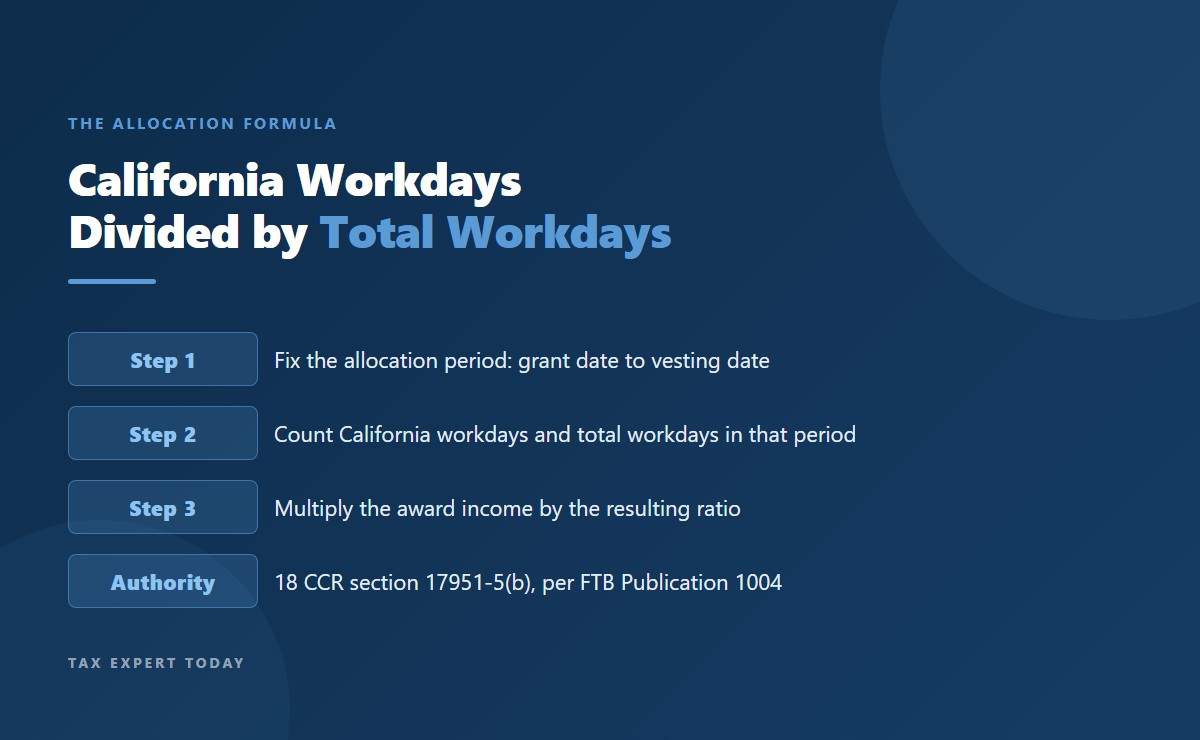
Publication 1004 illustrates the method with an employee who accumulated 700 California workdays and 300 workdays in other states across the allocation period. The total is 1,000 workdays, the ratio is .70, and 70 percent of the award income is taxable by California. The example is stated for restricted stock, and the summary table applies the same grant-to-vest measuring period to restricted stock units.
The practical consequence is that the ratio moves gradually rather than switching off. Consider a hypothetical four-year grant of restricted stock units that vests in equal annual tranches, held by an employee who worked entirely in California for the first two years and entirely in Florida afterward. Each tranche carries its own allocation period running from the single grant date to that tranche’s own vesting date, so each tranche produces a different ratio.
| Vesting tranche | Allocation period | California workdays | Total workdays | California ratio |
|---|---|---|---|---|
| Year 1 vest | Grant to first anniversary | 250 | 250 | 100 percent |
| Year 2 vest | Grant to second anniversary | 500 | 500 | 100 percent |
| Year 3 vest | Grant to third anniversary | 500 | 750 | about 67 percent |
| Year 4 vest | Grant to fourth anniversary | 500 | 1,000 | 50 percent |
The numbers above are illustrative and assume a uniform 250 workdays per year, which is a simplification. The point they carry is structural. Two full years after the move, half of the fourth tranche remains California source income, because half of the service period behind that tranche was worked in California. Nothing about the move date erases the earlier half of the measuring period.
This is also why the trailing obligation has a definite end. Once every outstanding grant has fully vested, and no allocation period any longer reaches back into California workdays, the California wage sourcing stops. Departing employees frequently assume the exposure is permanent. It is finite, and it is calculable in advance from the grant agreements.
Why does the vesting date matter more than your move date?
Because vesting is the event that creates the income, and the allocation period is anchored to the grant, the move date functions only as the boundary between California workdays and non-California workdays inside that period. It is one input to the ratio rather than a switch that turns the tax off.
This makes the sequencing of a departure genuinely consequential. An employee who leaves shortly before a large tranche vests still carries a high California ratio on that tranche, because nearly the whole service period behind it was worked in California. An employee who leaves early in the life of a grant carries a much smaller ratio on the later tranches.
Two related traps follow from this. The first is the assumption that establishing Florida residency before a vest date removes California from the picture. It removes California from your worldwide income, which matters a great deal, but it does not remove California from the sourced portion of the vest. The mechanics of establishing that residency in the first place are covered in our guide to leaving California taxes, and the myths that circulate about a departure levy are addressed in our guide to the California exit tax.
The second trap is the partial move. If you spend meaningful time back in California after the stated move date, whether for work, family, or a retained residence, those days may count as California workdays inside the allocation period, and they can also undercut the residency change itself. The factors the state weighs in deciding whether a residency change actually occurred are listed in FTB Publication 1031, and the statutory definition of a resident sits at Cal. Rev. & Tax. Code section 17014. The competing-residency problem is examined in our discussion of the dual state residency tax trap.
How do RSUs differ from stock options when you leave California?
The difference is the measuring period and the triggering event. A restricted stock unit is measured from grant to vest and taxed at vesting, which you do not control. A nonstatutory stock option is measured from grant to exercise and taxed at exercise, which you generally do control. That control is the entire distinction in planning terms.
Because the option allocation period runs to the exercise date, continuing to work outside California after a move keeps adding non-California workdays to the denominator, and the California ratio on an unexercised option keeps falling. Publication 1004 illustrates exactly this pattern with a nonresident who accumulated 700 California workdays and 300 workdays elsewhere between grant and exercise, producing a .70 ratio and California taxation of 70 percent of the option income.
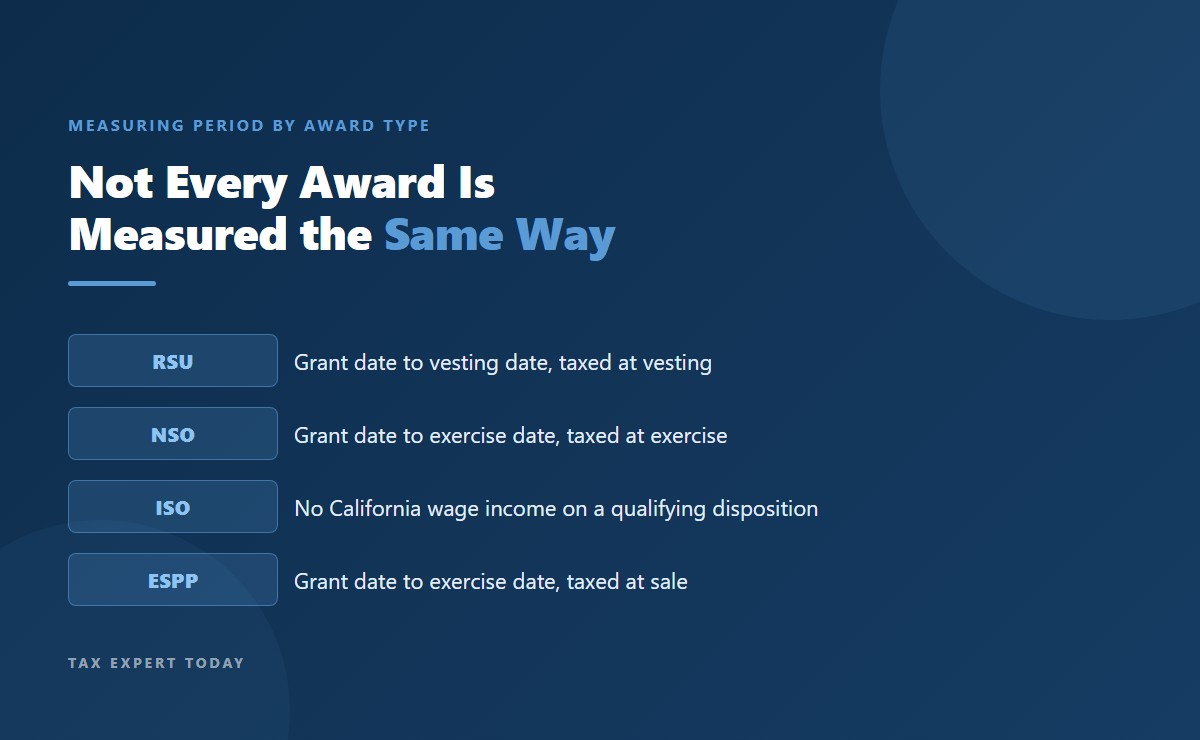
Restricted stock units do not offer the same lever, because vesting is scheduled by the plan rather than elected by the holder. What an RSU holder can influence is the timing of the sale, which affects the character of the post-vest appreciation. Once you are a nonresident, the gain measured from the vesting date value to the sale price is gain on intangible personal property sourced to your state of residence, and Florida imposes no personal income tax on it. The wage element fixed at vesting remains allocable to California regardless of when you sell.
Incentive stock options behave differently again. For a nonresident who satisfies the holding period requirements and sells in a qualifying disposition, Publication 1004 treats the income as gain from intangible personal property sourced to the state of residence at the time of sale, so California does not tax it even though the services that produced the grant were performed in the state. A disqualifying disposition converts the bargain element back into wages, and the grant-to-exercise workday ratio applies. Executives holding a mixed portfolio of award types will find that the same move produces different answers award by award, a point developed further in our guide to Florida domicile for executives.
Why is California tax still withheld from your vest after you move?
Employer withholding and actual liability are separate systems, and they routinely disagree after a relocation. Payroll withholds according to the state coded in its records and according to a flat supplemental percentage, while your actual California RSU tax liability is determined by the workday ratio. Neither over-withholding nor under-withholding changes what you owe.
California treats equity compensation as supplemental wages. The EDD publication DE 44, California Employer’s Guide, sets a flat withholding percentage of 10.23 percent on bonuses and stock options, and 6.6 percent on other supplemental wages, applied without allowance for withholding exemptions. The EDD also publishes Information Sheet DE 231SK, Stock Options, which addresses when option income is treated as wages subject to personal income tax withholding. Separately, the EDD confirms that the State Disability Insurance withholding rate for 2026 is 1.3 percent, and that since January 1, 2024 all wages are subject to SDI with no taxable wage ceiling.
| California withholding item | 2026 rate | Applies to |
|---|---|---|
| Flat supplemental withholding, bonuses and stock options | 10.23 percent | RSU vesting income treated as wages subject to PIT withholding |
| Flat supplemental withholding, other supplemental wages | 6.6 percent | Commissions, severance, and similar payments |
| State Disability Insurance | 1.3 percent | All wages, with no wage ceiling since January 1, 2024 |
| Top marginal income tax bracket | 12.3 percent | Taxable income in the highest bracket |
| Additional tax under section 17043 | 1 percent | Taxable income above one million dollars |
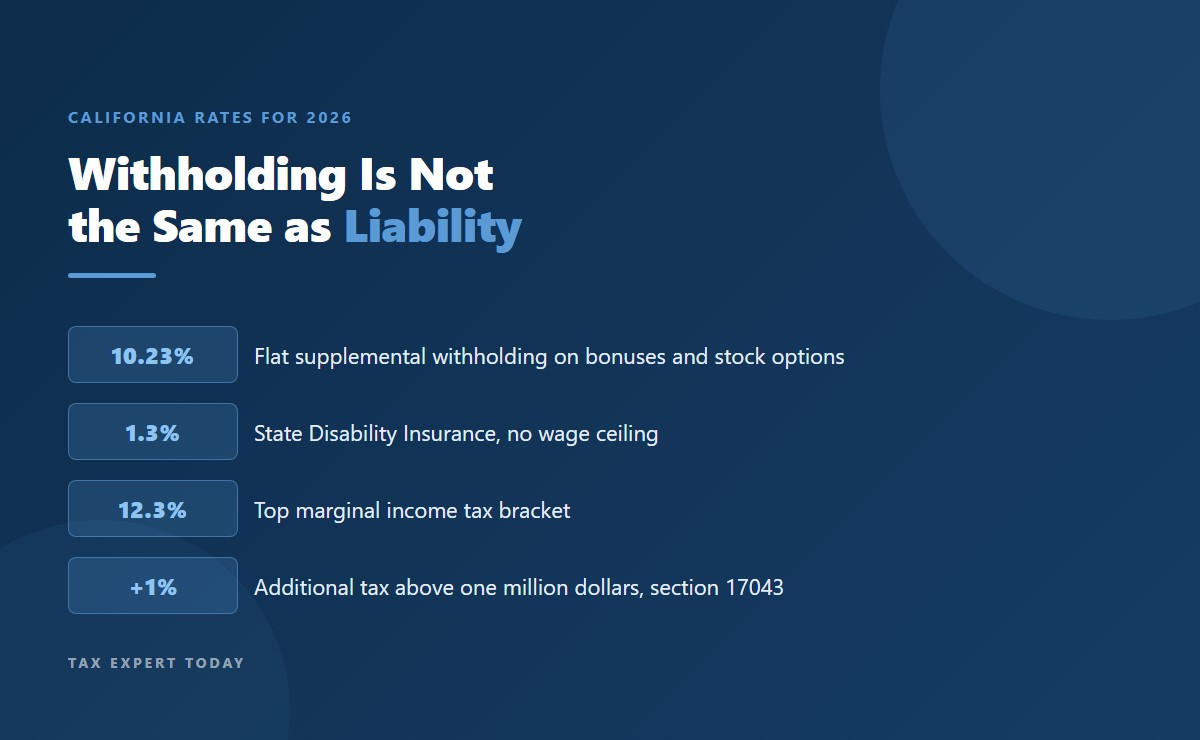
The gap between the 10.23 percent flat withholding rate and a combined top rate of 13.3 percent, being the 12.3 percent bracket plus the 1 percent additional tax imposed by section 17043, is the source of the balance due that surprises high earners in a large vest year. Section 17043 was added by Proposition 63 in November 2004 and imposes the additional 1 percent on the portion of taxable income in excess of one million dollars. A large vest is one of the few events that clears that threshold in a single year, and our guide to the California mental health tax works through how the surcharge lands once the move year return is a Form 540NR.
Two directions of error are common after a move. Payroll may continue coding you as a California employee and withhold California tax on 100 percent of a vest whose true allocation ratio is far lower, in which case the excess is recovered by filing the California return rather than by asking payroll to reverse it. Payroll may instead stop California withholding entirely at the move date, leaving a real California liability with nothing withheld against it. The second case is the one that produces underpayment exposure, and it is worth checking against the first vest that follows a relocation.
How do you report allocated RSU income on Form 540NR?
The allocated amount is reported as California source wages on Schedule CA (540NR), which carries a column structure separating federal amounts from the amounts California is entitled to tax. The California column should reflect the workday allocation, not the figure printed in the state boxes of your Form W-2.
This distinction matters because Form W-2 state reporting is prepared by payroll from its own records and is frequently wrong after a relocation. The W-2 is evidence of what was withheld. It is not a determination of source. Where the employer reported California wages that exceed the allocated amount, the return reports the correct allocated figure and the supporting workday computation stands behind it.
In the year of the move itself, the allocation interacts with the part-year computation, which applies a full-year effective rate to the income California may tax. That mechanism is set out in detail in our guide to California part year resident tax and Form 540NR. In later years, when you are a full-year nonresident with trailing vests, the same Form 540NR is filed as a nonresident return reporting only the California source portion.
Where another state taxed the same income, California may allow a credit for taxes paid on the double-taxed income through Schedule S, the Other State Tax Credit. The form and its instructions are published as FTB Schedule S. This is of limited use to Florida arrivals for a straightforward reason: Florida imposes no personal income tax, so there is no other state tax to credit. The Florida advantage on equity compensation is the absence of a second layer of state tax, not a credit that offsets the California layer.
What records support your California workday ratio?
The ratio is only as defensible as the day count behind it, and the day count is a factual assertion that the Franchise Tax Board can test. Contemporaneous records created at the time carry far more weight than a reconstruction assembled later from memory once an inquiry has already begun.
An allocation built on documents is a very different proposition from an allocation built on an estimate. The categories below are the ones that tend to carry a workday assertion.
| Record category | What it establishes |
|---|---|
| Grant agreements and vesting schedules | The grant date, the vesting dates, and therefore each allocation period |
| Travel records, boarding passes, and mileage logs | Which days were worked inside and outside California |
| Employer time and location reporting | Independent corroboration of the workday split |
| Calendars and expense reports | Day by day placement across the allocation period |
| Payroll registers and pay statements | What was actually withheld and how the employer coded your work state |
| Lease, closing, and utility records for the new residence | The move date that separates the two halves of the ratio |
Equity compensation is a frequent trigger for closer state review, because a large vest reported to California by an employer while the taxpayer files as a nonresident is a visible mismatch. What the Franchise Tax Board examines in that situation, and the statutory deadlines that govern the process, are covered in our guide to the California residency audit. Where the underlying question is whether the residency change itself holds up, the day counting discipline described in our Florida 183 day rule calculator supports the same record keeping habit.
Does moving to Florida eliminate California tax on your RSUs?
A move to Florida reduces California RSU tax to the California sourced portion alone, which is a substantial benefit but not a complete escape. Our overview of moving from California to Florida taxes sets out the other income categories that behave the same way. Florida imposes no personal income tax, so once residency changes, California reaches only the workday allocated share of vests tied to California service. Everything else falls outside its reach.
The items that genuinely do escape California after a properly executed move are worth listing plainly. Post-vest appreciation on shares you continue to hold is gain on intangible personal property sourced to Florida. Income from new grants issued for services performed entirely in Florida carries no California workdays and therefore no California ratio. Retirement plan distributions received after residency ends are protected by 4 U.S.C. section 114, which prohibits a state from taxing the retirement income of a person who is not a resident or domiciliary of that state.
What does not escape is the trailing wage element on grants that were partly earned in California. Planning therefore tends to focus on sequencing rather than on avoidance: understanding the ratio on each outstanding tranche before the move, timing controllable events such as option exercises and share sales to fall on the correct side of the residency line, and making sure the residency change is documented well enough to survive review. A comparable timing analysis for owners facing a liquidity event appears in our guide to moving to Florida before selling a business.
Frequently Asked Questions
Does California tax RSUs that vest after I become a nonresident?
Yes, to the extent the services behind the grant were performed in California. Publication 1004 provides that for a nonresident on the vesting date, California taxes the wage income to the extent services were performed in California from the grant date to the vesting date. The portion attributable to workdays outside California is not California source income.
How is the California workday ratio calculated for RSUs?
Divide California workdays during the allocation period by total workdays during the same period, then multiply the award income by that ratio. The allocation period for a restricted stock unit runs from the grant date to the vesting date. Publication 1004 cites California Code of Regulations, Title 18, section 17951-5(b) as the authority for allocating compensation earned within and outside the state.
Is the capital gain after vesting taxable by California once I move?
Generally no. Appreciation measured from the fair market value on the vesting date to the sale price is gain from the sale of intangible personal property, which is sourced to your state of residence at the time of sale. For a Florida resident that means no state income tax on the gain. The wage element fixed at vesting remains subject to the California allocation.
Why did my employer withhold California tax on a vest after I moved?
Payroll withholds according to the work state coded in its records and applies a flat supplemental percentage, which for bonuses and stock options is 10.23 percent under EDD guidance. That coding often lags a relocation. Withholding does not determine liability, and any excess is resolved on the California return rather than through a payroll correction.
How long does California continue to tax my equity compensation after I leave?
Until the allocation periods run out. Once every outstanding grant has fully vested and no remaining allocation period reaches back to a California workday, the trailing California wage sourcing ends. The end date is calculable in advance from the grant agreements and vesting schedules rather than being open ended.
Do stock options work the same way as RSUs after a move?
No. The allocation period for a nonstatutory stock option runs from grant to exercise rather than grant to vest, so workdays performed outside California after a move continue to dilute the California ratio until exercise. Incentive stock options sold by a nonresident in a qualifying disposition produce no California wage income at all.
California RSU Tax Help in Naples & Southwest Florida
Tax Expert Today LLC works with employees and executives who have relocated from California to Florida holding unvested equity, including the workday allocation on trailing vests, the Form 540NR reporting that follows, and the records that stand behind the day count. The firm brings together tax advisors, enrolled agents, CPAs, and attorneys, and handles state residency and tax matters nationwide.
California RSU tax help Naples: our office is located at 11983 Tamiami Trail N, Naples, Florida 34110. You can reach us at (239) 441-2005, Monday through Friday, 10am to 5pm ET. We also work with clients across all 50 states. Southwest Florida is a common landing point for California technology and finance departures, so the California to Florida corridor is familiar ground. For planning that spans both ends of the move, see our California tax services and Naples tax planning pages.
I moved from California to Naples with unvested RSUs. What should I do before the next vest?
Assemble the grant agreements and vesting schedules first, because they fix each allocation period, and then establish the workday count on both sides of the move date while the supporting records are still easy to obtain. Checking how payroll has coded your work state before the next vest is also worthwhile, since a wrong code produces either an unexpected balance due or withholding you will have to reclaim on the California return.
When to Engage a Professional
Consider professional guidance if any of the following describe your situation: you moved out of California holding unvested restricted stock units or unexercised options; a large tranche vested within the first year or two after the move; your Form W-2 reports California wages that do not match your actual workday allocation; you have returned to California for work after the move; you hold a mixture of restricted stock units, nonstatutory options, and incentive stock options subject to different rules; or your vest year pushes taxable income above the one million dollar threshold that triggers the additional 1 percent tax.
Outcomes in residency and sourcing matters depend on the specific facts, on the quality of the documentation, and on how the return was positioned when it was filed, and no result can be promised in advance. What professional involvement can do is make sure the allocation period is measured from the correct date for each award type, that the workday ratio rests on records rather than estimates, and that the California return and the underlying documents tell the same story. Where the move has not yet happened, the window before departure is where the sequencing choices still exist.
Where a California payer withholds on the payment itself, the allocation runs through Form 587, which our guide to California nonresident withholding works through in detail. The same workday ratio governs ordinary salary as well as equity, and our guide to California remote work tax applies it to a nonresident employee who kept a California employer.
Published July 30, 2026 by Dr. Pellumb Kabashi « Back to Learning Center
Have a question this article touches on?
Tax Expert Today LLC, based in Naples, Florida and serving clients across the United States.
Schedule a Consultation (239) 441-2005