
By Dr. Pellumb Kabashi, DBA, MBA, CES, CFE, EA
Founder, Tax Expert Today LLC · Tax advisors, enrolled agents, CPAs, and attorneys · Serving clients in all 50 states
Quick Answer: A NING trust no longer keeps a California resident grantor’s investment income away from California tax. Revenue and Taxation Code section 17082, added by SB 131 in 2023, treats the income of an incomplete gift nongrantor trust as the grantor’s own income for taxable years beginning on or after January 1, 2023, with a narrow charitable exception. Call (239) 441-2005 for a free consultation.
A NING trust, short for a Nevada incomplete gift nongrantor trust, was for about a decade one of the most widely marketed state income tax structures available to high income Californians. The idea was simple to describe and complicated to build: move investment assets into a trust administered in Nevada, keep the transfer incomplete for federal gift tax purposes, and arrange the trust so that it is a separate taxpayer for income tax purposes. Because California taxes a trust by reference to where its fiduciaries and noncontingent beneficiaries live, a properly arranged NING trust could accumulate dividends, interest, and capital gains without current California income tax.
That stopped working for California residents in 2023. The Legislature enacted Revenue and Taxation Code section 17082 as part of a budget trailer bill, made it effective for the whole 2023 taxable year, and amended it again for 2026. Much of the material that still ranks for this topic describes the structure as if the 2023 law did not exist, or mentions the change in a sentence and moves on. This guide explains what the statute now provides, how the trust reports to the Franchise Tax Board, what happens to income accumulated before 2023, what other structures the law still treats differently, and what changes for a grantor who genuinely leaves California for Florida. It describes the law; it is not a recommendation to create, keep, or unwind any trust, and every outcome depends on the trust instrument and the facts.
What is a NING trust?
A NING trust is an irrevocable trust, usually sited in Nevada, that is built to be a nongrantor trust for income tax purposes while the transfer into it remains an incomplete gift for gift tax purposes. The grantor keeps enough control over who ultimately receives the property to avoid a completed gift, but not enough to be treated as the income tax owner.
- Nongrantor status: the trust files its own federal Form 1041 and pays tax on income it accumulates, because no one is treated as its owner under the grantor trust rules of Internal Revenue Code sections 671 through 679.
- Incomplete gift: the grantor reserves powers, typically a testamentary power of appointment and a role in approving distributions, so the transfer is not a taxable gift under IRC section 2511.
- Distribution committee: distributions are usually directed by a committee of beneficiaries who hold adverse interests, which is what keeps the grantor from being treated as owner under sections 674 and 677.
- Estate inclusion: because the gift is incomplete, the assets generally remain in the grantor’s taxable estate and can receive a basis adjustment at death under IRC section 1014.
The letters stand for the state whose law governs the trust. A NING uses Nevada; a DING uses Delaware; a WING uses Wyoming. The generic federal and California term is an ING trust, meaning an incomplete gift nongrantor trust. California’s statute never mentions Nevada. It reaches every trust that meets the two part definition, wherever it is sited.
| Tax system | How a NING trust is designed to be treated | Why it matters |
|---|---|---|
| Federal income tax | Separate nongrantor trust, files Form 1041 | Income accumulated in the trust is taxed to the trust, not the grantor |
| Federal gift tax | Incomplete gift under section 2511 and Treas. Reg. 25.2511-2 | The transfer uses none of the grantor’s lifetime exclusion |
| Federal estate tax | Assets generally included in the grantor’s estate | Basis adjustment at death is generally available |
| California income tax before 2023 | Taxed under section 17742 by fiduciary and noncontingent beneficiary residence | Non California source income could accumulate without current state tax |
| California income tax for 2023 and later | Income included in a resident grantor’s gross income under section 17082 | The state income tax deferral is gone for a California grantor |
Why did NING trusts appeal to Californians in the first place?
California taxes a trust’s non California source income only when a fiduciary or a noncontingent beneficiary is a California resident, and it ignores where the person who created the trust lives. A trust with a Nevada trustee and only discretionary beneficiaries therefore had no current California tax on its portfolio income.
The rule comes from section 17742, which applies the tax to the entire taxable income of a trust “if the fiduciary or beneficiary (other than a beneficiary whose interest in such trust is contingent) is a resident, regardless of the residence of the settlor.” Most states tax a trust based on where the grantor lived when it became irrevocable. California does not, and that is the opening the NING structure used.
- No California trustee: a Nevada trust company served as the fiduciary, so the fiduciary test was not met.
- No noncontingent California beneficiary: the grantor and family members held only discretionary interests, which the FTB treats as contingent.
- No California source income inside the trust: the strategy worked for stocks, bonds, and funds, not for California real estate or a California business, because California source income is taxable regardless of residence.
- Retained control: the incomplete gift design let the grantor keep a say in where the property ultimately goes without paying gift tax on the transfer.
The pitch was most often made around a large expected gain, such as the sale of a concentrated stock position or a closely held company, where a single year’s California tax at marginal rates reaching 13.3 percent could be substantial. As a purely hypothetical illustration, on $5,000,000 of gain the difference between the trust paying no California tax and an individual paying at rates that reach 13.3 percent can run into hundreds of thousands of dollars. That size of number is why the strategy spread, and why the Legislature eventually acted.
The broader trust residency rules, including how California apportions income when some trustees or beneficiaries live in the state and others do not, are covered in our guide to trust situs after moving to Florida. This article stays on the incomplete gift structure and the statute aimed at it.
What did California change in 2023?
SB 131, approved by the Governor on July 10, 2023, added section 17082 to the Revenue and Taxation Code. For taxable years beginning on or after January 1, 2023, it includes the income of an incomplete gift nongrantor trust in the grantor’s gross income, as if the whole trust were a grantor trust under California’s conformity to federal Subchapter J.
The bill was a budget trailer bill, Chapter 55 of the Statutes of 2023, and it took effect immediately. Because the operative date reached back to the first day of the 2023 taxable year, income a NING trust earned in the first half of 2023, before the bill was signed, was also covered. Income earned in 2022 and earlier taxable years was not pulled into the grantor’s income by section 17082, although it remains subject to the separate throwback rule discussed below.
| Date | Event | Source |
|---|---|---|
| 2014 | New York enacts a similar rule including ING trust income in a resident grantor’s income | N.Y. Tax Law section 612(b)(41) |
| January 1, 2023 | First taxable years covered by the California rule | R&TC section 17082(a) |
| July 10, 2023 | SB 131 approved and filed with the Secretary of State | Stats. 2023, Ch. 55 |
| October 6, 2025 | SB 376 approved, excluding charitable remainder trusts | Stats. 2025, Ch. 410 |
| January 1, 2026 | Amended section 17082 in force | R&TC section 17082, history note |
California was not the first state to do this. New York adopted its own rule in 2014. The California version is broader in one respect: it works by redefining whose income the trust’s income is, rather than by adjusting the trust’s own residency status, so moving the trustee or the trust’s governing law does not change the result for a California grantor.
How does section 17082 tax a NING trust today?
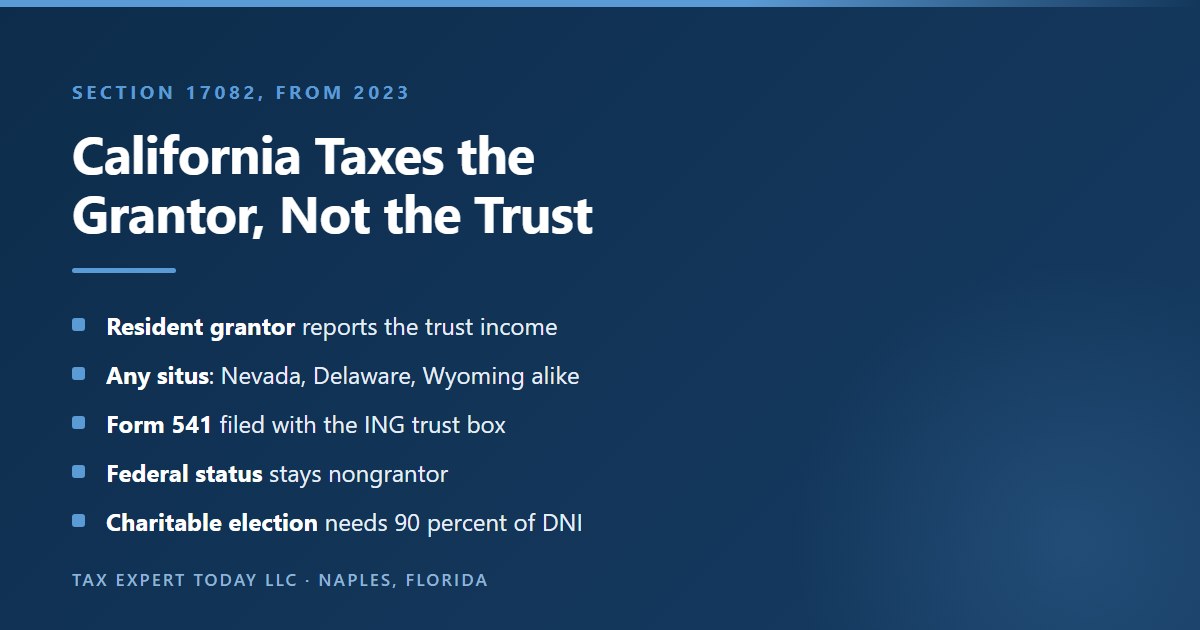
For a grantor who is a California resident, the trust’s income is included in the grantor’s gross income to the extent it would be if the entire trust were a grantor trust under section 17731. The trust still exists, but for California purposes its income is reported and taxed on the grantor’s own Form 540.
Subdivision (a) of the statute does the work. It does not say the trust becomes a grantor trust for every purpose. It says the income “shall be included in a qualified taxpayer’s gross income to the extent the income of the trust would be taken into account in computing the qualified taxpayer’s taxable income if the trust in its entirety were treated as a grantor trust under Section 17731.” Section 17731 is California’s general adoption of federal Subchapter J. The effect is a California only grantor trust overlay on top of a trust that remains a nongrantor trust for federal purposes.
- Who is taxed: the “qualified taxpayer,” which subdivision (d)(2) defines simply as the grantor of the incomplete gift nongrantor trust.
- What is taxed: the trust’s income items, computed as if the grantor owned the trust, including dividends, interest, and capital gains.
- When: every taxable year beginning on or after January 1, 2023, regardless of when the trust was created.
- Where the trust sits: irrelevant. Nevada, Delaware, Wyoming, South Dakota, and any other situs are treated the same.
- Distributions: subdivision (b) separately preserves section 17745 for distributions, which matters for income accumulated before the rule began.
The result is a mismatch that the promotional literature rarely mentions. Federally, the trust is still a separate taxpayer that pays federal tax on accumulated income at compressed trust brackets. For California, the grantor pays the state tax on that same income, even though the grantor did not receive it and may have no right to demand it. The grantor needs cash from somewhere else to pay a California tax on income sitting in a trust the grantor does not control.
| Item of trust income in 2026 | Federal treatment | California treatment for a resident grantor |
|---|---|---|
| Dividends and interest accumulated in the trust | Taxed to the trust on Form 1041 | Included in the grantor’s gross income under section 17082(a) |
| Capital gain on a sale of stock by the trust | Taxed to the trust on Form 1041 | Included in the grantor’s gross income under section 17082(a) |
| Income distributed to a family beneficiary | Carried out to the beneficiary through distributable net income | Subject to section 17745 rules for distributions under section 17082(b) |
| California source income such as California rents | Taxed to the trust | Taxable in California in any event; also included in the grantor’s income |
Which trusts count as an incomplete gift nongrantor trust under California law?
A trust is covered when two conditions are both met: it is not a grantor trust under the federal grantor trust rules, and the grantor’s transfer of assets to it is treated as an incomplete gift under IRC section 2511. A trust, or a portion of one, that qualifies as a charitable remainder trust under IRC section 664 is excluded.
The definition in subdivision (d)(1) piggybacks entirely on federal law. California does not create its own test for when a gift is incomplete or when a trust is a nongrantor trust. It asks the federal questions and attaches a California consequence to the answer.
| Element of the definition | Statutory text | How it is tested |
|---|---|---|
| Nongrantor trust | Section 17082(d)(1)(A)(i) | The trust “does not qualify as a grantor trust” under federal Subpart E (IRC sections 671 to 679) |
| Incomplete gift | Section 17082(d)(1)(A)(ii) | The transfer is “treated as an incomplete gift under Section 2511” |
| Charitable remainder trust carve out | Section 17082(d)(1)(B) | A trust or portion that qualifies under IRC section 664 is not an ING trust |
| Qualified taxpayer | Section 17082(d)(2) | The grantor of the incomplete gift nongrantor trust |
Whether a gift is incomplete is governed by Treasury Regulation section 25.2511-2. Under paragraph (c), a gift is incomplete when the donor keeps the power to revest title in himself or herself, or the power to name new beneficiaries or change their interests, unless the power is a fiduciary power limited by a fixed or ascertainable standard. Under paragraph (e), a power the donor can exercise together with a person who has no substantial adverse interest is treated as the donor’s own power. NING agreements are drafted around these rules, which is why the same drafting that produces an incomplete gift is exactly what places the trust inside California’s definition.
Two practical consequences follow. First, a trust cannot avoid the California rule by changing its name, its trustee, or its state of administration, because none of those are elements of the test. Second, a trust that is changed so that the gift becomes complete, or so that it becomes a grantor trust federally, falls outside the definition from that point forward, which is why completing the gift appears among the options discussed later in this guide.
What did SB 376 change for 2026?
SB 376, approved October 6, 2025 as Chapter 410 of the Statutes of 2025, amended the definition so that a trust, or a portion of a trust, that qualifies as a charitable remainder trust under IRC section 664 is expressly not an incomplete gift nongrantor trust. The Legislature declared that this is not a change in, but is declaratory of, existing law.
The enrolled text of SB 376 adds new subparagraph (B) to the definition and includes a legislative finding that the amendment is declaratory. The FTB’s 2025 Form 541 Booklet lists the change among the new items for the year and states that California law “explicitly provides” that a charitable remainder trust, or a portion of one, is not included in the definition of an ING trust.
- Who it affects: grantors of charitable remainder trusts whose retained powers could otherwise have made the transfer an incomplete gift, which is common where the grantor keeps a testamentary power to revoke a successor noncharitable interest.
- What it does not do: it does not reopen the NING structure for a California resident. An ordinary NING trust with no charitable remainder qualification is untouched by the amendment.
- Why it is declaratory: the finding signals that the Legislature regarded charitable remainder trusts as outside the rule from the start, so the clarification is not framed as new relief starting only in 2026.
Charitable remainder trusts have their own federal rules and their own planning purpose, which our guide to charitable remainder trust taxes explains. The point for this article is narrow: SB 376 confirms that the California ING rule is aimed at private wealth structures, not at split interest charitable trusts.
Is there any exception that keeps NING trust income off a California grantor’s return?
Only one, and it is narrow. The income is not included in the grantor’s income for a year if the trust is a nongrantor trust, its fiduciary makes an irrevocable election on a timely original Form 541 to be taxed as a resident nongrantor trust, and 90 percent or more of its distributable net income for the year goes to a section 501(c)(3) charity.
Subdivision (c) of section 17082 sets out the three conditions, and all three must be met for the taxable year in question. The FTB’s 2025 booklet describes this as an “ING Trust with an Annual Election” and directs the fiduciary to check the “ING trust w/ election” box under the type of entity.
| Condition under section 17082(c) | What it requires | Practical effect |
|---|---|---|
| (1) Irrevocable election | The fiduciary timely files an original California fiduciary return and elects on it to be taxed as a resident nongrantor trust | The trust gives up the nonresident trust position; all of its taxable income becomes subject to California tax at the trust level |
| (2) Nongrantor trust | The trust must be a nongrantor trust under California’s Subchapter J conformity | A trust that is a grantor trust federally is already outside the ING definition |
| (3) Charitable distribution | 90 percent or more of distributable net income is distributed, or treated as distributed, to a 501(c)(3) organization | Most of the trust’s income must go to charity for that year |
Read together, the exception is designed for a trust with a predominantly charitable purpose. A trust that elects resident status and sends nine tenths of its distributable net income to charity is no longer a vehicle for accumulating income for the family free of California tax, which is the outcome section 17082 was written to prevent. For a typical NING trust built to grow assets for the grantor’s descendants, the exception does not describe a realistic path.
Note also what subdivision (c)(1) requires: an original return, filed timely. An amended return or a late return does not satisfy the statute’s text, so a missed year cannot be repaired after the fact through an amendment.
How does a NING trust report to the FTB now?
For a covered trust without the charitable election, the fiduciary files Form 541, checks the “ING trust” box under type of entity, enters zero for total income, taxable income of fiduciary, and regular tax, and attaches a statement giving the grantor enough detail to report the income on the grantor’s own return.
The 2025 Form 541 Booklet spells out the mechanics in its Who Must File section. The approach mirrors how a grantor trust passes its items to its owner, except that the trust remains a separate filer federally.
| Filing element | ING trust (no election) | ING trust with an annual election |
|---|---|---|
| Type of entity box on Form 541 | “ING trust” | “ING trust w/ election” |
| Line 9, total income | Enter zero | Report under the normal line instructions |
| Line 20a, taxable income of fiduciary | Enter zero | Report under the normal line instructions |
| Line 21a, regular tax | Enter zero | Computed at the trust level as a resident nongrantor trust |
| Attachment | Name, identification number, and address of the person taxed, plus income, deductions, and credits in enough detail for the grantor’s return | Not the grantor attachment; the trust reports its own income |
| Who pays the California tax | The grantor, on the grantor’s own return | The trust |
- Copy to the grantor: the booklet states that the fiduciary must give the grantor a copy of the attachment, and the grantor reports the income on the grantor’s own return.
- Estimated tax: because the income is the grantor’s for California purposes, the grantor’s California estimated payments need to account for it. Our guide to the California estimated tax penalty explains the underpayment rules that apply.
- Federal return unchanged: the trust still files federal Form 1041 as a nongrantor trust and issues Schedule K-1 forms only for amounts actually distributed.
- Record keeping: the trust’s federal and California books now diverge every year, which adds preparation work that should be budgeted when weighing whether to keep the structure.
The booklet also states that a fiduciary should not file Form 541 at all if there are no California fiduciaries, no California noncontingent beneficiaries, and no California source income. That rule becomes important once the grantor is no longer a California resident, which is discussed below.
What happens to income a NING trust accumulated before 2023?
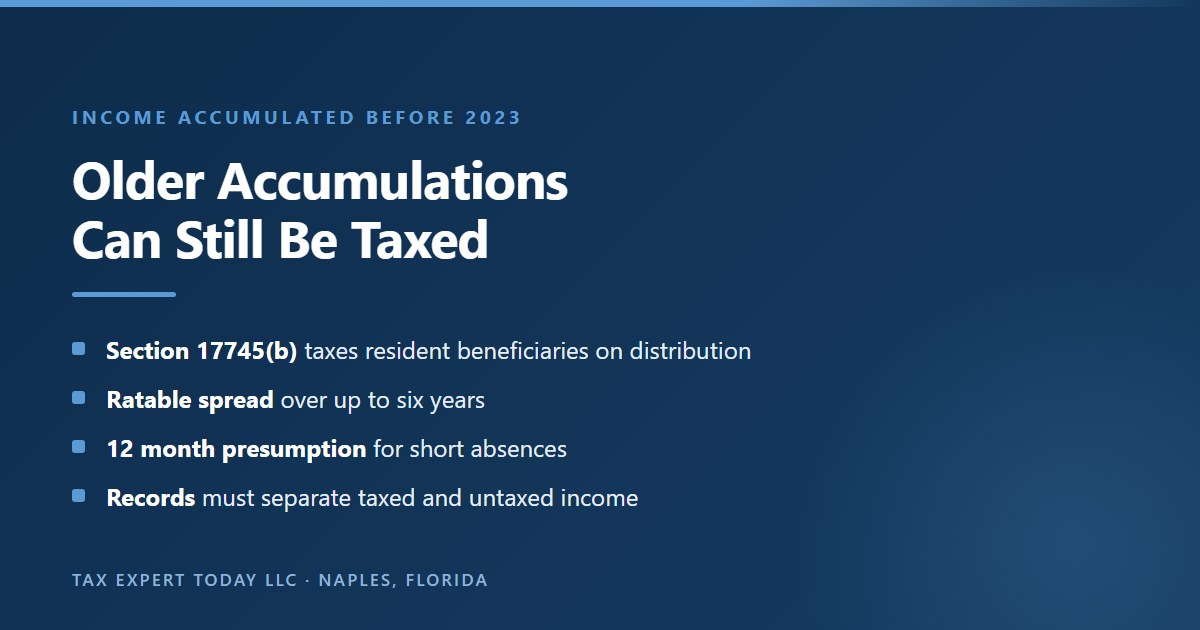
Section 17082 does not reach back past the 2023 taxable year, so income a NING trust earned and kept in 2022 and earlier years is not added to the grantor’s income by that statute. But subdivision (b) preserves section 17745, so when that older income is distributed to a California resident beneficiary, California can tax it then.
This is the part of the 2023 change that matters most for older trusts and that the ranking material almost never addresses. A NING trust created in, say, 2016 may hold several years of untaxed accumulated income. That pool did not become taxable on January 1, 2023. It sits in the trust, and the question of California tax arises when it comes out.
- Income from 2023 forward: taxed to a California grantor annually under section 17082(a), so a later distribution of it has already borne California tax.
- Income from 2022 and earlier: not taxed under section 17082, and potentially taxable to a resident beneficiary under section 17745 when distributed.
- Grantor as beneficiary: many NING agreements name the grantor as a discretionary beneficiary, so a distribution back to the grantor can be a distribution to a resident beneficiary.
- Family beneficiaries: children or other relatives living in California are resident beneficiaries for this purpose, even though they never created the trust.
Tracking which dollars in the trust are pre 2023 accumulations and which are post 2023 income already taxed to the grantor therefore becomes a permanent part of the trust’s administration. Without that tracking, a later distribution is difficult to characterize, and the burden of showing that California tax was already paid on a given amount generally falls on the taxpayer.
How does the California throwback in section 17745 work on a distribution?
Under section 17745(b), if no California tax was paid on a trust’s current or accumulated income because a resident beneficiary’s interest was contingent, that income is taxable to the beneficiary when it is distributed or distributable. Subdivision (d) computes the tax as if the income had been received ratably over the distribution year and the five preceding years, or the shorter accumulation period.
This is California’s own throwback rule, separate from the federal one. The text of section 17745 is short, and each subdivision does a distinct job.
| Subdivision | Rule | Relevance to a NING trust |
|---|---|---|
| 17745(a) | If trust level tax owed because a fiduciary or beneficiary is resident goes unpaid, the income is taxable to the beneficiary when distributable; a nonresident beneficiary is taxed only on California source income | Backstop where the trust itself should have paid |
| 17745(b) | If no tax was paid because the resident beneficiary’s interest was contingent, the income is taxable to that beneficiary when distributed or distributable | The core rule for pre 2023 NING accumulations |
| 17745(c) | The tax is on receipt; accumulated income remains income even if the instrument adds it to corpus | Labeling accumulations as principal does not change the result |
| 17745(d) | Tax equals the aggregate tax had the income been included ratably over the distribution year and five preceding years, or the shorter accumulation period | Spreads the income to soften the bracket effect, but does not eliminate the tax |
| 17745(e) | A resident beneficiary who leaves within 12 months before a distribution and returns within 12 months after is presumed to have remained a resident | A short absence timed around a distribution does not work |
A purely hypothetical example shows the computation. Assume a NING trust accumulated $600,000 of non California source income in 2017 through 2022 and distributes it in 2026 to the grantor, a California resident and discretionary beneficiary. Under subdivision (d), the tax would generally be the total of the California tax that would have resulted had $100,000 been added to the beneficiary’s income in each of 2026 and the five preceding years. The tax is still owed; the ratable spread only affects the rate at which it is computed. Actual figures depend on the beneficiary’s income in each of those years and on the trust’s records.
Subdivision (e) is the clause most relevant to anyone thinking about the timing of a move. It creates a presumption, not an absolute rule, but it is aimed squarely at a beneficiary who leaves California briefly to take a distribution and then returns. A genuine, permanent change of domicile is a different matter, and it is analyzed under the residency rules, not under subdivision (e).
Does the federal treatment of a NING trust change because of California’s law?
No. Section 17082 is a California personal income tax rule. It does not change whether the trust is a nongrantor trust for federal income tax purposes, whether the transfer was a completed gift for federal gift tax purposes, or whether the assets are included in the grantor’s federal gross estate.
Federal status continues to turn on the federal rules, chiefly IRC section 674 on the power to control beneficial enjoyment and IRC section 677 on income for the benefit of the grantor, both of which depend on whether distributions require the consent of an adverse party. The IRS has addressed specific ING trust arrangements in private letter rulings, but under IRC section 6110(k)(3) a private letter ruling may not be used or cited as precedent by any taxpayer other than the one who requested it.
- Federal income tax: the trust remains a separate taxpayer, reaching the top federal bracket at a far lower income level than an individual, and generally subject to the net investment income tax on undistributed investment income above its threshold.
- Federal gift tax: the transfer remains incomplete, so no lifetime exclusion is used until the gift is completed or a distribution to someone other than the grantor completes a gift.
- Federal estate tax: the assets generally remain in the grantor’s gross estate.
- Combined effect for a Californian: federal tax at trust rates on accumulated income, plus California tax on the same income at the grantor’s rates. The structure can now cost more in combined current tax than holding the assets directly, depending on the facts.
Does a NING trust still help with QSBS for a Californian?
Not for California tax. California does not conform to the federal qualified small business stock exclusion at all; Revenue and Taxation Code section 18152 provides that IRC section 1202 does not apply. A California grantor gains no state exclusion from a NING trust holding QSBS, and section 17082 includes the gain in the grantor’s California income regardless.
Some NING material, including the top ranking practitioner article on this topic, describes using an ING trust to “stack” an additional federal section 1202 exclusion, because a nongrantor trust is a separate taxpayer with its own per issuer limit. That is a federal question with its own risks, and the stacking technique is described even by its proponents as falling in a gray area. For California purposes, however, the question does not arise.
- Federal: a separate nongrantor trust may claim its own section 1202 limit, which for stock issued after July 4, 2025 is $15,000,000 per issuer, subject to the federal requirements and risks.
- California, before or after 2023: no section 1202 exclusion exists under California law, so there was never a California exclusion to stack.
- California, 2023 and later: the trust’s gain on QSBS is included in a resident grantor’s gross income under section 17082.
Our guide to California QSBS explains California’s nonconformity, the history behind it, and how sourcing of stock gain to the seller’s residence affects founders who leave the state.
What does California law still treat differently from a NING trust?
Section 17082 is aimed at one combination: a nongrantor trust funded by an incomplete gift. Structures outside that combination, such as a completed gift nongrantor trust, a grantor trust, a charitable remainder trust, or a trust whose grantor is not a California resident, are taxed under other rules, each with its own trade offs.
None of the alternatives below is a substitute that delivers the old NING result with no cost. Each gives up something the NING design was meant to keep, usually control, estate inclusion, or the grantor’s access to the assets. They are described here because the law treats them differently, not because any of them is right for a given family.
| Structure | Is it an ING trust under section 17082? | How California generally taxes it | Main trade off |
|---|---|---|---|
| NING, DING, or WING trust | Yes | Income included in a resident grantor’s gross income | State deferral gone; dual reporting |
| Completed gift nongrantor trust | No, the gift is complete | Section 17742, by fiduciary and noncontingent beneficiary residence; section 17745 on distributions | Uses lifetime exclusion; grantor gives up control and generally access |
| Grantor trust, such as a typical SLAT | No, it is a grantor trust | Income taxed to the grantor as owner | No state income tax benefit while the grantor is a resident |
| Charitable remainder trust | No, excluded by SB 376 | Under its own rules | Irrevocable charitable remainder |
| Any trust, once the grantor is a genuine nonresident | Possibly, but the grantor is a nonresident | Grantor taxed only on California source income | Requires an actual change of domicile |
Our guides to the spousal lifetime access trust and the dynasty trust cover two of the structures in this table in depth, including their federal gift and generation skipping transfer tax mechanics.
How does a completed gift nongrantor trust differ from a NING trust in California?
A completed gift nongrantor trust falls outside section 17082 because the gift is complete, so California taxes it under the ordinary trust residency rules in section 17742. With no California fiduciary and no California noncontingent beneficiary, its non California source income is not currently taxed by California, though section 17745 can apply on distribution.
The difference is not cosmetic. To make the gift complete, the grantor generally gives up the powers that kept the NING transfer incomplete, such as the power to redirect the property among beneficiaries. That has three consequences that run in the opposite direction from the NING design.
- Lifetime exclusion is used: the transfer is a taxable gift, reported on Form 709, and it consumes part of the grantor’s basic exclusion amount.
- Estate inclusion is generally avoided: which also means the assets generally do not receive a basis adjustment at the grantor’s death under IRC section 1014.
- Access is limited: if the grantor remains a beneficiary, the trust risks grantor trust status under section 677 unless an adverse party must consent to distributions, which brings it back to grantor treatment for income tax.
- California beneficiaries still matter: a noncontingent beneficiary living in California pulls a share of the trust’s income into California tax under sections 17742 and 17744.
| Feature | NING trust (2023 and later) | Completed gift nongrantor trust |
|---|---|---|
| Federal gift tax | Incomplete gift, no exclusion used | Completed gift, exclusion used |
| Federal estate inclusion | Generally included | Generally excluded |
| Basis adjustment at grantor’s death | Generally available | Generally not available |
| California tax on accumulated non California source income, resident grantor | Taxed to the grantor under section 17082 | Depends on fiduciary and noncontingent beneficiary residence under section 17742 |
| California throwback on distributions to contingent resident beneficiaries | Section 17745 preserved by section 17082(b) | Section 17745 applies |
| Grantor’s control after funding | Retains powers that keep the gift incomplete | Gives up those powers |
What does the higher 2026 federal exemption change about completed gifts?
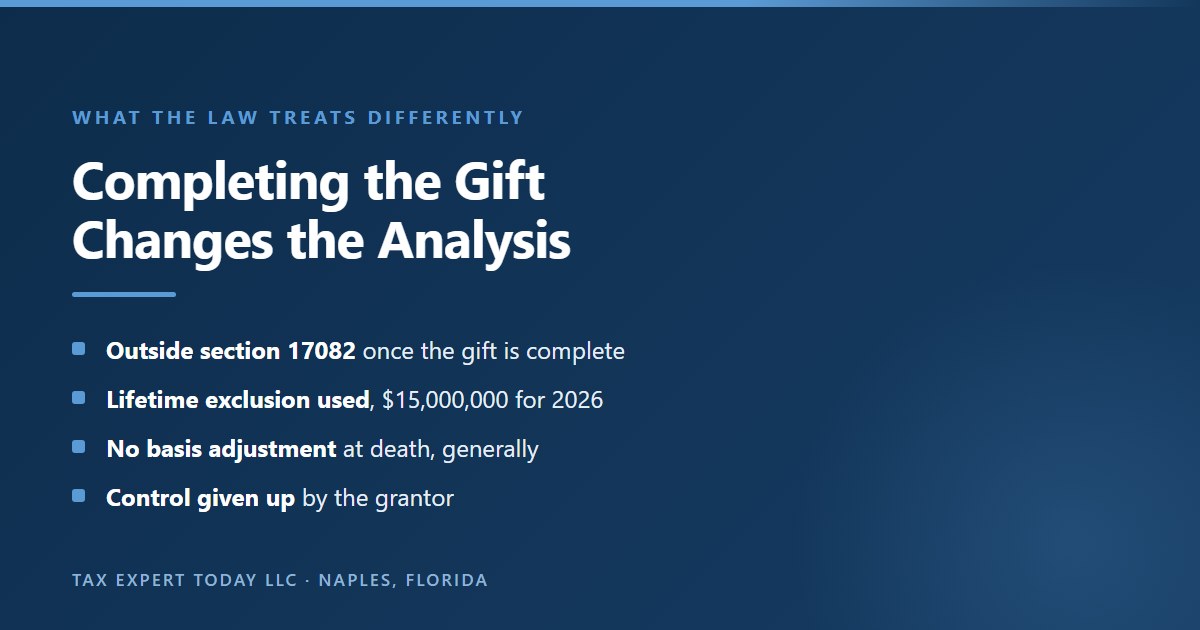
For 2026 the federal basic exclusion amount is $15,000,000 per individual, increased by Public Law 119-21 signed July 4, 2025, and the annual gift exclusion remains $19,000, according to the IRS. A larger exclusion makes a completed gift possible for more families without current gift tax, which changes the arithmetic of the completed gift path.
The IRS states the figures on its estate and gift tax update page. The higher amount does not change section 17082. It changes the cost of stepping outside it. When the basic exclusion was lower, the main reason to keep a gift incomplete was to avoid using exclusion; with a larger exclusion available, some grantors can complete a gift without paying gift tax, while still accepting the loss of control and of the basis adjustment at death.
- Exclusion used is gone: a completed gift permanently uses exclusion that would otherwise shelter the estate at death.
- Portability is not a substitute: a deceased spouse’s unused exclusion can be carried over only through a timely, properly prepared estate tax return.
- California has no gift or estate tax: the transfer tax analysis is federal; California’s interest is income tax. Our guide to California inheritance tax covers what California does and does not tax at death.
- Federal law can change: exemption amounts have changed repeatedly, and any plan built on a specific figure should be reviewed when the law changes.
What happens to a NING trust when the grantor moves to Florida?
Section 17082 still describes the trust, but its income is included in the gross income of a grantor who is now a nonresident. Under section 17951, a nonresident’s gross income for California purposes includes only income from California sources, so the trust’s non California source portfolio income generally drops out of California tax once the move is real.
The statute and the 2025 Form 541 Booklet do not address a nonresident grantor separately, so the general nonresident rules are the starting point. Section 17951 limits a nonresident’s gross income to California source income, and section 17952 provides that a nonresident’s income from stocks, bonds, notes, or other intangible personal property is not California source income unless the property has acquired a business situs in California.
- The purpose shifts: for a Floridian, the NING trust no longer has a state income tax job to do on portfolio income, because Florida has no personal income tax and California generally does not reach a nonresident’s intangible income.
- The costs remain: dual federal and California bookkeeping, trust company fees, compressed federal trust brackets, and the restrictions of the incomplete gift design continue.
- Filing may stop: the booklet says not to file Form 541 if there are no California fiduciaries, no California noncontingent beneficiaries, and no California source income, which can describe a NING trust with a Florida grantor and a Nevada trustee.
- The move must be genuine: everything above depends on the grantor actually changing domicile, which the FTB tests under its own residency standards.
This is the corridor point that the NING promotional material does not make. A Californian who completes a genuine move to Florida generally obtains, through the move itself, the state income tax result on portfolio income that a NING trust was built to deliver while the grantor stayed in California. The trust adds nothing to that result, though it may still serve other purposes such as asset protection, which a family may value independently. Our leaving California taxes checklist walks through breaking California domicile step by step.
| Type of trust income, grantor now domiciled in Florida | California treatment, generally | Statute |
|---|---|---|
| Dividends and interest on publicly traded securities | Not California source for a nonresident | Sections 17951 and 17952 |
| Gain on sale of stock held as an investment | Not California source unless the stock has a California business situs | Section 17952 |
| Rent from California real property | California source, taxable | Section 17951 |
| Income from a business operating in California, including through a pass through entity | California source to the extent attributable to California | Section 17951 and the apportionment rules |
| Distribution to a beneficiary who still lives in California | Can be taxable to that beneficiary under section 17745 | Sections 17082(b) and 17745 |
What does California still tax after the grantor leaves?
California keeps taxing California source income no matter where the grantor, trustee, or beneficiaries live. Real property in California, a California business, and income that accrued before the change of residence remain within California’s reach, and a California resident beneficiary can still be taxed on distributions of accumulated income.
Leaving California changes the tax on the trust’s portfolio income. It does not change the tax on assets that are themselves in California. A NING trust that holds a California rental property, an interest in a California operating partnership, or a note secured by California real estate still produces California source income, and our guide to California source income explains how the FTB sources each category.
- California real estate: rents and gain on sale are California source; a sale by a trust can also trigger withholding, covered in our guide to California nonresident withholding.
- California businesses: income from a business carried on in California remains California source, and a trust holding such an interest stays in the California system.
- Income tied to the resident period: income that accrued while the grantor was a California resident can remain taxable even if it is received after the move, which is a common issue with installment sales and deferred payments.
- California beneficiaries: a child who stays in California and receives a distribution of pre 2023 accumulated income can face section 17745 tax, regardless of where the grantor has moved.
How is the year of the move handled?
In the year of the move, the grantor is a part year resident. NING trust income attributable to the period of California residence is included under section 17082 and reported on Form 540NR, while income for the nonresident period generally follows the nonresident sourcing rules.
The part year return combines the resident and nonresident periods into a single computation, and the details matter when the trust has a large gain close to the move date. A sale that closes a week before the grantor’s domicile changes is a resident period event. A sale that closes after a genuine change of domicile is analyzed under the nonresident rules, subject to the FTB’s scrutiny of when the domicile actually changed.
- Date of domicile change: the FTB looks at the totality of the facts, not a single document, and the burden is on the taxpayer to support the date claimed.
- Timing of trust transactions: large trust sales near the move date are a common audit focus, because the grantor’s California inclusion depends on which side of the date they fall.
- Return mechanics: our guide to the California part year resident tax explains how Form 540NR allocates income between the two periods.
- Audit exposure: our guide to the California residency audit covers what the FTB requests and how the closest connections factors are weighed.
Do trustees and beneficiaries who stay in California change the answer?
Yes, in two ways. A California resident trustee or a California resident noncontingent beneficiary brings trust income into California tax under section 17742, apportioned under sections 17743 and 17744, and a California resident contingent beneficiary can be taxed under section 17745 when accumulated income is distributed to that beneficiary.
Once the grantor is a nonresident, the analysis of the trust’s own California exposure looks much like the analysis of any other nongrantor trust. The FTB’s 2025 booklet describes how California apportions non California source income when some trustees or noncontingent beneficiaries are residents and others are not, including the method from FTB Legal Ruling 238 for mixed cases.
| Fact pattern after the grantor’s move | California exposure on non California source income, generally | Statute |
|---|---|---|
| Nevada trustee only, no California noncontingent beneficiary | None currently at the trust level | Section 17742 |
| One of two trustees is a California resident | The share apportioned to the resident trustee | Sections 17742 and 17743 |
| A California resident holds a noncontingent interest | The share apportioned to resident noncontingent beneficiaries | Sections 17742 and 17744 |
| A California resident holds only a discretionary interest and receives a distribution of accumulated income | Taxable to that beneficiary on distribution, computed ratably | Section 17745(b) and (d) |
A corporate trustee’s residence is where it “transacts the major portion of its administration of the trust,” under section 17742(b), so a trust company with a California office that actually administers the trust there can create a California fiduciary even when the trust is nominally sited in Nevada. Our guide to trust situs after moving to Florida covers these residency rules in more detail, including how other states compare.
Can an existing NING trust be unwound or modified?
Possibly, depending on the trust instrument and state law. The options commonly discussed are completing the gift so the trust leaves the section 17082 definition, decanting into a new trust, distributing the assets back to the grantor and ending the trust, or keeping the trust as it is. Each has federal and California consequences that need to be modeled before acting.
No option restores the pre 2023 California result for a grantor who remains a resident. The choice is about which costs to accept going forward, and the right answer differs from family to family.
| Option | What changes for California | What it can cost |
|---|---|---|
| Complete the gift by releasing retained powers | Trust leaves the section 17082 definition from that point; taxed under section 17742 thereafter | Uses lifetime exclusion; ends estate inclusion and basis adjustment at death; grantor loses control |
| Decant into a new trust | Depends on the terms of the new trust and whether it is an ING trust | Federal gift and income tax questions on the decanting itself |
| Distribute assets to the grantor and terminate | Ends dual reporting; a distribution of pre 2023 accumulations to a resident grantor can trigger section 17745 | Possible California throwback tax; loss of any asset protection |
| Keep the trust unchanged | Grantor continues to report the income under section 17082 while a resident | Ongoing trust costs with no state income tax benefit |
| Grantor genuinely changes domicile | Grantor taxed only on California source income as a nonresident | The full cost and disruption of an actual move, and the burden of proving it |
Decanting has its own body of rules, explained in our guide to decanting a trust. A release of powers that completes a gift should be reviewed against Treasury Regulation section 25.2511-2(f), which treats the relinquishment of a power to change beneficiaries as the event that completes the gift.
What risks does the NING promotional material leave out?
Beyond the 2023 California rule itself, the main risks are a federal challenge to nongrantor or incomplete gift status, an economic substance challenge if the grantor behaves as if the assets were still personally owned, a California residency dispute for a grantor who claims to have moved, and stale advice that still describes the pre 2023 result.
- Status risk: if the distribution committee is not genuinely adverse, or the grantor’s powers are broader than the drafting assumes, the trust can become a grantor trust federally, which removes it from the California definition but also defeats the federal design.
- Economic substance: courts have looked at whether the grantor’s relationship to the property actually changed, whether the trustee was independent, and whether the restrictions of the trust were honored, citing cases such as Markosian v. Commissioner, 73 T.C. 1235 (1980).
- Residency risk: a grantor who relies on a move to Florida faces the FTB’s residency standards, and a large trust gain shortly after a claimed move invites scrutiny.
- Outdated sources: several pages that rank for this topic still state that a NING trust’s accumulated income escapes California tax until distribution, which has not been the law for a California resident grantor since the 2023 taxable year.
- Advisor framing: trust companies and promoters that earn fees from administering NING trusts have an interest in the structure’s continued use, so their material should be read alongside the statute.
Does Florida tax a NING trust or its grantor?
Florida has no personal income tax and does not tax trust income, so a Florida domiciliary grantor and a trust with no other state connections face federal income tax only. Florida also has no state estate tax. The remaining state exposure comes from California source income and from beneficiaries or trustees who live in states that tax trusts.
- Florida residency must be established: our guide to establishing Florida residency covers the declaration of domicile and the supporting facts.
- The scrutiny comes from the state being left: Florida has no income tax to protect, so the residency challenge, when there is one, generally comes from California, a point covered in our guide to the Florida residency audit.
- Estate planning after the move: a Florida resident’s documents generally need review under Florida law, discussed in our guide to Florida estate planning for new residents.
- The full corridor picture: our moving from California to Florida taxes guide connects the departure rules on the California side with the arrival rules on the Florida side.
For grantors weighing the California exposure that follows them after the move more generally, our guide to the California exit tax separates the proposals that never became law from the rules that actually reach former residents.
Frequently Asked Questions
What is a NING trust?
A NING trust is a Nevada incomplete gift nongrantor trust: an irrevocable trust designed to be a separate nongrantor taxpayer for income tax purposes while the transfer into it is an incomplete gift for federal gift tax purposes. DING and WING trusts are the Delaware and Wyoming versions of the same design.
Does a NING trust still avoid California income tax?
Not for a California resident grantor. Revenue and Taxation Code section 17082, added by SB 131 in 2023, includes the income of an incomplete gift nongrantor trust in the grantor’s gross income for taxable years beginning on or after January 1, 2023, as if the whole trust were a grantor trust.
When did California’s NING trust rule take effect?
SB 131 was approved on July 10, 2023, and section 17082 applies to taxable years beginning on or after January 1, 2023. SB 376, approved on October 6, 2025, amended the definition effective January 1, 2026 to exclude charitable remainder trusts, and declared that change to be existing law.
Is there any exception to California’s ING trust rule?
One. The income is not included in the grantor’s income for a year if the trust is a nongrantor trust, the fiduciary makes an irrevocable election on a timely original Form 541 to be taxed as a resident nongrantor trust, and 90 percent or more of its distributable net income is distributed to a section 501(c)(3) charity.
Is income a NING trust accumulated before 2023 taxed by California?
Section 17082 does not reach income from taxable years before 2023. However, section 17082(b) preserves section 17745, so accumulated income distributed to a California resident beneficiary whose interest was contingent can be taxed to that beneficiary when distributed, computed ratably over up to six years.
Does California’s rule change the federal treatment of a NING trust?
No. Section 17082 is a California personal income tax rule. The trust’s federal nongrantor status, the incomplete gift for federal gift tax purposes, and federal estate inclusion all continue to depend on federal law, so the trust still files federal Form 1041.
What happens to a NING trust if the grantor moves to Florida?
The grantor becomes a nonresident, and under sections 17951 and 17952 a nonresident is generally taxed by California only on California source income, which usually excludes income from stocks and bonds. California source income, such as California rents, remains taxable, and distributions to California resident beneficiaries can still be taxed under section 17745.
Can a Naples, Florida advisor help with a NING trust created in California?
Yes. California taxes the trust based on the residence of the grantor, the fiduciaries, and the beneficiaries, not on where the advisor works. A Naples, Florida advisor can review the trust instrument, the trustee’s federal and California returns, and the grantor’s own returns, and coordinate with the family’s trust company and estate planning counsel.
NING Trust Help in Naples & Southwest Florida
NING trust help Naples families can use starts with reading the trust instrument against the statute, not against a marketing summary. Tax Expert Today LLC advises on state residency and tax matters nationwide, including California departures and Florida arrivals, from our office in Naples, Florida. Our team includes tax advisors, enrolled agents, CPAs, and attorneys, and we review how an existing incomplete gift trust is being reported to California, whether pre 2023 accumulations are tracked, and how a move changes the picture, coordinating with the trust company and the family’s estate planning counsel.
We are located at 11983 Tamiami Trail N, Naples FL 34110. Call (239) 441-2005, Monday through Friday, 10:00 to 5:00 Eastern Time. Clients across Naples, Bonita Springs, Estero, Fort Myers, Marco Island, and the wider Southwest Florida region engage us on trust taxation, California part year returns, and residency questions. Our California tax services page describes the state engagements we take, Naples tax planning covers our local advisory work, and our estate and trust planning page describes how we work alongside a family’s attorneys.
- NING trust review Naples FL: reading the trust agreement, the trustee’s reporting, and the grantor’s California returns together.
- California ING trust reporting: checking Form 541 entity type, the grantor attachment, and the grantor’s Form 540 or 540NR inclusion.
- Pre 2023 accumulation tracking: separating income already taxed under section 17082 from older accumulations exposed to section 17745.
- Move year planning: aligning trust transactions with a documented change of domicile.
Local FAQ: I set up a NING trust while living in Los Angeles and have since moved to Naples. Can a Naples advisor review how the trust should be reported now? Yes. The California rules turn on the residence of the grantor, the trustees, and the beneficiaries, not on where the advisor is located. Bring the trust agreement, the trustee’s federal Forms 1041 and California Forms 541 since 2022, your own California returns for the same years, and the documents showing when your Florida domicile began, and we can review whether the trust still needs to file in California, how income from before and after 2023 has been tracked, and what a future distribution would mean for you and any family members still living in California.
When to Engage a Professional
Engage a professional before relying on any NING trust material written before 2023, before a NING trust makes a large sale or distribution, before completing a gift or decanting, and before a move that is expected to change how the trust is taxed. The California, federal income, and federal transfer tax results interact, and the instrument controls.
- You are the grantor of an existing NING, DING, or WING trust and are not sure how its income has been reported to California since 2023.
- The trust holds income accumulated before 2023 and a distribution to you or a California family member is being considered.
- You are planning a move out of California and the trust is expected to sell an appreciated asset around the same time.
- A trust company or promoter has proposed a new ING trust and you want the California statute read against the proposal.
- You have received an FTB notice about trust income or residency; our guide to the FTB power of attorney explains how a representative is authorized.
This article explains the law as it stands for 2026. It is not legal or tax advice for any specific trust, and outcomes depend on the trust instrument, the residence of each party, the type of income, and facts that only a full review can establish. Tax Expert Today LLC does not recommend any particular trust structure in general terms; any engagement begins with the documents. Call (239) 441-2005 to arrange a review.
Published October 3, 2026 by Dr. Pellumb Kabashi « Back to Learning Center
Have a question this article touches on?
Tax Expert Today LLC, based in Naples, Florida and serving clients across the United States.
Schedule a Consultation (239) 441-2005