
By Dr. Pellumb Kabashi, DBA, MBA, CES, CFE, EA
Founder, Tax Expert Today LLC · Tax advisors, enrolled agents, CPAs, and attorneys · Serving clients in all 50 states
Quick Answer: California source income is the income a nonresident still owes California tax on after leaving the state. Revenue and Taxation Code section 17951 limits a nonresident to gross income from sources within California, and the category decides the answer: services follow where the work was performed, real property follows location, and intangibles follow the owner residence unless they acquired a California business situs. Call (239) 441-2005 for a free consultation.
What is California source income?
California source income is income that originates within California and therefore stays taxable by California no matter where the recipient lives. A California resident pays tax on worldwide income. A nonresident pays tax only on the California source portion. The dividing line is not the payer address and not the mailing address on the check, it is the category of income and where the activity or property that produced it sat. Where the income arrives by inheritance rather than by employment, the parallel analysis is set out in our guide to the California inheritance tax.
That last point is the one most people get wrong on the way out of the state. Leaving California ends resident taxation going forward. It does not convert income that already carries a California source into income California cannot reach. The Franchise Tax Board applies a category test, and each category carries its own sourcing rule drawn from a different part of the Revenue and Taxation Code.
- Services follow the work. Compensation is sourced to the place where the services were physically performed, not to where the employer sits or where the payment lands.
- Real property follows location. Rent and gain on California real property are California source regardless of the owner residence.
- Intangibles follow the owner. Stock, bonds and notes are sourced to the owner state of residence unless the property acquired a business situs in California.
- Business income is apportioned. A trade or business operating both inside and outside California is divided by formula rather than assigned wholly to one state.
- Some income is off limits entirely. Federal statutes remove several categories from California reach even when the underlying activity happened inside the state.
The Franchise Tax Board publishes a deliberately short version of the list. Its part-year resident and nonresident page says that sourced income includes, but is not limited to, services performed in California, rent from real property located in California, the sale or transfer of real California property, and income from a California business, trade or profession. The phrase that matters in that sentence is “but is not limited to.” Those four bullets are an illustration, not the boundary, and the boundary is where the planning actually lives.
Which income categories count as California source income?
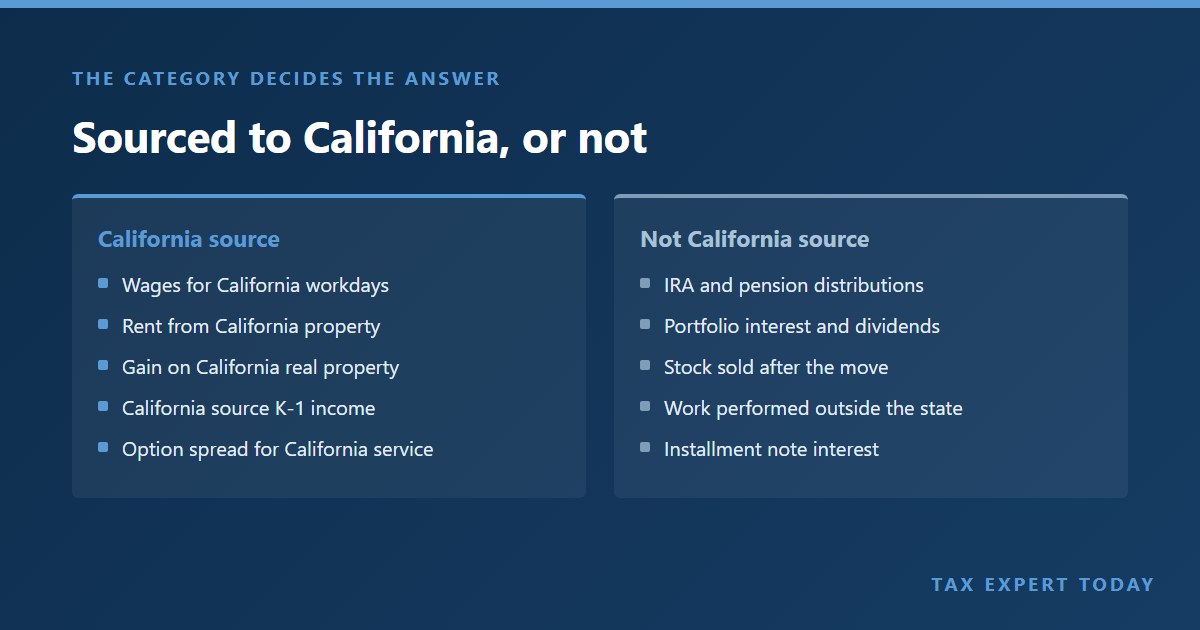
Eleven categories cover almost every fact pattern a former California resident meets. Wages for California workdays, rent from California property, gain on California real property, apportioned business income and California source pass-through income are taxable. Retirement distributions, portfolio interest and dividends, and gain on intangibles sold after the move are not.
The table below is the decision grid. It states the rule for a person who has already established residency in another state, which is the reader this guide is written for. A part-year resident applies a second layer on top of it, covered further down.
| Income category | California source for a nonresident? | Governing rule |
|---|---|---|
| Wages for services physically performed in California | Yes, in proportion to California workdays | R&TC 17951; FTB Pub. 1100 Example 9 |
| Wages for services performed entirely outside California | No, even where the employer is a California company | R&TC 17951 |
| Final paycheck received after the move for California work | Yes, the services were performed in California | FTB Pub. 1100 Example 10 |
| Rent from real property located in California | Yes | FTB nonresident guidance |
| Gain on the sale of California real property | Yes | FTB Pub. 1100 Section C |
| Gain on the sale of stock or other intangibles after the move | No, absent a California business situs | R&TC 17952 |
| Interest and dividends from a personal portfolio | No | R&TC 17952 |
| IRA and qualified plan distributions | No | 4 U.S.C. 114; FTB Pub. 1100 Section D |
| Schedule K-1 income from a California partnership or S corporation | Yes, to the extent the entity income is California source | FTB Pub. 1100 Section L, Example 37 |
| Sole proprietorship operating inside and outside California | Partly, by apportionment | R&TC 17954 |
| Nonstatutory stock option spread earned over California service | Yes | FTB Pub. 1100 Example 13 |
Read the middle column carefully. Five of the eleven rows say yes, and four of those five involve either physical presence in California or property located in California. That is the shape of the entire system. California reaches what happened inside its borders, and it reaches the person globally only while the person is a resident.
What does Revenue and Taxation Code section 17951 actually say?
Section 17951(a) provides that for purposes of computing taxable income of a nonresident or part-year resident under section 17041(i)(1), the gross income of a nonresident taxpayer includes only the gross income from sources within this state. That single sentence is the entire statutory basis for nonresident taxation in California, and everything else is interpretation built on top of it.
The statute is short because it delegates. It does not define what a source within the state means for each category. That work is done by section 17952 for intangibles, by section 17954 for allocation and apportionment, and by the regulations and publications the Franchise Tax Board issues under that authority.
- Section 17951 sets the base. Only California source gross income enters the nonresident computation in the first place.
- Section 17041(i)(1) supplies the frame. It is the provision that defines taxable income of a nonresident or part-year resident, and section 17951 exists to serve it.
- Section 17954 delegates the hard part. Income from sources within and without California is allocated and apportioned under rules and regulations prescribed by the Franchise Tax Board, except as provided in section 25141.
- Publication 1100 is the applied version. The agency worked examples are where the abstract rule becomes an answer for a specific taxpayer.
One practical consequence follows immediately. Because the nonresident base starts at zero and only California source items are added, the burden of the analysis runs item by item. There is no single test that resolves an entire return. A former resident with wages, a rental, a brokerage account and a K-1 is running four separate sourcing analyses on one Form 540NR. The same sourcing decides what a carried loss can offset, which our guide to the California NOL suspension covers for business owners.
Which income does federal law bar California from taxing at all?
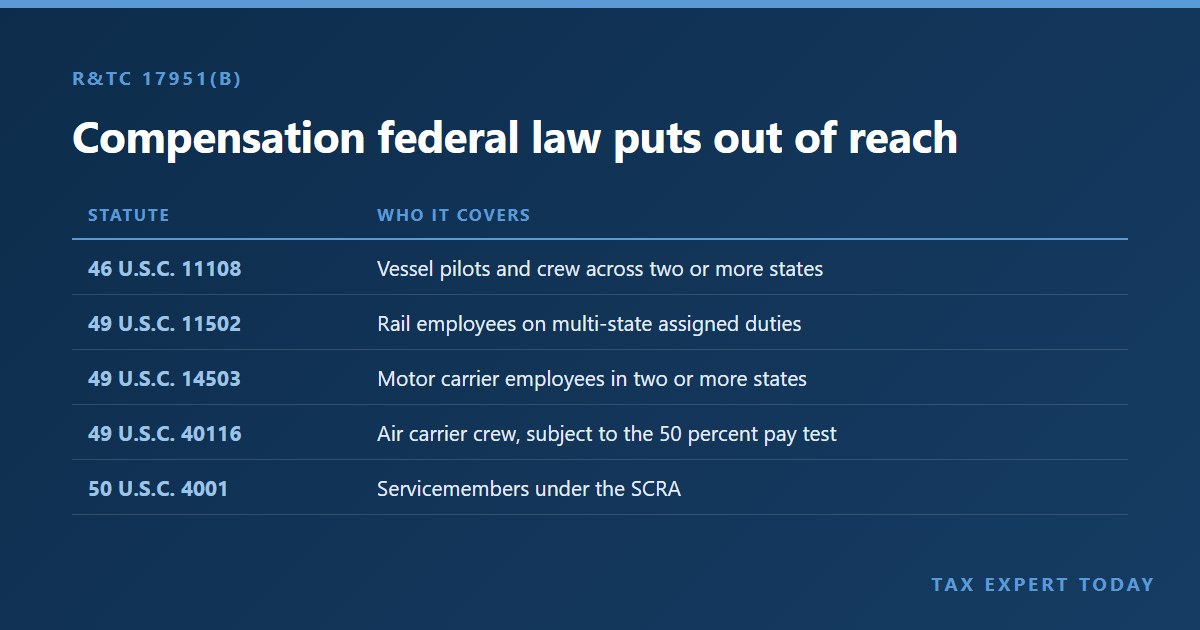
Section 17951(b) is the provision almost no published guide mentions. It states that notwithstanding the general rule, the gross income of a nonresident does not include income removed from the California Personal Income Tax Law by five specific federal statutes. Those five cover merchant seamen, rail employees, motor carrier employees, air carrier employees and servicemembers.
This matters because it is an absolute exclusion rather than a sourcing conclusion. A rail conductor who runs regularly assigned routes through California is taxable on that pay only by the state of residence, because Congress preempted California rather than because the workday ratio came out favorably. The five carve-outs, quoted from the statute as amended by Stats. 2004, Ch. 62, are set out below with the condition each one actually requires.
| Federal statute | Who it covers, and on what condition | Effect on California source income |
|---|---|---|
| 46 U.S.C. 11108 | A licensed vessel pilot with assigned duties in more than one state, and crew performing regularly assigned duties on a vessel operating in the navigable waters of two or more states | Compensation for those duties is taxable only by the state of residence |
| 49 U.S.C. 11502 | A rail carrier employee performing regularly assigned duties on a railroad in more than one state | Compensation is taxable only by the state of residence |
| 49 U.S.C. 14503 | A motor carrier or motor private carrier employee performing regularly assigned duties in two or more states | Compensation is taxable only by the state of residence |
| 49 U.S.C. 40116 | An air carrier employee with regularly assigned duties on aircraft in at least two states | Pay is taxable only by the state of residence, plus any state where more than 50 percent of pay is earned under the scheduled flight time test |
| 50 U.S.C. App. 571, now codified at 50 U.S.C. 4001 | Servicemembers, under the Servicemembers Civil Relief Act | Military compensation is not sourced to the duty station state |
Two cautions belong with that table. First, each federal statute carries its own qualifying conditions, and the exclusion applies only when those conditions are satisfied, so the citation alone does not decide a case. The air carrier rule is the clearest illustration, because it preserves California taxation for a crew member who earns more than half of a year of pay on California scheduled flight time. Second, the exclusions reach the compensation described in each statute and nothing else. A rail employee who also owns a rental in Sacramento still has California source rent. The shield is category specific, not taxpayer specific.
Are stocks, bonds and other intangibles California source income?
Generally no. Section 17952 provides that income of nonresidents from stocks, bonds, notes or other intangible personal property is not income from sources within California unless the property has acquired a business situs in the state. Interest, dividends and capital gain on a personal portfolio therefore follow the owner to the new state of residence.
The statute carries one important exception written into the same sentence. If a nonresident buys or sells such property in California, or places orders with brokers in California, so regularly, systematically and continuously as to constitute doing business in the state, the resulting profit or gain is California source regardless of where the property itself is situated. That provision is aimed at the trader who is effectively operating a California business, not at an investor with a California brokerage relationship.
- Business situs is the operative concept. An intangible acquires a California situs when it is localized in connection with a business carried on in the state, not merely because it is held at a California institution.
- The custodian address is not the test. Keeping an account at a bank or broker headquartered in California does not make the portfolio income California source.
- The trading exception is narrow. It requires activity regular, systematic and continuous enough to constitute doing business, which is a high threshold.
- Closely held stock is where situs fights arise. An interest tied into an operating California business is a different question from a publicly traded position.
This rule is the single largest reason the residency change date carries so much value in a liquidity event. A founder who sells stock as a California resident faces California tax on that gain. The same founder who has genuinely become a nonresident before the sale is outside section 17952 unless business situs applies. The timing question is covered in our guide to moving to Florida before selling a business, and the California side of an exit is set out in California exit tax myths versus reality.
Is wage income California source income after you move away?
Wages are sourced to the place where the services were physically performed. After a genuine move, work performed in the new state is not California source income even where the employer remains a California company. Work performed on trips back into California remains California source, measured by the ratio of California workdays to total workdays.
Publication 1100 Example 9 sets the pattern with a nonresident who lives and works in Wyoming and is temporarily assigned to California for four months at $5,000 per month while continuing to be paid from the Wyoming headquarters. The Franchise Tax Board conclusion is that $20,000 has a California source and is taxable by California. The paycheck origin changed nothing. The four months of physical presence decided it.
- The employer location is irrelevant. A California payroll department does not create California source income for work done elsewhere.
- Travel days count. Days worked inside California during visits enter the numerator of the workday ratio.
- Withholding is a separate problem. California withholding often continues after a move until the employer is notified, which produces a refund posture rather than a liability.
- Documentation carries the position. A contemporaneous workday calendar is what supports the ratio if the return is examined.
The mechanics of the workday ratio, the effect of a California employer on a remote worker, and the steps for stopping California withholding are covered in detail in our guide to California remote work tax after moving. This page stays with the category question of whether the wage is sourced to California at all.
Is a final paycheck after the move California source income?
Yes. Publication 1100 Example 10 addresses a taxpayer who lived and worked exclusively in California until retiring on December 31, then moved to Nevada on January 1 and received a final $4,000 paycheck by mail on January 10. The Franchise Tax Board treats that payment as California source because the income has a source in California, the state where the services were performed.
The example is worth holding onto because it isolates the principle cleanly. The taxpayer was unquestionably a Nevada resident on the date of receipt. The check arrived at a Nevada address. California still reached it, because sourcing for compensation looks backward to the work rather than forward to the payment.
The same logic extends to several other trailing payments a departing employee is likely to receive.
- Accrued vacation and paid time off. Cashed out after the move but earned over a California service period.
- Bonuses paid after departure. Sourced by reference to the service period the bonus compensates.
- Commission trailers. Attributable to selling activity performed while in California.
- Severance tied to prior service. Sourcing turns on what the payment is compensating, which is a facts and circumstances question.
None of that is a reason to delay a move. It is a reason to expect a California filing obligation in the year after the move and in some cases for several years afterward.
Does California tax retirement income after you leave?
No. 4 U.S.C. section 114(a) provides that no state may impose an income tax on any retirement income of an individual who is not a resident or domiciliary of that state. Publication 1100 Section D states the same conclusion from the California side, confirming that California does not tax the IRA distributions or the qualified pension, profit sharing and stock bonus plans of a nonresident.
The federal statute defines retirement income by listing the plan types it protects, and the list is broad. It reaches a qualified trust under section 401(a), a simplified employee pension under section 408(k), an annuity plan under section 403(a), an annuity contract under section 403(b), an individual retirement plan under section 7701(a)(37), an eligible deferred compensation plan under section 457, a governmental plan under section 414(d), and a trust described in section 501(c)(18). It also expressly includes retired or retainer pay of a member or former member of a uniformed service computed under chapter 71 of title 10.
This is the cleanest win in the entire corridor. A retiree who genuinely changes residency removes an entire income category from California reach, and the protection comes from federal law rather than from a California concession. The wider retirement picture on the Florida side is set out in our guide to retiring to Florida and the tax consequences.
Is deferred compensation California source income after the move?
It depends on how the deferred compensation is paid, and this is where 4 U.S.C. 114 stops being automatic. Nonqualified deferred compensation described in section 3121(v)(2)(C) is shielded only if it is part of a series of substantially equal periodic payments made over the life or life expectancy of the recipient, or over a period of not less than 10 years.
Read the other way, a lump sum distribution from a nonqualified plan generally falls outside the federal shield. The payment then reverts to ordinary sourcing analysis, which for deferred compensation means it is treated as compensation for the services that earned it. Services performed in California produce California source income under section 17951, and the person may be living in Florida when the money arrives without changing that conclusion.
| Payment form | Protected by 4 U.S.C. 114? | Practical result for a nonresident |
|---|---|---|
| Qualified plan or IRA distribution, any form | Yes | Not California source |
| Nonqualified plan paid over 10 years or more | Yes, if substantially equal and at least annual | Not California source |
| Nonqualified plan paid over life or life expectancy | Yes, if substantially equal and at least annual | Not California source |
| Nonqualified excess benefit plan paid after termination | Yes, under the separate excess plan clause | Not California source |
| Nonqualified plan paid as a lump sum | No | Sourced to where the services were performed |
| Nonqualified plan paid over five years | No, the period is under 10 years | Sourced to where the services were performed |
The statute adds one accommodation worth knowing. It provides that adjustments made from time to time under the plan to limit total disbursements under a predetermined formula, or to provide cost of living or similar adjustments, do not by themselves cause the payments to fail the substantially equal periodic payments test. An indexed stream is not disqualified simply because the dollar amounts move.
The election that sets the payment schedule is often made years before anyone contemplates leaving California, which is why this item deserves review well ahead of a move rather than in the filing season after it.
How are stock options and restricted stock sourced after you leave?
Equity compensation is sourced as compensation for services, so the California workdays during the vesting or service period decide the answer. Publication 1100 Example 13 confirms that a nonstatutory stock option granted while a California resident, earned entirely through California service, and exercised after a move to Texas produces California source income on exercise.
The example is instructive because every fact that a taxpayer might expect to help points the other way and none of them matters. The taxpayer left the company. The taxpayer moved permanently. The exercise happened after both events. The Franchise Tax Board conclusion is that the income is compensation for services having a source in California, the state where all of the services were performed.
- The grant date does not control. Nor does the exercise date on its own.
- The service period controls. Allocation runs on workdays between grant and vest, or between grant and exercise depending on the award.
- Statutory options behave differently. Incentive stock options and their disqualifying dispositions follow separate rules set out in the same publication.
- Publication 1004 is the specialist source. The Franchise Tax Board equity based compensation guidelines carry the detailed allocation formulas.
Restricted stock units carry the same character but a different clock, and the vesting schedule usually straddles the move date in a way that produces a partial California allocation for several years. That fact pattern is worked through in our guide to California RSU tax when leaving the state.
Does an installment sale keep producing California source income?
Yes for California real property, and yes for intangibles sold while still a California resident. Publication 1100 Section C states that California taxes installment gains received by a nonresident from the sale of tangible and intangible property that is sourced to California, with real property sourced by location and intangible gains generally sourced to the state of residence at the time of the sale.
Four of the agency examples map the corners of this rule, and the fourth is the one that decides most corridor cases.
| Publication 1100 example | Facts | California result |
|---|---|---|
| Example 2 | Always a nonresident, sold a California rental property on installment | Capital gain taxable by California, interest is not |
| Example 3 | Always a nonresident, sold Idaho land on installment | Neither the gain nor the interest is California source |
| Example 7 | Sold California real property while a resident, then moved to Washington | Gain remains taxable by California, interest is not |
| Example 8 | Sold stock while a resident, then became a Florida resident before receiving proceeds | Gain taxable by California because the sale occurred while a resident, interest is not |
Example 8 is the one to internalize. The taxpayer sold stock in September as a California resident, became a Florida resident on February 1, and received installment proceeds on May 1. The capital gain is taxable by California because the taxpayer was a California resident when the stock was sold. The sale date controls, not the payment date, and moving between the two does not change the character of the gain.
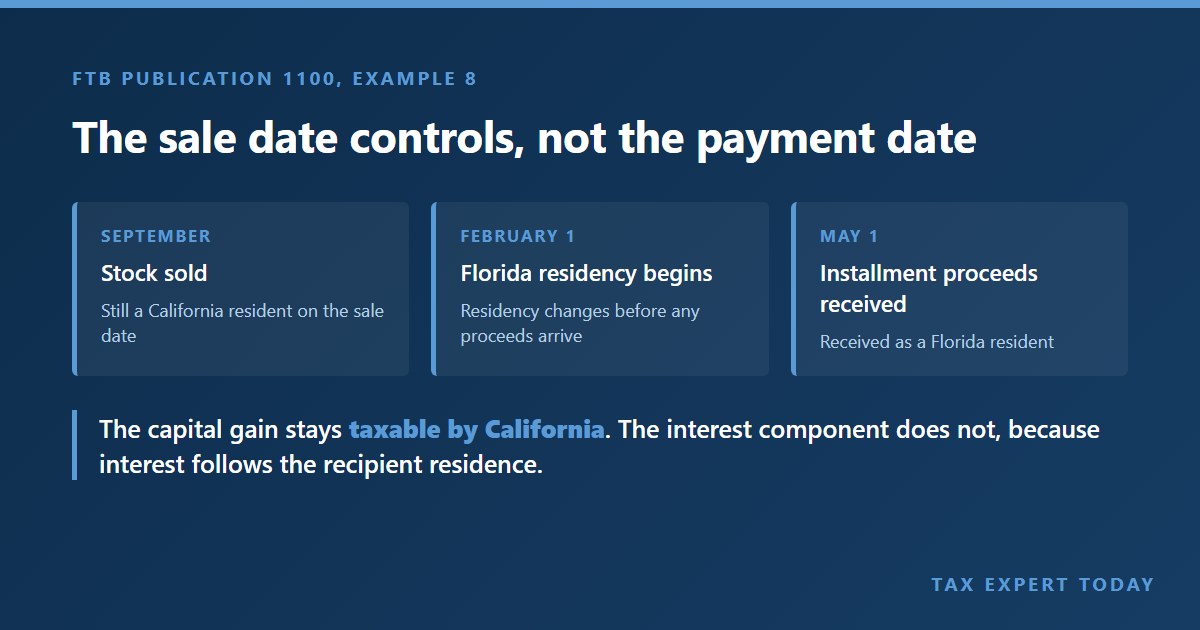
Notice also what is consistent across all four rows. The interest component is never California source once the recipient is a nonresident, because interest is intangible income under section 17952 and follows the owner. On a long installment note that split can be worth planning around.
Is rental income from California property still California source income?
Yes, without qualification. Rent from real property located in California is one of the four categories the Franchise Tax Board lists on its own nonresident page, and location is the entire test. Ownership through an out of state entity, management by an out of state agent, and payment into an out of state bank account all leave the answer unchanged.
Real property is the category where a change of residency accomplishes the least. The property does not move, so the source does not move. What does change is the filing posture: the owner shifts from reporting rental income on a resident return to reporting it on Form 540NR as a nonresident with California source income, and the property continues to generate a California filing obligation for as long as it is held.
- Rental operating income stays California source. Net of the deductions attributable to the property.
- Gain on eventual sale stays California source. Including the depreciation recapture component.
- Withholding attaches at closing. California real estate withholding applies to the sale of California real property by a nonresident.
- Passive loss rules are recomputed. Publication 1100 Section I addresses passive activity limitations for a nonresident on a California source basis.
The gain side of a California home sale, including the exclusion and the withholding mechanics, is covered separately in our guide to California capital gains tax on a home sale.
How is business income sourced when a business operates in two states?
By apportionment rather than by tracing. Section 17954 provides that gross income from sources within and without California is allocated and apportioned under rules and regulations prescribed by the Franchise Tax Board, except as provided in section 25141. A sole proprietorship or professional practice serving clients in several states therefore reports a California fraction of its income, not all of it and not none of it.
This is the category where a move produces the most gradual change. A consultant who relocates from San Jose to Naples and keeps several California clients does not stop having California source business income. What changes is the apportionment factor, which shifts as payroll, property and activity move out of the state over time.
- The question is the factor, not the address. A new home state does not zero the California share on its own.
- Where the work is performed matters. Services delivered remotely from the new state generally move the factor.
- Client location alone is not decisive. A California client does not automatically make the fee California source under a services apportionment analysis.
- Entity choice interacts with this. The apportionment question sits on top of whatever entity the practice uses.
Where the business is conducted through a California entity, the entity level obligations continue independently of the owner residency, including the annual franchise tax. Those obligations are covered in our guides to the California LLC franchise tax and to California LLC versus S corporation structuring.
Is Schedule K-1 income from a California entity California source income?
Yes, to the extent the entity income is itself California source. Publication 1100 Section L states that California taxes a nonresident distributive share of partnership, S corporation and trust income derived from California sources, and Example 37 confirms that a nonresident holding an interest in a California partnership is taxable on the California source net income reported on the Schedule K-1.
The critical word is derived. A nonresident partner is not taxed on the whole K-1 simply because the partnership is organized in California. The partnership first determines what portion of its income is California source, and the partner picks up that share. A California partnership with substantial out of state operations passes through a correspondingly smaller California figure.
Two mechanical consequences follow for a former resident holding pass-through interests.
- Nonresident withholding may apply. California generally requires withholding on California source distributions to a nonresident payee.
- An elective entity tax may also be in play. Where the entity has made the election explained in our California PTET guide, a consenting nonresident owner claims the credit on an individual return rather than on a group return.
- The entity return drives the timing. A fiscal year entity can push California source income into a later personal year.
- Part-year allocation is date based. The publication requires allocation between the residency and nonresidency periods reflecting the actual date of realization, and a daily pro rata method only where that information is unavailable.
- Basis is tracked on a California basis. Section K of the publication addresses basis in pass-through entities separately for this reason.
The withholding side, including the forms that establish an exemption or a reduced rate, is covered in our guide to California nonresident withholding.
What is not California source income for a nonresident?
The exclusions are as useful as the inclusions, because they are where an exit actually pays. Once residency has genuinely changed, portfolio income, retirement distributions, gain on intangibles sold after the move, and compensation for services performed entirely outside California all fall outside the California base.
| Item | Why it is outside the California base |
|---|---|
| Interest on bank accounts and bonds | Intangible income sourced to the owner residence under R&TC 17952 |
| Dividends on a personal portfolio | Same intangible rule, absent a California business situs |
| Capital gain on publicly traded stock sold after the move | Sale occurred while a nonresident and the intangible follows residence |
| IRA, 401(k) and pension distributions | Barred to the state by 4 U.S.C. 114 |
| Wages for work performed entirely outside California | No services performed in the state under R&TC 17951 |
| Gain on real property located outside California | Location test fails, per FTB Pub. 1100 Example 6 |
| Interest component of installment payments received as a nonresident | Intangible income following the recipient residence |
| Rail, motor carrier, air carrier and servicemember compensation | Federal preemption under R&TC 17951(b) |
The pattern running through that table is worth stating plainly. What leaves California with the taxpayer is income attached to the person. What stays behind is income attached to California property or to work physically done in California. Any planning conversation that does not start from that distinction tends to produce the wrong expectation. For senior employees whose compensation is heavily weighted toward equity and deferred items, the sequencing questions are covered in our guide to Florida domicile for executives.
How does California source income work in the year you move?
The move year splits into two periods. For the resident period the taxpayer reports worldwide income, and for the nonresident period only California source income. Both go on Form 540NR, which computes tax using a full year effective rate applied to the California share, so the California figure is not simply taxed at the rate a smaller income would carry.
That computation surprises people who expect a partial year to produce a proportionally lower rate. It does not. The rate is derived from total income and then applied to the California portion, which preserves the progressivity California would have applied to the full amount.
- Two periods, one return. Worldwide income for the resident months, California source income only for the rest.
- The residency date must be defensible. The split has no meaning if the departure date is not supportable.
- Pass-through items allocate by realization date. A daily pro rata split applies only where the actual date is unavailable.
- Withholding usually needs correcting. California withholding often overshoots because it continues past the move date.
The full mechanics of the effective rate calculation are covered in our guide to California part year resident tax and Form 540NR. The residency determination that sets the split date is addressed in the California departure checklist, and the corridor as a whole is mapped in moving from California to Florida and the tax consequences.
What records support a California source income position?
Documentation is category specific, and the record that supports a workday allocation does nothing for an intangible situs question. Build the file by category at the time the income arises, because reconstructing a workday calendar or a sale date two years later during a residency examination is materially harder than keeping it.
| Income category | Records that support the position |
|---|---|
| Wages and workday allocation | Contemporaneous calendar, travel receipts, badge or system access logs, employer workday attestation |
| Equity compensation | Grant agreements, vesting schedules, exercise confirmations, service location history |
| Intangibles and portfolio | Trade confirmations with dates, account statements bracketing the move, evidence of where decisions were made |
| Installment sales | Closing statement showing the sale date, the note, and the annual interest and principal split |
| California real property | Rent rolls, depreciation schedules, closing documents, withholding forms filed at closing |
| Pass-through interests | Schedules K-1, entity apportionment workpapers, interim statements for a move year allocation |
| Retirement distributions | Forms 1099-R, plan documents establishing the plan type and the payment schedule |
The residency change itself carries a separate evidentiary burden, and the Franchise Tax Board examines it on a closest connections analysis rather than on a day count alone. What that review looks at in practice is set out in our guide to the California residency audit, and the day counting side of establishing the new residence is covered in our Florida 183 day rule calculator.
California source income help Naples and Southwest Florida
Our office is in Naples, Florida, and a substantial part of the practice is the California to Florida corridor: people who have moved, or are planning to, and need the California side handled with the same care as the Florida side. California source income analysis is the work that sits between the two, because it decides how much of a former California life keeps producing a California filing obligation.
Tax Expert Today LLC is a multidisciplinary firm of tax advisors, enrolled agents, CPAs and attorneys handling state residency and tax matters nationwide. We work with departing California residents on sourcing analysis, Form 540NR preparation, residency documentation, and representation in Franchise Tax Board matters.
Tax Expert Today LLC
11983 Tamiami Trail N, Naples, FL 34110
Phone: (239) 441-2005
Hours: Monday through Friday, 10:00 a.m. to 5:00 p.m. ET
Do I need a Naples advisor if my California income is only a rental property? A single California rental is enough to create an ongoing California nonresident filing obligation, and it is also the category where a residency change accomplishes the least, because the property does not move. Many Southwest Florida clients arrive assuming the California return ended with the move and find that it did not. Reviewing the sourcing profile once, early, usually settles the question for years.
Broader planning for new and prospective Florida residents is described on our Naples tax planning page, and the California side of the engagement is outlined on our California tax services page.
When to Engage a Professional
Some California source income questions resolve on a plain reading of the category rules. Others sit on facts where the answer turns on timing, on documentation, or on a statutory exception that is easy to miss. The situations below generally warrant professional review before a return is filed rather than after.
- A liquidity event near a move date. The interaction of section 17952 with the sale date can be the largest single variable in the transaction.
- Deferred compensation coming due. Whether the payment schedule satisfies the 4 U.S.C. 114 conditions changes the answer entirely.
- Equity compensation straddling the move. Multi year vesting produces a California allocation that persists well past the departure date.
- Continuing California business activity. Apportionment questions rarely resolve cleanly without workpapers.
- A residency examination already underway. Sourcing positions taken on a filed return become harder to adjust once the review has started.
Nothing on this page is advice for a specific taxpayer, and results in any particular matter depend on facts and on law that may change. Anyone weighing a California sourcing position should have it reviewed against their own documents before filing.
Frequently Asked Questions
Does California tax my income if I work remotely for a California company from Florida?
Generally no, as to the work performed in Florida. Wages are sourced to the place where the services are physically performed, so a Florida workday is not California source income even when the employer is a California company. Days worked during trips into California remain California source and enter the workday ratio.
Is my brokerage account California source income if the broker is in California?
Generally no. Section 17952 sources intangible income to the owner state of residence unless the property has acquired a business situs in California. The custodian address does not create a California source. A nonresident trading regularly, systematically and continuously enough to constitute doing business in California is the narrow exception the statute names.
Will California tax my 401(k) withdrawals after I move to Florida?
No. 4 U.S.C. section 114 bars any state from taxing the retirement income of a person who is not a resident or domiciliary of that state, and Publication 1100 confirms that California does not tax the qualified plan and IRA distributions of a nonresident. The federal protection covers qualified trusts, IRAs, section 403(a) and 403(b) arrangements, section 457 plans and governmental plans.
I sold my California house before moving. Does California still tax the gain?
Yes. Gain on California real property is California source income based on the location of the property, and that conclusion does not depend on where the seller lives when the sale closes or when the proceeds arrive. The same rule carries the depreciation recapture component on a rental.
Does California tax the interest on an installment note after I become a nonresident?
No. Publication 1100 treats the interest component as intangible income sourced to the recipient state of residence, so a nonresident is not taxed on it. The capital gain component is analyzed separately and can remain California source depending on what was sold and when.
How long do I keep filing a California return after moving out?
For as long as California source income continues. A rental property or a California pass-through interest can produce a nonresident filing obligation indefinitely. Trailing wage items and equity compensation usually run for a defined number of years tied to the service or vesting period.
Does a California LLC make my income California source income?
Not by itself. A nonresident member is taxed on the distributive share of income derived from California sources, which is determined at the entity level. The entity level obligations, including the annual franchise tax, continue regardless of where the member lives.
Published September 1, 2026 by Dr. Pellumb Kabashi « Back to Learning Center
Have a question this article touches on?
Tax Expert Today LLC, based in Naples, Florida and serving clients across the United States.
Schedule a Consultation (239) 441-2005