
By Dr. Pellumb Kabashi, DBA, MBA, CES, CFE, EA
Founder, Tax Expert Today LLC · Tax advisors, enrolled agents, CPAs, and attorneys · Serving clients in all 50 states
Quick Answer: The California AMT is a separate 7 percent minimum tax figured on Schedule P. It most often reaches people who exercise incentive stock options and hold the shares past December 31, because the spread is added back for AMT but not for regular tax. Moving to Florida does not end it: an ISO exercise can still carry California AMT. Call (239) 441-2005 for a free consultation.
What Is the California AMT in 2026?
The California AMT is a second tax computation that runs alongside the regular California income tax. You figure a tentative minimum tax at a flat 7 percent of alternative minimum taxable income above an exemption, compare it with your regular tax before credits, and pay the difference if the tentative minimum tax is higher.
- Statute: R&TC section 17062 imposes the tax and sets the rate at 7 percent for taxable years beginning on or after January 1, 2011.
- Form: residents use Schedule P (540); nonresidents and part-year residents use Schedule P (540NR).
- Base: California follows IRC sections 55 through 59 as of January 1, 2015, with California modifications.
- Most common trigger: the spread on incentive stock options exercised and held past the end of the year.
- Relief later: AMT caused by timing items can come back as a credit on form FTB 3510 in later years.
The California AMT is easy to forget because most California filers never see it. The regular California rates climb to 12.3 percent, plus the 1 percent Behavioral Health Services Tax on taxable income above $1,000,000, and for an ordinary wage earner that regular tax comfortably exceeds 7 percent of a broader income base. The minimum tax only bites when something makes the AMT base much larger than the regular base. For people in technology and life sciences, that something is almost always an incentive stock option.
The statute is short. R&TC section 17062 imposes a tax equal to the excess of the tentative minimum tax over the regular tax, computes the tentative minimum tax under IRC sections 55 to 59 except as California provides otherwise, and replaces the federal rate structure with a single California rate. The history of that rate shows how stable it has been: 8.5 percent from 1991 through 1995, 7 percent from 1996 through 2008, 7.25 percent for 2009 and 2010, and 7 percent again for every taxable year beginning on or after January 1, 2011.
This guide is about the individual California AMT and the people who meet it most often: employees holding incentive stock options, and in particular those who are planning to leave California for Florida or who already have. If you want the regular income tax rules for restricted stock units and option income when you move, our guide to California RSU tax when leaving the state covers the sourcing of wage income in detail. This page owns the minimum tax computation, which is a different calculation on a different schedule.
| Feature | California AMT | Source |
|---|---|---|
| Rate | Flat 7 percent of AMTI above the exemption | R&TC 17062(b)(3)(A)(iv) |
| Federal law adopted | IRC sections 55 to 59 as of January 1, 2015, with modifications | Schedule P (540) instructions |
| Resident form | Schedule P (540), Parts I to III | FTB |
| Nonresident and part-year form | Schedule P (540NR) | FTB |
| Form 540 line | Line 61, separate from the Behavioral Health Services Tax on line 62 | 2025 Form 540 booklet |
| Credit for prior AMT | Form FTB 3510, credit code 188 | FTB 3510 instructions |
All dollar figures in this guide come from the 2025 California forms, which are the most recent complete set the Franchise Tax Board has published as of November 10, 2026. California indexes the exemption amounts and phase-out thresholds every year, so the 2026 figures will differ slightly when the 2026 Schedule P is released. The mechanics described here do not change from year to year.
How Is California AMT Different From Federal AMT?
California AMT uses a single 7 percent rate, a smaller exemption that phases out at much lower income, and a federal base frozen at January 1, 2015. Federal AMT uses 26 and 28 percent rates and, for 2026, an exemption of $90,100 for single filers that does not begin to phase out until $500,000. The two computations often disagree.
- Rate: California is a flat 7 percent; federal is 26 percent, then 28 percent above $244,500 of excess for 2026.
- Exemption phase-out: California begins phasing out at $347,808 for single filers in 2025; federal begins at $500,000 for 2026.
- State income tax: the federal AMT adds back state and local taxes; California never allowed its own income tax as a deduction, so that item barely matters on Schedule P.
- Conformity date: California applies the federal AMT rules as they stood on January 1, 2015, so later federal changes do not carry over automatically.
- Separate credit: each system has its own minimum tax credit and its own carryforward.
The federal figures for 2026 come from Revenue Procedure 2025-32, section 3.10. The exemption is $140,200 for joint returns and $90,100 for unmarried individuals, and the phase-out thresholds are $1,000,000 and $500,000. The same revenue procedure lists a complete phase-out at $680,200 for unmarried individuals, which means the federal exemption now shrinks by 50 cents for each dollar above the threshold. The One Big Beautiful Bill Act made the higher exemption permanent and reset the thresholds, which is why the federal AMT now reaches fewer people than it did before 2018 but reaches them harder once they cross the line.
California did none of that. The Schedule P (540) instructions state that California generally conforms to IRC sections 55 through 59 as of January 1, 2015, and refer to R&TC section 17062.1. So California keeps its own exemption, its own 25 percent phase-out rate, and its own list of adjustments. The practical result is that you can owe California AMT and no federal AMT, owe federal AMT and no California AMT, or owe both. Each return needs its own computation.
| Item | California (2025 Schedule P) | Federal (2026, Rev. Proc. 2025-32) |
|---|---|---|
| Rate | 7 percent flat | 26 percent and 28 percent |
| Exemption, single or head of household | $92,749 | $90,100 |
| Exemption, married filing jointly | $123,667 | $140,200 |
| Phase-out begins, single | $347,808 | $500,000 |
| Phase-out begins, joint | $463,745 | $1,000,000 |
| Phase-out rate | 25 percent | 50 percent |
| Exemption fully gone, single | $718,804 | $680,200 |
| State income tax add-back | Not relevant, no California deduction | Yes, taxes are added back |
One difference deserves emphasis because it surprises people who have only ever looked at the federal form. The biggest single federal AMT driver for California residents used to be the deduction for state income tax. California does not let you deduct California income tax on the California return in the first place, so the California AMT base does not grow from that item. On Schedule P (540), line 3 adds back only personal property taxes and real property taxes from Schedule CA (540). That is one reason the California AMT tends to be narrower in who it reaches, and why incentive stock options dominate the California picture.
What Are the California AMT Exemption Amounts?
For 2025, the California AMT exemption is $92,749 for single and head of household filers, $123,667 for married couples filing jointly, and $61,830 for married filing separately. It phases out at 25 cents per dollar of AMTI above $347,808, $463,745 and $231,868 respectively, and reaches zero at $718,804, $958,413 and $479,188.
The exemption is what keeps the California AMT away from most households. Without it, 7 percent of nearly any income base would exceed regular tax at the lower brackets. With it, the first $92,749 of AMT income for a single filer is untouched. The phase-out is the reason the tax concentrates on large one-time events: once AMT income passes the threshold, each additional dollar both adds 7 cents of tentative minimum tax and removes 25 cents of exemption, which adds another 1.75 cents. Inside the phase-out band the effective California AMT rate on additional income is 8.75 percent.
| Filing status | Exemption | Phase-out begins (AMTI) | Exemption reaches zero (AMTI) |
|---|---|---|---|
| Single or head of household | $92,749 | $347,808 | $718,804 |
| Married/RDP filing jointly or qualifying surviving spouse | $123,667 | $463,745 | $958,413 |
| Married/RDP filing separately | $61,830 | $231,868 | $479,188 |
| Certain children under age 24 | Limited to earned income plus $9,750 | Same worksheet | Same worksheet |
All of those figures are printed in the exemption worksheet in the 2025 Schedule P (540) instructions. Married couples filing separately have one extra step: if line 21 is above $479,188, the worksheet adds back 25 percent of the excess, capped at $61,830, so that a separate filer cannot shelter more than half of a joint exemption. The children rule mirrors the federal kiddie tax approach and limits the exemption to earned income plus $9,750.
- Single filer below $347,808 of AMTI: full $92,749 exemption.
- Single filer at $545,706 of AMTI: exemption of $43,274 after the 25 percent reduction.
- Single filer at or above $718,804: no exemption at all, so the full AMTI is taxed at 7 percent.
- Joint filers: a larger exemption, but the phase-out begins well below where the federal one does.
For 2026, expect slightly higher numbers. California indexes these thresholds each year using the California Consumer Price Index, and the 2026 Schedule P was not yet posted when this guide was written (the 2026 form address returned a not found page on November 10, 2026). Planning for a 2026 exercise with the 2025 figures is reasonable as long as you leave a margin for indexing. For an exercise late in a year, the safest course is to run the projection again once the new form is out.
How Does Schedule P (540) Calculate California AMT?
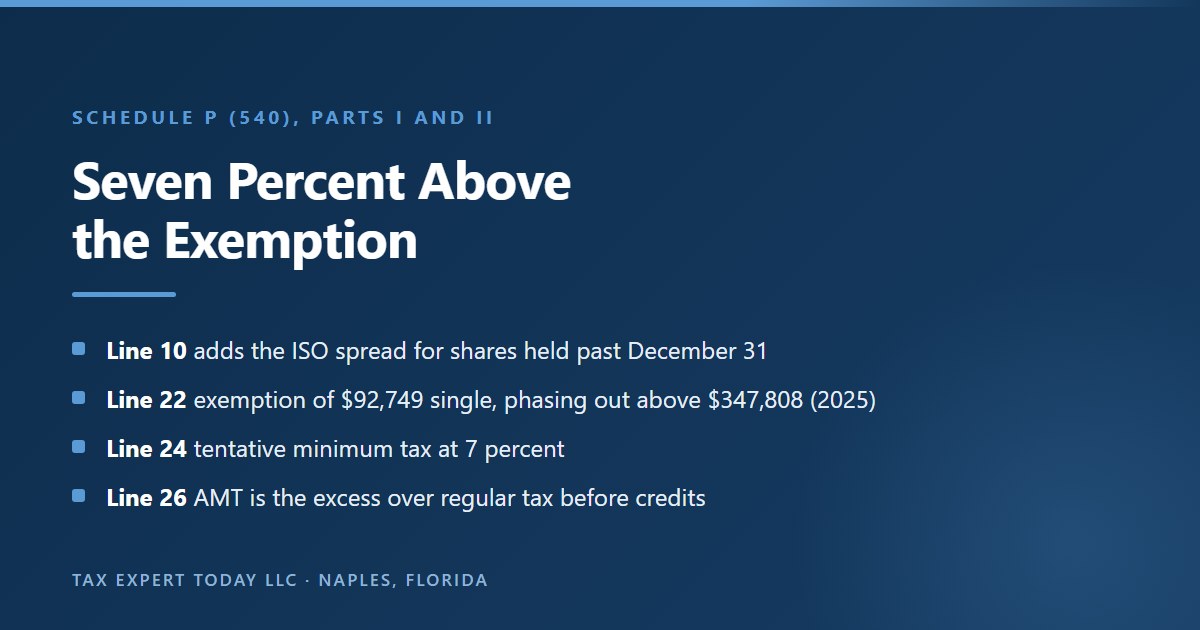
Schedule P (540) starts from your California taxable income, adds back items the AMT does not allow, adds AMT adjustments such as the ISO spread, subtracts any AMT net operating loss deduction to reach AMTI on line 21, subtracts the exemption on line 22, multiplies by 7 percent on line 24, and compares that with regular tax on line 25.
The schedule has three parts. Part I builds alternative minimum taxable income. Part II computes the tax. Part III decides how your credits are applied, and it matters even when you owe no AMT, because some credits cannot reduce regular tax below the tentative minimum tax. The FTB tells you to complete all four sides of the schedule for that reason.
| Schedule P (540) line | What it does | Common entries for an ISO holder |
|---|---|---|
| Line 1 | Adds back the standard deduction if you did not itemize | $5,706 for a single filer in 2025 |
| Lines 2 to 6 | Adjust itemized deductions the AMT limits | Real property taxes, home equity interest not used on the home |
| Line 9 | Adjusted gain or loss when AMT basis differs | Year of sale of ISO stock held from a prior year |
| Line 10 | ISOs and California qualified stock options | The spread at exercise for shares held past December 31 |
| Line 14 | Total adjustments and preferences | Sum of lines 1 to 13 |
| Line 15 | Taxable income from Form 540, line 19 | Your regular California taxable income |
| Line 21 | Alternative minimum taxable income | Taxable income plus adjustments |
| Line 22 | Exemption amount | From the exemption worksheet |
| Line 24 | Tentative minimum tax, line 23 times 7 percent | The figure to beat |
| Line 25 | Regular tax before credits, Form 540, line 31 | Your ordinary California tax |
| Line 26 | AMT, line 24 minus line 25 | Carried to Part III and then Form 540, line 61 |
The line numbers come from the 2025 Schedule P (540) form itself. Two details are worth noticing. First, line 25 uses regular tax before credits. Credits are handled later in Part III, which is where the interaction with the AMT credit and the PTET credit plays out. Second, line 26 carries an instruction to include the AMT on the 2026 Form 540-ES worksheet, because AMT counts for the estimated tax safe harbor.
The instructions say you must attach Schedule P to Form 540 if you owe AMT, if you have more than two credits, if you claim credits from certain sections, or in a few other situations. If you have no credits and no AMT, you can generally keep the worksheet in your file. If you exercised ISOs and held the shares, you should complete it every year, attached or not, because it sets the AMT basis and the credit carryover you will need later.
What Counts as Regular Tax in the California AMT Comparison?
Regular tax for this comparison is the tax computed under R&TC section 17041 or 17048 before any credits, which is Form 540, line 31. The 1 percent Behavioral Health Services Tax on taxable income above $1,000,000 is reported separately on line 62 and is not part of the regular tax that the tentative minimum tax is measured against.
Section 17062(b)(2) defines regular tax as the amount imposed by section 17041 or 17048, before reduction for credits, less certain amounts under section 17560. Section 17041 is the graduated rate table. The Behavioral Health Services Tax, which was renamed from the Mental Health Services Tax for taxable years beginning in 2025, is imposed by a different section and appears on its own line of Form 540. Our guide to the California mental health tax covers that surcharge, which applies on top of whatever regular tax or AMT you owe.
- Included: the graduated tax from the 2025 rate schedules, before exemption credits and other credits.
- Not included: the 1 percent Behavioral Health Services Tax on line 62.
- Not included: credits, which are applied in Part III.
- Nonresidents: regular tax is Form 540NR, line 37, the prorated California tax.
| 2025 single taxable income | Regular tax (Form 540, line 31) | Approximate average rate |
|---|---|---|
| $150,000 | $10,389 | 6.9 percent |
| $240,000 | $18,759 | 7.8 percent |
| $400,000 | $33,924 | 8.5 percent |
| $750,000 | $73,087 | 9.7 percent |
The amounts in that table are computed from the 2025 California tax rate schedules, Schedule X, rounded to the dollar, and are illustrative only. They show why the AMT is rare for ordinary income: average regular rates above 7 percent arrive quickly. The tentative minimum tax only overtakes regular tax when the AMT base is much larger than the regular base, which is exactly what an ISO spread produces.
Which Items Trigger California AMT Most Often?
For individuals, the California AMT is triggered most often by the spread on incentive stock options exercised and held past year end. Smaller contributors include real property taxes and home equity interest not used on the home, depreciation differences, and passive activity adjustments. Federal SALT add-backs do not drive California AMT.
- Incentive stock options: line 10, often six or seven figures in a single year.
- Itemized deduction add-backs: lines 3 to 5, typically property taxes and certain mortgage interest.
- Standard deduction: line 1, a small add-back for anyone who did not itemize.
- Depreciation and passive losses: lines 8 and 11, relevant for rental owners.
- Trust income: line 12, adjustments passed through on Schedule K-1 (541).
| Trigger | Schedule P line | Typical size | Permanent or timing |
|---|---|---|---|
| ISO spread held past year end | 10 | Large | Timing, so it can create a credit |
| California qualified stock option exclusion | 10 | Small and rare | Timing |
| Real and personal property taxes | 3 | Moderate | Permanent exclusion |
| Home equity interest not used on the home | 4 | Small | Permanent exclusion |
| Post-1986 depreciation | 8 | Varies | Timing |
| Passive activity differences | 11 | Varies | Timing |
The difference between permanent items and timing items is not academic. The FTB 3510 instructions treat the standard deduction, itemized deductions and depletion as exclusions, which cause a permanent difference, and everything else as deferral preferences, which only shift tax between years. Only AMT attributable to deferral preferences becomes a credit. AMT caused by an ISO exercise is a deferral item, so it generally comes back over time. AMT caused by property tax add-backs is not.
Business owners have one more rule to check before worrying about any of this. California excludes from AMTI the income, adjustments and preferences of any trade or business of a qualified taxpayer whose aggregate gross receipts are under $1,000,000. That exclusion is covered later in this guide, and it is one of the reasons the California AMT reaches fewer owners of small businesses than its federal counterpart once did.
How Does an ISO Exercise Trigger California AMT?
For regular tax, exercising an incentive stock option creates no income. For California AMT, Schedule P (540), line 10 adds the spread: the fair market value of the shares when your rights become transferable or no longer subject to a substantial risk of forfeiture, minus the price you paid. That one add-back can push AMTI far above regular taxable income.
The rule comes from IRC section 56(b)(3), which says that section 421, the provision that keeps ISO exercises out of regular income, does not apply for AMT purposes. California picks it up through section 17062 and states it plainly in the line 10 instructions: for regular tax, no income is recognized when an ISO is granted or exercised, but this rule does not apply for AMT. FTB Publication 1004 puts it the same way: for federal and California AMT you treat stock acquired through an ISO exercise as if the option were a nonstatutory option.
- Measure: fair market value at exercise, or when the shares first become transferable or vested, minus the exercise price.
- Year: the year you exercise, if you still hold the shares on December 31.
- Exception: no adjustment if you sell the shares in the same calendar year you exercise.
- Basis: your AMT basis in the shares increases by the adjustment.
- Credit: the AMT it creates is a deferral item that can return through FTB 3510.
The IRC section 422 rules define what an incentive stock option is. The option must be granted under a plan approved by shareholders, the exercise price must be at least the fair market value on the grant date, and only $100,000 of options, measured at grant-date value, can first become exercisable in any calendar year. Options above that limit are nonstatutory options and are taxed as wages at exercise, so they do not create an AMT adjustment. Your grant documents and the year-end Form 3921 from your employer show which shares are ISOs.
| Event | Regular California tax | California AMT (Schedule P) |
|---|---|---|
| ISO grant | Nothing | Nothing |
| ISO exercise, shares held past December 31 | Nothing | Spread added on line 10 |
| ISO exercise and sale in the same year | Wages on the disqualifying disposition | No adjustment, same treatment as regular tax |
| Qualifying sale in a later year | Capital gain on sale price minus exercise price | Gain measured from AMT basis, line 9 negative adjustment |
| Disqualifying sale in a later year | Wages up to the spread, then capital gain | Line 9 adjustment reverses the earlier add-back |
The holding periods for a qualifying disposition are two years from grant and one year from exercise. Sell before both are met and the sale is a disqualifying disposition: the spread at exercise, limited to the actual gain, is wage income for regular tax. Meet both and the whole gain is long-term capital gain. California taxes capital gain at ordinary rates, so the California benefit of a qualifying disposition is smaller than the federal one, but the AMT consequence of holding past year end is the same on both returns.
A short illustration shows the scale. Suppose you exercise 10,000 ISOs with a $5 exercise price when the shares are worth $35. You pay $50,000 and receive stock worth $350,000. Your regular California taxable income does not change. Your Schedule P line 10 entry is $300,000. If you are a single filer with $240,000 of taxable income from salary, that single entry moves you from no AMT to a California AMT of about $16,412, using the 2025 figures, as the next section shows.
How Much ISO Spread Can You Exercise Before California AMT Starts?
It depends on your regular tax, but for a single California resident with $240,000 of taxable income and the standard deduction, AMT begins at roughly $112,000 of ISO spread under the 2025 figures. Below that, the tentative minimum tax stays under regular tax. Above it, roughly 8.75 cents of AMT is added for each additional dollar inside the phase-out band.
Planners call this the AMT crossover point. You can exercise up to it in a year without paying California AMT, because the extra AMT income only narrows the gap between tentative minimum tax and regular tax. The figures below are a hypothetical single filer, California resident for the full year, taking the standard deduction, with no credits, using the 2025 Schedule X rates and the 2025 Schedule P exemption worksheet. They are illustrative, not a projection of your return.
| ISO spread (line 10) | AMTI (line 21) | Exemption (line 22) | Tentative minimum tax | Regular tax | California AMT |
|---|---|---|---|---|---|
| $0 | $245,706 | $92,749 | $10,707 | $18,759 | $0 |
| $50,000 | $295,706 | $92,749 | $14,207 | $18,759 | $0 |
| $100,000 | $345,706 | $92,749 | $17,707 | $18,759 | $0 |
| $150,000 | $395,706 | $80,774 | $22,045 | $18,759 | $3,287 |
| $200,000 | $445,706 | $68,274 | $26,420 | $18,759 | $7,662 |
| $300,000 | $545,706 | $43,274 | $35,170 | $18,759 | $16,412 |
| $500,000 | $745,706 | $0 | $52,199 | $18,759 | $33,441 |
AMTI in the table is taxable income of $240,000, plus the $5,706 standard deduction added back on line 1, plus the ISO spread on line 10. The crossover for this profile works out to about $112,439 of spread. Note how quickly the AMT grows once you pass the phase-out threshold of $347,808: the exemption shrinks by $12,500 for every $50,000 of extra spread, so the AMT rises faster than 7 percent of the added spread.
- Higher regular income raises the crossover: more regular tax means more room before the tentative minimum tax catches up.
- Itemizing changes the add-backs: large property taxes increase AMTI and lower the crossover.
- Joint filers have more room: a $123,667 exemption and a $463,745 threshold, but also higher regular tax on combined income.
- Federal crossover differs: run the federal Form 6251 separately, because the two systems rarely cross at the same point.
The crossover is the single most useful number for a California ISO holder. It tells you how many shares you can exercise in a year without paying minimum tax at all. Many employees with a long exercise window spread exercises over several years to stay near that number each year. Our quarterly estimated tax calculator is a starting point for the federal side of that projection; the California side needs a Schedule P run for each scenario.
What Happens If You Sell ISO Shares in the Same Year You Exercise?
If you exercise and sell the ISO shares in the same calendar year, there is no California AMT adjustment. The sale is a disqualifying disposition, the spread up to the actual gain is taxed as wages for regular tax, and the AMT treatment matches the regular treatment, so line 10 stays empty for those shares.
Both the Schedule P instructions and Publication 1004 say this directly: if you acquired and disposed of the stock in the same year, no adjustment is required. This is the cleanest way to avoid the California AMT, and it is also the most expensive in regular tax, because the spread becomes ordinary wage income taxed at up to 12.3 percent, plus the 1 percent Behavioral Health Services Tax above $1,000,000.
| Choice | California AMT | Regular California tax | Who it tends to suit |
|---|---|---|---|
| Exercise and sell the same year | None for those shares | Spread taxed as wages | Those who need cash or want certainty |
| Exercise and hold past December 31 | Spread added on line 10 | Nothing until sale | Those aiming for a qualifying disposition |
| Exercise early in the year, decide by December | Depends on whether shares are sold by year end | Depends on the same decision | Those who want to watch the stock price before committing |
| Partial same-year sale | Only on shares held | Wages on shares sold | Those funding the exercise cost and tax |
The same-year rule gives you an option that many people overlook. If you exercise in January or February and the share price falls during the year, you can sell before December 31 and convert the transaction into a disqualifying disposition. The wage income for a disqualifying disposition is limited to the actual gain if that is less than the spread at exercise, under the rule illustrated in Publication 1004, Example 7. You avoid an AMT bill computed on a spread that no longer exists. An exercise in December gives you no such window.
- Price falls after exercise: a same-year sale limits wage income to the actual gain.
- Price rises after exercise: holding keeps qualifying treatment available, at the cost of the AMT adjustment.
- Cash to pay the AMT: a partial sale can fund the tax on the rest, though the sold shares become wages.
- Payroll reporting: employers generally report disqualifying disposition income on Form W-2 when they learn of it; check the box 1 and box 16 figures.
If you are leaving California, the same-year rule has an extra dimension. The wage income from a disqualifying disposition is sourced to California based on where you worked between grant and exercise, even if you sell after you have moved. That sourcing rule, which comes from Publication 1004 and the Sun Microsystems case it cites, is covered in the corridor sections below and in more depth in our guide to California source income.
How Does California AMT Basis Work for ISO Shares?
When you make the line 10 adjustment, your AMT basis in the shares increases by the same amount, so you carry two bases: regular basis equal to the exercise price, and AMT basis equal to the exercise price plus the adjustment. In the year of sale, Schedule P line 9 reports the difference between the AMT gain and the regular gain, usually as a negative adjustment.
This is the mechanism that keeps the AMT from taxing the same spread twice. In the exercise year, AMT income includes the spread. In the sale year, the AMT gain is smaller than the regular gain by exactly that spread, so the line 9 adjustment reduces AMTI. Publication 1004, Example 8 walks through it with 30,000 shares, an option price of $10 and an exercise-date value of $50: the AMT adjustment is $1,200,000 and the AMT basis becomes $1,500,000 against a regular basis of $300,000.
| Figure | Regular tax | California AMT |
|---|---|---|
| Exercise price paid (10,000 shares at $5) | $50,000 | $50,000 |
| Spread at exercise (value $35) | Not income | $300,000 on line 10 |
| Basis in shares | $50,000 | $350,000 |
| Later qualifying sale at $45 ($450,000) | Gain of $400,000 | Gain of $100,000 |
| Schedule P line 9 in the sale year | Not applicable | Negative $300,000 |
The negative line 9 adjustment is what usually frees up room to use the AMT credit. In the year of a large qualifying sale, regular tax rises because of the capital gain, while AMTI rises much less because of the higher AMT basis. Regular tax then exceeds tentative minimum tax by a wide margin, and that excess is what the FTB 3510 credit can offset.
- Track both bases: brokerage statements show only regular basis, so the AMT basis lives in your own records.
- Lot by lot: each exercise date creates its own AMT basis per share.
- Federal and California may differ: the adjustment amount is generally the same, but keep separate records for each system’s carryovers.
- Losses: if the shares fall below the exercise-date value and you hold into a new year, the AMT basis produces a capital loss for AMT that is subject to the AMT capital loss limits.
The record-keeping instruction is in section C of the Schedule P instructions: you need to refigure items for AMT, and you must keep track of AMT carryovers to complete Schedule P in future years. Nobody else will track them for you. If you change preparers, or prepare your first return as a nonresident from Florida, bring every prior Schedule P and FTB 3510 with you.
What Is a California Qualified Stock Option and Why Does Schedule P Mention It?
A California qualified stock option is a narrow state-only option under R&TC section 17502 for options issued from 1997 through 2001 to employees earning $40,000 or less from the granting corporation. Regular California tax excludes the exercise income, but Schedule P line 10 adds it back. Few holders remain, so most ISO holders can ignore it.
The heading of line 10 reads incentive stock options and California qualified stock options, which leads many people to wonder whether their options are the California kind. They almost certainly are not. Publication 1004, section G, lists the conditions: the option was issued after January 1, 1997 and before January 1, 2002; the employee earned $40,000 or less from the granting corporation in the year of exercise; the grant covered no more than 1,000 shares worth no more than $100,000; and the employee was employed at grant or within three months of it.
| Condition | California qualified stock option | Incentive stock option |
|---|---|---|
| Governing law | R&TC section 17502, California only | IRC section 422, federal and California |
| Grant window | After January 1, 1997 and before January 1, 2002 | Any time under a qualifying plan |
| Income cap | Earned income from the granting corporation of $40,000 or less | None |
| Size cap | 1,000 shares and $100,000 of value | $100,000 first exercisable per year |
| Federal treatment | Nonstatutory option, wages at exercise | No regular income at exercise |
| California AMT | Excluded amount added back on line 10 | Spread added back on line 10 |
The practical relevance in 2026 is close to nil. Any option issued before 2002 would be roughly 25 years old, far beyond the 10-year maximum term most plans allow. The provision stays on the form because the statute remains on the books. If your grant notice does not say California qualified stock option in so many words, treat your options as ISOs or nonstatutory options under the federal definitions.
Do Federal and California AMT Hit the Same ISO Exercise Differently?
Yes. The ISO spread is added back on both returns, but the federal computation uses a 26 or 28 percent rate, a different exemption and phase-out, and a different regular tax. A single exercise can produce federal AMT and no California AMT, the reverse, or both, so each needs its own projection.
The federal crossover for a single filer is often higher than the California crossover in 2026, because the federal exemption does not start to phase out until $500,000 and federal regular tax at 24 to 35 percent marginal rates leaves a large cushion. California regular tax is much smaller in absolute dollars, so the state crossover can arrive sooner. That is a reversal of the pattern many advisors remember from the years before 2018, when the federal AMT was the bigger worry for California residents.
| Factor | Effect on federal AMT | Effect on California AMT |
|---|---|---|
| ISO spread | Added on Form 6251 | Added on Schedule P, line 10 |
| State income tax deduction | Added back if itemized | No California deduction exists |
| Exemption phase-out speed | 50 cents per dollar above the threshold | 25 cents per dollar above the threshold |
| Top AMT rate | 28 percent | 7 percent |
| Credit form | Form 8801 | FTB 3510 |
| Nonresident computation | Not applicable | Schedule P (540NR), Part II |
The federal instructions are in the IRS Instructions for Form 6251. The federal minimum tax credit is governed by IRC section 53. California conforms to the general structure of that credit but computes it on its own form, with its own carryover, and with no connection to whether you used the federal credit.
- Run both returns: a federal projection alone tells you nothing reliable about California.
- Separate carryovers: a federal credit carryforward and a California credit carryforward can be very different amounts.
- Different exit consequences: the federal credit follows you anywhere; the California credit only helps against California tax, which matters after a move.
- Software defaults: some programs do not carry California AMT basis forward automatically, so check the prior year detail.
That third point is the reason this guide spends so much time on the move to Florida. A federal AMT credit can be used against federal tax wherever you live. A California AMT credit can only be used against California regular tax, and once you are a Florida resident with little California income, there may be no California tax left to absorb it.
What Is the California AMT Credit and How Does FTB 3510 Work?
Form FTB 3510 lets you recover California AMT that was caused by timing items, such as an ISO exercise, in later years. The credit equals the prior year AMT attributable to deferral preferences, it can only offset regular tax above the tentative minimum tax, and any unused amount carries forward to the next year on Schedule P, Part III, line 10.
The 2025 FTB 3510 instructions divide the AMT you paid into two parts. Exclusions are adjustments that cause a permanent difference: the standard deduction or itemized deductions, and depletion. Deferral preferences are everything else on Schedule P. Part I of the form recomputes the prior year AMT using only the exclusions. Part II measures how much of the actual AMT came from deferral preferences, and that amount becomes the credit.
- Who files: anyone with a California AMT credit carryover, or who paid AMT the prior year with deferral items.
- Where it goes: Schedule P (540) or (540NR), Part III, line 10, credit code 188.
- Limit: the credit reduces only excess tax, meaning regular tax after exemption credits minus tentative minimum tax.
- Carryover: the unused credit carries to the next year through FTB 3510, line 31.
- Not limited by the $5,000,000 business credit cap: the instructions say so expressly.
| FTB 3510 step | What it computes | Where the number comes from |
|---|---|---|
| Part I, lines 1 to 13 | Prior year AMT on exclusion items only | Prior year Schedule P, lines 1 to 7, 13b and 13i |
| Part II | AMT attributable to deferral preferences | Prior year AMT minus the Part I amount |
| Line 31 | Unused credit carried from the prior year | Prior year Schedule P, Part III, line 10, column (d) |
| Line 32 | Total credit available this year | Entered in Schedule P, Part III, line 10, column (a) |
| Line 34 | Exemption and other credits that cannot cut below TMT | Form 540, line 32, and Schedule P Sections A1 and A2 |
| Line 36 | This year’s tentative minimum tax | Schedule P (540), line 24, or (540NR), line 43 |
The arithmetic that matters most is the limit. In a later year, the credit can only reduce your regular tax down to the level of your tentative minimum tax for that year. If you have no AMT preferences in the later year, the room is simply regular tax minus 7 percent of AMTI above the exemption. For the single filer in the earlier table, with $240,000 of taxable income and no new exercise, that room is about $8,052 a year using the 2025 figures. A $16,412 credit would take about two years of that income to recover, unless a large qualifying sale creates more room sooner.
The credit is generally recovered fastest in the year you sell the ISO shares in a qualifying disposition, because the capital gain raises regular tax while the negative line 9 adjustment keeps AMTI low. The FTB booklet describes the credit eligibility in plain terms: you must have paid AMT in a prior year and have no AMT liability in the current year. That second condition is the practical one; a year in which you are again subject to AMT is a year in which the credit does nothing.
Which Credits Can and Cannot Reduce Tax Below Tentative Minimum Tax?
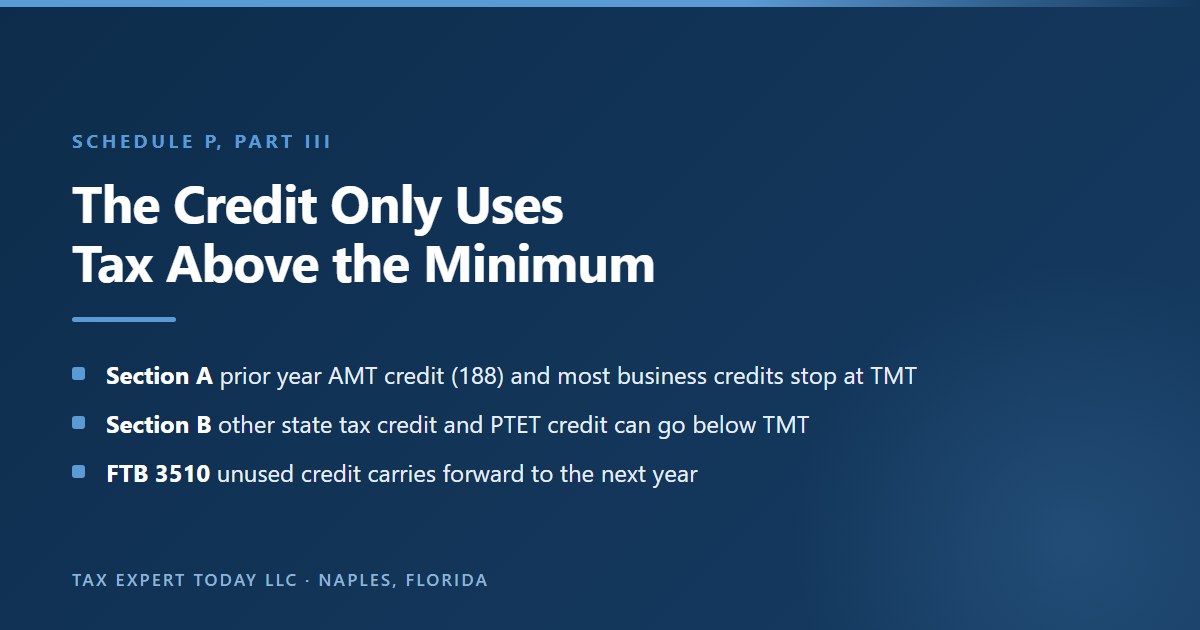
On Schedule P, Part III, credits in Section A, including the personal exemption credits, the child and dependent care credit, most business credits and the prior year AMT credit, can only reduce regular tax down to the tentative minimum tax. Credits in Section B, including the other state tax credit and the PTET elective tax credit, can reduce tax below it.
This is the part of Schedule P that affects people who owe no AMT at all. A household with a high tentative minimum tax, even one still below regular tax, may find that some of its credits are cut back. The 2025 Schedule P (540) orders the credits as follows.
| Section of Part III | Examples (credit code) | Can it reduce tax below TMT? |
|---|---|---|
| A1, no carryover | Prison inmate labor credit (162), child and dependent care expenses credit (232) | No |
| A2, with carryover | Most business credits, such as the research credit | No |
| A, line 10 | Credit for prior year AMT (188) | No |
| B1, no carryover | Joint custody head of household (170), dependent parent (173), senior head of household (163), renter’s credit | Yes |
| B2, with carryover | Credits listed in the Credit Table for Section B2 | Yes |
| B3 | Other state tax credit (187) | Yes |
| B4 | Pass-through entity elective tax credit (242) | Yes |
| C | Solar energy credit carryovers (180, 181) | Reduce AMT itself |
The personal and dependent exemption credits are included on Form 540, line 32, and the FTB 3510 instructions list them among the credits that cannot reduce regular tax below the tentative minimum tax. For most ISO holders that is a small amount. The business credits are larger. A founder or early employee who also claims a research credit through a pass-through entity may find that a large ISO exercise both creates AMT and suspends the research credit for the year, with the unused credit carried forward.
- Order matters: Section A credits are applied before Section B credits, and the prior year AMT credit sits at the end of Section A.
- Business credit cap: for 2024 through 2026, business credits cannot reduce net tax by more than $5,000,000; the AMT credit is exempt from that cap.
- Other state tax credit: relevant in a move year, when another state also taxes the same income.
- Section C: only certain solar carryovers can reduce the AMT itself.
The Section B3 placement of the other state tax credit is worth remembering if you work in more than one state before or after the move. The credit and its residency rules are covered in Schedule S. Our guide to nonresident state tax returns explains the general framework for income taxed by two states.
How Does the California AMT Interact With the PTET Credit?
The PTET elective tax credit sits in Section B4 of Schedule P, Part III, so it can reduce regular tax below the tentative minimum tax. It is applied after the other state tax credit. The interaction affects business owners who also exercise options or have other AMT items; it does not change the AMT computation itself.
The Schedule P instructions state that the PTET credit can reduce regular tax below the TMT and that it should be applied against net tax after the other state tax credit. They also note that the 9.3 percent elective tax as described there applies for taxable years beginning before January 1, 2026; the extension and changes for later years are covered in our dedicated guide to the California PTET, which works through the credit ordering problem in detail. This guide links to it rather than repeating it.
| Credit | Schedule P section | Below TMT? | Applied |
|---|---|---|---|
| Prior year AMT credit | A, line 10 | No | Before Section B credits |
| Other state tax credit | B3, line 20 | Yes | Before the PTET credit |
| PTET elective tax credit | B4, line 21 | Yes | After the other state tax credit |
- Owner who also holds ISOs: an exercise year can trap Section A credits while the PTET credit still applies in full.
- Credit carryover: unused PTET credit carries forward under its own rules, separate from the AMT credit.
- Move year: the PTET credit belongs to the owner, so a move changes how much California tax there is to offset.
Does California AMT Apply to Business Owners?
California excludes from AMTI the income, adjustments and preferences of any trade or business owned by a qualified taxpayer, meaning one whose aggregate gross receipts from all trades or businesses are under $1,000,000. Owners above that threshold include business AMT items, such as depreciation differences, on Schedule P.
This exclusion is a California modification written into section 17062(b)(4) and explained in section G of the Schedule P instructions. You are a qualified taxpayer if you own or have an ownership interest in a trade or business and your aggregate gross receipts, less returns and allowances, from all of them are under $1,000,000 for the year. For a pass-through interest, you count only your proportionate share of the entity’s gross receipts.
| Question | Rule |
|---|---|
| Threshold | Aggregate gross receipts under $1,000,000 from all trades or businesses |
| Joint return | Still $1,000,000; it does not double to $2,000,000 |
| Pass-through interests | Proportionate share: profit interest if a profit, loss interest if a loss, capital account if sold or liquidated |
| What is excluded | Business income, positive and negative adjustments, and preferences |
| Where it goes | Taxable business income on Schedule P (540), line 17 |
| What is not excluded | Your personal ISO spread from an employer’s options |
The last row is the one people get wrong. An ISO is compensation from your employer, not income from a trade or business you own. A founder whose own company has under $1,000,000 of receipts still adds the ISO spread on line 10 if they hold ISOs in that company and exercise them. The exclusion protects business depreciation and similar items, not equity compensation.
- Rental owners: a rental activity can be a trade or business, so receipts count toward the threshold.
- Corporate AMT: C corporations face a separate California corporate AMT on Schedule P (100); S corporations are generally exempt from it at the entity level, with their AMT items passing through to shareholders on Schedule K-1 (100S).
- NOL suspension: for 2024 through 2026, California suspends NOL deductions for taxpayers with business income or modified AGI of $1,000,000 or more; the AMT NOL follows similar rules.
The NOL suspension point connects to a separate guide. Our article on the California NOL suspension explains who is affected and how the carryover period is extended. For AMT purposes, line 20 of Schedule P allows an AMT NOL deduction of up to 90 percent of line 19, figured from AMT income and expenses rather than regular amounts.
How Do Estimated Tax Payments Account for California AMT?
California AMT counts toward the estimated tax safe harbor. Schedule P (540), line 26 tells you to carry the amount to the next year’s Form 540-ES worksheet, and the general information section states that AMT is required to be included in the estimated tax computation to meet a safe harbor from the underpayment penalty.
An ISO exercise creates tax without creating any withholding. The employer does not withhold on an ISO exercise because there is no regular income. So the entire California AMT from a large exercise is unpaid until you pay it, and the underpayment penalty runs from each installment due date. California front-loads its installments: 30 percent in April, 40 percent in June, nothing in September, and 30 percent in January of the following year.
| California installment | Due date (calendar year) | Share of required annual payment |
|---|---|---|
| First | April 15 | 30 percent |
| Second | June 15 | 40 percent |
| Third | September 15 | 0 percent |
| Fourth | January 15 of the next year | 30 percent |
- Prior year safe harbor: generally 100 percent of the prior year tax, or 110 percent if prior year AGI exceeded $150,000; California disallows the prior year method once AGI reaches $1,000,000.
- Annualized method: lets a late-year exercise be paid later without penalty, using form FTB 5805.
- Move year: a nonresident still owes estimated tax on California AMT from a California-sourced ISO adjustment.
The annualized method is usually the right tool for a December exercise, because it measures income when it was actually received. Our California estimated tax penalty calculator shows the penalty math, and our guide to the California late payment penalty covers what happens if the April balance is not paid on time.
What Happens to California AMT When You Move to Florida?
Moving to Florida ends California tax on income you earn and gains you realize as a Florida resident, but it does not end the California AMT on stock options earned in California. An ISO exercised after the move can still produce a California-source AMT adjustment, and an AMT credit earned while resident may sit unused if you have no California regular tax afterward.
Most people expect a clean break. They stop paying California tax on salary the day they become a Florida resident, and capital gains on shares sold after the move are sourced to Florida. Equity compensation earned in California is the exception, and incentive stock options are the most complicated part of that exception because they live in two systems at once: regular tax at sale, and AMT at exercise. FTB Publication 1004 addresses each combination of residency and timing.
- Exercised and held while resident, sold after the move in a qualifying sale: AMT paid in the exercise year; California does not tax the later gain.
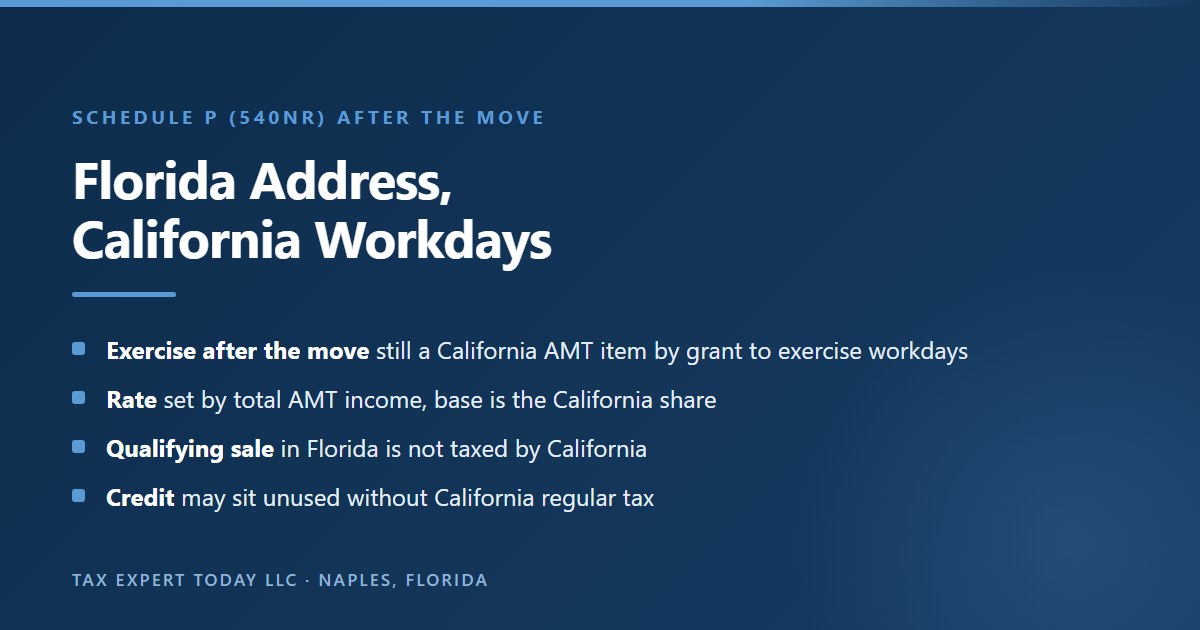
- Exercised after the move, shares held: California AMT adjustment to the extent you worked in California between grant and exercise.
- Disqualifying sale after the move: wages sourced to California by the same workday allocation; capital gain above the exercise-date value sourced to Florida.
- Credit from prior California AMT: only usable against California regular tax, which may be small or zero after the move.
| Exercise | Sale | California AMT | California regular tax at sale |
|---|---|---|---|
| While resident, held past year end | Qualifying, after the move | Full spread in the exercise year | None on the gain |
| While resident, held past year end | Disqualifying, after the move | Full spread in the exercise year | Wages to the extent of California workdays |
| After the move, held past year end | Qualifying, after the move | California workday share of the spread | None on the gain |
| After the move, held past year end | Disqualifying, later year | California workday share of the spread | Wages to the extent of California workdays |
| After the move | Same year as exercise | None | Wages to the extent of California workdays |
The table is built from Publication 1004, section D, and the Equity-Based Compensation Summary Table at the end of the publication. The summary table puts the nonresident rule in one line: on the date of ISO exercise, if the stock is not sold in the year of exercise, make an AMT adjustment, and include it to the extent services were performed in California from the grant date to the exercise date.
The general framework for leaving the state is in our leaving California taxes checklist and our guide to moving from California to Florida. On the Florida side, the arrival steps that make the move hold up are in how to establish Florida residency. The minimum tax analysis below assumes the move itself is solid; if your domicile is in question, the AMT is the least of the issues.
How Does Schedule P (540NR) Compute AMT for Nonresidents?
Schedule P (540NR) computes a total tentative minimum tax as if you were a California resident for the whole year, divides it by total AMTI to get a California AMT rate, and multiplies that rate by California AMTI, which is AMT income from California sources while nonresident plus all AMT income while resident. Regular California tax is then subtracted.
This method is required by section 17062(b)(3)(B) and (C). It mirrors the way Form 540NR computes regular tax: worldwide income sets the rate, and California income sets the base. The 2025 Schedule P (540NR) carries it out in Part II.
| Schedule P (540NR) line | What it does |
|---|---|
| Part I, line 21 | Total AMTI from all sources, as if a full-year resident |
| Line 24 | Total tentative minimum tax, line 23 times 7 percent |
| Line 25 | California AGI from Schedule CA (540NR) |
| Line 29 | California adjustments and preferences, including the California share of any ISO spread |
| Line 32 | California AMT AGI |
| Lines 33 to 39 | Prorated AMT itemized deductions |
| Line 40 | California AMTI |
| Line 42 | California AMT rate: line 41 divided by Part I, line 21 |
| Line 43 | California tentative minimum tax: line 40 times line 42 |
| Line 44 | Regular tax from Form 540NR, line 37 |
| Line 45 | California AMT: line 43 minus line 44 |
The line 29 instructions are the key to the corridor problem. They tell you to enter adjustments and preferences that relate to income shown on Schedule CA (540NR), column E, which is California-source income for any period you were a nonresident and income from all sources for any period you were a resident. An ISO adjustment that is California-source under Publication 1004 belongs on line 29, even in a year when you lived in Florida from January 1 to December 31.
- The rate uses everything: Florida wages, investment income and the full ISO spread all raise the California AMT rate.
- The base uses California only: only the California-source share is multiplied by that rate.
- Regular tax may be zero: if you have no other California income, nothing offsets the California tentative minimum tax.
- Carryovers: only California-source carryover items count, under section 17062(b)(3)(C)(iii).
The same structure applies to part-year residents. For the resident part of the year, everything goes into California AMTI. For the nonresident part, only California-source items do. Our guide to the California part-year resident tax explains how Form 540NR builds the regular side of the same computation.
Can California Tax a Florida Resident on an ISO Exercise?
Yes, through the AMT. If you exercise ISOs as a Florida resident and hold the shares past year end, Publication 1004 requires a California AMT adjustment to the extent you worked in California between the grant date and the exercise date. With little other California income, the California tentative minimum tax on that adjustment can become the entire California AMT.
Here is a hypothetical. A single filer moved from San Jose to Naples, Florida in 2024. In 2025, as a full-year Florida resident, the filer has $400,000 of taxable income from a new Florida-based role, exercises ISOs granted in 2021 with a $300,000 spread, and holds the shares into 2026. Between grant and exercise, 75 percent of the filer’s workdays were in California. The filer has no other California income. Using the 2025 figures and ignoring credits, the computation runs as follows.
| Step | Amount | Explanation |
|---|---|---|
| Total taxable income, as if resident | $400,000 | All income from all sources |
| Standard deduction added back | $5,706 | Part I, line 1 |
| Full ISO spread | $300,000 | Part I, line 10 |
| Total AMTI | $705,706 | Part I, line 21 |
| Exemption | $3,274 | $92,749 minus 25 percent of AMTI above $347,808 |
| Total tentative minimum tax | $49,170 | 7 percent of $702,432 |
| California AMT rate | 6.97 percent | $49,170 divided by $705,706 |
| California AMTI | $225,000 | 75 percent of the spread; no other California income |
| California tentative minimum tax | $15,677 | $225,000 times 6.97 percent |
| California regular tax | $0 | No California taxable income |
| California AMT | $15,677 | Owed on a Form 540NR |
The figures are rounded and illustrative. They show the point: a person who has lived in Florida for more than a year, with no California paycheck and no California property, can still owe California tax because of where options were earned. The filing requirement follows from the tax, so a Form 540NR is needed for that year.
- Trigger: exercise while nonresident and hold past December 31.
- Measure: the California workday share of the spread.
- Rate: set by total AMTI, so Florida income increases it.
- Avoidance by same-year sale: no AMT adjustment, but the California share of the spread becomes California wages instead.
That last point means there is no costless exit. A same-year sale swaps a 7 percent minimum tax for regular tax at California’s graduated rates on the California share of the spread. Which is cheaper depends on the numbers, and on whether you expect to have enough California regular tax in later years to use an AMT credit. For many people who have fully left, the AMT is the smaller bill, but the credit it creates may never be used, which changes the comparison.
How Is the ISO AMT Adjustment Sourced to California?
The same way as nonstatutory option income for regular tax: by the ratio of California workdays to total workdays between the grant date and the exercise date. Publication 1004 states that the AMT adjustment source is determined in the same manner as income from the exercise of nonstatutory stock options for regular tax purposes.
Publication 1004, section D, says this twice, once for qualifying dispositions and once for disqualifying dispositions. The workday method is the standard California allocation for equity compensation: California workdays from grant to exercise, divided by total workdays from grant to exercise, multiplied by the spread. Weekends, holidays, vacation and sick days are excluded from both counts. A remote workday is sourced to where you physically worked.
| Grant to exercise period | California workdays | Total workdays | California share of a $300,000 spread |
|---|---|---|---|
| All years worked in California | 960 | 960 | $300,000 |
| Three of four years in California | 720 | 960 | $225,000 |
| Half in California, half in Florida | 480 | 960 | $150,000 |
| Granted after the move, all work in Florida | 0 | 480 | $0 |
The workday counts in the table are hypothetical round numbers. In practice, a workday allocation needs evidence: calendars, travel records, badge data, payroll location codes. Employers often compute their own allocation for the regular tax wage reporting on Form W-2, but an ISO exercise produces no W-2 wages, so for the AMT adjustment you or your preparer usually build the allocation yourselves. Our guide to the California remote work tax covers how the FTB looks at days worked from home in another state.
- Grant date starts the window: not vesting, not the date you accepted the offer.
- Exercise date ends the window: workdays after exercise do not count for the AMT adjustment.
- Days in California on business count: a Florida resident visiting a California office accrues California workdays.
- Consistency: the same allocation should support the AMT adjustment and any later disqualifying disposition wages.
The companion question is when a grant made in California earns California workdays at all. A grant made after you moved, for work performed only in Florida, has no California workdays and no California AMT. A grant made while you were in California carries California workdays until you leave. The RSU and option sourcing rules in our California RSU tax guide use the same calendar, measured to the vesting date instead of the exercise date.
What Happens in the Move Year on a Part-Year Return?
In the move year you file Form 540NR as a part-year resident. AMT items from the resident period go into California AMTI in full, and AMT items from the nonresident period count only if California-source. An ISO exercised before the move date is fully California AMT income; one exercised after the move counts by the workday ratio.
The date of exercise, not the date of the move, controls which rule applies to a given lot. If you exercise in March and move in June, the March exercise is a resident-period item and the whole spread is in California AMTI, regardless of workdays. If you move in June and exercise in September, the September exercise is a nonresident-period item, and only the California workday share is in California AMTI. The total AMTI, which sets the rate, includes both spreads in full either way.
| Move year event | Total AMTI (rate) | California AMTI (base) |
|---|---|---|
| Salary while resident | Included | Included |
| Salary while nonresident, worked in Florida | Included | Excluded |
| ISO exercised while resident, held | Full spread | Full spread |
| ISO exercised while nonresident, held | Full spread | California workday share |
| Property taxes on a California home sold during the year | Included if itemized | Prorated through the itemized deduction lines |
- Timing a planned exercise: exercising after the move date reduces California AMTI only if some workdays between grant and exercise were outside California.
- A move does not reset the calendar: options granted in California and exercised the week after you leave are still almost entirely California-source.
- Residency evidence: the exact move date matters, so keep the documents that show it.
The residency date is where a California AMT question can turn into a residency dispute. If the FTB concludes you remained a resident until a later date, a nonresident-period exercise becomes a resident-period exercise and the whole spread is California AMTI. Our guide to the California residency audit explains how the FTB tests the date, and Florida domicile for executives covers the arrival side for people with large equity awards.
Can a Florida Resident Still Use a California AMT Credit?
Only against California regular tax that exceeds the California tentative minimum tax. A Florida resident with no California-source income has no California regular tax, so a California AMT credit carryover generally sits unused. It carries forward, and it becomes usable if California-source income returns, such as disqualifying disposition wages or other California income.
This is the part of the corridor problem that most guides miss. The AMT paid in California in the exercise year was supposed to be a prepayment that comes back as a credit. For a resident who stays, it usually does come back, in the year of a qualifying sale. For a person who exercises in California, moves to Florida, and then sells in a qualifying disposition, California does not tax the gain at all. Publication 1004, Example 6 and the paragraph before it make this explicit for a move to Illinois: an AMT adjustment in the exercise year, and no California tax on the later gain because the seller is a nonresident.
| Situation after the move | California regular tax | Credit usable? |
|---|---|---|
| No California income at all | None | No, carries forward |
| Qualifying sale of ISO shares | None on the gain | No, carries forward |
| Disqualifying sale with California workday wages | Yes, on the California share | Yes, to the extent regular tax exceeds TMT |
| California rental income or a California partnership | Yes | Yes, to the extent regular tax exceeds TMT |
| Return to California as a resident | Yes | Yes |
The FTB 3510 instructions provide for the carryover through line 31 and line 32, and nonresidents compute the limit with the exemption and other credits from Form 540NR, line 39, and the tentative minimum tax from Schedule P (540NR), line 43. The instructions do not state an expiration for the carryover. California follows the structure of IRC section 53, under which the minimum tax credit carries forward without a time limit; we read the California carryover the same way, but it is still worth tracking every year on the form.
- Do the math before the move: a large unused California credit is a cost of leaving that does not show up on any checklist.
- Disqualifying sales can unlock it: California-source wages create California regular tax for the credit to offset.
- The federal credit is unaffected: Form 8801 works the same wherever you live.
- Keep filing the carryover: if no return is required, keep the FTB 3510 computation in your file in case California income returns.
This is an area where a hedged reading of the forms matters. Whether California regular tax in a later year exceeds the tentative minimum tax in that year depends on the whole Form 540NR computation, and the result can change with any California-source item. The general direction is clear from the forms: a credit only reduces tax that exists, and a Florida resident often has none.
What Happens on a Disqualifying Disposition After You Move?
If you sell ISO shares after the move without meeting the holding periods, the transaction is treated like a nonstatutory option exercise. The spread at exercise, limited to the actual gain, is wages sourced to California by the grant-to-exercise workday ratio, and any increase above the exercise-date value is capital gain sourced to Florida.
Publication 1004, Examples 7 and 8 set out the facts for a retiree who moved to Florida. In Example 8, the employee exercised 30,000 ISOs at $10 when the shares were worth $50, while living and working in California, moved to Florida in July, and sold the following March at $60. The result for the sale year: $1,200,000 of California-source wage income, and $300,000 of capital gain sourced to Florida. The exercise year carried a $1,200,000 California AMT adjustment, and the publication notes that California may allow an AMT credit for prior year AMT.
| Publication 1004, Example 8 | Exercise year (resident) | Sale year (Florida resident) |
|---|---|---|
| Regular California income | None from the options | $1,200,000 wages, California source |
| Capital gain | None | $300,000, Florida source |
| California AMT adjustment | $1,200,000 added | AMT basis $1,500,000 reverses it |
| AMT credit | Created | Usable against California tax on the wages |
In this pattern the credit has California tax to absorb, because the disqualifying disposition creates California wages in the sale year. That is the opposite of the qualifying sale pattern, where the credit has nothing to offset. For a person deciding whether to sell before or after the holding periods end, the California AMT credit is one more input in a comparison that already includes federal capital gain rates, the California tax on the wages, and the risk of holding the stock.
- W-2 reporting: a former employer may report disqualifying disposition income in box 1 and box 16 with a California allocation; check it against your own workday count.
- Other state tax credit: if Florida had an income tax there would be double taxation to resolve, but it does not, so the issue rarely arises for Florida residents.
- Withholding: California nonresident withholding rules can apply to payments of California-source wages; see our guide to California nonresident withholding.
How Does a Qualifying Sale After the Move Affect California Tax?
A qualifying disposition of ISO shares made while you are a Florida resident produces capital gain sourced to Florida, so California does not tax it. That is true even if every day of work behind the grant was in California. The California AMT you paid in the exercise year stays paid, and the related credit may go unused.
Publication 1004 states the rule: if you exercise an ISO while a California resident or a nonresident and later sell the stock in a qualifying disposition while a nonresident, the income is characterized as income from the sale of intangible personal property with a source in your state of residence when you sold, and California does not tax it even though the services that gave rise to the grant may have been performed in California. The Equity-Based Compensation Summary Table repeats it: California will not tax the capital gain, and an AMT credit is possible.
| Item | Exercise year in California | Qualifying sale year in Florida |
|---|---|---|
| Regular California tax on the options | None | None |
| California AMT | On the full spread | None |
| California AMT credit | Created | Usually no California tax to offset |
| Federal capital gain | None | Long-term gain on sale price minus exercise price |
| Federal AMT credit | Created if federal AMT was paid | Often recovered in the sale year |
For many people this is still the best combination available. The alternative of selling in the exercise year would have produced California wages taxed at up to 12.3 percent on the whole spread. Paying 7 percent minimum tax on the spread, or less with the exemption, and then selling the shares tax-free for California purposes as a Florida resident, can cost less than a same-year sale even if the California AMT credit is never used.
- Holding periods: two years from grant and one year from exercise.
- Residency at sale: must be genuine Florida residency on the sale date, supported by the usual domicile evidence.
- The credit as a sunk cost: treat an unused California credit as part of the cost of the strategy, not as an asset you can count on.
- Federal side unchanged: the federal AMT credit and capital gain rules apply as they would anywhere.
The Florida side of a large equity sale is covered in our guide to moving to Florida before selling a business, which explains why timing the move ahead of a liquidity event matters and how the FTB tests it. If the shares are in a qualified small business, the California treatment differs from the federal treatment for a different reason; see our guide to California QSBS.
Which Timing Choices Change the California AMT Result?
Five choices drive most of the result: how much spread you exercise in a year, which month you exercise, whether you sell any shares in the same year, whether you exercise before or after a move, and in which year you plan the qualifying sale. Each changes either AMTI, the exemption, or the room to use the credit later.
| Choice | Effect on California AMT | Trade-off |
|---|---|---|
| Exercise up to the crossover each year | No AMT or very little | Takes several years; share price may rise in the meantime |
| Exercise early in the year | Keeps the same-year sale option open until December 31 | Requires cash earlier |
| Sell some shares the same year | Removes the adjustment for those shares | Those shares become wages |
| Exercise in a low-income year | More regular tax room relative to AMTI, depending on the profile | Requires planning around employment changes |
| Exercise after the move | Reduces California AMTI only by non-California workdays | No help if all workdays were in California |
| Qualifying sale after the move | No California tax on the gain | California AMT credit may be stranded |
One counterintuitive point: a low-income year does not always help with the California AMT. A lower regular income means a lower regular tax, and therefore less room before the tentative minimum tax overtakes it. The crossover depends on the gap between the two computations, not on income alone. That is why a projection for each scenario is worth more than a rule of thumb.
- Option expiration: ISOs generally expire 10 years after grant, or sooner after you leave the employer, so the calendar may force a decision.
- Post-termination window: an ISO exercised more than three months after employment ends is generally treated as a nonstatutory option, which removes the AMT question but creates wages.
- Tender offers and IPOs: a liquidity event can make a same-year sale practical when it would otherwise be impossible.
- Divorce: options transferred between spouses follow special rules; see our guide to dividing stock options in divorce.
The post-termination rule comes from IRC section 422(a)(2), which requires the option holder to be an employee from grant until three months before exercise. People who leave their employer as part of a move to Florida sometimes discover that their remaining ISOs have quietly become nonstatutory options. For California purposes, the wages at exercise are then sourced by the same workday ratio, as regular income rather than an AMT adjustment.
Should You Exercise ISOs Before or After Leaving California?
It depends on where the workdays were. If all work between grant and exercise was in California, the California share of the spread is the same before or after the move, so the move date alone does not reduce California AMT. If some workdays were outside California, exercising after the move can reduce California AMTI by that share.
The intuition many people bring to this question is wrong. They assume that exercising as a Florida resident moves the whole spread out of California. For regular income from nonstatutory options, and for the ISO AMT adjustment, California sources by where you worked between grant and exercise, not by where you live on the exercise date. A residency change helps only to the extent it is paired with work outside California during that window.
| Scenario | Exercise before move | Exercise after move |
|---|---|---|
| All grant-to-exercise work in California | Full spread in California AMTI | Full spread in California AMTI, by workday ratio of 100 percent |
| Grant in California, then 18 months working in Florida before exercise | Full spread, because a resident’s AMT items are all included | Only the California workday share |
| Grant after the move, all work in Florida | Not applicable | No California AMT |
| Rate effect | Resident computation on Schedule P (540) | Total AMTI sets the rate, so Florida income still counts |
There is one more effect worth noticing. A resident exercise is computed on Schedule P (540), where all your income is California income and regular tax is computed on all of it. A nonresident exercise is computed on Schedule P (540NR), where regular California tax may be small or zero. The nonresident may owe AMT on a smaller base but have no regular tax to absorb it, while the resident has a larger base but more regular tax. The comparison is not intuitive and needs to be modeled.
- Waiting adds Florida workdays: each Florida workday between grant and exercise lowers the California share.
- Vested options can still accrue workdays: the window runs to exercise, not to vesting.
- Stock price risk: waiting for workdays to accrue means bearing the price risk of the unexercised options.
- Option expiration: do not let the workday strategy run past the exercise deadline.
The broader residency timing issues, including how long before a liquidity event the move should happen, are covered in our California exit tax myths versus reality guide and in Florida wealth migration.
What Records Support California AMT Positions After a Move?
Keep every year’s Schedule P and FTB 3510, the Form 3921 for each ISO exercise, grant agreements showing grant dates and exercise prices, a lot-by-lot schedule of regular and AMT basis, a workday calendar from grant to exercise, and the documents that prove your move date.
| Record | Why it matters | How long to keep it |
|---|---|---|
| Prior Schedule P (540) and (540NR) | Source of AMT carryovers and credit computations | Until every carryover is used, plus the assessment period |
| FTB 3510 for each year | Shows the credit carried forward on line 31 | Until the credit is used up |
| Form 3921 from the employer | Grant date, exercise date, price and fair market value | Until the shares are sold and the return is final |
| Grant agreements and plan | Confirms ISO status and the $100,000 limit | Life of the option and shares |
| AMT basis schedule | Supports line 9 in the sale year | Until the shares are sold and the return is final |
| Workday calendar | Supports the California share on a nonresident return | Through the FTB assessment period for each affected year |
| Move date evidence | Determines resident versus nonresident period | Through any residency review |
The general California statute of limitations for an FTB assessment is four years from the filing of the return, with longer periods in specific situations. For a credit carryover, the relevant year can be open for a long time, because the FTB can examine the year that created the carryover when you use it. The practical rule is to keep AMT records until the last dollar of credit is used and that return is closed.
- Workday evidence: calendars, travel bookings, badge records, and expense reports from the grant-to-exercise window.
- Residency evidence: Florida declaration of domicile, driver license, voter registration, homestead, and the sale or lease of the California home.
- Brokerage records: supplemental statements that show ISO lots separately.
For the residency file, our Florida 183 day rule calculator and the companion guide on the dual state residency tax trap are useful starting points. On the Florida side, our guide to the Florida residency audit explains what supporting evidence looks like from the arrival state.
What Mistakes Cause California AMT Problems?
The most common mistakes are leaving the ISO spread off Schedule P because no income appeared on a W-2, forgetting the negative line 9 adjustment in the sale year, losing track of the FTB 3510 carryover, and failing to file Form 540NR for a nonresident exercise that produced California AMT.
| Mistake | Consequence | Fix |
|---|---|---|
| No line 10 entry in the exercise year | Understated AMT, possible penalty and interest | Amended return, Form 540X |
| No line 9 entry in the sale year | AMT computed on a gain already taxed, credit understated | Amended return for the sale year |
| Credit carryover not reported | Credit lost in that year | Amended return within the refund period |
| No Form 540NR after a nonresident exercise | Unfiled return and unpaid AMT | File the return and pay with interest |
| Federal AMT numbers copied to California | Wrong exemption, wrong rate, wrong credit | Recompute Schedule P separately |
| No estimated tax for the AMT | Underpayment penalty | Annualize on FTB 5805 where it helps |
The first mistake is the most common and the most understandable. Software usually prompts for the AMT adjustment only if Form 3921 is entered. If the form arrived late, went to an old address, or was overlooked, the return shows no adjustment. The FTB receives information returns and can match them. Our guide to the California amended tax return explains how to correct a prior year on Form 540X and what the refund deadlines are.
- Software carryovers: confirm that AMT basis and the credit carryover moved forward correctly when you changed software or preparers.
- Two systems, two credits: the federal Form 8801 carryover is not the California FTB 3510 carryover.
- Same-year sales: confirm no adjustment was made for shares sold in the exercise year.
- Partial sales across years: each lot needs its own basis tracking.
How Does the FTB Review AMT and ISO Reporting?
The FTB can compare employer information returns on ISO exercises with the California return and examine Schedule P entries and credit carryovers. For nonresidents, a review can test the workday allocation and the residency date. The FTB audit manual explains the AMT structure its auditors apply.
The FTB publishes its audit procedures in the Multistate Audit Technical Manual, chapter 8500, which covers the alternative minimum tax. It describes California conformity to IRC sections 55 to 59 with modifications and confirms that California did not follow the federal repeal of the corporate AMT or the 2017 changes to the NOL and AMT credit rules. The chapter is written mainly for business entities, but the mechanics it describes, adjustments, preferences, exemption, tentative minimum tax and the minimum tax credit, are the same building blocks used on the individual Schedule P.
| Review area | What the FTB may ask for |
|---|---|
| ISO exercise | Form 3921, grant agreement, exercise confirmation |
| AMT basis | Schedule of lots, exercise-date values, sale records |
| Credit carryover | Prior FTB 3510 and Schedule P for each year in the chain |
| California workdays | Calendars and travel records from grant to exercise |
| Residency date | The full domicile file, often in the same review |
If an FTB review of an ISO or residency issue produces a Notice of Proposed Assessment, there is a protest deadline printed on the notice. Our guides to the FTB notice of proposed assessment and to the FTB power of attorney explain the process and how to authorize a representative to deal with the FTB on your behalf.
- Do not ignore a notice: the protest period is short and fixed.
- Bring the whole chain: a credit carryover review may reach back several years.
- Residency and AMT together: a change to the move date changes the AMT result automatically.
Does Florida Have an Alternative Minimum Tax?
Florida has no personal income tax, so it has no individual alternative minimum tax. Article VII, section 5 of the Florida Constitution prohibits a state tax on the income of natural persons who are residents. Florida does impose a corporate income tax with its own rules, which is a separate matter.
For individuals the answer is simple: once your California-source items are behind you, your only minimum tax exposure is federal. The Florida Constitution, Article VII, section 5 bars a state tax on the income of resident natural persons except within a narrow federal credit allowance, and Florida levies no personal income tax. The Florida corporate income tax applies to corporations doing business in Florida, and it has its own computations, but it does not reach an individual’s ISO exercise.
| Tax | California resident | Florida resident |
|---|---|---|
| State regular income tax | Graduated rates up to 12.3 percent | None |
| State AMT | 7 percent on Schedule P | None at the state level |
| Surcharge above $1,000,000 | 1 percent Behavioral Health Services Tax | None |
| California tax on California-source items | All income | California-source only, including ISO AMT adjustments by workday |
| Federal AMT | Applies | Applies |
- Federal AMT still applies: the federal crossover analysis does not change with the move.
- Florida intangible tax: repealed effective 2007; see our note on the Florida intangible tax.
- Estate planning: a large ISO position is also an estate planning asset; see Florida estate planning for new residents.
How Do You Calculate California AMT Step by Step?
Start from California taxable income, add back the standard deduction or the disallowed itemized deductions, add the ISO spread and other adjustments to reach AMTI, subtract the exemption after any phase-out, multiply by 7 percent, and subtract regular tax before credits. A positive result is the California AMT, carried to Form 540, line 61.
Here is the complete computation for the resident example used earlier: a single filer, full-year California resident, $240,000 of taxable income after the $5,706 standard deduction, who exercises ISOs with a $300,000 spread in 2025 and holds the shares into 2026. The figures use the 2025 Schedule P (540) and the 2025 rate schedules, are rounded to the dollar, and ignore credits.
| Step | Schedule P (540) line | Amount |
|---|---|---|
| 1. Standard deduction added back | Line 1 | $5,706 |
| 2. ISO spread | Line 10 | $300,000 |
| 3. Total adjustments | Line 14 | $305,706 |
| 4. Taxable income from Form 540, line 19 | Line 15 | $240,000 |
| 5. AMTI | Line 21 | $545,706 |
| 6. Exemption: $92,749 minus 25 percent of ($545,706 minus $347,808) | Line 22 | $43,274 |
| 7. AMTI minus exemption | Line 23 | $502,432 |
| 8. Tentative minimum tax at 7 percent | Line 24 | $35,170 |
| 9. Regular tax before credits, Form 540, line 31 | Line 25 | $18,759 |
| 10. California AMT | Line 26 | $16,412 |
Regular tax in step 9 is $3,201.97 plus 9.3 percent of the amount over $72,724, from Schedule X. The AMT of $16,412 would be carried through Part III and to Form 540, line 61, and the full amount would generally be a deferral item that can become an FTB 3510 credit in later years, because it arose from the ISO adjustment rather than from the standard deduction. Strictly, FTB 3510, Part I recomputes the AMT using only the exclusion items; with only the standard deduction as an exclusion here, that recomputation produces no AMT, so the entire $16,412 is credit-eligible.
- Check 1: was any of the stock sold in 2025? Those shares come out of line 10.
- Check 2: do you itemize? Replace line 1 with lines 2 to 6 as they apply.
- Check 3: any credits? Run Part III to see which survive the tentative minimum tax.
- Check 4: estimated tax: the AMT counts toward the safe harbor, so pay it with the installments or annualize.
- Check 5: run the federal Form 6251 separately; do not assume the two agree.
For a nonresident or part-year resident, continue on Schedule P (540NR), Part II, line 25 and onward, using the California-source share of each item, as shown in the Florida resident example earlier. Our guide to the California bonus tax rate is a useful companion for anyone whose equity income also includes cash bonuses, because supplemental wage withholding at 10.23 percent may cover part of the regular tax but never any of the AMT.
California AMT Help in Naples & Southwest Florida
California AMT help Naples FL: Tax Expert Today works with people who hold incentive stock options from California employers and now live in Naples, Florida, or who are planning the move. We model the California and federal AMT for each exercise scenario, compute the California workday share for nonresident exercises, prepare Schedule P (540NR) and FTB 3510 with the correct carryovers, and coordinate the residency evidence that supports the move date.
Tax Expert Today LLC is a multidisciplinary firm of tax advisors, enrolled agents, CPAs, and attorneys handling state residency and tax matters nationwide. Our office is at 11983 Tamiami Trail N, Naples FL 34110, and you can reach us at (239) 441-2005, Monday through Friday, 10:00 to 5:00 Eastern Time. California returns are filed electronically, so we prepare them for clients across Southwest Florida, including Naples, Bonita Springs, Marco Island and Fort Myers, as well as clients still living in California.
- Exercise planning: the California and federal crossover for each year of a multi-year exercise plan.
- Move year returns: part-year Form 540NR with Schedule P (540NR) and the correct resident and nonresident split.
- Nonresident exercises: workday allocation and California AMT for options exercised after the move.
- Credit tracking: FTB 3510 carryovers and whether a disqualifying disposition would let you use them.
- Corrections: amended returns for missed line 10 or line 9 entries.
| Service | What we deliver |
|---|---|
| ISO exercise projection | California and federal AMT side by side for each scenario |
| Nonresident return | Form 540NR, Schedule P (540NR), workday schedule |
| Credit review | FTB 3510 chain from the first AMT year forward |
| Residency file | Coordinated with the Florida arrival steps |
Related pages: California tax services, Naples, Florida tax planning, and our guide to nonqualified deferred compensation for executives whose packages include deferred pay as well as options.
Local FAQ: I moved from Palo Alto to Naples in 2025 and exercised ISOs from my old California employer this year. Do I really owe California anything? Possibly, if you held the shares past December 31. California treats the AMT adjustment for an ISO exercised by a nonresident as California-source to the extent you worked in California between the grant date and the exercise date. If most of that window was spent in California, a Form 540NR with Schedule P (540NR) may be required even though you live in Florida and have no California paycheck. Bring your Form 3921, your grant agreement and a calendar of where you worked, and we can run the computation from our Naples office.
When to Engage a Professional
Consider professional help before exercising ISOs with a spread above your crossover, before moving out of California with unexercised or recently exercised ISOs, when you hold an FTB 3510 carryover and plan a qualifying sale as a Florida resident, or when a prior return may have missed the ISO adjustment. These are the situations where the answer depends on your numbers, your dates and your workdays rather than on a general rule.
- Large exercises: where the California and federal AMT both apply and interact with estimated tax.
- Interstate moves: where the exercise date, the move date and the workday calendar all matter.
- Stranded credits: where a disqualifying disposition or other California income might unlock a carryover.
- Past errors: where an amended return or a response to an FTB notice is needed.
To talk through your situation, contact Tax Expert Today or call (239) 441-2005. This guide is general information about California and federal tax law as of November 10, 2026, using the 2025 California forms and the 2026 federal figures. It is not legal or tax advice for your situation, it does not create a client relationship, and the examples are hypothetical. Securities and investment decisions about whether to exercise or sell should be made with your financial advisor.
Frequently Asked Questions About California AMT
What is the California AMT rate?
The California AMT rate is 7 percent of alternative minimum taxable income above the exemption amount, under R&TC section 17062. The rate has been 7 percent for every taxable year beginning on or after January 1, 2011. Inside the exemption phase-out band, each additional dollar of AMTI effectively costs 8.75 cents.
What is the California AMT exemption for 2025?
For 2025 the exemption is $92,749 for single and head of household filers, $123,667 for married couples filing jointly and $61,830 for married filing separately. It phases out by 25 percent of AMTI above $347,808, $463,745 and $231,868, and reaches zero at $718,804, $958,413 and $479,188.
Do incentive stock options trigger California AMT?
Yes, when you exercise and hold the shares past December 31. The spread between the fair market value and the exercise price is added on Schedule P (540), line 10, even though it is not regular income. If you sell the shares in the same calendar year you exercise, no AMT adjustment is required.
How do I get California AMT back?
AMT caused by timing items such as an ISO exercise can become a credit on form FTB 3510 in later years. The credit only offsets regular tax above the tentative minimum tax, so it is usually recovered in the year of a qualifying sale or over several later years. Unused credit carries forward.
Can I owe California AMT after moving to Florida?
Yes. If you exercise ISOs as a Florida resident and hold the shares past year end, Publication 1004 requires a California AMT adjustment to the extent you worked in California between grant and exercise. The tax is computed on Schedule P (540NR) using a rate set by your total AMT income.
Can I use a California AMT credit after I move?
Only against California regular tax that exceeds your California tentative minimum tax. A Florida resident with no California-source income has no California regular tax, so the credit generally carries forward unused until California income returns, for example through a disqualifying disposition of California-sourced ISO shares.
Does California tax my ISO gain if I sell after moving to Florida?
Not in a qualifying disposition. Publication 1004 treats that gain as income from intangible property sourced to your state of residence when you sell. In a disqualifying disposition, the spread at exercise is wages sourced to California by workdays, and only the later appreciation is sourced to Florida.
Is the California AMT the same as the federal AMT?
No. California uses a flat 7 percent rate, a smaller exemption with a 25 percent phase-out beginning at $347,808 for single filers in 2025, and the federal AMT rules as of January 1, 2015. The 2026 federal AMT uses 26 and 28 percent rates and a $90,100 single exemption phasing out from $500,000.
Does the Behavioral Health Services Tax count in the AMT comparison?
No. The comparison uses regular tax before credits from Form 540, line 31. The 1 percent Behavioral Health Services Tax on taxable income above $1,000,000 is reported separately on line 62 and applies in addition to regular tax or AMT.
Can a Naples, Florida advisor prepare my California Schedule P?
Yes. California part-year and nonresident returns, including Schedule P (540NR) and FTB 3510, are filed electronically with the Franchise Tax Board, so the preparer does not need to be in California. A Naples, Florida advisor can compute the workday share, the AMT and the credit carryover.
Published November 10, 2026 by Dr. Pellumb Kabashi « Back to Learning Center
Have a question this article touches on?
Tax Expert Today LLC, based in Naples, Florida and serving clients across the United States.
Schedule a Consultation (239) 441-2005