
By Dr. Pellumb Kabashi, DBA, MBA, CES, CFE, EA
Founder, Tax Expert Today LLC · Tax advisors, enrolled agents, CPAs, and attorneys · Serving clients in all 50 states
Quick Answer: The California PTET is an elective entity-level tax of 9.3 percent that a partnership or S corporation pays on its qualified net income, giving owners a nonrefundable California credit and the entity a federal deduction. Senate Bill 132 extended the regime through 2030 and replaced the old June 15 rule that killed a late election with a 12.5 percent credit reduction instead. Call (239) 441-2005 for a free consultation.
Almost everything published about the California PTET was written for a world that no longer exists. The guides describe a $10,000 federal deduction cap that has since been raised, and a June 15 deadline that used to destroy an election but no longer does. Two separate changes, one in Sacramento and one in Washington, have moved both halves of the calculation within the last year, and most of the material sitting on page one of a search result still reflects the old arithmetic on at least one of them.
The question that matters now is narrower than the one the older guides answer. The election still exists, and it still works. What has changed is who it actually helps, and by how much. That turns on a federal number that now varies with the owner’s income rather than sitting flat at $10,000, and on a California regime that was rebuilt from scratch rather than merely extended.
What is the California PTET election?
The California PTET, or pass-through entity elective tax, lets a qualifying partnership or S corporation choose to pay California income tax at the entity level at 9.3 percent of its qualified net income. The entity deducts that payment federally, which reduces the income reported to owners, and each consenting owner claims a nonrefundable California credit for their share of the tax the entity paid.
- It is elective, not mandatory. No entity is required to make it, and the decision is made fresh each year.
- It is an entity-level tax. The partnership or S corporation writes the check, which is what creates the federal deduction that individual owners could not get on their own.
- It is annual and irrevocable. Once made for a year, it binds every partner, shareholder, or member, consenting or not.
- It is a workaround, not a rate cut. The credit gives owners back the California tax, so the benefit is federal rather than a reduction in what California collects.
- California adds the deduction back. If the entity deducts the elective tax federally, that amount is added back in computing the entity’s California net income.
The mechanism exists because of a federal limit on the itemized deduction for state and local taxes. An individual who pays California income tax personally can deduct it federally only within that limit. A business entity that pays state income tax is not subject to that individual limit at all. The election moves the payment from the individual to the entity, which is why it produces a federal benefit without changing what California ultimately receives.
What did Senate Bill 132 change for 2026 through 2030?
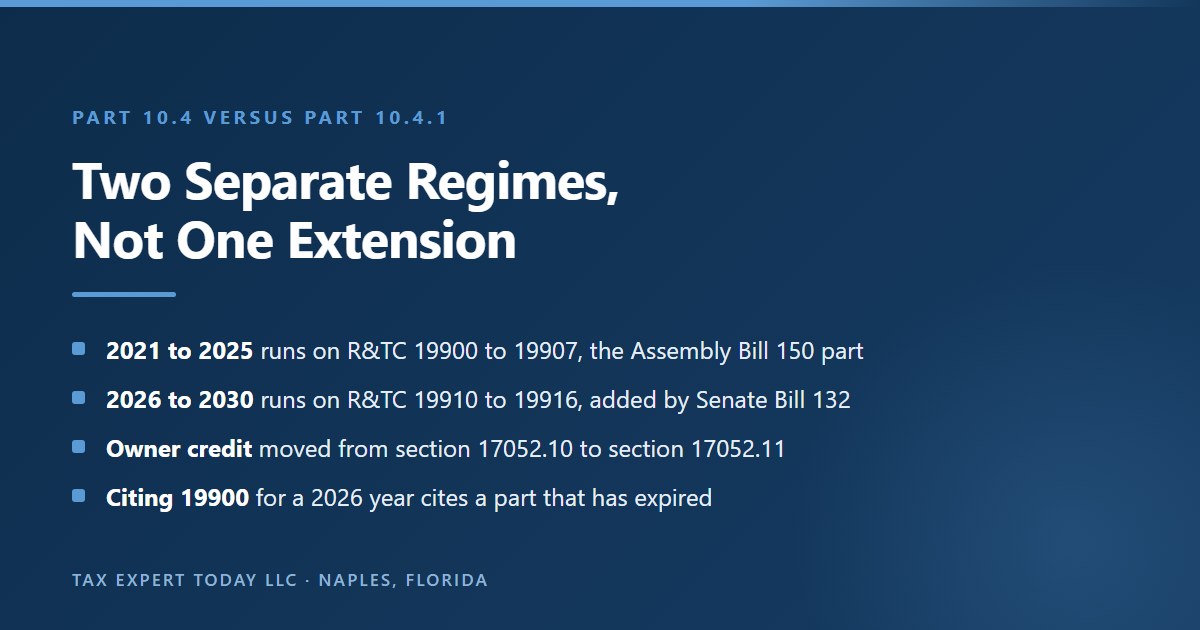
Senate Bill 132 did not extend the original statute. It created an entirely new part of the Revenue and Taxation Code, Part 10.4.1 beginning at section 19910, that governs taxable years 2026 through 2030, with a parallel new credit section at 17052.11. The original Assembly Bill 150 regime at Part 10.4 still governs 2021 through 2025 and was allowed to expire.
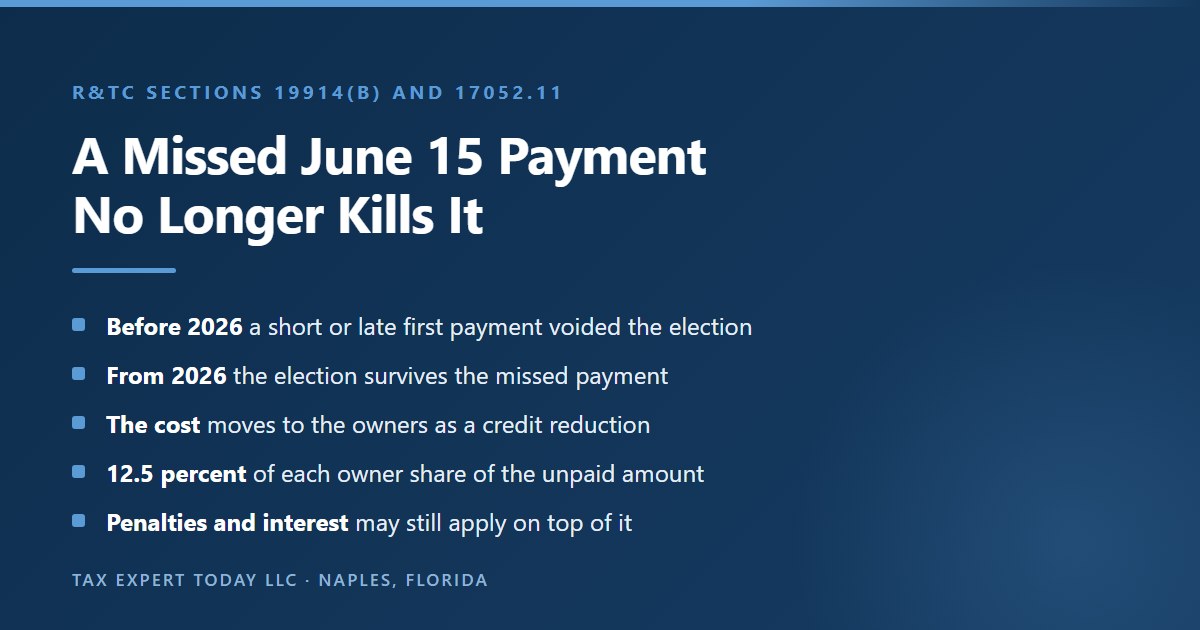
- A missed June 15 payment no longer voids the election. Section 19914(b) permits the election even when the first payment is short or late.
- The penalty moved to the credit. Owners instead reduce their credit by 12.5 percent of their share of the unpaid amount.
- Fiscal year mismatches were addressed. The credit is allowed where the electing entity and the owner have different taxable year beginnings.
- The citations changed. A 2026 election is made under Part 10.4.1, and a practitioner citing section 19900 for a 2026 year is citing the expired part.
That last point is more than pedantry. The two parts are not identical, and guidance written against the old one describes a consequence that no longer follows. This is the single most common error in currently published material on the topic.
| Feature | 2021 to 2025 (Part 10.4, AB 150) | 2026 to 2030 (Part 10.4.1, SB 132) |
|---|---|---|
| Governing statute | R&TC 19900 to 19907 | R&TC 19910 to 19916 |
| Owner credit section | R&TC 17052.10 | R&TC 17052.11 |
| Rate | 9.3% | 9.3% |
| June 15 payment missed | Election not available for that year | Election still available |
| Consequence of missing it | Loss of the entire election | Credit reduced by 12.5% of the unpaid share |
| Credit ordering | R&TC 17039(a)(7) | R&TC 17039(a)(8) |
Who qualifies to make the California PTET election?
A qualifying entity is one taxed as a partnership or an S corporation. Publicly traded partnerships and entities that are permitted or required to be part of a combined reporting group are excluded. A qualified taxpayer who can receive the credit is an individual, fiduciary, estate, or trust subject to California personal income tax, and each must consent to have their full share included.
- Consent is per owner and controls the base. Only consenting owners’ shares go into qualified net income, so a non-consenting owner shrinks the entity’s elective tax and receives no credit.
- Corporations and partnerships cannot be qualified taxpayers. An entity owned partly by a corporation can still elect, but that corporate owner’s share stays out.
- One disregarded entity does qualify. A single member LLC owned by an individual, fiduciary, estate, or trust subject to California tax can receive the credit.
- A disregarded entity cannot be the electing entity. It is not taxed as a partnership or S corporation, so it cannot elect on its own.
- Trusts can be qualified taxpayers. A trust within the section 17004 definition qualifies, and a grantor trust may generally pass the credit to the grantor.
The consent requirement is where most entities lose value without noticing. An owner who does not consent is not merely neutral. That owner’s income stays outside qualified net income, which lowers the entity’s deduction, while the consenting owners carry the full administrative burden. Entities with owners in different states, or with one owner who has left California, are the ones where this comes up.
Who cannot receive the California PTET credit?
The credit reaches individuals, fiduciaries, estates and trusts subject to California personal income tax, plus one narrow disregarded entity. Corporations, partnerships, and disregarded business entities generally cannot be qualified taxpayers, so their share of the income produces no credit even when the entity itself is free to elect.
| Owner | Qualified taxpayer? | Practical note |
|---|---|---|
| Individual | Yes | Must be subject to California personal income tax and must consent |
| Fiduciary, estate or trust | Yes | A trust within the section 17004 definition qualifies |
| Single member LLC owned by an individual, fiduciary, estate or trust | Yes | The one disregarded entity that can receive the credit |
| Any other disregarded business entity | No | Its partners and members generally cannot claim it either |
| Corporation | No | Its share stays outside qualified net income |
| Partnership | No | A partnership owner does not stop the entity from electing |
Two consequences follow that are easy to miss. An entity is still a qualifying entity even when one of its owners is a disregarded entity, so the presence of such an owner does not block the election for everyone else. And a grantor trust may consent, with the grantor generally claiming the resulting credit on their own return.
How is the California PTET calculated and paid?
The elective tax is 9.3 percent of qualified net income, which is the sum of each consenting owner’s pro rata or distributive share and guaranteed payments subject to California personal income tax. Payment comes in two installments: a first payment on or before June 15 of the election year, and the remainder by the original return due date without regard to extensions.
- The June 15 amount is formulaic. It is the greater of $1,000 or 50 percent of the elective tax paid for the prior taxable year.
- Prior year income drives the current year payment. An unusual income year raises the following year’s required first payment, and there is no statutory exception for that.
- Entity asset sales count, owner interest sales do not. Gain from the entity selling an asset is in qualified net income. Gain on an owner selling their interest is not.
- Guaranteed payments are included. Payments described in Internal Revenue Code section 707(c) form part of the base.
- Payments must be kept separate. The elective tax cannot be combined with the entity’s other tax payments, and must go through Web Pay or Form FTB 3893.
| Payment | Due | Amount |
|---|---|---|
| Payment 1 | On or before June 15 of the taxable year of the election | Greater of $1,000 or 50% of the prior year elective tax paid |
| Payment 2 | Original return due date, without regard to extensions | The remaining balance |
Where the statutory due date falls on a weekend or a legal holiday, a payment made the next business day is treated as made on the statutory date.
What counts as qualified net income?
Qualified net income is the sum of each consenting owner’s pro rata or distributive share and guaranteed payments that are subject to California personal income tax. It is built from the owners who consent, not from the entity’s whole income, and for a nonresident owner it includes only the portion that California sourcing rules reach.
- Only consenting owners are in the base. An owner who does not consent contributes nothing to qualified net income and receives no credit.
- Guaranteed payments are included. Payments described in Internal Revenue Code section 707(c) form part of the base alongside the distributive share.
- An entity asset sale is in. Gain from the entity selling an asset flows into each owner’s share and is captured.
- An owner selling their interest is out. Gain on disposing of a partnership or LLC interest, or S corporation stock, is owner level income excluded from the base.
- Nonresident shares are sourced first. A consenting nonresident contributes only the share that is subject to California personal income tax under the applicable sourcing rules.
The Franchise Tax Board describes where the figures generally come from on each Schedule K-1, which is the fastest way to sanity check a calculation before it is filed.
| Entity type | Schedule K-1 | Generally the sum of |
|---|---|---|
| S corporation | Schedule K-1 (100S) | Income and loss lines 1 through 10, less deduction lines 11 and 12 |
| Partnership or LLC | Schedule K-1 (565 or 568) | Income and loss lines 1, 2, 3 and 4c through 11, less deduction lines 12 and 13 |
For a former California resident, the sourcing step is the one that decides the number. Our guide to California source income sets out how each category is sourced, and the California part year resident return guide covers the year of the move, when part of the same income is resident income and part is not.
What happens if the June 15 payment is missed?
For taxable years 2026 through 2030, missing or underpaying the June 15 payment no longer costs the election. Section 19914(b) preserves it. Instead, each qualified taxpayer reduces the PTET credit by 12.5 percent of their pro rata share of the amount that was due on June 15 and not paid. The reduction falls on owners, not on the entity.
The Franchise Tax Board publishes a worked example that is worth following closely, because the reduction is measured against the shortfall rather than against the tax.
| Step | Figure | Source of the number |
|---|---|---|
| 2025 qualified net income | $500,000 | Four consenting partners |
| 2025 elective tax paid | $46,500 | $500,000 × 9.3% |
| 2026 required June 15 payment | $23,250 | 50% of the prior year elective tax |
| 2026 June 15 payment actually made | $10,000 | Entity paid short |
| Shortfall | $13,250 | $23,250 less $10,000 |
| 2026 qualified net income | $300,000 | Only three partners consent, $100,000 each |
| 2026 elective tax | $27,900 | $300,000 × 9.3% |
| Each partner’s unreduced credit | $9,300 | $100,000 × 9.3% |
| Each partner’s reduction | $552 | 12.5% × $13,250 × ($100,000 / $300,000) |
| Each partner’s allowed credit | $8,748 | $9,300 less $552 |
Two features of that arithmetic deserve attention. The reduction is proportionate to each owner’s share of qualified net income, so a change in who consents between years changes how the shortfall is spread. And the reduction is permanent for that year, unlike a penalty that could be abated. Separately, the Franchise Tax Board notes that failure to make required payments may still result in penalties and interest, so the credit reduction is not necessarily the only cost.
Does the California PTET election still help after the federal SALT cap changed?
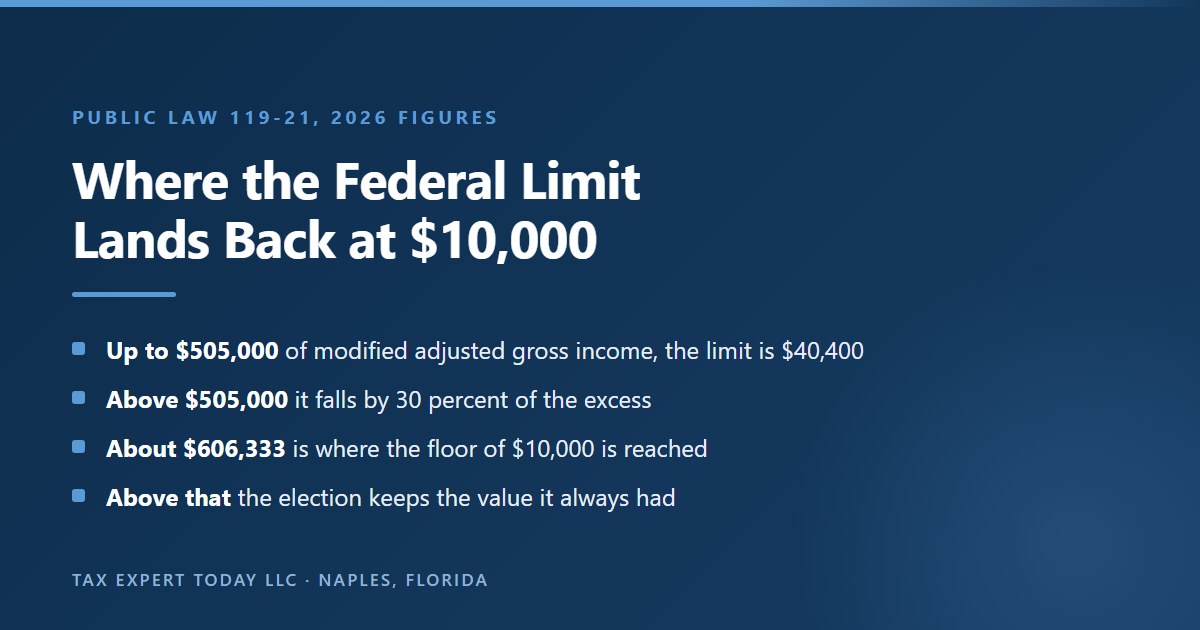
It helps far less for owners with moderate income and just as much as before for owners with high income. Public Law 119-21 raised the federal state and local tax deduction limit to $40,400 for 2026, but phases it down by 30 percent of modified adjusted gross income above $505,000, and never below $10,000. High earners land back on the old $10,000 floor.
- Below the threshold, the case weakened. An owner under $505,000 of modified adjusted gross income now has a $40,400 limit rather than $10,000, so much more state tax is already deductible without any election.
- Above roughly $606,000, nothing changed. At that point the phase-down has fully consumed the increase and the limit is back at $10,000.
- The middle band is where judgment is required. Between the two figures, the marginal value of the election rises as income rises.
- The relief is temporary. The limit is scheduled to reset to $10,000 for most taxpayers beginning in 2030, which is also when this California regime expires.
- The election may itself lower modified adjusted gross income. Because the entity deducts the tax, the owner’s reported income falls, which can matter near the phase-down range.
The phase-down floor is arithmetic rather than opinion. The 2026 limit of $40,400 exceeds the $10,000 floor by $30,400. At a reduction rate of 30 percent of the excess, that gap closes once modified adjusted gross income exceeds the $505,000 threshold by about $101,333, which is roughly $606,333 of modified adjusted gross income. Married taxpayers filing separately work from halved figures throughout.
| Owner’s 2026 modified adjusted gross income | Federal SALT limit | Practical effect on the election |
|---|---|---|
| Up to $505,000 | $40,400 | Much state tax is already deductible, so the marginal benefit is smaller than it was |
| $505,000 to about $606,333 | Between $10,000 and $40,400 | Benefit grows as income rises through the band |
| Above about $606,333 | $10,000 | Effectively the pre-2025 position, and the election retains its original value |
| 2030 and later, as scheduled | $10,000 | California regime also expires for years beginning in 2031 |
This is the part that current guidance most often gets wrong, in both directions. Material written before the federal change assumes every California pass-through owner benefits. Material written immediately after it sometimes suggests the workaround is finished. Neither is accurate. The election is now a calculation that depends on a specific owner’s income rather than a default that applies to everyone, and in an entity with several owners at different income levels the answer is not uniform across the group.
An illustration makes the band concrete. The figures below are hypothetical and are used only to show how the limit moves; they are not a projection for any particular taxpayer, and an actual result depends on the full return.
| Hypothetical owner | Modified adjusted gross income | Reduction at 30 percent of the excess | 2026 federal limit | What that means for the election |
|---|---|---|---|---|
| Owner A | $400,000 | None, below the threshold | $40,400 | State and local taxes may already fit inside the limit, so the election does less work |
| Owner B | $550,000 | $13,500 | $26,900 | Partial room remains, and the election covers what sits above it |
| Owner C | $606,333 | $30,400 | $10,000 | The floor is reached exactly here |
| Owner D | $800,000 | $88,500, limited by the floor | $10,000 | Effectively the pre-2025 position, so the election retains its original value |
Take Owner D a step further. Suppose that owner holds a share of a California S corporation producing a distributive share of $300,000. If the entity elects, it pays 9.3 percent of that qualified net income, which is $27,900, and deducts the payment federally, which reduces the income reported on the Schedule K-1. The owner then claims a $27,900 California credit, subject to the ordering rules. Without the election, the same California tax would have sat on the owner’s own return against a limit of $10,000. Owner A faces a materially different calculation on the same facts, which is precisely why a single entity level recommendation tends not to survive contact with the owner list.
Two cautions belong alongside that arithmetic. California adds the federal deduction back in computing the entity’s California net income, so the benefit is federal only. And the reduction is measured on modified adjusted gross income, which the election itself can move, so the calculation is not perfectly static.
How does the PTET credit interact with other credits?
The credit is nonrefundable, carries forward up to five years, and is applied after the other state tax credit. It may reduce tax below the tentative minimum tax, which was a real limitation when the regime began and was removed by Senate Bill 113. Where an owner claims both credits, the other state tax credit calculation must be adjusted.
- The tentative minimum tax is no longer a ceiling. The Franchise Tax Board states directly that the credit may reduce tax due below the tentative minimum tax.
- Ordering is fixed by statute. The credit sits in section 17039(a)(8) for 2026 and later, applied after the other state tax credit.
- The other state tax credit needs an adjustment. Net tax payable must be increased by the PTET credit that reduced net tax before the other state tax credit is computed.
- Unused credit survives the regime. The five year carryover period is not shortened by the expiration of the elective tax itself.
- An incorrect amount is simply disallowed. Reporting more credit than the entity supports on Form FTB 3804-CR results in the excess being denied.
The tentative minimum tax point is worth flagging because it is the most persistent piece of stale advice in this area. When the election was new, the credit could not reduce tax below the tentative minimum tax, which made it useless for a meaningful group of taxpayers. That restriction is gone. Guidance that still carries the warning is describing the 2021 rules.
What happens to the California PTET after an owner leaves California?
A nonresident owner can still be a qualified taxpayer and can still consent, because qualified net income includes a consenting nonresident’s California-sourced share determined under the ordinary sourcing rules. The credit, however, is available only on that owner’s individual California return. It cannot be claimed on a nonresident group return, which is the channel many departing owners otherwise prefer.
- Sourcing decides the base. Only the portion of a nonresident owner’s share that is subject to California personal income tax enters qualified net income.
- The group return closes the door. The entity may still file one, but the credit is not a flow-through item and cannot appear on it.
- Filing individually becomes the price of the credit. An owner who leaves California and wants the credit files a nonresident return rather than joining the group filing.
- Selling the interest is outside the base. Gain on disposing of a partnership interest or S corporation stock is owner-level income excluded from qualified net income.
- An entity asset sale is inside it. Gain from the entity selling an asset flows into each owner’s share and is included.
For an owner who has moved to Florida and still holds an interest in a California business, this sits alongside several other California obligations that survive the move. Our guide to California source income covers what stays taxable after a departure, and the California nonresident withholding guide covers the separate withholding that applies to payments made to nonresident owners. The two interact, because withholding and the elective tax are separate obligations on overlapping income.
Which forms apply to the California PTET?
Three forms carry the regime. Form FTB 3804 calculates the elective tax and makes the election with the entity’s timely filed original return. Form FTB 3804-CR claims the credit on the owner’s personal return. Form FTB 3893 is the payment voucher used for both the June 15 payment and the balance.
| Form | Filed by | Purpose |
|---|---|---|
| FTB 3804 | The electing entity | Calculates the elective tax, makes the election, and for 2026 calculates any reduced credit |
| FTB 3804-CR | The qualified taxpayer | Claims the credit on the individual California return |
| FTB 3893 | The electing entity | Payment voucher for the June 15 payment and the remaining balance |
The election cannot be made on an amended return, which makes the original filing deadline the real decision point. An entity that files late, or that files an original return without Form FTB 3804 attached, has no route back to the election for that year.
Can the election be made on a superseding return?
Yes, and this is the only second chance the regime offers. The election cannot be made on an amended return, but a superseding return replaces the original and is treated as if it were the original. A return is superseding only where both filings came before the original due date, or where both the original and the later return were filed on extension.
- Superseding replaces, amended corrects. That distinction, not the label on the form, decides whether the election is available.
- Extension status carries through. A return filed on extension can be superseded by a later return filed before the extended due date.
- Crossing the original due date breaks it. A first return filed on time followed by a later return after that date is an amended return, and the election is gone.
- It works both ways. Where a return is genuinely superseding, the election can be made or revoked on it.
- The extended due date is the outer wall. Nothing filed after it can carry the election.
| First return filed, no election | Second return filed, with election | Treated as | Election |
|---|---|---|---|
| Before the original due date | Before or on the original due date | Superseding | Allowed |
| On or before the original due date | After the original due date, on or before the extended due date | Amended | Not allowed |
| On or before the original due date | After the extended due date | Amended | Not allowed |
| After the original due date, on or before the extended due date | After the original due date, on or before the extended due date | Superseding | Allowed |
| Before or after the original due date | After the extended due date | Amended | Not allowed |
The fourth row is the one worth committing to memory. An entity that extends, files without the election, and then reconsiders can still elect, provided the second return lands before the extended due date. An entity that filed on time and then reconsidered cannot.
What happens if the entity’s income changes after the election?
The election itself is frozen, but qualified net income is not. Where a later adjustment increases it, the entity must file an amended return to increase the elective tax and pay the additional amount, with penalties and interest applying to the underpayment. Owners then amend to claim the increased credit.
- The entity carries the correction. An increase in qualified net income requires an amended return and an additional payment.
- Owners follow with their own amendments. Each revises the credit on the corrected qualified amount.
- A decrease is also handled by amendment. The entity files an amended Form FTB 3804 to request a refund of the overpayment, provided a valid election was made on the original return.
- Next year’s first payment can move. Because the June 15 amount is measured on the prior year elective tax, an upward adjustment can raise it.
- Consent cannot be revisited. The entity cannot amend Form FTB 3804 to change who consented, only to correct the income figure.
That last pairing is the trap. The numbers stay correctable while the people do not, so the consent decision deserves more attention at filing time than the arithmetic does.
How does the election affect estimated tax and withholding?
The elective tax is excluded from the entity’s own estimated tax computation under section 19136, while the credit does reduce the estimated payment computation for owners. The election has no effect at all on the separate 7 percent nonresident withholding requirement, and the credit cannot be applied against the 1 percent behavioral health services tax.
- Entity estimated tax excludes it. The elective tax liability is not part of the entity’s underpayment calculation under section 19136.
- Owner estimated tax includes it. The credit does reduce the computation of estimated payments for qualified taxpayers.
- Nonresident withholding is untouched. The Franchise Tax Board states that the election does not affect the 7 percent withholding requirement.
- The behavioral health surcharge is carved out. Section 17043(c)(1) keeps the 1 percent charge outside the credit’s reach.
- Payment method matters for some filers. Where an entity subject to mandatory electronic payment pays by check, penalty relief depends on establishing reasonable cause.
The withholding point produces the most common surprise. An electing entity with nonresident owners still withholds, so the same income can carry both an entity level elective tax payment and a separate withholding obligation. Our guide to California nonresident withholding explains why a payment arrives short and how Forms 587, 588 and 590 interact. The behavioral health carve out matters for high income owners specifically, and the surcharge itself is covered in our guide to the California tax on income over one million dollars.
What is the deadline calendar for a 2026 election?
Four dates govern a 2026 election. June 15 carries the first payment, the original return due date carries both the balance and Form FTB 3804, the extended due date is the last point a superseding return can still make the election, and the owner claims the credit with their own return on Form FTB 3804-CR.
| Date | What is due | Consequence of missing it |
|---|---|---|
| June 15 of the election year | Payment 1, the greater of $1,000 or 50 percent of the prior year elective tax | Election survives, but the owner credit is reduced by 12.5 percent of the unpaid share |
| Original return due date, no extension | Payment 2 and Form FTB 3804 with the entity return | The election is not made on a return filed after this point unless a superseding return applies |
| Extended due date | The outer limit for a superseding return that carries the election | Nothing filed after this can make the election for the year |
| Owner return due date | Form FTB 3804-CR with the individual California return | An owner who consented but did not claim may generally amend |
The June 15 date is measured against the prior year, which is why a strong year creates an obligation in the following one. Where the statutory date falls on a weekend or a legal holiday, payment on the next business day is treated as timely.
How does California compare with other state elective taxes?
California was early rather than unique. Many states adopted an elective entity level tax after the federal deduction limit arrived, and the designs differ on the points that decide value: the rate, whether the election binds every owner, whether nonresidents are swept in, and whether the credit is refundable. Multistate owners cannot assume one state’s answer travels.
- Rate design varies. California applies a single 9.3 percent rate rather than a graduated one.
- Binding effect varies. The California election binds consenting and non consenting owners alike once it is valid.
- Credit treatment varies. The California credit is nonrefundable with a five year carryover.
- Interaction with the other state tax credit is its own question. An owner claiming both must adjust the calculation.
- Sunset dates differ. The California regime runs to taxable years beginning before January 1, 2031.
An owner with interests in more than one state therefore runs the analysis separately for each. Our guide to the Georgia pass-through entity tax covers a neighbouring design and shows how different the details can be on the same underlying idea.
California PTET help Naples and Southwest Florida
Tax Expert Today LLC works with clients in Naples, Florida and across Southwest Florida who hold an interest in a California partnership or S corporation, and with California owners who have not moved at all. Our team of tax advisors, enrolled agents, certified public accountants, and attorneys handles state residency and tax matters nationwide. A California elective tax question does not become a Florida question because the owner now files from a Florida address, and it does not resolve itself when an entity has owners in several states.
The work on an engagement like this usually follows the same order. Establish which owners are qualified taxpayers and which cannot be, model the federal benefit at each owner’s own modified adjusted gross income rather than at the entity level, confirm what the prior year elective tax makes the June 15 payment, and decide whether a shortfall and its 12.5 percent credit consequence is acceptable before the date passes rather than afterward. Where an owner has left California, the group return question gets settled in the same conversation.
The office is at 11983 Tamiami Trail N, Naples FL 34110. The telephone number is (239) 441-2005 and office hours are Monday through Friday, 10:00 to 5:00 Eastern Time. Consultations are available in person and remotely. Our California tax services page describes the state side of the practice, and our Naples tax planning page covers the Florida side.
Local question: I moved from California to Naples and still own a quarter of a California LLC. Should I consent to the PTET election? It depends on figures that belong to you rather than to the entity. Your consent adds your California-sourced share to the entity’s qualified net income, and the credit that comes back is claimable only on your own nonresident California return, not on a group return the entity might otherwise file for its nonresident owners. Whether the federal deduction is worth that depends on where your modified adjusted gross income sits relative to the phase-down range. Owners in the same entity can reasonably reach different answers.
The elective tax is rarely the only California item left open after a move. Our moving from California to Florida guide maps the whole corridor, the leaving California taxes checklist covers breaking domicile, and the California residency audit guide covers what the Franchise Tax Board reviews if it disagrees that the move happened.
When to engage a professional
Several situations on this topic reward professional handling rather than a default election.
- Owners sit at very different income levels. The federal benefit is measured owner by owner, and a single recommendation for the whole group is unlikely to be right for all of them.
- An owner has left California. The group return limitation and the sourcing of that owner’s share both need to be settled before consent is given.
- The prior year was unusual. A high income year sets a high required June 15 payment for the following year, with no statutory exception available.
- The June 15 payment was short. The election survives, but the 12.5 percent credit reduction and any penalties and interest should be quantified rather than assumed to be small.
- The entity has a corporate or partnership owner. Those owners cannot be qualified taxpayers, which changes both the base and the economics for everyone else.
- Another state is also involved. The other state tax credit adjustment and the credit ordering rules interact, and several states now run their own elective regimes.
Tax Expert Today LLC can model the election at the owner level, confirm which statutory part applies to the year in question, and prepare the entity and individual filings. Call (239) 441-2005 to discuss a California entity.
Frequently asked questions
Is the California PTET the same as the $800 franchise tax? No. They are separate obligations and neither replaces the other. The annual franchise tax is a minimum tax owed by the entity regardless of income. The elective tax is voluntary, is measured at 9.3 percent of qualified net income, and produces a credit for owners. Our California LLC franchise tax guide covers the mandatory side.
Can an LLC make the California PTET election? Only if it is taxed as a partnership or an S corporation. An LLC treated as a disregarded entity cannot elect, because it is not taxed as either. Entity classification is therefore the first question, and it is one of the practical differences discussed in our California LLC versus S corporation comparison.
Is the California PTET election revocable? No. Once a valid election is made for a taxable year it is irrevocable for that year and binds all partners, shareholders, and members, including those who did not consent. The entity cannot later amend Form FTB 3804 to revoke it or to change who consented, although it must revise qualified net income if subsequent adjustments change it.
What happens to unused California PTET credit? It carries forward for up to five years. The Franchise Tax Board confirms that the carryover period is not affected by the expiration of the elective tax itself, so credit generated in a year the regime was operative remains usable within its carryover window.
Does the California PTET election reduce California tax? Not in substance. The entity pays the tax and consenting owners receive a matching nonrefundable credit, so the state collects broadly the same amount. The benefit is federal, arising because the entity can deduct a state income tax payment that individual owners could deduct only within the federal limit.
Do I still need to make California estimated payments if the entity elects? Usually yes, but the credit is taken into account. The Franchise Tax Board states that the PTE elective tax credit does reduce the computation of estimated payments for qualified taxpayers, while the elective tax liability itself is excluded from the entity’s own estimated tax computation under section 19136. The 1 percent behavioral health services tax stays outside the credit, so estimated payments for that charge are unaffected.
Can a California PTET election be made late? Not on an amended return. The only route after an original filing is a superseding return, which requires either that both returns were filed before the original due date or that the original and the later return were both filed on extension. Once the extended due date passes, no return can carry the election for that year.
Does the California PTET credit reduce the tentative minimum tax? The credit may reduce the amount of tax due below the tentative minimum tax. That was not true when the regime began, and guidance still carrying the old warning is describing the original rules rather than current ones.
Can a nonresident owner claim the California PTET credit? Yes, where that owner consented and the entity made a valid election, but only on an individual California return. The credit is not a flow-through item and cannot be claimed on a nonresident group return, which is a practical cost for an owner who has left the state. Our guides to the California exit tax and California remote work tax cover the wider set of obligations that follow a departure.
Does the election change nonresident withholding? No. The Franchise Tax Board states that the election does not affect the 7 percent withholding requirement, so an electing entity with nonresident owners can face both obligations on overlapping income.
What happens to the California PTET after 2030? The current regime applies to taxable years beginning before January 1, 2031. Credit already generated keeps its five year carryover, which the Franchise Tax Board confirms is not shortened by the expiration of the elective tax itself. The federal limit is separately scheduled to reset for most taxpayers beginning in 2030, so both halves of the calculation change at close to the same time.
Does the election help an owner who has already left California? It can, on the California-sourced share, but the analysis differs because the credit has to be claimed individually and because the owner’s federal position drives the benefit. Where a move is recent or still in progress, the residency question is settled first, and our Florida residency day counter and California home sale guides cover the two issues that most often sit alongside it.
This guide is general information about California law as it stands on the date of publication and is not tax advice for any particular taxpayer. Elective tax outcomes depend on entity classification, owner residency, and individual income, and legislative provisions described here carry scheduled expiration dates. Consult a qualified professional about your own facts.
Published September 19, 2026 by Dr. Pellumb Kabashi « Back to Learning Center
Have a question this article touches on?
Tax Expert Today LLC, based in Naples, Florida and serving clients across the United States.
Schedule a Consultation (239) 441-2005