
By Dr. Pellumb Kabashi, DBA, MBA, CES, CFE, EA
Founder, Tax Expert Today LLC · Tax advisors, enrolled agents, CPAs, and attorneys · Serving clients in all 50 states
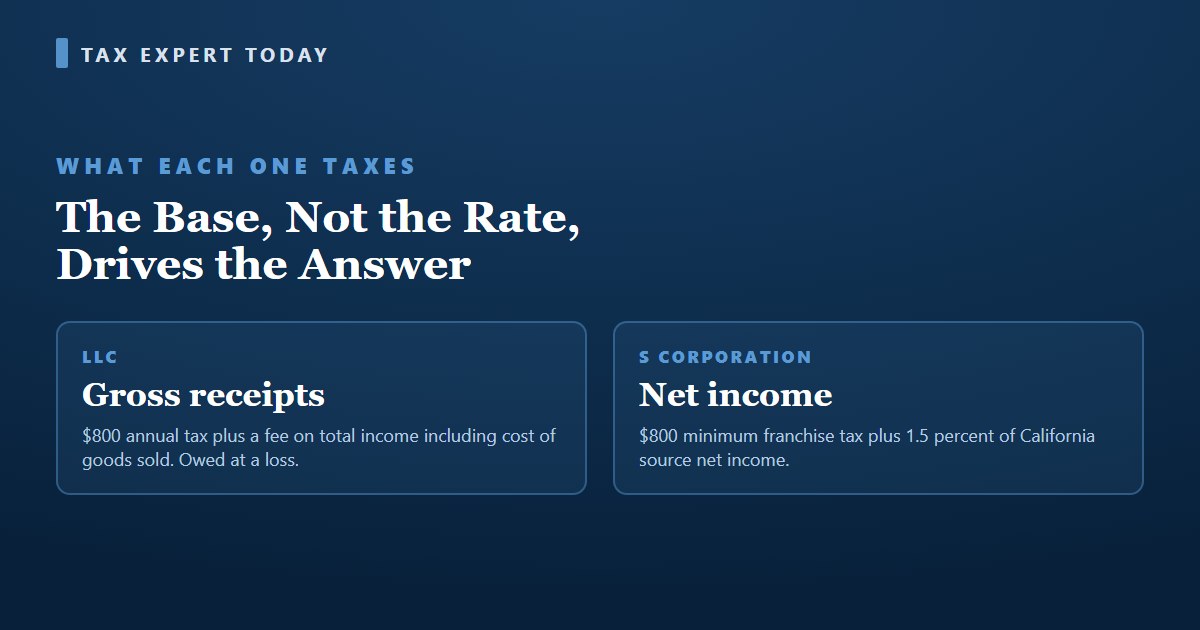
Quick Answer: The California LLC vs S corp decision comes down to two different tax bases. An LLC pays the $800 annual tax plus a fee measured on gross receipts under Revenue and Taxation Code section 17942. An S corporation pays the $800 minimum franchise tax plus 1.5 percent of net income under section 23802. Profit margin, not profit alone, decides which one costs less. Call (239) 441-2005 for a free consultation.
What Is the Real Difference Between a California LLC and an S Corp?
An LLC is a legal entity formed with the Secretary of State. An S corporation is a federal tax election under Internal Revenue Code section 1361, not an entity type. A California LLC can keep its legal form and elect S corporation treatment, which is why the honest comparison is not entity against entity but one California tax base against another.
- The legal layer: an LLC is organized under California law and is owned by members.
- The tax layer: the S election is made with the Internal Revenue Service and California follows the federal classification.
- The overlap: an LLC that elects S corporation treatment is taxed under the corporation rules, so it leaves the section 17942 fee behind and picks up the 1.5 percent tax instead.
- The constant: the $800 applies either way once the business is organized in or doing business in California.
Federal eligibility is what limits the election. IRC section 1361 caps an S corporation at 100 shareholders, restricts who may hold the stock, and permits only one class of stock. An LLC has none of those restrictions. That difference matters far more for a business with outside investors than the state tax arithmetic does. The state layer is not the same everywhere: in our Texas LLC vs S corp comparison, the election adds no state level tax at all, so the whole decision there is federal.
How Does California Tax an LLC?
A California LLC pays two separate amounts. The first is the $800 annual tax under R&TC section 17941. The second is a fee under section 17942 that is measured on total income from California sources, a figure that includes cost of goods sold and therefore behaves like a gross receipts tax rather than an income tax.
Section 17942(b)(1)(A) defines the base as gross income under section 24271 plus the cost of goods sold. That single clause is the most consequential sentence in this comparison, and it is the one the competing guides leave out. A distributor with thin margins can owe a four figure fee in a year when it earned very little.
| Total California income | Section 17942 fee |
|---|---|
| Under $250,000 | $0 |
| $250,000 to $499,999 | $900 |
| $500,000 to $999,999 | $2,500 |
| $1,000,000 to $4,999,999 | $6,000 |
| $5,000,000 or more | $11,790 |
The Franchise Tax Board states plainly that the annual tax is due “even if you are not conducting business, until you cancel your LLC.” The fee is estimated and paid on Form FTB 3536 by the fifteenth day of the sixth month of the taxable year, and the annual tax is paid on Form FTB 3522 by the fifteenth day of the fourth month. The return is Form 568.
How Does California Tax an S Corporation?
A California S corporation pays the $800 minimum franchise tax plus 1.5 percent of net income. Section 23802(b)(1) substitutes that 1.5 percent for the general corporate rate of 8.84 percent set by R&TC section 23151, and section 23802(c) confirms that the S corporation remains subject to the minimum franchise tax under section 23153.
- The rate applies to net income, so deductions and cost of goods sold reduce it.
- The $800 is a floor, not an addition. The FTB guidance describes the minimum as due each accounting period, and the corporation pays the greater of the measured tax or the floor.
- The obligation survives inactivity. The FTB states the tax is owed whether the corporation is active, inactive, operating at a loss, or filing a short period return.
- Financial corporations pay more. Section 23802(b)(2) increases the rate by the excess of the section 23183 rate over the section 23151 rate.
- The return is Form 100S, due the fifteenth day of the third month after the close of the taxable year.
- An elective entity tax sits on top. Either structure may separately elect the pass-through entity tax covered in our California PTET guide, which is optional and does not replace the 1.5 percent or the $800 floor.
California LLC vs S Corp: Which One Actually Costs Less?
Neither answer is universal, because the two charges are measured on different things. The LLC fee tracks revenue and ignores profitability. The 1.5 percent tracks profit and ignores revenue. The break even therefore depends on profit margin, and a business can cross from one side to the other without its revenue changing at all.
The arithmetic is straightforward once the bases are stated correctly. At $600,000 of California revenue the LLC fee is fixed at $2,500. The 1.5 percent charge on the same revenue depends entirely on what is left after expenses.
| California revenue | Net margin | Net income | LLC fee (17942) | S corp 1.5 percent (23802) | Lower state charge |
|---|---|---|---|---|---|
| $600,000 | 10 percent | $60,000 | $2,500 | $900 | S corporation |
| $600,000 | 28 percent | $168,000 | $2,500 | $2,520 | Roughly a tie |
| $600,000 | 50 percent | $300,000 | $2,500 | $4,500 | LLC |
| $3,000,000 | 5 percent | $150,000 | $6,000 | $2,250 | S corporation |
| $3,000,000 | 20 percent | $600,000 | $6,000 | $9,000 | LLC |
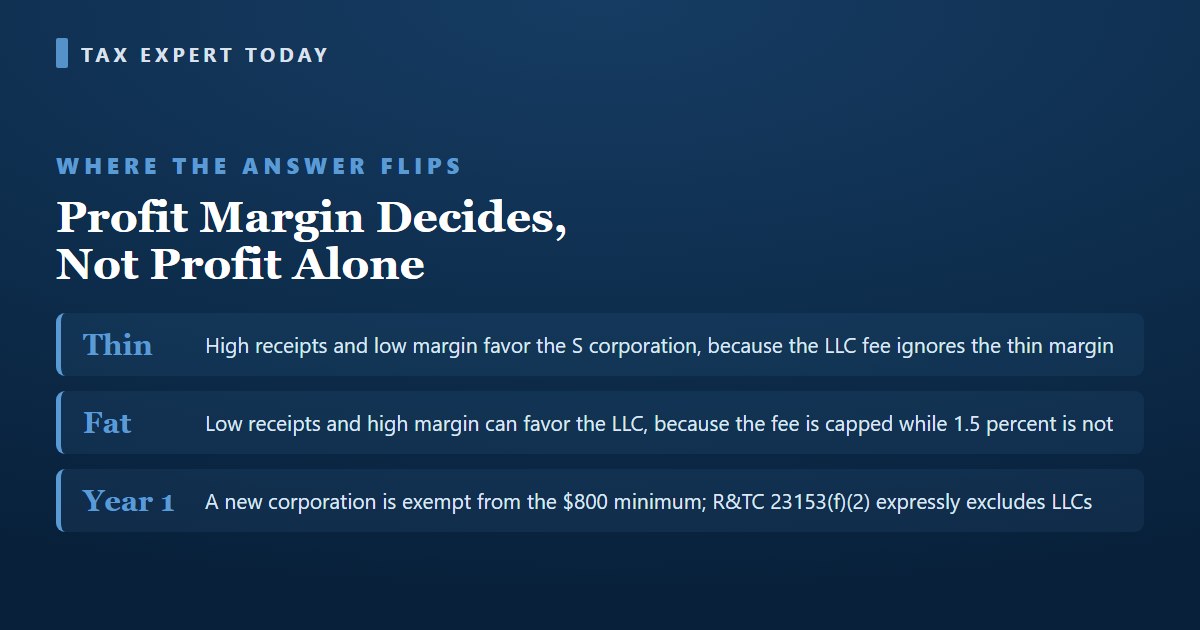
The pattern that emerges is the opposite of the common advice. High revenue with thin margins favors the S corporation, because the fee is indifferent to how little was earned. High margins favor the LLC, because the fee stops climbing while 1.5 percent of net income keeps going. The figures above are illustrative arithmetic rather than a projection for any particular business, and the federal self employment tax analysis, which is a separate question entirely, frequently outweighs both of these state charges.
Why Does the First Year Favor the S Corporation?
Section 23153(f)(1) provides that every corporation that incorporates or qualifies to do business in California on or after January 1, 2000 is not subject to the minimum franchise tax for its first taxable year. Section 23153(f)(2) expressly excludes limited liability companies from that waiver, so a new LLC pays the $800 in year one and a new corporation does not.
This is a real and permanent difference in the statute, and it is almost entirely absent from the guides currently ranking for this question. Two qualifications keep it honest:
- The waiver covers the minimum only. The FTB states that any first year net income remains subject to the 1.5 percent rate.
- The LLC exception has closed. The first year exemption for LLCs applied only to tax years beginning on or after January 1, 2021 and before January 1, 2024. It is no longer available.
- A short form cancellation still helps. An LLC cancelled within one year of organizing on SOS Form LLC-4/8 is not subject to the annual tax for its first tax year.
| First year item | New California LLC | New California S corporation |
|---|---|---|
| $800 minimum or annual tax | Due | Waived under 23153(f)(1) |
| Tax on first year net income | None at entity level | 1.5 percent applies |
| Gross receipts fee | Applies above $250,000 | Not applicable |
| Payment voucher | FTB 3522, and FTB 3536 for the fee | Estimated payments per FTB business due dates |
What Happens to the California Entity Tax After You Move Out of State?
Moving to Florida changes where the owner is taxed. It does not by itself change where the entity is taxed. If the business remains organized in California or continues to meet the section 23101 doing business tests, both the $800 and the entity level charge continue regardless of the owner’s new address.
Section 23101(b) treats a business as doing business in California when California sales, property, or payroll exceed the indexed threshold or 25 percent of the total, whichever is lower. The Franchise Tax Board publishes the indexed figures on its doing business in California page, and for 2025 they stand at $757,070 of sales and $75,707 of property or payroll. The FTB also instructs owners of a partnership, an LLC treated as a partnership, or an S corporation to include their distributive share of that entity’s property, payroll, and sales.
One distinction is worth stating carefully, because it separates the two charges for a departing owner. Public Law 86-272 can protect an out of state company whose only California activity is soliciting orders for tangible personal property from taxes measured on net income. The FTB notes that such businesses may still be considered to be doing business in California. In practical terms that protection reaches the 1.5 percent, which is a net income tax, and does not reach the $800 minimum franchise tax or the LLC gross receipts fee.
| Charge | Measured on | Survives the owner’s move | Reached by PL 86-272 |
|---|---|---|---|
| $800 minimum franchise tax | Neither, it is a floor | Yes, while registered or doing business | No |
| S corporation 1.5 percent | Net income | Yes, on California source net income | Potentially yes |
| LLC section 17942 fee | Gross receipts | Yes, on California sourced total income | No |
| Owner’s personal tax on the K-1 | Shareholder or member income | Only as to California source income | Not applicable |
The personal side of the move is a separate analysis. Our guide to the California part year resident return and Form 540NR covers how income is split across the move date, and the California to Florida tax guide maps both ends of the corridor.
Which Forms and Deadlines Apply to Each?
The filing calendars are not the same, and the gap is a common source of late payment notices for owners who convert. An LLC operates on a fourth month and sixth month rhythm for its two payments. An S corporation files earlier, on the fifteenth day of the third month after the close of the taxable year.
| Obligation | California LLC | California S corporation |
|---|---|---|
| Annual return | Form 568 | Form 100S |
| Return due date | Original return due date for the classification | 15th day of the 3rd month after year end |
| $800 payment voucher | FTB 3522, 15th day of the 4th month | Due the first quarter of the accounting period |
| Fee or estimate voucher | FTB 3536, 15th day of the 6th month | Estimated payments on the corporate schedule |
| Extension payment | FTB 3537 | Corporate extension payment |
| Apportionment when income is inside and outside California | Schedule R | Schedule R |
The Secretary of State imposes a separate $250 penalty when the Statement of Information is not filed, and the Franchise Tax Board collects it. That penalty is easy to trigger from out of state, because the notice goes to the California address of record.
When Does Electing S Corporation Status Backfire in California?
The election is not free at the state level, and California does not follow the federal treatment in one respect that matters. Section 23802(a) turns off IRC section 1363(a), so the S corporation remains a taxable entity in California rather than a purely pass through one. Several fact patterns turn the election into a net cost.
- High margin service businesses can pay more under 1.5 percent of net income than the flat fee would have cost.
- Loss years still carry the floor, since the $800 is owed whether the corporation operates at a loss or not.
- Payroll becomes mandatory, because a shareholder providing services must take reasonable compensation, which adds filings and cost.
- Ownership plans can break the election, given the 100 shareholder cap and the single class of stock requirement in IRC section 1361.
- Built in gains and passive investment income can draw entity level tax under the rules preserved by section 23802.
None of this makes the election wrong. It makes the election a calculation rather than a default. The federal self employment tax saving is usually the reason the conversation starts, and that saving has to be weighed against the 1.5 percent, the payroll cost, and the compliance burden together.
Does the S Corporation Election Actually Save Self Employment Tax?
The federal self employment tax saving is the reason most owners raise the question in the first place, and it is a federal matter rather than a California one. Profits distributed to a shareholder beyond reasonable compensation are not subject to self employment tax, but the compensation itself is subject to payroll tax, and the Internal Revenue Service treats understated compensation as a compliance issue.
The Internal Revenue Service addresses this directly in its guidance on S corporation compensation, which explains that an officer who performs services for the corporation is an employee and that reasonable compensation must be paid before non wage distributions are taken. The general framework for the entity itself is set out on the IRS S corporations page.
- The saving applies to the distribution portion only, not to the entire profit.
- Reasonable compensation is a facts and circumstances test, and setting it artificially low invites adjustment.
- Payroll brings real cost, including quarterly filings, state employment registration, and payroll administration.
- California charges 1.5 percent regardless, so any federal saving must be measured net of the state entity tax the election creates.
- The comparison is annual, because margins and compensation levels move from year to year.
This is why a California LLC vs S corp analysis that stops at the federal self employment tax is incomplete. The federal saving and the state cost move in opposite directions, and the correct answer is the net of the two.
How Do You Convert a California LLC to S Corporation Treatment?
The conversion is an election rather than a reorganization. An eligible entity files Form 2553 with the Internal Revenue Service, and California follows the federal classification. The LLC keeps its legal form with the Secretary of State while its tax treatment, its return, and its California charge all change.
Timing is governed by IRC section 1362, and the filing itself is described in the IRS instructions for Form 2553. California turns off the federal rule that would otherwise make the S corporation a non taxable entity, because section 23802(a) provides that IRC section 1363(a) does not apply. The FTB publication FTB 3556, Limited Liability Company Filing Information covers the LLC classification rules, and the FTB corporations guidance covers the corporate side.
| What changes on conversion | Before the election | After the election |
|---|---|---|
| California entity charge | Section 17942 fee on gross receipts | 1.5 percent of net income under 23802 |
| $800 obligation | Applies | Still applies as the minimum |
| California return | Form 568 | Form 100S |
| Owner compensation | No payroll required | Reasonable compensation required |
| Legal form with the Secretary of State | LLC | Unchanged, still an LLC |
| Ownership flexibility | Unrestricted | Limited by IRC section 1361 |
One practical warning for owners who have already left the state. Converting does not reduce the California footprint by itself, and the section 23101 doing business tests apply to the entity after the election exactly as they did before it. A conversion and a departure are two separate projects that are frequently confused for one.
How Do You Stop the California Entity Tax for Good?
Neither charge stops because the owner left the state or because the business went quiet. Each statute names the event that ends the obligation, and in both cases that event is a filing rather than a decision.
For a corporation, section 23153(a) runs the minimum franchise tax from the earlier of incorporation, qualification, or commencing business, and continues it until the effective date of dissolution or withdrawal under section 23331, or if later, the date the corporation ceases to do business in California. Section 23153(g) adds that a domestic corporation that files a certificate of dissolution and does not thereafter do business is not subject to the minimum for taxable years beginning on or after that filing.
For an LLC, section 17941(b)(1) is blunter still. The tax is payable for each taxable year, or part of a year, until a certificate of cancellation of registration or of articles of organization is filed. The mechanics of that sequence are covered in our guide to the California LLC franchise tax after you move.
- File the final return and check the final return box on the first page.
- Stop doing business in California after the final taxable year.
- File the termination documents with the Secretary of State, since the tax runs until that filing rather than until the business becomes inactive.
- Clear any suspension first, because the Secretary of State will not accept termination documents from a suspended or forfeited entity.
The Franchise Tax Board sets out the full sequence in FTB Publication 1038, which covers dissolution, surrender, and cancellation and the order in which the filings have to be made. The corporate return instructions are in the 2025 Form 100S booklet.
What Does Public Law 86-272 Protect, and What Does It Not?
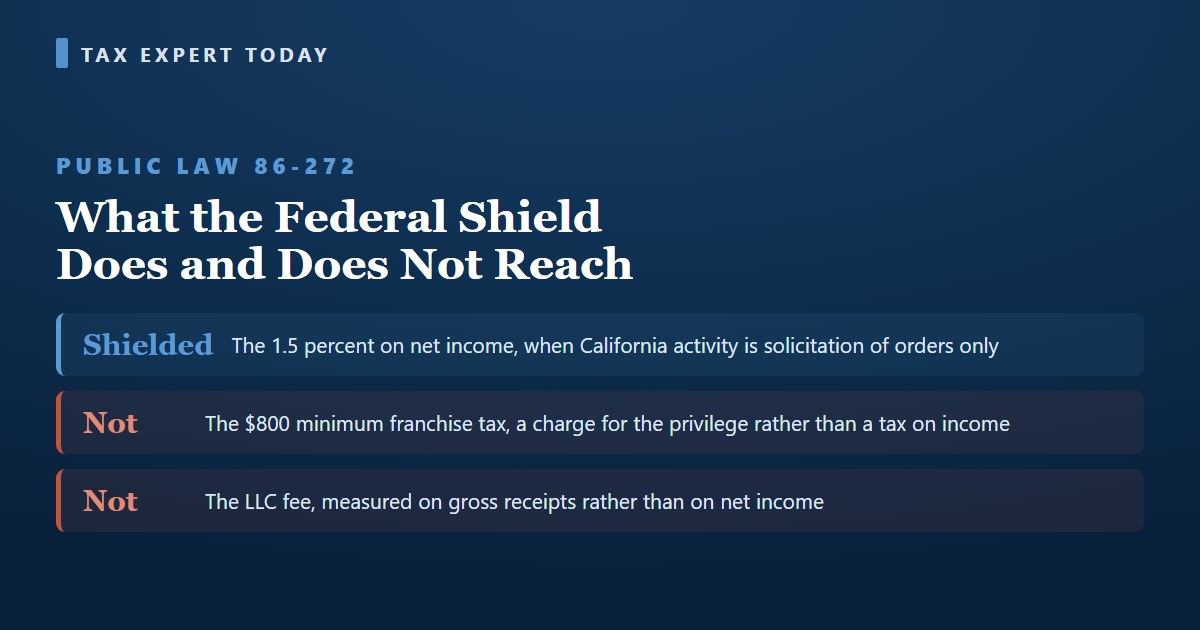
Public Law 86-272 shields only net income taxes, so it can switch off the 1.5 percent charge on an S corporation whose sole California activity is soliciting orders for tangible goods shipped from outside the state. It does not touch the $800 minimum or the LLC gross receipts fee, because neither one is a tax on net income.
This distinction is the single most useful thing a departing owner can understand about the two structures, and it is absent from every competing result on this topic. The protection is federal, it is narrow, and it applies unevenly across the three California charges.
- Protected: the 1.5 percent on net income. The tax imposed under R&TC section 23802 is measured by net income, which places it squarely inside the federal shield when the activity test is met.
- Not protected: the $800 minimum franchise tax. The minimum under R&TC section 23153 is a flat charge for the privilege of being qualified to do business, not a levy on income, so an entity that remains registered keeps paying it even when every dollar of income is shielded.
- Not protected: the LLC gross receipts fee. The section 17942 fee is measured by total income including cost of goods sold, so it is a gross receipts charge rather than a net income tax. This is a structural reason the LLC form travels worse than the S corporation for a departing seller of goods.
- Forfeited by almost any activity beyond solicitation. Installation, repair, training, collections, or maintaining inventory in California generally defeat the protection, and the Franchise Tax Board takes the position that certain internet activities directed at California customers do the same.
The practical consequence is narrow but real. A former California business that now ships tangible goods into the state from elsewhere, and does nothing else there, may owe the $800 and nothing more as an S corporation, while the same business held in an LLC continues to pay the gross receipts fee on every California sale. Service businesses should not rely on the protection at all, because it reaches only sales of tangible personal property. Owners weighing the entity question alongside a personal move should read it together with the residency side of the analysis, since the two are decided separately. Our guides to California capital gains tax on a home sale and to establishing Florida residency cover the personal half of the same departure.
Which Structure Makes More Sense After You Have Left California?
For an owner who has already moved, the entity question changes shape. The goal is usually no longer to minimize a California charge but to shrink the California footprint altogether, and the two charges respond differently to that effort. The fee follows California sourced receipts, while the 1.5 percent follows California sourced net income.
Three fact patterns cover most departing owners, and they point in different directions.
- The business left with the owner. If customers, payroll, and property are all outside California and the entity is dissolved or cancelled properly, both charges end. The entity type barely matters, and the priority is completing the termination filings rather than optimizing between two structures.
- The business stayed behind. If California customers, property, or payroll remain above the section 23101 thresholds, both charges continue. Here the margin analysis in the table above governs, and it should be rerun each year because the answer moves with margin.
- The business is partly in each state. This is the most common and the most easily mishandled. Income has to be apportioned on Schedule R, and only the California portion carries the entity level charge. An S corporation apportioning a modest share of net income to California can end up well below an LLC whose California sourced receipts remain high.
Two cautions are worth stating plainly. First, an entity that stays registered with the Secretary of State keeps the $800 running no matter how the apportionment turns out, because the minimum is a floor rather than a measured tax. Second, the owner’s personal California exposure is a separate question from the entity’s. Residency is decided on its own facts, and a business restructuring does not settle it. Our guide to the FTB residency audit describes what the Franchise Tax Board actually reviews, and the departure checklist covers the steps that establish the move itself.
Owners with equity compensation from a former California employer face a further layer, because California continues to reach wage income attributable to California workdays. That allocation is covered in our guide to California RSU tax after leaving the state. The broader question of what California can and cannot follow across a state line is addressed in our California exit tax guide.
California LLC vs S Corp Help Naples and Southwest Florida
The California LLC vs S corp question reaches our office in Naples, Florida most often from business owners who have moved to Southwest Florida while an entity, a payroll, or a customer base remains in California. The entity question and the residency question interact, and answering only one of them tends to leave the other exposed. We look at the entity classification, the California filing obligations that continue after a move, and the owner’s own return together.
Tax Expert Today LLC
11983 Tamiami Trail N, Naples, FL 34110
Phone: (239) 441-2005
Hours: Monday through Friday, 10:00 to 5:00 ET
Does moving to Naples let me drop the California entity filings? Not on its own. Relocating changes the owner’s residency analysis, and it changes where the K-1 income is taxed, but the entity keeps its California obligations while it stays registered with the Secretary of State or continues to meet the section 23101 tests. Closing the California filings is a separate sequence with its own paperwork. Our California tax services page and our Naples tax planning page describe how we handle both sides.
When to Engage a Professional
The California LLC vs S corp comparison is worth professional review when the numbers or the facts are not simple. Consider engaging an advisor when California revenue is near a fee tier boundary, when margins have shifted enough to move the break even, when an S election is being considered mid year, when the business has activity in more than one state, or when the owner has moved and the entity has not. Outcomes depend on the specific facts, and the analysis usually needs the actual figures rather than a rule of thumb.
Related reading on the California side of a move includes our guides to the California exit tax, the departure checklist for leaving California, and the FTB residency audit.
This article is educational and general in nature. It does not constitute tax advice for any particular taxpayer, and outcomes depend on individual facts and circumstances.
Published August 14, 2026 by Dr. Pellumb Kabashi « Back to Learning Center
Have a question this article touches on?
Tax Expert Today LLC, based in Naples, Florida and serving clients across the United States.
Schedule a Consultation (239) 441-2005