
By Dr. Pellumb Kabashi, DBA, MBA, CES, CFE, EA
Founder, Tax Expert Today LLC · Tax advisors, enrolled agents, CPAs, and attorneys · Serving clients in all 50 states
Quick Answer
A California residency audit is a Franchise Tax Board examination of whether you actually stopped being a California resident, or whether the state may still tax your worldwide income. The FTB weighs the closest-connection factors in Publication 1031, requests records covering the year you claim you left, and issues a Notice of Proposed Assessment if it disagrees. You carry the burden of proof.
What Is a California Residency Audit?
A California residency audit is an examination in which the Franchise Tax Board tests one question: were you a resident, a nonresident, or a part-year resident for the year under review. It is not a line-by-line review of deductions. The entire assessment turns on where your life was centered, because residency status decides whether California taxes all of your income or only your California-source income.
The stakes are structural rather than incremental. Under Revenue and Taxation Code section 17014, a resident includes every individual who is in California for other than a temporary or transitory purpose, and every individual domiciled in California who is outside the state for a temporary or transitory purpose. If the FTB concludes you remained a resident, California may tax your worldwide income for that year, including income earned entirely in another state.
That is why a residency audit often produces a far larger proposed assessment than an ordinary deduction dispute. A single year in which a business sale, an equity award, or a large distribution landed can swing the result substantially. Where the item is a vesting equity award, our guide to California RSU tax when you leave the state explains how the workday allocation is computed. Our companion guide on the California exit tax myths versus what the statutes actually say explains which items follow you regardless of where you live.
What Triggers a California Residency Audit?
Most residency audits begin with a document mismatch rather than a random selection. The FTB receives information returns, real property records, and filing history, and it looks for taxpayers whose paperwork still points to California after they filed as a nonresident. Departure to a state with no income tax raises the profile of the file.
Common triggers include the following patterns:
- A Form W-2, Form 1099, or Schedule K-1 arrives showing a California mailing address after you claimed nonresidency.
- You filed a full-year California return one year and no California return at all the next, with no part-year return bridging the two.
- You kept a California home and continued to claim the homeowner property tax exemption, which requires the property to be your principal residence.
- You reported a large one-time item, such as a business sale or an equity compensation event, in the same year you claim you left.
- Your spouse or registered domestic partner and your school-age children stayed in California.
- You retained California professional licenses, voter registration, or a California driver license.
None of these facts alone decides residency. Each one, however, is a reason the file gets opened, and once it is open the examination covers everything.
Which Factors Does the FTB Weigh in a Residency Audit?
The FTB applies a closest-connection analysis. Publication 1031 states the underlying theory plainly: you are a resident of the place where you have the closest connections. The publication also makes a point practitioners rely on heavily, which is that the strength of your ties matters, not merely the number of them, and no single factor controls the outcome.
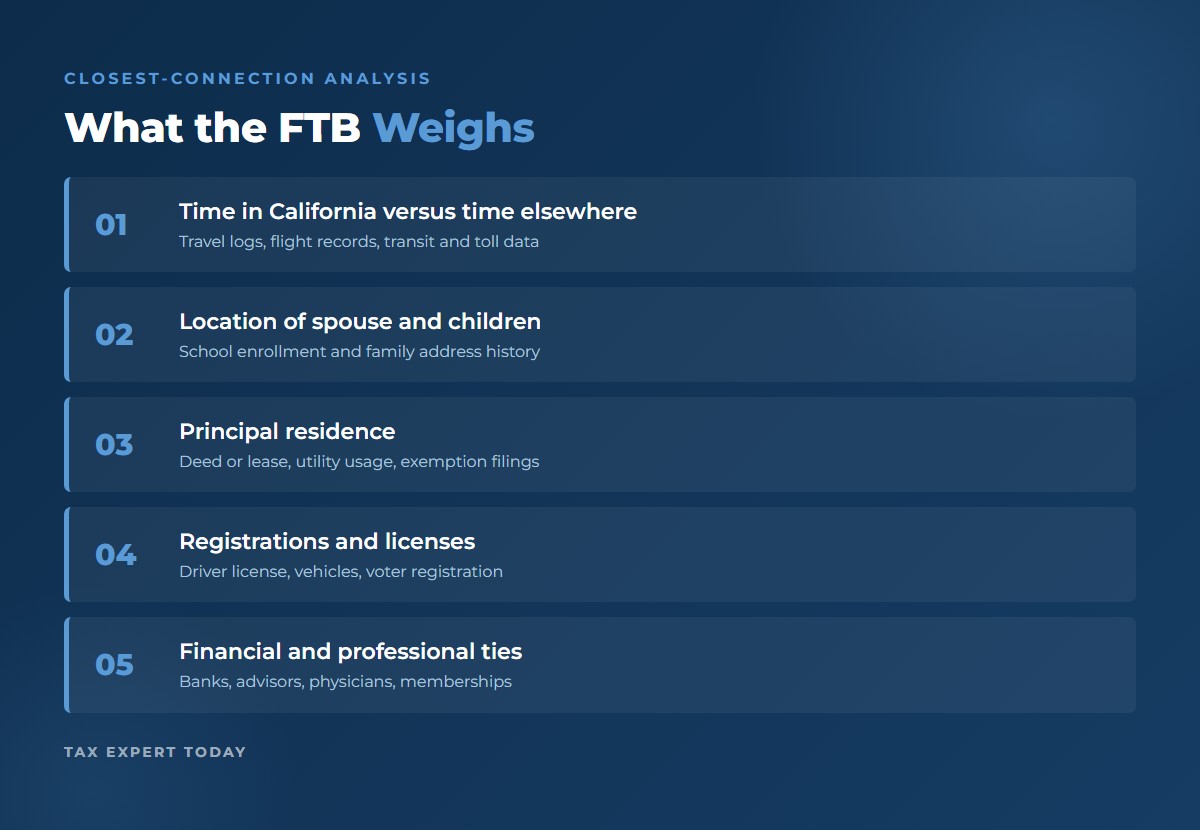
The factor list published by the FTB in Publication 1031 Section G is reproduced below, alongside the evidence that ordinarily supports each one.
| Factor the FTB weighs | Evidence that typically supports it |
|---|---|
| Time spent in California versus time spent outside California | Travel logs, flight records, toll and transit data, credit card location history |
| Location of your spouse or registered domestic partner and children | School enrollment records, spousal employment records, family address history |
| Location of your principal residence | Deed or lease, utility usage, homestead or exemption filings |
| State that issued your driver license | License issue date and surrender of the California license |
| State where your vehicles are registered | Registration and titling records |
| State where you maintain professional licenses | License registry status and address of record |
| State where you are registered to vote | Voter registration date and ballots actually cast |
| Location of the banks where you maintain accounts | Branch locations, account opening and closing dates |
| Origination point of your financial transactions | Statements showing where transactions are initiated |
| Location of doctors, dentists, accountants, and attorneys | Appointment records and engagement letters |
| Location of social ties, worship, and club memberships | Membership records and dues statements |
| Location of real property and investments | Property records, closing statements, rental activity |
| Permanence of your work assignments in California | Employment agreements, assignment letters, remote work policies |
Publication 1031 describes this list as partial. Auditors regularly consider adjacent facts, such as where pets live, where furniture and personal effects were shipped, and where you keep items of sentimental value. The departure checklist for leaving California works through these factors in the order most people can actually address them.
How Does the Audit Process Actually Work?
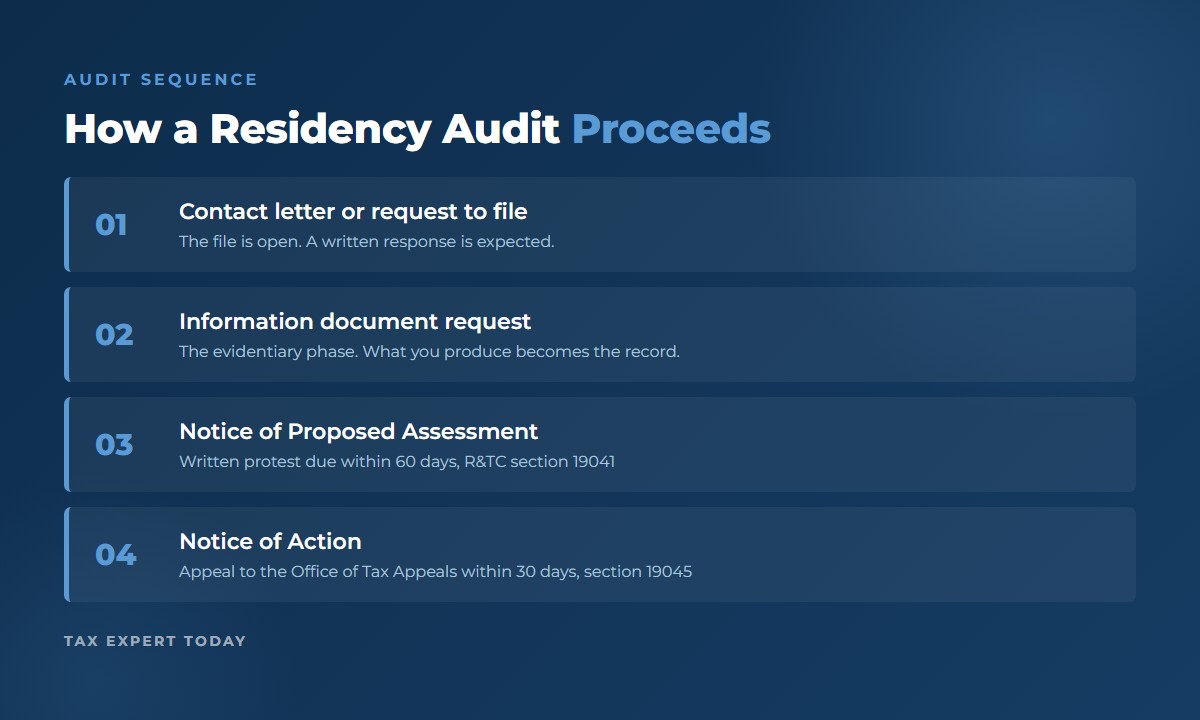
A residency audit follows a predictable sequence. It opens with a contact letter or a request to file, moves to written information document requests, and often includes a questionnaire covering the factors above. Interviews are possible but not universal. Every stage carries a deadline, and missed deadlines narrow your options later.
| Stage | What arrives | What it means |
|---|---|---|
| Contact or request to file | An FTB letter noting income reported to California, often asking why no return was filed | The file is open. A response is expected in writing, usually within 30 days. |
| Information document request | A written list of records, frequently paired with a residency questionnaire | The evidentiary phase. What you produce here becomes the record. |
| Interview or conference | A scheduled discussion with the auditor | Optional in many files. Representation is permitted throughout. |
| Notice of Proposed Assessment | A formal proposed deficiency | The clock starts. A written protest is due within 60 days under section 19041. |
| Notice of Action | The FTB decision on your protest | An appeal to the Office of Tax Appeals is due within 30 days under section 19045. |
One procedural point deserves emphasis. If the assessment window is closing, the FTB may ask you to sign a waiver extending it. Under Revenue and Taxation Code section 19067, the FTB must notify you of your right to refuse to extend that period. Whether signing helps or hurts depends entirely on the strength of your documentation, and it is a decision worth taking advice on rather than answering reflexively.
How Far Back Can the FTB Audit Your Residency?
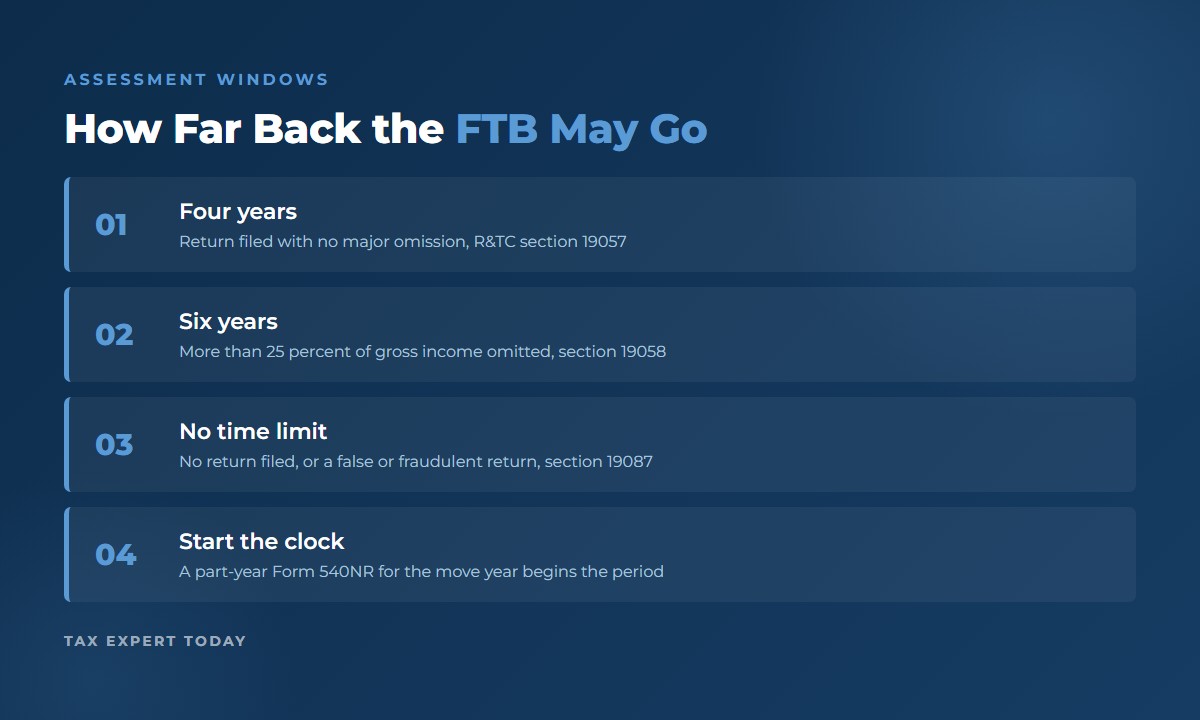
The general rule gives the FTB four years from the date a return was filed to mail a notice of proposed deficiency assessment, under section 19057. Two exceptions extend that period substantially, and the second one has no end date at all, which is what makes an unfiled California return so much riskier than most departing residents assume.
| Situation | Assessment window | Authority |
|---|---|---|
| Return filed, no major omission | Four years from the filing date | R&TC section 19057 |
| More than 25 percent of gross income omitted | Six years from the filing date | R&TC section 19058 |
| No return filed, or a false or fraudulent return | No time limit | R&TC section 19087 |
The practical consequence is straightforward. A taxpayer who leaves California and files nothing has not started any clock. Years later, when an information return surfaces, the FTB may still propose an assessment for the departure year. Filing a part-year Form 540NR for the year of the move is what starts the limitations period running, and it is one of the reasons the final-year return matters more than its dollar amount suggests. Our guide to California part year resident tax covers how that return allocates income and computes the rate.
Who Carries the Burden of Proof in a Residency Audit?
The taxpayer does. California treats a proposed assessment as presumptively correct, so the person asserting a change of residency must establish it with evidence. Silence, or a well-written narrative unsupported by records, generally does not carry that burden. Contemporaneous documents do most of the work.
This allocation shapes how a defense should be built. The question is rarely whether your story is plausible. The question is whether the file contains dated, third-party records that corroborate the story. A calendar reconstructed after the fact is weaker than utility bills, boarding passes, and payroll records created at the time. Taxpayers who moved without documenting the move often find that their strongest facts are the hardest ones to prove.
Domicile compounds the problem. A person can be physically absent from California and still be domiciled there, because domicile is the place you intend to return to. Breaking domicile requires both leaving and establishing a new permanent home, which is why the arrival side of the move carries evidentiary weight. Our guide to the dual-state residency trap covers the situation where two states each treat you as a resident.
What Digital and Social Evidence Does the FTB Look At?
A California residency audit is increasingly a documentary exercise about your electronic footprint. Alongside flight records and toll transponder data, information document requests commonly reach credit and debit card transaction locations, cell phone billing records, and publicly posted social media content, because each one places a person somewhere on a date without relying on recollection.
The reason is straightforward. Under Revenue and Taxation Code section 17014 the question is where you were and what you were doing there, and contemporaneous machine-generated records answer that better than a narrative written afterwards. The same evidence cuts both ways, which is the practical point for anyone who has already left.
- Card transactions map a calendar. A card used at a California grocery store on a date you recorded as a Florida day is the kind of discrepancy that turns a routine review into a detailed one. Reconciling your own statements against your day count before filing is cheaper than explaining it later.
- Publicly posted content is fair game. Dated posts, photographs with location metadata, and event check-ins are public records of presence. Content posted by other people and tagging you carries the same weight and is outside your control, which is a reason to keep your own contemporaneous record rather than rely on the absence of evidence.
- Professional and civic footprints persist. An active California professional license, a continuing club or gym membership, or a listing that still shows a California address all read as retained connections regardless of how little you use them.
- Absence of a new footprint is itself a finding. Establishing the new state matters as much as severing the old one. A Florida address with no Florida card activity, no local providers, and no local memberships supports the argument that the move was documentary rather than actual.
None of this changes the legal standard, and no single item is decisive. It changes what you should be assembling. The closest-connection analysis is weighed on the totality of contacts, so the file that wins on the facts is the one built while the facts were happening rather than reconstructed after a letter arrives.
What Records Should You Keep for a California Residency Audit?
Build the file before you need it. The records below are the ones auditors ask for most consistently, and each maps to one or more of the Publication 1031 factors. Keeping them for at least four years after the departure-year return is filed aligns with the general assessment window, and longer is prudent if the departure year included an unusually large income item.
| Record category | Specific documents worth retaining |
|---|---|
| Day count | Flight itineraries, hotel folios, toll transponder statements, calendar exports, cell phone location summaries |
| Housing | Closing statement or lease on the new home, listing or sale documents on the California home, utility bills for both |
| Registrations | New driver license, vehicle registrations, voter registration confirmation, dated surrender of California credentials |
| Financial | New bank and brokerage account openings, address change confirmations, statements showing transaction origination |
| Professional and personal services | New physicians, dentists, accountants, attorneys, and the dates those relationships began |
| Employment | Remote work agreements, assignment letters, payroll records showing the work state |
| Moving | Household goods shipment invoices, pet transport records, storage agreements |
A note on the safe harbor. Publication 1031 provides a safe harbor treating certain individuals as nonresidents during an employment-related absence from California, and the publication specifies that the absence must run for an uninterrupted period of at least 546 consecutive days. That safe harbor addresses employment-related absences and does not substitute for the closest-connection analysis in an ordinary departure, so it applies to a narrower set of taxpayers than its reputation suggests.
What Happens If the FTB Disagrees With Your Position?
Disagreement does not end the matter. The FTB issues a Notice of Proposed Assessment, and you may file a written protest within 60 days of the mailing date under section 19041, specifying the grounds. The protest keeps the assessment from becoming final and moves the file to a review function inside the FTB.
If the protest is denied in whole or in part, the FTB mails a Notice of Action. Under section 19045, that action becomes final 30 days after mailing unless you appeal in writing within that window. Appeals go to the Office of Tax Appeals, an independent body separate from the FTB, where residency disputes are decided by panels of administrative law judges. Published OTA opinions on residency turn heavily on documentary records, which reinforces the point about building the file early.
Deadlines in this sequence are strict. A protest filed on day 61 generally forfeits the administrative path and leaves the more burdensome route of paying the assessment and filing a claim for refund. Calendar the mailing date on every notice the day it arrives. Our guide to the FTB notice of proposed assessment walks through the protest, the interest decision, and the appeal step by step.
What Are the Possible Outcomes of a California Residency Audit?
A California residency audit ends in one of three findings for each year reviewed: full-year resident, taxed on worldwide income; nonresident, taxed only on California source income; or part-year resident, taxed on worldwide income for the resident period and California source income after the move. The finding sets the tax, and the protest and appeal deadlines start from the notices that follow. Call (239) 441-2005 for a free consultation.
The three outcomes come straight from the rate statute. Revenue and Taxation Code section 17041(a) taxes the entire taxable income of a full-year resident. Section 17041(b) and (i) tax a nonresident or part-year resident on all income for the resident period and on California source income for the nonresident period, at a rate computed as if the taxpayer had been a resident all year. That rate rule matters in an audit: even a nonresident finding applies California’s graduated rate to the California slice as though worldwide income were taxed.
| Audit finding | What California taxes | Statute | Typical fact pattern |
|---|---|---|---|
| Full-year resident | All income from every source for the year | R&TC sections 17014 and 17041(a) | The move is treated as temporary, or the California home, family, and work ties never changed |
| Part-year resident | Worldwide income before the residency end date; California source income after it | R&TC section 17041(b) and (i)(1) | The move is accepted, but on a later date than the taxpayer reported, which pulls a sale or bonus into the resident period |
| Nonresident | California source income only, such as California real property, a California business, or California workdays | R&TC section 17041(b) and (i)(1)(B) | The departure date and the closer connection to the new state are both accepted as filed |
Three points about the findings deserve emphasis:
- The residency end date is often the real dispute. A part-year finding with a later end date can cost as much as a full-year finding when a liquidity event sits between the two dates.
- Time is a presumption, not the test. Under section 17016, more than nine months in California in a year creates a presumption of residence, which may be overcome by evidence that the presence was for a temporary or transitory purpose.
- The finding arrives as a notice with a clock. A Notice of Proposed Assessment opens the 60 day protest window of section 19041, and a Notice of Action opens the 30 day appeal window of section 19045.
Because each year is decided on its own record, a single audit can produce different findings for different years, for example resident for the year of departure and nonresident for the year after. Reviewing each year separately, rather than arguing the move as a single event, generally gives the clearest view of where the exposure actually sits.
How Does a Move to Florida Change the Analysis?
Florida strengthens the arrival side of the record because it offers formal, dated instruments that most states do not. A Florida declaration of domicile may be filed under Florida Statutes section 222.17, creating a sworn, time-stamped statement of intent. Homestead filings, voter registration, and license issuance add further dated evidence.
Two federal points also matter for California departures. Under 4 U.S.C. section 114, a state may not tax the retirement income of an individual who is not a resident or domiciliary of that state, which shields qualifying pension and certain deferred distributions after a genuine move. Separately, equity compensation follows workday allocation rules described in FTB Publication 1004, so California-period workdays can keep a share of an award taxable in California even after you become a Florida resident.
The corridor works in both directions, and the arrival record is the mirror image of the departure record. If you are building the Florida side, see our guides on establishing Florida residency, the Florida residency audit companion to this article, and the Florida 183 day rule calculator for tracking day counts as you go.
New York runs a structurally similar examination with its own factor list and deadlines, described in our guide to the New York residency audit.
Frequently Asked Questions
Does spending fewer than 183 days in California make me a nonresident?
No. California has no 183 day rule that determines residency by itself. Day count is one of the factors in Publication 1031, and a low day count helps, but the FTB weighs the full closest-connection picture. A taxpayer with few California days and a California home, family, and business can still be found to be a resident.
Can I keep a house in California without losing nonresident status?
Yes, in qualifying situations. Owning California real property is one factor rather than a disqualifier. What matters is the role the property plays. A rental held as an investment reads differently than a furnished home kept available for your use year round, particularly if utility usage suggests regular occupancy.
How long does a California residency audit take?
Timelines vary with complexity and responsiveness. Files involving a single year and organized records generally resolve faster than those spanning multiple years, large one-time income items, or reconstructed documentation. Extensions of the assessment window, protests, and appeals each add time to the overall sequence.
Who carries the burden of proof in a California residency audit?
The taxpayer does. A proposed assessment is treated as presumptively correct, so the taxpayer asserting a change of residency must establish it with evidence. Contemporaneous third-party records such as utility bills, travel documentation, payroll records, and dated registrations carry more weight than a narrative prepared after the fact.
What deadlines apply after a Notice of Proposed Assessment?
Under Revenue and Taxation Code section 19041, a written protest is due within 60 days after the Notice of Proposed Assessment is mailed. If the protest is denied, section 19045 provides that the FTB action becomes final 30 days after the Notice of Action is mailed unless the taxpayer appeals in writing to the Office of Tax Appeals within that period.
Does the FTB look at social media in a residency audit?
It can. Publicly posted content is available to an examiner like any other public record, and dated posts or photographs are treated as evidence of presence on a date. The practical response is not to withdraw from public life but to keep your own contemporaneous day count and supporting records so the file does not depend on what a third party posted.
Should I respond to the FTB myself?
You may. Residency examinations are document-driven and the early submissions shape the record, so many taxpayers engage a representative before the first substantive response. Whether representation is warranted depends on the amount at issue, the number of open years, and the condition of your records. A representative can speak to the FTB only once a valid FTB power of attorney declaration is on file, so that paperwork belongs at the start.
California Residency Audit Help in Naples & Southwest Florida
Tax Expert Today LLC works with individuals and business owners who have relocated from California to Florida, including clients responding to Franchise Tax Board residency examinations. The firm brings together tax advisors, enrolled agents, CPAs, and attorneys, and handles state residency and tax matters nationwide. Southwest Florida is a common landing point for California departures, so the California to Florida corridor is familiar ground.
Our office is located at 11983 Tamiami Trail N, Naples, FL 34110. You can reach us at (239) 441-2005, Monday through Friday, 10am to 5pm ET. We also work with clients across all 50 states. For planning that spans both ends of the move, see our California tax services and Naples tax planning pages.
I moved from California to Naples last year and just received an FTB letter. What should I do first?
Note the mailing date and the response deadline before anything else, then gather the departure-year records described above rather than replying immediately with a narrative. Southwest Florida arrivals frequently have strong documentary evidence available, including a declaration of domicile, homestead filing, and Collier or Lee County property records, which is exactly the kind of dated third-party proof the FTB weighs.
When to Engage a Professional
Consider professional guidance if any of the following describe your situation: you have received an FTB contact letter, request to file, or Notice of Proposed Assessment; your departure year included a business sale, equity compensation, or a large distribution; you kept a home, business interest, or family presence in California after moving; you did not file a part-year return for the year you left; or you are approaching a 60 day protest or 30 day appeal deadline.
Outcomes in residency matters depend on the specific facts, the quality of the documentation, and the procedural posture of the file, and no result can be promised in advance. What professional involvement can do is make sure the record is assembled correctly the first time, that deadlines are met, and that the position taken in the departure year is consistent with the evidence available to support it. If you are planning a move that has not happened yet, the planning window before departure is where the most durable evidence gets created.
Published July 23, 2026 by Dr. Pellumb Kabashi « Back to Learning Center
Have a question this article touches on?
Tax Expert Today LLC, based in Naples, Florida and serving clients across the United States.
Schedule a Consultation (239) 441-2005