
By Dr. Pellumb Kabashi, DBA, MBA, CES, CFE, EA
Founder, Tax Expert Today LLC · Tax advisors, enrolled agents, CPAs, and attorneys · Serving clients in all 50 states
Quick Answer: A California amended tax return corrects a return you already filed. File the same form type marked AMENDED, usually Form 540NR for the move year, with Schedule X attached. A refund claim is due within four years of the original due date or one year from payment, whichever is later. A federal change that raises California tax must be reported within six months, even from Florida. Call (239) 441-2005 for a free consultation.
A California amended tax return is the way you fix a California return that has already been filed and accepted. For most people that is a routine task: a corrected Form W-2 arrives in March, a brokerage firm reissues a Form 1099-B, or a forgotten deduction turns up in a shoebox. For someone who has moved out of California, the same task carries more weight. The return being corrected is often a part-year resident Form 540NR, where a single change can move income from one side of the residency date to the other, change the tax rate applied to every California dollar, or reopen questions about when California residency actually ended.
The people who search for this topic tend to arrive with one of four problems. Some filed the move year return and then realized income was sourced to the wrong period. Some filed a federal Form 1040-X and are not sure whether California needs to hear about it now that they live in Florida. Some received an IRS notice, agreed to it, and only later learned that California expects to be told within six months. And some simply want a refund for a year that is getting old and need to know whether the window is still open. This guide is written for all four, with the focus on the taxpayer who has already left.
The guide covers when a correction is an amended return and when it is a superseding return, which form to use for each tax year, how Schedule X works line by line, the refund statute in Revenue and Taxation Code section 19306, the federal change reporting duty in section 18622 and what happens under section 19060 if you ignore it, how a part-year return is amended when the residency date or the sourcing of income changes, how carryovers and filing status interact with an amendment, protective claims, informal claims, the financially disabled exception, where to mail the return, and what to keep. Every example is a hypothetical illustration, not a description of any client.
California income tax is administered by the Franchise Tax Board under the Revenue and Taxation Code. Nothing in this guide concerns the procedures for a federal amended return beyond the point where a federal change triggers a California duty. If you are still working through the larger picture of the move itself, our leaving California taxes departure checklist and our guide to the California part year resident tax return explain the original filing that this guide shows you how to correct.
What is a California amended tax return?
A California amended tax return is a corrected Form 540, Form 540 2EZ, or Form 540NR, with the AMENDED box checked, filed after the original return to change income, deductions, credits, payments, or filing status. For tax years 2017 and later it travels with Schedule X, which reconciles the original and corrected figures and states the reasons for each change.
The Franchise Tax Board describes the process on its Correct an income tax return page in two steps: gather and complete the correct forms for the tax year, then submit them online through a tax representative or tax preparation software, or by mail. For tax year 2017 to the present, the package is the corrected return plus Schedule X, California Explanation of Amended Return Changes. For tax year 2016 and earlier, the package is Form 540X for that year plus a copy of the original return. The FTB page instructs filers to send both items together.
Three ideas from that page do most of the work for a former resident. First, the amended return is a complete return, not a list of changes. You prepare the corrected Form 540NR in full, as it should have been filed, and the system compares it with what you filed originally. Second, Schedule X is where the explanation lives. The FTB reads Part II of Schedule X to understand why the numbers moved, and the 2025 instructions warn that a refund may be denied or delayed if the changes are not explained in sufficient detail or the supporting documents are missing. Third, the amended return must match the form type of the return it corrects. A part-year resident who filed Form 540NR amends on Form 540NR.
- Corrected return: a full Form 540, 540 2EZ, or 540NR for the same year, with the AMENDED box checked at the top.
- Schedule X: the reconciliation in Part I and the written reasons in Part II, specific to the tax year from 2023 forward.
- Supporting documents: corrected Forms W-2 or 1099, California Schedules K-1, escrow statements, court documents, and any federal schedules that changed.
- Payment, if any: the additional tax shown on Schedule X, line 7, sent with the return or paid electronically.
| Tax year being corrected | What you file | Attach the original return? |
|---|---|---|
| 2017 through 2025 | Corrected Form 540, 540 2EZ, or 540NR marked AMENDED, plus Schedule X for that year | No. The 2025 540NR booklet says not to attach the previously filed return. |
| 2016 and earlier | Form 540X for that tax year and related supporting documents | Yes. The FTB page lists a copy of the original return as part of the package. |
| Any year, name, SSN, or address only | No amended return. Call or write to the FTB, or update your address through MyFTB or form FTB 3533. | Not applicable |
One rule in the 2025 Form 540NR booklet surprises people: you do not file an amended return to correct a Social Security number, a name, or an address. Those corrections go to the FTB by phone or letter. For a former resident, the address change matters for a different reason. Every notice about the amended return will go to the address the FTB has on file, and a notice that sits unopened at an old Los Angeles apartment does not stop any clock. The booklet points to MyFTB, the phone line, or form FTB 3533, Change of Address for Individuals.
Should you file an amended return or a superseding return?
A correction filed on or before the deadline for the original return is a superseding return, which California treats as the original. A correction filed after that deadline is an amended return, which does not replace the original. The difference matters because many tax elections can be made or revoked only on an original return.
The Franchise Tax Board explained the distinction in its May 2025 Tax News item, Amended vs. Superseding Tax Returns. A superseding return is a replacement for the original return and is treated as if it were the original, as long as it is filed within the original filing deadline, including extensions where the original and the replacement were both filed during the extension period. An amended return is a corrected return filed after the original return that does not replace the original filing, because it is filed after the applicable deadline.
The FTB gives two conditions for a superseding return. Either the original return was filed before the original due date and the replacement was filed on or before the original due date, or the original was filed after the original due date but before the extended due date and the replacement was filed on or before the extended due date. If you filed on time in April and correct the return in August, the correction is an amended return even though you were technically still inside the general extension window, because the original was filed before the original due date and the replacement came after it.
| When the original was filed | When the correction was filed | California treatment |
|---|---|---|
| Before the April due date | On or before the April due date | Superseding return, treated as the original |
| Before the April due date | After the April due date | Amended return, does not replace the original |
| After April, before the October extended due date | On or before the October extended due date | Superseding return, treated as the original |
| After April, before the October extended due date | After the October extended due date | Amended return, does not replace the original |
Why would a former resident care? Because a move year return often contains elections. A taxpayer may want to change how an installment sale is reported, revisit an election tied to a pass-through entity, or reconsider how a carryover is applied. The FTB states the general principle plainly: elections generally must be made on an original return, so certain elections can be made or revoked on a superseding return but not on an amended return. If you discover a problem in early April, correcting it before the due date can preserve options that disappear a few days later. Whether a specific election falls into that category depends on the statute that creates it, and it is worth confirming before you rely on a superseding filing to change one.
- Timing test: compare the filing date of the correction to the original due date, or to the extended due date if the original was filed during the extension period.
- Election test: if the correction makes or revokes an election, confirm whether that election must be made on an original return.
- Software label: tax software may call both kinds of filing an amended return, so the label on the screen does not decide the treatment.
Which form do you use for a California amended tax return after you move?
Use the same form type as your original return, marked AMENDED. A part-year resident who filed Form 540NR amends on Form 540NR with Schedule X. A full-year resident who filed Form 540 amends on Form 540. For 2016 and earlier years, the FTB requires Form 540X for that year instead.
The 2025 Form 540NR booklet, in the section titled Instructions for Filing a 2025 Amended Return, states the purpose directly: use Form 540NR to amend your original or previously filed California nonresident or part-year resident income tax return. If the FTB adjusted your return, use the amounts as adjusted by the FTB. Check the box at the top indicating AMENDED return, and submit the completed amended Form 540NR and Schedule X along with all required schedules and supporting forms.
That sentence about FTB adjustments is easy to miss and important. If the FTB already changed your original return, for example by correcting a math error, disallowing a credit, or applying a payment differently, your amended return starts from the FTB’s adjusted figures, not from your own first draft. Schedule X, line 2 also asks you to include any additional overpayment that resulted from an FTB change. A former resident who received an FTB letter after filing should locate it before starting the amendment, because building the amendment from the wrong baseline produces a Schedule X that does not reconcile.
| Your situation | Original form | Amended form |
|---|---|---|
| Moved out of California during the year | Form 540NR (part-year resident) | Form 540NR marked AMENDED, plus Schedule X |
| Lived in Florida all year with California source income | Form 540NR (nonresident) | Form 540NR marked AMENDED, plus Schedule X |
| California resident all year, moved the following January | Form 540 | Form 540 marked AMENDED, plus Schedule X |
| Simple resident return with no adjustments | Form 540 2EZ | Form 540 2EZ marked AMENDED, plus Schedule X |
| Correcting tax year 2016 or earlier | Any of the above | Form 540X for that year, with a copy of the original return |
What if the original return was filed on the wrong form altogether? A household that moved in June but filed a full-year resident Form 540, or one that stayed until December but filed Form 540NR as part-year residents, is not correcting a number. It is correcting a status. The FTB guidance quoted above is written around amending the same form type and does not set out a separate procedure for switching between Form 540 and Form 540NR. In practice, the corrected return is generally prepared on the form that matches the correct residency status, marked AMENDED, with Part II of Schedule X stating that residency status is being corrected and giving the facts and the residency date. Because the FTB does not publish a dedicated rule for that switch, it is sensible to confirm the handling with the FTB or a qualified advisor before filing, and to expect the change of status to draw review.
What does Schedule X do on a California amended return?
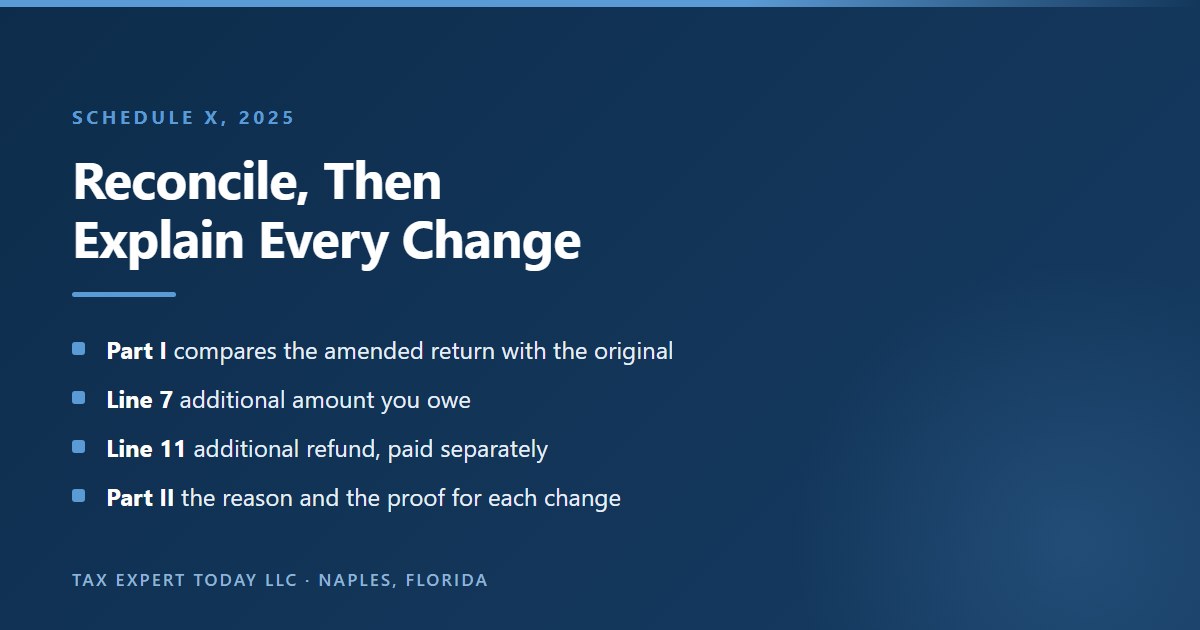
Schedule X reconciles the money and explains the change. Part I compares the amount owed or refunded on the amended return with what was paid or refunded on the original, producing either an additional balance due or an additional refund. Part II lists the reasons for amending and a detailed written explanation of each change.
The 2025 Instructions for Schedule X describe its purpose as determining any additional amount you owe or refund due to you and providing the reasons for amending. It is attached to an amended Form 540, Form 540NR, or Form 540 2EZ. Beginning with tax year 2023, Schedule X is year specific, so a 2024 amendment uses the 2024 Schedule X, not the current one. The schedule itself is published as a fillable form, the 2025 Schedule X.
Part I is a short reconciliation. Line 1 is the amount you owe from the amended return. Line 2 is the overpaid tax from the original return, meaning the refund plus any amount applied to estimated tax, plus any additional overpayment from an FTB change, but not interest received on a refund. Line 4 is the refund from the amended return. Line 5 is the amount actually paid with the original return plus any later tax payments, excluding interest and penalties. The arithmetic then leads either to line 7, an amount you owe, or to line 11, an additional refund.
| Schedule X line | What goes there | Former resident note |
|---|---|---|
| Line 1 | Amount you owe from the amended return | Taken from the corrected Form 540NR after all changes |
| Line 2 | Overpaid tax on the original return, including any amount applied to estimated tax and any FTB-caused overpayment | Do not include interest the FTB paid you on the first refund |
| Line 4 | Refund from the amended return | Compared with the original refund to isolate the change |
| Line 5 | Tax actually paid with the original return plus later tax payments | Excludes interest and penalties paid |
| Line 7 | Additional amount you owe | Pay through Web Pay, by card, or by check to the Franchise Tax Board |
| Lines 8a to 8c | Penalties and interest you choose to include with payment | If you leave interest out, the FTB figures it and bills you |
| Line 10 | Amount of an additional refund applied to 2026 estimated tax | Often zero after the move if no California income continues |
| Line 11 | Additional refund | Refunded separately from the original refund, with interest figured by the FTB |
Part II is where most amended returns succeed or fail. Line 1 offers a set of lettered reason boxes, including a protective claim for refund, an informal claim, and an Other box. The instructions note that the letters skip, so the box after e is g. Line 2 asks you to explain each change separately and in detail, stating the item being changed, the reason the change was needed, and the documents attached to support it. The FTB lists the kinds of attachments it expects: federal schedules if the federal return changed, corrected Forms W-2 or 1099, California Schedules K-1, escrow statements, court documents, and contracts. Each attachment should carry your name and SSN or ITIN.
- Year-specific form: from tax year 2023 forward, use the Schedule X printed for the year being amended.
- Line 2 detail: state the item changed, the reason, and the document attached for every change.
- Box a: protective claim for refund when an audit, litigation, or federal determination is pending.
- Box l: informal claim for refund when the full amount due has not yet been paid.
- Box m: Other, with the explanation written on line 2.
For a former resident, a good Part II explanation reads like a short memo. It names the tax year and the original residency date, identifies each changed line on Form 540NR and Schedule CA (540NR), explains why the original figure was wrong, and points to the document that proves the new figure. If the change involves sourcing, the explanation should say which period the income belongs to and why, citing the residency date that appears on the return. A one-line explanation such as corrected income invites a letter asking for more information, which delays the refund by months.
How long do you have to file a California amended return for a refund?
Under Revenue and Taxation Code section 19306, a claim for refund must be filed by the later of four years from the date a timely return was filed, four years from the original due date without extensions, or one year from the date of the overpayment. A claim filed after the period closes is barred, even if the overpayment is real.
The statute reads in full that no credit or refund shall be allowed or made after a period ending four years from the date the return was filed, if filed within the time prescribed, four years from the last day prescribed for filing the return, determined without regard to any extension, or after one year from the date of the overpayment, whichever period expires later, unless a claim is filed before that period expires. The text is available on the Legislature’s site at R&TC section 19306.
The 2025 Form 540NR booklet translates the statute into three situations, which together cover almost every former resident.
| When the original return was filed | Deadline for a refund claim on an amended return | Hypothetical for tax year 2024 |
|---|---|---|
| On or before April 15 | Four years from the original due date, or one year from the date of overpayment, whichever is later | Original due date April 15, 2025, so generally April 15, 2029 |
| During the extension period, April 15 to October 15 | Four years from the date the original return was filed, or one year from the date of overpayment, whichever is later | Filed September 22, 2025, so generally September 22, 2029 |
| After October 15 | Four years from the original April due date, or one year from the date of overpayment, whichever is later | Filed December 1, 2025, so generally April 15, 2029 |
The third row catches people. A return filed late, after the extended due date, does not earn a later refund deadline. The four-year period runs from the original due date in that case, so a late filer has less time than a taxpayer who filed during the extension period. Dates in the table are hypothetical and assume no weekend or holiday shift and no disaster postponement, and California has granted postponements to counties affected by wildfires and storms in several recent years. Before relying on any date for a real return, confirm the due date the FTB announced for that tax year.
The one year rule exists for a different situation: an overpayment made long after the original return, such as a payment on an FTB bill. If you paid an assessment in 2026 for an old year and later concluded the assessment was wrong, the one year period from the payment can keep a refund claim open after the four-year period has closed, but generally only for the amount paid in that window. The booklet adds a practical instruction: if you file an amended return after the normal four-year period, attach a statement explaining why the normal statute of limitations does not apply.
- Timely filed return: four years from the original due date.
- Extension period return: four years from the date you actually filed.
- Late return after October 15: four years from the original April due date, not from the filing date.
- Later payment: one year from the date of that payment, whichever period ends later.
- After a federal change: two years from the final federal determination under section 19311, covered below.
How does the California refund window compare with the federal window?
California generally allows four years from the due date or the filing date to claim a refund. The federal rule in Internal Revenue Code section 6511 generally allows three years from the date the return was filed or two years from the date the tax was paid, whichever is later. The two clocks do not run together.
The federal statute is at 26 U.S.C. section 6511. The practical consequence is that a California refund can still be available for a year in which the federal refund window has already closed. A former resident who discovers that the move year return overstated California source income may be able to recover California tax even though no federal change is possible or needed. The reverse is also true. A federal amended return filed late in the federal window can trigger a California reporting duty even after California’s own refund window for that year has narrowed.
| Question | California | Federal |
|---|---|---|
| Basic refund claim period | Later of four years from a timely filing date, four years from the original due date, or one year from overpayment (R&TC 19306) | Later of three years from filing or two years from payment (IRC 6511) |
| Claim after a government change | Two years from the final federal determination, or the normal period if later (R&TC 19311) | Governed by the federal adjustment and appeal rules |
| Form for an individual | Corrected Form 540, 540 2EZ, or 540NR plus Schedule X | Form 1040-X |
| Suspension for financial disability | Yes, R&TC 19316 | Yes, IRC 6511(h) |
| Duty to tell the other government | Report federal changes and federal amended returns that increase California tax within six months (R&TC 18622) | No federal duty to report a California amendment |
The IRS explains its side on the About Form 1040-X page and in Tax Topic 308, Amended Returns. You do not need to amend a federal return to amend a California return. If the federal return was right and only the California sourcing was wrong, the correction is a California-only amendment. The TurboTax community thread that ranks for this search shows exactly that situation: a filer who moved from California to Texas in mid-2025 overstated California wages on the part-year return and asked whether the federal return had to be amended first. It did not, because nothing federal had changed.
Do you have to amend your California return when you amend your federal return?
Generally yes, if the federal change increases your California tax. Section 18622(b) requires anyone who files a federal amended return to file a California amended return within six months. For an individual, the California return is not required unless the change would increase California tax for that year.
The statute is direct. Any taxpayer filing an amended return with the Commissioner of Internal Revenue shall also file within six months thereafter an amended return with the Franchise Tax Board. The individual exception follows in the same subdivision: for an individual subject to the personal income tax, an amended return need not be filed unless the change would increase the amount of tax payable for any year. The text is at R&TC section 18622. The Form 540NR booklet states the same rule in plain terms under When to File: if you filed federal Form 1040-X, file an amended California return within six months unless the changes do not affect your California tax liability.
Moving to Florida does not end this duty. The statute is written in terms of the taxpayer and the tax year, not where the taxpayer lives today. If you were a California resident for part or all of the year being amended federally, the federal change is tested against the California return for that year. Three examples show how often the answer is yes for a former resident.
| Hypothetical federal amendment | Effect on the California return for that year | California amended return required within six months? |
|---|---|---|
| Adds a forgotten Form 1099-DIV from a period when the taxpayer was a California resident | Increases California source income and California tax | Yes, because California tax increases |
| Adds income earned in Florida after the move, on a part-year return | California source income unchanged, but the rate under section 17041(b) can rise | Likely yes if the rate change increases California tax; test the math |
| Claims a deduction the taxpayer missed | Reduces California tax if California follows the deduction | Not required, but needed to claim the California refund |
| Corrects an item California does not follow, such as a federal-only deduction | No change to California tax | No |
The second row is the one most former residents miss, and a later section explains it in detail. California taxes a part-year resident on California source income, but at a rate set by total income from all sources. A federal amendment that adds only Florida income can still increase California tax, which brings the six month rule into play.
- Clock start: the date you filed the federal Form 1040-X.
- Clock length: six months.
- Individual exception: no California amended return is required unless California tax increases.
- Refund side: a federal change that lowers California tax is optional to report, but you must amend to get the money back.
What if the IRS changes your federal return after you moved to Florida?
Section 18622(a) requires you to report each IRS change or correction to the Franchise Tax Board within six months after the final federal determination. For an individual, changes need not be reported unless they increase California tax. The final federal determination is the date the IRS assesses the adjustment.
This is the duty that most often follows a former resident to Florida. An IRS examination of the move year, a CP2000 underreporting notice that you agreed to, or an IRS math error adjustment can each change items that also appear on the California return. Section 18622(a) covers any item required to be shown on a federal return, including gross income, deductions, penalties, credits, or tax, that is changed or corrected by the IRS or another competent authority. The taxpayer must report each change within six months after the date of each final federal determination and must either concede the accuracy of the determination or state where it is wrong.
Section 18622(d) defines the trigger date. The date of each final federal determination is the date on which each adjustment or resolution resulting from an IRS examination is assessed, which FTB Publication 1008 explains as the date the adjustment is assessed on the IRS account transcript under Internal Revenue Code section 6203. That is not the date of the first IRS letter, and it is not the date you signed an agreement form. It is the assessment date, which is visible on the federal account transcript. A former resident trying to calculate the six month window should pull the transcript rather than guess.
| Federal event | Reporting trigger | Six month window ends (hypothetical) |
|---|---|---|
| IRS examination closes with an agreed adjustment, assessed March 10, 2026 | Assessment date shown on the account transcript | September 10, 2026 |
| CP2000 proposal agreed, tax assessed June 2, 2026 | Assessment date of the agreed adjustment | December 2, 2026 |
| Federal Form 1040-X filed by the taxpayer on May 1, 2026 | Filing date of the federal amended return (section 18622(b)) | November 1, 2026 |
| IRS change that reduces California tax | No reporting duty for an individual | Refund claim period runs under section 19311 instead |
The individual exception in section 18622(a) mirrors the one for federal amended returns: changes need not be reported unless they increase the tax payable under the personal income tax law for any year. The phrase for any year matters. An IRS change to one year can ripple into another California year, for example by reducing a California carryover that was used later. Publication 1008 also warns about multi-year cases where one year produces an assessment and another produces an overpayment. If the refund year is not claimed in time, the overpayment cannot offset the assessment year and cannot be refunded.
If you live in Florida now and the federal adjustment involves a period when you were already a Florida resident, do not assume California is irrelevant. As the next sections show, the part-year computation uses total income to set the rate, and some items, such as deferred compensation or installment gains, stay California source after the move. Our guide to California source income explains which items follow you.
What happens if you do not report a federal change to the FTB?
Under section 19060(a), if you fail to report a federal change or file a required amended return, the FTB may mail a notice of proposed deficiency assessment at any time. The ordinary four-year assessment period in section 19057 does not protect you, and interest runs from the original due date.
Section 19060 is the enforcement side of section 18622. Subdivision (a) provides that if a taxpayer fails to report a change or correction by the IRS, or fails to file an amended return as required by section 18622, a notice of proposed deficiency assessment resulting from the adjustment may be mailed at any time. Subdivision (b) covers a late report: if the taxpayer or the IRS reports the change after the six month period, the FTB may mail a proposed assessment within four years from the date it is notified. The text is at R&TC section 19060.
Publication 1008 adds the timing on the timely side. If the FTB receives the federal changes within the six month period, it has two years from the date it receives the report to apply the federal changes to your California return. If you or the IRS notify the FTB more than six months after the final federal determination, the FTB has four years from receiving sufficiently detailed information. If no one notifies the FTB, the statute of limitations for assessment remains open and the FTB may assess at any time, with interest accruing from the original due date of the tax year until paid.
| How the FTB learns of the federal change | FTB period to propose an assessment | Source |
|---|---|---|
| You report within six months of the final federal determination | Two years from receipt of the report, or the ordinary period if later | FTB Publication 1008 |
| You or the IRS report after six months | Four years from the date the FTB is notified with sufficiently detailed information | R&TC 19060(b); FTB Publication 1008 |
| No one reports the change | Any time | R&TC 19060(a) |
| No federal change, ordinary return | Four years after the return was filed | R&TC 19057 |
| Omission of more than 25 percent of gross income stated | Six years after the return was filed | R&TC 19058 |
The ordinary four-year period appears in section 19057, and the six-year period for a large omission in section 19058. A former resident who assumes an old California year is closed because four years have passed can be wrong for a simple reason: the IRS and the FTB share information, and the FTB often learns of federal adjustments without the taxpayer’s help. When it does, the open-ended statute in section 19060(a) allows it to assess the California consequence years later, with interest from the original due date. The proposed assessment arrives as a notice of proposed assessment, which our guide to the FTB notice of proposed assessment explains, including the 60 day protest period.
- Interest: runs from the original due date of the year, not from the date of the federal change.
- Penalties: the 540NR booklet notes that most penalties assessed by the IRS also apply under California law.
- Information sharing: the FTB can learn of the change from the IRS, so silence does not keep the year closed.
- Refund risk: a related refund year that is not claimed within two years of the determination can be lost entirely.
How do you report a federal change to the FTB?
An individual can report a federal change by filing an amended Form 540 or 540NR with Schedule X, by faxing all federal information to 916-843-2269, or by mailing a notification letter with the federal documents to the FTB RAR/VOL unit. Whatever the method, include a complete copy of the final federal determination.
FTB Publication 1008 lists the three methods for individual taxpayers, and the 2025 Form 540NR booklet repeats them in its answer to the question, the IRS made changes to my federal tax return, what should I do? The booklet adds the mailing addresses for an amended Form 540NR with and without payment and a phone number, 916-845-4028, for questions about IRS audit adjustments. The publication sets out what the notification must contain: that a final federal determination has been made, the adjusted tax year, a full explanation of every adjustment, and federal documentation showing the adjustments to taxable income.
| Method | Where it goes | Best used when |
|---|---|---|
| Amended Form 540NR with Schedule X, with payment | Franchise Tax Board, PO Box 942867, Sacramento, CA 94267-0001 | You can compute the California change and want to pay it now to stop interest |
| Amended Form 540NR with Schedule X, without payment | Franchise Tax Board, PO Box 942840, Sacramento, CA 94240-0001 | The change produces a refund or no balance due |
| Fax of all federal information and changes | 916-843-2269 | You want to notify quickly and let the FTB compute the California effect |
| Notification letter with copies of the federal changes | ATTN RAR/VOL MS F310, Franchise Tax Board, PO Box 1998, Rancho Cordova, CA 95741-1998 | You prefer a written record and the FTB to compute the change |
Publication 1008 recommends including more than the bare minimum: a complete copy of the final federal determination or audit report with all schedules, copies of the original and revised schedules and forms with state and federal differences noted, complete copies of the state and federal returns if the adjusted years are more than three years old, and a phone number with convenient call hours. If someone other than you should be contacted, a completed form FTB 3520 PIT, Individual or Fiduciary Power of Attorney Declaration, must be on file. Our guide to the FTB power of attorney explains how that authorization works.
- Say that a final federal determination was made: and give its date.
- Identify the tax year: each adjusted year is reported separately.
- Explain every adjustment: concede it or state where it is wrong, as section 18622(a) requires.
- Attach the federal documents: the audit report or determination with all schedules.
Which method is better for a former resident? Filing the amended Form 540NR yourself has two advantages. You control the computation, which matters on a part-year return because the FTB may not know your residency date or how the federal adjustment should be split between the California and Florida periods. And paying the tax with the amended return stops interest from growing. The notification letter is simpler but leaves the computation to the FTB, which may treat the whole federal adjustment as California income unless the letter explains otherwise. Whichever route you take, the booklet is explicit that you must include a copy of the final federal determination along with all data and schedules on which the adjustment was based.
How do you claim a California refund after a federal change?
Under section 19311, a refund claim that results from an IRS change may be filed within two years from the date of the final federal determination, or within the ordinary refund period if that ends later. You claim it with an amended Form 540NR and Schedule X; the FTB does not refund it automatically.
Section 19311(a)(1) provides that if a change or correction is made or allowed by the IRS or another competent authority, a claim for credit or refund resulting from the adjustment may be filed within two years from the date of the final federal determination, or within the period provided in sections 19306, 19307, 19308, or 19316, whichever expires later. The current text, as amended effective September 14, 2026 by Stats. 2026, Chapter 236, is at R&TC section 19311. Subdivision (c) of the current text addresses adjustments to partnerships; individuals work from paragraph (1).
Publication 1008 is direct about the consequence of waiting. If federal changes decrease your income or increase your credits and result in a California refund, you must file a claim for refund if you want the overpayment refunded. The claim must be filed within the normal statute of limitations, one year from the date of overpayment, or two years after the final federal determination, whichever is later. There is no automatic refund just because the FTB later receives the federal adjustment from the IRS.
| Scenario (hypothetical) | Final federal determination | California refund claim deadline |
|---|---|---|
| IRS audit of 2021 reduces income; assessed or allowed April 1, 2026 | April 1, 2026 | Generally April 1, 2028, because that is later than the ordinary 2021 period |
| IRS accepts a federal refund claim for 2023 on February 15, 2026 | February 15, 2026 | The later of February 15, 2028 or the ordinary 2023 period under section 19306 |
| Federal determination still pending at the end of the California period | Not yet final | File a protective claim before the California period closes, explained below |
The two-year window is short for a former resident who no longer thinks of California as part of the household’s tax life. A favorable IRS outcome three years after a move can produce a California refund for the move year, but only if someone files the amended Form 540NR within two years of the final determination. Calendar it the day the federal case closes.
How do you amend a part-year return to correct your residency date?
Prepare a complete amended Form 540NR using the correct residency date, re-run the Schedule CA (540NR) column E allocation for every item of income and deduction, and explain the new date and the evidence for it in Schedule X, Part II. Expect the FTB to compare the new date with its own records.
A wrong residency date is one of the most consequential errors a former resident can correct. The date controls which income is taxed by California in full and which is taxed only if it has a California source. On Schedule CA (540NR), column D carries income from all sources as if you were a full-year California resident, after California and federal differences, and column E carries all income from all sources while you were a California resident plus income from California sources while you were a nonresident. The 2025 Schedule CA (540NR) instructions send part-year residents to a Part-Year Resident Worksheet to build the column E amounts. Change the residency date and every column E figure may change with it.
Why would the date be wrong? Common reasons include using the day the moving truck left rather than the day the move was complete, choosing the date a Florida declaration of domicile was filed when the household had already been living in Florida for weeks, or the reverse: picking an early date when the family was still returning to California for most of the summer. California residency is not decided by a single document. It turns on whether you were in California for other than a temporary or transitory purpose, or domiciled in California while outside it for a temporary purpose, under R&TC section 17014, applied through the factors in FTB Publication 1031, Guidelines for Determining Resident Status.
| Item on the move year return | If the corrected date is earlier | If the corrected date is later |
|---|---|---|
| Wages for work performed between the two dates | Move out of column E unless the work was performed in California | Move into column E as resident income |
| Interest and dividends paid between the two dates | Generally move out of column E, since intangible income of a nonresident is generally sourced to the residence | Move into column E |
| Capital gain on a stock sale between the two dates | Generally move out of column E, unless the asset has a business situs in California | Move into column E, because a resident is taxed on all gains |
| Gain on California real property | Stays in column E, because California real property is California source | Stays in column E |
| Itemized deductions and credits | Recomputed under the part-year rules for the new periods | Recomputed under the part-year rules for the new periods |
Our guide to the California part year resident tax return explains how each type of income is split across the move date on the original filing. The amended return applies the same rules, just from a different starting point. The table is a summary of general sourcing principles and is not a substitute for the line instructions, which carry exceptions for items such as deferred compensation, stock options, and installment sales.
An amendment that moves the residency date earlier and reduces California tax is, in effect, a claim that you stopped being a California resident sooner than you first said. That is a residency position, and residency positions draw review. The amendment should be filed only if the evidence supports the new date, and the Part II explanation should say what that evidence is: the closing date on the California home sale or lease termination, the Florida homestead or lease start date, the date the children started school in Florida, vehicle registrations, voter registration, and the professional and banking relationships that moved. If the FTB later questions the date, it will use the same factors it uses in any audit, which our guide to a California residency audit walks through, and which our guide to establishing Florida residency describes from the Florida side.
- Collect the evidence first: the amended date must be the date the facts support, not the date that minimizes tax.
- Re-run every column E line: wages, investment income, business income, deductions, and credits can all shift.
- State the date in Part II: give the old date, the new date, and the documents that prove it.
- Check consistency: the date on the amended return should match the date on any other California filing for the year, including Form 3853 health coverage coding.
How is income re-sourced on an amended Form 540NR?
Each item is assigned again to the California resident period or the nonresident period, and nonresident period income stays in column E only if it has a California source. Wages follow where the work was performed, most investment income follows residence, and California real property and California business income stay California source.
A hypothetical shows how a residency date correction flows through. A household originally reported a residency change date of August 31 on its move year Form 540NR. After reviewing the closing documents and school records, it concludes that the correct date is June 30. The wage earner worked remotely from Florida in July and August for a California employer. The household also received dividends during July and August and sold a block of publicly traded stock on July 20.
| Hypothetical item | Original column E (date August 31) | Amended column E (date June 30) | Reason |
|---|---|---|---|
| Wages, January to June, work in California | $120,000 | $120,000 | Resident period income |
| Wages, July to August, work performed in Florida | $40,000 | $0 | Nonresident period, services performed outside California |
| Dividends, July to August | $3,000 | $0 | Nonresident period intangible income, generally sourced to residence |
| Gain on stock sold July 20 | $60,000 | $0 | Sale after the corrected residency date, no California business situs |
| Rental income from a California condo, all year | $18,000 | $18,000 | California real property income is California source in both periods |
| Total California income, column E | $241,000 | $138,000 | Total from all sources (column D) is unchanged |
The column D total from all sources does not change in this example, because no income was added or removed from the federal return. Only the sourcing changed. The figures are hypothetical and simplified; a real return would also prorate deductions, apply any California and federal differences in columns B and C, and test each item against the exceptions in the instructions. The remote work fact pattern in particular has nuances that our guide to the California remote work tax explains, including how employer-reported California wages on Form W-2 are adjusted when the work was performed elsewhere.
Two documents often need to be corrected or explained alongside the amendment. The first is the Form W-2. A California employer may have reported all wages in the California state box and withheld California tax on all of them. The amended return can claim the correct allocation without a corrected W-2, but the Part II explanation should reconcile the W-2 state wages to the amended column E wages and attach a statement, such as payroll records or an employer letter, showing when and where the work was performed. The second is any brokerage statement that lists a California address after the move. The explanation should note the date the brokerage address was changed, because the FTB may receive information returns that still show California.
- Wages: sourced to where the services were performed during the nonresident period.
- Interest, dividends, and most stock gains: generally sourced to the residence of the taxpayer during the nonresident period.
- Rental income and gain on California real property: California source in every period.
- Business income from a California activity: California source, allocated or apportioned under the instructions.
- Deferred items: special rules apply to deferred compensation, stock options, and installment sales, so check the instructions before moving them.
Why does an amended Form 540NR change your California tax rate?
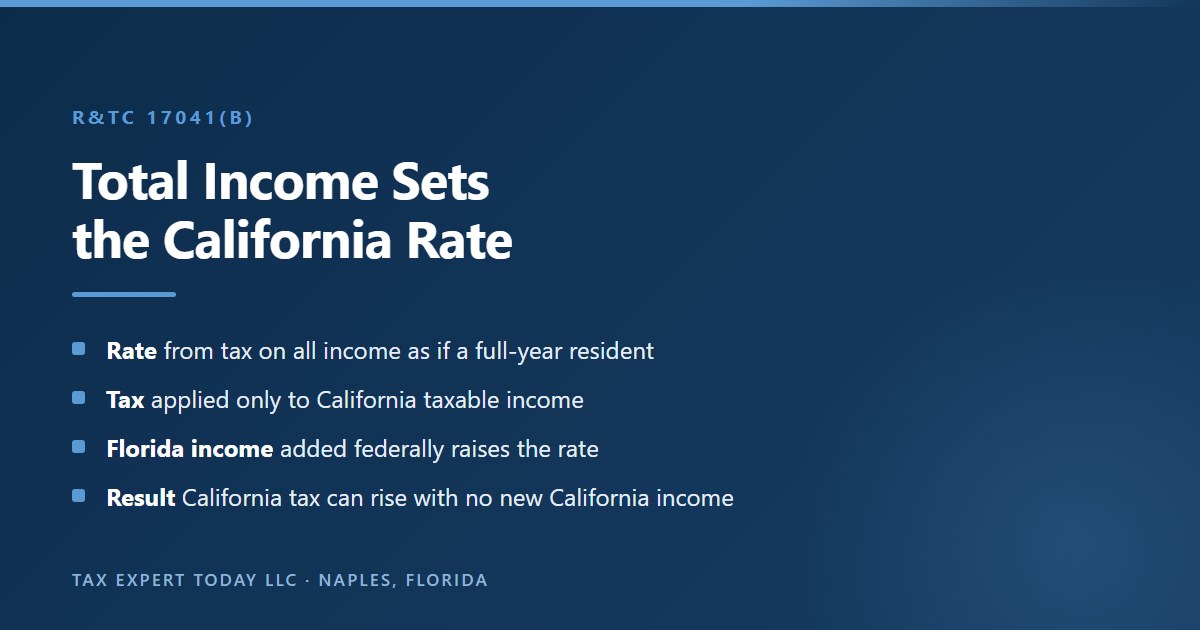
Under section 17041(b), a part-year resident pays tax on California taxable income at a rate equal to the tax on total taxable income, computed as if a full-year resident, divided by that total income. Any amendment that changes total income from all sources changes the rate applied to every California dollar, even if California income is unchanged.
This is the single most misunderstood feature of the part-year return, and it is the reason a federal change to Florida-period income can raise California tax. R&TC section 17041(b) provides that the tax on a nonresident or part-year resident is calculated by multiplying the taxable income of the nonresident or part-year resident by a rate equal to the tax computed on the entire taxable income as if the taxpayer were a resident for the taxable year, and for all prior years for carryover items, deferred income, suspended losses, or suspended deductions, divided by the amount of that income.
On Form 540NR, the computation runs in a predictable order. Line 17 carries total adjusted gross income from all sources, which equals Schedule CA (540NR), column D. Tax is computed on total taxable income as if the household were a full-year resident. That tax divided by total taxable income produces the California tax rate. The rate is then applied to California taxable income from column E. Change the total and the rate moves.
| Hypothetical part-year household | Original return | After federal change adding Florida income |
|---|---|---|
| Total taxable income from all sources | $400,000 | $500,000 |
| California taxable income | $150,000 | $150,000 |
| Rate from tax on total income, as if a full-year resident (assumed for illustration) | 8.0 percent | 8.6 percent |
| California tax before credits | $12,000 | $12,900 |
| Change in California tax | Not applicable | Increase of $900 |
The rates in the table are assumptions chosen to show the mechanism, not figures computed from the 2025 tax rate schedules, which the Form 540NR booklet prints for taxable income over $100,000. In a real return, the rate would come from the schedule for the filing status and would also reflect any Behavioral Health Services Tax on income over $1 million, which applies to California taxable income under its own rules. The point is the direction: adding income anywhere on the federal return pushes the rate up and increases California tax on the same California income.
That is why section 18622 can apply to a federal change that seems to have nothing to do with California. A former resident who agrees to an IRS adjustment adding consulting income earned in Naples after the move will generally see the California rate rise for the move year. Because the change increases California tax, the six month reporting duty applies. The same logic runs in reverse. A federal change that removes Florida-period income lowers the rate, which can support a California refund claim under section 19311 even though the California source income never changed.
- Rate base: total taxable income from all sources, computed as if a full-year resident.
- Tax base: California taxable income only.
- Federal change to Florida income: can change the rate and therefore California tax.
- Carryovers: included in the rate computation as if you had always been a resident.
Does a federal change to Florida-period income affect your California return?
Often yes, through the rate. If the change increases total income, the California rate rises and California tax increases, so section 18622 generally requires a report within six months. If it decreases total income, California tax may fall, and you must file an amended return to claim that refund.
Former residents often reason that once they lived in Florida, the IRS can change anything it likes about the Florida months without California caring. The previous section shows why that reasoning fails for the move year. For years after the move, the answer depends on whether you still file a California return. If you file Form 540NR as a full-year nonresident because you still have California source income, such as rent from a California property, distributions from a California business, or installment payments on a California sale, the same section 17041(b) rate mechanism applies, and a federal change to non-California income can still affect California tax.
| Year after the move (hypothetical) | California return filed? | Can a federal change to Florida income change California tax? |
|---|---|---|
| Move year, part-year resident | Yes, Form 540NR | Yes, through the rate on California income |
| Following year, still receives rent from a California property | Yes, Form 540NR as a nonresident | Yes, through the rate on the California rental income |
| Following year, receives installment payments on a California sale | Yes, Form 540NR as a nonresident | Yes, through the rate |
| Following year, no California source income and no filing requirement | No | Generally no California consequence for that year |
One more category of federal change has a direct California effect regardless of the rate: changes to items that are California source no matter where you live. If the IRS adjusts the gain on a California rental property, the basis of a California business interest, or the amount of a deferred compensation payment earned in California, the California income itself changes. Our guide to the California capital gains tax on a home sale covers one of the most common examples, the sale of a former California residence after the move.
The practical step for a former resident who receives any federal adjustment is simple: rebuild the California return for each affected year with the adjusted federal figures and compare the tax. If California tax rises, report within six months. If it falls, file the claim within two years of the final federal determination. If it does not change, keep the computation in the file as evidence that no report was required.
How do you amend to apply a restated NOL or capital loss carryover?
File an amended Form 540NR for the year in which the carryover should have been used, recomputing the carryover on the California forms such as form FTB 3805V for an NOL or the California Schedule D (540NR) for a capital loss. The carryover is restated to California amounts for a part-year or nonresident year.
Carryovers are where California and federal returns most often drift apart, and the drift is wider for a former resident. California computes its own net operating loss on form FTB 3805V. For taxable years beginning on or after January 1, 2024 and before January 1, 2027, California suspended the NOL carryover deduction for taxpayers whose net business income or modified adjusted gross income reaches the threshold, while allowing taxpayers to continue computing and carrying over the loss, as the 2025 Schedule CA (540NR) instructions note with a reference to R&TC section 17276.24. Our guide to the California NOL suspension explains the threshold, the extended carryover periods, and how the loss is restated after a move.
A typical amendment arises when an NOL or capital loss was applied incorrectly in the move year or a later nonresident year. A taxpayer may have used the federal carryover figure on the California return, ignored the suspension, or failed to restate the carryover to California source amounts once the taxpayer became a nonresident. Each of those errors can produce either too much or too little California tax. The fix is an amended Form 540NR for the first year the carryover was misapplied, followed by amended returns for any later year whose carryover balance changed as a result.
| Carryover error (hypothetical) | Effect | Amended return needed |
|---|---|---|
| Federal NOL used on the California return during a suspension year for a taxpayer over the threshold | California tax understated | Yes, to remove the deduction and carry the loss forward |
| California NOL not restated to California amounts in a nonresident year | Deduction can be too large or too small | Yes, to apply the restated figure |
| California capital loss carryover from the prior year omitted | California tax overstated | Yes, to claim the carryover and a refund if the period is open |
| Carryover applied in the wrong year | Errors in two or more years | Yes, for each affected year still open |
The refund statute applies year by year. If the year in which the carryover should have been deducted is outside the section 19306 period, a refund for that year is barred even though the carryover was real. The later years may still be open, and the carryover balance can be corrected going forward. Section 17041(b) also matters here: carryovers enter the rate computation as if you had been a California resident for all prior years, so a carryover correction can change both the tax base and the rate. The Form 540NR booklet reminds filers to keep records that verify carryover items for as long as they are needed, which for a long-lived loss can be many years after the move.
- NOL: computed on form FTB 3805V, subject to the 2024 to 2026 suspension and the restatement rules for nonresident years.
- Capital loss: carried on the California Schedule D (540NR), which can differ from the federal carryover.
- Chain effect: fixing one year can require amending every later year that used the balance.
- Closed years: a refund for a closed year is barred, but later open years can still be corrected.
How do you amend a California return to correct a credit?
Correct the credit on the amended Form 540NR and any supporting credit form, then explain the change in Schedule X, Part II with the documents that support it. Part-year and nonresident filers prorate many credits, so a residency date or income change can alter the credit even when the credit itself was right.
Credits on a part-year return follow the same logic as income. Many credits are prorated using the ratio of California adjusted gross income to total adjusted gross income, and some are available only to residents or only for resident months. A correction to the residency date, to California source income, or to total income can therefore change a credit that was computed correctly the first time. The reverse also occurs. A credit can be wrong while the income is right, for example a renter’s credit claimed by a household that did not meet the residency requirement, which the 2025 booklet ties to California residency for at least six months of the year.
The credit former residents ask about most often is the credit for taxes paid to another state, claimed on Schedule S. It applies in limited situations, such as income taxed by both California and another state that imposes an income tax. Because Florida has no personal income tax, the credit does not arise from Florida, but it can arise for a household that also had income from a third state. An amendment that changes California source income can change the credit in either direction. The detail of that credit is outside the scope of this guide; the point here is that a credit is part of the amended computation, not a separate filing.
| Credit issue (hypothetical) | How the amendment handles it | Schedule X, Part II |
|---|---|---|
| Credit prorated using the wrong California AGI ratio | Recompute the ratio from the amended Form 540NR | Explain that the ratio changed because income was re-sourced |
| Resident-only credit claimed for a nonresident period | Remove or reduce the credit | Explain the residency period and attach the computation |
| Dependent exemption credit for a dependent without an SSN or ITIN | Write “no id” in the SSN field and attach form FTB 3568 | Check box m, Other, and use the FTB’s stated explanation |
| Credit for taxes paid to another state | Recompute Schedule S with the amended income figures | Explain the change and attach the other state’s return |
The 2025 Schedule X instructions give a model for how specific the explanation should be. For the dependent exemption credit claimed without an identification number, they tell the filer to check box m for Other on Part II, line 1, and to write a set sentence on line 2 stating that the credit is claimed and that form FTB 3568 is attached, together with the required documents. When the FTB publishes a specific explanation for a change, use it word for word. When it does not, follow the structure the instructions describe: the item changed, the reason, and the document attached.
Can you change your filing status on a California amended return?
Generally your California filing status must match your federal status, with exceptions for registered domestic partners and for married couples where one spouse was an active member of the armed forces or was a nonresident all year with no California source income. You cannot switch from joint to separate after the due date unless an exception applies.
The 2025 Form 540NR booklet sets out the filing status rules for an amended return in detail. California filing status must be the same as the federal filing status, unless you are in a registered domestic partnership. A married couple who filed a joint federal return may file separate state returns if either spouse was an active member of the United States armed forces during the year being amended, or was a nonresident for the entire year and had no income from California sources during that year. If you changed filing status on a federal amended return, change it for California too, unless one of those exceptions applies.
The nonresident spouse exception matters to former residents in a specific way. If one spouse moved to Florida early, for example to start a job or a business, and was a Florida resident for the whole year with no California source income, while the other spouse stayed behind part of the year to sell the house, the couple may be able to file a joint federal return but separate California returns. That can keep the Florida spouse’s income out of the California rate computation entirely. The exception is narrow. A spouse who was a California resident for even part of the year, or who had any California source income, does not qualify.
| Requested change on the amended return | Allowed? | Rule from the 2025 Form 540NR booklet |
|---|---|---|
| Married filing jointly to married filing separately | Not after the due date of the return, unless an exception applies | Exceptions: armed forces member, or a spouse who was a nonresident all year with no California source income |
| Separate returns to married filing jointly | Generally yes, within four years from the original due date of the separate returns | Must have been married or in an RDP on the last day of the year; both spouses sign one amended joint return |
| Match a federal filing status change | Yes, change California to match | Unless one of the separate-return exceptions applies |
| Single federal status for a registered domestic partner | California requires married/RDP filing jointly or separately | RDP rule |
Changing from separate returns to a joint return can be attractive after a move, because a joint return combines the household’s income and deductions under one rate computation. It can also be expensive if one spouse had much higher Florida income, since that income would then enter the rate for California income that belonged to the other spouse. Run both computations before amending. The booklet instructs that to amend from separate returns to a joint return, you complete only one amended joint return and both spouses sign it.
- Default: California status follows federal status.
- Joint to separate: barred after the due date, except for the armed forces and nonresident spouse exceptions.
- Separate to joint: allowed within four years of the original due date of the separate returns.
- Test both ways: the rate mechanism can make a joint return better or worse for a split-residency couple.
When should a former resident file a protective claim for refund?
File a protective claim when the refund depends on an event that will not be resolved before the California refund period closes, such as another state’s audit, pending litigation, or an IRS determination. Check box a on Schedule X, Part II, line 1, and describe the pending matter on line 2 so the FTB can identify it.
Both the 2025 Schedule X instructions and the 2025 Form 540NR booklet describe the protective claim in the same words. If you are filing a claim for refund for a taxable year where an audit is being conducted by another state’s taxing agency, litigation is pending, or a final determination by the IRS is pending, check box a for Protective claim for refund on Schedule X, Part II, line 1, and specify the pending litigation or reference the federal determination on line 2 so the FTB can properly process the claim. FTB Publication 1008 adds that, for an amended return filed as a protective claim, you write PROTECTIVE CLAIM at the top of the amended return and Schedule X.
A protective claim keeps the refund door open without requiring you to know the final number. For a former resident, the most common use is a dispute with another government that affects California tax. If the IRS is examining the move year and an adjustment in your favor would reduce California tax through the rate, a protective claim filed before the section 19306 period ends preserves the California refund even if the IRS case runs past that date. Section 19311 would also give two years from the final federal determination, but a protective claim removes any argument about which period applies.
| Pending matter (hypothetical) | Why a protective claim helps | Part II, line 2 description |
|---|---|---|
| IRS examination of the move year, still open | A favorable federal outcome could lower California tax after the California period closes | Tax year, IRS examination, and the issue under review |
| Another state auditing whether you were its resident | The result may change which state taxes certain income | The other state, its agency, and the years under audit |
| Litigation over the amount of a sale price or a compensation payment | The final amount affects California source income | Court, case name or number, and the issue |
- When to file: before the section 19306 period closes, while the other matter is still open.
- How to mark it: box a on Schedule X, Part II, line 1, and PROTECTIVE CLAIM at the top of the forms.
- What to describe: the pending audit, litigation, or federal determination, specifically enough to match it later.
- What follows: a complete amended return or statement with final figures once the matter resolves.
A protective claim is not a substitute for a real claim once the facts are known. When the pending matter resolves, follow up with a complete amended return or a supplemental statement that gives the final figures. The protective claim should also be specific enough that the FTB can match it to the later resolution, which is why the instructions ask you to describe the pending matter rather than simply checking the box.
What if you are amending in response to an FTB bill or notice?
You can file an informal claim for refund by checking box l on Schedule X, Part II, line 1, even before the full amount due is paid. Billing notices continue until the amended return is accepted. Once the full amount is paid, you can appeal a disallowed claim to the Office of Tax Appeals or file suit in court.
The 2025 Form 540NR booklet addresses this situation under the California statute of limitations heading. If you are filing your amended return in response to a billing notice, you will continue to receive billing notices until the amended return is accepted. You may file an informal claim for refund even though the full amount due, including tax, penalty, and interest, has not yet been paid. After the full amount due has been paid, you have the right to appeal to the Office of Tax Appeals or to file suit in court if the claim for refund is disallowed. The informal claim is mailed to Franchise Tax Board, PO Box 942840, Sacramento, CA 94240-0040.
It is important to know which stage you are in before choosing this route. A notice of proposed assessment is a proposal, not a bill, and it carries its own 60 day protest period. If you disagree with a proposed assessment, the protest, not an amended return, is generally the right response while the protest period is open. Our guide to the FTB notice of proposed assessment explains the protest and appeal steps. The informal claim path in the booklet is for the later stage, when the amount has become due and a bill has issued.
| What you received | Usual response | Role of an amended return |
|---|---|---|
| Notice of proposed assessment, protest period open | Written protest by the Protest By date | Generally not the main response; the protest states your grounds |
| Bill or notice of balance due after the assessment is final | Pay, arrange a payment plan, or file an informal claim | An informal claim on Schedule X, box l, can start the refund process before full payment |
| Request for information about a filed return | Respond with the requested documents | Amend only if the response shows the original return was wrong |
| FTB adjustment letter after processing | Review the adjustment | If you amend later, start from the FTB-adjusted figures |
- Proposed assessment: protest by the Protest By date rather than amending.
- Final bill: an informal claim can be filed before the full amount is paid.
- Notices continue: billing notices keep arriving until the amended return is accepted.
- Appeal rights: after full payment, a disallowed claim can go to the Office of Tax Appeals or to court.
If the balance is due and cannot be paid in one amount, an FTB payment arrangement keeps the account from escalating while the claim is considered. Our guides to the FTB installment agreement and to the California late payment penalty explain the options and how penalties accrue while a balance remains open.
Does the refund deadline pause if you are financially disabled?
Yes. Section 19316 suspends the refund periods in sections 19306, 19308, 19311, 19312, and 19313 while an individual is financially disabled, meaning unable to manage financial affairs because of a medically determinable impairment that is terminal or expected to last at least 12 months. It does not apply while someone else is authorized to act.
R&TC section 19316 provides that for an individual taxpayer under the personal income tax law, the running of the periods specified in those refund sections is suspended during any period in which the taxpayer is financially disabled. An individual is financially disabled if unable to manage his or her financial affairs by reason of a medically determinable physical or mental impairment that is either deemed to be a terminal impairment or is expected to last for a continuous period of not less than 12 months. The 2025 Form 540NR booklet adds the limitation: you are not considered financially disabled during any period that your spouse or registered domestic partner, or any other person, is legally authorized to act on your behalf on financial matters.
The FTB handles the claim through form FTB 1564, Financially Disabled, Suspension of the Statute of Limitations, which explains how the suspension period is calculated and is filed with the claim for refund along with the medical support the form calls for. Moves are often tied to health events: a family relocates to Florida to be near relatives after a diagnosis, or an older parent moves in with adult children. In those households, a year that looks closed under the four-year rule may still be open if the taxpayer was financially disabled for part of the period and no one else held authority over the finances.
| Element | Requirement | Practical point for a former resident |
|---|---|---|
| Impairment | Medically determinable physical or mental impairment | Documented by a physician’s statement on the FTB form |
| Duration | Terminal, or expected to last at least 12 continuous months | Short illnesses do not qualify |
| Effect | Unable to manage financial affairs | Describe how the impairment prevented filing the claim |
| No authorized representative | No spouse, RDP, or other person legally authorized to act on financial matters during the period | A durable power of attorney in effect ends the suspension for that period |
The federal statute has a parallel rule in Internal Revenue Code section 6511(h), but the two are applied separately. A taxpayer who qualifies for California may still need to establish the federal suspension through the IRS process, and the reverse.
Can you e-file a California amended tax return, and where do you mail it?
Yes. The FTB accepts amended returns online through a tax representative or tax preparation software. By mail, an amended return with a payment goes to PO Box 942867, Sacramento, CA 94267-0001, and one without a payment goes to PO Box 942840, Sacramento, CA 94240-0001.
The FTB Correct an income tax return page lists two submission routes: online, through your tax representative or tax preparation software, or by mail. The page shows the PO Box 942840 address. The 2025 Schedule X instructions and the 2025 Form 540NR booklet add a second address for returns that include a payment. Using the right box matters less than it once did, but a return with a check that is sent to the no-payment address can be delayed while the payment is routed. The FTB’s general guidance on paper filing is on its File by mail page.
| What you are sending | Address or route | Source |
|---|---|---|
| Amended Form 540NR and Schedule X, with payment | Franchise Tax Board, PO Box 942867, Sacramento, CA 94267-0001 | 2025 Schedule X instructions; 2025 Form 540NR booklet |
| Amended Form 540NR and Schedule X, no payment or a refund | Franchise Tax Board, PO Box 942840, Sacramento, CA 94240-0001 | FTB amend page; 2025 Schedule X instructions |
| Informal claim for refund | Franchise Tax Board, PO Box 942840, Sacramento, CA 94240-0040 | 2025 Form 540NR booklet |
| Notification letter for federal changes | ATTN RAR/VOL MS F310, Franchise Tax Board, PO Box 1998, Rancho Cordova, CA 95741-1998 | 2025 Form 540NR booklet; FTB Publication 1008 |
| Electronic filing | Through a tax representative or tax preparation software | FTB amend page |
| Electronic payment | Web Pay at ftb.ca.gov/pay, or by credit card through ACI Payments with jurisdiction code 1555 | 2025 Schedule X instructions |
A few mechanical rules in the 2025 Form 540NR booklet trip up first-time filers. Do not attach the previously filed return for 2017 and later years. Enter zero on amended Form 540NR, line 102 for the amount applied to the next year’s estimated tax and use Schedule X, line 10 instead. Voluntary contributions cannot be amended, so enter the amount from the original return. Direct deposit is available: complete the amended Form 540NR through line 125, then Schedule X, and the Schedule X, line 11 refund carries to lines 126 and 127. If the total of lines 126 and 127 does not equal Schedule X, line 11, the FTB issues a paper check.
For a former resident, the direct deposit rule has a practical edge. A paper check mailed to an old California address can take weeks to catch up with a forwarding order, and a check sent to a closed California bank account will bounce back to the FTB. Confirm the bank account on the amended return is open, and update the address on file with the FTB before filing. Payments can be made through FTB Web Pay on the day the return is filed.
- Online: through software or a tax representative; the fastest and most traceable route.
- Mail with payment: PO Box 942867.
- Mail without payment: PO Box 942840.
- Direct deposit: lines 126 and 127 must equal Schedule X, line 11.
- Address: update it with the FTB first, because notices and checks go to the address on file.
Do you pay interest and penalties with a California amended return?
You may include them. Schedule X, line 8a carries penalties with an attached statement showing each penalty’s type, code section, and computation, and line 8b carries interest. If you leave interest out or include only part of it, the FTB figures the interest and bills you.
The 2025 Schedule X instructions set out the procedure. If you are including penalties with your payment, enter them on line 8a and attach a statement that shows, for each type of penalty, a description, the Internal Revenue Code or Revenue and Taxation Code section that provides for it if possible, and how you computed it. If you owe additional tax and are including interest, enter it on line 8b. Line 8c totals the two. If you do not include interest, or include only a portion, the FTB will figure the interest and bill you for it.
Interest on additional tax generally runs from the original due date of the return, which is why paying the additional tax with the amended return, or as soon as the amount is known, is usually the most important step. Penalties are a separate question. An amended return that reports additional tax may draw a late payment penalty on the additional amount, and a federal change that carried an IRS accuracy-related penalty may produce a California counterpart, since the 2025 booklet notes that most penalties assessed by the IRS also apply under California law. Our guide to the California late payment penalty explains how that penalty is computed and when relief may be requested.
| Amount | Where it goes on Schedule X | What happens if you leave it out |
|---|---|---|
| Additional tax | Line 7 | The FTB bills it, with interest continuing to accrue |
| Penalties you choose to compute | Line 8a, with an attached statement for each penalty | The FTB computes any penalty it determines applies |
| Interest | Line 8b | The FTB figures the interest and bills you |
| Total penalties and interest | Line 8c | Not applicable |
A former resident who also made estimated payments for the move year should check whether the amended figures change the estimated tax underpayment computation. A return that shows more tax can produce a larger underpayment penalty for the installments. Our California estimated tax penalty calculator gives a rough view of how the installment penalty responds to a change in the total tax.
How long does a California amended return take, and how do you check the status?
The FTB does not publish a fixed processing time for amended returns. The 2025 Form 540NR booklet tells filers not to send a duplicate amended return if no refund arrives within six months, and to write to the FTB for status instead.
The 2025 booklet is specific on this point. If you have not received a refund within six months of filing your amended return, do not file a duplicate amended return for the same year. For information on the status of the refund, write to Franchise Tax Board, PO Box 942840, Sacramento, CA 94240-0040, or use the telephone service. The FTB also maintains a refund status tool, and a MyFTB account shows notices, payments, and the account history for each year.
The 2025 Schedule X instructions add a note that every refund claimant should expect: even after you receive a refund, the FTB may request additional information to substantiate your claim. An amended return that relies on a residency date change, a re-sourcing of wages, or a carryover is the kind of claim most likely to draw a request. Keeping the supporting file organized, as the next sections describe, makes that request a matter of sending documents rather than reconstructing them.
| Stage | What to expect | What to do |
|---|---|---|
| First weeks after filing | The FTB receives and screens the amended return | Keep the e-file acknowledgment or mailing proof |
| During processing | The FTB may write asking for documents | Respond by the date in the letter with the requested items |
| Six months with no refund | Processing may still be under way | Write or call for status; do not file a duplicate |
| After the refund | The FTB may still request substantiation | Keep the file until the assessment period for the year has closed |
| Claim disallowed | A notice explains the disallowance | Consider an appeal to the Office of Tax Appeals within the period stated in the notice |
Does a California amended tax return reopen the year for an FTB audit?
An amended return does not create a new general audit period, but it invites review of the items it changes, and the FTB’s own assessment periods still apply: generally four years after the return was filed, six years for an omission over 25 percent of reported gross income, and any time if a required federal change was never reported.
Former residents sometimes worry that filing an amended return will expose every item on the move year return to fresh scrutiny. The statutes do not work that way in general. The FTB’s period to propose a deficiency for an ordinary return is set by section 19057 at four years after the return was filed, extended to six years under section 19058 for an omission of more than 25 percent of the gross income stated on the return. Section 19060 governs federal changes. The amended return is processed against those rules.
The practical risk is different. An amended return asks the FTB to look closely at the items it changes, and some changes are natural audit triggers. A claim that residency ended earlier than originally reported is a residency claim, and the FTB evaluates it with the same factors it uses in any residency examination. A claim that California wages were overstated invites a comparison with the employer’s payroll filings. Neither is a reason not to file a correct claim. Both are reasons to file a claim that is well documented, and to make sure that the rest of the move year return will withstand the same review. Our guides to the California residency audit and the dual state residency tax trap describe what that review looks at.
| Assessment rule | Period | Source |
|---|---|---|
| Ordinary return | Four years after the return was filed | R&TC 19057 |
| Omission over 25 percent of gross income stated | Six years after the return was filed | R&TC 19058 |
| No return filed, or a false or fraudulent return | Any time | R&TC 19087 |
| Federal change not reported | Any time | R&TC 19060(a) |
| Federal change reported late | Four years from notification | R&TC 19060(b) |
The federal side has its own rules, which our guide to the IRS audit statute of limitations explains. The two systems run independently, and the shorter federal period does not shorten California’s.
What records should you attach to a California amended return and keep afterward?
Attach every document that supports each change: corrected Forms W-2 and 1099, California Schedules K-1, federal schedules if the federal return changed, residency evidence for a date change, and the final federal determination for an IRS change. Keep copies, plus carryover records, for as long as they can affect a California year.
The 2025 Schedule X instructions list the core attachments: federal schedules if you made a change to the federal return, and documents supporting each change, such as corrected Forms W-2 and 1099, California Schedules K-1, escrow statements, court documents, and contracts. Each attachment should carry your name and SSN or ITIN. FTB Publication 1008 adds the federal determination package for an IRS change. A former resident has a third category: the residency file. If the amendment changes the residency date or the sourcing of income, the documents that establish where you lived and worked belong in the package, or at least in the file ready to send.
| Type of amendment | Attach | Keep in the file |
|---|---|---|
| Corrected information return | The corrected Form W-2, 1099, or K-1 | The original form and any correspondence with the issuer |
| Residency date correction | A statement of the old and new dates with key documents | Closing statements, lease, school enrollment, voter and vehicle records, Florida declaration of domicile |
| Wage re-sourcing | A reconciliation of W-2 state wages to amended California wages | Employer letters, payroll records, travel calendars, remote work agreements |
| Federal change | The final federal determination with all schedules | The federal account transcript showing the assessment date |
| Carryover correction | The recomputed form FTB 3805V or California Schedule D (540NR) | Every year’s carryover schedule back to the year of the loss |
| Filing status change | Both spouses’ signatures on an amended joint return | Evidence supporting any separate-return exception |
The 2025 Form 540NR booklet describes the general retention period. Requests for information usually occur within the California statute of limitations, which is usually the later of four years from the due date or four years from the file date, with an extended period possible for returns related to a federal audit. It also instructs filers to keep property records for as long as needed to figure basis, records needed to verify carryover items such as net operating losses and capital losses, and records needed to track deferred gains on a 1031 exchange. For a former resident, the residency file belongs on that list. Our guide to the California 1031 exchange clawback explains why exchange records can matter many years after the move.
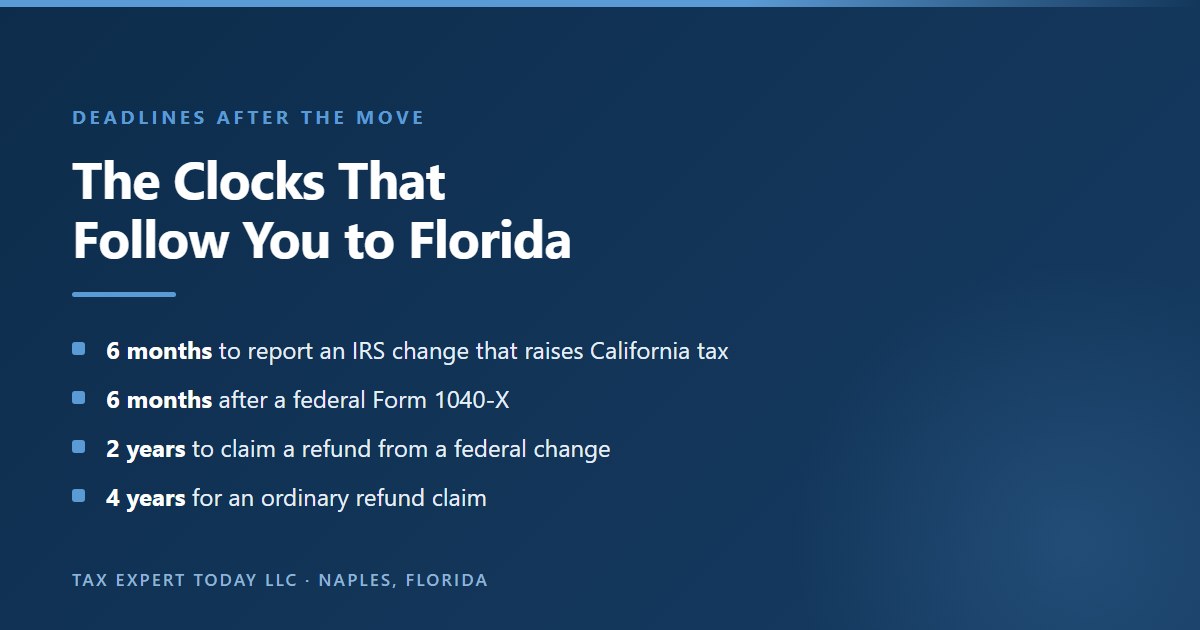
What does a complete California amended tax return look like for a former resident?
A complete package contains the corrected Form 540NR marked AMENDED, a revised Schedule CA (540NR), any changed supporting schedules, Schedule X with a line-by-line reconciliation and a written explanation, and the documents that prove each change, filed electronically or mailed to the correct PO box with any payment.
The following hypothetical pulls the pieces together. A couple moved from Orange County to Naples, Florida and became Florida residents on June 30 of the move year. Their original move year Form 540NR, filed on time in April of the following year, reported a residency change date of August 31 and California wages of $160,000 from the California W-2. In the following January, the IRS assessed an agreed adjustment for the move year that added $25,000 of consulting income the wage earner had earned in Florida in November. The couple wants to correct the residency date, which reduces California tax, and must also deal with the federal change, which increases total income.
| Step | What the couple does | Rule applied |
|---|---|---|
| 1. Confirm the residency date | Assemble the home sale closing, Florida lease, school enrollment, and voter registration dates, all supporting June 30 | R&TC 17014; FTB Publication 1031 |
| 2. Rebuild the federal starting point | Use federal figures as adjusted by the IRS, including the added $25,000 | Schedule CA (540NR), column A from the federal return |
| 3. Re-source income | Remove July and August wages for work performed in Florida from column E; leave the consulting income out of column E as Florida-period income | Schedule CA (540NR), column E |
| 4. Recompute the rate | Total income rises by $25,000, so the rate rises | R&TC 17041(b) |
| 5. Compare the tax | Lower California income times a higher rate; the net result may be a refund or a balance due | Form 540NR computation |
| 6. Report the federal change | If the federal change alone increases California tax, file within six months of the assessment date | R&TC 18622(a) |
| 7. Complete Schedule X | Reconcile in Part I; explain the residency date correction and the federal change separately in Part II | 2025 Schedule X instructions |
| 8. Attach and file | Attach the IRS determination, the W-2 reconciliation, and the residency documents; e-file or mail to the correct box | FTB amend page; Publication 1008 |
The couple’s example has a timing subtlety worth isolating. The federal change was assessed in January, so the section 18622 six month window runs to July. The residency date correction is a refund claim, and its deadline under section 19306 is four years from the original due date because the original return was timely. Filing one amended return that does both is efficient and keeps the explanation in one place, but it must be filed within the shorter window, the six months for the federal change, if the federal change by itself increases California tax. Part II should describe both changes separately so the FTB can see which part of the net result comes from each.
Whether the final result is a refund or a balance due depends on the actual numbers. The hypothetical is not a prediction about any real return. Its purpose is to show the order of operations: settle the facts, rebuild the federal base, re-source, recompute the rate, reconcile, explain, attach, and file on time.
What mistakes do former residents make with a California amended return?
The most common mistakes are missing the six month federal change window, amending the federal return but not California, using the wrong form or a stale Schedule X, starting from the original figures instead of FTB-adjusted figures, explaining changes too briefly, and moving the residency date without evidence.
Each of these mistakes traces back to a rule already covered. Collected in one place, they form a checklist a former resident can run before filing.
| Mistake | Consequence | Fix |
|---|---|---|
| Ignoring an IRS change because you now live in Florida | Open-ended FTB assessment period under section 19060(a), with interest from the original due date | Report within six months of the assessment date |
| Filing Form 1040-X but not a California amended return | Breach of section 18622(b) if California tax increases | File the California amendment within six months |
| Assuming Florida-period income cannot affect California | Underreported California tax through the rate | Recompute the section 17041(b) rate with total income |
| Using the current year Schedule X for an older year | Processing delay | Use the Schedule X for the tax year being amended |
| Starting from your original figures after an FTB adjustment | Schedule X does not reconcile | Start from the FTB-adjusted amounts |
| One-line Part II explanation | Refund delayed or denied | Explain each change, the reason, and the attached proof |
| Changing the residency date without documents | Claim denied and a residency inquiry | Amend only to a date the evidence supports |
| Waiting for an automatic refund after a favorable IRS result | Refund lost after two years | File the claim within two years of the final federal determination |
| Filing a duplicate amended return after a few months | Confusion and further delay | Wait six months, then write or call for status |
| Leaving the old California address on file | Missed notices and returned checks | Update the address with the FTB before filing |
Two more mistakes are specific to the move. The first is treating a California amended return as a chance to revisit the decision about when residency ended, without considering how the new date lines up with everything else filed for that year, including the health coverage coding on California Form 3853 and any nonresident withholding on California Form 593 for a real property sale. The second is overlooking items that stay California source after the move, such as the stock compensation covered in our guide to California RSU tax when leaving, which can be reported wrong on the original return and need correction in a later year.
California Amended Tax Return Help in Naples & Southwest Florida
Tax Expert Today LLC works with households in Naples, Florida and across Southwest Florida who moved from California and need a California return corrected, a federal change reported to the Franchise Tax Board, or a refund claim prepared before the window closes. We handle state residency and tax matters nationwide, and California amendments are filed electronically or by mail, so the work does not depend on where you live now. Our office is at 11983 Tamiami Trail N, Naples FL 34110. Call (239) 441-2005, Monday through Friday, 10:00 to 5:00 Eastern Time.
California amended return help Naples: for a former California resident, the review usually starts with three questions. Which years are still open for a refund under section 19306? Has the IRS changed any of those years, or have you filed a federal Form 1040-X, so that the six month reporting rule applies? And does the residency date on the move year Form 540NR match the evidence? From there, we can rebuild the part-year computation, re-source income where the facts support it, and prepare a Schedule X explanation that ties each change to a document. Households still planning the departure can start with our guide to moving from California to Florida and taxes, our Florida 183 day rule calculator, and our Naples, FL tax planning services.
California part-year return correction Naples FL: the work most often involves the move year Form 540NR, but it can extend to later nonresident years when California source income continues, such as rent from a California property or payments on a California business sale. Business owners who sold before or after the move can review our guide to moving to Florida before selling a business, and executives with deferred compensation can review our guide to Florida domicile for executives. For the full range of California services, see our California tax services page.
Local FAQ: We moved from San Jose to Naples two years ago and just agreed to an IRS change for our move year. Can a Naples advisor handle the California side? Yes. The California amended Form 540NR and Schedule X are filed with the Franchise Tax Board electronically or by mail, so where your advisor is located does not limit the process. Bring the IRS determination and your account transcript showing the assessment date, the original move year Form 540NR, and the records that support your residency date, and we can test whether the change increases California tax, compute the new part-year figures, and file within the six month window.
Frequently Asked Questions About the California Amended Tax Return
How do I file a California amended tax return?
For tax years 2017 and later, prepare a corrected Form 540, Form 540 2EZ, or Form 540NR with the AMENDED box checked, attach Schedule X for that tax year with the supporting documents, and file it through tax software or a tax representative, or mail it to the Franchise Tax Board. For 2016 and earlier, use Form 540X for that year.
Which form do I use to amend my California return if I moved out of state?
Use Form 540NR marked AMENDED if your original return was a part-year or nonresident Form 540NR, and attach Schedule X. The 2025 Form 540NR booklet says to use Form 540NR to amend an original or previously filed nonresident or part-year resident return, starting from any amounts the FTB already adjusted.
How long do I have to file a California amended return for a refund?
Under R&TC section 19306, the later of four years from the date a timely return was filed, four years from the original due date without extensions, or one year from the date of the overpayment. A late return filed after October 15 gets four years from the original April due date, not from the filing date.
Do I have to amend my California return if I amend my federal return?
Generally yes, within six months, if the federal change increases your California tax. R&TC section 18622(b) requires a California amended return within six months of a federal amended return, and an individual need not file one unless the change would increase California tax for the year.
Do I have to tell California about an IRS change after I moved to Florida?
Yes, if the change increases California tax for a year you filed a California return. Section 18622(a) requires a report within six months of the final federal determination, which is the date the IRS assesses the adjustment. If no one reports it, section 19060(a) lets the FTB assess at any time.
Can income I earned in Florida increase my California tax on an amended return?
It can on a part-year or nonresident return. Under R&TC section 17041(b), California taxes California income at a rate set by total income from all sources, so adding Florida income raises the rate. A federal change that adds Florida income can therefore increase California tax and trigger the six month rule.
What is the difference between an amended and a superseding California return?
A superseding return is filed by the original or extended deadline that applies, and California treats it as the original return. An amended return is filed after that deadline and does not replace the original. The difference matters because many elections can be made or revoked only on an original return.
Where do I mail a California amended return?
With a payment, mail it to Franchise Tax Board, PO Box 942867, Sacramento, CA 94267-0001. Without a payment, mail it to Franchise Tax Board, PO Box 942840, Sacramento, CA 94240-0001. You can also file online through tax preparation software or a tax representative.
How long does it take to get a California amended return refund?
The FTB does not publish a fixed time. The 2025 Form 540NR booklet says that if you have not received a refund within six months of filing the amended return, do not file a duplicate; write or call the FTB for status. The additional refund is paid separately from the original refund, with interest figured by the FTB.
Can a Naples, Florida advisor prepare my California amended tax return?
Yes. California amended returns are filed with the Franchise Tax Board electronically or by mail, so the work does not depend on where the advisor is located. A Naples, Florida advisor can review the open years, the residency date, and any federal changes, and prepare the amended Form 540NR and Schedule X.
When to Engage a Professional
Many California amendments are simple: a corrected Form 1099 arrives, the software produces an amended Form 540 and Schedule X, and the refund follows. A former resident’s amendment is different more often than not. Consider professional help when the amendment changes the residency date or the sourcing of income on a Form 540NR, when the IRS has assessed a change to a year you were a California resident for any part of, when a federal Form 1040-X has been filed and the six month California window is running, when a carryover such as an NOL or capital loss has to be restated across several years, when spouses had different residency periods and the filing status choice affects the rate, or when an FTB bill, notice of proposed assessment, or request for information is already open for the year.
A qualified advisor can confirm which years remain open, compute whether a federal change increases California tax through the rate, prepare a complete Schedule X explanation with the right attachments, decide whether a protective claim is warranted, and coordinate the California filing with any federal case. Tax Expert Today LLC is a multidisciplinary firm of tax advisors, enrolled agents, CPAs, and attorneys handling state residency and tax matters nationwide, including California part-year and nonresident returns and Franchise Tax Board correspondence for clients who now live in Florida. For a review of a California return you have already filed, call (239) 441-2005 or contact us to schedule a free consultation.
This guide is general information about California and federal tax rules as of its publication date and is not legal or tax advice for any particular situation. Examples are hypothetical illustrations and do not describe any client. Rules, forms, deadlines, and addresses change; confirm current requirements with the Franchise Tax Board or a qualified advisor before filing.
Published October 27, 2026 by Dr. Pellumb Kabashi « Back to Learning Center
Have a question this article touches on?
Tax Expert Today LLC, based in Naples, Florida and serving clients across the United States.
Schedule a Consultation (239) 441-2005