
By Dr. Pellumb Kabashi, DBA, MBA, CES, CFE, EA
Founder, Tax Expert Today LLC · Tax advisors, enrolled agents, CPAs, and attorneys · Serving clients in all 50 states
Quick Answer: Dividing stock options in divorce is generally not a taxable event for the employee spouse. Under Rev. Rul. 2002-22, a vested nonqualified option transferred incident to divorce is taxed to the former spouse when that spouse exercises it, as ordinary income reported on Form 1099-MISC. Incentive stock options lose their special status on transfer, and unvested awards fall outside the ruling. Call (239) 441-2005 for a free consultation.
Most of what ranks for dividing stock options in divorce is written by family law firms and financial planners, and it answers the property question: whether an option granted during the marriage is marital property, how a court apportions awards that vest after the divorce, and which formula a judge may apply. Those questions matter, and they belong to your family law attorney. What those pages rarely reach is the federal tax that follows the division, which is where a well negotiated split can quietly lose a meaningful part of its value.
This guide covers only the tax side of dividing stock options in divorce. It explains who is taxed when a transferred option is exercised, why the former spouse receives a Form 1099-MISC while the Social Security wages stay on the employee’s Form W-2, what happens to incentive stock options and restricted stock units, why the IRS ruling that makes the transfer tax free does not reach unvested awards, and how to compare an option with cash or a brokerage account on an after-tax basis. Every rule below is taken from the Internal Revenue Code, the Treasury regulations, or a published IRS ruling, and every dollar example is a hypothetical built to show the arithmetic.
One boundary before we start. Tax Expert Today LLC advises on the tax mechanics of divorce only. We do not practice family law, and nothing here is advice on whether an award is marital property, how it should be apportioned, or what any party should accept. Please coordinate with your family law attorney on every term of the settlement. Our role is the tax side of the divorce team, and this analysis is meant to sit alongside that representation rather than replace any part of it.
What Happens to Taxes When Dividing Stock Options in Divorce?
For a vested nonqualified option, the transfer itself is not taxed. IRC §1041 treats a transfer incident to divorce like a gift, and Rev. Rul. 2002-22 holds that the employee spouse recognizes nothing when the option moves. The former spouse is taxed later, at exercise, on the spread between the stock value and the exercise price.
- No income at transfer: the employee spouse does not include the option value in income when it is assigned under the settlement (Rev. Rul. 2002-22, Holding 1).
- Income at exercise, to the former spouse: the spread is taxed under IRC §83(a) as if the former spouse had performed the services (Holding 2).
- Ordinary income, not capital gain: the spread keeps its character as compensation, even in the hands of someone who never worked for the company.
- Capital gain only after exercise: growth after the exercise date is capital gain or loss when the shares are sold, measured from a basis equal to the exercise price plus the income recognized.
- The same answer in every state: the ruling applies whether the couple lived in a community property state or an equitable distribution state such as Florida.
The reason the IRS reached this result is worth understanding, because it also explains where the rule stops. Before 1984, a transfer of appreciated property to a spouse in exchange for the release of marital claims could be a taxable sale under United States v. Davis. Congress enacted §1041 to reverse that result, and Rev. Rul. 2002-22 concludes that stock options and unfunded deferred compensation rights can be “property” within that section. It then declines to apply the assignment of income doctrine, which would otherwise tax the person who earned the income, because doing so would frustrate the purpose of §1041. The ruling is explicit that this reasoning applies to transfers in connection with divorce, and to options and rights that are vested and not subject to substantial contingencies when they are transferred.
In practice, dividing stock options in divorce rarely means a single transfer on the day the decree is signed. Plans differ on whether an option can be assigned at all, the former spouse usually needs the employer to open an account or recognize a domestic relations order, and the option remains tied to the employee’s service, expiration date, and termination rules. The tax result follows whichever structure the settlement actually uses, so the structure should be known before the tax is estimated.
Which Equity Awards Does the Divorce Transfer Rule Cover?
Rev. Rul. 2002-22 covers vested nonqualified options and vested, noncontingent nonqualified deferred compensation. Incentive stock options are disqualified if the option itself moves, shares already owned move under §1041 with carryover basis, and awards that are unvested at the transfer are outside the ruling entirely.
- Inside the ruling: vested nonstatutory options and vested deferred compensation rights, transferred incident to divorce.
- Converted by the transfer: incentive stock options and §423 plan options, which become nonqualified options on the transfer date.
- Governed by their own rules: shares already acquired, including ISO shares under §424(c)(4), and retirement plans under §402 and §414(p).
- Outside the ruling: unvested options, unvested restricted stock units, and rights subject to substantial contingencies.
The table below summarizes the award types most often found in an executive’s or a technology employee’s estate. It reflects the published rules cited in this guide, and it is a starting map rather than an answer for any specific plan, because the plan document can restrict or prohibit a transfer that the tax law would otherwise allow.
| Award at the transfer date | Is the transfer itself taxed? | Who is taxed on the compensation income | Where the income is reported |
|---|---|---|---|
| Vested nonqualified stock option | No (§1041; Rev. Rul. 2002-22) | Former spouse, at exercise | Form 1099-MISC, Box 3; FICA wages on the employee’s W-2 |
| Unvested nonqualified stock option | Not addressed by the ruling | Uncertain; the IRS may look to the employee who earned it | Depends on the structure used |
| Incentive stock option (the option) | No, but ISO status ends | Former spouse, at exercise, as a nonqualified option | Form 1099-MISC, Box 3 |
| Shares from an exercised ISO | No (§424(c)(4) and §1041) | No compensation income; ISO holding rules carry over | Form 1099-B when the recipient sells |
| Unvested restricted stock units | Usually not transferable | Employee, at vesting and settlement | Employee’s Form W-2 |
| Shares delivered from vested RSUs | No (§1041) | Already taxed to the employee at settlement | Form 1099-B when the recipient sells |
| Restricted stock with a §83(b) election | No (§1041) | Taxed to the employee at grant | Form 1099-B when the recipient sells |
The pattern in the table is consistent. Where compensation income has not yet been recognized, the question is who recognizes it and when, and the answer depends on vesting and on the form of the award. Where the income has already been recognized and the award is now ordinary stock, the transfer is a property transfer under §1041, and the only tax that remains is capital gain or loss on a later sale, measured from the basis that carries over. For the broader map of which settlement items are and are not taxable, see our guide to whether a divorce settlement is taxable, and for the carryover basis problem on real estate, our guide to divorce house buyout taxes.
Who Pays the Tax When a Former Spouse Exercises a Transferred Option?
The former spouse who exercises the option reports the income and pays the income tax on it. The employee spouse reports nothing from that exercise on the income tax return. However, the Social Security and Medicare wages remain the employee’s, and the employee share of those taxes is withheld from what the former spouse receives.
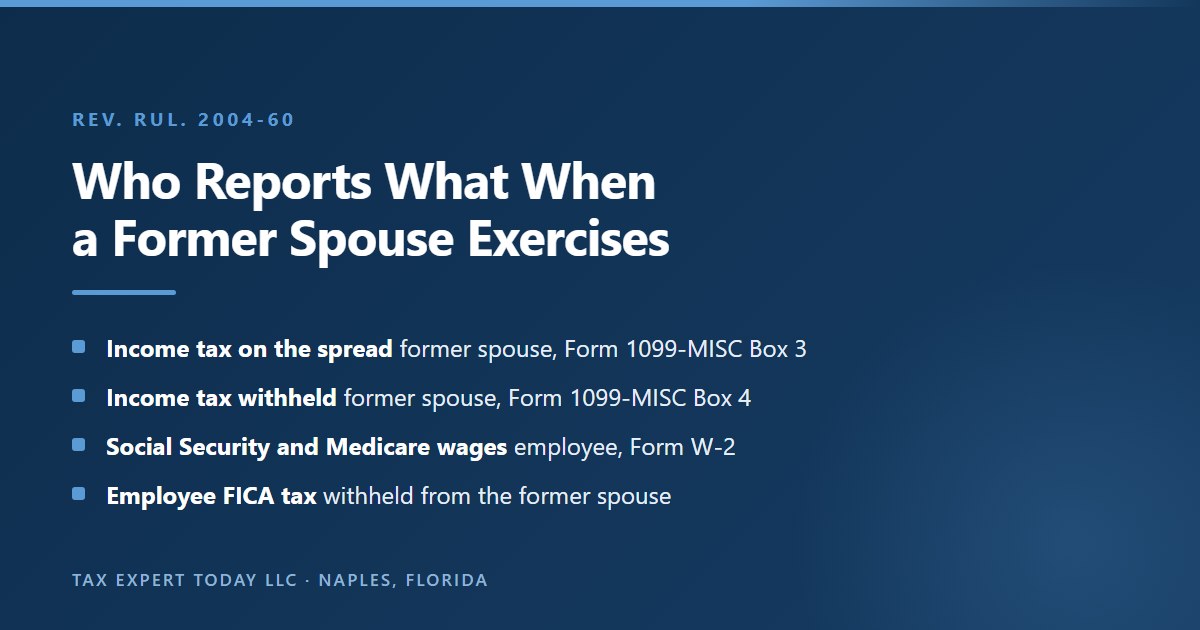
This split is the part of the rule that surprises both sides. Rev. Rul. 2004-60 addresses the employment taxes directly. It holds that the income recognized when a nonemployee spouse exercises a transferred nonstatutory option is still remuneration for the employee spouse’s services, so it is subject to FICA and FUTA to the same extent as if the employee had kept and exercised the option. The employee FICA tax is deducted from the payment to the former spouse, and the ruling adds that the amount included in the former spouse’s gross income “is not reduced by any FICA withholding.”
- Income tax: reported by the former spouse, who also receives the credit for any income tax the employer withholds (Treas. Reg. §1.31-1(a), as applied in Rev. Rul. 2004-60).
- Social Security and Medicare wages: reported on the employee spouse’s Form W-2, in the Social Security and Medicare wage boxes, and counted toward the employee’s own wage base for the year.
- Employee FICA tax: withheld from the shares or cash delivered to the former spouse, who therefore bears it economically.
- Box 1 of the employee’s W-2: the ruling states that these payments should not be included in Box 1, and no income tax withheld on them belongs in Box 2 of the employee’s form.
Two practical consequences follow. First, because the Social Security wages are the employee’s, an exercise by the former spouse late in a year when the employee has already reached the Social Security wage base may carry only the Medicare portion, while an exercise early in the year may carry both. The employer is permitted to take the employee’s other wages into account in making that determination. Second, the Social Security wages credited from the exercise are credited to the employee spouse, not to the former spouse who bore the withholding. Neither point changes the income tax, but both are the kind of detail a settlement can address if the parties know about it in advance.
Why Does the Former Spouse Receive a Form 1099-MISC Instead of a W-2?
A Form W-2 can only be issued to an employee, and the former spouse is not one. Rev. Rul. 2004-60 therefore directs the employer to report the exercise income on Form 1099-MISC, Box 3, with any income tax withheld in Box 4, while the Social Security and Medicare wages go on the employee’s W-2.
- Form 1099-MISC, Box 3 (Other income): the spread realized on exercise, reported to the former spouse. IRS Publication 525 confirms this for a nonemployee spouse who exercises options received incident to a divorce.
- Form 1099-MISC, Box 4: the federal income tax withheld from the former spouse’s exercise.
- Employer returns: the income tax withheld for the former spouse is reported on Form 945, the FICA tax on Form 941, and the FUTA tax on Form 940.
- No Form W-4 from the former spouse: the ruling says employers are not required to collect one and should not base withholding on one submitted by the nonemployee spouse.
The withholding method is where many former spouses end up short at filing time. Rev. Rul. 2004-60 allows the employer to treat the income as supplemental wages and withhold at the flat supplemental rate. IRS Publication 15 states that the rate remains 22 percent, or 37 percent for supplemental wages above $1 million paid to an employee in a year, because Pub. L. 119-21 made the individual rates permanent. A former spouse whose other income, alimony under a pre 2019 instrument, or the exercise itself pushes the return into the 24, 32, 35, or 37 percent bracket may owe the difference with the return, and may face an estimated tax penalty if nothing else was paid in during the year.
Because Box 3 income is not wages to the former spouse, it does not appear on a W-2 that tax software expects to see, and it is easy to mismatch. The spread belongs on the return as other income, the withholding from Box 4 is claimed as a payment, and the basis of the shares acquired is the exercise price plus the amount reported as income. If the shares are sold later, a broker’s Form 1099-B frequently shows only the exercise price as basis, and the income already reported on the 1099-MISC has to be added back so the same dollars are not taxed twice. That adjustment is shown on Form 8949.
How Does the Former Spouse Report an Option Exercise on the Tax Return?
The spread from the Form 1099-MISC is reported as other income, the income tax withheld is claimed as a payment, and the shares take a basis equal to the exercise price plus that income. When the shares are sold, Form 8949 corrects any broker basis that omits the income already taxed.
- Year of exercise: the spread is ordinary income to the former spouse, whether or not an information return is received.
- Withholding credit: the income tax withheld and shown in Box 4 belongs to the former spouse and is credited on that return.
- Estimated tax: if the flat withholding falls short, the former spouse may need a Form 1040-ES payment in the quarter of the exercise.
- Year of sale: the broker’s Form 1099-B, reconciled on Form 8949 with an adjustment in column (g) when the reported basis is too low.
Two reporting details deserve attention in the first year after a divorce. First, the information return threshold changed. The current Instructions for Forms 1099-MISC and 1099-NEC state that, for tax years beginning after 2025, the general reporting threshold for other income payments in Box 3 increased to $2,000. A small exercise below that amount may produce no form at all, but the spread is still income to the former spouse and still belongs on the return. Second, the estimated tax safe harbors in IRC §6654(d) look to the prior year’s tax, and a filer whose prior year return was a joint return with a different income profile should compare the required installment under each test. The safe harbor based on the preceding year rises to 110 percent when adjusted gross income for that year exceeded $150,000, or $75,000 for a married person filing separately.
| Form | Issued by | Issued to | What it shows for a transferred option |
|---|---|---|---|
| Form 1099-MISC, Box 3 | Employer | Former spouse | Spread on exercise, reported as other income |
| Form 1099-MISC, Box 4 | Employer | Former spouse | Federal income tax withheld on that spread |
| Form W-2, Social Security and Medicare wage boxes | Employer | Employee spouse | The same spread, as FICA wages only, with FICA tax withheld |
| Form 1099-B | Broker | Whoever sells the shares | Proceeds and a reported basis that may omit the income already taxed |
| Form 8949 and Schedule D | Taxpayer | Filed with the return | Sale reported with a basis adjustment in column (g) where needed |
The employee spouse should also expect to see the exercise on the Form W-2, in the Social Security and Medicare wage boxes, even though Box 1 does not include it. That can look like an error to the employee and to the preparer, and it is not one. Rev. Rul. 2004-60 directs exactly that treatment, and the employee’s income tax return does not report the spread as income. A short note in the file explaining the difference between Box 1 and Boxes 3 and 5 saves time if either return is later questioned. Where estimated payments are needed, our quarterly estimated tax calculator is a starting point for the arithmetic.
What Happens to Incentive Stock Options Transferred in a Divorce?
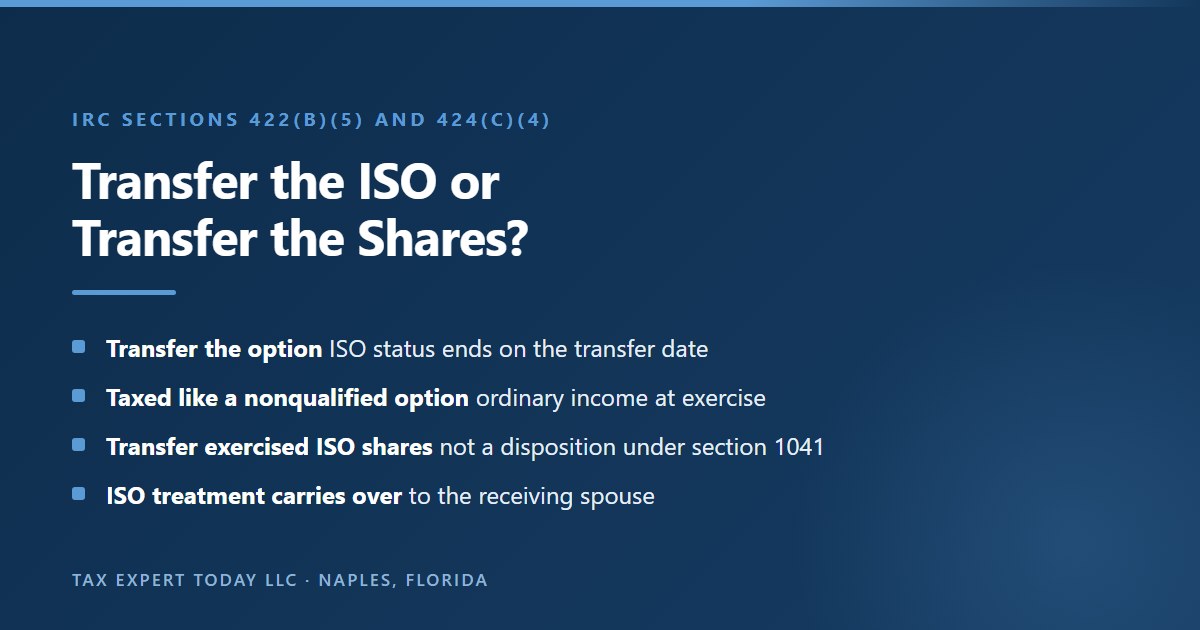
An incentive stock option cannot be transferred without losing its status. IRC §422(b)(5) requires the option to be nontransferable except at death, and Treas. Reg. §1.421-1(b)(2) provides that an option transferred incident to divorce stops being a statutory option on the day of transfer. It is then taxed like a nonqualified option.
- Option transferred: the favorable ISO treatment ends, and the former spouse recognizes ordinary income on the spread at exercise under the rules for nonqualified options.
- ISO stock transferred after exercise: IRC §424(c)(4) provides that a §1041 transfer of the shares is not a disposition, and the same ISO treatment carries over to the recipient.
- Holding periods: ISO stock qualifies for long-term capital gain only if it is held more than two years from grant and one year from exercise (IRC §422(a)(1)).
- Alternative minimum tax: the spread at exercise of an ISO is an adjustment for AMT purposes under IRC §56(b)(3), even though it is not regular taxable income.
- Employee stock purchase plans: Rev. Rul. 2002-22 notes that an option under a §423 plan transferred contrary to its terms is disqualified in the same way.
Rev. Rul. 2002-22 makes the distinction in one sentence. An employee who transfers a statutory option to a spouse or former spouse in connection with divorce causes it to be “disqualified as a statutory stock option” and treated like any other nonstatutory option, and §424(c)(4), which protects a transfer of ISO stock, “does not apply to a transfer of the stock option.” The difference between transferring the option and transferring the shares can therefore be the difference between ordinary income and long-term capital gain on the same economic value.
That does not mean exercising before the divorce is always better. Exercising an ISO requires cash for the exercise price, can create an AMT liability in the exercise year, and concentrates risk in a single stock. The Code has no provision that moves a minimum tax credit with the shares, so a credit generated by AMT on an exercise generally stays with the return that paid the tax. If a joint return for the exercise year is still to be filed, how that liability and any credit are shared is a settlement term for your family law attorney, informed by numbers from your tax advisor.
Does the Tax-Free Transfer Rule Cover Unvested Options and RSUs?
No, not by its terms. Rev. Rul. 2002-22 states that it does not apply to options or other future income rights to the extent they are unvested when transferred or subject to substantial contingencies. For those awards the IRS could apply the assignment of income doctrine and tax the employee who earned them.
- Vested and exercisable: inside the ruling; the former spouse is taxed on exercise.
- Unvested at the transfer date: outside the ruling, and the ruling cites Kochansky v. Commissioner, 92 F.3d 957 (9th Cir. 1996), where the assignment of income doctrine taxed the spouse who earned the income.
- Performance or service contingencies: also outside the ruling to the extent the transferor’s rights were subject to substantial contingencies at the transfer.
- Specific Code sections: transfers governed by their own provision, such as §402, §408, §414, §424, or §453B, are not affected by the ruling.
This carve out is the most important tax fact in most equity divisions, because many awards at the time of a divorce are partly unvested. The ruling does not say that an unvested transfer is taxed to the employee. It says the ruling does not address it, and it points to a case in which the earning spouse was taxed. That leaves a real risk that the employee spouse is treated as receiving the income at vesting or exercise even though the value goes to the former spouse.
For that reason, many settlements do not transfer unvested awards at all. Instead, the employee spouse keeps legal ownership, recognizes the income when the award vests or is exercised, and delivers the agreed share of the net shares or net proceeds to the former spouse after that. Family lawyers call this a deferred distribution or a constructive trust arrangement. From a tax standpoint, the income is the employee’s on vesting or exercise and appears on the employee’s W-2, and the later delivery of shares that have already been taxed is a §1041 transfer that carries over the employee’s basis. Whether the share delivered is measured before or after tax is a negotiated term, and it is exactly the kind of term that should be settled with numbers in hand.
How Does a Deferred Distribution of Unvested Awards Work for Tax Purposes?
In a deferred distribution, the employee spouse keeps the unvested awards, is taxed on each tranche at vesting or exercise, and later delivers the agreed share of the net shares or proceeds. The later delivery of already taxed shares is a §1041 transfer, so the former spouse takes the employee’s basis.
- At the decree: nothing is transferred and nothing is taxed, because the awards stay with the employee.
- At each vesting or exercise: compensation income on the employee’s W-2, with shares withheld or sold to cover tax.
- At delivery to the former spouse: no gain or loss under §1041, with carryover basis and holding period.
- At a later sale: capital gain or loss to whichever spouse sells, measured from that carried over basis.
The arithmetic below is a hypothetical built only to show the mechanics. Assume a four year grant of 800 restricted stock units, with 200 units vesting in the year after the divorce while the share price is $100. Assume the settlement provides that the former spouse receives half of each vested tranche, measured after the shares withheld for tax, and that the employer withholds 22 percent federal income tax plus 7.65 percent FICA by withholding shares.
| Step (hypothetical) | Units or amount | Whose return it affects |
|---|---|---|
| Units vesting in the year | 200 units worth $20,000 | Employee: $20,000 of W-2 wages |
| Shares withheld for tax at about 29.65 percent | About 59 units | Employee: withholding credited on the employee’s return |
| Net shares delivered to the employee | About 141 units | Employee: basis of $100 per share |
| Half of the net delivered to the former spouse | About 70 units | Former spouse: no income; basis of $100 per share carries over |
| Former spouse sells later at $120 | About $1,400 of gain | Former spouse: capital gain on the sale |
The hypothetical also shows why the definition in the decree matters. If the employee’s actual marginal rate is 32 percent rather than the 22 percent withheld, the employee owes additional income tax with the return on all 200 units, including the half whose value went to the former spouse. Whether that shortfall is shared, and whether the former spouse’s share is measured before or after tax, is a negotiated term for the family law attorney. What a tax advisor contributes is the calculation of each version, in dollars, before the language is final.
The same mechanics apply to unvested nonqualified options held back under a deferred distribution, with one difference. The employee decides when to exercise, and the exercise creates W-2 wages in that year. A settlement that gives the former spouse a say over timing, or requires exercise on request, can move income into a year of the employee’s choosing or not, and the resulting tax can differ widely between the two spouses’ brackets. For business owners whose equity is in a closely held company rather than a public employer, the valuation and redemption issues are different, and our guide to business owner divorce taxes covers them. Executives who moved from California should also review moving from California to Florida taxes, because a vest after the move can still carry California source income.
How Are Restricted Stock Units Taxed in a Divorce?
A restricted stock unit is an unfunded promise to deliver shares later, so there is usually nothing to transfer until it vests and settles. At settlement the share value is wages to the employee, taxed on the W-2. Shares delivered to a former spouse after that move tax free under §1041 with the employee’s basis.
- At grant: no income, because no stock has been transferred to the employee (IRC §83 applies only to property actually transferred).
- At settlement: the value of the delivered shares is compensation to the employee, typically with shares withheld to cover the income and employment taxes.
- After settlement: the shares are ordinary property, and a transfer incident to divorce carries over the employee’s basis, which is generally the value included in income.
- Holding period: because §1041(b) treats the recipient as acquiring the shares by gift, the transferor’s holding period generally carries over as well.
Most RSU plans prohibit assignment, and many do not recognize a domestic relations order for RSUs at all, so the employee spouse ordinarily remains the taxpayer until the shares are delivered. The practical tax questions are therefore about the net. Employers commonly withhold shares at the flat supplemental rate, which may be less than the employee’s actual marginal rate, so the employee can owe additional tax with the return on shares whose value has already been split. A decree that defines the former spouse’s share as a percentage of the gross units, without saying who bears the tax on them, invites a dispute the following April.
Restricted stock that the employee already owns is different. If the employee made an election under IRC §83(b), the stock was taxed at grant and is property today, and a transfer of it incident to divorce is a §1041 transfer with carryover basis. If no election was made and the stock is still subject to a substantial risk of forfeiture, the income will be recognized at vesting, and the same vesting concerns described for unvested options apply. Owners of a closely held company whose equity is part of the estate should also read our guide to business owner divorce taxes.
How Should Stock Options Be Compared With Other Assets for Tax Purposes?
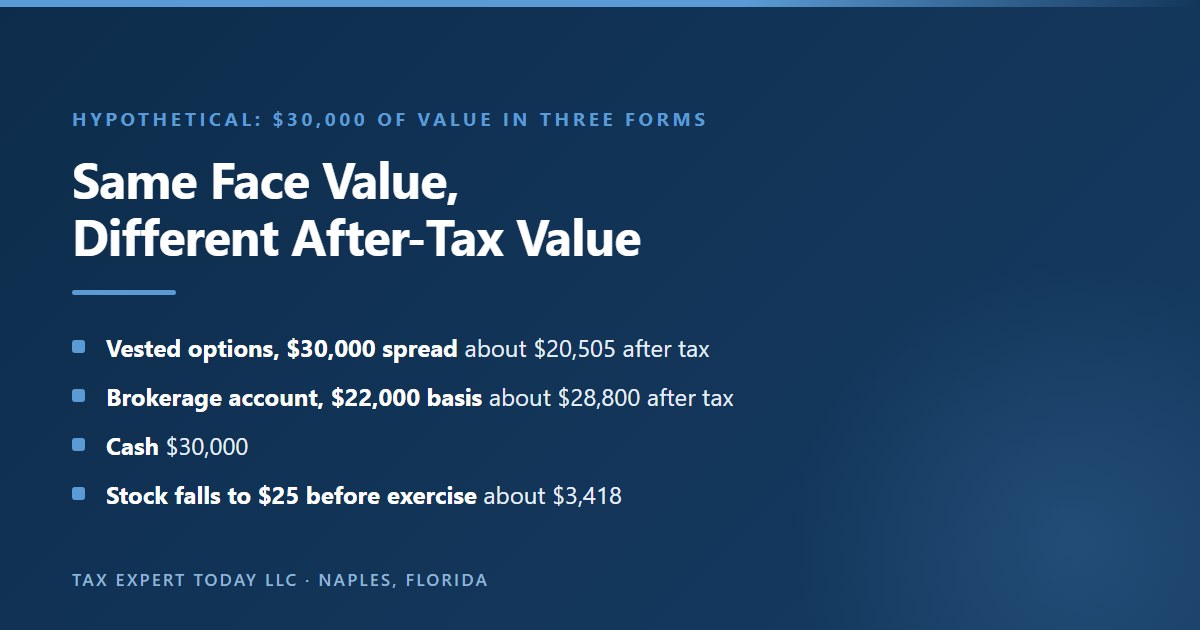
An option or RSU is a pre-tax asset, so its face value overstates what it is worth next to cash or a brokerage account. The spread will be taxed as ordinary income when exercised, while cash is already after tax and a brokerage account carries only capital gains tax on its appreciation.
Valuation methods for unvested and long dated options, including the Black-Scholes approach described in Rev. Proc. 98-34, are a subject for the valuation expert and the family law attorney. The tax adjustment is separate and simpler: it asks what each asset is worth after the tax that will eventually fall on whoever holds it. The table below is a hypothetical built only to show the arithmetic. It is not a recommendation about any division, and the figures will differ for every taxpayer.
| Hypothetical asset | Pre-tax value | Tax that follows the holder | Approximate after-tax value |
|---|---|---|---|
| Vested nonqualified options: 1,000 shares, $20 exercise price, $50 stock price | $30,000 spread | Ordinary income on exercise; illustrated at a 24 percent federal rate, plus employee FICA of 7.65 percent withheld from the delivery | About $20,505 |
| Brokerage account worth $30,000 with $22,000 basis | $30,000 | Long-term capital gain on $8,000 when sold; illustrated at 15 percent | About $28,800 |
| Cash of $30,000 | $30,000 | None | $30,000 |
| Same options, stock falls to $25 before exercise | $5,000 spread | Ordinary income on the smaller spread, same rates | About $3,418 |
The first row assumes the employee spouse has not yet reached the Social Security wage base for the year. If the employee has, only the 1.45 percent Medicare portion would be withheld, and the after-tax figure would be higher. The last row shows the other side of the comparison: an option has no floor, and a price decline between the settlement and the exercise reduces its value to the holder while the cash and the brokerage account are unaffected. These are the variables your family law attorney may want quantified before deciding whether an offset against other assets or a division of the options themselves fits the case.
When Must the Transfer Happen to Stay Tax Free?
Under IRC §1041(c), a transfer is incident to divorce if it occurs within one year after the marriage ends or is related to the end of the marriage. Treas. Reg. §1.1041-1T treats a transfer under the divorce instrument within six years as related. Later transfers are presumed unrelated unless the presumption is rebutted.
- Within one year of the divorce: incident to the divorce automatically.
- Within six years and required by the decree or instrument: treated as related to the end of the marriage (Treas. Reg. §1.1041-1T, Q&A-7).
- After six years, or outside the instrument: presumed not related, rebuttable by showing that legal or business impediments, such as plan transfer restrictions, delayed the division.
- Nonresident alien spouse: §1041(d) removes nonrecognition entirely when the recipient spouse is a nonresident alien.
Equity awards test these limits more often than a house or a bank account does, because an option can have a ten year term and an RSU schedule can run for four years or more. A deferred distribution that sends net shares to the former spouse as each tranche vests may continue well past the one year window. Anchoring every delivery to a specific provision of the decree helps each one fit the six year rule, and documenting the plan’s transfer restrictions supports the rebuttal if a delivery falls later. The broader timing presumptions are explained in our guide to which parts of a divorce settlement are taxable.
The option also remains subject to its own terms after it is transferred. Under many plans, the exercise window for all outstanding options, including those held by a former spouse, shortens when the employee leaves the company, often to a period measured in months. A former spouse who holds options therefore depends on information about the employee’s employment status, and a settlement can provide for that notice.
What Tax Terms Should the Settlement Address for Equity Awards?
The tax terms are factual, not strategic: which awards are vested on the transfer date, whether each is a nonqualified option, an ISO, or an RSU, who is taxed on each, who bears the withholding shortfall, and what information each spouse must share. Your family law attorney drafts the terms; your tax advisor supplies the numbers.
- A schedule of awards: grant date, type, vesting status on the transfer date, exercise price, and expiration date for each tranche.
- The mechanism for each tranche: a direct transfer where the plan allows it, or delivery of net shares or proceeds by the employee spouse.
- The tax gross or net definition: whether the former spouse’s share is measured before or after the income and employment taxes that apply.
- Information and notice: the employer statements, W-2 and 1099-MISC copies, and notice of any termination that shortens the exercise window.
- Prior joint returns: responsibility for any AMT from an ISO exercise, or tax on a vest, reported on a joint return for a year still open.
None of these items decides what is fair, and we do not advise on that. They only make sure that whatever division is agreed produces the tax result both sides expect. If the parties are still deciding how to file for the year of the divorce, our guide to divorce filing status explains how the December 31 rule interacts with a vest or exercise late in the year, and the treatment of support payments is covered in alimony taxes after divorce.
Do State Taxes Change the Answer for Florida Residents?
Florida has no personal income tax, so a Florida resident generally owes no state tax on option or RSU income. The exception is income tied to services performed in another state: option income is compensation, and the state where the work was done may tax the portion earned there even after the move.
That sourcing question is common among executives who relocated to Southwest Florida with awards granted while they worked elsewhere. Our guides to California RSU tax when you leave the state and Florida domicile for executives explain how an allocation by workdays can follow an award across state lines. When one spouse still lives in the other state, or when the former spouse is a nonresident of the state that taxes the compensation, the state treatment of the former spouse’s exercise should be confirmed under that state’s rules rather than assumed from the federal result.
Dividing Stock Options in Divorce: Help in Naples & Southwest Florida
Tax Expert Today LLC is based in Naples, Florida, and works with divorcing and recently divorced clients across Collier and Lee counties and in all 50 states. Many of the equity questions we see in Southwest Florida come from executives and their spouses who relocated here with awards still vesting from an employer in another state. The questions are federal and practical: which awards are inside Rev. Rul. 2002-22, what the former spouse will actually net after withholding, and how an award earned elsewhere is sourced. Typical requests from local clients include the following.
- Divorce tax Naples FL: building a schedule of every option and RSU tranche with its type, vesting status, and tax owner before the settlement terms are finalized.
- Stock options divorce help in Southwest Florida: modeling the after-tax value of options against cash, a brokerage account, or the home, so the attorney negotiates with tax-adjusted numbers.
- Former spouse exercises: reconciling a Form 1099-MISC, Box 3, with the broker’s Form 1099-B so the basis is not understated, and planning estimated payments when the flat withholding falls short.
- Coordination with your attorney: giving the family law attorney the tax consequences of each structure, without advising on the negotiation itself.
You can read more on our divorce tax consulting page, and about the broader practice at Naples FL tax planning.
Tax Expert Today LLC
11983 Tamiami Trail N, Naples, FL 34110
Phone: (239) 441-2005
Hours: Monday through Friday, 10:00am to 5:00pm ET
Does Florida tax stock options divided in a Naples divorce? Florida has no personal income tax, so a Naples resident generally owes only federal tax when a transferred option is exercised or an RSU vests. If the award was earned while the employee worked in another state, that state may still tax the portion of the income tied to the work done there, and its rules should be checked separately.
When to Engage a Professional
A single tranche of vested nonqualified options with a modest spread can often be handled with the rules above and a careful reading of the plan. Professional involvement tends to earn its cost when one or more of the following is present.
- Some awards are unvested on the transfer date. Those awards are outside Rev. Rul. 2002-22, and the structure chosen decides who is taxed.
- Incentive stock options are involved. Transferring the option disqualifies it, while transferring exercised shares preserves the treatment, and AMT may apply.
- The awards are large relative to the rest of the estate. The gap between pre-tax and after-tax value can change the balance of an offset.
- Awards were earned in another state. State sourcing can apply after a move to Florida.
- A joint return for an exercise or vest year is still open. Responsibility for the tax, and for any examination of that year, should be defined.
- The recipient spouse is a nonresident alien. Section 1041 does not apply, and the transfer itself may be taxable.
Where a joint return from the marriage is under examination or carries a balance, that liability question is separate from the equity division, and our guide to innocent spouse relief addresses it. Retirement plans follow their own rules under a qualified domestic relations order, which our guide to QDRO taxes explains, and the tax treatment of the fees paid to reach a settlement is covered in whether divorce legal fees are tax deductible.
This article is general information about tax mechanics and is not legal, tax, or family law advice for any particular situation. Tax outcomes depend on the specific facts, the terms of each equity plan, and the law in effect for the year in question, and the dollar examples are hypotheticals that illustrate arithmetic and do not predict any result. Please coordinate with your family law attorney on the terms of any settlement, including how equity awards are classified and divided, and with a qualified tax advisor on the tax treatment, before relying on any figure or timing.
Frequently Asked Questions
Is dividing stock options in divorce a taxable event? Not for a vested nonqualified option transferred incident to divorce. Rev. Rul. 2002-22 holds that the employee spouse includes nothing in income at transfer, and the former spouse is taxed on the spread when exercising. The ruling does not cover options that are unvested or subject to substantial contingencies at the transfer date.
Who pays tax when my ex-spouse exercises stock options I transferred? Your former spouse reports the income tax on the spread and receives a Form 1099-MISC. The Social Security and Medicare wages remain yours and appear on your Form W-2, but the employee share of those taxes is withheld from what your former spouse receives, under Rev. Rul. 2004-60.
Can incentive stock options be transferred in a divorce? They can be transferred only by losing ISO status. An ISO transferred incident to divorce is no longer a statutory option from the transfer date and is taxed like a nonqualified option. Shares already acquired by exercising an ISO can move under §1041 without a disposition, and the ISO treatment carries over to the recipient.
Are unvested RSUs taxed to me or my former spouse? Usually to the employee. RSUs generally cannot be assigned, so the employee recognizes wages when the units vest and settle, and delivers the agreed share of the shares afterward in a §1041 transfer with carryover basis. Whether that share is measured before or after tax is a settlement term for your attorney.
What basis does my former spouse have in shares from an exercised option? The exercise price plus the amount included in income on exercise. A broker’s Form 1099-B often reports only the exercise price, so the income already reported on Form 1099-MISC has to be added to basis on Form 8949 to avoid taxing the same amount twice.
Does Florida tax stock options divided in a Naples divorce? Florida has no personal income tax, so a Naples resident generally owes only federal tax when a transferred option is exercised or an RSU vests. If the award was earned while the employee worked in another state, that state may still tax the portion of the income tied to the work done there.
Published September 30, 2026 by Dr. Pellumb Kabashi « Back to Learning Center
Have a question this article touches on?
Tax Expert Today LLC, based in Naples, Florida and serving clients across the United States.
Schedule a Consultation (239) 441-2005