
By Dr. Pellumb Kabashi, DBA, MBA, CES, CFE, EA
Founder, Tax Expert Today LLC · Tax advisors, enrolled agents, CPAs, and attorneys · Serving clients in all 50 states
Quick Answer: Retiring to Florida taxes come down to two questions, not one. Florida itself imposes no personal income tax, so your pension, IRA, 401(k), and Social Security are untaxed at the state level. The question most guides skip is whether your old state can still reach that income after you leave. A federal law, 4 U.S.C. section 114, generally bars a former state from taxing the retirement income of a nonresident, which is the shield that makes the move pay off once your domicile actually changes.
Published: July 2026
Florida is one of the most common destinations for retirees leaving a high-tax state, and the reason is usually stated too simply. Yes, Florida has no state income tax, so pensions and retirement account withdrawals arrive without a state layer on top of the federal one. But the tax result of retiring to Florida is not decided by Florida alone. It is decided by whether the state you left can still tax the income after you go, and by whether your move cleanly ends your old domicile. Federal law answers the first question in your favor for most retirement income. Your own records answer the second. This guide walks through both, and through the timing choices, such as when to take a large distribution or run a Roth conversion, that decide how much the move is worth.
Does Florida Tax Retirement Income?
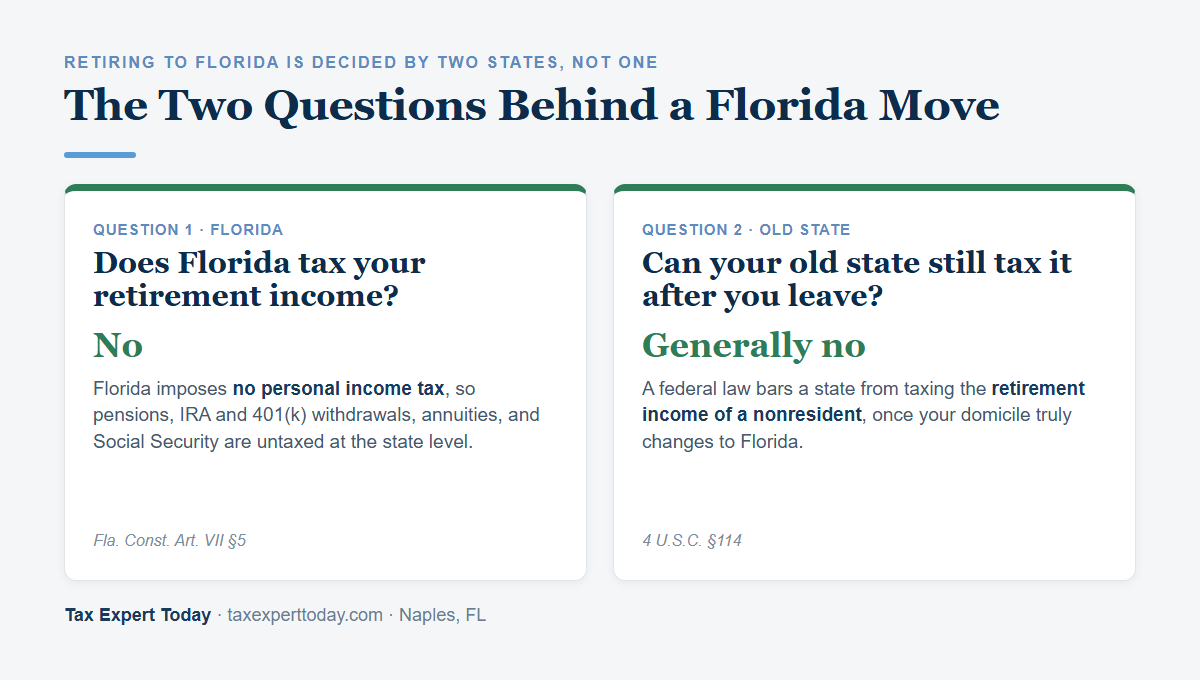
No. Florida imposes no personal income tax of any kind, so pensions, annuities, IRA and 401(k) distributions, and Social Security are all untaxed at the state level. There is no Florida resident return to file, no retirement-income exclusion to claim, and no state withholding on distributions to reconcile. For a retiree, Florida is a zero on the state line for every category of retirement income.
This is not a statute the legislature can change on its own. Article VII, Section 5 of the Florida Constitution bars the state from levying an income tax on individuals, which is why the answer holds across every income type rather than depending on a schedule of exclusions the way it does in states that do tax retirees. What Florida does tax is real property, through local ad valorem taxes, and consumption, through sales tax. Neither touches your pension or your retirement account, and the homestead exemption reduces the property side for a new resident who makes the Florida home a primary residence.
Because Florida asks nothing of retirement income, the entire tax analysis of the move happens on the other side of the line, in the state you are leaving. That is where the planning is, and it is where most of the surprises live.
Can My Old State Tax My Pension After Retiring to Florida?
Generally no, and the reason is a federal law rather than the goodwill of your old state. Under 4 U.S.C. section 114, no state may impose an income tax on the retirement income of an individual who is not a resident or domiciliary of that state. Once you are a Florida domiciliary, your former state is barred from taxing your qualified pension and retirement plan income, even though that income was earned while you lived and worked there.
This is the single most important rule for a retiree relocating to Florida, and it is the point every “Florida has no income tax” article leaves out. The value of the move for a working person can be clouded by wage-sourcing and accrual rules that reach back to the state where the work was performed. For most retirement income, Congress removed that ambiguity in 1996 with the source-tax ban. A New York, New Jersey, California, or Illinois retiree who genuinely changes domicile to Florida does not owe the old state tax on pension checks that continue after the move, because the old state simply lacks the power to impose it.
The protection is conditioned on one thing: you must actually be a nonresident and non-domiciliary of the old state. The statute shields the income of a person who has left. It does nothing for someone who keeps a domicile up north, and it does nothing on its own to defeat a statutory residency claim if you keep a home there and spend too many days in it. Establishing and documenting the domicile change is therefore the price of admission for the federal shield. See our guide on how to establish Florida residency for the full evidence file. The evidence standard, the day-count math, and the audit posture are the same ones covered in our guides on the Florida 183-day rule calculator, the dual-state residency trap, and defending a Florida residency audit.
Which Retirement Income Does Federal Law Protect?
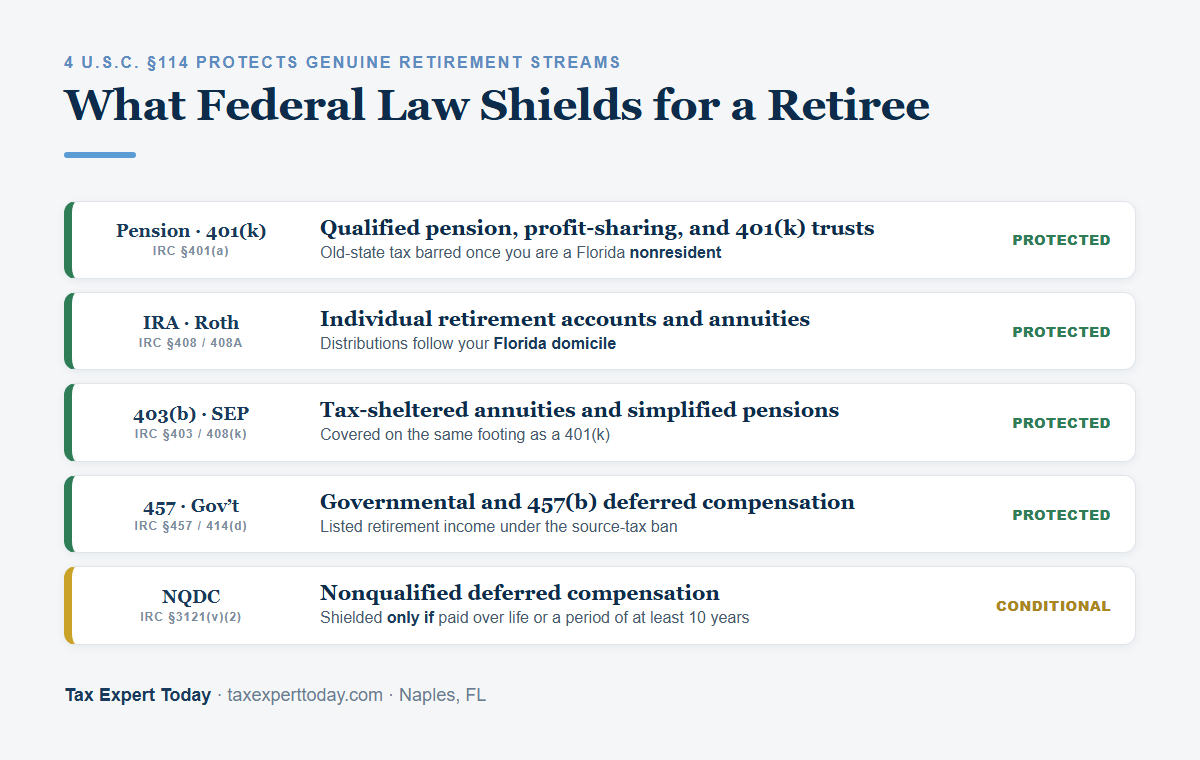
Section 114 protects income from qualified employer plans and individual retirement accounts broadly, and it protects certain nonqualified deferred compensation only when it is paid out as a genuine retirement stream. The dividing line is the payout structure. A pension or IRA is covered outright. A nonqualified plan is covered only if it pays in substantially equal periodic payments over your life or over a period of at least 10 years.
The statute lists the protected sources by their Internal Revenue Code section. The categories cover the retirement vehicles most retirees actually hold.
| Retirement income source | Governing Code section | Protected by 4 U.S.C. §114 for a nonresident? |
|---|---|---|
| Qualified pension, profit-sharing, and 401(k) trusts | IRC §401(a) | Yes |
| Individual retirement accounts and annuities (traditional and Roth) | IRC §408 and §408A | Yes |
| Simplified employee pensions (SEP) | IRC §408(k) | Yes |
| Annuity plans and tax-sheltered annuities | IRC §403(a) and §403(b) | Yes |
| Governmental and 457(b) deferred compensation plans | IRC §414(d) and §457 | Yes |
| Nonqualified deferred compensation | IRC §3121(v)(2)(C) | Only if paid over life or a period of at least 10 years |
The nonqualified carve-out is where high earners need to look closely. IRC section 3121(v)(2) defines the deferred compensation arrangements that section 114 will treat as protected retirement income, but only when the money is paid in substantially equal periodic payments, at least annually, for the life or life expectancy of the recipient or for a period of not less than 10 years. A supplemental executive retirement plan paid as a lifetime annuity is protected. The same balance paid as a lump sum, or over a period shorter than 10 years, is not, and the former state can tax it under the sourcing rules that applied to the underlying compensation. For a retiree with a nonqualified plan, the election of a payout period of 10 years or longer is often what converts a taxable item into a protected one. We cover the equity and deferred-compensation sourcing analysis for people still working in our guide on Florida domicile for executives.
How Are IRA and 401(k) Distributions Taxed in the Move Year?
In the year you move, an IRA or 401(k) distribution is split by the residency line. Amounts you receive while you are still a resident of the old state are taxable there, and amounts you receive after your Florida domicile begins generally fall out, because the source-tax ban and the intangible-sourcing rules both point the income to Florida. The federal treatment does not change at all; your Form 1040 reports the full year of distributions regardless of the move.
The mechanics matter because the move year is a part-year filing in the old state, not a Florida filing. You file a part-year resident return where you left, reporting income received during the resident period, and you file nothing at the state level in Florida. A distribution taken in January while you were still domiciled up north sits in the taxable resident period. The same distribution taken in July, after a documented domicile change, generally does not. This is why the calendar, not just the amount, drives the state result on a large withdrawal in the year of the move. Where the plan holds appreciated employer stock, the same timing question also decides a separate federal election, and the mechanics are set out in our guide to net unrealized appreciation. The mechanics of that part-year return, and the way the rest of your income splits across the move, are covered in our guide on snowbird taxes in your first year, and if a business sale is also in play, on moving to Florida before selling a business.
Federal rules continue to govern how much of each distribution is taxable and when penalties apply. IRC section 408 and IRS Publication 575 set the ordinary-income treatment of traditional IRA and pension distributions, the basis recovery rules for after-tax contributions, and the age thresholds for early-distribution penalties and required minimum distributions. None of that is affected by which state you live in. The move changes the state layer only, and in Florida that layer is zero once the residency line is crossed. One federal route does remove a distribution from income entirely rather than merely sourcing it, and that is a qualified charitable distribution, which is available from age 70 1/2 and is worth sequencing alongside the conversion timing above.
Should You Time Distributions or a Roth Conversion Around the Move?
Often yes. Because the old state taxes distributions received during the resident period and Florida taxes none of them, deferring a discretionary withdrawal or a Roth conversion until after your domicile changes can remove the state tax on that event entirely. The federal tax is the same either way; the state tax is what the timing controls, and in a high-tax state that difference can be substantial on a large conversion.
A Roth conversion is the clearest case. A conversion is a voluntary, taxable event whose timing you control completely. Running the conversion while you are still a resident of a state with a high income tax exposes the converted amount to that state. Running the same conversion after you are a documented Florida resident generally keeps it off the old state return, while the federal result is identical. For a retiree who plans to convert a traditional balance to a Roth over several years, sequencing the conversions to begin after the domicile date is a straightforward way to keep the state out of a decision that is otherwise entirely federal.
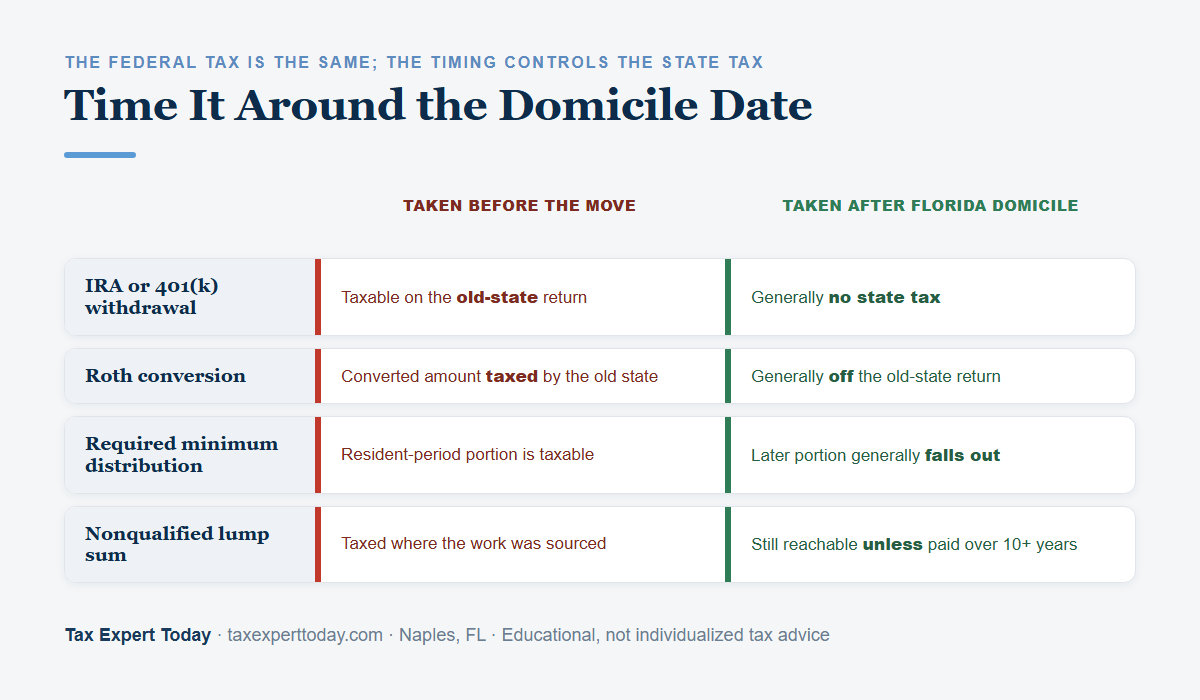
Two cautions keep this from being a simple “wait until you move” rule. First, the residency change must be real and documented, because a conversion run the week after a paper move that the old state later unwinds does not gain the protection. Second, a few states apply an accrual concept to items that accrued before the change of status, so a retiree who also has deferred compensation or an installment sale in the mix should map those items against the move date rather than assume everything follows the distribution timing. The following table sets out the common timing choices.
| Event | Taken while still a resident of the old state | Taken after Florida domicile begins |
|---|---|---|
| Discretionary IRA or 401(k) withdrawal | Taxable on the old-state part-year return | Generally no old-state tax; Florida has no income tax |
| Roth conversion | Converted amount taxed by the old state | Generally no old-state tax on the conversion |
| Required minimum distribution | Portion received while resident is taxable there | Portion received after the move generally falls out |
| Nonqualified deferred compensation lump sum | Taxable where the underlying work was sourced | Still reachable by the old state unless paid over 10 years or more |
Does Florida Tax Social Security, Annuities, or Investment Income?
No, Florida taxes none of them, because it has no personal income tax. Social Security benefits, commercial and qualified annuity payments, interest, dividends, and capital gains are all free of state tax for a Florida resident. The only tax on this income is the federal tax, which applies to a Florida retiree exactly as it would anywhere else.
It is worth separating the state result from the federal result, because retirees sometimes assume Florida changes the federal picture. It does not. Up to 85 percent of Social Security benefits can be taxable at the federal level depending on combined income, annuity payments carry their own federal exclusion ratio for the return of basis, and investment income is taxed federally at ordinary or capital-gains rates. Florida removes the state layer on all of it, which is the entire benefit, but the federal return is unchanged. For the investment side specifically, the intangible income of a Florida resident follows the Florida domicile, so once the move is complete a former state generally cannot tax the interest, dividends, and gains a retiree receives, in the same way it cannot tax the pension.
- Domicile
- Your one true, fixed, and permanent home, the place you intend to return to. A person has only one domicile at a time, and changing it is the event that starts Florida residency and ends the old state’s residency claim.
- Source tax
- A tax a state imposes on income connected to that state, such as wages for work performed there. 4 U.S.C. section 114 bars a state from applying a source tax to the retirement income of a nonresident.
- Qualified plan
- An employer retirement plan meeting the Internal Revenue Code requirements for favorable tax treatment, such as a 401(a) pension or a 401(k). Distributions are protected retirement income under section 114.
- Nonqualified deferred compensation
- A promise to pay compensation in a later year outside the qualified-plan rules. It is protected from old-state tax only when paid as a life annuity or over a period of at least 10 years.
- Part-year resident return
- The state return filed for the year of a move, reporting income received while you were a resident plus income sourced to that state afterward. In a Florida move, this return exists only in the state you left.
Retirement Tax Planning Help in Naples and Southwest Florida
Tax Expert Today LLC works with retirees and near-retirees moving to Naples, Bonita Springs, Fort Myers, Marco Island, and across Southwest Florida on the tax side of the relocation: confirming and documenting the domicile change, sequencing IRA distributions and Roth conversions around the move date, checking whether a nonqualified plan is structured to earn the section 114 shield, and preparing the part-year return in the state being left. The firm is multidisciplinary, with tax advisors, enrolled agents, CPAs, and attorneys, and advises clients in residency, retirement, and tax matters nationwide.
The office is at 11983 Tamiami Trail N, Naples, FL 34110, and consultations can be arranged at (239) 441-2005, Monday through Friday, 10:00am to 5:00pm ET. You can also review our Naples tax planning and Florida tax services pages, or contact us directly.
Frequently Asked Questions
Does Florida tax pensions, IRAs, or 401(k) withdrawals?
No. Florida has no personal income tax under Article VII, Section 5 of the Florida Constitution, so pensions, IRA and 401(k) distributions, annuities, and Social Security are all untaxed at the state level. There is no Florida resident return, no retirement-income exclusion to claim, and no state withholding to reconcile. Only the federal tax applies to these distributions, and that federal treatment is the same for a Florida resident as anywhere else.
Can my former state tax my pension after I move to Florida?
Generally no. Under 4 U.S.C. section 114, no state may tax the retirement income of a person who is not a resident or domiciliary of that state. Once you genuinely change your domicile to Florida, your old state is barred from taxing your pension, IRA, and 401(k) income even though it was earned there. The protection depends on actually being a nonresident, so documenting the domicile change is essential.
Is nonqualified deferred compensation protected after moving to Florida?
Only when it is paid the right way. 4 U.S.C. section 114 protects nonqualified deferred compensation from old-state tax only if it is paid in substantially equal periodic payments over the recipient’s life or over a period of at least 10 years, under the rules of IRC section 3121(v)(2). A lump sum, or a payout period shorter than 10 years, remains reachable by the state where the underlying work was sourced.
Should I wait until after moving to Florida to do a Roth conversion?
Often yes. A Roth conversion is a voluntary taxable event whose timing you control. Running it while you are still a resident of a high-tax state exposes the converted amount to that state, while running it after a documented Florida domicile change generally keeps it off the old-state return. The federal tax is identical either way, so the timing controls only the state tax, which in Florida is zero.
Where can I get help with retirement taxes when moving to Naples, FL?
Tax Expert Today LLC, located at 11983 Tamiami Trail N, Naples, FL 34110, helps retirees and near-retirees moving to Naples and Southwest Florida with the tax side of the relocation, including the domicile change, distribution and Roth-conversion timing, nonqualified plan structuring, and the part-year return in the state being left. The firm is multidisciplinary, with enrolled agents, CPAs, and attorneys. Consultations can be arranged at (239) 441-2005.
When to Engage a Professional on a Florida Retirement Move
The tax value of retiring to Florida is captured during the move year, not recovered afterward. The situations that most often justify professional help are a large IRA or 401(k) balance you plan to draw down or convert, a nonqualified or supplemental executive plan whose payout election is not yet fixed, a pension from a state with an aggressive residency or accrual rule, a northern home you intend to keep, and an installment sale or deferred item that straddles the move date. Any one of these can turn a move that looks purely beneficial into a question of timing and documentation.
Outcomes depend on individual facts, and nothing in this guide is a promise about how any particular retirement move will be taxed. Tax Expert Today LLC coordinates the domicile evidence, the distribution and conversion timing, and the part-year return so the plan holds together and the federal shield applies cleanly. If you are moving to Florida this year, or intend to before year end, a review before you take a large distribution or run a conversion is the least expensive way to get the retirement tax picture right. Call (239) 441-2005 or contact us to arrange a consultation.
Published July 22, 2026 by Dr. Pellumb Kabashi « Back to Learning Center
Have a question this article touches on?
Tax Expert Today LLC, based in Naples, Florida and serving clients across the United States.
Schedule a Consultation (239) 441-2005