
By Dr. Pellumb Kabashi, DBA, MBA, EA, CFE, CES
Founder, Tax Expert Today LLC · Tax advisors, enrolled agents, CPAs, and attorneys · Serving clients in all 50 states
Quick Answer
Form 1040-NR is the United States income tax return for nonresident aliens. It reports only income the United States taxes: business and wage income at graduated rates, and most passive United States income at a flat 30 percent or treaty rate. It is due April 15 with wages, otherwise June 15, and a very late return can lose its deductions. Call (239) 441-2005 for a free consultation.
What is Form 1040-NR?
Form 1040-NR, the U.S. Nonresident Alien Income Tax Return, is the federal return a foreign individual files when United States tax law reaches some of that person’s income but the person is not a United States resident. It is also used for nonresident alien estates and trusts. Unlike Form 1040, it reports United States income only, never worldwide income.
- It is a full income tax return. Income, deductions, credits, withholding, and the balance due or refund are all computed on it.
- It splits income into two tax systems. Effectively connected income is taxed at graduated rates, and other United States income is taxed at a flat rate on Schedule NEC.
- It carries its own schedules. Schedule OI, Schedule NEC, Schedule A (Form 1040-NR), and Schedule P replace or supplement the Form 1040 versions.
- It is where withholding is settled. Tax withheld on Forms W-2, 1042-S, and 8288-A is claimed here as a credit.
The 2025 Instructions for Form 1040-NR describe the return as the one used by nonresident alien individuals, estates, and trusts, and Publication 519, U.S. Tax Guide for Aliens, supplies the residency, sourcing, and treaty rules that sit underneath it. Whether a person files Form 1040-NR or Form 1040 is decided first by residency. A foreign national who holds a green card or meets the substantial presence test is generally a resident and files Form 1040 on worldwide income. A person who meets neither test, or who meets the substantial presence test but qualifies for the closer connection exception on Form 8840, is a nonresident, and Form 1040-NR is the return.
That makes Form 1040-NR a common filing in Naples, Florida and across Southwest Florida. Canadian and European owners of Gulf Coast condominiums, foreign investors who rent out a Collier or Lee County home, and seasonal visitors who sell a Florida property all end up here. This guide focuses on the return itself: who must file it, how its two tax systems work, how a foreign owner of Florida rental property should report, why filing on time decides whether any deductions are allowed, and what the return looks like in the year a property is sold.
Who has to file Form 1040-NR?
A nonresident alien must file Form 1040-NR if engaged in a United States trade or business at any time during the year, even with no income from it, or if owing United States tax that was not fully withheld. Special taxes, certain account distributions, and some estate and trust situations also require a return.
- Engaged in a United States trade or business. A return is required even if the income is exempt by treaty or there was no United States source income at all.
- Underwithheld United States income. Passive United States income reportable on Schedule NEC where not all of the tax owed was withheld.
- Special taxes. Alternative minimum tax, additional tax on retirement accounts, household employment taxes, and certain uncollected social security and Medicare tax.
- Representatives. The personal representative of a deceased nonresident, and the fiduciary of a nonresident alien estate or trust.
Table A of the 2025 instructions lists nine conditions, and any one of them triggers the filing requirement. The table below summarizes the ones a Southwest Florida client is most likely to meet, alongside the situations where a return is not required but is still worth filing.
| Situation | Form 1040-NR required? | Why |
|---|---|---|
| Foreign national working in the United States on wages | Yes | Performing services here is a United States trade or business |
| Foreign owner renting out a Florida home, 30 percent correctly withheld from gross rent | Generally no | Publication 519 says the liability is satisfied by the withholding |
| Same owner, electing to be taxed on net rental income under section 871(d) | Yes | The election is made on the return and deductions require a timely, accurate return |
| Foreign seller of Florida real estate with FIRPTA tax withheld | Yes, in practice | The gain is effectively connected, and the withholding is only a credit against the actual tax |
| Passive United States income with less than the full tax withheld | Yes | Table A condition 2 |
| Too much tax withheld under a treaty that was not applied | Not required, but needed to get a refund | The instructions say to file if you can get money back |
| Student on an F, J, M, or Q visa with no taxable income | No | Exception 1 in the instructions, though Form 8843 may still be required |
The trade or business test is broader than many foreign nationals expect. Performing personal services in the United States is generally a trade or business, so even a short working visit can create a filing requirement. Where a treaty exempts the income, the return is still filed, the exemption is claimed on Schedule OI, and a treaty position may need to be disclosed on Form 8833.
What is the difference between Form 1040 and Form 1040-NR?
Form 1040 reports a resident’s worldwide income, while Form 1040-NR reports only the income the United States taxes a nonresident on. Form 1040-NR also restricts filing status, generally denies the standard deduction, limits itemized deductions to those tied to United States business income, and allows the child tax credit only for certain countries’ residents.
- Income scope. Worldwide on Form 1040; United States income only on Form 1040-NR.
- Filing status. No married filing jointly and no head of household on Form 1040-NR.
- Deductions. No standard deduction for most filers; a separate Schedule A with narrower items.
- Credits. The child tax credit and credit for other dependents are available in full only to residents of Canada and Mexico and to United States nationals.
| Feature | Form 1040 (resident) | Form 1040-NR (nonresident) |
|---|---|---|
| Income reported | Worldwide income | Effectively connected income plus United States source passive income |
| Tax rates | Graduated rates on taxable income | Graduated rates on effectively connected income; 30 percent or treaty rate on Schedule NEC income |
| Filing statuses | Single, married filing jointly, married filing separately, head of household, qualifying surviving spouse | Single, married filing separately, qualifying surviving spouse |
| Standard deduction | Available | Not available, except certain students and business apprentices from India under Article 21(2) of that treaty |
| Itemized deductions | Schedule A (Form 1040) | Schedule A (Form 1040-NR): state and local income tax on connected income, gifts to United States charities, qualifying casualty and theft losses, and a few others |
| Foreign earned income exclusion | Available to qualifying citizens and residents on Form 2555 | Not available; Form 2555 is not used |
| Where to mail (no payment) | Depends on state of residence | Department of the Treasury, Internal Revenue Service, Austin, TX 73301-0215 |
The instructions direct Form 1040-NR filers to the Instructions for Form 1040 for many lines and then list exceptions line by line. That structure is the source of many errors: a line that works one way on a resident return often has a nonresident exception a few pages later. The foreign earned income exclusion is a good example. It is a resident and citizen benefit covered in our guide to the foreign earned income exclusion versus the credit, and it has no place on Form 1040-NR.
How is income taxed on Form 1040-NR?
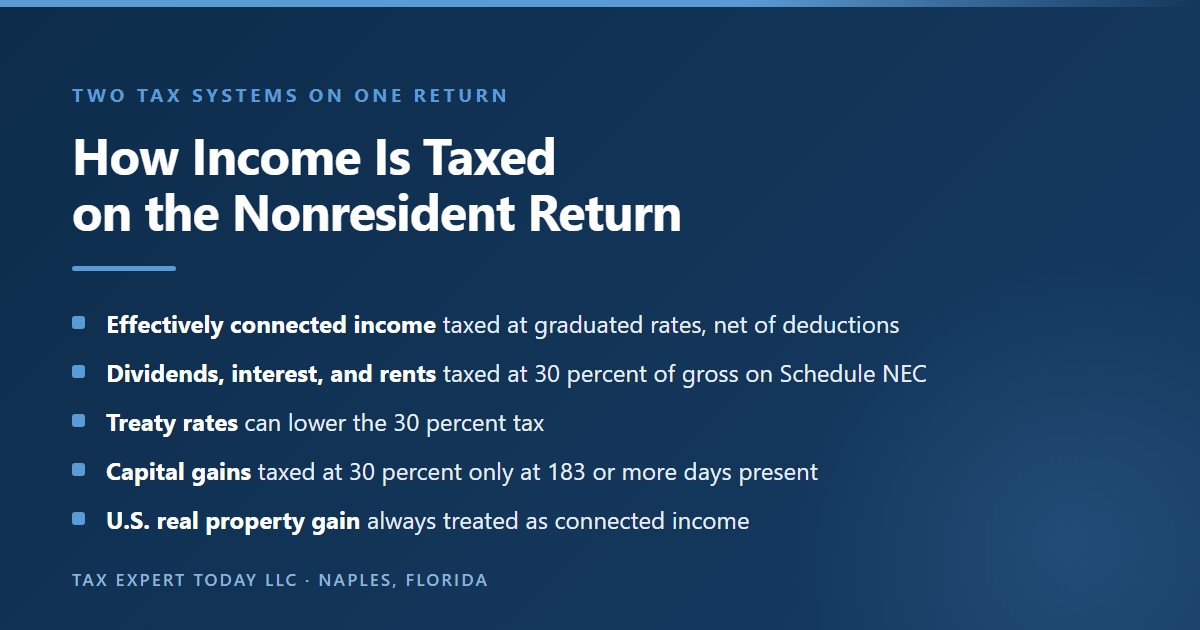
Form 1040-NR taxes two kinds of income differently. Income effectively connected with a United States trade or business is taxed on a net basis at the graduated rates residents pay. Other fixed or periodic United States income, such as dividends, most interest, and rents without an election, is taxed at 30 percent of gross unless a treaty lowers it.
- Effectively connected income. Wages, business profits, and gain on United States real property, reported on page 1 and taxed after allowable deductions.
- Not effectively connected income. Reported on Schedule NEC and taxed at 30 percent or the treaty rate with no deductions.
- Capital gains. Generally not taxed for a nonresident, but section 871(a)(2) imposes 30 percent on net United States source gains of a nonresident present 183 days or more in the year.
- Real property gain. Always treated as effectively connected under FIRPTA, whatever the seller’s presence.
The 30 percent tax comes from 26 U.S.C. section 871(a), which applies it to the amount received from United States sources as interest, dividends, rents, salaries, annuities, and other fixed or determinable income, when that income is not effectively connected with a United States business. Because it applies to the gross amount, nothing is subtracted for expenses. For a dividend that rarely matters. For rental income it matters a great deal, because a property’s mortgage interest, property tax, insurance, association dues, repairs, and depreciation can consume most of the rent.
Most Schedule NEC income is collected at the source. A United States payer withholds the tax and reports it on Form 1042-S, and where the correct amount was withheld the nonresident may have nothing further to do for that income. Where the payer withheld at 30 percent although a treaty allowed a lower rate, the Form 1040-NR is how the difference is recovered. The certification that should have prevented that over-withholding is covered in our guide to Form W-8BEN. This article covers the return side only. How to read the statement itself, including the box 10 credit that goes on line 25g, is covered in our guide to Form 1042-S.
How does a foreign owner report Florida rental income on Form 1040-NR?
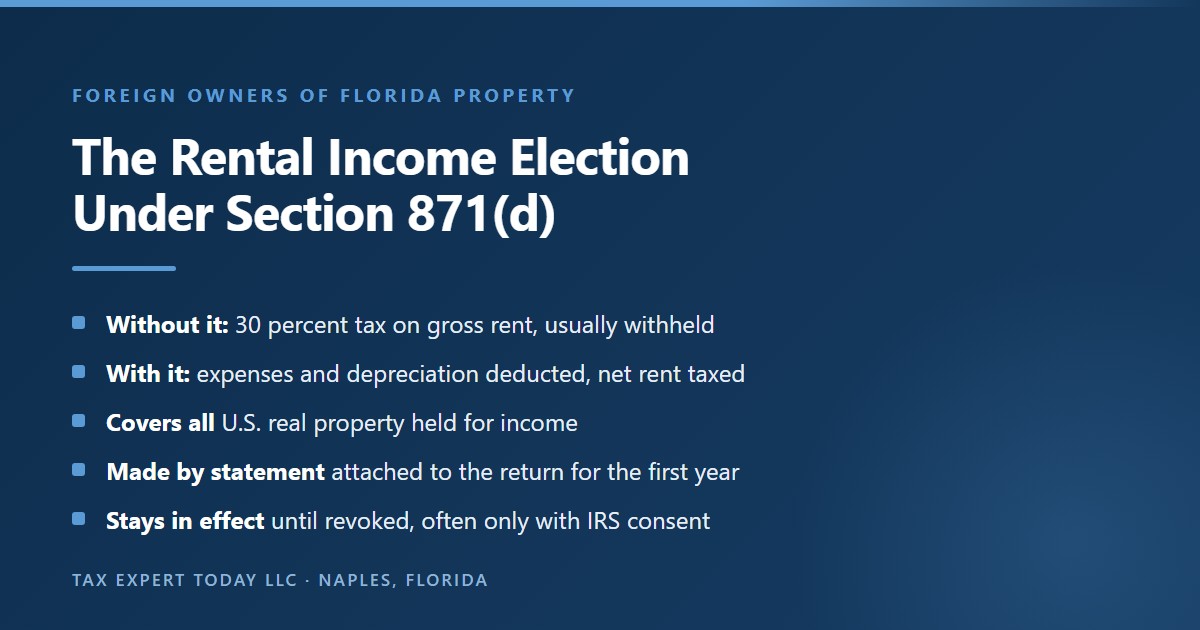
A foreign owner of Florida rental property has two choices. Without an election, the gross rent is taxed at 30 percent, usually through withholding, and no return may be required. With the section 871(d) election, the rent is treated as effectively connected, expenses and depreciation are deducted, and only the net income is taxed at graduated rates on Form 1040-NR.
- Default treatment. 30 percent of gross rent, collected by the tenant or the property manager as withholding agent.
- The election. Section 871(d) lets a nonresident treat all United States real property income as effectively connected.
- What it covers. All income from all United States real property held for the production of income, not one property at a time.
- How long it lasts. Every later year until revoked, and revocation after the amendment window needs IRS consent.
Publication 519 walks through the default case with a single rented house: the rent is subject to 30 percent tax, the tenants withheld it and reported it on Form 1042-S, and the owner does not have to file Form 1040-NR because the liability was satisfied by the withholding. The same passage explains the alternative. If the owner makes the choice under section 871(d), the rental income is reported on Schedule E, carried to Schedule 1, and attached to Form 1040-NR, and certain rental expenses offset the rent.
A hypothetical illustration. Assume a foreign owner rents a Naples condominium for 30,000 dollars of gross rent in a year, and the mortgage interest, property tax, association dues, insurance, management fees, repairs, and depreciation total 24,000 dollars. Without the election, the tax is 30 percent of 30,000 dollars, or 9,000 dollars, regardless of the expenses. With the election, the owner reports 6,000 dollars of net rental income and pays tax on that amount at graduated rates. The figures are illustrative only, and the actual result depends on the owner’s other connected income, treaty position, and deductions.
The election is made by attaching a statement to the return, or to an amended return, for the first year. Publication 519 lists what the statement must contain:
- That the choice is being made, and whether it is under section 871(d) or a tax treaty.
- A complete list of all United States real property, or interests in real property, the extent of ownership, and the location.
- Major improvements, the dates the property was owned, and the income from it.
- Details of any previous choices and revocations of the real property election.
On the 2025 form, Schedule OI item M asks whether this is the first year of the election or whether an earlier election remains in effect. Revocation without IRS approval is possible only by amending the year the choice was made, within 3 years from the date that return was filed or 2 years from the time the tax was paid, whichever is later. After that, Treas. Reg. section 1.871-10 requires IRS consent. The election also does not, by itself, make the owner engaged in a United States trade or business for other purposes. Because it is sticky, the election should be evaluated with a few years of expected rent, expenses, and a possible sale in view, rather than decided in the first April.
Where the Florida property is held through a single-member limited liability company owned by the foreign person, the company itself generally has a separate information filing, covered in our guide to Form 5472, in addition to the owner’s Form 1040-NR.
Why does filing Form 1040-NR on time matter for deductions?
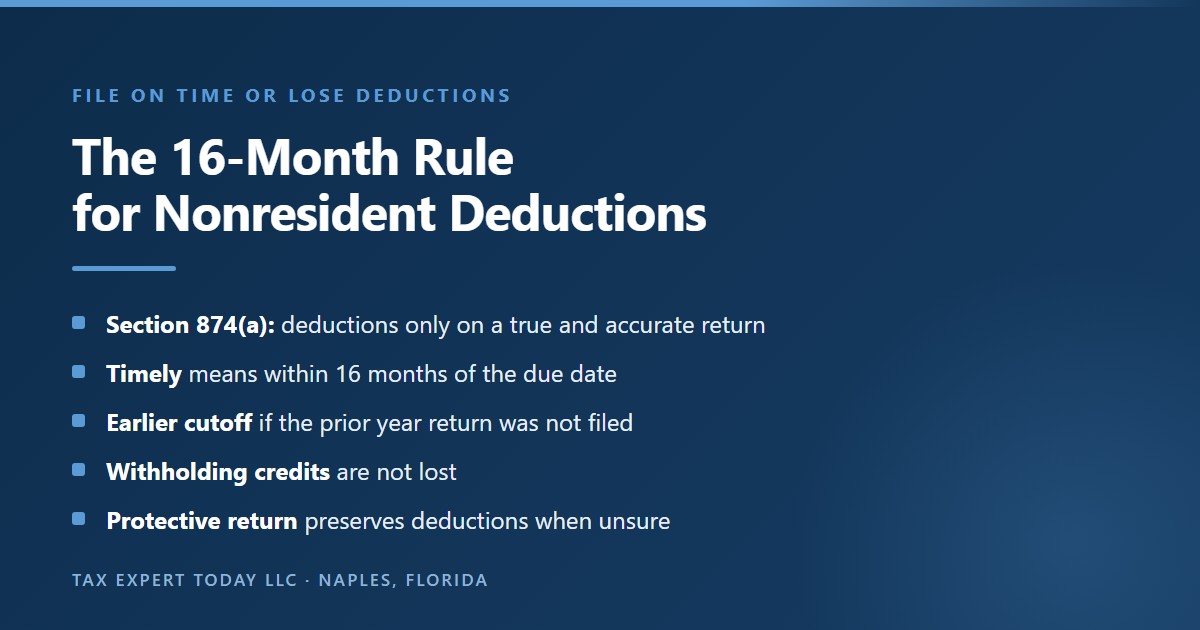
Section 874(a) allows a nonresident alien deductions and credits only on a true and accurate return. Under Treas. Reg. section 1.874-1, that return is timely if filed within 16 months of its due date, with a shorter deadline when the prior year return was not filed. Miss it, and tax may be computed on gross income.
- The statute. 26 U.S.C. section 874(a) makes the return a prerequisite to deductions and credits.
- The 16-month window. Measured from the regular due date for the year.
- The shorter deadline. If the prior year’s required return was not filed, the earlier of 16 months or the date the IRS notifies the taxpayer.
- Credits that survive. The credit for tax withheld is not lost, nor are two narrow fuel and fund credits.
This is the single most expensive rule on Form 1040-NR, and none of the leading ranking pages we reviewed explain it. The text of 26 U.S.C. section 874(a) says a nonresident alien receives the benefit of deductions and credits only by filing a true and accurate return. Treas. Reg. section 1.874-1 supplies the timing. If a return was filed for the immediately preceding year, or this is the first year a return is required, the current return must be filed within 16 months of its due date. If no return was filed for the preceding year, the current return must be filed by the earlier of that 16-month date or the date the IRS notifies the taxpayer that the return has not been filed and that deductions and credits may not be claimed.
For a foreign owner who made the section 871(d) election, the consequence is severe. The election turns rent into effectively connected income, which removes it from flat 30 percent withholding, but the deductions that make the election worthwhile depend on a timely return. An owner who elected, stopped filing, and let the window pass may face tax computed on the rent with no expenses allowed. Publication 519 notes that the IRS may waive the deadline where the taxpayer acted reasonably and in good faith, but a waiver is a request, not a right. Where penalties have also accrued, our guide on getting IRS penalties removed explains the separate relief routes for the penalties themselves.
The protective return. A nonresident whose United States activities were limited, and who does not believe any income was effectively connected, can file a protective Form 1040-NR by the deadline. It reports no connected income and no deductions but states the reason it is being filed. If the IRS later decides that some income was effectively connected, the protective return preserves the right to the deductions and credits. The same procedure is available to a person who believes a treaty eliminates any United States tax, with item L on Schedule OI completed. For an owner who is unsure whether a Florida rental activity rises to a trade or business, a protective filing is inexpensive insurance.
What happens on Form 1040-NR in the year you sell U.S. property?
When a foreign person sells United States real estate, the buyer generally withholds 15 percent of the amount realized under FIRPTA and reports it on Form 8288-A. That withholding is a prepayment, not the tax. The seller reports the gain as effectively connected income on Form 1040-NR and claims the withholding on line 25f, which often produces a refund.
- Withholding base. 15 percent of the amount realized, meaning the price, not the gain, under 26 U.S.C. section 1445.
- The actual tax. Figured on the net gain, after basis, improvements, and selling costs.
- The credit. Form 1040-NR line 25f, with a copy of every Form 8288-A attached to the front of the return.
- Depreciation. Deductions claimed under a section 871(d) election reduce basis and affect the gain.
Under 26 U.S.C. section 1445(a), the transferee in a disposition of a United States real property interest by a foreign person must withhold a tax equal to 15 percent of the amount realized. Because the base is the gross price, the withholding frequently exceeds the tax on the actual gain, particularly on a long-held property. The seller recovers the difference only by filing. The 2025 instructions direct the seller to enter the section 1445 withholding shown on Form 8288-A on line 25f and to attach every Form 8288-A to the front of the return.
The withholding mechanics, including reduced withholding certificates and the exemptions available at closing, are covered in our guide to FIRPTA withholding. The Form 1040-NR point is narrower. The sale year return is where the gain is actually computed, where any depreciation claimed under the rental election is accounted for, and where the refund is claimed. The same 16-month rule applies to deductions on that return, so a seller waiting for a large refund has a practical reason to file promptly.
Which filing statuses and deductions are allowed on Form 1040-NR?
A Form 1040-NR filer may use single, married filing separately, or qualifying surviving spouse, but not married filing jointly or head of household. The standard deduction is generally unavailable. Itemized deductions are limited to those allocable to effectively connected income, plus gifts to United States charities and qualifying casualty losses, which are allowed regardless.
- Married nonresidents. Generally married filing separately, with a narrow single-status exception for certain residents of Canada, Mexico, and South Korea who live apart from a spouse.
- State and local income tax. Deductible only on income connected with a United States trade or business.
- Charitable gifts. Only to United States charities.
- Dependent credits. Available in full only to residents of Canada and Mexico and United States nationals, and in part to residents of South Korea and India.
The instructions state flatly that a nonresident alien filing Form 1040-NR cannot have a married filing jointly or head of household status. The one route to a joint return runs through residency rather than the form: a nonresident married to a United States citizen or resident may elect under section 6013(g) to be treated as a resident for the whole year and file jointly on Form 1040. That election brings worldwide income onto the return and makes the nonresident a specified individual for Form 8938, so it is a planning decision, not a form choice.
The standard deduction exception is narrow. Students and business apprentices eligible for Article 21(2) of the United States and India treaty may take it; everyone else itemizes on Schedule A (Form 1040-NR) or claims nothing. For a Canadian or European homeowner, the practical deduction items are usually the rental expenses carried through Schedule E under the section 871(d) election, rather than Schedule A items. Florida’s lack of a personal income tax also removes the state income tax deduction that a nonresident working in another state might claim.
When is Form 1040-NR due, and where do you file it?
An individual who received wages subject to United States withholding files Form 1040-NR by April 15. Everyone else, including most foreign rental owners and sellers, files by June 15. For 2025 returns those dates are April 15 and June 15, 2026. Form 4868 extends the filing date, not the payment date, and returns can be e-filed or mailed to Austin.
- With withheld wages. The 15th day of the 4th month after year end, April 15, 2026 for 2025.
- Without withheld wages. The 15th day of the 6th month, June 15, 2026 for 2025.
- Extension. Form 4868 gives an automatic 6 months to file; interest runs on unpaid tax from the original date.
- Weekend rule. A due date on a Saturday, Sunday, or legal holiday moves to the next business day.
| Filer | 2025 return due | Mail to (no payment enclosed) |
|---|---|---|
| Individual with wages subject to United States withholding | April 15, 2026 | Department of the Treasury, Internal Revenue Service, Austin, TX 73301-0215, USA |
| Individual without such wages | June 15, 2026 | Same Austin address |
| Individual enclosing a payment | Same dates | Internal Revenue Service, P.O. Box 1303, Charlotte, NC 28201-1303, USA |
| Nonresident estate or trust with a United States office | 15th day of the 4th month after year end | See the instructions |
| Nonresident estate or trust without a United States office | 15th day of the 6th month after year end | See the instructions |
The instructions state that these addresses apply to returns filed in 2026 and that the address for later returns may change, so the current version at IRS.gov/Form1040NR should be checked before mailing. Form 1040-NR can be e-filed, and paid preparers must generally e-file it. A Form 8840 or Form 8843 that goes with the return is attached to it; one filed without a return is mailed by itself to the Austin service center by the same due date.
What schedules and forms go with Form 1040-NR?
Every Form 1040-NR includes Schedule OI, which records citizenship, residence, visa history, days present, and treaty claims. Schedule NEC reports flat-rate income, Schedule A (Form 1040-NR) carries itemized deductions, and Schedule P reports foreign partner interests. Withholding statements and treaty disclosures are attached, several of them to the front.
- Schedule OI. Always required; its item M tracks the real property election and item L the treaty exemption.
- Schedule NEC. Income not effectively connected, taxed at 30 percent or treaty rates.
- Withholding statements. Forms W-2, 1042-S, and 8288-A attached to the front.
- Treaty disclosure. Form 8833 where a treaty-based return position must be disclosed.
| Form or schedule | What it does | Who typically needs it |
|---|---|---|
| Schedule OI (Form 1040-NR) | Other information: citizenship, residence, visa, days present, treaty benefits, real property election | Every filer |
| Schedule NEC (Form 1040-NR) | Tax on income not effectively connected | Dividends, interest, and rents without the election |
| Schedule A (Form 1040-NR) | Itemized deductions | Filers with connected income and allowable deductions |
| Schedule E and Schedule 1 (Form 1040) | Net rental income under the section 871(d) election | Foreign rental owners who elect |
| Form 8288-A | FIRPTA withholding statement, claimed on line 25f | Foreign sellers of United States real property |
| Form 1042-S | Withholding on nonresident income, claimed on line 25g | Recipients of United States passive income |
| Form 8833 | Treaty-based return position disclosure | Filers claiming a treaty benefit that requires disclosure |
| Form 8840 or Form 8843 | Closer connection exception, or excluded days | Seasonal residents and exempt individuals |
Schedule OI deserves more care than it usually gets. It asks for the number of days present in each of the last three years, which the IRS can compare against a Form 8840 filed in the same year and against entry and exit records. An answer that does not match the day count on another form is one of the easiest inconsistencies for an examiner to find.
Does a Form 1040-NR filer also file an FBAR or Form 8938?
Usually not. The FBAR applies to United States persons, and Form 8938 applies to specified individuals, which generally excludes nonresident aliens unless they elect to be treated as residents for a joint return or are bona fide residents of American Samoa or Puerto Rico. A treaty tie-breaker filer is treated differently for each form.
- FBAR. A filing for United States persons; a true nonresident alien is generally outside it.
- Form 8938. Nonresident aliens are specified individuals only in the two situations the instructions list.
- Treaty tie-breaker filers. The Form 8938 instructions excuse the part of the year covered by a timely Form 1040-NR with Form 8833.
- Prior resident years. Years when the person was a resident may carry reporting that was never made.
The 2025 Instructions for Form 8938 list who is a specified individual: a United States citizen, a resident alien for any part of the year, a nonresident alien who elects resident treatment to file jointly, and a nonresident alien who is a bona fide resident of American Samoa or Puerto Rico. The instructions also carry a special rule for dual resident taxpayers who compute tax as nonresidents under a treaty, excusing Form 8938 reporting for the part of the year covered by a timely Form 1040-NR with Form 8833 attached. FBAR residency follows its own rules, discussed in our guide to whether you need to file an FBAR, and the answer for a treaty filer should be confirmed with an adviser rather than assumed from the income tax result.
The exposure that matters most is usually historical. A foreign national who was a resident in earlier years, perhaps before a closer connection claim was filed or in a year with 183 or more days, may have owed an FBAR or Form 8938 for those years. The civil penalties in our guide to FBAR penalties are statutory maximums, not predictions, and the non-willful routes to catch up depend on facts that should be reviewed before any late filing is made.
Form 1040-NR Help in Naples & Southwest Florida
Tax Expert Today LLC prepares nonresident returns from an office in Naples, Florida, and serves clients in all 50 states. Collier and Lee counties hold a large number of homes owned by Canadian, European, and Latin American residents, which makes Form 1040-NR a routine part of local cross-border tax work.
- Form 1040-NR help Naples: preparing the annual nonresident return, Schedule OI, and Schedule NEC.
- Nonresident tax return Naples FL: evaluating the section 871(d) election for Florida rental property and keeping the 16-month rule in view.
- International tax Naples FL: sale year returns that claim FIRPTA withholding back on line 25f.
- Treaty and residency questions: Form 8840, Form 8833, and the Schedule OI day count, reviewed together.
Florida has no personal income tax, so for a foreign owner of Southwest Florida property the income tax question is a federal one. Our international and expat tax services page explains how we approach cross-border returns, and the Florida planning questions that often travel with a seasonal home are covered in our guide to retiring to Florida.
Office: 11983 Tamiami Trail N, Naples FL 34110
Phone: (239) 441-2005
Hours: Monday through Friday, 10:00 to 5:00 ET
Frequently Asked Questions
We are Canadian and rent out our Naples condominium when we are not using it. Do we need to file Form 1040-NR?
It depends on how the rent is taxed. If 30 percent of the gross rent is withheld and you make no election, a return may not be required. If you elect under section 871(d) to be taxed on net rental income, each owner generally files Form 1040-NR, and it should be filed within 16 months of the due date to keep the deductions.
Can I file Form 1040-NR jointly with my spouse?
No. Form 1040-NR does not allow married filing jointly. A nonresident married to a United States citizen or resident may elect to be treated as a resident and file a joint Form 1040, which reports worldwide income instead.
Do I get the standard deduction on Form 1040-NR?
Generally no. The standard deduction is available on Form 1040-NR only to certain students and business apprentices eligible for Article 21(2) of the United States and India treaty. Other filers itemize on Schedule A (Form 1040-NR) or claim no deductions beyond those attached to business or rental income.
What happens if I file Form 1040-NR late?
Late filing and late payment penalties and interest can apply as they do for residents. The larger risk is section 874: a return filed more than 16 months after its due date, or later than an IRS notice where the prior year was also unfiled, can lose the deductions and most credits, leaving tax computed on gross income.
How do I get back FIRPTA tax withheld when I sold my Florida home?
File Form 1040-NR for the year of sale, report the gain, and enter the withholding shown on Form 8288-A on line 25f with a copy attached to the front of the return. If the withholding exceeds the tax on the gain, the difference is refunded.
Do I need an ITIN to file Form 1040-NR?
You need a taxpayer identification number. A nonresident who is not eligible for a Social Security number generally uses an individual taxpayer identification number, and the application can usually be submitted with the return.
When to Engage a Professional
Form 1040-NR is manageable when the facts are simple: a wage earner with one Form W-2, or a passive investor whose withholding was correct. It becomes a planning exercise quickly once real property is involved, because the section 871(d) election is sticky, the 16-month rule turns a missed year into a much larger bill, and the sale year return decides how much FIRPTA withholding comes back.
Consider a consultation if any of the following applies: you own United States rental property and have never decided whether to elect, you made the election and then missed one or more years, you sold or plan to sell United States real estate, a payer withheld 30 percent although a treaty applies, your day count is close to the substantial presence line, you hold the property through a United States limited liability company, or earlier years may have been resident years without the related foreign account reporting.
Tax Expert Today LLC is a tax advisory firm in Naples, Florida serving clients in all 50 states. Call (239) 441-2005 to discuss your facts.
Primary Sources
- IRS: About Form 1040-NR, U.S. Nonresident Alien Income Tax Return
- 2025 Instructions for Form 1040-NR
- Publication 519, U.S. Tax Guide for Aliens (for 2025 returns)
- 26 U.S.C. section 871 (30 percent tax and the real property election)
- Treas. Reg. section 1.874-1 (return required for deductions, 16-month rule)
- 26 U.S.C. section 1445 (FIRPTA withholding)
This article is general information, not advice for any particular taxpayer, and does not create a client relationship. The rental figures in the example are hypothetical illustrations only. Forms, instructions, and mailing addresses change annually, and the 2025 versions were current when this article was written. Verify current rules and confirm your own facts with a qualified tax professional before filing.
Published September 21, 2026 by Dr. Pellumb Kabashi « Back to Learning Center
Have a question this article touches on?
Tax Expert Today LLC, based in Naples, Florida and serving clients across the United States.
Schedule a Consultation (239) 441-2005