
By Dr. Pellumb Kabashi, DBA, MBA, EA, CFE, CES
Founder, Tax Expert Today LLC · Tax advisors, enrolled agents, CPAs, and attorneys · Serving clients in all 50 states
Quick answer: A Fort Myers tax advisor works almost entirely on federal ground, because Florida imposes no state individual income tax. The live Lee County issues are storm and casualty losses under section 165, the DR-405 tangible personal property return, the 0.5 percent county surtax, first-year Florida residency filing, and seasonal rental allocation. Call (239) 441-2005 for a free consultation.
What does a Fort Myers tax advisor do when Florida has no income tax?
Because Florida imposes no state individual income tax, a Fort Myers tax advisor spends almost no time on state returns and almost all of it on federal exposure. The recurring Lee County work is casualty losses from named storms, the tangible personal property return, entity structure for the trades, and residency for households that arrived from a taxing state.
This is the point most national tax content misses about Southwest Florida. The absence of a state income tax does not mean there is less to do. It means the work moves. A household in a state with an income tax spends its planning energy on state credits, apportionment, and residency audits. A Lee County household spends it on federal timing, on entity choice, and on the handful of Florida filings that are not income taxes at all but still carry deadlines and penalties.
- Casualty and disaster timing. Lee County sits in one of the most frequently declared disaster areas in the country, and the deduction rules changed for 2026.
- Tangible personal property. A Florida filing with an April 1 deadline that many new business owners have never encountered before.
- Sales and surtax compliance. Lee County adds a county surtax that neighboring Collier County does not.
- First-year residency. The departing state, not Florida, decides when domicile actually changed.
- Entity structure in the trades. Construction, marine, and service firms clustered around the rebuilding economy.
- Seasonal rental allocation. Second homes on the water that are rented for part of the year.
Geography explains most of the caseload a Fort Myers tax advisor sees. Fort Myers is the county seat of Lee County, which also contains Cape Coral, Bonita Springs, Estero, Lehigh Acres, North Fort Myers, Fort Myers Beach, Sanibel, and Captiva. The economy runs on healthcare, construction and the skilled trades, hospitality and tourism, real estate, marine services, and professional services, with a large seasonal population that arrives in winter and leaves in spring. Nearly every item on the list above traces back to one of those characteristics.
How do Lee County storm and casualty losses work in 2026?
A personal casualty loss is deductible only when it is attributable to a declared disaster, and Public Law 119-21 made that limitation permanent while extending it to state-declared disasters beginning in 2026. Lee County property owners reach the deduction through Form 4684, and section 165(i) allows the loss to be claimed on the prior year return.
Two things changed, and both matter in Lee County more than almost anywhere else. First, the limitation that confined personal casualty losses to federally declared disasters was scheduled to expire after 2025. It did not expire. Public Law 119-21, which the IRS refers to as the Working Families Tax Cuts, made it permanent. Second, and more usefully, the same law widened the category: beginning in 2026 a loss attributable to a state-declared disaster may also qualify, where before only a federal declaration would do. For a county that sees state declarations more often than federal ones, that is a real expansion.
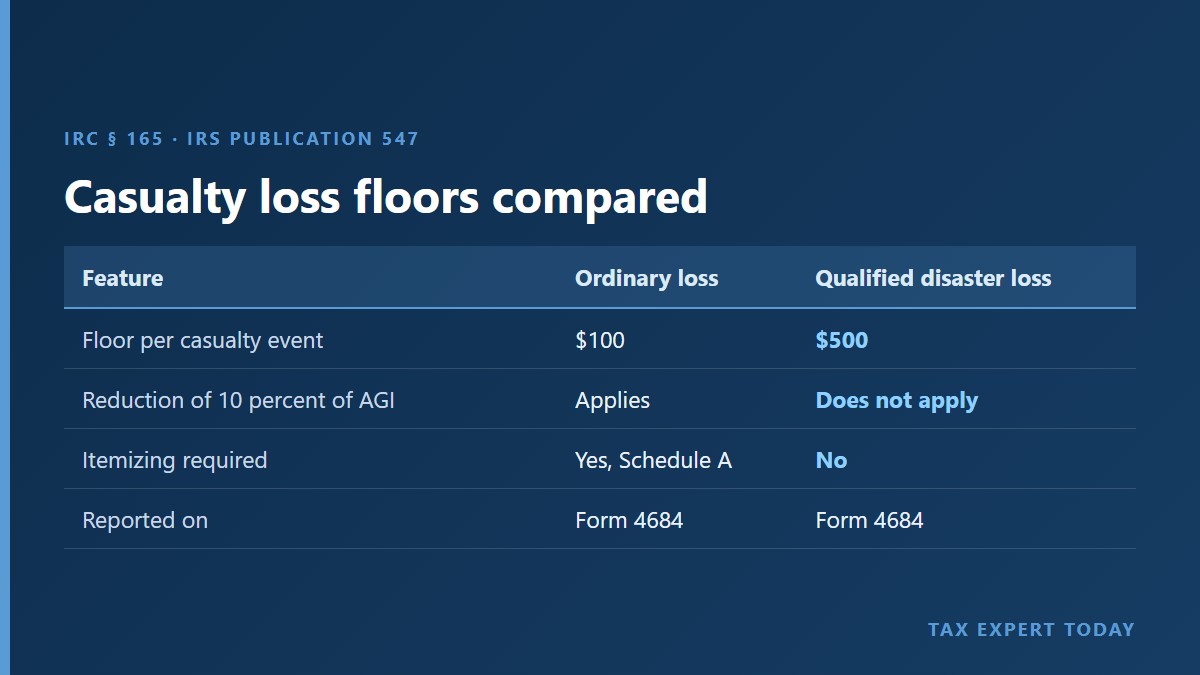
The arithmetic depends on which kind of loss it is, and the difference is large enough to change whether a return is worth amending.
| Feature | Ordinary personal casualty loss | Qualified disaster loss |
|---|---|---|
| Floor applied per casualty event | $100 | $500 |
| Reduction of 10 percent of adjusted gross income | Applies | Does not apply |
| Itemizing required | Yes, on Schedule A | No, the loss may be added to the standard deduction |
| Reported on | Form 4684, carried to Schedule A | Form 4684 |
The 10 percent of adjusted gross income reduction is what quietly wipes out most ordinary casualty claims. A household with $150,000 of adjusted gross income absorbs $15,000 of loss before a single dollar becomes deductible, so a damaged roof and a flooded vehicle can produce a real economic loss and no deduction at all. A qualified disaster loss skips that reduction entirely and may be claimed without itemizing, which is why the classification question deserves attention before the return is prepared rather than after.
Section 165(i) is the other lever, and it is the one most often left unused. Where a loss is attributable to a federally declared disaster, the taxpayer may elect to treat it as having occurred in the immediately preceding taxable year. That is not merely a scheduling convenience. It moves the loss into whichever year produces the better result, which may be the year with the higher income, the lower adjusted gross income floor, or simply the year in which a refund arrives sooner. The election is made on the prior year return, generally by amending it.
- Basis, not market value, sets the ceiling. The deductible amount is the lesser of the decline in fair market value or the adjusted basis in the property.
- Insurance recovery comes off first. Reimbursement reduces the loss, and a reasonable prospect of recovery defers the deduction until the claim resolves.
- A claim you decline to file is not deductible. Where property is covered, failing to submit a timely insurance claim disallows the loss to that extent.
- Business and rental property follow different rules. The declared-disaster limitation and the adjusted gross income reduction apply to personal-use property, not to property held in a trade or business.
- Filing postponements are separate from the deduction. The postponement granted for Hurricane Milton in IRS announcement FL-2024-10, which covered Lee County, ran to May 1, 2025 and has expired. The casualty deduction survives the postponement.
Who in Fort Myers must file the DR-405 tangible personal property return?
Any Lee County business, rental operator, or self-employed contractor who owned tangible personal property on January 1 must file Form DR-405 with the Lee County Property Appraiser by April 1. Filing on time secures an exemption of up to $25,000 of assessed value under section 196.183, Florida Statutes, and skipping the first filing forfeits it.
This is the filing that most often brings a new business owner to a Fort Myers tax advisor in the first place, and it catches people in a specific way. Because Florida has no income tax, an owner arriving from a taxing state reasonably assumes there is nothing to file. There is. Tangible personal property means the furniture, equipment, tools, signage, computers, and leasehold improvements used in a business, assessed as of January 1 and reported to the county property appraiser rather than to the Florida Department of Revenue.
The $25,000 exemption is generous enough that a great many small Fort Myers operations owe nothing once it applies. The trap is that the exemption is not automatic. It is granted on a timely filed initial return, so an owner who assumes the exemption covers them and therefore never files can end up outside it. The Lee County Property Appraiser administers the return locally, and the Florida Department of Revenue publishes the statewide rules.
- Sole proprietors are included. A self-employed contractor or agent with tools and a truck-mounted rig is within the filing population.
- Rental furnishings count. An owner who furnishes a rental property is holding tangible personal property used in a rental activity.
- Leased equipment is reportable. Property that is leased, lent, or rented to another party carries its own reporting obligation.
- The assessment date is fixed. January 1 controls, so equipment bought on January 2 belongs to the following year.
Why does a Fort Myers business charge 6.5 percent sales tax when Naples charges 6?
Florida charges a 6 percent state sales tax, and each county may add a discretionary surtax. Lee County imposes 0.5 percent through December 31, 2028, so a Fort Myers sale carries 6.5 percent. Collier County imposes none, so the same sale in Naples carries 6 percent. The surtax reaches only the first $5,000 of a single item.
Businesses that operate across the Lee and Collier line, which is a common footprint for contractors, marine services, and mobile trades working the corridor between Fort Myers and Naples, deal with two rates rather than one. The surtax follows the county where the sale occurs or where the item is delivered, so a single company can owe different rates on two jobs in the same week. The $5,000 cap on a single item of tangible personal property means the surtax matters far less on a large equipment sale than the headline rate suggests, and far more on a high volume of ordinary transactions.
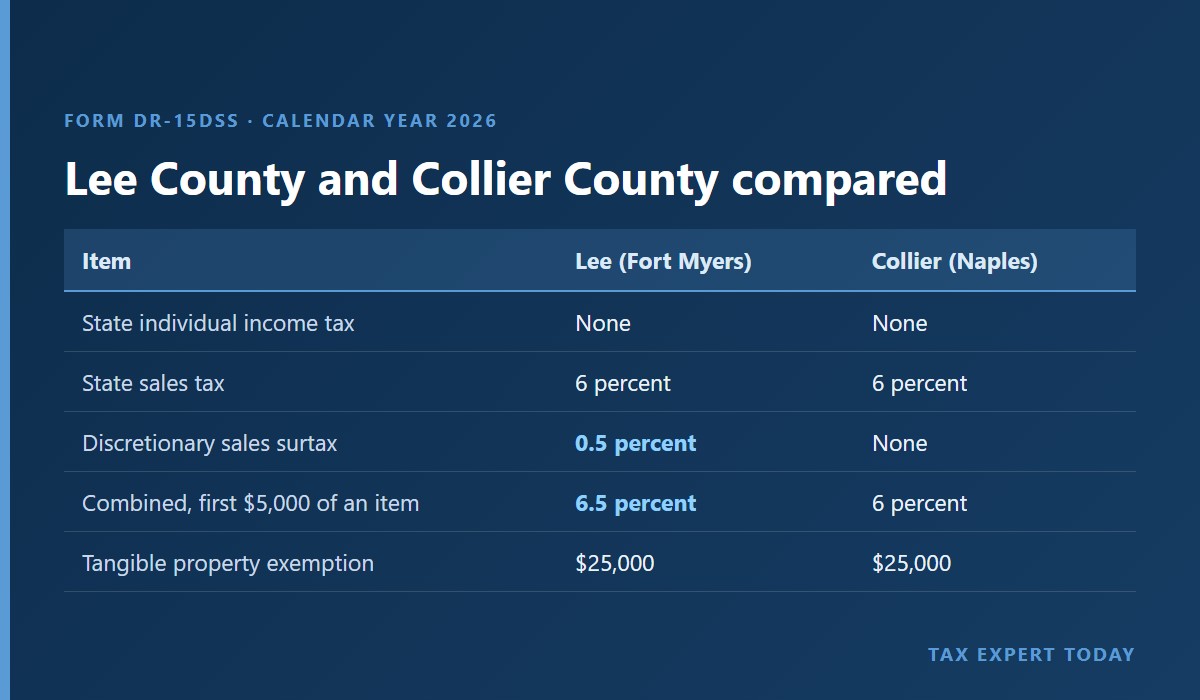
| Item | Lee County (Fort Myers) | Collier County (Naples) |
|---|---|---|
| State individual income tax | None | None |
| State sales tax rate | 6 percent | 6 percent |
| Discretionary sales surtax, calendar year 2026 | 0.5 percent, in effect through December 31, 2028 | None |
| Combined rate on the first $5,000 of a single item | 6.5 percent | 6 percent |
| Tangible personal property return | Form DR-405 to the Lee County Property Appraiser by April 1 | Form DR-405 to the Collier County Property Appraiser by April 1 |
| Tangible personal property exemption | Up to $25,000 of assessed value, statewide under section 196.183 | Up to $25,000 of assessed value, statewide under section 196.183 |
| Homestead exemption, treated here only as evidence of Florida domicile | Available on a Florida primary residence | Available on a Florida primary residence |
The surtax term matters for planning. Lee County’s 0.5 percent is scheduled to run through December 31, 2028, and county surtaxes are periodically renewed or allowed to lapse by referendum, so a long-range projection should not assume the current rate runs forever in either direction. The Calendar Year 2026 edition of Form DR-15DSS is republished each November and is the authority to check rather than a cached figure.
How does a first-year Florida resident in Fort Myers file?
A household that moves to Fort Myers mid-year generally files a final part-year return in the departing state and a federal return only for Florida years afterward. Florida collects no individual income tax, so the work shifts to proving the date domicile changed, because the former state decides that question on evidence rather than on the moving date.
The asymmetry is the whole point. Florida asks for nothing and therefore contests nothing. The state being left behind has both a revenue interest and, in several cases, an established residency audit program. So the first-year file is built for an audience that is not in Florida. What persuades that audience is a coherent record with a clear break date, not a single document.
- The declaration of domicile is a starting point, not a conclusion. Section 222.17, Florida Statutes, provides for filing a sworn declaration with the clerk of the circuit court, and it is useful precisely because it is dated.
- Day counting is evidence, not the test. Domicile turns on intent demonstrated by conduct, though several departing states apply a day-count statutory residency rule in parallel.
- Move the center of life, not just the mailing address. Physicians, banking, vehicle registration, voter registration, and professional licensure all carry dates.
- Income earned before the break stays where it was earned. A part-year return is normal and expected, and claiming a full Florida year for a partial year invites the audit.
- Deferred compensation and equity follow their own sourcing rules. Amounts earned in the former state can remain taxable there after the move.
Our guide to Florida wealth migration covers the wider relocation picture, and our Naples tax planning practice handles the Florida side of these moves for households across the region.
How is a seasonal Fort Myers rental taxed under section 280A?
Section 280A divides a Fort Myers seasonal property between rental use and personal use, and the split governs how much of the mortgage interest, insurance, and depreciation is deductible. Renting for fourteen days or fewer in the year keeps the income out of gross income entirely. Lee County also levies a 5 percent tourist development tax.
This is the most common second-home question in Lee County, and it usually arrives already half-answered by something the owner read that was written for a different fact pattern. The fourteen-day rule is real and genuinely favorable: rent the property for fourteen days or fewer during the year and the rental income is excluded from gross income, though the corresponding expenses are not deductible either. Cross that line and the property becomes an allocated one, with every shared expense split between the rental days and the personal days.
Where owners are surprised is on what counts as a personal day. Use by a family member, and use by anyone paying less than a fair rental price, generally counts as personal use even though money changed hands. A week lent to a relative in February can shift the allocation for the entire year. Our guide to the short-term rental tax loophole works through the material participation questions that sit alongside the section 280A allocation, and IRS Publication 527 sets out the allocation mechanics.
The Lee County layer is separate and easy to miss. Accommodations rented for six months or less are subject to a 5 percent tourist development tax, which in Lee County is administered by the Clerk of the Circuit Court rather than by the county tax collector or the state, alongside the 6.5 percent state and county sales tax. An owner who registers for sales tax and stops there has completed half the registration.
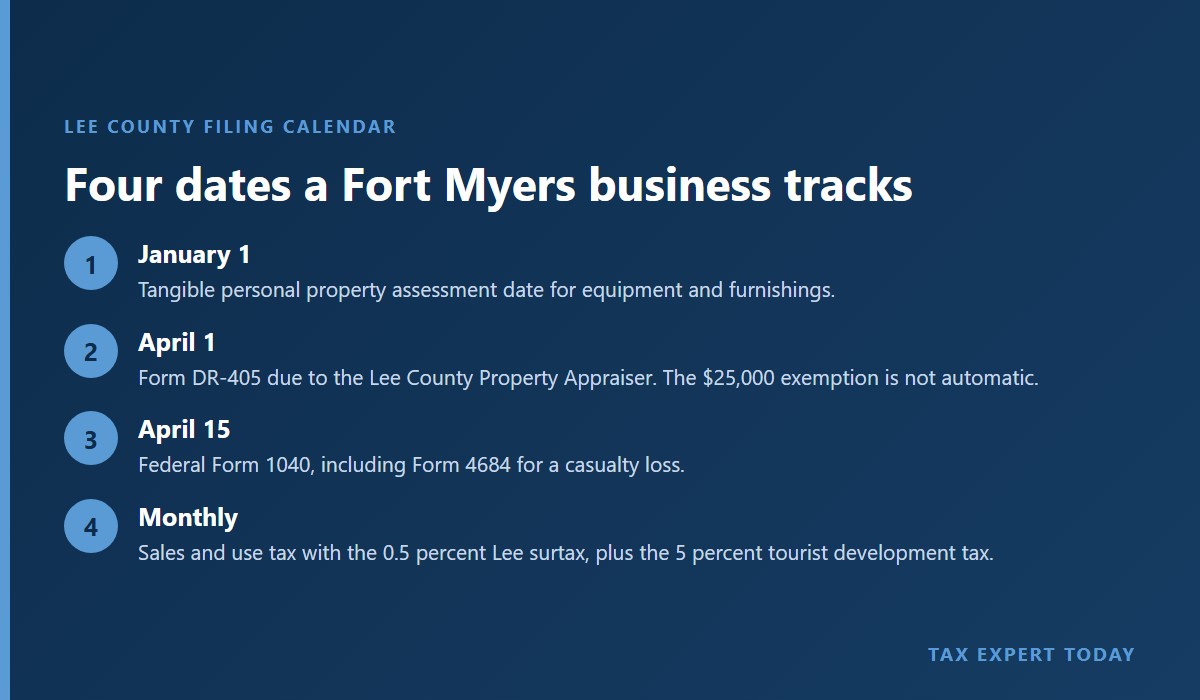
| Date | Filing | Who it reaches in Lee County |
|---|---|---|
| January 1 | Tangible personal property assessment date | Any business or rental operator holding equipment or furnishings |
| April 1 | Form DR-405 to the Lee County Property Appraiser | The same population, including sole proprietors |
| April 15 | Federal Form 1040, including Form 4684 for casualty losses | Individuals |
| Monthly or quarterly | Florida sales and use tax, including the 0.5 percent Lee surtax | Registered dealers |
| Monthly | Tourist development tax to the Lee County Clerk | Owners renting accommodations for six months or less |
What is reasonable compensation for an S corporation in the Fort Myers trades?
An S corporation shareholder who works in the business must take reasonable compensation as W-2 wages before taking distributions. In the Fort Myers trades, where roofing, marine service, and air conditioning firms often elect S status after a strong rebuilding season, the figure has to reflect what the owner actually does rather than what the cash flow allows.
The pattern is specific to a rebuilding economy. A contractor has two or three unusually strong years, elects S corporation status on the advice that it will reduce self-employment tax, and then sets a salary chosen to maximize the distribution rather than to match the work performed. The election itself is sound. The salary figure is where the exposure sits, and the IRS guidance on S corporation compensation is explicit that distributions to a working shareholder can be recharacterized as wages.
- The owner’s actual role drives the number. An owner who runs crews, sells jobs, and handles procurement is performing several roles, each with a market wage.
- Comparable local wages are the evidence. What a Southwest Florida firm would pay a non-owner to do that work is the benchmark, not a percentage rule of thumb.
- A boom year is not a reason to lower the salary. Compensation tracks services performed, and a year of high volume usually means more services, not fewer.
- Documentation is the defense. A contemporaneous file showing how the figure was derived is worth considerably more than a reconstruction later.
Our detailed guide to S corp reasonable compensation sets out the factors and the case law in full.
What does a Fort Myers business owe Florida if there is no income tax?
Florida imposes no individual income tax, but it does impose a 5.5 percent corporate income tax with a $50,000 exemption, and an employer in Lee County also registers for reemployment tax on the first $7,000 of each employee’s wages. An S corporation is generally exempt from the corporate tax, though not always.
This is the second thing that surprises an owner arriving from a taxing state, and it surprises them in the opposite direction from the first. The absence of a personal income tax gets all the attention, so the business-level obligations that do exist tend to go unexamined until a registration is late. None of them is onerous. All of them have deadlines.
The corporate income tax reaches C corporations and limited liability companies that have elected to be taxed as corporations. The $50,000 exemption, subtracted from adjusted federal income, means a great many small Fort Myers corporations compute a Florida liability of zero, and Form F-1120A exists as a short return for smaller filers. Zero owed is not the same as nothing due, because the return itself is still required. The Florida Department of Revenue sets out the filing population in detail.
- An S corporation is usually outside the corporate tax. The exception is an S corporation that pays federal income tax on line 23c of Form 1120S, which then has a Florida filing obligation of its own.
- A single-member LLC that is disregarded does not file separately. Its activity follows the owner.
- A partnership with a corporate partner files Form F-1065. The presence of a corporate owner is what triggers it.
- Reemployment tax starts at 2.7 percent for a new employer. It applies only to the first $7,000 of each employee’s annual wages, reported quarterly on Form RT-6.
- The quarterly report is due even with no payroll. A quarter with no employees and no wages still requires the filing once an employer is registered.
For a Fort Myers contractor who incorporates after a strong season, this is the practical sequence: register with the Department of Revenue, determine whether the entity is inside or outside the corporate tax, set up the quarterly reemployment reporting, and only then worry about the federal entity questions that usually prompted the incorporation in the first place. The reemployment tax rules govern the payroll side.
| Florida obligation | Who it reaches | Key figure |
|---|---|---|
| Individual income tax | Nobody | Florida imposes none |
| Corporate income tax, Form F-1120 or F-1120A | C corporations and LLCs taxed as corporations | 5.5 percent, after a $50,000 exemption |
| Partnership return, Form F-1065 | Partnerships and LLCs taxed as partnerships with a corporate owner | Triggered by the corporate partner |
| Reemployment tax, Form RT-6 | Registered employers | 2.7 percent initial rate on the first $7,000 of wages |
| Sales and use tax, Form DR-15 | Registered dealers | 6 percent plus the 0.5 percent Lee surtax |
| Tangible personal property, Form DR-405 | Businesses holding equipment on January 1 | Exemption up to $25,000 of assessed value |
What records support a Lee County casualty loss claim?
A casualty loss claim rests on documentation of three separate figures: the adjusted basis in the property, the decline in fair market value, and the insurance reimbursement. Lee County owners who assemble that file while the damage is still visible tend to fare better than those reconstructing it from memory two years later.
The deduction is not computed from the repair estimate, which is the assumption that causes most of the trouble. It is the lesser of the decline in fair market value or the adjusted basis, reduced by reimbursement and then by the applicable floors. Each of those inputs needs its own support, and they come from different places.
- Basis comes from the purchase file. The closing statement, the cost of improvements over the years, and any prior casualty adjustments together establish adjusted basis. This is the record most often missing, particularly on a property held for decades.
- The decline in value usually needs an appraisal. A qualified appraisal prepared for the loss is the cleanest evidence. Repair cost can serve as a measure of the decline where the repairs are actually made, are not excessive, and restore the property to its condition before the event.
- Photographs before the event carry real weight. Insurance inspection photos, listing photographs, and even routine family images dated before the storm establish the prior condition.
- The insurance file has to be complete. The claim, the adjuster report, the settlement, and any denial all bear on the reimbursement figure, and a claim not filed on covered property is not deductible to that extent.
- Record the declaration itself. The disaster declaration and its number establish the eligibility that section 165(h)(5) requires, and from 2026 that includes a state declaration.
- Keep the repair invoices, not just the estimates. An estimate shows what work was contemplated. An invoice shows what was done.
Where a return has already been filed without the loss, or filed with a figure that the documentation does not support, an amended return is the ordinary route. That decision interacts with the section 165(i) election discussed above, because the election itself is generally made by amending the prior year, so the two questions are usually answered together rather than separately.
When does a Fort Myers tax matter become a resolution case?
A Fort Myers matter shifts from planning to resolution when the IRS has taken a position rather than merely awaited a filing. A notice proposing additional tax, an examination letter, or a balance moving through the collection sequence all carry their own deadlines, and those deadlines run whether or not the taxpayer responds.
The distinction matters because the two kinds of work have different clocks. Planning work can usually wait for a convenient week. Resolution work frequently cannot, because the response window is fixed by statute and closing it forfeits an option that was available the week before.
- A notice of deficiency starts a hard 90-day clock. Our guide to the IRS notice of deficiency explains what the letter is and what the deadline forecloses.
- An examination has a scope that can be managed. What the IRS audit process covers is often narrower at the start than it becomes later.
- The assessment period is finite. The audit statute of limitations governs how far back an examination can reach, and certain omissions extend it.
- A casualty loss can attract attention. A large loss on a return is a legitimate deduction and also a visible one, which is another reason the documentation file matters before the return is filed rather than after.
- Residency can be examined years later. A departing state may open a residency inquiry well after a move to Lee County, which is why the first-year file is built to be read by someone else.
Where a Fort Myers matter has already reached that stage, our tax resolution practice in Naples handles examinations, notices, and collection matters for clients throughout Lee County, in person or remotely.
Fort Myers tax help from Tax Expert Today
Clients looking for a Fort Myers tax advisor reach us at an office in Naples, Florida that serves Fort Myers and the rest of Lee County in person as well as remotely. The office sits on Tamiami Trail North, roughly half an hour down the corridor from downtown Fort Myers, and Lee County clients regularly meet with us there. Our team includes tax advisors, enrolled agents, CPAs, and attorneys.
Searches such as tax advisor Fort Myers and tax help Lee County tend to come from two different moments. One is a business owner who has just learned that the DR-405 was due in April. The other is a homeowner who has been told a storm loss is not deductible and wants a second reading now that the 2026 rules have changed. Both are ordinary engagements, and both are easier to handle before a deadline passes than after.
Tax Expert Today LLC, 11983 Tamiami Trail N, Naples, FL 34110. Telephone (239) 441-2005. Office hours Monday through Friday, 10:00 to 5:00 Eastern time. Where a Fort Myers matter involves an IRS notice or a balance owed rather than planning, our Naples tax resolution practice covers that side, and our Florida tax services page sets out the full range of work we handle across the state.
Do I have to drive to Naples to work with a Fort Myers tax advisor?
No. Most of the work is handled through a secure document portal with scheduled calls, and a great many Lee County clients never come to the office. For clients who prefer to meet face to face, the Tamiami Trail office in Naples, Florida is a straightforward drive from Fort Myers, Cape Coral, and Bonita Springs, and appointments are available Monday through Friday during office hours.
When should you bring in a professional?
A Lee County return with wage income, a primary residence, and no rental activity is a return most people can file without help. Florida’s lack of an income tax genuinely does simplify the picture for a straightforward household, and it would be dishonest to suggest otherwise.
The situations that reward professional attention are the ones where a decision has to be made rather than a form filled in. A casualty loss where the classification determines whether the 10 percent of adjusted gross income reduction applies. A section 165(i) election that requires choosing between two years before an amended return is filed. A first move to Florida where a former state may examine the break date years later. A seasonal rental whose allocation depends on how personal-use days were counted. An S corporation salary that has never been documented. In each of these, the outcome depends on analysis done before the filing rather than on the filing itself.
If any of those describe the year you are working through, a conversation with a Fort Myers tax advisor is worth having early. Call (239) 441-2005 to arrange a consultation, and bring the prior year return along with whatever documentation exists for the item in question.
Published September 4, 2026 by Dr. Pellumb Kabashi « Back to Learning Center
Have a question this article touches on?
Tax Expert Today LLC, based in Naples, Florida and serving clients across the United States.
Schedule a Consultation (239) 441-2005