
By Dr. Pellumb Kabashi, DBA, MBA, EA, CFE, CES
Founder, Tax Expert Today LLC · Tax advisors, enrolled agents, CPAs, and attorneys · Serving clients in all 50 states
Quick Answer: Georgia self employment tax is not a separate state tax. Self-employed Georgians pay the federal 15.3 percent self employment tax on 92.35 percent of net earnings, then Georgia income tax at the flat 4.99 percent rate for 2026 on net profit after deductions, usually through quarterly Form 500-ES payments due April 15, June 15, September 15, and January 15. Call (239) 441-2005 for a free consultation.
People search for Georgia self employment tax because they are about to owe it for the first time. A W-2 job ends, a consulting practice starts, a side business turns real, or a retiree begins billing clients again. The first surprise is the federal self employment tax, which takes 15.3 percent of most net earnings before income tax is even counted. The second question is what Georgia adds on top.
The short version is that Georgia does not charge a second self employment tax. It taxes self-employed people through its ordinary individual income tax, at a flat rate of 4.99 percent for 2026, applied to Georgia taxable income that starts from federal adjusted gross income. That sounds simple, and for many people it is. But several Georgia rules change the number in ways a federal-only calculator misses: Georgia does not follow federal bonus depreciation, it has not adopted the 2025 federal tax act, it uses a 70 percent current-year safe harbor for estimated tax, cities and counties charge their own occupation taxes, and self employment income counts as earned income for the retirement income exclusion.
This guide walks through each of those points for the 2026 tax year, with a worked example and the primary sources behind each figure. It is written for sole proprietors, single-member LLC owners, freelancers, gig workers, and partners who receive self employment income and file a Georgia return as residents, part-year residents, or nonresidents.
What Is Georgia Self Employment Tax?
Georgia self employment tax is a common name for two separate taxes on the same profit: the federal self employment tax of 15.3 percent for Social Security and Medicare, reported on Schedule SE, and Georgia individual income tax at the flat 4.99 percent rate for 2026, reported on Form 500. Georgia itself imposes no payroll-style tax on owners.
- Federal layer: self employment tax under Internal Revenue Code Section 1401, plus federal income tax.
- Georgia layer: income tax under O.C.G.A. 48-7-20 on Georgia taxable net income.
- Local layer: a city or county occupation tax in most places a business operates.
- What is missing: Georgia has no local income tax and no state self employment tax.
The distinction matters because the two layers are computed on different bases. The federal self employment tax is figured on net earnings from self employment, which is Schedule C profit (or partnership self employment income) multiplied by 92.35 percent. Georgia income tax is figured on Georgia taxable income, which starts with federal adjusted gross income, adds and subtracts Georgia adjustments on Schedule 1 of Form 500, and then subtracts the Georgia standard deduction or Georgia itemized deductions. The tax rate statute, O.C.G.A. 48-7-20, imposes the tax on every resident’s Georgia taxable net income and on nonresidents’ income from services performed or business carried on in Georgia.
In practice, a self-employed Georgia resident sees three numbers each year: federal self employment tax, federal income tax, and Georgia income tax. The first is identical in every state. The second depends on federal brackets. The third is where Georgia’s own rules apply, and it is the focus of this article.
Does Georgia Have Its Own Self Employment Tax?
No. Georgia has no state self employment tax and no state payroll tax on a sole proprietor’s own earnings. A self-employed Georgia resident pays Georgia income tax on net business profit, and Georgia unemployment tax applies only to wages paid to employees, not to the owner’s own Schedule C profit.
- No Georgia Schedule SE: Form 500 has no line for a state self employment tax.
- No owner unemployment tax: a sole proprietor does not pay Georgia unemployment tax on personal profit.
- No local income tax: Atlanta, Savannah, and other cities do not tax income.
- Income tax still applies: the full net profit flows into Georgia adjusted gross income.
This is the same answer a Florida or Texas freelancer gets about self employment tax, with one difference: Georgia does have an income tax. Florida and Texas have none, which is why our Texas self employment tax guide stops at the federal layer. A Georgia business owner needs both.
Owners who hire employees take on Georgia payroll duties that do not apply to their own earnings. Wages paid to employees require Georgia income tax withholding, covered in our Georgia withholding tax guide, and Georgia unemployment insurance contributions, covered in our Georgia unemployment tax guide. Those are employer taxes on the staff, not a self employment tax on the owner.
How Much Is the Federal Self Employment Tax in 2026?
The federal self employment tax for 2026 is 15.3 percent of net earnings from self employment: 12.4 percent for Social Security on the first $184,500 of combined wages and self employment earnings, and 2.9 percent for Medicare with no cap, plus a 0.9 percent additional Medicare tax above $200,000 for single filers.
- Base: net profit times 92.35 percent equals net earnings from self employment.
- Filing trigger: net earnings of $400 or more require Schedule SE.
- Wage coordination: W-2 wages use up the Social Security wage base first.
- Deduction: half of the tax is deducted in figuring adjusted gross income.
The IRS describes these figures on its self employment tax page, which confirms the $184,500 Social Security wage base for 2026 and the additional Medicare tax thresholds. Because this part of the bill is federal and identical in every state, we cover the mechanics in depth in our self employment tax calculator. The table below is a reference for the Georgia examples that follow.
| Component | Rate | Applies to (2026) | Where it is reported |
|---|---|---|---|
| Social Security | 12.4 percent | Net earnings up to $184,500, less any W-2 wages | Schedule SE |
| Medicare | 2.9 percent | All net earnings | Schedule SE |
| Additional Medicare tax | 0.9 percent | Earnings above $200,000 single, $250,000 joint, $125,000 separate | Form 8959 |
| Deduction for half of SE tax | Not a tax | Half of the 15.3 percent tax | Schedule 1 of Form 1040, flows to Georgia |
| Georgia income tax | 4.99 percent flat | Georgia taxable income after Georgia adjustments and deductions | Georgia Form 500 |
Two federal details affect Georgia directly. First, the deduction for half of self employment tax reduces federal adjusted gross income, and because Georgia starts from that number, the deduction lowers Georgia tax too. Second, self employment tax is not deductible again on Schedule C; the half deduction is the only place it reduces income.
How Does Georgia Tax Self Employment Income in 2026?
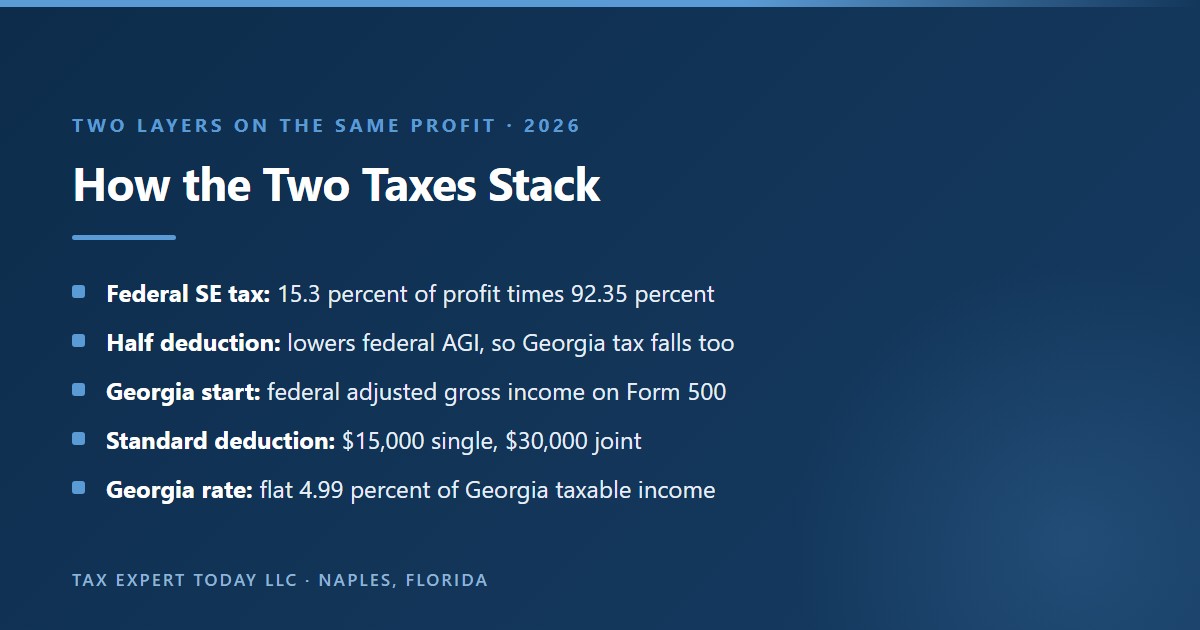
Georgia taxes self employment income as part of Georgia taxable income at a flat 4.99 percent for tax years beginning in 2026. The starting point is federal adjusted gross income, which already includes Schedule C profit less half of self employment tax, followed by Georgia adjustments and the $15,000 or $30,000 standard deduction.
- Rate: 4.99 percent for 2026, down from 5.19 percent for 2025 and 5.39 percent for 2024.
- Standard deduction: $15,000 single, head of household, or separate; $30,000 married filing jointly.
- Starting point: federal adjusted gross income on Form 500, Line 8.
- Adjustments: Schedule 1 additions and subtractions, including depreciation differences.
The Department of Revenue’s Important Tax Updates page states that the Georgia income tax rate has been reduced to a flat 4.99 percent and the standard deduction increased to $15,000 and $30,000 for 2026. Georgia’s rate has been changing every year since the switch to a flat tax, so the year matters: a 2025 return filed in 2026 uses 5.19 percent, while 2026 estimated payments should be planned at 4.99 percent. Our Georgia state income tax guide tracks the full rate history and the scheduled reductions.
Because the rate is flat, every additional dollar of Georgia taxable income costs 4.99 cents in Georgia tax for 2026, whether it is the first dollar of profit above the standard deduction or the two hundred thousandth. That makes the Georgia layer easy to estimate once federal adjusted gross income is known. The work is in getting the Georgia adjustments right.
For most sole proprietors the Georgia adjustments are small or zero. They become material when the business buys equipment and claims federal bonus depreciation, when the owner holds U.S. government bond interest, when the owner is 62 or older and claims the retirement income exclusion, or when the owner lives in Georgia for only part of the year. Each of those is covered below.
How Does the Federal Self Employment Tax Deduction Lower Georgia Tax?
The deduction for half of federal self employment tax reduces federal adjusted gross income, and Georgia starts its computation from that figure, so the same deduction lowers Georgia taxable income. At the 2026 rate, every $1,000 of that deduction saves about $49.90 of Georgia income tax.
- Automatic: no separate Georgia line is needed; it is inside federal adjusted gross income.
- Size: half of 15.3 percent of 92.35 percent, roughly 7.07 percent of net profit below the wage base.
- Georgia value: about 0.35 percent of net profit at the 4.99 percent rate.
- Not double counted: the self employment tax itself is not deductible again in Georgia.
The same carry-through applies to other above-the-line deductions that self-employed people take on Schedule 1 of Form 1040, such as the self-employed health insurance deduction and contributions to a SEP, SIMPLE, or solo 401(k) plan. Georgia’s IT-511 booklet asks part-year and nonresident filers to show the self-employed pension contribution separately on Schedule 3 so it can be allocated, but for a full-year resident it simply arrives inside federal adjusted gross income.
One point causes confusion every filing season. The federal qualified business income deduction under Section 199A is taken after adjusted gross income, so it never reaches Georgia. A self-employed owner who saves 20 percent of qualified income federally gets no matching reduction on the Georgia return, because Georgia starts above the line where that deduction is taken.
What Does a Georgia Self Employment Tax Example Look Like?
In a hypothetical 2026 example, a single Georgia resident with $90,000 of Schedule C profit and no other income owes about $12,717 of federal self employment tax and about $3,425 of Georgia income tax. The half self employment tax deduction cuts Georgia taxable income by $6,358 before the $15,000 standard deduction applies.
- Hypothetical facts: single filer, full-year Georgia resident, $90,000 net profit, no W-2 wages.
- Federal SE base: $90,000 times 92.35 percent equals $83,115.
- Georgia base: federal adjusted gross income of $83,642 less $15,000.
- Not included: federal income tax, credits, and local occupation tax.
The figures below are a hypothetical illustration of the arithmetic, rounded to whole dollars. They are not a projection for any particular taxpayer, and a real return will include items this example leaves out, such as interest income, retirement contributions, health insurance premiums, and credits.
| Step | Single filer, $90,000 profit | Married couple, $120,000 profit plus $60,000 spouse W-2 |
|---|---|---|
| Schedule C net profit | $90,000 | $120,000 |
| Net earnings from self employment (times 92.35 percent) | $83,115 | $110,820 |
| Federal self employment tax (15.3 percent) | $12,717 | $16,955 |
| Deduction for half of self employment tax | $6,358 | $8,478 |
| Federal adjusted gross income | $83,642 | $171,522 |
| Georgia standard deduction (2026) | $15,000 | $30,000 |
| Georgia taxable income | $68,642 | $141,522 |
| Georgia income tax at 4.99 percent | $3,425 | $7,062 |
| Georgia tax saved by the half SE deduction | $317 | $423 |
In the married example, the Social Security wage base is applied person by person, so the spouse’s W-2 wages do not reduce the self-employed spouse’s Social Security portion. Their combined wages and self employment earnings of $170,820 are also below the $250,000 joint threshold for the additional Medicare tax. A household with W-2 wages on the same person who has self employment income would compute the Social Security portion differently, because those wages use up part of the $184,500 base first.
The example also shows the relative size of the two layers. Federal self employment tax is more than three times the Georgia income tax at these income levels. That is why most planning for self-employed Georgians starts federally, with entity choice, retirement plans, and expense documentation, and then checks the Georgia effect of each choice rather than the other way around.
Do Self-Employed Georgians Have to Make Estimated Tax Payments?
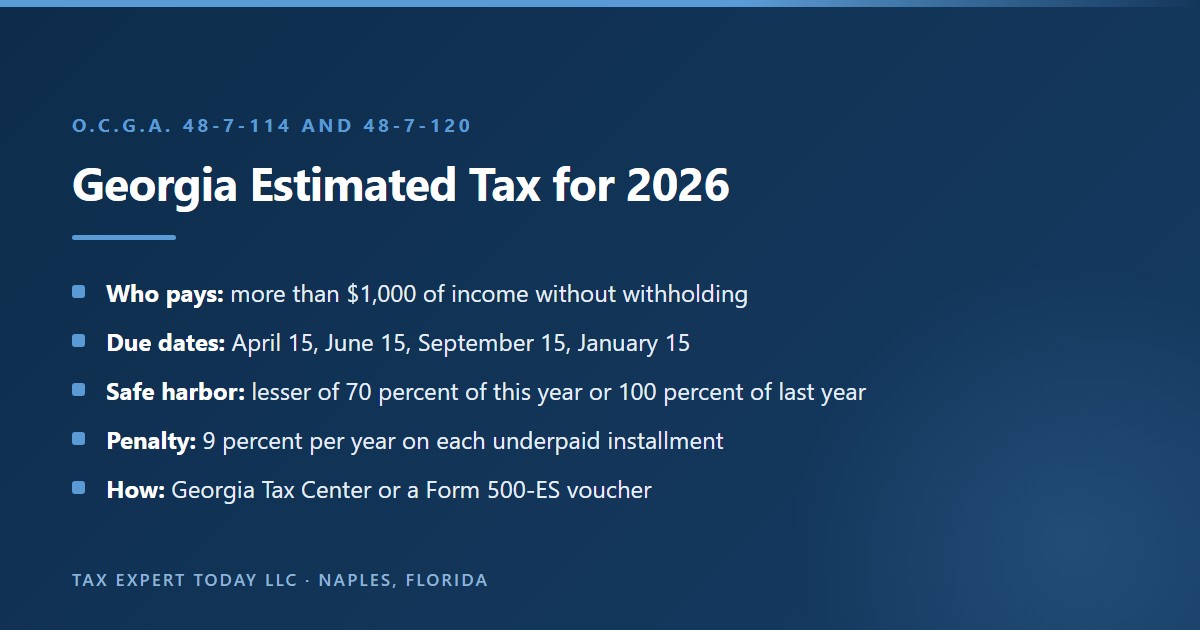
Usually yes. O.C.G.A. 48-7-114 requires Georgia estimated tax when a resident or taxable nonresident expects more than $1,000 of income not subject to withholding and gross income above the filing threshold. Self employment profit has no withholding, so most self-employed Georgians pay quarterly through the Georgia Tax Center or Form 500-ES.
- Trigger: more than $1,000 of income from sources other than wages.
- How to pay: the Georgia Tax Center online, or a Form 500-ES voucher by mail.
- Alternative: extra Georgia withholding from a spouse’s or second job’s wages on Form G-4.
- Separate from federal: federal estimated payments on Form 1040-ES do not count for Georgia.
The statute, O.C.G.A. 48-7-114, defines estimated tax as the expected Georgia income tax less expected credits, and it requires a declaration from every resident and taxable nonresident who can reasonably expect to file a Georgia return and whose gross income can reasonably be expected to include more than $1,000 from sources other than wages. The IT-511 booklet restates the rule as gross income exceeding the exemption for dependents, plus estimated deductions, plus $1,000 of income not subject to withholding. Georgia.gov puts it more plainly: if you are self-employed, you most likely need to make estimated tax payments.
A self-employed person who is also married to a W-2 earner, or who keeps a part-time job, can sometimes avoid separate Georgia vouchers by increasing Georgia withholding on that job. Withholding is credited as tax paid, so a larger G-4 amount reduces or removes the need for vouchers; how withholding is timed against each installment on Form 500 UET is worth confirming in that form’s instructions before relying on a late-year increase. Our Georgia Form G-4 guide explains how to request an additional withholding amount. Voucher mechanics, including how to pay without a voucher through the Georgia Tax Center, are covered in our Georgia Form 500-ES guide.
What Are the Georgia Estimated Tax Due Dates and Safe Harbors?
For calendar 2026, Georgia estimated payments are due April 15, June 15, and September 15, 2026, and January 15, 2027. To avoid the underpayment charge, timely payments generally need to reach the lesser of 70 percent of the 2026 Georgia tax or 100 percent of the 2025 Georgia tax.
- 70 percent rule: Georgia’s current-year target is 70 percent, lower than the federal 90 percent.
- Prior year rule: 100 percent of last year’s tax, if last year was a full 12 months and a return was filed.
- Farmers and fishermen: 66 2/3 percent under the statute’s special rule.
- Late start: a requirement first met after April 1 moves the first payment to a later date.
The penalty statute, O.C.G.A. 48-7-120, measures an underpayment against the lesser of an installment based on 70 percent of the tax shown on the current return or an installment based on 100 percent of the tax shown on the prior year return. Unlike the federal rule for higher-income taxpayers, the statute text does not raise the prior year target to 110 percent for larger incomes. That makes the prior year rule a reliable floor for a growing practice: pay last year’s Georgia tax in four equal parts and the underpayment charge generally does not apply, even if this year’s profit doubles.
| Installment for tax year 2026 | Due date | Cumulative share of required payment | Hypothetical single filer at 70 percent of $3,425 |
|---|---|---|---|
| First | April 15, 2026 | 25 percent | $599 |
| Second | June 15, 2026 | 50 percent | $599 |
| Third | September 15, 2026 | 75 percent | $599 |
| Fourth | January 15, 2027 | 100 percent | $600 |
The IT-511 booklet also describes the late-start schedule: if the estimated tax requirement is first met on or after April 1 and before June 1, the first payment is due June 15; on or after June 1 and before September 1, it is due September 15; and on or after September 1, it is due January 15 of the following year. A consultant who lands a first large engagement in July therefore starts with the September payment rather than owing for April and June retroactively. Note that the Georgia schedule is not the same as the federal one in every year; when a due date falls on a weekend or holiday, it moves to the next business day.
What Is the Georgia Penalty for Underpaying Estimated Tax?
Georgia charges an addition to tax at 9 percent per year on each underpaid installment, from the due date until the earlier of the payment date or April 15 of the following year. It is computed on Form 500 UET and entered on Form 500. Late payment penalties and interest on the balance due are separate charges.
- Rate: 9 percent per year for the period of underpayment, per the IT-511 booklet.
- Form: Form 500 UET, with an exception box when an exception applies.
- Interest: Georgia interest on unpaid tax runs at the prime rate plus 3 percent.
- Separate penalties: late filing and late payment penalties can apply on top.
The 2025 IT-511 booklet lists the failure to file estimated tax penalty at 9 percent per year for the period of underpayment and directs taxpayers to Form 500 UET to compute it. The same booklet states that interest accrues at the Federal Reserve prime rate plus 3 percent and that the late payment penalty is 0.5 percent per month, with the combined late filing and late payment penalty capped at 25 percent of the tax not paid by the original due date. A self-employed person who skips estimates and files on time with full payment in April usually faces only the estimated tax charge; one who files late and pays late can face all three.
For a quick projection of the charge on a specific payment history, our Georgia estimated tax penalty calculator applies the installment method. When a large balance is already owed, the Department of Revenue offers installment arrangements, which we describe in our guide to a Georgia Department of Revenue payment plan.
How Does Georgia Treat Bonus Depreciation and Section 179 for Self-Employed Owners?
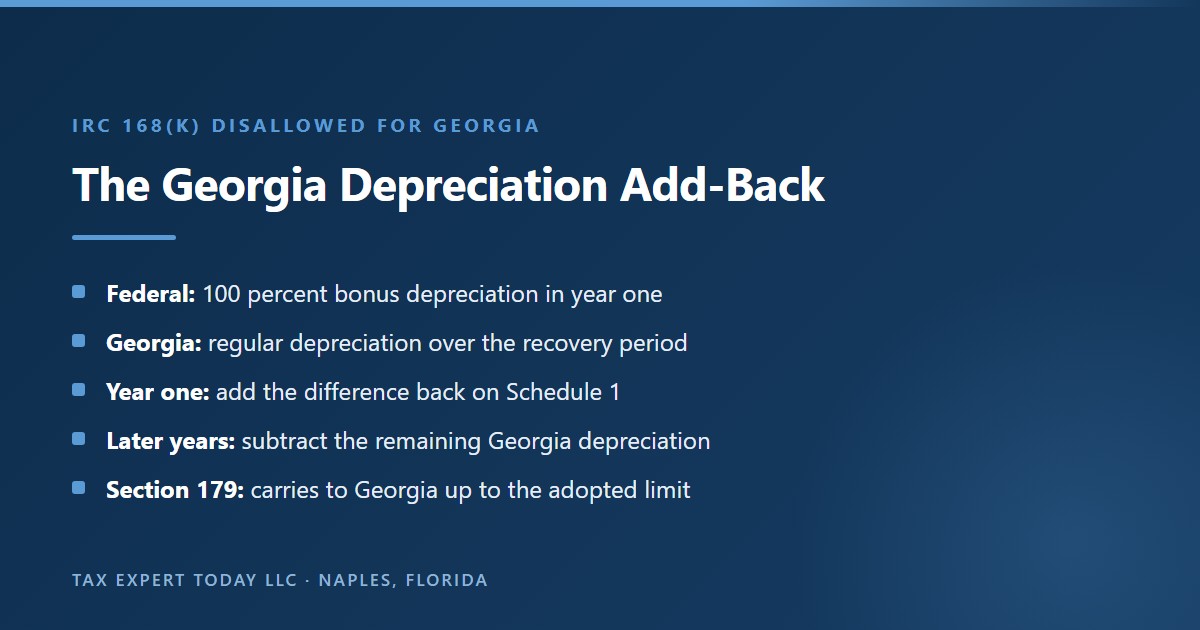
Georgia does not allow federal bonus depreciation under Section 168(k). A self-employed owner who takes bonus depreciation federally must add back the difference on the Georgia return and depreciate the asset under regular Georgia rules. Section 179 expensing generally carries to Georgia, but only to the limit Georgia has adopted.
- Bonus depreciation: disallowed for Georgia; the IT-511 booklet calls it the 168(k) disallowance.
- Effect: higher Georgia income in the purchase year, lower Georgia income in later years.
- Section 179: follows the Code as Georgia adopts it, which can lag federal increases.
- Records: a separate Georgia depreciation schedule for every asset with a difference.
Georgia’s IT-511 booklet instructs taxpayers to compute business income and deductions “pursuant to the I.R.C. as defined for Georgia purposes (with the I.R.C. Section 168(k) disallowance, etc.)”. Federally, 100 percent bonus depreciation returned for most property acquired after January 19, 2025, so many self-employed owners now write off equipment, computers, and furniture in the year of purchase on the federal return. On the Georgia return, the same purchase is depreciated over its normal recovery period unless Section 179 is used instead.
| Hypothetical: $40,000 of 7-year equipment placed in service in 2026 | Federal (100 percent bonus) | Georgia (regular MACRS, half year) |
|---|---|---|
| Year 1 deduction | $40,000 | $5,716 |
| Georgia addition in year 1 | Not applicable | $34,284 |
| Extra Georgia tax in year 1 at 4.99 percent | Not applicable | About $1,711 |
| Years 2 to 8 | No deduction left | Remaining $34,284 deducted as Georgia subtractions |
| Total deduction over the asset’s life | $40,000 | $40,000 |
The timing difference is the whole story: the deduction is not lost for Georgia, it is spread out. But it creates a real cash cost in the purchase year and a recordkeeping duty for as long as the asset is held, and a sale of the asset produces a different Georgia gain than federal gain because the Georgia basis is higher. Self-employed owners who sell or trade in equipment, vehicles, or a practice should expect a Georgia gain adjustment in the year of sale. The same difference can also change a Georgia net operating loss, which we discuss in our Georgia net operating loss guide.
Section 179 works differently. Georgia adopts the Code as amended through a stated date each year, and its federal tax changes page records, for example, that Georgia adopted the increased Section 179 limit of $1,050,000 for 2021 but did not adopt Section 179 for certain real property. Because the 2025 IT-511 booklet states that Georgia conforms to the Code as enacted on or before January 1, 2025, and has not adopted the 2025 federal act, Georgia’s Section 179 limit for 2025 is the pre-act indexed amount rather than the higher federal amount. For a small business buying well under those limits, electing Section 179 federally instead of bonus depreciation can keep the federal and Georgia deductions aligned and avoid the add-back. Confirm the Georgia limit for 2026 in that year’s Georgia depreciation instructions before relying on it.
Which 2025 Federal Tax Changes Has Georgia Not Adopted?
Georgia’s 2025 return follows the Internal Revenue Code as enacted on or before January 1, 2025, so it does not include the federal law signed July 4, 2025. For self-employed owners, that mainly affects Section 179 limits and loss rules; Georgia already disallowed bonus depreciation and already allowed current research expensing.
- Conformity date: Code as of January 1, 2025, per the 2025 IT-511 booklet.
- Section 179: Georgia uses the pre-act limit, not the higher federal figure.
- Research costs: Georgia never required amortization of research expenses after 2021.
- Excess business losses: Georgia’s Section 461(l) treatment differs from federal after 2025.
The 2025 IT-511 booklet states that Georgia conforms to the Code as amended through federal law enacted on or before January 1, 2025, and that Georgia has not adopted the One Big Beautiful Bill Act because it was signed on July 4, 2025. The General Assembly usually considers a conformity bill each session, so the treatment for 2026 returns depends on what the 2026 and 2027 sessions adopt. The table below summarizes how the main items affect a self-employed owner’s Georgia return as of the 2025 booklet.
| Item | Federal treatment | Georgia treatment (as published by DOR) | What a self-employed owner does |
|---|---|---|---|
| Bonus depreciation, Section 168(k) | 100 percent for most property acquired after January 19, 2025 | Not allowed | Add back on Schedule 1 and keep a Georgia depreciation schedule |
| Section 179 expensing | Higher limit under the 2025 federal act | Limit under the Code as Georgia adopted it | Compare the purchase total with the Georgia limit |
| Research and experimental costs | Domestic costs expensed again from 2025 | Deduction allowed without amortization since 2022 under Senate Bill 56 | Usually no Georgia adjustment for current-year research costs |
| Excess business loss limit, Section 461(l) | Made permanent | DOR states the limit is set to expire for Georgia for taxable years beginning on or after January 1, 2026 | Track any Georgia carryforward separately |
| Qualified business income deduction | Made permanent | Never reaches Georgia, which starts from adjusted gross income | No Georgia effect |
The research expense row comes from the Department of Revenue’s federal tax changes page, which explains that Senate Bill 56 did not adopt the 2017 requirement to amortize research and experimental expenditures, so Georgia still allows a current deduction. The Section 461(l) row also comes from that page, which states that because Georgia did not adopt later federal changes to the limit, the limit is set to expire for Georgia purposes for taxable years beginning on or after January 1, 2026. A self-employed owner with a large business loss should treat that as a point to confirm against the 2026 Georgia instructions, because a conformity bill can change it.
Which Other Deductions Carry From the Federal Return to Georgia?
Every deduction taken in arriving at federal adjusted gross income carries to Georgia automatically, including Schedule C business expenses, half of self employment tax, self-employed health insurance, and SEP, SIMPLE, or solo 401(k) contributions. Itemized deductions follow Georgia’s own Schedule A rules if you itemize instead of taking the $15,000 or $30,000 standard deduction.
- Business expenses: Schedule C expenses reduce profit for both returns, subject to the Georgia depreciation rules.
- Retirement contributions: deducted above the line, so Georgia tax falls with federal tax.
- Health insurance: the self-employed health insurance deduction flows through.
- Home office: claimed on Schedule C, so it carries to Georgia inside profit.
This carry-through is why retirement plan contributions are the most common planning step for self-employed Georgians. A contribution that reduces federal adjusted gross income by $20,000 also cuts Georgia tax by about $998 at the 2026 rate, on top of the federal income tax saving. The plan does not reduce self employment tax, because Schedule SE is computed on net earnings before the contribution. Our guides to the SEP IRA contribution deadline and the SEP IRA versus solo 401(k) choice explain the contribution formulas.
Georgia also offers deductions and exclusions that do not exist federally, and some apply to self-employed people. The retirement income exclusion, discussed below, is the most important. Others, such as the Georgia 529 plan deduction in our Georgia 529 plan guide, reduce Georgia taxable income regardless of how the income was earned.
Do Self-Employed Georgians Owe a Local Business or Occupation Tax?
Often yes. Georgia law lets each city and county levy an occupation tax on businesses and practitioners located in its jurisdiction, usually through a business license or occupation tax certificate. The amount and basis vary locally, commonly gross receipts, number of employees, or a flat fee, and home-based businesses are generally included.
- Authority: the Georgia Business and Occupation Tax article, starting at O.C.G.A. 48-13-5.
- Who collects: the city if the business is inside city limits, otherwise the county.
- Gross receipts: defined broadly, before cost of goods sold or expenses.
- Not income tax: it is a local business tax, separate from Form 500.
The definitions section, O.C.G.A. 48-13-5, defines gross receipts as total revenue without deduction for cost of goods sold or expenses, and it defines an employee by reference to W-2 reporting rather than Form 1099. Related sections allow cities and counties to tax businesses with a location in their jurisdiction and, in limited cases, out-of-state businesses whose employees or agents solicit or serve customers there. State and local registrations for a new Georgia business are part of the work described on our Georgia tax help page. Because each locality sets its own rate classes and deadlines, the practical step is to call or check the website of the city or county where the business is based before the first invoice goes out.
This is the one place where Georgia self employment does involve a separate business-level tax, and it is easy to miss for a freelancer working from home. It is usually small compared with income tax, but an unregistered business can face back occupation tax and local penalties when it later applies for a license, a lease, or a professional permit.
What Other Georgia Registrations Can a Self-Employed Business Need?
A self-employed Georgian who only sells services usually needs no state tax account beyond the individual Form 500. Selling taxable goods requires a sales tax registration, hiring employees requires withholding and unemployment accounts, and forming a corporation or electing S corporation status adds a state business return and net worth tax.
- Sales tax: required when selling tangible goods or certain taxable services in Georgia.
- Withholding: required once the business pays wages to employees.
- Unemployment: required for employees, through the Georgia Department of Labor.
- Net worth tax: corporations only, not sole proprietors.
| Situation | Georgia account or filing | Our guide |
|---|---|---|
| Consulting, design, writing, or other services only | Form 500 and estimated payments | This article |
| Selling products, at markets or online, into Georgia | Sales and use tax registration and returns | Georgia use tax |
| Hiring the first employee | Withholding account, Forms G-7 and G-1003, unemployment account | Georgia withholding tax |
| Needing a state tax ID for the business | Georgia Tax Center registration | Georgia tax ID number |
| Electing S corporation or forming a corporation | Form 600S or Form 600, net worth tax | Georgia net worth tax |
| Paying independent contractors | Georgia copies of Forms 1099 with Form G-1003 | Georgia Form G-1003 |
Self-employed people who pay other freelancers should note the Georgia filing calendar. The Department of Revenue’s updates page states that W-2s and 1099-NEC statements are due on or before January 31 of the following year, and other 1099 statements by February 28, moving to the next business day when the date falls on a weekend or holiday.
How Is Self Employment Income Taxed for Nonresidents Working in Georgia?
A nonresident who performs services or carries on business in Georgia owes Georgia income tax on that Georgia-source income. Self employment income earned from work physically done in Georgia is generally Georgia-source, and the nonresident files Form 500 with Schedule 3 to allocate income and prorate deductions.
- Source rule: income from services performed in Georgia is taxable to nonresidents.
- Return: Form 500 with Schedule 3, the same form residents use.
- Proration: deductions are prorated by the ratio of Georgia income to total income.
- Home state: the home state may give a credit for Georgia tax paid.
Under O.C.G.A. 48-7-20(a), the Georgia tax reaches nonresidents’ income “from services performed, property owned” or business carried on in Georgia. A Florida photographer who shoots weddings in Savannah, an Alabama contractor who works job sites in Columbus, or a Tennessee consultant who spends weeks on site in Atlanta can each owe Georgia tax on the Georgia portion. Remote work done from outside Georgia for Georgia clients is a different question; it generally turns on where the services are performed, and the facts matter. Our Georgia part-year resident tax return guide walks through the Schedule 3 ratio with the booklet’s own example.
Florida residents in Southwest Florida who travel into Georgia for work are the clearest case: Florida has no income tax to credit against, so any Georgia tax on Georgia-source self employment profit is a net cost. Planning for those owners focuses on documenting days and locations so that only genuinely Georgia-source income is reported.
What Happens When a Georgia Resident Earns Self Employment Income in Another State?
A full-year Georgia resident is taxed on all self employment income wherever it is earned. If another state also taxes part of it, Georgia generally allows a credit for income tax paid to that state, limited to the Georgia tax on the same income. Federal self employment tax is unaffected by where the work is done.
- Residence rule: Georgia taxes residents on worldwide income.
- Credit: a credit for taxes paid to other states reduces double taxation.
- Limit: the credit cannot exceed the Georgia tax on the doubly taxed income.
- Moving: a mid-year move makes the owner a part-year resident in both states.
The credit for taxes paid to other states requires the other state’s return and a computation on the Georgia return. Because Georgia’s 2026 rate is lower than many neighboring and northeastern states, the credit often eliminates Georgia tax on the out-of-state portion entirely, while a lower-rate state leaves some Georgia tax due. The decisive questions are residence and source, which is why self-employed people moving into or out of Georgia should read our part-year resident guide before the move rather than after the year closes.
Can Self Employment Income Count Toward the Georgia Retirement Income Exclusion?
Yes. For Georgians 62 and older, or permanently disabled, up to $5,000 of the retirement income exclusion may be earned income, and the IT-511 booklet treats self employment income as earned income for that purpose. A semi-retired consultant can therefore exclude up to $5,000 of net business profit within the $35,000 or $65,000 per-person limit.
- Limit by age: $35,000 per person at ages 62 to 64, $65,000 at 65 and older.
- Earned income cap: no more than $5,000 of the exclusion may come from earned income.
- Counts as earned: income subject to self employment tax goes on the earned income line.
- Per person: each spouse figures the exclusion on his or her own income.
The 2025 IT-511 booklet sets the maximum exclusion at $35,000 for taxpayers aged 62 to 64 or permanently disabled and $65,000 for those 65 and older, and states that up to $5,000 of the maximum may be earned income. Its worksheet instructions add that rental, royalty, or partnership income subject to self employment tax belongs on the earned income line rather than the unearned income line, and that S corporation business income from a corporation in which the taxpayer or spouse materially participates is treated the same way. That makes a part-time consulting practice in retirement one of the more tax-efficient ways to earn a modest amount in Georgia: up to $5,000 of profit can fall outside Georgia tax, although federal self employment tax still applies in full.
The exclusion also has to be prorated for part-year residents and nonresidents, with separate ratios for earned and unearned income. Our Georgia retirement income exclusion guide covers the full computation, including how pensions, Social Security, and investment income interact with the $5,000 earned income component.
Does an LLC or S Corporation Change Georgia Self Employment Tax?
A single-member LLC that has not elected corporate status is disregarded, so the owner reports the same Schedule C profit and pays the same taxes. An S corporation election can reduce federal self employment tax through a reasonable salary, but it adds a Georgia Form 600S, net worth tax, payroll accounts, and Georgia unemployment tax on the owner’s wages.
- Disregarded LLC: no change in Georgia income tax or federal self employment tax.
- Multi-member LLC: partnership return, with self employment tax on active members’ shares.
- S corporation: salary subject to payroll tax, remaining profit not subject to self employment tax.
- Georgia cost: extra returns, net worth tax, withholding, and unemployment tax.
The Georgia income tax rate is the same 4.99 percent in each structure, so the Georgia layer rarely drives the choice by itself. What Georgia adds is administrative weight and a few specific costs on the S corporation side, plus an option that only entities have: the Georgia pass-through entity tax election, which can move state tax to the entity level for federal purposes. Our Georgia LLC taxes guide compares the structures side by side, and our Georgia pass-through entity tax guide explains the election. On the federal side, the salary question is covered in our article on S corporation reasonable compensation.
A practical threshold many advisors use is whether net profit comfortably exceeds a reasonable salary plus the added compliance cost. Below that point, a disregarded LLC or plain sole proprietorship is often simpler and costs about the same in total tax. Above it, the federal savings can be meaningful, but they should be measured after the Georgia costs, not before.
How Do Gig Workers and Online Sellers Report Georgia Self Employment Income?
Gig workers, rideshare and delivery drivers, and online sellers report their net profit on Schedule C like any other self-employed person, and Georgia taxes it through Form 500. A Form 1099-K or 1099-NEC is only a reporting document; Georgia tax is owed on actual net profit whether or not a form arrives.
- Same rules: net profit, not gross platform payments, drives both taxes.
- Expenses: mileage, platform fees, and supplies reduce profit on Schedule C.
- No form, still taxable: income below a reporting threshold is still income.
- Sellers: selling goods can also trigger Georgia sales tax duties, often handled by the marketplace.
Platform payments are reported on Forms 1099-K or 1099-NEC at federal thresholds that have changed several times in recent years, and a Georgia filer may receive one, several, or none. None of that changes the computation. The tax follows the profit: gross receipts from all platforms, less the platform’s fees, less vehicle and other business expenses, equals the Schedule C profit that drives both the federal self employment tax and the Georgia income tax.
Drivers are a good illustration of why expenses matter twice. A driver with $40,000 of gross platform receipts and $14,000 of deductible vehicle and platform costs has $26,000 of profit. Every documented expense dollar reduces federal self employment tax by about 14 cents and Georgia income tax by about 5 cents, before federal income tax is counted. A mileage log kept through the year is worth more than any year-end estimate.
Online sellers of physical goods face one extra layer. Georgia treats many large online platforms as marketplace facilitators that collect and remit sales tax on the seller’s behalf, but sellers who also sell directly, at markets, or through their own website may need their own sales tax registration. The sales tax question is separate from Georgia self employment tax, and our Georgia sales tax exemption guide covers the exemptions that commonly apply to small sellers.
How Does a Self-Employed Person File the Georgia Return Step by Step?
File the federal return first, because Georgia starts from federal adjusted gross income. Then complete Georgia Form 500, enter Schedule 1 adjustments such as the bonus depreciation add-back, apply the standard or itemized deduction, compute tax at 4.99 percent for 2026, subtract credits and estimated payments, and attach Form 500 UET if a penalty or exception applies.
- Step 1: complete Schedule C and Schedule SE on the federal return.
- Step 2: carry federal adjusted gross income to Form 500.
- Step 3: enter Georgia additions and subtractions on Schedule 1.
- Step 4: claim estimated payments, credits, and any underpayment computation.
The order matters because every Georgia figure depends on the federal one. A change to the federal return, such as a late Form 1099 or a corrected depreciation election, generally requires a matching change to the Georgia return. The IT-511 booklet also directs filers to include a copy of the federal return and applicable schedules in certain situations, including when federal adjusted gross income differs from the Georgia figures in ways the Department will need to see.
For a full-year resident, the sequence on Form 500 looks like this: federal adjusted gross income; Georgia additions such as the depreciation difference and interest on other states’ bonds; Georgia subtractions such as the retirement income exclusion and U.S. government bond interest; Georgia adjusted gross income; the standard deduction or Georgia itemized deductions; Georgia taxable income; tax at the flat rate; credits; and then payments, including estimated payments made through the Georgia Tax Center or by voucher. A part-year resident or nonresident adds Schedule 3 to allocate income between Georgia and other states before the tax is computed.
Self-employed filers who cannot finish by April 15 can request an extension of time to file, but an extension of time to file is not an extension of time to pay. Any Georgia tax expected to be owed should be paid by the original due date to limit penalties and interest, and the IT-511 booklet directs extension payments through the Georgia Tax Center or Form IT-560.
What Records Should Self-Employed Georgia Taxpayers Keep?
Keep the records that support both returns: income and expense records for Schedule C, mileage and home office records, a Georgia depreciation schedule for any asset with a federal and Georgia difference, proof of each estimated payment, local occupation tax receipts, and day and location records for any work done across state lines.
- Payments: Georgia Tax Center confirmations or cancelled checks for each installment.
- Depreciation: federal and Georgia basis for each asset, kept until the asset is sold.
- Travel and location: calendars and invoices that show where services were performed.
- Retirement plan: contribution records and plan documents.
Georgia generally has three years after a return is filed to assess additional tax, with longer periods in specific cases, and depreciation records need to be kept for as long as the asset remains in service plus that period. The two records most often missing when a Georgia notice arrives are the Georgia depreciation schedule and proof of estimated payments made by voucher. Both are easy to keep from the start and hard to reconstruct later.
What Are Common Georgia Self Employment Tax Mistakes?
The most common mistakes are assuming federal estimated payments cover Georgia, taking federal bonus depreciation without a Georgia add-back, using the wrong year’s rate, ignoring local occupation tax, missing the $5,000 earned income component of the retirement exclusion, and reporting a nonresident’s out-of-state work as Georgia-source.
- Estimated payments: federal and Georgia payments are separate.
- Depreciation: Georgia disallows bonus depreciation.
- Rate: 5.19 percent for 2025, 4.99 percent for 2026.
- Local tax: most cities and counties require an occupation tax certificate.
| Mistake | What happens | How to avoid it |
|---|---|---|
| Paying only federal estimates | Georgia underpayment charge at 9 percent per year on each missed installment | Pay Georgia separately through the Georgia Tax Center or Form 500-ES |
| No Georgia add-back for bonus depreciation | Georgia income understated; assessment with interest | Use a Georgia depreciation schedule and report the difference on Schedule 1 |
| Using 5.19 percent to plan 2026 estimates | Overpayment that sits until the return is filed | Plan 2026 payments at 4.99 percent |
| Assuming Georgia has a state self employment tax | Overestimated budget, sometimes double counting | Budget federal SE tax plus Georgia income tax only |
| No local business license | Back occupation tax and local penalties | Register with the city or county where the business is located |
| Missing the retirement exclusion on business profit | Up to $5,000 of profit taxed unnecessarily for owners 62 and older | Report self employment income on the earned income line of the worksheet |
| Treating all income of a nonresident as Georgia-source | Overpaid Georgia tax | Allocate by where services were performed on Schedule 3 |
Several of these mistakes are expensive only because they are found late. A Georgia notice that adds back three years of bonus depreciation, with interest at prime plus 3 percent, costs more than the original timing difference. Catching the add-back in the purchase year keeps it a simple adjustment. If a filed return already contains one of these errors, our Georgia amended tax return guide explains how and when to correct it.
Georgia Self Employment Tax Help in Naples & Southwest Florida
Tax Expert Today LLC advises self-employed Georgia residents, part-year residents, and nonresidents from its office in Naples, Florida, and serves Georgia clients nationwide and remotely. We project federal self employment tax and Georgia income tax together, set Georgia estimated payments, track Georgia depreciation differences, and review entity choices.
- Office: 11983 Tamiami Trail N, Naples FL 34110.
- Phone: (239) 441-2005.
- Hours: Monday through Friday, 10 a.m. to 5 p.m. Eastern.
- Self employment tax help Naples: Naples and Southwest Florida in person, Georgia and all 50 states remotely.
Many of the self-employed people we work with in Southwest Florida have a Georgia connection: a consulting practice that started in Atlanta before a move to Naples, a contractor who still works Georgia job sites, or a retiree who splits the year between the two states and bills a few clients from each. For them, Georgia self employment tax is really a residence and sourcing question layered on top of a federal one. We work as tax advisors on state tax matters nationwide, and a Georgia review usually connects to the owner’s federal return, entity structure, and Florida planning. For the full range of our Georgia work, see the Georgia tax services page, and for owners weighing a move or a new business structure, our Naples tax planning page.
When to Engage a Professional
Engage a tax professional when self employment profit first passes the point where Georgia estimates are required, before a large equipment purchase, when moving into or out of Georgia, when working in more than one state, before an S corporation election, or when a Georgia notice questions estimated payments or depreciation.
- First profitable year: set federal and Georgia estimates before April 15.
- Equipment: choose between bonus depreciation and Section 179 with the Georgia effect in view.
- Moves and travel: document residence dates and work locations as they happen.
- Entity changes: measure federal savings after Georgia costs.
A professional review is about the mechanics, not a promise of a particular result: confirming which income is Georgia-source, which deductions and exclusions apply, how much to pay each quarter, and which records support the position if the Department of Revenue asks. Our contact page is the place to start, and the first conversation is a free consultation.
Frequently Asked Questions About Georgia Self Employment Tax
Is there a Georgia self employment tax?
No. Georgia self employment tax is not a separate state tax. Self-employed Georgians pay the federal self employment tax of 15.3 percent on net earnings and Georgia income tax at the flat 4.99 percent rate for 2026 on Georgia taxable income.
What is the Georgia income tax rate for self-employed people in 2026?
The rate is a flat 4.99 percent for tax years beginning in 2026, the same rate that applies to wages and other income. The 2025 rate was 5.19 percent, so 2025 returns filed in 2026 use the higher rate.
Do I have to pay Georgia estimated taxes if I am self-employed?
Usually. Georgia requires estimated tax when you expect more than $1,000 of income not subject to withholding and gross income above the filing threshold. Payments for 2026 are due April 15, June 15, September 15, and January 15, 2027.
How much should my Georgia estimated payments be?
To avoid the underpayment charge, timely payments generally need to reach the lesser of 70 percent of your 2026 Georgia tax or 100 percent of your 2025 Georgia tax, if 2025 was a full year and a return was filed, divided across the four installments.
Does Georgia allow bonus depreciation for self-employed owners?
No. Georgia disallows federal bonus depreciation under Section 168(k), so the difference is added back on the Georgia return and recovered through regular depreciation in later years. Section 179 expensing generally carries to Georgia up to the limit Georgia has adopted.
Does the half self employment tax deduction reduce Georgia tax?
Yes. The deduction reduces federal adjusted gross income, which is the starting point for the Georgia return, so it lowers Georgia taxable income automatically. At 4.99 percent, each $1,000 of the deduction saves about $49.90 of Georgia tax.
Do I need a business license to be self-employed in Georgia?
Usually. Most Georgia cities and counties require an occupation tax certificate or business license for businesses located in their jurisdiction, including many home-based businesses. The tax is set locally, often on gross receipts or employee count, and is separate from state income tax.
Can self employment income count toward the Georgia retirement income exclusion?
Yes. For taxpayers 62 and older or permanently disabled, up to $5,000 of the exclusion may be earned income, and income subject to self employment tax counts as earned income on the worksheet. Federal self employment tax still applies in full.
Can a Naples, Florida tax firm help with Georgia self employment tax?
Yes. Tax Expert Today LLC works from its Naples, Florida office at 11983 Tamiami Trail N and serves Georgia residents, part-year residents, and nonresidents remotely, including Southwest Florida owners who still earn Georgia-source self employment income. Call (239) 441-2005, Monday through Friday, 10 a.m. to 5 p.m. Eastern.
Published November 19, 2026 by Dr. Pellumb Kabashi « Back to Learning Center
Have a question this article touches on?
Tax Expert Today LLC, based in Naples, Florida and serving clients across the United States.
Schedule a Consultation (239) 441-2005