
By Dr. Pellumb Kabashi, DBA, MBA, CES, CFE, EA
Founder, Tax Expert Today LLC · Tax advisors, enrolled agents, CPAs, and attorneys · Serving clients in all 50 states
This Florida 183 day rule calculator helps you check two things at once: whether your day count in your former state still puts you at risk of being taxed there, and how many of the key Florida domicile steps you have actually completed. Florida has no personal income tax, so the 183 day test that matters is usually your former state’s statutory residency rule, not a Florida one. Use the tool below, then read on for how residency audits really work. Households that want the day count reviewed alongside the wider plan can work with a Naples tax consultant year-round rather than only at filing time.
Quick answer: The Florida 183 day rule is shorthand for a residency test most high tax states apply: if you keep a permanent home available in that state and spend more than 183 days there in a year, the state can tax you as a statutory resident even if you call Florida home. Florida itself imposes no income tax, so winning the argument means doing two things, spending 183 days or fewer in the former state and building a clear record of Florida domicile through steps like a Declaration of Domicile, a Florida driver license, voter registration, and a homestead exemption.
Published: June 2, 2026
Primary sources
Check your day count and your Florida domicile steps, results update as you type
Guidance tool only. This tool counts days against the common 183 day statutory residency line and scores how many standard Florida domicile steps you have taken. It is not legal advice, it does not apply any single state’s exact statute, and it cannot decide your residency. The 183 day rule, the meaning of a permanent place of abode, and the weight of each domicile factor vary by state and by the facts. See the disclaimer below.
How to use this Florida residency tool
Enter the number of days you plan to spend in your former state during 2026, check the box if you still keep a home available there, then check off the Florida domicile steps you have completed. The tool compares your day count to the 183 day line that most states use and scores how complete your Florida domicile record is. Both halves matter, because winning a residency dispute usually requires staying under the day count and showing a genuine move, not just one or the other.
What is the Florida 183 day rule?
The Florida 183 day rule is a common shorthand, but it is slightly misleading. Florida has no personal income tax, so Florida is not trying to count your days. The 183 day test that matters belongs to the higher tax state you are leaving.
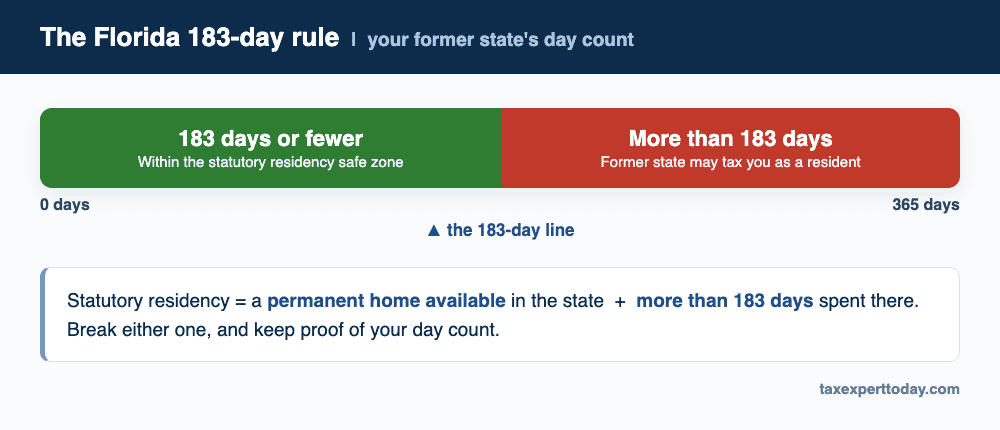
Most income tax states treat you as a statutory resident, taxable on your worldwide income, if you keep a permanent place of abode in the state and spend more than 183 days there during the year. So the practical Florida 183 day rule is this: to be treated as a Florida resident and out of your old state’s tax net, you generally want to spend 183 days or fewer in that former state and keep proof of it.
Does Florida have a 183 day rule of its own?
No. Because Florida levies no personal income tax, there is no Florida residency day count that creates a Florida tax bill. What Florida does provide is a way to prove your domicile, through the Declaration of Domicile under §222.17 and the residency factors in §196.015, which is the same evidence that helps you defend against your former state. The day count is the former state’s tool. The domicile record is yours.
Domicile vs. statutory residency, the two tests
States generally tax you as a resident under either of two separate tests, and you have to clear both to leave a state cleanly.
- Domicile: your one true, fixed, permanent home, the place you always intend to return to. You can have many residences but only one domicile. Changing it requires both leaving the old domicile and establishing a new one in Florida.
- Statutory residency: a day count plus abode test. Even if your domicile is Florida, a former state can still tax you as a resident if you keep a home available there and spend more than 183 days in the state.
How to establish Florida domicile
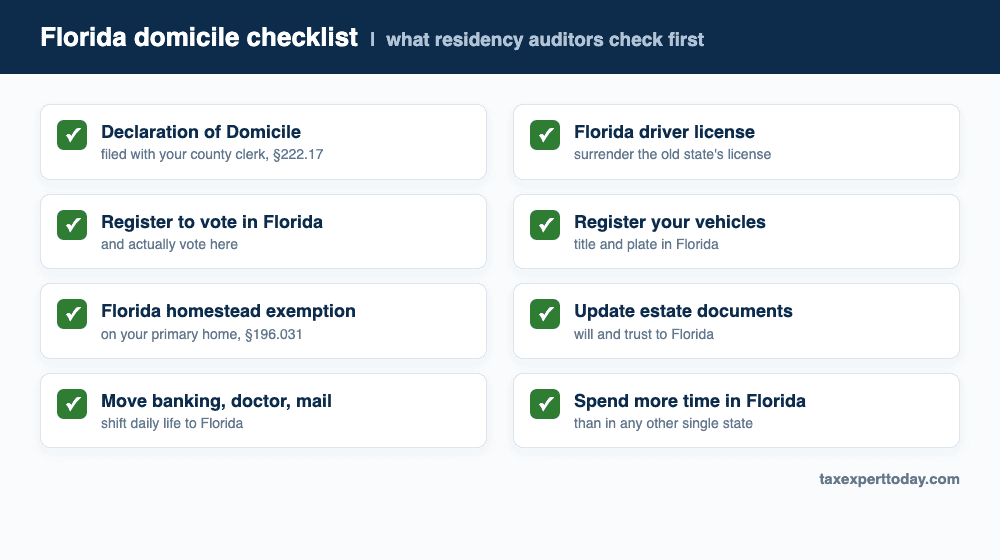
There is no single magic step. Auditors look at the total picture, but the items below are the ones they check first and the ones that carry the most weight. The more of them you complete, and the sooner, the stronger your position.
- File a Declaration of Domicile with the clerk of court in your Florida county under §222.17
- Get a Florida driver license or state ID and surrender the old one
- Register to vote in Florida and actually vote there
- Register your vehicles in Florida
- File for the Florida homestead exemption on your primary home under §196.031
- Move your primary residence and most valued possessions to Florida
- Update your will, trust, and estate documents to Florida
- Move your banking, primary physician, and important mail to Florida
- File a final or part year resident return in your former state for the year of the move
- Spend more time in Florida than in any other single state
How former states audit residency
High tax states audit departing residents aggressively because the dollars are large. A residency audit typically tests two things: whether you truly abandoned your old domicile and whether your day count and abode break statutory residency. Auditors pull cell phone records, E ZPass and toll data, credit card and bank statements, calendars, and even social media to reconstruct where you actually were.
The burden of proof is generally on you. That is why a contemporaneous day log, travel receipts, and an early, complete set of Florida domicile steps matter so much. The Florida 183 day rule is really a recordkeeping discipline as much as a calendar limit, so treat your day count as something you can prove, not just something you remember.
Florida homestead and the residency link
The Florida homestead exemption under §196.031 reduces the taxable value of your primary Florida home and signals that Florida is your permanent residence. You cannot claim a residence based property tax break in two states at once, so filing for Florida homestead while dropping a comparable benefit in your former state is strong evidence of where your home truly is. It is one of the most persuasive single items in a residency file, which is why it appears on the checklist above.
Frequently asked questions
How many days can I spend in my old state and stay a Florida resident?
As a general rule, spend 183 days or fewer in your former state, and ideally well under that, while keeping proof of your whereabouts. Most states treat you as a statutory resident if you keep a home available there and spend more than 183 days in the state, so the day count and the abode both matter.
Does a partial day count as a full day?
In most states, yes. Any part of a day spent in the state usually counts as a full day for the 183 day test, with narrow exceptions such as travel through the state or days spent there only for medical treatment. Because the rules vary, count conservatively and keep records.
Is a Florida Declaration of Domicile required?
It is not legally required to be a Florida resident, but filing a Declaration of Domicile under §222.17 with your county clerk creates a sworn, dated record that Florida is your permanent home. It is inexpensive and is strong supporting evidence in a residency dispute, so most people changing domicile file one.
Does Florida tax my income once I move?
No. Florida imposes no personal income tax on wages, retirement income, or investment income. The reason day counting matters is your former state, which may still try to tax you if you remain a statutory resident or never fully abandon your old domicile.
Where can I get help establishing Florida residency near Naples, FL?
Tax Expert Today LLC is based at 11983 Tamiami Trail N, Naples, FL 34110 and serves clients in Florida and all 50 states. Our team of Enrolled Agents, CPAs, and tax attorneys helps with Florida residency planning, day count documentation, and former state residency audits. Call (239) 441-2005 to discuss your situation.
Get help planning your Florida residency
Moving your domicile to Florida can save real money, but a sloppy move invites a residency audit from the state you left. Tax Expert Today helps individuals, retirees, and business owners plan the day count, complete the domicile steps in the right order, and build the records that hold up if a former state pushes back. You can re-run the Florida 183 day rule tool above any time your travel plans or domicile steps change, and read our deeper guide on how to establish Florida residency.
Call (239) 441-2005 or schedule a consultation to review your Florida residency plan. Tax advisors, enrolled agents, CPAs, and attorneys serving clients in all 50 states.
Disclaimer: This tool and article are provided for general educational purposes only. They do not constitute tax, legal, or financial advice, and using them does not create a client relationship. State residency and domicile rules, including the 183 day test, the meaning of a permanent place of abode, and the weight given to each domicile factor, vary by state and depend on your specific facts. Your residency is ultimately determined by the relevant state authorities. Consult a qualified tax professional about your situation. See our full disclaimer.
Published June 2, 2026 by Dr. Pellumb Kabashi « Back to Learning Center
Have a question this article touches on?
Tax Expert Today LLC, based in Naples, Florida and serving clients across the United States.
Schedule a Consultation (239) 441-2005