
By Dr. Pellumb Kabashi, DBA, MBA, CES, CFE, EA
Founder, Tax Expert Today LLC · Tax advisors, enrolled agents, CPAs, and attorneys · Serving clients in all 50 states
Quick Answer: California Form 541 is the fiduciary income tax return a trust files when it has a California resident trustee, a California resident noncontingent beneficiary, or California source income, and meets the income thresholds. Moving the grantor to Florida does not end the filing, because R&TC section 17742 looks at trustees and beneficiaries, not the settlor. Call (239) 441-2005 for a free consultation.
What Is California Form 541 and Who Files It?
California Form 541 is the California Fiduciary Income Tax Return. The executor of a decedent’s estate or the trustee of a trust uses it to report income, deductions, gains, losses, distributions to beneficiaries, and the tax owed by the estate or trust to the Franchise Tax Board. It is the California counterpart of federal Form 1041.
- Who signs it: the fiduciary, meaning the executor, administrator, or trustee, or one of them when there are several.
- What it reports: the trust’s own taxable income, the income distribution deduction, and each beneficiary’s share on Schedule K-1 (541).
- What it is not: it is not the grantor’s personal return. A trust that is a separate taxpayer files its own Form 541, while the grantor or beneficiary files Form 540 or Form 540NR.
- Why it matters after a move: the trust can stay a California filer long after the person who created it has moved to Florida.
Most people who search for California Form 541 are in one of three positions. They are a trustee who just inherited the job and does not know whether the trust still has to file in California. They are a grantor or a family member who has moved to Florida and assumes the trust followed them. Or they are a beneficiary who received a Schedule K-1 (541) and wants to know why California is involved at all. This guide is written for all three, with a focus on the situation that generates the most confusion: a trust that was set up while the family lived in California, where some of the people involved have since left.
The 2025 Form 541 booklet lists the entity types the return covers, including a decedent’s estate, simple trusts, complex trusts, grantor type trusts, bankruptcy estates, pooled income funds, and incomplete gift nongrantor trusts. For a family trust, the two questions that decide almost everything are whether the trust is a grantor trust or a separate taxpayer, and where its trustees and noncontingent beneficiaries live. The rest of this article works through both questions and then through the mechanics of the return itself.
| Form | Who files it | When it is used |
|---|---|---|
| Form 541 | Trustee or executor | Estate or trust with a California filing requirement |
| Schedule K-1 (541) | Trustee, one per beneficiary | Reports each beneficiary’s share of income, deductions, and credits |
| Schedule G (on Form 541) | Trustee | Trust with a mix of resident and nonresident trustees or noncontingent beneficiaries |
| Form 541-ES | Trustee or executor | Quarterly estimated tax for fiduciaries |
| Form 540 or Form 540NR | Grantor or beneficiary | Personal return that picks up grantor trust income or K-1 income |
| Form 592 and Form 592-B | Trustee as withholding agent | Withholding on California source payments to nonresident beneficiaries |
When Does a Trust Have to File California Form 541?
A trust files Form 541 when two tests are both met. First, California must have a connection: a California resident fiduciary, a California resident noncontingent beneficiary, or California source income. Second, the trust must cross an income threshold: gross income over $10,000, net income over $100, or an alternative minimum tax liability.
- Connection test: the booklet says not to file Form 541 if there are no California fiduciaries, no California noncontingent beneficiaries, and no California source income.
- Gross income test: more than $10,000 of gross income, regardless of net income.
- Net income test: more than $100 of net income for a trust, and more than $1,000 for an estate.
- AMT test: any California alternative minimum tax liability.
The thresholds come from R&TC section 18505, which requires a fiduciary to file for every trust having a net income from all sources over one hundred dollars, and for every estate or trust having gross income from all sources over ten thousand dollars regardless of net income. The FTB estates and trusts page restates the same rules in plain language and lists Form 541 as the form for reporting income received by a trust, reporting income distributed to beneficiaries, amending, and claiming withholding.
The $100 net income figure is very low. A trust holding a modest brokerage account can exceed it in a single quarter of dividends. That is why the threshold rarely ends the analysis for a family trust with real assets. The connection test does most of the work, and for a trust whose family has moved, that test is where the answer changes.
| Filer | Gross income threshold | Net income threshold | Other trigger |
|---|---|---|---|
| Trust | More than $10,000 | More than $100 | Any AMT liability |
| Decedent’s estate | More than $10,000 | More than $1,000 | Any AMT liability |
| Bankruptcy estate (Chapter 7 or 11) | Booklet thresholds apply | Booklet thresholds apply | Tax figured on Form 540 at married filing separately rates |
Source: 2025 Form 541 booklet, General Information C, Who Must File; R&TC section 18505(e) and (f). Thresholds apply in addition to the California connection test.
Does a Trust Still File Form 541 After the Grantor Moves to Florida?
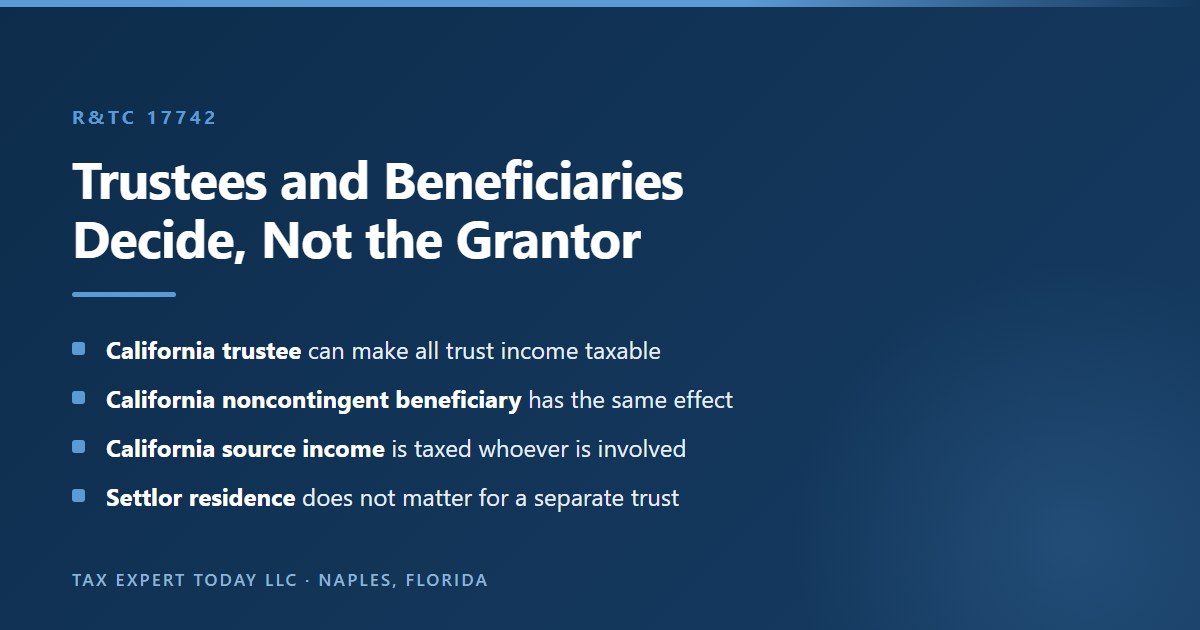
Often yes. Under R&TC section 17742(a), a trust is taxed on its entire taxable income if a fiduciary or a noncontingent beneficiary is a California resident, regardless of the residence of the settlor. The grantor’s move to Florida changes nothing on Form 541 unless the trustees and noncontingent beneficiaries also stop being California residents.
- The settlor is irrelevant for a separately taxed trust. The statute says so in those words.
- A California trustee keeps the trust in. A sibling, adult child, or advisor in California serving as trustee can make all of the trust’s income taxable.
- A California beneficiary keeps the trust in. An adult child in Los Angeles with a vested interest has the same effect.
- California source income never leaves. Rent from a California property is taxable to the trust whoever the trustees and beneficiaries are.
The text of section 17742 is short. It says the income of an estate or trust is taxable to the estate or trust, that the tax applies to the entire taxable income of a trust if the fiduciary or beneficiary (other than a beneficiary whose interest is contingent) is a resident, and that this is so regardless of the residence of the settlor. The Schedule G instructions in the booklet repeat the point: taxability of non-California source income retained by a trust depends on the residence of the fiduciaries and noncontingent beneficiaries, not the person who established the trust.
This is the single most common misunderstanding we see from families who moved from California to Naples. They changed their driver’s licenses, filed Florida declarations of domicile, and filed a part-year Form 540NR for the move year. Then the trust they created years earlier kept a California trustee, or kept a California beneficiary, and nobody revisited it. The family’s personal returns are correct, and the trust’s return is still a California resident trust return. For the residency side of the move itself, see our guide to moving from California to Florida taxes. For the broader question of where a trust is administered and which states can reach it, see trust situs after moving to Florida, which covers New York and the Kaestner decision as well as California.
There is one important exception to the rule that the settlor does not matter. If the trust is a grantor trust for income tax purposes, the grantor is treated as the owner of the income and reports it personally. In that case the grantor’s residence matters a great deal, because a Florida resident grantor reports grantor trust income on a nonresident California return only to the extent it is California source. We cover that in its own section below.
Who Counts as a California Fiduciary for Form 541?
A fiduciary is the trustee, or each co-trustee, who administers the trust. An individual trustee is a California fiduciary if that person is a California resident. A corporate trustee’s residence is the place where the corporation transacts the major portion of its administration of the trust, under R&TC section 17742(b), not where it is incorporated or headquartered.
- Individual trustees: residence follows the ordinary California residency rules that apply to any individual.
- Corporate trustees: look at where the trust officer and administration actually sit.
- Co-trustees: each one is counted separately on Schedule G.
- Trustees who changed during the year: each person who served during any portion of the year is reported, with an attached statement.
The corporate fiduciary rule matters for families who use a bank or trust company. A national bank with offices in both states could administer a trust from a California trust office for years. If the account relationship moves to a Florida trust office and the administration genuinely moves with it, the trustee’s residence for section 17742 purposes can move as well. If only the mailing address moves while the same California team continues to make decisions, the result may not change. The statute asks where the major portion of the administration is transacted, which is a factual question.
For an individual trustee, the question is the same residency question California asks of anyone. A trustee who is in California for other than a temporary or transitory purpose, or who is domiciled in California and outside only temporarily, is a resident. A sibling who has lived in San Diego for thirty years is a resident trustee. A grantor who moved to Naples, filed the move year return correctly, and serves as trustee of a separately taxed trust is generally a nonresident trustee from the date of the move. Our guide to the California residency audit explains how the FTB tests a claimed move, and those same facts govern whether a trustee is a resident.
| Trustee type | Residence test for Form 541 | Practical evidence |
|---|---|---|
| Individual trustee | Ordinary California residency rules | Home, time in state, driver’s license, voter registration, personal return filed |
| Corporate trustee | Where the major portion of the trust’s administration is transacted (section 17742(b)) | Location of the trust officer, investment decisions, records, and distribution approvals |
| Co-trustees | Each counted separately | Number of California trustees and total trustees reported on Schedule G, lines 1(a) to 1(c) |
| Trustee who resigned, began, or moved during the year | Reported as serving during the year | Attached statement naming the trustee, the dates, and the event |
Who Is a Noncontingent Beneficiary on California Form 541?
A noncontingent beneficiary is one whose interest in the trust is not subject to a condition precedent, as defined in the FTB regulation under section 17742. The booklet describes this as an unconditional interest in trust income or corpus. Contingent beneficiaries, such as remainder beneficiaries who must survive someone first, are not counted when deciding whether California can tax the trust.
- Counted: a current income beneficiary with a present right to income, or a beneficiary whose interest has vested.
- Not counted: a beneficiary who receives anything only if a future event happens first, such as surviving the current income beneficiary.
- Booklet example: surviving an existing beneficiary to receive a right to trust income is a condition precedent.
- Why it matters: a California grandchild who is only a contingent remainder beneficiary does not by itself make the trust a California trust.
The regulation is Cal. Code Regs. tit. 18, section 17742, which says in subdivision (b) that a noncontingent beneficiary is one whose interest is not subject to a condition precedent. The booklet’s Schedule G instructions add that if the interest is subject to a condition precedent, meaning something must occur before the interest becomes present, the beneficiary is not counted for purposes of computing taxable income.
Discretionary trusts are where this gets difficult. A beneficiary who may receive distributions only at the trustee’s discretion has an interest that some practitioners treat as contingent and others treat as noncontingent depending on the terms. The booklet does not settle every drafting pattern, and the answer turns on the trust instrument. This is one of the places where reading the actual document is not optional. When we review a trust for a family that has moved to Florida, the beneficiary classification is often the item that decides whether the trust has a California filing requirement at all.
Contingent beneficiaries are not ignored forever. Section 17745 can tax a California resident beneficiary on accumulated income when it is eventually distributed, if no tax was paid on it because that beneficiary’s interest was contingent. We explain that throwback rule near the end of this guide.
| Beneficiary situation (hypothetical) | Likely classification | Counted on Schedule G? |
|---|---|---|
| Surviving spouse entitled to all income for life | Noncontingent | Yes |
| Children who take the remainder only if they survive the spouse | Contingent while the spouse is alive | No |
| Adult child with a vested share payable in installments | Noncontingent | Yes |
| Grandchild who takes only if a parent dies before a stated age | Contingent | No |
| Beneficiary of a purely discretionary sprinkle trust | Depends on the instrument | Confirm with the trust terms |
Hypothetical classifications for illustration. The trust instrument controls, and discretionary interests should be reviewed individually.
What Are the Five Schedule G Situations on California Form 541?
The 2025 booklet lists five situations. All resident trustees, or all resident noncontingent beneficiaries, means all income is taxable. Mixed trustees with all nonresident beneficiaries means apportionment by trustees under section 17743. All nonresident trustees with mixed beneficiaries means apportionment by beneficiaries under section 17744. Mixed on both sides means both steps apply.
- Situations 1 and 2: the trust is taxed on all income from all sources, and Schedule G is not completed.
- Situation 3: California source income plus the share of other income equal to resident trustees divided by total trustees.
- Situation 4: California source income plus the share of other income equal to resident noncontingent beneficiaries divided by total noncontingent beneficiaries.
- Situation 5: both apportionments, applied in sequence under FTB Legal Ruling No. 238 (1959).
The apportionment statutes are brief. Section 17743 provides that where taxability depends on the residence of the fiduciary and there are two or more fiduciaries, the income taxable under section 17742 is apportioned according to the number of fiduciaries resident in California. Section 17744 provides the parallel rule for beneficiaries, apportioning according to the number and interest of beneficiaries resident in California. Both sections leave the details to FTB rules, and the booklet supplies them.
The booklet acknowledges that the code and regulations do not discuss the mixed case directly, which is why it relies on Legal Ruling No. 238 from October 27, 1959 for the method. That ruling is old, but it is the method the current Schedule G is built on, and the form’s column structure follows it step by step.
| Situation | Trustees | Noncontingent beneficiaries | What California taxes | Schedule G? |
|---|---|---|---|---|
| 1 | All California residents | Any | All income from all sources | No |
| 2 | Any | All California residents | All income from all sources | No |
| 3 | Mixed | All nonresidents | California source income plus other income times resident trustees over total trustees | Yes |
| 4 | All nonresidents | Mixed | California source income plus other income times resident beneficiaries over total beneficiaries | Yes |
| 5 | Mixed | Mixed | Both steps, trustees first, then beneficiaries on the remainder | Yes |
| Not listed | All nonresidents | All nonresidents | California source income only (regulation 17742(a)) | No, and no return without California source income |
Source: 2025 Form 541 booklet, Schedule G instructions; R&TC sections 17742 to 17744; Cal. Code Regs. tit. 18, section 17742(a).
How Does Schedule G Apportion Trust Income Step by Step?
Schedule G applies the trustee fraction first and the beneficiary fraction second. Non-California source income is multiplied by California trustees over total trustees. That amount is subtracted, and the remainder is multiplied by California noncontingent beneficiaries over total noncontingent beneficiaries. The two results are added to all California source income.
- Column A: California source income for lines 1 through 8.
- Column B: non-California source income for the same lines.
- Column C: column B times California trustees over total trustees.
- Column D: column B minus column C.
- Column E: column D times California noncontingent beneficiaries over total noncontingent beneficiaries. Column F adds A, C, and E.
The booklet’s own example uses a trust with $90,000 of taxable income, none of it from California sources. There are three trustees, one of whom lives in California, and two noncontingent income beneficiaries, one of whom lives in California. The trustee step allocates one third of $90,000, or $30,000, to California. That leaves $60,000. The beneficiary step allocates one half of $60,000, or $30,000, to California. California taxes $60,000 of the trust’s $90,000.
| Step | Calculation | Amount |
|---|---|---|
| Non-California source income (column B) | Given | $90,000 |
| Trustee step (column C) | 1 California trustee of 3, so 1/3 of $90,000 | $30,000 |
| Remainder (column D) | $90,000 minus $30,000 | $60,000 |
| Beneficiary step (column E) | 1 California beneficiary of 2, so 1/2 of $60,000 | $30,000 |
| Taxable by California (column F) | Column A ($0) plus C plus E | $60,000 |
Source: 2025 Form 541 booklet, Schedule G example, following FTB Legal Ruling No. 238.
The order matters. If you applied the beneficiary fraction first and the trustee fraction second, you would get the same answer in this particular example, but the form is built around the trustee step first, and following the columns as printed avoids errors in cases with uneven fractions. The deductions follow a separate allocation, covered in the next sections.
Part I of Schedule G requires the trustee to disclose the counts: lines 1(a) and 1(b) for California resident and nonresident trustees, line 1(c) for total trustees, and lines 1(d) and 1(e) for California resident and total noncontingent beneficiaries. If there are no California resident noncontingent beneficiaries, or no nonresident ones, the booklet says to enter zero on the relevant line. These counts are the first thing an FTB reviewer will compare with the trust instrument, the K-1s, and the beneficiaries’ own returns.
How Does a California Form 541 Change When Only Some of the Family Moves?
It changes in proportion to who moved. If the grantor and one co-trustee moved to Florida but a co-trustee stayed in California, the trust moves from situation 1 to situation 3, and California taxes California source income plus a fraction of everything else. Only when every trustee and every noncontingent beneficiary is a nonresident does the return drop to California source income alone.
- One of two trustees moves: one half of non-California income stays taxable, if all beneficiaries are nonresidents.
- Both trustees move, one of two beneficiaries stays: one half of non-California income stays taxable through the beneficiary step.
- Everyone moves: only California source income remains, such as rent from California real estate.
- Nobody files a statement: the FTB has no way to see the change, and the return may be wrong either way.
The three hypothetical cases below use a family trust that accumulates $120,000 of interest, dividends, and capital gains from a brokerage account each year, none of it California source, and makes no distributions. The tax figures use the 2025 Form 541 rate schedule in the booklet, applied to the California amount as the line 21a instructions direct, less the $1 trust exemption credit. They are rounded, ignore credits and AMT, and are for illustration only.
| Hypothetical case | Trustees | Noncontingent beneficiaries | California amount | Approximate California tax |
|---|---|---|---|---|
| Before the move | 2 of 2 in California | 2 of 2 in California | $120,000 | About $7,598 |
| Grantor couple moves, sibling co-trustee stays | 1 of 2 in California | 0 of 2 in California | $60,000 | About $2,183 |
| Both trustees in Florida, one adult child in Oakland | 0 of 2 in California | 1 of 2 in California | $60,000 | About $2,183 |
| Everyone in Florida, no California property | 0 of 2 in California | 0 of 2 in California | $0 | $0, and no Form 541 required |
Hypothetical illustration. Tax on $120,000: $3,201.97 plus 9.3 percent of the excess over $72,724, about $7,599 before the $1 exemption credit. Tax on $60,000: $1,987.41 plus 8 percent of the excess over $57,542, about $2,184 before the $1 exemption credit. Actual results depend on deductions, distributions, credits, and AMT.
What the table shows is the shape of the result. Moving one trustee out of a two trustee trust cuts the California amount in half, not to zero. A family that assumes the move took the trust out of California is wrong in the middle two rows, and a family that assumes the trust is still fully taxable is overpaying in those same rows. Either error is common.
What Happens on Form 541 When a Trustee Moves Out of California Mid-Year?
The trust reports every trustee who served during any part of the year. The booklet’s Schedule G line 1(a) and 1(b) instructions say that if a trustee changed residence during the taxable year, began serving, or stopped serving, the trustee must attach a statement identifying the trustee, the relevant dates, and a description of the event.
- Attach the statement: name, date of the move or appointment, and what happened.
- Keep the evidence: the same residency records that support a personal move support a trustee’s move.
- Do not guess the proration: the booklet requires disclosure but does not print a day count formula for the year of change.
- Coordinate with the personal returns: the trustee’s move date on the trust statement should match the date on that person’s Form 540NR.
The booklet does not publish a formula for how a mid-year change should be reflected in the apportionment fractions. Practitioners take different approaches, and the right one depends on facts such as when income was realized relative to the move. Our view is that this is a point to settle with the facts in front of you rather than by rule of thumb, and that the most important thing is consistency: the trustee’s move date on the trust’s attached statement should match the move date on that trustee’s personal Form 540NR and the evidence behind it. Inconsistent dates are the easiest thing for a reviewer to spot.
The move year is also the year when other changes tend to happen at once. The trust may replace a California co-trustee with a Florida one, change its mailing address, and move accounts. Each of those is a separate fact, and only the trustee residence counts under section 17742. A new Naples address on the trust’s brokerage statements does not make a California trustee a nonresident.
What Income Is California Source Income for a Trust?
For a trust whose trustees and noncontingent beneficiaries are all nonresidents, the FTB regulation under section 17742 limits California tax to income from real or personal property located in California, a business carried on in California, and intangible personal property with a business or taxable situs in California. Ordinary investment income from stocks and bonds is generally not California source.
- Real property: rent from a California house or building, and gain on its sale, are California source.
- Business income: income from a business carried on in California, including a share of a California partnership or LLC business, is California source.
- Intangibles: income from stocks, bonds, and notes is not California source unless the property has a business situs in California, under R&TC section 17952.
- Active trading: section 17952 treats trading in California so regularly as to constitute doing business there as California source.
Subdivision (a) of regulation 17742 says that when the fiduciaries and noncontingent beneficiaries of a trust are all nonresidents, only income from real or personal property located in California, business carried on in California, and intangible personal property having a business or taxable situs in California is taxable. Section 17952 provides that income of nonresidents from stocks, bonds, notes, or other intangible personal property is not California source income unless the property has acquired a business situs in California, with an exception for regular, systematic, and continuous trading in California.
The classification of each income stream should follow the same rules used on a nonresident individual return. Our guide to California source income walks through wages, rent, business income, partnership income, and stock compensation for individuals, and the categories carry over. The difference is that a trust has no wages in the ordinary case, so the questions are usually about real estate and pass-through business interests.
| Trust income item (hypothetical) | Generally California source? | Authority |
|---|---|---|
| Rent from a Pasadena rental house | Yes | Regulation 17742(a), property located in California |
| Gain on sale of that rental house | Yes | Regulation 17742(a) |
| Dividends from a national brokerage account | Generally no | Section 17952, no business situs |
| Interest on Treasury bills | No for California tax (also exempt from state tax as federal obligations) | Section 17952 |
| K-1 share of a California operating LLC | Yes, to the extent of California business income | Regulation 17742(a), business carried on in California |
| Gain on sale of stock in a private company | Generally no, unless business situs | Section 17952 |
Hypothetical items. Sourcing of pass-through and installment sale income can be fact specific and should be confirmed.
How Are Deductions Apportioned on Schedule G?
Deductions follow the income. Schedule G column G lists the total deductions for lines 10 through 15b, and column H multiplies each one by a ratio: the California total income in line 9 column F divided by total income from all sources in line 9 columns A plus B. Only the California share of deductions flows to Form 541.
- Column G: total deductions from all sources for lines 10 through 15b.
- Column H: column G times line 9 column F divided by line 9 columns A plus B.
- Effect: if California taxes half the income, it allows roughly half the deductions.
- Exempt income: deductions allocable to tax-exempt income are reduced first, as the line 10 instructions explain.
The booklet’s deduction allocation instructions are explicit. Column H is the amounts in column G, line 10 through line 15b, multiplied by line 9 column F divided by line 9 column A plus B. The amounts transferred from Schedule G columns F and H should include only income and deductions reportable to California.
In the second hypothetical row above, a trust with $120,000 of non-California income and one of two trustees in California has $60,000 in column F. If the trust paid $6,000 of trustee fees and tax preparation costs, column H would allow $3,000 of those deductions on Form 541, half of the total, because California is taxing half the income. The trust’s federal Form 1041 still deducts the full $6,000. The difference is one of the reasons the California return cannot simply copy federal figures.
The same ratio does not apply to items with their own California rules. The booklet notes, for example, that the investment interest deduction is limited and figured on form FTB 3526, and that miscellaneous itemized deductions remain subject to the 2 percent floor for California. These are applied using California amounts before the Schedule G allocation is completed.
What Tax Rates Apply on California Form 541?
A trust or estate pays California tax at the same rates as a single individual. R&TC section 17041(e) imposes on every estate and trust a tax equal to the amount computed for an individual with the same taxable income. The 2025 Form 541 rate schedule runs from 1 percent to 12.3 percent, and the top rate applies above $742,953 of taxable income.
- Bottom bracket: 1 percent on the first $11,079 of taxable income.
- Middle brackets: 2, 4, 6, 8, and 9.3 percent, with 9.3 percent starting above $72,724.
- Top brackets: 10.3 percent above $371,479, 11.3 percent above $445,771, and 12.3 percent above $742,953.
- Additional 1 percent: the Behavioral Health Services Tax on taxable income over $1,000,000.
The rate rule is in section 17041(e). Unlike the federal trust brackets, which compress the top federal rate into a very small band of income, California’s trust schedule is the single filer schedule. A trust reaches California’s 9.3 percent bracket at roughly the same income as a single person. That makes California tax on accumulated trust income meaningful even for trusts of moderate size.
On Form 541 the tax is computed on line 21a from line 20a, the trust’s taxable income after the income distribution deduction. Where Schedule G applies, line 20a is already the California amount, because Schedule G column F and column H flow to lines 1 through 15b. The rate schedule is applied to that California amount directly. There is no separate step on Form 541 that sets the rate by reference to worldwide income, which is a difference from the Form 540NR method individuals use.
| Taxable income over | But not over | Tax |
|---|---|---|
| $0 | $11,079 | 1.00 percent |
| $11,079 | $26,264 | $110.79 plus 2.00 percent of the excess over $11,079 |
| $26,264 | $41,452 | $414.49 plus 4.00 percent of the excess over $26,264 |
| $41,452 | $57,542 | $1,022.01 plus 6.00 percent of the excess over $41,452 |
| $57,542 | $72,724 | $1,987.41 plus 8.00 percent of the excess over $57,542 |
| $72,724 | $371,479 | $3,201.97 plus 9.30 percent of the excess over $72,724 |
| $371,479 | $445,771 | $30,986.19 plus 10.30 percent of the excess over $371,479 |
| $445,771 | $742,953 | $38,638.27 plus 11.30 percent of the excess over $445,771 |
| $742,953 | And over | $72,219.84 plus 12.30 percent of the excess over $742,953 |
Source: 2025 Form 541 booklet, 2025 Tax Rate Schedule for line 21a. The FTB indexes the brackets each year; use the schedule for the tax year being filed.
Does the Behavioral Health Services Tax Apply to a Trust on Form 541?
Yes. Form 541 line 27 adds 1 percent of the trust’s or estate’s taxable income above $1,000,000. For 2025 the booklet renames the former Mental Health Services Tax as the Behavioral Health Services Tax. All taxable income of the S portion of an electing small business trust counts toward it, and qualified settlement funds are excluded.
- Threshold: taxable income on line 20a plus ESBT taxable income on line 20b over $1,000,000.
- Rate: 1 percent of the excess.
- Name change: the booklet notes that for taxable years beginning on or after January 1, 2025, the Mental Health Services Act was renamed the Behavioral Health Services Act.
- Exclusion: the tax is not computed for a qualified settlement fund.
The worksheet in the booklet adds line 20a and line 20b, subtracts $1,000,000, and multiplies the result by 1 percent. For a trust whose income spikes in one year, typically from the sale of a large position or a business interest, the surcharge can be the difference between a 12.3 percent and a 13.3 percent marginal California rate on that sale. The surcharge on individuals is explained in our guide to the California mental health tax, and the trust version works the same way at the trust level.
This is also where the Schedule G apportionment has real value. A trust that has one California trustee out of two, and no California beneficiaries, and sells $2,400,000 of appreciated stock that is not California source, reports about $1,200,000 of that gain to California through column C. Only about $200,000 is over the $1,000,000 threshold. If the same trust had replaced its California trustee before the sale, the California amount on these hypothetical facts would have been zero.
| Hypothetical gain year | California taxable amount | Amount over $1,000,000 | Behavioral Health Services Tax |
|---|---|---|---|
| All trustees and beneficiaries in California | $2,400,000 | $1,400,000 | $14,000 |
| 1 of 2 trustees in California, beneficiaries in Florida | $1,200,000 | $200,000 | $2,000 |
| All trustees and beneficiaries in Florida, gain not California source | $0 | $0 | $0 |
Hypothetical illustration before deductions and distributions. Regular tax under the rate schedule applies in addition.
What Exemption Credit Does a Trust Get on Form 541?
A trust gets an exemption credit of $1 on line 22. An estate gets $10, and a qualified disability trust gets $153 for 2025. No exemption credit is allowed in the year of a final distribution, when all taxable income must be shown as distributed to beneficiaries on line 18.
- Trust: $1.
- Decedent’s estate: $10.
- Qualified disability trust: $153.
- Final year: no exemption credit when assets are fully distributed.
The $1 credit is so small that it is effectively a placeholder. Its practical effect is that a trust has almost no tax free amount in California, which is consistent with the $100 net income filing threshold. A family trust that accumulates even a few thousand dollars of income will owe some California tax if California has a claim on that income under section 17742.
The final year rule matters for trusts that terminate after a death or after a beneficiary reaches a stated age. In the year the trust distributes everything, the booklet requires all taxable income to be entered on line 18 as distributed, so the beneficiaries report it on their own returns. For Florida resident beneficiaries, that means the income leaves the California trust return and is taxed by California only to the extent it is California source.
How Does a Grantor Trust Handle California Form 541 After a Move to Florida?
A grantor trust is generally not taxed as a separate taxpayer. California adopts the federal trust rules in Subchapter J, including the grantor trust rules, through R&TC section 17731, so the grantor reports the income. For a grantor who is now a Florida resident, California taxes that income only to the extent it is California source, reported on Form 540NR.
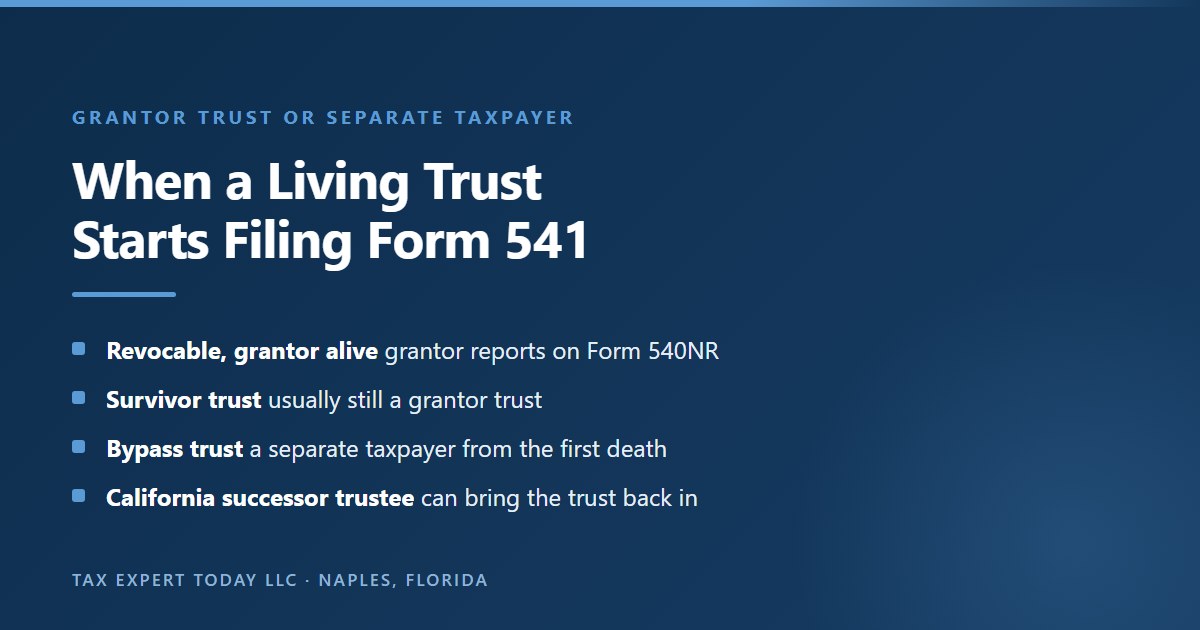
- Revocable living trust: usually a grantor trust while the grantor is alive, so the grantor’s personal residence controls.
- Optional reporting methods: the booklet says the FTB accepts the optional methods in Treasury Regulation section 1.671-4(b)(2).
- California rental in the trust: still California source, so a Florida grantor still files Form 540NR for that income.
- At the grantor’s death: a revocable trust usually becomes irrevocable and a separate taxpayer, and the trustee and beneficiary tests begin to apply.
Section 17731 provides that Subchapter J of Chapter 1 of Subtitle A of the Internal Revenue Code, relating to estates, trusts, beneficiaries, and decedents, applies in California except as otherwise provided. Subchapter J contains the federal grantor trust rules, so a trust that is a grantor trust federally is generally a grantor trust for California as well, with the ING trust rules discussed below as the notable exception.
For most retired couples who moved from California to Naples, the main trust is a revocable living trust. While both spouses are alive and the trust is revocable, it is a grantor trust, and there is often no separate Form 541 at all. Their Florida residency is the relevant fact, and California reaches only California source income, such as rent from a house they kept in California. That income goes on their Form 540NR, not on a Form 541. If the house is sold, the gain is California source; see our guide to the California capital gains tax on a home sale and the California Form 593 withholding that applies at closing.
The picture changes at the first death in some trust designs and at the second death in most. When a revocable trust becomes irrevocable and splits into subtrusts, such as a survivor’s trust and a bypass trust, each irrevocable subtrust that is not a grantor trust becomes a separate taxpayer. From that point on, the trustees and noncontingent beneficiaries decide whether Form 541 is required. If an adult child in California becomes successor trustee, the bypass trust can become a California resident trust on the date that child takes office, even though both parents were Florida residents.
| Trust stage (hypothetical family) | Tax status | Whose residence matters | California return |
|---|---|---|---|
| Revocable trust, both spouses alive in Naples | Grantor trust | The grantors | Form 540NR for California source income only |
| Survivor’s trust after first death | Usually grantor trust to the survivor | The surviving spouse | Form 540NR for California source income only |
| Bypass or credit shelter trust after first death | Separate taxpayer | Trustees and noncontingent beneficiaries | Form 541 if a California trustee, California noncontingent beneficiary, or California source income |
| Trust after second death, California child as trustee | Separate taxpayer | Trustees and noncontingent beneficiaries | Form 541, likely on all income if the child is sole trustee |
For a decedent’s estate the rule is different from the trust rule. The booklet says that if the decedent was a California resident at death, the entire income of the estate must be reported, and if the decedent was a nonresident at death, only income from California sources is reported. A person who completed a genuine move to Florida before death therefore leaves an estate that reports to California only on California source income, whatever the residence of the executor. Our guide to California inheritance tax covers what heirs owe and what they do not.
How Does an ING Trust File California Form 541?
For taxable years beginning on or after January 1, 2023, the income of an incomplete gift nongrantor trust is included in the qualified taxpayer’s gross income as if it were a grantor trust. The trustee checks the ING trust box on Form 541, enters zero on lines 9, 20a, and 21a, and attaches the income, deduction, and credit detail the grantor needs.
- Type of entity box: check ING trust, or ING trust with election if the annual election applies.
- Zero lines: line 9 total income, line 20a taxable income, and line 21a regular tax.
- Attachment: income, deductions, and credits in enough detail for the grantor’s return, with a copy to the grantor.
- Annual election: available only if the trustee timely files an original Form 541 electing resident nongrantor trust treatment and 90 percent or more of DNI goes to charity.
The booklet also notes that, for 2025, a trust or portion of a trust that qualifies as a charitable remainder trust under IRC section 664 is excluded from the ING definition. The full history and the effect of a move to Florida are covered in our dedicated guide to the NING trust, including the throwback analysis for income accumulated before 2023. On Form 541 itself, the mechanics are the box, the zeros, and the attachment.
A grantor who has moved to Florida and still has an ING trust is in a particular position. Because the trust’s income is treated as the grantor’s for California purposes, the grantor’s Florida residency becomes the relevant fact, and the trust’s income is reported on the grantor’s Form 540NR only to the extent it is California source. The trust still files a Form 541 with the box checked if it has a filing requirement, because the zeros and the attachment are how the FTB matches the income to the grantor.
How Are Distributions to Beneficiaries Reported on California Form 541?
Distributions are deducted by the trust on line 18 and reported to each beneficiary on a separate Schedule K-1 (541). A California resident beneficiary is taxed on distributed income from all sources. A nonresident beneficiary, including one in Florida, is taxed only on distributed income derived from California sources, under R&TC sections 17734 and 17953.
- Line 18: the income distribution deduction, figured on Schedule B of Form 541.
- Schedule K-1 (541): one per beneficiary, showing federal amounts, California adjustments, total California amounts, and California source amounts.
- Column (e): the California source amounts a nonresident beneficiary carries to Schedule CA (540NR), column E.
- Intangible income: the K-1 instructions say a nonresident beneficiary is deemed the owner of the intangibles, so that income is taxed at the beneficiary’s domicile.
The 2025 Schedule K-1 (541) beneficiary instructions state that resident beneficiaries are taxed on income distributed or distributable from all sources and that nonresident beneficiaries are taxed only on income distributed or distributable that is derived from sources within California, citing section 17953. They add that the trust attaches a schedule of intangible income, such as income from stocks, bonds, bank accounts, and notes, which is not California source income for nonresidents. Section 17734 is the parallel rule for computing a nonresident beneficiary’s taxable income.
This produces a planning consequence that families who moved often miss. A trust with a California co-trustee pays California tax on half of its accumulated investment income in the second hypothetical row earlier in this guide. If the same trust instead distributes that income to Florida resident beneficiaries, the income distribution deduction moves it off the trust return, and in the hands of Florida beneficiaries investment income is generally not California source. Whether that is appropriate depends on the trust’s terms and the family’s goals, not on tax alone, but it is a question that should be asked every year.
Part-year resident beneficiaries are a special case. The K-1 instructions caution that part-year residents may have to compute their section 652 or 662 income in a way that differs from the amounts in column (e), and they refer to FTB Pub. 1100. A beneficiary who moved from California to Florida during the year should not simply copy column (e) onto the move year return. Our guide to the California part-year resident tax return explains how the move date divides the year.
| Beneficiary | Distributed investment income | Distributed California rent | Personal California return |
|---|---|---|---|
| California resident all year | Taxable | Taxable | Form 540 |
| Florida resident all year | Generally not taxable by California | Taxable as California source | Form 540NR if a filing requirement exists |
| Moved from California to Florida during the year | Taxable for the resident period, figured under Pub. 1100 | Taxable | Form 540NR, part-year |
Does the Trustee Withhold California Tax From a Florida Beneficiary?
Generally yes, on California source income. The booklet says fiduciaries must withhold on payments of California source income, not subject to payroll withholding, made to nonresident beneficiaries, under R&TC sections 18662 through 18677. The trustee reports it on Form 592 and gives the beneficiary Form 592-B. The standard rate is 7 percent.
- What is subject: California source income paid to a nonresident beneficiary, such as distributed California rent.
- What is not: investment income that is not California source for a nonresident beneficiary.
- Rate: 7 percent, or a reduced amount the FTB authorizes in writing through Form 589.
- Threshold: withholding is optional on the first $1,500 of payments in a calendar year, after which it applies.
The 2025 Form 592 instructions say to compute resident and nonresident withholding at 7 percent or a reduced amount authorized in writing by the FTB, and that withholding is optional on the first $1,500 of payments in the calendar year at the withholding agent’s discretion. The booklet’s distributions section points to Cal. Code Regs. tit. 18, sections 17951-1(c), 17951-2, and 17953 for the taxability of distributions to nonresident beneficiaries.
The beneficiary claims the withholding on Form 540NR. A Florida beneficiary whose only California income is a share of California rent may find that the 7 percent withheld exceeds the actual tax at that beneficiary’s California rate, in which case the Form 540NR produces a refund. The same withholding concepts apply to other payers; our guide to California nonresident withholding explains Form 592 and Form 589 in more detail.
When Is California Form 541 Due?
Form 541 is due on the 15th day of the 4th month after the close of the trust’s taxable year, which is April 15 for a calendar year trust. The 2025 return was due April 15, 2026. California grants an automatic six month extension to file without a written request, but tax must still be paid by the original due date to avoid late payment penalties and interest.
- Calendar year trust: April 15, with Schedules K-1 (541) due on the same date.
- Weekend or holiday: the deadline moves to the next business day.
- Automatic extension: six months to file, no form needed to request it.
- Payment with an extension: pay by the original date, using form FTB 3563 for a payment with an automatic extension.
The booklet is explicit that the extension extends only the time to file. Interest runs on tax not paid by the original due date even if the return is filed by the extended due date. For a trust whose trustee is waiting on K-1s from partnerships, the usual approach is to estimate the tax, pay it by April 15 with FTB 3563, and file the return by October 15.
An estate that elected a fiscal year follows the same rule from the end of its fiscal year. A trust generally must use a calendar year under federal rules, and California follows. Bankruptcy estates can have a fiscal year, and the booklet notes that the period cannot be longer than 12 months.
| Item | Tax year 2025 | Tax year 2026 |
|---|---|---|
| Form 541 and Schedules K-1 (541) due | April 15, 2026 | April 15, 2027 |
| Tax payment due (even with extension) | April 15, 2026 | April 15, 2027 |
| Automatic extended filing date | October 15, 2026 | October 15, 2027 |
| Extension payment form | FTB 3563 | FTB 3563 (confirm the year’s version) |
Calendar year trusts. If a date falls on a weekend or legal holiday, the next business day applies. Disaster postponements announced by the FTB can change these dates for affected counties.
Does a Trust Make Estimated Tax Payments With Form 541-ES?
Generally yes, if the trust expects to owe at least $500 after withholding and credits. The required annual payment is generally the lesser of 100 percent of the prior year’s tax or 90 percent of the current year’s tax, paid 30 percent, 40 percent, zero, and 30 percent across the four installments. Higher income fiduciaries face stricter prior year limits.
- Threshold: at least $500 of expected tax, including AMT.
- Installment split: 30 percent first, 40 percent second, nothing for the third, and 30 percent fourth.
- AGI over $150,000: the prior year safe harbor rises to 110 percent of prior year tax.
- AGI of $1,000,000 or more: estimates must be based on 90 percent of current year tax.
- Estates: required for years ending two or more years after the date of death, for estates and trusts receiving the residue.
The California installment pattern is different from the federal pattern of four equal installments, and it catches trustees who use federal habits. The front-loaded 30 and 40 percent installments mean that 70 percent of the required annual payment is due by the second installment. A trust that realizes a large gain late in the year can annualize, but that is a calculation, not an assumption. The booklet points to Form 541-ES for the details.
The $1,000,000 rule is worth noting for trusts that sell a business or a concentrated position. A fiduciary with AGI of $1,000,000 or more cannot use the prior year safe harbor at all, so a trust that had modest income the prior year cannot rely on that year to avoid an underpayment penalty in the sale year. Our California estimated tax penalty calculator was built for individuals, but it illustrates how the installment percentages drive the penalty.
| Fiduciary AGI | Required annual payment (lesser of) | Installment percentages |
|---|---|---|
| $150,000 or less | 100 percent of prior year tax or 90 percent of current year tax | 30 / 40 / 0 / 30 |
| Over $150,000 and under $1,000,000 | 110 percent of prior year tax or 90 percent of current year tax | 30 / 40 / 0 / 30 |
| $1,000,000 or more | 90 percent of current year tax only | 30 / 40 / 0 / 30 |
Source: 2025 Form 541 booklet, General Information J, Estimated Tax Payments. Amounts include AMT.
What Penalties Apply to a Late California Form 541?
The booklet describes a late filing penalty when the return is filed after the due date including extensions, with a minimum penalty of $135 or 100 percent of the tax due, whichever is less, for a return filed more than 60 days after the extended date. Late payment draws 5 percent of the unpaid tax plus one half of 1 percent per month, up to 25 percent.
- Late payment: 5 percent plus one half of 1 percent per month or part of a month, capped at 25 percent.
- Combined cap: when both penalties apply, the total does not exceed 25 percent of the unpaid tax.
- Reasonable cause: the late payment penalty can be waived for reasonable cause, which is presumed when 90 percent of the tax is paid by the original due date.
- Interest: charged on tax not paid by the due date, even if the return is filed by the extended due date.
The 90 percent presumption is a practical target. A trustee who pays at least 90 percent of the final tax by April 15 is in a far better position than one who pays nothing until the return is filed in October. Our guide to the California late payment penalty explains how the two components are computed and how abatement requests are framed.
For a trust that was a California filer and stopped filing after the family moved, the risk is different. If the trust in fact still had a California trustee or noncontingent beneficiary, the missing returns are unfiled returns, and California’s assessment period does not begin to run on a return that was never filed. That is a reason to settle the filing question carefully rather than assume it away.
Where Do You File California Form 541?
Form 541 can be e-filed through software that supports fiduciary returns, or mailed. With a payment, mail it to Franchise Tax Board, PO Box 942867, Sacramento, CA 94267-0001. With a refund or no amount due, mail it to Franchise Tax Board, PO Box 942840, Sacramento, CA 94240-0001. Payments for e-filed returns use form FTB 3843.
- e-file: the booklet says the FTB offers e-file for Form 541, subject to software support.
- Payment with a mailed return: PO Box 942867, Sacramento, CA 94267-0001.
- Payment for an e-filed return: FTB 3843 to PO Box 942867, Sacramento, CA 94267-0008.
- Refund or no amount due: PO Box 942840, Sacramento, CA 94240-0001.
- Private delivery services: they cannot deliver to PO boxes, so do not use an FTB PO box with them.
Every payment should show the trust’s FEIN and the year and form, such as 2025 Form 541. Electronic funds withdrawal for extension and estimated payments is available through software that supports it. A trustee in Naples, Florida can file and pay a California fiduciary return entirely by mail or electronically; nothing about the filing requires a California address.
| What you are sending | Address |
|---|---|
| Mailed Form 541 with payment | Franchise Tax Board, PO Box 942867, Sacramento, CA 94267-0001 |
| FTB 3843 payment for an e-filed Form 541 | Franchise Tax Board, PO Box 942867, Sacramento, CA 94267-0008 |
| Mailed Form 541 with refund or no amount due | Franchise Tax Board, PO Box 942840, Sacramento, CA 94240-0001 |
Source: 2025 Form 541 booklet, General Information I, Where to File. Check the current year booklet before mailing.
How Does California Form 541 Differ From Federal Form 1041?
Form 541 starts from the same Subchapter J concepts as federal Form 1041, but the results often differ. California uses single filer rates instead of compressed trust brackets, allows only a $1 exemption credit, taxes non-California income only in proportion to resident trustees and beneficiaries, uses front-loaded estimated payments, and does not tax interest on federal obligations.
- Rates: California uses the individual schedule under section 17041(e); federal law uses its own compressed trust brackets.
- Who is taxed: federal law taxes a domestic trust on worldwide income; California taxes a trust by trustee and beneficiary residence.
- Exemption: a $1 credit in California compared with the federal exemption amounts for trusts.
- Estimated tax: 30, 40, 0, and 30 percent in California compared with four equal federal installments.
- Conformity: the booklet says California generally conforms to the IRC as of January 1, 2025, with continuing differences.
The federal rules are set out in the IRS Instructions for Form 1041. The booklet repeatedly tells the preparer to follow the federal instructions for particular items and to use California amounts. In practice that means the federal return is prepared first, and the California return then adjusts it: removing interest on federal obligations, adding back items California does not conform to, applying the Schedule G apportionment, and recomputing the distribution deduction under California figures.
A trustee should never assume that a trust with no federal tax has no California tax, or the reverse. A trust that distributes all of its income may owe little federal tax and little California tax. A trust that accumulates income may owe meaningful amounts in both, and in California the amount depends on residence counts that do not appear anywhere on the federal return.
| Item | Federal Form 1041 | California Form 541 |
|---|---|---|
| Basis of taxation for a domestic trust | Worldwide income | All income if a resident trustee or noncontingent beneficiary; otherwise California source, with Schedule G in mixed cases |
| Rate schedule | Compressed trust brackets | Single individual schedule, 1 to 12.3 percent |
| Surcharge | Net investment income tax for trusts above the threshold | 1 percent Behavioral Health Services Tax above $1,000,000 |
| Exemption | Exemption deduction by trust type | $1 trust exemption credit, $10 for an estate |
| Estimated payments | Four equal installments | 30, 40, 0, and 30 percent |
| Interest on U.S. obligations | Taxable | Not taxable by California |
| Due date (calendar year) | April 15 | April 15 |
| Extension | Requires Form 7004 | Automatic six months, no form to request it |
Summary for orientation. Federal figures and thresholds change annually; confirm the current Form 1041 instructions.
Which Schedules and Forms Attach to California Form 541?
Common attachments include Schedule K-1 (541) for each beneficiary, Schedule D (541) for capital gains and losses, Schedule P (541) for AMT and credit limits, Schedule J (541) for accumulation distributions, form FTB 3885F for depreciation, form FTB 3526 for investment interest, and FTB 3805V for net operating losses.
- Schedule K-1 (541): required for each beneficiary.
- Schedule P (541): required whenever an income distribution deduction is reported on line 18, even if no AMT is owed.
- Schedule D (541): capital gains and losses, using California basis.
- Schedule J (541): trust allocation of an accumulation distribution.
- FTB 3885F: depreciation and amortization for a trust with a trade, business, or rental.
The Schedule P rule surprises many trustees. The booklet’s line 26 instructions say Schedule P (541) must be completed regardless of whether the estate or trust is subject to AMT if an income distribution deduction is reported on line 18. That means almost every trust that makes distributions attaches Schedule P. The 2025 Schedule P (541) instructions explain the computation, and the 2025 Schedule J (541) instructions cover accumulation distributions.
California basis can differ from federal basis. A trust that holds property depreciated differently for California, or that holds assets whose basis was affected by a California specific rule, uses Schedule D (541) to report the California gain. Where the trust has a rental or business, depreciation is computed on form FTB 3885F using California amounts, and the federal Schedule E is attached using California figures.
| Attachment | When it is required |
|---|---|
| Schedule K-1 (541) | One for each beneficiary |
| Schedule G (Form 541, Side 3) | Mixed resident and nonresident trustees or noncontingent beneficiaries |
| Schedule P (541) | AMT, credit limitations, or any income distribution deduction on line 18 |
| Schedule D (541) | Capital gains or losses |
| Schedule J (541) | Accumulation distribution allocation |
| FTB 3885F | Depreciation and amortization |
| FTB 3526 | Investment interest expense deduction |
| FTB 3805V | Net operating loss computation and carryover |
| Statement of trustee changes | A trustee began, stopped serving, or changed residence during the year |
| Additional fiduciaries schedule | Fiduciaries who served during the year but are not listed on Side 1 |
Source: 2025 Form 541 booklet, line instructions and General Information E. Not every trust needs every attachment.
How Does California Form 541 Handle a Trust Selling California Real Estate?
Gain on the sale of California real property is California source income, so the trust reports it to California even if every trustee and every noncontingent beneficiary lives in Florida. The buyer’s escrow generally withholds under Form 593, and the trust claims that withholding on Form 541. Distributing the gain does not remove it from California, because it remains California source in the beneficiaries’ hands.
- Source: real property located in California, under regulation 17742(a).
- Withholding at closing: real estate withholding on Form 593, claimed on Form 541.
- Distributed gain: a Florida beneficiary who receives it is taxed on it as California source income.
- Exchange property: a California property exchanged for out-of-state property can carry a later California reporting obligation.
The sale of a California rental or second home is often the last California event for a family trust. The trust reports the gain on Schedule D (541) and Form 541, and the escrow company usually withholds. Our guide to California Form 593 explains the withholding calculation and exemptions, and our guide to the California 1031 exchange clawback explains the annual information return that follows California property exchanged for property elsewhere.
The hypothetical below assumes a trust with Florida trustees and Florida noncontingent beneficiaries that sells a California rental for a $500,000 gain and accumulates it. It uses the 2025 rate schedule and ignores depreciation recapture differences, other income, and credits.
| Hypothetical item | Amount |
|---|---|
| California source gain on sale | $500,000 |
| Schedule G needed? | No; all trustees and beneficiaries are nonresidents, so only California source income is taxed |
| Tax on $500,000 under the 2025 schedule | $38,638.27 plus 11.3 percent of $54,229, about $44,766 |
| Less exemption credit | $1 |
| Approximate California regular tax | About $44,765 |
| Behavioral Health Services Tax | $0, taxable income is under $1,000,000 |
Hypothetical illustration. If the gain were distributed, the beneficiaries would report it on Form 540NR at their own California rates instead.
Whether to distribute or accumulate a California source gain is a real decision. If the trust distributes it, each Florida beneficiary reports a share on Form 540NR, where the California rate depends on that beneficiary’s total income. If the trust accumulates it, the trust pays at the trust schedule. The answer depends on the trust’s terms and on the beneficiaries’ other income, and it is worth modelling before the sale closes. For the personal residence side of a sale after a move, see our guide to selling your home after moving to Florida.
What Happens to Form 541 if a Beneficiary Moves Into California?
The trust can become a California taxpayer on its non-California income from the date that beneficiary becomes a California resident, if the beneficiary’s interest is noncontingent. A trust with Florida trustees and one California noncontingent beneficiary out of three is taxed on one third of its non-California income under section 17744, plus all California source income.
- Trigger: a noncontingent beneficiary becomes a California resident.
- Effect: the trust moves into Schedule G situation 4 or 2.
- Contingent beneficiary: the move does not change the trust’s own count, but section 17745 may apply on later distributions.
- Temporary moves: section 17745(e) presumes continued residence for a beneficiary who leaves within 12 months before a distribution and returns within 12 months after.
The trust has no control over where an adult beneficiary chooses to live. A grandchild who takes a job in San Francisco can change the trust’s California position as completely as a trustee moving there. That is why the annual questionnaire should ask about beneficiaries as well as trustees. If a beneficiary has moved into California, the trust’s first California year after the move needs Schedule G, the beneficiary counts on lines 1(d) and 1(e), and estimated payments that reflect the new California share.
| Change in the family (hypothetical) | Schedule G situation after the change | Share of non-California income taxed |
|---|---|---|
| One of three noncontingent beneficiaries moves to Los Angeles; all trustees in Florida | Situation 4 | One third |
| The only noncontingent beneficiary moves to San Diego | Situation 2 | All |
| A contingent remainder beneficiary moves to Sacramento | No change to the count | None now; section 17745 may apply later |
| One of two co-trustees moves to Oakland; beneficiaries in Florida | Situation 3 | One half |
What Is the 2026 Estimated Tax Calendar for California Form 541?
For a calendar year trust, the 2026 Form 541-ES vouchers are dated April 15, 2026, June 15, 2026, September 15, 2026, and January 15, 2027. Under the booklet’s 30, 40, 0, and 30 percent pattern, 30 percent of the required annual payment is due in April, 40 percent in June, nothing in September, and 30 percent in January.
- April 15, 2026: 30 percent.
- June 15, 2026: 40 percent.
- September 15, 2026: no payment required under the standard pattern.
- January 15, 2027: 30 percent.
The 2026 Form 541-ES includes a voucher for each date, including the September date, even though the standard pattern requires no payment then. A trust that annualizes its income, or that realizes income late in the year, may need to pay in September after all. The voucher exists so that it can.
The hypothetical below applies the pattern to a trust whose required annual payment is $20,000, for example because its prior year tax was $20,000 and its fiduciary AGI is under $150,000.
| Voucher date | Percentage | Hypothetical payment | Cumulative paid |
|---|---|---|---|
| April 15, 2026 | 30 percent | $6,000 | $6,000 |
| June 15, 2026 | 40 percent | $8,000 | $14,000 |
| September 15, 2026 | 0 percent | $0 | $14,000 |
| January 15, 2027 | 30 percent | $6,000 | $20,000 |
Hypothetical illustration for a calendar year trust. Fiscal year trusts and annualized computations follow Form 541-ES.
Trustees who also prepare their own personal estimates sometimes combine the two calendars by mistake. A Florida resident grantor of a grantor trust with California rent makes personal estimated payments on Form 540-ES, while a separately taxed trust uses Form 541-ES under its own FEIN. A payment sent under the wrong taxpayer identification number is one of the more tedious problems to correct. For the residency foundation on the grantor’s side, see our guides to retiring to Florida taxes and the California exit tax question, and for a trustee who needs someone to speak with the FTB on the trust’s behalf, our guide to the FTB power of attorney. Families using irrevocable planning trusts, such as a spousal lifetime access trust or a dynasty trust, should confirm whether each trust is a grantor or nongrantor trust for California before deciding which return it files.
What Happens When Accumulated Income Is Later Distributed to a California Beneficiary?
R&TC section 17745 can tax a California resident beneficiary on accumulated trust income when it is distributed, if California tax was not paid on it earlier. Subdivision (b) applies where no tax was paid because the resident beneficiary’s interest was contingent, and the tax is computed as if the income had been received ratably over the year of distribution and up to five prior years.
- Subdivision (a): if tax owed by the trust on resident-based income is unpaid when the income becomes distributable, the beneficiary can be taxed on it.
- Subdivision (b): if no tax was paid because the resident beneficiary’s interest was contingent, the income is taxed to that beneficiary when distributed.
- Ratable computation: the year of distribution and the five preceding years, or the accumulation period if shorter.
- Twelve month presumption: a resident beneficiary who leaves within 12 months before a distribution and returns within 12 months after is presumed to have stayed a resident.
The text of section 17745 also says that accumulated income continues to be income even if the trust instrument provides that it becomes part of corpus. That sentence closes the argument that accumulated income becomes untaxable principal simply by being added to the corpus account. On Form 541 itself, the booklet’s line 21b instructions refer to a partial throwback tax when an estate or trust is itself the beneficiary of another trust and receives an accumulation distribution, computed on Schedule J (541).
The planning point for a family that has moved is this. A trust with Florida trustees and only contingent California beneficiaries may legitimately pay California tax only on California source income for years. If one of those California beneficiaries later becomes entitled to a distribution of the accumulated income, section 17745(b) can reach back. Our NING trust guide walks through the throwback computation in detail; the same rules apply to any nongrantor trust with contingent California beneficiaries.
| Section 17745 subdivision | Trigger | Who is taxed |
|---|---|---|
| (a) | Trust tax on resident-based income unpaid when the income becomes distributable | The beneficiary, when distributable (nonresident only on California source) |
| (b) | No tax paid because the resident beneficiary’s interest was contingent | The resident beneficiary, when distributed or distributable |
| (c) | Accumulated income added to corpus | Still treated as income |
| (d) | Computing tax under (b) | Ratable over the distribution year and up to five prior years |
| (e) | Beneficiary leaves within 12 months before and returns within 12 months after | Presumed resident throughout the distribution |
Does Florida Tax a Trust That Files California Form 541?
No. Florida has no personal income tax, and its constitution limits an income tax on natural persons. A Florida trustee, a Florida beneficiary, and a family trust administered in Naples do not file a Florida personal income tax return for the trust’s investment income. The only state income tax claim on a trust whose family moved from California is usually California’s, through the Form 541 rules above.
- No Florida fiduciary income tax return for trust income.
- No Florida tax on distributions to Florida beneficiaries.
- No Florida estate tax on new deaths.
- Other states: a trust with trustees or beneficiaries in a third state, such as New York, may have a filing requirement there as well.
Article VII, section 5 of the Florida Constitution restricts the state’s power to levy an income tax on natural persons who are residents or citizens of the state. The practical effect is that moving a trust’s administration to Florida does not create a new state income tax liability for the trust. It only removes or reduces California’s. The broader estate planning steps for a new resident are covered in our guide to Florida estate planning for new residents.
Because Florida does not tax the trust, there is also no Florida credit to offset California tax. When California taxes a portion of the trust’s income under Schedule G, that California tax is a real cost with nothing on the Florida side to balance it. That is the reason the trustee and beneficiary counts deserve attention every year.
How Does a Trust Stop Filing California Form 541?
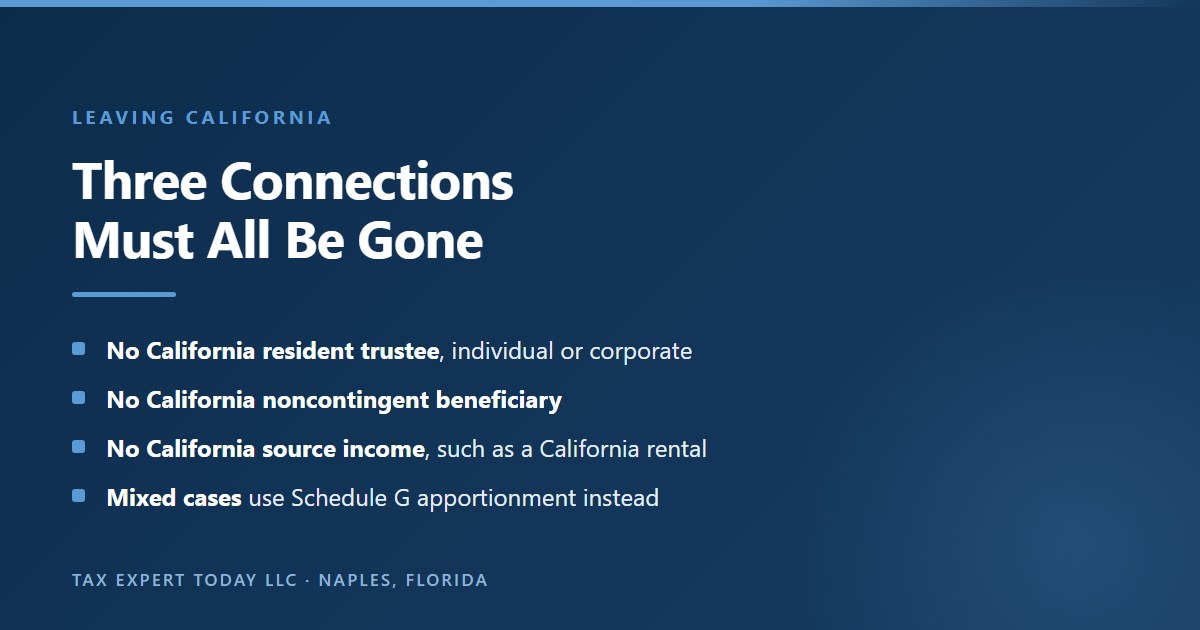
A trust stops having a California filing requirement when all three California connections are gone: no California resident trustee, no California resident noncontingent beneficiary, and no California source income. When that happens, the booklet says not to file Form 541. If it happens mid-year, the trust files a final California year with the required trustee statement.
- Trustees: replace or remove California trustees according to the trust instrument, and document the date.
- Corporate trustees: move the actual administration, not just the address.
- Beneficiaries: beneficiaries’ residence is their own decision; it cannot be changed for the trust’s benefit.
- California property: a California rental keeps a filing requirement for its income as long as the trust owns it and crosses the thresholds.
Replacing a California trustee is a legal act under the trust instrument and the governing trust law. It may require a resignation, an appointment, notice to beneficiaries, and in some cases court involvement. The tax result follows the legal change, not the other way around. A resignation letter that is signed but never acted on, or a Florida co-trustee who is named but never participates in administration, invites a challenge to whether the change was real. For the situs and governing law side of a move, see trust situs after moving to Florida and decanting a trust.
The booklet’s Form 541 checkboxes include a final tax return box. A trust that has stopped having California connections does not need to file a final return to tell the FTB it is gone, because the instruction is simply not to file. In practice, filing the last California year completely, with the trustee change statement and the counts on Schedule G, creates a clean record of the change. If the FTB later asks why returns stopped, that last return is the answer.
| California connection | Can the family change it? | What a real change looks like |
|---|---|---|
| California individual trustee | Often, under the trust instrument | Signed resignation, written acceptance by the successor, notices, accounts retitled, successor actually administering |
| California corporate trustee | Sometimes, by moving the account or the trustee | Administration and decision making moved to an office outside California |
| California noncontingent beneficiary | No, it is the beneficiary’s own life | Not a planning lever; distributions may change how much the trust itself reports |
| California source income | Only by changing the assets | Sale of the California property, which itself produces California source gain |
How Do You Amend a California Form 541?
Check the amended tax return box on Form 541, complete the entire return, correct the lines that change, recompute the tax, and attach an explanation identifying each changed line and amount, with the trust’s name and FEIN on every attachment. If the change affects beneficiaries, file amended Schedules K-1 (541) and give one to each beneficiary.
- Same form: there is no separate amended fiduciary form; use Form 541 with the box checked.
- Full return: complete the whole return, not just the changed lines.
- Explanation: attach a sheet explaining the reasons and the changed amounts.
- Amended K-1s: required if income or distribution information given to beneficiaries changes.
- Protective claim box: available when a refund depends on another dispute, such as pending litigation or an audit.
The most common reasons we see for amending a California Form 541 after a family has moved are a missed Schedule G apportionment, where the trust reported all income as California taxable even though some trustees or beneficiaries had become nonresidents, and the reverse, where the trust stopped reporting non-California income too early. The first produces a refund claim, which is subject to the California refund statute. The second produces additional tax and interest. For the refund time limits and the federal change rules that apply to amended returns generally, see our guide to the California amended tax return.
A federal change to the trust’s Form 1041 also flows to California. When the IRS adjusts a trust’s federal return, or the trustee amends federally, the California return generally must be conformed. If the FTB issues a notice instead, our guide to the FTB notice of proposed assessment explains the protest window.
What Are the Most Common California Form 541 Mistakes After a Move?
The most common mistakes are stopping California filing because the grantor moved, continuing full California filing after every trustee and beneficiary moved, miscounting contingent beneficiaries as noncontingent, skipping Schedule G in a mixed case, omitting the mid-year trustee statement, and treating investment income as California source for nonresident beneficiaries.
- Grantor moved, trust stopped filing: section 17742 says the settlor’s residence does not matter for a separately taxed trust.
- Everyone moved, trust kept full filing: the trust may be overpaying on non-California income.
- Remainder beneficiaries counted: contingent beneficiaries do not belong in the Schedule G counts.
- No Schedule G: a mixed trust that reports all or nothing has almost certainly reported the wrong amount.
- Federal deductions copied: column H limits deductions to the California share.
| Mistake | Why it happens | What the rule says |
|---|---|---|
| Trust stopped filing when the grantor moved | Family assumes the trust follows the grantor | Section 17742(a): regardless of the residence of the settlor |
| Full California filing after everyone left | Preparer rolls the prior year forward | Regulation 17742(a): only California source income when all are nonresidents |
| Contingent remainder beneficiaries counted | Every name in the trust is treated as a beneficiary | Booklet: contingent beneficiaries are not relevant |
| Schedule G skipped in a mixed trust | Software default is all income taxable | Booklet: complete Schedule G for situations 3, 4, and 5 |
| No statement for a trustee who moved | The change is treated as informal | Schedule G lines 1(a) and 1(b): attach a statement with dates |
| Full federal deductions on Form 541 | Federal figures copied across | Schedule G column H: only the California share |
| No withholding on California rent paid to a Florida beneficiary | Withholding rules not reviewed | R&TC sections 18662 to 18677, Form 592 at 7 percent |
| Equal federal style estimated payments | Federal habits | Booklet: 30, 40, 0, and 30 percent installments |
Most of these mistakes come from a single source: a trust return is often prepared by rolling forward last year’s file. A roll forward preserves whatever trustee and beneficiary counts were entered years ago. The move to Florida, a trustee resignation, or a child moving to California never reaches the return unless someone asks. A short annual questionnaire for the trustee, asking where each trustee and each current beneficiary lived during the year and whether any of them changed, catches nearly all of these.
What Should a Trustee Gather Before Preparing California Form 541?
Gather the trust instrument and amendments, a list of every trustee who served during the year with their residence and any change dates, a list of beneficiaries marked as noncontingent or contingent with their residence, the federal Form 1041 and K-1s, income detail split by source, and the prior year’s California return and estimated payments.
- Trust instrument: the document and every amendment, resignation, and appointment.
- Trustee list: name, residence, and any dates of appointment, resignation, or move.
- Beneficiary list: name, residence, and whether the interest is noncontingent.
- Income by source: California real property, California businesses, and everything else.
- Prior filings: prior year Form 541, estimated payments, and any FTB notices.
| Document | What it answers on Form 541 |
|---|---|
| Trust instrument and amendments | Grantor or nongrantor status, who is a noncontingent beneficiary, trustee succession |
| Resignations and appointments | Schedule G trustee counts and the attached statement |
| Residence evidence for each trustee | Whether each trustee is a California resident under section 17742 |
| Beneficiary addresses and residence | Schedule G beneficiary counts and K-1 (541) treatment |
| Federal Form 1041 and federal K-1s | Starting figures, distribution deduction, and DNI |
| Brokerage statements and partnership K-1s | Split between California source and non-California source income |
| Property records for any California real estate | California source rent and gain, depreciation on FTB 3885F |
| Prior year Form 541 and estimated payments | Safe harbor amount, carryovers, and consistency of counts |
The trust instrument is the document most often missing. Trustees who inherited the role from a parent sometimes have only the original signed trust and not the later amendments, or only a summary prepared at closing. Because the California answer depends on who is a noncontingent beneficiary and on whether the trust is a grantor trust, a summary is rarely enough. If the drafting attorney’s file is still available, ask for the complete set.
Frequently Asked Questions About California Form 541
What is California Form 541?
California Form 541 is the California Fiduciary Income Tax Return. Executors and trustees use it to report the income, deductions, gains, losses, distributions, and tax of an estate or trust to the Franchise Tax Board, with a Schedule K-1 (541) for each beneficiary. It is the California counterpart of federal Form 1041.
Who must file California Form 541 for a trust?
A trustee must file if the trust has a California resident trustee, a California resident noncontingent beneficiary, or California source income, and the trust has gross income over $10,000, net income over $100, or an alternative minimum tax liability. If none of the California connections exist, the booklet says not to file.
Does a trust still file in California if the grantor moved to Florida?
Often yes. R&TC section 17742 taxes a trust on all of its income if a trustee or a noncontingent beneficiary is a California resident, regardless of the residence of the settlor. The grantor’s move matters only for a grantor trust, where the grantor reports the income personally.
What is Schedule G on Form 541?
Schedule G, California Source Income and Deduction Apportionment, is completed when a trust has both resident and nonresident trustees or both resident and nonresident noncontingent beneficiaries. It taxes all California source income plus a share of other income based on the number of California trustees and then California beneficiaries.
Do contingent beneficiaries count for California trust tax?
No. The 2025 Form 541 booklet says contingent beneficiaries are not relevant in determining the taxability of a trust. Only noncontingent beneficiaries, whose interest is not subject to a condition precedent, are counted. Section 17745 can still tax a California beneficiary later if accumulated income is distributed to them.
How is a corporate trustee’s residence determined in California?
Under R&TC section 17742(b), the residence of a corporate fiduciary of a trust is the place where the corporation transacts the major portion of its administration of the trust. It is not determined by where the corporation is incorporated or headquartered.
What tax rate does a trust pay in California?
A trust pays tax at the same rates as a single individual under R&TC section 17041(e). The 2025 Form 541 rate schedule runs from 1 percent to 12.3 percent, with the top rate above $742,953 of taxable income, plus a 1 percent Behavioral Health Services Tax on taxable income over $1,000,000.
When is California Form 541 due?
For a calendar year trust, Form 541 and the Schedules K-1 (541) are due April 15 following the close of the year. California allows an automatic six month extension to file, but the tax must be paid by April 15 to avoid late payment penalties and interest.
Is a Florida beneficiary taxed by California on trust distributions?
Only on distributed income derived from California sources, such as rent from California property. The Schedule K-1 (541) instructions say nonresident beneficiaries are taxed only on income derived from California sources, and investment income from stocks, bonds, and bank accounts is generally not California source for them.
Can a Naples, Florida advisor prepare California Form 541?
Yes. Form 541 is filed with the Franchise Tax Board electronically or by mail, so the preparer does not need to be in California. A Naples, Florida advisor can review the trust instrument and residency facts, complete Schedule G, and prepare the return and the beneficiaries’ Schedules K-1 (541).
California Form 541 Help in Naples & Southwest Florida
Tax Expert Today works with families and trustees in Naples, Florida and across Southwest Florida who still have California trust filings after a move. We review the trust instrument, the trustee and beneficiary counts, and the source of each income item, and we prepare Form 541 and Schedule G for trusts with California connections.
- California trust return help Naples: Form 541 preparation and review for trusts whose families have moved to Florida.
- Schedule G apportionment: trustee and beneficiary counts, mid-year change statements, and deduction allocation.
- Grantor and survivor’s trusts: coordination with the grantor’s Form 540NR when a revocable trust holds California property.
- Prior year review: whether past Form 541 filings were complete, and whether an amended return or refund claim is worth pursuing.
Our office is at 11983 Tamiami Trail N, Naples FL 34110. Call (239) 441-2005, Monday through Friday, 10:00 to 5:00 Eastern Time. We are a multidisciplinary firm of tax advisors, enrolled agents, CPAs, and attorneys, and we handle state residency and tax matters nationwide, including California fiduciary returns for trusts administered from Florida. For the wider California picture, see our California tax services page and our Naples tax planning page, and for trust design questions our estate and trust planning page. If you are still deciding whether the move itself is complete, start with leaving California taxes and how to establish Florida residency.
Local FAQ: My parents moved from Orange County to Naples and named me successor trustee. I live in Naples too, but my brother, a co-trustee, still lives in Irvine. Does the trust file California Form 541? Very likely yes, if the trust is now a separate taxpayer and crosses the income thresholds. With one California trustee out of two, Schedule G generally apportions half of the non-California income to California, plus all California source income, unless a California noncontingent beneficiary changes the count. Bring the trust instrument, any appointment and resignation documents, and the last federal Form 1041, and we can confirm the counts and prepare the return from Naples.
When to Engage a Professional
Engage a professional when a trust has any mix of California and non-California trustees or beneficiaries, when a trustee or beneficiary moved during the year, when the trust holds California real estate or a California business interest, when a large sale is planned, or when the trust stopped filing in California after the family moved and no one confirmed it was correct.
- Mixed residency: any trust that belongs in Schedule G situations 3, 4, or 5.
- Change years: a trustee resignation, appointment, or move during the year.
- California assets: rental property, an operating business, or a California partnership interest.
- Large transactions: a planned sale that could reach the 12.3 percent bracket or the 1 percent surcharge.
- Gaps in filing: years with no Form 541 that may have required one.
The California rules for trusts are short in statute and long in practice. The difference between a correct and an incorrect Form 541 after a move is usually not a technical computation. It is whether someone asked who the trustees and noncontingent beneficiaries were, where they lived, and when that changed. A review of the trust instrument and the last three California returns is often enough to tell whether the filings are in order. If they are not, it is better to find out from your own review than from an FTB letter.
This article provides general information about California fiduciary income tax rules as of its publication date and is not legal or tax advice for any particular trust. The examples are hypothetical and simplified. Trust classification and residency depend on the governing instrument and the facts, and the result for your trust may differ. Call (239) 441-2005 to discuss your situation.
Published October 31, 2026 by Dr. Pellumb Kabashi « Back to Learning Center
Have a question this article touches on?
Tax Expert Today LLC, based in Naples, Florida and serving clients across the United States.
Schedule a Consultation (239) 441-2005