
By Dr. Pellumb Kabashi, DBA, MBA, CES, CFE, EA
Founder, Tax Expert Today LLC · Tax advisors, enrolled agents, CPAs, and attorneys · Serving clients in all 50 states
Quick Answer: For 2026, the kiddie tax taxes a child’s unearned income above $2,700 at the parent’s rate, using Form 8615, for children under 18 and for supported students under 24. The first $1,350 is generally tax-free and the next $1,350 is taxed at the child’s rate. Wages a child earns, including from a family business, stay at the child’s own rate. Call (239) 441-2005 for a free consultation.
What Is the Kiddie Tax in 2026?
The kiddie tax is the rule in IRC section 1(g) that taxes a child’s unearned income above $2,700 at the parent’s marginal rate instead of the child’s own rate for 2026. It applies to investment income such as interest, dividends, and capital gains, not to wages, and it is computed on Form 8615.
- Statute: Internal Revenue Code section 1(g), titled certain unearned income of children taxed as if parent’s income.
- 2026 threshold: unearned income above $2,700 can be taxed at the parent’s rate.
- Form: Form 8615 is attached to the child’s own Form 1040.
- Alternative: parents may elect Form 8814 in narrow cases and report the income themselves.
- Scope: earned income, such as wages from a summer job or a family business, is outside the rule.
The phrase kiddie tax is informal. The Internal Revenue Code never uses it. The operative rule sits in section 1(g), which tells a child with more than a set amount of unearned income to compute tax on part of that income as if it were an addition to the parent’s taxable income. The child still files the return, the child still owes the tax, and the child’s own name and Social Security number appear at the top of the form. What changes is the rate. The excess, called net unearned income, is taxed at whatever rate it would have borne on the parent’s return.
For 2026, the dollar figures that drive the rule come from Revenue Procedure 2025-32, section 3.02, which sets the section 1(g)(4)(A)(ii)(I) amount at $1,350. That amount is doubled to produce the $2,700 threshold most people quote. We checked the figure against the revenue procedure itself on November 19, 2026, along with the IRS summary in Tax Topic 553, which states the same $2,700 trigger. Several pages that rank for this topic still repeat older amounts, so the source matters.
This guide is written for the parent who also owns a business. That reader usually has three separate questions in the same conversation: what happens to investment income in a custodial account, what happens to wages paid to a child from the family company, and what happens when a family trust distributes income to a minor beneficiary. The kiddie tax treats each of those differently, and the differences are where most of the planning sits. Our Naples, Florida tax planning page describes how the firm approaches this kind of family review.
| Item | 2026 rule |
|---|---|
| First $1,350 of unearned income | Generally offset by the dependent standard deduction, so no tax |
| Next $1,350 of unearned income | Taxed at the child’s own rate |
| Unearned income above $2,700 | Taxed at the parent’s marginal rate if higher |
| Earned income (wages, tips) | Taxed at the child’s own rate, never at the parent’s rate |
| Reporting | Form 8615 on the child’s return, or Form 8814 on the parent’s return if eligible |
The kiddie tax is not a separate tax with its own rate table. It is a method of computing ordinary federal income tax. That is why it interacts with every other part of the child’s return, including the standard deduction, preferential capital gain rates, the alternative minimum tax, and the 3.8 percent net investment income tax, each covered below.
What Are the Kiddie Tax Thresholds for 2026?
For 2026, the first $1,350 of a child’s unearned income is generally sheltered by the standard deduction, the next $1,350 is taxed at the child’s rate, and unearned income above $2,700 is taxed at the parent’s rate. Parents can elect Form 8814 only when the child’s gross income is below $13,500.
- Base amount: $1,350, set by Revenue Procedure 2025-32 for section 1(g)(4)(A)(ii)(I).
- Kiddie tax trigger: unearned income above $2,700.
- Form 8814 ceiling: the child’s gross income must be less than $13,500, ten times the base amount.
- Dependent standard deduction: the greater of $1,350 or earned income plus $450, capped at $16,100.
- Child AMT exemption cap: earned income plus $9,750.
Every number in that list comes from one paragraph of the 2026 inflation adjustments. Revenue Procedure 2025-32 states that the $1,350 amount used to reduce net unearned income is the same as the dependent standard deduction floor in section 63(c)(5)(A), and that the same $1,350 is used under section 1(g)(7) to test whether a parent may make the Form 8814 election. The Form 8814 gross income ceiling is ten times that amount, which is where $13,500 comes from.
The $1,350 figure did not change from 2025 to 2026. Inflation adjustments round down to multiples of $50, and the 2026 computation did not cross the next step. A reader comparing a 2025 table with a 2026 table may therefore see the same kiddie tax figures while the ordinary brackets, the standard deduction for adults, and the capital gain breakpoints all moved. That is expected, not an error.
The dependent standard deduction is the piece most often missed. A child who can be claimed as a dependent does not receive the full $16,100 single standard deduction automatically. Under section 63(c)(5), the deduction is limited to the greater of $1,350 or earned income plus $450, never more than the regular single amount. A child with only investment income therefore gets $1,350. A child who also earns wages gets more, which is why paying a child for real work changes the arithmetic.
| Figure | 2026 amount | Code reference |
|---|---|---|
| Base amount | $1,350 | IRC 1(g)(4)(A)(ii)(I) |
| Kiddie tax threshold (two times base) | $2,700 | IRC 1(g)(4) |
| Form 8814 gross income ceiling | Less than $13,500 | IRC 1(g)(7) |
| Dependent standard deduction floor | $1,350 | IRC 63(c)(5)(A) |
| Dependent earned income add-on | $450 | IRC 63(c)(5)(B) |
| Single standard deduction (cap) | $16,100 | IRC 63(c)(2) |
| Child AMT exemption limit | Earned income plus $9,750 | IRC 59(j) |
Because the thresholds are low, the kiddie tax reaches modest accounts. At a 4 percent yield, a custodial account of roughly $68,000 produces $2,700 of income in a year, and a single large capital gain distribution from a mutual fund can cross the line on its own.
Who Is Subject to the Kiddie Tax?
The kiddie tax applies to a child under 18 at year-end, an 18 year old whose earned income does not exceed half of their support, or a full-time student aged 19 to 23 meeting the same support test, when unearned income exceeds $2,700, a parent is living, and the child does not file jointly.
- Under 18: covered regardless of earned income or support.
- Age 18: covered only if earned income is not more than half of the child’s support.
- Students 19 to 23: covered only if full-time and the same support test is met.
- Living parent: at least one parent must be alive at year-end.
- Filing: the child must be required to file and must not file a joint return.
These conditions come from section 1(g)(2) and are restated in the Instructions for Form 8615 and in IRS Tax Topic 553. All of them must be met. If any one fails, the child’s unearned income is taxed entirely at the child’s own rates, regardless of how much there is.
The age test is measured at the end of the tax year, not on the date the income is received. A child who turns 18 in December 2026 is age 18 for the whole 2026 year, which moves that child from the automatic category into the support test category. For many working teenagers the support test is the deciding factor, and it is covered in its own section below.
Dependency is not one of the conditions. A child does not need to be claimed as a dependent for the kiddie tax to apply, and a child who is claimed as a dependent is not automatically covered. The tests are age, support, a living parent, a filing requirement, and no joint return. That separation matters for divorced parents, for children supported partly by grandparents, and for young adults who live away from home. Our Form 8332 guide covers the separate question of which parent claims a child as a dependent.
| Child’s age at end of 2026 | Earned income test | Covered if unearned income exceeds $2,700? |
|---|---|---|
| Under 18 | None | Yes, if a parent is living and no joint return |
| 18 | Earned income not more than half of support | Yes, if the support test is met |
| 19 to 23, full-time student | Earned income not more than half of support | Yes, if the support test is met |
| 19 to 23, not a full-time student | Not applicable | No |
| 24 or older | Not applicable | No |
Married children who file a joint return with their spouse are outside the rule, which is one of the few cases where a young adult’s marital status changes the tax on investment income held in their own name.
What Counts as Unearned Income Under the Kiddie Tax?
Unearned income is every item of gross income other than pay for work actually performed. For the kiddie tax that includes taxable interest, dividends, capital gains, rents, royalties, taxable scholarships not reported on a Form W-2, unemployment compensation, the taxable part of pensions and Social Security, and trust income that is not earned income.
- Investment income: interest, ordinary and qualified dividends, and capital gain distributions.
- Sales: net capital gains from selling stock, funds, or property held in the child’s name.
- Trust income: amounts a beneficiary must include from a trust, other than earned income.
- Scholarships: the taxable portion not reported on a Form W-2.
- Excluded: tax-exempt interest and other nontaxable receipts.
The Form 8615 instructions define unearned income as generally all income other than salaries, wages, and other amounts received as pay for work actually performed, and they list the categories above. The definition looks only at the character of the income, not at who funded the account. The instructions state that unearned income includes all income produced by property belonging to the child, even if the property was transferred to the child, regardless of when it was transferred or who transferred it.
That sentence closes a common misunderstanding. Grandparents who fund a custodial account, a parent who gifted shares years ago, and an inheritance received from a relative all produce the same result. Once the asset belongs to the child, its income is the child’s unearned income, and the kiddie tax applies if the child meets the age and support tests.
Only amounts the child must include in gross income count. Tax-exempt municipal bond interest is not unearned income for this purpose, although private activity bond interest can matter for the alternative minimum tax. Capital losses offset capital gains first, and up to $3,000 of net capital loss can reduce other unearned income, with any excess carried forward on the child’s own return.
| Income item | Unearned for the kiddie tax? | Notes |
|---|---|---|
| Bank and bond interest | Yes | Taxable interest only |
| Municipal bond interest | No | Tax-exempt, but check AMT for private activity bonds |
| Qualified dividends | Yes | Keep their preferential rate in the Form 8615 computation |
| Capital gain distributions | Yes | Eligible for Form 8814 if the other tests are met |
| Gain on selling stock | Yes | Makes the child ineligible for Form 8814 |
| Wages from any employer | No | Earned income |
| Trust distribution of interest or dividends | Yes | See our trust tax rates guide |
| Taxable scholarship not on Form W-2 | Yes | See Publication 970 |
Rental income from property titled to a child is also unearned income. Families who place a rental unit in a child’s name, directly or through an entity, should expect the net rent above $2,700 to be taxed at the parent’s rate while the kiddie tax applies.
Does Earned Income From a Job Count Toward the Kiddie Tax?
No. Wages, tips, and other pay for work the child actually performs are earned income and are taxed at the child’s own rates, even when the employer is a parent’s business. Earned income also raises the child’s standard deduction, so a working child can often shelter far more income than an investing child.
- Earned income: wages, salaries, tips, and pay for personal services.
- Rate: always the child’s own brackets, starting at 10 percent.
- Standard deduction: earned income plus $450, up to $16,100 for 2026.
- Family employer: wages from a parent’s company are still earned income if the work is real.
- Self-employment: limited earned income treatment where capital is also material.
The Form 8615 instructions define earned income as wages, tips, and other payments received for personal services performed. Their own example makes the point directly: a child’s wages are earned, not unearned, income because they are received for work actually performed. No parent’s rate ever applies to that income, regardless of the amount.
Earned income also changes the standard deduction. Under section 63(c)(5), a dependent child receives the greater of $1,350 or earned income plus $450, up to the $16,100 single amount for 2026. A child who earns $12,000 therefore has a $12,450 standard deduction. Those wages are effectively untaxed for federal income tax, and the extra $450 also absorbs a small slice of investment income.
There is one limit for self-employed children. When a child runs a business in which both personal services and capital are material income-producing factors, the instructions treat only a reasonable allowance for services, capped at 30 percent of the child’s share of net profit, as earned income. The rest is unearned. This rarely affects a teenager mowing lawns, but it can matter when a child is made a partner in a capital-heavy family business. The wage route through a parent’s company is covered in detail below, alongside our S corporation reasonable compensation guide.
| Child’s income | Standard deduction | Taxed at whose rate? |
|---|---|---|
| $8,000 interest only | $1,350 | Child’s rate on $1,350, parent’s rate on $5,300 |
| $12,000 wages only | $12,450 | Child’s rate, and here no income tax at all |
| $12,000 wages and $8,000 interest | $12,450 | Child’s rate except $5,300 at the parent’s rate |
| $16,000 wages only | $16,100 | Child’s rate, no income tax |
| $20,000 wages only | $16,100 | Child’s rate on $3,900, starting at 10 percent |
The table shows why wages and investments must be analyzed together. Adding wages does not reduce net unearned income, which is still unearned income minus $2,700, but it does widen the slice of income taxed at the child’s own low rate and can lift the child above the filing threshold.
Why Does the Kiddie Tax Exist?
Congress created the kiddie tax in the Tax Reform Act of 1986 to stop families from moving investments into children’s names so that the income would be taxed in the children’s low brackets. By taxing a child’s unearned income above a small threshold at the parent’s rate, the rule removes most of the benefit of that income shifting.
- Origin: the Tax Reform Act of 1986 added section 1(g).
- Target: income shifting from high-bracket parents to low-bracket children.
- Expansion: the age limit rose over time, reaching full-time students under 24.
- 2018 and 2019: the rule briefly used trust rates instead of parent rates.
- Today: the parent’s rate method applies again.
Before 1987, a parent in a high bracket could give appreciated stock or an interest-bearing account to a child, and the income would be taxed at the child’s rate, which was often zero or very low. Wealthy families could repeat that across several children. The kiddie tax was Congress’s response. It did not prohibit gifts to children. It simply made the tax on the income look, at the margin, as if the parent had kept the asset.
The rule has changed shape several times. The original version applied to children under 14. Later legislation extended it to children under 18, and then to 18 year olds and full-time students under 24 who do not support themselves through earned income. The current text of section 1(g)(2) reflects that expansion.
For 2018 and 2019, the 2017 tax act replaced the parent’s rate with the compressed estates and trusts schedule. That change raised tax on some families with modest incomes, including survivors receiving certain benefits, and the SECURE Act of 2019 repealed it, restoring the parent’s rate method. Our trust tax rates guide explains why the trust schedule is so steep, which is the reason that short experiment drew attention.
| Period | Ages covered | Rate on net unearned income |
|---|---|---|
| 1987 to 2005 | Under 14 | Parent’s rate |
| 2006 to 2007 | Under 18 | Parent’s rate |
| 2008 to 2017 | Under 18, plus 18 and students under 24 meeting the support test | Parent’s rate |
| 2018 and 2019 | Same | Estates and trusts schedule (taxpayers could elect parent’s rate for some years) |
| 2020 to 2026 | Same | Parent’s rate |
Understanding that purpose helps when reading the planning sections. Strategies that respect the rule’s purpose, such as paying a child for real work or investing for growth rather than current income, tend to hold up. Arrangements that only relabel the parent’s income as the child’s tend to fail.
How Is the Kiddie Tax Calculated on Form 8615?
Form 8615 subtracts $2,700 from the child’s unearned income to find net unearned income, adds that amount to the parent’s taxable income, and charges the child the resulting increase in the parent’s tax. The child’s remaining taxable income is taxed at the child’s own rates, and the child pays the larger of that total or regular tax.
- Step 1: unearned income minus $2,700, limited to the child’s taxable income, equals net unearned income.
- Step 2: tax on the parent’s taxable income plus net unearned income, minus tax on the parent’s income alone.
- Step 3: the child’s other taxable income is taxed at the child’s rates.
- Step 4: the child pays the larger of steps 2 and 3 combined or tax at the child’s rates on everything.
- Result: reported on the child’s Form 1040, not the parent’s.
The mechanics come from section 1(g)(1), which says the child’s tax is the greater of the tax computed without the rule or the sum of the child’s tax on income other than net unearned income plus the child’s share of the allocable parental tax. Form 8615 turns that sentence into lines. Line 1 is unearned income, line 2 is the $2,700 or the larger amount allowed when the child itemizes directly connected deductions, line 4 is the child’s taxable income, and line 5 is the smaller of line 3 or line 4, which is net unearned income.
Lines 6 through 13 compute the tentative tax at the parent’s rate. The form takes the parent’s taxable income from the parent’s return, adds the net unearned income of every child using that parent’s return, computes tax on the total, and subtracts the parent’s actual tax. When several children share the parent, the increase is divided among them in proportion to their net unearned income.
Lines 14 through 18 then compute tax on the rest of the child’s taxable income at the child’s own rate and compare the result with tax computed as if the kiddie tax did not exist. The child pays the larger figure. In practice the kiddie tax figure is almost always larger when the parent is in a higher bracket than the child.
| Line concept | Amount | Comment |
|---|---|---|
| Unearned income (line 1) | $8,000 | Interest plus qualified dividends |
| Threshold (line 2) | $2,700 | Two times $1,350 |
| Child’s taxable income (line 4) | $6,650 | $8,000 minus $1,350 standard deduction |
| Net unearned income (line 5) | $5,300 | Smaller of $5,300 or $6,650 |
| Tax at parent’s rate on $5,300 | About $974 | 24 percent ordinary, 15 percent on the dividend share |
| Tax at child’s rate on remaining $1,350 | About $51 | Dividend share at 0 percent, interest share at 10 percent |
| Kiddie tax total | About $1,024 | Compared with about $165 at the child’s rates alone |
All figures in that table are hypothetical and rounded, computed with the 2026 brackets in Revenue Procedure 2025-32, with deductions allocated proportionally between interest and dividends. Real returns use the worksheets in the Form 8615 instructions, which can shift a few dollars between lines.
Which Parent’s Tax Rate Applies?
If the parents are married and file jointly, their joint return is used. If they are married filing separately, the return of the parent with greater taxable income is used. For divorced, separated, or never married parents, the custodial parent’s return is generally used, with special rules when that parent remarries.
- Married filing jointly: use the joint return.
- Married filing separately: use the parent with the greater taxable income.
- Divorced or separated: generally the parent the child lived with longer.
- Custodial parent remarried and filing jointly: use the joint return with the new spouse.
- Missing information: a reasonable estimate is allowed, with an amended return later.
These rules come from the Which Parent’s Return To Use section of the Form 8615 instructions. They matter because the parent’s bracket sets the rate, and in blended families the right return is not always the obvious one. The instructions are explicit that when a custodial parent remarries and files a joint return with the new spouse, that joint return is used, and the person listed first on it goes on the form even if that person is not the child’s parent.
For parents who never married or who separated, the custodial parent is generally the one with whom the child lived for the greater part of the year, as defined in Publication 501. When the time was equal, the parent with greater taxable income is used. These are tax computation rules only. They do not change who may claim the child as a dependent, which is governed separately. Our Form 8332 guide addresses that release.
The parent’s information is not always available by the child’s filing deadline. The instructions allow the child to use a reasonable estimate, file on time, and amend later when the parent’s return is final. Families with a parent on extension often face exactly that sequence.
| Parents’ situation | Return used for the parent’s rate |
|---|---|
| Married, filing jointly | The joint return |
| Married, filing separately | Parent with the greater taxable income |
| Not living together, treated as unmarried | Parent the child lived with for most of the year |
| Divorced, custodial parent not remarried | Custodial parent |
| Custodial parent remarried, filing jointly | The joint return with the new spouse |
| Custodial parent remarried, filing separately | Greater taxable income of the custodial parent and new spouse |
| Equal time with each parent | Parent with the greater taxable income |
Because a remarriage can move the child onto a higher-income joint return, the kiddie tax can rise in the year a custodial parent remarries even though nothing about the child’s account has changed.
How Are Capital Gains and Qualified Dividends Taxed Under the Kiddie Tax?
Capital gains and qualified dividends keep their preferential character inside Form 8615. The portion that falls in net unearned income is taxed at the parent’s capital gain rate, which can be 0, 15, or 20 percent, and the portion taxed at the child’s rate can still qualify for the child’s own 0 percent rate.
- Character preserved: net capital gain and qualified dividends flow through lines 8 and 9 of Form 8615.
- Parent’s rate: 0, 15, or 20 percent based on the parent’s taxable income.
- Child’s slice: the child’s own 0 percent rate can apply below $49,450 for 2026.
- Worksheets: the Line 5 worksheets allocate gains between the two slices.
- Form 8814 drawback: the election taxes part of this income at 10 percent instead.
The Form 8615 instructions require the preparer to identify how much net capital gain and qualified dividends are included in net unearned income before computing the tax on line 9. That tax is then figured with the Qualified Dividends and Capital Gain Tax Worksheet or the Schedule D Tax Worksheet, using the combined parent and child amounts. In plain terms, a child’s qualified dividend taxed at the parent’s rate is taxed the way the parent’s own dividend would be taxed.
For 2026, the capital gain breakpoints in Revenue Procedure 2025-32 are $98,900 and $613,700 of taxable income for joint filers, and $49,450 and $545,500 for single filers. A married couple with $300,000 of taxable income is in the 15 percent capital gain range, so the dividend share of a child’s net unearned income is taxed at 15 percent. A couple above $613,700 pays 20 percent on that share, plus any net investment income tax that applies on the parent’s own return, which the child’s return does not inherit.
This is where the kiddie tax most often differs from the simple explanation that income above $2,700 is taxed at the parent’s rate. The parent’s ordinary rate may be 24 or 35 percent, but a fund that pays mostly qualified dividends and long-term gains is taxed at the parent’s 15 or 20 percent rate, not the ordinary one. Our tax gain harvesting guide explains how the 0 percent range works for adults.
| Filing status | 0 percent up to | 15 percent up to | 20 percent above |
|---|---|---|---|
| Married filing jointly | $98,900 | $613,700 | $613,700 |
| Head of household | $66,200 | $579,600 | $579,600 |
| Single (most children) | $49,450 | $545,500 | $545,500 |
| Married filing separately | $49,450 | $306,850 | $306,850 |
Because the character carries through, a child’s portfolio built from growth-oriented holdings that pay little current income usually produces less kiddie tax than one built from bond funds, even at the same market value. That is a planning point, not a recommendation of any investment.
What Happens When Several Children Use the Same Parent’s Return?
When two or more children use the same parent’s return, Form 8615 adds every child’s net unearned income to the parent’s taxable income at once, computes one increase in tax, and divides that increase among the children in proportion to their net unearned income. Each child’s return needs the other children’s figures.
- Line 7: net unearned income of the other children using the same parent.
- Pooling: all children’s amounts stack on top of the parent’s income together.
- Allocation: each child bears a pro rata share of the combined parental tax.
- Coordination: every child’s Form 8615 must use consistent numbers.
- Amendments: a change on one child’s return can require amending the others.
The pooling rule comes from section 1(g)(3)(B), which allocates the allocable parental tax among children in proportion to their net unearned income. On the form, line 7 picks up the net unearned income of the other children, line 8 combines it with the parent’s taxable income and this child’s amount, and line 12 applies this child’s percentage. The Form 8615 instructions tell preparers not to attach the other children’s forms, but the figures must agree.
Stacking matters when the parent is near a bracket boundary. One child’s $5,300 might stay in the parent’s 24 percent bracket, but three children with $5,300 each add $15,900, which can push part of the combined amount into the next bracket. Each child then bears a share of the higher rate, even though no single child’s income would have crossed it alone.
The same pooling applies to capital gains and qualified dividends, so the worksheets combine every child’s preferential income. A family with several custodial accounts at different institutions should gather all the year-end statements before any child’s return is filed. Filing one child early and another late, with different assumptions, is a common reason for amended returns.
| Children with Form 8615 | Combined net unearned income | Parents’ rate on the stack | Kiddie tax per child |
|---|---|---|---|
| One | $5,300 | 24 percent | About $1,407 |
| Two | $10,600 | 24 percent to $403,550, then 32 percent | About $1,489 |
| Three | $15,900 | Partly 24 percent, mostly 32 percent | About $1,603 |
The per-child amounts in that table are hypothetical approximations that include the child’s 10 percent tax on the second $1,350 slice. They show the direction of the effect: more children on the same parent’s return can mean a higher average rate for each child.
What Did the SECURE Act Change About the Kiddie Tax?
The SECURE Act of 2019 repealed the temporary rule that taxed a child’s net unearned income at the compressed estates and trusts rates for 2018 and 2019, and restored the parent’s rate method starting in 2020. It also allowed families to elect the parent’s rate retroactively for 2018 and 2019 by amending those returns.
- 2017 tax act: net unearned income taxed using the trust brackets for 2018 to 2025.
- SECURE Act: repealed that rule beginning with 2020.
- Retroactive election: parent’s rate permitted for 2018, 2019, or both.
- 2026 rule: the parent’s rate method under section 1(g).
- Old section 1(j)(4): no longer used for the kiddie tax.
The 2017 change added section 1(j)(4), which taxed a child’s net unearned income using the estates and trusts brackets rather than the parent’s. Because the trust schedule reaches the top rate at very low income, many families paid more, including some with modest incomes whose children received survivor benefits. Congress reversed the change in the SECURE Act, and the current Form 8615 again uses the parent’s return.
Some ranking pages still describe the trust rate method as current. It is not. For 2026, the computation is the one described in the previous sections, based on the parent’s taxable income. Any article or calculator that asks for the trust brackets to compute a 2026 kiddie tax is out of date.
The amendment window for 2018 and 2019 is now generally closed under the normal statute of limitations for refunds, so the retroactive election is mostly of historical interest. It does, however, explain why older returns in a family file may look inconsistent with current ones. Our trust tax rates guide shows the 2026 trust schedule that briefly applied to children.
| Tax year | Rate method | Source |
|---|---|---|
| 2017 and earlier | Parent’s rate | IRC 1(g) |
| 2018 | Trust brackets, or parent’s rate by election | 2017 tax act, SECURE Act election |
| 2019 | Trust brackets, or parent’s rate by election | 2017 tax act, SECURE Act election |
| 2020 to 2026 | Parent’s rate | IRC 1(g) as restored |
The episode is a useful reminder that the kiddie tax is a policy dial Congress adjusts. Any long-range plan for a child’s account should be reviewed when the law changes, not only when the account grows.
Does the Kiddie Tax Apply to Capital Losses and Tax-Exempt Interest?
Tax-exempt interest is not unearned income for the kiddie tax because it is not included in gross income. Capital losses first offset the child’s capital gains, then up to $3,000 of net loss reduces other unearned income for the year, and any remaining loss carries forward on the child’s own return.
- Municipal bond interest: excluded from unearned income.
- Private activity bond interest: still relevant for the alternative minimum tax.
- Capital losses: net against gains first.
- Net loss: up to $3,000 reduces other unearned income.
- Carryover: remaining loss belongs to the child, not the parent.
The Form 8615 instructions say unearned income includes only amounts the child must include in gross income, and they give tax-exempt interest and the nontaxable part of Social Security as examples of items left out. They also describe the capital loss rule: if losses exceed gains, the difference up to $3,000 is subtracted from interest, dividends, and other unearned income, and any amount over $3,000 is carried to the next year.
That makes a capital loss in a child’s account worth more than it might seem. A $3,000 loss that reduces net unearned income is saving tax at the parent’s rate, not the child’s. Families who review a custodial account before year-end sometimes realize losses for that reason, keeping in mind the wash sale rules and the account’s investment purpose.
Tax-exempt bonds are a more direct lever. Interest that is excluded from gross income never enters Form 8615 at all. Whether a lower tax-exempt yield is worth more than a higher taxable yield taxed at the parent’s rate depends on the yields, the parent’s bracket, and the account’s goals, and is an investment decision for the family and its adviser.
| Child’s 2026 activity | Unearned income counted | Net unearned income |
|---|---|---|
| $8,000 taxable interest | $8,000 | $5,300 |
| $8,000 municipal bond interest | $0 | $0 |
| $8,000 interest and $3,000 net capital loss | $5,000 | $2,300 |
| $8,000 interest and $6,000 net capital loss | $5,000 | $2,300, with $3,000 carried forward |
| $4,000 gain and $4,000 loss | $0 | $0 |
Each row is a hypothetical illustration. Actual results depend on holding periods, wash sale adjustments, and the child’s other income.
Can a 24 Year Old Be Subject to the Kiddie Tax?
No. A child who is 24 or older at the end of the tax year is outside the kiddie tax even if still a full-time student and fully supported by parents. The upper limit in section 1(g)(2) is a full-time student who has not reached age 24, so the rule stops applying for the year a child turns 24.
- Under 24 at year-end: a full-time student may still be covered.
- Age 24 at year-end: not covered for that entire year.
- Birthday timing: the age is measured on December 31.
- Graduate students: covered only while under 24 and full-time.
- Planning window: large gains can sometimes wait for the first year the rule no longer applies.
The statutory language in section 1(g)(2)(A) describes a child who has not attained age 18 before the close of the year, or who has attained 18 but meets the earned income test, and in the student case has not attained age 24. The IRS Tax Topic 553 restates it as a full-time student at least age 19 and under age 24 at the end of the year.
Because the test is applied at the close of the year, a graduate student who turns 24 on December 30, 2026 is outside the kiddie tax for all of 2026. That student’s interest, dividends, and gains are taxed at the student’s own rates for the whole year, including income received in January when the student was 23.
That bright line creates a timing opportunity for families with a child nearing 24 who holds appreciated assets in their own name. A sale in the year the child is 23 may be taxed at the parent’s capital gain rate, while the same sale in the year the child turns 24 may be taxed at the child’s own rate, potentially 0 percent within the $49,450 single breakpoint for 2026. Whether waiting makes sense depends on market risk, the child’s other income, and financial aid, and is a decision for the family.
| Age at December 31, 2026 | Full-time student? | Kiddie tax possible? |
|---|---|---|
| 17 | Any | Yes |
| 18 | Any | Yes, if earned income is not more than half of support |
| 21 | Yes | Yes, if earned income is not more than half of support |
| 21 | No | No |
| 23 | Yes | Yes, if earned income is not more than half of support |
| 24 | Yes | No |
A child who is outside the kiddie tax still may be a dependent, and a dependent’s standard deduction is still limited under section 63(c)(5). Leaving the kiddie tax does not by itself give a student the full $16,100 standard deduction.
How Does the Support Test Work for 18 Year Olds and Students?
An 18 year old, or a full-time student aged 19 to 23, is covered only if the child’s earned income is not more than half of the child’s support for the year. Support counts everything spent on the child’s food, housing, clothing, education, medical care, and similar needs, from all sources combined.
- Measure: the child’s earned income against total support.
- Total support: amounts from parents, the child, and others.
- Scholarships: a full-time student’s scholarship is not counted as support.
- More than half: if earned income exceeds half of support, the child is outside the rule.
- Records: tuition, rent, and insurance usually dominate the total.
The Form 8615 instructions define support as all amounts spent to provide the child with food, lodging, clothing, education, medical and dental care, recreation, transportation, and similar necessities, counting support provided by the parent, the child, and others. They also state that a scholarship received by a full-time student is not considered support. The comparison is earned income, not unearned income, against that total.
This test is different from the dependency support test in Publication 501, which asks whether the child provided more than half of their own support. The kiddie tax test asks whether the child’s earned income exceeds half of total support. A student who earns $20,000 at a job but spends only part of it, while parents pay $40,000 of tuition and housing, has total support of perhaps $50,000 and earned income below half. That student remains covered.
For an 18 year old working full time and living at home, the result often flips. A teenager earning $30,000 whose total support is $36,000 has earned income above half of support and is outside the kiddie tax for that year, so any investment income is taxed at the teenager’s own rates.
| Child’s earned income | Total support from all sources | Earned income more than half? | Kiddie tax applies? |
|---|---|---|---|
| $4,000 | $45,000 | No | Yes |
| $20,000 | $50,000 | No | Yes |
| $30,000 | $36,000 | Yes | No |
| $18,000 | $34,000 | Yes | No |
| $0 | $60,000 | No | Yes |
Families should keep a simple support worksheet for an 18 year old or student who has meaningful investment income, because the answer can change from one year to the next as jobs, housing, and tuition change.
What Is the January 1 Birthday Rule?
For tax purposes, a person is treated as reaching a given age on the day before the birthday. A child born on January 1 is therefore treated as having reached that age on December 31 of the prior year, which can move the child out of the kiddie tax a year earlier than the calendar suggests.
- Rule: an age is attained on the day before the anniversary of birth.
- January 1 birthdays: treated as one year older at the prior year-end.
- Effect: can remove a child from an age category a year early.
- Where stated: the certain January 1 birthdays tables in the Form 8615 and Form 8814 instructions.
- Practical step: check birth dates before assuming coverage.
The Form 8615 instructions and the Form 8814 instructions each include a short table titled certain January 1 birthdays. The tables translate the general rule into dates. A child born on January 1, 2009, for example, is treated as having reached age 18 on December 31, 2026, and is therefore age 18 for 2026 rather than 17.
The practical effect is narrow but real. A January 1 child who would otherwise be under 18 at year-end may instead fall into the age 18 category, where the support test applies. If that child’s earned income exceeds half of support, the kiddie tax does not apply. The same shift can take a full-time student out of the rule a year early at the age 24 boundary.
Software usually applies this rule correctly when the birth date is entered. Manual reviews and planning projections sometimes do not, which is why it is worth checking any child born on January 1 when a projection shows the kiddie tax applying near an age boundary.
| Birth date | Treated age at December 31, 2026 | Kiddie tax category |
|---|---|---|
| January 2, 2009 | 17 | Under 18, covered |
| January 1, 2009 | 18 | Age 18, support test applies |
| January 2, 2003 | 23 | Student, support test applies |
| January 1, 2003 | 24 | Outside the kiddie tax |
The same age convention appears elsewhere in the tax code, so families who have dealt with it for retirement plan ages or Medicare timing will recognize it here.
How Much Can My Kid Make Without Paying Taxes?
For 2026, a dependent child with only investment income generally owes no federal income tax on the first $1,350. A child with only wages can earn up to $16,100 without federal income tax, because earned income raises the dependent standard deduction. Payroll taxes and state taxes are separate questions.
- Investment income only: about $1,350 tax-free, then the child’s rate to $2,700.
- Wages only: up to $16,100 sheltered by the standard deduction.
- Mixed income: deduction is the greater of $1,350 or wages plus $450.
- Payroll tax: wages can still owe Social Security and Medicare tax.
- Florida: no personal income tax on either type.
The answer depends on the type of income, because section 63(c)(5) limits a dependent’s standard deduction to the greater of $1,350 or earned income plus $450, capped at the regular single amount. Revenue Procedure 2025-32 sets those 2026 figures, and the single standard deduction cap is $16,100.
A child with $1,350 of interest and nothing else has taxable income of zero. A child with $2,700 of interest has $1,350 of taxable income, taxed at 10 percent, or $135. Above $2,700 the kiddie tax begins. A child with $16,000 of wages and no investment income has taxable income of zero for federal income tax purposes, although Social Security and Medicare tax may still be withheld unless an exemption applies.
Filing is a separate question from owing tax. A child may need to file to recover withholding or because the filing thresholds in the Form 1040 instructions are met, even when no tax is due. The next section covers those filing requirements.
| Child’s 2026 income | Standard deduction | Federal income tax |
|---|---|---|
| $1,350 interest | $1,350 | $0 |
| $2,700 interest | $1,350 | $135 |
| $5,000 interest, parents at 24 percent | $1,350 | About $687 |
| $10,000 interest, parents at 24 percent | $1,350 | About $1,887 |
| $16,000 wages | $16,100 (wages plus $450, capped at $16,100) | $0 |
| $20,000 wages | $16,100 | $390 |
The investment rows assume parents filing jointly in the 24 percent bracket and are hypothetical. A child whose parents are in the 35 percent bracket would owe more on the same interest.
When Must a Child File a Return in 2026?
A dependent child generally must file a 2026 return if unearned income exceeds $1,350, earned income exceeds $16,100, or gross income exceeds the larger of $1,350 or earned income up to $15,650 plus $450. Filing may also be required for self-employment income of $400 or more or to claim a refund of withholding.
- Unearned income: more than $1,350.
- Earned income: more than $16,100.
- Gross income test: more than the larger of $1,350 or earned income (up to $15,650) plus $450.
- Self-employment: net earnings of $400 or more.
- Refunds: file to recover federal income tax withheld from wages.
The filing thresholds for dependents are set out in the dependents chart in the Form 1040 instructions and in Publication 501, and they track the standard deduction figures in Revenue Procedure 2025-32. The 2026 instructions were not final when this guide was checked, so the amounts above are derived from the 2026 standard deduction figures and should be confirmed against the 2026 dependents chart when it is released.
The filing requirement matters for the kiddie tax because both Tax Topic 553 and the Form 8615 instructions say the rule applies only if the child is required to file. A child with $2,000 of interest is required to file because unearned income exceeds $1,350, but owes tax only at the child’s own rate because $2,000 is below $2,700. A child with $3,000 of interest files and attaches Form 8615.
Self-employment income has its own trigger under section 6012 and the self-employment tax rules. A teenager who earns $500 from a lawn care business generally must file Schedule SE even though no income tax is due.
| Child’s situation | Must file? | Form 8615? |
|---|---|---|
| $1,200 interest only | No | No |
| $2,000 interest only | Yes | No, below $2,700 |
| $3,000 interest only | Yes | Yes |
| $10,000 wages only, tax withheld | Not required, but filing recovers withholding | No |
| $600 net self-employment income | Yes, Schedule SE | No |
| $12,000 wages and $5,000 dividends | Yes | Yes |
When a child is not required to file, the kiddie tax cannot apply in that year, even if the child has some investment income. That is the main reason the Form 8814 election, which also requires a filing obligation, is limited.
Does the Kiddie Tax Apply If a Parent Has Died or the Child Is Married?
The kiddie tax does not apply if neither parent was alive at the end of the year, or if the child files a joint return. When one parent has died, the surviving parent’s return is used. A married child who files separately can still be covered if the age and support tests are met.
- Both parents deceased at year-end: the rule does not apply.
- One parent deceased: use the surviving parent’s return.
- Surviving parent remarried: the joint return with the new spouse may be used.
- Married child filing jointly: outside the rule.
- Married child filing separately: may still be covered.
Section 1(g)(2)(B) requires that either parent be alive at the close of the year, and section 1(g)(2)(C) excludes a child who files a joint return. The Form 8615 instructions apply those rules through their checklist and through the Which Parent’s Return To Use section, including the case of a widowed parent who remarried.
The death of a parent often coincides with an inheritance in the child’s name or a trust that begins distributing to the child. If the surviving parent is alive, the kiddie tax continues, using the survivor’s rate. That can produce a lower parental rate than before the death, if the household income fell, or a higher one, if the survivor remarries a high-income spouse and files jointly.
Survivor benefits deserve a specific note. The taxable part of Social Security and pension payments is unearned income for this purpose, and the 2018 and 2019 trust rate rule hit some surviving children hard for that reason. Under the 2026 parent’s rate method, those benefits are generally taxed at the surviving parent’s rate on the portion above $2,700, if they are taxable at all.
| Family situation | Kiddie tax? | Whose rate? |
|---|---|---|
| Both parents living, married filing jointly | Yes | Joint return |
| One parent died during 2026 | Yes | Surviving parent, or the final joint return if filed |
| Both parents died before year-end | No | Child’s own rate |
| Surviving parent remarried, filing jointly | Yes | Joint return with the new spouse |
| Child married, filing jointly | No | Child’s and spouse’s joint rate |
| Child married, filing separately | Possibly | Parent’s rate if tests met |
Our trust tax rates guide and our 2026 lifetime gift tax exemption guide cover the trust and transfer tax side of the same family events.
What Is Form 8814 and Who Can Use It?
Form 8814 lets a parent report a child’s interest and dividends on the parent’s own return instead of filing a return for the child. For 2026, the child must be under 19, or under 24 if a full-time student, have only interest and dividend income below $13,500, and have no estimated payments or withholding.
- Age: under 19, or under 24 if a full-time student, at year-end.
- Income type: only interest, ordinary dividends, capital gain distributions, and Alaska Permanent Fund dividends.
- Amount: gross income less than $13,500 for 2026.
- Payments: no estimated tax payments, no prior-year overpayment applied, and no federal income tax withheld from the child’s income.
- Return: the child would otherwise be required to file, and does not file a joint return.
The election is authorized by section 1(g)(7) and described in the Instructions for Form 8814 and in Tax Topic 553. Its appeal is simplicity: one return instead of two. The parent attaches a separate Form 8814 for each child, and the child files nothing.
The eligibility rules are narrow on purpose. Any wages disqualify the child, so a teenager who works for the family business or anywhere else cannot be reported on Form 8814. Any capital gain from selling stock or fund shares disqualifies the child, because only capital gain distributions are permitted. A single trade in a custodial account during the year closes the door.
The age test also differs from Form 8615. Form 8814 uses under 19, or under 24 for a full-time student, and has no support test. In some years an 18 year old who works and supports themselves is outside the kiddie tax entirely for Form 8615 purposes but would otherwise be eligible for Form 8814. That child is usually better off filing their own return, which is taxed at the child’s own rates.
| Requirement | Eligible | Not eligible |
|---|---|---|
| Age at year-end | Under 19, or under 24 if a full-time student | Older |
| Types of income | Interest, dividends, capital gain distributions | Wages, stock sale gains, rents, trust income |
| Gross income | Less than $13,500 | $13,500 or more |
| Estimated tax or withholding | None for the child | Any |
| Joint return by the child | No | Yes |
Eligibility is only the first question. The more important one, covered next, is whether the election costs the family more than filing Form 8615 on the child’s own return.
When Does Form 8814 Cost More Than Form 8615?
Form 8814 often costs more because it taxes the second $1,350 at 10 percent even when that income is qualified dividends that could be taxed at 0 percent on the child’s return, adds the child’s income to the parents’ adjusted gross income, and gives up deductions the child could claim on a separate return.
- Rate on the second tier: a flat 10 percent, up to $135 extra on preferential income.
- Higher parental AGI: can reduce deductions, credits, and phaseout-based benefits.
- Net investment income tax: added income can be taxed at 3.8 percent on the parents’ return.
- Lost child deductions: the child’s itemized deductions and the blind additional deduction.
- Estimated tax: the parents may need to increase payments.
The Form 8814 instructions list these costs under rate may be higher, reduced deductions or credits, and tax benefits you cannot take. They state that a parent may pay up to $135 more tax with the election when the child has qualified dividends or capital gain distributions, because the tax rate on the child’s income between $1,350 and $2,700 is 10 percent with the election, while a separate return could tax that income as low as 0 percent.
The instructions also warn that the increased adjusted gross income may reduce certain deductions or credits on the parent’s return, and they list several, including the traditional IRA deduction, the student loan interest deduction, the newer deductions for qualified tips, qualified overtime compensation, seniors, and qualified passenger vehicle loan interest, and the medical expense itemized deduction. Each of those depends on AGI or modified AGI, and the child’s income now sits inside the parent’s AGI.
The net investment income tax is the cost most families miss. Under section 1411, a married couple filing jointly pays 3.8 percent on net investment income to the extent modified AGI exceeds $250,000. If the parents are above that threshold, the child’s income reported on Form 8814 can be taxed at 3.8 percent on the parents’ return. On the child’s own return, the threshold is $200,000, which a child rarely reaches.
| Item | Form 8615 on child’s return | Form 8814 on parent’s return |
|---|---|---|
| Tax on second $1,350 | Child’s rate, possibly 0 percent on dividends | Flat 10 percent, $135 |
| Parent’s AGI | Unchanged | Increased by income above $2,700 |
| Net investment income tax | Child’s $200,000 threshold | Parents’ $250,000 joint threshold |
| Child’s itemized deductions | Allowed | Lost |
| Separate return to file | Yes | No |
| State return effects | Child’s state return | Parent’s state return |
When parents are below every AGI phaseout and below the net investment income tax threshold, and the child’s income is all taxable interest, the dollar difference can be small. In that case the convenience of one return may be worth it. The next section shows a case where it is not.
How Do Form 8615 and Form 8814 Compare in Dollars?
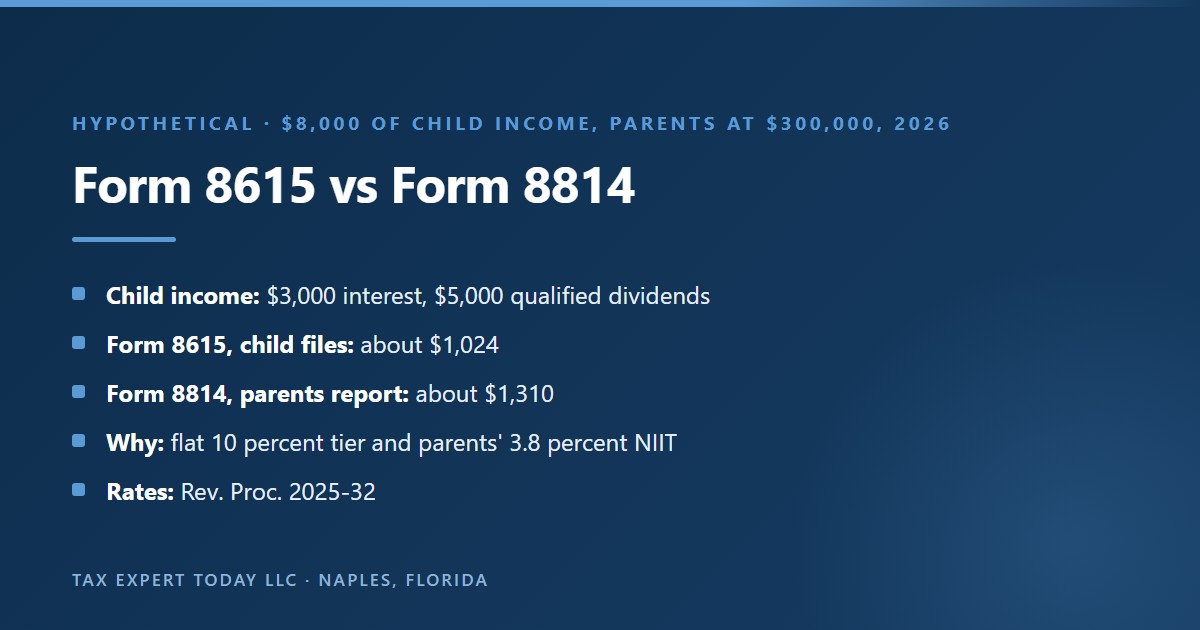
In a hypothetical 2026 example with $3,000 of interest and $5,000 of qualified dividends for a 15 year old and parents with $300,000 of taxable income, Form 8615 produces about $1,024 of tax, while Form 8814 produces about $1,310, including $201 of net investment income tax on the parents’ return.
- Form 8615: about $974 at the parents’ rates plus about $51 at the child’s rate.
- Form 8814: about $974 on the added income plus $135 plus about $201 of NIIT.
- Difference: about $286 more with the election in this example.
- Driver: the parents’ modified AGI is above $250,000.
- Caveat: hypothetical, simplified, and rounded.
The example assumes married parents filing jointly with $300,000 of taxable income and modified AGI of about $330,000, which places them in the 24 percent ordinary bracket and the 15 percent capital gain range under Revenue Procedure 2025-32. The child has $8,000 of income, $5,000 of which is qualified dividends, and no other income.
On Form 8615, net unearned income is $5,300. Allocated proportionally, about $3,313 is qualified dividends taxed at the parents’ 15 percent rate and about $1,988 is interest taxed at 24 percent, for about $974. The remaining $1,350 of the child’s taxable income is taxed at the child’s rate, with the dividend share at 0 percent and the interest share at 10 percent, about $51. Total, about $1,024.
On Form 8814, the parents add $5,300 to their income with the same character, for about $974 of additional tax, plus a flat $135 on the second $1,350 slice. Because their modified AGI exceeds $250,000, the added $5,300 is also net investment income under section 1411, adding about $201. Total, about $1,310. The Form 8960 instructions describe how the parents compute that tax.
| Component | Form 8615 | Form 8814 |
|---|---|---|
| Tax on $5,300 at parents’ rates | $974 | $974 |
| Tax on the $1,350 to $2,700 slice | $51 | $135 |
| Net investment income tax | $0 | $201 |
| Total federal tax | $1,024 | $1,310 |
| Returns filed | Two | One |
| Parents’ AGI change | None | Up $5,300 |
If the same parents had $650,000 of taxable income, both totals rise, to about $1,409 and $1,695, and the gap stays near $286. Every figure here is a hypothetical illustration, not a projection for any family, and actual results depend on each return’s full facts.
How Does Form 8814 Affect the Parents’ AGI and Net Investment Income Tax?
Form 8814 adds the child’s income above $2,700 to the parents’ adjusted gross income. That higher AGI can reduce AGI-based deductions and credits and can increase the parents’ net investment income tax, because the child’s interest and dividends become net investment income on the parents’ return.
- AGI increase: the child’s income minus $2,700.
- NIIT: 3.8 percent above $250,000 of modified AGI for joint filers.
- Phaseouts: AGI-based deductions and credits can shrink.
- Itemized deductions: the medical floor rises with AGI.
- Estimated tax: the parents may owe a penalty if payments are not increased.
The Form 8814 instructions direct the parent to include the child’s qualified dividend share on Form 1040 lines 3a and 3b, the capital gain distribution share on Schedule D or line 7a, and the remaining amount from line 12, which covers interest and other dividends, on Schedule 1. Those amounts become part of the parent’s AGI. They also state that if the parent did not have enough withholding or estimated tax to cover the added tax, a penalty may apply.
For the net investment income tax, the IRS net investment income tax page gives the thresholds: $250,000 for married filing jointly, $125,000 for married filing separately, and $200,000 for single and head of household filers. Those thresholds are fixed in section 1411(b) and are not indexed for inflation. A family already above $250,000 pays 3.8 percent on every dollar of child income moved onto its return.
AGI also drives eligibility for several credits and deductions that depend on income, including some education benefits. Families claiming an education credit or saving through a Roth IRA should model the election before making it. Our backdoor Roth IRA guide explains how modified AGI limits direct Roth contributions.
| Filer | Modified AGI threshold | Rate |
|---|---|---|
| Married filing jointly | $250,000 | 3.8 percent |
| Married filing separately | $125,000 | 3.8 percent |
| Single or head of household | $200,000 | 3.8 percent |
| Child filing own return (single) | $200,000 | 3.8 percent |
| Estates and trusts (2026) | $16,000 (top bracket start) | 3.8 percent |
The trust threshold in the last row is the start of the top trust bracket for 2026 and is explained in our trust tax rates guide. It shows why the same dollar of investment income can face very different 3.8 percent exposure depending on whose return it lands on.
How Do You Report Form 8814 on the Parents’ Return?
The parent files a separate Form 8814 for each child, carries the child’s income above $2,700 to the appropriate lines of Form 1040 and Schedule 1, and adds the tax from line 15 to the tax line with box 1 checked. The child does not file a return for that year.
- One form per child: attach each Form 8814 to the parent’s Form 1040.
- Qualified dividends: reported on lines 3a and 3b with the notation Form 8814.
- Capital gain distributions: Schedule D line 13 or Form 1040 line 7a.
- Interest and other dividends: the line 12 amount on Schedule 1, line 8z.
- Tax: line 15 amount added on Form 1040 line 16, box 1.
Those line references come from the 2025 Form 8814 instructions, the current edition when this guide was checked. Line numbers can change for 2026 forms, so preparers should follow the 2026 instructions when released. The structure is stable: income above the base amount is added to the parent’s income, keeping its character, and a small separate tax covers the slice between $1,350 and $2,700.
The Form 8814 page links the current form and instructions. Parents who use software should confirm that the program has placed the qualified dividend share in the qualified dividend total, because an error there loses the 15 or 20 percent rate and taxes the dividends as ordinary income.
If the parents file separately, are divorced, or never married, the instructions identify which parent may make the election, using rules similar to Form 8615. A parent who is not the right parent cannot make the election.
| Form 8814 line | Carried to | Notation |
|---|---|---|
| Line 9 (qualified dividends included) | Form 1040, lines 3a and 3b, or Schedule B line 5 | Form 8814 |
| Line 10 (capital gain distributions) | Schedule D line 13, or Form 1040 line 7a | Form 8814 |
| Line 12 (interest and other dividends included) | Schedule 1, line 8z | Form 8814 |
| Line 15 (tax) | Form 1040, line 16, box 1 | Total of all Forms 8814 |
A parent who makes the election should keep each child’s Forms 1099 with the parent’s return, since the IRS will match the child’s Social Security number to income that appears on the parent’s return.
Which Parent Uses the Child’s Income After a Divorce?
For Form 8615, a divorced child’s parent’s rate generally comes from the custodial parent, meaning the parent the child lived with for the greater part of the year, or the joint return if that parent remarried. For Form 8814, generally only that same parent may make the election. A dependency release does not change these rules.
- Custodial parent: the one the child lived with longer during the year.
- Equal time: the parent with greater taxable income.
- Remarriage: the custodial parent’s joint return with the new spouse.
- Form 8332: releases the dependency claim, not the kiddie tax parent.
- Coordination: the child’s return needs the right parent’s figures.
The Form 8615 instructions and the Form 8814 instructions use the custodial parent concept defined in Publication 501. Neither ties the kiddie tax parent to the parent who claims the child as a dependent. A noncustodial parent who claims the child under a signed release still does not supply the rate for the child’s Form 8615.
That distinction can surprise divorced families. The parent who claims the child may expect the child’s investment income to be measured against their own bracket. Instead, the custodial parent’s taxable income is used, and the child’s preparer needs that parent’s return information. If the parents do not share returns, the instructions permit a reasonable estimate and a later amended return.
Our Form 8332 guide covers the dependency release itself, and our Roth IRA in divorce guide covers another place where divorce and a child’s financial planning intersect. This section addresses the kiddie tax computation only.
| Scenario | Parent whose rate is used | Who may claim the child? |
|---|---|---|
| Child lives with mother 9 months, father 3 | Mother | Mother, unless she signs Form 8332 |
| Equal time, father has higher income | Father | Determined by the tiebreaker rules |
| Mother remarried, files jointly with new spouse | Mother and new spouse’s joint return | Mother, unless released |
| Father claims child under Form 8332 | Still the custodial parent | Father |
Parents negotiating a settlement that moves a custodial account or a trust interest to a child may want both returns modeled, since the kiddie tax parent is fixed by custody, not by the agreement.
Are Wages From a Family Business Subject to the Kiddie Tax?
No. Wages a parent’s business pays a child for real work are earned income, so they are taxed at the child’s own rates and never at the parent’s rate under the kiddie tax. The wages must be for services actually performed and in a reasonable amount, or the IRS can recharacterize them as the parent’s income.
- Character: wages for work actually performed are earned income.
- Rate: the child’s own brackets, with a standard deduction up to $16,100.
- Business deduction: wages are generally deductible by the business as ordinary and necessary expenses.
- Substance: real duties, time records, and pay comparable to an unrelated worker.
- Kiddie tax link: wages do not reduce net unearned income but widen the child’s low-rate slice.
This is the gap the planning literature on the kiddie tax rarely fills. Most pages explain that earned income is outside the rule and stop there. For the business owner parent, that sentence is where the planning starts, because a family business can pay a child for real work and shift that income out of the parent’s bracket into the child’s, something the kiddie tax specifically prevents for investment income.
The Form 8615 instructions treat wages as earned income because they are received for work actually performed. The words actually performed carry the weight. Wages paid to a child who does not work, or who is paid far more than the work is worth, are not earned income of the child in substance. The IRS can treat them as a gift from the parent, deny the business deduction, or both. The IRS family help page describes how wages paid to family members are treated for employment tax.
Reasonableness is judged the same way as any wage. The question is what the business would pay an unrelated person for the same work, hours, and skill. A 15 year old who answers phones, files, and cleans the shop for ten hours a week can be paid a market rate for that work. A 15 year old who is paid $40,000 to sit on a board is a different matter. Our S corporation reasonable compensation guide covers the same standard from the owner’s side.
| Payment to child | Character | Kiddie tax? | Business deduction? |
|---|---|---|---|
| Hourly wages for real office work at market rate | Earned income | No | Generally yes |
| Wages above what an unrelated worker would earn | Excess may be recharacterized | Excess may be treated as a gift | Excess may be denied |
| Distribution on S corporation shares the child owns | Unearned income | Yes | No |
| Interest on a loan the child made to the business | Unearned income | Yes | Interest may be deductible |
| Rent for property the child owns | Unearned income | Yes | Rent may be deductible |
The last three rows matter because some families give a child an ownership interest instead of a job. Income from ownership is unearned income and runs straight into the kiddie tax. Wages for work do not.
Are Wages Paid to a Child Subject to Payroll Tax?
It depends on the business form. Wages a sole proprietor parent, or a partnership owned only by the parents, pays a child under 18 are exempt from Social Security and Medicare tax, and from FUTA until age 21. Wages paid by an S corporation, a C corporation, or any other partnership are subject to all payroll taxes.
- Sole proprietorship of a parent: child under 18 exempt from FICA, under 21 exempt from FUTA.
- Partnership where each partner is a parent: same exemption.
- S corporation or C corporation: full FICA and FUTA at any age.
- Income tax withholding: applies to a child’s wages regardless of age.
- Source: IRC 3121(b)(3)(A) and 3306(c)(5).
The exemption comes from section 3121(b)(3)(A), which excludes from employment service performed by a child under the age of 18 in the employ of his father or mother, and from section 3306(c)(5), which excludes from FUTA service performed by a child under 21 in the employ of a parent. The IRS family help page adds the limit that controls most business owners: if the business is a corporation, a partnership unless each partner is a parent of the child, or an estate, payments for a child’s services are subject to income tax withholding, Social Security, Medicare, and FUTA regardless of age.
That means the popular advice to hire your kids and skip payroll tax does not fit an owner who operates through an S corporation, which is the most common structure for the readers of this guide. The S corporation is the employer, not the parent, and the exemption does not apply. The wages are still earned income for the kiddie tax and still deductible to the corporation, but 7.65 percent is withheld from the child and the corporation pays a matching 7.65 percent.
The Publication 15 section on family employees summarizes the same rules for employers. Owners who run a Schedule C business alongside an S corporation sometimes employ the child through the sole proprietorship for that reason. Whether that is appropriate depends on which business the child actually works for. Our S corporation versus C corporation guide compares the entity choices more broadly.
| Employer | Child’s age | Social Security and Medicare | FUTA | Income tax withholding |
|---|---|---|---|---|
| Parent’s sole proprietorship | Under 18 | Exempt | Exempt | Applies |
| Parent’s sole proprietorship | 18 to 20 | Applies | Exempt | Applies |
| Partnership, each partner a parent | Under 18 | Exempt | Exempt | Applies |
| S corporation owned by parents | Any | Applies | Applies | Applies |
| C corporation owned by parents | Any | Applies | Applies | Applies |
| Single-member LLC taxed as a sole proprietorship | Under 18 | Generally exempt | Generally exempt | Applies |
On $12,000 of wages from an S corporation, combined Social Security and Medicare tax is about $1,836, half withheld from the child and half paid by the corporation. The same wages from a parent’s sole proprietorship to a child under 18 would carry no Social Security or Medicare tax. Both amounts are hypothetical illustrations.
What Makes Wages Paid to a Child Reasonable?
Wages to a child are reasonable when they pay for real, documented work at a rate an unrelated person would receive for the same duties, hours, and skill. Age-appropriate tasks, time sheets, a written job description, payment through payroll, and deposit into an account the child owns all support the treatment.
- Real work: tasks the business actually needs, suited to the child’s age.
- Market rate: comparable to what an unrelated worker would be paid.
- Records: time sheets, a job description, and payroll reports.
- Payment: through payroll, with a Form W-2 issued.
- Ownership: wages deposited to the child’s own account.
No bright-line test applies to family wages. The general rule in the employment tax provisions and in the business deduction rules is that compensation must be for services actually rendered and reasonable in amount. The family relationship invites scrutiny, so documentation that would be optional for an unrelated hourly worker becomes important for a child.
A practical file includes a short job description, a time record for each pay period, the hourly rate and the basis for it, payroll records showing withholding where required, a Form W-2 at year-end, and bank records showing the pay went to an account in the child’s name. Payment in cash to the parent, or wages that are paid but then spent on the parent’s household expenses, weaken the position.
Age matters. Child labor laws limit the hours and types of work for younger teenagers, and an arrangement that violates those rules is hard to defend for tax purposes. A seven year old modeling in the company’s advertising may be paid a market modeling fee. A seven year old paid a monthly salary for bookkeeping is not credible. Our Augusta rule and accountable plan guides cover other owner strategies that depend on the same kind of substance and documentation.
| Document | What it shows |
|---|---|
| Job description | Duties the business actually needs |
| Time sheets | Hours actually worked each pay period |
| Rate support | What an unrelated worker would earn for the same work |
| Payroll records and Form W-2 | Wages processed like any employee’s |
| Form W-4 and state new hire filing | Normal employer onboarding |
| Bank statements in the child’s name | Wages belong to the child |
None of this assures any particular result in an examination. It is the ordinary evidence that separates wages for work from a transfer of the parent’s income.
How Does a Child’s Earned Income Raise the Standard Deduction?
A dependent child’s 2026 standard deduction is the greater of $1,350 or earned income plus $450, capped at $16,100. Each dollar of wages up to $15,650 therefore raises the deduction by a dollar, sheltering the wages themselves and leaving $450 of extra room that can absorb investment income at the child’s rate.
- Floor: $1,350 for a child with no earned income.
- Formula: earned income plus $450.
- Cap: $16,100, the 2026 single standard deduction.
- Effect on wages: wages up to $15,650 carry no federal income tax.
- Effect on investment income: $450 more taxed at zero, but net unearned income is unchanged.
The rule is in section 63(c)(5), with 2026 amounts in Revenue Procedure 2025-32. The revenue procedure states that a dependent’s standard deduction cannot exceed the greater of $1,350 or the sum of $450 and the individual’s earned income. The ordinary single standard deduction of $16,100 is the ceiling.
Wages do not change net unearned income. Net unearned income is unearned income minus $2,700, limited to taxable income. A child with $8,000 of investment income has $5,300 of net unearned income whether the child earns zero or $12,000 of wages. What wages change is the part of the return taxed at the child’s own rate. In the hypothetical example in this guide, adding $12,000 of wages increases the child’s taxable income from $6,650 to $7,550, and the extra amount is taxed at the child’s 10 percent rate or less.
That is why wages and investment planning work side by side rather than as substitutes. Wages move earned income out of the parent’s bracket. Investment choices control how much unearned income reaches the parent’s bracket.
| Child’s wages | Standard deduction | Wages taxed? |
|---|---|---|
| $0 | $1,350 | Not applicable |
| $900 | $1,350 | No |
| $5,000 | $5,450 | No |
| $12,000 | $12,450 | No |
| $15,650 | $16,100 | No |
| $20,000 | $16,100 | $3,900 at the child’s rate |
A child who works for an unrelated employer gets the same standard deduction. The family business is simply the employer the parent controls, which is why its documentation must be stronger.
Can a Child Contribute Wages to a Roth IRA?
Yes. A child with earned income can contribute up to the lesser of $7,500 or taxable compensation for 2026 to a Roth IRA, usually through a custodial Roth account. Investment growth inside a Roth IRA is not current unearned income, so it does not create kiddie tax while it stays in the account.
- 2026 limit: $7,500, or the child’s taxable compensation if less.
- Compensation: wages from a real job, including a family business.
- Account: generally a custodial Roth IRA for a minor.
- Kiddie tax: earnings inside the Roth are not current income.
- Source: IRC 219(b) and 408A, Notice 2025-67.
The IRS IRA contribution limits page states that for 2026 the total contributions to all traditional and Roth IRAs cannot be more than $7,500, or the person’s taxable compensation if less. Notice 2025-67 sets that 2026 figure. The compensation limit comes from section 219(b), applied to Roth IRAs through section 408A. Wages from a family business count as compensation if they are real wages for real work.
This pairing is where the kiddie tax analysis and the family wage analysis connect. Money that stays in a taxable custodial account produces interest and dividends that are unearned income every year. Money contributed to a Roth IRA from wages grows without current tax, and qualified distributions later are tax-free. The contribution does not need to come from the exact dollars earned. A parent may give the child the contribution amount while the child keeps the paycheck, so long as the child has the compensation.
There are limits. A Roth IRA is the child’s property, so the parent gives up control as the child reaches adulthood under state law. Early withdrawals of earnings can be taxed and penalized. Our backdoor Roth IRA guide and our Roth conversion ladder guide explain the adult-side Roth rules that eventually apply to the same account.
| Child’s 2026 compensation | Maximum Roth IRA contribution |
|---|---|
| $0 | $0 |
| $2,500 | $2,500 |
| $7,500 | $7,500 |
| $12,000 | $7,500 |
| $20,000 | $7,500 |
Roth contributions are not deductible, so they do not change the child’s federal income tax for the year. Their value is in moving future growth out of the yearly kiddie tax calculation.
How Does a Business Owner’s Child With Wages and Investments Fare?
In a hypothetical 2026 example, a 16 year old with $12,000 of S corporation wages and $8,000 of investment income owes about $1,143 of federal income tax, nearly all from the kiddie tax on $5,300 of net unearned income. The wages themselves carry no income tax but do carry about $1,836 of combined payroll tax.
- Wages: $12,000 from the parents’ S corporation, fully sheltered by the $12,450 deduction.
- Investments: $3,000 interest and $5,000 qualified dividends.
- Kiddie tax: about $974 at the parents’ rates.
- Child’s rate: about $169 on the remaining $2,250.
- Payroll tax: about $918 from the child and $918 from the corporation.
The example assumes parents filing jointly with $300,000 of taxable income, a 16 year old employed by the parents’ S corporation for real office work at a market rate, and a custodial brokerage account producing $3,000 of interest and $5,000 of qualified dividends. All figures use Revenue Procedure 2025-32 and are rounded and simplified.
The child’s standard deduction is $12,450, which is wages plus $450. Taxable income is $20,000 minus $12,450, or $7,550. Net unearned income is $8,000 minus $2,700, or $5,300, taxed at the parents’ rates for about $974. The remaining $2,250 is taxed at the child’s rates for about $169. Total federal income tax is about $1,143. The S corporation generally deducts the $12,000 of wages, and the payroll tax applies because the employer is a corporation rather than a parent.
If instead the wages came from a parent’s sole proprietorship and the child were under 18, the income tax picture would be the same, and the roughly $1,836 of combined payroll tax would not apply under section 3121(b)(3)(A). If the investment account held growth assets paying little current income, the kiddie tax line would shrink. Neither change is a recommendation, and the right structure depends on where the child actually works.
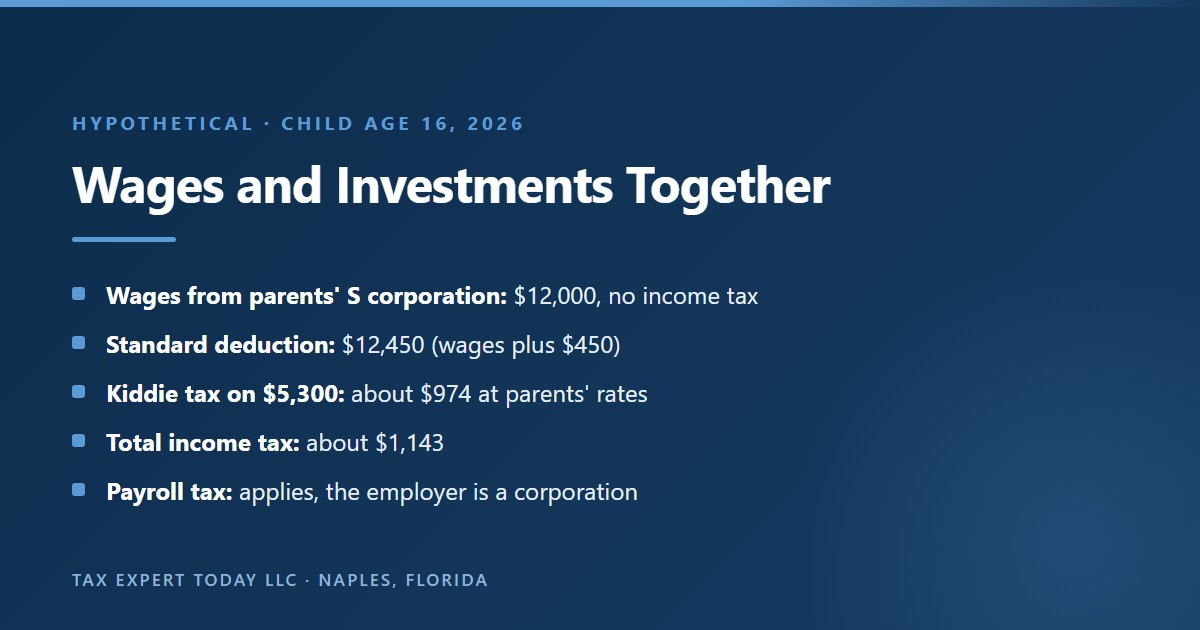
| Item | Amount |
|---|---|
| Wages from parents’ S corporation | $12,000 |
| Interest and qualified dividends | $8,000 |
| Dependent standard deduction | $12,450 |
| Child’s taxable income | $7,550 |
| Net unearned income | $5,300 |
| Tax on net unearned income at parents’ rates | About $974 |
| Tax on remaining $2,250 at child’s rates | About $169 |
| Total federal income tax | About $1,143 |
| Combined Social Security and Medicare tax on wages | About $1,836 |
| Form 8814 available? | No, the child has wages |
The example is a hypothetical illustration prepared for this guide, not a client outcome. It also omits the parents’ side of the calculation, where the wage deduction reduces the S corporation’s pass-through income and can interact with the qualified business income deduction.
Is a Trust Distribution to a Child Subject to the Kiddie Tax?
Yes, generally. Income a non-grantor trust distributes to a child beneficiary carries out distributable net income, and the interest, dividends, and gains in that distribution are unearned income to the child. If the child meets the kiddie tax tests, the portion above $2,700 is taxed at the parent’s rate on Form 8615.
- Mechanism: distributions carry out DNI under IRC 662.
- Character: the child’s share keeps the trust’s interest, dividend, and gain character.
- Kiddie tax: unearned income, so the parent’s rate can apply above $2,700.
- Exception: taxable distributions from a qualified disability trust are treated as earned income.
- Reporting: Schedule K-1 (Form 1041) to the child, and Form 8615 if required.
The Form 8615 instructions list income, other than earned income, received as the beneficiary of a trust among the items of unearned income, and they state that interest, dividends, capital gains, and other unearned income from a trust are unearned income to the child. They also note one exception: taxable distributions from a qualified disability trust are treated as earned income for completing Form 8615.
Under section 662, a beneficiary includes distributions in income to the extent of the trust’s distributable net income, defined in section 643(a). The beneficiary receives a Schedule K-1 showing the character of what was carried out. When the beneficiary is a minor subject to the kiddie tax, that K-1 income lands on Form 8615.
This is the piece the trust planning pages and the kiddie tax pages each leave to the other. Trustees are taught that distributing income to beneficiaries in lower brackets saves tax because trust brackets are compressed. That is often true for adult beneficiaries. For a beneficiary under 18, or a supported student under 24, the lower bracket may not exist above $2,700, because the parent’s rate applies. Our trust tax rates guide explains the trust side of that decision.
| Trust income distributed | Character to the child | Kiddie tax treatment |
|---|---|---|
| Interest | Interest | Unearned income, parent’s ordinary rate above $2,700 |
| Qualified dividends | Qualified dividends | Unearned income, parent’s capital gain rate |
| Capital gains included in DNI | Capital gains | Unearned income, parent’s capital gain rate |
| Tax-exempt interest | Tax-exempt interest | Not unearned income |
| Qualified disability trust distribution | Treated as earned income for Form 8615 | Outside the parent’s rate |
Grantor trusts are different. If the trust is a grantor trust as to a parent, the income is taxed to the parent directly, and the child does not report it at all, regardless of distributions. Our intentionally defective grantor trust guide covers that structure.
When Does Distributing Trust Income to a Minor Cost More Than Retaining It?
When parents are in a high bracket, distributing trust income to a minor can cost more than retaining it. In a hypothetical 2026 example with $20,000 of interest, the trust pays about $5,442 if it keeps the income, while a 15 year old pays about $4,287 with parents at 24 percent and about $6,190 at 35 percent.
- Trust retains: about $5,294 of income tax plus about $148 of NIIT.
- Distributed, parents at 24 percent: about $4,287 of kiddie tax.
- Distributed, parents at 35 percent: about $6,190 of kiddie tax.
- Child’s NIIT: none, because a child rarely exceeds $200,000.
- Lesson: run both returns before choosing.
The example uses the 2026 estates and trusts schedule from Revenue Procedure 2025-32, which reaches 37 percent at $16,000, and assumes a complex trust with $20,000 of taxable interest, a $100 exemption, and no other income. Retaining the income produces about $5,294 of federal income tax and about $148 of net investment income tax under section 1411, for about $5,442.
If the trust instead distributes the $20,000 to a 15 year old beneficiary, the child has $18,650 of taxable income and $17,300 of net unearned income. With parents in the 24 percent bracket, the kiddie tax is about $4,152 at the parents’ rate plus $135 at the child’s rate, about $4,287. With parents in the 35 percent bracket, it is about $6,055 plus $135, about $6,190, which is more than the trust would have paid.
The child’s own net investment income tax threshold is $200,000, so the child pays none. The trust’s threshold is the $16,000 start of its top bracket. That difference helps the distribution case, but not always enough to overcome a 35 percent parental rate. Our dynasty trust and spousal lifetime access trust guides discuss the trusts where this question tends to arise.
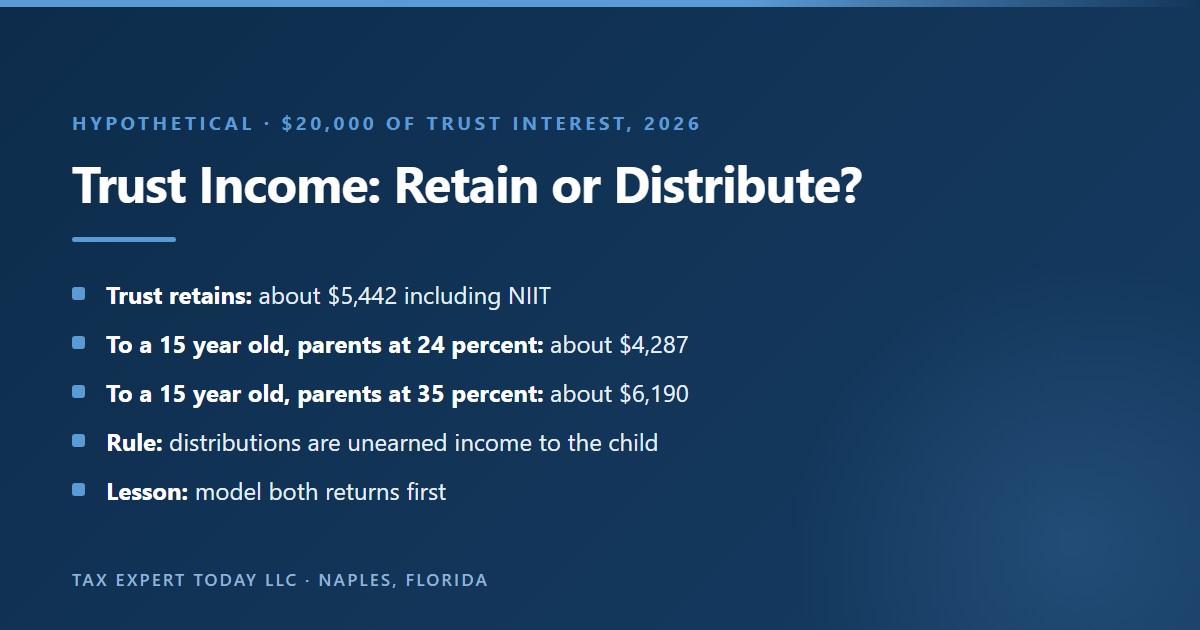
| Approach | Income tax | NIIT | Total |
|---|---|---|---|
| Trust retains all income | $5,294 | $148 | $5,442 |
| Distributed, parents in 24 percent bracket | $4,287 | $0 | $4,287 |
| Distributed, parents in 35 percent bracket | $6,190 | $0 | $6,190 |
| Same income taxed at the child’s own single rates (for contrast) | About $1,990 | $0 | About $1,990 |
The last row shows what the same distribution would cost if it were taxed entirely at the child’s own single rates, as it would be for a beneficiary outside the kiddie tax who still had only a $1,350 standard deduction. All figures are hypothetical, simplified, and rounded, and the trustee’s decision also turns on the trust instrument and the trustee’s duties, not tax alone.
How Are UTMA and UGMA Custodial Accounts Taxed?
Income from a custodial account under the Uniform Transfers to Minors Act or the Uniform Gifts to Minors Act belongs to the child for tax purposes. It is reported under the child’s Social Security number and is unearned income subject to the kiddie tax, even though a parent or other custodian manages the account.
- Owner for tax: the child.
- Taxpayer number: the child’s Social Security number.
- Income type: interest, dividends, and gains are unearned income.
- Gift: the transfer into the account is a completed, irrevocable gift.
- Exception: income used to discharge a parent’s support obligation can be taxed to the parent.
A custodial account is the most common way children come to own investments, and it is the main source of kiddie tax returns. Because the gift is complete when made, the income is the child’s. The Form 8615 instructions confirm that unearned income includes all income produced by property belonging to the child, regardless of who transferred it.
The custodian is not the taxpayer. The parent who manages the account does not report its income on the parent’s return unless the parent makes the Form 8814 election. One exception is widely cited: if custodial account income is used to pay for something the parent is legally obligated to provide, such as basic support, that income can be taxed to the parent. What counts as support depends on state law, so families should not spend custodial funds on ordinary household needs.
Transfers into a custodial account also have gift tax consequences. For 2026, the annual exclusion in Revenue Procedure 2025-32 allows each donor to give $19,000 per recipient without using lifetime exemption. Our 2026 lifetime gift tax exemption guide explains how larger gifts are reported.
| Feature | Treatment |
|---|---|
| Legal owner | The child |
| Income reported under | The child’s Social Security number |
| Character of income | Unearned income for the kiddie tax |
| Return filed | The child’s, with Form 8615 if required, or Form 8814 on the parent’s |
| Gift into the account | Completed gift, $19,000 annual exclusion per donor for 2026 |
| Funds used for parental support obligations | Income may be taxed to the parent |
Custodial accounts end at the age set by state law, commonly 18 or 21, when the assets pass to the child outright. That date has nothing to do with the kiddie tax ages, so a child can own the account outright while still subject to the kiddie tax as a student under 24.
Can Moving a Custodial Account Into a 529 Plan Avoid the Kiddie Tax?
It can reduce future kiddie tax, because earnings inside a 529 plan are not currently taxed and qualified withdrawals are tax-free. But a custodial account must first be sold to make a cash contribution, which can create capital gains taxed under the kiddie tax that year, and the 529 remains the child’s property.
- Inside a 529: no current tax on earnings.
- Qualified withdrawals: tax-free under IRC 529(c)(3)(B).
- Cash only: 529 contributions must be cash, so assets are sold first.
- Sale year: gains on the sale are unearned income in that year.
- Ownership: a custodial 529 stays the child’s asset.
Under section 529, earnings in a qualified tuition program are not taxed while they remain in the account, and distributions used for qualified education expenses are excluded from income. Publication 970 describes those rules. That means investment growth inside a 529 does not appear on the child’s return at all and cannot generate kiddie tax while it stays there.
The obstacle is the move. Section 529 accounts accept only cash contributions, so the custodian must sell the custodial account’s holdings first. Any gain on that sale is unearned income to the child in the year of sale and runs through Form 8615. A sale spread over two tax years, or one timed for a year in which the child is outside the kiddie tax, can reduce that cost. Because the money belongs to the child, it generally must go into a custodial 529 account, not a parent-owned account.
For new gifts, the analysis is simpler. A grandparent or parent who is about to fund a custodial account for college can often fund a 529 instead and avoid creating new unearned income. Whether a 529 fits depends on the family’s education plans and the account’s flexibility, and is an investment and family decision.
| Where the assets sit | 2026 federal tax on the $8,000 | Notes |
|---|---|---|
| Custodial brokerage account, Form 8615 | About $1,024 | Interest and qualified dividends |
| Custodial brokerage account, Form 8814 | About $1,310 | Includes parents’ NIIT |
| Custodial 529 plan | $0 currently | Taxable later only if withdrawn for nonqualified uses |
| Year of moving from custodial account into 529 | Depends on gains realized | Sale gains are unearned income |
The figures in that table are hypothetical illustrations. The 529 row shows current tax only, and nonqualified withdrawals later can carry income tax and an additional tax on earnings.
Are Scholarships Subject to the Kiddie Tax?
The taxable part of a scholarship or fellowship grant that is not reported on a Form W-2 is unearned income for the kiddie tax. A scholarship is taxable to the extent it pays for room, board, or other costs beyond qualified tuition and related expenses, or is payment for services.
- Tax-free part: amounts used for qualified tuition, fees, books, and required supplies.
- Taxable part: amounts used for room, board, and travel.
- Not on Form W-2: treated as unearned income on Form 8615.
- On Form W-2: treated as earned income.
- Support test: a full-time student’s scholarship is not counted as support.
The Form 8615 instructions list taxable scholarship and fellowship grants not reported on Form W-2 as unearned income and refer readers to chapter 1 of Publication 970 for the special rules. Under section 117, a scholarship is excluded from income only to the extent it is used for qualified tuition and related expenses by a degree candidate.
For a full-time student under 24, this creates an unexpected kiddie tax return. A student who receives a $30,000 scholarship and uses $10,000 for housing has $10,000 of taxable scholarship income. If the student meets the support test, the portion above $2,700 can be taxed at the parent’s rate. The instructions’ rule that a full-time student’s scholarship is not counted as support makes it more likely, not less, that the support test is met.
Coordination with education credits matters here. Families sometimes allocate a scholarship to room and board on purpose, making part of it taxable, so that tuition paid from other funds qualifies for an education credit. The kiddie tax affects the cost of that choice when the student is under 24.
| Use of a $30,000 scholarship | Taxable? | Kiddie tax character |
|---|---|---|
| $20,000 tuition and required fees | No | Not income |
| $1,000 required books | No | Not income |
| $9,000 room and board | Yes | Unearned income if not on Form W-2 |
| Teaching assistant stipend reported on Form W-2 | Yes | Earned income |
Because scholarship rules are detailed, students with large grants should review Publication 970 and their award terms before filing.
Does the Net Investment Income Tax Apply to a Child?
Technically yes, but rarely in practice. A child pays the 3.8 percent net investment income tax only if the child’s own modified adjusted gross income exceeds $200,000. The kiddie tax uses the parent’s income tax rate but not the parent’s net investment income tax threshold, so most children owe no NIIT.
- Child’s threshold: $200,000 of modified AGI as a single filer.
- Not inherited: the parent’s NIIT threshold does not apply to the child’s return.
- Form: Form 8960 if the child is above the threshold.
- Form 8814 contrast: income moved to the parent’s return can face NIIT there.
- Trusts: a trust faces NIIT above $16,000 in 2026.
The IRS Tax Topic 553 notes that a child who must file Form 8615 may be subject to the net investment income tax and points to Form 8960. The tax under section 1411 applies to the lesser of net investment income or the excess of modified AGI over the threshold, which is $200,000 for single filers. The Form 8960 instructions confirm the threshold.
Form 8615 borrows the parent’s income tax brackets, not the parent’s NIIT exposure. A parent above $250,000 may pay 3.8 percent on the parent’s own investment income, while the same family’s child, with $8,000 of dividends taxed at the parent’s rate, pays no NIIT. That asymmetry is one of the measurable differences between Form 8615 and Form 8814, as shown in the comparison earlier in this guide.
A child with a very large gain, such as on the sale of inherited stock or a business interest, could exceed $200,000 and owe NIIT. In that case the child’s Form 8615 and Form 8960 are both needed, and the tax is substantial enough that the timing of the sale deserves review.
| Where the income is reported | NIIT threshold | Typical exposure on $8,000 of dividends |
|---|---|---|
| Child’s own return, Form 8615 | $200,000 | None |
| Parents’ joint return via Form 8814, parents above $250,000 | $250,000 | About $201 on $5,300 included |
| Trust that retains the income | $16,000 start of top bracket | Depends on the trust’s total income |
| Child with a $300,000 gain | $200,000 | 3.8 percent on the lesser of NII or MAGI above $200,000 |
The second row uses the hypothetical family from the Form 8814 comparison. All exposure figures are illustrations, not projections.
How Does the Alternative Minimum Tax Apply to a Child?
A child subject to the kiddie tax computes the alternative minimum tax with a limited exemption. For 2026, the child’s AMT exemption cannot exceed the child’s earned income plus $9,750. Most children never owe AMT, but private activity bond interest or large preference items in a child’s account can trigger it.
- Exemption limit: earned income plus $9,750 for 2026.
- Source: IRC 55(d) and 59(j), Rev. Proc. 2025-32.
- Common trigger: tax-exempt interest from private activity bonds.
- Form: Form 6251 with the child’s return.
- Form 8814 parents: the child’s private activity bond interest enters the parents’ AMT.
Revenue Procedure 2025-32 states that for a child to whom the kiddie tax applies, the AMT exemption under section 55(d) and section 59(j) may not exceed the sum of the child’s earned income and $9,750 for 2026. Adults receive far larger exemptions, so this limit exists to stop the kiddie tax from being sidestepped through AMT preferences.
The Form 6251 instructions and the Form 8615 instructions both address AMT for children. In practice, the most common source is private activity bond interest in a municipal bond fund. That interest is tax-exempt for regular tax, and therefore not unearned income for Form 8615, but it is an AMT preference. A child with a large municipal bond position could owe AMT even though the kiddie tax computation shows little income.
The Form 8814 instructions also warn that if the child received tax-exempt interest from certain private activity bonds, the parent must take it into account in determining whether the parent owes AMT.
| Child’s earned income | Maximum AMT exemption |
|---|---|
| $0 | $9,750 |
| $5,000 | $14,750 |
| $12,000 | $21,750 |
| $20,000 | $29,750 |
Families who hold tax-exempt funds in a child’s name to reduce the kiddie tax should ask whether any of the fund’s income is private activity bond interest, because that choice can move the issue from Form 8615 to Form 6251.
What Planning Strategies Reduce the Kiddie Tax?
Common approaches include paying a child reasonable wages for real work, holding growth-oriented assets that pay little current income, using tax-exempt bonds, funding 529 plans or Roth IRAs instead of taxable custodial accounts, harvesting losses, and timing large gains for a year when the child is outside the rule. Each depends on the family’s facts.
- Earned income: wages for real work are taxed at the child’s rate.
- Low current income: growth assets defer gains until sale.
- Tax-exempt income: municipal interest is not unearned income, subject to AMT checks.
- Tax-advantaged accounts: 529 plans and Roth IRAs remove current income from the return.
- Timing: sales after the child turns 24, or meets the support test, avoid the parent’s rate.
Each strategy works by respecting the rule’s purpose rather than defeating it. The kiddie tax in section 1(g) targets unearned income above $2,700. Strategies that create earned income for real work, or that keep investment income from arising in the child’s name, reduce the tax without relabeling the parent’s income.
Growth assets are the quiet strategy. A custodial account invested for appreciation rather than income may produce little interest or dividends each year, keeping unearned income under $2,700, with gains realized later when the child may be outside the rule. Tax gain harvesting in the child’s own name after the kiddie tax ends can then use the child’s 0 percent capital gain range, explained in our tax gain harvesting guide.
Loss harvesting works the other way. Realized losses in the child’s account offset gains and up to $3,000 of other unearned income, reducing tax at the parent’s rate. The wash sale rules apply to the child’s account as they would to an adult’s. None of these strategies is suitable for every family, and investment choices should be made with the account’s purpose in mind.
| Approach | How it reduces kiddie tax | Trade-off |
|---|---|---|
| Reasonable wages from a family business | Creates earned income taxed at the child’s rate | Real work, records, payroll tax for corporations |
| Growth-oriented holdings | Keeps current unearned income low | Market risk and later gains |
| Municipal bonds | Tax-exempt interest is not unearned income | Lower yield, AMT check |
| 529 plan | No current income on the child’s return | Education use rules |
| Custodial Roth IRA | No current income, tax-free qualified withdrawals | Requires the child’s compensation |
| Loss harvesting | Offsets gains and up to $3,000 of other income | Wash sale rules |
| Timing a large sale | Gain realized after the rule stops applying | Price risk while waiting |
Strategies that depend on paying a child should also consider the parent’s side. A wage deduction for the business, the qualified business income deduction, and the child’s payroll tax all move at once, which is why we model the family as a whole.
What Are the Most Common Kiddie Tax Mistakes?
The most common mistakes are using an outdated threshold, choosing Form 8814 without comparing it to Form 8615, forgetting that wages from an S corporation carry payroll tax, treating a trust distribution to a minor as automatically tax-saving, using the wrong parent’s return after divorce, and missing the support test for students.
- Stale thresholds: the 2026 trigger is $2,700, from Rev. Proc. 2025-32.
- Untested election: Form 8814 can add NIIT and AGI phaseouts.
- Payroll assumption: the under 18 exemption does not apply to corporations.
- Trust distribution reflex: the parent’s rate can exceed the trust’s cost.
- Wrong parent: custody, not the dependency claim, picks the return.
Each mistake comes from applying a correct general idea to the wrong facts. It is true that a child’s investment income is taxed at the parent’s rate, but only above $2,700, only for the covered ages, and only when the child must file. It is true that wages paid to a child can avoid Social Security tax, but only when the employer is the parent’s sole proprietorship or a partnership of the parents, as the IRS family help page explains. It is true that trust distributions often save tax, but not when the beneficiary’s rate is the parent’s 35 percent.
Several ranking pages still quote pre-2026 figures, including a legal resource page that cites a 2010 threshold and articles that describe the 2018 trust rate rule as current. Every 2026 figure in this guide was checked against Revenue Procedure 2025-32 and the current Form 8615 and Form 8814 instructions on November 19, 2026.
Filing mistakes are also common: omitting Form 8615 when a child’s unearned income is just over $2,700, failing to coordinate several children’s returns that use the same parent, and placing qualified dividends on the wrong line of the parent’s return under Form 8814, which loses the preferential rate.
| Mistake | Correct rule |
|---|---|
| Using $2,500 or an older threshold | $2,700 for 2026 |
| Applying trust brackets | Parent’s rate since 2020 |
| Electing Form 8814 by default | Compare with Form 8615, including NIIT and AGI effects |
| Assuming S corporation wages to a child skip FICA | Corporations withhold and pay FICA at any age |
| Assuming distributions to minors always save tax | Parent’s rate applies above $2,700 |
| Using the parent who claims the child | Use the custodial parent’s return |
| Ignoring the support test at 18 to 23 | Earned income more than half of support ends coverage |
Most of these errors are visible only when the child’s return and the parents’ return are reviewed together, which is the main reason families with business income or trusts often prepare them as a set.
What Kiddie Tax Deadlines Matter for the 2026 Tax Year?
For the 2026 tax year, year-end planning such as loss harvesting, wage payments, and 529 contributions should be completed by December 31, 2026. The child’s return with Form 8615, or the parents’ return with Form 8814, is due April 15, 2027, or October 15, 2027 on extension. Trust distributions can count for 2026 if made by March 6, 2027.
- December 31, 2026: last day for 2026 trades, wages, and 529 funding.
- January 31, 2027: Forms W-2 to a child employee.
- March 6, 2027: 65-day trust distributions for 2026.
- April 15, 2027: child’s Form 1040 with Form 8615, or parents’ return with Form 8814.
- October 15, 2027: extended individual due date.
The child’s return is an ordinary individual return, so its due date is the same as the parents’. Because Form 8615 needs the parents’ taxable income, the child’s return often waits on the parents’ return. When the parents extend, the child can extend too, or file on time with a reasonable estimate as the Form 8615 instructions permit, then amend.
Wage deadlines follow the employer’s calendar. A child employed by a family business must receive a Form W-2 by January 31, 2027, under the rules in Publication 15. Wages must be paid in 2026 to count as 2026 earned income, which matters for the 2026 standard deduction and the 2026 Roth IRA contribution, the latter of which can be made up to the April 15, 2027 due date.
Trust distributions have their own window. A complex trust can elect under section 663(b) to treat distributions made in the first 65 days of 2027 as made in 2026, which for a calendar-year trust ends March 6, 2027. Our trust tax rates guide explains that election in detail.
| Date | Action |
|---|---|
| December 31, 2026 | Complete 2026 sales, loss harvesting, wages, and 529 contributions |
| January 15, 2027 | Fourth-quarter estimated payment if the parents will elect Form 8814 |
| January 31, 2027 | Forms W-2 to child employees |
| March 6, 2027 | Last day for 65-day trust distributions treated as 2026 |
| April 15, 2027 | Child’s return with Form 8615, parents’ return with Form 8814, 2026 Roth IRA contributions |
| October 15, 2027 | Extended individual returns |
Weekend and holiday rules can move a due date to the next business day. The dates above are the general 2026 calendar and should be confirmed against the current year’s instructions.
Does Florida Tax a Child’s Investment Income?
No. Florida does not impose a personal income tax, so a Florida resident child’s interest, dividends, capital gains, and wages are subject only to federal income tax, including the kiddie tax. A child who is a resident of another state, or who has income sourced there, may still owe that state’s tax.
- Florida residents: no state personal income tax on a child’s income.
- Source: Article VII, section 5 of the Florida Constitution.
- Federal tax: the kiddie tax still applies in full.
- Other states: a student living elsewhere may become a resident there.
- Trusts: Florida does not tax trust income at the state level either.
Article VII, section 5 of the Florida Constitution provides that no tax upon the income of natural persons who are residents or citizens of the state shall be levied by the state, beyond amounts creditable against a similar federal tax. For a Florida family, the kiddie tax analysis is therefore federal only. There is no separate state Form 8615 equivalent to prepare.
That simplicity can disappear when a child attends college in another state. Some states treat a student who lives there for much of the year as a resident or tax income earned there, such as wages from a campus job or a summer internship. A student under 24 who is still subject to the federal kiddie tax may need a state return in the state where they study or work.
Families who moved to Florida from a state with an income tax should also check any trusts created before the move. A trust may remain taxable in the former state depending on that state’s rules. Our trust situs after moving to Florida guide covers that question.
| Child’s situation | Florida tax | Possible other state tax |
|---|---|---|
| Florida resident, custodial account income | None | None |
| Florida resident, wages from a Florida family business | None | None |
| Student living in another state, campus job | None | Possibly, under that state’s rules |
| Trust created in another state, distributing to a Florida child | None | Possibly, under the trust’s former state rules |
Because Florida adds no state layer, the federal choices, especially Form 8615 versus Form 8814 and the employer structure for family wages, carry the whole result for Florida families.
Kiddie Tax Help in Naples & Southwest Florida
Tax Expert Today LLC works with parents, business owners, and trustees in Naples, Florida and across Southwest Florida on the kiddie tax. That work can include comparing Form 8615 with Form 8814, reviewing wages paid to children through a family business, projecting trust distributions to minors, and preparing the returns. Results depend on each family’s facts.
- Kiddie tax help Naples: Form 8615 and Form 8814 preparation and comparison for families in Collier and Lee counties.
- Family business: wage structure, payroll treatment, and documentation for children who work.
- Trusts: distribution projections for minor and student beneficiaries.
- Service area: an office in Naples, with clients served in all 50 states.
Our office is at 11983 Tamiami Trail N, Naples FL 34110. Call (239) 441-2005, Monday through Friday, 10 a.m. to 5 p.m. ET. Our Naples tax planning page and our tax planning services page describe how the firm works with families, and our estate and trust planning services page covers trust and fiduciary work.
Southwest Florida has many family-owned businesses, from construction and landscaping to medical practices and hospitality, along with many families who hold investment accounts and trusts for children and grandchildren. The kiddie tax touches each of those in a different way, and the family business owner often faces all three at once: a child who works in the business, a custodial account funded by grandparents, and a trust created by a prior generation.
Where can I get help with the kiddie tax and Form 8615 in Naples, FL? Tax Expert Today LLC is based at 11983 Tamiami Trail N in Naples and works with parents and trustees on Form 8615 and Form 8814 comparisons, wages paid to children through family businesses, custodial accounts, and trust distributions to minor beneficiaries. The firm does not promise any particular tax result, and outcomes depend on each family’s facts.
| Season | Typical family activity | Kiddie tax step |
|---|---|---|
| November and December 2026 | Year-end reviews as seasonal residents return | Project each child’s unearned income and wages |
| January 2027 | Year-end statements arrive | Gather every custodial and trust statement for each child |
| February to March 2027 | Peak season for many local businesses | Compare Form 8615 and Form 8814, finalize trust distributions by March 6 |
| April 2027 | Individual returns due | File the child’s and parents’ returns together or extend both |
When to Engage a Professional
Consider professional help when a child’s unearned income will exceed $2,700, before electing Form 8814, before paying a child through a family business, before a trust distributes to a beneficiary under 24, when parents are divorced, and before a large sale in a child’s account. Each choice can change whose rate applies.
- Before electing Form 8814: compare total family tax including NIIT.
- Before hiring a child: entity type decides payroll tax.
- Before a trust distribution to a minor: model the parent’s rate.
- After divorce or remarriage: confirm which parent’s return is used.
- Before a large gain: check age, support, and timing.
Tax Expert Today LLC is a Naples, Florida firm of tax advisors, enrolled agents, CPAs, and attorneys serving clients in all 50 states. To discuss the kiddie tax, a child’s custodial account, wages paid through a family business, or trust distributions to a young beneficiary, contact our Naples, Florida tax planning team, review our tax planning services, or call (239) 441-2005. Readers may also find our guides to trust tax rates, S corporation reasonable compensation, the Augusta rule, the accountable plan, tax gain harvesting, the backdoor Roth IRA, the qualified business income deduction, the 2026 lifetime gift tax exemption, and S corporation versus C corporation useful, along with the full learning center.
| Situation | Why it matters |
|---|---|
| Child’s investment income above $2,700 | Form 8615 required, parent’s rate applies |
| Considering Form 8814 | Can add NIIT and reduce AGI-based benefits |
| Child working for an S corporation | Payroll tax applies, documentation needed |
| Trust distributing to a beneficiary under 24 | Parent’s rate can exceed the trust’s cost |
| Parents divorced or recently remarried | Return used for the parent’s rate can change |
| Planned sale of appreciated assets in a child’s name | Timing can change the rate on the gain |
This article is general information about the federal income taxation of children’s unearned income and wages and is not tax, legal, or investment advice for any specific family, child, business, or trust. Statutory and regulatory references were checked against the text of IRC sections 1(g), 55, 59(j), 63(c)(5), 117, 219, 408A, 529, 643, 662, 1411, 3121(b)(3)(A), and 3306(c)(5), Revenue Procedure 2025-32, Notice 2025-67, IRS Tax Topic 553, the Instructions for Forms 8615, 8814, 6251, and 8960, Publications 15, 501, and 970, the IRS family help page, and Article VII, section 5 of the Florida Constitution on November 19, 2026. Some form line numbers come from the 2025 editions of the instructions and may change for 2026. All dollar examples, including children’s income, wages, parents’ taxable income, trust income, and tax amounts, are hypothetical illustrations prepared for this guide, simplified and rounded, and are not client outcomes or predictions for any taxpayer. Whether wages paid to a child are reasonable, whether a trust distribution is consistent with a trustee’s duties, and which investments suit a child’s account depend on facts not addressed here. Tax laws apply differently to each person’s facts. Consult a qualified professional about your situation before taking any action.
Published November 19, 2026 by Dr. Pellumb Kabashi « Back to Learning Center
Have a question this article touches on?
Tax Expert Today LLC, based in Naples, Florida and serving clients across the United States.
Schedule a Consultation (239) 441-2005