
By Dr. Pellumb Kabashi, DBA, MBA, CES, CFE, EA
Founder, Tax Expert Today LLC · Tax advisors, enrolled agents, CPAs, and attorneys · Serving clients in all 50 states
Quick Answer
California part year resident tax is calculated on Form 540NR, and it is not a simple matter of taxing the months you lived in the state. California first computes the tax as if you had been a resident for the entire year, converts that figure into an effective rate, and then applies that rate to the income California is actually allowed to tax. The result is a full-year California rate applied to a partial-year slice of income.
What Is California Part Year Resident Tax?
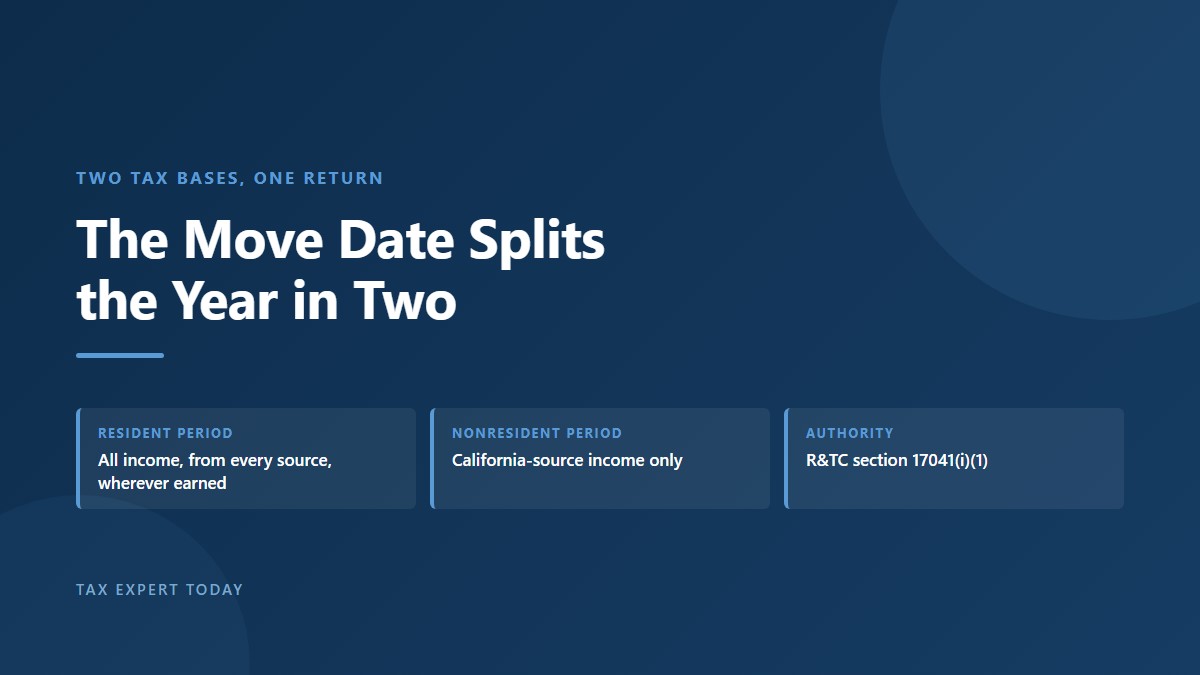
California part year resident tax is the tax owed by someone who was a California resident for only part of the tax year. Under Revenue and Taxation Code section 17041(i)(1), that person is taxed on all income from every source during the resident period, and on California-source income only during the nonresident period. Where the move year also includes a sale of the California home, see the California capital gains tax on home sale analysis for the Form 593 credit mechanics.
Those are two different tax bases stitched into one return. For the months you lived in California, the state reaches your worldwide income: wages earned anywhere, interest from any bank, gain on the sale of any asset. The day your residency ends, the base narrows sharply. From that point California may tax only what is sourced to California, such as wages for services physically performed in the state, rental income from California real property, or income from a California business. If a California LLC is part of the picture, note that the California LLC franchise tax is an entity level obligation that runs separately from the owner personal return.
The move date is therefore the single most consequential fact on the return. It is also the fact the Franchise Tax Board is most likely to test later, which is why the departure-year record matters well beyond the filing itself. Our guide to the California residency audit covers what the FTB reviews when it disagrees with the date you claimed.
Who Files Form 540NR as a Part-Year Resident?
You file Form 540NR as a part-year resident if you were a California resident for part of the year and a nonresident for the rest, and you meet the filing thresholds. This covers people who moved out of California, people who moved in, and people whose residency changed mid-year because their domicile and closest connections shifted, whether or not the move was permanent.
Residency itself is defined by Revenue and Taxation Code section 17014 and elaborated in FTB Publication 1031. It turns on domicile and on the closest-connection factor analysis, not on a day count alone. A common misunderstanding is that leaving before some threshold number of days converts a full year into a part year. It does not. The status follows the facts of where your life was centered.
Two situations frequently produce a missing California part year resident tax return rather than a wrong one. The first is the taxpayer who moves in, say, February and assumes the short California stretch is immaterial. The second is the taxpayer who moves out late in the year and files only a Florida-free federal return, forgetting that California still expects a final part-year filing. Both leave an unfiled year on the record, and under section 19087 an unfiled year carries no assessment deadline at all.
How Does California Calculate Part Year Resident Tax?
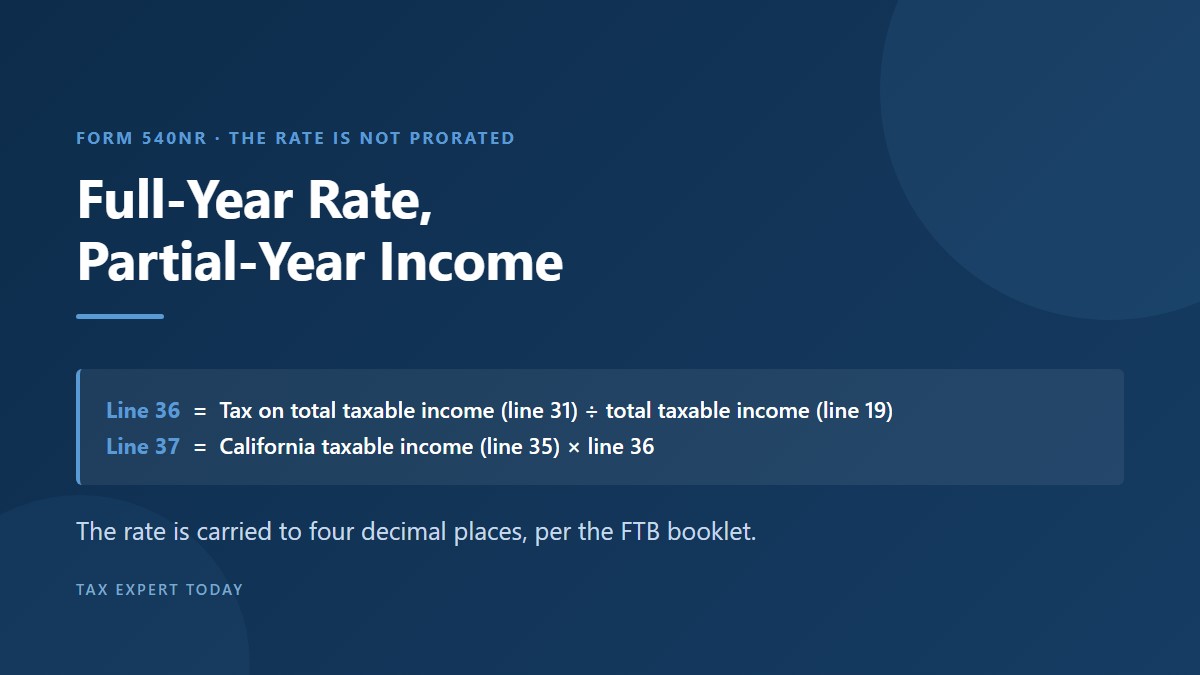
California uses an effective rate method, not a proration of the tax itself. Section 17041(b)(2) directs that the tax be calculated by multiplying the taxable income of a part-year resident by a rate equal to the tax computed on the entire taxable income as if the taxpayer had been a California resident for the whole year, divided by that income.
Read plainly, that means California looks at everything you earned all year, everywhere, and asks what rate a full-year resident with that much income would pay. It then applies that rate to the smaller California slice. Because California brackets are graduated, the effect is that your California income is taxed at the rate your total income commands, not at the lower rate the California slice would have commanded on its own.
The 2025 Form 540NR carries this out in a fixed sequence of lines:
| Form 540NR line | What it holds | How it is derived |
|---|---|---|
| Line 17 | Total income from all sources | Schedule CA (540NR), Part II, line 27, column D |
| Line 18 | California standard or itemized deduction | Full amount, not reduced for residency |
| Line 19 | Total taxable income | Line 17 less line 18, computed as if a full-year resident |
| Line 31 | Tax on total taxable income | Tax table or rate schedule applied to line 19 |
| Line 32 | California adjusted gross income | Schedule CA (540NR), Part II, line 27, column E |
| Line 35 | California taxable income | Schedule CA (540NR), Part IV, line 5 |
| Line 36 | California tax rate | Line 31 divided by line 19, carried to four decimals |
| Line 37 | California tax before exemption credits | Line 35 multiplied by line 36 |
| Line 38 | Exemption credit percentage | Line 35 divided by line 19 |
| Line 39 | Prorated exemption credits | Full credit multiplied by line 38 |
A hypothetical illustrates the arithmetic. Assume total taxable income for the year of $300,000, of which $120,000 falls into the California column, and assume the full-year California tax on $300,000 works out to $21,000. The effective rate is $21,000 divided by $300,000, or 0.0700. California tax before credits is $120,000 multiplied by 0.0700, which is $8,400. Had the $120,000 been taxed on its own graduated schedule, the figure would have been meaningfully lower. That gap is the entire point of the method, and it is the line item that surprises most people in a move year.
The FTB rounds the line 36 rate to four decimal places and notes in the booklet that a differently rounded computation can generate a notice. It is worth matching their convention exactly.
How Does Schedule CA (540NR) Allocate Your Income?
Schedule CA (540NR) is where the allocation actually happens, and it runs on five columns. Columns A through D rebuild your income as though you had been a California resident all year. Column E, and only column E, carries the income California may actually tax. Confusing the two is the most common preparation error on this form.
| Column | What belongs in it |
|---|---|
| Column A | Federal amounts, copied directly from your federal return |
| Column B | Subtractions required because California law differs from federal law, such as California lottery winnings and Social Security benefits |
| Column C | Additions required because California law differs from federal law, such as interest on non-California municipal bonds |
| Column D | Column A less column B plus column C, representing income from all sources as a full-year resident would report it |
| Column E | All income from all sources while a California resident, plus California-source income while a nonresident |
The FTB states the trap directly in its own instructions for columns B and C: do not use those columns to remove income earned while a nonresident or from sources outside California. There must be an actual difference between state and federal law to justify an entry. The agency adds a useful test, which is that if a full-year California resident could not subtract an item in column B, a part-year resident may not subtract it either.
Residency-based exclusion belongs in column E instead, and the instructions supply a dedicated Part-Year Resident Worksheet to build it. That worksheet splits each income line into California resident amounts and California nonresident amounts, then transfers the combined figure into column E. Working the schedule in that order, rather than adjusting column B by instinct, is what keeps the return defensible.
Part II, line 27 then feeds the return in three places. Column B and column C move to Form 540NR lines 14 and 16, column D reconciles to line 17, and column E becomes California adjusted gross income on line 32. What belongs in column E in the first place is a sourcing question, covered in our guide to what counts as California source income.
How Is Income Split Across the Move Date?
Each income type follows its own sourcing logic across the move date, and the answer is rarely a calendar proration. What matters is when the income was earned or received relative to the residency change, and whether it has an independent California source that survives the move. That same seam decides the surcharge above one million dollars, which our guide to the California mental health tax covers in detail.
| Income type | Resident period | Nonresident period |
|---|---|---|
| Wages and salary | Fully taxable regardless of where the work was performed | Taxable only for services physically performed in California |
| Interest and dividends | Fully taxable | Generally not taxable, because the source follows your residence |
| Capital gain on securities | Fully taxable if the sale date falls in the resident period | Generally not taxable, subject to the carryover and deferral rules below |
| California rental real estate | Fully taxable | Still taxable, because real property is sourced where it sits |
| Sole proprietorship or partnership income | Fully taxable | Taxable to the extent the business operates in California |
| Pensions, IRAs, and qualified plans | Fully taxable | Not taxable by California, under 4 U.S.C. section 114 |
The retirement line deserves emphasis because it is the clearest win in the move year. Title 4, section 114 of the United States Code bars any state from taxing the retirement income of an individual who is not a resident or domiciliary of that state. Once residency genuinely ends, California pension and qualified plan distributions fall outside its reach, even though the benefits were earned entirely through California employment. Our guide to retiring to Florida and how pensions and IRAs are taxed covers the retirement side of the move in detail.
Equity compensation is the opposite case and the one that most often produces an unexpected California balance years after a move. Wage income tied to California workdays remains California-source when it is finally recognized, which is why timing an exercise or a vest around a move requires its own analysis. The California side of that analysis, including the workday ratio applied to a vest, is set out in our guide to California RSU tax after you leave the state. The same holds for a business sale timed around a move, where the sale date rather than the payment date generally controls.

Which Deductions and Credits Get Prorated?
Deductions and credits are not claimed in full on a part-year return. California allows them in the same ratio that California income bears to total income, so the benefit tracks the portion of the year the state is taxing. Two separate percentages do this work, and they are computed from different figures.
The deduction percentage lives on Schedule CA (540NR), Part IV, line 3, and equals Part II, line 27, column E divided by column D, carried to four decimals and capped at 1.0000. That percentage reduces your California itemized or standard deduction, and California taxable income on line 5 of Part IV is California adjusted gross income less that prorated deduction.
The exemption credit percentage lives on Form 540NR, line 38, and equals California taxable income on line 35 divided by total taxable income on line 19. It reduces personal and dependent exemption credits. The booklet carves out several credits that this percentage does not touch, including the Nonrefundable Renter’s Credit, the Nonrefundable Child and Dependent Care Expenses Credit, and the Other State Tax Credit.
| Item | Prorated? | Basis |
|---|---|---|
| Standard or itemized deduction | Yes | Column E divided by column D |
| Personal and dependent exemption credits | Yes | Line 35 divided by line 19 |
| Nonrefundable Renter’s Credit | No | Claimed under its own rules |
| Other State Tax Credit | No | Claimed under its own rules |
| Tax rate applied to California income | No | Full-year effective rate under section 17041(b) |
For 2025 the California standard deduction is $5,706 for single and married filing separately filers, and $11,412 for married filing jointly, head of household, and qualifying surviving spouse filers. Exemption credits phase down once federal adjusted gross income on line 13 exceeds $252,203 for single and married filing separately filers, $504,411 for joint and qualifying surviving spouse filers, and $378,310 for heads of household, at which point the booklet’s AGI Limitation Worksheet applies before the line 38 percentage.
What Happens to Deferred Income and Carryovers?
Deferred income and carryover items do not reset when you cross the state line. Section 17041(i)(3) provides that carryovers, deferred income, suspended losses, and suspended deductions are includable or allowable only to the extent they derived from California sources, calculated as if the taxpayer had been a nonresident for all prior years.
This cuts in both directions and both surprises people. A California capital loss carryforward, a suspended passive loss, or a net operating loss does not simply travel intact into the nonresident period. It is recalculated on a California-source basis, and the portion attributable to non-California activity is not available against California income. Section 17041(i)(2) applies a parallel limitation to a net operating loss sustained in a year that included a nonresident period.
On the income side, deferred compensation traceable to California services remains California-source when it is eventually recognized, regardless of where you live at that moment. Installment gain from a sale that closed while you were a resident continues to carry California character as the payments arrive. This trailing income is a recurring theme across the departure cluster, and it is treated at length in our article on the California exit tax, which separates the wealth-tax proposals that never became law from the residency rules that genuinely follow a former resident.
Does Florida Income Get Taxed After the Move?
No, provided the residency change is genuine and properly documented. Once you are a Florida resident and no longer a California resident, income you earn from Florida activity is outside California’s reach, because the nonresident base is limited to California-source income under section 17041(i)(1)(B). Florida imposes no personal income tax of its own, so that income is simply untaxed at the state level.
That result creates an asymmetry worth understanding. The Other State Tax Credit exists to relieve double taxation when two states tax the same income, but Florida levies no income tax, so there is nothing to credit. The entire benefit of the move depends on California accepting that residency ended when you say it ended. There is no offsetting credit to fall back on if the FTB disagrees.
That is why the documentary record around the move date carries so much weight. A Florida declaration of domicile under Florida Statutes section 222.17, a homestead filing, a Florida license, and dated third-party records all corroborate a date that a part-year return asserts in a single box. Our departure checklist for leaving California walks through building that record, and the guide to establishing Florida residency covers the arrival side. If you are tracking day counts through the transition, the Florida 183 day rule calculator is a practical tool.
What Are the Most Common Part Year Return Mistakes?
Most errors on a California part year resident tax return trace back to a handful of recurring habits. They are worth reviewing before filing, because several of them create the exact pattern that draws FTB attention to the move year in the first place.
- Filing Form 540 instead of Form 540NR. Reporting a move year on the full-year resident return concedes worldwide income for twelve months.
- Removing nonresident income in column B. The FTB instructions reserve columns B and C for state and federal law differences. Residency-based exclusion belongs in column E.
- Prorating the tax instead of the rate. Section 17041(b) prorates the base and applies a full-year rate. Cutting the tax by months lived in California understates the liability.
- Claiming full deductions and exemption credits. Both are reduced by their own percentages, and skipping that step produces a return that will not reconcile.
- Filing no California return at all for the move year. This is the costliest version, because an unfiled year leaves the assessment window open indefinitely.
- Treating the move date as flexible. The date drives every allocation on the return and should match the documentary record, not the preferred outcome.
A related trap appears when someone maintains meaningful ties to both states through the transition period. That situation is covered in our article on the dual state residency tax trap.
Frequently Asked Questions
Do I file Form 540 or Form 540NR for the year I moved?
Form 540NR. Form 540 is the full-year resident return and reports worldwide income for the entire year. Form 540NR is the return for nonresidents and part-year residents, and it is the only form that carries the column structure and the effective rate computation needed to allocate a move year correctly.
Does California prorate the tax by the number of months I lived there?
No. California prorates the income base rather than the tax. Section 17041(b)(2) applies the effective rate that a full-year resident with your total income would pay to the California portion of your income. Months of residence affect what falls into the California column, but they do not reduce the rate.
Is my California pension taxable after I move to Florida?
Distributions received after residency ends are not taxable by California. Title 4, section 114 of the United States Code prohibits a state from taxing the retirement income of a person who is not a resident or domiciliary of that state. Distributions received while you were still a California resident remain fully taxable.
How long should I keep records supporting the move date?
Longer than the ordinary federal habit. California generally has four years from the filing date to assess, six years when more than 25 percent of gross income was omitted, and no deadline at all when no return was filed. Because a part-year return is the document that establishes the date, keeping the supporting records for the full window is prudent.
California Part Year Resident Tax Help in Naples & Southwest Florida
Tax Expert Today LLC works with individuals and business owners who have relocated from California to Florida, including the part-year return for the move year and the nonresident returns that follow it. The firm brings together tax advisors, enrolled agents, CPAs, and attorneys, and handles state residency and tax matters nationwide. Southwest Florida is a frequent landing point for California departures, so the California to Florida corridor is familiar ground.
Our office is located at 11983 Tamiami Trail N, Naples, FL 34110. You can reach us at (239) 441-2005, Monday through Friday, 10am to 5pm ET. We also work with clients across all 50 states. For planning that spans both ends of the move, see our California tax services and Naples tax planning pages.
I moved from California to Naples in the middle of last year. Which returns do I actually need to file?
Generally a federal return, a California Form 540NR covering the resident and nonresident portions of the year, and no Florida personal income tax return, because Florida imposes none. If California-source income continued after the move, such as rent from a California property or wages tied to California workdays, a California nonresident return remains necessary in later years as well.
When to Engage a Professional
Consider professional guidance if any of the following describe your move year: you had a business sale, an equity compensation event, or a large distribution near the move date; you kept California real property, a business interest, or family presence after leaving; you carry capital loss, passive loss, or net operating loss carryforwards into the nonresident period; your move date is not clearly supported by dated third-party records; or you did not file a California return for a prior move year.
Outcomes in residency and allocation matters depend on the specific facts, on the quality of the documentation, and on how the return was positioned when it was filed, and no result can be promised in advance. What professional involvement can do is make sure the allocation is built in the order the instructions require, that the effective rate computation matches the FTB convention, and that the move year return tells the same story as the records behind it. If the move has not happened yet, the planning window before departure is where the strongest evidence gets created.
Amounts a California payer withheld during the move year are claimed as a credit on this same return, and our guide to California nonresident withholding If tax for the move year was paid after the due date, our guide to the California late payment penalty covers the section 19132 computation and the one-time abatement under section 19132.5. If you kept the same employer and now work remotely from outside the state, our guide to California remote work tax explains how the workday allocation applies in the years after the move year.
Published July 28, 2026 by Dr. Pellumb Kabashi « Back to Learning Center
Have a question this article touches on?
Tax Expert Today LLC, based in Naples, Florida and serving clients across the United States.
Schedule a Consultation (239) 441-2005