
By Dr. Pellumb Kabashi, DBA, MBA, CES, CFE, EA
Founder, Tax Expert Today LLC · Tax advisors, enrolled agents, CPAs, and attorneys · Serving clients in all 50 states
Quick answer: Trust situs describes where a trust is administered and which state law governs it, and moving to Florida does not change it on its own. Most states fix the tax residence of a trust at a moment in the past, usually the grantor domicile when the trust became irrevocable, so the old state can keep taxing undistributed income long after everyone involved has left. Changing situs is a separate and deliberate step. Call (239) 441-2005 for a free consultation.
Published: September 2026
What Is Trust Situs, and What Does It Actually Control?
Trust situs is shorthand for three separate questions that state law answers separately. Which state law governs the meaning of the trust terms, where the trust is administered, and which state may tax the trust income are three different determinations with three different tests. Fla. Stat. §736.0107 answers the first, Fla. Stat. §736.0108 answers the second, and the resident-trust statute of each state answers the third. The estate half of the same California statute, and what a California heir owes when the decedent was domiciled in another state, is covered in our guide to the California inheritance tax.
- Governing law is a drafting question. Under Fla. Stat. §736.0107, the meaning and effect of the terms of a trust are determined by the jurisdiction designated in the trust, provided there is a sufficient nexus, and otherwise by the law of the jurisdiction where the settlor resided when the trust was first created.
- Principal place of administration is a facts question. Under Fla. Stat. §736.0108(2), absent a valid designation it is the trustee usual place of business where the trust records are kept, or the trustee residence if the trustee has no place of business.
- Tax residence is neither of those. No state defers to the governing law clause when it decides whether a trust is its resident. Each state applies its own statute, and several of them look only at historical facts that a present day move cannot reach.
- Asset situs is a fourth question again. Real property and tangible property remain taxable where they physically sit, which is why source income survives every situs change discussed here.
The practical consequence is that a trust can be a Florida trust in every ordinary sense, administered from Naples by a Florida trustee, holding Florida real estate, drafted to be governed by Florida law, and still file a resident fiduciary return in New York or Illinois every year. Nothing has gone wrong when that happens. The three questions simply have three different answers, and only one of them is the one that generates a tax bill.
| The question | What decides it | What changes the answer | What does not |
|---|---|---|---|
| Which law governs the trust terms | Fla. Stat. §736.0107, or the equivalent in the drafting state | A governing law designation with sufficient nexus, or a modification or reformation | The grantor moving, or appointing a new trustee |
| Where the trust is administered | Fla. Stat. §736.0108, trustee place of business and records | Appointing a Florida trustee and moving the records and the decision making | A governing law clause standing alone |
| Which state taxes the trust income | The resident-trust statute of each state | Only what that statute makes relevant, which for many states is nothing you can still change | Governing law, and place of administration in most grantor-domicile states |
| Where the assets are taxed at source | Physical location of real and tangible property | Selling or exchanging the property | Every situs step in this article |
Which State Can Still Tax Your Trust After You Move to Florida?
Usually the same state that could tax it before the move. Most resident-trust statutes fix status at a moment in the past, either the grantor domicile when the trust became irrevocable or the testator domicile at death, and a later relocation does not reopen that determination. California is the significant exception, because it runs on present facts and looks at the fiduciary and the noncontingent beneficiaries rather than at the settlor.
- Grantor domicile at irrevocability is the most common test. New York, New Jersey, Illinois, Connecticut and Minnesota all key off it in some form, and the date it fixes has already passed.
- Testamentary trusts key off the decedent. A trust created under a will is generally a resident trust of the state where the testator was domiciled at death, which is a fact that can never change.
- Some states look at the trustee. A change of trustee is then meaningful, and it is one of the few levers that actually works.
- A few look at the beneficiaries. That is the category the Supreme Court narrowed in 2019, and it is discussed in its own section below.
- Several states apply more than one test. Satisfying any one prong is enough, so a trust can be a resident of two states at once and depend on a credit mechanism, or on an exemption statute, to avoid double taxation.
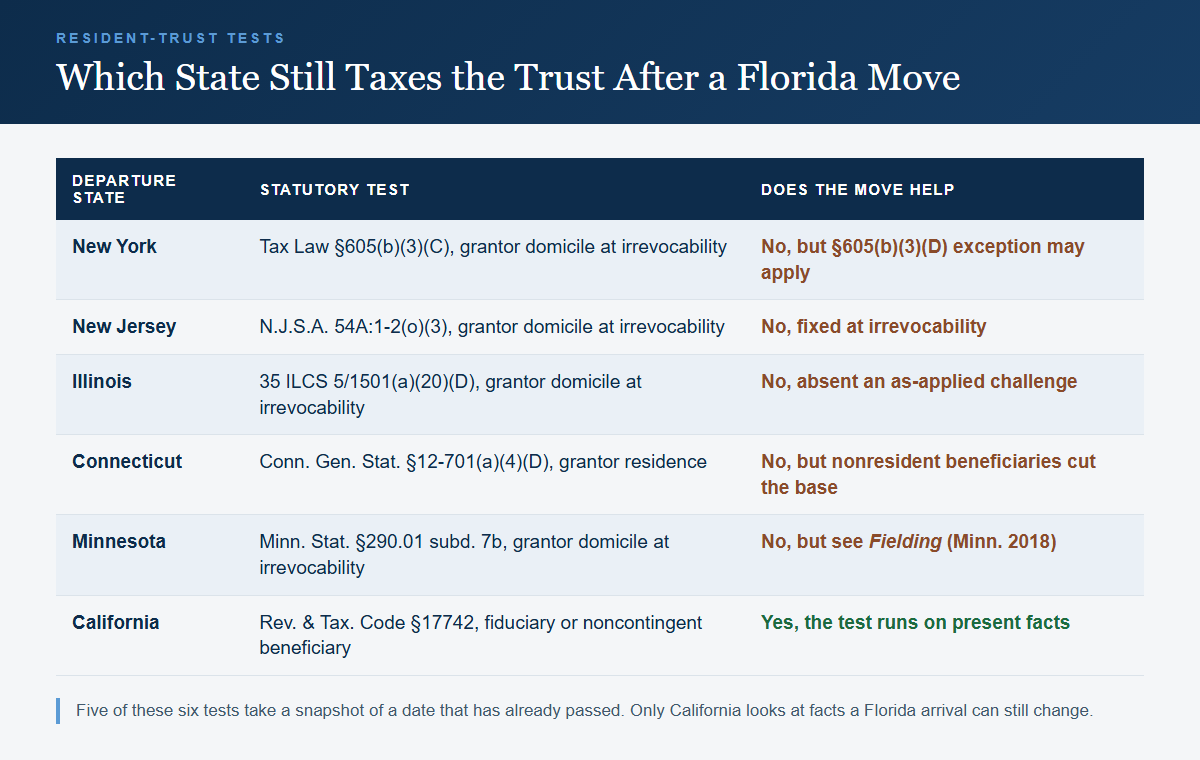
This is the point the general situs literature consistently skips. Almost every article ranking for this topic is written for someone deciding where to establish a new trust, and it compares Delaware, Nevada, South Dakota and Alaska on trust duration, privacy and asset protection. That is a real question, and it is not the question a Florida arrival is asking. Someone who has just completed a move already holds a trust that was drafted somewhere else, and the only thing that matters is whether the state left behind can still tax what that trust accumulates. One structure is handled by a separate California rule: since the 2023 taxable year, section 17082 taxes the income of an incomplete gift nongrantor trust to a resident grantor regardless of trustee or situs, as our guide to the NING trust explains.
| Departure state | Statutory test for a resident trust | Does moving to Florida help |
|---|---|---|
| New York | N.Y. Tax Law §605(b)(3)(C), grantor domiciled in New York when the trust became irrevocable | Not directly, although a three condition exception in §605(b)(3)(D) can remove the tax |
| New Jersey | N.J.S.A. 54A:1-2(o)(3), the same grantor-domicile structure as New York | Not by itself, because the classification is fixed at irrevocability |
| Illinois | 35 ILCS 5/1501(a)(20)(D), grantor domiciled in Illinois when the trust became irrevocable | Not by itself, although constitutional challenges have turned on present contacts |
| Connecticut | Conn. Gen. Stat. §12-701(a)(4)(D), grantor a Connecticut resident at transfer or at irrevocability | Not directly, although nonresident noncontingent beneficiaries reduce the Connecticut base |
| Minnesota | Minn. Stat. §290.01, subd. 7b, grantor domiciled in Minnesota at irrevocability for trusts irrevocable after 1995 | Not by itself, although a due process challenge succeeded in Fielding on that trust own facts |
| California | Cal. Rev. & Tax. Code §17742, residence of the fiduciary or of a noncontingent beneficiary | Yes, materially, because the test runs on present facts that can still be changed |
Does Florida Tax a Trust That Moves Here?
Florida imposes no income tax on natural persons, and its income tax on other entities under Chapter 220 reaches organizations treated as corporations, including common law declarations of trust under Chapter 609. An ordinary family trust holding marketable securities and real estate is not in that category. A trust that becomes a Florida trust therefore stops having a state level income tax home, which is the whole point of the exercise.
- The constitutional bar is explicit. Fla. Const. Art. VII, §5(a) prohibits a state tax on the income of natural persons who are residents or citizens of Florida beyond a federal credit amount that does not exist.
- Chapter 220 is aimed at business entities. Fla. Stat. §220.03 defines a corporation to include common law declarations of trust under Chapter 609, which are business trusts, not family estate planning trusts.
- Florida takes nothing from the trust when it arrives. There is no entry charge, no accession tax and no Florida estate tax, since the Florida estate tax applied only to deaths before 2005.
- Federal tax does not change at all. Under IRC §641 the trust still computes and reports its federal taxable income exactly as before, and the Form 1041 obligation is unaffected by any state situs question.
The reason this matters is arithmetic rather than principle. A trust accumulating investment income inside a state with a top marginal rate approaching double digits gives up a meaningful share of its compounding every year, and that loss is permanent. Removing a state layer, where it can be removed, is one of the few planning steps whose benefit repeats annually without requiring anything further to happen. It is also one of the few steps where the analysis is genuinely mechanical, since a statute either reaches the trust or it does not.
What Did the Kaestner Decision Actually Decide, and What Did It Leave Standing?
In 2019 the Supreme Court held unanimously that the presence of in-state beneficiaries alone does not empower a state to tax trust income that has not been distributed, where the beneficiaries have no right to demand that income and are uncertain to receive it. That is the entire holding. It did not address grantor-domicile statutes, trustee residence, or source income, and those regimes were left intact.
- The three facts the Court relied on. The beneficiaries received no income in the years at issue, had no right to demand income or to control the assets, and could not count on receiving any specific amount in the future.
- The Court was explicit about its narrowness. It observed that only a small handful of states rely on beneficiary residency as a sole basis for trust taxation, and fewer still do so regardless of whether the beneficiary is certain to receive anything.
- Grantor-domicile statutes were not before the Court. New York, New Jersey, Illinois and Connecticut all key off the grantor rather than the beneficiary, so nothing in Kaestner disturbs them on its face.
- A mandatory distribution changes the analysis. The holding turns on discretion and uncertainty, so a beneficiary with a right to demand income sits outside the facts the Court decided.
- State constitutional challenges continue separately. In Fielding v. Commissioner of Revenue (Minn. 2018), the Minnesota Supreme Court held the grantor-domicile statute unconstitutional as applied to trusts whose present contacts with Minnesota were minimal, which is an as-applied result rather than a general rule.
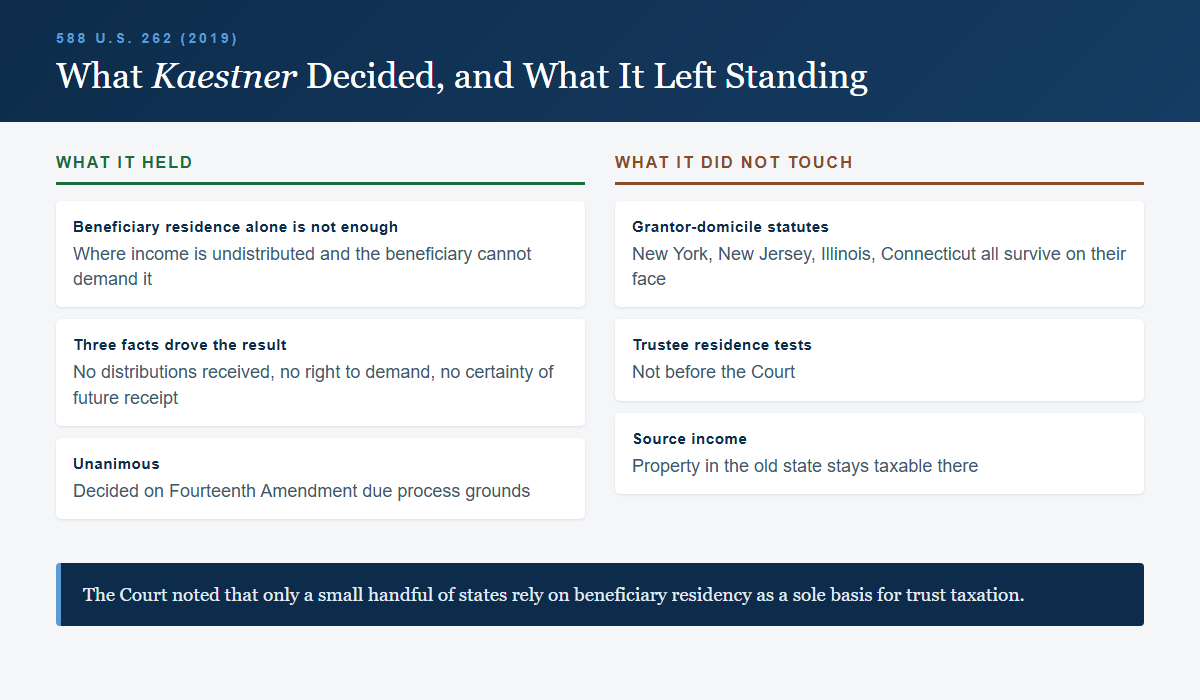
The practical reading is that Kaestner gave taxpayers a genuine constitutional argument and a narrow one. Where a state is taxing a discretionary trust purely because a beneficiary lives there, the case is close to dispositive. Where a state is taxing because the grantor lived there decades ago, the case supplies a framework about minimum connection but not an answer, and the outcome depends on how few present contacts the trust actually has with the taxing state. Anyone planning around it should treat it as a reason to build a clean record of present contacts with Florida, not as a reason to stop filing in the old state.
Georgia applies Kaestner narrowly. Its Department of Revenue treats a nonresident trustee as taxable unless the trust’s facts closely match the Kaestner facts, so a trust that moved its trustee to Florida but still distributes to a Georgia beneficiary may still owe a Georgia return. Our guide to Georgia Form 501 explains that filing and the part year return for the year of the move.
How Does New York Treat a Trust After the Grantor Moves to Florida?
New York keeps the resident trust label permanently, because N.Y. Tax Law §605(b)(3)(C) fixes it at the grantor domicile when the trust became irrevocable. What New York does provide is an exemption. Under §605(b)(3)(D) a resident trust is not subject to tax if all trustees are domiciled outside New York, the entire corpus is located outside New York, and all income and gains come from sources outside New York.
- All three conditions must be satisfied. The statute is written in the conjunctive, so failing any one of them puts the trust back into full New York taxation on its worldwide income.
- Intangible property follows the trustee. Section 605(b)(3)(D)(ii) provides that intangible property is located in New York if one or more trustees are domiciled in New York, which makes the trustee change the operative step rather than an optional one.
- The exemption is not permanent. It is tested year by year. Appointing a New York successor trustee, or acquiring a New York rental property, ends it prospectively.
- New York still requires a return. An exempt resident trust reports its position rather than disappearing, so the filing does not stop even when the tax does.
- The throwback reaches the beneficiary, not the trust. N.Y. Tax Law §612(b)(40) adds an accumulation distribution from an exempt resident trust back into the income of a New York resident beneficiary, using the framework of IRC §667.
That last item is the piece most commonly missed, and it cuts in the taxpayer favor for the family this article is written for. The New York addback applies to a beneficiary who is a New York resident, and it expressly disregards income the trust earned in any year before that beneficiary first became a New York resident, and any year beginning before 2014. If the grantor has moved to Naples and the children have also left New York, there is no New York resident beneficiary for the throwback to reach. The exemption then delivers what it appears to deliver. If one child remains in Manhattan, the accumulated income is waiting for that child rather than being forgiven, and the distribution planning matters more than the exemption does.
This interacts directly with the departure analysis itself. Whether New York accepts that the grantor actually left is a separate fight with its own evidentiary standards, covered in our guides to the New York exit tax and the New York residency audit. The trust question sits on top of that one, because a failed domicile change makes every trust step below it irrelevant.
How Does California Reach a Trust With No California Grantor?
California ignores the settlor entirely. Under Cal. Rev. & Tax. Code §17742, the entire taxable income of a trust is subject to California tax if the fiduciary or a noncontingent beneficiary is a California resident, regardless of the residence of the settlor. A trust drafted in Florida by a Florida grantor can therefore be taxed by California because one trustee or one vested beneficiary lives there.
- A contingent beneficiary does not count. The statute excludes a beneficiary whose interest in the trust is contingent, which makes the vesting language in the trust instrument the operative fact.
- Corporate trustee residence has its own rule. Section 17742(b) locates a corporate fiduciary where it transacts the major portion of its administration of the trust.
- Multiple fiduciaries are apportioned. Section 17743 apportions the taxable income according to the number of fiduciaries resident in California.
- Multiple beneficiaries are apportioned differently. Section 17744 apportions according to the number and the interest of the California resident beneficiaries, which is a different formula from the fiduciary rule.
- This is the one test a move can genuinely fix. Replacing a California trustee, or the passage of time that changes which beneficiaries are noncontingent, changes the California answer prospectively.
The California structure is worth understanding even for families with no California connection, because it demonstrates why a single national answer to the situs question does not exist. New York asks who created the trust and when. California asks who administers it and who is entitled to it now. Connecticut asks the New York question and then reduces the base for nonresident noncontingent beneficiaries under Conn. Gen. Stat. §12-701(a)(4). A step that solves one of these can be irrelevant to another and can make a third worse. Families with California income exposure alongside the trust question should also review how the state defines California source income, since that analysis runs independently of the resident-trust test.
Does It Matter Whether the Trust Is a Grantor Trust?
It matters more than any other single fact, and it is the question that decides whether there is a problem at all today. While a trust is a grantor trust under IRC §671 and the sections following it, its income is reported by the grantor rather than by the trust. If the grantor now lives in Florida, that income has no state tax home. The state level problem appears at the moment the trust stops being a grantor trust.
- A revocable living trust is a grantor trust. For as long as the grantor can revoke it, the income belongs to the grantor for federal purposes and follows the grantor domicile.
- Death is the usual trigger. The trust becomes irrevocable at the grantor death, and that is typically the moment a resident-trust statute takes its snapshot.
- Some statutes say this expressly. Both 35 ILCS 5/1501(a)(20)(D) and Minn. Stat. §290.01, subd. 7b, treat a trust as irrevocable only to the extent the grantor is not treated as the owner under IRC §§671 to 678.
- Which state is looked at is decided then. A grantor who becomes a Florida domiciliary before the trust becomes irrevocable can change the answer permanently. A grantor who waits cannot.
- Releasing a power has the same effect as death. Giving up a power of substitution or a power to revoke starts the clock in exactly the same way, and the timing is controllable.
This is the sequencing point that turns a general article into an actionable one. A couple who moved to Naples in 2024 and holds a revocable trust drafted in Illinois in 2011 has, on those facts, no Illinois fiduciary income tax problem right now, because the trust is a grantor trust and the income is reported on their own return. The exposure crystallizes at the first death. If the domicile change is complete and documented before then, 35 ILCS 5/1501(a)(20)(D) looks at an Illinois grantor who is no longer an Illinois domiciliary and finds nothing. If the move is still contested when that day arrives, the trust may be an Illinois resident trust for the rest of its existence. The order of events, not the paperwork, is what decides it, which is why the Florida residency record and the day count behind it carry consequences well beyond the year of the move.
How Do You Actually Move a Trust Situs to Florida?
Fla. Stat. §736.0108 supplies the mechanism. A trustee is under a continuing duty to administer the trust at a place appropriate to its purposes, and may transfer the principal place of administration to another state without court approval. The trustee must notify the qualified beneficiaries at least 60 days before initiating the transfer, and that authority is suspended if a qualified beneficiary files suit objecting by the stated date.
- The notice has five required contents. Section 736.0108(6) requires the name of the destination jurisdiction, the new address and telephone number, an explanation of the reasons, the anticipated date, and the objection deadline.
- Trust property can move with the administration. Section 736.0108(8) allows the trustee to transfer trust property to a successor trustee designated in the trust terms or appointed under Fla. Stat. §736.0704.
- A governing law change is a different act. Fla. Stat. §736.0107 requires a sufficient nexus for a designation, and changing the designation generally requires a modification, a reformation or an express power in the instrument.
- Decanting is the heavier tool. Where the instrument does not allow what is needed, distributing to a new trust under the Florida decanting statute may reach the same place, with its own federal gift and generation skipping consequences, worked through in our guide to the tax consequences of decanting a trust.
- Counsel executes all of this. Trust modification, trustee appointment and decanting are legal acts. This article addresses the tax consequences, and the instruments themselves belong with a Florida trusts and estates attorney.
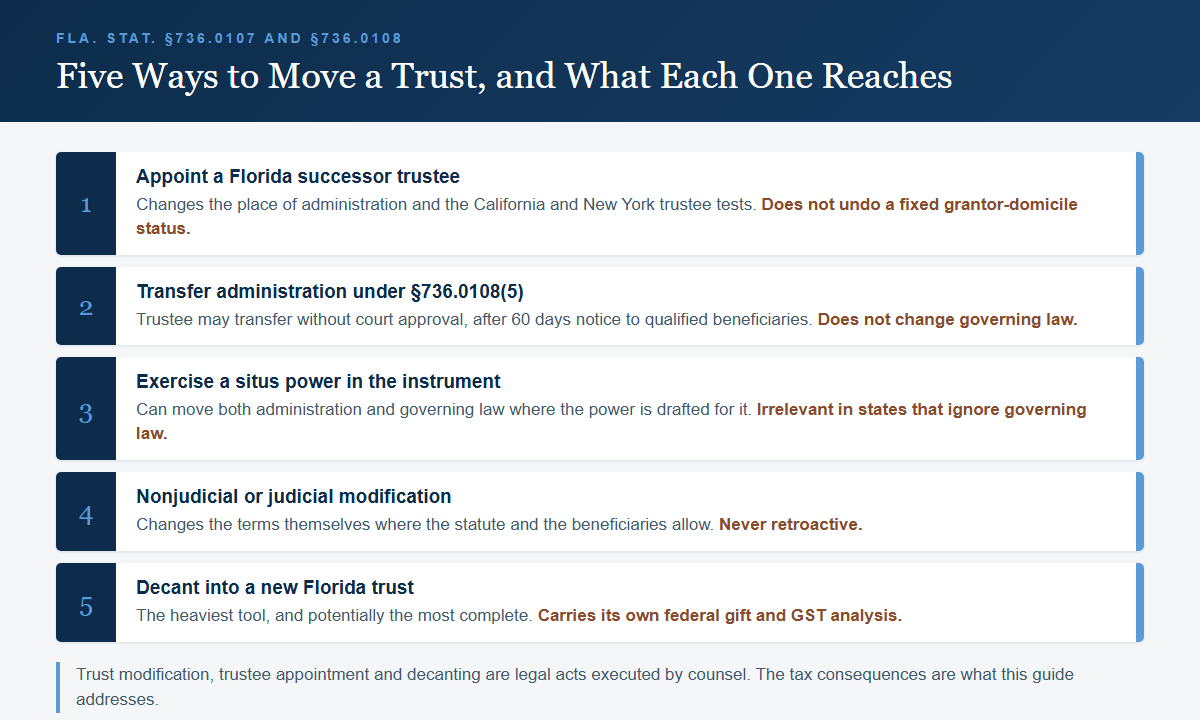
| Mechanism | What it changes | What it does not change |
|---|---|---|
| Appointing a Florida successor trustee | Principal place of administration, and the California and New York trustee tests | A grantor-domicile classification already fixed |
| Transfer of principal place of administration under §736.0108(5) | Where administration occurs, subject to the 60 day notice | Governing law, and any historical resident-trust status |
| Exercising a situs or governing law power in the instrument | Both administration and governing law, if the power is drafted that way | Tax residence in states that never look at governing law |
| Nonjudicial or judicial modification | The terms themselves, where the statute and the beneficiaries permit it | Prior year filings and any assessment already outstanding |
| Decanting into a new Florida trust | Potentially everything prospectively, depending on the new instrument | Nothing retroactive, and it carries its own federal gift and GST analysis |
What Does Changing Situs Not Fix?
It does not undo a resident-trust classification that a statute fixed at creation or at irrevocability, it does not remove income sourced to another state, it does not change the governing law unless that is separately addressed, and it does nothing about prior years. Every one of those limits is routinely misunderstood, and each of them survives a perfectly executed situs transfer.
- Historical tests stay historical. New York, New Jersey, Illinois, Connecticut and Minnesota all look backward. A trustee in Naples does not change what the grantor domicile was on the date the trust became irrevocable.
- Source income is untouched. Rent from a building in Chicago, or gain on its sale, remains Illinois source income and continues to require a nonresident fiduciary return.
- Open years remain open. A transfer today has no effect on assessments, notices or unfiled returns for earlier years, which have to be resolved on their own terms.
- Beneficiary residence can create new exposure. A California resident beneficiary whose interest vests brings California into the picture for the first time, no matter where the trust is administered.
- Documentation still decides audits. A situs change that exists only on paper, with the records and the real decision making still in the old state, is the version that fails on examination.
The honest summary is that a situs change is worth doing where a statute makes it relevant, and is close to cosmetic where a statute does not. That is not an argument against doing it. Administration in the state where the family actually lives is easier, cheaper and more responsive, and it removes the trustee prong from any state that has one. It is an argument against expecting it to solve a problem it was never capable of solving. Families whose broader concern is creditor exposure rather than income tax should also read our guide to Florida asset protection for new residents, which runs on entirely different statutes and different timing rules.
What Should You Gather Before Anyone Can Answer This?
Five items decide the analysis, and none of them requires a professional to assemble. The trust instrument with every amendment, the date the trust became irrevocable, the grantor domicile on that exact date, the current trustees and the states where they live and work, and the beneficiary list showing whose interest is vested rather than contingent. The last three fiduciary returns close the picture.
- The instrument and all amendments. The governing law clause, any situs or transfer power, and the distribution standard that decides contingency all live in the document.
- The irrevocability date. For a testamentary trust it is the date of death. For an inter vivos trust it is the date the power to revoke ended, which may be a release rather than a death.
- The grantor domicile on that date. Not where the grantor lived when the trust was signed, and not where the grantor lives now, but the domicile at the moment the statute takes its snapshot.
- Trustee list with states. Both residence and principal place of business matter, and they can differ for a professional or corporate trustee.
- Beneficiary list with vesting status. California turns on whether an interest is contingent, and Connecticut reduces its base for nonresident noncontingent beneficiaries.
- The last three Forms 1041 and the state fiduciary returns. These show which states the trust has been filing in and what position has already been taken.
Assembling that list is often the whole engagement. In practice the common finding is not an aggressive planning opportunity but a mismatch, where a trust has been filing as a resident of a state whose statute no longer reaches it, or has stopped filing in a state whose statute still does. Both are correctable going forward, and both are cheaper to find deliberately than to have found for you. Where the trust also holds property in the departure state, the related question of the ongoing nonresident filing is covered in our guide to the nonresident state tax return after a move.
Trust Situs Help in Naples & Southwest Florida
Tax Expert Today LLC works with individuals, families and trustees who have relocated to Florida from New York, New Jersey, Illinois, Connecticut, California and other high tax states, and who are carrying a trust that was drafted somewhere else. The firm brings together tax advisors, enrolled agents, CPAs and attorneys, and handles residency and multistate tax matters nationwide. Southwest Florida draws heavily from exactly the states whose resident-trust statutes reach backward, so this pattern is familiar ground here.
Our office is located at 11983 Tamiami Trail N, Naples, Florida 34110. You can reach us at (239) 441-2005, Monday through Friday, 10am to 5pm ET. We also work with clients across all 50 states.
- Trust situs review Naples: reading the instrument against the departure state statute to establish whether the trust is still a resident trust there, and whether any lever remains.
- Estate and trust planning Naples FL: coordinating the situs question with the wider plan, described further on our estate and trust planning page and in our guide to Florida estate planning for new residents.
- Florida residency Naples FL: building and preserving the domicile record that decides whether the grantor side of the analysis holds, including the issues raised in a Florida residency audit and in the dual residency trap.
- Tax planning Naples FL: sequencing a trustee change, a distribution or a release of a power against the moment a statute takes its snapshot, described on our Naples tax planning page.
- Tax resolution Naples: unfiled fiduciary years, late state filings and notices, described on our Naples tax resolution page and on our resolution and audit support page.
- Statewide and nationwide: multistate fiduciary work handled from Naples for clients across Florida and the country.
We moved from Westchester to Naples four years ago and our trust still files a New York return every year. Is that right?
It may well be correct, and it may also be correcting itself already. If the trust is still revocable, it is a grantor trust and the income belongs on your own return, so a New York resident fiduciary return would be unusual on those facts. If the trust became irrevocable while you were still domiciled in New York, it is permanently a New York resident trust under N.Y. Tax Law §605(b)(3)(C), and the question becomes whether it qualifies for the exception in subparagraph D. That requires every trustee to be domiciled outside New York, the entire corpus to be outside New York, and all income and gains to come from non New York sources. A single New York trustee defeats it, and under subparagraph D(ii) that trustee also pulls the intangible property back into New York. The return does not stop even when the exception applies, because an exempt resident trust still reports. What we would want to see first is the trustee list, the irrevocability date and the last three returns.
When to Engage a Professional
Much of this is diagnosis rather than planning, and the diagnosis is often within reach of an organized trustee working from the statute of a single departure state. A revocable trust with a Florida grantor, a Florida trustee and no out of state property rarely presents a question at all. An irrevocable residence trust raises a different Florida question altogether, because the ad valorem homestead exemption turns on a beneficial interest for life rather than the term of years a qualified personal residence trust retains.
Consider engaging an advisor when any of the following is present: the trust is irrevocable and the grantor was domiciled in a grantor-domicile state at that moment, so the classification is fixed and the analysis turns on an exception rather than on a move; a trustee or a noncontingent beneficiary lives in California, where the test runs on present facts and a change has immediate consequences; the grantor is still living and a release of a power or a change in the instrument is under consideration, where the sequencing against the domicile change is the whole question; the trust holds real property in the departure state, so a nonresident fiduciary filing continues regardless of situs; a state notice or an unfiled fiduciary year is outstanding, which is a resolution matter and not a planning one; or a decanting or modification is being considered, where the federal gift and generation skipping consequences need to be priced before the instrument is signed. How those generation skipping rules apply to a trust built to last for many generations is covered in our guide to the dynasty trust.
The firm brings together tax advisors, enrolled agents, CPAs and attorneys and works with clients nationwide from its Naples office. If you have relocated to Southwest Florida and are carrying a trust drafted in a state you have left, call (239) 441-2005 or use our contact page to arrange a consultation. Outcomes depend on the specific facts, and nothing here is a prediction about any particular trust.
This article is educational and general in nature. It is not legal, tax or accounting advice, and it does not create a professional relationship. State law changes and applies differently to different facts. Trust modification, trustee appointment and decanting are legal acts that should be handled with a qualified Florida trusts and estates attorney. Please consult a qualified advisor about your own situation.
Published September 5, 2026 by Dr. Pellumb Kabashi « Back to Learning Center
Have a question this article touches on?
Tax Expert Today LLC, based in Naples, Florida and serving clients across the United States.
Schedule a Consultation (239) 441-2005