
By Dr. Pellumb Kabashi, DBA, MBA, CES, CFE, EA
Founder, Tax Expert Today LLC · Tax advisors, enrolled agents, CPAs, and attorneys · Serving clients in all 50 states
Quick answer: Leaving California taxes behind is not a single event and not an exit fee. It is a process of breaking California residency under Revenue and Taxation Code section 17014, cutting your closest connections to the state, filing a final part-year return on Form 540NR, and continuing to report any California source income you keep. The Franchise Tax Board decides residency on the facts, so a documented, deliberate departure is what protects you.
Every year a large number of residents look into leaving California taxes behind by moving to a no income tax state such as Florida, Texas, or Nevada. The move can work, and for many households it saves a meaningful amount. What surprises people is that California does not simply wave goodbye. The Franchise Tax Board, the state agency that administers personal income tax, keeps the right to tax you until you have genuinely broken residency, and it keeps the right to tax certain California source income long after you are gone. This article is the practical departure checklist: the steps to sever residency, the factors the Franchise Tax Board weighs, the final return you file, and the records that protect you if the state asks questions later.
One clarification first, because the search results are crowded with it. There is no enacted California exit tax or wealth tax. Bills that proposed one never became law. We covered that myth in detail in our companion article on the California exit tax, myths versus reality. This piece assumes you already know there is no departure fee and focuses on what actually matters: doing the move correctly.
What does leaving California taxes actually mean?
Leaving California taxes means changing your legal residency so that California can no longer tax your worldwide income. Under Revenue and Taxation Code section 17014, a resident is someone in California for other than a temporary purpose, or someone domiciled in California who is outside the state for a temporary purpose. Until you break both tests, California treats you as a resident and taxes everything you earn, wherever you earn it.
Two concepts drive the whole analysis. Residency is about where you are present and for what purpose. Domicile is your true, fixed, permanent home, the place you intend to return to whenever you are away. You can have only one domicile at a time. Moving your body to Florida is not enough on its own. You have to move your domicile, and you have to be able to show that you did. The Franchise Tax Board explains the framework in Publication 1031, which is the single most useful document to read before you move.
What is the departure checklist for breaking California residency?
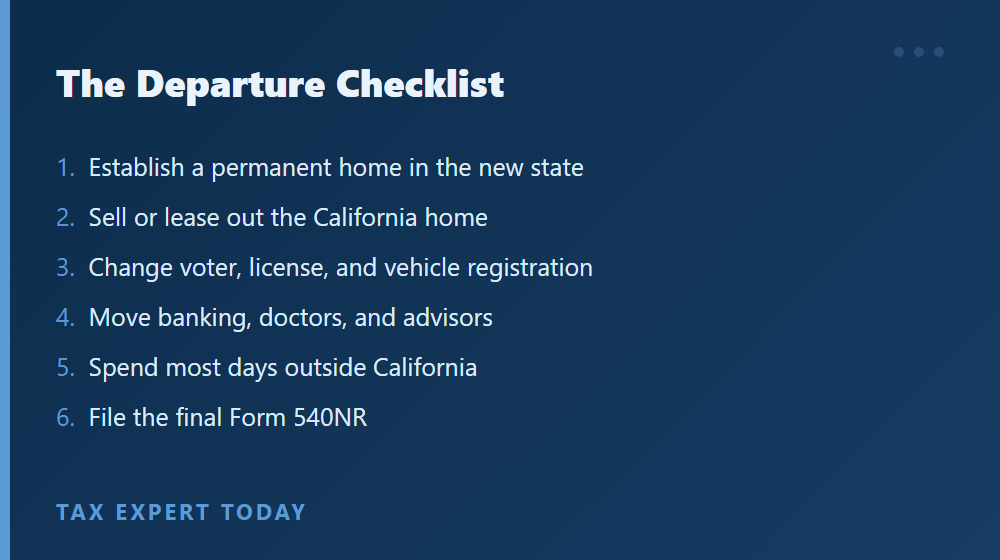
Breaking California residency is a list of concrete actions that together show a permanent move. No single item is decisive, and no single item is required by statute. The Franchise Tax Board looks at the whole picture, so the goal is to line up as many connections as possible in your new state and close as many as possible in California. The table below is the working checklist.
| Action | Why it matters | Document to keep |
|---|---|---|
| Establish a permanent home in the new state | The location of your primary residence is a leading connection factor | Deed, lease, closing statement, utility accounts |
| Sell or lease out the California home | A retained, available California home is a strong resident signal | Sale closing or a bona fide arms length lease |
| Register to vote and change your driver license | Voter and license state show declared intent | New registration cards, surrendered California license |
| Register vehicles in the new state | Vehicle registration location is a tracked factor | New titles and registrations |
| Move banking, doctors, and professional advisors | The location of your financial and personal relationships weighs heavily | New account statements, new provider records |
| File a Florida Declaration of Domicile | A recorded sworn statement of your new permanent home | Recorded declaration from the county clerk |
| Update address on tax, employer, and benefit records | Consistency across every record supports the move | Payroll, IRS, Social Security, insurance updates |
| Spend the majority of your days outside California | Time and physical presence is a core factor the state counts | Calendar, travel records, cell and toll data |
| File the final California part-year return on Form 540NR | Closes your resident period and reports the departure | Filed Form 540NR for the move year |
Florida makes several of these steps straightforward. A Declaration of Domicile under Florida Statutes section 222.17 is a recorded sworn statement that Florida is your permanent home, and it pairs naturally with the arrival side of the move. Our guide to establishing Florida residency covers the arrival checklist in full. The point of the corridor is that both ends have to line up.
How does California decide whether you truly left?
California decides residency by weighing your connections to the state against your connections to your new home, an approach the State Board of Equalization set out in the Appeal of Bragg and the Franchise Tax Board summarizes in Publication 1031. There is no single day count that settles it. The state looks at the closest connections you keep, and it compares the two states side by side.
The factors the Franchise Tax Board weighs include the ones in the table below. Our companion guide to moving from California to Florida taxes covers what the receiving state changes once those factors point to Florida. None of them is a bright line, and the state does not add them up mechanically. A person who spends most of the year in Florida but keeps a California home, California doctors, and California club memberships can still be found to be a California resident, because the closest connections remained in California.
| Connection factor | What the Franchise Tax Board looks for |
|---|---|
| Home | Where your primary residence is, and whether a California home stays available to you |
| Time | Where you spend the greatest number of days across the year |
| Family | Where your spouse and dependent children live and go to school |
| Professional and financial ties | Where your bank, advisors, doctors, and business interests are |
| Registrations | Where your voter registration, driver license, and vehicles are |
| Social ties | Where your memberships, community, and religious affiliations are |
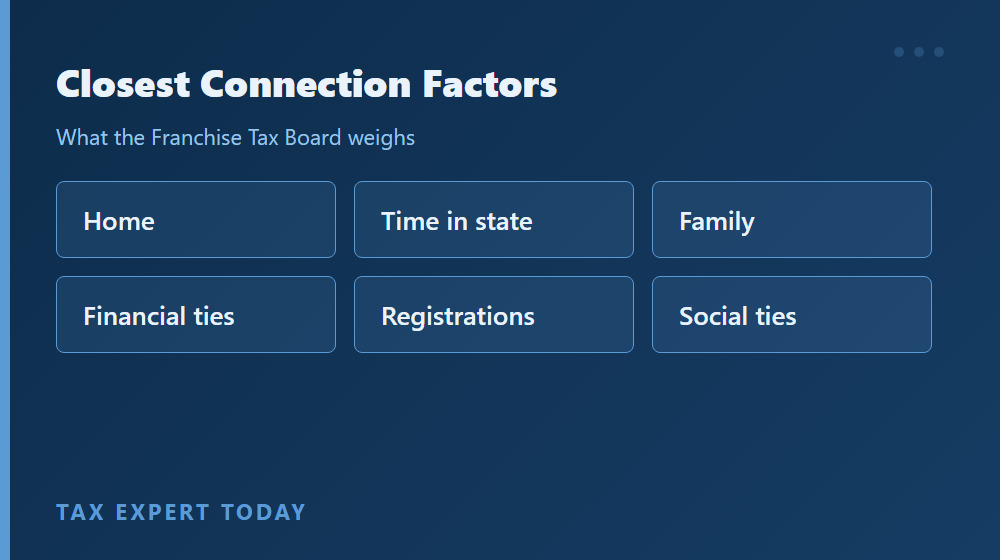
The lesson from the factor list is consistency. The strongest departure is one where every factor points the same direction. A move that leaves half the connections in California invites a second look, and the burden of proving the change falls on you, not on the state.
What California income still gets taxed after you move?
Even a clean departure does not end California tax on income that has a California source. Under Revenue and Taxation Code section 17952 and the sourcing rules the Franchise Tax Board applies, a nonresident still owes California tax on income earned from California sources. Breaking residency stops tax on your worldwide income, not on income the state can trace back to activity inside its borders.
Common categories of California source income that follow a former resident include the items below.
- California real estate. Rent from a California property and gain on its sale remain California source income while you own it.
- California business income. Income from a business, partnership, or S corporation operating in California is sourced to California.
- Deferred and equity compensation. Stock options, restricted stock units, and deferred pay earned for California workdays are allocated to California even if they vest or pay out after you leave.
- Installment sale gain. If you sell a California asset on an installment note, the trailing payments keep their California character.
Two important limits work in your favor. Federal law at 4 U.S.C. section 114 bars any state from taxing the retirement income of a former resident, so California cannot reach your pension or qualified plan distributions once you live elsewhere. And intangible income such as interest and dividends generally follows you to your new state rather than staying with California. The nuance is in the timing and the workday allocation, which is exactly where careful planning before the move pays off. Our companion pieces on timing a business sale around a move and executive equity compensation after a move go deeper on those two categories. A smaller item that changes with residence is a health savings account, which California taxes every year while you live there; our guide to the California HSA tax explains what stops after the move. A net operating loss carryover also changes at the move, and our guide to the California NOL suspension explains how it is restated and what it can still offset.
How do you file taxes in the year you leave California?
In the year you move, you file a part-year resident return on Form 540NR. The return splits the year into two parts: the period you were a California resident, when California taxes your worldwide income, and the period after you left, when California taxes only your California source income. The Form 540NR booklet walks through the allocation. Our dedicated guide to California part year resident tax works through the form line by line.
A few mechanics matter in the move year. Your California taxable income is computed as if you were a resident all year, then prorated by a ratio of California source income to total income, so the rate that applies reflects your full income even though only part is taxed. Set your departure date carefully and keep evidence for it, because that date is the line between the two periods. If you sell your California home as part of the move, the buyer or escrow may withhold under the real estate withholding rules on Form 593, and you reconcile that withholding on the return.
What records should you keep to survive a residency audit?
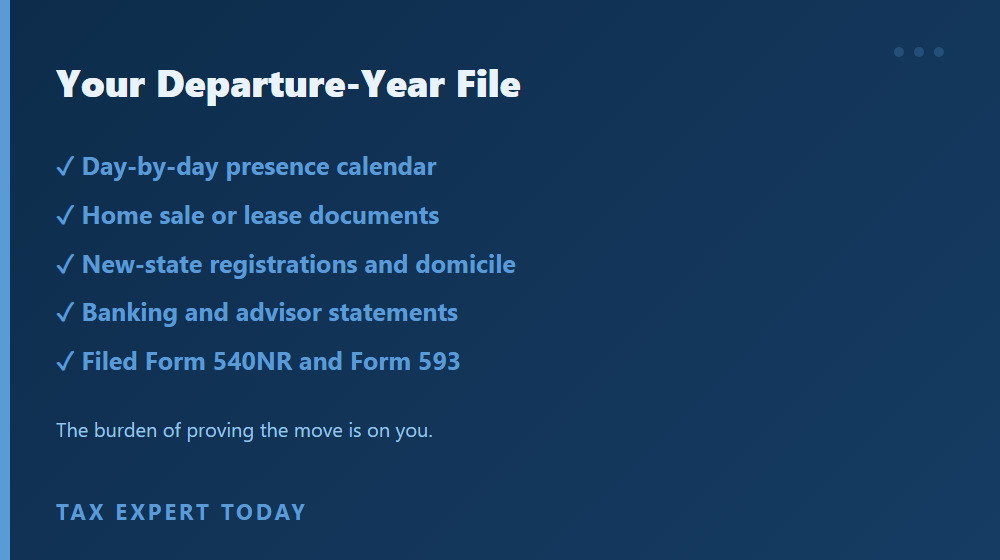
Keep records that prove both where you were and what you intended, because in a Franchise Tax Board residency audit the burden of showing the change of domicile is on you. The state can question a move for years afterward, and memory is not evidence. Contemporary documents are.
A defensible file for a departure year usually includes the following. For how the examination itself unfolds, from the first contact letter through the Notice of Proposed Assessment, see our guide to the California residency audit.
- A day-by-day calendar for the year, supported by travel, toll, and card records that show physical presence outside California.
- The closing or lease documents for both the California home you left and the new home you established.
- New-state voter registration, driver license, vehicle registrations, and a recorded Declaration of Domicile.
- Statements showing that banking, advisors, and medical care moved to the new state.
- The filed Form 540NR for the move year and any Form 593 withholding records.
Our companion article on defending a residency move in an audit explains what triggers a review and how the process runs. The best time to build the audit file is during the move, not after a notice arrives.
What are the most common mistakes when leaving California?
The most common mistakes in leaving California taxes are half measures: moving physically while keeping the connections that define residency. California residency turns on the whole set of facts, so a move that leaves the home, the family, or the closest ties in California often fails, and the failure is expensive because it exposes worldwide income for the entire year.
The recurring problems we see include keeping a California home available for personal use, leaving a spouse or school-age children in California while one person claims to have moved, spending more days in California than in the new state, and failing to change registrations and financial relationships. Another is treating the move as instantaneous. Domicile changes on a date you can prove, so a vague plan to relocate over time leaves the departure date unclear and the resident period open. The fix for all of these is the same: a deliberate, documented move where every factor points to the new state.
Leaving California Taxes Help in Naples & Southwest Florida
Tax Expert Today is a multidisciplinary advisory firm based in Naples, Florida, and we help clients handle state residency and tax matters nationwide, including departures from California to Florida and other no income tax states. Our team of tax advisors, enrolled agents, CPAs, and attorneys plans the departure, prepares the final Form 540NR, and builds the documentation file that supports the move. For clients arriving in Southwest Florida, we handle both ends of the corridor, the California exit and the Florida arrival, as one engagement.
Tax Expert Today LLC
11983 Tamiami Trail N, Naples, FL 34110
Phone: (239) 441-2005
Hours: Monday to Friday, 10:00 a.m. to 5:00 p.m. ET
Local question: Can you help if I am moving from California to Naples this year? Yes. We regularly guide households relocating to Collier and Lee County from California, coordinating the California part-year return, the Florida Declaration of Domicile, and the connection changes so the departure holds up. See our Naples tax planning and California tax services pages.
Frequently Asked Questions
Is there a fee or tax just for leaving California?
No. California has no enacted exit tax or wealth tax, and no fee applies simply because you move. What you owe comes from residency for the part of the year you lived there and from any California source income you keep. The proposed wealth tax bills never became law.
How long does it take to break California residency?
Residency changes on the date you establish a new permanent home and sever your California ties, not after a fixed waiting period. There is no set number of months. The date you can prove with documents is the date your resident period ends, so a clean, well documented move can take effect immediately.
Do I still file a California return after I move?
In the move year you file a part-year return on Form 540NR. In later years you file a California nonresident return only if you still have California source income, such as rent from a California property or California workday compensation. With no California source income, no further California return is required.
Can California audit my move years later?
Yes. The Franchise Tax Board can review a claimed change of residency for years after the fact, and the burden of proving the move is on you. That is why a contemporaneous file of presence, registrations, and home records built during the move year is the best protection.
Does California tax my retirement income after I leave?
No. Federal law at 4 U.S.C. section 114 bars any state from taxing the retirement income of a former resident. Once you live in another state, California cannot tax your pension or qualified retirement plan distributions, even though the income relates to California work.
When to Engage a Professional
The stakes in leaving California taxes rise with the size of the year, so consider professional guidance when your departure involves a home sale, a business, equity compensation, or a high income year, because those are the situations where a residency challenge is most likely and most costly. A planned move that sequences the departure date, the final return, and the documentation reduces the risk that California treats you as a resident after you believe you have left. Tax outcomes depend on your specific facts, and this article is educational rather than advice for any particular situation. An unpaid California balance does not lapse on departure, and our guide to the FTB installment agreement explains the twenty year collection window that continues to run after a move. Our guide to the FTB levy covers which California collection tools still reach a taxpayer who has moved to Florida.
If you are planning a move out of California or want your departure year reviewed before you file, our team can help. Call (239) 441-2005 or visit If a California balance from the departure year is still unpaid, see our guide to the California late payment penalty.
Published July 21, 2026 by Dr. Pellumb Kabashi « Back to Learning Center
Have a question this article touches on?
Tax Expert Today LLC, based in Naples, Florida and serving clients across the United States.
Schedule a Consultation (239) 441-2005