
By Dr. Pellumb Kabashi, DBA, MBA, EA, CFE, CES
Founder, Tax Expert Today LLC · Tax advisors, enrolled agents, CPAs, and attorneys · Serving clients in all 50 states
Quick Answer: IRS Letter 6174 is an educational “soft letter” telling you the IRS has information that you held virtual currency. It alleges no error and says you do not need to respond. Letter 6174-A is a firmer version, and Letter 6173 does require a reply. If past crypto was misreported, amending before any examination contact can keep the 20 percent accuracy penalty off the added tax. Call (239) 441-2005 for a free consultation.
What is IRS Letter 6174?
IRS Letter 6174 is an educational notice titled “Reporting Virtual Currency Transactions.” It tells you the IRS has information that you have or had an account holding virtual currency, explains how crypto must be reported, and asks you to amend if you misreported. The letter itself says you do not need to respond to it.
Most IRS letters are about a specific number. A CP14 says you owe a balance, a CP2000 says your return does not match a Form 1099, and a notice of deficiency says the IRS has decided you owe more tax. IRS Letter 6174 does none of that. It does not name a tax year, does not propose a dollar amount, and does not state that anything is wrong. Its opening line says the IRS has information that you have or had one or more accounts containing virtual currency “but may not know the requirements” for reporting it. The rest of the letter is a short tax lesson: virtual currency is property, sales and exchanges must be reported, crypto received for services is income, and the common schedules are C, D, and E.
That makes IRS Letter 6174 unusual, and it is why the letter generates so much confusion. A reader who receives it often expects a demand and finds a reminder. The useful way to read the letter is as a signal about what the IRS already knows. The agency does not send this letter at random. It sends it because a data source, usually an exchange or a broker, connected your name and taxpayer identification number to digital asset activity. Whether the letter matters to you depends entirely on whether your past returns reported that activity correctly.
- What it is: an educational “soft letter” in the IRS virtual currency compliance program.
- What it says: the IRS has information you held virtual currency and may not know the reporting rules.
- What it asks: amend or file returns if you did not report crypto accurately.
- What it does not do: propose a tax, start a deadline, or open an examination on its face.
- What to write on any amended return: “Letter 6174” at the top of the first page.
This guide is written for the person holding the letter. It explains how IRS Letter 6174 differs from Letter 6174-A and Letter 6173, why you received it, how to check your past returns, and the timing question that the ranking pages on this topic tend to skip: what amending now does to the accuracy penalty, and which events can close that window. It also covers how Form 1099-DA, the new broker form for digital assets, changes the matching the IRS can do from here on.
Is IRS Letter 6174 real or a scam?
The genuine IRS Letter 6174 is a real IRS form, catalog number 72273Z, and the IRS publishes its text on IRS.gov. It never asks you to register crypto, scan a QR code, or enter wallet keys. In 2026 the IRS warned about a fake “Digital Assets Compliance Portal” letter that does exactly that.
The first question is not what the letter means but whether it came from the IRS at all. Crypto holders are an attractive target for fraud because a stolen seed phrase or exchange login can empty an account in minutes. The IRS has said publicly that it is not sending letters asking taxpayers to register digital assets on a “compliance portal.” The IRS Digital Assets page carries a scam alert stating that if you receive a letter with a QR code that claims to be from the IRS and asks you to register your cryptocurrency on a compliance portal, you should not respond, because the IRS does not require registration of digital assets.
Compare what you hold against the published text. The real Letter 6174 carries the form number and revision date in the footer, explains Schedules C, D, and E, lists IRS publications and instructions, gives a hotline number to leave a message, and states that you do not need to respond. It asks for nothing except, if needed, an amended or delinquent return mailed to an IRS address. Our guide to a certified letter from the IRS covers how to confirm any IRS letter is genuine through your IRS online account or a phone number taken from IRS.gov rather than from the letter.
| Feature | Genuine IRS Letter 6174 | Red flag of a fake |
|---|---|---|
| Response | States you do not need to respond | Demands enrollment or registration by a deadline |
| QR code or portal | None | QR code to a “compliance portal” |
| What it asks for | An amended or delinquent return, only if needed | Wallet addresses, seed phrases, exchange logins |
| Where returns go | An IRS mailing address printed in the letter | A website or an email address |
| Payment | Asks for no payment | Asks for payment, often in crypto or gift cards |
- Never scan a QR code on a letter you have not verified.
- Never share a seed phrase or private key with anyone; the IRS has no use for one.
- Check your IRS online account for notices issued in your name.
- Report suspected fakes through the IRS phishing reporting channels listed on IRS.gov.
What is the difference between IRS Letter 6174, 6174-A, and 6173?
All three are virtual currency letters the IRS began mailing in July 2019. Letter 6174 says you may not know the reporting rules. Letter 6174-A says you may not have properly reported. Letter 6173 says the IRS has not received a return or schedule reporting your crypto and sets a “respond by” date.
The IRS announced the three versions together in News Release IR-2019-132, stating that more than 10,000 taxpayers would receive one of them by the end of August 2019 and that the names came from ongoing IRS compliance efforts. The letters share most of their text. The differences are in the first paragraph and in what the IRS asks you to do, and those differences tell you how far along the IRS is in looking at you.
| Letter | Opening statement | Response required? | Deadline | What to write on an amended return |
|---|---|---|---|---|
| Letter 6174 | You “may not know the requirements” for reporting virtual currency | No; the letter says you do not need to respond | None | “Letter 6174” |
| Letter 6174-A | You “may not have properly reported” virtual currency transactions | No | None | “Letter 6174-A” |
| Letter 6173 | The IRS has not received a return or schedule reporting your virtual currency for certain years | Yes: file, amend, or send a signed statement of facts | A “respond by” date; a 30 day extension can be requested | “Letter 6173” |
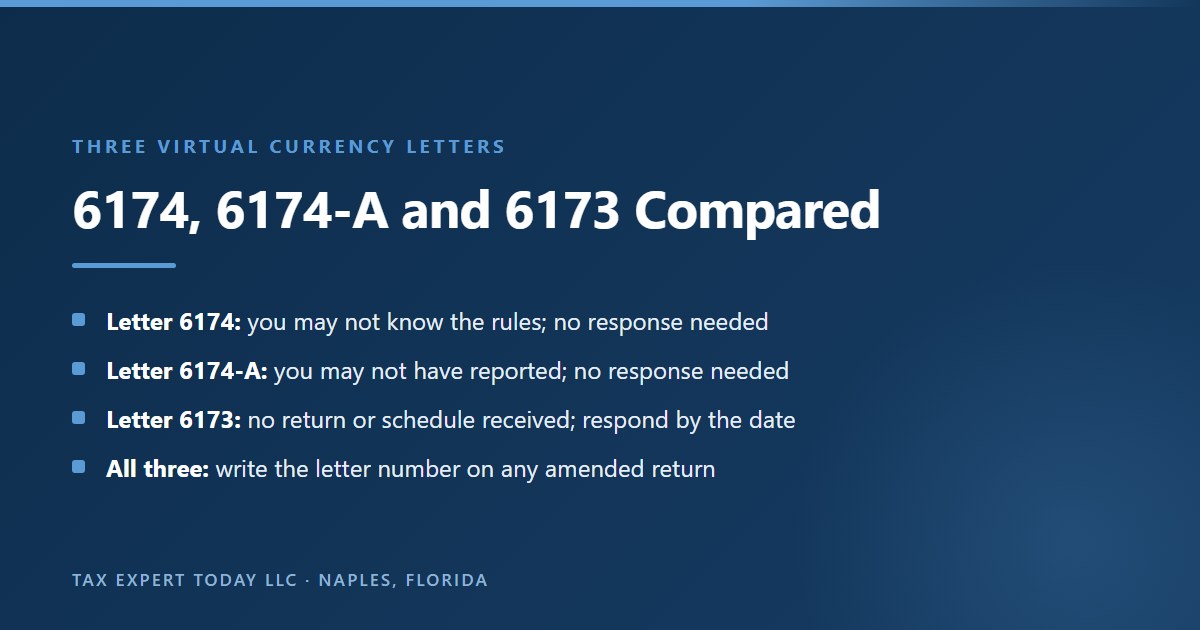
Letter 6174-A uses almost the same words as IRS Letter 6174, but the change in the first sentence is meaningful. Where 6174 assumes you may simply not know the rules, 6174-A states that you “may not have properly reported” your transactions. That shift suggests the IRS has compared data it holds with what you filed and sees a gap. Neither letter requires a reply, and both warn that inaccurate reporting may lead to “future civil and criminal enforcement activity.”
Letter 6173 is a different kind of letter. In the 2019 version it stated that for one or more of tax years 2013 through 2017 the IRS had not received a return or the applicable form or schedule reporting your virtual currency. It lists three choices: file delinquent returns, amend, or mail a statement of facts signed under penalties of perjury explaining why you believe you complied. It warns that if the IRS does not hear from you by the “respond by” date, it may refer your account for examination. It also invites you to send a Form 2848 if someone represents you.
- Holding 6174: review, and amend only if your returns were wrong.
- Holding 6174-A: same choices, but treat the review as more urgent.
- Holding 6173: respond by the date printed on the letter, even if your answer is that you complied.
- Holding a CP2000: that is a proposed adjustment with a deadline, covered in our IRS CP2000 notice guide.
Do I have to respond to IRS Letter 6174?
No. IRS Letter 6174 states in plain words that you do not need to respond, and it sets no deadline. But no response required is not the same as no action required. If your returns omitted crypto sales, income, or a required answer, the letter asks you to file amended or delinquent returns.
The sentence “You do not need to respond to this letter” appears near the end of IRS Letter 6174, just above the hotline paragraph. You do not need to call, write, or send a statement. If every return you filed reported your digital asset activity accurately, the correct action is to keep the letter with your tax records and move on. There is nothing to sign and nothing to mail.
If your returns were not accurate, the letter is a prompt rather than a demand. It says that if you believe you did not accurately report your virtual currency transactions, “you should file amended returns or delinquent returns.” No deadline appears, but the absence of a deadline does not mean time is irrelevant. The value of amending is highest before the IRS takes its next step, because a voluntary correction filed before an examination contact is treated differently for penalty purposes than a correction made after one. That timing rule is explained in its own section below.
| Your situation | Reasonable next step |
|---|---|
| All crypto activity was reported correctly | Keep the letter with your records; no reply needed |
| You bought crypto but never sold, traded, or spent it | Confirm the digital asset answer was correct; usually no amendment |
| You sold or traded crypto and left it off the return | Rebuild the numbers and consider an amended return promptly |
| You earned staking, mining, or business income in crypto and omitted it | Amend to report the income at fair market value when received |
| You did not file a return for a year with crypto activity | File the delinquent return; see our unfiled tax returns guide |
| You are not sure what you did years ago | Gather exchange and wallet records before deciding anything |
The hotline number printed on the letter takes messages, and the letter states that the IRS will respond to messages within three business days. A call can confirm that the letter is genuine and was sent to you. It cannot tell you whether your returns were correct, and it is not a substitute for reviewing your records. Anything you say on that call is part of the record, so it is usually wiser to understand your own position before volunteering an account of it.
Why did the IRS send me Letter 6174?
The IRS sends IRS Letter 6174 because a third party linked you to a digital asset account. Sources include exchange records produced under court-approved summonses, broker information returns such as Form 1099-B, 1099-K, 1099-MISC, and now 1099-DA, and your own answer to the digital asset question on Form 1040.
The 2019 news release said the names of letter recipients “were obtained through various ongoing IRS compliance efforts.” The IRS does not say which source produced a particular letter, but the categories are well known. The first is information returns. Exchanges that operated as brokers or payment platforms have issued Forms 1099-K, 1099-MISC, and in some cases 1099-B to US customers for years. Each of those forms carries your name and taxpayer identification number and goes to the IRS as well as to you.
The second source is legal process. Under IRC §7609(f), the IRS can ask a federal court for permission to serve a “John Doe” summons on a company to identify unnamed taxpayers in a class, for example US customers above a transaction threshold. The Justice Department has announced court orders authorizing John Doe summonses directed at cryptocurrency exchanges and dealers, which produced customer names, transaction histories, and account details. Our guide to the IRS summons explains the ordinary summons power that a John Doe summons builds on.
The third source is your own return. Since the 2019 tax year the individual return has asked about virtual currency, and since 2022 it has asked a broader digital asset question. A “Yes” answer with no Form 8949 or Schedule 1 entry, or a “No” answer from someone an exchange reported, can flag a return for review. The fourth source, growing quickly, is Form 1099-DA, explained in the next section.
- Information returns: Forms 1099-K, 1099-MISC, 1099-B, and from 2025 transactions Form 1099-DA.
- John Doe summonses: court-authorized demands to exchanges for customer records.
- Your return: the digital asset question and the presence or absence of Form 8949.
- Other campaigns: examinations and criminal investigations that surface counterparties.
News coverage in November 2026 reported a new wave of IRS Letter 6174 mailings. The IRS has not, as of this writing, issued a news release describing a new campaign, so the size and selection criteria of any recent wave are not confirmed from an IRS source. What is confirmed is the letter text, which has not changed since its June 2019 revision, and the reporting system behind it, which has changed a great deal.
What does Form 1099-DA change for crypto letters?
Form 1099-DA is the new broker form for digital assets. Brokers must report gross proceeds for sales effected on or after January 1, 2025, and basis for certain sales on or after January 1, 2026. That gives the IRS a per transaction record to match against your return, much like stock sales.
Before Form 1099-DA, the IRS often knew that you had an exchange account but not what you sold or what you paid for it. A Form 1099-K reported gross payments, which could include both buys and sells and said nothing about gain. That gap is one reason IRS Letter 6174 reads like a reminder rather than a bill: the IRS often could not compute your tax from the data it had. Form 1099-DA closes much of that gap. Under the final broker regulations described on the IRS Digital Assets page, brokers that take possession of the assets they sell for customers, including custodial trading platforms, certain hosted wallet providers, digital asset kiosks, and certain payment processors, must file it.
| Sale date | What the broker reports on Form 1099-DA | What it means for matching |
|---|---|---|
| Before January 1, 2025 | No Form 1099-DA; possibly Form 1099-K, 1099-MISC, or 1099-B | The IRS may know an account exists but often not the gain |
| On or after January 1, 2025 | Gross proceeds for each sale | The IRS sees what you sold and for how much |
| On or after January 1, 2026 | Gross proceeds plus basis for covered digital assets | The IRS can estimate gain on covered assets directly |
| Assets moved in from another wallet | Proceeds; basis optional for noncovered assets | You must supply basis from your own records |
The current Instructions for Form 1099-DA also describe optional aggregate reporting for qualifying stablecoins and specified nonfungible tokens, with a $10,000 de minimis threshold for qualifying stablecoin sales, and a $600 de minimis threshold for sales handled by a processor of digital asset payments. Those thresholds are reporting rules for brokers. They do not change what you must report. As the IRS virtual currency FAQs state, you must report income, gain, or loss from crypto whether or not you receive a payee statement.
- 2025 sales: proceeds reported, so an omitted sale is now easy for the IRS to see.
- 2026 sales: basis also reported for covered assets, so the IRS can compute an estimated gain.
- Transferred assets: a broker may report proceeds with no basis, which can make a CP2000 overstate tax.
- Earlier years: not covered by Form 1099-DA, but still subject to soft letters and examination.
The practical consequence is that the soft letter era is ending for recent years. When a broker reports proceeds that do not appear on your return, the automated matching program can issue a CP2000 proposing tax on the full proceeds if no basis was reported. An IRS Letter 6174 about older years is often the last low-pressure opportunity to correct those years before matching data makes the next notice a bill.
What does the digital asset question on Form 1040 have to do with IRS Letter 6174?
Form 1040 asks whether, at any time during the year, you received a digital asset as a reward, award, or payment, or sold, exchanged, or otherwise disposed of one. A wrong answer is not a separate penalty, but it is a statement made under penalties of perjury and a data point the IRS compares with broker records.
The question appears on Forms 1040, 1040-SR, 1040-NR, 1041, 1065, 1120, 1120-S, and 709, according to the IRS Digital Assets page. Many people answer it incorrectly in both directions. Some answer “Yes” because they own crypto, even though merely holding or buying with dollars calls for “No.” Others answer “No” because they think a small trade or a crypto-to-crypto swap does not count, even though it does.
| Activity during the year | Correct answer per IRS guidance |
|---|---|
| Only held digital assets in a wallet or account | No |
| Bought digital assets with US dollars and did not sell | No |
| Moved assets between your own wallets, no fee paid in crypto | No |
| Paid a transfer fee in crypto | Yes |
| Sold crypto for dollars or swapped one coin for another | Yes |
| Spent crypto on goods or services, in any amount | Yes |
| Received staking or mining rewards, an airdrop after a hard fork, or crypto as pay | Yes |
If you answered “No” in a year when you swapped tokens or spent crypto, an amended return should correct the answer as well as report the transactions. If you answered “Yes” and attached no Form 8949 and no crypto income, your return may already look incomplete to a reviewer, even if the only activity was a purchase. In that case a short explanation in your records is useful, though the IRS generally does not need an amended return just to change a “Yes” to a “No” when no tax changes.
How do I check whether my past crypto was reported correctly?
Start with the records the IRS is likely to hold: every exchange and broker account in your name, every Form 1099 you received, and each return’s digital asset answer. Then rebuild each sale, swap, and income event with dates, dollar values, and basis, and compare the result with what each return actually reported.
A review after IRS Letter 6174 is a reconciliation exercise. The goal is to know, year by year, what you should have reported and what you did report. The IRS letter lists the records it expects you to keep: “bank, wallet, and exchange reports and statements to determine your basis, amount received, and other information needed for reporting on Schedule D.” The IRS Digital Assets page adds that you need the type of asset, the date and time of each transaction, the number of units, the fair market value in US dollars at the time, and your basis in the units disposed of.
- Download full histories: every exchange account, including closed ones, back to the first deposit.
- Collect forms: each Form 1099-K, 1099-MISC, 1099-B, and 1099-DA issued to you.
- Map wallets: list self-custody wallets and the transfers between them and exchanges.
- Classify events: sale, swap, spend, income, gift, transfer between your own wallets.
- Compare: line up the rebuilt figures against Form 8949, Schedule D, Schedule 1, and Schedule C as filed.
The classification step is where most errors hide. The IRS treats virtual currency as property under Notice 2014-21, so each disposition is a separate tax event. A swap of one token for another is a sale of the first token at its fair market value, even though no dollars changed hands. Paying for a purchase with crypto is a sale. Staking rewards and mining income are ordinary income when received, measured in dollars at that time, and the dollar value then becomes the basis of those units for a later sale.
| Event | Tax treatment | Where it usually goes on the return |
|---|---|---|
| Sell crypto for dollars | Capital gain or loss: proceeds minus basis | Form 8949 and Schedule D |
| Swap one token for another | Capital gain or loss on the token given up | Form 8949 and Schedule D |
| Spend crypto on goods or services | Capital gain or loss on the crypto spent | Form 8949 and Schedule D |
| Receive staking, mining, or airdrop tokens | Ordinary income at fair market value when received | Schedule 1, or Schedule C if a business |
| Paid in crypto as a contractor | Self-employment income at fair market value | Schedule C and Schedule SE |
| Paid in crypto as an employee | Wages | Form W-2 and Form 1040 |
| Transfer between your own wallets | Not a sale, unless a fee is paid in crypto | Not reported, but keep the records |
| Gift of crypto above the annual exclusion | No income to the giver; gift tax return may be needed | Form 709 |
Holding period matters too. Under the IRS virtual currency FAQs, crypto held more than one year produces long-term gain, and crypto held one year or less produces short-term gain taxed at ordinary rates. If you did not specifically identify which units you sold, the FAQs state the units are treated as sold in first in, first out order. That default can produce a very different gain from the one a tracking app computed using another method, so the method you used on the original return needs to be checked as well.
Should I amend my return after IRS Letter 6174?
Amend if a past return understated tax because crypto sales, swaps, or income were omitted or misreported. Do not amend just because the letter arrived. If the return was correct, the letter needs no reply. If the error lowered your tax, amending can also claim a refund, subject to the refund deadline.
IRS Letter 6174 tells you to file amended returns if you believe you did not accurately report your virtual currency transactions. The decision therefore turns on your reconciliation, not on the letter. Three outcomes are common. The first is that the returns were correct, and nothing is needed. The second is that the returns omitted gains or income, and an amendment reports more tax. The third, more common than people expect, is that the returns omitted transactions that produced losses, and an amendment reduces tax or creates a capital loss carryforward.
| Reconciliation result | Effect of amending | Main consideration |
|---|---|---|
| Return correct | No amendment needed | Keep records that prove it |
| Omitted net gains or crypto income | More tax, plus interest from the original due date | Amending before an examination contact can avoid the accuracy penalty on the added tax |
| Omitted net losses | Less tax or a larger carryforward | A refund generally must be claimed within 3 years of filing or 2 years of payment; Form 1040-X is the claim, not IRS Form 843 |
| Wrong digital asset answer only, no tax change | Often no amendment | Correct the answer on future returns and keep notes |
| Year never filed | File the original return, not a Form 1040-X | Failure to file penalties may already apply |
An amended return for an individual is filed on Form 1040-X, with corrected forms and schedules attached, including a Form 8949 listing the crypto transactions. IRS Letter 6174 asks that you write “Letter 6174” at the top of the first page of each amended or delinquent return and mail it to the address in the letter, which in the published version is the IRS at 2970 Market Street, Philadelphia, PA 19104. Following that instruction routes the return to the unit that sent the letter.
Amending is not risk free, and it is not the only choice. An amended return is a signed statement that the new figures are correct, so it should be built from complete records rather than estimates. Where the omissions are large, span many years, or involve facts that could suggest intent, the right path may be different, and that is a conversation to have before anything is filed. The voluntary disclosure section below explains why.
What is a qualified amended return, and why does timing matter after IRS Letter 6174?
A qualified amended return is an amended return filed after the due date and before certain IRS events, mainly the first contact about an examination. Tax shown on it counts as tax shown on the original return, so the 20 percent accuracy penalty generally does not apply to it. Fraud is excluded.
This is the timing rule that gives IRS Letter 6174 its real significance. Under IRC §6662, the accuracy-related penalty is 20 percent of the portion of an underpayment caused by negligence or by a substantial understatement of income tax. An “underpayment” is measured against the tax shown on your return. Treas. Reg. §1.6664-2(c)(2) provides that the tax shown on the return includes additional tax shown on a qualified amended return, except where it relates to a fraudulent position on the original return. So if you report the omitted crypto gain on a qualified amended return, the added tax is treated as if it had been on the original return, and there is no underpayment on that amount for penalty purposes.
The window closes on the earliest of several events listed in Treas. Reg. §1.6664-2(c)(3). For a typical individual crypto holder, the two that matter are the first IRS contact concerning an examination of the return, and the service of a John Doe summons relating to a class that includes you.
| Event that ends the qualified amended return window | Regulation | Relevance to crypto holders |
|---|---|---|
| The IRS first contacts you concerning an examination of the return, including a criminal investigation | §1.6664-2(c)(3)(i)(A) | The most common cutoff; an audit letter for the year ends the window |
| The IRS serves a John Doe summons under §7609(f) relating to a person, group, or class that includes you, for an activity on which you claimed a tax benefit | §1.6664-2(c)(3)(i)(D) | Relevant where an exchange you used received a John Doe summons |
| The IRS contacts a promoter about a §6700 examination of an activity you used | §1.6664-2(c)(3)(i)(B) | Rare for ordinary trading |
| A pass-through entity is first contacted about an examination | §1.6664-2(c)(3)(i)(C) | Applies to crypto held through a partnership or S corporation |
| A listed transaction settlement initiative is announced | §1.6664-2(c)(3)(i)(E) | Not relevant to ordinary crypto activity |
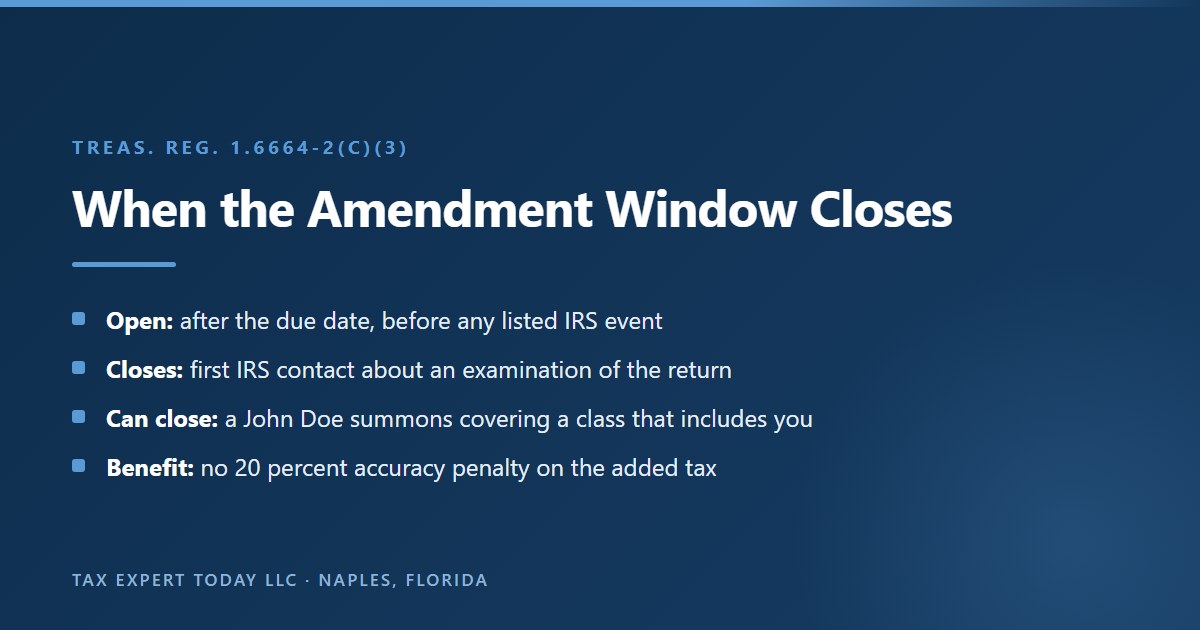
Is IRS Letter 6174 itself a “first contact concerning an examination”? On its face, the letter does not say an examination has started. It is described by the IRS as educational, it says you do not need to respond, and it names no tax year. Those features point toward the letter not being an examination contact. Letter 6173, which warns of referral for examination if you do not respond, is closer to the line, though it also does not state that an examination has begun. No regulation or published ruling addresses the soft letters directly, so this reading is a reasonable interpretation of the letter text rather than a settled rule. What is certain is that once an examination letter arrives, the window for that year is closed.
- The benefit: no 20 percent accuracy penalty on the added tax shown on a qualified amended return.
- The limit: it does not remove interest, and it does not cover fraud.
- The clock: it runs until the first examination contact or another listed event, whichever comes first.
- The practical lesson: after IRS Letter 6174, an accurate amendment filed sooner is usually worth more than one filed later.
Does a John Doe summons to a crypto exchange affect my amended return?
Possibly. Under Treas. Reg. §1.6664-2(c)(3)(i)(D), a return cannot be a qualified amended return if it is filed after the IRS serves a John Doe summons covering a class that includes you, for an activity on which you claimed a tax benefit. Whether an omitted crypto gain is a “tax benefit” from that activity is not settled.
A John Doe summons is a summons to a third party, such as an exchange, for records about unnamed taxpayers in a defined class. Section 7609(f) requires the IRS to obtain a court order before serving it. The regulation’s examples are drawn from offshore credit card summonses: a taxpayer whose card records were covered by a John Doe summons could no longer file a qualified amended return for the covered years after the summons was served, even before the IRS contacted the taxpayer personally.
Applying that rule to crypto raises two questions. First, the summons must relate to “a person, group, or class that includes the taxpayer,” which depends on the exchange, the years, and any dollar threshold in the court order. Second, it must relate to “an activity for which the taxpayer claimed any tax benefit on the return.” For an offshore account used to hide income, the benefit of leaving the income off the return is clear. For a crypto trader who simply failed to report gains, it is arguable whether the omission is a “tax benefit” from the activity in the regulation’s sense. No published guidance resolves the point, and reasonable practitioners read it differently. Our IRS summons guide explains how summonses work generally.
| Question | Why it matters |
|---|---|
| Did an exchange you used receive a court-authorized John Doe summons? | If not, this cutoff does not apply to you |
| Do the summons years cover the year you are amending? | A summons for earlier years can still matter under §1.6664-2(c)(3)(i)(D)(2) |
| Were you inside any dollar threshold the court order set? | A class with a threshold may not include smaller accounts |
| Is the omission a “tax benefit” from the summoned activity? | Unsettled; the answer affects whether the penalty can be avoided by amending |
Even where the qualified amended return rule may not apply, amending still has value. The accuracy penalty can be defended on other grounds, such as reasonable cause and good faith under IRC §6664(c), and a taxpayer who corrected the return before being asked is in a better position to show good faith than one who waited for an examination. Our guide to reasonable cause penalty abatement covers how that defense is built.
What penalties can apply to unreported crypto after IRS Letter 6174?
Unreported crypto can bring interest from the original due date, a 20 percent accuracy-related penalty under IRC 6662, a 75 percent civil fraud penalty under IRC 6663 where fraud is proved, and failure to file and failure to pay penalties for years with no return or unpaid tax. First Time Abate does not cover the accuracy penalty.
The penalty that most often applies to omitted crypto is the accuracy-related penalty. It has two common triggers. Negligence includes a failure to make a reasonable attempt to comply with the tax law. A substantial understatement of income tax exists for an individual when the understatement exceeds the greater of 10 percent of the tax required to be shown or $5,000. Either one supports a penalty of 20 percent of the underpayment it caused. Our guide to the IRS accuracy-related penalty covers the defenses in detail, and our guide on how to get IRS penalties removed compares every relief route.
| Charge | Statute | Rate or rule | Can amending first help? |
|---|---|---|---|
| Interest on unpaid tax | IRC §6601 | Federal short-term rate plus 3 points, compounded daily, from the original due date | No; paying sooner stops it growing |
| Accuracy-related penalty | IRC §6662 | 20 percent of the underpayment from negligence or substantial understatement | Yes, through a qualified amended return or a reasonable cause defense |
| Civil fraud penalty | IRC §6663 | 75 percent of the underpayment attributable to fraud | The qualified amended return rule does not cover fraud |
| Failure to file | IRC §6651(a)(1) | 5 percent per month of net tax due, up to 25 percent | Filing sooner limits it; see our failure to file penalty guide |
| Failure to pay | IRC §6651(a)(2) | 0.5 percent per month of unpaid tax, up to 25 percent | Paying with the amendment limits it; see our failure to pay penalty guide |
A common surprise is that First Time Abate does not help here. The IRS administrative waiver covers failure to file, failure to pay, and failure to deposit penalties, plus certain partnership and S corporation filing penalties. It does not list the accuracy-related penalty. Our first time penalty abatement guide explains the eligible list. For the accuracy penalty, the realistic relief paths are the qualified amended return rule, the reasonable cause and good faith defense, and showing that the understatement does not meet the statutory thresholds.
- Interest is not a penalty and generally cannot be waived for reasonable cause; our IRS penalty and interest calculator shows how it builds over time.
- The 20 percent penalty is the main controllable cost after IRS Letter 6174.
- Fraud is a different case: the IRS must prove it by clear and convincing evidence, and the facts that matter are intent facts.
- Criminal exposure exists only for willful conduct, and is the reason some cases call for a different path than a simple amendment.
How far back can the IRS go on unreported crypto?
Generally three years from the date a return was filed. The period is six years if you omitted more than 25 percent of the gross income stated on the return, and an overstated basis counts as an omission. There is no limit for a false or fraudulent return filed with intent to evade tax, or for a year with no return.
The assessment statute of limitations in IRC §6501 decides how many years are still open. That matters for two reasons after IRS Letter 6174. It tells you which years the IRS can still assess, and it frames which years an amendment is worth filing for. Our IRS audit statute of limitations guide covers the rule in depth; the table below shows how it applies to crypto.
| Situation | Assessment period | Statute |
|---|---|---|
| Return filed, ordinary errors | 3 years from filing | §6501(a) |
| Omitted gross income above 25 percent of gross income stated on the return | 6 years from filing | §6501(e)(1)(A) |
| Basis overstated, so gain understated | Treated as an omission for the 25 percent test | §6501(e)(1)(B)(ii) |
| False or fraudulent return with intent to evade | No limit | §6501(c)(1) |
| No return filed | No limit until a return is filed | §6501(c)(3) |
For the 25 percent test, “gross income” from a sale generally means the amount realized, not the net gain, so a person who left large crypto sales off a return can cross the threshold quickly even if the gain was modest. The six year period can therefore reach years that a person assumed were closed. That makes the reconciliation step important for older years too, and it is one reason a review should look at every year with exchange activity rather than only the most recent ones.
How do I file an amended return after IRS Letter 6174?
Prepare Form 1040-X with a corrected Form 8949, Schedule D, and any other changed schedules, correct the digital asset answer if needed, write “Letter 6174” at the top of page one, sign it, and mail it to the address printed on your letter. Pay the added tax and interest, or arrange a payment plan.
The mechanics are ordinary, but the details matter because the return is your account of what happened. The steps below follow the instructions in IRS Letter 6174 and the Instructions for Form 1040-X.
- Finish the reconciliation first. Do not amend from a partial export or an app summary you have not checked.
- Prepare Form 8949 listing each crypto disposition with dates, proceeds, basis, and gain or loss, and carry the totals to Schedule D.
- Add ordinary income from staking, mining, airdrops, or payments on Schedule 1 or Schedule C.
- Correct the digital asset answer on the amended return if the original answer was wrong.
- Explain the change in Part II of Form 1040-X in neutral, factual language.
- Write “Letter 6174” at the top of the first page, as the letter instructs.
- Mail the signed original to the address in the letter and keep a complete copy with proof of mailing.
- Pay the added tax and interest, or set up a plan; our IRS installment agreement options guide covers the choices.
Amended returns take months to process, and the IRS “Where’s My Amended Return” tool tracks them. If you owe, interest runs from the original due date until paid, so paying with the amendment, or as soon as the amount is known, keeps the balance from growing. If your amendment produces an assessed balance you cannot pay at once, our IRS tax debt help in Naples page explains the payment and relief options available after assessment.
| Item | What to include |
|---|---|
| Form 1040-X | Original figures, corrected figures, and the net change |
| Form 8949 and Schedule D | Every crypto disposition for the year |
| Schedule 1 or Schedule C | Crypto income such as staking or business receipts |
| Part II explanation | A short factual statement of what was omitted and how it was corrected |
| Header notation | “Letter 6174” (or “Letter 6174-A” or “Letter 6173”) at the top of page one |
| Payment | The added tax and interest, or a plan request |
What if I never filed a return for a year with crypto activity?
File the missing return rather than a Form 1040-X. IRS Letter 6174 asks for “delinquent returns” in that case, with “Letter 6174” written on page one. Failure to file and failure to pay penalties may apply, and the assessment period for an unfiled year does not begin until a return is filed.
Some recipients of IRS Letter 6174 did not file at all for a year, often because their only income was below the filing threshold apart from crypto, or because they assumed crypto trades did not count. If your gross income, including the full amount realized from crypto sales rather than just the gain, met the filing threshold for your filing status, a return was required. The letter treats this case directly, asking for delinquent returns for any taxable year in which you did not file.
A delinquent return is prepared on the form for that year, with all income, not just the crypto. Penalties for late filing are figured as a percentage of the net tax due, so a return that shows little or no tax may carry little or no failure to file penalty, apart from the minimum penalty for returns more than 60 days late that do show tax due. Our unfiled tax returns guide explains how to approach several missing years in order, and our failure to file penalty guide covers how that penalty is computed.
- Check the threshold using gross proceeds, not net gain.
- File the original form for that year, not Form 1040-X.
- Write “Letter 6174” on page one as the letter instructs.
- Expect penalties to be measured on the tax shown, and plan for interest.
- Address all open years, since an unfiled year has no assessment deadline.
What happens if I ignore IRS Letter 6174?
Nothing happens because of the letter itself, since it requires no response. But the information that triggered it stays in IRS systems. If your returns were wrong, the likely next steps are a CP2000 proposed adjustment, a Letter 6173, or an examination, each of which closes the easy correction window and adds pressure.
Ignoring IRS Letter 6174 is a reasonable choice when your returns were correct. It is a poor choice when they were not, because the letter is the least costly stage of a sequence that becomes more expensive at each step. The 2019 letter warned that failure to report accurately “may” lead to “future civil and criminal enforcement activity.” The IRS has broad tools to follow up on the information it holds.
| Stage | What the IRS sends | Your position |
|---|---|---|
| 1. Soft letter | IRS Letter 6174 or 6174-A | No deadline; a correction is fully voluntary |
| 2. Response letter | Letter 6173 | Respond by the date shown, or risk referral for examination |
| 3. Matching notice | CP2000 proposing tax on reported proceeds | A deadline applies; the proposal may overstate tax if basis is missing |
| 4. Examination | An audit letter for specific years | The qualified amended return window is closed for those years; a closed audit can later be revisited only through audit reconsideration |
| 5. Deficiency | Notice of deficiency | 90 days to petition the Tax Court; see our notice of deficiency guide |
If a balance is assessed and left unpaid, the ordinary collection notices follow, and an old balance can even be assigned to a private IRS debt collector. Not every case moves through every stage. Some soft letters lead nowhere, particularly for older years or small accounts. But the direction of travel since 2025 is clear: with broker reporting on Form 1099-DA, the IRS no longer needs a soft letter to ask about recent years. It can propose tax directly. Our guide to what happens if you get audited by the IRS explains how an examination proceeds if one is opened.
How does IRS Letter 6174 lead to a CP2000 notice?
IRS Letter 6174 is a reminder sent without a computed tax. A CP2000 is an automated proposal that compares information returns with your return and computes tax on the difference. Once brokers report crypto sales on Form 1099-DA, an unreported sale can produce a CP2000 directly, often with tax figured on gross proceeds.
The two notices come from different programs and serve different purposes. The soft letter is outreach. The CP2000 comes from the Automated Underreporter program, which matches Forms W-2, 1099, and other information returns against the return you filed. Our IRS CP2000 notice guide explains how to agree, partly agree, or disagree with a proposal and the response deadline.
The difference matters most for basis. When a broker reports proceeds but no basis, which is common for assets transferred into an account from another wallet and for sales before basis reporting began, the CP2000 may treat the full proceeds as gain. A person who sold $50,000 of crypto bought for $45,000 could face a proposal computed on $50,000 rather than $5,000. The fix is to respond with a Form 8949 showing the real basis, supported by records. That is one more reason to reconcile records after IRS Letter 6174: the same work answers the soft letter, supports any amendment, and is the evidence needed if a CP2000 follows.
- Soft letter: no computed tax, no deadline, no response required.
- CP2000: computed proposal, firm deadline, written response expected.
- Missing basis: can inflate a CP2000; records showing basis correct it.
- Amending first: can prevent a CP2000 for that year, since the return then matches.
What if I lost my records or cannot find my cost basis?
Reconstruct what you can from exchange exports, bank transfers, blockchain explorers, and emails. Basis you cannot prove may be treated as zero, which overstates gain. Where units were not specifically identified, IRS guidance treats them as sold first in, first out. Document every assumption you make.
Missing records are the most common practical problem after IRS Letter 6174. Exchanges close, accounts get locked, and early wallet software leaves little history. The tax law places the burden on the taxpayer: the IRS virtual currency FAQs state that the Internal Revenue Code and regulations require taxpayers to keep records sufficient to establish the positions taken on their returns. In practice that means rebuilding the trail from several sources at once.
| Source | What it can establish |
|---|---|
| Exchange transaction exports | Purchase dates, prices, fees, and sales on that platform |
| Bank and card statements | Dollar deposits to and withdrawals from exchanges |
| Blockchain explorers | Transfers between wallets by address, date, and amount |
| Emails and trade confirmations | Fills, deposits, and account notices from closed platforms |
| Forms 1099 received | What the IRS was told, and in which year |
| Prior tax software or tracking app files | The method used originally, for consistency checks |
When a lot was bought and its cost cannot be shown, reporting a zero basis overstates the gain but cannot be challenged as too low. Using a reasonable estimate supported by bank transfers and market prices on the purchase date is often defensible, but it should be documented and labeled as reconstructed. The worst outcome is an amended return built on guesses that do not survive a later examination, so the reconstruction deserves as much care as the return itself.
When is voluntary disclosure relevant instead of an amended return?
The IRS Criminal Investigation Voluntary Disclosure Practice is for taxpayers whose noncompliance was willful and who face potential criminal exposure. Most IRS Letter 6174 recipients made mistakes rather than willful choices and are better served by amended returns. The two paths should not be mixed without advice.
An amended return corrects errors. It is the right tool where the omission came from not understanding the rules, missing records, or software errors, which describes most crypto reporting problems. Voluntary disclosure is a different program run by IRS Criminal Investigation. Its page, the IRS Criminal Investigation Voluntary Disclosure Practice, describes it as a way for taxpayers with willful noncompliance to come forward, with eligibility rules, a preclearance step, and civil penalty terms set by the program.
Choosing between the two is a legal judgment, and it turns on facts about intent. A person who hid accounts, used false identities, or deliberately structured activity to avoid reporting is in a different position from a person who did not know a token swap was taxable. Filing a simple amended return in a case that involves willful conduct does not resolve the criminal exposure, and entering a disclosure program in a case that did not need one can be costly. This is a decision to make with a representative before filing anything, and conversations about potential criminal exposure are often held with a tax attorney.
- Mistake, missing records, or software error: amended returns are the usual tool.
- Possible willful conduct: get advice before filing anything.
- Timeliness: the IRS page states a disclosure is timely only if received before the IRS has commenced a civil examination or criminal investigation, or has received third-party information, such as from a John Doe summons, alerting it to your noncompliance.
- Foreign exchange accounts: consider foreign reporting rules too; see do I need to file an FBAR, our guide to filing a late FBAR, and our FBAR penalties guide.
What could amending save in a hypothetical IRS Letter 6174 case?
In a simplified hypothetical, a taxpayer who omitted a $40,000 short-term crypto gain owes the same added tax and interest either way. Amending before an examination contact can avoid a 20 percent accuracy penalty on that tax. Waiting for an audit leaves the penalty in play, subject to a reasonable cause defense.
Consider a hypothetical single filer in Florida, where there is no state personal income tax. The filer sold crypto in 2023 for a $40,000 short-term gain and left it off the return. Assume, to keep the math simple, that the gain is taxed at a flat 24 percent marginal rate, ignoring other effects. The added federal tax is $9,600. Assume the correct total tax for the year is $30,000. Ten percent of that is $3,000, so the substantial understatement threshold is the greater figure of $5,000, and a $9,600 understatement exceeds it. These figures are illustrative only and are not a prediction for any taxpayer.
| Item | Amend before any examination contact | Wait until an audit for the year |
|---|---|---|
| Added tax | $9,600 | $9,600 |
| Interest from the original due date | Yes, until paid | Yes, for a longer period |
| Accuracy-related penalty at 20 percent | $0 if the amendment is a qualified amended return | $1,920, unless reasonable cause is shown |
| Control over the numbers | You prepare them from your records | The examiner proposes them, possibly from proceeds only |
| Other years | You can review all years on your schedule | The examination can expand to related years |
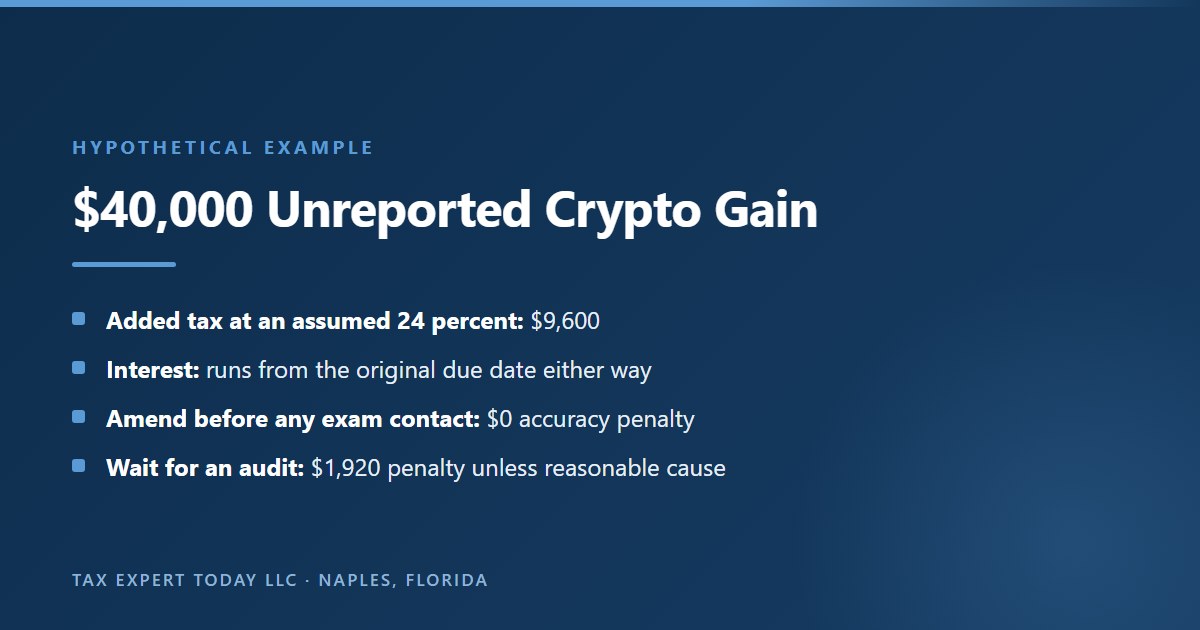
The penalty difference in this hypothetical is $1,920, but the larger difference is often control. When you amend, you decide how basis was computed and you document it. When the IRS proposes the adjustment, it starts from its data, which may lack basis entirely. Whether a real taxpayer qualifies for the qualified amended return treatment depends on the facts, including whether any listed event occurred first, so this example illustrates the mechanism rather than a result.
IRS Letter 6174 help Naples: tax resolution Naples and Southwest Florida
Tax Expert Today LLC provides IRS tax resolution from its Naples, Florida office: back taxes and IRS tax debt, payment plans and installment agreements, offers in compromise, wage garnishment and bank levy release, federal tax lien withdrawal, penalty abatement, unfiled returns, and audit representation. The firm is led by Dr. Pellumb Kabashi, an Enrolled Agent with unlimited rights to represent taxpayers before the IRS, a Certified Fraud Examiner, and a Certified Estate and Trust Specialist, with a team of enrolled agents, CPAs, and tax attorneys.
For IRS Letter 6174, the work is usually a reconciliation and a decision. We gather exchange and wallet histories, rebuild each year’s transactions, compare them with the returns as filed, and then lay out the choices: no action, amended returns, delinquent returns, or a referral for legal advice where intent questions arise. If an amendment creates a balance, our Naples tax resolution team handles payment arrangements, and if the IRS has already opened an examination, our IRS resolution and audit support service and our IRS audit help in Naples page explain how representation works. For balances already assessed, see our IRS tax debt help Naples page.
Southwest Florida has a large population of retirees and seasonal residents, and many hold crypto through exchanges opened years ago in another state. Florida has no state personal income tax, so the IRS is usually the only income tax agency involved, but a seasonal resident who was a resident of another state in the year of a sale may also have a state return to consider. The office is at 11983 Tamiami Trail N, Naples, FL 34110. Call (239) 441-2005, Monday through Friday, 10 a.m. to 5 p.m. Eastern.
When to engage a professional about IRS Letter 6174
Professional help is worth considering when you hold Letter 6173 or a CP2000, when several years or several exchanges are involved, when basis records are missing, when you did not file for a year, or when the facts could raise questions about intent. A single correct year usually needs no help.
Many recipients of IRS Letter 6174 can confirm their returns were correct and file the letter away. Others find that one year of a single exchange needs a straightforward amendment they can prepare themselves. The cases that benefit from a representative are the ones with moving parts: multiple years that may fall inside the six year period, transfers between exchanges and self-custody wallets that break the basis trail, decentralized finance activity, staking income, or a business that took crypto as payment.
- Multiple years or exchanges: reconciliation is the bulk of the work and drives every later choice.
- Letter 6173 or a CP2000: a deadline is running and the response is part of the record.
- Missing basis: reconstruction methods should be consistent and documented.
- Possible intent questions: get advice before filing anything, ideally from a tax attorney.
- A resulting balance: payment plans and penalty relief can be arranged once the tax is known.
A representative can also file Form 2848 so that the IRS deals with them on any follow-up. If you received IRS Letter 6174 or a related notice and want a review before deciding whether to amend, our tax resolution team in Naples and our IRS resolution and audit support service can help you assess your options. You can read more about the firm on our firm background page. Results depend on the facts of each case, and no particular outcome can be promised.
Frequently Asked Questions About IRS Letter 6174
Is IRS Letter 6174 an audit?
No. IRS Letter 6174 is an educational letter. It does not name a tax year, propose tax, or state that an examination has begun, and it says you do not need to respond. An audit begins with a letter that identifies the return and years under examination.
What is the deadline for IRS Letter 6174?
There is none. IRS Letter 6174 sets no deadline. Letter 6173 is the virtual currency letter with a “respond by” date. Even so, amending before any examination contact can help avoid the 20 percent accuracy penalty on added tax.
What is the difference between Letter 6174 and Letter 6174-A?
Letter 6174 says you may not know the reporting rules for virtual currency. Letter 6174-A says you may not have properly reported your transactions. Neither requires a response, but 6174-A suggests the IRS sees a gap between its data and your return.
Should I call the hotline number on IRS Letter 6174?
You can, but you do not need to. The hotline takes messages and the IRS says it responds within three business days. A call can confirm the letter is genuine. It is usually wiser to review your records before describing your situation to the IRS.
Where do I mail an amended return for IRS Letter 6174?
The published letter directs amended or delinquent returns to the Internal Revenue Service, 2970 Market Street, Philadelphia, PA 19104, with “Letter 6174” written at the top of the first page. Use the address printed on your own letter if it differs.
Do I have to report crypto if I did not receive a Form 1099?
Yes. The IRS states that you must report income, gain, or loss from virtual currency whether or not you receive a payee statement such as a Form 1099. Form 1099-DA reporting began with 2025 sales, but the reporting duty existed long before it.
Does buying crypto and holding it trigger IRS Letter 6174 problems?
Buying with dollars and holding is not a taxable event, and the correct digital asset answer for that year is generally “No.” If that is all you did, the letter usually needs no action beyond keeping it with your records.
Can First Time Abate remove a crypto accuracy penalty?
No. First Time Abate covers failure to file, failure to pay, and failure to deposit penalties, not the accuracy-related penalty. Relief from that penalty depends on a qualified amended return, reasonable cause and good faith, or the understatement falling below the statutory thresholds.
Is a letter asking me to register crypto on an IRS portal real?
No. The IRS has warned that letters with a QR code directing crypto holders to a “Digital Assets Compliance Portal” are a scam. The IRS does not require registration of digital assets. Do not scan the code or share wallet or exchange details.
Where can I get help with IRS Letter 6174 in Naples, FL?
Tax Expert Today LLC reviews crypto reporting, prepares amended and delinquent returns, and represents taxpayers on CP2000 notices and examinations from its office at 11983 Tamiami Trail N, Naples, FL 34110. Call (239) 441-2005, Monday through Friday, 10 a.m. to 5 p.m. Eastern.
This article is for general educational purposes and is not legal or tax advice for any specific situation. Tax outcomes depend on individual facts, and the law and IRS procedures change. Review your circumstances with a qualified professional before acting.
Published November 19, 2026 by Dr. Pellumb Kabashi « Back to Learning Center
Have a question this article touches on?
Tax Expert Today LLC, based in Naples, Florida and serving clients across the United States.
Schedule a Consultation (239) 441-2005