
By Dr. Pellumb Kabashi, DBA, MBA, CES, CFE, EA
Founder, Tax Expert Today LLC · Tax advisors, enrolled agents, CPAs, and attorneys · Serving clients in all 50 states
What Is the Convenience of the Employer Rule?
Quick answer: The convenience of the employer rule is a state sourcing rule that treats days you work from home as days worked at your employer’s office. If your assigned office sits in New York and you now work from Naples, New York generally still taxes those wages unless your home office qualifies as a bona fide employer office. Seven states apply some version of it. Call (239) 441-2005 for a free consultation.
Published: August 2026
A large share of the people who move to Southwest Florida do not change jobs when they change states. They keep the same employer, the same title, and the same team, and they simply stop commuting. The house closes in Naples, the furniture arrives, and the work continues from a room off the lanai. Everything about that arrangement feels like it should end the old state’s claim on the paycheck.
For most states it does. Wages are ordinarily sourced to the place where the work is physically performed, so once the work happens in Collier County, the old state has nothing left to tax. A small group of states rejected that logic, and the convenience of the employer rule is the result. Under it, the state where your employer’s office sits keeps taxing your wages on every day you chose to work somewhere else, no matter how far away that somewhere else is.
This guide is written for the person on the receiving end of that rule rather than for the payroll department administering it. It covers which states apply the convenience of the employer rule in 2026, why the rule is more expensive for a Florida resident than for anyone else in the country, the specific test New York uses to decide whether your home office escapes it, which of the seven states can actually reach you in Florida, and what you file when the rule applies.
Which States Apply the Convenience of the Employer Rule in 2026?
Direct answer: Seven states apply the convenience rule: Alabama, Connecticut, Delaware, Nebraska, New Jersey, New York, and Pennsylvania. Connecticut and New Jersey apply a reciprocal version that operates only when the worker’s home state has a convenience rule of its own, according to Connecticut OLR Report 2025-R-0067. The distinction matters enormously to a Florida resident.
The Connecticut Office of Legislative Research summarized the landscape in May 2025, and its count is the one to work from. Most income tax states source nonresident wage income by counting the days actually worked inside their borders. The seven states below do something different.
| State | Type of rule | Reaches a Florida resident? |
|---|---|---|
| New York | Full convenience rule, applied through 20 NYCRR §132.18 and TSB-M-06(5)I | Yes |
| Pennsylvania | Full convenience rule | Yes |
| Delaware | Full convenience rule | Yes |
| Nebraska | Full convenience rule | Yes |
| Alabama | Full convenience rule | Yes |
| Connecticut | Reciprocal, applies only if the worker’s resident state has a similar rule | No, because Florida has no convenience rule |
| New Jersey | Reciprocal, enacted by P.L. 2023, c.125 effective for tax years beginning in 2023 | No, because Florida has no convenience rule |
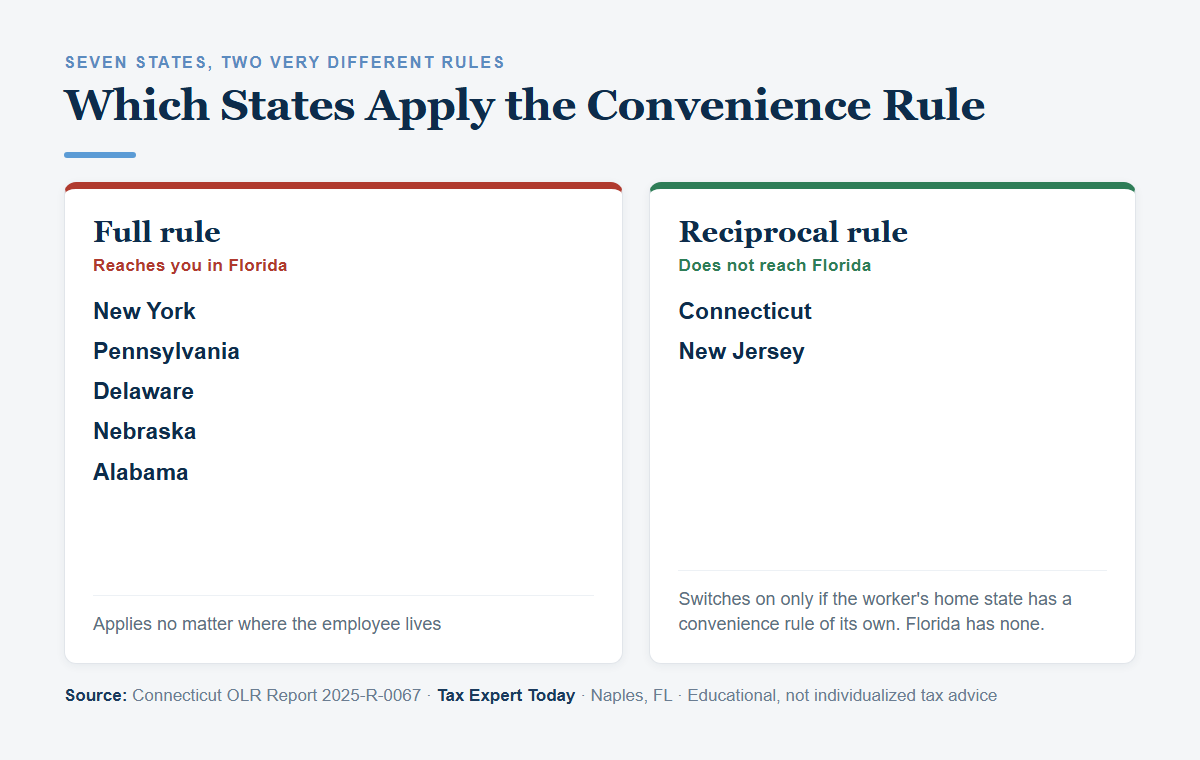
That last column is the practical headline, and it is the point most national coverage of this topic never reaches. A person who moves from an apartment in Jersey City to a condo in Naples while keeping a New Jersey employer walks away clean, because New Jersey’s rule is switched on only when the employee’s new home state runs a convenience rule too. Florida does not. The same move away from a New York employer produces the opposite result.
New York is where the overwhelming majority of Southwest Florida cases come from, both because New York is the largest feeder state into Florida and because New York enforces its rule harder than the others. The rest of this guide uses New York as the working example, and the mechanics translate reasonably well to Pennsylvania, Delaware, Nebraska, and Alabama.
Why Does the Convenience of the Employer Rule Cost Florida Residents More Than Anyone Else?
Direct answer: Because there is no resident credit to claim. A worker who moves from New York to Connecticut pays New York under the convenience rule and then claims a credit for those taxes on the Connecticut return, so the double taxation is largely neutralized. A Florida resident has no state return, so there is nothing to claim the credit against and the New York tax is a pure unrecovered cost.
This is the single most important thing to understand about the convenience of the employer rule, and it is almost never explained from the mover’s side. The resident credit is the safety valve in the whole multistate system. States allow their own residents a credit for income taxes paid to other jurisdictions precisely so that the same dollar is not taxed twice. The Connecticut legislative report describes the mechanism plainly and notes that since 2019 Connecticut has allowed a resident credit for income sourced to another state under a convenience rule, codified at CGS §12-711(b)(2)(C).
Florida has no personal income tax, which is usually the entire reason people move here. That same fact removes the credit. The table below shows the same fact pattern landing three different ways.
| Where the employee moves | New York tax under the convenience rule | Resident credit available in the new state? | Net effect |
|---|---|---|---|
| Connecticut | Applies to remote days | Yes, under CGS §12-711(b)(2)(C) | Largely offset, the worker mostly pays one state’s worth of tax |
| New Jersey | Applies to remote days | Yes, plus a separate credit for successfully challenging another state’s rule | Largely offset |
| Florida | Applies to remote days | No, because Florida imposes no personal income tax | Full New York tax with nothing to offset it |
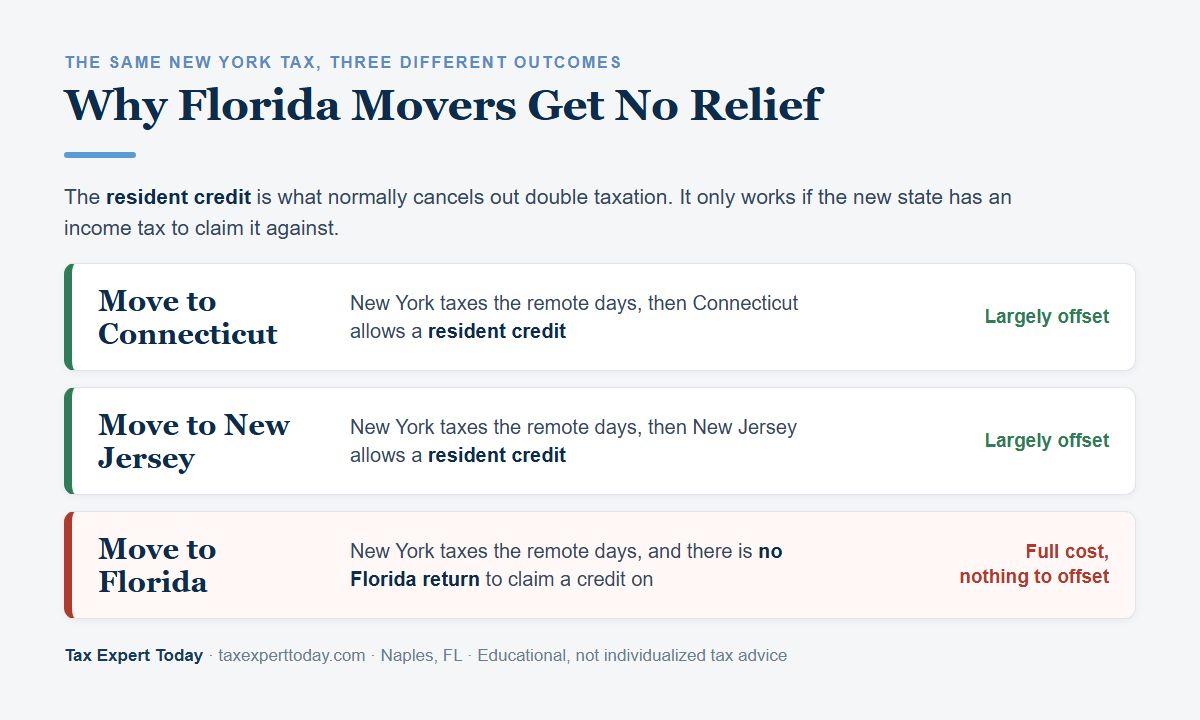
Read that bottom row carefully. The Florida mover is not paying more New York tax than the Connecticut mover. The Florida mover is paying the same New York tax and receiving none of the relief, which means the convenience of the employer rule quietly cancels a meaningful portion of the financial benefit that motivated the move in the first place. Somebody who relocated expecting to keep an additional several percent of gross wages may find that the old state is still collecting most of it.
It also means the stakes of the bona fide employer office test are higher for a Florida resident than for anyone else. In Connecticut the test determines which state gets the revenue. In Florida it determines whether the tax is paid at all.
Does Moving to Florida Stop the Convenience of the Employer Rule?
Direct answer: No. Establishing Florida domicile ends the old state’s power to tax you as a resident on your worldwide income, but it does nothing to the sourcing of wages. The convenience rule is a sourcing rule, not a residency rule. A person can win the residency argument completely and still owe New York tax on remote work days under the same rule.
This distinction confuses more people than any other part of the subject, and it is worth slowing down on. There are two entirely separate questions a state can ask.
- Are you our resident? If yes, the state taxes all of your income from every source. This is the domicile and statutory residency question covered in our guides to establishing Florida residency and the dual state residency trap, and it is what the 183 day rule calculator helps you track.
- Is this particular income sourced to us? Even for a clear nonresident, a state taxes income derived from sources inside its borders. Wages, business income, and real property gains each have their own sourcing rule.
Winning question one does not answer question two. A retired executive who moves to Naples and stops working has no wage sourcing issue at all, which is why our guide to retiring to Florida covers a federal shield that has no equivalent here. A working executive who moves to Naples and keeps the same New York desk job has a sourcing issue every single pay period. So does the person who sells the northern house afterward, for a different reason explained in our guide to selling your home after moving to Florida, where the gain is sourced to the state where the land physically sits.
There is one important consolation. Because the convenience of the employer rule is a nonresident sourcing rule, it applies only to the wages, not to the rest of your financial life. Investment income, retirement distributions, and business income from other sources fall outside it once you are a genuine Florida resident. The rule is narrow, and it is expensive inside its narrow lane.
How Does New York Decide If Your Home Office Is a Bona Fide Employer Office?
Direct answer: New York applies a structured test set out in TSB-M-06(5)I. A home office qualifies as a bona fide employer office if it meets either the single primary factor, or at least four of the six secondary factors together with three of the ten other factors. Meeting the test converts your Naples work days into non-New York days.
This is the escape hatch, and the specific arithmetic of it is published. For tax years beginning on or after January 1, 2006, the Tax Department’s stated position is that where a taxpayer’s assigned or primary office is in New York State, any normal work day spent at the home office is treated as a day worked outside the state if the home office is a bona fide employer office.
Two definitions do a great deal of work here. A normal work day means any day the taxpayer performed the usual duties of the job. The memorandum is explicit that responding to occasional phone calls or emails, reading professional journals, or simply being available if needed does not count as performing usual duties. And a day spent at the home office that is not a normal work day is treated as a nonworking day, which drops out of the allocation entirely.
| Category | Number of factors | How many must be met |
|---|---|---|
| Primary factor | 1 | Meeting it alone satisfies the entire test |
| Secondary factors | 6 | At least 4, and only in combination with the other factors below |
| Other factors | 10 | At least 3, and only in combination with 4 secondary factors |
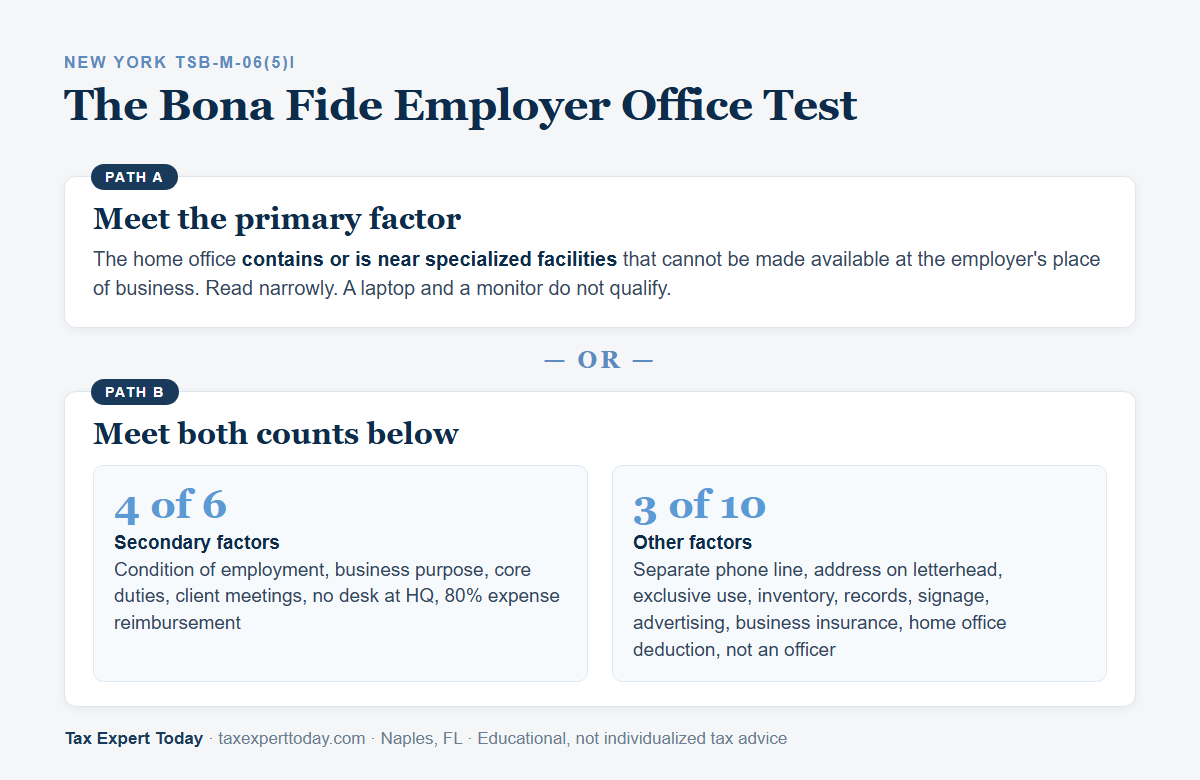
The primary factor is that the home office contains or is near specialized facilities. New York reads this narrowly. The memorandum’s own illustration involves an employee whose duties require a test track for testing new cars where no test track exists at the employer’s New York City offices but one is available near the employee’s home. By contrast, if the duties require specialized scientific equipment that happens to be set up at the employee’s home but could physically be set up at the employer’s New York location, the home office does not meet this factor.
For the great majority of relocating professionals, finance, law, technology, consulting, and management, the primary factor is simply unavailable. A laptop and a monitor are not specialized facilities. That leaves the four-of-six plus three-of-ten path, which is where the real analysis happens.
What Are the Secondary and Other Factors in the New York Test?
Direct answer: The six secondary factors concern the substance of the working arrangement, whether the home office is required, whether the employer has a business purpose for its location, and whether the employer pays for it. The ten other factors are mostly documentary indicia, separate phone lines, business cards, exclusive use, insurance, and signage.
The six secondary factors, as published in the memorandum, are:
- The home office is a requirement or condition of employment. A written employment contract stating the employee must work from home to perform specific duties satisfies this.
- The employer has a bona fide business purpose for the employee’s home office location, for example an engineer who needs an office near projects in that state to meet deadlines.
- The employee performs some of the core duties of the employment at the home office. The memorandum contrasts a stock broker who executes purchases and sales from the home office, which counts, against one who merely reads business publications on the weekend, which does not.
- The employee meets or deals with clients, patients, or customers on a regular and continuous basis at the home office.
- The employer does not provide the employee with designated office space or other regular work accommodations at one of its regular places of business. An employee who must use a visitors cubicle or conference room when visiting headquarters meets this factor.
- The employer reimburses expenses for the home office. This means substantially all of the home office expenses such as utilities and insurance, or a fair rental value for the space plus substantially all supplies and equipment. The memorandum defines substantially all as 80 percent or more.
The ten other factors are:
- The employer maintains a separate telephone line and listing for the home office.
- The employee’s home office address and phone number appear on the employer’s business letterhead or business cards.
- The employee uses a specific area of the home exclusively to conduct the employer’s business, separate from the living area. Mixed business and personal use fails this factor.
- The employer sells products at wholesale or retail and the employee keeps inventory or product samples in the home office.
- Business records of the employer are stored at the home office.
- The home office location has a sign indicating a place of business of the employer.
- Advertising for the employer shows the home office as one of the employer’s places of business.
- The home office is covered by a business insurance policy or a business rider on the homeowner policy.
- The employee is entitled to and actually claims a federal home office deduction.
- The employee is not an officer of the company.
Two observations follow from reading this list against a typical relocation. First, most of these factors are inside the employer’s control rather than the employee’s. Whether there is a separate business line, whether the home address appears on letterhead, whether the arrangement is written into the employment agreement, and whether the employer reimburses 80 percent of home office costs are all decisions made by somebody else. An employee who intends to rely on this test needs the conversation with the employer to happen before the move rather than during an audit two years later.
Second, factor nine of the other factors is a trap worth naming. Claiming a federal home office deduction helps here, but employees have not been able to deduct unreimbursed employee business expenses on a federal return since the 2017 law suspended miscellaneous itemized deductions through 2025. Anyone relying on that factor should confirm current federal treatment for the year in question rather than assuming it is available.
Which Convenience Rule States Can Actually Reach a Florida Resident?
Direct answer: Five of the seven. New York, Pennsylvania, Delaware, Nebraska, and Alabama apply full convenience rules that operate regardless of where the employee lives. Connecticut and New Jersey apply reciprocal rules that switch on only when the employee’s resident state has a similar rule, and Florida does not, so those two states do not reach a Naples-based remote worker.
The New Jersey Division of Taxation states the reciprocity condition directly in its official FAQ: the state applies another state’s convenience rule to nonresidents only where the nonresident’s home state has the same kind of rule. In practice New Jersey identifies Delaware, Nebraska, and New York residents as the group caught by its rule. Florida residents are not on that list, and cannot be, because the trigger is the existence of a convenience rule in the worker’s own state.
Connecticut works the same way. The Office of Legislative Research describes Connecticut’s rule as applying to nonresident employees of a Connecticut employer who work from an out-of-state location and reside in a state that also imposes a convenience rule, giving New York as the example.
The planning consequence is concrete. If you are weighing a move to Naples and your employer’s office is in Hartford or Newark, the wage sourcing problem discussed in this guide does not apply to you. If the office is in Manhattan, Philadelphia, Wilmington, Omaha, or Birmingham, it does. That single fact should be established before the move, not after, and it is worth confirming in writing given that state guidance changes.
What Do You File If the Convenience of the Employer Rule Applies?
Direct answer: A nonresident return in the sourcing state, and nothing in Florida. For New York that means Form IT-203 with Form IT-203-B, Schedule A, which is where wage income is allocated between New York and non-New York work days. Florida imposes no personal income tax, so there is no Florida return and no Florida credit.
Mechanically, the nonresident computation in New York works the way TSB-M-06(5)I describes. Tax Law §601(e) imposes tax on a nonresident’s New York source income by computing the tax as though the individual were a full-year resident and then multiplying by an income percentage. The numerator of that percentage is New York source income and the denominator is income from all sources. Schedule A of Form IT-203-B is where the day count that drives the wage portion of that numerator gets reported.
The day count is where the convenience of the employer rule bites. Under 20 NYCRR §132.18, any allowance claimed for days worked outside New York State must rest on services which of necessity, as distinguished from convenience, obligate the employee to out of state duties. Absent a bona fide employer office, remote days in Naples go into the New York column even though nobody set foot in New York.
Three practical points follow:
- Nonworking days are excluded on both sides. The regulation takes no account of Saturdays, Sundays, holidays, illness, vacation, or leave. The allocation is work days over work days, which makes an accurate contemporaneous calendar the most valuable record you keep.
- The move year is a hybrid. A part-year resident computes New York tax the same way a nonresident does, but the convenience test applies only to the nonresident portion of the year, and the percentage is based on work days in that period only. The move year also carries the special accrual rules under Tax Law §639, which our guide to the first year of snowbird taxes covers in more depth.
- Equity compensation follows its own path. Restricted stock and options that vest after the move are allocated on their own workday formula rather than on the current year day count. That interaction is covered separately in our guide to Florida domicile for executives.
One more item belongs on the checklist. The Yonkers nonresident earnings tax follows the same rules described above, so an employee whose New York office sits in Yonkers has a second layer to allocate.
Has the Convenience of the Employer Rule Been Challenged?
Direct answer: Yes, repeatedly, and it has survived. The most prominent recent challenge involved Massachusetts rather than New York. New Hampshire asked the United States Supreme Court in October 2020 to hear a constitutional challenge to a temporary Massachusetts convenience regulation, and the Court denied the motion in June 2021 without explaining its decision.
That history is documented in the Connecticut legislative report cited throughout this guide. Massachusetts had imposed a temporary rule during the pandemic, at 830 Mass. Code Regs. 62.5A.3, requiring nonresidents who had worked in Massachusetts before the pandemic to treat telecommuting days as days worked at the employer’s location. Connecticut and three other states filed an amicus brief supporting New Hampshire. The Supreme Court declined to take the case, which left the underlying question unresolved rather than settled in the states’ favor, but it also left the rules standing.
New Jersey took a different and more creative approach. In 2023 it enacted a refundable income tax credit equal to 50 percent of the tax owed to New Jersey, available to residents who worked remotely for an out of state company between 2020 and 2023 and were denied a refund by that state. To claim it, the taxpayer must file and win an appeal in the other state’s tax court and actually obtain a refund. Connecticut’s report notes that as of May 2025 a single taxpayer had used the program, receiving a credit of $7,797 for the 2020 tax year.
The takeaway for planning purposes is sober. Challenging a convenience rule is possible, it has occasionally succeeded at the individual level, and it is slow, expensive, and uncertain. For most people the better route is to structure the arrangement so the rule does not apply, rather than to litigate after the assessment arrives.
How Can a Florida Resident Plan Around the Convenience of the Employer Rule?
Direct answer: The realistic options are to qualify the home office under the bona fide employer office test, to have the employer reassign your primary work location out of the sourcing state, to change employers, or to accept the tax and plan around it. Each depends on the employer’s cooperation, which is why the conversation belongs before the move.
In descending order of how often they actually work:
- Have the primary work location formally reassigned. The entire New York rule is premised on the taxpayer’s assigned or primary office being in New York. Where the assigned or primary work location is an established office of the employer outside New York, the memorandum states that normal work days at home are treated as days worked outside the state. If the employer has a genuine Florida presence, this is the cleanest path, and it is a records and payroll question rather than a factor-counting exercise.
- Build the bona fide employer office file deliberately. Work the four-of-six and three-of-ten list with the employer before the move: a written condition of employment, no designated desk at headquarters, reimbursement of substantially all home office costs at the 80 percent threshold, a separate business line, exclusive use of a defined room, and business insurance coverage. Retrofitting this after an audit notice rarely persuades.
- Track work days contemporaneously from day one. Whatever position you take, the allocation is a day count and the burden of substantiating it sits with the taxpayer. A calendar reconstructed two years later is the weakest evidence there is. The same discipline protects the residency position discussed in our guide to the Florida residency audit.
- Document the Florida domicile independently. Filing a Fla. Stat. §222.17 declaration of domicile does not defeat the convenience rule, but it establishes the date your nonresident period began, which is what limits the old state to sourcing rather than worldwide taxation.
- Model the real number before you rely on it. If the rule applies and the home office does not qualify, the wage tax does not go away, and the household budget built on Florida arithmetic needs to be rebuilt on the actual figure. Broader relocation planning is covered on our Naples tax planning and Florida tax services pages.
One approach to avoid: quietly stopping the withholding and hoping the old state does not notice. State revenue departments receive the same federal wage data you do, and a W-2 showing a New York employer with no New York allocation is a visible discrepancy. Positions on the convenience of the employer rule should be taken openly on a filed return, with the supporting file assembled in advance.
- Convenience of the employer rule
- A state sourcing rule under which wages a nonresident earns working remotely are sourced to the employer’s location unless the remote work is required by the employer’s necessity rather than the employee’s convenience.
- Bona fide employer office
- A home office that satisfies New York’s published factor test and therefore converts remote work days into days worked outside New York.
- Normal work day
- Any day on which the taxpayer performed the usual duties of the job. Answering occasional emails or being available does not qualify.
- Resident credit
- The credit a state gives its own residents for income taxes paid to another jurisdiction. Florida residents have none, because Florida imposes no personal income tax.
- Reciprocal convenience rule
- A convenience rule that applies only when the nonresident employee’s home state also has one. Connecticut and New Jersey use this structure.
Remote Work Tax Help Naples and Southwest Florida
Tax Expert Today LLC works with relocating professionals and business owners throughout Naples, Florida and the surrounding Southwest Florida communities, including Bonita Springs, Estero, Fort Myers, Marco Island, and Cape Coral, as well as clients in all 50 states. The firm brings together tax advisors, enrolled agents, CPAs, and attorneys, which matters on a question like this one because the answer usually requires a state sourcing analysis, a review of the employment arrangement, and coordination with the employer’s payroll function at the same time.
The convenience of the employer rule is a recurring theme in the Naples market for a straightforward reason. A large share of new arrivals here come from New York, and many of them keep working for the same employer. The households most exposed are the ones that moved for the tax arithmetic and never checked whether the wage income actually followed them.
Office: 11983 Tamiami Trail N, Naples, FL 34110
Phone: (239) 441-2005
Hours: Monday through Friday, 10:00 am to 5:00 pm ET
Local FAQ: I moved from Manhattan to Naples and kept my job. Does my employer’s payroll department decide whether New York keeps taxing me?
No. Payroll decides where to withhold, and the return decides what is owed. Those two things frequently disagree after a relocation. Many employers continue New York withholding by default because the assigned work location in their system never changed, and some stop it on request without any analysis of the bona fide employer office factors. Either way the filed nonresident return is what determines the liability, and the taxpayer carries the burden of supporting the allocation. If the withholding and the return are going to differ, that is a reason to review the position before the year closes rather than at filing time.
The convenience rule is one piece of a larger New York departure question, and the rest of it, including residency, special accruals, and the estate tax cliff, is covered in our guide to the New York exit tax.
When to Engage a Professional
Not every remote worker needs help with this. If your employer’s office sits in a state with no convenience rule, or in Connecticut or New Jersey while you live in Florida, the wage sourcing issue does not arise and ordinary part-year filing in the move year is usually the end of it.
Professional review is worth considering in these situations:
- Your employer’s assigned office is in New York, Pennsylvania, Delaware, Nebraska, or Alabama, and you now work from Florida.
- You intend to rely on the bona fide employer office test and want the arrangement structured and documented before the move rather than after.
- Your compensation includes restricted stock, options, or deferred pay that straddles the move date.
- You have received a notice, an information document request, or a residency questionnaire from a former state.
- The move year involves a part-year return, special accruals, or a sale of the former residence in the same period.
Where a state has already opened an examination, the work shifts from planning to defense, and documentation assembled during the audit is worth considerably less than documentation assembled in advance. Our audit support and resolution services cover representation in those matters, and the Naples tax resolution page describes how those engagements are handled locally. Households coordinating a relocation alongside estate documents may also want to review our estate and trust planning services and our guide to Florida estate planning for new residents.
Outcomes in this area depend on the specific facts of the employment arrangement, the state involved, and the quality of the contemporaneous records, so nothing in this guide should be read as a prediction about a particular return. To review a specific situation, contact Tax Expert Today or call (239) 441-2005.
This article is educational and does not constitute tax advice for any specific taxpayer. State sourcing rules change, and the treatment of any particular arrangement depends on its facts.
Published August 3, 2026 by Dr. Pellumb Kabashi « Back to Learning Center
Have a question this article touches on?
Tax Expert Today LLC, based in Naples, Florida and serving clients across the United States.
Schedule a Consultation (239) 441-2005