
By Dr. Pellumb Kabashi, DBA, MBA, CES, CFE, EA
Founder, Tax Expert Today LLC · Tax advisors, enrolled agents, CPAs, and attorneys · Serving clients in all 50 states
Quick Answer: Comparing Texas vs Florida taxes, neither state taxes individual income, so the decision turns on the business layer. Texas charges a franchise tax on gross margin above $2,650,000 in revenue. Florida charges a 5.5 percent corporate income tax that most pass-through entities never pay. Texas also carries broader constitutional tax bans. Call (239) 441-2005 for a free consultation.
What Is the Real Difference Between Texas vs Florida Taxes?
The headline is identical in both states. Neither Texas nor Florida imposes a personal income tax, so wages, interest, dividends, and retirement distributions escape state tax in each. The genuine difference sits one level down, at the entity layer, where Texas taxes gross margin and Florida taxes net income only for certain entity types. Owners who settle on Florida can review Florida tax planning for business owners for the entity and domicile sequence that follows the move.
Most comparisons stop at the personal layer and then pivot to property tax rates and insurance premiums. That framing serves someone choosing a house. It does not serve a business owner or a high earner, because it skips the two questions that actually change the tax bill: what the state charges the business, and how durable the protection against a future income tax really is.
| Item | Texas | Florida |
|---|---|---|
| Individual income tax | None, prohibited by constitution | None, prohibited by constitution |
| Entity level tax | Franchise tax on taxable margin | Corporate income tax at 5.5 percent |
| Entities generally reached | Most entities, including LLCs and partnerships | Corporations and entities taxed as corporations |
| Small business relief | No tax due below $2,650,000 in total revenue | $50,000 exemption against Florida net income |
| State sales tax rate | 6.25 percent, up to 8.25 percent with local | 6 percent, plus county discretionary surtax |
| Estate or inheritance tax | None, prohibited by constitution | None, prohibited by constitution |
| Property tax | Locally assessed, no state property tax | Locally assessed, no state property tax |
| Statutory domicile filing | No equivalent statutory filing | Declaration of Domicile under Section 222.17 |
Do Texas or Florida Tax Individual Income?
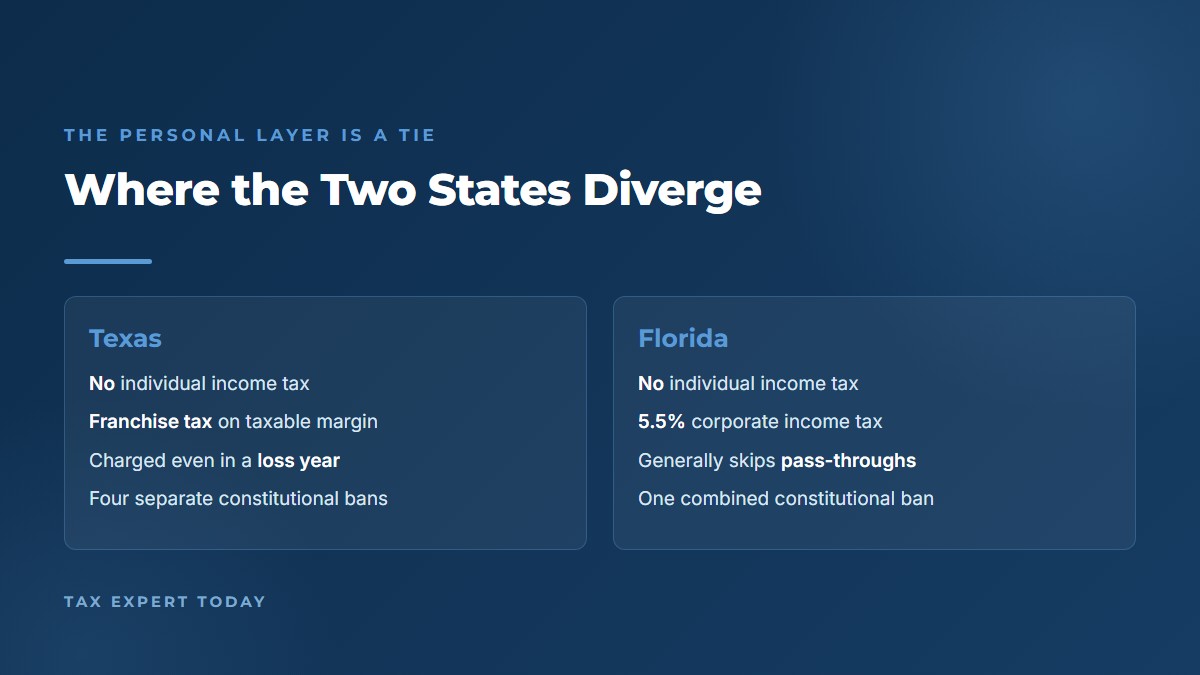
Neither state taxes individual income, and in both cases the protection is constitutional rather than merely legislative. That matters because a statute can be repealed by an ordinary majority in a single session, while a constitutional prohibition requires a vote of the people. The two states arrived at that protection by different routes and with different scope.
Texas prohibits an individual income tax under Article VIII, Section 24-a of its constitution, added November 5, 2019. The text says the legislature may not impose a tax on the net incomes of individuals, including an individual share of partnership and unincorporated association income. Texas then added three more prohibitions on top of it. What that protection does and does not reach for a relocating high earner is covered in our guide to Texas no state income tax.
Florida takes a single combined approach. Article VII, Section 5(a) provides that no tax upon estates or inheritances or upon the income of natural persons who are residents or citizens of the state shall be levied by the state. One sentence covers income and death taxes together.
The scope difference is worth understanding before assuming the two states are interchangeable for planning purposes.
| Protection | Texas authority | Florida authority |
|---|---|---|
| Individual income tax banned | Art. VIII, Sec. 24-a, added Nov. 5, 2019 | Art. VII, Sec. 5(a) |
| Capital gains tax banned | Art. VIII, Sec. 24-b, added Nov. 4, 2025 | Covered indirectly through Sec. 5(a) |
| Wealth or net worth tax banned | Art. VIII, Sec. 25, added Nov. 7, 2023 | No express separate prohibition |
| Estate and inheritance tax banned | Art. VIII, Sec. 26, added Nov. 4, 2025 | Art. VII, Sec. 5(a) |
| Entity income tax posture | No corporate income tax, franchise tax instead | Sec. 5(b) contemplates a tax on non natural persons |
Texas Section 24-b, added at the November 4, 2025 election, prohibits a tax on the realized or unrealized capital gains of an individual, family, estate, or trust. Section 25 prohibits a tax based on wealth or net worth. Section 26 prohibits a state death tax and a tax on the transfer of an estate, inheritance, legacy, succession, or gift. Our guide to the Texas capital gains tax walks through what Section 24-b does and does not reach.
Florida Section 5(b) runs the other direction. It expressly contemplates a tax on the income of residents other than natural persons and caps it at 5 percent of net income, or a greater rate authorized by a three fifths vote of each house. Florida therefore has a constitutional framework that anticipates the corporate income tax it actually imposes, while Texas has four separate provisions closing off individual level taxes it does not impose.
How Does the Texas Franchise Tax Compare With the Florida Corporate Income Tax?
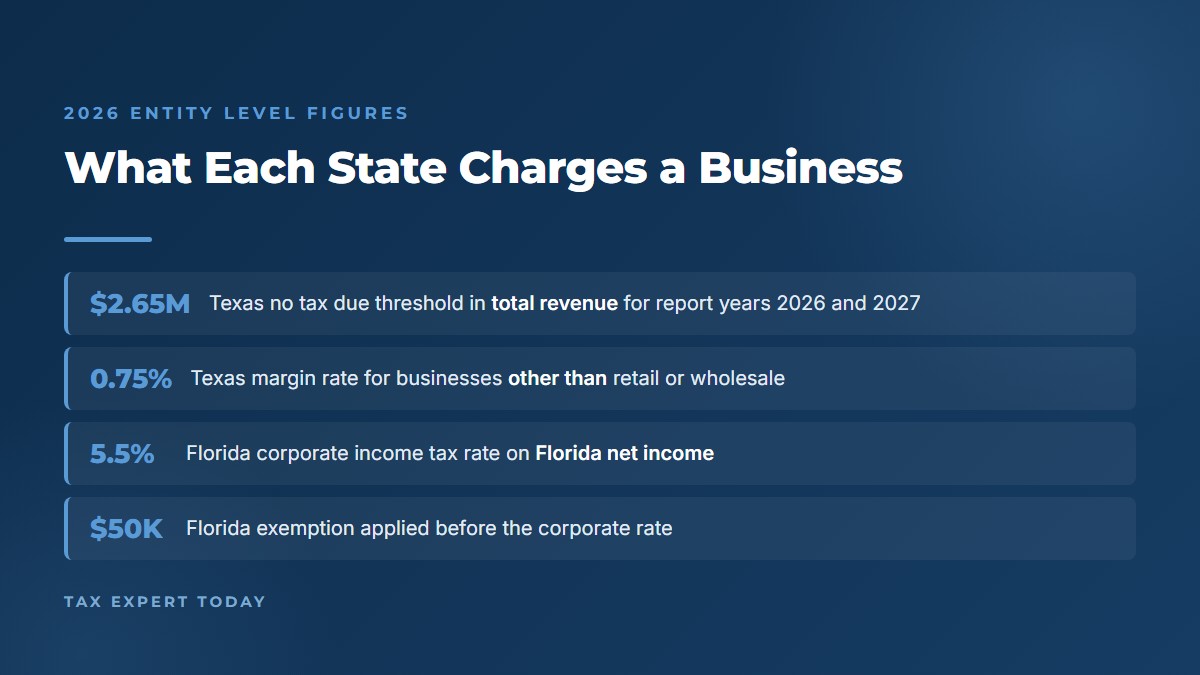
This is where the two states genuinely diverge, and it is the question most comparisons skip. Texas taxes gross margin without regard to profitability, reaching most entity types. Florida taxes net income at 5.5 percent but generally reaches only corporations and entities taxed as corporations, so many pass-through businesses owe no Florida entity level income tax at all.
Start with Texas. The Texas Comptroller sets a no tax due threshold of $2,650,000 in total revenue for the 2026 and 2027 report years. Above that threshold, the rate is 0.375 percent for retail and wholesale businesses and 0.75 percent for everyone else, applied to taxable margin rather than to profit. The compensation deduction limit is $480,000 per person. An entity with $20 million or less in total revenue may elect the EZ computation at 0.331 percent of apportioned total revenue. Annual reports are due May 15. Our Texas franchise tax guide covers the margin calculation methods in detail.
The structural point is that the Texas franchise tax is a margin tax, not a profit tax. A consulting firm with $3,000,000 in revenue and a break even year still computes and files. A loss does not automatically produce a zero liability the way it would under an income tax.
Florida works differently. Under the Florida Department of Revenue rules, the corporate income tax rate is 5.5 percent for taxable years beginning on or after January 1, 2022, applied to Florida net income after subtracting an exemption of $50,000. A business with no net income generally owes no Florida corporate income tax.
| Entity type | Texas treatment | Florida treatment |
|---|---|---|
| Single member LLC | Franchise tax applies if revenue exceeds the threshold | Generally no entity level income tax |
| Multi member LLC or partnership | Franchise tax applies if revenue exceeds the threshold | Generally no entity level income tax |
| S corporation | Franchise tax applies if revenue exceeds the threshold | Generally no entity level income tax |
| C corporation | Franchise tax applies if revenue exceeds the threshold | 5.5 percent on Florida net income above $50,000 |
| Tax base | Taxable margin, charged even in a loss year | Net income, so a loss year generally produces no tax |
| Economic nexus trigger | $500,000 in Texas gross receipts | Registration follows activity and sales thresholds |
The practical reading is that a profitable C corporation may prefer the Texas structure, because a 0.75 percent margin tax will usually cost less than 5.5 percent of net income. A pass-through business with strong revenue and thin margins often prefers Florida, because the Texas franchise tax follows revenue while Florida generally leaves the pass-through alone. Facts drive the answer, and the same business can reach opposite conclusions in two different years. Our guide to Texas LLC taxes explains how the franchise tax interacts with federal pass-through treatment.
Which State Is Easier for Establishing Domicile?
Florida offers a statutory filing that Texas does not. Neither state applies a statutory day count test to establish domicile, so intent and evidence govern in both. The difference is that Florida gives a relocating taxpayer a formal sworn instrument to point to, while a Texas arrival builds the same record from ordinary documents.
Under Florida Statutes Section 222.17, a person who has established a domicile in Florida may manifest and evidence it by filing a sworn statement with the clerk of the circuit court in the county of residence. A person who keeps homes in more than one state may file a sworn statement that the Florida abode is the predominant and principal home and that the person intends to continue it permanently. That filing does not by itself decide a residency dispute, but it creates a dated, sworn record.
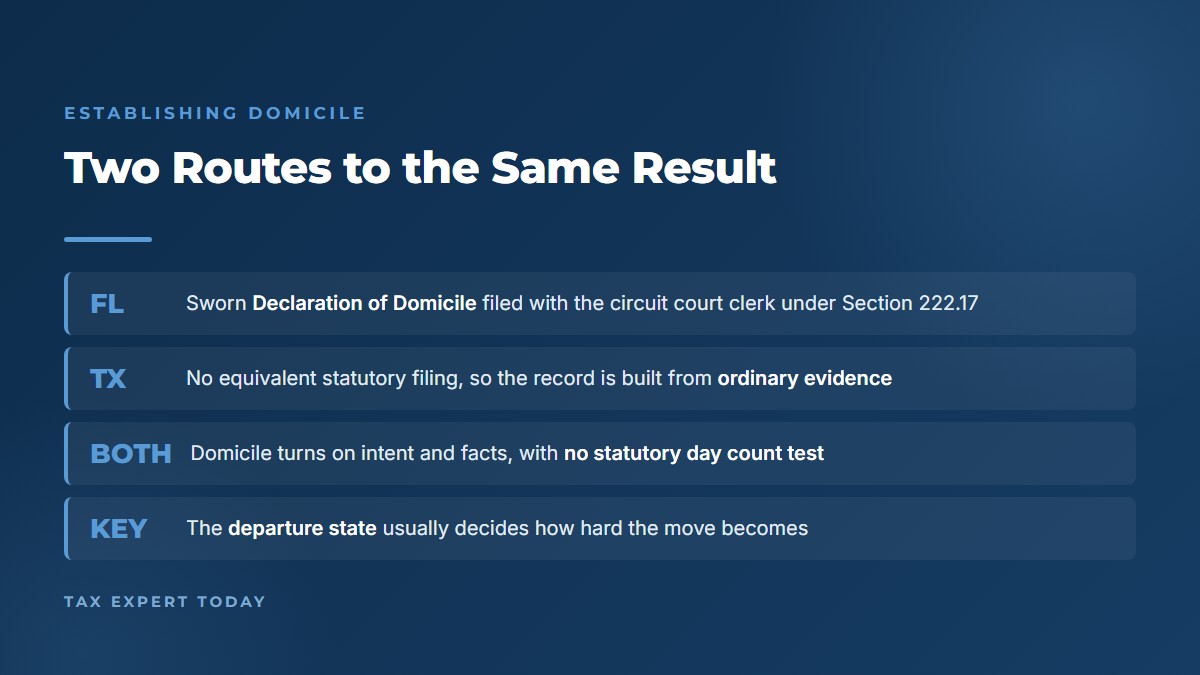
Texas has no equivalent statutory declaration. A person establishing Texas domicile assembles the record from a driver license, voter registration, vehicle registration, a homestead designation, and the ordinary pattern of where life is actually centered. Our guide on how to establish Texas residency covers that evidence set, and the parallel guide on how to establish Florida residency covers the Florida side.
In practice the destination state is rarely the hard part. The state being left decides how difficult the move becomes, because a high tax departure state has both the incentive and the audit machinery to argue that domicile never actually changed. That is the same dynamic described in our guide to the dual state residency trap. Choosing between Texas and Florida on domicile difficulty alone usually answers a question that was never the binding constraint.
How Do Sales Tax and Business Registration Compare?
Texas carries a higher combined sales tax ceiling and a higher revenue threshold before an out of state seller must register. Florida starts one quarter point lower at the state level but adds county surtaxes, and Florida requires registration at a much lower level of remote sales, which matters for any business selling into both states.
The Texas rate is 6.25 percent at the state level, and local taxing jurisdictions may add up to 2 percent for a maximum combined rate of 8.25 percent. Florida applies a general state rate of 6 percent, with many counties adding a discretionary sales surtax on top.
The registration thresholds differ more sharply than the rates. Texas provides a safe harbor for remote sellers with total Texas revenue below $500,000 in the preceding twelve calendar months. Florida requires remote sellers to collect and remit once taxable remote sales exceed $100,000 in the previous calendar year. A growing online business will therefore usually trip the Florida obligation well before the Texas one.
Texas layers one more registration test on top. A taxable entity with annual gross receipts of $500,000 or more from business in Texas has economic nexus for franchise tax purposes even without physical presence in the state. An out of state business can owe a Texas franchise tax report without ever setting foot in Texas. Our tax checklist for moving a business to Texas walks through the registration sequence.
What Do Texas vs Florida Taxes Mean for Estates and Trusts?
Neither state imposes an estate or inheritance tax, so the state level result is the same. The differences that matter for estate planning are the source of the protection and the reach of homestead creditor protection, not the tax rate, because the rate is zero in both places.
Florida bans estate and inheritance taxes in the same constitutional sentence that bans the individual income tax, under Article VII, Section 5(a). Texas added its prohibition more recently through Article VIII, Section 26, approved at the November 4, 2025 election, which reaches a state death tax and a tax on the transfer of an estate, inheritance, legacy, succession, or gift.
Homestead creditor protection is a real distinction. Florida Constitution Article X, Section 4 exempts a homestead from forced sale, extending to one half acre of contiguous land inside a municipality and up to 160 acres outside one, with no cap on value. Texas provides its own homestead exemption from forced sale through acreage based limits in Texas Property Code Chapter 41. Both are strong, and the right comparison depends on the acreage and location involved.
Neither state protection changes the federal picture. The federal estate tax still applies regardless of which no income tax state a person calls home, and property situated in another state can remain exposed to that state estate tax even when the owner is domiciled in Texas or Florida. Our guide to Florida estate planning for new residents covers the documents that usually need revisiting after a move.
Which State Should a Business Owner Choose?
There is no universal answer, and any comparison that produces one has skipped the facts that matter. The choice depends on entity type, revenue, margin, where customers are located, and what the departure state will assert. In many cases the tax difference between the two states is smaller than the cost of an unclean exit from the prior state.
A short framework helps. If the business is a profitable C corporation with healthy margins, the Texas franchise tax often produces a lower state cost than a 5.5 percent Florida corporate income tax. If the business is a pass-through with substantial revenue and modest margins, Florida frequently produces the lower result, because the Texas franchise tax follows revenue while Florida generally does not tax the pass-through at the entity level.
If the plan involves selling the business, timing matters more than the destination. Gain sourcing rules in the departure state can reach a sale that closes after the move, which is the subject of our guides on the Texas capital gains tax and on moving to Florida before selling a business. If the concern is a future state level tax on income or wealth, the Texas constitutional structure is broader on paper today.
These outcomes depend on individual circumstances, and a projection built on one year of figures can reverse in the next. The analysis is worth running with actual numbers rather than with state averages.
Texas vs Florida Tax Planning Help in Naples & Southwest Florida
Tax Expert Today LLC advises business owners and high earners weighing multi-state tax planning Naples clients ask about every season, including the Texas and Florida comparison. The firm is based in Naples, Florida, and serves clients in all 50 states, so the same team can model the Texas franchise tax exposure and the Florida corporate income tax result side by side rather than looking at only one of them.
Our practice covers state tax matters nationwide alongside federal advisory work. Texas franchise tax and Florida corporate income tax are state agency matters handled with the Texas Comptroller and the Florida Department of Revenue, and we coordinate them with the federal planning that runs underneath both. Clients relocating in either direction typically need the entity analysis, the domicile evidence file, and the departure state exposure reviewed together.
Tax Expert Today LLC
11983 Tamiami Trail N, Naples, FL 34110
Phone: (239) 441-2005
Hours: Monday through Friday, 10:00 am to 5:00 pm ET
Business owners already operating in Texas can review our Texas tax services, and those weighing the Florida side can start with Naples tax planning.
Frequently Asked Questions
Is Florida or Texas better for taxes?
Neither state taxes individual income, so the answer depends on the business layer. Texas charges a franchise tax on margin above $2,650,000 in total revenue regardless of profit. Florida charges 5.5 percent on corporate net income above a $50,000 exemption but generally does not reach pass-through entities. Entity type and margin decide the result.
Does Texas have a corporate income tax?
Texas does not impose a traditional corporate income tax. It imposes a franchise tax measured by taxable margin under the rates published by the Texas Comptroller. Because the base is margin rather than profit, a business can owe Texas franchise tax in a year with no net income, provided total revenue exceeds the current no tax due threshold.
Do LLCs pay tax in Florida?
A Florida LLC treated as a partnership or disregarded entity generally does not pay Florida corporate income tax, because that tax reaches corporations and entities taxed as corporations. An LLC that elects corporate treatment can fall within it. Sales tax, reemployment tax, and federal obligations are separate and apply on their own terms.
Which state is harder for establishing residency?
Both states rely on domicile rather than a statutory day count. Florida provides a sworn Declaration of Domicile under Section 222.17 that creates a dated record. Texas has no equivalent statutory filing and relies on ordinary evidence. In most disputes the departure state, not the destination state, determines how difficult the change becomes.
Do Texas and Florida both avoid estate tax?
Yes, at the state level. Florida bans estate and inheritance taxes under Article VII, Section 5(a) of its constitution. Texas added a comparable prohibition through Article VIII, Section 26, approved at the November 4, 2025 election. The federal estate tax still applies in both states, and property located elsewhere may remain exposed to another state tax.
Can a Naples advisor handle a Texas business tax question?
Yes. Tax Expert Today LLC works from Naples, Florida and serves clients in all 50 states, including Texas franchise tax registration and reporting questions. State filings are handled with the relevant state agency, and the federal analysis is coordinated alongside them. Call (239) 441-2005 to discuss a specific situation.
When to Engage a Professional
Consider professional guidance when the comparison stops being theoretical. That usually happens when revenue approaches the Texas no tax due threshold, when an entity conversion or relocation is on the table, when a sale or liquidity event is being timed around a move, or when a departure state has already begun asking questions about domicile.
The analysis is fact dependent, and published state averages rarely match a specific set of books. A projection that models the actual entity structure, revenue, margin, and customer footprint in both states gives a far more reliable answer than a rate comparison. Tax Expert Today LLC works with business owners and high earners on state and federal planning of this kind. Call (239) 441-2005 or visit our Naples tax planning page to arrange a consultation.
This article is educational and general in nature. It is not tax, legal, or financial advice for any specific situation. Tax outcomes depend on individual facts and on law that can change. Consult a qualified advisor about your circumstances.
Published August 3, 2026 by Dr. Pellumb Kabashi « Back to Learning Center
Have a question this article touches on?
Tax Expert Today LLC, based in Naples, Florida and serving clients across the United States.
Schedule a Consultation (239) 441-2005