
By Dr. Pellumb Kabashi, DBA, MBA, CES, CFE, EA
Founder, Tax Expert Today LLC · Tax advisors, enrolled agents, CPAs, and attorneys · Serving clients in all 50 states
Quick Answer
Nonqualified deferred compensation lets an executive postpone income tax on salary or bonus until it is paid, under IRC section 409A. For 2027 pay, the election is generally due by December 31, 2026. FICA can be owed at deferral, and installments of ten years or more may escape a former state’s tax. Call (239) 441-2005 for a free consultation.
What is nonqualified deferred compensation?
Nonqualified deferred compensation is an employer’s contractual promise to pay compensation earned now at a later date, outside the rules for qualified plans such as a 401(k). The executive generally pays no income tax until payment, but the promise is unfunded and unsecured, and the plan must satisfy IRC section 409A.
- Statutory home: IRC section 409A, effective for amounts deferred after 2004.
- What it is legally: a contract right to future payment, not a trust account the executive owns.
- Who uses it: executives and other highly paid employees who have reached the qualified plan limits.
- Main tradeoff: income tax deferral in exchange for creditor risk and rigid timing rules.
The word “nonqualified” describes what the plan is not. A qualified plan, such as a 401(k), a profit sharing plan, or a cash balance plan, meets the coverage, contribution, vesting, and funding rules of IRC section 401(a), holds its assets in a trust that the employer cannot reach, and receives tax treatment written into the Code for that purpose. A nonqualified deferred compensation plan, often shortened to NQDC, sits outside that structure. There is no dollar cap on how much can be deferred, there is no nondiscrimination test, and the plan can be offered to a handful of executives only.
The price of that freedom is that the money is not set aside for the executive in any legally protected way. The executive holds a promise from the employer. If the employer later cannot pay, the executive stands in line with other general creditors. That single fact explains most of the tax rules in this guide: the income tax deferral works precisely because the executive has not yet received anything the law treats as property or as income available on demand.
The IRS NQDC Audit Technique Guide describes these plans as elective or nonelective arrangements between an employer and an employee to pay compensation in the future. Since 2005, nearly every such arrangement has had to follow the election and payment rules of IRC section 409A. Section 409A does not tell an employer how much to pay. It tells the employer and the executive when the decision to defer must be made and when the money can come out.
| Element | General rule | Where it comes from |
|---|---|---|
| Income tax | Generally deferred until paid, if the plan complies with 409A and the amount is not constructively received | IRC 409A, IRC 451, Reg. 1.451-2 |
| FICA tax | Generally owed when the services are performed or, if later, when the amount vests | IRC 3121(v)(2) |
| Election timing | Generally before the start of the year in which the services are performed | IRC 409A(a)(4)(B); Reg. 1.409A-2(a) |
| Payment events | Six permitted events, such as separation from service or a fixed date | IRC 409A(a)(2) |
| Security | Unfunded and unsecured; the executive is a general creditor | Plan terms; IRS NQDC Audit Technique Guide |
| Penalty for failure | Current inclusion of vested deferrals, plus a 20 percent additional tax and premium interest | IRC 409A(a)(1) |
How does nonqualified deferred compensation differ from a 401(k)?
A 401(k) holds money in a protected trust, caps deferrals at $24,500 for 2026, allows rollovers and loans, and must pass nondiscrimination tests. Nonqualified deferred compensation has no dollar cap and no testing, but the account is only a promise, it cannot be rolled into an IRA, and payment timing is locked in advance.
- Limits: a 401(k) is capped by IRC 402(g) and 415(c); an NQDC plan has no statutory cap.
- Protection: 401(k) assets sit in a trust; NQDC balances are reachable by the employer’s creditors.
- Portability: a 401(k) can roll to an IRA; NQDC payments generally cannot.
- Flexibility: 401(k) withdrawals follow age rules; NQDC payments follow the dates chosen at election.
The two arrangements are often described as complements, and that is accurate. Most executives who are offered an NQDC plan are already deferring the maximum to the company 401(k). Under IRS Notice 2025-67, the 2026 elective deferral limit is $24,500, with an $8,000 catch-up at age 50 and older. For someone earning $500,000, that ceiling covers less than 5 percent of pay. The nonqualified plan picks up where the qualified plan stops.
The differences that matter most in practice are security and flexibility. A 401(k) account belongs to the participant, held in a trust that the employer’s creditors cannot touch. If the participant changes jobs, the account can move to an IRA or a new plan. If money is needed early, the participant can usually take it, paying the 10 percent early withdrawal tax where it applies. None of that is true of NQDC. The balance is a bookkeeping entry on the employer’s books. Payment comes only on the events and in the form the executive chose before the money was earned, and changing that schedule later requires a five-year push into the future.
There is also no early withdrawal penalty in the 401(k) sense. A payment from a compliant NQDC plan at age 52 is taxed as ordinary wages, without the 10 percent additional tax of IRC section 72(t), because the plan is not a qualified retirement plan. That feature makes NQDC useful for planned expenses before 59½, such as tuition or a bridge to retirement, provided the dates are elected in advance. Readers who are weighing other high-earner savings routes may also find our guides to the mega backdoor Roth and the backdoor Roth IRA useful, since those routes use the qualified plan and IRA rules rather than an employer promise.
| Feature | 401(k) plan | Nonqualified deferred compensation |
|---|---|---|
| 2026 deferral limit | $24,500, plus $8,000 catch-up at 50 or older | No statutory dollar limit; set by the plan |
| Who may participate | Broad coverage required | Generally a select group of management or highly compensated employees |
| Nondiscrimination testing | ADP, ACP, and coverage tests | None |
| Where the money is | Trust for participants | General assets of the employer, sometimes a rabbi trust |
| Creditor risk | Protected from employer creditors | Exposed to employer creditors |
| Rollover to an IRA | Permitted | Not permitted |
| Loans | Often permitted | Not permitted |
| Early access penalty | 10 percent before 59½ unless an exception applies | None, but payment only on elected events |
| Employer deduction | When contributed, within limits | When the executive includes the payment in income |
Who is eligible for a nonqualified deferred compensation plan?
An employer usually limits a nonqualified deferred compensation plan to a select group of management or highly compensated employees, because that limit keeps the plan exempt from most of the participation, vesting, and funding rules of ERISA. The Code itself sets no income threshold, but plans commonly use a salary floor or an officer title.
- Top-hat status: ERISA exempts unfunded plans for a select group from most of its requirements.
- Typical eligibility: officers, directors, and employees above a pay level set by the plan.
- Independent contractors and directors: 409A can apply to them as well.
- Owners: shareholder-employees of a corporation can generally participate, with extra care.
The eligibility rule comes from labor law, not tax law. The Employee Retirement Income Security Act treats an unfunded plan “maintained by an employer primarily for the purpose of providing deferred compensation for a select group of management or highly compensated employees” as a so-called top-hat plan. The language appears in several sections of ERISA, including the participation exemption in 29 U.S.C. section 1051(2). A top-hat plan is excused from ERISA’s participation, vesting, funding, and fiduciary rules, and it satisfies the reporting rules with a short notice to the Department of Labor. A plan that covers too broad a group can lose that status and face the full set of ERISA requirements, which an unfunded promise cannot meet.
Neither ERISA nor the regulations set a bright line for “select group.” Courts look at the size of the group relative to the whole workforce, the pay of the covered employees compared with everyone else, and whether those employees have the bargaining power to protect themselves. As a working practice, many employers limit eligibility to a small percentage of the workforce and to employees paid well above the qualified plan limits.
Section 409A is broader than ERISA. It applies to a “service provider,” which includes employees, directors, and independent contractors, with limited exceptions. A board member who defers director fees, or a consultant with a deferred payment arrangement, can be inside 409A even though no employer-employee relationship exists. The definitions are in Treasury Regulation section 1.409A-1.
| Participant type | Can 409A apply? | Common practical note |
|---|---|---|
| Senior executive employee | Yes | The core group for elective deferral plans |
| Highly paid non-officer employee | Yes | Eligibility depends on the plan’s pay threshold |
| Outside director | Yes | Deferred board fees are a frequent use |
| Independent contractor | Often yes | Limited exception for contractors serving many unrelated clients |
| Shareholder of a C corporation who works in the business | Yes | Deduction timing and reasonable compensation review are important |
| Rank-and-file employees | Yes, in principle | Usually excluded to keep top-hat status under ERISA |
What types of nonqualified deferred compensation plans exist?
The common types are elective deferral plans, where the executive chooses to defer salary or bonus; supplemental executive retirement plans, where the employer funds a benefit; excess benefit plans, which restore benefits cut by qualified plan limits; and bonus or phantom arrangements that pay later. Section 409A can apply to each type.
- Elective deferral plan: the executive gives up pay now for a promise of pay later.
- SERP: a nonelective employer promise, often a formula tied to pay and years of service.
- Excess benefit plan: restores benefits that IRC 415 limits would otherwise cut.
- Deferred bonus or phantom equity: a promise of cash later, sometimes measured by share value.
The type of plan matters for two practical reasons. First, it determines whether the executive makes an election at all. In an elective deferral plan the executive decides each year how much salary or bonus to defer and, usually, when and how it will be paid. In a supplemental executive retirement plan, commonly called a SERP, the employer decides the amount and the plan document fixes the payment terms. Second, the type affects the FICA timing rules. Account balance plans, where the benefit equals a notional account, follow one set of rules under the employment tax regulations. Nonaccount balance plans, where the benefit is a formula such as a percentage of final pay, follow another.
Excess benefit plans have a special place in state tax law. 4 U.S.C. section 114 protects payments from a plan “maintained solely for the purpose of providing retirement benefits for employees in excess of the limitations” of the qualified plan rules, even when they are not paid in installments. That protection is discussed later in the state tax sections.
Equity awards can also fall inside 409A. Restricted stock units that settle after the year of vesting, stock appreciation rights with a below-market exercise price, and discounted stock options are the usual examples. Most standard restricted stock unit programs are designed to fit the short-term deferral exception described below, which keeps them outside 409A. Our guide to California RSU tax when leaving the state covers how equity is sourced between states, which is a different question from the 409A election rules covered here.
| Type | Who decides the amount | Typical funding | Typical payment trigger |
|---|---|---|---|
| Elective salary or bonus deferral | Executive | Employer general assets, sometimes a rabbi trust | Separation from service or a fixed date chosen at election |
| Supplemental executive retirement plan | Employer formula | Employer general assets, often with corporate-owned life insurance | Separation from service or a stated age |
| Excess benefit plan | Formula restoring capped benefits | Employer general assets | Retirement |
| Deferred bonus or retention award | Employer | Employer general assets | A fixed date or a vesting date |
| Phantom stock or stock appreciation right | Employer | Unfunded, measured by share value | A fixed date, separation, or a change in control |
What does Section 409A require?
Section 409A requires that the decision to defer be made in writing before the compensation is earned, that payment occur only on one of six permitted events, that payment not be accelerated, and that any later change follow a 12-month notice and 5-year delay rule. A plan must satisfy these rules both in its document and in its operation.
- Timing of elections: generally before the year the services are performed.
- Permitted payment events: separation, disability, death, a fixed date or schedule, change in control, or unforeseeable emergency.
- No acceleration: payment cannot be moved earlier except under narrow regulatory exceptions.
- Later elections: a delay or change in form must be made 12 months ahead and push payment out at least 5 years.
Congress enacted IRC section 409A in 2004, after a series of corporate failures in which executives accelerated their deferred compensation while ordinary creditors and employees were left unpaid. The statute is short. The final regulations, issued in 2007 at Treasury Regulation sections 1.409A-1 through 1.409A-6, are long, and they carry most of the detail an executive needs.
The structure is easiest to see as three gates. The first gate is the initial election: the executive must decide to defer, and generally must choose when and how payment will happen, before the year in which the work is done. The second gate is the payment event: money can come out only on an event the plan names in advance from the statutory list, and only in the form elected. The third gate is the change rule: once set, the time and form can be pushed later, but not earlier, and only by following the 12-month and 5-year rule.
Each gate applies to the plan document and to the way the plan is run. A plan with a perfect document can still fail if the employer pays a benefit a month early, or lets an executive change an election after the deadline. A failure in one participant’s account generally affects that participant, not everyone in the plan, under section 409A(a)(1)(A)(ii). The consequences of a failure, and the IRS correction programs, are covered later in this guide.
| Gate | What must happen | Statutory source | Regulation |
|---|---|---|---|
| Initial deferral election | Elect to defer, and generally the time and form of payment, before the service year begins | IRC 409A(a)(4)(B) | Reg. 1.409A-2(a) |
| Payment | Pay only on a permitted event, in the elected form, with no acceleration | IRC 409A(a)(2) and (a)(3) | Reg. 1.409A-3 |
| Subsequent election | Elect 12 months ahead, effective 12 months later, and delay at least 5 years | IRC 409A(a)(4)(C) | Reg. 1.409A-2(b) |
When is the nonqualified deferred compensation election deadline for 2027 pay?
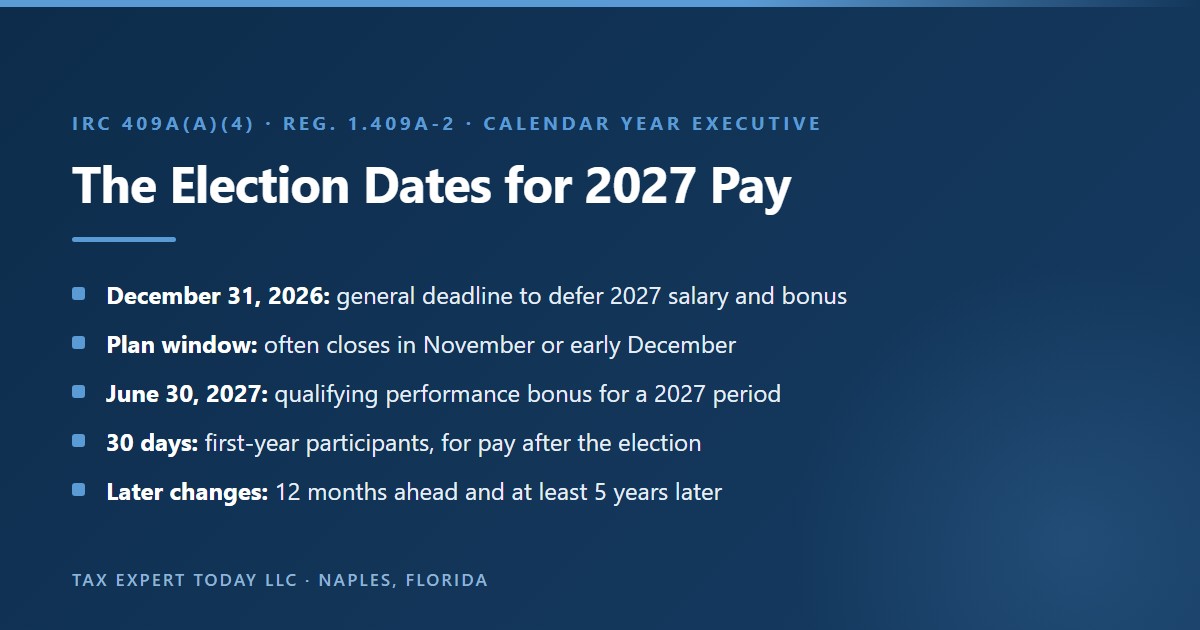
For a calendar year executive, the general rule requires the election to defer 2027 salary to be made by December 31, 2026, before the year in which the services are performed. Many plans set an earlier internal deadline in November or early December, and the plan’s own date controls if it is earlier than the legal limit.
- Legal rule: election by the close of the taxable year before the service year.
- Calendar year example: 2027 salary requires an election by December 31, 2026.
- Plan deadline: enrollment windows often close weeks earlier to allow payroll setup.
- Irrevocable: the election generally becomes irrevocable when the deadline passes.
The statute says that compensation for services performed in a taxable year may be deferred “only if the election to defer such compensation is made not later than the close of the preceding taxable year.” Treasury Regulation section 1.409A-2(a)(3) restates the rule: the election must be made “not later than the close of the service provider’s taxable year next preceding the service year.” Almost every individual executive is a calendar year taxpayer, so for 2027 salary that means December 31, 2026.
That is why searches for nonqualified deferred compensation rise in November and December. Open enrollment for the plan usually runs alongside open enrollment for health benefits, and the window commonly closes well before year end so that payroll can set up the reductions for the first January paycheck. An executive who misses the plan’s window generally cannot defer that year’s salary at all, even if December 31 has not yet arrived, because the plan document sets the operational deadline.
The election is generally irrevocable once the deadline passes. The regulations allow the plan to let the executive change or revoke the election up until the deadline, but not after. A later change in circumstances, such as an unexpected expense in mid-2027, generally does not reopen the salary deferral for that year. The only mid-year cancellation the regulations allow is limited, such as a cancellation following a hardship distribution from a 401(k) or an unforeseeable emergency distribution from the NQDC plan itself.
| Compensation deferred | Service period | General legal deadline for the election | Rule |
|---|---|---|---|
| 2027 base salary | Calendar 2027 | December 31, 2026 | Reg. 1.409A-2(a)(3) |
| Annual bonus for services in 2027, paid in 2028 | Calendar 2027 | December 31, 2026 | Reg. 1.409A-2(a)(3) |
| Performance bonus for a 2027 performance period of at least 12 months | Calendar 2027 | June 30, 2027, if the bonus qualifies and is not yet readily ascertainable | Reg. 1.409A-2(a)(8) |
| Fiscal year compensation paid only after the fiscal year | Employer fiscal year | Before the employer’s fiscal year begins | Reg. 1.409A-2(a)(6) |
| First year of eligibility for a new participant | Remainder of the year | Within 30 days of becoming eligible, for pay earned after the election | Reg. 1.409A-2(a)(7) |
How do first-year participants make a nonqualified deferred compensation election?
An executive who first becomes eligible for a plan mid-year may elect within 30 days of becoming eligible, but only for compensation paid for services performed after the election. Pay already earned before the election cannot be deferred, and the 30-day rule is not available to someone already eligible for a similar plan of the same employer.
- Window: 30 days after the date of initial eligibility.
- Scope: only pay for services after the election is made.
- Bonuses: a bonus earned over a period is prorated to the portion after the election.
- Aggregation: eligibility in a similar plan of the same employer blocks a fresh 30-day window.
The rule is in Treasury Regulation section 1.409A-2(a)(7). In the regulation’s words, the service provider “may make an initial deferral election within 30 days after the date the service provider becomes eligible to participate in such plan, with respect to compensation paid for services to be performed after the election.” The common use is a newly hired or newly promoted executive who joins the plan in, say, April and wants to defer part of the remaining salary and part of the year’s bonus.
The bonus calculation trips up many first-year elections. If the bonus is earned over the calendar year and the election is made on April 30, the regulation treats only the portion of the bonus attributable to services after the election as eligible. The usual method is a straight proration by days. A $90,000 bonus for the year, with the election made after one third of the year has passed, would allow at most about $60,000 to be deferred under that method.
The 30-day window is not a second chance for someone already in the plan. The regulations aggregate plans of the same type for this purpose. An executive who was already eligible under another elective account balance plan of the same employer, or who had been eligible and was paid out, generally cannot use the new eligibility rule for a similar plan. The plan administrator usually tracks this, but executives who move between subsidiaries or rejoin after a break should confirm their status before relying on the 30-day rule.
| Item | Amount | Note |
|---|---|---|
| Annual salary | $360,000 | Paid evenly through the year |
| Salary for services May through December | $240,000 | Only this portion is eligible |
| Elected deferral rate | 20 percent | Applied to eligible salary |
| Salary deferred | $48,000 | Hypothetical |
| Calendar year bonus target | $90,000 | Earned over the full year |
| Bonus eligible after proration | About $60,000 | Days after the election divided by days in the year |
How do bonus and performance-based compensation elections work?
A bonus earned for services in 2027 generally requires an election by December 31, 2026, even if it is paid in 2028. A bonus that qualifies as performance-based compensation over a period of at least 12 months may be elected up to six months before the period ends, if the amount is not yet readily ascertainable.
- Default rule: the service year controls, not the payment year.
- Performance-based exception: election up to six months before the end of a 12-month or longer period.
- Conditions: preestablished written criteria, continuous service, and no readily ascertainable amount at election.
- Forfeitable rights: a separate 30-day rule can apply to awards with at least 12 months of required service remaining.
Bonuses cause more election mistakes than salary, because the payment date and the service period differ. A bonus paid in March 2028 for work done in 2027 is compensation for services performed in 2027. Under the general rule in Reg. 1.409A-2(a)(3), the election to defer it is due by December 31, 2026. Executives sometimes assume they can wait until the bonus amount is announced in early 2028, which is too late under the general rule.
The statute gives a narrow exception in section 409A(a)(4)(B)(iii) for performance-based compensation “based on services performed over a period of at least 12 months.” The election can be made “no later than 6 months before the end of the period.” For a calendar year performance period, that is June 30. Reg. 1.409A-2(a)(8) adds conditions: the criteria must be set in writing within 90 days after the period starts, the outcome must be substantially uncertain when the criteria are set, the executive must have worked continuously from the start of the period (or from when the criteria were set) through the election date, and the amount must not be readily ascertainable when the election is made. A bonus that is effectively certain by June does not qualify.
The plan, not the executive, decides whether to offer the mid-year election. Many plans simply require bonus elections by the December deadline to avoid the question of whether a particular bonus program meets the performance-based definition. If the plan offers it, the plan administrator should be able to say which bonus programs qualify.
| Bonus type | Typical payment date | General election deadline | Source |
|---|---|---|---|
| Annual discretionary bonus for 2027 services | Early 2028 | December 31, 2026 | Reg. 1.409A-2(a)(3) |
| Qualifying performance bonus, 2027 calendar year period | Early 2028 | June 30, 2027 | IRC 409A(a)(4)(B)(iii); Reg. 1.409A-2(a)(8) |
| Three-year performance award, 2027 to 2029 | Early 2030 | June 30, 2029, if the award qualifies | Reg. 1.409A-2(a)(8) |
| Retention award requiring at least 12 more months of service | At vesting | Within 30 days of the legally binding right, if 12 months of service remain | Reg. 1.409A-2(a)(5) |
| Sign-on bonus for a new hire | At hire or soon after | Generally cannot be deferred once earned | Reg. 1.409A-2(a)(3) |
What payment events does Section 409A permit?
Section 409A allows payment only on six events: separation from service, disability, death, a specified time or fixed schedule, a change in control of the employer, or an unforeseeable emergency. The plan must name the events and the form of payment in advance, and money cannot come out on any other trigger.
- Separation from service: the most common trigger for retirement benefits.
- Specified time or fixed schedule: for example, January 2035, or five annual installments starting in 2032.
- Change in control: defined narrowly in the regulations.
- Disability, death, and unforeseeable emergency: each with a regulatory definition.
The list appears in section 409A(a)(2)(A), and the definitions are in Reg. 1.409A-3. A plan can combine events, such as “the earlier of separation from service or January 1, 2035.” What it cannot do is let the executive decide later, in the moment, to take the money. A plan that pays “whenever the participant requests” is the textbook example of a 409A failure.
The regulations also define how precise the payment date must be. A plan satisfies the rule if it pays within the same calendar year as the event, or by the 15th day of the third month after the event, and it may set a payment period of up to 90 days as long as the executive cannot choose the taxable year. That flexibility helps payroll process a payment, but it does not let the executive pick between December and January for tax reasons.
Unforeseeable emergency has a demanding meaning. The regulations describe a severe financial hardship resulting from an illness or accident, a casualty loss, or similar extraordinary circumstances beyond the executive’s control, and the payment is limited to the amount reasonably needed after insurance and other resources. Buying a home or paying tuition does not qualify. Planned expenses should be handled with a fixed date elected in advance.
| Event | Common use | Key condition | Source |
|---|---|---|---|
| Separation from service | Retirement or job change | Six-month delay for specified employees of public companies | IRC 409A(a)(2)(A)(i), (a)(2)(B)(i) |
| Disability | Protection if unable to work | Statutory definition, generally a 12-month or longer impairment | IRC 409A(a)(2)(C) |
| Death | Beneficiary payment | Beneficiary designation under the plan | IRC 409A(a)(2)(A)(iii) |
| Specified time or fixed schedule | Tuition years, a bridge to retirement | Date fixed at election | IRC 409A(a)(2)(A)(iv) |
| Change in control | Sale of the employer | Ownership, effective control, or asset tests in the regulations | IRC 409A(a)(2)(A)(v); Reg. 1.409A-3(i)(5) |
| Unforeseeable emergency | Severe, unexpected hardship | Limited to the amount reasonably needed | IRC 409A(a)(2)(B)(ii); Reg. 1.409A-3(i)(3) |
What is the six-month delay for specified employees?
A specified employee of a company with publicly traded stock cannot receive a payment triggered by separation from service until six months after the separation, or death if earlier. Specified employees are key employees under IRC 416(i), which for 2026 generally includes officers paid more than $235,000, within limits.
- Who it affects: key employees of a company whose stock is publicly traded on an established securities market.
- 2026 officer threshold: $235,000 of compensation, under IRS Notice 2025-67.
- What it delays: only payments triggered by separation from service.
- Practical effect: the first payment usually slides to the seventh month after separation.
Section 409A(a)(2)(B)(i) says that for a specified employee, distributions “may not be made before the date which is 6 months after the date of separation from service (or, if earlier, the date of death of the employee).” A specified employee is a key employee “of a corporation any stock in which is publicly traded on an established securities market or otherwise.” Private companies are not subject to the delay.
Key employee status comes from IRC section 416(i), read without its paragraph (5). It includes officers with compensation above an indexed amount, 5 percent owners, and 1 percent owners with compensation above $150,000. Under IRS Notice 2025-67, the officer threshold “is increased from $230,000 to $235,000” for 2026. The number of officers who can count is capped, generally at 50, which is why large public companies maintain a formal list.
The regulations at Reg. 1.409A-1(i) let the employer set a specified employee identification date, and the list then applies for a 12-month period starting on a specified employee effective date. An executive who expects to retire should ask whether they are on the current list, because the answer shifts the first payment date by six months. Plans usually pay the delayed amounts in a lump sum on the first day after the six-month period ends, and then resume the regular schedule.
| Scheduled payment | Not a specified employee | Specified employee of a public company |
|---|---|---|
| First installment | On or soon after March 15, 2037 | On or after September 16, 2037, with any delayed amounts caught up |
| Monthly installments April to September 2037 | Paid monthly | Held, then paid together after the delay ends |
| Payments after September 2037 | Regular schedule | Regular schedule |
| If the executive dies in June 2037 | Beneficiary receives per plan | Delay ends at death; beneficiary paid per plan |
What counts as a separation from service under Section 409A?
Separation from service generally means the employer and the executive reasonably expect that services will stop or drop to no more than 20 percent of the average level over the prior 36 months. A drop to 50 percent or more is presumed not to be a separation. Consulting arrangements after retirement can therefore delay the payment trigger.
- Bright line at 20 percent: a permanent decrease to 20 percent or less is presumed a separation.
- Bright line at 50 percent: continued services of 50 percent or more are presumed not a separation.
- Between the two: facts and circumstances decide.
- Leaves of absence: a bona fide leave generally does not end employment for six months.
The definition in Reg. 1.409A-1(h) is functional, not formal. A job title change does not decide the question, and neither does a press release announcing retirement. The regulation asks whether the parties reasonably anticipated that “the level of bona fide services the employee would perform after such date (whether as an employee or as an independent contractor) would permanently decrease to no more than 20 percent of the average level of bona fide services performed” over the immediately preceding 36 months.
This matters most for executives who plan to stay on as advisors. A retiring chief financial officer who agrees to consult two days a week, roughly 40 percent of a prior full-time schedule, sits in the gray zone between 20 and 50 percent, and the separation date may be unclear. If the plan pays on separation and the parties treat the retirement date as the separation, but the facts later show services did not drop far enough, the payment may have been made early, which is a 409A failure. Agreeing in writing on the expected level of future services is a common way to document the decision.
The regulations also include an aggregation rule. The service recipient includes related employers in the same controlled group under the definitions in Reg. 1.409A-1(h)(3), so moving from one subsidiary to another inside the group is usually not a separation from service. The ownership percentage used for that test can depend on the plan’s terms, which is a point to confirm with the plan administrator before a transfer.
| Expected level of future services | Presumption | Practical note |
|---|---|---|
| Stops entirely | Separation | Clearest case |
| 20 percent or less of the prior 36-month average | Presumed separation | For example, occasional advisory work |
| More than 20 but less than 50 percent | No presumption; facts and circumstances | Document the expected schedule |
| 50 percent or more | Presumed no separation | For example, a move to part-time employment |
| Bona fide leave of absence | Employment continues for up to six months, longer with a right to return | A 29-month period applies for certain disability leaves |
Can a nonqualified deferred compensation payout date be changed after the election?
A payout date can be delayed, but generally not accelerated. A later election must be made at least 12 months before the first scheduled payment, cannot take effect for 12 months, and must push each affected payment out at least five years, except for payments on death, disability, or unforeseeable emergency.
- 12 months ahead: the new election must precede the original first payment by at least a year.
- 12 months to take effect: the change does not become effective until a year after it is made.
- Five-year push: the new payment date must be at least five years after the original date.
- No acceleration: moving a payment earlier is generally prohibited.
The subsequent election rule is in section 409A(a)(4)(C). The plan must require that the election “may not take effect until at least 12 months after the date on which the election is made,” that the payment be deferred “for a period of not less than 5 years from the date such payment would otherwise have been made,” and, for a payment at a specified time, that the election be made “not less than 12 months prior to the date of the first scheduled payment.” The five-year push does not apply to payments on death, disability, or unforeseeable emergency.
Installments create a planning wrinkle. Under Reg. 1.409A-2(b)(2)(iii), “the entitlement to a series of installment payments that is not a life annuity is treated as the entitlement to a single payment, unless the plan provides at all times” that the installments are separate payments. If installments are treated as one payment, a later change to the schedule moves the whole series by five years from the first installment. If the plan treats each installment as a separate payment, each one can be handled individually, and some may qualify for the short-term deferral exception. Many modern plans adopt the separate payment designation for that flexibility.
The five-year rule is a reason to make the first election carefully. An executive who elects payment at age 60 and later decides that age 62 would have been better cannot move to 62. The nearest available date would be age 65. Readers coordinating the payout with other retirement income may find our Roth conversion ladder guide useful, since conversions in low-income years often compete with deferred compensation payments for the same tax brackets.
| Step | Rule | Hypothetical date |
|---|---|---|
| Original scheduled payment | Set at initial election | January 15, 2037 |
| Latest date to make the change | At least 12 months before the scheduled payment | January 14, 2036 |
| Change takes effect | 12 months after the election | January 2037 |
| Earliest new payment date | At least 5 years after the original date | January 15, 2042 |
| Moving the payment to 2035 instead | Acceleration | Generally prohibited |
Can nonqualified deferred compensation be paid early?
Early payment is generally prohibited, but the regulations list narrow exceptions, including small cash-outs that do not exceed the $24,500 elective deferral limit for 2026, payments needed to cover FICA on the deferral, domestic relations orders, conflict of interest divestitures, and qualifying plan terminations.
- Limited cash-out: a full payout of the executive’s interest if it is no more than the 402(g)(1)(B) amount.
- FICA payment: acceleration to pay FICA on the amount deferred, plus related income tax withholding.
- Plan termination: permitted only under strict conditions, including a waiting period.
- Domestic relations orders: payment to a former spouse under a qualifying order.
The anti-acceleration rule in section 409A(a)(3) says a plan may not permit “the acceleration of the time or schedule of any payment,” except as the regulations provide. Reg. 1.409A-3(j)(4) lists the exceptions. Two come up often. The first is the limited cash-out: a plan may pay out the executive’s entire interest if the payment “is not greater than the applicable dollar amount under section 402(g)(1)(B),” which is $24,500 for 2026, and the payment ends the executive’s interest in that plan and all plans aggregated with it. The second is the FICA exception, which allows acceleration to pay the employee share of FICA due on the deferral, plus the related income tax withholding.
Plan terminations are allowed but are not a way to reach the money quickly. Under Reg. 1.409A-3(j)(4)(ix), a voluntary termination generally requires terminating all plans of the same type, waiting 12 months before any payments begin, finishing payments within 24 months, and not adopting a similar plan for three years. Terminations connected to a corporate dissolution, a bankruptcy court order, or a change in control have their own rules. An executive should not assume that a new management team can simply wind up the plan and pay everyone in the next quarter.
| Exception | What it allows | Key condition |
|---|---|---|
| Limited cash-out | Full payment of a small balance | No more than $24,500 for 2026, ending the executive’s interest in aggregated plans |
| FICA and related withholding | Payment to cover employment tax on the deferral | Limited to the FICA amount and related income tax withholding |
| Domestic relations order | Payment to a former spouse | Order must meet the regulatory definition |
| Conflict of interest | Payment to comply with ethics rules | Required by a federal, state, or foreign ethics law |
| Payment of state, local, or foreign tax | Payment to cover tax imposed before payment | Limited to the tax and related withholding |
| Plan termination | Payment after a qualifying termination | 12-month wait, 24-month payout, three-year bar on a similar plan for voluntary terminations |
| Section 409A failure | Payment of the amount required to be included in income | Limited to the amount included |
What happens when a nonqualified deferred compensation plan fails Section 409A?
If a plan fails Section 409A, all vested amounts deferred under it for the affected executive, for the current and prior years, become taxable in the year of failure. The executive also owes a 20 percent additional tax on that amount and premium interest at the underpayment rate plus one percentage point. The executive, not the employer, pays.
- Current inclusion: vested deferrals for the year and all prior years become income.
- 20 percent additional tax: on the amount required to be included.
- Premium interest: the underpayment rate plus one percentage point, measured from the original deferral year.
- Who pays: the executive, even though the employer usually caused the failure.
Section 409A(a)(1)(A) provides that if a plan “fails to meet the requirements” of the statute or “is not operated in accordance with such requirements, all compensation deferred under the plan for the taxable year and all preceding taxable years shall be includible in gross income” to the extent vested and not already included. Section 409A(a)(1)(B) adds the interest and “an amount equal to 20 percent of the compensation which is required to be included in gross income.” The interest is computed “at the underpayment rate plus 1 percentage point” on the underpayments that would have occurred had the amount been taxed when first deferred.
The burden falls on the executive, which is why executives have a reason to understand rules that are mostly run by their employer. The failure can be small, such as a payment made a few weeks early, and the consequence can be large. Some states have their own additional tax on 409A failures, so the total cost can be higher than the federal figures alone.
The regulations limit the damage in two ways. First, the inclusion applies only to participants affected by the failure, under section 409A(a)(1)(A)(ii). Second, plans of the same type are aggregated for this purpose, but different types are not, so a failure in an elective account balance plan generally does not pull in a SERP balance. Unvested amounts are not included until they vest.
| Item | Amount | Basis |
|---|---|---|
| Deferrals included in income in the failure year | $150,000 | IRC 409A(a)(1)(A) |
| Regular federal income tax at an assumed 37 percent marginal rate | $55,500 | Hypothetical rate |
| Additional tax at 20 percent | $30,000 | IRC 409A(a)(1)(B)(i)(II) |
| Premium interest | Varies | Underpayment rate plus 1 percentage point from the deferral year |
| Federal cost before interest | $85,500 | Sum of the two lines above |
| Cash actually received | Possibly none | Inclusion can occur before payment |
How is a Section 409A failure corrected?
The IRS offers correction programs that can reduce or eliminate the penalty when a failure is fixed quickly. Notice 2008-113 covers operational failures, such as a payment made at the wrong time, and Notices 2010-6 and 2010-80 cover document failures. Relief generally depends on how fast the error is found and fixed.
- Same-year correction: errors fixed in the year they occur often carry the least cost.
- Next-year correction: some operational failures can be fixed by the end of the following year, with partial relief.
- Insider limits: some relief is narrower for officers, directors, and large owners.
- Reporting: correction programs generally require statements attached to the employer’s and executive’s returns.
IRS Notice 2008-113 sets out a correction program for operational failures, such as deferring the wrong amount, paying early, or paying late. The general pattern is that a failure corrected within the same taxable year can avoid inclusion entirely, while a failure corrected in the following year can avoid the full inclusion but may still require the corrected amount to be included and subjected to the 20 percent additional tax in limited cases. The notice also has small-amount rules for errors that do not exceed the 402(g) limit.
IRS Notice 2010-6, later modified by Notice 2010-80, addresses document failures, such as a plan that lists an impermissible payment trigger or an ambiguous definition of separation from service. A document can often be amended before the provision is applied, sometimes with a partial inclusion. The W-2 instructions point employers to these notices for “correcting failures to comply with section 409A and related reporting.”
Because the 20 percent tax falls on the executive, an executive who sees an unexpected payment, a missing payment, or a deferral that does not match the election should raise it promptly with the plan administrator. The window for the most favorable correction often closes at year end.
| Program | What it covers | General timing | Typical result if conditions are met |
|---|---|---|---|
| Notice 2008-113, same year | Operational errors such as early payment or excess deferral | Corrected in the year of the error | No 409A inclusion for the corrected amount |
| Notice 2008-113, following year | Many of the same errors | Corrected by the end of the next year | Inclusion limited to the corrected amount in some cases, with the 20 percent tax |
| Notice 2008-113, small amounts | Errors not above the 402(g) limit | Within the time the notice sets | Reduced or no penalty, depending on the facts |
| Notices 2010-6 and 2010-80 | Plan document errors | Before the provision affects a payment, in many cases | Amendment with no inclusion or a partial inclusion |
When is nonqualified deferred compensation subject to income tax?
Nonqualified deferred compensation is generally subject to federal income tax in the year it is paid or made available, not the year it is earned, as long as the plan complies with Section 409A, the executive cannot reach the money at will, and the benefit is not secured by assets set aside beyond the reach of the employer’s creditors.
- Constructive receipt: income set aside or made available without substantial restriction is taxed even if not taken.
- Economic benefit: a funded, secured promise can be taxed when it vests.
- Section 83: property transferred for services is taxed when it vests, unless an exception applies.
- Section 409A: a failure accelerates inclusion regardless of the other doctrines.
Income tax deferral rests on doctrines older than 409A. IRC section 451 taxes a cash method individual on income in the year it is received, and the constructive receipt rule in Reg. 1.451-2 treats income as received when it is “credited to his account, set apart for him, or otherwise made available so that he may draw upon it at any time.” An executive who can ask for the account balance whenever they want is in constructive receipt, whether or not they ask. The deferral works only because the plan locks the money away until a stated event.
The economic benefit doctrine and IRC section 83 address the other side: security. If the employer puts assets into a trust that its creditors cannot reach, the executive has received property, and the value is taxed when it vests. That is why an NQDC plan must remain unfunded in the legal sense. A rabbi trust, discussed later, avoids the problem because its assets remain available to the employer’s general creditors.
Section 409A then adds its own layer. Since 2005 a plan can satisfy constructive receipt and still fail 409A, and a 409A failure causes inclusion on its own terms. Section 409A(b) also treats certain funding arrangements as transfers of property, including assets held offshore and assets that become restricted to paying benefits if the employer’s financial health declines. An executive generally does not need to manage these doctrines directly, but they explain why the plan forbids so many things that look harmless.
| Situation | General income tax result | Source |
|---|---|---|
| Compliant plan, unfunded, payment on elected date | Taxed when paid | IRC 451; IRC 409A |
| Executive may withdraw at will | Taxed when made available, under constructive receipt | Reg. 1.451-2 |
| Assets set aside beyond the employer’s creditors | Taxed when vested, as property transferred | IRC 83; economic benefit doctrine |
| Assets held in an offshore trust for the plan | Treated as property transferred | IRC 409A(b)(1) |
| Assets restricted on a decline in employer financial health | Treated as property transferred | IRC 409A(b)(2) |
| Plan fails 409A in operation or in form | Vested deferrals included, plus 20 percent and interest | IRC 409A(a)(1) |
What is the short-term deferral exception to Section 409A?
A payment is a short-term deferral outside Section 409A if it is paid by the later of March 15 after the end of the executive’s year or the employer’s year in which the right vests. Most annual bonuses and many restricted stock units rely on this rule, which is the reason they are not treated as nonqualified deferred compensation.
- The 2½ month rule: payment by the 15th day of the third month after the vesting year ends.
- Common users: annual bonuses, retention bonuses paid at vesting, and many RSU settlements.
- Risk: a payment that slips past the deadline can turn into deferred compensation.
- Interaction: an election to defer a short-term deferral must follow the subsequent election rules.
Not every payment made after the year it is earned is deferred compensation. Under Reg. 1.409A-1(b)(4), a payment is not a deferral of compensation if it is made within “the applicable 2 1/2 month period,” which ends on “the later of the 15th day of the third month following the end of the service provider’s first taxable year in which the right to the payment is no longer subject to a substantial risk of forfeiture” or the same date measured from the employer’s taxable year. For a calendar year executive and a calendar year employer, a bonus that vests on December 31, 2026 and is paid by March 15, 2027 is a short-term deferral.
The exception is widely used. Restricted stock units that settle within the 2½ month window after vesting generally avoid 409A, which is why equity plan documents tie settlement to vesting so carefully. Retention awards that pay at the vesting date likewise fit. The risk arises when a plan allows the payment date to drift, for example a bonus that is “paid in the first half of the following year.” That language can put the bonus inside 409A, where it must meet all of the election and payment rules.
An executive who wants to defer a bonus that would otherwise be a short-term deferral has a narrow option. Reg. 1.409A-2(a)(4) lets the plan treat that election under the subsequent election rules, which generally means making it at least 12 months before the scheduled vesting and payment and pushing the payment out at least five years.
| Award | Vests | Paid | Short-term deferral? |
|---|---|---|---|
| 2026 annual bonus, earned through December 31, 2026 | December 31, 2026 | March 1, 2027 | Yes, paid by March 15, 2027 |
| Retention bonus | June 30, 2027 | July 15, 2027 | Yes |
| RSU tranche | February 1, 2027 | Shares delivered February 5, 2027 | Yes |
| Bonus paid “within the first half of the following year” | December 31, 2026 | Any date to June 30, 2027 | No, because payment can fall after March 15 |
| RSU settling at separation from service | Over four years | At separation | No, subject to 409A |
When is nonqualified deferred compensation subject to FICA tax?
Under the special timing rule of IRC 3121(v)(2), deferred compensation is generally counted as FICA wages when the services are performed or, if later, when the right vests, even though income tax waits until payment. For an executive already above the $184,500 Social Security wage base in 2026, that usually means Medicare tax only.
- Timing: the later of when the services are performed or when the amount is no longer forfeitable.
- Two taxes, two years: FICA now, income tax later, for the same dollars.
- Social Security cap: the 6.2 percent tax stops at the wage base, $184,500 in 2026.
- Medicare has no cap: 1.45 percent on all wages, plus 0.9 percent above the Additional Medicare Tax threshold.
This is the rule many executives do not expect, because general explainers often stop at the income tax deferral. IRC section 3121(v)(2)(A) provides that “any amount deferred under a nonqualified deferred compensation plan shall be taken into account for purposes of this chapter as of the later of (i) when the services are performed, or (ii) when there is no substantial risk of forfeiture of the rights to such amount.” The chapter it refers to is the Federal Insurance Contributions Act. The employment tax regulations at Reg. 31.3121(v)(2)-1 repeat the rule in nearly the same words.
For a typical elective deferral of salary, the services are performed and the amount is vested in the same pay period, so FICA applies in the year of deferral. The executive’s paycheck shows the salary reduction for income tax purposes, but the deferred dollars still appear in Medicare wages and, until the cap, Social Security wages. For an executive whose salary already exceeds the Social Security wage base, the extra cost of deferring is Medicare tax only.
The 2026 Social Security wage base is $184,500, according to IRS Topic 751. The Medicare rate of 1.45 percent has no cap, and IRC section 3101(b)(2) adds 0.9 percent on wages above $250,000 for a joint return and $200,000 for most single filers. Employers withhold the additional 0.9 percent once an employee’s wages from that employer pass $200,000 in the year.

| Tax | Rate | Applies to the $150,000 deferral? | Employee cost |
|---|---|---|---|
| Social Security | 6.2 percent up to the wage base | No, salary already exceeds $184,500 | $0 |
| Medicare | 1.45 percent, no cap | Yes | $2,175 |
| Additional Medicare Tax | 0.9 percent above the threshold | Yes, wages already above $200,000 | $1,350 |
| Total employee FICA on the deferral | $3,525 | ||
| Federal income tax on the deferral in that year | No | Deferred until payment |
How does the FICA nonduplication rule work for deferred compensation?
Once an amount deferred has been taken into account as FICA wages under the special timing rule, neither that amount nor the income attributable to it is FICA wages again. The growth on a properly handled account can therefore escape Social Security and Medicare tax entirely when it is later paid.
- Taxed once: the statute says amounts taken into account “shall not thereafter be treated as wages.”
- Earnings included: the protection covers income attributable to the amount, within limits.
- Reasonable rate limit: earnings above a reasonable rate of interest or a predetermined actual investment can be wages.
- Result at payout: income tax applies, but FICA generally does not.
The second half of section 3121(v)(2) is what makes the special timing rule valuable. Section 3121(v)(2)(B) provides that an amount taken into account as wages “(and the income attributable thereto) shall not thereafter be treated as wages.” Reg. 31.3121(v)(2)-1(a)(2)(iii) calls this the nonduplication rule: once an amount is taken into account, “neither the amount taken into account nor the income attributable to the amount taken into account” is treated as FICA wages “at any time thereafter.”
For an account balance plan, income attributable generally means earnings credited at a reasonable rate of interest or based on a predetermined actual investment, such as a mutual fund the plan tracks. Earnings credited above those measures can be treated as additional deferrals subject to FICA when credited. Most modern plans track real investment options, so the earnings fall within the protection.
The planning point is that a payout years later, perhaps in retirement when the executive has no other wages and would otherwise sit below the Social Security wage base, can arrive free of FICA. That is often worth more than the Medicare tax paid at deferral.
| Stage | Amount | FICA treatment under the special timing rule |
|---|---|---|
| Amount deferred in the deferral year | $150,000 | FICA wages in the deferral year |
| Assumed growth over 10 years | About $118,600 | Income attributable, not FICA wages |
| Balance at payout | About $268,600 | No further FICA |
| Federal income tax | Not yet taxed | Due when paid |
What happens if an employer misses the FICA special timing rule?
If an employer does not take the deferral into account under the special timing rule when required, the general timing rule applies, and the full payment, including all growth, can become FICA wages when paid. For a retiree with no other wages, that can mean Social Security tax up to the wage base plus Medicare on every dollar.
- General timing rule: FICA applies when the amount is actually or constructively paid.
- Lost protection: the earnings no longer benefit from the nonduplication rule.
- Retiree exposure: a retiree is often below the wage base, so Social Security tax applies.
- Executive claims: some courts have heard claims by executives against employers that missed the rule.
The special timing rule is mandatory in the sense that the regulations describe when an amount “is required to be taken into account.” If the employer fails to do so, the nonduplication rule protects only amounts actually taken into account. The rest falls back to the general timing rule, under which wages are counted when paid. The regulations at Reg. 31.3121(v)(2)-1(d) describe when an amount is taken into account, and they give employers limited flexibility on timing within the year.
The rule of administrative convenience in Reg. 31.3121(v)(2)-1(e)(5) lets the employer treat an amount deferred as if the services were performed on December 31 of the year, so the employer can compute FICA once at year end. It does not let the employer skip the year.
The exposure is easy to see with the hypothetical numbers used in this guide. Paid in a single year with no other wages, a $268,600 balance under the general timing rule would carry about $11,400 of Social Security tax (6.2 percent of a wage base of $184,500, using the 2026 figure as a stand-in for the later year), about $3,900 of Medicare tax, and about $600 of Additional Medicare Tax withholding, roughly $15,900 in total, compared with $3,525 paid at deferral under the special timing rule. Spread over ten installments, the general timing rule could cost more because each year’s payment is below the wage base. Executives can check their Medicare wages on Form W-2, box 5, in the deferral year to confirm that the deferral was counted.
| Scenario | When FICA applies | Approximate employee FICA |
|---|---|---|
| Special timing rule applied at deferral | Deferral year, on $150,000 | $3,525 |
| General timing rule, lump sum of about $268,600, no other wages | Payout year | About $15,950 |
| General timing rule, 10 installments of about $36,500, no other wages | Each payout year | About $2,790 per year, about $27,900 in total |
How do Medicare and the Additional Medicare Tax apply to deferred compensation?
Medicare tax of 1.45 percent applies to deferred compensation with no wage cap when it is taken into account, and the 0.9 percent Additional Medicare Tax applies to wages above $250,000 on a joint return or $200,000 for most single filers. Employers withhold the 0.9 percent once wages from that employer exceed $200,000.
- Employee rate: 1.45 percent Medicare, plus 0.9 percent above the threshold.
- Employer rate: 1.45 percent Medicare, with no employer share of the 0.9 percent.
- Thresholds: $250,000 joint, $125,000 married filing separately, $200,000 other filers.
- Reconciliation: Form 8959 on the individual return settles over or under withholding.
The Additional Medicare Tax in section 3101(b)(2) is “a tax equal to 0.9 percent of wages” above the statutory thresholds, which are not indexed for inflation. Because deferred compensation taken into account under the special timing rule is FICA wages, it counts toward the thresholds in the deferral year. For most executives who use NQDC, salary alone already passes the threshold, so every deferred dollar carries the full 2.35 percent employee Medicare rate.
The withholding rule and the liability rule differ. The employer must withhold the 0.9 percent on wages it pays above $200,000, regardless of filing status. The actual liability depends on the couple’s combined wages. A married executive with a spouse who also earns wages may owe more than was withheld, and a couple with one earner just above $200,000 may have been over-withheld. Form 8959 reconciles the difference on the return. Investment income may separately carry the 3.8 percent net investment income tax, which does not apply to wages.
| Item | Employee | Employer | Source |
|---|---|---|---|
| Hospital insurance (Medicare) | 1.45 percent, no cap | 1.45 percent, no cap | IRC 3101(b)(1), 3111(b) |
| Additional Medicare Tax, joint return | 0.9 percent over $250,000 | None | IRC 3101(b)(2)(A) |
| Additional Medicare Tax, married filing separately | 0.9 percent over $125,000 | None | IRC 3101(b)(2)(B) |
| Additional Medicare Tax, other filers | 0.9 percent over $200,000 | None | IRC 3101(b)(2)(C) |
| Employer withholding trigger | Over $200,000 of wages from that employer | IRC 3102(f) |
How is nonqualified deferred compensation reported on Form W-2?
In the deferral year, the deferral is excluded from box 1 but generally included in boxes 3 and 5 as FICA wages. In the payout year, the payment is reported in box 1 and in box 11. Code Y in box 12 is optional, and code Z reports income included because a plan failed Section 409A.
- Box 1: taxable wages, which exclude a compliant deferral until paid.
- Boxes 3 and 5: Social Security and Medicare wages, which include the deferral under the special timing rule.
- Box 11: distributions from a nonqualified plan, so the Social Security Administration can avoid counting them twice.
- Box 12, codes Y and Z: Y for current-year deferrals, optional; Z for 409A failure income.
The General Instructions for Forms W-2 and W-3 describe both codes. Code Y covers “Deferrals under a section 409A nonqualified deferred compensation plan,” and the instructions add that “it is not necessary to show deferrals in box 12 with code Y.” Code Z covers “Income under a nonqualified deferred compensation plan that fails to satisfy section 409A,” and the instructions explain that this income “will be reported in box 1 and in box 12 using code Z” and “is also subject to an additional tax of 20%” reported on the individual return.
Box 11 is the item executives most often overlook. The W-2 instructions explain that the purpose of box 11 is for the Social Security Administration “to determine if any part of the amount reported in box 1 or boxes 3 and/or 5 was earned in a prior year,” which it uses to apply the Social Security earnings test correctly. The employer reports a distribution from a nonqualified plan in box 11 and also in box 1. The instructions also say that deferred amounts no longer subject to a substantial risk of forfeiture are reported in boxes 3 and 5 “even if not distributed.” When a payment is made to a former employee after the year of separation, it is still reported on Form W-2, not Form 1099, because it is wages from the former employment relationship. Payments made after an employee’s death follow separate rules in the W-2 instructions for a deceased employee’s wages, and a payment made in a later year to a beneficiary is generally reported on a Form 1099 rather than a W-2.
Reviewing the W-2 in both years is a practical check on the FICA treatment described in the previous sections. In the deferral year, box 5 should exceed box 1 by roughly the amount deferred (plus 401(k) deferrals). In the payout year, box 1 should include the payment and box 11 should show it.
| Year | Box 1 wages | Boxes 3 and 5 | Box 11 | Box 12 |
|---|---|---|---|---|
| Deferral year | Excludes the deferral | Include the deferral under the special timing rule | Generally blank for this deferral | Code Y optional |
| Payout year | Includes the payment | Generally exclude amounts already taxed for FICA | Shows the distribution | None for a compliant plan |
| Year of a 409A failure | Includes amounts included under 409A | Depends on prior FICA treatment | As applicable | Code Z |
How is income tax withheld on nonqualified deferred compensation payments?
Payments from a nonqualified deferred compensation plan to a current or former employee are generally supplemental wages. Employers may withhold federal income tax at a flat 22 percent, and must withhold at 37 percent on supplemental wages above $1 million paid to an employee in the calendar year, under IRS Publication 15.
- Flat rate: 22 percent on supplemental wages up to $1 million in the year.
- Mandatory rate: 37 percent on the excess over $1 million.
- Underwithholding risk: a 22 percent flat rate can fall short of the executive’s actual marginal rate.
- Estimated payments: the safe harbor rules can be used to cover the gap.
IRS Publication 15 states that “the withholding rate on supplemental wages remains 22% (37% if supplemental wages paid to an employee during the calendar year exceed $1 million) because P.L. 119-21 permanently extended the individual tax rates.” Deferred compensation payments fall within supplemental wages, so employers commonly use the flat rate.
The flat rate is a withholding method, not the tax. An executive in the 35 or 37 percent bracket who receives a large payment withheld at 22 percent can face a sizeable balance due in April, and potentially an underpayment penalty. In the other direction, a retiree in a low bracket receiving a modest installment may be over-withheld at 22 percent and receive a refund. Either way, a payout year deserves a quick withholding check. Our quarterly estimated tax calculator can help model the gap.
State withholding follows state rules. A former employer paying a Florida resident generally withholds no state income tax on qualifying installments, but an employer that has not been notified of a change of residence may continue withholding for the old state, which then has to be recovered through a nonresident return. Updating the payroll address and state withholding form after a move is a simple step that avoids that problem.
| Supplemental wages paid in the calendar year | Withholding | Note |
|---|---|---|
| Up to $1 million | Optional flat 22 percent, or aggregate method | Actual tax may be higher or lower |
| Over $1 million | Mandatory 37 percent on the excess | Applies regardless of Form W-4 |
| Payment to a beneficiary after the executive’s death | Follows the rules for a deceased employee’s wages | Year of payment affects whether a W-2 or a Form 1099 is used |
What is a rabbi trust for nonqualified deferred compensation?
A rabbi trust is an irrevocable trust an employer funds to pay deferred compensation, whose assets remain subject to the claims of the employer’s general creditors in bankruptcy or insolvency. It protects executives against a change of heart by new management, but not against the employer’s insolvency, which is why it does not trigger current tax.
- Protects against: a refusal to pay by a future owner or board.
- Does not protect against: the employer’s bankruptcy or insolvency.
- Tax result: no current income to the executive, because creditors can reach the assets.
- Grantor trust: the employer reports the trust’s income and receives no deduction until payment.
The name comes from an early IRS private letter ruling involving a trust a congregation set up for its rabbi. The IRS later published a model rabbi trust form so employers could rely on standard language. The IRS NQDC Audit Technique Guide discusses how examiners review these trusts and the funding rules that apply to them.
The key feature is that the trust assets remain part of the employer’s estate for creditors. That is what keeps the arrangement unfunded for tax purposes. Under IRC section 83, the executive is not taxed on assets that remain subject to the employer’s creditors. Under section 409A(b), two features can defeat that result: holding the assets outside the United States, and providing that assets become restricted to paying the plan if the employer’s financial health declines. A trust drafted with a “springing” funding trigger tied to a credit downgrade, for example, can cause immediate taxation.
For an executive, the practical question is what risk the trust addresses. A rabbi trust is useful when the main concern is a merger, a hostile board, or a new owner who would prefer not to honor old promises. It is not useful when the main concern is that the company may fail. In a bankruptcy, the executive and the trust assets both stand behind the secured creditors.
| Question | Rabbi trust | Why it matters |
|---|---|---|
| Can the employer take the assets back for other uses? | No, the trust is irrevocable | Protects against a change of heart |
| Can the employer’s creditors reach the assets in insolvency? | Yes | Keeps the plan unfunded for tax purposes |
| Is the executive taxed when the employer funds the trust? | Generally no | IRC 83 and the economic benefit doctrine |
| Who reports the trust’s investment income? | The employer, as grantor | Grantor trust rules |
| Can assets be held offshore? | Generally no without current taxation | IRC 409A(b)(1) |
| Can funding be triggered by a decline in financial health? | No without current taxation | IRC 409A(b)(2) |
What is the creditor risk of nonqualified deferred compensation?
A nonqualified deferred compensation balance is an unsecured promise, so if the employer becomes insolvent the executive generally ranks as a general unsecured creditor and may recover only part of the balance, or nothing. That risk grows with the size of the balance and with the length of time before payment.
- Unsecured: no lien on any asset of the employer.
- Behind secured lenders: banks and bondholders with collateral are paid first.
- Rabbi trust: does not change the ranking in insolvency.
- Concentration: the same employer pays the salary, the stock awards, and the deferred balance.
Creditor risk is not a tax rule, but it is the reason the tax rules work. The executive defers tax precisely because the executive has accepted that risk. Every attempt to remove it, such as an offshore trust or a funding trigger, risks current taxation under section 83 or section 409A(b). The IRS Audit Technique Guide frames an NQDC plan as an unfunded and unsecured promise for that reason.
The size of the risk varies with the employer. A large investment-grade company with modest debt presents a different picture from a leveraged private company. Many executives weigh the deferral horizon accordingly: a shorter deferral, such as three to five years, limits exposure compared with a deferral until retirement 20 years away. Others cap the share of their net worth held in deferred compensation and company stock combined. These are personal financial planning judgments that depend on facts outside the tax return, and a financial advisor or attorney familiar with the employer’s situation is the appropriate person to help evaluate them.
The plan document may also include a change in control provision. Some plans pay out on a qualifying change in control, which can reduce exposure to a new owner. That payment trigger must be chosen at the time of the initial election and must meet the regulatory definition in Reg. 1.409A-3(i)(5).
| Factor | Lower exposure | Higher exposure |
|---|---|---|
| Deferral horizon | Short, such as a fixed date in 3 to 5 years | Long, such as separation at retirement decades away |
| Employer balance sheet | Low leverage, stable cash flow | High leverage, volatile industry |
| Concentration | Deferred balance is a small share of net worth | Deferred balance plus company stock dominate net worth |
| Plan features | Rabbi trust and change in control trigger | No trust and no change in control trigger |
| Payment form | Lump sum soon after separation | Long installment period after separation |
How does a lump sum compare with installments for nonqualified deferred compensation?
A lump sum puts the whole balance into one tax year, often at a high marginal rate, while installments spread the income across many years and may keep each payment in lower brackets. Installments extend creditor exposure, but a schedule of ten years or more can also bring state tax protection under 4 U.S.C. 114.
- Federal brackets: one large payment can climb the brackets; smaller payments may not.
- State tax: installments of ten years or more can qualify for federal protection from a former state.
- Creditor risk: a longer schedule leaves more of the balance exposed for longer.
- Five-year rule: the form is chosen at election and is hard to change later.
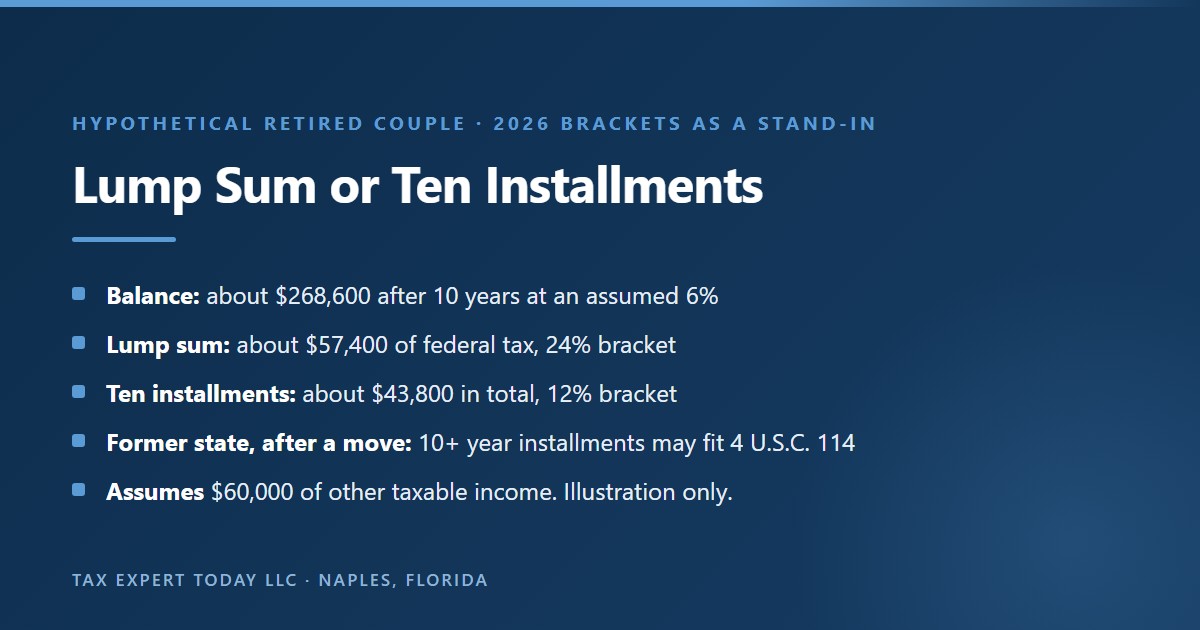
The form of payment is part of the initial election under Reg. 1.409A-2(a), and changing it later triggers the subsequent election rule, including the five-year push. That makes the choice consequential. The hypothetical below shows the federal income tax effect for a retired married couple, using the 2026 joint brackets from Rev. Proc. 2025-32 as a stand-in for later years. The couple has $60,000 of other taxable income after deductions in each retirement year, and the $150,000 deferral has grown at an assumed 6 percent for 10 years to about $268,600.
Paid as a lump sum, the balance stacks on top of the other income, and the incremental federal tax is about $57,400, or about 21.4 percent of the payment. Paid as ten annual installments of about $36,500, with the unpaid balance continuing to grow at the same assumed rate, each installment adds about $4,380 of federal tax, about 12 percent, for a total of about $43,800 on about $365,000 of payments. The installments pay more total dollars and less total federal tax, though the timing of tax and the time value of money differ between the two.
The comparison is sensitive to assumptions. If the couple had $300,000 of other income from a pension and investment portfolio, the installment advantage would shrink because each installment would land in a higher bracket. If tax rates rise in later years, installments carry rate risk that a lump sum does not. The table is an illustration of the mechanism, not a prediction or a recommendation for any executive.
| Item | Lump sum | Ten annual installments |
|---|---|---|
| Balance at the start of payout | About $268,600 | About $268,600 |
| Assumed growth during payout | None | 6 percent on the unpaid balance |
| Payment per year | About $268,600 once | About $36,500 for ten years |
| Total paid | About $268,600 | About $365,000 |
| Highest federal bracket reached | 24 percent | 12 percent |
| Incremental federal income tax | About $57,400 | About $4,380 per year, about $43,800 in total |
| Federal tax as a share of payments | About 21.4 percent | About 12.0 percent |
How does 4 U.S.C. 114 protect deferred compensation from a former state’s tax?
Federal law at 4 U.S.C. 114 bars a state from taxing a nonresident’s retirement income, including nonqualified deferred compensation paid as substantially equal periodic payments at least annually over the recipient’s life or a period of at least ten years, or paid from an excess benefit plan after employment ends.
- Applies to: nonresidents of the state that would otherwise tax the income.
- Series test: substantially equal payments, at least annually, for life or at least ten years.
- Excess benefit test: payments after termination from a plan maintained solely to restore benefits above qualified plan limits.
- Not covered: a lump sum from an ordinary elective deferral plan.
Before 1996, several states taxed retirement payments to former residents on the theory that the income was earned in the state. Congress responded with 4 U.S.C. section 114, which provides that “no State may impose an income tax on any retirement income of an individual who is not a resident or domiciliary of such State.” Qualified plans and IRAs are covered by name. For nonqualified plans, the statute covers income that is “part of a series of substantially equal periodic payments (not less frequently than annually …) made for (I) the life or life expectancy of the recipient … or (II) a period of not less than 10 years,” and income that is “a payment received after termination of employment and under a plan, program, or arrangement … maintained solely for the purpose of providing retirement benefits for employees in excess of the limitations” of the qualified plan rules.
For an elective deferral plan, the series test is usually the relevant one. A deferral paid in ten or more annual installments after the executive has moved to a state without an income tax, such as Florida, generally falls within the protection. A lump sum or a five-year schedule does not, and the former state may tax it as income sourced to services performed there. The excess benefit test can protect a lump sum, but only from a plan maintained solely to restore benefits capped by the qualified plan limits, which many elective plans are not.
The protection depends on residence at the time of payment. An executive who has not actually changed domicile, or who keeps enough ties to the former state to be treated as a resident there, does not benefit. Our guides to Florida domicile for executives and the dual-state residency tax trap cover how states test a move.
| Payment form | Protected? | Basis |
|---|---|---|
| Substantially equal annual installments over 10 years or more | Generally yes | 4 U.S.C. 114(b)(1)(I)(i)(II) |
| Life annuity or payments over life expectancy | Generally yes | 4 U.S.C. 114(b)(1)(I)(i)(I) |
| Lump sum from an excess benefit plan after termination | Generally yes | 4 U.S.C. 114(b)(1)(I)(ii) |
| Lump sum from an elective deferral plan | Generally no | Not a series, not solely an excess plan |
| Installments over five years | Generally no | Period shorter than 10 years |
| Any payment to a person who remains a resident of the state | No | Statute protects nonresidents only |
How does a move from California to Florida affect nonqualified deferred compensation?
California taxes nonresidents on income sourced to services performed in California, which can include deferred compensation paid after a move. If the payment qualifies under 4 U.S.C. 114, such as ten or more annual installments, California generally cannot tax it. A lump sum paid after the move may still be taxable by California.
- Deferral year: a California resident saves California tax on the deferred amount in that year.
- Payout as a Florida resident, qualifying installments: generally no California tax.
- Payout as a Florida resident, lump sum: California may tax the portion sourced to California services.
- Residency proof: the result depends on a genuine change of domicile.
California’s rules for nonresidents tax income from California sources, and compensation for services performed in California is California-source income even when paid later. Our guides to California source income and moving from California to Florida explain the general sourcing rules. Federal law then carves out the retirement income described in 4 U.S.C. 114. The combination produces a sharp difference between a lump sum and a qualifying installment schedule for a former California resident.
The hypothetical below follows the same $150,000 deferral. In the deferral year, the executive is a California resident with about $650,000 of federal taxable income on a joint return. Deferring $150,000 removes about $52,100 of federal income tax from that year, using 2026 joint brackets, and about $15,450 of California tax at an assumed marginal rate of 10.3 percent. The executive later moves to Florida, establishes domicile, and the balance is paid starting ten years after the deferral. For California, the illustration uses an assumed flat rate of 9.3 percent on any payment California may tax, which is a simplification: California computes a nonresident’s tax using a rate based on total income.
If paid as a lump sum after the move, California may tax the payment as California-source compensation, about $25,000 under the assumed rate. If paid as ten annual installments after the move, the payments generally fall within 4 U.S.C. 114, and California tax on them is generally zero. If the executive had stayed in California, each installment would be taxable there as a resident, about $33,900 in total at the assumed rate. California also imposes a 1 percent Mental Health Services Tax on taxable income above $1 million, which a large lump sum can trigger.
| Scenario | California tax saved in the deferral year | California tax at payout | Federal income tax at payout |
|---|---|---|---|
| Stays in California, ten annual installments | About $15,450 | About $33,900 in total | About $43,800 in total |
| Moves to Florida, lump sum after the move | About $15,450 | About $25,000, as California-source income | About $57,400 |
| Moves to Florida, ten annual installments after the move | About $15,450 | Generally $0 under 4 U.S.C. 114 | About $43,800 in total |
| Moves to Florida, five annual installments | About $15,450 | May be taxable, because the period is under 10 years | Depends on the brackets each year |
How should installments be structured to fit 4 U.S.C. 114?
To fit the series test, installments generally need to be substantially equal, paid at least annually, and scheduled over the recipient’s life or at least ten years. Plans that recalculate payments from a fluctuating account balance, or that allow a later switch to a lump sum, can raise questions, so the plan’s actual formula matters.
- Substantially equal: a declining balance divided by remaining years is a common method; large swings can raise questions.
- At least annually: annual, quarterly, or monthly payments all meet the frequency test.
- Ten years or more: a nine-year schedule does not meet the period test.
- Elected at the start: the schedule must be set under the 409A election rules.
The statute does not define “substantially equal” for this purpose, and states have applied it with some variation. Many plans pay installments by dividing the remaining balance by the number of remaining installments, so each payment moves with investment results. That approach is widely used and is commonly treated as substantially equal in practice, but an executive relying on 4 U.S.C. 114 should review the plan’s formula with an advisor. A plan that permits the executive to collapse the remaining installments into a lump sum at will would also create a 409A problem, so most plans do not allow it.
The 409A installment rules interact with the state tax rule. Under Reg. 1.409A-2(b)(2)(iii), a plan can treat installments as a single payment or as a series of separate payments. That designation affects how a later change works under 409A. It does not by itself determine whether the schedule is a series of substantially equal periodic payments for 4 U.S.C. 114, which is a separate federal statute applied by the states.
Executives who plan to change residence should also time the move. Installments paid while the executive is still a resident of the former state are taxable there as resident income. The protection applies only to payments received after residency has genuinely changed, and California and other states examine the timing of moves closely. Our California residency audit guide covers what the Franchise Tax Board reviews.
| Design point | Fits the series test more clearly | Raises questions |
|---|---|---|
| Length | 10 or more years, or life | Fewer than 10 years |
| Frequency | Annual, quarterly, or monthly | Irregular payments |
| Amount | Level, or balance divided by remaining installments | Large discretionary swings |
| Changes | Fixed at election under 409A | Executive may convert to a lump sum |
| Residence | Domicile changed before the first payment | Payments begin before the move |
How does nonqualified deferred compensation compare with a 457 deferred compensation plan?
A 457(b) plan is a deferred compensation plan for state and local governments and certain tax-exempt employers, with a 2026 limit of $24,500. Governmental 457(b) assets are held in trust and can roll over, while a tax-exempt employer’s 457(b) is unfunded. Section 457(f) covers other tax-exempt deferrals, taxed when they vest.
- Governmental 457(b): trust-funded, rollovers allowed, reported on Form 1099-R.
- Tax-exempt 457(b): unfunded, limited to a top-hat group, reported on Form W-2.
- 457(f): taxed when the substantial risk of forfeiture lapses, even if paid later.
- Private for-profit employers: use 409A plans, not 457 plans.
Search interest in “deferred compensation plan” is several times larger than interest in “nonqualified deferred compensation,” and a good share of it comes from public employees enrolling in a state or city 457(b). The two arrangements share a name but follow different rules. IRC section 457 governs deferred compensation plans of state and local governments and of tax-exempt organizations. Under IRS Notice 2025-67, the 2026 limit on deferrals under section 457(e)(15) is $24,500, the same as the 401(k) limit.
A governmental 457(b) plan holds its assets in trust for participants, allows rollovers to IRAs and other plans, and reports distributions on Form 1099-R, as the W-2 instructions note. Distributions from a governmental 457(b) are not subject to the 10 percent early withdrawal tax that applies to 401(k) distributions before 59½. A 457(b) plan of a tax-exempt employer, such as a hospital or university, must be unfunded and is generally limited to a top-hat group, which makes it much closer to a private NQDC plan.
Section 457(f) covers deferred compensation at tax-exempt employers above the 457(b) limits. It uses a vesting rule rather than a payment rule: the amount is taxed when it is no longer subject to a substantial risk of forfeiture, even if payment comes later. Private, for-profit employers use plans governed by section 409A instead, as described throughout this guide.
| Feature | 409A NQDC (for-profit employer) | Governmental 457(b) | Tax-exempt 457(b) | 457(f) |
|---|---|---|---|---|
| 2026 deferral limit | None by statute | $24,500 | $24,500 | None by statute |
| Funding | Unfunded | Trust for participants | Unfunded | Unfunded |
| Eligibility | Generally top-hat group | Broad | Generally top-hat group | Generally top-hat group |
| Income tax timing | When paid | When paid | When paid or made available | When vested |
| Rollover to an IRA | No | Yes | No | No |
| Reporting of distributions | Form W-2 | Form 1099-R | Form W-2 | Form W-2 |
How does nonqualified deferred compensation work for business owners?
A corporation can offer nonqualified deferred compensation to owner-employees, but the employer’s deduction is generally delayed until the owner includes the payment in income under IRC 404(a)(5). Owners of S corporations and partnerships face extra limits, and a plan that is not respected as a bona fide deferral can be recharacterized.
- Deduction timing: the employer deducts in its year that includes the end of the executive’s year of inclusion.
- C corporation owners: deferral is common, but reasonable compensation and 409A both apply.
- S corporations and partnerships: pass-through rules and related party limits reduce the benefit.
- Change in control payments: can raise golden parachute issues under IRC 280G.
For the employer, the main tax feature of a nonqualified plan is the matching of deduction to inclusion. IRC section 404(a)(5) allows a deduction for nonqualified deferred compensation “in the taxable year in which an amount attributable to the contribution is includible in the gross income of employees.” The employer gives up a current deduction in exchange for keeping the cash or investing it inside the business. For a C corporation taxed at a flat 21 percent rate, deferring the deduction may cost relatively little if the corporation expects to remain profitable.
Owner-employees of a closely held C corporation can participate, and many do. Two points deserve attention. First, the deferral must be a genuine deferral of compensation for services, not a disguised dividend, so the total pay including the deferred amount should be reasonable for the services performed. Second, 409A applies to the owner just as it does to any other executive, including the December election deadline and the restrictions on changing the payment date. The fact that the owner controls the corporation does not relax those rules, and the IRS Audit Technique Guide flags owner-controlled plans as an examination focus.
Pass-through entities are different. In an S corporation, the deduction for a deferred amount owed to a shareholder-employee is generally delayed under the related party rules until the shareholder includes it in income, and the shareholder’s share of the S corporation’s income already flows to the shareholder’s return. The benefit of deferring wages is therefore smaller, and in some cases nonexistent. Partnerships raise more complicated questions about whether a payment to a partner is a fixed payment for services under IRC 707(c) or a distributive share of partnership income. Owners of S corporations are usually better served by the qualified plan options discussed in our guides to S corp reasonable compensation, the safe harbor 401k, and the cash balance plan, which generate a current deduction and hold assets in a protected trust.
For publicly traded corporations, deferral interacts with the $1 million deduction limit for covered employees in IRC 162(m). After the 2017 changes, covered employee status generally continues for life, so deferring payment until after retirement no longer moves a payment outside 162(m) as it once could. Change in control payments can also be excess parachute payments under IRC 280G, which section 3121(v)(2) carves out of the special timing rule.
| Employer | Employer deduction | Practical note |
|---|---|---|
| C corporation, non-owner executive | When the executive includes the payment | IRC 404(a)(5) |
| C corporation, owner-employee | When the owner includes the payment | Reasonable compensation and 409A both apply |
| S corporation, shareholder-employee | Generally delayed until inclusion under related party rules | Benefit is often small because income passes through |
| Partnership, partner | Depends on the character of the payment | IRC 707(c) payment and allocation questions |
| Public company, covered employee | Subject to the $1 million limit in IRC 162(m) | Deferral generally no longer avoids the limit |
| Tax-exempt employer | Not applicable | Section 457 governs instead of a for-profit 409A plan |
What should an executive review before the December nonqualified deferred compensation election?
Before the December deadline, an executive generally reviews cash needs for the coming year, the plan’s payment options and investment menu, the employer’s financial strength, expected tax brackets now and at payout, any planned change of state residence, and whether the specified employee delay or Medicare tax applies.
- Cash flow: deferred salary is unavailable until the elected date.
- Payout form: lump sum or installments, and for how many years.
- Payment event: separation, a fixed date, or the earlier of the two.
- State plan: whether a move is likely before payment and how 4 U.S.C. 114 would apply.
The December election bundles several decisions. The executive chooses how much to defer, when payment will start, and in what form it will be paid. Some plans allow a separate payment election for each year’s deferral, often called a class year or a deferral account, which lets the executive build a ladder of fixed-date payments over time. Others require one election for all deferrals. The enrollment materials should say which approach the plan uses.
The tax review compares the marginal rate saved now with the expected marginal rate at payout, federal and state. That comparison depends on the executive’s other income in retirement: pensions, Social Security, required minimum distributions from IRAs, Roth conversions, and investment income. Executives with large pre-tax 401(k) and IRA balances may find that required minimum distributions under the rules described in our qualified charitable distribution guide fill the lower brackets in retirement, which narrows the gap between today’s rate and tomorrow’s.
The review should also look at the non-tax risks. The employer’s financial position, the length of the deferral, and the share of net worth already tied to the employer through stock awards all affect how much creditor risk the executive is willing to accept. This guide describes the mechanics. Whether to defer, and how much, is a personal decision that depends on facts beyond the tax law.
| Question | Where to find the answer |
|---|---|
| What is the plan’s enrollment deadline? | Plan enrollment materials; often earlier than December 31 |
| Which compensation can be deferred, and up to what percentage? | Plan document or summary |
| What payment events and forms does the plan offer? | Plan document; election form |
| Are installments treated as one payment or separate payments? | Plan document under Reg. 1.409A-2(b)(2)(iii) |
| Is there a rabbi trust or a change in control trigger? | Plan document; trust agreement |
| Is the executive a specified employee? | Employer’s specified employee list |
| What are the expected federal and state rates at payout? | Projection with a tax advisor |
| Is a change of residence likely before payout? | Personal plans; residency analysis |
What are the most common nonqualified deferred compensation mistakes?
Common mistakes include missing the plan’s enrollment deadline, assuming a bonus can be deferred after it is announced, choosing a short installment schedule that loses 4 U.S.C. 114 protection, not checking that FICA was applied at deferral, overlooking the specified employee delay, and treating the balance as safe as a 401(k).
- Timing errors: elections after the deadline are generally invalid.
- Payout design errors: forms chosen without regard to state tax or brackets.
- Payroll errors: FICA missed at deferral, or withholding too low at payout.
- Risk errors: large balances accumulated with a single employer.
Most mistakes trace back to the rigidity of 409A. Because the time and form of payment are fixed early and can be changed only by pushing payment five years later, a choice that seemed harmless at enrollment can cost money a decade later. An executive who elected a five-year installment schedule while living in California, then retired to Florida, may find that the payments remain taxable in California because the schedule is shorter than the ten years required by 4 U.S.C. 114. Changing the schedule at that point would require a subsequent election made at least 12 months before the first payment and a five-year delay.
Payroll errors matter because the executive bears the consequence. If FICA was not applied in the deferral year, the protection of the nonduplication rule is lost for that amount. If a payment is made early, the 20 percent additional tax falls on the executive. Reviewing the W-2 each year, as described above, catches many of these problems while correction is still available under the IRS programs.
| Mistake | Rule involved | Possible consequence |
|---|---|---|
| Election after the plan or legal deadline | IRC 409A(a)(4)(B) | No deferral for that year |
| Trying to defer a bonus after it is known | Reg. 1.409A-2(a)(8) | Election invalid unless the bonus qualifies |
| Short installment period before a move | 4 U.S.C. 114 | Former state may tax the payments |
| FICA not applied at deferral | IRC 3121(v)(2) | FICA on the full payout, including growth |
| Ignoring the six-month delay | IRC 409A(a)(2)(B)(i) | Cash flow gap after retirement |
| Early or accelerated payment | IRC 409A(a)(3) | Inclusion plus 20 percent and interest |
| Consulting at too high a level after retirement | Reg. 1.409A-1(h) | Separation date uncertain; payment may be early |
| Assuming the balance is protected | Unfunded plan status | Loss in an employer insolvency |
Nonqualified Deferred Compensation Help in Naples & Southwest Florida
Tax Expert Today LLC, based in Naples, Florida, helps executives and business owners understand nonqualified deferred compensation: modeling the election before the December deadline, comparing lump sum and installment payouts, reviewing FICA and W-2 reporting, and coordinating payout schedules with a move to Florida and 4 U.S.C. 114.
- Deferred compensation planning Naples: election modeling before the plan deadline.
- Executive relocation to Florida: coordinating payout schedules with a change of domicile.
- Payroll and W-2 review: confirming FICA timing and box 11 reporting.
- Retirement income planning: fitting deferred compensation alongside IRAs, pensions, and Roth conversions.
Southwest Florida has a large population of executives who earned deferred compensation in another state and plan to receive it here. Many arrive from California, New York, New Jersey, Illinois, and other states with income taxes, which is why the interaction between 409A payout elections and 4 U.S.C. 114 comes up so often in planning conversations in Naples, Bonita Springs, Fort Myers, and Marco Island. The firm’s Naples tax planning practice and its tax planning services work on these questions together with each client’s employer plan administrator, financial advisor, and estate planning attorney. Executives establishing residence may also find our guides to establishing Florida residency and retiring to Florida useful, and those holding employer stock in a 401(k) can review our guide to net unrealized appreciation.
Tax Expert Today LLC
11983 Tamiami Trail N, Naples FL 34110
Phone: (239) 441-2005
Hours: Monday to Friday, 10:00 to 5:00 ET
Where can I get help with nonqualified deferred compensation in Naples, FL? Tax Expert Today LLC, at 11983 Tamiami Trail N in Naples, Florida, helps executives and business owners review nonqualified deferred compensation elections, model lump sum and installment payouts, check FICA and W-2 reporting, and coordinate payout schedules with a move to Florida. The firm includes tax advisors, enrolled agents, CPAs, and attorneys, and serves clients in all 50 states. Results depend on each person’s facts and plan terms.
| Item | Why it helps |
|---|---|
| Plan document and summary, plus the enrollment materials | Shows deadlines, payment options, and installment treatment |
| Prior election forms for each deferral year | Shows the time and form already locked in |
| Most recent account statement | Shows balances by deferral year and investment options |
| Forms W-2 for the last two or three years | Confirms FICA treatment and box 11 reporting |
| Expected retirement date and any consulting plans | Affects separation from service and the payout start |
| Residency plans and dates of any move | Determines state tax and 4 U.S.C. 114 treatment |
| Prior year federal and state returns | Supports bracket projections for deferral and payout years |
When to Engage a Professional
Nonqualified deferred compensation decisions are hard to undo, because Section 409A locks the time and form of payment and the penalties fall on the executive. A professional review is worthwhile before the first enrollment, each fall before the deadline, before retiring or changing jobs, before moving states, and whenever a payment does not match the election.
- Before the first enrollment, to understand the plan’s options and the creditor risk.
- Each October or November, to model the next year’s deferral before the plan deadline.
- Before retirement or a job change, to confirm the separation date and the specified employee delay.
- Before moving to Florida, to review payout schedules against 4 U.S.C. 114.
- When the W-2 looks wrong, to raise FICA or 409A issues while correction is still available.
- In a sale of the employer, to review change in control payments and 280G exposure.
Tax Expert Today LLC is a multidisciplinary practice of tax advisors, enrolled agents, certified public accountants, and attorneys serving clients in all 50 states. To discuss how nonqualified deferred compensation fits within a broader plan, contact our Naples, Florida tax planning team or review our tax planning services, or call (239) 441-2005. Executives leaving a high-tax state may also find our guides to leaving California, the California part-year resident tax, and the California exit tax useful, along with our guides to the Roth conversion ladder and the donor-advised fund tax deduction for high-income years.
This article is general information about federal and state tax provisions affecting nonqualified deferred compensation and is not tax, legal, or investment advice for any specific person or business, and it is not a recommendation to defer or not to defer compensation. Statutory and regulatory references were checked against the text of IRC sections 409A, 3121(v)(2), 3101, 451, 404, 83, and 457, Treasury Regulation sections 1.409A-1, 1.409A-2, 1.409A-3, and 31.3121(v)(2)-1, 4 U.S.C. section 114, IRS Notices 2025-67, 2008-113, and 2010-6, Rev. Proc. 2025-32, IRS Publication 15, IRS Publication 5528, and the General Instructions for Forms W-2 and W-3 on October 27, 2026. All dollar examples, including salaries, deferral amounts, growth rates, tax rates, and payout schedules, are hypothetical illustrations, not client outcomes and not predictions for any person. State tax results depend on residence, sourcing rules, and plan terms, and tax laws apply differently to each person’s facts. Consult a qualified professional about your situation before taking any action.
Published October 27, 2026 by Dr. Pellumb Kabashi « Back to Learning Center
Have a question this article touches on?
Tax Expert Today LLC, based in Naples, Florida and serving clients across the United States.
Schedule a Consultation (239) 441-2005