
By Dr. Pellumb Kabashi, DBA, MBA, CES, CFE, EA
Founder, Tax Expert Today LLC · Tax advisors, enrolled agents, CPAs, and attorneys · Serving clients in all 50 states
Quick Answer: An FTB notice of proposed assessment is a proposal, not a bill. You have 60 days from the mailing date, and the Protest By date printed on the notice controls, to file a written protest stating your grounds. A protest does not stop interest, but a deposit can. If the FTB denies the protest, you have 30 days from its Notice of Action to appeal to the Office of Tax Appeals. Call (239) 441-2005 for a free consultation.
An FTB notice of proposed assessment tends to arrive months or years after the return it concerns, and for a former California resident it often arrives at a Florida address, forwarded, a week or two after the date printed on it. That delay matters more than most people realize, because the California protest clock runs from the day the Franchise Tax Board mails the notice, not from the day you open it. The notice itself is not a bill. It is the state’s proposal to assess additional tax, penalties, or both, and California law gives you a defined window to dispute it before it becomes final.
This guide is about that window and everything that follows it. It explains what a Notice of Proposed Assessment is under Revenue and Taxation Code section 19033, how the 60 day protest period in section 19041 is counted, what happens if it passes, whether the FTB was still allowed to propose the assessment at all, and how interest keeps running while you dispute it. It then walks through the protest itself, what it must contain, how the FTB reviews it, the Notice of Action that ends it, and the appeal to the Office of Tax Appeals, the settlement program, and the refund route that remains when the deadlines are missed. Every example is a hypothetical illustration, not a description of any client.
The Notice of Proposed Assessment is a California procedure administered by the Franchise Tax Board. It is not an IRS notice, and the federal rules for a statutory notice of deficiency, the 90 day Tax Court window, and IRS Appeals do not govern it. Where the two systems are compared below, the comparison is there to keep a federal assumption from costing you a California deadline. For the federal side, our guide to the IRS notice of deficiency covers the separate federal timeline.
What is an FTB notice of proposed assessment?
An FTB notice of proposed assessment is the written notice the Franchise Tax Board must mail before it can assess additional California tax. It sets out the proposed deficiency, the reasons for it, the computation, and the last day to protest. It is not a bill, and nothing is owed on it until it becomes final.
- Legal basis: Revenue and Taxation Code section 19033 requires the notice before a deficiency is assessed.
- Required contents: section 19034 requires the reasons, the computation, and the protest deadline.
- Common form numbers: FTB 5830 for individuals after an audit and FTB 6830 for business entities.
- Status: a proposal that becomes final only if no protest is filed or the protest process ends.
The statutory starting point is section 19033. When the FTB determines that the tax you reported on an original or amended return, including an amended return reporting federal adjustments, is less than the tax its own examination shows, it “shall mail notice to the taxpayer of the deficiency proposed to be assessed.” The same subdivision adds a sentence that matters in every protest: “In no case shall the determination of the deficiency be arbitrary or without foundation.” The notice must also be mailed in a manner that includes a postmark, which fixes the mailing date that starts every deadline discussed below.
Section 19034 governs what the notice must say. Each notice “shall set forth the reasons for the proposed deficiency assessment and the computation thereof,” and each notice must include the date the FTB has determined to be the last day on which you may file a written protest. That date is printed on the notice as the Protest By date. If the FTB omits it, the notice is not invalidated, but if the date is present, it becomes the deadline you work to.
The FTB’s own description is plain. Its Notice of Proposed Assessment page says that after an audit the agency mails an NPA if you owe additional tax, penalties, or interest, and that “this notice is not a bill.” The balance becomes a bill only if you take no action by the Protest By date. The FTB letter catalog lists the audit version for individuals as the Notice of Proposed Assessment, FTB 5830, and the business entity version as FTB 6830, each stating that you have a right to protest within 60 days.
| Feature of the notice | What it tells you | Authority |
|---|---|---|
| Proposed deficiency | Additional tax the FTB intends to assess | R&TC section 19033(a) |
| Reasons and computation | Why the FTB changed the return and how it computed the tax | R&TC section 19034(a) |
| Protest By date | The last day a written protest is treated as timely | R&TC sections 19034(b) and 19041(b) |
| Penalties | Accuracy, late filing, demand, or other penalties proposed with the tax | R&TC section 19036 |
| Interest | Accrues from the original due date until paid | FTB 7275, citing R&TC section 19101 |
Two features of the notice set it apart from a bill. First, nothing in it is due yet. FTB 7275 tells the recipient directly, “You do not currently owe the amount shown on the NPA,” and states that the FTB “will take no further action before the Protest By date.” Second, the notice is the doorway to every administrative right that follows. The protest, the oral hearing, the Notice of Action, the appeal to the Office of Tax Appeals, and the settlement program all begin with a timely response to this one document.
Why does the FTB issue a notice of proposed assessment?
The FTB issues a notice of proposed assessment when an audit, a federal change, information returns, or an unfiled return leads it to conclude you owe more California tax. For a former resident, the most common triggers are residency and timing disputes, California source income after the move, and IRS adjustments that were never reported to California.
- Completed audit: the examiner adjusts income, deductions, credits, or residency.
- Federal change: an IRS adjustment that increases California tax and was not reported within six months.
- Unfiled return: the FTB estimates income from W-2s, 1099s, and other records under section 19087.
- Sourcing disputes: California source income on a nonresident or part-year return.
The audit route is the most familiar. The FTB examines the return, issues information document requests, and, when it disagrees with what was reported, writes up its position and mails the NPA. For people who left California, the examination is frequently a residency review. Our guide to the California residency audit explains what the FTB weighs, and the NPA described here is what that audit produces when the FTB concludes that you remained a resident longer than you reported, or that a sale or bonus fell inside the resident period.
The federal route is quieter. Under section 18622, a taxpayer whose federal return is changed by the IRS must report each change to the FTB within six months after the final federal determination and “shall concede the accuracy of the determination or state wherein it is erroneous.” For an individual, the report is required only when the change increases California tax. When the FTB learns of an IRS adjustment before the taxpayer reports it, an NPA mirroring the federal change is a common result. Our guide to the IRS CP2000 notice covers the federal matching letter that often starts this chain.
The non-filer route is the one with the least room for error. Section 19087 allows the FTB, when a taxpayer fails to file a return, to “make an estimate of the net income, from any available information,” and propose an assessment of tax, interest, and penalties. The FTB letter catalog explains the sequence: a demand for a tax return is mailed first, and if there is no response by the date on that demand, the FTB will “estimate your income and issue a Notice of Proposed Assessment” that includes tax, a demand penalty, a delinquent filing penalty, and a cost recovery fee. Section 19087(b) gives the same protest and appeal rights as any other NPA, on the same deadlines.
| Trigger | Typical situation for a former resident | What the protest usually turns on |
|---|---|---|
| Residency audit | FTB says domicile changed later than the return claims | Dated evidence of the move and the closing of California ties |
| Sourcing adjustment | Wages, equity, or K-1 income allocated to California after the move | Workday records, grant and vest dates, and entity apportionment |
| Federal change | IRS adjustment carried to California and not reported | Whether the federal change was final, correct, and correctly translated |
| Unfiled return | No California return for a year with California income | Filing the actual return and replacing the estimate |
| Withholding or credit mismatch | Credit claimed that the FTB cannot match | Payer records and the Form 592-B or W-2 trail |
Sourcing is where many corridor NPAs come from. A former resident can be a Florida domiciliary beyond dispute and still owe California tax on California source income, such as wages for days worked in California, the California portion of a restricted stock unit vest, or apportioned income from a California business. Our guides to California source income and California RSU tax cover the allocation rules that an NPA in this category usually applies.
Is a notice of proposed assessment the same as an FTB bill?
No. A notice of proposed assessment is a proposal you can protest. A bill, such as a Notice of State Income Tax Due, follows a final assessment and carries collection consequences. A mathematical error notice is different again, because section 19051 gives no right of protest or appeal from it.
- NPA: protest within 60 days; nothing is due until it becomes final.
- Notice and demand: mailed after an assessment becomes final; due 15 days after its date under section 19049.
- Math error notice: no protest or appeal right on that notice; the route is payment and a refund claim.
- Demand to file: a request for a missing return that precedes an estimated NPA.
The distinction is not a technicality. Each notice opens a different set of rights and a different clock, and responding to the wrong one in the wrong way can cost the remedy you actually needed. The NPA is the only one of these that carries the 60 day protest right under section 19041. Once an assessment becomes final, section 19049 requires the FTB to mail notice and demand for payment, and the deficiency is “due and payable at the expiration of 15 days from the date of the notice and demand.”
The math error notice deserves a separate warning. Section 19051 provides that tax in excess of the return “due to a mathematical error” is not a deficiency assessment, and “the taxpayer has no right of protest or appeal based on that notice.” Sending a protest letter in response to a math error notice does not create a protest right that the statute withholds. The available route is to pay and file a claim for refund, or to contact the FTB to correct an obvious mistake.
| Notice | Is it a bill? | Your right on that notice | Clock |
|---|---|---|---|
| Notice of Proposed Assessment (FTB 5830 or 6830) | No | Written protest, oral hearing on request | 60 days, Protest By date controls |
| Notice of Action on a protest | No, until final | Appeal to the Office of Tax Appeals | 30 days, appeal date on the notice controls |
| Notice and demand after final assessment | Yes | Pay, arrange a payment plan, or pay and claim a refund | Due 15 days after the notice date |
| Mathematical error notice | Effectively, yes | No protest or appeal on that notice | Pay and claim a refund |
| Demand for tax return | No | File the return or explain why none is required | Response date on the demand |
A related notice that confuses carryforward planning is the proposed adjusted carryover. Under section 19043.5, when the FTB concludes that a loss, credit, or deduction carried forward on your return is overstated, it may mail a notice of the proposed carryover adjustment, and that notice carries “protest and appeal rights as if that proposed adjusted carryover amount were a proposed deficiency assessment.” Once final, the adjusted carryover is generally binding in later years. For an owner carrying a California loss after a move, the interaction is covered in our guide to the California NOL suspension.
How long do you have to protest an FTB notice of proposed assessment?
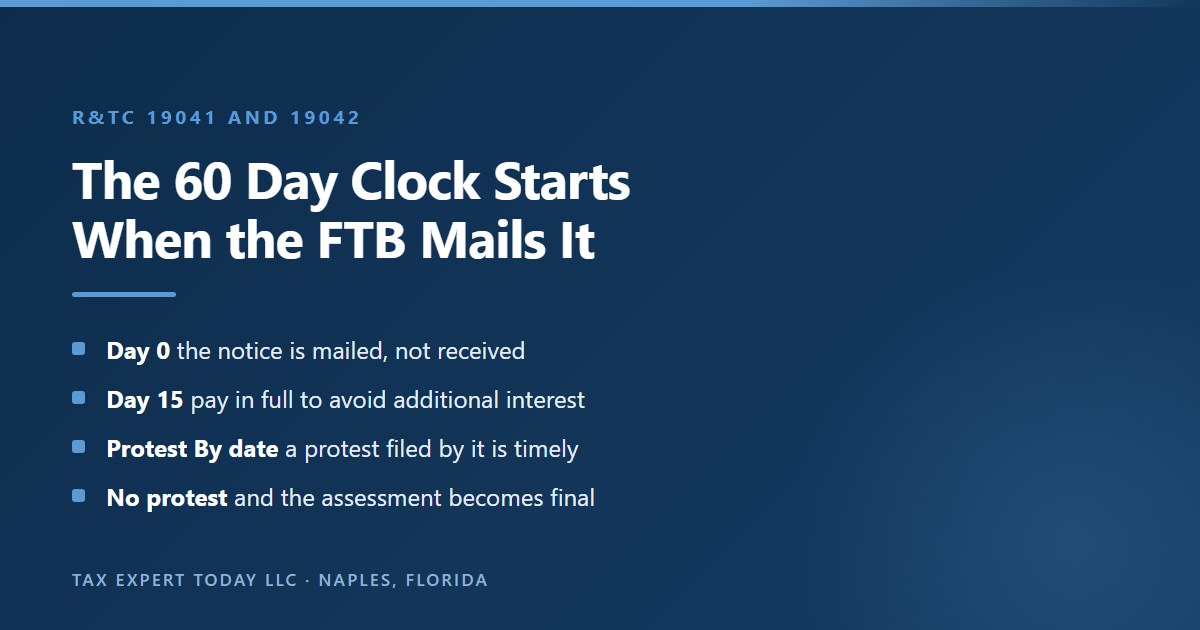
You have 60 days after the FTB mails the notice to file a written protest under section 19041(a). If the notice prints a Protest By date, a protest filed on or before that date is treated as timely under section 19041(b). Count from the mailing date on the notice, never from the day it reached you.
- Start of the clock: the mailing of the notice, which section 19033(e) ties to a postmark.
- Length: 60 days under section 19041(a).
- Safe harbor: a protest filed by the printed Protest By date is timely under section 19041(b).
- Forwarded mail: nothing in section 19041 adds days for a notice mailed to an address outside California.
The rule itself is short. Section 19041(a) states that “within 60 days after the mailing of each notice of proposed deficiency assessment the taxpayer may file with the Franchise Tax Board a written protest against the proposed deficiency assessment, specifying in the protest the grounds upon which it is based.” Subdivision (b) then provides that any protest filed on or before the last date specified by the FTB in the notice “shall be treated as timely filed.” The practical instruction from the FTB is the same: you must submit the protest by the Protest By date, “or your NPA will become final and billable.”
Two counting points matter for people who no longer live in California. The first is the start date. The statute counts from mailing, and a notice that is forwarded from an old California address to a Florida one can lose a week or more before it is opened. The second is the absence of any extension for distance. The Office of Tax Appeals rules, discussed later in this guide, extend the appeal deadline when a notice is mailed outside California, but that extension applies to appeals to the Office of Tax Appeals. Neither section 19041 nor the FTB protest instructions contain a comparable extension for the protest itself, so the Protest By date should be treated as fixed.
| Hypothetical date | Event | Effect |
|---|---|---|
| March 2 | NPA mailed to the old Los Angeles address | The 60 day period begins |
| March 16 | Forwarded notice reaches the Naples address | 14 of the 60 days are already gone |
| March 17 | Last day to pay in full without additional interest | 15 days from the notice date |
| May 1 | Protest By date printed on the notice | A protest filed by this date is timely |
| May 2 | No protest filed | The proposed assessment becomes final under section 19042 |
The table is a hypothetical illustration, and the dates on a real notice govern. It shows why the first task on receiving an NPA is to find the notice date and the Protest By date and to work backward from them, rather than from the day the envelope arrived. If the notice carries no Protest By date, the 60 days still run from the mailing date under subdivision (a), and the safer course is to count conservatively from the earliest date the notice could have been mailed.
A protest is not the same as a phone call. Calling the number on the notice can answer questions, and FTB staff can sometimes correct a straightforward error, but section 19041 requires a written protest that specifies the grounds. An online protest through MyFTB satisfies the written requirement. A voicemail or a note on a payment stub does not. FTB 7275 also warns that contacting the Taxpayers’ Rights Advocate “is not a protest and does not extend the period of time for filing one.”
What happens if you miss the protest deadline?
If no protest is filed, section 19042 makes the proposed assessment final when the 60 day period expires. The FTB then bills the amount with interest. The remaining path is to pay the assessment in full and file a claim for refund, which preserves a later appeal but requires payment first.
- Finality: section 19042 makes the assessment final on expiration of the 60 days.
- Billing: notice and demand follows, due 15 days after its date under section 19049.
- Collection: an unpaid final balance can lead to liens, levies, and wage garnishment.
- Refund route: pay in full, then file a claim for refund within the section 19306 period.
The finality rule is one sentence. Section 19042 provides that “if no protest is filed, the amount of the proposed deficiency assessment becomes final upon the expiration of the 60-day period provided in Section 19041.” FTB 7275 describes the consequence: if you take no action by the Protest By date, the proposed amount “will become due and payable,” and any earlier payments are applied with a bill for the balance. The FTB’s protest page puts the remedy in one line: if you missed the timeframe, “you may pay the balance due in full and file a claim for refund.”
The refund route is real, but it is a different kind of remedy. Under section 19306, a claim for refund must generally be filed within four years from the date the return was filed, if timely, four years from the original due date, or one year from the date of the overpayment, whichever expires later. Because a final assessment is usually paid well after the return was filed, the one year from payment rule is often the one that keeps a claim open.
A claim can be filed before the entire balance is paid, but only to hold the date. Section 19322.1 treats a claim made before full payment as a claim “only for purposes of tolling the time periods” in section 19306. For every other purpose, including appeal rights, the claim is deemed filed on the date full payment is made, and no refund is allowed for any payment made more than seven years before full payment. FTB 7275 calls this an informal claim for refund and explains that it protects your right to appeal or to sue later, once the balance is paid.
| Route | Payment required first? | Interest during the dispute | Next forum |
|---|---|---|---|
| Timely protest | No | Accrues unless paid or deposited | Office of Tax Appeals after the Notice of Action |
| Missed protest, then refund claim | Yes, in full, for appeal and suit | Stopped by the payment | Office of Tax Appeals after denial, or Superior Court |
| Informal refund claim before full payment | Not to file it; yes to use it | Accrues on the unpaid part | Available only once the balance is paid |
| No action at all | Not applicable | Accrues with collection | None until a refund claim is filed |
Missing the protest date therefore converts a dispute you could have pursued without paying into one you can pursue only after paying. For a small balance, that may not matter. For a residency assessment covering a year with a large sale, it can decide whether the dispute is practical at all. That is the strongest reason to calendar the Protest By date the day the notice is opened.
Was the FTB still allowed to propose this assessment?
Usually the FTB must mail the notice within four years after the return was filed under section 19057. The period extends to six years for an omission of more than 25 percent of gross income, runs from federal reporting for IRS changes, and has no limit when no return was filed or a federal change was never reported.
- General rule: four years after the return was filed, with an early return treated as filed on the due date.
- Large omission: six years when omitted gross income exceeds 25 percent of the amount stated.
- Federal changes: two years from timely reporting, or at any time if never reported.
- No return: section 19087 allows a proposed assessment at any time.
Checking the limitations period is the first legal question in any protest, because an assessment mailed too late fails regardless of its merits. Section 19057(a) provides that, except for a false or fraudulent return and except as otherwise provided, “every notice of a proposed deficiency assessment shall be mailed to the taxpayer within four years after the return was filed.” A return filed early is treated as filed on the last day prescribed for filing, determined without regard to extensions, under section 19066.
The six year rule in section 19058 applies when the taxpayer omits from gross income “an amount properly includable therein which is in excess of 25 percent of the amount of gross income stated in the return.” An amount disclosed on the return or in an attached statement in a manner adequate to apprise the FTB of its nature and amount is not counted as omitted. For a part-year resident who reported a sale as nonresident income with a clear explanation, that disclosure rule can be the difference between a four year and a six year window.
Federal changes have their own clocks. Under section 19059, when a federal change is reported within six months, by the taxpayer or by the IRS, an NPA resulting from it may be mailed within two years from that report, or within the ordinary period if later. Under section 19060, if the taxpayer never reports the change, the NPA “may be mailed to the taxpayer at any time,” and a late report starts a four year period. Section 19065 adds that if you agreed to extend the federal assessment period, the California period runs at least six months beyond the expiration of that federal agreement.
| Situation | Deadline for the FTB to mail the NPA | Authority |
|---|---|---|
| Return filed, ordinary case | Four years after filing | R&TC section 19057(a) |
| Omission over 25 percent of gross income | Six years after filing | R&TC section 19058(a) |
| Federal change reported within six months | Two years from the report, or the ordinary period if later | R&TC section 19059(a) |
| Federal change never reported | Any time | R&TC section 19060(a) |
| Federal change reported late | Four years from the late report | R&TC section 19060(b) |
| Federal assessment period extended by agreement | Four years or six months after the federal agreement expires, whichever is later | R&TC section 19065 |
| Waiver signed with the FTB | The agreed period | R&TC section 19067(a) |
| No return filed | Any time | R&TC section 19087(a) |
Waivers deserve attention because they are signed voluntarily, often during an audit. Section 19067 allows the assessment period to be extended by a written consent made before the period expires, and it requires the FTB to notify you of your right to refuse the extension or to limit it to a particular period. A protest that argues the statute has run should start by collecting every waiver signed for the year, because a single forgotten extension can defeat the argument.
The most consequential row for former residents is the last one. A taxpayer who left California and stopped filing has started no clock at all for any year with California source income. That is the same point our leaving California taxes checklist makes about the final part-year return: filing it is what starts the four year period running. For the federal comparison, see our guide to the IRS audit statute of limitations, which is generally three years rather than four.
Does filing a protest stop interest on the assessment?
No. Filing a protest does not stop interest. Interest on additional tax runs from the original due date of the return until payment. The FTB charges no additional interest if the full NPA balance is paid within 15 days of the notice date, and a tax deposit limits interest without giving up the protest.
- Interest start: the original due date of the return, not the date of the notice.
- 15 day rule: full payment within 15 days of the notice date avoids additional interest after the notice.
- Deposit option: a tax deposit under section 19041.5 limits interest while preserving the protest.
- Penalty interest: interest on penalties runs from the effective date of each penalty.
The FTB states the rule in the same words on its NPA page, its protest page, and FTB 7275: “Filing a protest will not stop the accrual of interest on the NPA.” FTB 7275 explains the mechanics. Interest accrues on additional taxes “from the original due date of the tax return until the date we receive full payment,” and on penalties from the effective date of the penalty. Additional interest accrues from the notice date to the payment date, “however, we charge no additional interest if we receive your payment in full within 15 days of this notice date.”
Because interest runs from the original due date, an NPA for a year four or five years back already carries years of interest on its face, and every month of protest adds more. The rate is set by statute and changes periodically, so the FTB directs taxpayers to its interest rate information or the phone number on the notice rather than a fixed figure. For a large assessment that may take many months to resolve, the interest cost of protesting without a deposit can be substantial, and it is one of the main reasons to decide early whether to deposit.
Interest is generally not something you protest on its own merits, because it follows the tax automatically. The exception is interest abatement under section 19104, which allows the FTB to abate interest attributable to an unreasonable error or delay by an FTB employee in performing a ministerial or managerial act, or interest that the IRS abated on a related federal deficiency. The request is made on Form FTB 3701, and the form’s instructions add a timing rule: if you are protesting or appealing a proposed assessment and also want abatement, “you must include the request for abatement of interest with your protest or appeal.”
| Interest question | Answer | Source |
|---|---|---|
| When does interest on the tax start? | The original due date of the return | FTB 7275, citing R&TC section 19101 |
| Does a protest stop it? | No | FTB Disagree with an NPA page |
| How do you avoid additional interest after the notice? | Pay in full within 15 days of the notice date | FTB 7275 |
| How do you limit interest while protesting? | Make a tax deposit | R&TC section 19041.5 and FTB 7275 |
| Can interest be abated? | Only for FTB error or delay, or matching IRS abatement | R&TC section 19104 and Form FTB 3701 |
What is a tax deposit and how does it differ from paying the NPA?
A tax deposit is money sent to the FTB to suspend interest on a disputed amount while you keep protesting. Under section 19041.5 it is not treated as a payment of tax for refund purposes until you say so in writing or it is applied to a final liability. Paying the NPA as an NPA payment signals agreement.
- Deposit: limits interest, preserves the protest, and is identified with Form FTB 3576 or the Tax Deposit option in Web Pay.
- NPA payment: the route FTB 7275 describes for a taxpayer who agrees with the proposed amount.
- Conversion: a deposit becomes a payment when you elect in writing or it satisfies a final liability.
- Return of a deposit: any excess after a reduction is held as a deposit and can be requested back on FTB 3581.
Section 19041.5 adopts Internal Revenue Code section 6603, the federal rule on deposits made to suspend the running of interest, with one California substitution: wherever the federal statute refers to a “30-day letter,” California reads “notice of proposed deficiency assessment.” A deposit “shall not be considered a payment of tax” for purposes of a refund claim under section 19306, converting a protest into a refund action under section 19335, or filing suit under section 19384, until the taxpayer provides a written statement that it is a payment of tax for those purposes, or the deposit is used to pay a final tax liability.
FTB 7275 lays out the practical choice. If you agree with the proposed amount, you “may pay the additional tax, penalties, and interest on the notice as an NPA Payment,” and the notice instructs you not to file an amended return. If you disagree, you “may pay the amount shown on the notice as a Tax Deposit to limit the accrual of interest without losing your right to protest the assessment.” For individuals, the deposit is identified with Form FTB 3576, Pending Audit Tax Deposit Voucher for Individuals, or by choosing Tax Deposit as the payment type online. Corporations, LLCs, and limited partnerships use FTB 3577, 3578, and 3579.
Two mechanical details deserve care. First, if you make a deposit and the same tax year already has a balance due, FTB 7275 says the FTB will apply the payment to that existing balance first and treat only the remainder as the deposit for the protested NPA. Second, a taxpayer who is required to pay electronically must make the deposit electronically as well, and should not mail the voucher. The mandatory electronic payment rule applies once an estimated or extension payment exceeds $20,000 or a tax liability exceeds $80,000, and a paper payment after that point carries a 1 percent penalty.
| Option | Effect on interest | Effect on the protest | Best fit |
|---|---|---|---|
| Pay in full within 15 days as an NPA payment | No additional interest after the notice | Signals agreement with the proposed amount | You accept the assessment |
| Tax deposit with Form FTB 3576 | Suspends interest on the amount deposited | Protest continues | You dispute the amount but want to cap interest |
| Partial deposit | Suspends interest on the deposited part only | Protest continues | You dispute part and expect to win part |
| No payment | Interest continues to accrue | Protest continues | Strong position and limited funds |
| Payment of tax after protest is filed | Stops interest on the amount paid | Protest is treated as a refund claim under section 19335 | You prefer a refund posture |
The last row reflects section 19335. If, with or after filing a protest or an appeal, you pay the protested tax before the FTB acts on the protest, the FTB “shall treat the protest or the appeal as a claim for refund.” That conversion changes the procedural posture and the deadlines that follow, which is why the deposit, rather than an outright payment, is the usual tool for limiting interest while keeping the case in protest. Where the FTB later withdraws or reduces the assessment, FTB 7275 explains that any remaining amount is held as a deposit, and FTB 7275 points to FTB 3581 to request a refund or transfer of it.
Should you pay, deposit, or protest without paying?
The choice turns on how strong the protest is, how large the balance is, and how long the dispute may last. Paying within 15 days ends interest but concedes the amount. A deposit caps interest and keeps the protest. Protesting without paying keeps cash but lets interest grow for months or longer.
- Strong position, small balance: protesting without a deposit is often reasonable.
- Uncertain position, large balance: a full or partial deposit limits the interest cost of losing.
- Clear FTB error: a protest with documents may resolve quickly, and interest may matter less.
- Agreement with the change: pay as an NPA payment within 15 days and close the year.
There is no single right answer, and the right one for a residency assessment on a large sale may differ from the right one for a disallowed deduction. What matters is that the choice is made deliberately and early. FTB 7275 warns that a protest “may take several months to resolve,” and an appeal adds more time. A deposit made in the first weeks of a protest suspends interest for that entire period on the amount deposited. A deposit made after a year of protest suspends it only going forward.
A partial deposit is often the practical middle ground. Many NPAs contain several adjustments, some of which the taxpayer expects to concede and some of which are genuinely in dispute. Depositing the tax attributable to the conceded items, while protesting the rest, caps interest on the part you expect to owe without paying the part you are contesting. The protest should then identify clearly which amounts are accepted and which are protested, which is exactly what the FTB asks a written protest to state.
| Hypothetical balance | Position | Common approach | Reason |
|---|---|---|---|
| $2,800, one disallowed credit | Documents prove the credit | Protest with documents, no deposit | Quick resolution likely, small interest exposure |
| $48,000, residency timing | Reasonable but contested | Protest with a full deposit | Long dispute, large interest exposure if lost |
| $19,000, three adjustments | Agree with one, dispute two | Deposit the agreed part, protest the rest | Caps interest on the conceded amount |
| $6,500, unreported federal change | Federal change is final and correct | Pay within 15 days as an NPA payment | No dispute on the merits |
None of the approaches in the table is a recommendation for any particular taxpayer. They illustrate how the interest rule, the deposit statute, and the strength of the protest interact. A deposit also does not need to be all or nothing on a fixed date. It can be made at any point while the protest is pending, and it can be returned if the assessment is withdrawn or reduced.
What must a written protest of an FTB notice of proposed assessment contain?
A written protest must identify you, the tax years and amounts you protest and any amounts you accept, what you disagree with and why, the facts, the supporting documents and legal authorities, and your or your representative’s signature. Include a copy of the NPA so the protest is matched to the right file.
- Identification: name, address, daytime phone number, and Social Security or taxpayer identification number.
- Scope: each year and amount protested, and each amount you accept.
- Grounds: a statement of facts and the arguments, evidence, and authorities supporting your position.
- Signature: yours, or your authorized representative’s with the power of attorney.
The FTB publishes the required elements in two places, and they align. Its Disagree with an NPA page lists a copy of the NPA; your name, address, and phone number; your identification number; the amounts and tax years you wish to protest and any amounts you accept; what you disagree with and why; any supporting documents; and a signature. FTB 7275 adds that the protest should contain a statement of facts and “arguments, evidence, and documentation that substantiate your position, including legal authorities.” Business entities must also include the name, title, and phone number of the contact person handling the protest.
The statutory floor is lower than the FTB’s checklist. Section 19041(a) requires only a written protest “specifying in the protest the grounds upon which it is based.” A protest that states its grounds is valid even if it is brief, and the FTB may request more information during its review. But a protest that only states disagreement, without grounds, invites a short process and an unfavorable Notice of Action. The checklist is the FTB’s statement of what it needs to reconsider the assessment, and following it is the most reliable way to have the protest decided on its merits.
| Element | What to include | Why it matters |
|---|---|---|
| Copy of the NPA | The full notice, including the computation pages | Matches the protest to the correct notice and year |
| Amounts protested and accepted | A schedule by year and by adjustment | Allows partial action under section 19044(b) |
| Statement of facts | Dated, specific facts tied to documents | Most protests turn on facts, not law |
| Legal authorities | Statutes, regulations, and decisions | Shows why the facts produce your result |
| Supporting documents | Indexed exhibits referenced in the facts | Allows the reviewer to verify each point |
| Oral hearing request | An express request in the protest | Section 19044(a) grants a hearing if requested |
| Interest abatement request | Form FTB 3701, if claimed | Must accompany the protest when one is filed |
| Signature and authority | Taxpayer signature or representative with POA | Shows the protest is authorized |

The oral hearing row is the one most often missed. Under section 19044(a), when a protest is filed the FTB “shall reconsider the assessment of the deficiency and, if the taxpayer has so requested in his or her protest, shall grant the taxpayer or his or her authorized representatives an oral hearing.” The hearing right attaches to the request in the protest. A taxpayer who wants to present evidence in person or by video should say so in the protest itself rather than waiting to see how the review develops.
How do you file the protest online or in writing?
The FTB describes filing online through MyFTB as the fastest way to protest: log in, select Account, then Proposed Assessments, choose the NPA number, and follow the protest instructions. A written protest can be mailed or faxed to the Protest Section. Keep proof of the date you filed.
- Online: MyFTB, Account, Proposed Assessments, then the NPA number.
- Mail for audit NPAs: Protest Section MS F340, Franchise Tax Board, PO Box 1286, Rancho Cordova CA 95741-1286.
- Fax for audit NPAs: 916-364-2754, according to the FTB protest page.
- Proof: a MyFTB confirmation, a fax confirmation, or a postmarked certified mail receipt.
The FTB’s protest page describes the online route in three steps and adds a caution: “Some proposed assessments may not display on the Proposed Assessment List.” If the NPA you need to protest is not listed, the FTB instructs you to “send FTB a message” through MyFTB. A representative can use the same route once the FTB has processed an online power of attorney declaration. FTB 7275 notes that otherwise a representative may submit the protest in writing along with a copy of the power of attorney.
Not every NPA goes to the same address. The audit NPA mailing address and fax number above come from the FTB’s current protest page and FTB 7275. NPAs issued by the filing enforcement program, such as an estimated assessment after an unanswered demand for a return, are accompanied by FTB 5821, Protest Procedures, which directs written protests to the Filing Enforcement Section and asks for an enclosed Quick Resolution Worksheet. FTB 5821 also states that if you have not filed a valid tax return for one of the last five tax years, you cannot file online and must use the written procedure. Use the address and instructions printed on your own notice, because they identify the unit that issued it.
| Method | How | Proof of timely filing | Watch for |
|---|---|---|---|
| MyFTB online protest | Account, Proposed Assessments, NPA number | Online confirmation | Some NPAs do not display on the list |
| Address printed on the notice or on FTB 7275 or 5821 | Certified mail with a postmarked receipt | Mail early enough to beat the Protest By date | |
| Fax | Number printed on the notice or FTB publication | Fax transmission report | Large exhibits may need to follow by mail |
| Representative filing | Online with a processed POA, or in writing with a copy | Same as above | The POA must be in place or attached |
Whichever method you use, the record of filing should be kept with the notice. Section 19041(b) treats a protest filed by the printed date as timely, and the burden of showing that the protest was filed on time rests in practice with the person who filed it. A dated online confirmation, a fax report showing the number and time, or a certified mail receipt is the evidence that settles any later question about timeliness.
How do you write the grounds of an effective protest?
An effective protest takes each adjustment in the notice separately, states the facts that answer it, attaches the documents that prove those facts, and cites the authority that applies. It concedes what should be conceded and keeps the disputed items clear. Most protests turn on whether the facts are documented, not on novel law.
- Organize by adjustment: mirror the computation in the NPA, one issue at a time.
- Lead with facts: dated, specific, and tied to exhibits.
- Cite the rule: the statute or regulation the FTB applied, and why it produces a different result.
- Use the foundation rule: section 19033(a) bars an arbitrary or unfounded determination.
A practical structure follows the notice. The NPA, under section 19034(a), must set out the reasons for the proposed deficiency and its computation, so the protest can answer each reason in the same order. For each adjustment, state what the FTB did, state what you contend is correct, explain the facts that support your figure, identify the exhibit that proves each fact, and cite the rule that applies. Where an adjustment is correct, say so. A protest that concedes a clear item gains credibility for the items it contests, and section 19044(b) allows the FTB to act on part of a protest while the rest remains under review.
The examination record is often the best starting point. The Tax Adviser’s guide to disputing California tax assessments describes the audit issue presentation sheet, a write-up of facts, law, and the proposed adjustment that the FTB may prepare during the audit, and to which the taxpayer can respond in writing. Where one exists, the protest should answer the reasoning in it directly. The same article notes that the FTB usually follows federal tax law where California has no conflicting rule, so federal authorities can be cited where California conforms.
The foundation rule in section 19033(a) is a genuine tool but a narrow one. The statute says the determination of a deficiency shall not be “arbitrary or without foundation.” That argument is strongest against an estimated assessment built on incomplete information, such as an NPA that treats gross proceeds from a sale as income without any basis, or that assigns a full year of wages to California for someone who moved in February. It is weakest as a substitute for evidence. A protest that relies only on the foundation rule, without documents showing the correct figure, rarely moves the result.
| Protest section | Content | Hypothetical example |
|---|---|---|
| Summary | Years, amounts protested, amounts accepted | Protesting $31,400 of tax for 2023, accepting $1,200 |
| Adjustment 1 | FTB position, your position, facts, exhibits, authority | Bonus paid after the Florida move, workday records attached |
| Adjustment 2 | Same structure | Gain on a brokerage account, residence at sale date shown |
| Penalties | Why each penalty does not apply or should be reduced | Accuracy penalty, reasonable reliance on a prepared return |
| Requests | Oral hearing, interest abatement, records | Oral hearing requested, Form FTB 3701 attached |
| Exhibits | Indexed and cross-referenced | Exhibit A, lease; Exhibit B, workday calendar; Exhibit C, closing statement |
Residency protests reward a timeline. A single page listing each relevant date, such as the lease signing, the closing of the California home, the Florida declaration of domicile, the driver license change, the voter registration, and the date of the sale or vest at issue, lets the reviewer see the shape of the case before reading the exhibits. Our guides to establishing Florida residency and the dual state residency trap describe the records that usually support that timeline.
What if the NPA is based on an estimated return because you did not file?
An estimated NPA under section 19087 is built from whatever information the FTB has, usually gross figures with no deductions or basis. The most effective response is usually to file the actual return. The estimated assessment still carries protest rights, but penalties such as the demand penalty can apply even when the return shows little tax.
- How it is built: income estimated from W-2s, 1099s, and other records available to the FTB.
- What it adds: tax, a demand penalty, a delinquent filing penalty, and a cost recovery fee.
- Best response: file the real return, with the protest if the deadline is near.
- Penalty point: the demand penalty is computed before payments and credits.
The non-filer NPA is often the one with the largest gap between the proposed amount and the correct amount, because the estimate has no information about deductions, the cost basis of sold assets, or the nonresident portion of income. A former resident who sold California stock after moving may see the full gross proceeds treated as California income. The return the taxpayer files answers those questions, and the FTB’s letter catalog explains that the Reply to FTB form included with a demand allows the recipient to state that a return was already filed, that none is required, or that the recipient is unsure.
The penalties on an estimated NPA deserve close reading. FTB 7275 describes the demand to file penalty under section 19133 as 25 percent of the tax on the FTB’s assessment “before applying any payments or credits,” which means “you may owe penalties and interest even if your tax return shows that a refund is due.” The demand penalty is in addition to the late filing penalty under section 19131, which FTB 7275 describes as 5 percent of the tax due for each month or part of a month the return is late, up to 25 percent. These penalties are discussed in more detail in our guide to the California late payment penalty.
| Component of an estimated NPA | How it is computed | Usual response |
|---|---|---|
| Estimated tax | From information returns, without deductions or basis | Replace with the actual return |
| Demand penalty | 25 percent of the assessed tax before payments and credits | Reasonable cause argument, if the facts support one |
| Late filing penalty | 5 percent per month, up to 25 percent | Recomputed on the actual tax once the return is processed |
| Cost recovery fee | Fee for the filing enforcement process | Generally follows the demand and the assessment |
| Interest | From the original due date | Follows the corrected tax |
Filing the return does not by itself extend the Protest By date. If the date is close, the safer course is to file a protest by the deadline that states the grounds, typically that the estimate overstates income and that the actual return is enclosed or will follow, and then file the return. That preserves the administrative path if the processed return does not resolve the assessment in full.
What if the NPA follows an IRS adjustment?
An NPA that follows an IRS adjustment usually mirrors the federal change. Section 18622 requires you to concede the federal determination or state where it is wrong. A protest can argue that the federal change was not final, was later reduced, does not apply to California under its conformity rules, or was translated incorrectly.
- Reporting duty: report federal changes that increase California tax within six months of the final federal determination.
- Final determination date: the date the federal adjustment is assessed under Internal Revenue Code section 6203.
- Protest grounds: nonfinal or reduced federal change, nonconformity, or a wrong California computation.
- Interest link: interest abated by the IRS may support matching abatement under section 19104(a)(3).
Section 18622(a) frames the dispute. The taxpayer must report each federal change and “shall concede the accuracy of the determination or state wherein it is erroneous.” That language invites a specific kind of protest: not a general disagreement with the IRS, which the FTB is not the forum for, but an identification of where the federal determination is wrong or where it does not carry to California. Subdivision (d) defines the date of each final federal determination as the date on which each adjustment is assessed under section 6203 of the Internal Revenue Code, which is the date that starts the six month reporting period.
The California translation is where many federal-change NPAs can be corrected. California does not conform to every federal provision, so a federal adjustment may produce a different California change or none at all. A former resident who was a nonresident for part of the year should also see the federal change allocated between the resident and nonresident periods on the Form 540NR, rather than applied in full. Our guide to California part year resident tax explains that allocation.
Timing matters in both directions. If the federal case is still open, the FTB may hold its action, and the FTB letter catalog includes a Hold Pending Federal Action letter that informs the taxpayer “their audit is being held until a final federal determination is made.” If the federal adjustment was later reduced through IRS Appeals or audit reconsideration, the protest should attach the revised federal result. Our guide to IRS audit reconsideration covers the federal route to reopening an assessment.
| Federal-change protest ground | What to attach | Authority |
|---|---|---|
| Federal change not final | Evidence the federal matter is pending | R&TC section 18622(d) |
| Federal change reduced | Revised IRS report or account transcript | R&TC section 18622(a) |
| No California equivalent | The California rule that differs | The applicable California conformity provision |
| Wrong part-year allocation | Form 540NR allocation of the federal item | FTB Publication 1100 and Form 540NR instructions |
| Assessment period expired | Dates of the federal report and the NPA | R&TC sections 19059 and 19060 |
Can you protest the penalties on an NPA?
Yes. Penalties proposed in an NPA are part of the deficiency and can be protested on the same timeline. The accuracy-related penalty under section 19164 is 20 percent of the related underpayment, and arguments usually rest on reasonable cause, adequate disclosure, or the underlying adjustment being wrong. A few penalties have restricted protest rights.
- Accuracy-related penalty: 20 percent of the related underpayment under section 19164 and Internal Revenue Code section 6662.
- Fraud penalty: 75 percent of the related underpayment.
- Demand and late filing penalties: 25 percent each at their maximums, computed under sections 19133 and 19131.
- Post-amnesty penalty: FTB 7275 states the amount shown on the NPA is an estimate and cannot be protested.
Section 19036 provides that any interest, penalty, or addition to tax “may be assessed and collected in the same manner as if it were a deficiency,” and penalties proposed in the NPA are protested with the tax. FTB 7275 describes the most common ones. The accuracy-related penalty under section 19164 is equal to 20 percent of the related underpayment, determined under Internal Revenue Code section 6662 except as California modifies it. The fraud penalty is 75 percent of the related underpayment.
If the protest succeeds on the underlying adjustment, the penalty attached to that adjustment generally falls with it, because a penalty computed on an underpayment cannot survive the elimination of the underpayment. Where the adjustment stands, the argument shifts to the penalty itself. The reasonable cause and good faith exception sits in Internal Revenue Code section 6664(c), and section 19164 refers to section 6664 directly, applying the federal amendments to section 6664(c) to California returns filed on or after January 1, 2024. The reasoning is similar to the federal analysis in our guide to reasonable cause penalty abatement, although the decision rests with the FTB on California facts.
| Penalty | Rate described by the FTB | Usual protest approach |
|---|---|---|
| Accuracy-related | 20 percent of the related underpayment | Defeat the adjustment, or show reasonable cause and good faith |
| Fraud | 75 percent of the related underpayment | The FTB must establish fraud; contest the factual basis |
| Demand to file | 25 percent of the assessed tax before payments and credits | Reasonable cause for not responding to the demand |
| Late filing | 5 percent per month, up to 25 percent | Reasonable cause, or recomputation on the correct tax |
| Post-amnesty | 50 percent of certain accrued interest | Not protestable on the NPA; refund claim only for a computation error |
The post-amnesty penalty applies only to tax years that were eligible for the 2005 amnesty, which means years beginning before January 1, 2003, so it is now rare. FTB 7275 describes it and states that the amount on the NPA “cannot be protested,” and section 19777.5(e) limits refund claims for it to the ground that the FTB did not compute it properly. It is included in the table for completeness, and because it is an example of a component of an NPA where the ordinary protest right does not reach.
Who can represent you in an FTB protest?
You can be represented at any time during a protest. A representative needs a power of attorney declaration on file with the FTB, filed online through MyFTB or on Form FTB 3520-PIT for individuals or 3520-BE for business entities. A Taxpayer Information Authorization allows access to information but not representation.
- Right to representation: the FTB protest page states you may have a representative at any time during a protest.
- Power of attorney: FTB 3520-PIT or 3520-BE, or the online declaration in MyFTB.
- Information only: a Taxpayer Information Authorization, FTB 3534, does not allow the person to act for you.
- Hearings: an authorized representative may represent you at the oral hearing.
The FTB’s protest page states that you “have the right to have a representative at any time during a protest, such as an accountant or tax attorney.” FTB 5821 distinguishes the two authorizations that matter. A Taxpayer Information Authorization allows a person to see your account history but “does not authorize the representative to act on your behalf.” A power of attorney declaration “allows you to grant a POA representative permission to represent you in FTB matters.” For a protest, the second is the one that matters.
Timing is the practical issue. FTB 7275 recommends that taxpayers and representatives register with MyFTB and file the declaration electronically, because paper declarations take longer to process, and it states that a representative whose online declaration has been processed may file the protest online. If the declaration is still pending as the Protest By date approaches, the representative can file a written protest with a copy of the declaration attached. Our guide to the FTB power of attorney walks through Forms 3520-PIT and 3520-BE and the processing steps.
For a taxpayer who has moved, the power of attorney has a second benefit. A representative with an active declaration can see notices in MyFTB as they post, which reduces the risk that a forwarded paper notice consumes part of the protest period before anyone reads it. That is one of the most direct ways to protect a 60 day deadline from a change of address.
What happens during the FTB protest review?
After you protest, the FTB acknowledges receipt, reconsiders the assessment, and may send information document requests. If you asked for one, it holds an oral hearing where you can present your position and evidence. It may act on all or part of the protest, and it notifies you of the result in writing.
- Acknowledgment: a letter or notification that the protest was received.
- Information requests: one or more IDRs to gather facts and verify the issues.
- Oral hearing: held if requested in the protest, under section 19044(a).
- Partial action: section 19044(b) allows the FTB to decide part and keep the rest under protest.
The FTB describes the protest stage in four steps on its protest page. It sends a letter stating it received the protest. It reviews the protest, and “may send you one or more Information Document Requests (IDRs) to gather additional facts, understand, and verify the issues under protest.” If requested, it holds an oral hearing so you can present your position with supporting evidence and provide additional documentation to establish facts or support the law. It then notifies you of the results in writing.
Responding to IDRs fully and on time matters beyond the protest itself. FTB Notice 2020-03, discussed below, states that the Settlement Bureau “generally does not consider new information to support the taxpayer’s position” and that a case will generally not be accepted into the settlement program while information and documentation requests are outstanding. The protest stage is therefore the place to complete the factual record. Evidence held back during the protest may be harder to introduce later.
The hearing is an administrative meeting, not a trial. Section 19044(a) states that the Administrative Procedure Act hearing provisions in Chapter 4.5 of the Government Code do not apply to it. The Tax Adviser describes protest hearings being conducted at an FTB office or by phone or video conference, and FTB 7275 notes that taxpayers and representatives may request virtual protest hearings. The value of the hearing is the opportunity to walk the reviewer through the timeline and the exhibits, and to answer questions before the FTB writes its decision.
| Protest stage | What the FTB does | What you should do |
|---|---|---|
| Receipt | Sends an acknowledgment | Confirm the years and amounts are recorded correctly |
| Review | Reconsiders the assessment | Keep the deposit decision under review |
| Information requests | Issues IDRs | Respond completely by the stated dates |
| Oral hearing | Hears your position if requested | Present the timeline and exhibits; answer questions |
| Decision | Acts on all or part of the protest | Read the Notice of Action and calendar the appeal date |
What is a Notice of Action and what can it say?
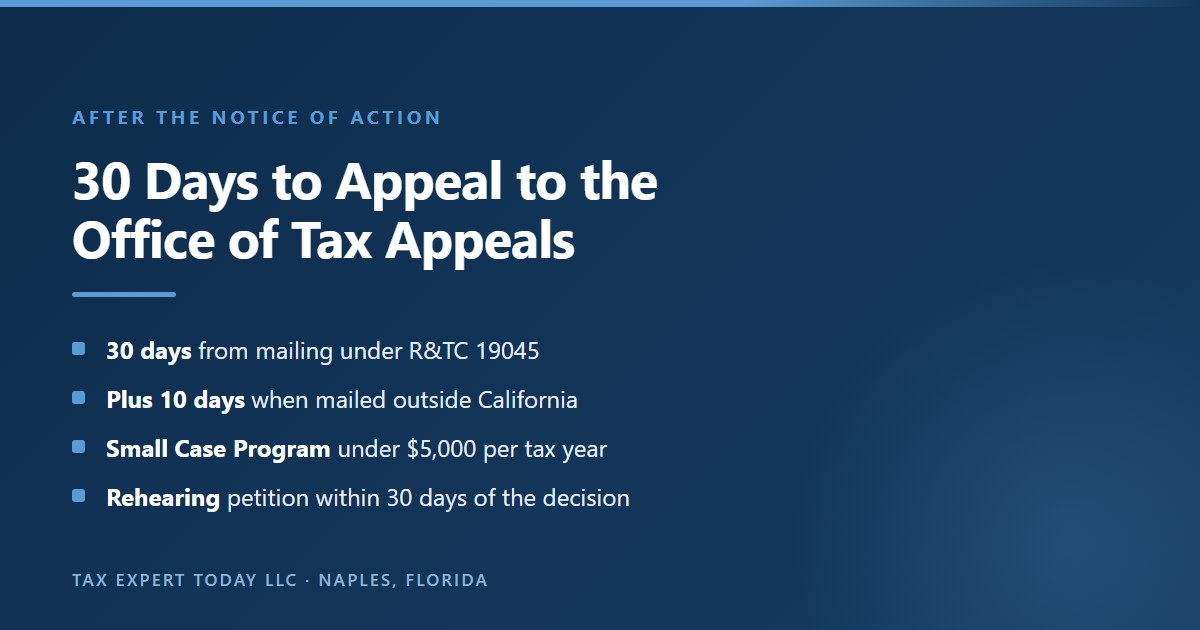
A Notice of Action is the FTB’s written decision on your protest. It will affirm, revise, or withdraw the proposed assessment. If it affirms or revises the assessment and you disagree, it starts a 30 day period to appeal to the Office of Tax Appeals, and the appeal date printed on the notice controls.
- Affirm: the proposed assessment stands as issued.
- Revise: the FTB reduces or otherwise changes the assessment.
- Withdraw: the proposed assessment is cancelled.
- Appeal window: 30 days from mailing under section 19045, with the printed appeal date treated as timely.
The FTB states that once a decision is made, “you will receive a Notice of Action (NOA) which will either affirm, revise, or withdraw the audit decision.” Depending on the case, you may also receive a reissued Notice of Proposed Overassessment, a Notice of Action on a Notice of Proposed Adjusted Carryover Amount, a Notice of Action on an Overassessment, Credit, or Refund, or a letter fully or partially denying a refund claim. Each of these has its own appeal deadline, which the Office of Tax Appeals rules list separately.
The appeal clock begins with the mailing of the Notice of Action. Section 19045(a) provides that the FTB’s action on the protest “is final upon the expiration of 30 days from the date when it mails notice of its action to the taxpayer, unless within that 30-day period the taxpayer appeals in writing.” Subdivision (b) requires the Notice of Action to state the last day to appeal and treats an appeal filed by that date as timely. The window is half the length of the protest window, and it is the shortest deadline in the process.
| Notice of Action result | What it means | Next step if you disagree |
|---|---|---|
| Affirmed | The FTB rejected the protest | Appeal to the Office of Tax Appeals within 30 days |
| Revised | The FTB accepted part of the protest | Appeal the remaining amount within 30 days, or accept |
| Withdrawn | The proposed assessment is cancelled | Request return of any deposit not needed |
| Partial action | Part decided, part still under protest | Appeal the decided part on its own date if needed |
A revised Notice of Action is often a reasonable place to stop. If the protest removed the main adjustment and the remaining amount is small or clearly correct, paying the revised amount may cost less than an appeal. If the remaining dispute is material, the appeal is the next forum, and it must be filed within the 30 days, because a Notice of Action that becomes final leaves only the payment and refund route described earlier.
How do you appeal a Notice of Action to the Office of Tax Appeals?
You appeal by filing with the Office of Tax Appeals within 30 days of the date the FTB mails its Notice of Action, or by the appeal date printed on it. File through the Office of Tax Appeals Portal, or mail or fax a Request for Appeal with your grounds and a copy of the Notice of Action.
- Forum: the Office of Tax Appeals, an agency separate from the FTB that succeeded the State Board of Equalization for appeals.
- Deadline: 30 days from mailing of the Notice of Action under section 19045 and OTA Rule 30203(a)(1).
- Filing: the Office of Tax Appeals Portal, or mail to PO Box 989880, West Sacramento CA 95798-9880, or fax to (916) 492-2089.
- Required items: a Request for Appeal or written grounds, the jurisdictional document, and supporting documents.
The appeal statute still refers to “the board,” because sections 19045 through 19048 were written when the State Board of Equalization heard income tax appeals. Government Code section 15672 resolves the reference: the Office of Tax Appeals “is the successor to, and is vested with, all of the duties, powers, and responsibilities of the State Board of Equalization necessary or appropriate to conduct appeals hearings.” Subdivision (b) adds that the tax appeals panels and their hearings “shall not be construed to be, or to be conducted by, a tax court.”
The Office of Tax Appeals explains the filing steps on its How to Appeal page. Appeals are filed through the Office of Tax Appeals Portal, which lets the parties exchange briefs, check status, and request extensions. Alternatively, you can mail or fax a completed Request for Appeal Form, or a written request for an appeal with specific grounds, together with a copy of the jurisdictional document issued by the FTB and any supporting documents. For an NPA dispute, the jurisdictional document is the Notice of Action on the protest.
The deadline rules are in the Office of Tax Appeals Rules for Tax Appeals. Rule 30203(a)(1) treats an appeal from a Notice of Action on a protested proposed assessment as timely if it is mailed to or received by the Office of Tax Appeals within 30 days from the date the FTB mails the notice, or within the period before the appeal deadline indicated on the notice. Rule 30205 treats the postmark date as the mailing date in the absence of other evidence, and extends a deadline that falls on a Saturday, Sunday, or California state holiday to the next business day.
| FTB notice being appealed | Appeal deadline under OTA Rule 30203(a) |
|---|---|
| Notice of Action on a protested proposed assessment | 30 days from mailing, or the deadline printed on the notice |
| Notice of Action denying a refund claim | 90 days from mailing |
| Refund claim not acted on within six months | Any time, as a deemed denial |
| Notice denying abatement of unpaid interest | 30 days from mailing |
| Notice denying abatement of paid interest | 90 days from mailing |
| Notice of Action affirming a proposed carryover adjustment | 30 days, or the deadline printed on the notice |
The Office of Tax Appeals is also explicit about what it does not hear. Its How to Appeal page states that you are not in the right place if active collection steps are being taken against you, such as a wage garnishment, levy, lien, or bank account intercept, unless you have paid the full liability and filed a refund claim that the FTB denied or did not act on within six months. A corporation whose status is suspended is given 30 days to return to good standing before the appeal is dismissed. Questions about jurisdiction can be directed to the Office of Tax Appeals Ombudsperson listed on that page.
Do you get extra time to appeal if you now live outside California?
Yes, for the appeal to the Office of Tax Appeals. OTA Rule 30204 extends the appeal deadline by 10 days when the notice was mailed to an address outside California but within the United States, and by 20 days outside the country. No comparable extension appears in section 19041 for the 60 day protest to the FTB.
- Mailed within California: 5 additional days for the appeal.
- Mailed to Florida or another state: 10 additional days for the appeal.
- Mailed outside the United States: 20 additional days for the appeal.
- Protest to the FTB: no comparable extension; the Protest By date controls.
Rule 30204 provides that, unless the law provides otherwise, the deadline for filing an appeal or a petition for rehearing with the Office of Tax Appeals is extended under Code of Civil Procedure section 1013 by five days if the notice or decision was mailed to an address within California, “ten days, if the notice or decision being appealed was mailed to an address outside California, but within the United States,” and twenty days if it was mailed outside the United States. For a former resident whose Notice of Action is mailed to a Naples address, the rule adds 10 days to the 30 day appeal window.
The extension is a reason for care, not a reason to wait. It applies to the Office of Tax Appeals stage only, and it depends on where the notice was mailed, not where you live. A Notice of Action mailed to your old California address and forwarded to Florida is a notice mailed within California for this purpose. And because the protest statute and the FTB’s protest instructions contain no comparable mailing extension, a taxpayer who assumes the out-of-state rule also stretches the 60 day protest period may lose the protest entirely. The practical rule is to treat every printed deadline as the real one.
| Hypothetical mailing address | Protest to the FTB | Appeal to the Office of Tax Appeals |
|---|---|---|
| Old address in San Diego, forwarded to Naples | 60 days, Protest By date controls | 30 days plus 5 |
| Current address in Naples, Florida | 60 days, Protest By date controls | 30 days plus 10 |
| Address outside the United States | 60 days, Protest By date controls | 30 days plus 20 |
The simplest protection against address problems is to keep the FTB’s records current after a move and to have a representative with an active power of attorney who can see notices as they post in MyFTB. Both steps cost little and remove the most common reason a former resident discovers an NPA after its deadline has passed.
What is the Office of Tax Appeals Small Case Program?
The Small Case Program lets an individual appealing an FTB action have the appeal heard by one panel member instead of a full panel. For personal income tax appeals, the total amount in dispute must be less than $5,000 for each tax year, and appeals involving precedential or complex issues are excluded.
- Threshold: less than $5,000 in dispute per tax year for personal income tax appeals from the FTB.
- Format: one panel member under Government Code section 15676.2.
- Measured by year: each year on the FTB action is tested separately.
- Exclusions: precedential questions, complex or novel issues, and open-ended refund claims.
Rule 30209.05 defines the Small Case Program as “the process authorized by Government Code section 15676.2 under which a taxpayer filing an appeal with OTA may opt to appear before one Panel Member.” Rule 30209.1(a)(1) sets the eligibility for personal income tax appeals from the FTB: the total amount in dispute must be “less than five thousand dollars ($5,000) per tax year.” The total amount in dispute is the tax, fees, and penalties on the FTB action, reduced by interest you choose not to contest, items you choose not to dispute separately, and amounts the FTB concedes in its opening brief.
The program has exclusions that matter for corridor cases. Rule 30209.1(e) bars the election if any year on the FTB action exceeds the limit, if the action is a refund denial for “$1 or more” or another unspecified amount, if the parties cannot agree on the amount in dispute, if the appeal involves an issue of law with potential for precedential treatment, or if it involves complex or novel issues of fact or procedure. Many residency disputes exceed the dollar limit, and some raise issues the Office of Tax Appeals may treat as complex, so the program is most useful for single-issue disputes such as a disallowed credit or a penalty.
| Hypothetical appeal | Small Case eligible? | Reason |
|---|---|---|
| $3,200 penalty for one year | Generally yes | Under $5,000 for the year, single issue |
| $4,100 in each of two years | Generally yes | Each year tested separately and each is under $5,000 |
| $4,800 and $6,300 in two years | No | One year exceeds the limit |
| $38,000 residency assessment | No | Exceeds the limit |
| Refund claim stated as “$1 or more” | No | Unspecified amount excluded |
What happens after the Office of Tax Appeals decides?
The Office of Tax Appeals issues a written opinion. Either party may petition for rehearing within 30 days, and otherwise the decision becomes final 30 days after it is issued under section 19048. A taxpayer who loses can then pursue a refund suit in Superior Court, but only after paying the tax and having a refund claim denied.
- Rehearing: a petition within 30 days, under section 19048 and OTA Rule 30602.
- Finality: 30 days after the decision, or 30 days after the opinion on rehearing.
- Court: a refund action under section 19382 requires payment and a denied refund claim.
- Court deadline: generally 90 days after the FTB acts on the claim or the Office of Tax Appeals decision on a refund appeal becomes final, under section 19384.
Section 19048 provides that the determination “becomes final upon the expiration of 30 days from the time of the determination unless within the 30-day period the taxpayer or the Franchise Tax Board files a petition for rehearing.” If a petition is filed, the determination becomes final 30 days after the opinion on the petition. Rule 30602 treats a petition as timely if it is mailed within that 30 day period, and the out-of-state extension in Rule 30204 applies to petitions for rehearing as well as appeals.
The route to court is narrow and runs through payment. Section 19382 allows an action against the FTB “after payment of the tax and denial by the Franchise Tax Board of a claim for refund,” on the grounds set forth in that claim. Section 19384 requires the action to be filed within four years from the last date prescribed for filing the return, within one year from payment, or within 90 days after the FTB’s notice of action on the refund claim or the final determination on an appeal from it, whichever is later. If the FTB does not act on a refund claim within six months, section 19385 allows the taxpayer to treat it as disallowed and sue.
In practice, The Tax Adviser observes, few California income tax disputes go beyond the Office of Tax Appeals. The sequence matters anyway, because it explains why the protest stage carries so much weight. A protest and an appeal to the Office of Tax Appeals can be pursued without paying the tax. Every later forum requires payment first. For a large assessment, the administrative path that starts with the 60 day protest is often the only one that is practical without first paying the full liability.
| Stage | Payment required? | Deadline to enter | Authority |
|---|---|---|---|
| Protest to the FTB | No | 60 days from the NPA | R&TC section 19041 |
| Appeal to the Office of Tax Appeals | No | 30 days from the Notice of Action | R&TC section 19045 |
| Petition for rehearing | No | 30 days from the decision | R&TC section 19048 |
| Refund claim after payment | Yes | Four years from filing or due date, or one year from payment | R&TC section 19306 |
| Superior Court refund suit | Yes | Generally 90 days after the final refund determination | R&TC sections 19382 and 19384 |
Can you settle a protested FTB assessment?
Yes, through the FTB Settlement Bureau under section 19442, which covers protests, appeals, and refund claims. Settlement is based on the costs and risks of litigation, not ability to pay, and the full settlement amount is due when a tentative settlement is reached. Acceptance into the program is discretionary.
- Authority: R&TC section 19442 and FTB Notice 2020-03.
- Basis: a reasonable evaluation of litigation costs and risks, not financial hardship.
- Payment: the full settlement amount at the time of the tentative settlement.
- Timing: the FTB expects a tentative settlement within nine months of acceptance.
Section 19442(a) states the Legislature’s intent that the FTB, its staff, and the Attorney General pursue settlements of civil tax matters in dispute that are the subject of protests, appeals, or refund claims, “consistent with a reasonable evaluation of the costs and risks associated with litigation of these matters.” Settlements above a statutory dollar threshold, adjusted annually for inflation, go to the Attorney General for review and then to the Franchise Tax Board itself for approval. Smaller reductions can be approved jointly by the executive officer and chief counsel.
FTB Notice 2020-03 sets out the procedure. A written request must include, among other items, the tax years and amount in dispute, the present status of the dispute, a power of attorney for the representative, “a good faith settlement offer, including the grounds in support of the offer,” and a full analysis of every issue. The Notice distinguishes the program from the FTB offer in compromise, because the settlement program “is not able to offer any concession based on a taxpayer’s ability to pay,” and from a payment plan, because the full settlement amount is due at the tentative settlement.
The Notice also limits when a request is useful. The Settlement Bureau “does not factually develop cases,” so the record must be complete before the request is made. A case with outstanding information requests will generally not be accepted. And “a protest near the end of the protest process ordinarily will not be considered for the settlement program,” in which case the taxpayer is ordinarily expected to appeal to the Office of Tax Appeals first and request settlement after the appeal is acknowledged.
| Settlement milestone | General maximum time in FTB Notice 2020-03 |
|---|---|
| Decision on whether the case is accepted | 1 month from the request |
| First contact by the assigned staff member | 2 months from acceptance |
| Bureau director and Chief Counsel approval | 7 months from first contact |
| Attorney General approval | 1 month from Chief Counsel approval |
| Franchise Tax Board approval | 2 months from Attorney General approval |
| Total settlement process | 13 months |
Settlement and compromise answer different questions. Settlement asks what the dispute is worth given the risk that each side loses. An offer in compromise asks what can be collected from someone who cannot pay a liability that is not in dispute. Our guide to the FTB offer in compromise covers that second program, which generally applies after the assessment is final.
What if you cannot pay the assessment once it becomes final?
Once the assessment is final and billed, the FTB’s collection tools apply, including liens, bank levies, and wage garnishment. The usual options are an installment agreement, an offer in compromise for a taxpayer who cannot pay, and an independent administrative review of certain collection actions requested within the stated periods.
- Payment plan: an FTB installment agreement for a balance that can be paid over time.
- Compromise: an FTB offer in compromise based on inability to pay.
- Levy review: request within 30 days of the Final Notice Before Levy.
- Lien review: request within 30 days of the notice of intent to record a lien, or 15 days of the Notice of State Tax Lien.
FTB 5821 describes the review rights. To request an independent administrative review of the filing of a tax lien, the request must be filed within 30 days of the notice of intent to record the lien or within 15 days of the date of the Notice of State Tax Lien. To request review of a wage garnishment or levy, the request must be filed within 30 days of the Final Notice Before Levy. A rejected or terminated installment agreement can be reviewed on a request filed within 30 days of the rejection or termination. These reviews concern collection, not the amount of the tax.
The collection stage has its own guides on this site. Our FTB installment agreement guide covers what approval turns on, and our FTB levy guide explains how California collects from a taxpayer who has moved. The point for this article is sequence: a protest is far easier to pursue before collection begins, and the Office of Tax Appeals will not hear a dispute while active collection is underway unless the liability has been paid and a refund claim is pending.
| Collection action | Review window | Source |
|---|---|---|
| Intent to record a tax lien | 30 days from the notice | FTB 5821 |
| Notice of State Tax Lien | 15 days from the notice | FTB 5821 |
| Wage garnishment or levy | 30 days from the Final Notice Before Levy | FTB 5821 and FTB 7275 |
| Rejected or terminated installment agreement | 30 days from the rejection or termination | FTB 5821 |
How does a move to Florida change the way you handle an NPA?
A move changes the logistics, not the deadlines. The protest clock still runs from the mailing date, forwarded mail can consume part of it, joint filers who now live apart can each receive a copy, and the out-of-state extension helps only at the Office of Tax Appeals stage. The fix is current records and active monitoring.
- Mailing date governs: a forwarded notice is still dated from its original mailing.
- Separate residences: section 19035 requires duplicate originals to each spouse if the FTB is notified.
- Online access: MyFTB, for you and for a representative with a power of attorney.
- Appeal extension: 10 extra days only when the notice is mailed outside California.
Former residents face three practical risks. The first is delay: a notice mailed to an old address and forwarded can lose a significant part of the 60 days before it is opened. The second is separation: section 19035 allows a single joint notice on a joint return, except that if the FTB is notified by either spouse that separate residences have been established, it must mail each spouse duplicate originals. A couple who separated during or after a move should make sure the FTB knows, so that neither spouse learns of a joint assessment only after the deadline. The third is distance from the records that win residency and sourcing disputes.
The residency and sourcing questions behind most corridor NPAs are covered across this site. Our guide to moving from California to Florida taxes sets out the full departure sequence, our California remote work tax guide covers wages for a California employer after the move, and our California nonresident withholding guide explains the withholding credits that often drive a mismatch notice. On the Florida side, our guide to the Florida residency audit describes the records that show where you lived, and the Florida 183 day rule calculator helps reconstruct days.
| Risk after the move | What can go wrong | Practical step |
|---|---|---|
| Forwarded mail | Part of the 60 days is lost in transit | Update the FTB address and register for MyFTB |
| Separate residences | One spouse never sees the joint notice | Notify the FTB under section 19035 |
| No representative access | Notices post unread | File a power of attorney declaration in advance |
| Records left behind | Residency facts cannot be documented in time | Keep a dated move file from the start |
| Assumed extension | The out-of-state rule is applied to the protest | Treat the Protest By date as fixed |
How does an FTB NPA differ from an IRS notice of deficiency?
The two notices sit at different points in their systems. The FTB NPA works like the IRS 30 day letter: it opens an administrative protest within the agency. The IRS notice of deficiency opens the 90 day window to petition the Tax Court. California has no prepayment tax court, so the Office of Tax Appeals fills that role.
- FTB NPA: 60 day protest to the FTB, then 30 days to the Office of Tax Appeals.
- IRS 30 day letter: an invitation to request IRS Appeals before a notice of deficiency.
- IRS notice of deficiency: 90 days, or 150 days if addressed outside the United States, to petition the Tax Court.
- Court without payment: available federally in the Tax Court; in California, court generally requires payment first.
California’s own statute draws the comparison. Section 19041.5(b) modifies the federal deposit rule in Internal Revenue Code section 6603 by substituting “notice of proposed deficiency assessment” for “30-day letter” wherever the federal statute uses it. In both systems, that notice is the point at which the agency has finished its examination and invites an administrative response. The difference is what comes next. Federally, the statutory notice of deficiency opens a path to a court that hears the case before payment. In California, the Office of Tax Appeals hears it before payment, and Government Code section 15672(b) states expressly that its panels are not a tax court.
| Step | California (FTB) | Federal (IRS) |
|---|---|---|
| Proposal after examination | Notice of Proposed Assessment | 30 day letter with the examination report |
| Administrative review | Protest to the FTB within 60 days | Request for IRS Appeals, generally within 30 days |
| Formal deficiency notice | Notice of Action on the protest | Statutory notice of deficiency |
| Prepayment forum | Office of Tax Appeals, 30 days | United States Tax Court, 90 days |
| Payment then court | Refund claim, then Superior Court | Refund claim, then District Court or Court of Federal Claims |
The federal side, and its strict petition deadline, is covered in our guide to the IRS notice of deficiency. The reason to keep both in view is that a single federal adjustment can produce both notices for the same year, on different clocks, before different agencies. A taxpayer who calendars only the federal deadline can lose the California protest, and the reverse is also true.
What does a full FTB protest timeline look like?
A typical sequence runs from the NPA to a 60 day protest, an FTB review that can take several months, a Notice of Action, a 30 day appeal window, an Office of Tax Appeals briefing and decision, and a 30 day rehearing window. Interest runs throughout unless the amount is paid or deposited.
- Day 0: the FTB mails the NPA.
- Day 15: the last day to pay in full without additional interest.
- Day 60: the last day to protest, or the printed Protest By date.
- After the Notice of Action: 30 days to appeal, plus any applicable mailing extension.
The table below is a hypothetical illustration of the statutory steps, not a prediction of how long any particular case will take. The FTB states only that a protest “may take several months to resolve,” and the length of the Office of Tax Appeals stage depends on briefing, extensions, and whether an oral hearing is held.
| Step | Statutory timing | What to have ready |
|---|---|---|
| NPA mailed | Starts every later deadline | Calendar the notice date and the Protest By date |
| Interest decision | Within 15 days to avoid additional interest | Decide on payment, deposit, or neither |
| Protest filed | Within 60 days, by the Protest By date | Grounds, schedule, exhibits, hearing request, FTB 3701 if needed |
| FTB review | No fixed period; several months is typical per FTB 7275 | IDR responses on time; hearing preparation |
| Notice of Action | Starts the 30 day appeal period | Decide whether to accept, settle, or appeal |
| Appeal filed | 30 days, plus 5, 10, or 20 days by mailing address | Request for Appeal and the Notice of Action |
| OTA decision | Final 30 days after issuance | Decide whether to petition for rehearing |
| Refund route | Section 19306 and 19384 periods | Full payment and a refund claim |
What records should you gather when an NPA arrives?
Gather the full notice and envelope, the return and every schedule for the year, any audit correspondence and issue write-ups, waivers of the assessment period, payment records, and the evidence for each disputed adjustment. For residency and sourcing disputes, add a dated timeline of the move and the documents behind each date.
- The notice itself: every page, plus the envelope or the MyFTB posting date.
- The return: Form 540 or 540NR with all schedules, and any amended return.
- The audit file: IDRs, your responses, and any issue presentation sheets.
- Federal records: IRS reports and account transcripts for any federal-change NPA.
The list is driven by the questions a protest must answer. The notice and envelope establish the dates. The return and the audit file establish what the FTB changed and why. Waivers and federal reports establish whether the assessment period was open, under the rules in sections 19057 through 19067. Payment records establish what has been paid, deposited, or applied. And the evidence for each adjustment, whether a closing statement, a payroll record, a workday calendar, or a lease, is what the protest is actually decided on.
| Record | Question it answers |
|---|---|
| Notice, envelope, MyFTB posting | When did the protest period start and end? |
| Return and schedules | What was reported, and as resident or nonresident income? |
| Audit correspondence | What did the FTB rely on, and what was already answered? |
| Waivers of the assessment period | Was the period still open when the NPA was mailed? |
| IRS reports and transcripts | Is a federal change final, and was it reported on time? |
| Payment and deposit records | What has been paid, deposited, or applied? |
| Move timeline and evidence | When did domicile change, and where was the work done? |
For a sale or a home disposition after a move, the closing documents and the residency evidence on the closing date are usually decisive. Our guides to the California capital gains tax on a home sale and California Form 593 describe the records that support the sourcing and the withholding credit in that situation.
What mistakes do taxpayers make with an FTB notice of proposed assessment?
The most costly mistakes are counting the deadline from receipt instead of mailing, treating a phone call as a protest, protesting without grounds or documents, ignoring interest during a long dispute, and missing the 30 day appeal window after the Notice of Action. Each one can turn a contestable assessment into a final one.
- Counting from receipt: the statute counts from mailing.
- Calling instead of filing: section 19041 requires a written protest with grounds.
- Arguing without evidence: most protests are decided on documented facts.
- Missing the appeal: the Notice of Action window is only 30 days.
Several quieter errors also recur. Filing an amended return in response to an NPA is one: FTB 7275 tells a taxpayer who agrees with the assessment not to submit Form 540X, but to pay it as an NPA payment. Paying the full disputed amount outright when a deposit was intended is another, because under section 19335 a payment after a protest is filed can convert the protest into a refund claim. Forgetting to request an oral hearing in the protest itself is a third, because section 19044(a) ties the hearing right to the request.
| Mistake | Consequence | Prevention |
|---|---|---|
| Counting 60 days from receipt | Late protest; assessment final under section 19042 | Count from the notice date; use the Protest By date |
| Phone call instead of a written protest | No protest on file | File online or in writing with grounds |
| Protest with no documents | Notice of Action affirms the assessment | Indexed exhibits for each adjustment |
| No interest strategy | Large interest cost if the protest fails | Decide on a deposit early |
| Payment instead of a deposit | Protest converted to a refund claim | Use FTB 3576 or the Tax Deposit option |
| No hearing request | No oral hearing | Request it in the protest |
| Missed 30 day appeal | Notice of Action becomes final | Calendar the appeal date the day the notice arrives |
| Amended return in response to the NPA | Confusion and delay | Follow the payment or protest instructions in FTB 7275 |
Frequently Asked Questions About the FTB Notice of Proposed Assessment
What is an FTB notice of proposed assessment?
It is the written notice the California Franchise Tax Board must mail before assessing additional tax. Under Revenue and Taxation Code sections 19033 and 19034 it states the proposed deficiency, the reasons, the computation, and the last day to protest. It is not a bill, and nothing is due until it becomes final.
How long do I have to protest an FTB notice of proposed assessment?
You have 60 days after the notice is mailed under section 19041(a). A protest filed on or before the Protest By date printed on the notice is treated as timely under section 19041(b). Count from the mailing date, not the date the notice reached you.
What happens if I do not protest the NPA in time?
Under section 19042 the proposed assessment becomes final when the 60 day period expires, and the FTB bills the amount with interest. You can still pay the balance in full and file a claim for refund, which preserves a later appeal, but payment comes first.
Does a protest stop interest on the proposed assessment?
No. Interest runs from the original due date of the return until payment. The FTB charges no additional interest if the full balance is paid within 15 days of the notice date, and a tax deposit under section 19041.5 limits interest while the protest continues.
What should a written protest include?
Include a copy of the NPA, your name, address, phone number, and identification number, the years and amounts you protest and any amounts you accept, what you disagree with and why, a statement of facts, supporting documents and legal authorities, and your or your representative’s signature.
How long do I have to appeal an FTB Notice of Action?
You have 30 days from the date the FTB mails the Notice of Action to appeal to the Office of Tax Appeals under section 19045. Office of Tax Appeals Rule 30204 adds 10 days when the notice was mailed to an address outside California but within the United States.
Can I settle a protested FTB assessment?
Yes. The FTB Settlement Bureau may settle protests, appeals, and refund claims under section 19442, based on the costs and risks of litigation rather than ability to pay. FTB Notice 2020-03 sets out the request requirements, and acceptance into the program is discretionary.
Can a Naples, Florida advisor handle a California FTB protest?
Yes. Protests are filed with the FTB online or in writing and appeals are filed through the Office of Tax Appeals portal, so the work does not depend on where the advisor is located. A Naples, Florida advisor can review the notice, prepare the protest, and handle the appeal.
FTB Notice of Proposed Assessment Help in Naples & Southwest Florida
FTB notice of proposed assessment help Naples taxpayers can use starts with the dates on the notice, the reasons for each adjustment, and the records that answer them, before the protest is written. Tax Expert Today LLC advises on state residency and tax matters nationwide, including California protests and appeals for former residents who now live in Florida, from our office in Naples, Florida. Our team of tax advisors, enrolled agents, CPAs, and attorneys reviews the notice and the assessment period, prepares the protest and the exhibits, requests the oral hearing, and handles the deposit decision and the appeal to the Office of Tax Appeals when one is needed.
We are located at 11983 Tamiami Trail N, Naples FL 34110. Call (239) 441-2005, Monday through Friday, 10:00 to 5:00 Eastern Time. Clients across Naples, Bonita Springs, Estero, Fort Myers, Marco Island, and the wider Southwest Florida region engage us on California notices after a move. Our California tax services page describes the state work we do for former California residents, our Naples tax resolution page covers notice and collection matters, and our Naples tax planning and tax planning services pages explain how an engagement is structured. For the history of the move itself, see our guides to the California exit tax and leaving California taxes.
- FTB protest help Naples FL: reviewing the notice, the computation, and the Protest By date.
- Assessment period review: checking sections 19057 through 19067 and every waiver signed.
- Protest and hearing: grounds, exhibits, the oral hearing request, and IDR responses.
- Office of Tax Appeals: the appeal, the Small Case election where it fits, and settlement requests.
Local FAQ: I moved from San Jose to Naples and just received an FTB notice of proposed assessment at my Florida address. Can a Naples advisor handle the protest? Yes. The protest is filed with the Franchise Tax Board online or in writing, and the appeal goes to the Office of Tax Appeals through its portal, so the location of your advisor does not limit the process. Bring the full notice and envelope, the California return for that year, any audit letters, and the records behind your move date, and we can confirm the Protest By date, review whether the assessment period was open, and prepare the protest before the deadline.
When to Engage a Professional
Engage a professional when the NPA involves residency or sourcing, when the amount is large enough that interest and penalties matter, when the deadline is close, when a federal change is involved, when the assessment period may have expired, or when you have already received a Notice of Action and the 30 day appeal window is running.
- Residency or sourcing: the NPA turns on where you lived or worked, and when.
- Large balance: the deposit decision and the penalty arguments carry real cost.
- Short time left: the Protest By date is weeks or days away.
- Federal change: the IRS and FTB matters need to be coordinated.
- Notice of Action received: the appeal must be filed within 30 days.
This article explains California law and FTB procedure as they stand in October 2026. It is not legal or tax advice for any specific situation, and outcomes depend on the facts of each return, the documentation available, and determinations that rest with the Franchise Tax Board and the Office of Tax Appeals. The examples are hypothetical illustrations, not client results. Call (239) 441-2005 to arrange a review.
Published October 20, 2026 by Dr. Pellumb Kabashi « Back to Learning Center
Have a question this article touches on?
Tax Expert Today LLC, based in Naples, Florida and serving clients across the United States.
Schedule a Consultation (239) 441-2005