
By Dr. Pellumb Kabashi, DBA, MBA, CES, CFE, EA
Founder, Tax Expert Today LLC · Tax advisors, enrolled agents, CPAs, and attorneys · Serving clients in all 50 states
This Georgia estimated tax penalty calculator estimates the Department of Revenue penalty you may owe for paying your 2026 Georgia estimated taxes too slowly. Georgia computes its own underpayment penalty on Form 500 UET under O.C.G.A. §48-7-120, and the safe harbor is more generous than the federal one. Use the calculator below, then read on for the Georgia rules that catch people.
Quick answer: Georgia charges an estimated tax penalty when your timely payments fall short of the smaller of 70% of your current year tax or 100% of your prior year tax. The penalty is interest at 9% per year, charged on each installment’s shortfall for the time it stays unpaid. Georgia uses four equal installments due April 15, June 15, September 15, and January 15, and unlike the federal system there is no higher prior year percentage for high earners. Call (239) 441-2005 for a free consultation.
Published: June 2, 2026
Primary sources
Estimate your 2026 Georgia underpayment penalty, results update as you type
Estimate only. This tool applies the Form 500 UET regular method with four equal installments and the 9% annual rate, and assumes any shortfall stays unpaid through the April 15, 2027 filing deadline. It does not apply the annualized income method or every special rule, including the separate farmer and fisher schedule. Your actual penalty is determined by the Georgia Department of Revenue. Confirm the current rate on the Georgia DOR penalty and interest rates page and see the disclaimer below.
How to use this Georgia estimated tax penalty calculator
Enter your projected 2026 Georgia tax, your Georgia withholding, the estimated payments you made on the four due dates, and your 2025 Georgia tax. The Georgia estimated tax penalty calculator applies the Form 500 UET weighting of four equal installments and the 9% rate, then estimates your penalty as you type. Because Georgia’s safe harbor uses the smaller of 70% of the current year or 100% of the prior year, entering an accurate prior year figure usually lowers the required amount.
What is the Georgia estimated tax penalty?
The Georgia estimated tax penalty is interest the Department of Revenue charges when you pay your state income tax too slowly during the year. It is authorized by O.C.G.A. §48-7-120 and computed on Form 500 UET. It is not a flat fine. Georgia applies a 9% annual rate to each installment’s shortfall for the time it stays unpaid, so the longer an underpayment sits, the larger the penalty grows.
Georgia’s safe harbor, 70% of current year or 100% of prior year
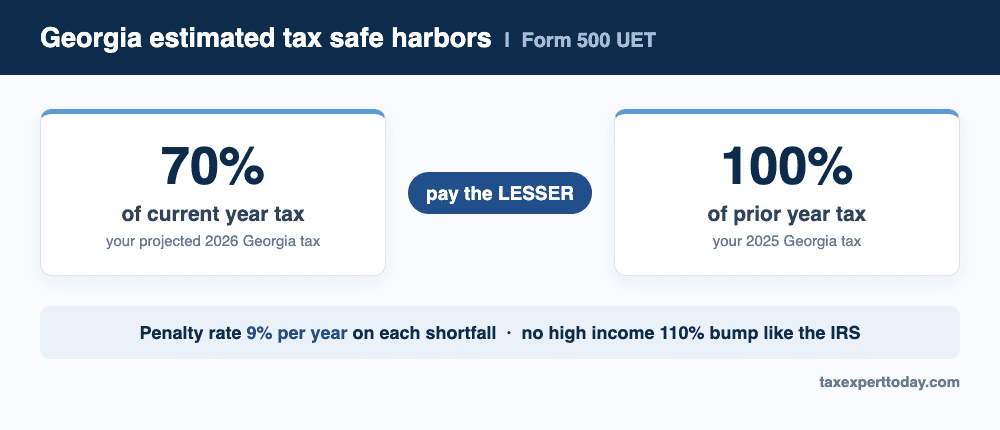
You avoid the penalty if your timely payments meet the smaller of 70% of your current year tax or 100% of your prior year tax. This is the rule that makes Georgia more forgiving than the IRS, which requires 90% of the current year. Two points matter. First, Georgia does not raise the prior year percentage for high earners, so there is no 110% trap like the federal $150,000 AGI rule. Second, the prior year return must cover a full 12 month period to use the 100% prior year figure.
What are the Form 500 UET exceptions to the Georgia safe harbor?
The Georgia safe harbor estimated tax rules give you three more ways to avoid the penalty on Form 500 UET: payments covering the tax on last year’s income at this year’s rates, payments of at least 70% of the tax on annualized income, or payments of at least 90% of the tax on income actually earned through 3, 5, or 8 months. Call (239) 441-2005 for a free consultation.
The exceptions are tested installment by installment on lines 13 through 16 of the Form 500 UET for tax years beginning on or after January 1, 2025, and any installment that meets one of them carries no penalty even if the 70% and 100% tests above are missed for the year. They matter most when income arrives late in the year, such as a fourth quarter capital gain or a year-end bonus.
| Form 500 UET exception | The test | Who it usually helps |
|---|---|---|
| Exception 1, prior year income at current rates | Payments to date equal the tax on last year’s income, figured with this year’s rates and exemptions | Taxpayers whose income rose but whose rates fell |
| Exception 2, annualized income | Payments to date equal at least 70% of the tax on income annualized to the end of the month before the installment | Seasonal businesses and anyone with income concentrated late in the year |
| Exception 3, actual income over 3, 5, and 8 months | Payments to date equal at least 90% of the tax on income actually earned from January 1 through the end of the month before the installment | Taxpayers with a large gain or bonus after the first three installments |
The instructions tie each exception to the payments made by that installment date, with Georgia withholding treated as paid in equal amounts on each date. Farmers and fishers use the separate 66 and two thirds percent schedule instead, and the federal side has its own exceptions on Form 2210, which our IRS underpayment penalty calculator covers.
2026 Georgia estimated tax due dates
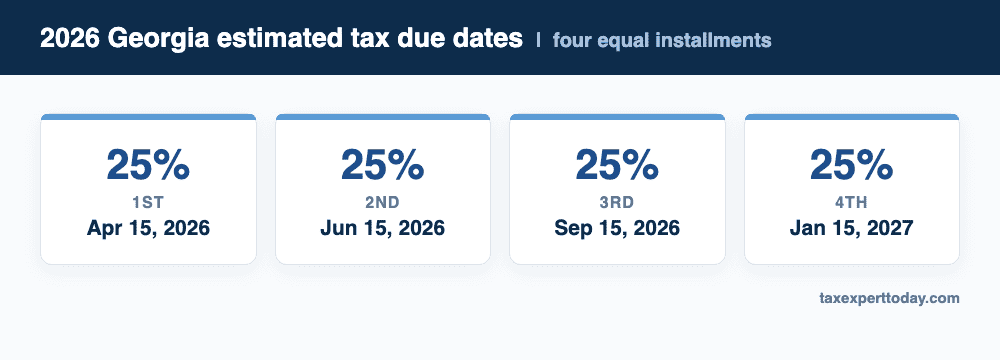
Georgia splits the required annual payment into four equal installments of 25% each, on the same calendar as the IRS. Each installment that comes in short starts the 9% clock for that period.
- 1st installment (25%): due April 15, 2026
- 2nd installment (25%): due June 15, 2026
- 3rd installment (25%): due September 15, 2026
- 4th installment (25%): due January 15, 2027
Who has to make Georgia estimated payments?
Georgia generally requires estimated tax payments when you expect to owe more than $500 in Georgia income tax after subtracting your withholding and credits. That commonly includes self employed people, business owners, retirees with investment income, and anyone with a large capital gain or other income that is not subject to Georgia withholding. You make the payments with Form 500 ES or through the Georgia Tax Center.
Taxpayers who moved into or out of Georgia during the year reach this question only after the Georgia portion of the year has been computed, because the safe harbor is measured against the Georgia tax actually owed. Our guide to the Georgia part year resident tax return explains how Form 500 Schedule 3 arrives at that figure.
Purchasing a transferable state credit is sometimes proposed as a way to cover a Georgia balance. It reduces the tax shown on the return for the year it is properly claimed, but it is not a substitute for paying on time, and the claim year is fixed by regulation rather than chosen freely. Our guide to the Georgia film tax credit explains how that timing works.
The penalty is only half of the picture. The payment itself runs on its own rules: the income test in O.C.G.A. 48-7-114, a shorter schedule when the requirement first arises after March 31, and withholding that is treated as paid evenly on each installment date. Those rules, and how to pay online or with the voucher, are covered in our guide to Georgia Form 500 ES.
How do I avoid the Georgia penalty?
Aim to pay the smaller safe harbor on time. Take 70% of your projected current year tax, compare it to 100% of last year’s tax, use the smaller number as your target, and pay it in four equal installments. If your income is uneven, the annualized income installment method on Form 500 UET can lower the penalty by matching required payments to when you actually earned the income. Because Georgia withholding counts as paid evenly across the year, increasing withholding late in the year can still reduce a penalty. Farmers and fishers have a lower 66 and two thirds percent current year threshold and a different single installment schedule, so they should not use the four installment estimate above.
Can the Georgia penalty be waived?
Sometimes. Georgia can waive the estimated tax penalty in limited situations, such as a casualty, disaster, or other unusual circumstance, or where the underpayment was due to reasonable cause and not willful neglect. You explain the circumstances when you file Form 500 UET with your return. Waivers are fact specific, and documentation matters.
Georgia late filing and late payment penalties (the other “late fee”)
Georgia’s estimated tax penalty is separate from its late fees. If you file or pay after the deadline, the Department of Revenue adds a late filing penalty of 5% of the unpaid tax per month and a late payment penalty of 0.5% per month, each capped at 25%, with the two combined also capped at 25%. Call (239) 441-2005 for a free consultation.
- Late filing: 5% of the tax not paid by the original due date, plus another 5% for each additional month the return is late, capped at 25% (O.C.G.A. §48-7-57).
- Late payment: 0.5% of the unpaid tax, plus another 0.5% for each additional month it stays outstanding, capped at 25% (O.C.G.A. §48-7-86).
- Interest: accrues monthly at the Federal Reserve prime rate plus 3 percentage points, reviewed each January (O.C.G.A. §48-2-40).
- Estimated tax: 9% per year on each period’s underpayment, computed on Form 500 UET (O.C.G.A. §48-7-120).
These stack. A Georgia filer who underpaid estimates and then filed late can owe the 9% estimated tax penalty on the installment shortfalls, the late filing and late payment penalties on the balance, and interest on top. The combined 25% cap applies only to the late filing and late payment pair, so the estimated tax penalty sits outside it. Confirm current figures on the Georgia DOR penalty and interest rates page.
Georgia vs. federal estimated tax penalties
The two systems run in parallel, and you can owe both. The federal penalty requires 90% of the current year tax (or 100% of the prior year, 110% if your AGI was over $150,000) at a rate that the IRS resets quarterly. Georgia is more generous on the safe harbor at 70% of the current year, charges a flat 9% per year, and uses four equal installments. If you owe Georgia estimated tax, you very likely owe federal estimated tax too. Estimate the federal side with our IRS underpayment penalty calculator, and remember the two penalties are calculated separately on different forms.
Frequently asked questions
What is the Georgia estimated tax penalty rate for 2026?
Georgia charges 9% per year on the underpaid amount for each installment period, computed on Form 500 UET. Confirm the current figure on the Georgia Department of Revenue penalty and interest rates page before relying on it.
What is the Georgia safe harbor for estimated taxes?
You avoid the penalty if your timely payments equal the smaller of 70% of your current year Georgia tax or 100% of your prior year Georgia tax. Unlike the federal rule, Georgia does not raise the prior year percentage for higher income taxpayers.
When are Georgia estimated tax payments due in 2026?
Georgia uses four equal installments due April 15, 2026, June 15, 2026, September 15, 2026, and January 15, 2027. Each installment is 25% of your required annual payment.
Do I have to make Georgia estimated payments?
Generally yes if you expect to owe more than $500 in Georgia income tax after withholding and credits. This often applies to self employed people, business owners, and taxpayers with investment income or capital gains not covered by withholding.
Is there a Georgia late fee calculator?
This calculator estimates the Georgia estimated tax penalty on Form 500 UET, which is separate from the late fees. The Georgia late filing penalty is 5% of the unpaid tax per month and the late payment penalty is 0.5% per month, each capped at 25% and capped at 25% combined, with interest at the prime rate plus 3 percentage points charged on top. Multiply the unpaid tax by the applicable monthly rate and the number of months late to estimate them.
Where can I get help with a Georgia estimated tax penalty in Naples, FL?
Georgia estimated tax help Naples: Tax Expert Today LLC is based at 11983 Tamiami Trail N, Naples, Florida 34110 and serves clients in Georgia and all 50 states. Our team of Enrolled Agents, CPAs, and tax attorneys helps with multistate estimated tax planning, Form 500 UET review, and tax resolution. Call (239) 441-2005 to discuss your situation.
Get help with Georgia and federal estimated taxes
Georgia’s safe harbor is friendlier than the federal one, but business owners, retirees, and anyone with a large capital gain can still slip into a penalty when income is uneven or last year’s tax was low. Tax Expert Today helps individuals and business owners set safe harbor payment plans across both Georgia and federal systems, apply the annualized income method, and pursue waivers when a penalty has already been assessed. You can also re-run the Georgia estimated tax penalty calculator above any time your income or withholding changes.
Call (239) 441-2005 or schedule a consultation to review your Georgia and federal exposure. Tax advisors, enrolled agents, CPAs, and attorneys serving clients in all 50 states.
Disclaimer: This calculator and article are provided for general educational purposes only and produce estimates, not a determination of tax owed. They do not constitute tax, legal, or financial advice, and using them does not create a client relationship. Georgia penalty rules under O.C.G.A. §48-7-120 are fact specific, rates can change, and your actual liability is determined by the Georgia Department of Revenue based on your complete return. Consult a qualified tax professional about your situation. See our full disclaimer.
Published June 2, 2026 by Dr. Pellumb Kabashi « Back to Learning Center
Have a question this article touches on?
Tax Expert Today LLC, based in Naples, Florida and serving clients across the United States.
Schedule a Consultation (239) 441-2005