
By Dr. Pellumb Kabashi, DBA, MBA, CES, CFE, EA
Founder, Tax Expert Today LLC · Tax advisors, enrolled agents, CPAs, and attorneys · Serving clients in all 50 states
Quick Answer: In the year you move, snowbird taxes come down to one filing: a part-year resident return in your old state, and no return in Florida, which levies no state income tax. Your old state taxes all income you received while you were still domiciled there, plus any income sourced to that state after you left. The pivot is the exact date your Florida domicile begins, because that date splits the year and decides which state taxes your investment income.
Published: July 2026
The word snowbird covers two very different tax situations, and the year one filing depends on which one you are. If you keep your permanent home up north and only winter in Florida, you generally remain a full-year resident of the northern state and nothing changes on the Florida side. This guide is for the other snowbird: the one who has decided to make Florida the permanent home and is filing for the first time as someone whose year was split between two states. That first return is where most of the money is won or lost, because it fixes the date your Florida residency began and allocates a full year of income across the line. Get the date and the allocation right and the plan holds. Get them wrong and the old state can pull income back that you thought had followed you south.
What Are Snowbird Taxes in Your First Year?
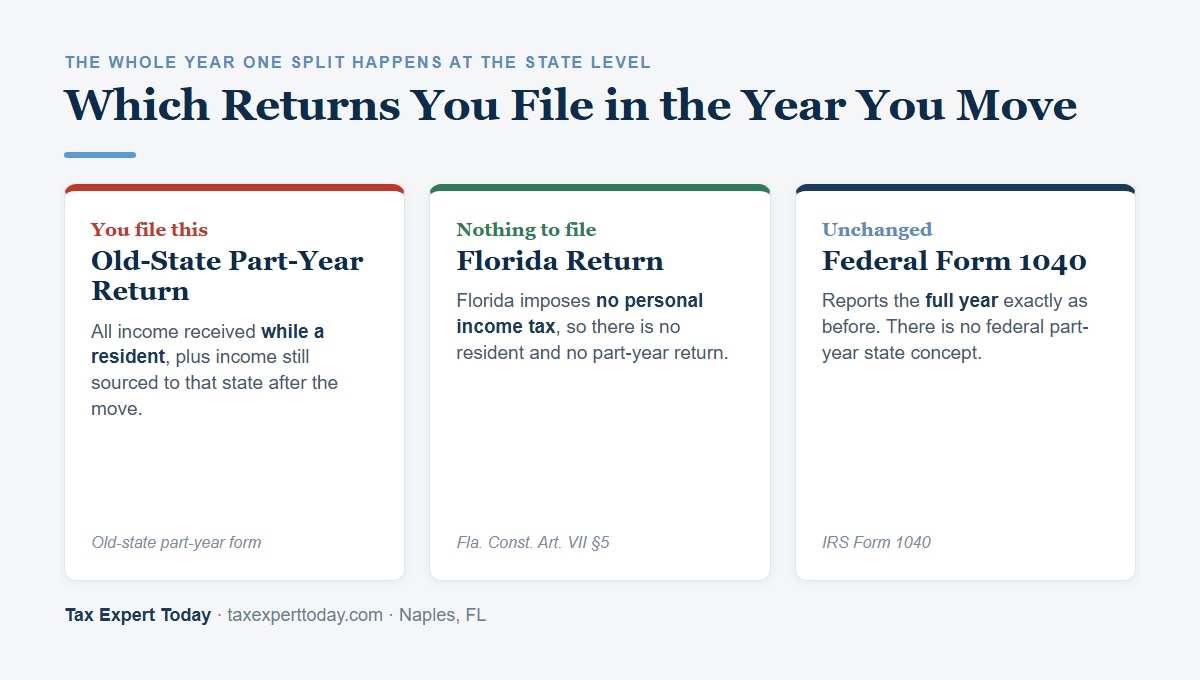
In the year you move, snowbird taxes reduce to a single state filing. You file a part-year resident return in the state you left, and you file nothing at the state level in Florida, because Florida imposes no personal income tax. The part-year return reports every dollar you received while you were still a resident there, and then only the income sourced to that state for the part of the year after your domicile changed.
Florida takes no personal income tax by constitutional design. Article VII, Section 5 of the Florida Constitution bars the state from levying an income tax on individuals, so there is no Florida resident return, no part-year Florida return, and no Florida withholding to reconcile. The entire year one exercise happens on the return of the state you are leaving, which is why the mechanics of that state matter so much.
| Return | What it covers in the year you move |
|---|---|
| Old-state part-year resident return | All income received while you were a resident there, plus income sourced to that state after the move, such as wages for work performed there or rent from property located there. |
| Old-state nonresident portion | Reported on the same part-year return for most states. Investment income received after the domicile change generally falls out, because intangibles follow your new domicile. |
| Florida return | None. Florida has no personal income tax, so there is nothing to file at the state level. |
| Federal return | Unchanged. The federal return taxes your worldwide income for the full year regardless of which state you live in, so the move does not alter it. |
The federal side is worth stating plainly because it reassures people who expect a second layer of complexity. There is no federal concept of a part-year resident of a state. Your Form 1040 reports the whole year exactly as it would if you had never moved. The split only exists at the state level, and in Florida that split has only one side.
When Does Florida Residency Actually Start?
Florida residency starts on the date your domicile changes, which is the date you are physically present in Florida and intend to make it your true, fixed, and permanent home while abandoning your old domicile. It is not the date you buy a Florida home, and it is not automatically January 1. It is a facts-and-intent date, and it is the single most important number on your first return, because it decides how the year is split.
Because domicile turns on intent, the date has to be evidenced rather than simply asserted. Florida gives new residents a specific tool for this. Florida Statutes §222.17 lets a person file a sworn declaration of domicile with the clerk of the circuit court, stating that Florida is the predominant and principal home and recording the date it became so. The declaration is not the only proof, and it does not by itself defeat a determined old state, but it is a dated, sworn record that supports the rest of the file.
The evidence that sets the date is the same evidence that survives a later challenge: the declaration of domicile, a Florida driver license, voter registration, a homestead exemption filing, where your vehicles are registered, where your physicians and advisors are, and where you actually spend your days. For the full checklist, see our guide on how to establish Florida residency and the Florida 183-day rule calculator. The goal in year one is a clean, dated line that the return can rely on.
How Is Your Income Split Between States in the Year You Move?
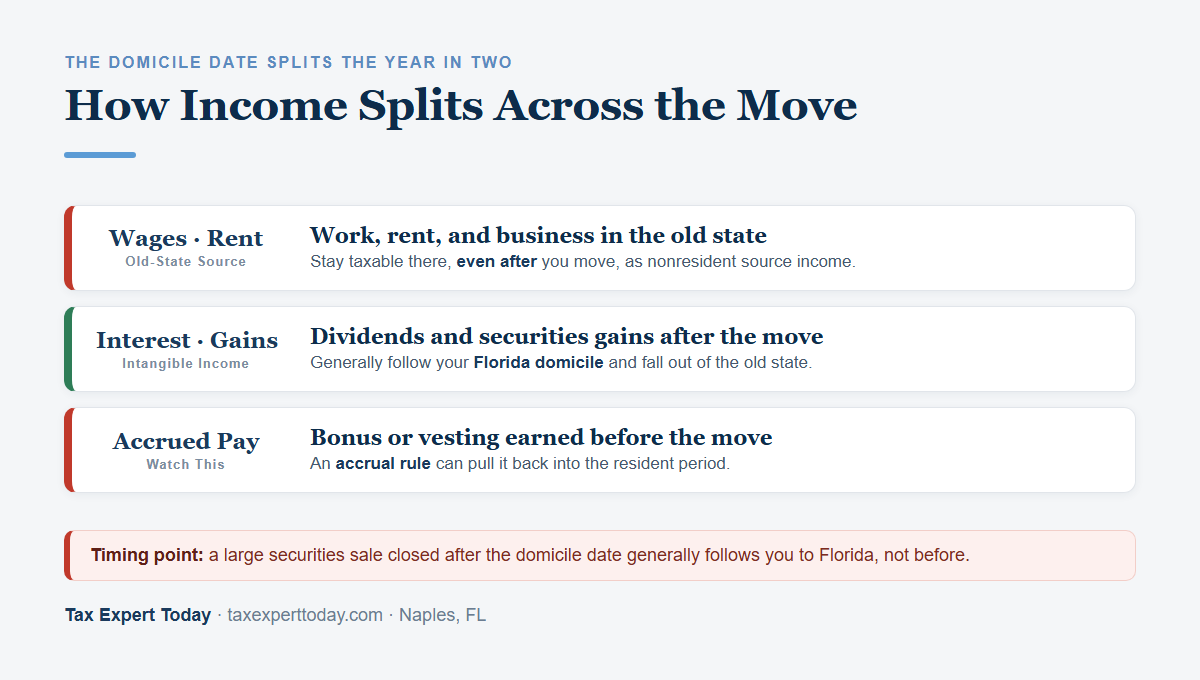
Income is split by two rules working together: everything you received while you were a resident of the old state is taxable there, and everything sourced to that state stays taxable there even after you leave. What falls out after the move is intangible income, such as interest, dividends, and capital gains on securities, because that income follows your domicile to Florida. That single distinction is why the sale of a large position is often timed to close after the domicile date rather than before.
The allocation is done by category, and the categories behave differently across the residency line.
| Type of income | Old-state resident period | After the move to Florida |
|---|---|---|
| Wages for work performed in the old state | Taxable there | Still taxable there for any days actually worked in that state; Florida days are not |
| Interest, dividends, and gains on securities | Taxable there while resident | Generally not taxable there; intangibles follow your Florida domicile |
| Rent or gain from real property in the old state | Taxable there | Still taxable there as nonresident source income |
| Income from a business operating in the old state | Taxable there | Still taxable there to the extent the business operates in that state |
| Retirement plan and IRA distributions | Taxable there while resident | Generally not taxable there; federal law limits a state taxing a former resident’s retirement income |
California states the framework directly for the states that follow it. FTB Publication 1031 explains that a part-year resident is taxed on all income received while a California resident and only on California-source income while a nonresident. New York works the same way on its part-year resident return, Form IT-203. The common thread is the residency line: what matters is whether income was received before or after it, and where the income is sourced once you are on the Florida side of it.
What About a Bonus, RSUs, or Deferred Comp Paid After You Move?
Income you earned in the old state does not always escape its tax just because the check arrives after you become a Floridian. Several states apply an accrual rule that reaches back and taxes compensation and other items that accrued during the resident period, no matter when they are actually paid. A year-end bonus for work performed up north, a vesting event tied to prior service, or an installment payment on a pre-move sale can all be pulled back into the resident-period return.
New York is the clearest example. New York Tax Law §639 provides that when an individual changes status from resident to nonresident, items of income, gain, loss, and deduction accrued up to the change of status are included on the resident-period return, unless the taxpayer posts a bond or other security. The rule exists precisely to stop a late-year move from converting already-earned income into untaxed income. California applies related concepts to income with a California source or that accrued while a resident. The practical takeaway is that the paycheck date is not the whole story, and deferred or lump-sum compensation should be mapped against the move date before you file.
Retirement accounts follow the same residency line as the rest of your income in the move year. A distribution or Roth conversion taken after your Florida domicile begins generally escapes the old state, while one taken before it does not. Our guide on retiring to Florida and the taxes on pensions and IRAs covers how to sequence those decisions and how federal law shields a nonresident from old-state tax on a pension.
This is also where the timing of the move interacts with the type of pay. Equity compensation and deferred compensation carry their own multi-state sourcing rules that turn on where the work was performed over the vesting or deferral period, not simply on where you live when the money lands. We cover that analysis for relocating executives in our guide on establishing Florida domicile for executives.
Do Snowbirds Who Keep a Northern Home Still Risk Full-Year Taxation?
Yes. Changing your domicile to Florida is necessary, but by itself it may not be enough, because several high-tax states apply a second, purely mechanical test. Under a statutory residency rule, a person who keeps a permanent place of abode in the state and spends more than 183 days there in the year can be taxed as a full-year resident even after a genuine domicile change. That is how a snowbird who kept the old house and visited too often can end up taxed by both states in the same year.
New York defines this in New York Tax Law §605(b), which treats a person as a resident either by domicile or by maintaining a permanent place of abode and being present in the state for more than 183 days. Any part of a day generally counts as a day. In the year of the move this is a live risk, because you were present in the old state for a stretch before you left, and the day count for the whole year still applies. Keeping a contemporaneous log of days and holding the northern day count down is part of a clean first year. The full mechanics of that two-state exposure, and how to avoid it, are covered in our guide on the dual-state residency trap.
What Should You Do Before the Move to Protect Year One?
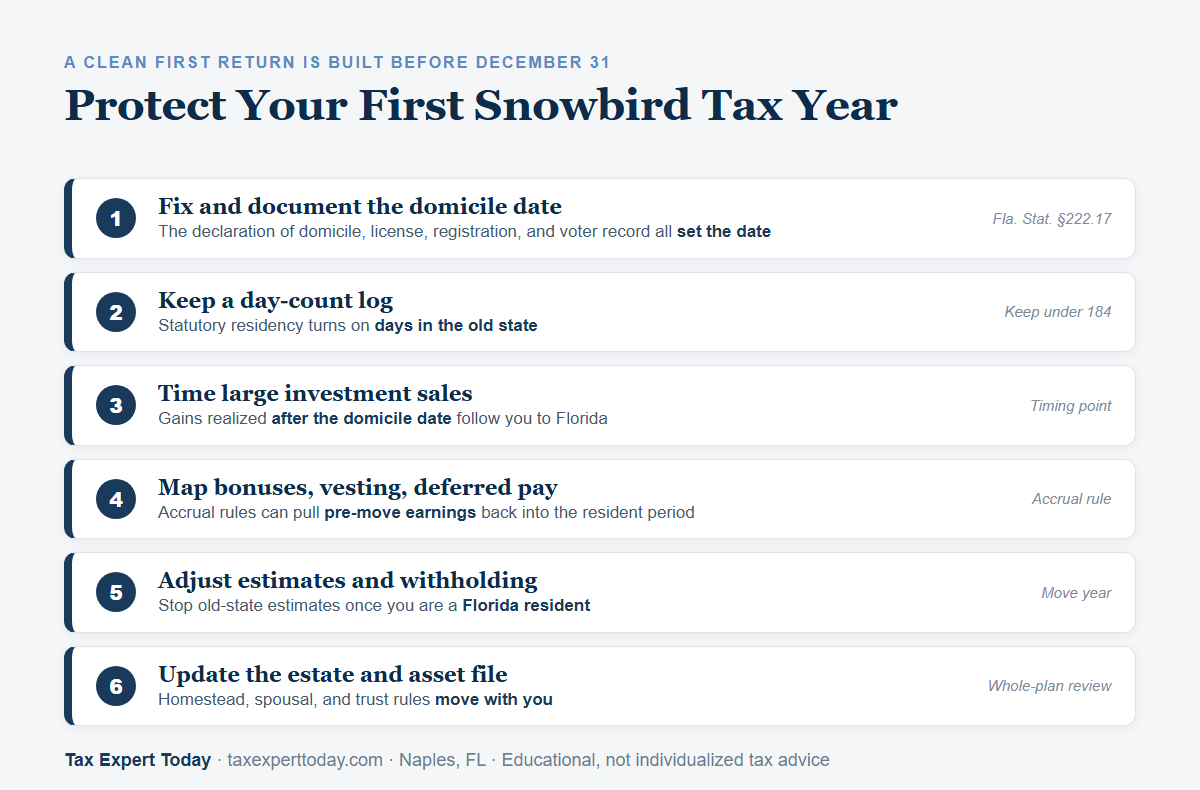
A clean first-year return is mostly built before December 31, not at filing time. The move date, the day count, and the timing of large income items are all easier to control in advance than to defend in hindsight. A short list of steps taken during the move year does most of the work, and it is where snowbird taxes are actually managed rather than merely reported.
| Step | Why it matters for the first return |
|---|---|
| Fix and document the domicile date | File the §222.17 declaration, change your license, registration, and voter record, and keep the dates. The domicile date splits the entire return. |
| Keep a day-count log | Statutory residency turns on days in the old state. A contemporaneous record is the evidence that keeps you under 184. |
| Time large investment sales | Gains on securities realized after the domicile date generally follow you to Florida. Closing a sale before the move can leave it taxable in the old state. |
| Map bonuses, vesting, and deferred pay | Accrual rules can pull pre-move earnings back into the resident period. Know which items are exposed before you file. |
| Adjust estimated payments and withholding | Stop old-state estimates once you are a Florida resident, and confirm employer withholding reflects the change to avoid overpaying the old state. |
| Update the estate and asset-protection file | The move also changes homestead, spousal, and trust rules. See our guides below so the whole plan moves together. |
The move is the trigger for the rest of the plan, not the end of it. The domicile evidence that supports your income tax position is the same evidence that supports your homestead protection and your estate plan, which is why they are best handled together. See our guides on Florida asset protection for new residents and Florida estate planning for new residents, and if a business sale is on the horizon, on moving to Florida before selling a business.
Snowbird Tax Help in Naples and Southwest Florida
Tax Expert Today LLC works with new and prospective Florida residents in Naples, Bonita Springs, Fort Myers, Marco Island, and across Southwest Florida on the first-year tax picture: fixing and documenting the domicile date, allocating income across the residency line, mapping bonuses and deferred pay against the accrual rules, and preparing the part-year return in the state you are leaving. The firm is multidisciplinary, with tax advisors, enrolled agents, CPAs, and attorneys, and advises clients in residency, tax, and planning matters nationwide.
The office is at 11983 Tamiami Trail N, Naples, FL 34110, and consultations can be arranged at (239) 441-2005, Monday through Friday, 10:00am to 5:00pm ET. You can also review our Naples tax planning and Florida tax services pages, or contact us directly.
Frequently Asked Questions
Do I file a Florida tax return in the year I move?
No. Florida imposes no personal income tax under Article VII, Section 5 of the Florida Constitution, so there is no Florida resident return and no part-year Florida return. In the year you move you file a part-year resident return in the state you left, reporting income received while you were a resident there plus income sourced to that state afterward. Your federal Form 1040 covers the full year and is unaffected by the move.
When does my Florida residency start for tax purposes?
Your Florida residency starts on the date your domicile changes, which is the date you are present in Florida and intend to make it your true, fixed, and permanent home while abandoning your old domicile. It is a facts-and-intent date, not the closing date on a home and not automatically January 1. Filing a declaration of domicile under Florida Statutes section 222.17, and changing your license, registration, and voter record, help fix and document that date.
Will my old state still tax income I receive after I move?
Sometimes. Income sourced to the old state, such as wages for work performed there, rent from property located there, or business income earned there, generally stays taxable in that state even after you move. Interest, dividends, and gains on securities generally follow your Florida domicile and fall out. Some states also apply an accrual rule that reaches back to tax compensation earned before the move, even when it is paid afterward. A small group of states goes further still and treats days you work from your Florida home as days worked in the old state under the convenience of the employer rule.
Can I be taxed as a full-year resident by my old state after moving to Florida?
Yes, if the state applies a statutory residency test and you meet it. States such as New York treat a person as a resident if they keep a permanent place of abode in the state and are present there for more than 183 days in the year, even after a genuine domicile change. In the year of the move the day count for the whole year still applies, so keeping a day log and limiting time in the old state matters.
Where can I get help with snowbird taxes in Naples, FL?
Tax Expert Today LLC, located at 11983 Tamiami Trail N, Naples, FL 34110, helps new and prospective Florida residents across Naples and Southwest Florida with the first-year tax picture, including the domicile date, income allocation across the residency line, accrual-rule exposure on bonuses and deferred pay, and the part-year return in the state you are leaving. The firm is multidisciplinary, with enrolled agents, CPAs, and attorneys. Consultations can be arranged at (239) 441-2005.
If the state you left was New York, the departure mechanics of that first year are set out in more detail in our guide to the New York exit tax.
When to Engage a Professional on Your First-Year Snowbird Return
The first return after a move rewards planning during the move year rather than a correction after it. The situations that most often justify professional help are a mid-year move with wages in two states, a large investment sale near the move date, a bonus or vesting event tied to prior service in a high-tax state, a northern home you intend to keep, and a state such as New York or California with an aggressive accrual or statutory residency rule. Any one of these can turn a return that looks simple into a two-state exposure the family did not expect.
Outcomes depend on individual facts, and nothing in this guide is a promise about how any particular return will be taxed. Tax Expert Today LLC prepares the part-year return and coordinates the domicile evidence, the income allocation, and the timing questions so the first year holds up. If you have moved to Florida this year, or you intend to before year end, a review before you file is the least expensive way to get snowbird taxes right in year one. Call (239) 441-2005 or contact us to arrange a consultation.
Published July 20, 2026 by Dr. Pellumb Kabashi « Back to Learning Center
Have a question this article touches on?
Tax Expert Today LLC, based in Naples, Florida and serving clients across the United States.
Schedule a Consultation (239) 441-2005