
By Dr. Pellumb Kabashi, DBA, MBA, CES, CFE, EA
Founder, Tax Expert Today LLC · Tax advisors, enrolled agents, CPAs, and attorneys · Serving clients in all 50 states
Quick Answer: The California late payment penalty under Revenue and Taxation Code section 19132 has two parts. Five percent of the unpaid tax applies at once, and then 0.5 percent of the remaining tax is added for each month it stays unpaid, for as many as 40 months. The two parts together cannot exceed 25 percent of the unpaid tax. Call (239) 441-2005 for a free consultation.
What Is the California Late Payment Penalty?
The California late payment penalty is the charge the Franchise Tax Board adds when you do not pay the full amount of tax you owe by the payment due date. Revenue and Taxation Code section 19132 imposes it. It is separate from interest, separate from the penalty for filing late, and it applies whether or not you filed your return on time.
- Statutory basis. R&TC section 19132, applied by the FTB as the underpayment and monthly penalty.
- What triggers it. Any amount of tax shown on the return that remains unpaid after the payment due date.
- What it is not. It is not the estimated tax penalty, which runs under a different section and a different formula.
- The statutory defense. The penalty applies unless the failure is shown to be due to reasonable cause and not due to willful neglect.
The penalty attaches to the payment obligation rather than the filing obligation. That distinction is the single most useful thing to understand about California penalties, because the two obligations behave differently in practice. California grants individuals an automatic extension of time to file, but it grants no extension of time to pay. A taxpayer who uses the automatic extension, files in October, and pays in October has avoided the filing penalty entirely and has still accrued the late payment penalty from April.
The penalty also reaches beyond the individual income tax. Section 19132 applies to the amounts required to be paid under sections 17941 and 23091, which are the annual tax provisions, and under sections 17948 and 23097. For a limited liability company, the FTB computes the penalty on the underpayment of the annual tax, the LLC fee, and the non-consenting nonresident tax where one applies. Our guide to the California LLC franchise tax covers how the annual tax and the fee are computed before any penalty is layered on top.
How Is the California Late Payment Penalty Calculated?
The penalty is built from two separate components that are added together. The first is a flat 5 percent of the total tax unpaid. The second is 0.5 percent of the remaining tax for each month or fraction of a month it stays unpaid, running for no more than 40 months. The aggregate cannot exceed 25 percent of the total unpaid tax.
- The underpayment component. Five percent of the total tax unpaid, charged once rather than monthly.
- The monthly component. Half a percent of the remaining tax per month or fraction of a month, limited to 40 months.
- The arithmetic of the ceiling. Forty months at 0.5 percent is 20 percent, which added to the initial 5 percent reaches the 25 percent ceiling exactly.
- A fraction of a month counts fully. A payment made on the second day of a month carries the same monthly charge as one made on the last day.
The two defined terms in the statute matter. Total tax unpaid means the tax shown on the return reduced by any part of the tax paid on or before the payment due date and by any credit claimed on the return. Remaining tax means that same figure reduced further by any payment made afterward. The practical effect is that the flat 5 percent is fixed at the moment of default, while the monthly 0.5 percent shrinks every time a payment is applied to the balance.
That structure rewards partial payment in a way many taxpayers do not expect. Paying half the balance does not reduce the 5 percent component at all, because that component was measured against the tax unpaid at the due date and does not recalculate. It does cut the monthly component roughly in half going forward, because the monthly charge is measured against remaining tax. A taxpayer who cannot pay in full but can pay something is still improving the arithmetic.
| Component | Rate | Measured against | Limit |
|---|---|---|---|
| Underpayment, charged once | 5 percent | Total tax unpaid at the payment due date | Not repeated |
| Monthly | 0.5 percent per month or fraction of a month | Remaining tax, reduced by later payments | 40 months maximum |
| Combined | Sum of both components | Total unpaid tax | 25 percent aggregate ceiling |
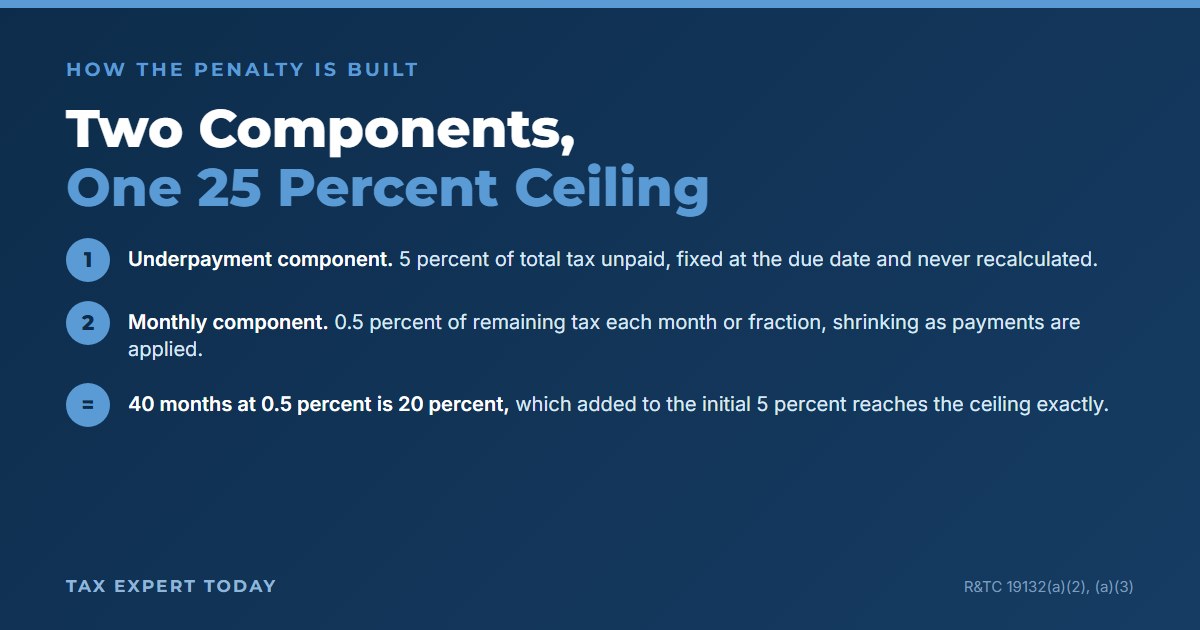
Consider a hypothetical balance of $10,000 that came due in April and received no payment at all until the statutory limit was reached. The initial component is 5 percent of $10,000, which is $500. The monthly component accrues at $50 a month and stops after 40 months, which is $2,000. The total is $2,500, or 25 percent of the balance, and the penalty stops growing at that point. Interest, as the sections below explain, does not stop.
What Is the Difference Between the Late Payment and Late Filing Penalty?
The late payment penalty under section 19132 charges you for not paying. The late filing penalty under section 19131 charges you for not filing, at 5 percent of the tax for each month the return is late, to a maximum of 25 percent. The filing penalty accrues far faster, which is why filing on time matters even when payment is impossible.
- Rate. The filing penalty runs at 5 percent per month. The payment penalty runs at 5 percent once, then 0.5 percent per month.
- Speed to the ceiling. The filing penalty reaches 25 percent in five months. The payment penalty needs 40 months.
- Minimum penalty. An individual or fiduciary more than 60 days late in filing faces a minimum of the lesser of $135 or 100 percent of the tax required to be shown.
- Fraud multiplier. Where a failure to file is fraudulent, section 19131 substitutes 15 percent per month and a 75 percent ceiling.
The gap between the two rates is the reason practitioners press clients to file even when the balance cannot be funded. The filing penalty is ten times the monthly rate of the payment penalty and reaches its ceiling eight times faster. A return filed on time with nothing attached to it stops the more expensive of the two penalties from ever starting.
The minimum penalty deserves a note, because the FTB describes it in a way that can confuse. The published guidance frames it as a $540 threshold, and the statute frames it as a floor. Both describe the same arithmetic. Twenty five percent of $540 is $135, so for any balance above $540 the ordinary percentage calculation already exceeds the floor and the floor never binds. Below $540 the floor takes over. A balance of $134 or less produces a penalty equal to 100 percent of the amount due, and a balance between $135 and $540 produces a penalty of $135.
| Feature | Late filing, R&TC 19131 | Late payment, R&TC 19132 |
|---|---|---|
| What triggers it | Return not filed by the due date as extended | Tax not paid by the payment due date |
| Rate | 5 percent per month or fraction | 5 percent once, plus 0.5 percent per month |
| Maximum | 25 percent of the tax | 25 percent of the unpaid tax |
| Months to reach the maximum | 5 | 40 |
| Minimum penalty | Lesser of $135 or 100 percent of tax, after 60 days | None specified |
| Fraud rate | 15 percent per month, 75 percent ceiling | Not applicable |
| Extension of time to file | Prevents the penalty if the return is filed within it | No effect, payment remains due in April |
Does California Stack the Filing and Payment Penalties Together?
No, and this is where California departs sharply from federal practice. Section 19132 subdivision (b) provides that the late payment penalty is not assessed at all when the filing penalties for the same taxable year equal or exceed it. Where the payment penalty is larger, only the excess over the filing penalties is assessed.
- The coordination runs one way. The payment penalty is reduced by the filing penalties, not the reverse.
- Which penalties count. The section 19131 failure to file penalty and the section 19133 demand penalty, for the same taxable year.
- Full absorption. If those filing penalties equal or exceed the payment penalty, the payment penalty is not assessed.
- Partial absorption. If the payment penalty is larger, the assessed amount is only the portion that exceeds the filing penalties.
Federal law coordinates its two timeliness penalties in the opposite direction. Under Internal Revenue Code section 6651, the failure to file penalty is reduced by the failure to pay penalty for any month in which both apply. California instead reduces the failure to pay penalty by the failure to file penalty. The taxpayer-facing result is similar in that the two are not simply added, but the mechanics are different, and a practitioner reading a California notice with federal habits will misread which line absorbed which.
Three hypothetical scenarios on the same $10,000 balance show how the rule operates in each of its modes.
| Scenario | Filing penalty, 19131 | Payment penalty before coordination | Payment penalty assessed | Total |
|---|---|---|---|---|
| Filed 5 months late, paid 5 months late | $2,500 at the 25 percent ceiling | $750 | $0, fully absorbed | $2,500 |
| Filed on time, paid 40 months late | $0 | $2,500 | $2,500, nothing to absorb it | $2,500 |
| Filed 1 month late, paid 40 months late | $500 | $2,500 | $2,000, the excess over $500 | $2,500 |
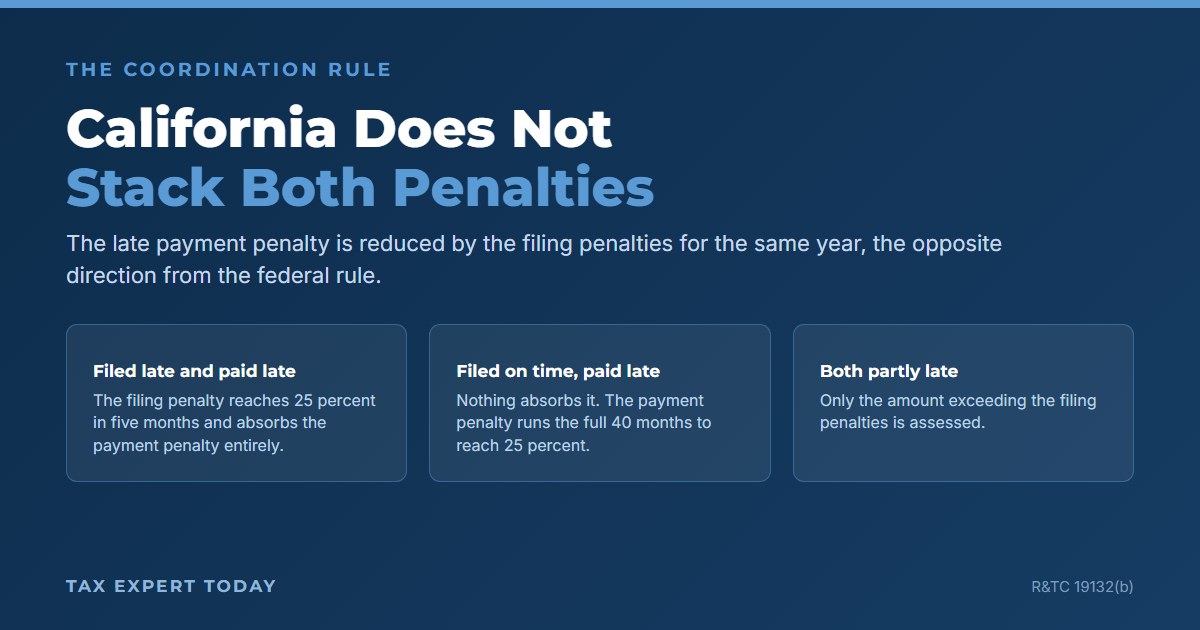
The pattern in the right hand column is worth pausing on. In all three scenarios the combined timeliness penalty lands at $2,500, which is 25 percent of the balance. The coordination rule does not change the destination when a balance goes fully delinquent. What it changes is the speed of arrival. The first scenario reaches $2,500 in five months. The second and third take more than three years. For a taxpayer who intends to resolve the balance within a year or two, filing on time is worth a great deal of money even though the ceiling is identical.
How Much Interest Does the FTB Charge on a Late Payment?
Interest is charged at the adjusted annual rate set under Revenue and Taxation Code section 19521, and it is compounded daily. For the period July 1, 2026 through December 31, 2026, the rate on personal income tax underpayments is 7 percent. Interest is not a penalty and is generally not abatable on hardship or reasonable cause grounds.
- Current rate. Seven percent for personal income tax under and overpayments from July 1, 2026 through December 31, 2026.
- Compounding. Daily, under section 19521 subdivision (b), which is why a balance grows faster than a simple annual rate suggests.
- Reset frequency. Twice per taxable year, effective each January 1 and each July 1.
- Symmetry for individuals. California modifies the federal rule so that the overpayment rate for a noncorporate taxpayer equals the underpayment rate.
The rate is derived from Internal Revenue Code section 6621, with California modifications, and the timing mechanism is unusual enough to be worth stating plainly. Section 19521 provides that the rate determined for January applies during the following July through December, and the rate determined for July applies during the following January through June. There is a deliberate six month lag between the determination and the period it governs. A taxpayer watching federal rate announcements will see California follow roughly half a year later rather than immediately.
| Period | Personal income tax under and overpayments | Corporation overpayments |
|---|---|---|
| 07/01/2026 through 12/31/2026 | 7 percent | 4 percent |
| 07/01/2025 through 06/30/2026 | 7 percent | 4 percent |
| 01/01/2025 through 06/30/2025 | 8 percent | 5 percent |
| 07/01/2024 through 12/31/2024 | 8 percent | 5 percent |
| 01/01/2024 through 06/30/2024 | 7 percent | 5 percent |
Because the rate resets twice a year and compounds daily, a balance carried across several periods does not accrue at a single blended rate. Each segment of the balance accrues at the rate in effect for the days it was outstanding. This is the reason FTB interest figures rarely match a taxpayer estimate built on one annual percentage, and the reason a notice should be checked against the period table rather than assumed correct.
Does Interest Accrue on the Penalty Itself?
Partly. Interest runs on the tax and on most penalties, but section 19132 subdivision (f) states that no interest accrues on the monthly 0.5 percent component of the late payment penalty. The initial 5 percent component and the section 19131 filing penalty do carry interest.
- Exempt from interest. The 0.5 percent per month component described in section 19132 subdivision (a)(2)(B).
- Carries interest. The 5 percent underpayment component of the same penalty.
- Carries interest. The section 19131 late filing penalty, including the minimum penalty.
- Carries interest. The underlying tax, from the original payment due date forward.
This is a small provision with a real consequence on an aged account. On a balance that has been outstanding for several years, the monthly component can represent the larger share of the penalty, and that share sits in the account without generating further interest. A taxpayer reviewing a long standing FTB balance who assumes every dollar of penalty is compounding is overstating the projected figure. The distinction is also a useful check on the accuracy of a notice, because a computation that applies interest to the whole penalty has applied it to something the statute exempts.
What Is the California One-Time Penalty Abatement?
The One-Time Penalty Abatement is a once in a lifetime cancellation of a California timeliness penalty, created by Assembly Bill 194 and codified at Revenue and Taxation Code section 19132.5. It is available to individual taxpayers for a single taxable year, it covers the late filing and late payment penalties, and it does not require any showing of reasonable cause.
- Once in a lifetime. A taxpayer who has already been granted abatement under section 19132.5 cannot receive it again.
- Individuals only. It applies to individuals subject to the Personal Income Tax Law, and not to fiduciaries, estates, or trusts.
- Which penalties. The section 19131 failure to file penalty and the section 19132 failure to pay penalty, for one taxable year.
- Years covered. Taxable years beginning on or after January 1, 2022.
- No excuse required. Unlike reasonable cause relief, it asks for no explanation of why the failure occurred.
Three conditions must be satisfied at the time of the request. The taxpayer must have filed all returns required under Part 10 of the Revenue and Taxation Code. The taxpayer must not have previously been granted abatement under this section. And, excluding the timeliness penalty that is the subject of the request, the taxpayer must have paid in full any tax, penalties, fees, and interest due for those required returns, or must have arranged to pay under an installment agreement and be current on the installment payments.
The FTB accepts the request three ways. It can be made verbally by calling 800-689-4776. It can be made through a MyFTB account using authenticated chat or a secure message. Or it can be made on Form 2918, One-Time Penalty Abatement, Individual, mailed or uploaded through MyFTB. Where the balance including the penalty has already been paid in full, the request needs to travel as a written statement or a Form 2918 on the claim for refund track rather than as a simple phone request.
How Does California One-Time Abatement Differ From Federal Relief?
The two programs share a name and almost nothing else. Federal First Time Abate is an administrative waiver keyed to a three year clean compliance history, and a taxpayer can qualify for it repeatedly across a lifetime. California relief is statutory, requires no clean history, and can be used exactly once.
- Frequency. Federal relief may be earned again after a clean period. California relief is available one time only.
- Prior compliance. Federal relief looks back three years for penalties. California looks only at whether returns are filed and balances are current now.
- Authority. Federal relief is administrative. California relief is written into statute at section 19132.5.
- Entities. Federal relief reaches business filers. California relief is limited to individuals.
The federal side is in transition as of this year, which matters for anyone comparing the two. The IRS has announced that First Time Abate is being replaced by Automatic Exemption from Penalty, beginning in summer 2026. Under that program, a taxpayer who files or pays late but has timely filed and paid for the three prior years is simply not assessed the penalty, with no request required, applied when the original return finishes processing. It covers the Form 1040, 1065, and 1120 series among others, starting with 2025 tax year returns.
The direction of travel is therefore opposite on the two sides. Federal timeliness relief is becoming automatic and effectively renewable through good compliance. California relief remains a manual election that a taxpayer spends once and cannot recover. Our guide to first-time penalty abatement covers the federal mechanism in detail.
| Feature | California, R&TC 19132.5 | Federal, First Time Abate and its successor |
|---|---|---|
| How many times | Once in a lifetime | Repeatable when the compliance history is clean |
| Compliance lookback | None required | Three prior years of timely filing and payment |
| Who qualifies | Individuals only, no fiduciaries, estates, or trusts | Individuals and business filers |
| Penalties covered | Failure to file and failure to pay | Failure to file, failure to pay, and failure to deposit |
| How it is obtained | Request by phone, MyFTB, or Form 2918 | Request under First Time Abate, or automatically under the successor program |
| Earliest year reached | Taxable years beginning on or after January 1, 2022 | Successor program begins with 2025 returns |
Should You Request Reasonable Cause or One-Time Abatement First?
Reasonable cause should generally be attempted first where any credible facts exist. Section 19132.5 provides that a timeliness penalty abated for reasonable cause is treated as never having been imposed for purposes of eligibility, so winning on reasonable cause preserves the one-time abatement for a future year.
- Reasonable cause does not consume the one-time relief. A penalty abated on that ground is treated as not imposed under section 19132.5 subdivision (d)(1).
- The order is preserved either way. The statute permits a one-time request after a reasonable cause request has been considered and rejected.
- The spouse rule. That treatment extends to a penalty abated for reasonable cause with respect to the taxpayer or the taxpayer spouse.
- Timing of imposition. A timeliness penalty is considered imposed on the original due date of the return for the year in question.
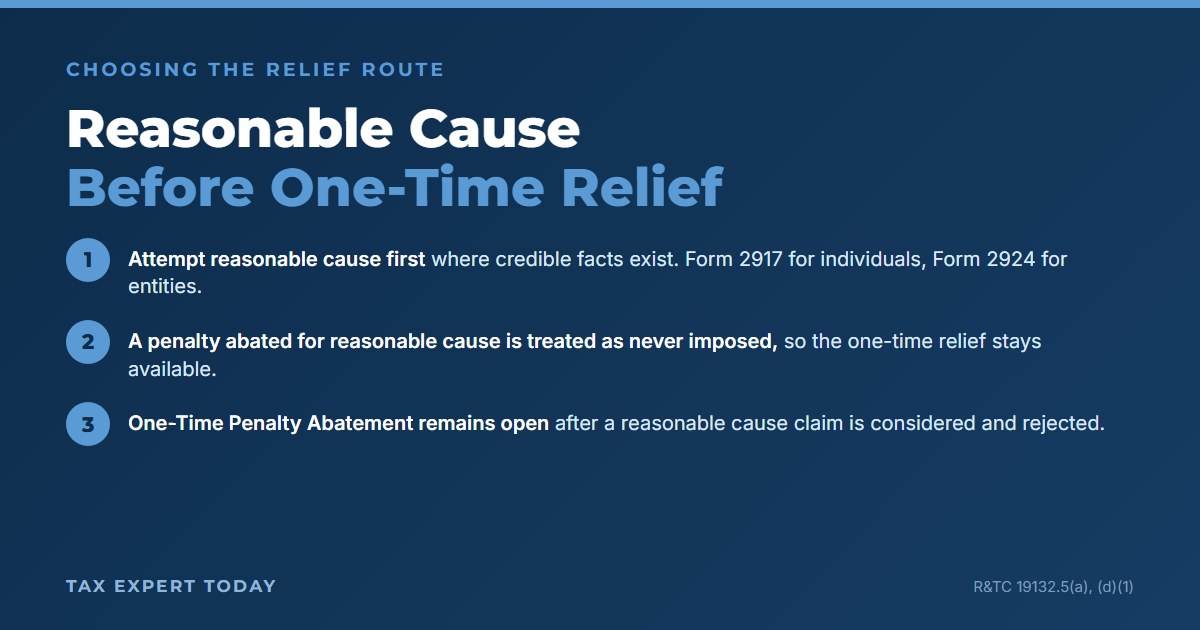
The sequencing point is easy to miss and expensive to get wrong. A taxpayer with a genuine reasonable cause narrative, such as a serious illness or a records loss, who reaches instead for the simpler one-time request has spent a once in a lifetime asset on a year that could have been resolved another way. The statute expressly contemplates the better order by allowing the one-time request to follow a rejected reasonable cause claim, which means attempting reasonable cause first costs the taxpayer the wait but not the option.
Reasonable cause claims travel on their own forms. Individuals and fiduciaries use Form 2917, Reasonable Cause, Individual and Fiduciary Claim for Refund, and business entities use Form 2924, Reasonable Cause, Business Entity Claim for Refund. Because those are claims for refund, the FTB position is that the penalty needs to be paid before the claim is considered, which is a meaningful difference from the one-time route where an installment agreement in good standing is sufficient.
Where multiple years carry penalties, the choice of which year receives the one-time abatement is a planning decision rather than an administrative one. The relief cancels the timeliness penalty for a single taxable year, so it is generally worth the most on the year with the largest combined section 19131 and section 19132 exposure, provided the eligibility conditions can be met at the time of the request.
What Other California Penalties and Fees Attach to a Late Balance?
A delinquent California balance rarely carries only one penalty. The demand penalty, the collection cost recovery fee, the filing enforcement fee, the dishonored payment penalty, and the mandatory electronic payment penalty can all attach, each under its own Revenue and Taxation Code section and each on its own trigger.
- Demand penalty. Twenty five percent of the tax under section 19133, applied regardless of payments or credits made on time.
- Collection cost recovery fee. Charged under section 19254 when involuntary collection action becomes necessary.
- Filing enforcement fee. Charged under section 19254 when a taxpayer fails to file after a legal demand to file.
- Mandatory electronic payment penalty. One percent for individuals under section 19011.5, and 10 percent for businesses under section 19011.
The demand penalty deserves emphasis because it is the harshest of the group and the least understood. Section 19133 applies when a taxpayer fails or refuses to furnish information requested in writing, or fails to file after a formal notice and demand. It is a flat 25 percent of the tax determined under section 19087 or of the deficiency assessed. Unlike the ordinary filing penalty, it does not build up month by month and it is not reduced by payments or credits that were made on time. Ignoring a Demand for Tax Return letter can therefore produce a 25 percent penalty on a year where a refund would otherwise have been due.
The fee amounts are set by legislation and change from year to year, so a figure carried forward from an older article is often stale. The amounts below are the ones the FTB publishes as current.
| Penalty or fee | Amount | Authority |
|---|---|---|
| Demand penalty | 25 percent of the tax determined or deficiency assessed | R&TC 19133 |
| Collection cost recovery fee, individuals and partnerships | $362, for 07/01/26 to current | R&TC 19254 |
| Collection cost recovery fee, corporations | $292, for 07/01/26 to current | R&TC 19254 |
| Filing enforcement fee, individuals and other businesses | $143 | R&TC 19254 |
| Filing enforcement fee, corporations | $122 | R&TC 19254 |
| Dishonored payment, $1,250 or more | 2 percent of the payment | R&TC 19134 |
| Dishonored payment, under $1,250 | $25 or the payment amount, whichever is less | R&TC 19134 |
| Federal treasury offset fee | $23.64 | Government Code 16583.1 |
Two of these sit outside the scope of this guide but are worth naming so they are not confused with the late payment penalty. The estimated tax penalty under section 19136 is computed by multiplying the days late by the effective interest rate for the installment period, which makes it function much more like interest than like a penalty. Our California estimated tax penalty calculator covers that computation and the FTB 5805 mechanics. The LLC fee underpayment penalty under section 17942 is a flat 10 percent of the underpaid fee.
What Happens to California Penalties After You Move Out of State?
Moving does not end the liability and does not stop the penalty. The Franchise Tax Board retains authority over any year in which you were a California resident or received California source income, and the section 19132 penalty continues to accrue on that balance no matter where you now live.
- The year is fixed, not the address. Penalties attach to the taxable year in question, and a later change of residence does not reach back into it.
- Nonresident returns carry the same penalties. A Form 540NR filed late or paid late is subject to sections 19131 and 19132 exactly as a Form 540 would be.
- Collection crosses state lines. FTB tools include liens under section 19221 and offsets through the federal Treasury Offset Program.
- The compliance condition is the usual obstacle. One-Time Penalty Abatement requires that every required California return has been filed.
That last point is where former Californians most often lose access to relief they would otherwise qualify for. The abatement conditions look at the present, not the past. A taxpayer who left in 2023 with one late year behind them may still owe California returns for later years without realizing it, because California source income does not stop at the state line. Rental income from a retained property, stock compensation attributable to California workdays, and payments subject to nonresident withholding all continue to create a filing obligation on a nonresident return. A retained California home carries the same point forward, because the California capital gains tax on a home sale reaches a former resident on the California source gain.
The sequence that follows is unfortunate and common. The taxpayer requests abatement for the late year, the FTB reviews the account, and the request fails because a later year is unfiled rather than because the late year lacked merit. The fix is to bring the later years current first and then make the request, which costs time but does not cost the once in a lifetime relief. Our guides to the California part-year resident return and to California nonresident withholding explain which post-move years still require a filing.
Withholding credits are worth checking before conceding the balance. Where a California payer has been withholding 7 percent on payments to a nonresident, those amounts are credits against the California tax for the year. A balance that appears delinquent sometimes shrinks materially once the Form 592-B credits are claimed, and because both penalty components are measured against unpaid tax, a reduction in the tax reduces the penalty proportionally. Taxpayers who moved during the year should also confirm the residency period allocation on the return itself, since an incorrect allocation inflates the tax the penalty is calculated on. See our guides to leaving California taxes and the California residency audit for how the FTB tests a departure.
Does an Extension to File Stop the Late Payment Penalty?
No. An extension extends the time to file a return and never extends the time to pay the tax. California individuals receive an automatic extension to file, and a taxpayer who uses it without paying by the original April due date will owe the section 19132 penalty and interest from that April date forward.
- What the extension does. It prevents the section 19131 late filing penalty when the return arrives within the extended period.
- What it does not do. It has no effect at all on the payment due date or on the section 19132 penalty.
- Interest runs regardless. Interest accrues from the original due date of the return, not from the extended date.
- Pay with the extension. A payment made by the original due date, even an estimate of the eventual liability, limits both the penalty and the interest.
The FTB states the position directly in its guidance on penalties and fees, noting that an extension to file extends the filing due date and not the payment due date. Taxpayers who receive a penalty in this situation are frequently surprised, because the extension felt like permission. It is worth restating for anyone approaching an October deadline that paying an estimated amount in April and filing accurately in October produces a better result than filing and paying together in October.
How Do You Request Abatement or Dispute a California Penalty?
The route depends on the relief sought. A one-time abatement can be requested by phone, through MyFTB, or on Form 2918. A reasonable cause claim travels on Form 2917 for individuals or Form 2924 for business entities. A disagreement about whether the penalty is correct at all is handled through the options printed on the notice.
- One-time abatement. Call 800-689-4776, use MyFTB authenticated chat or secure message, or file Form 2918.
- Reasonable cause, individuals and fiduciaries. Form 2917, filed as a claim for refund.
- Reasonable cause, business entities. Form 2924, filed as a claim for refund.
- Disputing the penalty itself. Follow the options listed on the FTB letter, and supply a copy of the letter with supporting documents.
The practical difference between the routes is the payment posture each one requires. A reasonable cause claim is a claim for refund, and the FTB expects the amount to be paid in full before the claim is considered. The one-time abatement route accepts either payment in full of everything other than the timeliness penalty at issue, or an installment agreement that the taxpayer is current on. For a taxpayer who cannot clear the balance, that difference frequently decides which route is actually available this year, independent of which one has the better facts. Where the balance cannot realistically be paid at all, the separate FTB offer in compromise program is the California route for a reduced amount, and it requires agreement with the liability first.
A representative can make the one-time request on a client behalf through the same telephone line by selecting the power of attorney option and entering the client taxpayer identification number, which requires a valid authorization already on file. Our guide to the FTB power of attorney covers the declaration the agency requires. Where the balance including the penalty has already been paid, the request must be made in writing or on Form 2918 and processed on the claim for refund track rather than resolved on the call.
California Late Payment Penalty Help Naples and Southwest Florida
California late payment penalty help Naples clients ask for usually arrives in the same shape. A move to Southwest Florida is complete, the California file was believed closed, and then an FTB notice appears for a year that was filed late or funded late during the transition. Our office in Naples, Florida works the penalty question and the residency question together, because the amount of tax the penalty is calculated on depends on the residency period allocation, and because eligibility for the one-time abatement depends on whether every post-move California return has actually been filed.
Tax Expert Today LLC
11983 Tamiami Trail N, Naples, FL 34110
Phone: (239) 441-2005
Hours: Monday through Friday, 10:00 to 5:00 ET
I left California two years ago and just received an FTB penalty notice for my final resident year. Is it too late to do anything? Usually not. Two questions come first. Whether the tax the penalty is computed on is correct, which depends on the residency period allocation and on any withholding credits that were never claimed, and whether the one-time abatement under section 19132.5 is still available to you and whether this is the right year to spend it on. Both questions need the notice and the returns rather than a general rule, and where a reasonable cause narrative exists it is generally worth attempting first so that the one-time relief stays available. Our California tax services page and our Naples tax planning page describe how we handle both ends of the corridor.
When to Engage a Professional
A California late payment penalty is worth professional review when the amount is material or the facts are mixed. Consider engaging an advisor when penalties are running on more than one taxable year and the one-time abatement has to be allocated to the right one, when a reasonable cause narrative exists and should be attempted before the one-time request is spent, when a Demand for Tax Return letter has been received and the section 19133 penalty is in play, when the penalty year is also the year of a move and the residency allocation drives the tax figure, or when an installment agreement needs to be in place before an abatement request can be made. Outcomes depend on the specific facts, and the analysis generally requires the notices and the filed returns rather than a general rule. A balance carrying these additions can still be paid over time, and our guide to the FTB installment agreement covers the conditions under which California must accept one.
Related reading on the corridor includes our complete guide to moving from California to Florida, the California exit tax question, and on the Florida side, how to establish Florida residency and our Florida 183 day rule calculator.
This article is educational and general in nature. It does not constitute tax advice for any particular taxpayer, and outcomes depend on individual facts and circumstances.
Published August 20, 2026 by Dr. Pellumb Kabashi « Back to Learning Center
Have a question this article touches on?
Tax Expert Today LLC, based in Naples, Florida and serving clients across the United States.
Schedule a Consultation (239) 441-2005