
By Dr. Pellumb Kabashi, DBA, MBA, CES, CFE, EA
Founder, Tax Expert Today LLC · Tax advisors, enrolled agents, CPAs, and attorneys · Serving clients in all 50 states
A quarterly estimated tax calculator answers the question every freelancer, business owner, investor, and retiree with untaxed income faces four times a year: how much should I actually send the IRS? The answer is a formula, not a guess. This free 2026 calculator applies the safe harbor rules, the $1,000 threshold, and your withholding to produce a per quarter payment schedule, and the guide below explains every rule behind it.
Quick Answer: For 2026, pay the smaller of 90 percent of your expected 2026 tax or 100 percent of your 2025 tax (110 percent if your 2025 adjusted gross income exceeded $150,000), spread across four due dates: April 15, June 15, and September 15 of 2026, and January 15 of 2027. Withholding counts toward the target first, and if your balance due after withholding is under $1,000, no estimated payments are required.
How Does This Quarterly Estimated Tax Calculator Work?
Enter your expected 2026 total federal tax, your expected 2026 withholding, and your 2025 total tax. The calculator selects your cheapest safe harbor under IRC Section 6654, credits your withholding against it, applies the $1,000 threshold, and splits the remainder across the four 2026 due dates.
Quarterly Estimated Tax Calculator (2026)
Find your safe harbor target and what to pay each quarter, after credit for withholding.
Planning estimate only. The safe harbor protects against the underpayment penalty; it does not change the tax you ultimately owe with your return. Each installment is technically due as of its date, so payments started late in the year may not cure earlier quarters. Your exact requirement depends on your complete facts.
Ask a tax expert to set your safe harbor plan → Call (239) 441-2005What Are Quarterly Estimated Taxes?
Quarterly estimated taxes are prepayments of income tax on earnings that have no withholding: self-employment profit, business income, capital gains, dividends, interest, rental income, and many retirement distributions. The federal tax system is pay as you go under IRC Section 6654, so tax is due as income arrives, not once a year in April.
Employees satisfy the requirement invisibly, because every paycheck carries withholding. Everyone else satisfies it with four payments a year using Form 1040-ES or an electronic payment. The payments are credited against the tax computed on the 2026 return you file in early 2027; estimated taxes change when you pay, never how much you ultimately owe.
Who Must Make Estimated Tax Payments in 2026?
You generally must make estimated payments for 2026 if you expect to owe at least $1,000 after subtracting withholding and refundable credits, and your withholding will not reach a safe harbor. The rule reaches freelancers and gig workers, business owners, landlords, investors with meaningful gains, and retirees whose IRA or pension withholding runs light. See the IRS estimated taxes overview.
Two groups get softer treatment. If you had no tax liability at all for 2025, were a U.S. citizen or resident the full year, and your 2025 return covered twelve months, the penalty generally does not apply for 2026. Farmers and fishermen who earn at least two-thirds of gross income from those activities use a single January payment and a 66 and two-thirds percent threshold under the special rules in Publication 505.
What Are the Safe Harbor Rules for 2026?
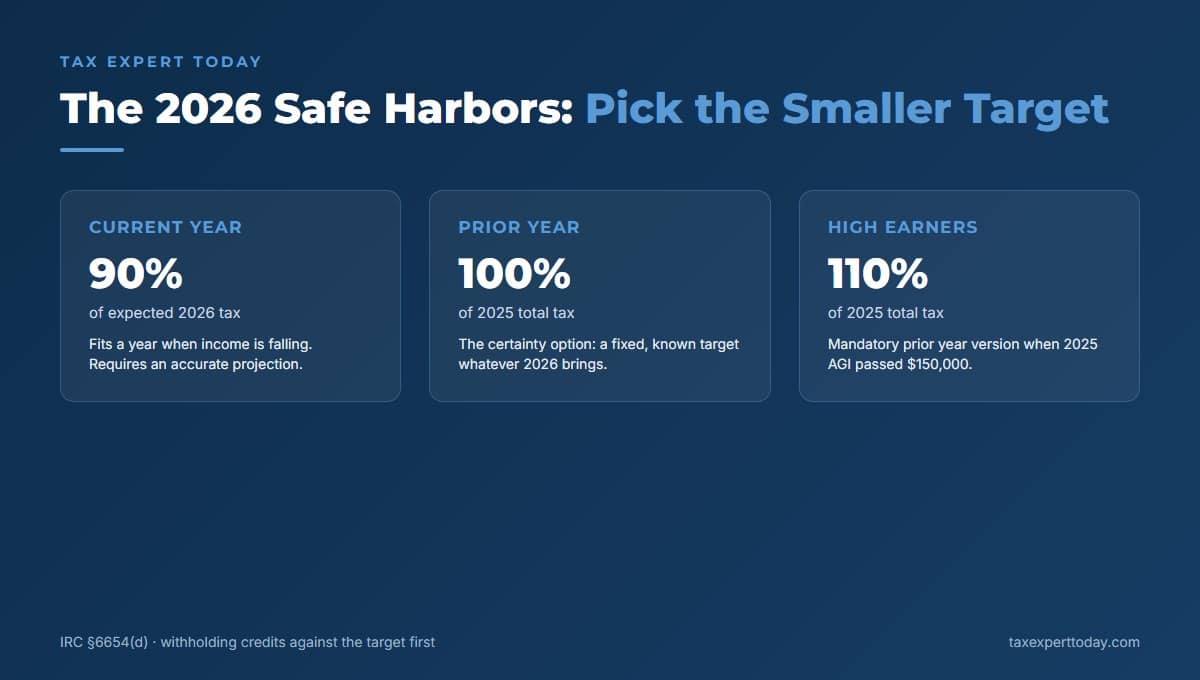
The safe harbors define how much you must prepay to be penalty-proof regardless of what your final 2026 return shows. Pay the smaller of 90 percent of your 2026 tax or 100 percent of your 2025 tax, with the prior year number rising to 110 percent when 2025 adjusted gross income exceeded $150,000 ($75,000 married filing separately).
| Safe harbor | Who it fits | The catch |
|---|---|---|
| 90% of current year (2026) tax | Income falling versus last year | Requires an accurate 2026 projection all year |
| 100% of prior year (2025) tax | Income steady or rising; certainty seekers | A big 2026 still leaves a balance due in April, just no penalty |
| 110% of prior year tax | Mandatory version of the prior year harbor when 2025 AGI exceeded $150,000 | The 100 percent option is not available at that income level |
The prior year harbor is the planning workhorse because it turns an unpredictable year into a fixed, known target. A business owner expecting a windfall in 2026 can pay 110 percent of the 2025 tax on schedule, invest the difference all year, and settle the remainder penalty-free with the April return.
When Are the 2026 Estimated Tax Due Dates?
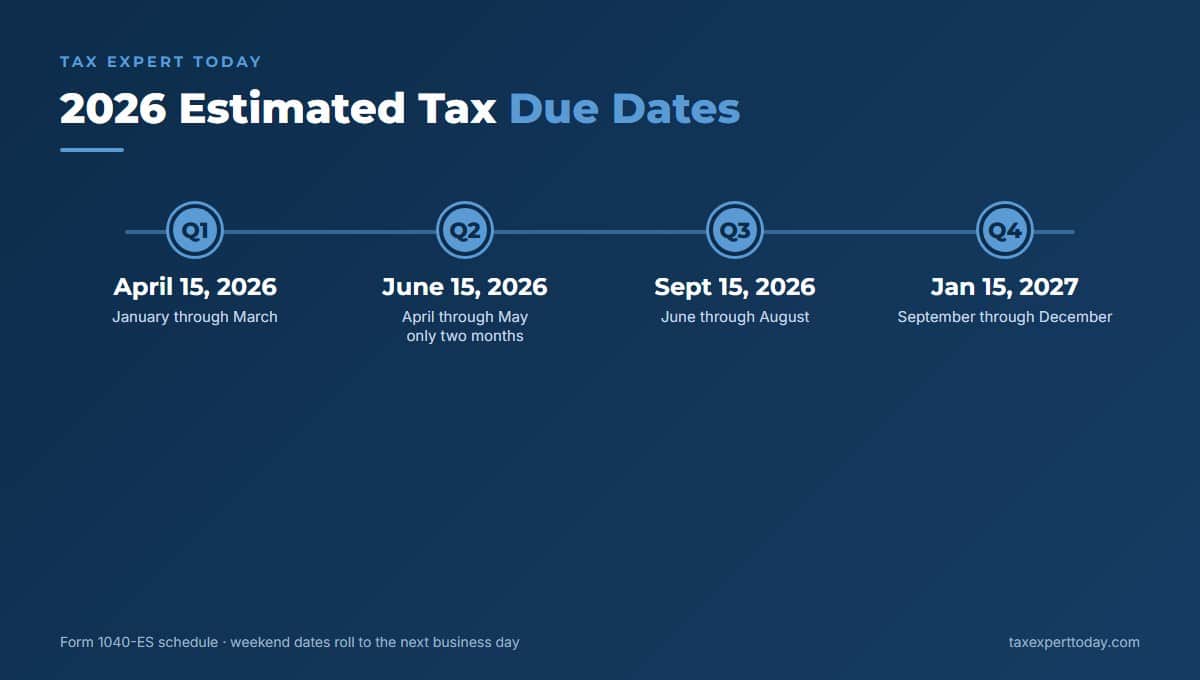
The 2026 installments are due April 15, June 15, and September 15 of 2026, with the fourth installment due January 15, 2027. The periods are not equal calendar quarters, and the two-month second period surprises nearly every first-year filer.
| Installment | Income period covered | Due date |
|---|---|---|
| First | January through March 2026 | April 15, 2026 |
| Second | April through May 2026 | June 15, 2026 |
| Third | June through August 2026 | September 15, 2026 |
| Fourth | September through December 2026 | January 15, 2027 |
When a due date falls on a weekend or federal holiday it moves to the next business day; all four dates above fall on business days. Filing your 2026 return and paying in full by early February 2027 can substitute for the January installment, a timing move covered in Publication 505.
What Is a Worked Example of the 2026 Computation?
Consider a hypothetical consultant who expects $48,000 of total federal tax for 2026, had $36,000 of total tax on the 2025 return with AGI above $150,000, and expects $12,000 of withholding from a spouse’s paycheck. The computation runs like this:
| Step | Computation | Amount |
|---|---|---|
| 90 percent of 2026 tax | $48,000 × 90% | $43,200 |
| Prior year harbor | $36,000 × 110% | $39,600 |
| Safe harbor target | Smaller of the two | $39,600 |
| Less withholding | $39,600 − $12,000 | $27,600 |
| Per quarter | $27,600 ÷ 4 | $6,900 |
Four payments of $6,900 on the schedule above make this taxpayer penalty-proof for 2026, even though the April 2027 return will still show roughly $8,400 due ($48,000 less $39,600 prepaid). The figures illustrate the mechanism; your own numbers depend on your complete facts.
How Do You Pay Estimated Taxes?
The fastest route is IRS Direct Pay, which pulls from a bank account free of charge; select Estimated Tax as the reason and 1040-ES as the form. EFTPS suits taxpayers who want to schedule all four payments in advance, and the paper Form 1040-ES vouchers still work by mail.
Whichever channel you use, designate the correct tax year and installment, and keep the confirmation. Misapplied payments are a recurring source of IRS notices, and the confirmation number resolves them in minutes rather than months. An IRS Online Account also shows every estimated payment the IRS has credited, which is worth checking before filing.
What Happens If You Skip a Quarter?
Each installment is due on its own date, and IRC Section 6654 charges interest style penalties per quarter at the federal short term rate plus three points, currently 7 percent for the quarter beginning October 1, 2026. Catching up in December stops the accrual going forward but does not erase the charge that already ran on the missed quarters.
One rescue exists late in the year: withholding is treated as paid evenly across all four quarters no matter when it actually happens, so increasing withholding on a December paycheck, bonus, or IRA distribution can retroactively cure earlier shortfalls in a way a December estimated payment cannot. To see what a shortfall actually costs, run our IRS underpayment penalty calculator, or the California estimated tax penalty calculator and Georgia estimated tax penalty calculator if you owe a state layer too, which applies the Form 2210 math to your numbers.
What If Your Income Is Uneven During the Year?
The default schedule assumes income arrives evenly, which punishes seasonal businesses, commission earners, and anyone with a large fourth quarter capital gain. The annualized income installment method in Publication 505 recomputes each installment on income actually received to date, so the payments track the cash.
The method is computed on Schedule AI of Form 2210 with the return, and it requires period by period income records, so decide early in the year if it fits. Self-employed taxpayers should also remember that estimated payments must cover self-employment tax, not just income tax; our self-employment tax calculator computes that 15.3 percent layer, and the total feeds the expected tax input above.
How Do S Corporation Owners and Retirees Handle Estimated Taxes?
S corporation owners often need smaller estimated payments than sole proprietors with the same profit, because the salary the corporation pays them already carries withholding. The pass-through profit on the K-1 still needs coverage, and a common design is to set salary withholding high enough to reach the prior year safe harbor on its own, which eliminates the quarterly payment chore entirely.
Retirees have the same lever in a different form. Withholding on IRA distributions, pensions, and Social Security can be dialed to cover the year’s expected tax, and because withholding counts as paid evenly across all four quarters, a single well-sized withholding election late in the year can stand in for every missed installment. That makes the IRA withholding election one of the most forgiving tools in the estimated tax system, and one of the most underused.
Estimated Tax Help in Naples and Southwest Florida
Tax Expert Today builds safe harbor payment plans for business owners, retirees, and investors across Naples, Bonita Springs, Estero, Fort Myers, and Marco Island, and for clients in all 50 states. Southwest Florida’s mix of seasonal businesses, new residents with big income shifts, and retirees managing IRA distributions makes estimated tax planning a year-round conversation here.
Visit us at 11983 Tamiami Trail N, Naples, FL 34110, call (239) 441-2005, Monday through Friday, 10am to 5pm Eastern.
Does Florida require state estimated tax payments?
No. Florida has no personal income tax, so individuals make only the federal payments. New Florida residents who still have income sourced to a prior state, such as a business or rental there, may owe that state’s estimated payments in the transition years.
When to Engage a Professional
A calculator sets the safe harbor when the inputs are known. It cannot project your 2026 tax through an entity sale, a new S corporation, a large Roth conversion, or a move between states, and it cannot decide whether the annualized method, a withholding adjustment, or a bigger January payment is the cheapest fix for a year already in motion. Those calls depend on your complete facts.
Tax Expert Today can project the year, set the payment plan, and adjust it as the year develops. Call (239) 441-2005 or schedule a consultation here. Tax advisors, enrolled agents, CPAs, and attorneys serving clients in all 50 states as part of a broader tax planning engagement.
Frequently Asked Questions
What happens if I overpay my estimated taxes?
Nothing is lost. Overpayments come back as a refund with the 2026 return, or you can apply them forward to the 2027 first quarter installment. The cost is opportunity, not penalty: money parked with the IRS earns you nothing, which is why the safe harbor target, not a rough overshoot, is the efficient number.
Do I need to make estimated payments in my first year of self-employment?
Usually yes, once expected tax after withholding reaches $1,000. If last year you were an employee with a filed return, the prior year safe harbor still works: pay 100 percent of last year’s total tax (110 percent above $150,000 AGI) across the four dates and the penalty does not apply, whatever the first year earns.
Can I just make one big payment in January instead of four?
No. Each installment is due on its own date, so a single January payment leaves the first three quarters underpaid and accruing the penalty. The one exception is withholding, which counts as paid evenly through the year regardless of timing.
Do estimated payments cover self-employment tax too?
Yes. Estimated payments must cover your total expected liability, including the 15.3 percent self-employment tax layer and the Additional Medicare Tax where they apply, not just income tax. Underestimating that layer is the most common reason first-year freelancers undershoot the safe harbor.
This article and calculator are for educational purposes only and do not constitute legal, tax, or accounting advice. Safe harbor percentages and thresholds reflect IRC Section 6654 as in effect for tax year 2026 and are subject to change. Every situation is different; consult a qualified professional before acting on any information presented here.
Published July 13, 2026 by Dr. Pellumb Kabashi « Back to Learning Center
Have a question this article touches on?
Tax Expert Today LLC, based in Naples, Florida and serving clients across the United States.
Schedule a Consultation (239) 441-2005