
By Dr. Pellumb Kabashi, DBA, MBA, CES, CFE, EA
Founder, Tax Expert Today LLC · Tax advisors, enrolled agents, CPAs, and attorneys · Serving clients in all 50 states
Quick Answer: California nonresident withholding is a 7 percent prepayment that a payer takes out of California source payments to a person or business outside the state, once the calendar year total passes $1,500. Revenue and Taxation Code section 18662 authorizes it. It is not an extra tax. It is a credit reported on Form 592-B and claimed on your California return. Call (239) 441-2005 for a free consultation.
What Is California Nonresident Withholding?
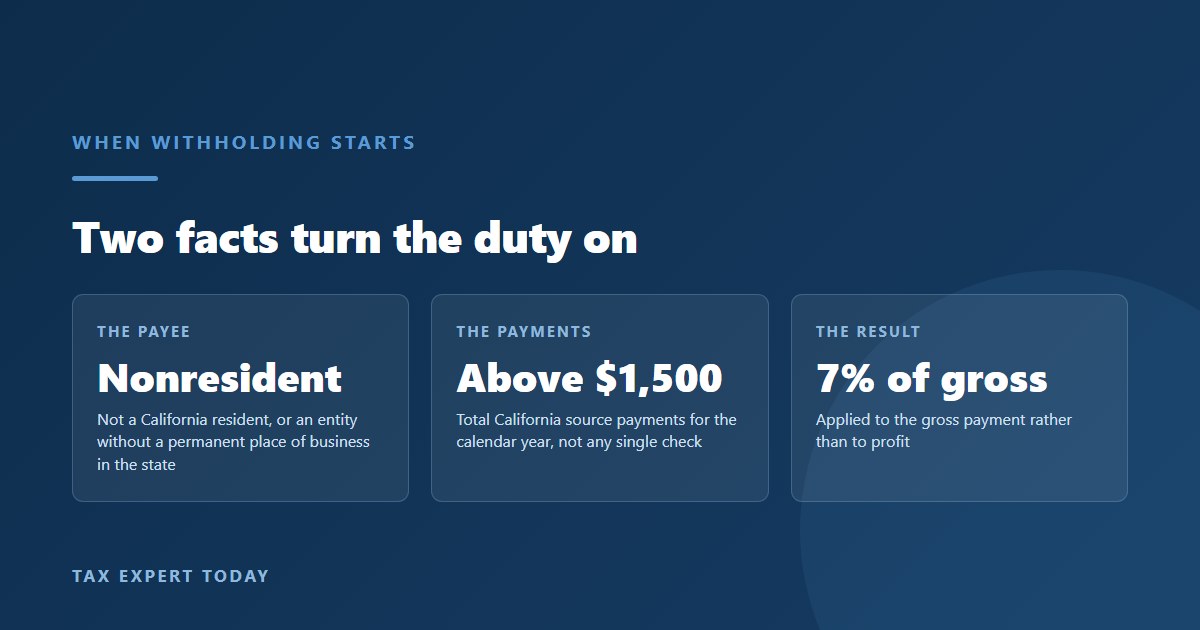
California nonresident withholding is a prepayment of California income or franchise tax that a payer takes out of California source income before it reaches a payee outside the state. Revenue and Taxation Code section 18662 authorizes it, and the rate is 7 percent of the gross payment once total payments for the calendar year pass $1,500. It is a credit, not an additional tax.
- A prepayment, not a separate levy. FTB Publication 1017 describes withholding as a prepayment of California state income or franchise tax, similar in function to wage withholding.
- Measured on gross, not on profit. The 7 percent applies to the gross California source payment, which is why a thin margin engagement can be substantially overwithheld.
- The $1,500 test is annual. The threshold looks at total payments or distributions of California source income for the calendar year, not at any single check.
- The duty sits with the payer. Section 18662(d) makes a person who fails to withhold, or fails to remit what was withheld, liable for the amount specified in section 18668.
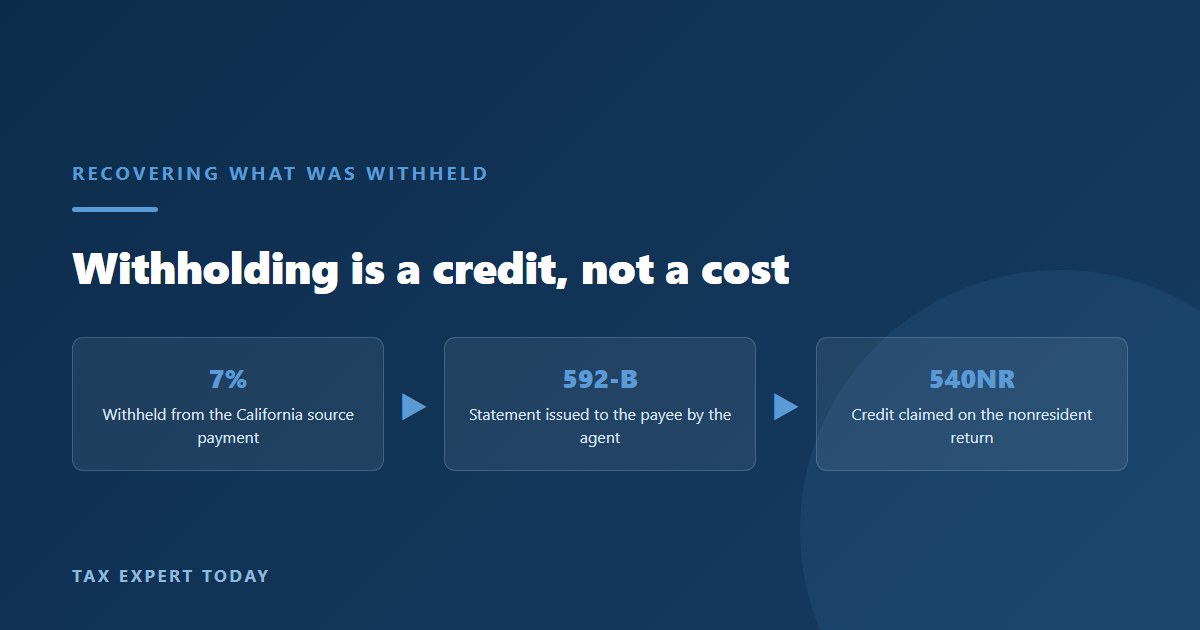
- The money comes back through the return. Form 592-B reports the amount taken, and the payee claims it as a credit against the California tax actually owed.
The reason this matters to anyone who has left California is simple. The rules reach nonresident payees. While you lived in California, a payer had no reason to withhold under these provisions. The move is the event that turns the obligation on, and many people meet it for the first time as an unexplained 7 percent reduction in a payment they were expecting in full.
Who Has to Withhold, and Who Gets Withheld On?
A withholding agent is any person or entity with the control, receipt, custody, disposal, or payment of California source income. A nonresident payee is a person or entity that is not a California resident and receives California source income or distributions. Publication 1017 also lists categories that are exempt entirely and certify that status on Form 590.
- Common withholding agents. The Franchise Tax Board lists promoters, rental property managers, partnerships and limited liability companies, estates and trusts, and venues as examples.
- Payer and payee are defined broadly. Publication 1017 treats the payee as anyone who receives items of income from a payer, including partners, beneficiaries, shareholders, and members receiving distributions from a pass-through entity, estate, or trust.
- Entity status turns on registration and presence. A corporation, partnership, or limited liability company is a nonresident payee when it is not qualified through the Secretary of State and has no permanent place of business in California.
- Tax-exempt status does not excuse the payer. Publication 1017 question 28 states that a tax-exempt organization making a payment to a nonresident for services performed in California may still have to withhold.
| Category | Nonresident payee (withholding applies) | Exempt payee (certifies on Form 590) |
|---|---|---|
| Individuals | Individuals who are not residents of California | California residents |
| Corporations | Not qualified through the Secretary of State and no permanent place of business in California | Qualified through the Secretary of State, or holding a permanent place of business in California |
| Partnerships and LLCs | No permanent place of business in California and not registered through the Secretary of State | Permanent place of business in California |
| Trusts | Any trust without a resident grantor, beneficiary, or trustee | California nongrantor trusts |
| Estates | Estates where the decedent was not a California resident | Estates where the decedent was a California resident at the date of death |
| Other | Nonresident entertainers, contractors, and royalty recipients | Tax-exempt organizations, insurance companies, individual retirement accounts, and qualified pension or profit sharing plans |
Which Payments Trigger the 7 Percent, and Which Do Not?
Withholding follows California source income. For personal services, the location where the services are performed determines the source, and Publication 1017 is explicit that where the payee lives, where the contract was signed, and where payment is issued do not control. Payments for goods, for services performed outside California, and for most intangible income fall outside the rules. The real property channel runs on a different form and a different rate, and it is covered separately in our guide to California Form 593.
- Services performed in California. Construction by independent contractors, software installation, and public speaking are the examples the Franchise Tax Board gives.
- Entertainer and athlete payments. Publication 1017 states that these include, but are not limited to, guaranteed payments, overages, royalties, and residual payments for services rendered in California.
- Compensation substitutes. Payments for a covenant not to compete in California, payments releasing a contractual obligation to perform services in California, income from options received because of services performed in California, and bonuses for California services are all listed as subject.
- Property income with a California location. Rents and royalties from assets located in California, and prizes and winnings from California contests.
- Distributions of California source income. Note that this is distribution based, which Publication 1017 distinguishes from foreign partner withholding under section 18666, which is allocation based.
| Subject to the 7 percent | Not subject | Authority |
|---|---|---|
| Personal services physically performed in California | Services performed entirely outside California | Pub 1017 Q17 and Q18; R&TC section 17951 |
| Rents and royalties from California assets | Payments for goods | FTB withholding on nonresidents |
| Distributions of California source income to nonresident owners | Return of capital and distributions not taxable by California | Pub 1017 Q17 |
| Prizes, winnings, and entertainer payments for California events | Interest, dividends, and other intangible income without a California business situs | Pub 1017 Q18 |
| Bonuses and option income traceable to California services | Wages paid to employees, which the Employment Development Department handles | Pub 1017 Q15 and Q17 |
| Payments for a covenant not to compete in California | Payments to a nonresident corporate director for board meetings | Pub 1017 Q17 and Q18 |
| Installation and repair labor performed in California | Motor carrier compensation for transportation in two or more states | Pub 1017 Q15 and Q51; 49 U.S.C. section 14503(a)(1) |
The business situs rule in question 18 deserves attention. Intangible property such as stocks, bonds, and notes is generally not California source, but a California business situs is acquired when the property is employed as capital in California, or when possession and control have been localized in connection with a California business so that its substantial use and value become an asset of that business. Publication 1017 gives the example of an intangible asset pledged as security for a loan connected to a California business.
What Changes the Day You Stop Being a California Resident?
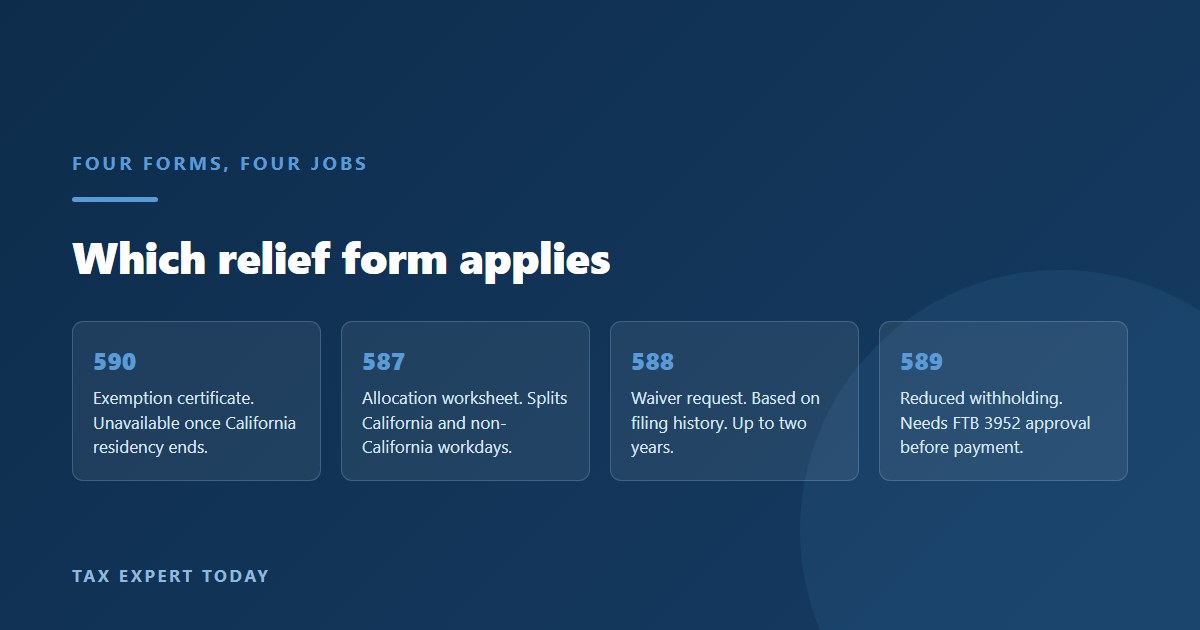
Residency is the switch. These provisions reach nonresident payees, so the same California source payment that was never withheld upon while you lived in the state becomes withholdable once your residency ends. The Form 590 residency exemption you may have relied on stops being available to you, and your payers are expected to reevaluate.
- The exemption certificate goes stale. Form 590 certifies a status. Once you are no longer a California resident, that certification is no longer accurate and the exemption no longer applies to you.
- Your address is a proxy the payer may use. Publication 1017 question 36 permits a withholding agent to rely on a California street address as an indication of residency, unless the agent has reason to believe the address is merely a forwarding address. A California post office box or an in care of address does not qualify.
- A change of address restarts the analysis. The same question requires the withholding agent to reevaluate the payee’s residency status when an address change occurs.
- Only California workdays are California source. Section 17951 taxes nonresidents on income from California sources, and the location of performance controls for services.
- Leaving does not lower the rate. The 7 percent applies to the gross unless you obtain an approved reduction or a waiver, which are covered below.
This is where the departure side and the arrival side meet. The residency determination itself is governed by a separate body of rules, and our guides to leaving California taxes, the California residency audit, and the California part-year resident return cover how that determination is made and documented. Withholding is the practical consequence that shows up first, often before the first nonresident return is even filed.
How Does Form 590 Work, and When Does It Stop Working for You?
Form 590, the Withholding Exemption Certificate, is how a payee tells a payer that no withholding is required. It covers California residents and the listed exempt entities. Publication 1017 question 42 sets out what the form must contain to be valid, and question 34 confirms that exemptions apply to the actual payee rather than to an agent or representative.
- Required content. The payee name and address, the payee taxpayer identification number, the withholding agent name, a checked box in front of the applicable exemption, and the name and title of the individual completing the form.
- Acceptable identification numbers. A Secretary of State file number, a social security number, an individual taxpayer identification number, a California corporation number, or a federal employer identification number.
- It protects the payer. Question 38 notes that reliance on a completed Form 590 protects the withholding agent from failure to withhold penalties, unless the agent has actual knowledge that the statement is false.
- It does not travel with you. An exemption certified on the basis of California residency has no continuing effect once that residency ends.
- Certifying a status you no longer hold is not a workaround. The form is signed under penalty of perjury, and the correct route after a move is an allocation, a reduction, or a waiver.
Can Form 587 Reduce Withholding on Work Performed Outside California?
Yes, and for someone who has moved this is usually the most useful of the four forms. Form 587, the Nonresident Withholding Allocation Worksheet, separates the portion of a payment that is California source from the portion that is not, so the 7 percent applies only to the California share rather than to the whole payment.
- Goods against services. Publication 1017 question 23 states that Form 587 may be used to distinguish the portion of payments made for goods from the portion for services when a vendor does both.
- The workday ratio. Question 50 provides that compensation for personal services performed by nonresident independent contractors is normally allocated to California based on working days in California over total working days in and out of California, with the denominator being the total number of days actually worked on the particular job.
- When contract days may be used instead. Only where the vendor is hired for the exclusive use of the withholding agent for the entire contract period, is required to be available to work each day at the discretion of the withholding agent, and is paid whether or not services are provided.
- Training days do not count. Days spent acquiring knowledge, skills, or experience necessary as a condition of employment are not work days, following Marc Wilson v. Franchise Tax Board (1993) 20 Cal. App. 4th 1441.
- Hourly professionals use billable hours. Those who bill by the hour allocate on billable hours worked in California over total billable hours related to the particular service.
Two practical points follow. Question 21 confirms that any reasonable method may be used to approximate the ratio, including the prior year ratio, annualized current year data, or actual year to date figures, and that a good faith effort satisfies the requirement rather than exactness. Question 49 requires the completed form to be retained for a minimum of five years. The same workday logic drives equity compensation sourcing after a move, which our guide to California RSU tax after leaving works through in detail.
| Form | What it does | Who submits it | Timing |
|---|---|---|---|
| Form 590 | Certifies that the payee is exempt, usually as a California resident or a listed exempt entity | Payee, to the withholding agent | Before payment; no Franchise Tax Board approval needed |
| Form 587 | Allocates a payment between California and non-California sources so only the California share is withheld upon | Payee, to the withholding agent | Before payment; retained five years; no approval needed |
| Form 588 | Requests a waiver of withholding based on compliance history | Payee or withholding agent, to the Franchise Tax Board | Response generally within 21 working days; maximum two year term |
| Form 589 | Requests a reduced withholding amount where 7 percent of gross significantly overwithholds | Payee, to the Franchise Tax Board, before payment | Allow 10 business days online, or 21 business days by mail or fax |
How Do You Request Reduced Withholding on Form 589?
Form 589, the Nonresident Reduced Withholding Request, is for the situation where 7 percent of the gross California source payment results in significant overwithholding. The payee files it with the Franchise Tax Board before receiving payment, and the withholding agent may only reduce the rate after receiving FTB 3952 confirming approval.
- The expense cap. Publication 1017 question 52 provides that beginning January 1, 2020 the total amount of expenses cannot exceed 50 percent of the gross California source payment.
- The payee initiates it. Question 54 requires the payee to provide the gross California source payment, the expenses relevant to the services being performed, and a proposed reduced withholding amount.
- Lead time is the constraint. Question 56 asks for at least 10 business days online, or at least 21 business days by mail or fax, before payment.
- Approval is documented. Question 60 is direct: without FTB 3952 approving a reduction in hand before the nonresident is paid, the withholding agent must withhold the full 7 percent of gross.
- Agents must honor an approval. Question 58 confirms that authorized reduced amounts are binding on the withholding agent.
Who Qualifies for a Withholding Waiver on Form 588?
Form 588, the Nonresident Withholding Waiver Request, turns on compliance history rather than on the economics of the payment. Publication 1017 question 69 lists two qualifying paths, and a waiver is generally granted for a fixed period with a maximum expiration of two years.
- Path one, returns on file. The payee has California tax returns on file for the two most recent taxable years in which the payee had a filing requirement, and is considered current on any outstanding tax obligations.
- Path two, current estimates. The payee is making timely estimated tax payments for the current taxable year and is current on outstanding obligations. Question 61 notes this route can produce a waiver good for a two year period ending December 31.
- Domestic payees only. Question 62 confirms that a foreign partner or member may file Form 589 to reduce or eliminate withholding but may not request a waiver.
- Response time and scope. Question 65 gives a general response window of 21 working days, and question 66 confirms that a waiver need not be requested for each payment or distribution.
- Amounts already withheld. Question 70 provides that if the agent withheld 7 percent but has not yet remitted it when a waiver is authorized, the agent must return the amounts withheld.
For a taxpayer who has recently left California, path one is often the stronger argument, because the two most recent filed California returns are usually resident returns filed on time. That compliance history is an asset in the waiver request, and it is worth assembling before the first large payment of the year rather than after.
How Do You Claim California Nonresident Withholding on Your Return?
Withholding is a credit, so it is recovered by filing. The withholding agent issues Form 592-B, the Nonresident Withholding Tax Statement, and the payee claims that amount against the California tax actually owed. For an individual who has left the state, that return is Form 540NR, the California Nonresident or Part-Year Resident Income Tax Return.
- Form 592-B is the supporting document. It reports the income and the amount withheld for the payee, and it is what substantiates the credit.
- Overwithholding is recovered on an individual return. Because the 7 percent is measured on gross while the tax is measured on taxable income, a nonresident with real expenses is frequently overwithheld and recovers the difference by filing.
- Form 540NR is the vehicle for individuals. Publication 1017 question 19 confirms this for nonresidents reporting California source income, and notes that California does not conform to federal law relating to income protected by United States tax treaties.
- Entity returns attach it physically. Question 95 directs a pass-through entity claiming part of an amount withheld to attach Form 592-B, or Form 593 for real estate withholding, to the front lower portion of the tax return with a schedule explaining any remainder allocated.
- Filing is not optional if you want the money. There is no mechanism by which unclaimed withholding returns itself.
If the move happened mid year, the credit lands on the same return that allocates your income between the resident and nonresident periods. The mechanics of that allocation are covered in our guide to the California part-year resident tax return.
What Are the Withholding Deadlines and Forms?
Withheld amounts are remitted on a four period schedule that mirrors the individual estimated tax due dates, and the form used depends on whether the payee is domestic or foreign and whether a pass-through entity is involved. Form 592-PTE is annual and due January 31 following the year of withholding.
| Payment period | Due date | Form used |
|---|---|---|
| January 1 through March 31 | April 15 | Form 592 with Form 592-V, or Form 592-Q for pass-through entity withholding |
| April 1 through May 31 | June 15 | Form 592 with Form 592-V, or Form 592-Q |
| June 1 through August 31 | September 15 | Form 592 with Form 592-V, or Form 592-Q |
| September 1 through December 31 | January 15 of the next year | Form 592 with Form 592-V, or Form 592-Q |
| Foreign partner installments | 15th day of the 4th, 6th, 9th, and 12th months | Form 592-A, with Form 592-F filed annually |
| Pass-through entity annual return | January 31 following the year of withholding | Form 592-PTE |
- Form 592-B goes to the payee. It is the statement the payee needs in order to claim the credit.
- Electronic filing above 250 payees. A withholding agent with 250 or more payees files through the Secure Web Internet File Transfer system.
- Paper route below that. Agents with fewer than 250 payees mail the form and payment to Withholding Services and Compliance MS F182, Franchise Tax Board, PO Box 942867, Sacramento CA 94267-0651.
- Correcting a taxable year. The Franchise Tax Board requires an original form for the correct year plus an amended form for the incorrect year showing every original payee with income and withholding changed to zero, and only a withholding agent may file the amendment.
What Is Form 592-V, and When Do You Send It?
Form 592-V is the Payment Voucher for Resident and Nonresident Withholding. It travels with the money rather than with the information: the withholding agent reports who was withheld on using Form 592, then remits the withheld tax with Form 592-V by the due date for that payment period. The Franchise Tax Board publishes a separate voucher for each tax year.
Payees who search for the 2026 Form 592-V are usually looking at the wrong end of the process, which is worth saying plainly. Form 592-V is a withholding agent document. If California tax was taken out of a payment made to you, the form you need is Form 592-B, the Nonresident Withholding Tax Statement, which the agent furnishes to you and which supports the credit on your California return. The voucher is how your payer moves the money to the state, not how you get it back.
- Form 592 reports, Form 592-V pays. The 2026 Form 592, Resident and Nonresident Withholding Statement, lists each payee and the amount withheld. The 2026 Form 592-V accompanies the remittance for that same period.
- Pass-through entities use a different voucher. Where the withholding is pass-through entity withholding, the payment voucher is Form 592-Q rather than Form 592-V, and the annual return is Form 592-PTE.
- The four periods are not calendar quarters. The periods run January 1 through March 31, April 1 through May 31, June 1 through August 31, and September 1 through December 31, with payments due April 15, June 15, September 15, and January 15 of the following year. The second period is two months and the third is three months, which is the detail most often missed.
- Electronic filers remit on the same schedule. A withholding agent with 250 or more payees files through the Secure Web Internet File Transfer system, and the paper voucher is used by agents below that threshold.
- Where the paper goes. Paper Form 592 and Form 592-V are mailed to Withholding Services and Compliance MS F182, Franchise Tax Board, PO Box 942867, Sacramento CA 94267-0651.
One practical consequence follows for a payee who has moved. Because the voucher and the statement are separate documents on separate schedules, the Form 592-B you need in order to claim the credit can arrive well after the withholding itself occurred. If a payment came up 7 percent short in March and no statement has appeared by the time the California return is due, the amount is still creditable, but you have to request the statement from the agent rather than assume the money was never remitted.
How Does California Nonresident Withholding Work for Pass-Through Entity Owners?
Pass-through entities sit on both sides of these rules. An S corporation, partnership, or limited liability company must withhold on distributions of California source income to its nonresident owners, and it may itself be withheld upon, in which case it allocates the credit through to its owners on Form 592-PTE.
- Distributions of prior year income count. Publication 1017 question 31 includes distributions of prior year income that were not previously reported as California source income on the owner’s California return.
- The first $1,500 is discretionary. Withholding is optional at the discretion of the agent on the first $1,500 of payments in the calendar year, or where the owner holds a waiver.
- FTB 3832 does not switch it off. Question 29 states that limited liability companies must withhold on nonresident members who have signed the consent form, and question 30 adds that paying the nonconsenting nonresident tax does not relieve the duty, though a waiver may be requested.
- Allocation reaches every owner. Question 96 requires the withholding to be allocated to all partners, members, shareholders, or beneficiaries, whether residents or nonresidents, in proportion to ownership or beneficial interest.
- Payments and the annual return are separate filings. Question 97 confirms Form 592-PTE is due January 31 following the year of withholding while payments remain due each period with Form 592-Q.
| Entity type | How it claims withholding it was subject to | Refund at entity level |
|---|---|---|
| Partnership | On Form 565 only to the extent the annual tax is still due when the return is filed; the excess must be allocated to the partners | No |
| Limited liability company | On Form 568 to offset LLC tax, including nonconsenting nonresident tax, or fees still due, with any excess allocated to members | No |
| S corporation | Allocated to shareholders, claimed on Form 100S not exceeding the tax, or a combination of both | No |
| Estate or trust | Withholding follows the income: claimed on Form 541 if the related income is not distributed, or allocated to beneficiaries if it is | Follows the income |
Owners who have moved out of state while the entity remains in California face both sides of this at once. The entity level charges that continue after a move are covered in our guides to the California LLC franchise tax and the California LLC versus S corporation comparison.
How Is Real Estate Withholding Different from Nonresident Withholding?
Real estate withholding is a separate regime under section 18662(e) with its own rate, its own form, and its own publication. The transferee withholds 3 and one third percent of the sales price of the California real property conveyed, reported on Form 593 rather than Form 592-B, and Publication 1016 governs it rather than Publication 1017.
- A different base. The default calculation runs on the sales price rather than on gain or on a payment for services.
- An elective alternative exists. Section 18662(e)(2)(B) allows the transferor to certify a different amount in writing under penalty of perjury, which may not be less than the gain required to be recognized multiplied by the applicable rate.
- Escrow is not your advisor. The statute itself requires the certification form to state that title and escrow persons and exchange accommodators are not authorized to provide legal or accounting advice for purposes of determining withholding amounts.
- A different statement. Form 593 is the real estate withholding statement, and it supports the credit in the same way Form 592-B does for nonwage withholding.
- Foreign sellers have narrower relief. The Franchise Tax Board notes that foreign sellers cannot apply for a waiver, although they may apply for reduced withholding.
| Feature | Nonresident withholding (section 18662(a)) | Real estate withholding (section 18662(e)) |
|---|---|---|
| What triggers it | California source payments to a nonresident payee above $1,500 for the calendar year | Disposition of a California real property interest by a covered transferor |
| Rate and base | 7 percent of the gross California source payment | 3 and one third percent of the sales price, or a certified alternative based on recognized gain |
| Who withholds | The payer, described as the withholding agent | The transferee, including an intermediary or accommodator in a deferred exchange |
| Statement to the payee | Form 592-B | Form 593 |
| Governing publication | FTB Publication 1017 | FTB Publication 1016 |
| Relief available | Form 590 exemption, Form 587 allocation, Form 588 waiver, Form 589 reduction | Reduced withholding by certification; foreign sellers cannot apply for a waiver |
Anyone selling a former California residence after a move is dealing with this second regime rather than the one described above, and our guide to California capital gains tax on a home sale works through the interaction with the federal exclusion.
What Happens If a Withholding Agent Does Not Withhold?
The liability shifts to the agent. Section 18662(d) provides that a person who fails to withhold amounts required by the section, or fails to remit taxes withheld, is liable for the amount specified in section 18668. The Franchise Tax Board states plainly that an agent who does not withhold may have to pay the amount required to be withheld, including penalties and interest.
- The statutory chain. Section 18662 imposes the duty, and section 18668 makes the withholding agent liable to remit the tax withholding required.
- Backup withholding overrides. Section 18664 applies backup withholding, conforming to Internal Revenue Code section 3406, to reportable payments made on or after January 1, 2010. Where backup withholding and another type both apply, Publication 1017 question 2 states that backup withholding replaces all other types of withholding.
- Different due dates. California backup withholding due dates follow the individual estimated tax payment periods rather than the federal backup withholding schedule, and remittance uses Form 592-V.
- The dispute route. A withholding agent assessed penalties and interest that it disagrees with may pay the balance due and file a claim for refund.
- Reliance is a defense, within limits. A completed Form 590 protects the agent from failure to withhold penalties unless the agent has actual knowledge that the statement is false.
For the payee, the practical consequence of an agent that fails to withhold is not relief. The California tax on that California source income remains due on the nonresident return, and the absence of a credit simply means more is owed at filing. Understanding which side of the transaction you are on determines what you should be asking for.
Frequently Asked Questions
What is the California nonresident withholding rate and threshold?
The rate is 7 percent of the gross California source payment, and the duty begins once total payments or distributions to that payee exceed $1,500 for the calendar year. The threshold is annual and cumulative rather than per payment, so a series of small payments can cross it partway through the year.
Can I use Form 590 after I move out of California?
No. Form 590 is the Withholding Exemption Certificate, and the exemption it certifies rests on being a California resident or on being an entity qualified to do business in California. Once your residency has ended the certificate no longer describes you, and continuing to give one to a payer misstates your status. Form 587 or Form 588 is the correct route after a move.
How do I get California withholding back?
Through the return, not through a refund request to the withholding agent. Form 592-B reports the amount taken, and you claim that amount as a credit against the California tax actually owed on your nonresident return. Where the 7 percent on gross exceeds the tax on the California source net income, the excess comes back as a refund.
Who qualifies for a California nonresident withholding waiver?
Form 588 seeks a waiver on the strength of a filing history, and it is often strongest immediately after a move, because the two most recent California returns were filed as a resident and show a compliant record. Waivers are granted at the discretion of the Franchise Tax Board and depend on the specific facts.
What is Form 592-V used for?
Form 592-V is the Payment Voucher for Resident and Nonresident Withholding. A withholding agent sends it with the withheld tax for a given payment period, alongside Form 592, which reports the payees. It is not a form a payee files, and it is not the document used to claim the credit.
Is the 2026 Form 587 different from prior years?
Form 587, the Nonresident Withholding Allocation Worksheet, keeps the same function each year, and the Franchise Tax Board posts a version carrying the tax year on its face. Use the year that matches the payment period being allocated, and retain the completed worksheet, which Publication 1017 requires be kept for a minimum of five years.
California Nonresident Withholding Help Naples and Southwest Florida
California nonresident withholding help Naples clients ask for most often follows the same pattern. Someone has completed a move to Southwest Florida, the California residency file is in order, and then a payment arrives 7 percent short with no explanation attached. Our office in Naples, Florida works the withholding question and the residency question together, because the allocation you can support on Form 587 depends on the same workday records that support the residency position, and the credit on the nonresident return depends on both.
Tax Expert Today LLC
11983 Tamiami Trail N, Naples, FL 34110
Phone: (239) 441-2005
Hours: Monday through Friday, 10:00 to 5:00 ET
I moved to Naples and my California client is still withholding 7 percent. Can that be stopped? Often it can be reduced rather than stopped outright. Form 590 is no longer available to you once your California residency has ended, but Form 587 allocates the payment so only the California portion is withheld upon, and Form 588 seeks a waiver on the strength of your filing history, which is frequently strong immediately after a move because the two most recent California returns were filed as a resident. Where the work is genuinely performed in Florida rather than in California, the allocation route tends to do more than the waiver route. Our California tax services page and our Naples tax planning page describe how we handle both ends of the corridor.
When to Engage a Professional
California nonresident withholding is worth professional review when the amounts are material or the facts are mixed. Consider engaging an advisor when a single engagement mixes California and non-California workdays, when the 7 percent on gross is large relative to the actual expected tax, when a Form 589 reduction has to be filed before a payment date, when a pass-through entity must both withhold and allocate credits in the same year, or when the move year and the withholding year are the same year. Outcomes depend on the specific facts, and the analysis usually needs the actual payment records and workday documentation rather than a general rule.
Related reading on the corridor includes our complete guide to moving from California to Florida, the California exit tax question, and on the Florida side, how to establish Florida residency Where tax for a California year was paid after the due date, our guide to the California late payment penalty explains how the section 19132 penalty and the interest on it are computed.
This article is educational and general in nature. It does not constitute tax advice for any particular taxpayer, and outcomes depend on individual facts and circumstances.
Published August 18, 2026 by Dr. Pellumb Kabashi « Back to Learning Center
Have a question this article touches on?
Tax Expert Today LLC, based in Naples, Florida and serving clients across the United States.
Schedule a Consultation (239) 441-2005