
By Dr. Pellumb Kabashi, DBA, MBA, CES, CFE, EA
Founder, Tax Expert Today LLC · Tax advisors, enrolled agents, CPAs, and attorneys · Serving clients in all 50 states
Quick Answer: The California bonus tax rate of 10.23 percent is a withholding rate, not the tax you owe. Your bonus is taxed as ordinary income at rates up to 12.3 percent, plus 1 percent on taxable income over $1,000,000, so a high earner can owe more than was withheld. A bonus earned in California stays California income after a move to Florida. Call (239) 441-2005 for a free consultation.
What Is the California Bonus Tax Rate in 2026?
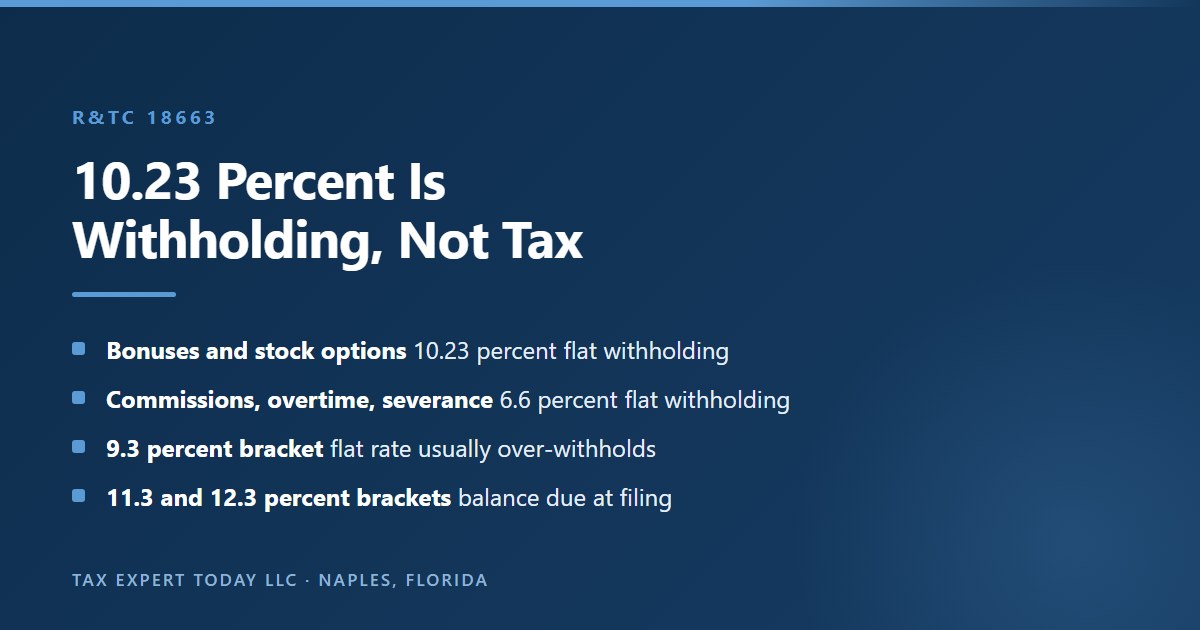
The California bonus tax rate in 2026 is 10.23 percent when an employer withholds state income tax from a bonus paid separately from regular wages. It is set by R&TC section 18663 and repeated in the 2026 EDD Employer’s Guide. Other supplemental pay, such as commissions and overtime, uses a 6.6 percent flat rate instead.
- Bonuses and stock options: 10.23 percent flat state withholding when paid apart from regular wages.
- Other supplemental wages: 6.6 percent flat state withholding, including commissions, overtime, sales awards, severance, and vacation pay.
- Bonus paid with regular wages: no flat rate; the employer withholds on the combined amount using the wage tables.
- What it is not: it is not the final tax. The final tax is figured on your return using the progressive rate schedule.
When people search for the California bonus tax rate, they usually want one number, and 10.23 percent is the number every payroll calculator gives them. That figure is correct as far as it goes. R&TC section 18663(c)(2) says that for stock options and bonus payments that constitute wages paid on or after November 1, 2009, the rate of withholding that may be applied in place of the wage withholding tables is 10.23 percent. Section 18663(b)(1)(B) sets the rate for other supplemental wages at 6.6 percent. The 2026 California Employer’s Guide (DE 44) repeats both figures in its section on how to withhold personal income tax on supplemental wages.
The rest of this guide is about what the 10.23 percent figure leaves out. For most employees the flat rate is close enough to their real rate that the difference washes out at filing. For a high earner, and especially for someone whose income crosses $1,000,000, it can fall well short. For anyone who has moved from California to Florida, a bonus paid after the move can still be California income, and the employer may or may not withhold on it correctly. Those are the situations where a bonus creates a balance due, an estimated tax penalty, or a notice from the Franchise Tax Board.
| Type of supplemental pay | California flat withholding rate | Authority |
|---|---|---|
| Cash bonus paid separately | 10.23 percent | R&TC 18663(c)(2); DE 44 |
| Stock options treated as wages | 10.23 percent | R&TC 18663(c)(2); DE 44 |
| Commissions | 6.6 percent | R&TC 18663(b)(1)(B); DE 44 |
| Overtime paid separately | 6.6 percent | R&TC 18663(b)(1)(B); DE 44 |
| Sales awards | 6.6 percent | DE 44 |
| Severance or dismissal pay | 6.6 percent | DE 44 |
| Vacation pay paid in addition to regular wages | 6.6 percent | DE 44; DE 231PS |
| Any supplemental pay included in a regular paycheck | No flat rate, wage tables apply | UI Code 13043(c); DE 44 |
Is 10.23 Percent the Tax on a Bonus or Only the Withholding?
It is only the withholding. California taxes a bonus as ordinary wage income on your Form 540 or Form 540NR, at the same progressive rates as salary. The 10.23 percent withheld is a prepayment credited against that final tax. If your top bracket is higher, you owe the difference; if it is lower, the excess is refunded.
- Withholding: an amount your employer sends to the state on your behalf when the bonus is paid.
- Tax: the amount computed on your annual return from the 2026 rate schedule.
- Settlement: the return compares the two and produces a refund or a balance due.
- Penalty risk: if withholding plus estimates fall short during the year, an underpayment penalty can apply even if you pay in full by April.
There is no separate “bonus tax” in California. The personal income tax is imposed by R&TC section 17041 on taxable income, and a bonus is simply part of your wages for the year. The withholding statutes in the Unemployment Insurance Code exist to collect that tax as the year goes along. Unemployment Insurance Code section 13020 describes the goal: the amount withheld should be substantially equivalent to the tax reasonably estimated to be due because of those wages. A flat rate is a shortcut toward that goal, and like any shortcut it is more accurate for some people than for others.
The confusion is understandable. A paystub that shows 10.23 percent of a $50,000 bonus going to the state looks like a tax bill. Many employees also notice that federal withholding on the same bonus was 22 percent, which feels higher than their usual paycheck withholding, and conclude that bonuses are taxed at a special higher rate. They are not. Federal and California law both tax a bonus at your ordinary marginal rate. The withholding rates are simply set at levels designed to roughly match what a typical recipient will owe, and the return corrects the difference.
For California purposes, the practical question is therefore not “what is the bonus rate” but “what is my marginal rate this year, and is 10.23 percent above or below it.” The answer depends on your filing status and your total taxable income. The tables later in this guide show where the crossover sits.
| Question | Withholding at 10.23 percent | Final California tax |
|---|---|---|
| When is it figured? | On the day the bonus is paid | On the annual return after year end |
| Who figures it? | The employer’s payroll system | You or your preparer on Form 540 or Form 540NR |
| What rate applies? | One flat rate | Progressive rates from 1 to 12.3 percent, plus 1 percent over $1,000,000 |
| Does it consider other income? | No | Yes, all income for the year |
| Does it consider residency? | Only through the employer’s records | Yes, resident, part-year resident, or nonresident status |
| What happens to the difference? | Nothing until filing | Refund or balance due, possibly with a penalty |
Why Does California Withhold 10.23 Percent on Bonuses but 6.6 Percent on Other Supplemental Pay?
The Legislature set two separate flat rates. In 2009 it raised the bonus and stock option rate to 10.23 percent and the general supplemental rate to 6.6 percent. The higher bonus rate reflects that large bonuses and option exercises tend to go to higher earners, whose marginal California rate is closer to the top brackets.
- From 1992 to 2001: one supplemental rate of 6 percent applied to all supplemental wages.
- From 2002: bonuses and stock options received their own rate of 9.3 percent.
- From November 1, 2009: the bonus and stock option rate rose to 10.23 percent and the general rate to 6.6 percent.
- Since then: neither rate has changed, although the rate brackets have been indexed every year.
The history is written into the statute. Section 18663 still carries each step: a 6 percent supplemental rate for wages paid on or after January 1, 1992, 6.6 percent for wages paid on or after November 1, 2009, a 9.3 percent rate for stock options and bonus payments paid on or after January 1, 2002, and 10.23 percent for those paid on or after November 1, 2009. The 2009 increases came in the same budget legislation that told the Franchise Tax Board to build wage tables that withhold 10 percent more than the estimated tax, which is why 9.3 percent became 10.23 percent: 9.3 multiplied by 1.1.
That arithmetic matters for understanding what the rate is meant to do. The 10.23 percent rate is the 9.3 percent bracket with a 10 percent cushion built in. For a taxpayer whose top dollars are taxed at 9.3 percent, the flat rate over-withholds slightly by design. For a taxpayer in the 10.3, 11.3, or 12.3 percent bracket, the cushion is gone or reversed. The rate has not moved since 2009, while the brackets have been indexed upward every year, so the income level at which 10.23 percent stops being enough has drifted higher, but the top rates themselves have not changed.
The 6.6 percent rate follows the same logic from a lower starting point: 6 percent multiplied by 1.1. It applies to commissions, overtime, severance, and similar payments. If your employer labels a payment as something other than a bonus, such as a “performance commission” or a “retention payment,” check which rate payroll actually used. The DE 44 lists the categories, and the label on the paystub is usually the quickest way to see which one was applied.
| Payment date | Bonus and stock option rate | Other supplemental rate |
|---|---|---|
| January 1, 1992 to December 31, 2001 | 6 percent (general rate) | 6 percent |
| January 1, 2002 to October 31, 2009 | 9.3 percent | 6 percent |
| November 1, 2009 and later | 10.23 percent | 6.6 percent |
| 2026 (current) | 10.23 percent | 6.6 percent |
Which Payments Count as a Bonus for the 10.23 Percent Rate?
The 10.23 percent rate applies to bonus payments and to stock options that are wages subject to California withholding. Commissions, overtime, sales awards, severance, and vacation pay use 6.6 percent. A payment called a bonus but included in a regular paycheck gets no flat rate at all, because the employer must withhold on the combined amount.
- Annual performance bonus: 10.23 percent if paid separately.
- Signing bonus: generally a bonus payment, so 10.23 percent if paid separately.
- Retention bonus: generally a bonus payment, but check the payroll code.
- Commission or sales award: 6.6 percent, even if the paystub calls it incentive pay.
- Restricted stock and option income: 10.23 percent when it is wages; see the separate rules for equity.
The Unemployment Insurance Code section 13043(b) defines supplemental wages to include bonus payments, overtime payments, commissions, sales awards, back pay including retroactive wage increases, and reimbursements for nondeductible moving expenses. Section 18663 then splits that group in two, giving bonuses and stock options the 10.23 percent rate and everything else 6.6 percent. The EDD information sheet DE 231PS repeats the same split and adds that vacation pay paid in addition to regular wages for the vacation period is treated as a supplemental wage payment.
Equity compensation follows its own path. The EDD information sheet on stock options, DE 231SK, explains when option income is wages subject to personal income tax withholding, and the 10.23 percent rate applies to that income. Restricted stock units are taxed as wages when they vest. Because equity raises its own sourcing questions when a holder moves, we cover it separately in our guide to California RSU tax after leaving the state. This guide focuses on the cash bonus.
Two practical points help here. First, the label your employer uses is less important than the payroll code it runs the payment through, because that code drives the withholding. Second, if you receive several kinds of supplemental pay in one check, payroll may apply different rates to each line. A year-end check that combines a $40,000 bonus with a $10,000 commission could show $4,092 of withholding on the bonus line and $660 on the commission line.
| Payment | Usual California treatment | Flat rate if paid separately |
|---|---|---|
| Annual performance bonus | Supplemental wage, bonus category | 10.23 percent |
| Signing bonus | Supplemental wage, bonus category | 10.23 percent |
| Retention bonus | Supplemental wage, bonus category | 10.23 percent |
| Spot award or holiday bonus | Supplemental wage, bonus category | 10.23 percent |
| Commission | Supplemental wage, other category | 6.6 percent |
| Sales award | Supplemental wage, other category | 6.6 percent |
| Overtime paid on a separate check | Supplemental wage, other category | 6.6 percent |
| Severance | Supplemental wage, other category | 6.6 percent |
| Nonqualified stock option exercise | Wages subject to withholding | 10.23 percent |
| RSU vesting | Wages subject to withholding | 10.23 percent (equity rules apply) |
How Do Employers Choose Between the Flat Rate and the Aggregate Method?
If the bonus is paid at the same time as regular wages, the employer must add the two together and withhold using the wage tables. If the bonus is paid separately, the employer may either use the 10.23 percent flat rate or compute withholding on the bonus plus the current regular wage payment and subtract what was already withheld.
- Same check as salary: aggregate method required, using the regular payroll period.
- Separate check, option one: aggregate method, computing tax on salary plus bonus and subtracting the salary withholding.
- Separate check, option two: flat 10.23 percent, ignoring the allowances on your DE 4.
- Your role: you cannot choose the method, but you can ask payroll which one it uses and adjust your DE 4 or estimates.
The DE 44 sets out the rule in two steps. If the supplemental wage is given to the employee at the same time as the regular wages, the employer is required to treat the sum as regular wages and withhold using the personal income tax withholding schedules for the regular payroll period. If the supplemental wage is not given at the same time, the employer may either compute the withholding on the combined amount and subtract the tax already withheld from the regular wages, or withhold the flat percentage without allowing for any withholding allowances. Section 13043(c) of the Unemployment Insurance Code contains the same choice.
Most large employers use the flat rate for separate bonus runs because it is simple and predictable. Smaller employers with less sophisticated payroll systems sometimes pay bonuses inside a regular paycheck, which forces the aggregate method. The aggregate method treats the bonus as if your salary for that pay period were much larger, which can push the withholding computation into higher brackets. That is the source of the common complaint that a bonus “got taxed at 40 percent.” What actually happened is that the withholding tables annualized one large paycheck as if it were your pay every period.
Neither method changes your final tax. Both are prepayments. The difference is only in how much cash you receive on payday and how much you get back, or owe, when you file. If you know your employer uses the aggregate method and the withholding looks heavy, you can reduce estimated payments later in the year or simply accept the larger refund. If it uses the flat rate and you are a high earner, the more common problem is the opposite: not enough was withheld.
| Situation | Required or permitted method | Typical effect for a high earner |
|---|---|---|
| Bonus included in a regular paycheck | Aggregate method required | Withholding can be heavy for that pay period |
| Bonus paid on its own check, employer elects flat rate | 10.23 percent flat | Can fall short above the 9.3 percent bracket |
| Bonus paid on its own check, employer elects aggregate | Combined computation minus salary withholding | Often closer to the real marginal rate |
| Commission paid on its own check | 6.6 percent flat or aggregate | Often short for any income above about $60,000 |
Why Can the Aggregate Method Withhold More Than 10.23 Percent?
California wage tables are built to withhold 10 percent more than the estimated tax. R&TC section 18663(a)(2) requires that cushion for wages paid after November 1, 2009, so the 2026 tables in the DE 44 show rates from 1.1 percent up to 14.63 percent. A large bonus run through those tables can therefore be withheld above 10.23 percent.
- Table rates: each bracket rate in the DE 44 exact calculation method is the statutory rate multiplied by 1.1.
- Top table rate: 14.63 percent on wages above the $1,000,000 annualized level, which is 13.3 percent times 1.1.
- Annualization: the tables treat one paycheck as if it repeated every pay period.
- Result: a single large bonus check can be over-withheld under the aggregate method, then refunded at filing.
Section 18663(a)(2) directs the FTB to prepare wage withholding tables that produce an amount equal to 10 percent more than the estimated tax, in order to significantly prevent underwithholding. The 2026 DE 44 exact calculation tables show the result: brackets starting at 1.100 percent and climbing through 10.230, 11.330, 12.430, and 13.530 percent, with a top table rate of 14.630 percent above $1,000,000. Those rates are not tax rates. They are the tax rates plus the 10 percent cushion.
The cushion matters most when a bonus is run through the aggregate method. Suppose a single employee earns $10,000 per semimonthly pay period and receives a $100,000 bonus in the same check. The payroll system treats that check as if it were $110,000 every pay period, or about $2.6 million a year, and applies the top table rates to much of it. The withholding on that one check can approach 14 percent of the bonus. The employee’s actual marginal rate may be 9.3 or 10.3 percent, so most of the excess comes back at filing.
This is one reason two coworkers who received the same bonus can see very different state withholding on their paystubs. It is also why a refund after a bonus year is not proof that the bonus was taxed at a lower rate, and a balance due is not proof it was taxed at a higher one. The final tax on the return is the only number that reflects what the bonus actually cost.
| 2026 single taxable income bracket | Statutory rate | DE 44 table rate (rate times 1.1) |
|---|---|---|
| $0 to $11,456 | 1 percent | 1.10 percent |
| $75,197 to $384,109 | 9.3 percent | 10.23 percent |
| $384,109 to $460,927 | 10.3 percent | 11.33 percent |
| $460,927 to $768,213 | 11.3 percent | 12.43 percent |
| $768,213 to $1,000,000 | 12.3 percent | 13.53 percent |
| Over $1,000,000 | 13.3 percent including the 1 percent tax | 14.63 percent |
The statutory brackets in the first column come from the FTB 2026 California Tax Rate Schedules. The DE 44 withholding schedules use the wage withholding brackets the FTB supplied to the EDD for 2026, which are not identical to the return brackets, so treat the third column as an illustration of the 1.1 multiplier rather than a payroll table.
What Will a High Earner Actually Owe on a California Bonus?
A bonus is taxed at your top California brackets, because it sits on top of your other income. For a single filer in 2026, income up to $384,109 is taxed at no more than 9.3 percent, so 10.23 percent withholding usually covers it. Above that line the bonus hits 10.3, 11.3, and 12.3 percent brackets, and above $1,000,000 the 1 percent tax applies too.
- Single, 9.3 percent bracket: 10.23 percent withholding exceeds the tax on the bonus; expect a small refund.
- Single, taxable income above $384,109: part of the bonus is taxed above 10.23 percent.
- Married filing jointly: the 9.3 percent bracket runs to $768,218 in 2026, so the shortfall starts later.
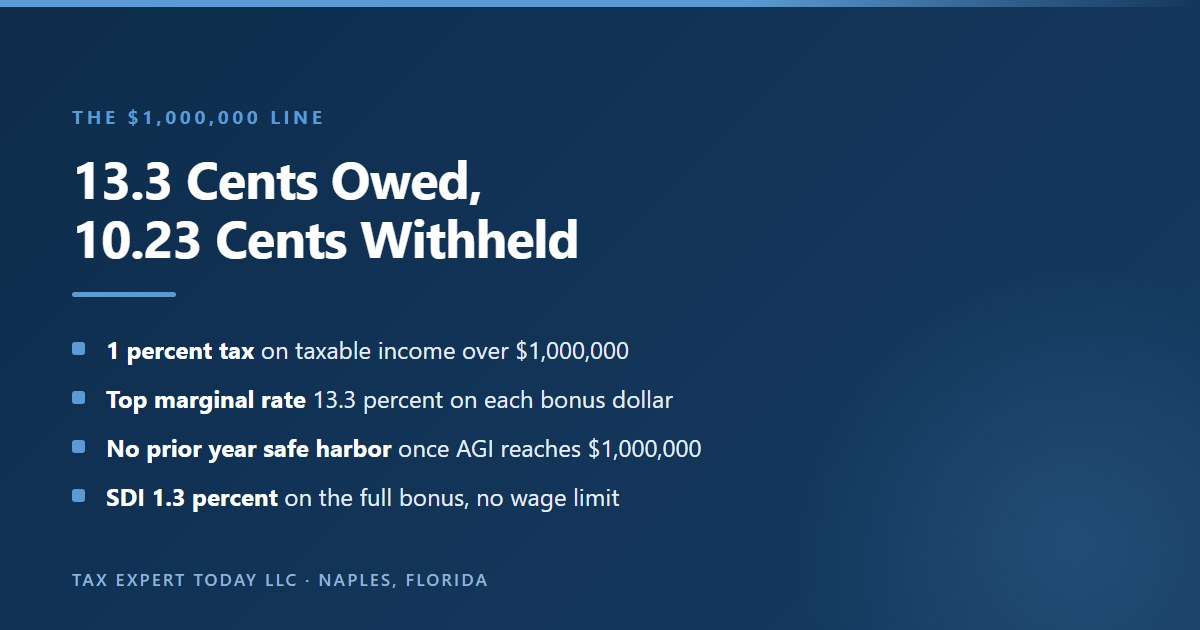
- Any filer above $1,000,000: each additional bonus dollar costs 13.3 cents of California tax against 10.23 cents withheld.
The examples below are hypothetical. They use the 2026 California tax rate schedules, assume the bonus is the last income added for the year, and ignore exemption and other credits, which are small at these income levels and phase out for high earners. “Other taxable income” means taxable income before the bonus. The 1 percent additional tax under R&TC section 17043, explained in our guide to the California mental health tax, is included where it applies.
| Hypothetical filer | Other taxable income | Bonus | Added California tax | Withheld at 10.23 percent | Difference at filing |
|---|---|---|---|---|---|
| Single | $150,000 | $20,000 | $1,860 (9.30 percent) | $2,046 | About $186 refund |
| Single | $300,000 | $60,000 | $5,580 (9.30 percent) | $6,138 | About $558 refund |
| Married filing jointly | $450,000 | $100,000 | $9,300 (9.30 percent) | $10,230 | About $930 refund |
| Single | $600,000 | $250,000 | $29,068 (11.63 percent) | $25,575 | About $3,493 due |
| Single | $800,000 | $400,000 | $51,200 (12.80 percent) | $40,920 | About $10,280 due |
| Married filing jointly | $1,200,000 | $500,000 | $63,136 (12.63 percent) | $51,150 | About $11,986 due |
| Single | $500,000 | $1,500,000 | $191,818 (12.79 percent) | $153,450 | About $38,368 due |
The pattern is consistent. In the 9.3 percent bracket, the flat rate over-withholds by about 0.93 percentage points, the 10 percent cushion. Once the bonus reaches the 10.3 percent bracket, the cushion is nearly gone, and in the 11.3 and 12.3 percent brackets the flat rate under-withholds. Above $1,000,000 of taxable income the gap widens to about 3.07 percentage points on every additional dollar. For a single filer with $800,000 of other taxable income, a $400,000 bonus produces roughly $10,280 of additional California tax that no one withheld.
These figures are before any credits and before the interaction with other items on the return, such as capital gains, which are also taxed as ordinary income in California. A preparer working from the actual return will get a more precise number, but the direction is reliable: above the 9.3 percent bracket, plan for a balance due.
When Does a California Bonus Leave a Balance Due?
A California bonus leaves a balance due when the bonus, added to your other income, reaches brackets above 9.3 percent, or when your other income already had too little withholding. For 2026 that starts above $384,109 of taxable income for single filers and above $768,218 for joint filers.
- Bracket test: compare your expected 2026 taxable income with the top of the 9.3 percent bracket for your filing status.
- Other income test: capital gains, rental income, partnership income, and interest have no withholding at all.
- DE 4 test: claiming many allowances lowers withholding on regular pay all year.
- Two jobs test: each employer withholds as if its wages were your only wages.
The bracket test is the one most specific to bonuses. The table below shows the 2026 thresholds from the FTB rate schedules. If your taxable income including the bonus stays within the 9.3 percent bracket, the 10.23 percent withholding will usually cover the bonus with a little to spare. Once it crosses into 10.3 percent, the margin is close to zero. At 11.3 and 12.3 percent, it is negative.
| 2026 filing status | Top of 9.3 percent bracket | 10.3 percent bracket | 11.3 percent bracket | 12.3 percent bracket starts |
|---|---|---|---|---|
| Single or married filing separately | $384,109 | $384,109 to $460,927 | $460,927 to $768,213 | $768,213 |
| Married filing jointly | $768,218 | $768,218 to $921,854 | $921,854 to $1,536,426 | $1,536,426 |
| Head of household | $522,385 | $522,385 to $626,864 | $626,864 to $1,044,771 | $1,044,771 |
The 1 percent additional tax is not part of these brackets. It applies to taxable income over $1,000,000 for every filing status, including married couples filing jointly. Section 17043(c) says the joint return and filing status rules of section 17041 do not apply to it, so a married couple reaches the 1 percent tax at the same $1,000,000 line as a single filer. That is why a joint filer can be in the 11.3 percent bracket and still pay 12.3 percent on part of a bonus.
The other tests catch people who are not in the top brackets at all. A household with $250,000 of salary and $200,000 of capital gains has no withholding on the gains, and a year-end bonus withheld at 10.23 percent does nothing to cover them. The California estimated tax penalty calculator can show whether the total of withholding and estimates for the year meets the safe harbor, which is the real question.
How Does the $1,000,000 Line Change the Math on a Large Bonus?
Above $1,000,000 of taxable income, California adds a 1 percent tax under R&TC section 17043, now called the Behavioral Health Services Tax. Combined with the 12.3 percent top bracket, each bonus dollar above that line costs 13.3 cents of California tax, while the flat withholding takes only 10.23 cents.
- Threshold: taxable income over $1,000,000, the same for single and joint filers.
- Rate: 1 percent on the excess, added to the regular tax.
- Name: renamed from the Mental Health Services Tax for taxable years beginning in 2025.
- Bonus effect: a shortfall of about 3.07 cents on every bonus dollar above $1,000,000.
Section 17043(a) imposes an additional tax at the rate of 1 percent on that portion of a taxpayer’s taxable income in excess of one million dollars. It was added by Proposition 63 in 2004. The 2025 Form 540 booklet explains that, beginning with 2025, references to the Mental Health Services Tax have been renamed to the Behavioral Health Services Tax, computed on line 62 of Form 540 as 1 percent of taxable income over $1,000,000. Our guide to the California mental health tax covers the tax itself in depth, including how it applies to capital gains and business sales. Here the point is narrower: how it interacts with bonus withholding.
The interaction is simple and easy to miss. The 10.23 percent flat rate was set in 2009 against a 9.3 percent bracket. It was never designed to cover a 13.3 percent marginal rate. A single employee with $900,000 of salary and other income who receives a $300,000 bonus will have $100,000 of the bonus in the 12.3 percent bracket below $1,000,000 and $200,000 above it at 13.3 percent. Withholding covers 10.23 percent of all of it. The shortfall on the part above $1,000,000 alone is about $6,140.
Because the 1 percent tax ignores filing status, married couples feel it sooner than the brackets suggest. A joint return with $1,200,000 of taxable income is still in the 11.3 percent bracket, but every dollar above $1,000,000 also carries the 1 percent tax, so the marginal rate is 12.3 percent. That is why the joint example in the earlier table shows a 12.63 percent effective rate on a $500,000 bonus even though the joint 12.3 percent bracket does not start until $1,536,426.
| Portion of the bonus | California marginal rate | Withheld | Shortfall per $100,000 |
|---|---|---|---|
| In the single 9.3 percent bracket | 9.3 percent | 10.23 percent | $930 over-withheld |
| In the single 10.3 percent bracket | 10.3 percent | 10.23 percent | $70 short |
| In the single 11.3 percent bracket | 11.3 percent | 10.23 percent | $1,070 short |
| In the single 12.3 percent bracket, under $1,000,000 | 12.3 percent | 10.23 percent | $2,070 short |
| Above $1,000,000, any filing status in the top bracket | 13.3 percent | 10.23 percent | $3,070 short |
| Above $1,000,000, joint filer in the 11.3 percent bracket | 12.3 percent | 10.23 percent | $2,070 short |
Why Does a Bonus Above $1,000,000 Remove the Prior Year Safe Harbor?
California denies the prior year safe harbor for estimated tax to anyone whose current year adjusted gross income is $1,000,000 or more, or $500,000 if married filing separately. R&TC section 19136.3 makes that change. A bonus that pushes income past the line means payments must be based on 90 percent of the current year tax.
- Usual safe harbor: pay the lesser of 90 percent of this year’s tax or 100 percent of last year’s tax.
- Prior year AGI over $150,000: the prior year figure becomes 110 percent.
- Current year AGI of $1,000,000 or more: the prior year option disappears entirely.
- Why bonuses matter: a large late-year bonus can move a taxpayer across the line after most installments are due.
California adopts the federal estimated tax penalty in R&TC section 19136, with modifications. One of them is in section 19136.3, which says that the prior year safe harbor in Internal Revenue Code section 6654(d)(1)(B)(ii) shall not apply if the adjusted gross income shown on the return for the taxable year is equal to or greater than $1 million, or $500,000 for a married individual filing a separate return. The FTB’s estimated tax payments page describes the same rule under the heading high income estimated tax: if your current year California adjusted gross income is $1,000,000 or more, you must pay your estimated tax based on 90 percent of your tax for the current year.
The trap is timing. The safe harbor test looks at the current year, which is not known until the year ends. A taxpayer who expected $800,000 of income and paid estimates at 110 percent of the prior year tax did everything right until a December bonus pushed adjusted gross income to $1,050,000. At that point the 110 percent figure no longer protects any installment, and the penalty is computed against 90 percent of the actual 2026 tax, installment by installment. Federal law has no comparable rule for individuals, so a taxpayer who relies on the same safe harbor for both returns can be protected federally and exposed in California.
Our California estimated tax penalty calculator models the installments, and the general quarterly estimated tax calculator is useful for the federal side, together with the IRS underpayment penalty calculator. Both are only as good as the income projection, which is why a bonus forecast should be part of any year-end estimate review.
| Your 2026 situation | California estimated tax target | Source |
|---|---|---|
| 2025 AGI $150,000 or less, 2026 AGI under $1,000,000 | Lesser of 90 percent of 2026 tax or 100 percent of 2025 tax | R&TC 19136; FTB estimated tax page |
| 2025 AGI over $150,000, 2026 AGI under $1,000,000 | Lesser of 90 percent of 2026 tax or 110 percent of 2025 tax | FTB estimated tax page; 2026 Form 540-ES instructions |
| 2026 AGI $1,000,000 or more | 90 percent of 2026 tax, no prior year option | R&TC 19136.3 |
| Married filing separately, 2026 AGI $500,000 or more | 90 percent of 2026 tax, no prior year option | R&TC 19136.3 |
How Should Estimated Payments Be Planned Around a Year End Bonus?
California estimated tax is due in four installments of 30, 40, 0, and 30 percent, on April 15, June 15, September 15, and January 15 of the following year. A bonus paid late in the year falls between the last two dates, so the January 15 installment is the main tool for covering any bonus shortfall.
- April 15, 2026: 30 percent of the required annual payment.
- June 15, 2026: 40 percent.
- September 15, 2026: 0 percent, no California installment is required.
- January 15, 2027: 30 percent.
- Early filing option: filing the 2026 return by January 31, 2027 and paying in full replaces the fourth installment.
The schedule is front loaded compared with the federal one. The 2026 Form 540-ES instructions list the dates and add two options that matter for bonus recipients. One is the early return: if you file your 2026 return by January 31, 2027 and pay the entire balance, you do not have to make the last estimated payment and will not owe a penalty for the fourth installment. The other is annualization: if income is not received evenly during the year, the annualized income installment method can lower the required early installments, because the bonus income is assigned to the period in which it was received.
A bonus known in advance can be built into the plan. If an employee expects a $400,000 bonus in December and knows the flat rate will leave about $10,000 uncovered, the simplest step is to add that amount to the January 15 payment. If the bonus will push adjusted gross income above $1,000,000, the earlier installments also need to be checked against 90 percent of the full year tax, and the annualized method may be the better route to show that those earlier installments were adequate for the income actually received by each date.
A bonus that arrives in January or February of the following year is treated differently. It belongs to the year it is paid, not the year it rewards, because wages are taxed when received by a cash basis employee. That shifts the planning into the next tax year and, for someone who has moved, into a year when they may be a nonresident.
| Bonus paid in | Tax year | Installments it affects | Planning step |
|---|---|---|---|
| March 2026 | 2026 | April and June 2026 carry 70 percent of the annual target | Raise the April or June payment, or add DE 4 withholding |
| July 2026 | 2026 | June has passed; September is 0 percent | Use annualization or raise the January payment |
| December 2026 | 2026 | January 15, 2027 installment | Add the shortfall to January, or file and pay by January 31, 2027 |
| February 2027 for 2026 performance | 2027 | 2027 installments | Plan the 2027 estimates; check residency status on the payment date |
Can Extra Withholding From a Bonus Cure an Underpayment Earlier in the Year?
Partly. Federal law treats withholding as paid evenly through the year, but California modifies that rule. Under R&TC section 19136(e)(2), California withholding is treated as paid in the installment percentages of 30, 40, 0, and 30, so extra withholding from a December bonus is spread back across the earlier due dates in those proportions.
- Federal rule: IRC 6654(g) treats withholding as paid in equal parts on each due date unless you elect actual dates.
- California rule: section 19136(e)(2) substitutes “the applicable percentage” for “an equal part.”
- Effect: 30 percent of the extra withholding counts toward April, 40 percent toward June, and 30 percent toward January.
- Use: asking payroll for extra state withholding on a late bonus can repair earlier shortfalls in a way an estimated payment cannot.
Section 19136(e)(2)(A) modifies Internal Revenue Code section 6654(g)(1) by substituting the phrase “the applicable percentage” for the phrase “an equal part,” and subdivision (e)(2)(B) defines the applicable percentage by reference to the California installment schedule. The practical result is that withholding, unlike an estimated payment, is not tied to the date it was actually paid. A December estimated payment helps only the January installment. The same dollars withheld from a December bonus are treated as if 30 percent had been paid in April and 40 percent in June.
This is one of the few planning levers that works after the fact. An employee who underpaid in the first half of the year can ask payroll to withhold extra California tax from the year-end bonus, through an additional amount on the EDD Form DE 4 or a one-time request if the employer allows it, and the extra amount is spread back to the earlier installments. The DE 44 notes that employees can request additional withholding. It also warns that quarterly estimates paid directly to the FTB in place of proper withholding may result in an assessment to the employer, so the request should be framed as additional withholding, not as a substitute for it.
The lever has limits. It does not erase an underpayment if the total for the year still falls short, and it cannot be used once the bonus has been paid. It is also only available if the employer agrees to process the change in time for the bonus payroll. For a planned bonus, a conversation with payroll in early December is usually enough.
How Much SDI Comes Out of a California Bonus in 2026?
California State Disability Insurance is withheld at 1.3 percent on the entire bonus in 2026, because there has been no SDI taxable wage limit since January 1, 2024. A $100,000 bonus therefore carries $1,300 of SDI on top of income tax withholding. SDI is a separate payroll tax and is not a credit against income tax.
- 2026 rate: 1.3 percent, covering disability insurance and paid family leave.
- Wage limit: none since January 1, 2024, under Senate Bill 951.
- On a bonus: every dollar is subject to SDI, regardless of salary already paid.
- Not refundable at filing: SDI is not credited against your income tax on Form 540.
The 2026 DE 44 states that the 2026 SDI withholding rate is 1.3 percent, which provides for both State Disability Insurance and Paid Family Leave benefits, and that there is no SDI taxable wage limit beginning January 1, 2024. The EDD rates and withholding page carries the same figures. Before 2024, high earners stopped paying SDI once their wages crossed the annual cap, so a year-end bonus often had no SDI at all. That is no longer true.
For a high earner, the SDI on a bonus is now a meaningful number: $5,200 on a $400,000 bonus and $19,500 on a $1,500,000 bonus. It appears on the paystub next to the income tax withholding and is easy to confuse with it. The detailed rules, including the treatment of SDI for multistate workers and the itemized deduction question, are in our guide to the California SDI tax.
| Bonus amount | California income tax withheld at 10.23 percent | SDI at 1.3 percent | Total state withholding |
|---|---|---|---|
| $10,000 | $1,023 | $130 | $1,153 |
| $50,000 | $5,115 | $650 | $5,765 |
| $100,000 | $10,230 | $1,300 | $11,530 |
| $250,000 | $25,575 | $3,250 | $28,825 |
| $1,000,000 | $102,300 | $13,000 | $115,300 |
How Do Federal and California Bonus Withholding Compare?
Federal withholding on a separately paid bonus is a flat 22 percent, rising to 37 percent on supplemental wages above $1,000,000 for the year. California uses 10.23 percent with no step up. Both are prepayments of ordinary income tax, but the federal step up at $1,000,000 is mandatory, while California has none.
- Federal optional flat rate: 22 percent for supplemental wages up to $1,000,000 in the calendar year.
- Federal mandatory rate: 37 percent on supplemental wages above $1,000,000, without regard to Form W-4.
- California: 10.23 percent at every level, with no mandatory step up.
- Payroll taxes: Social Security, Medicare, Additional Medicare Tax, and California SDI apply in addition.
IRS Publication 15 for 2026 says the withholding rate on supplemental wages remains 22 percent, or 37 percent if supplemental wages paid to an employee during the calendar year exceed $1 million, because P.L. 119-21 permanently extended the individual tax rates enacted in 2017. For the amount above $1 million the 37 percent rate is mandatory and applies without regard to the employee’s Form W-4. The same publication gives the 2026 Social Security wage base of $184,500 and notes that Medicare tax has no wage base limit.
The federal step up means federal withholding on a very large bonus tracks the top federal rate closely. California has no equivalent, which is why the state shortfall grows with the size of the bonus while the federal shortfall does not. An employee with a $2,000,000 bonus may find federal withholding close to right and California withholding well short. The planning steps in this guide are about closing the California side.
| Item | Federal | California |
|---|---|---|
| Flat rate on supplemental wages | 22 percent (optional method) | 10.23 percent for bonuses, 6.6 percent for other supplemental pay |
| Rate above $1,000,000 of supplemental wages | 37 percent, mandatory | Still 10.23 percent |
| Top income tax rate | 37 percent | 12.3 percent plus 1 percent over $1,000,000 |
| Disability or similar payroll tax | None | SDI 1.3 percent, no wage limit |
| Social Security | 6.2 percent up to $184,500 of wages in 2026 | Not applicable |
| Medicare | 1.45 percent, plus 0.9 percent Additional Medicare Tax on wages over $200,000 | Not applicable |
| Estimated tax safe harbor at high income | 110 percent of prior year still available | No prior year option at $1,000,000 AGI |
What Is the Total Take Home Effect of a $100,000 Bonus in California?
For a single employee whose salary is already above the Social Security wage base and $200,000, a $100,000 bonus paid on a separate check typically has about $22,000 of federal income tax, $10,230 of California income tax, $1,300 of SDI, and $2,350 of Medicare withheld, leaving roughly $64,100 before any adjustment at filing.
- Federal income tax: 22 percent flat, $22,000.
- California income tax: 10.23 percent flat, $10,230.
- SDI: 1.3 percent, $1,300.
- Medicare and Additional Medicare Tax: 2.35 percent, $2,350.
- Social Security: zero if the wage base was already reached, otherwise 6.2 percent up to the base.
The net check is not the final answer, because both income tax figures are later trued up on the returns. For the hypothetical employee in this example, if the bonus falls in the 9.3 percent California bracket, about $930 of state withholding will come back. If it falls in the 12.3 percent bracket, about $2,070 more will be due. The SDI and Medicare figures are final; they are not recomputed on the income tax return, except that Additional Medicare Tax is reconciled on the federal return.
| Withholding item on a $100,000 bonus | Rate | Amount | Final or trued up later? |
|---|---|---|---|
| Federal income tax | 22 percent | $22,000 | Trued up on Form 1040 |
| California income tax | 10.23 percent | $10,230 | Trued up on Form 540 or 540NR |
| California SDI | 1.3 percent | $1,300 | Final |
| Medicare | 1.45 percent | $1,450 | Final |
| Additional Medicare Tax (wages over $200,000) | 0.9 percent | $900 | Reconciled on Form 1040 |
| Social Security (wage base already met) | 0 percent | $0 | Final |
| Net before filing adjustments | About $64,120 |
Does the Federal Overtime Deduction Apply to a California Bonus?
No, for two separate reasons. A bonus is generally not qualified overtime compensation under the 2025 federal law, which covers the overtime premium required by the Fair Labor Standards Act. And California does not conform to that law; the FTB states that, in general, California does not conform to the One Big Beautiful Bill Act.
- Federal deduction: P.L. 119-21 allows a deduction of up to $12,500, or $25,000 joint, of qualified overtime compensation for 2025 through 2028.
- Scope: it reaches the overtime premium, not discretionary or performance bonuses.
- California: R&TC conforms to the Internal Revenue Code as of January 1, 2025, before the federal law was enacted.
- Result: a California bonus is fully taxable on Form 540 regardless of any federal deduction.
The related searches for this topic include the question of whether bonuses are taxed differently under the 2025 federal tax law. Publication 15 describes the federal provision: for tax years beginning after 2024 and ending before 2029, P.L. 119-21 allows individuals to deduct up to $12,500, or $25,000 if married filing jointly, of qualified overtime compensation from income subject to federal income tax. That is a deduction for a specific kind of pay. It does not change the federal or California treatment of an ordinary bonus.
On the California side, the answer is clearer still. The FTB’s 2025 Schedule CA (540NR) instructions state that, in general, California does not conform to the federal act, because California’s conformity date for 2025 and later years is January 1, 2025 and the act was signed on July 4, 2025. Any federal deduction a taxpayer claims for overtime or tips would be added back on the California return unless California enacts its own provision. For a bonus, there is nothing to add back, because the bonus was never deductible federally in the first place.
Does California Tax a Bonus Paid After You Move to Florida?
Yes, to the extent the bonus pays for work you performed in California. California taxes nonresidents on income from California sources, and compensation is sourced where the services were performed. FTB Publication 1100 gives the example of a final paycheck received after a move to Nevada: it is taxable by California because the work was done in California.
- Residency at payment: decides whether California can tax all of the bonus or only its California source part.
- Source: decided by where the work that earned the bonus was performed, not where you live when it is paid.
- Florida: has no personal income tax, so the move removes any second state from the picture.
- Return: a bonus received as a nonresident is reported on Form 540NR as California source wages.
This is the question the payroll calculators do not answer, and it is the one most departing Californians get wrong. The logic starts with R&TC section 17951, which says that for nonresident taxpayers gross income includes only the gross income from sources within California. The regulation under that section, Cal. Code Regs. tit. 18, section 17951-5, treats wages, salaries, and other compensation for personal services performed in California as California source income. A bonus is compensation for personal services. If the services were performed in California, the bonus is California source, and the employee’s later residence does not change that.
FTB Publication 1100 makes the point with a simple example. A taxpayer lived and worked exclusively in California until retiring on December 31, 2022, moved to Nevada on January 1, 2023, and received the last paycheck of $4,000 on January 10, 2023. The FTB’s determination is that the $4,000 is taxable by California because the income has a source in California, the state where the services were performed. A year-end bonus for a year worked entirely in California, paid in February after a move to Naples, follows the same reasoning.
Florida’s side of the picture is simple. Article VII, section 5 of the Florida Constitution bars a state income tax on natural persons. A bonus paid to a Florida resident is not taxed by Florida at all, so there is no second state to claim a credit from. The only question is how much of the bonus California can reach. The wider list of what changes in the move year is in our guide to moving from California to Florida. Our guide to California source income covers the sourcing rules for every category of income; this section applies them to the bonus.
| Where the work was done | Where you lived when paid | California treatment of the bonus |
|---|---|---|
| All in California | California | Fully taxable as a resident |
| All in California | Florida | Fully taxable as California source income |
| Part in California, part in Florida | Florida | Taxable in proportion to California workdays in the period the bonus covers |
| Part in California, part in Florida | California | Fully taxable, because residents are taxed on all income |
| All in Florida, after the move | Florida | Generally not taxable by California |
How Is a Bonus Sourced When the Work Was Done in California?
A bonus is sourced to the state where the services it compensates were performed. If the bonus rewards a full year of work in California, it is entirely California source. If it rewards a period split between California and another state, it is generally apportioned by working days in each state during that period.
- Identify the period: which months or year the bonus rewards, from the plan document or offer letter.
- Count the days: working days in California and elsewhere during that period.
- Apply the ratio: California workdays divided by total workdays, times the bonus.
- Document it: the plan terms and a calendar of work locations support the ratio.
Regulation 17951-5(b) describes the working day method for employees who perform services both in and outside California: the California source portion is the part of total compensation that the number of working days in California bears to the total number of working days within and without the state. The DE 44 applies the same ratio for withholding: when a nonresident employee performs services both in California and another state, only the wages earned in California are subject to California withholding, and the amount is the portion of working days in California compared to total working days in both states.
The harder question for a bonus is what period it compensates. An annual bonus for calendar 2026 performance compensates 2026 workdays. A signing bonus compensates the decision to join, and its source is usually tied to where the job is performed. A retention bonus that vests after a stated service period compensates that period. A transaction bonus paid on the sale of a company may compensate a long stretch of prior service. The plan document, the offer letter, and the bonus communication are the best evidence. Where the documents are silent, the FTB and a taxpayer can reasonably disagree, and the facts decide. This is an area where we describe the general approach rather than a fixed rule.
The same workday logic is used for the much larger category of remote and hybrid work. If you kept your California job after moving to Florida and now work remotely, our guide to California remote work tax after moving covers how ongoing salary is sourced. The bonus simply inherits the same allocation for the period it covers.
| Type of bonus | Period it usually compensates | Evidence to keep |
|---|---|---|
| Annual performance bonus | The performance year | Bonus plan, performance letter, payment notice |
| Quarterly bonus | The quarter | Plan terms and quarterly statement |
| Signing bonus | The start of employment, often with a clawback period | Offer letter and clawback terms |
| Retention bonus | The required service period | Retention agreement and vesting date |
| Project or deal bonus | The project or deal period | Engagement memo and project dates |
| Transaction or change in control bonus | Often a multiyear service period | Transaction bonus agreement, board materials |
How Is a Bonus Allocated by Workdays When You Moved Mid Year?
Count working days in California and outside California during the period the bonus covers, divide the California days by the total, and multiply by the bonus. For a 2026 bonus paid in 2027 to someone who moved to Florida on July 1, 2026, about half the bonus is typically California source if work days were evenly spread.
- Working days: days you actually worked, excluding weekends, holidays, vacation, and sick days.
- California days: days physically working in California, including visits after the move.
- Outside days: days physically working in Florida or elsewhere.
- Travel days: treat consistently and keep the calendar that supports the count.
Here is a hypothetical example. An employee worked for a San Francisco company through June 30, 2026, moved to Naples, Florida on July 1, and kept the same job working remotely from Naples for the rest of the year, with no work trips back to California. In February 2027 the employee receives a $240,000 bonus for 2026 performance. In 2026 the employee had 250 working days: 125 in California before the move and 125 in Florida after it. The California source portion is 125 divided by 250, or 50 percent, which is $120,000. The other $120,000 is Florida source, and California does not tax it because the employee was a nonresident when it was paid.
Two details change the count in practice. First, trips back to California count as California workdays. An employee who flew back for ten days of meetings in the fall would have 135 California days of 250, and the California share would rise to 54 percent, or $129,600. Second, the period matters. If the bonus plan says the bonus rewards performance from April 1, 2026 to March 31, 2027, the count uses that period instead.
| Hypothetical scenario | California workdays | Total workdays in period | California share | California source portion of a $240,000 bonus |
|---|---|---|---|---|
| Moved July 1, no trips back | 125 | 250 | 50 percent | $120,000 |
| Moved July 1, ten workdays back in California | 135 | 250 | 54 percent | $129,600 |
| Moved October 1, no trips back | 188 | 250 | 75.2 percent | $180,480 |
| Moved January 2, 2027, bonus for 2026 | 250 | 250 | 100 percent | $240,000 |
| Moved April 1, 2026, worked from Florida after | 63 | 250 | 25.2 percent | $60,480 |
These counts are illustrations, not a template. Real calendars have holidays, vacation, and partial days, and the count should come from your own records. The Florida 183 day rule calculator is about residency, not sourcing, but the same calendar data usually feeds both.
Does It Matter Whether the Bonus Is Paid Before or After the Move Date?
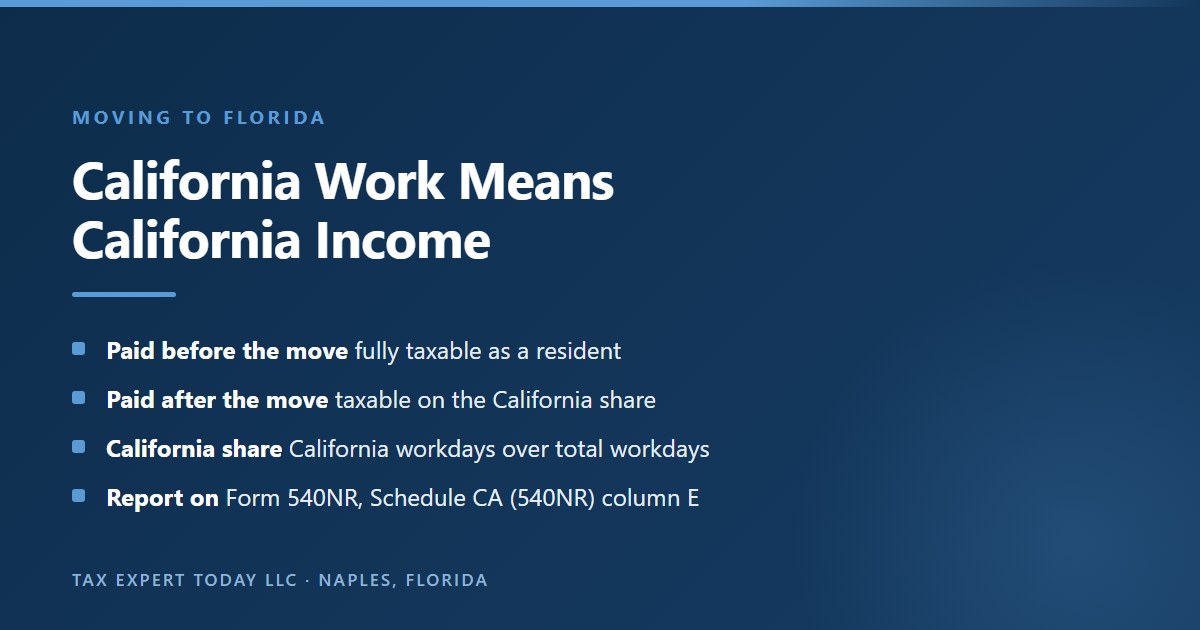
Yes. A bonus received while you are a California resident is fully taxable by California, even if part of it rewards work done elsewhere. A bonus received after you become a nonresident is taxable only on its California source part. Payment timing can therefore help with the portion earned outside California, but it cannot remove the California source portion.
- Received before the move: all of it is taxed, because residents are taxed on income from all sources.
- Received after the move: only the California workday share is taxed.
- Deferral by itself: does not change the source of a bonus for work done in California.
- Credit: a resident taxed by another state on the same bonus may claim the other state credit on Schedule S.
R&TC section 17041(i)(1) defines the taxable income of a part-year resident in two parts. For the part of the year the taxpayer was a resident, all items of gross income regardless of source. For the part of the year the taxpayer was not a resident, gross income derived from sources within California. Wages are recognized when received. So the date of payment decides which of the two rules applies, and the source decides how much the nonresident rule reaches.
Publication 1100 shows the reverse case for a move into California. A taxpayer who lived and worked in New York until April 30, 2023 and moved to California on May 1 received the last New York paycheck on May 8. The FTB says it is taxable by California because the taxpayer was a California resident when the income was received, with a credit allowed for any New York tax on it. The same timing rule cuts against a departing resident: a bonus for Florida work received a week before the move is still California taxable.
The practical consequence is narrow but real. If part of a bonus will reward work done after you leave, it is better to receive it after you are a Florida resident, because that part is then outside California’s reach. If all of the bonus rewards California work, the payment date does not matter for California purposes, and asking your employer to delay it gains nothing except a later tax year. Any request to change the timing of a bonus also needs to respect the plan terms and the federal rules on deferred compensation, which our nonqualified deferred compensation guide covers.
| Bonus rewards | Paid while a California resident | Paid after becoming a Florida resident |
|---|---|---|
| Only California work | Fully taxable by California | Fully taxable by California |
| Mixed California and Florida work | Fully taxable by California | Taxable only on the California workday share |
| Only Florida work | Fully taxable by California | Generally not taxable by California |
How Does Form 540NR Compute Tax on a Post Move Bonus?
Form 540NR taxes your California source income at the effective rate that would apply to your total income if you had been a resident all year. A post-move bonus is reported as California wages, but the rate applied to it is set by your worldwide income, so a Florida resident with large other income pays California tax at a high effective rate.
- Step one: compute tax on total taxable income as if you were a California resident all year.
- Step two: divide that tax by total taxable income to get an effective rate.
- Step three: multiply the effective rate by California taxable income.
- Additional tax: the 1 percent tax applies if California taxable income exceeds $1,000,000.
Publication 1100 states the formula directly: prorated tax equals California taxable income multiplied by the tax on total taxable income divided by total taxable income. The effective rate is the California tax on all income as if the taxpayer were a California resident for the current year. In other words, California taxes only its share of the income, but at a rate set by all of the income.
A hypothetical example shows the effect. A single Florida resident has $900,000 of total taxable income in 2027, including a $300,000 bonus that is entirely California source because it rewards 2026 work in California. Tax on $900,000 under the 2026 schedule, ignoring credits, is about $90,885, an effective rate of about 10.10 percent. California tax on the $300,000 bonus is about $30,295. The bonus is taxed at a rate set by $900,000 of income, not at the rate a $300,000 earner would pay.
The 1 percent tax uses a different base. The 2025 Form 540NR booklet computes it on line 72 when taxable income or nonresident California source taxable income is more than $1,000,000, using California taxable income from line 35. So a nonresident pays it only if California taxable income itself exceeds $1,000,000. For the full mechanics of the move-year return, including Schedule CA (540NR), see our guide to the California part-year resident tax return.
| Hypothetical line | Amount | How it is used |
|---|---|---|
| Total taxable income, as if a resident all year | $900,000 | Sets the rate |
| Tax on total taxable income, 2026 schedule | About $90,885 | Numerator of the rate |
| Effective rate | About 10.10 percent | Tax divided by total taxable income |
| California taxable income (the bonus) | $300,000 | The amount California taxes |
| California tax before credits | About $30,295 | $300,000 times the effective rate |
| Withheld at 10.23 percent, if payroll withheld | $30,690 | Credited on Form 540NR |
Should Your Employer Still Withhold California Tax After You Move?
Generally yes on the California source portion. Unemployment Insurance Code section 13020 requires withholding on wages paid to a nonresident employee for services performed in California. If payroll updated your address to Florida and stopped all California withholding, a bonus for California work may be paid with none, leaving the full tax due at filing.
- Before the move: withholding applies to all wages paid to a resident employee.
- After the move: withholding applies to wages for services performed in California.
- Common error: payroll switches the work state to Florida and withholds nothing on a bonus earned in California.
- Fix: tell payroll how much of the bonus relates to California work, or make an estimated payment.
Section 13020(a)(1) requires every employer who pays wages to a resident employee for services performed within or without California, or to a nonresident employee for services performed in California, to withhold. The DE 44 adds the working day rule for nonresidents who work in both states. Payroll systems, however, tend to key withholding to the employee’s current work location. Once a remote employee’s location is changed to Florida, the next payroll, including the annual bonus, may withhold no California tax at all.
The result is a California liability with no prepayment. In the earlier example, a $240,000 bonus with a 50 percent California share produces $120,000 of California source wages. If payroll withheld nothing, the employee owes the California tax on that amount at filing and may also owe an underpayment penalty. Our guide to California nonresident withholding covers the employer side of these rules in more detail.
Over-withholding is also common. Some employers keep withholding California tax on the entire bonus because the employee is still coded to a California office. The fix there is a refund on Form 540NR, but cash is tied up until the return is processed. Either way, the W-2 will show what payroll did, not necessarily what the law requires, and the return must reflect the correct California source amount.
| Payroll setup after the move | What happens to the bonus | Effect at filing |
|---|---|---|
| Work state still California, full withholding | 10.23 percent withheld on the whole bonus | Refund of withholding on the non-California share |
| Work state changed to Florida, no California withholding | No California withholding | Tax due on the California share, possible penalty |
| Workday allocation applied | 10.23 percent withheld on the California share only | Usually close, subject to the effective rate |
| Employer unaware the bonus covers pre-move work | Often no California withholding | Tax due on the California share |
What About a Signing, Retention, or Relocation Bonus Around a Move?
Each follows the same rules: it is wages, it is sourced to the services it compensates, and it is taxed in full if received while a California resident. Relocation payments to move to a new job are generally wages too. The answer turns on which work the payment rewards and on your residency on the payment date.
- Signing bonus for a new Florida job: generally not California source if paid after the move and tied to Florida work.
- Signing bonus received before the move: fully taxable as a California resident.
- Retention bonus from a California employer: California source for the California part of the retention period.
- Relocation payments: generally taxable wages, and reimbursements for nondeductible moving expenses are supplemental wages.
Signing and retention bonuses are the payments most often misclassified around a move. A signing bonus from a new employer in Florida is easy: if it is paid after you become a Florida resident and relates to the new job, California generally has no claim on it. The risk is a signing bonus paid in the last weeks before the move, while you are still a California resident. That payment is fully taxable by California even though the job it relates to is in Florida, and some offer letters have repayment clauses that complicate the picture if you leave early.
A retention bonus from your California employer is the reverse. It usually rewards staying through a defined period, much of which may have been spent working in California. If you moved during the retention period and the bonus was paid after the move, the California share is the California workdays in that period. The DE 231PS lists reimbursement for nondeductible moving expenses as a supplemental wage payment, and under federal law moving expense reimbursements are generally taxable wages for most employees, so a relocation package is part of the same analysis. Executives negotiating a package around a move should also read our guide to Florida domicile for executives, because the residency date and the payment date work together.
| Payment | Paid while a California resident | Paid after the move to Florida |
|---|---|---|
| Signing bonus for a Florida job | Fully taxable by California | Generally not California source |
| Retention bonus from a California employer | Fully taxable by California | California workday share of the retention period |
| Relocation lump sum | Fully taxable by California | Source follows the job it relates to; facts decide |
| Moving expense reimbursement | Supplemental wage, 6.6 percent flat rate if paid separately | Source follows the job it relates to; facts decide |
How Do Severance and a Final Bonus Interact With a Move?
Severance is a supplemental wage withheld at 6.6 percent, and a final bonus at 10.23 percent. If you leave a California job and then move, both are generally sourced to the California employment they relate to, so both stay California taxable even if paid after you become a Florida resident.
- Severance: 6.6 percent flat withholding if paid separately; sourced to the employment it ends.
- Final bonus: 10.23 percent flat withholding; sourced to the work it rewards.
- Accrued vacation payout: supplemental wages; sourced to the period in which it was earned.
- Combined effect: a large final payment package can create a shortfall because severance withholding at 6.6 percent is well below most high earners’ rates.
A departure package often combines several payments with different withholding rates. A senior employee leaving a California role might receive a prorated bonus, three months of severance, and a vacation payout, all in the same quarter. The bonus is withheld at 10.23 percent, while severance and vacation pay are withheld at 6.6 percent. For someone in the 11.3 or 12.3 percent bracket, the severance withholding is short by roughly 4.7 to 5.7 percentage points.
The move adds a sourcing question on top. Publication 1100’s final paycheck example shows that pay for California service remains California source after the employee leaves. Severance generally relates to the employment being ended, and if that employment was in California, a reasonable approach is to treat the severance as California source, allocated by workdays if the employee also worked elsewhere. This is an area where the facts and the agreement terms matter, so treat the general approach here as a starting point for the analysis rather than a rule.
| Departure payment | California flat withholding rate | Usual source after a move |
|---|---|---|
| Prorated final bonus | 10.23 percent | The work it rewards |
| Severance | 6.6 percent | The employment it ends |
| Accrued vacation payout | 6.6 percent | The period in which it accrued |
| Final regular paycheck | Wage tables | Where the work was done (Pub 1100 example) |
What If the New State Also Taxes the Bonus?
For a move to Florida, it cannot, because Florida has no personal income tax. For a move to a state with an income tax, the same bonus can be taxed by both states, and the credit for taxes paid to another state on Schedule S is the relief. Which state gives the credit depends on residency on the payment date and on the source of the income.
- California to Florida: no Florida tax; California taxes only its share after the move.
- California to a taxing state: both may tax a bonus earned in one state and received in the other.
- Resident credit: a California resident may claim credit for another state’s tax on income sourced there.
- Nonresident rule: a California nonresident generally receives the credit from the new home state instead.
Publication 1100 notes, in its New York example, that a new California resident who also paid New York tax on the same compensation is allowed a credit for taxes paid, and points to California Schedule S, Other State Tax Credit. The mirror case arises for someone who leaves California for a state that taxes residents on all income: that state may tax the bonus received after the move, while California taxes its California source share. The new state then generally gives a credit for the California tax, under its own rules.
For Florida movers, the double tax problem disappears. The remaining question is simply whether California’s share has been reported and paid, which our guide to leaving California taxes places in the context of the whole move year. If you lived in another taxing state on the way to Florida, or split the year among three states, the analysis gets more involved and our guide to the dual-state residency tax trap is the better starting point.
| Destination | Does the new state tax the bonus? | Double tax relief needed? |
|---|---|---|
| Florida | No personal income tax | No |
| Texas, Nevada, Washington (wages) | No tax on wage income | No |
| A state that taxes residents on all income | Yes, on bonuses received while a resident there | Yes, through that state’s credit or California Schedule S |
How Do Deferred Bonuses and Equity Differ From a Cash Bonus?
A cash bonus is taxed when paid. A bonus deferred under a nonqualified plan is taxed when distributed, and a former resident may be protected by the federal limit on state taxation of certain retirement income. Equity such as RSUs and options follows its own sourcing rules in FTB Publication 1004, generally based on California workdays between grant and vesting or exercise.
- Cash bonus: taxed in the year received; sourced to the period it rewards.
- Deferred bonus: taxed when paid out; certain series payments to nonresidents are protected by federal law.
- RSUs: taxed at vesting; allocated by California workdays during the vesting period.
- Stock options: nonstatutory options are wages at exercise and sourced to the services that earned them.
Equity is where most of the money is for many departing Californians, and it has its own guidance. FTB Publication 1004, the equity-based compensation guidelines, and the stock option section of Publication 1100 explain how option and restricted stock income is sourced when the holder changes residency. Publication 1100’s own example says that income from exercising nonstatutory options after a move to Texas is taxable by California when all of the services were performed in California. Our guide to California RSU tax after leaving walks through the workday allocation for RSUs, which is the most common equity question.
Deferred bonuses are different again. A bonus deferred under a nonqualified deferred compensation plan is generally not taxed until it is paid, and federal law, 4 U.S.C. section 114, bars a state from taxing certain retirement income of nonresidents, including some nonqualified plan payments made as a series of substantially equal periodic payments over at least ten years. Whether a particular deferred bonus qualifies depends on the plan design and the payment schedule. The nonqualified deferred compensation guide covers that analysis. For a plain cash bonus with no deferral, none of these protections apply.
| Form of incentive pay | When California taxes it | Source rule after a move | Where we cover it |
|---|---|---|---|
| Cash bonus | When paid | Work period it rewards | This guide |
| RSUs | At vesting | California workdays from grant to vest | California RSU tax guide |
| Nonstatutory stock options | At exercise | Services that earned the option | FTB Pub 1004, RSU guide |
| Nonqualified deferred bonus | When distributed | Service period, subject to 4 U.S.C. 114 for qualifying series payments | Nonqualified deferred compensation guide |
How Does a Bonus Show Up on the W-2 for a Part Year Resident?
Your W-2 shows the California wages and withholding your employer reported, in boxes 16 and 17. For a part-year resident those figures may not match the amount California can tax. Schedule CA (540NR) column E is where you report the correct California amount: all income while a resident, and California source income while a nonresident.
- Box 1: federal wages, including the full bonus.
- Box 16: state wages the employer assigned to California, which may be all, some, or none of the bonus.
- Box 17: California income tax actually withheld, which is the credit you claim.
- Schedule CA (540NR), column E: the California taxable amount you determine under the residency and source rules.
The Schedule CA (540NR) instructions describe column E as all income from all sources while a resident of California and income from California sources while a nonresident. That is the legal amount. Box 16 of the W-2 is the employer’s view, built from its payroll coding, and it can be wrong in either direction for the year of a move. A bonus paid after the move might appear in box 16 in full because the employer never changed the work state, or not at all because the employer changed it before the bonus run.
When box 16 and the correct California amount differ, the return should use the correct amount and keep the workpapers that explain the difference: the move date, the bonus period, the workday count, and the allocation. A mismatch between box 16 and the return is one of the things that can generate an FTB inquiry. If one arrives, our guides to the FTB notice of proposed assessment and the California residency audit explain what the FTB is likely to ask for. If a prior return got it wrong, the fix is usually a California amended tax return.
| W-2 box | What it shows | How it is used on the California return |
|---|---|---|
| Box 1 | Federal wages including the bonus | Starting point for Schedule CA (540NR) column A |
| Box 15 | State code and employer state ID | Identifies the California employer account |
| Box 16 | Wages the employer reported to California | A reference point; the return uses the correct source amount |
| Box 17 | California income tax withheld | Claimed as a payment on Form 540NR |
| Box 14 (often) | California SDI withheld | Not a credit against income tax |
What Records Prove Where a Bonus Was Earned?
The records that matter are the bonus plan or letter showing the period the bonus rewards, a calendar of where you worked each day, travel records for any trips to California, and evidence of the date your Florida residency began. Together they support the workday allocation if the FTB asks.
- Bonus terms: the plan document, offer letter, or award notice stating the performance or service period.
- Work location calendar: a day-by-day record of where you worked.
- Travel records: airline, hotel, and expense reports for California trips.
- Residency evidence: Florida driver’s license, voter registration, homestead filing, and the date of the move.
The FTB does not accept a workday percentage on its own word. It asks how the number was built. The strongest support is contemporaneous: an expense system that logs trips, a calendar that shows meeting locations, badge records from a California office. Reconstructed calendars are weaker but still useful if they are consistent with other evidence. The residency side, which decides whether California can tax the whole bonus or only part of it, is covered in our guides to establishing Florida residency and Florida domicile for executives.
| Record | What it proves | Where to get it |
|---|---|---|
| Bonus plan or award letter | The period the bonus rewards | Human resources or the plan administrator |
| Work location calendar | California and non-California workdays | Your calendar, timekeeping system, or a log you keep |
| Expense reports and travel bookings | Dates of California trips | Employer expense system, airline and hotel accounts |
| Office badge or access records | Days in a California office | Employer security or facilities |
| Florida driver’s license and voter registration | Start of Florida residency | Your own records |
| Payroll change of address and work state | When the employer recognized the move | Payroll or the employee portal |
| Final pay statement and W-2 | What was withheld and reported | Payroll |
What Are Common Mistakes With California Bonus Taxes?
The most common mistakes are treating 10.23 percent as the final tax, missing the $1,000,000 safe harbor rule, assuming a bonus paid after a move is not California income, letting payroll stop all California withholding after a move, and reporting box 16 instead of the correct California source amount.
- Rate mistake: budgeting the bonus at 10.23 percent when the real marginal rate is 11.3 to 13.3 percent.
- Safe harbor mistake: relying on 110 percent of last year’s tax in a year income reaches $1,000,000.
- Residency mistake: assuming the move ends California’s claim on income earned before it.
- Payroll mistake: not telling payroll that a bonus covers California work.
- Reporting mistake: copying box 16 to the return without checking it.
Each of these mistakes is common because each one is reasonable on its face. The paystub shows 10.23 percent, so it looks like the tax. The safe harbor worked last year, so it seems safe to use again. The new address is in Naples, so a bonus paid there feels like Florida income. Payroll changed the work state when asked. And the W-2 is an official document. None of these assumptions is reliable for a high earner in the year of a move.
| Mistake | Consequence | Correct approach |
|---|---|---|
| Treating 10.23 percent as the tax | Balance due at filing | Project tax at your marginal rate |
| Using the prior year safe harbor at $1,000,000 AGI | Underpayment penalty on each installment | Base estimates on 90 percent of current year tax |
| Ignoring the bonus because you moved | Unreported California income, possible notice of proposed assessment | Report the California source share on Form 540NR |
| Payroll stops California withholding | No prepayment on California source wages | Ask payroll to withhold on the California share, or pay estimates |
| Copying W-2 box 16 without review | Over or under reporting | Use the correct amount in Schedule CA (540NR) column E |
| Forgetting SDI has no wage limit | Smaller net bonus than expected | Budget 1.3 percent SDI on the full bonus |
| Receiving a Florida signing bonus before the move | Fully taxable by California | Time payment after the move where the terms allow |
How Can You Change California Withholding on a Bonus?
File a new Form DE 4 with your employer to request an additional amount of California withholding per pay period, or ask payroll whether it will apply additional withholding to the bonus run. You cannot change the 10.23 percent flat rate itself, but you can add to it, and extra withholding is spread back across the installments.
- DE 4: the California Employee’s Withholding Allowance Certificate, which includes a line for additional withholding.
- Federal W-4: controls only federal withholding; it does not change California withholding.
- Timing: submit the change before the bonus payroll is processed.
- Alternative: make a California estimated payment through the FTB if the employer cannot help.
The DE 4 is the California form that controls state income tax withholding on regular pay. Since 2020 the federal Form W-4 is used for federal withholding only, and the DE 4 says that if you do not give your employer a completed DE 4, the employer must use single with zero withholding allowances. Line 2 of the DE 4 lets you request an additional amount each pay period, but the form notes that the employer is not required to withhold it; if the employer declines, the fallback is single with zero allowances and, if that is still short, Form 540-ES estimates. The DE 44 has a section on what an employer should do when an employee wants additional personal income tax withheld. Because California treats withholding as paid in the installment percentages rather than on the actual date, an additional amount withheld from a late bonus has more value than the same amount paid as a January estimate.
For someone who has moved, the DE 4 conversation also covers the work state. A short written note to payroll stating the move date and asking that California withholding continue on any payment for work performed before that date, at the appropriate workday share, is often enough to prevent the no-withholding problem described earlier.
| Tool | What it controls | Best use for a bonus |
|---|---|---|
| Form DE 4 | California withholding on regular pay, plus additional amounts | Add withholding before the bonus run |
| Federal Form W-4 | Federal withholding only | Federal side of the same bonus |
| Payroll request for extra bonus withholding | One-time additional state withholding | Cover the shortfall above 10.23 percent |
| Form 540-ES or Web Pay | California estimated payments | When the employer cannot add withholding in time |
| Written note to payroll after a move | Work state coding and workday share | Keep California withholding on pre-move work |
What Is the California Bonus Tax Calendar for 2026 and 2027?
For 2026, the key California dates are the estimated tax installments of April 15, June 15, and January 15, 2027, the January 31, 2027 early filing option, and the April 15, 2027 filing and payment deadline. A 2026 bonus paid in early 2027 moves into the 2027 calendar.
- Before the bonus is paid: project the tax and file a DE 4 if extra withholding is needed.
- December 2026: confirm payroll coding if you have moved.
- January 15, 2027: fourth 2026 installment, 30 percent.
- April 15, 2027: 2026 return and any balance due.
The dates come from the 2026 Form 540-ES instructions and the FTB’s estimated tax page. If the payment is late, interest and penalties apply; our guide to the California late payment penalty explains how the FTB computes them. California also allows an automatic extension to file, but not to pay, so the balance due on a bonus year must be paid by April 15 even if the return is filed later.
| Date | California event | Bonus planning step |
|---|---|---|
| April 15, 2026 | First 2026 installment, 30 percent | Include any known first quarter bonus |
| June 15, 2026 | Second 2026 installment, 40 percent | Include any bonus paid by mid year |
| September 15, 2026 | Third installment, 0 percent in California | No California payment required |
| November to December 2026 | Bonus payroll for many employers | File DE 4 changes and confirm work state coding |
| January 15, 2027 | Fourth 2026 installment, 30 percent | Pay the shortfall on a December bonus |
| January 31, 2027 | Early filing option | File and pay in full to skip the fourth installment |
| February to March 2027 | 2026 bonuses paid in 2027 | Treat as 2027 income; check residency on the payment date |
| April 15, 2027 | 2026 return and payment due; first 2027 installment | Pay the 2026 balance; start 2027 estimates |
What Should a High Earner Check Before a Year End Bonus Is Paid?
Before a year end bonus is paid, check your projected 2026 California taxable income against the bracket table, confirm whether adjusted gross income will reach $1,000,000, decide whether to add withholding through a DE 4, and, if you moved, confirm how payroll will treat the bonus and what period it covers.
- Bracket check: will the bonus land above the 9.3 percent bracket?
- Safe harbor check: will 2026 AGI reach $1,000,000?
- Withholding check: is extra state withholding on the bonus the cheapest way to cover the gap?
- Residency check: will you be a California resident on the payment date?
- Payroll check: is the work state coding correct for the bonus period?
The checklist below can be worked through in an hour with a pay statement, last year’s return, and the bonus letter. It does not replace a full projection, but it catches the five issues that produce most bonus-related balances due and notices. For a broader view of the move year itself, our guide to leaving California taxes and the companion page on moving from California to Florida cover the other items that change when you leave.
| Check | Question | If the answer is yes |
|---|---|---|
| Bracket | Will 2026 taxable income exceed $384,109 single or $768,218 joint? | Expect a balance due on the bonus; plan the payment |
| Additional tax | Will taxable income exceed $1,000,000? | Add 1 percent on the excess to the projection |
| Safe harbor | Will AGI reach $1,000,000? | Base estimates on 90 percent of current year tax |
| Withholding | Is the projected shortfall material? | File a DE 4 or request extra bonus withholding |
| Residency | Have you moved, or will you before payment? | Determine the California source share |
| Payroll | Has payroll changed your work state? | Confirm withholding on the California share |
Frequently Asked Questions About the California Bonus Tax Rate
What is the California bonus tax rate in 2026?
The California bonus tax rate in 2026 is a 10.23 percent flat withholding rate on bonuses and stock options paid separately from regular wages, under R&TC section 18663. Other supplemental pay, such as commissions and overtime, uses 6.6 percent. These are withholding rates; the bonus is taxed on your return at ordinary rates up to 12.3 percent, plus 1 percent over $1,000,000.
Is a bonus taxed at a higher rate in California?
No. California taxes a bonus as ordinary wage income at the same progressive rates as salary. The 10.23 percent withheld is a prepayment. If your marginal rate is 9.3 percent you usually get some of it back, and if your income reaches the 11.3 or 12.3 percent brackets you usually owe more at filing.
Why was 10.23 percent withheld from my bonus?
Your employer paid the bonus separately from your regular wages and chose the flat rate method. R&TC section 18663(c)(2) sets that rate at 10.23 percent for bonuses and stock options paid on or after November 1, 2009. It equals the 9.3 percent bracket plus a 10 percent cushion.
Do I owe California tax on a bonus if I make over $1 million?
Yes, and usually more than was withheld. Taxable income over $1,000,000 carries an extra 1 percent tax under R&TC section 17043, so the top marginal rate is 13.3 percent against 10.23 percent withheld. Adjusted gross income of $1,000,000 or more also removes the prior year estimated tax safe harbor under R&TC section 19136.3.
Is SDI taken out of a bonus in California?
Yes. The 2026 SDI withholding rate is 1.3 percent and, since January 1, 2024, there is no SDI taxable wage limit. Every dollar of a bonus is subject to SDI, so a $100,000 bonus has $1,300 of SDI withheld. SDI is a separate payroll tax and is not a credit against California income tax.
Does California tax a bonus paid after I move to Florida?
Yes, to the extent the bonus pays for work you performed in California. A nonresident is taxed on California source income, and compensation is sourced where the services were performed. FTB Publication 1100 treats a final paycheck received after a move out of state as California income for that reason.
How is a bonus allocated if I moved during the year?
A bonus received after the move is generally allocated by working days. Divide the California workdays in the period the bonus rewards by the total workdays in that period and multiply by the bonus. A bonus received while you were still a California resident is fully taxable, regardless of where the work was done.
Should my employer withhold California tax on a bonus after I move?
Generally yes on the California source portion. Unemployment Insurance Code section 13020 requires withholding on wages paid to a nonresident for services performed in California. If payroll changed your work state to Florida, it may withhold nothing, which leaves the California tax due at filing.
How are federal and California bonus withholding different?
Federal withholding on a separate bonus is 22 percent, and 37 percent is mandatory on supplemental wages above $1,000,000 in a year. California withholds 10.23 percent at every level with no step up. That is why the California shortfall grows with the bonus size while the federal one does not.
Can a Naples, Florida advisor handle my California bonus taxes?
Yes. California part-year and nonresident returns are filed with the Franchise Tax Board electronically, so the preparer does not need to be in California. A Naples, Florida advisor can project the tax on the bonus, allocate it by workdays, coordinate withholding, and prepare Form 540NR.
California Bonus Tax Help in Naples & Southwest Florida
Tax Expert Today works with executives and professionals in Naples, Florida and across Southwest Florida who still receive California bonuses, severance, or deferred pay after a move. We project the California tax on the bonus, allocate it by workdays, coordinate withholding, and prepare the Form 540NR that reports it.
- California bonus tax help Naples: projections of the real California tax on a bonus, not just the withholding.
- Move year allocation: workday counts, bonus period analysis, and Schedule CA (540NR) reporting.
- Estimated tax planning: the $1,000,000 safe harbor rule, installment timing, and extra withholding.
- Payroll coordination: written guidance you can send to payroll about California withholding after a move.
Our office is at 11983 Tamiami Trail N, Naples FL 34110. Call (239) 441-2005, Monday through Friday, 10:00 to 5:00 Eastern Time. We are a multidisciplinary firm of tax advisors, enrolled agents, CPAs, and attorneys, and we handle state residency and tax matters nationwide, including California part-year and nonresident returns for clients who now live in Florida. For the wider California picture, see our California tax services page and our Naples tax planning page. If your move is recent, our guides to the California exit tax question and to nonresident state tax returns are useful next reads.
Local FAQ: I moved from Palo Alto to Naples in August and my employer will pay my 2026 bonus in March 2027. Payroll now lists my work state as Florida. Will California tax the bonus? Most likely in part. If the bonus rewards 2026 performance and you worked in California until August, the California workdays in 2026 divided by your total 2026 workdays set the share California can tax, and you report it on a 2027 Form 540NR. Because payroll now codes you to Florida, it may withhold no California tax on the bonus, so plan an estimated payment or ask payroll to withhold on the California share. Bring the bonus letter and your 2026 work calendar, and we can work out the allocation from Naples.
When to Engage a Professional
Engage a professional when a bonus will push California taxable income above the 9.3 percent bracket or adjusted gross income to $1,000,000, when you moved during the period the bonus covers, when payroll changed your work state, when a departure package combines bonus, severance, and vacation pay, or when equity vests in the same year.
- High income years: any year with a bonus that reaches the 11.3 or 12.3 percent brackets or the 1 percent tax.
- Move years: a bonus period that spans the move date.
- Payroll changes: a work state change in the year of a bonus.
- Departure packages: several kinds of supplemental pay with different withholding rates.
- Equity overlap: RSUs or options vesting in the same year as a cash bonus.
The California bonus tax rate is a simple number that hides a set of real decisions. For most employees the 10.23 percent withholding is close enough and the return sorts out the rest. For a high earner, and for anyone in the year of a move to Florida, the gap between withholding and tax can be large, the estimated tax rules change at $1,000,000, and California’s claim on a bonus can follow you to Naples. A projection done before the bonus is paid is almost always cheaper than a penalty computed after it. You can reach us through our contact page or by phone.
This article provides general information about California withholding and personal income tax rules as of its publication date and is not legal or tax advice for any particular situation. The examples are hypothetical and simplified, use the 2026 FTB rate schedules, and ignore credits. Sourcing of a particular bonus depends on its terms and on where the work was performed, and the result for your situation may differ. Call (239) 441-2005 to discuss your situation.
Published November 3, 2026 by Dr. Pellumb Kabashi « Back to Learning Center
Have a question this article touches on?
Tax Expert Today LLC, based in Naples, Florida and serving clients across the United States.
Schedule a Consultation (239) 441-2005