
By Dr. Pellumb Kabashi, DBA, MBA, CES, CFE, EA
Founder, Tax Expert Today LLC · Tax advisors, enrolled agents, CPAs, and attorneys · Serving clients in all 50 states
Quick Answer: An FTB installment agreement lets a taxpayer pay a California income tax balance monthly instead of at once. Revenue and Taxation Code section 19008(b) requires the Franchise Tax Board to accept one when five conditions are met, including a tax liability of $25,000 or less and full payment within five years. Approval turns on ability to pay and compliance history. Call (239) 441-2005 for a free consultation.
Most published guidance on the California payment plan stops at the brochure. It repeats the $25,000 ceiling, the $34 fee, and the ninety day processing window, and then sends the reader to an online application. None of that answers the question a taxpayer with a real balance is actually asking, which is what decides whether the Franchise Tax Board says yes, and what the agreement does and does not protect once it is in place.
Those answers sit in the statute rather than on the agency web pages. Revenue and Taxation Code section 19008 does something the FTB website never states plainly: in a defined band it removes the agency’s discretion entirely. It also bars the state from levying during several specific windows, including one that opens the moment a request is submitted and another that runs for thirty days after a rejection. This guide works through the statute, the current agency terms, and the differences from a federal payment plan that catch California taxpayers who assume the two agencies behave alike.
What Is an FTB Installment Agreement?
An FTB installment agreement is a contract under Revenue and Taxation Code section 19008 in which the Franchise Tax Board accepts monthly payments of a California income tax liability instead of immediate payment in full. It covers tax, interest, penalties, fees, and related amounts, and the FTB enters it when the agency determines that doing so will facilitate full or partial collection of the balance.
- Statutory basis. Section 19008(a) authorizes agreements covering liabilities under Part 10, Part 11, or Part 10.2, including additions to tax, interest, penalties, and fees.
- Two doors. Subdivision (a) is discretionary and turns on financial hardship. Subdivision (b) is mandatory and turns on five objective conditions.
- Not forgiveness. The agreement changes the timing of payment only. It reduces nothing, and interest continues to run under section 19101.
- Paper and electronic paths. The request is made online, by telephone, or on Form FTB 3567, Installment Agreement Request.
The Franchise Tax Board is direct about its preference. Form FTB 3567 opens by stating that the agency will always ask for immediate payment in full and encourages taxpayers to borrow from private sources first. An installment agreement is what follows a determination that immediate payment is not possible, which is why ability to pay sits at the center of the approval question.
When Must the FTB Accept an FTB Installment Agreement?
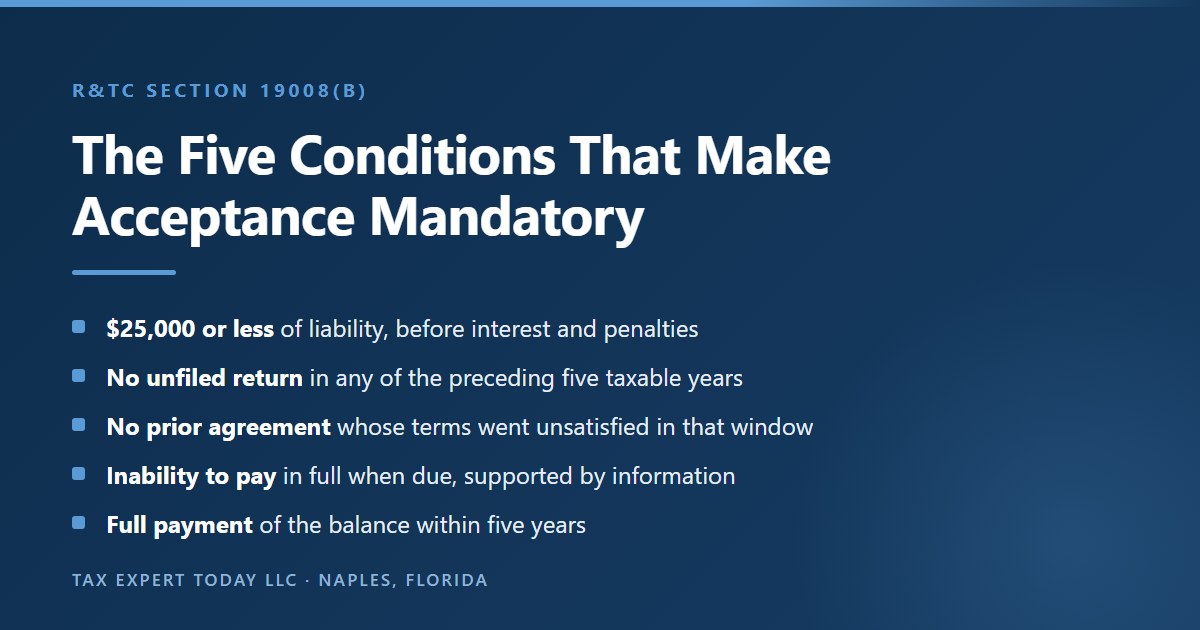
Section 19008(b) states that the Franchise Tax Board shall enter into an agreement when five conditions are all satisfied as of the date the individual offers to enter it. Inside that band the agency has no discretion to refuse. Outside it, the request falls back to the discretionary standard in subdivision (a), where financial hardship and the prospect of collection govern.
This is the most consequential fact on the topic and the agency web pages do not state it. They present the $25,000 figure as an eligibility ceiling for a convenience feature. The statute presents it as the outer edge of a taxpayer entitlement.
| Condition, section 19008(b) | What it requires |
|---|---|
| (b)(1) Amount | Aggregate liability, determined without regard to interest, penalties, additions to tax, and additional amounts, does not exceed $25,000 |
| (b)(2)(A) Filing history | Neither the taxpayer nor, on a joint liability, the spouse or registered domestic partner failed to file any required return during any of the preceding five taxable years |
| (b)(2)(B) Agreement history | Neither party failed to satisfy any term of a prior installment agreement under this section during those same five taxable years |
| (b)(3) Inability to pay | The FTB determines the taxpayer cannot pay in full when due, and the taxpayer submits the information the agency requires to reach that determination |
| (b)(4) Term | The agreement requires full payment of the liability within five years |
| (b)(5) Future compliance | The taxpayer agrees to comply with Part 10 and Part 10.2 for the period the agreement is in effect |
Conditions (b)(2)(A) and (b)(2)(B) are separate tests inside a single paragraph, which is why the table lists them apart. A taxpayer who filed every return on time for five years but defaulted on an earlier installment agreement in that window falls outside the mandatory band, even though the agency pages describe only the filing requirement.
How Is the $25,000 Threshold Actually Measured?
The statutory $25,000 in section 19008(b)(1) is measured on the underlying liability determined without regard to interest, penalties, additions to tax, and additional amounts. The federal $50,000 threshold is measured the opposite way, on combined tax, penalties, and interest. Two taxpayers with identical total balances can therefore land on different sides of their respective thresholds.
- California counts the tax. Accrued interest and the late payment penalty are stripped out before the comparison.
- The federal figure counts everything. The IRS states its simple payment plan threshold as $50,000 or less in combined tax, penalties, and interest.
- The practical effect. A California balance that has aged for several years can show a total well above $25,000 while the tax itself remains inside the mandatory band.
- The agency shorthand differs. The FTB payment plans page says only that the amount due must not exceed $25,000, which is the self service rule rather than the statutory test.
The distinction is not academic. Interest under section 19101 runs from the original due date of the return, and the California late payment penalty can reach a substantial share of the tax on its own. A taxpayer who reads the agency page, adds up a notice total of $31,000, and concludes that the mandatory band is closed has misread which number the statute uses. Our guide to the California late payment penalty and interest works through how those additions build on a balance over time.
What Does the FTB Mean by Compliance History?
The Franchise Tax Board states in its own payment plan terms that it approves or rejects a request based on ability to pay and compliance history. Section 19008(b)(2) supplies the content of that phrase inside the mandatory band: no failure to file a required return, and no failure to satisfy the terms of a prior installment agreement, in either case during any of the preceding five taxable years.
- Five taxable years, not five calendar years. The lookback is measured in taxable years preceding the offer.
- A joint liability doubles the exposure. The test applies to the taxpayer and to the spouse or registered domestic partner when the liability relates to a joint return.
- A prior default counts. Failure to satisfy any term of an earlier agreement, not merely a missed payment, falls inside paragraph (b)(2)(B).
- Misrepresentation is fatal. The agency terms state that if the taxpayer fails to prove or misrepresents financial condition, the FTB may reject the request.
Outside the mandatory band the same two words carry more weight rather than less, because subdivision (a) leaves the decision to the agency. There the question becomes whether the agreement will facilitate full or partial collection, which is a judgment about the taxpayer’s circumstances rather than a checklist.
What Does an FTB Payment Plan Cost to Set Up?
A personal FTB installment agreement carries a $34 setup fee and a business agreement carries $50, and in both cases the agency adds the fee to the balance rather than collecting it separately. The FTB states that the fee amount is subject to change without further notice. Interest and applicable penalties continue to accrue on the unpaid balance throughout the agreement.
| Term | Personal | Business |
|---|---|---|
| Setup fee | $34, added to the balance | $50, added to the balance |
| Self service balance ceiling | $25,000 | $25,000 |
| Typical term the FTB describes | Three to five years | Up to twelve months |
| Maximum term for the self service path | 60 months or less | 12 months or less |
| Return filing condition | All income tax returns filed for the past five years | All tax returns filed |
| Processing time | Up to 90 days | Up to 90 days |
| Telephone line | 800-689-4776 | 888-635-0494 |
| Electronic funds transfer | Required when applying online | Required when applying online |
Business taxpayers should note one condition that has no personal analog. The FTB business terms state that payment in full under an installment agreement does not reinstate an entity’s status if the entity was not in good standing before the request, and that additional action may be required. A suspended limited liability company does not revive itself by paying the balance, which matters when the entity needs to contract, sue, or complete a sale. Our guide to the California LLC franchise tax covers the revivor sequence in more detail.
How Long Does FTB Approval Take, and What Should You Pay Meanwhile?
The Franchise Tax Board states that processing an installment agreement request may take up to 90 days. During that period the agency instructs taxpayers to keep making the payments they proposed, both to limit further interest and penalties and to prevent the balance from being referred to collections or reaching a wage garnishment.
- Ninety days is the stated outside figure for both personal and business requests.
- Mail and telephone applicants should receive written notification within 30 days according to Form FTB 3567, and the form directs a call to 800-689-4776 if nothing arrives.
- Online applicants check status using the social security number and the confirmation number issued at submission.
- Acceptance arrives by letter confirming the payment amount, the due date of each monthly payment, and when the first payment falls due.
Paying the proposed amount during the review window is more than good manners. Section 19008(b)(3) conditions mandatory acceptance on a determination that the taxpayer cannot pay in full when due, and voluntary payments in the interim demonstrate the good faith the agency weighs under the discretionary standard. They also reduce the interest that section 19101 accrues from the original due date of the return.
Can You Apply for an FTB Payment Plan Online?
Sometimes, and considerably less often than the agency front end suggests. Form FTB 3567 states that only newly assessed liabilities may qualify for an online installment agreement. The FTB separately lists four situations that block the online path entirely, in which case the taxpayer must telephone the agency rather than submit a request through the web application.
- An existing installment agreement with the FTB closes the online path.
- A wage garnishment, which California issues as an earnings withholding order for taxes, closes it.
- A bank levy, issued as an order to withhold, closes it.
- Other collection orders, including a warrant or a continuous order to withhold, close it.
- An older assessment may fall outside the newly assessed limitation even with none of the above present.
| Situation | Online application | What the FTB directs instead |
|---|---|---|
| Newly assessed balance, no collection action | Available | Apply online with recurring electronic funds transfer |
| Older assessment, no collection action | May not qualify | Form FTB 3567 by mail, or telephone |
| Existing installment agreement in place | Blocked | Telephone 800-689-4776, and do not file Form FTB 3567 |
| Earnings withholding order for taxes | Blocked | Telephone 800-689-4776, and do not file Form FTB 3567 |
| Order to withhold on a bank account | Blocked | Telephone the agency to apply |
| Warrant or continuous order to withhold | Blocked | Telephone the agency to apply |
This matters because the taxpayers most likely to search for a payment plan are frequently the ones already carrying a collection action, and they are precisely the group the online application will not serve. Form FTB 3567 is equally direct on the paper side, instructing taxpayers not to submit the form at all if they have an existing agreement or a current garnishment, and to call 800-689-4776 instead.
For those who do apply online, electronic funds transfer with recurring withdrawals is mandatory. The withdrawal date must fall no later than the 28th of the month. If a later date is selected the FTB withdraws on the 28th regardless, and failing to select a date delays processing of the request.
Does an FTB Installment Agreement Stop a Levy?
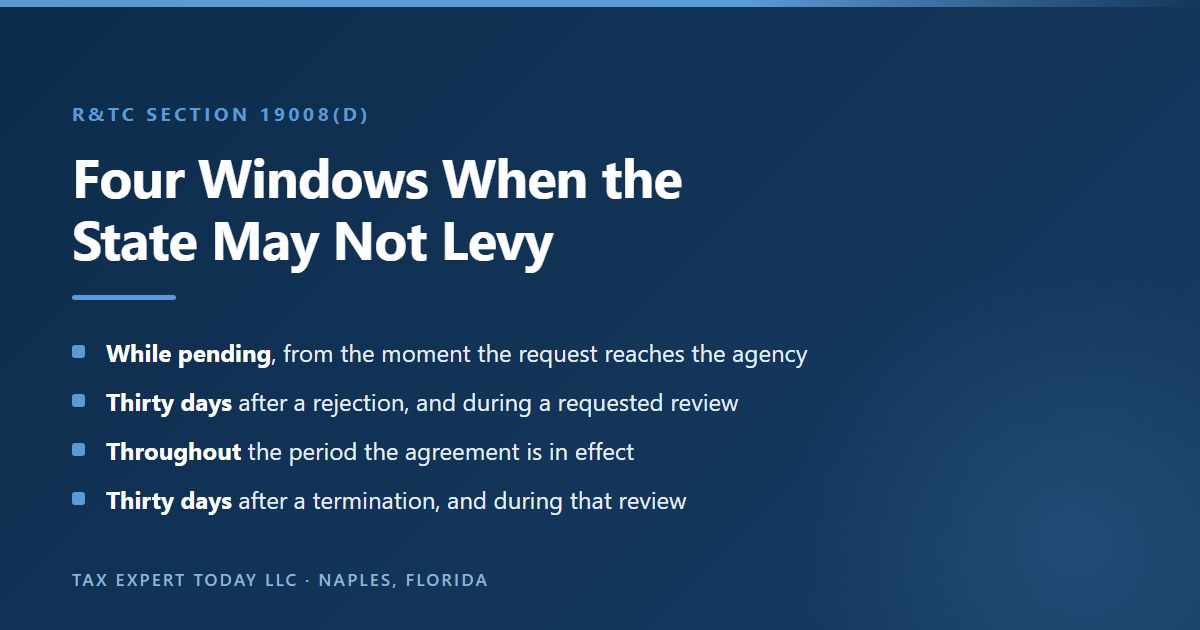
Yes, and the protection begins earlier than most taxpayers expect. Section 19008(d) bars the Franchise Tax Board from issuing a levy on property or rights to property during four separate periods, the first of which opens while the request is merely pending. The bar is statutory rather than a matter of agency practice.
| Period, section 19008(d) | When the levy bar runs |
|---|---|
| (d)(1) Request pending | While an offer for an installment agreement is pending with the FTB |
| (d)(2) After a rejection | For 30 days after rejection, and, if review is requested within those 30 days, while that review is pending |
| (d)(3) Agreement in effect | For the entire period the installment agreement is in effect |
| (d)(4) After a termination | For 30 days after the FTB terminates the agreement, and during a review requested within those 30 days |
Four exceptions in section 19008(d)(5) narrow the protection, and each deserves attention before a taxpayer relies on the bar.
- Written waiver. A taxpayer who files a written notice waiving the restriction gives up the protection for that liability.
- Jeopardy. The bar does not apply where the FTB finds collection of the liability to be in jeopardy.
- Levies already issued. A levy first issued before the relevant proceeding commenced is unaffected, so submitting a request does not lift a garnishment that is already running.
- Repeat offers. Where a taxpayer makes a further offer after an earlier one was rejected, the FTB may disregard the bar at its discretion.
Section 19008(d)(5)(D) adds a consequence that cuts the other way. The period of limitation under section 19371 is suspended for the time during which the levy bar applies, so the protection extends the window in which California can pursue the balance through a court proceeding.
The third exception is the one that disappoints taxpayers most often. California issues wage garnishments as earnings withholding orders for taxes and bank levies as orders to withhold, and a request submitted after one of those is already in place does not stop it. The statutory bar reaches levies the agency has yet to issue, not collection that has already begun, which is a different rule from the release mechanics that apply on the federal side. Our guides to stopping a federal wage garnishment and to an IRS bank levy release describe those federal procedures, which do not transfer to a Franchise Tax Board collection action.
What Records Should You Gather Before Requesting an FTB Payment Plan?
Assemble the records that answer the two questions the Franchise Tax Board actually asks, which are ability to pay and compliance history. The agency may request a financial statement as a condition for approval, and section 19008(b)(3) requires the taxpayer to submit whatever information the FTB needs to determine that full payment when due is not possible.
- Every notice for every year. The assessment year and the amount assessed decide which liabilities the request must cover.
- The tax figure separated from the additions. Section 19008(b)(1) measures the threshold on the liability without interest, penalties, and additions to tax, so the notice total is the wrong number for that test.
- Five years of filing history. Both spouses on a joint liability, and any prior installment agreement and how it ended.
- Current income and expenses. Enough to support a proposed monthly figure that pays the balance inside five years.
- Bank routing and account numbers. A regular checking or savings account is required, and Form FTB 3567 states that a deposit slip is not a reliable source for those numbers.
- Current withholding. The Form DE 4 and Form W-4 on file, since the agreement requires confirming that they will cover the following year.
The second item is where most self prepared requests go wrong. A taxpayer who compares a notice total against $25,000 may conclude that the mandatory band is unavailable when the tax alone sits comfortably inside it, and will then apply under the discretionary standard without the statutory entitlement that was actually available.
Does an FTB Installment Agreement Stop a State Tax Lien?
No. The Franchise Tax Board states in its own terms that it may file a lien as a condition for approval, which reverses the intuition most taxpayers bring from the federal system. A California state tax lien can be the price of the agreement rather than a consequence of defaulting on it, and the FTB notes that this may affect a credit report.
- The condition is explicit. The agency terms state that the FTB may file a lien or request a financial statement as a condition for approval.
- The payment plans page repeats it. That page states plainly that a tax lien may be a condition of the arrangement.
- The reach is broad. Government Code section 7170 attaches the lien to all property and rights to property in the state, real or personal, tangible or intangible, including after acquired property.
- A homestead declaration does not block it. Section 7170(a) states that the lien attaches to a dwelling notwithstanding a previously recorded homestead declaration.
The release timing is worth knowing in advance. FTB Publication 1140 states that once the liability is paid, the agency records a certificate of release with the county recorder, or files it with the California Secretary of State, no later than 40 days after payment. Where payment is made by check, that 40 day period does not begin until the financial institution honors the check. A taxpayer clearing a lien before a closing should plan around that sequence rather than the payment date.
The contrast with current federal practice is sharp. The IRS removed the notice of federal tax lien determination requirement for its simple payment plan, so the standard federal agreement at that level now involves no lien determination at all. California moved in the opposite direction and treats the lien as an available condition of approval. Our guide to federal tax lien withdrawal on Form 12277 covers the separate federal mechanism.
What Happens If the FTB Rejects Your Request?
A rejection carries a thirty day clock that decides whether collection pauses. Section 19008(e) directs the Taxpayers’ Rights Advocate to establish an independent departmental administrative review for rejected offers and for terminated agreements. Unless the taxpayer requests that review within 30 days, the review does not stay collection of the liability.
- The notice states a reason. FTB Publication 1140 confirms that a rejection notice sets out the reason for the rejection.
- The request must be written. Form FTB 3567 directs the taxpayer to request the independent administrative review in writing within 30 days of the rejection date.
- Where it goes. The form gives the address as Executive and Advocate Services, MS A381, PO Box 157, Rancho Cordova CA 95741-0157.
- Miss the window and collection resumes. Form FTB 3567 states that collection actions may resume if the request is not made, and section 19008(e) removes the stay.
- It is not an APA proceeding. Section 19008(e) provides that the review is not subject to Chapter 4.5 of Part 1 of Division 3 of the Government Code.
California offers no state analog to the federal collection due process hearing, which is an independent statutory right with access to the United States Tax Court. The section 19008(e) review is a departmental process, and the thirty day deadline that protects it runs from the date on the rejection notice rather than from receipt. Taxpayers accustomed to the federal route should read our guide to the collection due process hearing for the comparison, and should not expect the same forum on a California balance.
When Can the FTB Terminate an FTB Installment Agreement?
Section 19008(c)(2) lists six grounds on which the Franchise Tax Board may alter, modify, or terminate an agreement entered into on or after January 1, 2024. Except where collection is in jeopardy, the agency must give notice not later than 30 days before the action and must include an explanation of its rationale.
| Ground, section 19008(c)(2)(A)(i) | What triggers it |
|---|---|
| (I) Inaccurate information | Information the taxpayer provided before the agreement was entered was inaccurate or incomplete |
| (II) Jeopardy | The FTB determines that collection of the liability is in jeopardy |
| (III) Changed finances | The taxpayer’s financial condition has significantly changed |
| (IV) Missed payment | The taxpayer fails to make an installment payment when it is due |
| (V) New noncompliance | The taxpayer fails to file a required return or to pay any other liability when due |
| (VI) No financial update | The taxpayer fails to provide a financial condition update on the FTB request |
Ground (V) is the one that ends most agreements, and it reaches beyond the balance under the agreement. A taxpayer who pays every monthly installment on time but files the next year’s return late, or lets a new year’s balance go unpaid, has given the FTB a termination ground. The agency may also modify the agreement to fold in a liability the taxpayer fails to pay when due, under section 19008(c)(2)(A)(ii).
Two procedural points are easy to miss. First, the thirty day notice and rationale requirement applies to agreements entered on or after January 1, 2024, following the amendment made by Stats. 2023, Ch. 209. Agreements entered before that date fall under the older paragraph, which renders an agreement null and void on a failure to comply fully unless the FTB determines the failure was due to reasonable cause. Second, where a taxpayer is already in an agreement under subdivision (a) or (b), section 19008(c)(2)(A)(iii) allows the FTB to require financial hardship before it will alter or modify the existing terms, so a request to lower a payment is not a routine adjustment.
Form FTB 3567 describes the same thirty day notice from the taxpayer side, stating that the agency will send notice of its intent to terminate thirty days before the termination and will state the reason for the action. Section 19008(f) adds that the FTB reviews a representative sample of existing agreements at least once every two years, and the personal terms state that agreements above $25,000 or running beyond 60 months are subject to periodic review.
How Does an FTB Installment Agreement Differ From an IRS Payment Plan?
The two agreements differ on nearly every operative term, and the federal side changed materially in July 2026 when the Internal Revenue Service replaced the streamlined installment agreement with the simple payment plan and removed the seventy two month maximum term. Guidance written before that date, including much of what still ranks, describes a federal plan that no longer exists.
| Feature | FTB installment agreement | IRS simple payment plan |
|---|---|---|
| Threshold for the standard path | $25,000 | $50,000 |
| How the threshold is measured | Liability without regard to interest, penalties, and additions to tax | Combined tax, penalties, and interest |
| Required payoff period | Within five years under section 19008(b)(4) | By the collection statute expiration date, with no fixed month cap since July 2026 |
| Self service term ceiling | 60 months personal, 12 months business | No stated month ceiling |
| Setup fee | $34 personal, $50 business | $29 for a long term plan paid by automatic withdrawal, waived for low income taxpayers |
| Lien treatment | May be filed as a condition for approval | No lien determination required for a simple payment plan |
| Collection window on the balance | Twenty years under section 19255 | Ten years after assessment under IRC section 6502(a)(1) |
| Review of a rejection | Departmental review under section 19008(e), 30 days | Collection due process rights with access to the United States Tax Court |
| Financial statement | FTB may request one as a condition for approval | Generally not required inside the simple payment plan band |
Two rows carry most of the practical weight. The threshold measurement row explains why a taxpayer can qualify federally and not at the state level, or the reverse, on the same underlying facts. The collection window row is the one that changes strategy, and it deserves its own treatment below.
Readers working a federal balance in parallel should see our guides to IRS installment agreement options and to the partial payment installment agreement, which has no direct California equivalent. The financial statement the FTB may request performs the function that Form 433-A performs federally.
How Long Does California Have to Collect?
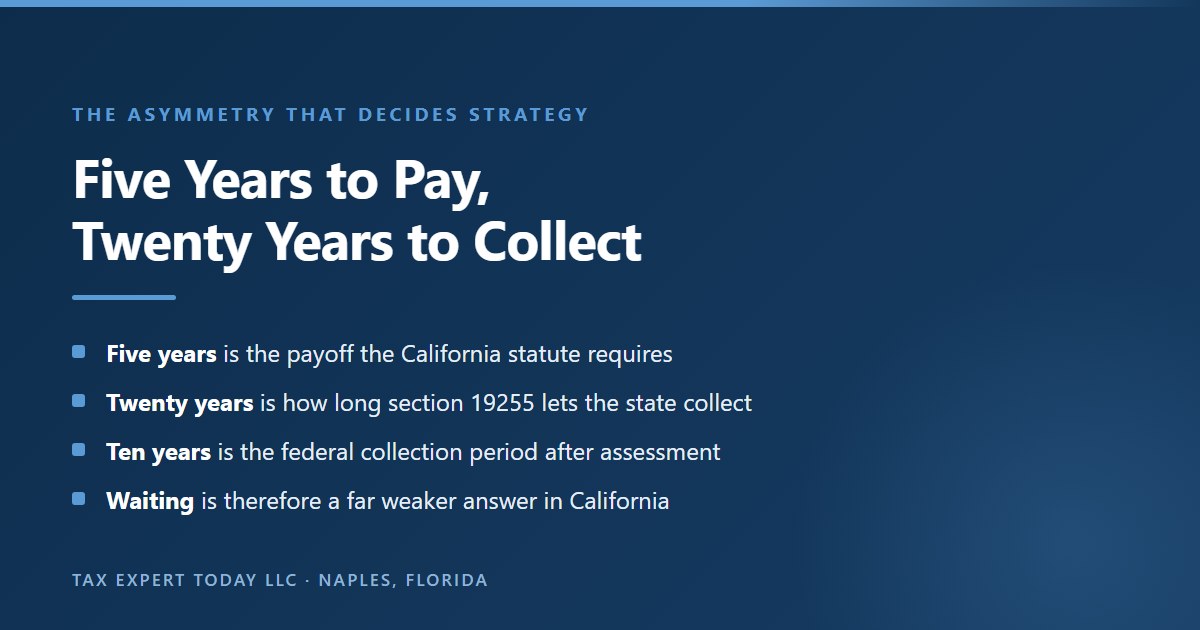
Twenty years. Revenue and Taxation Code section 19255 provides that after 20 years have lapsed from the date the latest liability for a taxable year became due and payable within the meaning of section 19221, the Franchise Tax Board may not collect the amount and the liability is abated by lapse of time. The federal period under IRC section 6502(a)(1) is ten years after assessment.
- The clock can restart in effect. Where more than one liability is due and payable for a taxable year, section 19255(c)(2) provides that the later date starts the twenty year period.
- Abatement is automatic in form. Collection actions on an uncollectible liability must be released, withdrawn, or otherwise terminated, and no further administrative or civil action may be brought.
- Amounts collected afterward are overpayments. Section 19255(a) treats any amount received in contravention of the section as an overpayment that may be credited and refunded.
- Suspensions apply. Section 19255(e) suspends the period for defined intervals, including time during which bankruptcy prevents collection.
- A judgment changes the analysis. Under section 19255(b), a timely civil action or a probate claim extends collectability until the judgment is satisfied or becomes unenforceable.
The strategic consequence is the one point on this topic that most changes how a case is handled. A federal balance can sometimes be managed against the collection statute expiration date, because ten years is a period a taxpayer can realistically outlast. A California balance carries twice that window, and section 19008(d)(5)(D) suspends the section 19371 period while the levy bar is running. Waiting is therefore a far weaker strategy against the Franchise Tax Board than against the Internal Revenue Service, and the five year payoff the statute requires under section 19008(b)(4) sits inside a collection window four times its length.
What Happens to Your Refunds During an FTB Installment Agreement?
The Franchise Tax Board keeps them. Form FTB 3567 states that the agency will retain any state tax refund due and apply it toward the liability, and that this action does not replace the monthly payment. The agency may also submit the account to the Federal Treasury Offset Program and intercept funds owed by other California state agencies.
- State refunds are applied, not credited forward. The monthly installment remains due in full in the same month.
- Federal refunds are reachable. An offset through the Federal Treasury Offset Program applies a federal refund to the state income tax debt, and an additional offset fee may apply.
- Future federal payments. Form FTB 3567 states that if the full amount is not collected in one year, the agency may offset future federal payments.
- Other agencies. Interception may reach funds due from other California state agencies under Government Code sections 926.8 and 12419 through 12419.12.
| Source of funds | What the FTB does with it | Effect on the monthly payment |
|---|---|---|
| California income tax refund | Retained and applied to the liability | None, the installment remains due in full |
| Federal income tax refund | May be offset through the Federal Treasury Offset Program | None, and an additional offset fee may apply |
| Future federal payments | May be offset if the balance is not collected within one year | None |
| Amounts due from another California agency | May be intercepted under Government Code sections 926.8 and 12419 through 12419.12 | None |
| Voluntary extra payment | Applied to the balance and reduces accruing interest | Does not substitute for the next installment |
Taxpayers frequently plan a payoff around an expected refund and then find that the refund reduced the balance without reducing the payment obligation. The FTB has been consistent on this point across both the form and Publication 1140, and the agreement terms require the monthly payment regardless.
Do Interest and Penalties Continue During the Agreement?
Yes. An installment agreement changes the timing of payment and nothing else. Interest accrues under Revenue and Taxation Code section 19101 from the original due date of the return until the FTB receives full payment, and interest also accrues on penalties from the effective date of each penalty. The agreement suspends no charge.
- The setup fee joins the balance. The $34 or $50 fee is added to the liability rather than billed separately.
- Dishonored payments carry their own penalty. The personal terms state that the FTB may cancel the plan and add a penalty for a dishonored payment, and that the taxpayer bears any overdraft fees.
- Mandatory electronic payment can apply. Under section 19011.5, once an estimated tax or extension payment exceeds $20,000, or the tax liability exceeds $80,000 for a taxable year, all payments must be remitted electronically, and a 1 percent penalty applies to a non electronic payment absent reasonable cause.
- Withholding must be corrected. The agreement requires the taxpayer to confirm that the amounts withheld under Form DE 4 and federal Form W-4 will cover the next year’s California liability, and to change them if they will not.
- Estimated payments remain due. A taxpayer with income from sources other than wages must keep making required estimated payments, and our California estimated tax penalty guide covers how a shortfall is charged.
That last condition is a quiet trap. A taxpayer who enters an agreement without correcting withholding creates a new balance for the following year, which is a termination ground under section 19008(c)(2)(A)(i)(V) and can end the agreement that was solving the original problem.
What If You Owe Both the FTB and the IRS?
Sequence the two rather than treating them as one negotiation. The agencies share no application, no threshold, and no approval standard, and each one measures ability to pay on its own terms. A monthly amount that satisfies one agency is not evidence of anything to the other, and both agreements can be terminated for noncompliance arising from the other balance.
- Separate authority is required. An IRS Form 2848 does not reach the Franchise Tax Board, which uses its own power of attorney forms.
- The tighter constraint usually binds. California requires payoff within five years under section 19008(b)(4), which is frequently a higher monthly figure than a federal plan on a comparable balance.
- Offsets cross over. The FTB may reach a federal refund through the Federal Treasury Offset Program, so a federal overpayment may not arrive to fund a federal payment.
- Filing compliance is shared in practice. A late return creates a termination ground on both sides at once.
- The federal notice sequence runs separately. A federal balance moves through its own notices, and our guide to the IRS CP504 notice covers the stage at which federal levy authority attaches.
In practice the state agreement is usually built first where the California payoff window is the binding constraint, because the five year requirement sets a floor under the monthly amount that the federal plan must then accommodate.
Does Leaving California End the Balance?
No. A California income tax liability follows the taxpayer across state lines. Residency governs whether new income is taxable in California, not whether an assessed balance remains collectible, and the twenty year period under section 19255 continues to run regardless of where the taxpayer lives. Moving changes the next return, not the outstanding one.
- The lien reaches California property. Government Code section 7170 attaches the state tax lien to property located in California, which commonly survives a move.
- Interception is not geographic. The Federal Treasury Offset Program reaches a federal refund wherever the taxpayer files from.
- A departure can invite scrutiny. An open balance and a residency change in the same period are a combination the FTB notices, and our California exit tax guide addresses what the state does and does not impose on a departure.
- The agreement conditions still bind. Future filing and payment compliance remains a condition wherever the taxpayer now lives.
Taxpayers who have moved or are planning to should read our guides to leaving California and breaking domicile, the California residency audit, and the full guide to moving from California to Florida. A balance under an installment agreement is one of the records that makes a residency position easier to test, which is a reason to resolve the filing side cleanly rather than to leave loose ends behind. Taxpayers counting days toward a new domicile can use our Florida 183 day rule calculator. Our guide to the California part year return covers the move year filing itself, and the California source income guide covers what remains taxable afterward.
FTB Installment Agreement Help Naples and Southwest Florida
Tax Expert Today LLC works with clients in Naples, Florida and across Southwest Florida who carry an open California balance after a move, and with California residents who have not moved at all. The Franchise Tax Board is a state agency with its own statute, its own forms, and its own approval standard, and a California balance does not become simpler because the taxpayer now files a Florida address. Our team of tax advisors, enrolled agents, certified public accountants, and attorneys handles state residency and tax matters nationwide.
The practical work on a case like this is usually the same sequence. Confirm which liabilities are assessed and for which years, measure the tax alone against the section 19008(b)(1) threshold rather than the notice total, test the five year filing and agreement history in section 19008(b)(2), and determine whether the request belongs on the mandatory path or the discretionary one before anything is submitted. Where a collection action is already running, that determination changes the application channel as well.
The office is at 11983 Tamiami Trail N, Naples FL 34110. The telephone number is (239) 441-2005 and office hours are Monday through Friday, 10:00 to 5:00 Eastern Time. Consultations are available in person and remotely. Our California tax services page describes the state side of the practice, and our Naples tax planning page covers the Florida side.
Local question: I moved from California to Naples two years ago and just received an FTB notice for a year I thought was closed. Does the move help? Not by itself. A Florida address changes where future income is taxed, and it changes nothing about an assessed California liability, which stays collectible for twenty years under section 19255. What the move may affect is the correct year of the assessment and whether the income in question was California source at all, and those are questions to resolve before agreeing to pay a balance monthly. An installment agreement is an acknowledgment of the amount, so the amount is worth testing first.
When to Engage a Professional
Several situations on this topic reward professional handling rather than a self service application.
- The balance sits near $25,000. Whether the mandatory band in section 19008(b) is available depends on measuring the tax without interest and penalties, and the notice total does not show that figure.
- A collection action is already running. A garnishment or a bank levy closes the online path, and the levy bar in section 19008(d) does not lift a levy first issued before the request.
- A prior agreement defaulted. A default inside the five year lookback moves the request to the discretionary standard, where presentation matters.
- A rejection has arrived. The thirty day window under section 19008(e) is short, and missing it removes the stay on collection.
- A lien is proposed as a condition. Whether to accept that condition is a judgment that depends on property, credit, and any transaction in prospect.
- Both agencies are owed. Sequencing the state and federal agreements affects the monthly figure on both.
Tax Expert Today LLC can review the notices, confirm which statutory path applies, and prepare the request. Call (239) 441-2005 to discuss a California balance.
Frequently Asked Questions
Is an FTB installment agreement the same as a payment plan? Yes. The Franchise Tax Board uses the two terms interchangeably, and its own page is titled payment plans with installment agreement alongside it. Form FTB 3567 is named the Installment Agreement Request, while the online application is presented as a payment plan request.
Can you get an FTB installment agreement for more than $25,000? Yes, although not through the self service application and not with the mandatory acceptance the statute provides. The personal terms expressly contemplate a liability above $25,000 or a period beyond 60 months, and state that such an agreement is subject to periodic review to confirm compliance with its terms. The request falls under the discretionary standard in Revenue and Taxation Code section 19008(a).
Does the FTB require a financial statement for an installment agreement? Sometimes. The agency terms state that the FTB may request a financial statement as a condition for approval, and the payment plans page repeats that a financial statement may be required. Inside the mandatory band, section 19008(b)(3) requires the taxpayer to submit whatever information the agency needs to determine inability to pay in full.
How long does the FTB take to respond to an installment agreement request? The agency states that processing may take up to 90 days. Form FTB 3567 adds that a taxpayer who applied by mail or telephone should receive written notification within 30 days and should call 800-689-4776 if nothing arrives in that time.
What happens if you miss a payment on an FTB installment agreement? A missed payment is a termination ground under Revenue and Taxation Code section 19008(c)(2)(A)(i)(IV). For agreements entered on or after January 1, 2024, the FTB must give notice at least 30 days before terminating and must explain its rationale, except where it finds collection to be in jeopardy.
Does an FTB installment agreement affect a credit report? The agreement itself does not, but a state tax lien may. The FTB states in its personal payment plan terms that it may file a state tax lien to protect the state interest until the liability is paid, and that this may affect a credit report.
Can a nonresident who moved out of California still request an FTB payment plan? Yes. Residency does not govern eligibility for an installment agreement, and the same section 19008 conditions apply. The balance and the agreement follow the taxpayer to a new state, which is a common pattern for former California residents now living in Naples, Florida and elsewhere in Southwest Florida.
Published September 12, 2026 by Dr. Pellumb Kabashi « Back to Learning Center
Have a question this article touches on?
Tax Expert Today LLC, based in Naples, Florida and serving clients across the United States.
Schedule a Consultation (239) 441-2005