
By Dr. Pellumb Kabashi, DBA, MBA, EA, CFE, CES
Founder, Tax Expert Today LLC · Tax advisors, enrolled agents, CPAs, and attorneys · Serving clients in all 50 states
Quick Answer: Form 8804 is the annual return a partnership files to report the section 1446 withholding tax it owes on effectively connected taxable income allocated to foreign partners. The rate is 37 percent for individual foreign partners and 21 percent for corporate partners. A calendar year partnership files by the 15th day of the third month after year end, with Form 8805 for each foreign partner. Call (239) 441-2005 for a free consultation.
What is Form 8804?
Form 8804 is the Annual Return for Partnership Withholding Tax under section 1446. A partnership uses it to report its total withholding liability on effectively connected taxable income allocated to foreign partners for the year, to reconcile the installments it paid during the year, and to transmit a Form 8805 for each foreign partner.
- The annual return: Form 8804 shows the partnership’s gross section 1446 tax, the payments and credits against it, any underpayment penalty, and the balance due or overpayment.
- The partner statement: Form 8805 shows each foreign partner’s share of effectively connected taxable income and the credit the partner can claim.
- The payment voucher: Form 8813 accompanies each installment of section 1446 tax paid during the year, unless the payment is made through EFTPS.
- The partner certificate: Form 8804-C lets a foreign partner certify deductions and losses that can reduce the withholding.
| Form | Who prepares it | When | What it does |
|---|---|---|---|
| Form W-8BEN, W-8BEN-E, or W-9 | Each partner | Before the first installment | Establishes whether the partner is foreign and whether it is a corporation |
| Form 8804-C | A foreign partner, at its option | Any time before the partnership files Form 8804 | Certifies deductions, losses, or the de minimis exception to reduce withholding |
| Form 8813 | The partnership | 15th day of months 4, 6, 9, and 12 | Accompanies each installment of section 1446 tax |
| Form 8804 | The partnership | 15th day of month 3 after year end, or month 6 if books are kept abroad | Reports the year’s liability, payments, credits, and any penalty |
| Schedule A (Form 8804) | The partnership | With Form 8804 | Computes the underpayment penalty or supports an exception |
| Form 8805 | The partnership, one per foreign partner | With Form 8804; partner copy by the return due date | Shows the partner’s ECTI and the credit it claims on its own return |
The obligation comes from section 1446(a), which says that if a partnership has effectively connected taxable income for any taxable year and any portion of that income is allocable under section 704 to a foreign partner, the partnership “shall pay a withholding tax.” Notice the wording. The partnership pays the tax whether or not it distributes any cash. That is the feature that surprises most owners of a Florida property partnership with members abroad, because the tax is owed on allocated income, not on money that actually left the bank account.
The current version of the return is the December 2025 revision of Form 8804, used with the Instructions for Forms 8804, 8805, and 8813 (Rev. January 2026). Those instructions are a continuous-use revision for tax years beginning in 2025 and later, until a superseding revision is issued. The January 2026 instructions removed the fixed penalty threshold amounts and now send readers to the annual inflation adjustment revenue procedure, and the December 2025 form added lines 14b through 14d so a partnership can receive a refund by direct deposit.
Form 8804 is a partnership form, but it sits inside a larger system of withholding on foreign persons. Payments of fixed or determinable income such as dividends and interest are reported on Form 1042 and Form 1042-S. Dispositions of U.S. real property by foreign persons are reported under FIRPTA on Forms 8288 and 8288-A, which our FIRPTA withholding guide covers. Form 8804 is the piece that applies when the income runs through a partnership and is effectively connected with a U.S. trade or business.
Who must file Form 8804?
Every partnership, domestic or foreign, other than a publicly traded partnership, that has effectively connected gross income allocable to a foreign partner must file Form 8804. The filing requirement applies even if the partnership ends up with no effectively connected taxable income and no withholding tax liability for the year.
- Domestic partnerships: a Florida LLC taxed as a partnership with a nonresident alien member is a common example.
- Foreign partnerships: a partnership organized abroad that earns income effectively connected with a U.S. business also files.
- No liability is not an exemption: the instructions state the forms must be filed “even if the partnership has no withholding tax liability under section 1446.”
- Publicly traded partnerships are different: they withhold on distributions and report on Forms 1042 and 1042-S instead.
The IRS instructions phrase the test in terms of gross income. A partnership that has effectively connected gross income allocable to a foreign partner must file Form 8804 “regardless of whether it had ECTI allocable to a foreign partner.” So a partnership with $200,000 of effectively connected rental receipts and $210,000 of deductions still files, even though its net effectively connected taxable income is a loss and its withholding tax is zero.
The partnership must also file a Form 8805 for each partner on whose behalf it paid section 1446 tax, and it must complete a Form 8805 for a partner even when no tax was paid if it reduced that partner’s withholding for state and local taxes or relied on a partner’s Form 8804-C. The partnership can designate a person to file the forms, and a partner or LLC member can sign Form 8804. If a paid preparer completes the return, the preparer signs and enters a PTIN.
A partnership treated as a corporation under the general rule of section 7704(a) is outside section 1446 altogether, because it is taxed as a corporation and pays its own tax. A publicly traded partnership that is not treated as a corporation is inside section 1446, but under a separate regime: it withholds at 37 percent or 21 percent on distributions of effectively connected income to foreign partners, cannot use preferential rates, and reports on Forms 1042, 1042-S, and 1042-T rather than Forms 8804 and 8805.
Who counts as a foreign partner for Form 8804?
A foreign partner is any partner who is not a United States person under section 7701(a)(30). That includes nonresident alien individuals, foreign corporations, foreign partnerships, foreign trusts and estates, and certain foreign tax exempt organizations. A partnership documents status with Form W-9 or a Form W-8, and a missing form lets it presume the partner is foreign.
- Nonresident alien individuals: a Canadian or European owner who is not a U.S. citizen, green card holder, or resident under the substantial presence test.
- Foreign entities: foreign corporations, partnerships, trusts, and estates that hold a partnership interest directly.
- Documentation: Forms W-8BEN, W-8BEN-E, W-8ECI, W-8EXP, W-8IMY, or W-9, or an acceptable substitute.
- Default rule: if no certification is provided, the partnership can presume the partner is foreign and withhold.
Residency drives the answer for individuals. A Canadian snowbird who spends long winters in Naples can become a U.S. resident under the substantial presence test unless the closer connection exception on Form 8840 or a treaty tie-breaker applies. Whether that person is a foreign partner for section 1446 purposes depends on that residency result, so the partnership should collect a current withholding certificate rather than guess from a passport or a mailing address.
The Form W-8BEN is the usual document for an individual foreign partner. The instructions explain that a partnership can rely on a valid certificate to decide whether a partner is foreign and, if so, whether it is a corporation for U.S. tax purposes. A W-8 form is valid only if its validity period has not expired, it is signed under penalties of perjury, and it contains all the required information. A partnership cannot rely on a certificate it knows or has reason to know is incorrect or unreliable when the error would reduce the withholding.
The protection for good faith reliance is real but limited. The partnership is not subject to penalties for failing to pay section 1446 tax before the date it knows or has reason to know a certificate is not valid. From the installment period in which it gains that knowledge, it is fully liable for the year’s section 1446 tax plus penalties and interest. A partnership is not required to obtain a Form W-9 and can rely on other means to establish that a partner is a U.S. person, but if it relies on other means and gets it wrong, it is liable for the tax, penalties, and interest.
What is effectively connected taxable income on Form 8804?
Effectively connected taxable income, or ECTI, is the partnership’s gross income that is effectively connected, or treated as effectively connected, with a U.S. trade or business, minus the deductions connected with that income. Only the portion allocable to foreign partners is subject to section 1446 withholding.
- Business income: operating income from an active U.S. trade or business carried on by the partnership.
- Elected real property income: rental income covered by a partner’s election under section 871(d) or 882(d) to treat real property income as effectively connected.
- Real property gains: gain on a disposition of U.S. real property treated as effectively connected under section 897.
- Excluded items: fixed or determinable income such as interest and dividends is not ECTI and is withheld under sections 1441 and 1442 instead.
Section 1446(c) computes ECTI with three statutory adjustments. Section 703(a)(1) does not apply, so the partnership does not separately state items the way it does for Schedule K-1. The partnership may deduct depletion on oil and gas wells only without regard to sections 613 and 613A. And the partnership does not take into account any item of income, gain, loss, or deduction allocable to a partner who is not a foreign partner. The regulations at 26 CFR 1.1446-2 add further adjustments, and IRS Publication 519 explains how effectively connected income is determined.
The rental income question is where most Florida property partnerships go wrong. Rent from U.S. real estate received by a nonresident alien is generally fixed or determinable income taxed at a flat 30 percent on the gross amount unless the owner is engaged in a U.S. trade or business or makes the net basis election under section 871(d). The Form 8804 instructions state that a partnership’s ECTI includes partnership income subject to a partner’s election under section 871(d) or 882(d). So once a foreign partner elects net basis treatment, the partnership’s share of rental income allocable to that partner moves into the section 1446 system. The concept of effectively connected income is broad enough to deserve its own treatment, and our Form 1040-NR guide shows how the partner reports it on the individual side.
The amount allocable to a foreign partner is that partner’s distributive share of effectively connected gross income under section 704, minus the partner’s share of connected deductions under section 873(a) or 882(c). The computation takes into account any section 743 basis adjustment under a section 754 election. ECTI is not allocable to a foreign partner to the extent a treaty, a reciprocal agreement, or a Code provision exempts it from U.S. tax for that partner. That exemption still has to be shown, because line 8b of Form 8805 is checked when ECTI is treated as not allocable to the partner for that reason.
What are the Form 8804 withholding rates for 2026?
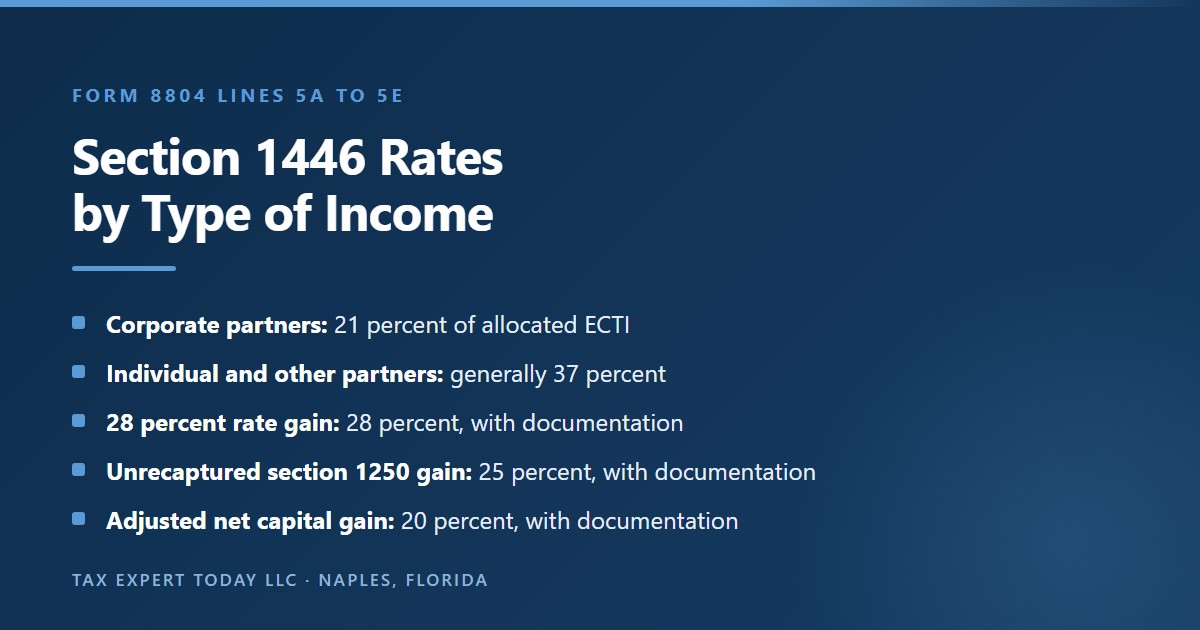
For 2026 the section 1446 applicable percentage is 21 percent for corporate foreign partners and generally 37 percent for noncorporate foreign partners. A partnership may apply lower rates of 28, 25, or 20 percent to specific types of gain allocated to a noncorporate partner who would be entitled to a preferential rate, if it has appropriate documentation.
- Statutory basis: section 1446(b)(2) ties the rates to the highest rate in section 1 for individuals and section 11(b) for corporations.
- Ordinary income: 37 percent for individuals, trusts, and other noncorporate partners.
- Preferential gains: 28 percent rate gain, 25 percent unrecaptured section 1250 gain, and 20 percent adjusted net capital gain.
- No preferential rate where it would not apply: the instructions cite gain recharacterized as short-term under section 1061 as an example.
The rates appear directly on lines 5a through 5e of the December 2025 Form 8804, and the table below follows that line structure. Some older guides to Form 8804 still describe a corporate rate from before 2018. The current corporate applicable percentage is 21 percent, matching the flat corporate rate in section 11(b).
| Form 8804 line | Type of ECTI | Applicable percentage |
|---|---|---|
| Line 5a (from line 4d) | ECTI allocable to corporate partners | 21 percent |
| Line 5b (from line 4h) | ECTI allocable to noncorporate partners, other than the gain categories below | 37 percent |
| Line 5c (from line 4l) | 28 percent rate gain allocable to noncorporate partners | 28 percent |
| Line 5d (from line 4p) | Unrecaptured section 1250 gain allocable to noncorporate partners | 25 percent |
| Line 5e (from line 4t) | Adjusted net capital gain, including qualified dividend income and net section 1231 gain, allocable to noncorporate partners | 20 percent |
The lower rates are permissive and conditional. The instructions say the partnership enters the specified types of gain on lines 4i, 4m, and 4q only “if appropriate documentation is received and such partners would be entitled to use a preferential rate on such income or gain.” The partnership looks at the facts and circumstances it knows or has reason to know. If it lacks that documentation, the gain is withheld at 37 percent and the partner recovers any excess when filing a return. Net ordinary losses, net short-term capital losses, and net 28 percent rate losses are netted against the matching categories under section 1(h) and Notice 97-59, and no negative number is entered on the category lines.
Withholding is not the partner’s final tax. A foreign individual partner whose actual tax on the allocated income is lower than 37 percent, because of graduated rates, other deductions, or a treaty, claims the difference back on Form 1040-NR. A partner whose actual tax is higher pays the balance. The 37 percent figure is a collection mechanism that assumes the top bracket, which is why the 8804-C certificate and the state tax reduction discussed below matter to partners with large deductions.
When is Form 8804 due in 2026?
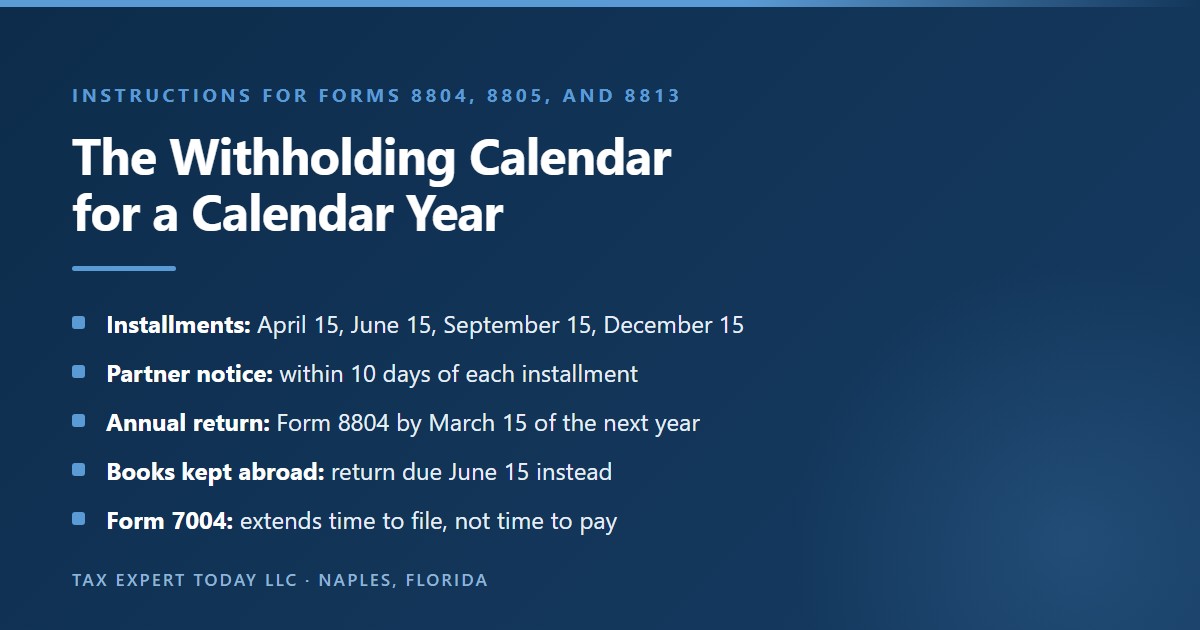
Form 8804 and Forms 8805 are due on the 15th day of the third month after the partnership’s tax year ends. The 2025 calendar year return was due March 16, 2026, because March 15 fell on a Sunday. A partnership keeping its books outside the United States and Puerto Rico files by the 15th day of the sixth month.
- Extension: Form 7004 gives an automatic extension of time to file, generally six months.
- Payment is not extended: the instructions say filing Form 7004 does not extend the time for payment of tax.
- Weekend rule: if a due date falls on a Saturday, Sunday, or legal holiday, file by the next business day.
- Filed separately: Forms 8804 and 8805 are filed apart from Form 1065, at the Ogden, Utah address in the instructions.
Some older guides still give an April due date, which reflects the rules before the due date moved to the third month. The Rev. January 2026 instructions set the general due date at the 15th day of the 3rd month following the close of the partnership’s tax year, the same month as Form 1065. The checkbox at the top of Form 8804 is for a partnership allowed to use the later sixth month date because it keeps its books outside the United States and Puerto Rico. The Instructions for Form 7004 list Form 8804 among the returns covered by the automatic extension, which is generally six months.
| Deadline (calendar year partnership) | What is due | Date |
|---|---|---|
| 2025 tax year return | Form 8804, Forms 8805, any balance of 2025 section 1446 tax | Monday, March 16, 2026 |
| 2025 return, books kept abroad | Same, using the sixth month rule | Monday, June 15, 2026 |
| 2025 return on extension | Form 8804 and Forms 8805 after a timely Form 7004 | Tuesday, September 15, 2026 |
| 2026 first installment | Form 8813 or EFTPS payment | Wednesday, April 15, 2026 |
| 2026 second installment | Form 8813 or EFTPS payment | Monday, June 15, 2026 |
| 2026 third installment | Form 8813 or EFTPS payment | Tuesday, September 15, 2026 |
| 2026 fourth installment | Form 8813 or EFTPS payment | Tuesday, December 15, 2026 |
| 2026 tax year return | Form 8804, Forms 8805, any balance of 2026 section 1446 tax | Monday, March 15, 2027 |
A fiscal year partnership applies the same month counts to its own year. The installment dates for Form 8813 run on the 15th day of the 4th, 6th, 9th, and 12th months of the partnership’s tax year, so a partnership with a year ending June 30 pays on October 15, December 15, March 15, and June 15. If the partnership extends Form 8804 with Form 7004, the instructions direct it to pay the balance of section 1446 tax estimated to be due with the Form 7004 to avoid the late payment penalty.
Each partner must also receive a copy of its Form 8805 by the due date of the partnership return, including extensions. In practice the K-1 package and the Form 8805 travel together, and a foreign partner who files Form 1040-NR in June needs the Form 8805 to claim the credit. A partnership that extends Form 1065 and Form 8804 to September should tell its foreign partners early, because their own returns may need to be extended as well.
How do Form 8813 installment payments work?
A partnership with ECTI allocable to foreign partners pays section 1446 tax in four installments during the year, each with Form 8813 or through EFTPS. The amount of each installment is the sum of the installments figured for each foreign partner under the principles of section 6655, the corporate estimated tax rules, using Form 8804-W.
- Four due dates: the 15th day of the 4th, 6th, 9th, and 12th months of the partnership’s tax year.
- Worksheet: Form 8804-W, Installment Payments of Section 1446 Tax for Partnerships, computes each installment.
- Partner notice: foreign partners must be told their share of each installment within 10 days of the due date or the payment date.
- EIN required: a partnership without an EIN must apply for one and still pay, noting the application date on Form 8813.
The installment system is borrowed from the corporate estimated tax rules. The instructions tell the partnership to determine each foreign partner’s installment “by applying the principles of section 6655 and Regulations section 1.1446-3.” That means the partnership can use the current year safe harbor, the prior year safe harbor where it qualifies, or the annualized income and adjusted seasonal installment methods. A seasonal Naples rental that earns most of its rent from January through April is exactly the kind of business for which the annualized method can lower the early installments.
Each payment of section 1446 tax made during the year must be accompanied by Form 8813, unless the partnership pays through the Electronic Federal Tax Payment System. Paying through EFTPS does not remove the filing obligations. Forms 8804 and 8805 must still be filed, and Form 8813 must still be filed where applicable, for example in an installment period where the partnership relies on a Form 8804-C and must attach it even if no tax is due for that period.
The notification rule protects the partner. Under 26 CFR 1.1446-3(d)(1), the partnership must notify each foreign partner of the section 1446 tax paid on its behalf within 10 days of the installment due date or, if paid later, the payment date. The partner can then credit that installment against its own estimated tax for the year. The regulation adds that a foreign partner cannot obtain an early refund of section 1446 tax; the credit is claimed on the partner’s annual return.
What is Form 8805 and how does a foreign partner use it?
Form 8805 is the Foreign Partner’s Information Statement of Section 1446 Withholding Tax. The partnership prepares one for each foreign partner, attaches Copy A to Form 8804, and gives the partner a copy by the due date of the partnership return. The partner attaches Copy C to its U.S. return to claim the withholding as a credit under section 33.
- Line 9: the partner’s ECTI before any reduction for state and local taxes or Form 8804-C items.
- Line 10: the total section 1446 credit allowed to the partner, figured by income type and applicable percentage.
- Line 8b: checked when treaty or Code exempt ECTI is treated as not allocable to the partner.
- Schedule T: used by a foreign trust or estate partner to pass the credit through to its beneficiaries.
The credit timing follows the partnership year. Section 1446(d)(1) allows each foreign partner a credit under section 33 for its share of the withholding tax for the partner’s taxable year in which or with which the partnership year ends. Section 1446(d)(2) then treats the partner’s share of the tax as distributed to the partner. The instructions describe the distribution date as the earliest of the day the tax was paid, the last day of the partnership year, or the last day the partner owned an interest that year, and generally treat the payment as an advance or draw to the extent of the partner’s share of income.
The partnership must also give the foreign partner a statement, generally Schedule K-1, listing each type of ECTI included on line 9: ordinary income, 28 percent rate gain, unrecaptured section 1250 gain, and adjusted net capital gain including qualified dividends and net section 1231 gain. A foreign corporate partner also needs enough information to complete Schedule P of Form 1120-F. Where the partnership reduced a partner’s withholding using a Form 8804-C or the state tax reduction, it must attach the calculation and, where relevant, the Form 8804-C itself to that partner’s Form 8805.
A U.S. person who was mistakenly withheld on, for example because the partnership presumed foreign status when no Form W-9 was on file, also receives a Form 8805 and claims the credit on its own return. The fix for the following year is simple: collect the Form W-9 before the first installment date.
How can a foreign partner reduce withholding with Form 8804-C?
Form 8804-C, the Certificate of Partner-Level Items to Reduce Section 1446 Withholding, lets a foreign partner certify deductions and losses it reasonably expects to use against its share of partnership ECTI, or, for a nonresident alien individual, certify that the partnership is its only effectively connected activity. The partnership may consider the certificate but is not required to.
- Certified losses: items such as net operating loss carryovers, suspended passive losses, and suspended at-risk losses.
- The 90 percent cap: a certified NOL cannot reduce more than 90 percent of the partner’s allocable ECTI after other reductions.
- De minimis exception: no withholding is required for a nonresident alien partner if the partnership investment is the only effectively connected activity and the tax would be under $1,000.
- Filing history: the partner must certify that prior U.S. returns were filed and paid on time.
The rules are in 26 CFR 1.1446-6, applied partner by partner for each installment period and again when the partnership completes Form 8804. The Instructions for Form 8804-C explain that a partnership may not consider a certified NOL deduction in an amount greater than 90 percent of the partner’s allocable share of ECTI reduced by all other certified deductions and the state and local taxes the partnership withholds for the partner. The 90 percent limit applies on a cumulative basis for each installment period.
The de minimis rule in 1.1446-6(c)(1)(ii) is narrow. It is available only to a nonresident alien individual partner, only where the partner certifies that its only activity giving rise to effectively connected income, gain, deduction, or loss for the year is its investment in the partnership, and only where the partnership estimates that the annualized, or for Form 8804 the actual, section 1446 tax for that partner is less than $1,000 without counting any certified deductions or state taxes. A partner who later begins another effectively connected activity must notify the partnership in writing and revoke the certificate within 10 days. The regulation gives an example: owning U.S. real property alone does not require notice unless an 871(d) election is in effect, but disposing of it does.
Form 8804-C is signed under penalties of perjury and contains a consent allowing the IRS to disclose to the partnership information about the certificate’s validity. A partner who submits a certificate for the first time certifies that its return for the preceding year has been or will be timely filed and that returns for the second and third preceding years were filed within the time limits the form describes. A partner who has certified before certifies timely filing and payment for every year since the first certificate. Updated certificates are required within 10 days when certain facts change. The partner gives the form to the partnership; it does not file Form 8804-C with the IRS.
Separately from Form 8804-C, the partnership can treat 90 percent of the state and local income taxes it withholds and remits for a foreign partner on that partner’s share of ECTI as a deduction of the partner, whether or not the partner submits a certificate. Florida has no personal income tax, so this reduction rarely matters for a Florida only property partnership, but it does for a partnership with operations in states that require nonresident withholding, such as California, discussed in our California nonresident withholding guide.
What is the Form 8804 Schedule A underpayment penalty?
Schedule A (Form 8804) computes the penalty for failing to pay the required section 1446 installments. A partnership generally owes it if it did not timely pay at least the smaller of the current year tax or the qualifying prior year amount. No penalty applies if the tax on line 5f of Form 8804 is under $500.
- Current year safe harbor: installments based on the tax shown on line 5f of the current Form 8804.
- Prior year safe harbor: available only if the prior year amount is at least 50 percent of the current year ECTI base and the prior year was a full 12 months.
- Seasonal relief: the annualized income and adjusted seasonal installment methods can reduce early installments.
- IRS computation: if Schedule A is not attached, the IRS figures the penalty without any exceptions the schedule would have allowed.
The Instructions for Schedule A describe the test for the 2025 return in concrete terms. A partnership is generally subject to the penalty if it did not timely pay in installments at least the smaller of the tax shown on line 5f of its 2025 Form 8804, or the total section 1446 tax that would have been due for 2024, without regard to reductions for certified partner-level items, provided that 2024 amount is at least 50 percent of the sum of lines 4d, 4h, 4l, 4p, and 4t for 2025 and the 2024 tax year was a full 12 months.
The penalty is figured separately for each installment due date. A payment is applied against unpaid installments in the order in which they were required, regardless of the installment to which the partnership meant it to apply, with any excess carried to later installments. That ordering rule means a large payment in December does not cure an April shortfall; it simply stops the penalty from running on the April shortfall from the payment date forward.
Line 8 of Form 8804 is where the penalty appears. The instructions warn that if the partnership failed to pay withholding as required and does not attach a completed Schedule A, the IRS will figure the penalty without regard to any exceptions. Partnerships whose income comes in seasonally should attach the schedule even if they believe no penalty is due, because the schedule is the only way to claim the annualized or seasonal method.
What penalties apply to a late or missing Form 8804?
A late Form 8804 can draw 5 percent of the unpaid tax per month, up to 25 percent, and late payment draws one half of 1 percent a month, also capped at 25 percent. Forms 8805 carry separate information return penalties, and a person who fails to withhold can face a section 6672 penalty equal to the tax.
- Interest: charged on unpaid tax from the due date even if an extension to file was granted.
- Minimum penalty: a return more than 60 days late is subject to the inflation adjusted minimum failure to file penalty under section 6651.
- Reasonable cause: the late filing, late payment, and Form 8805 penalties do not apply where the partnership shows reasonable cause.
- Do not attach a statement to the return: the instructions say to send the explanation only after receiving a penalty notice.
| Penalty | Code section | Amount described in the Rev. January 2026 instructions |
|---|---|---|
| Late filing of Form 8804 | 6651 | 5 percent of unpaid tax per month or part of a month, up to 25 percent; inflation adjusted minimum if more than 60 days late |
| Late payment of tax | 6651 | One half of 1 percent of unpaid tax per month or part of a month, up to 25 percent |
| Failure to file a correct Form 8805 | 6721 | Per form amount set in the annual inflation adjustment revenue procedure; higher for intentional disregard |
| Failure to furnish a correct Form 8805 to the partner | 6722 | Per form amount set in the annual inflation adjustment revenue procedure; higher for intentional disregard |
| Failure to pay required installments | 6655 principles, Schedule A | Computed per installment; none if line 5f tax is under $500 |
| Failure to withhold and pay over | 6672 | Civil penalty equal to the amount that should have been withheld and paid over |
| Inaccurate reporting | 6662, 6663 | Accuracy related and fraud penalties on underpayments, absent reasonable cause and good faith |
The January 2026 instructions no longer print the dollar amounts for the minimum late filing penalty or the per form Form 8805 penalties. They direct readers to IRS.gov/InflationAdjustment, to the revenue procedure for the relevant year, and to the entries for sections 6651, 6721, and 6722. Any article that prints a fixed figure for those penalties without naming the year it applies to should be read with care. The 6721 and 6722 penalties can be reduced for partnerships with average annual gross receipts of not more than $5 million, for failures corrected within a specified period, and for a de minimis number of failures.
The section 6672 penalty is the one to take seriously. It reaches any person required to withhold, account for, and pay over the section 1446 tax who fails to do so, and it equals the full amount that should have been paid. It is the same trust fund style penalty the IRS uses for unpaid payroll taxes, which is why responsible persons in a partnership should not treat section 1446 as optional while cash is tight.
Relief is fact dependent and never automatic. The instructions say the late filing and late payment penalties do not apply if the partnership can show reasonable cause, and a partnership can seek a waiver of the Form 8805 penalties on the same ground. Our guides to reasonable cause penalty abatement and the failure to pay penalty explain how the IRS evaluates those requests in general. Relief is decided by the IRS on the facts of each case, and none is assured.
How do tiered partnerships report section 1446 withholding on Form 8804?
When one partnership owns an interest in another, the lower-tier partnership withholds on ECTI allocable to the upper-tier partnership if that upper tier is foreign or has foreign partners. The upper-tier partnership then claims the lower tier’s withholding as a credit on line 6b or 6c of its own Form 8804 and passes the credit to its foreign partners.
- Credit line 6b: section 1446 tax withheld by a lower-tier partnership and reported on Form 8805.
- Credit line 6c: tax withheld by a lower-tier publicly traded partnership and reported on Form 1042-S, income code 27.
- Look-through: with proper documentation, the lower tier can look through to the upper tier’s partners when computing its tax.
- Attachments: the upper tier must attach the Forms 8805 or 1042-S it received to claim the credit.
The look-through rules in 26 CFR 1.1446-5 apply only to the portion of the upper tier’s allocation for which the lower tier received appropriate documentation about the upper tier’s partners. The instructions stress that look-through affects only the lower tier’s computation of its own withholding. It does not change the upper tier’s obligation to file Forms 8804 and 8805 and to notify its partners. A family structure in which a foreign holding partnership owns a Florida operating LLC is a typical tiered case, and the documentation has to flow up and down the chain before the first installment date.
Form 8804 also has credit lines for withholding imposed on the partnership itself under other regimes: line 6d for section 1445(a) or 1445(e)(1) FIRPTA withholding reported on Form 8288-A, line 6e for section 1445(e) withholding on a distribution from a domestic trust reported on Form 1042-S, and lines 6f and 6g for section 1446(f)(1) withholding on a transfer of a partnership interest. Each credit requires the underlying form to be attached to Form 8804.
How does section 1446(f) apply when a partnership interest is sold?
Under section 1446(f)(1), when a foreign person disposes of an interest in a partnership and any part of the gain would be effectively connected under section 864(c)(8), the transferee must withhold 10 percent of the amount realized. If the transferee fails to withhold, section 1446(f)(4) requires the partnership to withhold that amount, plus interest, from distributions to the transferee.
- Who withholds first: the buyer of the partnership interest, not the partnership.
- Exception: no withholding if the seller furnishes an affidavit of nonforeign status with its U.S. taxpayer identification number.
- Reporting: transferees use Forms 8288 and 8288-A; a partnership withholding under 1446(f)(4) uses Forms 8288 and 8288-C.
- Effective dates: the final regulations generally apply to transfers on or after January 29, 2021, and the 1446(f)(4) rules to transfers on or after January 1, 2023.
Section 1446(f) was added by the 2017 tax act and applies to transfers on or after January 1, 2018. It works alongside section 864(c)(8), which treats gain or loss of a foreign partner on the sale of a partnership interest as effectively connected to the extent the partnership would have had effectively connected gain or loss if it had sold all its assets at fair market value. The IRS partnership withholding page notes that a transfer can also occur when a partnership distribution results in gain under section 731.
The statute allows the IRS to prescribe a reduced amount of withholding at the request of the transferor or transferee where the full 10 percent is not needed to protect collection. The final regulations, published November 30, 2020 as T.D. 9919, contain the detailed exceptions and certification procedures. Because the partnership becomes the backstop under section 1446(f)(4) when a buyer fails to withhold, a partnership whose foreign partner is selling its interest has a direct reason to confirm that the buyer handled the withholding before the next distribution goes out.
For a foreign partnership that is itself the seller of an interest in a lower-tier U.S. business partnership, the 1446(f)(1) tax withheld from it is credited against its own section 1446 liability for the year, to the extent allocable to foreign partners, on line 6f of Form 8804 for a non publicly traded interest or line 6g for a publicly traded one.
How does Form 8804 interact with FIRPTA when a Florida partnership sells real estate?
A domestic partnership that sells U.S. real property and has foreign partners satisfies its FIRPTA obligation through section 1446. The gain is effectively connected under section 897, so it flows into ECTI and is withheld on Form 8804 at the applicable rates, rather than under the separate section 1445(e)(1) reporting rules.
- Domestic partnership: compliance with section 1446 satisfies section 1445 for dispositions of U.S. real property interests.
- Nonrecognition exception: a domestic partnership otherwise exempt by a nonrecognition provision must still comply with Regulations section 1.1445-5(b)(2).
- Foreign partnership: the buyer withholds under section 1445(a), and the partnership credits that amount on line 6d of Form 8804.
- Rate by gain type: for noncorporate partners with documentation, unrecaptured section 1250 gain at 25 percent and the balance of long-term gain at 20 percent.
This coordination rule, stated in the Form 8804 instructions under Real Property Gains, changes the practical sequence of a sale. When an individual foreign owner sells a Naples condo held in their own name, the buyer withholds under section 1445 at closing, as our FIRPTA guide describes. When the same condo is held by a domestic LLC taxed as a partnership, the partnership is the seller, it is a U.S. person, and the buyer does not withhold under section 1445(a). The withholding obligation moves into the partnership’s section 1446 installments and its Form 8804 for the year of sale.
That shift has timing consequences. The installment due after the closing has to reflect the gain allocated to the foreign partners, and the 25 and 20 percent rates are available only if the partnership has the documentation the instructions require. A partnership that ignores the sale until the Form 8804 is due in March can owe a Schedule A penalty for the installments it should have increased after the closing.
How is Form 8804 different from Forms 1042 and 8288?
All three report U.S. withholding on foreign persons, but they cover different income and different withholding agents. Form 8804 covers a partnership’s tax on effectively connected income allocated to foreign partners. Form 1042 covers withholding on fixed or determinable income such as dividends. Form 8288 covers FIRPTA dispositions and section 1446(f) transfers.
- Different trigger: allocation of ECTI for Form 8804, payment of income for Form 1042, a sale or transfer for Form 8288.
- Different statement: Form 8805, Form 1042-S, and Form 8288-A respectively.
- Different rate base: net ECTI, gross income, and amount realized.
- Overlap rules: fixed or determinable income is excluded from ECTI and withheld under sections 1441 and 1442.
| Feature | Form 8804 and 8805 | Form 1042 and 1042-S | Form 8288 and 8288-A |
|---|---|---|---|
| Statute | Section 1446(a) | Sections 1441 and 1442 | Sections 1445 and 1446(f) |
| Who withholds | The partnership | The withholding agent paying the income | The buyer or transferee; the partnership under 1446(f)(4) |
| Income covered | ECTI allocable to foreign partners | Fixed or determinable income such as dividends, interest, and royalties | Dispositions of U.S. real property and transfers of partnership interests |
| Base | Net taxable income | Gross payment | Amount realized |
| General rate | 37 or 21 percent, with 28, 25, and 20 percent for documented gain | 30 percent unless reduced by treaty | 15 percent under FIRPTA for most real property; 10 percent under 1446(f)(1) |
| Timing | Quarterly installments plus annual return | Deposits as income is paid plus annual return | Within 20 days of the transfer |
The 15 percent FIRPTA rate and the 20 day filing window come from the section 1445 regime, and the IRS states that the time for filing Forms 8288 and 8288-A for section 1446(f)(1) withholding is the same as for section 1445 withholding. Our Form 1042-S guide explains the recipient side of the gross basis regime, and our Form 5472 guide covers the separate reporting for a single member LLC owned by a foreign person, which is a disregarded entity rather than a partnership and is outside Form 8804 entirely.
What does the Form 8804 cycle look like for a Naples, Florida rental partnership?
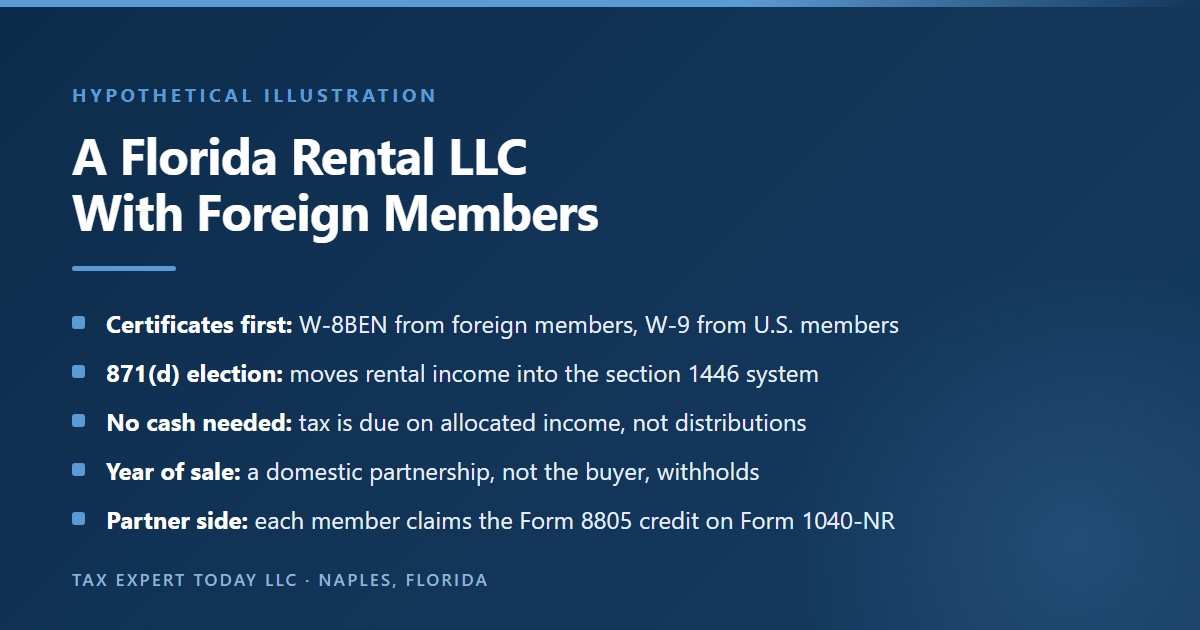
Consider a hypothetical Naples, Florida LLC taxed as a partnership that owns a rental condominium. Two Canadian members own 40 percent each and a U.S. member owns 20 percent. The Canadians made section 871(d) elections, so the rental income allocated to them is ECTI and the LLC withholds at 37 percent on their share in quarterly installments.
- Before the first installment: collect Forms W-8BEN from the Canadian members and a Form W-9 from the U.S. member.
- During the year: pay four installments with Form 8813 or EFTPS and notify each Canadian member within 10 days.
- After year end: file Form 8804 with a Form 8805 for each Canadian member by March 15, with Schedule A if needed.
- Partner side: each Canadian member files Form 1040-NR and claims the Form 8805 credit.
The numbers below are a hypothetical illustration only. They are not drawn from any client, they ignore the annualized method, and they assume the partnership has the documentation needed to apply preferential rates to gain. Actual results depend on the partnership agreement, depreciation, the members’ residency, and treaty positions.
| Step (hypothetical) | Amount | How it is figured |
|---|---|---|
| Net rental income for the year, after expenses and depreciation | $100,000 | Partnership level, effectively connected through the 871(d) elections |
| ECTI allocable to the two Canadian members | $80,000 | 40 percent plus 40 percent; the U.S. member’s 20 percent is excluded under section 1446(c)(3) |
| Gross section 1446 tax, rental year | $29,600 | $80,000 at 37 percent, Form 8804 line 5b |
| Each quarterly installment if paid evenly | $7,400 | $29,600 divided by four, with Form 8813 |
| Credit on each Canadian member’s Form 8805 | $14,800 | Half of $29,600, claimed on Form 1040-NR |
| Later year: gain on sale of the condo, of which unrecaptured section 1250 gain | $500,000, including $150,000 | Section 897 makes the gain effectively connected |
| Withholding on Canadian members’ share of 1250 gain | $30,000 | $120,000 (80 percent of $150,000) at 25 percent, line 5d |
| Withholding on Canadian members’ share of remaining gain | $56,000 | $280,000 (80 percent of $350,000) at 20 percent, line 5e |
In the sale year the buyer does not withhold under FIRPTA, because the seller is a domestic partnership. The $86,000 of section 1446 tax on the gain is paid through the partnership’s installments, and the installment due after closing is the one that has to absorb most of it. If either Canadian member had no other U.S. effectively connected activity and the expected tax on their share were under $1,000, the de minimis certificate on Form 8804-C would be worth examining, but at these amounts it does not apply.
The Canadian members’ home country taxation, the foreign tax credit in Canada, and the treaty provisions that affect real property are separate questions. Our Form 8833 guide explains when a treaty position must be disclosed on a U.S. return, and our Form 1116 guide explains the U.S. foreign tax credit for U.S. members who pay tax abroad.
What are the most common Form 8804 mistakes?
The most frequent Form 8804 problems are treating the withholding as due only when cash is distributed, missing the quarterly installments, using an April due date, applying a pre-2018 corporate rate, failing to collect withholding certificates, and overlooking the partnership’s FIRPTA role when it sells property.
- Distribution thinking: section 1446 tax is due on allocated ECTI, not on cash paid out.
- Annual only payment: paying everything with Form 8804 invites a Schedule A penalty.
- Stale dates and rates: the return is due in the third month, and the corporate rate is 21 percent.
- No certificates on file: without a Form W-9, a partner can be presumed foreign.
| Mistake | Why it matters | What the rules say |
|---|---|---|
| Waiting for a distribution before withholding | Tax, interest, and penalties accrue on undistributed income | Section 1446(a) requires payment when ECTI is allocable to a foreign partner |
| Skipping Form 8813 installments | Schedule A penalty computed per installment | Installments due in months 4, 6, 9, and 12 under section 6655 principles |
| Filing in April | Late filing penalty of 5 percent a month | Due the 15th day of the 3rd month, or 6th month if books are kept abroad |
| Using an old corporate rate | Over or under withholding for corporate partners | 21 percent for all corporate partners |
| Not filing because ECTI is zero | Missing return when effectively connected gross income exists | File regardless of whether there is ECTI or tax |
| Assuming the buyer handles FIRPTA on a partnership sale | Underpaid installments in the year of sale | A domestic partnership satisfies section 1445 through section 1446 |
| Not notifying partners within 10 days | Partners cannot coordinate their estimated tax | 26 CFR 1.1446-3(d)(1) |
| Forgetting the Forms 8805 for partners with no tax | Information return penalties | Required where Form 8804-C or the state tax reduction was used |
Most of these problems come from treating a Florida property LLC as if it were a simple co-ownership. Once a foreign owner’s share of income is effectively connected and the LLC is taxed as a partnership, the LLC is a withholding agent with quarterly deadlines, partner notices, and an annual return of its own. If years have already been missed, late returns and payments can carry the penalties and interest described above, and the right sequence for catching up is a question for a professional reviewing the actual facts.
Form 8804 Help in Naples & Southwest Florida
Tax Expert Today LLC works with international clients from an office in Naples, Florida and serves clients in all 50 states. Southwest Florida has a large community of Canadian and European owners who hold condominiums, rental homes, and small businesses through Florida LLCs, often together with family members who are U.S. persons. When that LLC is taxed as a partnership and a foreign member’s income is effectively connected, the Form 8804, 8805, and 8813 cycle applies.
- Form 8804 help Naples: setting up the installment calendar, the partner notices, and the annual return for a partnership with foreign members.
- International tax Naples FL: coordinating section 1446 withholding with Form 1040-NR, treaty positions, and FIRPTA.
- Foreign partner withholding Naples: collecting and reviewing Forms W-8BEN, W-9, and 8804-C before the first installment.
- Foreign tax Naples: planning the year of sale for a partnership that owns Southwest Florida real estate.
Our international and expat tax services page explains how we approach cross-border work. The international tax Naples FL guide and the Naples tax planning page cover the wider picture for residents of Naples, Bonita Springs, Fort Myers, and Marco Island.
Office: 11983 Tamiami Trail N, Naples FL 34110
Phone: (239) 441-2005
Hours: Monday through Friday, 10:00 to 5:00 ET
Frequently Asked Questions
We own a Naples, Florida rental condo through an LLC with a Canadian partner. Do we need to file Form 8804?
If the LLC is taxed as a partnership and has effectively connected gross income allocable to the Canadian partner, yes, even if the LLC has no net taxable income. Rental income becomes effectively connected for a foreign partner who makes a section 871(d) election or who is engaged in a U.S. trade or business. The LLC files Form 8804, a Form 8805 for the Canadian partner, and pays installments with Form 8813.
What is the Form 8804 due date for a calendar year partnership?
The 15th day of the third month after year end, which is March 15 in most years and March 16, 2026 for the 2025 return because March 15 fell on a Sunday. A partnership that keeps its books outside the United States and Puerto Rico files by the 15th day of the sixth month. Form 7004 extends the time to file but not the time to pay.
What is the section 1446 withholding rate in 2026?
Twenty-one percent for corporate foreign partners and generally 37 percent for noncorporate foreign partners. With appropriate documentation, a partnership may apply 28 percent to 28 percent rate gain, 25 percent to unrecaptured section 1250 gain, and 20 percent to adjusted net capital gain allocated to noncorporate partners.
Does a partnership have to withhold if it makes no distributions?
Yes. Section 1446 tax is based on effectively connected taxable income allocable to foreign partners, not on cash distributed. The partner’s share of the tax paid is treated as a distribution to the partner, generally as an advance or draw against the partner’s share of income for the year.
Can a foreign partner stop the partnership from withholding?
A foreign partner can reduce withholding by giving the partnership a Form 8804-C certifying deductions and losses, subject to limits such as the 90 percent cap on net operating losses. A nonresident alien individual whose only effectively connected activity is the partnership and whose tax would be under $1,000 can use the de minimis certificate. The partnership is not required to accept a certificate.
What happens if a partnership never filed Form 8804?
The partnership may face late filing and late payment penalties of up to 25 percent each, interest, Form 8805 information return penalties, and possible section 6672 exposure for the persons responsible for withholding. Each penalty can be waived only on a showing of reasonable cause, which the IRS decides on the facts. The correct catch-up approach depends on the years and amounts involved.
When to Engage a Professional
Form 8804 looks like a single annual return, but it is the last step of a year-long cycle: classifying each partner, deciding which income is effectively connected, figuring installments under the corporate estimated tax rules, notifying partners within 10 days, deciding whether to rely on a Form 8804-C, and coordinating with FIRPTA, section 1446(f), and the partners’ own returns. A mistake early in the year, such as a missing withholding certificate or an overlooked 871(d) election, usually shows up later as an underpayment penalty or a credit mismatch on a partner’s Form 1040-NR.
A professional review is worth considering when a foreign person joins a Florida LLC or partnership, when a foreign member makes or revokes a net basis election, before a partnership sells real property or a foreign partner sells an interest, when a partnership receives a notice about Form 8804 or Form 8805, and when prior years were never filed. Planning before the first installment date is simpler than reconstructing a year after the return is due.
Tax Expert Today LLC is a tax advisory firm in Naples, Florida serving clients in all 50 states. Call (239) 441-2005 to discuss your facts.
This article is general information, not advice for any particular taxpayer, and does not create a client relationship. The examples are hypothetical illustrations only and do not describe any client. The rules described here reflect the Instructions for Forms 8804, 8805, and 8813 (Rev. January 2026), the December 2025 revision of Form 8804, the Instructions for Form 8804-C and Schedule A (Form 8804), the IRS Partnership Withholding page, and the statutes and regulations cited, as of the date of writing. Penalty amounts tied to inflation change each year. Verify current rules and confirm your own facts with a qualified tax professional before filing or making a decision.
Published October 9, 2026 by Dr. Pellumb Kabashi « Back to Learning Center
Have a question this article touches on?
Tax Expert Today LLC, based in Naples, Florida and serving clients across the United States.
Schedule a Consultation (239) 441-2005