
By Dr. Pellumb Kabashi, DBA, MBA, CES, CFE, EA
Founder, Tax Expert Today LLC · Tax advisors, enrolled agents, CPAs, and attorneys · Serving clients in all 50 states
Quick Answer
Moving from California to Florida taxes your income differently only after your California residency actually ends, and ending it is a factual question rather than a calendar event. Florida imposes no personal income tax, so future wages, interest, and dividends escape state tax once you are a nonresident. California still taxes income sourced to California and income you earned while you were a resident. Call (239) 441-2005 for a free consultation.
Moving from California to Florida taxes: what actually changes?
Three things change and one does not. Florida stops taxing your income entirely, because the Florida Constitution forbids a state income tax on natural persons. California stops taxing your worldwide income. California continues taxing anything sourced to California. The item that does not change is your obligation to prove, with facts, that your California residency ended when you say it did. If the California residence is being sold rather than kept, see our guide to the California capital gains tax on a home sale after you move. The destination side of the move is covered in our guide to Florida tax planning.
Article VII, section 5(a) of the Florida Constitution states that no tax upon estates or inheritances or upon the income of natural persons who are residents or citizens of the state shall be levied by the state. That prohibition sits in the constitution rather than in a statute, which is why Florida has no personal income tax to repeal and no bracket schedule to consult.
California operates on the opposite premise. Under Revenue and Taxation Code section 17014(a), a resident includes every individual who is in the state for other than a temporary or transitory purpose, and every individual domiciled in the state who is outside it for a temporary or transitory purpose. Residents are taxed on worldwide income. Nonresidents are taxed only on California source income under section 17951.
The practical consequence is that the move itself does nothing. Changing the address on your driver license does not end California residency. What ends it is a change of domicile supported by the pattern of your life, and that is the standard the Franchise Tax Board applies if it ever reviews your file. Our guide to leaving California taxes and the departure checklist walks that sequence step by step.
When does California stop taxing your income after the move?
California stops taxing your worldwide income on the day your residency ends, which is the day you both abandon your California domicile and establish a new one in Florida. Those two acts must coincide. Abandoning California without establishing Florida leaves your California domicile intact, because domicile continues until a new one replaces it.
FTB Publication 1031 sets out the closest connections analysis the Franchise Tax Board uses. It weighs where you spend time, where your spouse and children live, where your home is, where you are registered to vote, where your vehicles and professional licenses are registered, where your bank and investment accounts are maintained, and where your social and professional ties sit. No single factor decides the question. The Board looks at the whole picture and asks which state you are more closely connected to.
Section 17014 also contains a narrow safe harbor. Under subdivision (d), an individual domiciled in California who is absent from the state for an uninterrupted period of at least 546 consecutive days under an employment related contract is treated as outside the state for other than a temporary or transitory purpose, and returns totaling not more than 45 days during a taxable year are disregarded. That safe harbor is drafted for contract assignments abroad or out of state. It is not the route most people relocating to Florida will use, and it does not apply if your intent is a permanent move.
The evidence that matters is contemporaneous. Filing the sworn declaration of domicile under Florida Statutes section 222.17 with the clerk of the circuit court in your Florida county creates a dated public record that you recognize and intend to maintain a Florida abode as your permanent home. It is not conclusive on its own, and the Franchise Tax Board is not bound by it, but it is a dated fact rather than a later recollection.
Which income does California still tax after you move to Florida?
California continues to tax income sourced to California regardless of where you live. Sourcing turns on where the income is generated, not on where you receive the payment or on the state printed on your mailing address. This is the category that surprises people, because the tax arrives after the move is complete and the California house is sold.
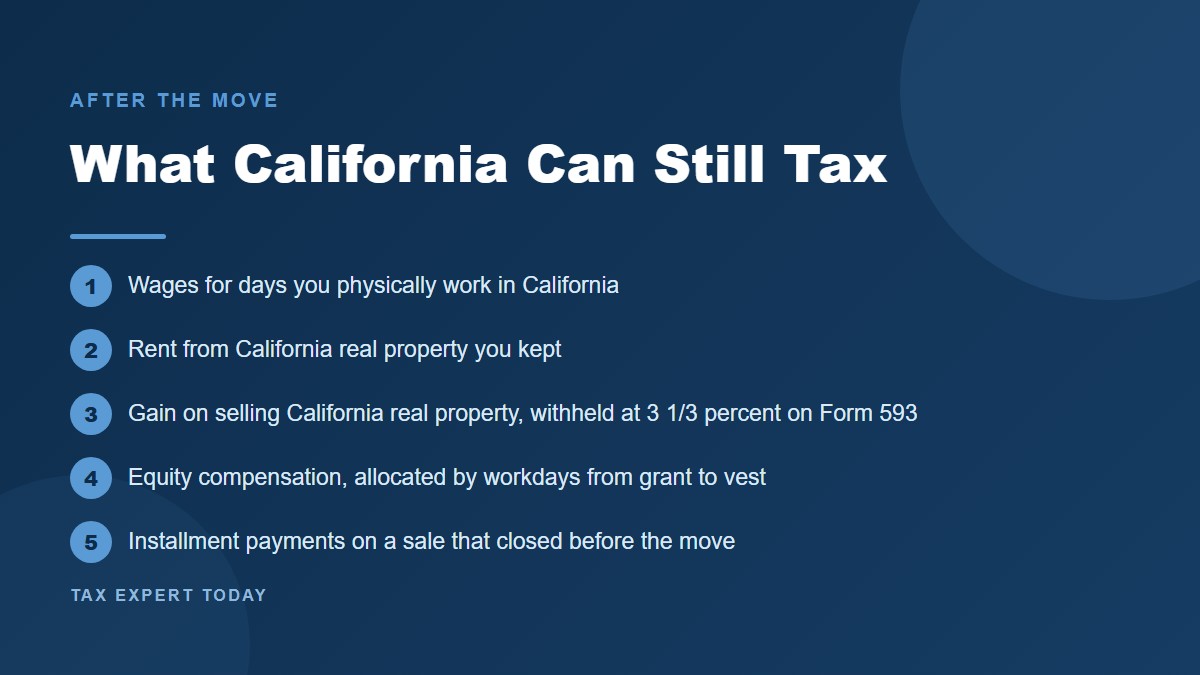
The table below shows how the common categories fall for a Florida resident with a California history.
| Income type | Taxable by California after you move? | Why |
|---|---|---|
| Wages for work performed in Florida | No | Services are sourced where performed, so Florida workdays are not California source income |
| Wages for California workdays | Yes | The employer location does not control; the workday location does |
| Rent from a California property you kept | Yes | Income from real property is sourced to the state where the property sits |
| Gain on selling a California property | Yes | Real property gain is California source, and withholding applies at closing |
| Interest, dividends, and gain on publicly traded stock | No | Intangible income generally follows the residence of the owner |
| Restricted stock units granted for California service | Partly | Allocated by workdays from grant to vest under FTB Publication 1004 |
| Deferred compensation and pensions | No | Barred by 4 U.S.C. section 114 once you are a Florida resident |
| Installment payments on a pre-move California sale | Yes | The character and source are fixed at the original sale, not at payment |
Two of these deserve emphasis. Equity compensation is allocated rather than switched off. FTB Publication 1004 allocates restricted stock unit income by the ratio of California workdays to total workdays between grant and vest, so units granted during your California years remain partly California taxable when they vest years after the move. Our article on California RSU tax after you leave the state works the ratio through a four tranche example.
Selling California real property triggers withholding at closing. The Franchise Tax Board real estate withholding rules and the 2026 Form 593 apply a rate of 3 1/3 percent, stated in the form as .0333, to the sales price rather than to the gain, unless you elect the alternative withholding calculation. Withholding on the gross price can substantially exceed the actual tax on a modest gain, which makes the election worth evaluating before closing. Our guide to selling your home after moving to Florida covers the federal exclusion side of that transaction.
Does Florida protect your retirement income from California?
Yes, and the protection comes from federal law rather than from Florida law. 4 U.S.C. section 114(a) provides that no state may impose an income tax on any retirement income of an individual who is not a resident or domiciliary of that state. Once you are genuinely a Florida resident, California cannot reach your qualified plan distributions.
The statute defines retirement income broadly. It covers distributions from a qualified trust under Internal Revenue Code section 401(a), and it extends to the other common qualified arrangements, including certain nonqualified deferred compensation paid in substantially equal periodic payments over life expectancy or over a period of at least ten years. The effect is that a California career funding a Florida retirement produces distributions California cannot tax, even though every dollar of the underlying contribution was earned in California.
The condition attached to that shield is the same condition attached to everything else in this guide. The protection depends on being a nonresident and nondomiciliary of California, determined under California law. A retiree who spends most of the year in California, keeps the California house as the primary home, and files a Florida declaration of domicile has not met the condition, and the federal statute does not help. Our overview of retiring to Florida and the tax consequences covers the planning sequence for retirees specifically.
How do California and Florida taxes compare side by side?
The headline gap is the income tax, but it is not the only difference, and one of the differences runs in California’s favor. The comparison below uses figures verified against the governing sources on the date of publication.
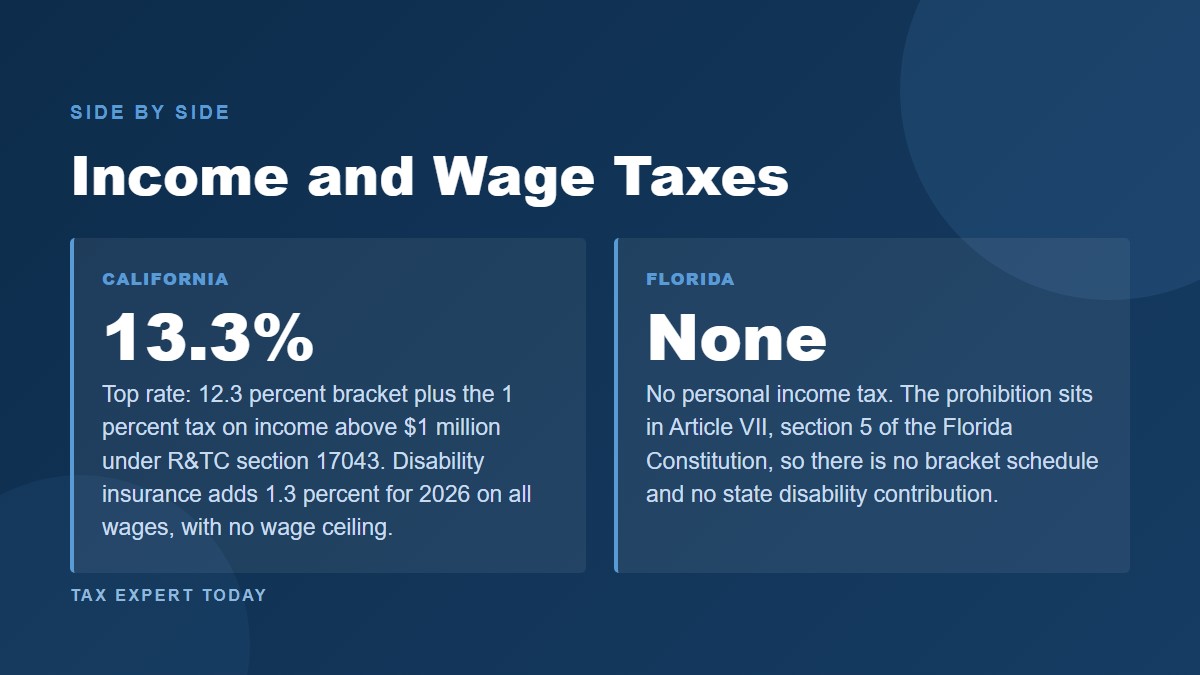
| Tax | California | Florida |
|---|---|---|
| Personal income tax | Graduated, top bracket 12.3 percent | None, prohibited by the state constitution |
| Surtax on high income | Additional 1 percent above $1 million under R&TC section 17043, for a 13.3 percent top rate | None |
| State disability insurance | 1.3 percent for 2026 on all wages with no wage ceiling | None |
| Statewide sales tax rate | 7.25 percent before local district taxes | 6 percent before county surtaxes |
| Estate or inheritance tax | None | None, prohibited by the state constitution |
| Property tax assessment cap | 2 percent annual increase under Proposition 13 | Lower of 3 percent or CPI on homestead property |
| Homestead exemption | Limited | Up to $50,000, with the second $25,000 tranche inflation adjusted |
Two entries in that table are frequently reported incorrectly. The California disability insurance contribution is often described as capped. It is not. The Employment Development Department confirms the 2026 rate at 1.3 percent and states that effective January 1, 2024, all wages are subject to disability insurance contributions, with no taxable wage limit. For a high earner this functions as an uncapped additional wage tax that disappears entirely on a move to Florida.
The 13.3 percent top rate is also two separate taxes rather than one bracket. The graduated schedule tops out at 12.3 percent, and Revenue and Taxation Code section 17043 adds a separate 1 percent tax on taxable income above $1 million for taxable years beginning on or after January 1, 2005. The statewide California sales rate of 7.25 percent comes from the California Department of Tax and Fee Administration, and the Florida rate of 6 percent is set by Florida Statutes section 212.05. Both figures rise once local add ons apply, so the real gap in any given county is narrower than the statewide comparison suggests.
What other Florida taxes apply once you get there?
Florida raises revenue through consumption and property rather than income. The state sales tax rate is 6.00 percent, and the average combined state and local rate is about 7.02 percent. Corporations pay 5.50 percent. There is no state estate tax and no inheritance tax. The effective property tax rate on owner-occupied housing averages 0.78 percent. Call (239) 441-2005 for a free consultation.
People arriving from California often model the move as a pure subtraction of the California income tax and stop there. The arithmetic is usually still favorable, but the shape of the bill changes rather than simply shrinking, and two line items catch new residents out.
| Tax | Florida | What changes for a new arrival |
|---|---|---|
| Personal income tax | None | The entire saving sits here, and it begins only when California residency actually ends |
| State sales tax | 6.00 percent, about 7.02 percent combined with local surtaxes | County discretionary surtaxes vary, so the combined rate depends on the county you land in |
| Corporate income tax | 5.50 percent | Applies to C corporations. Pass-through owners are not taxed at the entity level on Florida income |
| Estate and inheritance tax | None | Federal estate tax still applies, so the planning question moves to the federal exclusion rather than disappearing |
| Property tax | 0.78 percent average effective rate on owner-occupied housing | Higher headline millage than many California bills, offset by homestead exemption and the assessment cap |
| Use tax | 6 percent on items brought in | Reaches motor vehicles and other goods purchased outside Florida and brought in, which surprises people who shipped a car |
- The property tax comparison is not a rate comparison. California caps assessment growth under Proposition 13 and Florida caps it under the Save Our Homes provision, which limits the annual increase in assessed value on a homesteaded primary residence to 3 percent or the change in the Consumer Price Index, whichever is lower. The mechanisms are similar in effect. The difference is that a Californian arriving in Florida resets to current market value on purchase and starts a new cap, rather than carrying a decades-old basis.
- Homestead has to be claimed. The exemption of up to $50,000 on a permanent primary residence under Florida Statutes section 196.031 is not automatic. It is applied for with the county property appraiser, and the deadline is early in the year following the one in which you established residence.
- Use tax is the quiet one. The Florida Department of Revenue guidance for new residents confirms that the 6 percent use tax reaches motor vehicles brought into the state, which is a real cost on a car bought recently in California and driven across.
- No income tax does not mean no filing. A move partway through the year still produces a California part-year or nonresident return, and California source income continues to produce a California filing obligation indefinitely. Florida adds no return, but it removes none either.
- A stock sale is its own question. California does not follow the federal qualified small business stock exclusion, so a founder selling shares should read our guide to California QSBS and the conformity gap before fixing a closing date.
A note for readers arriving from somewhere other than California. The Florida side of this analysis is identical no matter which state you left, and so is the domicile evidence discussed above. What differs is the departure state. New York and New Jersey apply a statutory residency test that can hold you as a resident on a day count plus a permanent place of abode even after domicile changes, which is a harder trap than California sets. California instead runs the closest-connection analysis described throughout this guide. If you are leaving a statutory residency state rather than California, the day count matters more than it does here, and the abode you keep behind matters most of all.
What happens to your property taxes in the move?
You give up a Proposition 13 assessment base and you acquire a Florida homestead. Whether that trade helps depends almost entirely on how long you held the California home. A long held California property carries an assessed value far below market, and that benefit does not travel with you.
Florida replaces it with two protections. Florida Statutes section 196.031 grants a homestead exemption of up to $25,000 on the residence, plus an additional exemption of up to $25,000 on assessed value greater than $50,000 for all levies other than school district levies. That second tranche is adjusted annually on January 1 for inflation using the change in the Consumer Price Index, a detail most comparison articles omit.
The larger protection is the assessment cap. Florida Statutes section 193.155, the Save Our Homes provision, limits the annual increase in the assessed value of homestead property to the lower of 3 percent of the prior year assessed value or the percentage change in the Consumer Price Index. The cap is commonly described as a flat 3 percent. The statute is more favorable than that, because in a low inflation year the CPI figure governs instead.
One California question survives the move. If you keep California property, or if you expect to inherit California property, Proposition 19 governs whether a parent to child transfer keeps the old assessment base. Proposition 19 narrowed that exclusion substantially and generally requires the child to use the property as a principal residence. A Florida resident inheriting the California family home is unlikely to satisfy that condition, which means a reassessment to current market value.
What do you file in the year you actually move?
You file a federal return as usual and a California Form 540NR as a part-year resident. The move year is the only year in which California taxes you on two different bases in the same return, and it is where most preparation errors occur. Which items keep a California source after the move is set out separately in our guide to California source income.
The Form 540NR booklet computes tax using an effective rate method rather than a simple proration. California first computes the tax on your total income as though you had been a resident for the entire year, derives an effective rate from that figure, and applies that rate to the California portion. The result is that your California income is taxed at the rate your worldwide income supports, not at the lower rate the California slice alone would carry. Deductions and exemption credits are prorated on their own separate percentages.
Florida requires no personal return, so there is no second state filing to prepare and no credit for taxes paid to another state to compute. That asymmetry is the reason the California side of the move year deserves the attention. Our detailed walkthrough of the California part year resident tax return and Form 540NR covers the line sequence and the Schedule CA column structure.
What is the first year timeline for a California to Florida move?
Planning around moving from California to Florida taxes rewards sequencing more than speed. The record you build in the first ninety days is the record the Franchise Tax Board will read years later, and it is far easier to create contemporaneously than to reconstruct.
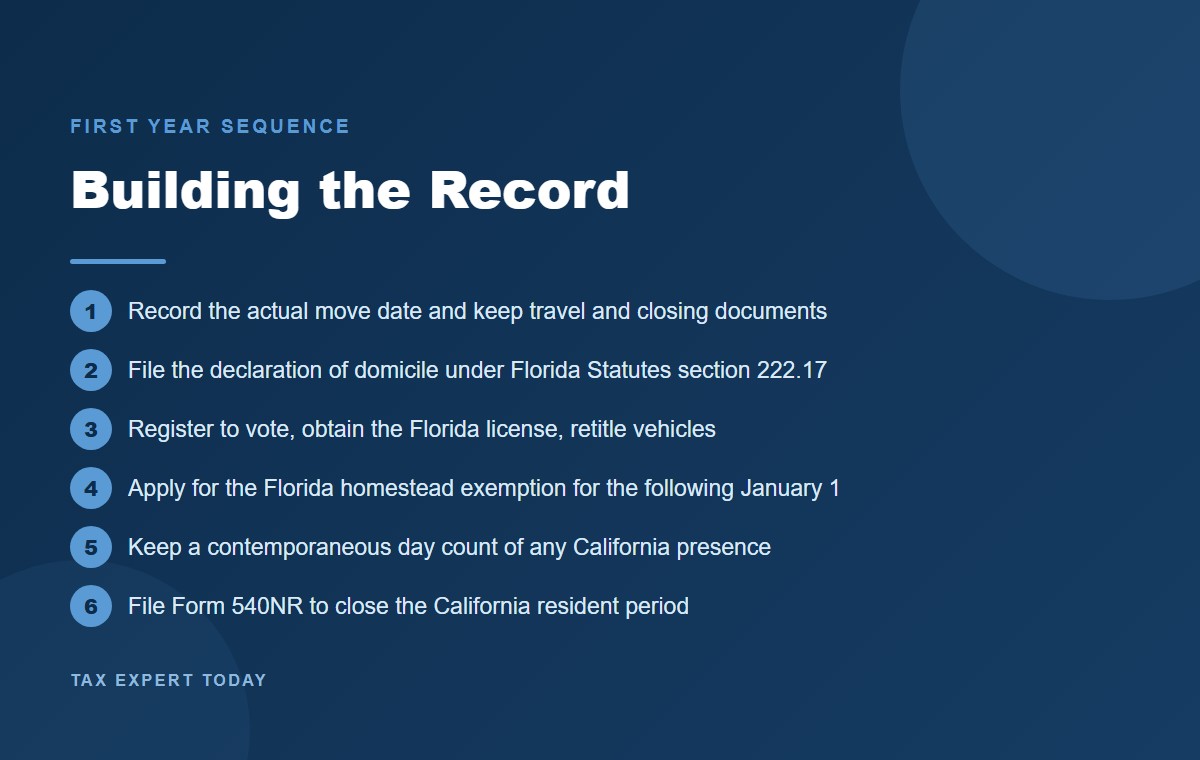
| When | Action | Why it matters |
|---|---|---|
| Before the move | Review equity compensation vesting dates and any pending sale of a business or property | Timing that precedes the residency change is generally fixed and cannot be improved afterward |
| Move week | Record the actual date of the move and retain travel and closing documents | The residency change date drives the entire Form 540NR allocation |
| First 30 days | File the declaration of domicile under section 222.17, register to vote, obtain the Florida license, retitle vehicles | Creates dated public records of Florida connection rather than later assertions |
| First 60 days | Apply for the Florida homestead exemption for the following January 1 | Homestead status is both a property tax benefit and strong residency evidence |
| First 90 days | Move banking, advisers, physicians, and memberships to Florida | These are the professional and social ties Publication 1031 weighs |
| Ongoing | Keep a day count of any California presence | Day counts are the first item requested in a residency review |
| Following spring | File Form 540NR for the move year | The final California return closes the resident period |
If you keep a California home, a California business, or California workdays after the move, treat the day count as a permanent discipline rather than a first year task. A retained California LLC carries its own separate obligation, because the California LLC franchise tax continues until the entity registration is formally cancelled. Our Florida 183 day rule calculator is built for exactly that tracking, and our article on the dual state residency tax trap explains how two states can each conclude you belong to them.
What mistakes trigger a California residency review after the move?
The pattern that draws attention is a large California income event reported near a claimed residency change, combined with continuing California connections. The Franchise Tax Board does not need to prove you never left. It needs only to conclude that your closest connections remained in California on the relevant dates.
The recurring problems are consistent, and each has a corresponding step that strengthens the record.
| Fact pattern | Why the Franchise Tax Board weighs it | What strengthens your position |
|---|---|---|
| California house kept available for personal use | Suggests the California residence was never truly given up | Rent it at arm’s length under a written lease, or sell it |
| Spouse remains in California | The family home is among the heaviest closest connections factors | Document the business reason and the expected end date |
| Children still enrolled in California schools | Indicates the household center of life did not move | Enroll in Florida schools as of the move term |
| California professional licenses left active | Publication 1031 lists license location as a factor | Convert to inactive status where practical |
| California homeowner exemption still claimed | A direct written assertion of California residence | Withdraw it and claim the Florida homestead instead |
| More days in California than in Florida | Day counts are the first item requested in a review | Keep a contemporaneous day log from the move date |
| Large sale or equity event near the move date | Timing near the residency change invites scrutiny | Fix and document the residency change before the transaction |
None of these is fatal standing alone, and several have innocent explanations that hold up. The difficulty arises when several appear together and the taxpayer has no contemporaneous record to explain them. Our article on the California residency audit and what the Franchise Tax Board reviews sets out the procedure and the statutory deadlines, and our guide to the California exit tax myths and what the statutes actually say separates the proposals that never became law from the rules that genuinely follow you.
Frequently Asked Questions
Is there an exit tax for moving from California to Florida?
No. California has no exit tax and no wealth tax. Proposals along those lines have been introduced and have failed. What follows you is ordinary residency based and source based taxation, which is a different mechanism and applies to specific categories of income rather than to your net worth.
Does spending fewer than 183 days in California make me a nonresident?
No. California has no bright line day count rule for residency. Day counts are evidence within the closest connections analysis, and a taxpayer domiciled in California can remain a resident while spending well under half the year in the state.
Do I still owe California tax on my salary if I work remotely for a California employer from Florida?
Generally no for the days you work in Florida, because compensation for services is sourced to the place the services are performed. Days you physically work in California remain California source income even though you live in Florida.
Will California tax my 401(k) distributions after I move?
No, provided you are genuinely a nonresident and nondomiciliary of California. 4 U.S.C. section 114 prohibits a state from taxing the retirement income of someone who is not its resident or domiciliary.
What if I keep my California house?
You may. Keeping it is not disqualifying, but it is a significant closest connections factor, particularly if it remains available for your personal use. Renting it at arm’s length changes the character of the connection and creates California source rental income you will report on Form 540NR.
Does Florida have a sales tax if it has no income tax?
Yes. The state rate is 6.00 percent, and county discretionary surtaxes bring the average combined rate to roughly 7.02 percent. A 6 percent use tax also applies to goods purchased outside Florida and brought into the state, including motor vehicles, which is a common cost for a household that shipped a car from California.
Will Florida tax my estate after I move from California?
Florida imposes no state estate tax and no inheritance tax, and California imposes none either, so the move does not change state level death taxes. Federal estate tax continues to apply, so the planning question after a move is the federal exclusion and portability rather than a state exposure.
California to Florida Tax Help in Naples & Southwest Florida
California to Florida tax help Naples is a core part of our practice, because Southwest Florida receives a steady flow of households relocating from California. Questions about moving from California to Florida taxes reach us in both directions, from people still planning the move and from people who completed it a year ago. Tax Expert Today LLC works with individuals and business owners on both ends of the corridor, coordinating the California departure with the Florida arrival so the two sides tell one consistent story.
Our office is at 11983 Tamiami Trail N, Naples, FL 34110, and you can reach us at (239) 441-2005, Monday through Friday, 10am to 5pm ET. We are a multidisciplinary firm of tax advisors, enrolled agents, CPAs, and attorneys handling state residency and tax matters nationwide. If you are early in the process, our California tax services page and our Naples tax planning page describe how the engagements are typically structured.
Do you work with clients who have already moved from California to Naples, Florida?
Yes, and that is the most common posture. A move that is already complete can still be documented, and the move year return is usually still open. We review what evidence exists, identify the gaps while they can still be addressed, and prepare the Form 540NR that closes the California resident period. Our guide to establishing Florida residency covers the arrival side in detail, and our article on Florida residency audits explains how the receiving state views the same facts.
When to Engage a Professional
A straightforward move with wage income and no California holdings is often manageable without help. Professional involvement is worth considering when the facts include a liquidity event, ongoing California ties, or an income stream that spans the residency change.
Consider engaging a professional if you hold unvested equity compensation granted for California service, if you plan to sell a California business or property, if you will keep California rental property, if your spouse will remain in California for a period, if you expect to spend meaningful time in California after the move, or if a prior year California return is already under review. In qualifying situations the sequencing of a sale relative to the residency change can materially affect the California result, but that opportunity generally exists only before the transaction closes.
Outcomes depend on individual facts, and nothing in this article is a prediction about any particular situation. If you are planning a move from California to Florida, or you have already made one and want the record reviewed while it can still be improved, call (239) 441-2005 or visit our guide to moving to Florida before selling a business for the timing considerations that apply before a sale. Business owners weighing whether to keep an LLC or elect S corporation treatment after the move can compare both California charges in our California LLC vs S corp guide.
California source payments that continue after the move carry their own withholding rules, and our guide to California nonresident withholding explains the 7 percent rule form by form. Employees who keep a California employer and work remotely after the move should also read our guide to California remote work tax.
Published August 4, 2026 by Dr. Pellumb Kabashi « Back to Learning Center
Have a question this article touches on?
Tax Expert Today LLC, based in Naples, Florida and serving clients across the United States.
Schedule a Consultation (239) 441-2005