
By Dr. Pellumb Kabashi, DBA, MBA, CES, CFE, EA
Founder, Tax Expert Today LLC · Tax advisors, enrolled agents, CPAs, and attorneys · Serving clients in all 50 states
Quick Answer: FBAR penalties in 2026 reach $16,536 per year for non-willful violations and the greater of $165,353 or 50 percent of the account balance per year for willful violations, under 31 U.S.C. §5321(a)(5) as adjusted for inflation by 31 CFR §1010.821. This FBAR penalty calculator estimates your statutory maximum exposure. Actual assessments are frequently lower under IRS mitigation guidelines, and several disclosure programs can reduce the penalty to zero.
FBAR Penalty Calculator
Estimate your maximum FBAR penalty exposure. Enter the facts as best you know them. This tool computes statutory maximums for 2026 assessments; it does not predict what the IRS will actually assert in your case.
Educational estimate of statutory maximums only. The six year limit reflects the statute of limitations in 31 U.S.C. §5321(b)(1). Figures use 2026 inflation-adjusted amounts. This is not legal or tax advice.
How Are FBAR Penalties Calculated in 2026?
FBAR penalties are assessed per year under 31 U.S.C. §5321(a)(5), with the amount depending on whether the violation was willful or non-willful. For 2026 assessments, the inflation-adjusted ceiling is $16,536 per non-willful violation and the greater of $165,353 or half the account balance per willful violation.
Because the FBAR arises under the Title 31 Bank Secrecy Act rather than the Internal Revenue Code, the usual income tax penalty relief tools work differently here. First-Time Abatement does not apply, and the penalty exists independently of whether any tax was underpaid. A taxpayer who owes no tax at all can still face six figures of FBAR exposure, which is why the conduct classification matters more than any other single fact.
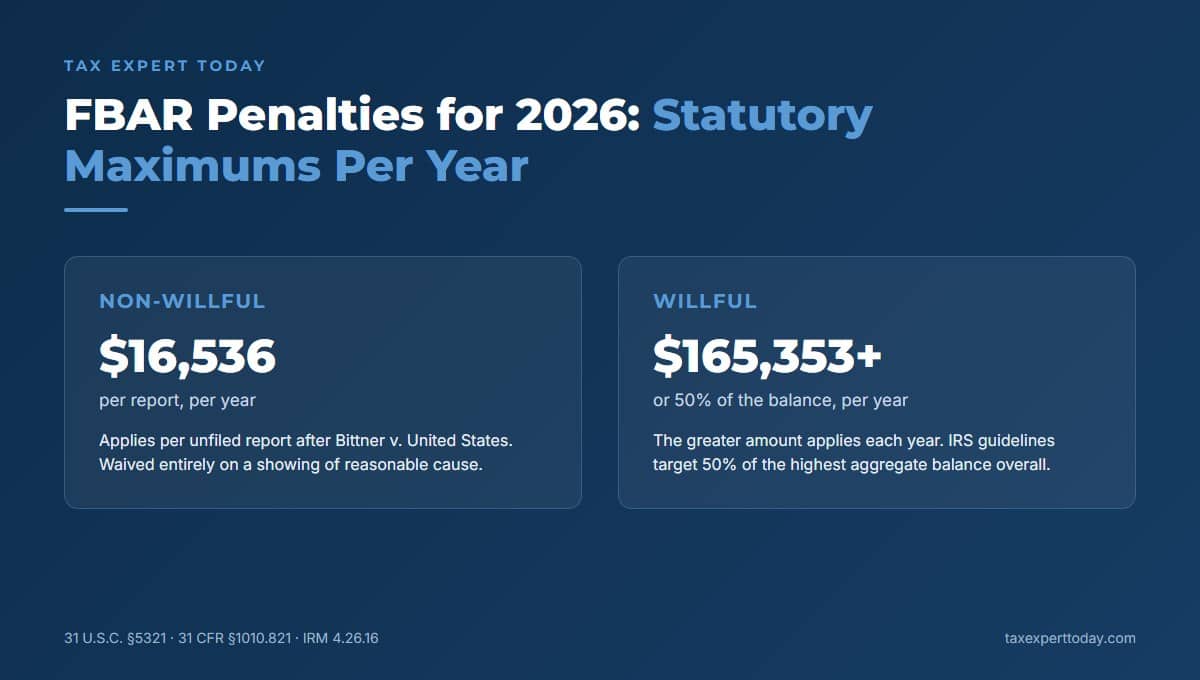
The table below summarizes the 2026 amounts and the relief available at each tier.
| Violation type | 2026 statutory maximum | How it is applied | Relief available |
|---|---|---|---|
| Non-willful | $16,536 per report, per year | Per unfiled or incorrect FBAR under Bittner v. United States, for up to six years | Reasonable cause waiver, streamlined procedures, IRM 4.26.16 mitigation |
| Willful | Greater of $165,353 or 50 percent of the account balance, per year | Per year for up to six years; IRM 4.26.16 targets 50 percent of the highest aggregate balance in total | Examiner mitigation guidelines, representation before any filing |
| Criminal (willful) | Fines and possible imprisonment under 31 U.S.C. §5322 | Reserved for egregious concealment, often alongside tax charges | Voluntary disclosure before the government finds the account |
Who Must File an FBAR in 2026?
A United States person must file FinCEN Form 114 when the combined value of all foreign financial accounts exceeded $10,000 at any point during the calendar year, under 31 U.S.C. §5314. That covers citizens, green card holders, resident aliens, and entities such as LLCs, corporations, and trusts organized under U.S. law. The threshold is aggregate, so five small accounts that briefly total $10,001 together trigger the filing just as surely as one large account does.
The FBAR is filed electronically with FinCEN, separately from the income tax return. It is due April 15 and carries an automatic extension to October 15 with no extension request required. Signature authority without ownership can also create a filing obligation: the ability to move funds in an aging parent’s overseas account or an employer’s corporate account may require a report even though the money is not yours. Spouses can sometimes file a single report for jointly owned accounts, but where either spouse holds any separate foreign account, separate FBARs are generally required.
What Counts as a Foreign Financial Account?
Reportable accounts include foreign bank and checking accounts, brokerage and securities accounts, foreign mutual funds, and foreign issued life insurance or annuity contracts with cash value. Many foreign pension and retirement accounts are reportable as well, which surprises taxpayers who never thought of a workplace pension as a financial account. The IRS comparison of Form 8938 and FBAR requirements is the reference worth checking for edge cases.
Location controls, not currency or the bank’s nationality. An account at a U.S. bank’s London branch is a foreign account; an account at a foreign bank’s New York branch is not. Keep in mind that Form 8938 is a separate filing under the tax code with its own higher thresholds, and filing one form never satisfies the other. Taxpayers over the 8938 threshold typically owe both reports on the same accounts.
What Is the Non-Willful FBAR Penalty?
The non-willful penalty applies when a required FBAR was not filed, or was filed incorrectly, through an honest mistake rather than intentional concealment. For 2026 the maximum is $16,536 per report per year, and it can be waived entirely where the failure rests on reasonable cause under 31 U.S.C. §5321(a)(5)(B).
Most inherited accounts, immigrant taxpayers unaware of the requirement, and taxpayers whose preparers never asked about foreign accounts fall on the non-willful side. For these situations the practical outcome is usually far below the statutory ceiling, and the right disclosure path, covered in our FBAR penalties guide, often reduces it to a single 5 percent charge or to nothing.
What Is the Willful FBAR Penalty?
The willful penalty applies when the taxpayer knew about the filing requirement and ignored it, or was recklessly indifferent to it. For 2026 the ceiling is the greater of $165,353 or 50 percent of the account balance, assessed per year, which allows cumulative exposure to approach the entire account value.
Courts find willfulness from circumstantial evidence: answering no to the foreign account question on Schedule B, moving funds between undisclosed accounts, or using entities to hold accounts. The government must prove willfulness, and the line between aggressive and reckless conduct is exactly where experienced representation earns its fee. IRM 4.26.16 instructs examiners that the total willful penalty should in most cases equal 50 percent of the highest aggregate balance during the examination years and should not exceed 100 percent of it.
How Did Bittner v. United States Change the Math?
In Bittner v. United States, 598 U.S. 85 (2023), the Supreme Court held that the non-willful penalty applies per unfiled report, not per account. A taxpayer with twenty accounts and five unfiled FBARs faces five non-willful penalties, not one hundred, which capped non-willful exposure at dramatic levels.
Before Bittner, the government multiplied the penalty across every account listed on every missing report. After it, the per-year arithmetic in the calculator above is the correct frame for non-willful cases. The decision does not protect willful violators, whose penalties still scale with account balances.
How Does the IRS Find Unreported Foreign Accounts?
Under FATCA, foreign financial institutions report the names, account numbers, and balances of their American account holders to the IRS every year. That flow is automatic and does not depend on any suspicion about a particular taxpayer. Form 8938 is the FATCA report filed with your return; see how it differs from the FBAR in our guide to FBAR vs Form 8938. The IRS matches the incoming data against filed returns and FBARs, and a foreign account that appears in bank data but on no report is exactly the mismatch the matching programs exist to catch.
Information exchange agreements, whistleblower awards, and disclosures produced by enforcement actions against foreign banks add further streams. The practical takeaway for anyone with an unfiled FBAR is that discovery has become a question of when rather than if, and every voluntary disclosure path discussed below requires arriving before that moment.
Can FBAR Penalties Be Reduced or Eliminated?
Yes, through several routes. Reasonable cause eliminates non-willful penalties entirely. The Delinquent FBAR Submission Procedures, which once resolved unfiled reports without penalty when all income was reported, ended on July 1, 2026, and the IRS list of disclosure options no longer carries them. A late FBAR filed now is reviewed case by case, and the non-willful reasonable cause defense is the route that replaced the program. The Streamlined Filing Compliance Procedures cap the cost at 5 percent of the highest year-end balance for domestic filers, and at zero for qualifying taxpayers living abroad. Our guide to the streamlined procedures covers eligibility and the certification forms in detail.
The critical constraint is timing. Every one of these programs requires that you come forward before the IRS finds you. Once an examination begins, or once the IRS receives your account data from a foreign bank under FATCA, the voluntary paths close and the penalty regimes above take over. The six year statute of limitations under 31 U.S.C. §5321(b)(1) also means exposure accumulates for six years before older violations fall away.
Did the Delinquent FBAR Submission Procedures End?
Yes. The IRS ended the penalty-free Delinquent FBAR Submission Procedures effective July 1, 2026, and the program page it occupied now returns a 404. A late FBAR is filed directly with FinCEN through BSA E-Filing, and penalty relief is now decided case by case on reasonable cause rather than granted automatically by a named program. Call (239) 441-2005 for a free consultation.
The change is easy to miss because the procedures were withdrawn by removal rather than by a numbered notice. The current IRS list of options for taxpayers with undisclosed foreign financial assets now names three routes only: the Criminal Investigation Voluntary Disclosure Practice, the Streamlined Filing Compliance Procedures, and the delinquent international information return submission procedures, which reach forms such as 5471 and 3520 rather than the FBAR itself.
What survives is the statutory defense. Under 31 U.S.C. §5321(a)(5)(B)(ii) a non-willful penalty may not be imposed where the failure was due to reasonable cause and the balance in the account was properly reported. That defense is asserted in the late-filing reason field inside BSA E-Filing at the moment the report is transmitted, which is why the wording of that field carries more weight now than it did before July 2026. Our guide to filing a late or delinquent FBAR walks through the field line by line.
FBAR filing help Naples: for anyone reading an exposure estimate on this page, the live question is no longer which program to elect, but whether the facts support reasonable cause before anything is transmitted. Our office in Naples, Florida reviews that question with clients across Southwest Florida and in all 50 states.
What Would Three Unfiled Years Cost? A Worked Example
Consider a hypothetical taxpayer whose foreign account peaked at $400,000, with three unfiled FBAR years and all foreign income properly reported on each return. The table compares what each path allows for 2026, assuming the facts support a non-willful classification.
| Path | How the number is computed | Hypothetical exposure |
|---|---|---|
| Statutory maximum, non-willful | 3 years × $16,536 per report | $49,608 |
| Streamlined domestic procedures | 5 percent of the highest year-end balance | About $20,000 |
| Late FBAR filed directly with FinCEN (the route since July 1, 2026) | All income was reported, and reasonable cause is stated in the BSA E-Filing late-filing reason field | $0 if reasonable cause is accepted, decided case by case |
| If the conduct were found willful | Up to 50 percent of the balance per year, generally capped in total at the balance itself under IRM 4.26.16 | Up to $400,000 |
Identical facts, and the range runs from zero to the entire account. The arithmetic is easy; choosing the path, documenting reasonable cause, and certifying non-willfulness accurately are where the real risk sits, because a wrong certification can convert a paperwork problem into a fraud problem. These figures illustrate the mechanism and are not a prediction for any actual case.
FBAR Help in Naples and Southwest Florida
Tax Expert Today works with taxpayers holding foreign accounts across Naples, Bonita Springs, Estero, Fort Myers, and Marco Island, and with clients in all 50 states. Southwest Florida is home to dual citizens, foreign retirees, and globally mobile business owners, so unfiled FBARs come up regularly here, and most rest on honest mistakes rather than concealment.
Visit us at 11983 Tamiami Trail N, Naples, FL 34110, call (239) 441-2005, Monday through Friday, 10am to 5pm Eastern.
When to Engage a Professional
Run the calculator, then weigh the number against the cost of getting the disclosure path wrong. If your estimated exposure is non-willful and modest, a preparer experienced with late FBAR filings and reasonable cause statements may be all you need. If the willful classification is even arguable, or the balances are substantial, the choice of disclosure program is a legal strategy decision that should be made with counsel before anything is filed. Tax Expert Today LLC is a multidisciplinary firm of enrolled agents, CPAs, and attorneys providing IRS resolution and audit support for offshore compliance matters nationwide.
Call (239) 441-2005 or schedule a consultation to review your exposure and the disclosure options before the IRS makes the first move.
Frequently Asked Questions
Click each question to expand the answer.
Are the Delinquent FBAR Submission Procedures still available in 2026?
No. The IRS ended the penalty-free Delinquent FBAR Submission Procedures effective July 1, 2026, and the program page now returns a 404. Late FBARs are filed directly with FinCEN through BSA E-Filing, and relief from the penalty now depends on a case-by-case reasonable cause showing rather than on an automatic program election.
Is there an FBAR penalty if I owe no tax?
Yes. The FBAR penalty is independent of any tax liability because it punishes the failure to disclose, not underpayment. However, if all foreign income was reported and tax paid, reasonable cause is the defense that generally holds the penalty at zero. The Delinquent FBAR Submission Procedures that once produced that result automatically ended on July 1, 2026, so the outcome is now decided case by case.
Does the IRS always assess the maximum FBAR penalty?
No. IRM 4.26.16 contains mitigation guidelines that scale penalties to account size and conduct, and examiners have discretion to assess less than the statutory ceiling. Many non-willful cases close with a single penalty across all years, or with a warning letter and no penalty.
How many years back can the IRS assess FBAR penalties?
Six years. The statute of limitations in 31 U.S.C. §5321(b)(1) runs six years from the FBAR due date, and it runs whether or not the report was ever filed. That is why the calculator caps the year input at six.
Where can I get help with FBAR penalties in Naples, FL?
Tax Expert Today LLC, located at 11983 Tamiami Trail N, Naples, FL 34110, advises clients on FBAR penalty exposure and offshore disclosure programs, serving Naples, Southwest Florida, and clients nationwide. Call (239) 441-2005 to discuss your situation confidentially.
This article and calculator are for educational purposes only and do not constitute legal, tax, or accounting advice. Penalty amounts reflect 2026 inflation adjustments under 31 CFR §1010.821 and are subject to change. Every situation is different; consult a qualified professional before acting on any information presented here.
Published July 10, 2026 by Dr. Pellumb Kabashi « Back to Learning Center
Have a question this article touches on?
Tax Expert Today LLC, based in Naples, Florida and serving clients across the United States.
Schedule a Consultation (239) 441-2005