
By Dr. Pellumb Kabashi, DBA, MBA, CES, CFE, EA
Founder, Tax Expert Today LLC · Tax advisors, enrolled agents, CPAs, and attorneys · Serving clients in all 50 states
Quick answer: A nonresident state tax return reports income you earned in a state where you do not live. After a move to Florida, you file one in any state that still sources income to you, and that state computes a base tax on your entire income before apportioning it. Call (239) 441-2005 for a free consultation.
Published: August 2026
What Is a Nonresident State Tax Return?
A nonresident state tax return is the form a state requires when you receive income from sources inside its borders but live somewhere else. It reports only the income that state can reach, yet the tax is calculated from your entire income first, which is the part most filers miss.
The concept sounds simple and the arithmetic is not. A state cannot tax a nonresident on income earned anywhere in the world, because the connection that justifies taxation is the income itself rather than the person. What a state can do, and what nearly every state with an income tax does, is measure your ability to pay using your whole financial picture and then charge you a proportional slice of that measurement. New York and California both work this way, and so do most of their peers.
- Only source income is taxed. The state reaches wages for days worked inside it, rent from property located there, and business income earned there, not your income generally.
- Your whole income still matters. The rate applied to the taxable slice is derived from your total income, so income Florida does not tax can still raise the bill.
- It is a separate return. A nonresident return is filed alongside your federal return, and it is not the same document as the part-year return you filed in the year you moved.
- It can recur indefinitely. Unlike the part-year return, which is a one time event, a nonresident return repeats every year the source income continues.
That last point is the one that surprises people who moved to Southwest Florida and assumed the state filing chapter of their life had closed. Establishing Florida domicile ends resident taxation in the departure state. It does not end nonresident taxation, and the two are separate questions. Our guide to establishing Florida residency covers the first question, and this guide covers the second.
Who Must File a Nonresident State Tax Return After a Move to Florida?
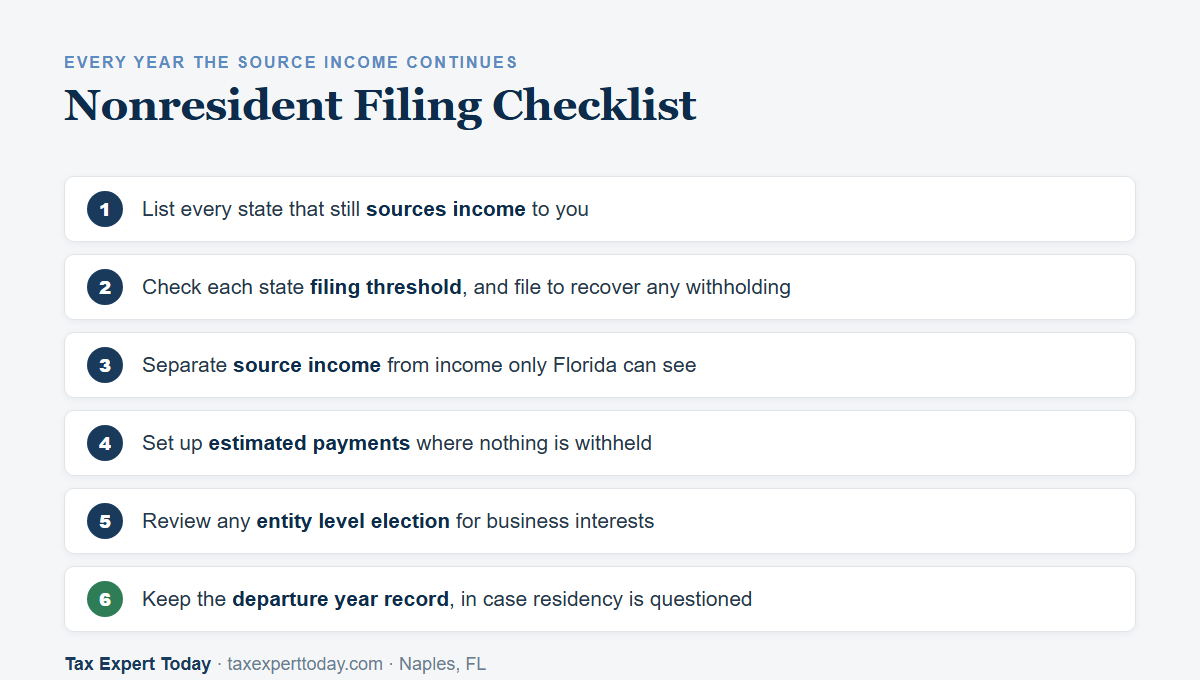
You file wherever a state still sources income to you and that income exceeds the state filing threshold. New York requires Form IT-203 when your New York adjusted gross income in the federal amount column exceeds your New York standard deduction, and also whenever you want a refund of withholding.
The New York instruction is worth reading literally, because the threshold is not what most filers assume. Per the Department of Taxation and Finance, you must file Form IT-203 if you have income from a New York source and your New York adjusted gross income measured in the federal amount column exceeds the New York standard deduction. The federal amount column carries your entire income, not just the New York portion, so the comparison that opens the filing gate is made against a number that includes everything you earned in Florida.
- Refund claims force a filing. If an old employer or a payer withheld state tax, the only route to recovering it is filing the nonresident return.
- Withholding at closing counts. Real property sales commonly trigger mandatory nonresident withholding that is recovered only on the return.
- Thresholds vary widely. Some states require a return after a single day of in-state work, while others set a dollar or day threshold.
- Multiple states are possible. A consultant who travels files in each state that sources compensation to them, not only in the largest one.
California states the rule in plainer language. Per the Franchise Tax Board, a nonresident pays tax on taxable income from California sources, which includes services performed in California, rent from California real property, the sale or transfer of California real property, and income from a California business, trade, or profession. The Board also addresses the remote work scenario directly, confirming that a person who relocates and continues to work for a California employer has California source income to the extent services are physically performed in California.
What Income Counts as State Source Income?
Source income is income with a physical or economic connection to the state. Real property, services performed there, and business activity carried on there are sourced to the state. Interest, dividends, and gains on intangible property generally are not, unless the property is employed in a business carried on in that state.
The distinction between tangible and intangible property is the single most valuable thing a new Florida resident can understand about nonresident taxation, because it determines whether the investment portfolio that funds retirement remains exposed to the old state. N.Y. Tax Law §631 and the Form IT-203 instructions both confirm that interest, dividends, other income from intangible personal property, and gains from the sale or exchange of intangible personal property are excluded from New York source income unless the intangible property is employed in a business, trade, profession, or occupation carried on in New York.
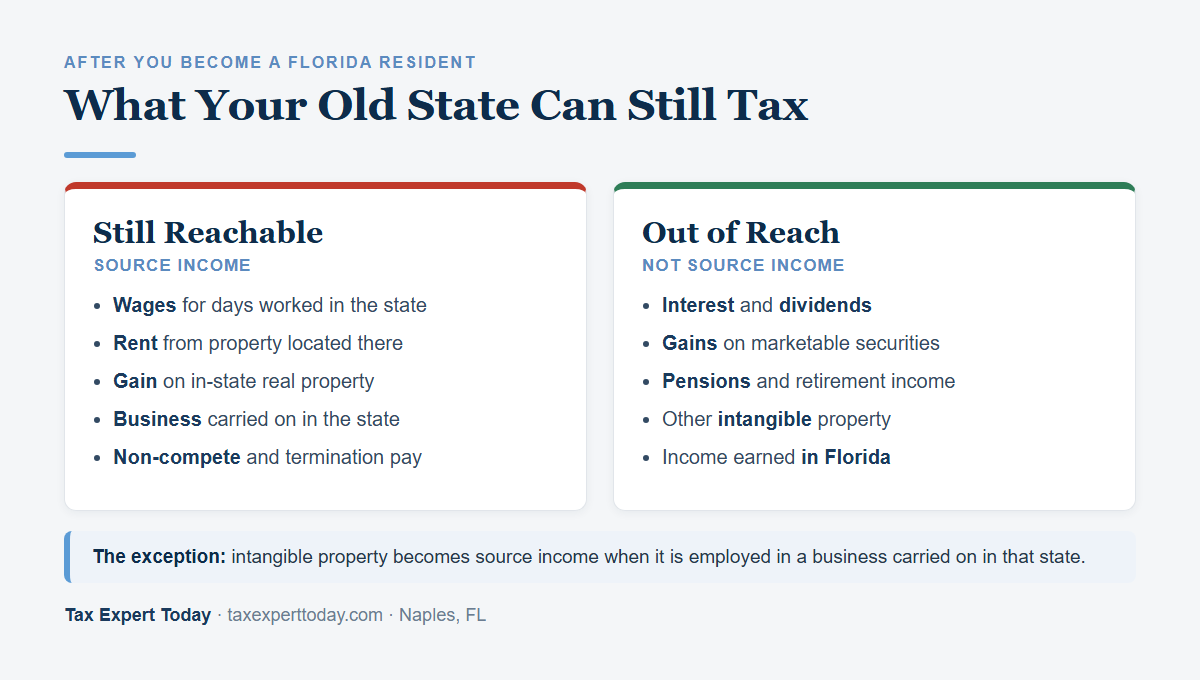
| Income type | Reachable by the former state? | Basis |
|---|---|---|
| Wages for days physically worked in the state | Yes | Services performed in the state |
| Remote wages for an employer in the state | Sometimes | Depends on whether the state applies a convenience of the employer rule |
| Rent from real property located there | Yes | Real or tangible property located in the state |
| Gain on the sale of real property there | Yes | Real property situs |
| Gain on an interest in an entity holding real property there | Yes | Look through treatment of the underlying real property |
| Income from a business carried on there | Yes | Trade or business carried on in the state |
| Payments under a covenant not to compete or a termination agreement | Often | Income related to a business previously carried on in the state |
| Interest and dividends | No | Intangible property not employed in an in-state business |
| Capital gains on marketable securities | No | Intangible property not employed in an in-state business |
| Qualifying pension and retirement income | No | 4 U.S.C. §114 source tax prohibition |
Two rows deserve emphasis. The covenant not to compete row catches business owners who sold a company before or after leaving, because the Form IT-203 instructions treat income related to a business previously carried on in the state as New York source income, and New York provides Form IT-203-F for allocating it across years. A seller who moved to Naples and now receives deferred consideration may still be filing New York returns years after the closing. The retirement row runs the other way and is protective: federal law bars a state from taxing the retirement income of a former resident, which our guide to retiring to Florida treats in full.
How Is the Tax on a Nonresident State Tax Return Calculated?
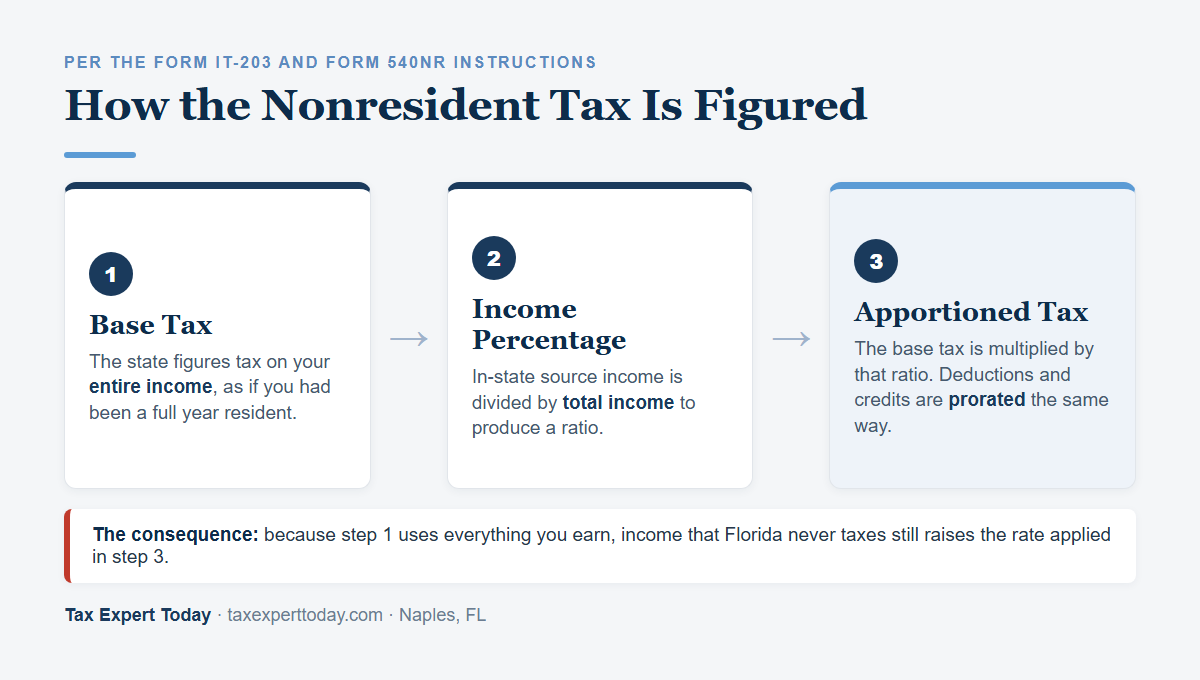
Most states do not simply apply their rate schedule to your in-state income. They compute a base tax as if you were a full year resident of that state, then apportion it by the ratio of in-state income to total income. The result is a proportional share of a resident sized tax.
New York states this in the opening pages of the Form IT-203 instructions, which direct the filer to calculate a base tax as if a full year resident, then determine the percentage of income subject to New York tax and the amount of tax apportioned to New York. The return itself is built around two columns for exactly this reason: a federal amount column carrying your entire income, and a New York State amount column carrying only the income from New York sources.
- Two columns, one ratio. The federal amount column sets the base, the state amount column sets the numerator, and the ratio between them apportions the tax.
- The rate is not marginal on state income. The graduated brackets are climbed using total income, so the effective rate on the state slice reflects your full income level.
- Deductions are prorated too. Standard or itemized deductions and exemption credits are generally reduced by the same income percentage.
- The method is near universal. California, New York, and most graduated rate states use a version of it, though the mechanics and terminology differ.
California expresses the same idea as an effective rate. The Form 540NR booklet instructs the filer to compute total adjusted gross income as if a California resident for the entire year, then determine California tax by multiplying California taxable income by an effective tax rate, where that effective rate equals the tax on total taxable income divided by total taxable income. The vocabulary differs from New York and the outcome is the same.
Why Does Your Florida Income Raise the Rate on Your Old State Income?
Because the base tax is computed on everything you earn, a rise in untaxed Florida income pushes you into higher brackets, which raises the effective rate applied to the in-state slice. Florida income is never taxed by the other state, but it silently increases the tax on the income that state can reach.
This is the mechanism no consumer guide explains and the one that most often produces an unexpected balance due. Consider the structure rather than any particular figures. A person who keeps a rental property in the old state and whose remaining income is Florida sourced computes a base tax on the combined total. If the Florida sourced portion grows, whether from a business, a portfolio, or a new venture, the base tax grows with it, and although the apportionment percentage falls, the two movements do not cancel. The brackets are graduated, so the rate climb is not proportional to the income climb.
- Untaxed income is not invisible income. Florida sourced earnings appear in the federal amount column even though Florida imposes no tax on them.
- A better year can raise an old state bill. Growth in Florida income can increase the tax charged on an unchanged in-state rental or consulting stream.
- Timing choices interact. Accelerating a Florida sourced gain into a year with in-state income can raise the rate applied to that in-state income.
- Planning has a lever. Where the in-state income is itself controllable, sequencing the two streams across tax years can matter.
The practical consequence is that a Florida resident with any remaining old state source income should treat their nonresident return as a planning item rather than a compliance afterthought. The interaction is entirely lawful and entirely mechanical, and it rewards attention in advance rather than discovery at filing time. Where a residency position is also being examined, the same records serve both purposes, as our guide to the New York residency audit describes.
Nonresident Return or Part-Year Return: Which One Applies?
The part-year return covers the single year in which you moved, splitting the year at the date domicile changed. The nonresident return covers every later year in which the state still sources income to you. Many movers file a part-year return once and a nonresident return for years afterward.
New York uses a single form for both, Form IT-203, which is titled the Nonresident and Part-Year Resident Income Tax Return, and this shared form is a common source of confusion. California likewise uses Form 540NR for both statuses. The form is the same; the computation of the state amount column is not.
Georgia takes the same approach, routing residents, part-year residents and nonresidents through Form 500 and separating them on Schedule 3. Our guide to the Georgia part year resident tax return walks that schedule line by line.
| Feature | Resident return | Part-year return | Nonresident return |
|---|---|---|---|
| Income reached | Worldwide income | Worldwide income while resident, plus source income while nonresident | Source income only |
| When it applies | Years you were domiciled there | The year of the move | Every later year with source income |
| How often | Annually until the move | Once | Repeats indefinitely |
| Credit for other state tax | Available | Available for the resident portion | Not applicable |
| New York form | IT-201 | IT-203 | IT-203 |
The year of the move is its own subject, with special accrual rules and an income split at the domicile date, and it is treated at length in our guide to the first year of snowbird filing. If you are still working out whether your domicile actually changed, that threshold question comes first and is covered in our guide to the dual state residency trap and in the Florida 183 day rule calculator.
Where Does the Credit for Taxes Paid to Another State Go?
The credit belongs on the resident state return, not on the nonresident return. A resident state relieves double taxation by crediting tax its residents paid elsewhere. Florida residents have no resident return and no state income tax, so no credit exists and the nonresident tax is an absolute cost.
This is the structural point that changes how a Florida resident should think about remaining old state income. While you lived in the departure state and earned income elsewhere, the system protected you: your resident state gave a credit for the tax paid to the other state, so the same dollar was generally not taxed twice. N.Y. Tax Law §620 is the New York version of that credit, and every state with an income tax has an equivalent.
The Supreme Court treated this as a constitutional requirement rather than a courtesy. In Comptroller of the Treasury of Maryland v. Wynne, decided in 2015, the Court held that a Maryland personal income tax scheme that failed to give residents a full credit for income taxes paid to other states violated the dormant Commerce Clause, reasoning that a state may not tax a transaction more heavily when it crosses state lines than when it occurs entirely within the state.
- The credit runs one direction. It is claimed by residents on a resident return, and it offsets resident tax, so a nonresident return never carries it.
- Florida offers no offset. Under Fla. Const. Art. VII, §5, Florida levies no income tax on natural persons who are residents, so there is nothing for a credit to reduce.
- Wynne does not help a Florida filer. The protection it describes is a duty owed by a resident state, and Florida residents have no resident state tax to be credited against.
- The cost becomes visible. Old state tax that used to be neutralized by a credit now shows up as a real reduction in after tax return on that asset.
The practical consequence is a genuine change in the economics of holding old state assets. An out of state rental that produced a certain after tax yield while you were a resident of that state may produce a different one now, because the state tax on it is no longer offset anywhere. That is a reason to review whether the asset still belongs in the portfolio in its current form, a question our guide to selling a home after moving to Florida approaches from the disposition side.
Do Reciprocity Agreements Remove the Nonresident Filing Requirement?
Reciprocity agreements let a resident of one state work in a neighboring state and be taxed only at home, which removes the nonresident filing requirement between those two states. Florida has no income tax and therefore no reciprocity agreements, so a Florida resident never benefits from one.
Reciprocity is a bargain between two taxing states: each agrees not to tax the wages of the other state residents who commute across the border, so the employee files only in the state of residence. The arrangements are common in regions with heavy cross border commuting and they apply to wages, not to rental income, business income, or gains.
- Reciprocity requires two taxing states. Florida imposes no personal income tax, so it has nothing to trade and participates in no agreement.
- It covers wages only. Even where an agreement exists, rent, business income, and property gains fall outside it.
- It does not survive a move. An agreement that once covered you as a resident of a participating state stops applying once you become a Florida resident.
- Convenience rules are the opposite problem. Some states tax remote work performed outside their borders, which is a broader reach rather than a narrower one.
That final point matters more to Florida movers than reciprocity does. A handful of states apply a convenience of the employer rule that treats days a remote employee works from home as in-state days when the arrangement is for the convenience of the employee rather than the necessity of the employer. For a person who moved to Naples and kept a northern employer, that rule can source wages to the old state even though no day was physically worked there, and it is treated in full in our guide to the convenience of the employer rule. Equity compensation raises a parallel sourcing question addressed in our guide to Florida domicile for executives.
How Do You Pay a Nonresident State Tax Bill During the Year?
Wages are covered by employer withholding, but rental, business, and partnership income usually are not, so quarterly estimated payments to the source state are generally required. Real property sales carry their own mandatory withholding at closing, collected before the return is ever filed.
The payment side is where a first nonresident year most often goes wrong, because the income that survives a move to Florida is frequently the kind that arrives without withholding attached. A salary has tax taken out automatically. Rent from a northern duplex does not, and neither does a distribution from a partnership that operates in the old state. The obligation to pay as the income is earned does not disappear simply because no payer is withholding.
- Estimated payments follow the income. Where a state sources income to you and nothing is withheld, that state generally expects quarterly payments during the year.
- Property sales withhold at closing. New York collects estimated tax from nonresident sellers on Form IT-2663 and California uses Form 593, both taken at the closing table.
- Composite returns can substitute. Many states let a pass-through entity file one return covering its nonresident owners, which can replace the individual filing in some cases.
- Entity level elections change the math. A pass-through entity tax election shifts the liability to the entity and gives the owner a credit.
That final item deserves attention from any Florida resident who holds an interest in a business operating in a state with an income tax. New York, for example, imposes an optional pass-through entity tax under Tax Law Article 24-A, which partnerships and New York S corporations may elect annually. Where the election is made, the entity pays the tax and eligible partners, members, or shareholders may claim a PTET credit on their New York returns. The election exists because the entity level tax is deductible federally in circumstances where the individual state tax deduction is limited, so for an owner whose personal deduction is capped the election may improve the federal result. Whether it does depends on the entity structure, the ownership mix, and the other state filings of the owners, and the election carries its own deadlines.
What Happens If a Required Nonresident State Tax Return Is Not Filed?
An unfiled nonresident return generally leaves the statute of limitations open indefinitely for that year, because the limitation period typically begins when a return is filed. States also receive federal and payer data, so unreported in-state income is frequently identified years later through matching rather than audit.
The exposure created by a missing return is different in kind from the exposure created by a return with an error. A filed return starts a clock. An unfiled return generally does not, which means a year that would otherwise have closed remains open for assessment, and the interest that accrues in the meantime compounds the original amount. Where the return would have produced a refund of withholding, the opposite problem arises, because refund claims are subject to their own deadline and a late claim can be denied even when the overpayment is real.
- The clock may not start. Limitation periods generally run from filing, so an unfiled year can stay open well beyond the ordinary window.
- Data matching finds it. Payer reporting, property records, and federal data sharing surface in-state income without an examination being opened.
- Refunds expire. Withheld tax that would have come back on a timely return can be lost once the refund claim period closes.
- Residency questions can follow. Contact about a source income year can broaden into questions about whether the move itself was effective.
That last risk is the reason nonresident filing and residency defense should be handled together rather than separately. A state that opens correspondence about an unfiled nonresident year has your file in front of it, and the natural next question concerns the departure year. Taxpayers who left New York should read this alongside our guide to what leaving New York actually costs and our guide to the Florida residency audit. Where a state assessment sits alongside a federal balance, coordination is described on our IRS resolution and audit support page.
Nonresident State Tax Return Help in Naples & Southwest Florida
Tax Expert Today LLC works with individuals and business owners who have relocated to Florida and continue to receive income sourced to a former home state. The firm brings together tax advisors, enrolled agents, CPAs, and attorneys, and handles residency and multistate tax matters nationwide. Southwest Florida draws arrivals from New York, New Jersey, Illinois, and California in particular, so multistate filing after a move is familiar ground.
Our office is located at 11983 Tamiami Trail N, Naples, Florida 34110. You can reach us at (239) 441-2005, Monday through Friday, 10am to 5pm ET. We also work with clients across all 50 states.
- Nonresident return help Naples: review of which states still source income to you, and preparation of the returns those states require.
- Multistate tax Naples FL: coordination across several states for consultants, business owners, and holders of out of state property.
- Tax planning Naples FL: forward looking work on sourcing, timing, and the structure of remaining old state assets, described on our Naples tax planning page.
- Tax resolution Naples: handling of unfiled nonresident years and state notices, described on our Naples tax resolution page.
- Statewide and nationwide: multistate filing handled from Naples for clients in Florida and across the country.
I moved to Naples but still own a rental property up north. Do I have to keep filing there every year?
Generally yes, for as long as the property produces income above that state filing threshold, because rent from real property located in a state is sourced to that state regardless of where the owner lives. The filing continues indefinitely rather than ending with your move, and the tax is no longer offset by a resident credit because Florida imposes no income tax against which a credit could apply. Many Southwest Florida arrivals find that this changes the after tax economics of holding the property, which is worth reviewing alongside estate considerations addressed on our estate and trust planning page.
When to Engage a Professional
Consider professional guidance if any of the following describe your situation: you moved to Florida and continue to receive wages, rent, business income, or deferred consideration connected to a former home state; you have received correspondence from a state where you no longer live; you did not file a nonresident return for a year in which state tax was withheld; you sold real property in another state and withholding was taken at closing; you work remotely for an employer in a state that applies a convenience of the employer rule; or you are weighing the sale or restructuring of an out of state asset now that no resident credit offsets the tax on it.
Multistate filing after a relocation is an area where the cost of getting it wrong is rarely a single year. Sourcing positions repeat annually, an unfiled year can stay open indefinitely, and a question about source income can widen into a question about the move itself. Whether professional involvement is warranted depends on the number of states involved, the type of income at issue, and whether any year remains unfiled. You can reach our office at (239) 441-2005 or through our contact page.
This article is educational and is not tax advice for any particular situation. State sourcing rules, filing thresholds, and forms change, and outcomes depend on individual facts. Consult a qualified professional about your circumstances.
Published August 24, 2026 by Dr. Pellumb Kabashi « Back to Learning Center
Have a question this article touches on?
Tax Expert Today LLC, based in Naples, Florida and serving clients across the United States.
Schedule a Consultation (239) 441-2005