
By Dr. Pellumb Kabashi, DBA, MBA, CES, CFE, EA
Founder, Tax Expert Today LLC · Tax advisors, enrolled agents, CPAs, and attorneys · Serving clients in all 50 states
Quick Answer: An FTB power of attorney is filed on form FTB 3520-PIT for an individual, estate, or trust, or on form FTB 3520-BE for a business entity. The Franchise Tax Board rejects IRS Form 2848 and every other non FTB form. A declaration generally lasts six years, cannot be renewed, and does not revoke earlier overlapping declarations. Call (239) 441-2005 for a free consultation.
An FTB power of attorney is the document that lets someone other than you speak with the California Franchise Tax Board about your account. Without one, the agency will not discuss your file with your accountant, your attorney, your adult child, or anyone else, however obvious the relationship seems. That confidentiality is not a matter of agency preference. Revenue and Taxation Code section 19542 makes it a misdemeanor for agency personnel to disclose the particulars of a return except as the statute allows, and a valid declaration on file is the route the agency uses to allow it.
This guide is written for two readers. The first is anyone who needs to give a representative authority to deal with the FTB and wants to get the form right the first time. The second is the reader this track exists for: a former Californian who now lives in Florida, still has open business with the FTB, and is discovering that the federal paperwork already on file with the IRS does nothing at all in Sacramento. If that is you, our guide to moving from California to Florida covers the wider corridor, and the sections below cover the authority question in detail.
What is an FTB power of attorney?
An FTB power of attorney is a declaration, filed on an agency form, that authorizes a named individual to talk to the Franchise Tax Board about your account, receive and inspect your confidential tax information, represent you in all matters before the agency, and request the information the FTB receives from the IRS about you.
The agency describes the declaration in plain terms on its power of attorney overview: it gives another person the legal right to look at your account information, talk to the agency, send it information, and represent you. The 3520-PIT instructions list the same four general authorizations and add that information may be released by phone, in person, in writing, or online through MyFTB.
- It is a state document only. It governs the Franchise Tax Board and nothing else, not the IRS and not the other California tax agencies.
- It names individuals, not firms. The instructions state that only individuals may be named and that the declaration does not establish a relationship with the organization where the representative works.
- It has a built in expiration. The authority generally ends six years after the date you sign.
- It is not the same as a Tax Information Authorization. A TIA lets someone look but not act, and it runs on a much shorter clock.
The word “declaration” matters. The FTB uses the phrase “Power of Attorney Declaration” throughout its forms because the document is specific to its own proceedings. It is not a general financial power of attorney of the kind an estate planning attorney drafts, although, as discussed below, a general or durable power of attorney can be attached to the FTB form when someone signs it on your behalf.
Which form do you need, FTB 3520-PIT or FTB 3520-BE?
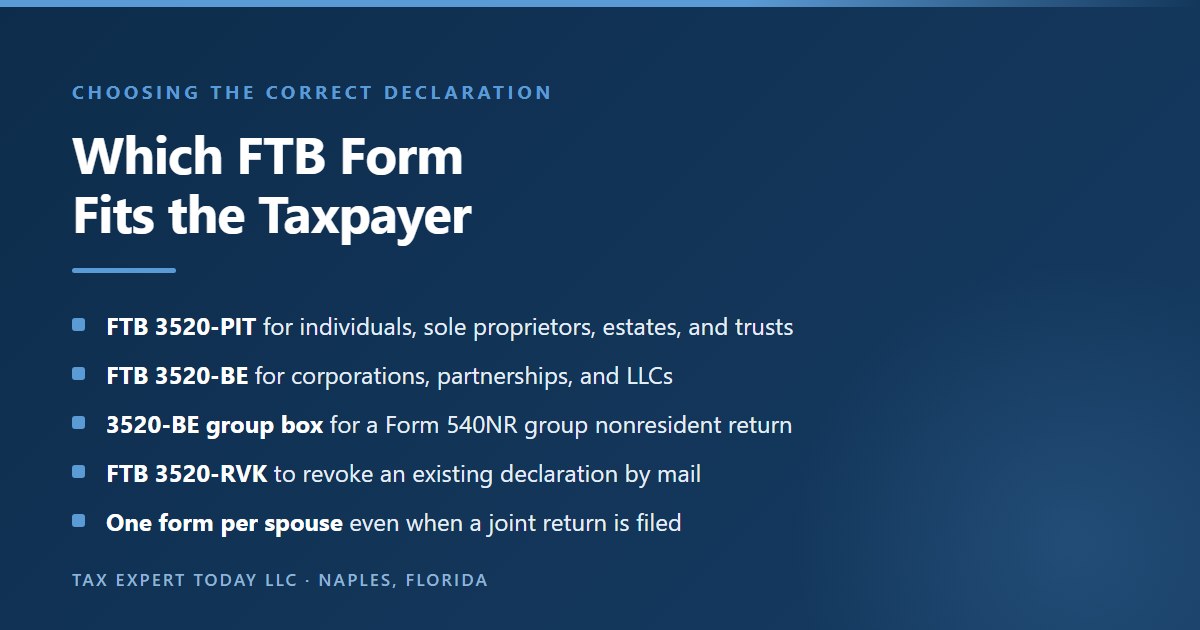
Use form FTB 3520-PIT for an individual, a sole proprietorship, an estate, or a trust. Use form FTB 3520-BE for a corporation, partnership, limited liability company, or other business entity, and for a business entity that files a Form 540NR group nonresident return. Revocations use a third form, FTB 3520-RVK.
The agency’s submission page frames the choice as step one, and getting it wrong is one of the quickest routes to a rejection letter. A sole proprietorship is not a separate taxpayer for California income tax purposes, so the owner files the individual form and checks the “Individual” box, as the 3520-PIT instructions direct.
| Form | Who it is for | Taxpayer identifier | Common mistake |
|---|---|---|---|
| FTB 3520-PIT | Individuals, sole proprietors, estates, trusts, deceased individuals | SSN or ITIN for individuals; FEIN for estates and trusts; SSN for a decedent | Filing one form for a married couple instead of one per spouse |
| FTB 3520-BE | Corporations, partnerships, LLCs, REMICs, and other business entities | California Secretary of State number for partnerships and LLCs when available, otherwise FEIN | Checking both the business entity box and the 540NR group box |
| FTB 3520-BE (group) | A business entity acting for a Form 540NR group nonresident return | The entity’s identifiers, with the group box checked | Leaving the group box blank, which files the authority to the entity account instead |
| FTB 3520-RVK | Anyone ending an existing declaration by mail | Matches the declaration being revoked | Assuming a new declaration automatically ends the old one |
| FTB 3534 (TIA) | Information access only, with no authority to act | Same as the underlying account | Using a TIA when the representative needs to respond to a notice |
- Married couples file separately. The instructions state that if a joint return is filed, each spouse or registered domestic partner must complete their own declaration.
- A group nonresident return needs its own declaration. The 3520-BE instructions say the entity must file one declaration for the entity return and a separate one for the Form 540NR group account.
- Unitary groups list only the key corporation. A corporation filing on a Schedule R-7 unitary group return provides the key corporation information rather than a list of every member.
- Use the current revision. The instructions state that the FTB will reject form FTB 3520-C1 and any outdated version.
For business owners who left California but kept a California entity alive, the choice of form often surfaces at the same time as the $800 California LLC franchise tax notices keep arriving. The entity needs its own 3520-BE even when the owner already has a 3520-PIT on file, because the entity is a separate taxpayer with its own account.
What authority does an FTB power of attorney grant by default?
By default, every representative named on the declaration can talk to FTB agents about your account, receive and inspect your confidential information, represent you in all matters before the agency, and request information the FTB receives from the IRS. The agency also lets any representative remove another representative and revoke the declaration.
Those default powers are listed in section B of the 3520-PIT instructions, and the agency’s overview adds the two relationship management powers. The practical meaning is broad: once the declaration is approved, the representative can respond to a notice, argue an audit issue, discuss a balance, and request the federal data the FTB is using, all without you on the line.
| Authority | Granted by default? | Where it comes from |
|---|---|---|
| Talk to FTB agents about your account | Yes | General authorizations, section B |
| Receive and inspect confidential information | Yes | General authorizations, section B |
| Represent you in all matters before the FTB | Yes | General authorizations, section B |
| Request information the FTB receives from the IRS | Yes | General authorizations, section B |
| Remove another representative | Yes | Important information, 3520-PIT instructions |
| Revoke the declaration | Yes | FTB overview, “Ending (revoking) your POA” |
| Add new representatives | Only if checked | Part IV, question 1 |
| Sign your return | Only if checked, and only in narrow conditions | Part IV, question 2 |
| Receive, but not endorse, refund checks | Only if checked | Part IV, question 3 |
| Waive the California statute of limitations | Only if checked | Part IV, question 4 |
| Execute settlement and closing agreements | Only if checked, extenuating circumstances | Part IV, question 5 |
- “All matters” really means all matters. A representative is not limited to one notice or one issue once approved for the years covered.
- Every representative can remove the others. The instructions warn about this directly, and it matters when several advisors are listed on one declaration.
- Federal data is included. The right to request what the FTB receives from the IRS is useful because many California adjustments start with a federal change.
What additional authorizations can you add in Part IV?
Part IV lets you grant five specific extra powers: adding representatives, signing your return in limited circumstances, receiving but not endorsing refund checks, waiving the California statute of limitations, and executing settlement and closing agreements in extenuating circumstances. A sixth box authorizes other described acts listed on Side 5.
Each additional authority requires a clear “Yes” or “No.” The instructions state that if you check neither box, or both, the agency will not grant that authority. That default protects taxpayers from accidentally handing over a power they did not intend to give.
- Add representatives. A representative granted this power can add others, and anyone they add receives the same power to add or remove representatives.
- Sign the return. Only in the event of an incapacitating disease or injury, or a continuous absence from the United States, including Puerto Rico, of at least 60 days before the filing due date.
- Refund checks. The check can be sent to the representative, who may receive it but not endorse it; arrangements are made by calling the agency.
- Statute waivers and closing agreements. These carry real consequences and are discussed in their own section below.
- Other acts. Side 5 is also where a declaration limited to nontax debt matters is described, by writing “nontax debt only.”
The narrow return signing authority is worth pausing on for readers who have moved. Moving from California to Florida does not by itself qualify, because Florida is inside the United States. The absence condition is aimed at taxpayers who are genuinely abroad for a sustained period around the due date, not at taxpayers who simply live in another state.
Who can be named as a representative on an FTB power of attorney?
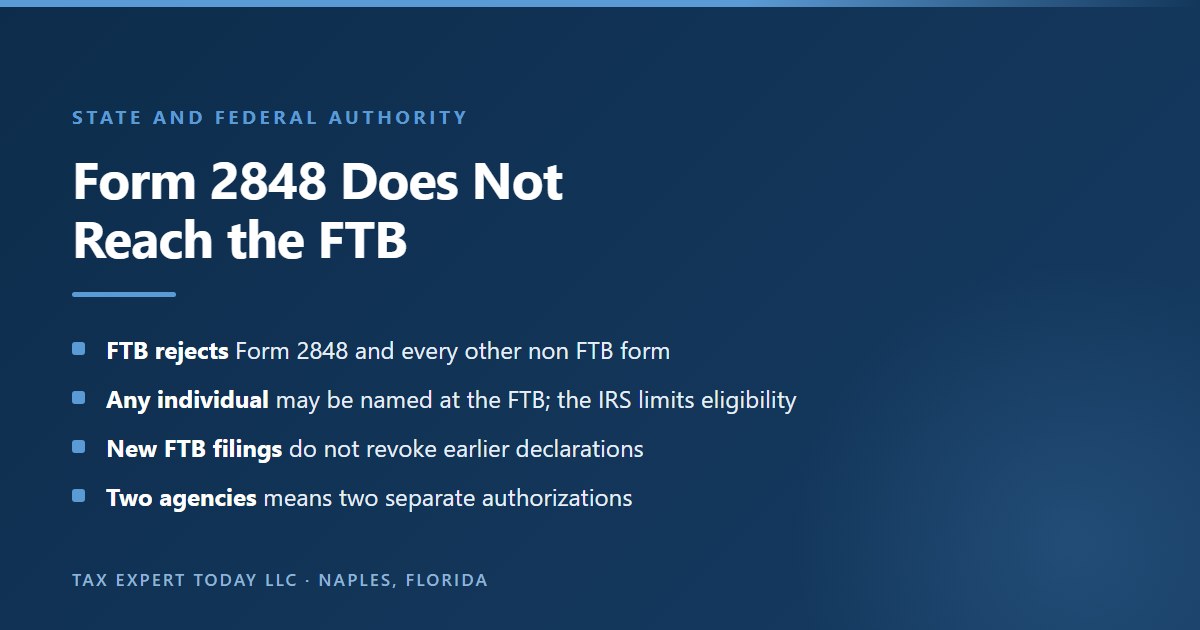
Any individual can be named. The FTB asks for a California CPA license number, State Bar number, CTEC number, enrolled agent number, or PTIN where the representative has one, but its submission page states it is acceptable to leave these blank. Firms cannot be named; only individuals can.
This is one of the sharpest differences between the California and federal systems. The IRS limits Form 2848 representatives to individuals eligible to practice before it, a category defined in Circular 230 and listed in Part II of the federal form. The FTB has no equivalent eligibility list on its declaration. The submission page asks representatives to “provide all available identification numbers” and then adds that it is okay to leave them blank if the representative has none.
| Question | FTB declaration | IRS Form 2848 |
|---|---|---|
| Who may be named? | Any individual | Only individuals eligible to practice before the federal agency |
| Professional number required? | Requested where available, may be left blank | Designation and jurisdiction required in Part II |
| Can a firm be named? | No | No |
| Maximum representatives | Two on the main form, more on added copies of Side 4 | Four on the form, more on an attached additional form |
| Primary representative | One must be designated | No primary designation; up to two may receive notice copies |
- Family members can be named. An adult child helping an aging parent with an FTB balance can be the named representative without a professional credential.
- Professional numbers still matter in practice. A representative who has a qualifying number can register for a tax professional MyFTB account, which is what unlocks online access.
- The primary representative receives notice of endings. The instructions state that only the primary representative is notified if the agency ends the relationship.
- Staff turnover does not transfer authority. If the named person leaves a firm, a new declaration naming the replacement is needed.
A useful consequence for former Californians is that the person best placed to handle the state file does not need to be the same person handling the federal one. Many of our clients arrive in Naples, Florida with a long standing California preparer who still knows the history. That preparer can remain on the FTB declaration while a Florida based advisor coordinates the federal side, or the reverse, as long as each agency has its own valid authority on file.
Does the FTB accept an IRS Form 2848?
No. The 3520-PIT instructions state that the FTB will only accept form FTB 3520-PIT and will reject form FTB 3520-C1 and non FTB power of attorney forms. An IRS Form 2848 on file with the federal agency gives your representative no authority at all with the Franchise Tax Board.
This is the single most common surprise for taxpayers who owe both agencies. A signed Form 2848 feels like “the” power of attorney, and many people reasonably assume the state follows the federal record. It does not. The FTB lists “an old or non FTB form was used” as the first of its common rejection reasons on its help with power of attorney page. The federal system is more flexible in the other direction: the Form 2848 instructions state that the IRS will accept a power of attorney other than Form 2848 if the document meets its requirements, although such a document cannot be recorded on the federal Centralized Authorization File without a completed Form 2848 attached.
| Rule | FTB 3520-PIT or 3520-BE | IRS Form 2848 |
|---|---|---|
| Accepts the other agency’s form? | No, only FTB declarations | Not the FTB form; accepts some non 2848 documents that meet federal requirements |
| Typical duration | Generally six years from signing | No fixed expiration; runs until revoked, withdrawn, or superseded |
| Effect of a new filing on the old one | Does not revoke earlier overlapping declarations | Generally revokes an earlier power recorded for the same matter unless the retention box on line 6 is checked |
| Future years allowed | Specific years ending no later than five years from the signature year; “all years” runs to expiration | Not recorded beyond three years from December 31 of the year the IRS receives it |
| Electronic signatures | Not accepted on paper or uploaded declarations | Permitted in certain online submission channels |
| Copies of notices to the representative | Most notices are not mailed; email notification if an address is provided | Up to two representatives may be designated to receive copies |
- File both when both agencies are involved. A California residency audit that follows a federal examination needs a Form 2848 for the federal side and an FTB declaration for the state side.
- The year limits do not line up. A federal authority listing future years and a state authority listing future years will not cover identical periods.
- Retention works in opposite directions. Federally you check a box to keep an old power alive; at the FTB you have to act to end an old one.
- The federal information authorization has a state twin. Form 8821 is to Form 2848 roughly what FTB 3534 is to the FTB declaration.
Readers who owe both agencies can see the practical consequence in our guide to the FTB installment agreement: the state and federal payment arrangements are negotiated separately, and the person negotiating each one needs authority from that agency specifically.
How is an FTB power of attorney different from a Tax Information Authorization?
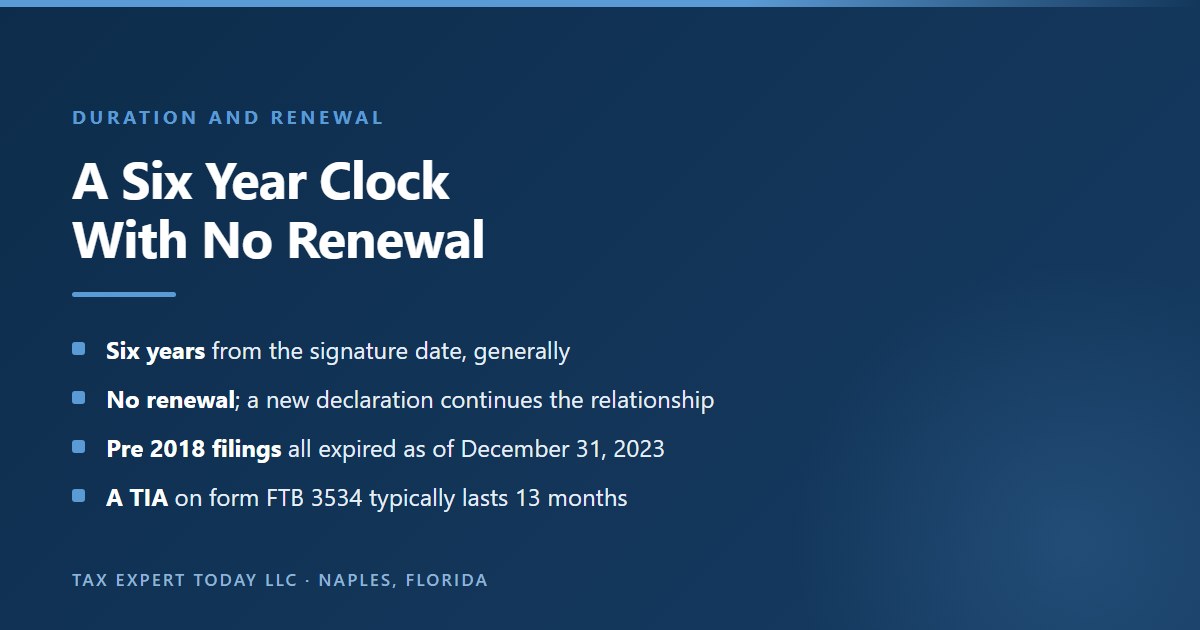
A power of attorney lets a representative act for you: talk to the agency, represent you, and manage the relationship. A Tax Information Authorization, filed on form FTB 3534, only lets the representative review your tax account information. The typical duration is six years for a declaration and 13 months for a TIA.
The agency publishes a direct comparison on its TIA versus POA page, and the differences go beyond the headline. A TIA covers all years; a declaration can cover all years or specific years. A TIA can be renewed, but only in MyFTB and only by the representative; a declaration cannot be renewed at all.
| Feature | Power of Attorney (3520-PIT or 3520-BE) | Tax Information Authorization (FTB 3534) |
|---|---|---|
| Talk to the FTB about your account | Yes | Yes |
| Receive and inspect confidential information | Yes | Yes |
| Represent you in matters before the FTB | Yes | No |
| Receive information from nontax programs such as court ordered debt | Yes | No |
| Update representatives on the relationship | Yes | No |
| Years covered | All years or specifically defined years | All years |
| Typical duration | 6 years | 13 months |
| Renewal | No; submit a new declaration | Yes, only in MyFTB and by the representative |
- Use a TIA for a look, a declaration for a fight. A preparer who only needs estimated payment history for the return can work from a TIA.
- A TIA can change online access. The 3520-PIT instructions give an example in which a later TIA with limited access downgrades a representative’s existing full access.
- Nontax debts need a declaration. The FTB also collects court ordered debt and vehicle registration debt, and only a declaration reaches those programs.
Which tax years can an FTB power of attorney cover?
Part III requires two answers. You either authorize all years, which covers previous, current, and future years up to the expiration date, or you list specific years, which may include any current or past year and future years ending no later than five years from the year you sign. General wording such as “all taxes” in the specific year boxes makes the declaration invalid.
Both questions in Part III need a checked “Yes” or “No.” The instructions state that an unanswered question is processed as a “No,” which may make the declaration invalid. If you answer “Yes” to both, the specific years you listed prevail. The agency gives its own illustration: a declaration signed March 1, 2025 with “all years” authorized covers all years up to March 1, 2031.
| What you enter in Part III | What the FTB does with it |
|---|---|
| “Yes” to all years, “No” to specific years | Covers past, current, and future years until the declaration expires |
| “No” to all years, “Yes” to specific years 2022 to 2025 | Covers only 2022 through 2025 |
| “Yes” to both questions | The specific years listed prevail |
| Neither box checked on a question | Treated as “No,” which may invalidate the declaration |
| “All years” or “all taxes” written into a specific year box | Invalid and rejected |
| A future year more than five years past the signature year | Outside the permitted range for specific years |
- A single year is written twice. The instructions show 2025 entered as both the beginning and ending year.
- Blank year boxes need “NA.” Unused fields in boxes 2a through 2d should be marked “NA” or struck through.
- The move year is usually the one that matters. For a departed Californian, the part year return and the years around it are where FTB questions tend to arise.
That last point is the corridor reason to think about years carefully. The California part year resident return for the year you moved, and the one or two years before it, are the years the FTB is most likely to examine when it reviews a residency change. A declaration that lists only the current year can leave your representative unable to discuss the year that actually matters.
How long does an FTB power of attorney last?
Generally six years from the date you sign it, unless it is revoked earlier on form FTB 3520-RVK or through MyFTB. The FTB does not renew declarations; to continue the relationship you submit a new one. Declarations filed on or before January 1, 2018 all expired as of December 31, 2023.
The six year clock and the no renewal rule both appear on the agency’s overview page and its relationship management page, which answers the renewal question with a flat no. The January 2018 cutoff is easy to miss: a taxpayer who signed an FTB declaration years ago and has not thought about it since may assume it is still in force when it is not.
- Track the signature date, not the approval date. The clock runs from the date the declaration is signed.
- An open matter does not extend it. If an examination or protest is still running near the six year mark, a new declaration is needed to keep the representative in place.
- A TIA runs on a separate, shorter clock. Thirteen months is the typical duration the agency cites.
- Old declarations do not revive. A relationship that expired needs a fresh submission, not a request to reinstate.
Does a new FTB power of attorney revoke the old one?
No. The 3520-PIT instructions state that submitting a new declaration will not revoke any previously submitted declarations with overlapping authorizations. Every earlier representative keeps their authority until you revoke it, the representative withdraws, or the old declaration expires.
This is the reverse of the default federal rule and it creates a real confidentiality risk. A taxpayer who changes advisors, files a new FTB declaration for the new advisor, and does nothing else has left the previous advisor fully authorized to discuss the account for the rest of the six year term. The instructions put the burden plainly: it is your responsibility to revoke your declaration when you are no longer working with a representative, and it is the representative’s responsibility to revoke it when they no longer represent you.
- Revoke first, then file. When changing representatives, end the old relationship through MyFTB, by phone, or on form FTB 3520-RVK.
- Check what is on file before assuming. A MyFTB login shows your current relationships, and the agency can confirm them by phone.
- Online access levels are the exception. For the same tax professional, the most recent access authorization overrides the earlier level.
How do you submit an FTB power of attorney?
Submit it online through MyFTB by selecting “File a Power of Attorney,” which the agency describes as the faster route, or mail the signed form, separately from any return, to the POA/TIA Unit, Franchise Tax Board, PO Box 2828, Rancho Cordova, CA 95741-2828. Processing generally takes about three weeks.
The submission page states that the agency generally takes three weeks to review and process declarations, longer if it needs more information, and that it sends the taxpayer a letter when it approves or denies the declaration. The mailing address appears both in the form instructions and on the agency’s help pages.
| Method | How it works | What to watch |
|---|---|---|
| MyFTB, individual account | Log in, select File a Power of Attorney from the services menu, review and submit | The information keyed in must match any uploaded declaration |
| MyFTB, tax professional account | The representative files from the quick links list and enters the client’s information | Uploaded declarations must not be in an editable format |
| Send the signed paper form to the POA/TIA Unit, PO Box 2828, Rancho Cordova, CA 95741-2828 | Mail it separately from returns and other correspondence | |
| Phone (changes only) | 800-852-5711 in the United States, 916-845-6500 from outside it | Used for revoking or removing representatives, not for creating a declaration |
- Every representative must be keyed in. A representative listed on an uploaded declaration but not entered in MyFTB is a listed rejection reason.
- Supporting documents go with the form. Trust instruments, letters of administration, and general or durable powers of attorney must be attached where required.
- Allow for the processing window. If a notice response deadline is close, file the declaration immediately and consider having the taxpayer respond directly in the meantime.
That last point matters because deadlines in California run whether or not your representative is authorized yet. A California late payment penalty accrues on its own schedule, and a protest window on a proposed assessment does not pause while a declaration is processed.
What is limited versus full online account access?
A tax professional named on an approved declaration automatically receives limited online access, which shows FTB notices and correspondence from the last 12 months. Full access, which adds balances, estimated payments, account summary, and available actions for the authorized years, requires your separate approval using an authorization code the agency mails to you.
Part V of the declaration is where access is requested. The instructions state that if you check “Yes,” the FTB mails you an authorization code for each tax professional, and full access is granted only when you approve it. If you check “No” or leave it blank, the professional gets limited access, and any existing full access for a professional on that declaration is reduced to limited.
| Access level | What the tax professional can see or do online | How it is granted |
|---|---|---|
| None | Nothing online; phone, in person, and written contact only | Representative has no tax professional MyFTB account, or the account is a fiduciary account |
| Limited | Notices and correspondence issued in the last 12 months | Automatic on approval of the declaration |
| Full | Available actions, estimated payments, notices, balance due, and account summary for authorized years | Requested in Part V and approved by the taxpayer with a mailed code |
- Access level does not limit representation. The instructions state that the online level does not affect what a representative can do or receive by phone, chat, correspondence, or in person.
- Fiduciary accounts have no online access. Representatives for estates and trusts obtain information by calling 800-852-5711.
- Watch your mail after filing. For a former Californian, the authorization code goes to the address the FTB has on file, which should already be your Florida address.
Will your representative receive copies of FTB notices?
Generally not by mail. The instructions state that the FTB does not mail copies of most notices to representatives. A representative who lists a valid email address on the declaration receives an electronic notification each time the agency sends you a notice; a representative with a MyFTB account can view notices online.
This catches people who are used to the federal system, where a taxpayer can designate up to two representatives to receive copies of IRS notices. At the FTB, the notice still goes to you, and if your representative cannot register for MyFTB, the instructions state that you must provide copies yourself.
- Always include the representative’s email. The instructions recommend it specifically so notifications are sent.
- Update your own address after a move. Notices mailed to an old California address are the most common reason a departed taxpayer misses a deadline.
- Forward everything promptly. A representative cannot respond to a notice they never saw.
Who signs an FTB power of attorney for a business, trust, or estate?
An individual signs their own form. For a business, an officer or individual with authority to bind the company signs the 3520-BE and enters a title. A general or tax matters partner signs for a partnership, and an authorized managing member or tax matters partner signs for an LLC. A fiduciary signs for an estate or trust and attaches proof of authority.
The signature rules are in Part VI of the 3520-PIT instructions and in the signature section of the 3520-BE instructions. The agency’s submission page adds a requirement that applies to everyone: the signer must include a printed name, a title where one applies, a signature, and a signature date.
| Taxpayer | Who signs | What must be attached |
|---|---|---|
| Individual | The individual | Nothing, unless someone signs on their behalf |
| Minor | A parent, legal guardian, or conservator, stating the relationship | Birth certificate, custody agreement, court order, or other proof of authority |
| Estate or trust | The fiduciary, with title | Letters testamentary or of administration, certification of trust, court order, or governing instrument; a copy of federal Form 56 if one is required |
| Corporation or association | An officer with authority to bind the company, such as the president, CEO, or CFO | Title and date on the form |
| General or limited partnership | The tax matters partner or general partner | Title and date on the form |
| LLC or LLP | An authorized managing member or tax matters partner | Title and date on the form |
- No electronic or stamped signatures. The agency states it does not accept them on paper or uploaded declarations.
- A fiduciary is not a representative. The instructions explain that a fiduciary stands in the position of the taxpayer and acts as the taxpayer, then uses the declaration to appoint a representative.
- Trusts matter to this track. A trust whose grantor has left California may still owe California tax, a question our guide to California inheritance tax touches for heirs and beneficiaries.
How do you sign an FTB power of attorney on behalf of someone else?
Attach the general or durable power of attorney that gives you authority, and sign using one of the formats the FTB prescribes, such as “John Doe, Attorney-in-Fact for Jane Doe” or “Jane Doe by John Doe, Attorney-in-Fact.” A declaration signed for someone else without the attachment and the prescribed format is invalid.
This is where the FTB form and an ordinary estate planning power of attorney meet. The estate planning document does not itself work at the FTB, but it establishes the authority of the person signing the FTB declaration. The instructions set out three acceptable formats for individuals, and the submission page sets out three parallel formats for business entities, each ending with the entity name.
- Individual formats. “John Doe, Attorney-in-Fact for Jane Doe”; “Jane Doe by John Doe, Attorney-in-Fact”; or “Jane Doe by John Doe, Power of Attorney.”
- Business formats. The same three patterns, with the officer title and company name added, for example “Jane Doe, CEO, by John Doe, Attorney-in-Fact, XYZ Corp.”
- Durable wording matters later. As explained below, a declaration established with a durable power of attorney survives the taxpayer’s incapacity, and one without it does not.
Why does the FTB reject power of attorney declarations?
The agency lists the common reasons: an old or non FTB form, an electronic or stamped signature, a missing signature, date, printed name, or title, missing supporting documents, unchecked boxes on a business form, and MyFTB errors such as keyed information that does not match the uploaded declaration.
When a declaration is rejected, the FTB sends the taxpayer a letter giving the reason, and tax professionals can see the reason in MyFTB, according to the agency’s help page. A rejection costs more than the paperwork; it costs the roughly three weeks of processing time, which may be the time you had to answer a notice.
| Rejection reason | How to prevent it |
|---|---|
| Old or non FTB form, including IRS Form 2848 | Download the current 3520-PIT or 3520-BE from the agency site each time |
| Electronic or stamped signature | Sign in ink, then scan or mail the original |
| Missing signature, date, printed name, or title | Complete all four elements in the signature block |
| Missing supporting documents | Attach the trust document, letters of administration, or general or durable power of attorney |
| Business form with entity type or authorization boxes unchecked | Check exactly one entity type box and answer every Yes or No question |
| MyFTB entries do not match the upload | Key in every representative exactly as written on the form |
| Uploaded declaration in an editable format | Upload a flattened, non editable file |
| General reference such as “all years” in the specific year boxes | Use the all years question for that purpose, and list real years in the boxes |
- Answer every Yes or No box. Blank answers are treated as “No,” and on the year questions that can invalidate the declaration.
- Do not mix forms. Mail the declaration by itself, never stapled to a return or a notice response.
- Keep a copy of what you sent. The signature date on your copy is what you will need to update or revoke the relationship later.
How do you revoke or change an FTB power of attorney?
You can revoke a declaration online in MyFTB, by mailing form FTB 3520-RVK, or by phone, naming the representatives to be revoked. Anyone on the declaration, including the representative, can revoke it. To add a representative you submit a new declaration listing only the new person, and to remove one you can use MyFTB, a written request, or a phone call.
The agency’s relationship management page sets out each change and the routes available for it. Estates, trusts, and group returns have a narrower path: they can revoke only by phone and mail unless their tax professional does it online for them.
| Change | Online | By mail | By phone |
|---|---|---|---|
| Revoke the declaration | MyFTB | Form FTB 3520-RVK | Yes, naming the representatives |
| Add a representative, if authorized | MyFTB | New declaration listing only the new representatives | No |
| Remove a representative | MyFTB | Written request with taxpayer name, ID, representative name, and the declaration signature date | Yes |
| Update representative contact details | MyFTB | Written request with the updated information and declaration signature date | No |
| Renew | Not available; submit a new declaration | ||
| Change online access level | MyFTB | New declaration | No |
- Phone numbers. Taxpayers call 800-852-5711 within the United States or 916-845-6500 from outside it; tax professionals use 916-845-7057, weekdays 8 a.m. to 5 p.m. Pacific.
- A change of contact details does not need a new form. The instructions say so directly, though they recommend keeping the representative’s email current.
- Revoke when the engagement ends. Both taxpayer and representative carry that responsibility under the instructions.
What happens to an FTB power of attorney at death or incapacity?
When the FTB is notified of a taxpayer’s death, it revokes the declaration. A new declaration can then be signed by the decedent’s legal representative. When the agency is notified of incapacity, the declaration is generally terminated, unless it was originally established with a durable power of attorney, in which case it continues.
Sections H through J of the 3520-PIT instructions cover these endings. The death of a representative is handled differently from the death of the taxpayer: if there is one representative the declaration is revoked, but if there are several, only the deceased representative’s authority ends and the others continue.
- Estates need a federal identification number. The instructions state that the estate’s representative must obtain an FEIN to identify the estate in filings.
- Refunds for a decedent do not need a declaration. The agency states that a representative claiming a deceased taxpayer’s refund files federal Form 1310 with the FTB instead.
- Durable language protects continuity. For an aging parent with an open FTB matter, a declaration established with a durable power of attorney avoids a gap if capacity declines.
Do CDTFA and EDD accept the FTB power of attorney?
No. California has three separate tax agencies, and each has its own authorization. The Franchise Tax Board handles income and franchise tax, the California Department of Tax and Fee Administration uses form CDTFA-392 for sales and use and special taxes, and the Employment Development Department uses form DE 48 for payroll tax and benefit reporting.
Former California business owners are the readers most likely to need all three, because a closed California business can leave an income tax question at the FTB, a final sales tax return at the CDTFA, and a payroll account at the EDD at the same time. The CDTFA’s form CDTFA-392 appoints attorneys in fact for the programs the department administers and can also be requested through its online services. The EDD’s form DE 48 states that it remains in effect until revoked or until a new one is received, a different duration rule from the FTB’s six years.
| Agency | What it administers | Authorization form | Duration rule |
|---|---|---|---|
| Franchise Tax Board | Personal income tax, corporate franchise and income tax, LLC tax and fee, court ordered debt collection | FTB 3520-PIT or FTB 3520-BE | Generally six years from signing |
| California Department of Tax and Fee Administration | Sales and use taxes and special taxes and fees | CDTFA-392 | Set by the periods selected on the form |
| Employment Development Department | Payroll taxes and benefit reporting | DE 48 | Until revoked or replaced, unless an expiration date is specified |
| Internal Revenue Service | Federal taxes | Form 2848 | Until revoked, withdrawn, or superseded |
- One engagement, several documents. A representative handling a closed California business may need four separate authorizations.
- Florida adds nothing on income tax. Florida has no personal income tax, so a Florida resident’s personal income tax authority questions are federal and Californian only.
- Payroll issues can outlive the business. An EDD account left open after a move can generate notices long after operations stopped.
How should you sequence FTB and IRS authority after leaving California?
File the federal Form 2848 and the FTB declaration together, covering the same years, whenever the matter could involve both agencies. For a former Californian, that usually means the move year, the one or two years before it, and any year still open to assessment, because a federal change often flows into a California adjustment.
The sequencing problem is practical rather than legal. A federal examination that changes income for a year you were a California resident will often lead the FTB to follow up, and a California residency audit may ask for federal records. If your representative has authority at one agency and not the other, conversations stall while a second authorization is prepared, signed, and processed.
| Situation | Federal authority | California authority |
|---|---|---|
| FTB residency inquiry after a move to Florida | Form 2848 helpful if federal records are requested | FTB 3520-PIT covering the move year and prior years |
| Balances owed to both agencies | Form 2848 for the federal collection matter | FTB 3520-PIT for the state payment arrangement |
| Federal audit of a year you lived in California | Form 2848 for the examination | FTB 3520-PIT so the representative can handle the state follow up |
| California LLC still open after the owner moved | Form 2848 for the entity if federal issues exist | FTB 3520-BE for the LLC and FTB 3520-PIT for the owner |
| Estate of a California decedent | Form 2848 signed by the fiduciary, with Form 56 | FTB 3520-PIT signed by the fiduciary, with letters and Form 56 copy |
- Match the years. Remember that the federal and state year limits differ, so check each form against its own rules.
- Coordinate the people. If different advisors hold federal and state authority, decide who speaks for the whole picture.
- Keep your address current at both agencies. Our departure checklist for leaving California covers the address and filing steps that prevent missed notices.
The residency question itself sits on the Florida side as well. Readers building the Florida record should see our guide to establishing Florida residency, and those facing questions from both states should read about the dual state residency tax trap.
Should you authorize a representative to waive the California statute of limitations?
Only with care. Checking that box lets your representative sign a consent extending the time the FTB has to assess tax. Revenue and Taxation Code section 19067 allows such written consents and requires the FTB to tell you of your right to refuse an extension or limit it to a particular period each time it asks.
The statute of limitations protects taxpayers by closing old years. Section 19067 provides that when a taxpayer consents in writing, before the assessment period expires, to an assessment after that time, the assessment may be made any time before the agreed period ends, and later written agreements can extend it further. Granting a representative this authority on the declaration means they can sign that consent without returning to you.
- Waivers are sometimes sensible. Refusing a requested extension can prompt the agency to issue an assessment on the information it already has.
- A limited extension is an option. The statute requires notice of the right to limit the extension to a particular period.
- Closing agreements are narrower still. The instructions allow a representative to execute settlement and closing agreements only when there are extenuating circumstances.
- You can leave both boxes at “No.” The representative can still discuss the extension and bring it to you for signature.
For the time limits themselves, including how long the FTB generally has to assess, see our guide to the California residency audit, which sets out the assessment windows in a table, and the federal parallel in our article on the IRS audit statute of limitations.
FTB Power of Attorney Help in Naples & Southwest Florida
FTB power of attorney help Naples residents can use starts with one question: which agencies and which years does your matter really involve. Tax Expert Today LLC advises on state residency and tax matters nationwide, including California departures and Florida arrivals, from our office in Naples, Florida. Our team includes tax advisors, enrolled agents, CPAs, and attorneys, and we prepare the declaration, confirm the years, and coordinate the state and federal authority so nothing stalls between agencies.
We are located at 11983 Tamiami Trail N, Naples FL 34110. Call (239) 441-2005, Monday through Friday, 10:00 to 5:00 Eastern Time. Clients across Naples, Bonita Springs, Estero, Fort Myers, Marco Island, and the wider Southwest Florida region engage us for FTB correspondence, California part year returns, and residency planning. Our California tax services page describes the state engagements we take, Naples tax planning covers our local advisory work, and federal matters are handled through our IRS resolution and audit support practice and our IRS audit help in Naples.
Local FAQ: I retired to Naples from Los Angeles two years ago and just received an FTB letter about my last California year. Can a Naples advisor deal with the FTB for me? Yes, provided you sign a valid FTB declaration naming that advisor. The FTB does not limit representation to California based professionals, and the declaration can be filed online through MyFTB or mailed to Rancho Cordova. Bring the letter, your last California return, and your move records, and we can check which years the declaration should cover, file it, and review whether the letter raises a residency question, a California source income question, or something narrower.
When to Engage a Professional
Engage a professional as soon as an FTB notice arrives with a response deadline, when you owe both the IRS and the FTB, when a residency change is under review, or when someone must sign on behalf of a family member, trust, or estate. In each case the authority has to be right before any substantive conversation can start.
- Deadlines do not wait for processing. A declaration typically takes about three weeks, and a rejection restarts the clock.
- Two agencies need two documents. Federal and California authority must be filed and tracked separately.
- Old authority lingers. Earlier representatives remain authorized until someone revokes them.
- The additional powers carry weight. Statute waivers and closing agreements deserve deliberate decisions, not default checkmarks.
Tax Expert Today LLC advises on state residency and tax matters nationwide. We can prepare and file your FTB declaration, confirm the years and access level, coordinate it with any federal Form 2848, and then address the underlying matter, whether that is a notice, a nonresident withholding credit, or a payment arrangement. We do not promise any particular result, and outcomes depend on facts and on law that may change. Call (239) 441-2005 to discuss your situation, or review our California tax services.
Frequently Asked Questions About the FTB Power of Attorney
Does the FTB accept IRS Form 2848 as a power of attorney?
No. The Franchise Tax Board states that it will only accept its own declarations, form FTB 3520-PIT for individuals, estates, and trusts and form FTB 3520-BE for business entities, and that it rejects non FTB power of attorney forms. A Form 2848 on file with the IRS gives your representative no authority with the FTB.
How long does an FTB power of attorney last?
Generally six years from the date the declaration is signed, unless it is revoked earlier online in MyFTB or on form FTB 3520-RVK. The FTB does not renew declarations, so continuing the relationship requires a new declaration. Declarations filed on or before January 1, 2018 expired as of December 31, 2023.
How long does the FTB take to process a power of attorney?
The FTB states that it generally takes three weeks to review and process a declaration, and longer if it needs more information. The agency sends the taxpayer a letter when it approves or denies the declaration. Online submission through MyFTB is described by the agency as the faster route.
Can a family member be named on an FTB power of attorney?
Yes. Any individual can be named. The FTB asks for a CPA, State Bar, CTEC, enrolled agent, or PTIN number where the representative has one, but states that it is acceptable to leave these blank. Only individuals, not firms, can be named as representatives.
Does filing a new FTB power of attorney cancel the old one?
No. The 3520-PIT instructions state that a new declaration does not revoke earlier declarations with overlapping authorizations. Earlier representatives stay authorized until the declaration is revoked through MyFTB, by phone, or on form FTB 3520-RVK, or until it expires.
What is the difference between an FTB power of attorney and form FTB 3534?
Form FTB 3534 is a Tax Information Authorization, which only lets a representative review your account information and typically lasts 13 months. A power of attorney also lets the representative represent you before the FTB and manage the relationship, and it typically lasts six years.
Can a Naples, Florida advisor file an FTB power of attorney for a former California resident?
Yes. The FTB does not limit representation to California based professionals. A former California resident now living in Naples, Florida or elsewhere in Southwest Florida can name a Florida based advisor on form FTB 3520-PIT and file it online through MyFTB or by mail to the POA/TIA Unit in Rancho Cordova.
Published September 25, 2026 by Dr. Pellumb Kabashi « Back to Learning Center
Have a question this article touches on?
Tax Expert Today LLC, based in Naples, Florida and serving clients across the United States.
Schedule a Consultation (239) 441-2005