
By Dr. Pellumb Kabashi, DBA, MBA, CES, CFE, EA
Founder, Tax Expert Today LLC · Tax advisors, enrolled agents, CPAs, and attorneys · Serving clients in all 50 states
Quick Answer: California remote work tax follows the place where the work is performed, not the place where the employer sits. Once you are a nonresident, salary you earn for services performed entirely outside California is not California source income under Revenue and Taxation Code section 17951, and only the days you still work inside California remain taxable. Call (239) 441-2005 for a free consultation.
Does California tax remote work after you move out of state?
No, not the wages you earn for work performed outside the state. California taxes a nonresident only on income from sources within California under Revenue and Taxation Code section 17951. Once you are genuinely a nonresident and you perform your services from Florida, those wages have a Florida source, even though the paycheck comes from a California employer.
- The test is physical location. California asks where you were while you did the work, not where the payroll department is.
- Residency comes first. The sourcing rule only helps once you have actually stopped being a California resident under section 17014.
- California days stay taxable. Travel back for meetings, and those specific workdays become California source income again.
- The employer may still be withholding. Sourcing and withholding are two separate questions, and payroll often lags the move by months.
This is the most common misunderstanding among people who leave the state and keep the job. The worry is usually phrased as a fear that a California employer somehow drags California tax across the country. It does not. What actually creates exposure is either a residency position that does not hold up, which is the subject of our guide to the California residency audit, or California workdays that were never counted. Both of those are questions of fact rather than questions of law, which is why two people with identical job titles and identical employers can reach opposite results in an examination. The statute treats them the same. Their calendars and their domicile evidence do not.
Why does the location of your employer not control California remote work tax?
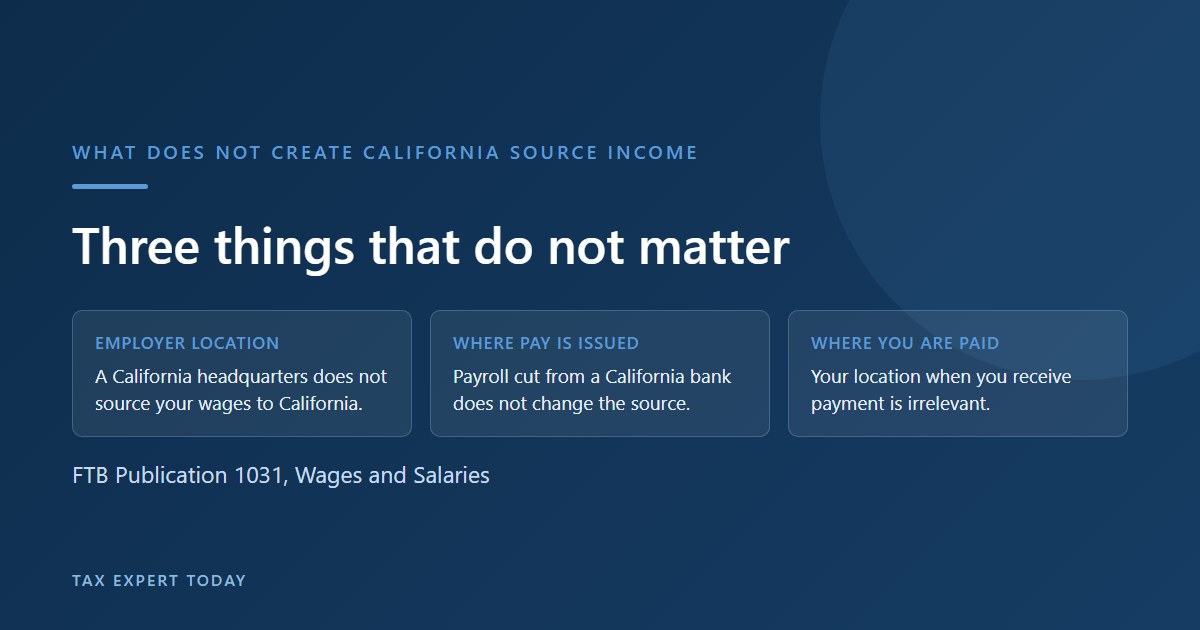
Because the Franchise Tax Board sources compensation to the place of performance and says so in plain terms. Publication 1031 states that wages and salaries have a source where the services are performed, and that neither the location of the employer, nor where the payment is issued, nor your location when you receive payment affects the source of that income.
That sentence disposes of three separate theories at once. The employer being headquartered in San Francisco does not matter. The payroll being cut from a California bank does not matter. Logging into a California server does not matter. Publication 1031 reduces the question to a single fact, which is where you were when you did the work.
| Your status | Where the work happened | Taxable by California | Authority |
|---|---|---|---|
| California resident | Anywhere in the world | Yes, all of it | R&TC 17041, Pub 1031 |
| Nonresident | Entirely outside California | No | R&TC 17951 |
| Nonresident | Some days inside California | Yes, the California days only | CCR 17951-5(b) |
| Part-year resident | During the resident period | Yes, regardless of location | Sch CA (540NR) column E |
| Part-year resident | During the nonresident period | Only California source | Sch CA (540NR) column E |
What does Revenue and Taxation Code section 17951 actually say?
Section 17951(a) provides that in computing the taxable income of a nonresident, gross income includes only the gross income from sources within this state. That is the whole engine. It does not carve out remote workers, it does not mention employers, and it does not treat a California payroll as a California source.
- It is a limiting rule. The statute restricts what California may reach rather than expanding it.
- It cross-references section 17041. The nonresident computation runs through the rate structure in that section.
- Subdivision (b) adds federal overrides. Several occupations are removed from California gross income by act of Congress.
None of the pages currently ranking for this question quote the statute at all. They state the correct conclusion and leave the reader without the citation to bring to a payroll department that disagrees. When you are asking an employer to change withholding, the section number is the part that carries weight.
Which remote workers are protected by federal law regardless of California sourcing?
Section 17951(b) removes several categories from the California gross income of a nonresident entirely, by operation of federal statutes. These cover interstate transportation crews and military members, and they can apply even where some work is genuinely performed in California, which makes them a stronger shield than the ordinary sourcing rule.
| Category | Federal statute | Effect for a nonresident |
|---|---|---|
| Certain merchant seamen | 46 U.S.C. 11108 | Compensation excluded from California gross income |
| Rail carrier employees | 49 U.S.C. 11502 | Taxable only by the state of residence |
| Motor carrier employees | 49 U.S.C. 14503 | Taxable only by the state of residence |
| Air carrier employees | 49 U.S.C. 40116 | Taxable only by the state of residence, subject to the statutory tests |
| Military service members | 50 U.S.C. App. 571 | Military compensation excluded |
A flight attendant or a long haul driver who relocates to Florida and keeps a California based employer is therefore in a different position from a software engineer doing the same thing. The engineer relies on where the work happened. The flight crew member relies on a federal statute. These provisions carry conditions, and the air carrier rule in particular depends on how flight time is distributed, so the specific facts govern.
How do you calculate California tax on days you still work in California?
You allocate by workdays. California Code of Regulations, title 18, section 17951-5(b) requires a nonresident who performs services both within and outside the state to allocate to California the portion of total compensation reasonably attributed to services performed here. Publication 1004 confirms that an allocation based on time worked is one reasonable method.
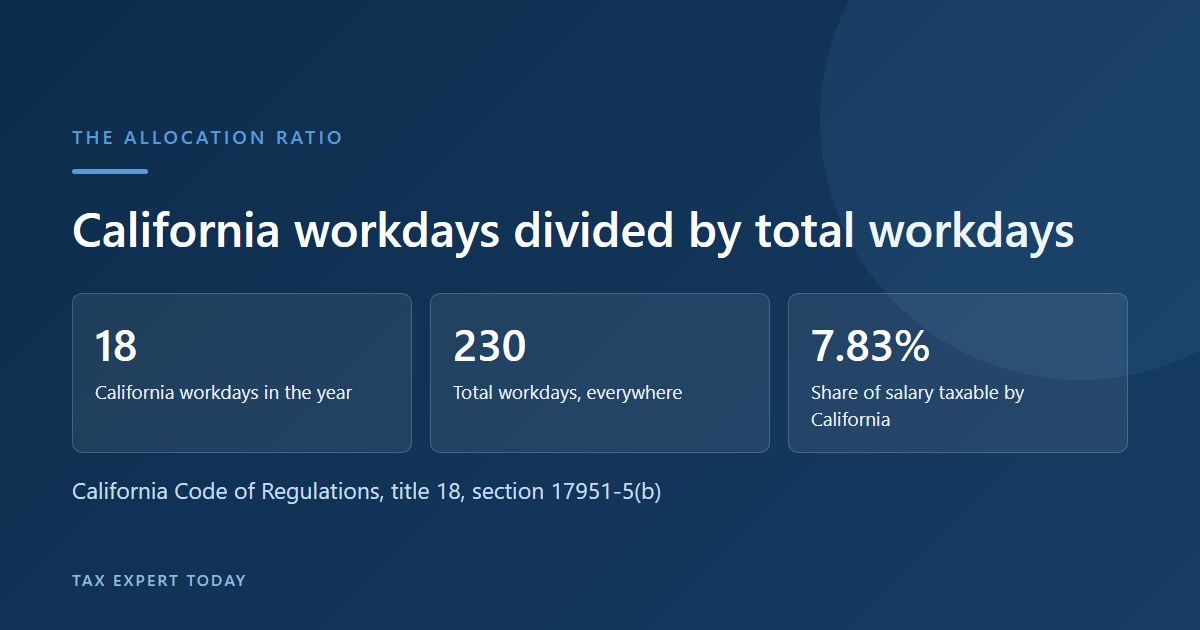
The ratio is straightforward once the days are counted:
- Numerator. California workdays during the period.
- Denominator. Total workdays during the same period, everywhere.
- Result. Multiply total compensation for the period by that ratio.
- Exclude non-working days. Weekends, holidays and paid leave are generally outside the count on both sides of the fraction.
| Fact | Amount | Note |
|---|---|---|
| Salary for the year | $220,000 | Single California employer, worker resident in Florida all year |
| Total workdays | 230 | Excludes weekends, holidays and paid leave |
| Days physically working in California | 18 | Quarterly onsite planning weeks plus one conference |
| Allocation ratio | 18 divided by 230, or 7.83 percent | CCR 17951-5(b) time basis |
| California source wages | $17,217 | Reported on Schedule CA (540NR), column E |
| Wages not taxable by California | $202,783 | Services performed in Florida |
Two points deserve emphasis. The first is that eighteen days of travel does not make the entire salary taxable, which is a fear we hear often. The second is that eighteen days is not zero either, and a return that reports nothing while a W-2 shows California wages invites correspondence. The arithmetic is the defense. Wages are only one of the categories that can carry a California source, and the full category by category breakdown is in our guide to California source income.
When should your employer stop withholding California tax from your paycheck?
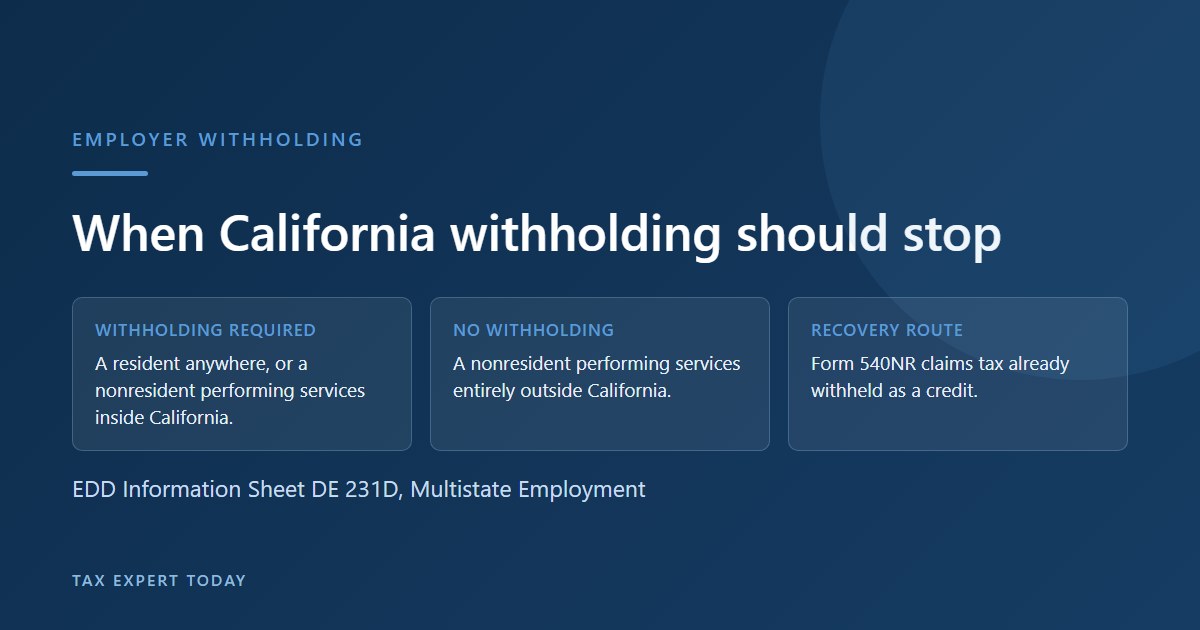
Once you are a nonresident performing no services in California. EDD Information Sheet DE 231D states that wages paid to a resident employee for services performed within or without the state, or to a nonresident employee for services performed within this state, are subject to California personal income tax withholding. A nonresident working entirely elsewhere falls outside both descriptions.
- Notify payroll in writing. Give the employer your new address and the date your California residency ended.
- Expect a lag. Payroll systems frequently keep withholding for a full quarter or longer after a move.
- Watch the W-2. A W-2 that still shows CA in box 15 with state wages in box 16 will need to be reconciled on the return.
- Withholding is not the tax. Money withheld in error is recoverable, but only by filing.
| Employee status | Where services are performed | California PIT withholding required |
|---|---|---|
| California resident | Inside California | Yes |
| California resident | Entirely outside California | Yes, where the employer is subject to California law |
| Nonresident | Inside California, some days | Yes, as to those services |
| Nonresident | Entirely outside California | No |
DE 231D also notes that the personal income tax rules differ from the unemployment insurance, employment training tax and state disability insurance rules, which are localized to a single state under a separate test. That is why an employer sometimes continues to report a departed worker to California for one purpose while correctly stopping income tax withholding for another. The two answers are allowed to diverge, and a payroll department that resists the change is often reasoning from the unemployment insurance rule rather than the income tax rule. Our guide to the California SDI tax walks through those multistate tests for a remote worker who has moved to Florida.
It is worth correcting a widespread misstatement here, because it appears frequently in general guidance. Form 590 is a Withholding Exemption Certificate on which an individual certifies that the payee is a California resident. It belongs to the nonresident withholding regime that applies to non-wage payments, which we cover in our guide to California nonresident withholding. It is not the form a departing employee files to switch off wage withholding, and handing it to an employer would certify the opposite of the position being taken.
How do you recover California tax withheld after you became a nonresident?
By filing Form 540NR for the year and claiming the withheld amount as a credit against the small California liability that actually exists. The withholding shown on the W-2 is applied against the tax computed on genuine California source income, and the excess is refunded. There is no separate reclaim form for wage withholding.
- Report the California days. Column E of Schedule CA (540NR) carries the allocated California source wages, not the full W-2 figure.
- Claim the withholding in full. The credit is the amount actually withheld, regardless of how little tax is due.
- Attach the W-2. The state copy substantiates the credit.
- Do not simply skip the return. Ignoring it leaves the money with the state and leaves a filing gap.
The mechanics of that return, including how column E behaves across a move, are set out in our guide to the California part year resident tax return.
Does California have a convenience of the employer rule?
No. California does not apply a convenience of the employer rule, and this is one of the most consequential differences between leaving California and leaving New York. Under a convenience rule, days worked remotely for the worker’s own convenience are treated as days worked at the employer’s location and remain taxable by the employer’s state.
| Question | California | Convenience rule states |
|---|---|---|
| Remote days sourced to the employer state | No | Yes, unless the remote location is a business necessity |
| Basis of sourcing | Physical place of performance | Place of performance, subject to the convenience test |
| Effect of a full relocation | Wages leave the California base entirely | Wages may remain taxable by the former state |
| Practical planning consequence | The move itself does the work | The reason for the move can control the result |
The absence of a convenience rule is why a corridor move out of California is comparatively clean on the wage question, and why the analysis then concentrates almost entirely on residency itself rather than on the character of the remote arrangement. That emphasis is the reason our departure checklist for leaving California spends its attention on domicile facts.
What happens to remote wages in the year you actually move?
The move year splits. Schedule CA (540NR) column E requires all income earned while a California resident, no matter where the services were performed, plus California source income earned during the nonresident portion. The same job therefore produces two different sourcing answers within one calendar year, divided at the residency change date.
- Before the move date. Every dollar of salary is California taxable, including days you happened to work from Florida.
- After the move date. Only California workdays are taxable.
- The date matters. A residency change date that cannot be supported by facts undermines the whole allocation.
- Bonuses and equity follow their own rules. Deferred compensation and equity awards are allocated over the period earned, not the period paid.
Equity compensation is the most frequent complication for departing technology employees, because a grant made while resident in California continues to carry California source income long after the move. We treat that separately in our guide to California RSU tax after leaving the state, and the Florida side of the same planning problem appears in our discussion of Florida domicile for executives.
How is an independent contractor treated differently from a W-2 employee?
Differently in both sourcing and withholding. A contractor is carrying on a trade or business rather than performing services as an employee, so the income is business income sourced under the market based rules, and payments to a nonresident contractor for California services can be subject to the 7 percent nonresident withholding regime rather than payroll withholding.
- Sourcing basis. Business income looks to where the benefit of the service is received, not only where the work occurred.
- Withholding regime. Payments above the statutory threshold to a nonresident payee can require withholding by the payer.
- Different forms. Forms 587, 588 and 590 operate in this regime, not in payroll.
- Entity choice interacts. Operating through an entity changes both the sourcing analysis and the California filing footprint.
| Feature | W-2 employee | Independent contractor |
|---|---|---|
| Sourcing rule | Where the services are physically performed | Business income rules, including market based sourcing |
| Allocation method | Workday ratio under CCR 17951-5(b) | Depends on where the benefit of the service is received |
| Withholding mechanism | Payroll withholding under the employment tax rules | Nonresident withholding on California source payments |
| Relevant certificates | Employer payroll records | Forms 587, 588 and 590 |
| Reporting form received | Form W-2 | Form 1099-NEC |
| Entity considerations | None | LLC or S corporation registration and fee exposure |
This distinction is the reason the answer to a remote work question genuinely changes depending on whether a Form W-2 or a Form 1099-NEC arrives in January. If you converted from employee to contractor as part of the move, the analysis restarts, and the entity question in our comparison of a California LLC against an S corporation and our guide to the California LLC franchise tax both become relevant.
Does the 546 day safe harbor apply to a remote worker leaving California?
Only in narrow circumstances. Publication 1031 provides that an individual domiciled in California who is outside the state under an employment-related contract for an uninterrupted period of at least 546 consecutive days is considered a nonresident, subject to two disqualifiers. It is a rule for assignments abroad or out of state, not a general substitute for changing domicile.
- 546 consecutive days. Roughly eighteen months, and the periods of two separate contracts cannot be combined.
- Intangible income ceiling. Intangible income above $200,000 in any taxable year the contract is in effect disqualifies the safe harbor.
- Purpose test. A principal purpose of avoiding personal income tax disqualifies it.
- Return visits. Visits totaling no more than 45 days in a taxable year are treated as temporary.
- Spouse coverage. An accompanying spouse or registered domestic partner is also treated as a nonresident for the period.
For most people leaving California permanently for Florida, the safe harbor is beside the point, because they are changing domicile outright rather than working under a fixed term contract. The ordinary facts and circumstances test governs instead, and that is the analysis described in how to establish Florida residency and tested in a Florida residency audit.
Do you still have to file a California return after going fully remote?
Often yes, at least for a transition period. A filing obligation can arise from California source income, and it also arises in practice whenever California withholding appears on a W-2, because filing is the only mechanism that returns it. A year with genuinely zero California workdays and zero withholding is the year the obligation finally ends.
- California source income. Any allocated California workday wages can create a filing requirement.
- Withholding recovery. Filing is required to claim back tax withheld in error.
- Equity vesting. Awards granted while resident continue to generate California source income for years afterward.
- The final resident year. The move year itself always requires a part-year return.
The pattern we see most often runs three years long. The move year produces a part-year return. The first full nonresident year produces a nonresident return, usually to recover withholding that payroll did not stop promptly and to report a handful of travel days. By the third year, if payroll has been corrected and the travel has stopped, there may be nothing left to file. Understanding that arc in advance prevents the two errors at either end, which are filing nothing in year one and continuing to file indefinitely in year five out of caution.
A related trap is the assumption that no California return means no California scrutiny. The Franchise Tax Board receives wage data directly, so a year in which a California employer reports wages and no return appears is precisely the fact pattern that generates a demand letter. Filing a nonresident return that reports a small allocated amount is a considerably better posture than filing nothing and explaining later.
What records prove your California workday count?
Contemporaneous records that show physical location on specific dates. Because the allocation ratio is built from a day count, the burden in an examination falls on the day count, and reconstructing it years later from memory is the single most common weakness in an otherwise correct position.
- Travel documents. Flight itineraries, boarding passes and hotel folios establish presence and dates.
- Calendar exports. A preserved calendar showing onsite meetings is stronger than a later summary.
- Expense reports. Employer reimbursements independently corroborate California trips.
- Payroll records. Any employer-maintained work location coding supports the same conclusion.
- A running log. A simple contemporaneous spreadsheet of California days costs nothing and answers the question directly.
A practical habit is worth more than a perfect system. Recording California days as they happen, in whatever tool already holds your calendar, converts the hardest part of a California remote work tax position into a clerical task. The alternative is an examination in which the auditor proposes a day count and the burden of displacing it falls on the taxpayer. Where records are genuinely unavailable, a reconstruction built from independent sources such as credit card statements, airline account histories and employer expense systems is generally more persuasive than a narrative, because each source was created for a different purpose and none of them was created for the audit.
The examination risk here is not usually the legal theory, which is well settled, but the evidence. Someone who can produce a dated log and matching itineraries is in a strong position. Someone estimating from recollection three years later is not, and the same evidentiary problem drives outcomes in the dual state residency trap.
California remote work tax help Naples and Southwest Florida
California remote work tax help Naples clients ask for tends to arrive in one of two shapes. Either a W-2 arrived in January still showing California wages for a full year that was worked from a home office in Collier County, or an FTB notice has appeared asking why a return was not filed for a year in which a California employer reported wages. Our office in Naples, Florida works the sourcing question and the residency question together, because the workday allocation is only as strong as the residency date it is measured from, and because the two questions are usually examined at the same time.
Tax Expert Today LLC
11983 Tamiami Trail N, Naples, FL 34110
Phone: (239) 441-2005
Hours: Monday through Friday, 10:00 to 5:00 ET
I moved to Naples last year but my employer kept withholding California tax all twelve months. Do I have to file a California return to get it back? Generally yes, and that filing is the only route to recovery for wage withholding. There is no standalone refund claim for California tax withheld from a paycheck. The return computes the tax on whatever California source wages genuinely exist, which for a fully remote year may be very little or none, then applies the entire amount withheld as a credit and refunds the difference. The two things to assemble first are the residency change date with the facts that support it, and a day count for any trips back to California during the year. Our California tax services page and our Naples tax planning page describe how we handle both ends of the corridor.
When to Engage a Professional
A California remote work position is worth professional review when the facts are mixed rather than clean. Consider engaging an advisor when the move happened mid-year and the residency date drives the entire allocation, when California workdays are substantial enough that the ratio materially changes the result, when equity compensation granted before the move is still vesting, when a W-2 continues to report California wages after payroll was notified, when an FTB notice has already been issued for an unfiled year, or when the arrangement converted from employment to independent contracting as part of the relocation. Outcomes depend on the specific facts, and the analysis generally requires the payroll records, the travel history and the residency documentation rather than a general rule.
Related reading on the corridor includes our complete guide to moving from California to Florida, the California exit tax question, our guide to the California late payment penalty if a balance went unpaid during the transition, and on the Florida side our Florida 183 day rule calculator.
Frequently Asked Questions
Do I pay California tax if I work remotely for a California company? Not on the wages you earn while physically working outside California, provided you are a nonresident. Revenue and Taxation Code section 17951 limits a nonresident to income from sources within California, and FTB Publication 1031 confirms that the location of the employer does not affect the source of wage income.
How many days can I work in California before I owe tax there? California does not publish a de minimis day threshold for wage sourcing, so in principle the first California workday creates California source income. The practical question is the size of the allocation, which is the California workday count divided by total workdays, applied to compensation for the period.
My W-2 shows California wages even though I live in Florida. What do I do? File Form 540NR, report only the genuinely California source portion in column E of Schedule CA (540NR), and claim the full amount withheld as a credit. Ask payroll to correct the coding prospectively, and keep the written notification of your residency change.
Does California have a convenience of the employer rule like New York? No. California sources wages to the place where the services are performed and does not treat remote days as days worked at the employer location. This is a significant difference between departing California and departing a convenience rule state.
Is Form 590 how I stop California withholding on my paycheck? No. Form 590 is a certification used in the nonresident withholding regime for non-wage payments, and an individual signing it certifies being a California resident. Wage withholding is governed by the employment tax rules described in EDD Information Sheet DE 231D.
What if I am an airline or trucking employee working remotely for a California employer? Federal statutes cited in section 17951(b) may remove that compensation from California gross income entirely, taxing it only in your state of residence. These rules carry conditions, so the specific employment facts need to be reviewed.
This article is educational and general in nature. It does not constitute tax advice for any particular taxpayer, and outcomes depend on individual facts and circumstances.
Published August 25, 2026 by Dr. Pellumb Kabashi « Back to Learning Center
Have a question this article touches on?
Tax Expert Today LLC, based in Naples, Florida and serving clients across the United States.
Schedule a Consultation (239) 441-2005