
By Dr. Pellumb Kabashi, DBA, MBA, CES, CFE, EA
Founder, Tax Expert Today LLC · Tax advisors, enrolled agents, CPAs, and attorneys · Serving clients in all 50 states
Quick Answer: A California capital loss carryover follows the federal $3,000 limit and never expires, but it is often a different number from your federal carryover. When you move to Florida, California restates it as if you had always been a nonresident, so most stock losses stop counting for California and only California source losses survive. Call (239) 441-2005 for a free consultation.
What Is a California Capital Loss Carryover?
A California capital loss carryover is the part of a net capital loss that you could not deduct on your California return in the year it happened. California follows the federal limit of $3,000 a year against other income, or $1,500 if married or an RDP filing separately, and lets the unused balance roll forward with no expiration date.
- Statute: R&TC section 18151 applies the federal capital gain and loss rules of Subchapter P, including IRC sections 1211 and 1212, except as California provides otherwise.
- Form: residents report it on Schedule D (540), line 6; nonresidents and part-year residents use Schedule D (540NR), line 6, and its worksheet.
- Annual limit: net capital losses offset all capital gains, plus up to $3,000 of other income ($1,500 married or RDP filing separately).
- Life span: an individual carryover has no expiration date while the taxpayer is alive.
- Key difference: the California figure is computed with California basis and California law, so it often does not match the federal figure.
Most people meet the California capital loss carryover for the first time when they prepare a state return and the software asks for a number they cannot find. The federal carryover is printed on last year’s federal Schedule D worksheet, and many people assume the California figure is the same. Sometimes it is. Often it is not, and the gap can run to tens of thousands of dollars for anyone who has held small business stock, invested in an opportunity zone fund, inherited property, owned S corporation shares for a long time, or lived in another state while some of the losses were generated.
The rule that California borrows the federal framework is in a single sentence. R&TC section 18151 provides that Subchapter P of Chapter 1 of the Internal Revenue Code, relating to capital gains and losses, shall apply, except as otherwise provided. Subchapter P includes IRC section 1211, which caps the deduction of capital losses against ordinary income, and IRC section 1212, which carries the unused loss forward. The exceptions that California does provide are where the two carryovers start to drift apart.
This guide is about the carryover itself: how it is computed, why it differs from the federal one, and above all what happens to it when you leave California for Florida. If you want the complete picture of the move-year return, our guide to the California part-year resident tax return covers Form 540NR as a whole. This page owns one line of that return and the worksheet behind it.
| Feature | California rule | Source |
|---|---|---|
| Framework | Federal Subchapter P applies unless California says otherwise | R&TC 18151 |
| Annual deduction against other income | $3,000, or $1,500 married or RDP filing separately | Schedule D (540), line 9 |
| Carryover period | Indefinite for individuals | IRC 1212(b) as adopted |
| Resident line | Schedule D (540), line 6 | 2025 Schedule D (540) instructions |
| Nonresident and part-year line | Schedule D (540NR), line 6, plus the column A to E worksheet | 2025 Schedule D (540NR) instructions |
| Rate on capital gains | No lower rate; all capital gains are taxed as ordinary income | FTB capital gains and losses page |
All line references in this guide come from the 2025 California forms and instructions, which are the most recent complete set the Franchise Tax Board has published as of November 14, 2026. The 2026 instructions for Schedule D (540) were not yet posted when this guide was checked, so the 2026 line 6 will read “California capital loss carryover from 2025” but the mechanics should not change. The 2025 instructions state that California generally conforms to the Internal Revenue Code as of January 1, 2025, with continuing differences.
How Much Capital Loss Can You Deduct in California Each Year?
California lets a net capital loss offset every dollar of capital gain in the same year, plus up to $3,000 of other income such as wages, interest or business income. Married couples and RDPs filing separately are limited to $1,500 each. Anything above that limit becomes the California capital loss carryover to the following year.
- Step one: net all California capital gains and losses for the year, including K-1 amounts and capital gain distributions.
- Step two: add the California capital loss carryover from the prior year on line 6.
- Step three: if the result is a net loss, deduct the smaller of that loss or $3,000 on line 9.
- Step four: use the California Capital Loss Carryover Worksheet to compute the balance that carries forward.
The 2025 Schedule D (540) instructions state the line 9 rule directly: if line 8 is a net capital loss, enter the smaller of the loss on line 8 or $3,000, or $1,500 if married or an RDP filing separately. That is the same limit the IRS describes in Topic No. 409, and it has not been indexed for inflation since it was set at $3,000 in the late 1970s. In a world of six-figure portfolios, the limit means a large loss can take decades to use up against ordinary income if no gains come along to absorb it.
The dollar value of the annual $3,000 allowance on the California return depends on your marginal rate. California has no separate capital gains rate; the FTB capital gains and losses page says all capital gains are taxed as ordinary income. That cuts both ways. A capital loss that offsets a capital gain saves California tax at your ordinary marginal rate, and the $3,000 allowance against wages saves tax at the same ordinary rate.
| California marginal rate | Tax value of $3,000 allowance | Tax value of $50,000 of gains sheltered |
|---|---|---|
| 9.3 percent | $279 | $4,650 |
| 10.3 percent | $309 | $5,150 |
| 11.3 percent | $339 | $5,650 |
| 12.3 percent | $369 | $6,150 |
The table is arithmetic, not a projection, and it ignores the 1 percent Behavioral Health Services Tax on taxable income above $1,000,000, which our guide to the California mental health tax explains. The point it makes is the one that matters for planning: the real value of a California capital loss carryover is in the gains it can absorb, not in the $3,000 a year it trickles against wages. That is why the timing of gains around a move date, which this guide covers later, matters so much more than the annual allowance.
The annual allowance also has a quiet limit that the worksheet enforces. The California Capital Loss Carryover Worksheet adds the allowed loss back to Form 540, line 17, less line 18, which is your California adjusted gross income less your standard or itemized deduction. If that figure is very low or negative, the worksheet can preserve more of the carryover than a simple “loss minus $3,000” calculation would suggest. That situation is common in the first year after retirement, and also for a nonresident whose California-source income is small.
Why Is My California Capital Loss Carryover Different From My Federal Carryover?
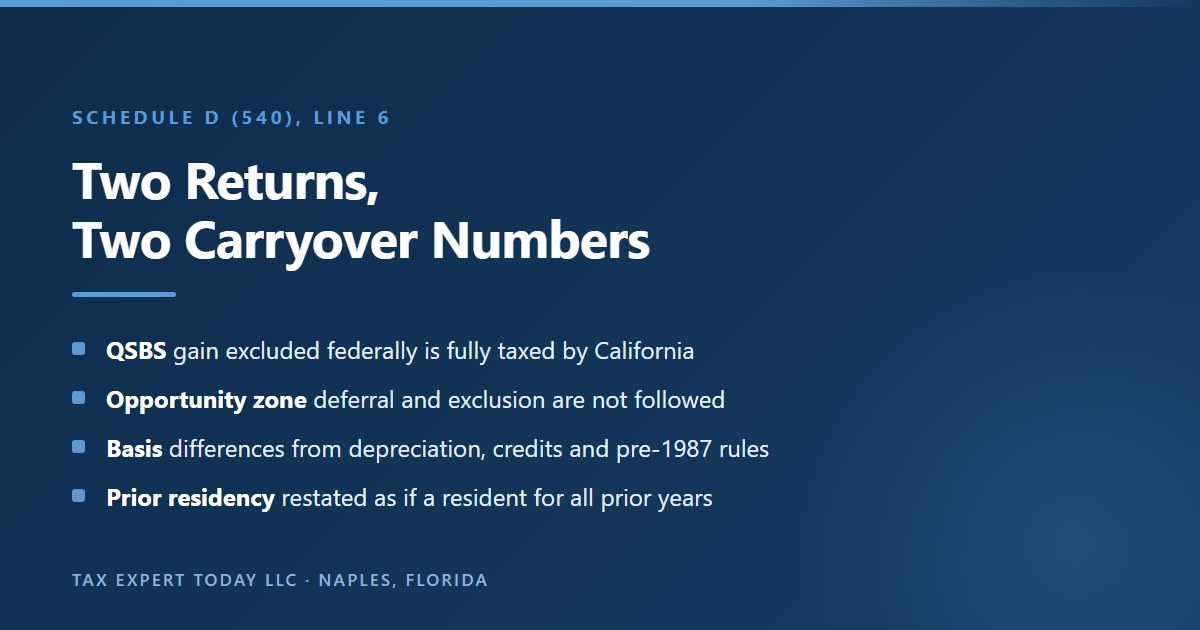
Your California capital loss carryover differs from the federal one whenever California computed any gain or loss differently in an earlier year. The usual causes are basis differences, California nonconformity to federal exclusions such as QSBS and opportunity zone funds, and years when you were not a California resident and the carryover had to be restated.
- Different basis: California basis can differ because of depreciation, expensing, credits, pre-1987 rules and S corporation history.
- Different gains: California taxes small business stock gain that is excluded federally under IRC section 1202.
- Different deferrals: California does not follow opportunity zone deferral or exclusion under IRC sections 1400Z-1 and 1400Z-2.
- Different residency history: a prior nonresident year changes how the carryover is restated.
- Different software entries: a federal figure typed into the California line is a frequent source of error.
The Schedule D (540) instructions describe the purpose of the schedule in one sentence: use it only if there is a difference between your California and federal capital gains and losses. That sentence explains why so many people have never seen the form. If every gain and loss you ever reported was the same for both governments, the California carryover equals the federal carryover and the state return simply follows the federal Schedule D. The moment one item was different, the two carryovers began to diverge, and they stay different until the gap is absorbed.
The divergence is not always in the direction you expect. When California taxes a gain that the federal return excluded, California has more gain and therefore a smaller carryover. When California basis is higher than federal basis, for example because the federal return took bonus depreciation that California did not allow, a California sale produces a smaller gain or a larger loss, and the California carryover can be bigger. Over a long investing life, both effects can appear in different years.
| Cause of difference | Effect on California gain | Effect on California carryover |
|---|---|---|
| QSBS gain excluded federally under IRC 1202 | Larger: California taxes the full gain | Smaller |
| Opportunity zone gain deferred or excluded federally | Larger in the year of the original sale | Smaller in that year |
| Opportunity zone deferred gain recognized federally later | Not taxed again by California | Larger relative to federal in that later year |
| Federal bonus depreciation not allowed by California | Smaller on sale: California basis is higher | Larger if the sale is at a loss |
| Credits that reduced California basis | Larger: California basis is lower | Smaller |
| Prior years as a nonresident | Depends on which column is being computed | Restated, often different |
Two of these items, small business stock and opportunity zone funds, are listed in the column (e) instructions for both Schedule D (540) and Schedule D (540NR): California does not conform, so you enter the entire gain. For anyone in the technology corridor between San Francisco and San Jose, those two items alone explain most of the carryover gaps we see, and our guide to California QSBS covers the small business stock rule in depth.
Which Basis Differences Change the California Carryover?
California tells you to compute the basis of each asset under the California law in effect when you acquired it and to adjust it under California law while you owned it. Depreciation methods, expensing limits, special credits, inherited property and S corporation stock held before 1987 are the items the FTB lists as common reasons the basis differs.
- Depreciation and expensing: California has its own limits on IRC section 179 expensing and treats federal additional depreciation under IRC section 168(k) differently.
- Pre-1987 rules: California disallowed ACRS and certain asset depreciation ranges before 1987.
- Inherited property: California basis is generally fair market value at death, which usually matches federal basis.
- S corporation stock: California did not recognize S corporations before 1987, so long-held shares can carry a different basis.
- Special credits: if a California credit required a basis reduction, the California basis is lower.
The column (c) instructions in the Schedule D (540) booklet tell you to enter the cost or adjusted basis of the asset for California purposes and to use your records and California tax returns for years before 1987. They then list the reasons a California basis may differ: depreciation methods and property expensing, inherited property, S corporation stock and special credits. They close with the general rule: figure the original basis using the California law in effect when the asset was acquired, and adjust it according to California law during the period of ownership.
For depreciable property the details are in the 2025 FTB 3885A instructions, which list additional depreciation under IRC section 168(k) and the asset expense election under IRC section 179 among the federal provisions where California differs. Depreciable business property usually produces section 1231 gain or loss rather than a pure capital loss, so it reaches Schedule D only after the section 1231 netting. Even so, a difference in depreciation decades ago can change the California capital loss carryover in the year a building or a business interest is finally sold.
| Asset type | Typical federal versus California basis | Practical effect on the carryover |
|---|---|---|
| Publicly traded stock bought for cash | Usually identical | No difference unless another rule applies |
| Rental real property | California basis often higher if federal bonus or extra expensing was taken | Smaller California gain on sale; possible larger California loss |
| S corporation stock held before 1987 | Often different because of the pre-1987 rules | Gain or loss differs on sale |
| Inherited property | Generally fair market value at death for both | Usually no difference |
| Property tied to a California credit | California basis reduced by the credit | Larger California gain on sale |
Inherited property deserves a word of reassurance. Both systems generally use fair market value at death under IRC section 1014, and California follows the community property rule that steps up both halves of community property when the first spouse dies after 1986. For most families that means a sale of inherited stock produces the same gain or loss on both returns. Our guide to California inheritance tax explains the step-up from the estate side.
The records problem is real. Basis differences that began in the 1990s are rarely documented anywhere except in old California returns, and many families no longer have them. If you cannot rebuild a difference with records, the safer course is usually to use the federal basis and accept that the California figure may be slightly conservative, rather than to claim a California basis you cannot support if the Franchise Tax Board asks.
How Does QSBS Change a California Capital Loss Carryover?
Federal law can exclude some or all of the gain on qualified small business stock under IRC section 1202, but California does not. R&TC section 18152 says section 1202 does not apply. In a year when you have both a QSBS gain and capital losses, the federal losses are not used against the excluded gain, while the California losses are, so the California carryover shrinks.
- Federal side: the excluded QSBS gain never enters the federal netting, so federal losses carry forward intact.
- California side: the full QSBS gain enters the California netting and absorbs California losses first.
- Result: the California capital loss carryover is smaller than the federal carryover, sometimes zero.
- Deferral too: California also does not follow the section 1045 rollover of QSBS gain.
The statute is short. R&TC section 18152 provides that section 1202 of the Internal Revenue Code, relating to the exclusion for gain from certain small business stock, does not apply. The Schedule D (540) column (e) instructions repeat the point: California does not conform to the deferral and exclusion under IRC sections 1045 and 1202, so enter the entire gain realized. Federally, IRC section 1202 can exclude up to 100 percent of the gain for stock that meets the holding period and the other requirements, which our guide to qualified small business stock explains.
The following example is hypothetical, assumes full-year California residency, and assumes enough other taxable income that the worksheet does not limit the $3,000 allowance. In 2025 a founder sells qualified small business stock for a $50,000 gain that is fully excluded federally, and sells a stock fund for a $60,000 loss.
| 2025 item | Federal Schedule D | California Schedule D (540) |
|---|---|---|
| QSBS gain | $0 (excluded under IRC 1202) | $50,000 |
| Stock fund loss | ($60,000) | ($60,000) |
| Net capital loss | ($60,000) | ($10,000) |
| Allowed against other income | $3,000 | $3,000 |
| Carryover to 2026 | $57,000 | $7,000 |
The $50,000 difference between the two carryovers is exactly the QSBS gain that California taxed and the federal return did not. If the founder later types the federal $57,000 into the California return, the California return overstates the loss by $50,000, which at a 9.3 percent marginal rate is $4,650 of California tax understated across the years the excess is used. Errors of that kind are the type the Franchise Tax Board can pick up by comparing Schedule D (540) with the federal return, and our guide to the FTB notice of proposed assessment explains what follows if it does.
The same logic runs in the other direction for founders who leave California before selling. A Florida resident who sells QSBS after the move generally owes California nothing on the gain, because California sources gain on stock to the seller’s state of residence. That makes the residency date, not the QSBS exclusion, the main California planning tool for founders, and it is one reason the carryover rules for movers covered below matter so much.
Does the Opportunity Zone Deemed Gain at the End of 2026 Affect the California Carryover?
It can. Federal law recognizes gain that was deferred into a qualified opportunity fund at the end of 2026, but California never allowed the deferral, so it already taxed that gain in the year of the original sale. The 2026 federal gain will absorb federal losses that the California return does not, which widens the gap between the two carryovers.
- Original sale year: California taxed the full gain; the federal return deferred it into the fund.
- Federal recognition: deferred gain is generally included federally on December 31, 2026, under IRC section 1400Z-2(b).
- California in 2026: the instructions say not to include gain that California already included in an earlier year.
- Carryover effect: federal losses are used against the 2026 deemed gain; California losses are not, so the California carryover can end up larger.
The column (e) instructions for both California Schedule D forms say California does not conform to the deferral and exclusion of capital gains invested in qualified opportunity zone funds under IRC sections 1400Z-1 and 1400Z-2, so you enter the entire gain. They add that if California already included gain from an opportunity zone investment in an earlier year, you do not include it again in the current year. Federally, IRC section 1400Z-2(b) sets the inclusion date for the deferred gain at the earlier of the date the investment is sold or December 31, 2026. Our guide to the qualified opportunity fund rules covers the federal side.
For a California resident who also carries capital losses, the federal 2026 deemed gain soaks up federal losses that would otherwise carry into 2027. California has no matching gain in 2026, so its carryover is untouched. If you invested in an opportunity fund in 2019 or 2020, it is worth reconciling the two carryovers on your 2026 returns rather than assuming they still match.
| Year | Federal treatment | California treatment | Carryover gap |
|---|---|---|---|
| Year of original sale | Gain deferred into the fund | Full gain taxed | California carryover smaller |
| Holding years | No inclusion | No inclusion | Gap unchanged |
| 2026 (deemed inclusion) | Deferred gain included | Not included again | Gap narrows or reverses |
| Later sale of the fund interest | Possible basis step-up rules | Ordinary basis rules | Must be reconciled again |
The reconciliation is not complicated if you keep the original California Schedule D (540) from the sale year. It becomes very hard if that year is lost, because the California gain on the original sale is the only record of what California already taxed. If you are leaving California, put that return in the file you take with you.
Where Do You Find Your California Capital Loss Carryover?
Your California capital loss carryover is on last year’s California return, not the federal one. Look for the California Capital Loss Carryover Worksheet in the Schedule D (540) or Schedule D (540NR) instructions, or in your tax software’s California forms. If no California Schedule D was filed, the California figure usually equals the federal carryover, but only if every year matched.
- Prior California Schedule D: line 8 shows the net loss and the worksheet shows the carryover to the next year.
- Software forms view: most programs keep a California capital loss carryover worksheet separate from the federal one.
- No California Schedule D filed: the state return followed the federal Schedule D, so start from the federal figure and check for any difference.
- Prior nonresident years: the figure must be restated under FTB Publication 1100, not copied.
- Paid preparer: ask for the California worksheet, which is often omitted from the client copy.
The search behavior around this question tells its own story. The pages that rank for it are mostly forum threads in which taxpayers report that software carried the federal number into the California return, or that a California carryover appeared from nowhere after a move. The 2025 Schedule D (540) form itself says at the top not to complete it if all of your California gains and losses are the same as your federal gains and losses. That instruction is sensible, but it means many households have never produced a California carryover figure at all, and the first time they need one is the year something changes.
If you were a California resident for every prior year and no item was ever different, the answer is simple: your California carryover equals your federal carryover from the federal Schedule D instructions worksheet. If any item was different, you need to rebuild the California figure from the first year the difference appeared. In practice that means pulling the California returns for every year since the loss began and recomputing the netting with California amounts.
| Your situation | Where the California carryover comes from |
|---|---|
| Always a California resident, no differences ever | Same as the federal carryover |
| Always a resident, with a QSBS, opportunity zone or basis difference | Prior year California Capital Loss Carryover Worksheet |
| Moved into California in a prior year | Restated as if a resident for all prior years (FTB Pub. 1100, Example 22) |
| Moved out of California this year | Both a resident-basis and a nonresident-basis figure, prorated by days |
| Already a Florida resident filing Form 540NR | Nonresident-basis carryover from the prior year Schedule D (540NR) worksheet |
When the prior returns were prepared by someone else, ask specifically for the California Capital Loss Carryover Worksheet. Client copies of returns often include the forms that were filed but not the worksheets behind them, and the carryover worksheet is not filed with the return. Without it you are rebuilding from scratch.
If you are planning a move, collect these worksheets for at least the last three years before you leave. Once you are a Florida resident, the figure that California cares about is computed differently, and the resident-basis history is the starting point for that computation.
How Do You Complete the California Capital Loss Carryover Worksheet?
The worksheet takes the loss you deducted on Schedule D (540), line 11, compares it with your California adjusted gross income less your deductions, and subtracts the smaller of the two from the total net loss on line 8. What is left is the California capital loss carryover to the next year. It has eight lines.
- Lines 1 to 5: measure how much of the allowed loss actually reduced income.
- Line 6: the total net loss for the year from Schedule D (540), line 8.
- Line 7: the portion of the loss treated as used.
- Line 8: the carryover to the next year.
The 2025 Schedule D (540) instructions print the worksheet at the end. Its line descriptions are short, and the logic is easier to follow when you see what each line is doing.
| Worksheet line | Instruction | What it does |
|---|---|---|
| 1 | Loss from Schedule D (540), line 11, as a positive number | The loss you deducted, up to $3,000 |
| 2 | Amount from Form 540, line 17 | California adjusted gross income |
| 3 | Amount from Form 540, line 18 | Standard or itemized deduction |
| 4 | Line 2 minus line 3 (may be negative) | Taxable income before exemption credits |
| 5 | Line 1 plus line 4; if less than zero, enter zero | Income the allowed loss actually offset |
| 6 | Loss from Schedule D (540), line 8, as a positive number | The total net loss including the carryover in |
| 7 | Smaller of line 1 or line 5 | Loss treated as used this year |
| 8 | Line 6 minus line 7 | California capital loss carryover to next year |
For most working taxpayers, line 5 is larger than line 1 and the worksheet simply produces “total loss minus $3,000.” The worksheet matters in years when income is low. Suppose a retiree has a $40,000 net capital loss on line 8, deducts $3,000 on line 11, and has California adjusted gross income of $9,000 after the loss and a standard deduction of $5,706. Line 4 is $3,294, line 5 is $6,294, and line 7 is $3,000, so the carryover is $37,000. If adjusted gross income had been only $1,000 after the loss, line 4 would be negative $4,706, line 5 would be zero, and line 7 would be zero, so the entire $40,000 carries forward because none of the allowed loss actually reduced taxable income.
The standard deduction figure in that example is the 2025 single amount of $5,706 from the 2025 Form 540 booklet. The example is hypothetical and ignores every other item on the return. The point is that the carryover is not always the loss minus $3,000, and a California figure built by subtracting $3,000 a year from an old balance can drift from the correct number in low-income years.
Federal law has a parallel rule in IRC section 1212(b)(2), which treats the $3,000 allowance as a short-term gain for carryover purposes and measures it against taxable income. The two worksheets reach similar answers for most people, but they use different income figures, so a low-income year is another place where the two carryovers can part ways.
What If Tax Software Entered the Federal Number on the California Return?
If your California return used the federal carryover when the correct California figure was different, the California return is wrong in every year the error flowed through. Prior returns are not changed just to restate a carryover, but if the error changed the tax on a filed return, an amended California return may be needed within the refund or assessment period.
- Find the first year: the error starts in the year the California and federal figures should have diverged.
- Recompute forward: rebuild the California worksheet for each year from that point.
- Check the tax effect: an error that changed tax owed on a filed year is an amendment question.
- Check the deadline: R&TC section 19306 generally allows a refund claim for four years from the original due date or one year from payment, whichever is later.
Forum threads that rank for this topic describe a recurring pattern: a taxpayer prepares the federal return, the software copies the federal capital loss carryover into the California interview, and the taxpayer accepts it. When the federal and California figures should have matched, nothing goes wrong. When they should have differed, the California return quietly over- or understates the loss.
Whether you should amend depends on what the error did. If the wrong carryover simply sat in the carryover line and never changed the tax, because there were no gains and the $3,000 allowance would have been taken either way, the fix may be to start using the correct figure on the next return and keep a workpaper showing how you rebuilt it. If the wrong carryover sheltered a gain that California should have taxed, the filed return understated tax. If it understated a loss, you may have a refund. Our guide to the California amended tax return explains Form 540 with the amended return box checked and the Schedule X explanation.
The refund deadline is in R&TC section 19306: no credit or refund is allowed after the later of four years from the date the return was filed (if filed on time), four years from the original due date, or one year from the date of the overpayment, unless a claim is filed before then. Years outside that window cannot be refunded, but the corrected carryover still runs forward to open years. FTB Publication 1100 makes a related point in its definition of “restate”: prior year carryovers are refigured to determine the amount allowable in the current year, and prior year tax returns are not amended.
| Effect of the error on a filed year | Usual response |
|---|---|
| No change in tax (carryover only) | Use the corrected figure going forward and keep a reconstruction workpaper |
| Gain under-taxed because the carryover was too large | Consider an amended return for open years; the Franchise Tax Board can also assess |
| Loss under-claimed because the carryover was too small | Consider a refund claim within the R&TC 19306 period |
| Year outside the refund period | No refund, but the corrected carryover still flows to open years |
Before amending, confirm that the corrected figure is really correct. A reconstruction that relies on memory rather than prior returns is weak evidence, and an amended return invites a closer look. If the dollars are small, the cost and attention of an amendment can exceed the benefit.
Does California Track Short-Term and Long-Term Carryovers Separately?
No. Because California taxes all capital gains as ordinary income, Schedule D (540) does not split gains, losses or the carryover into short-term and long-term amounts. Federal law does keep the character of the carryover, so the federal worksheet produces two numbers while the California worksheet produces one.
- Federal: IRC section 1212(b) carries short-term and long-term losses forward with their character.
- California: one combined carryover on line 6, one net figure on line 8.
- Why it matters: the federal character affects which federal gains the loss offsets first; California has no rate difference to protect.
- Reconciling: compare the sum of the federal short-term and long-term carryovers with the single California figure.
The single-number structure is visible on the form. The 2025 Schedule D (540) lists each transaction in one table, combines K-1 amounts and capital gain distributions, and then adds a single line 6 for the California capital loss carryover from 2024. Federally, the federal Schedule D separates short-term and long-term transactions in Parts I and II, and the federal carryover worksheet produces a short-term and a long-term carryover. IRC section 1222 defines the holding periods behind that split.
The practical consequence is that you cannot reconcile the two returns line by line. Add the federal short-term and long-term carryovers together, and compare the total with the California carryover. Any remaining difference should be explained by one of the causes listed earlier: QSBS, opportunity zone funds, basis, residency or a software entry error.
| Feature | Federal Schedule D | California Schedule D (540) |
|---|---|---|
| Holding period split | Short-term and long-term parts | None |
| Carryover numbers | Two (short-term and long-term) | One |
| Rate on long-term gain | 0, 15 or 20 percent, plus possible 3.8 percent net investment income tax | Ordinary rates up to 12.3 percent |
| Annual limit against other income | $3,000 or $1,500 | $3,000 or $1,500 |
| Expiration for individuals | None while alive | None while alive |
One subtle effect of the federal character rules is worth noting for movers. A federal long-term carryover offsets long-term gain that would otherwise be taxed at a preferential rate, so its federal value per dollar can be lower than its California value per dollar. Once you live in Florida and California no longer taxes your stock gains, the federal value is the only value left for most of the carryover.
How Does the $3,000 Limit Interact With California Taxable Income?
The $3,000 limit applies to the net loss after all gains, so a California capital loss carryover first absorbs capital gains without any cap and only then offsets up to $3,000 of other income. For nonresidents and part-year residents, the limit applies to the California computation on the Schedule D (540NR) worksheet, not to the federal total.
- Gains first: the carryover offsets capital gains dollar for dollar with no cap.
- Then other income: any remaining net loss offsets up to $3,000 of wages, interest or other income.
- Married filing separately: $1,500 each for married couples and RDPs.
- Part-year residents: the limit applies on line 5 of the Schedule D (540NR) worksheet.
A common misunderstanding is that California “only allows $3,000 a year” of the carryover. That is true only in a year with no capital gains. In a year with a $100,000 gain, a $100,000 carryover is used in full, and none of it is lost to the cap. The cap matters when losses are large and gains are rare, which is the profile of an investor who sold a concentrated position at a loss in a downturn and then bought index funds that are rarely sold.
For a resident, the netting is on Schedule D (540), lines 4 through 9. For a nonresident or part-year resident, the 2025 Schedule D (540NR) instructions add a worksheet with five columns that this guide walks through below. Line 5 of that worksheet tells you to enter the smaller of the loss on line 4 or $3,000, or $1,500 if married or an RDP filing separately.
| Year profile | Carryover used | Carryover remaining |
|---|---|---|
| $60,000 carryover, $0 gains | $3,000 against other income | $57,000 |
| $60,000 carryover, $20,000 gains | $20,000 against gains plus $3,000 against other income | $37,000 |
| $60,000 carryover, $60,000 gains | $60,000 against gains | $0 |
| $60,000 carryover, $90,000 gains | $60,000 against gains; $30,000 of gain remains taxable | $0 |
Each row assumes a full-year resident with enough other income that the worksheet does not preserve more of the loss. The rows show why the best use of a California carryover is to pair it with a gain in a year when California taxes that gain. For a California resident, that is any year. For someone about to leave, the window closes on the day residency ends, as the next sections explain.
Is a California Capital Loss Carryover Affected by the NOL Suspension?
The California suspension for taxable years 2024 through 2026 applies to the net operating loss carryover deduction, not to capital loss carryovers. A capital loss carryover is a separate attribute on Schedule D, and the 2025 Schedule CA (540NR) instructions describe the suspension only in terms of net operating losses.
- What is suspended: the NOL carryover deduction for taxpayers with net business income or modified adjusted gross income of $1,000,000 or more.
- What is not: the capital loss carryover on Schedule D (540) or Schedule D (540NR), line 6.
- Where they meet: under IRC section 172(d)(2), an individual counts capital losses in an NOL computation only up to capital gains, so the excess stays a capital loss carryover.
- Related attribute: excess business losses become a California carryover excess business loss, which is also different.
The 2025 Schedule CA (540NR) instructions describe the suspension under General Information: for taxable years beginning on or after January 1, 2024, and before January 1, 2027, California has suspended the net operating loss carryover deduction, taxpayers may continue to compute and carry over an NOL during the suspension, and taxpayers with net business income or modified adjusted gross income of less than $1,000,000 are not affected. The same instructions list the capital loss carryover from the prior year Schedule D (540NR) among the items that cause a difference on line 7, which is a separate line from the NOL deduction on line 8.
Our guide to the California NOL suspension explains who is affected and how the carryover period is extended. For this guide the important point is that a capital loss carryover keeps working through 2026 even for high-income taxpayers whose NOL deduction is suspended. If you have both attributes, the capital loss carryover is the one you can use now.
| Attribute | Form | Suspended for 2024 to 2026? |
|---|---|---|
| Capital loss carryover | Schedule D (540) or (540NR), line 6 | No |
| Net operating loss carryover | FTB 3805V | Yes, for taxpayers at or above the $1,000,000 threshold |
| Excess business loss carryover | FTB 3461 | Treated as a carryover excess business loss, not an NOL |
| Disaster loss carryover | FTB 3805V | Not affected by the suspension |
The excess business loss rules are covered in our guide to the excess business loss limitation. The 2025 FTB 3805V instructions govern the NOL computation itself. Keeping the three attributes separate on your workpapers avoids the common error of treating a capital loss as if it were part of an NOL schedule.
What Happens to a California Capital Loss Carryover When You Move to Florida?
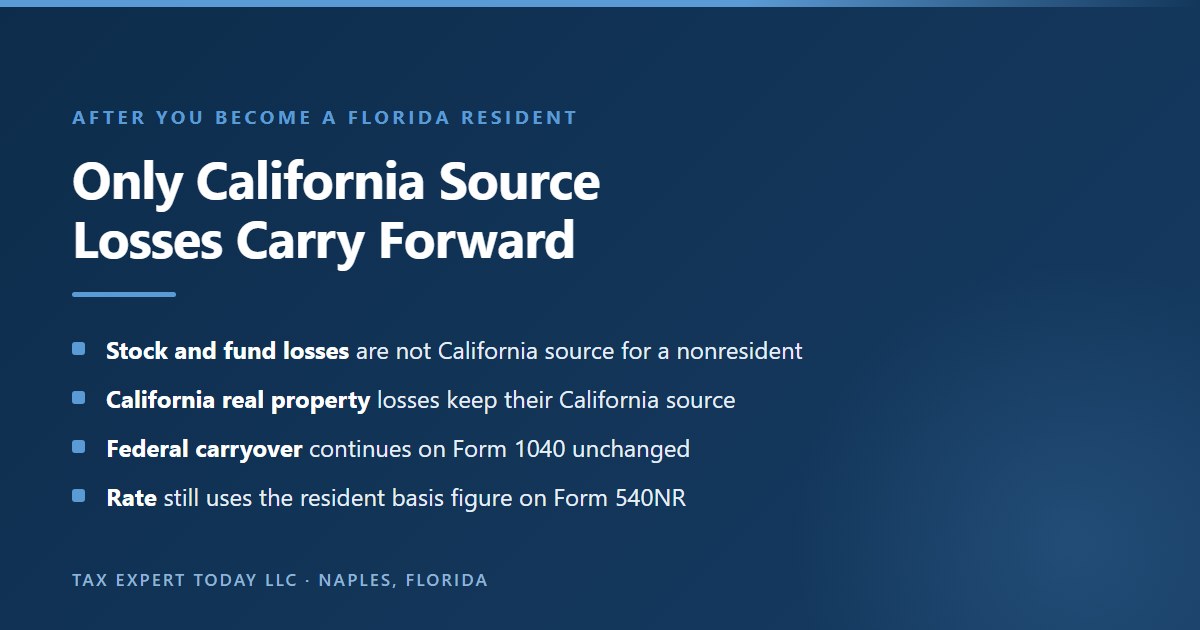
When you become a nonresident, California restates your capital loss carryover as if you had been a nonresident for every prior year, counting only California source gains and losses. Stock, bond and fund losses are generally not California source for a nonresident, so for most movers the California carryover used against California taxable income falls to zero or close to it.
- Statute: R&TC section 17041(i)(3) limits a nonresident’s carryover items to those derived from California sources, computed as if a nonresident for all prior years.
- Publication: FTB Publication 1100, Example 23, shows the restatement for someone who moves out.
- Move year: the resident-basis and nonresident-basis carryovers are each prorated by days.
- After the move: only the nonresident-basis carryover reduces California taxable income.
- Still relevant: the resident-basis figure still affects the tax rate on Form 540NR.
This is the part of the topic that almost no ranking page explains, and it is the part that costs movers the most. A taxpayer who lived in San Francisco for twenty years and built up an $80,000 California capital loss carryover from the sale of a tech stock may assume that the carryover moves to Florida with the furniture. For federal purposes it does. For California purposes it is restated under rules designed for nonresidents, and those rules generally strip out losses on intangible property.
The statute that does this is R&TC section 17041, subdivision (i)(3). For purposes of computing the taxable income of a nonresident or part-year resident, any carryover items, deferred income, suspended losses or suspended deductions are includable or allowable only to the extent they were derived from sources within California, calculated as if the taxpayer, for the portion of the year he or she was a nonresident, had been a nonresident for all prior years. FTB Publication 1100 states the same rule in plain terms under the heading Change of Residency From California: if you have capital loss carryovers and you become a nonresident of California, your capital loss carryovers need to be restated as if you had been a nonresident for all prior years.
Florida does not tax personal income, so it does not care about any of this. Article VII, section 5 of the Florida Constitution bars a state income tax on natural persons. Once you are a Florida resident, your capital loss carryover matters for two governments only: the federal government, which keeps the full carryover, and California, which keeps only the California source part. Our guide to moving from California to Florida taxes covers the rest of that transition.
| Stage | Federal carryover | California carryover used for California taxable income |
|---|---|---|
| Years as a California resident | Full carryover | Full California carryover, resident basis |
| Year of the move | Full carryover | Resident basis prorated by resident days plus nonresident basis prorated by nonresident days |
| Years as a Florida resident | Full carryover | Nonresident basis only: California source losses |
| If you later move back | Full carryover | Restated again as if a resident for all prior years |
The last row is not a curiosity. FTB Publication 1100, Example 22, shows a taxpayer moving into California and restating the carryover as if a resident for all prior years. A carryover that is set aside when you leave can come back if you return, which is one more reason to keep the resident-basis worksheet up to date even after the move.
What Does “As If a Nonresident for All Prior Years” Mean?
It means you rebuild your capital loss history using only the gains and losses that would have been California source if you had never lived in California. You go back to the year the carryover began, net only the California source items each year, apply the $3,000 limit against California source income, and carry the result forward. Prior returns are not amended.
- Start year: the first year that generated any part of the current carryover.
- Items counted: California source capital gains and losses only, such as California real property.
- Items ignored: gains and losses that would not be California source for a nonresident, generally stocks and funds.
- Annual limit: applied year by year to the restated figures.
- No amendment: Publication 1100 defines “restate” as refiguring carryovers for the current year without amending prior returns.
FTB Publication 1100 works through this with a three-year example. In Example 21, a lifelong New York resident has California capital gains of $2,000, California capital losses of $6,000, New York capital gains of $5,000 and New York capital losses of $2,000 in 2022. For total taxable income, all items net to a $1,000 loss, which is fully allowed, leaving no carryover. For California taxable income, only the California items count: a $4,000 net loss, $3,000 allowed and $1,000 carried to 2023.
Example 23 then follows the same taxpayer after a year of California residency in 2023 and a move back out on January 1, 2024. Step 1 restates the carryovers as if the taxpayer had been a nonresident for all prior years by netting California source items only. The 2022 restatement repeats the $1,000 California carryover. The 2023 restatement takes the $4,000 California capital loss from 2023, ignores the Wyoming gain of $5,000 that was taxable while the taxpayer was a resident, adds the $1,000 carryover, allows $3,000, and carries $2,000 into 2024. In 2024 the California source items are a $9,000 gain and a $5,000 loss, and the $2,000 restated carryover reduces the California capital gain to $2,000.
| Publication 1100, Example 23 | Total taxable income (resident basis) | California taxable income (nonresident basis) |
|---|---|---|
| 2022 net result | ($1,000), fully allowed | ($4,000), $3,000 allowed |
| Carryover to 2023 | $0 | ($1,000) |
| 2023 restated (California loss $4,000, Wyoming gain $5,000) | $1,000 gain | ($5,000), $3,000 allowed |
| Carryover to 2024 | $0 | ($2,000) |
| 2024 capital gain after carryover | $12,000 | $2,000 |
The striking feature of the example is that a Wyoming gain, which California taxed in full while the taxpayer was a resident in 2023, simply disappears from the nonresident restatement. The restatement is not a history of what California actually taxed. It is a hypothetical history built on the counterfactual that you were never a resident. That is why a carryover that California actually computed, and actually allowed, can shrink or vanish after you leave.
The restatement also has a practical cost. You need every California return and every federal Schedule D back to the year the carryover began, and you need to know the source of each item. For a long-held carryover, the work is real, which is one reason this computation is often skipped. Skipping it is not a safe default: the restated figure is what the statute allows, and a larger figure claimed without support is exposed if the Franchise Tax Board reviews the nonresident return.
Why Do Stock Losses Usually Disappear for California After the Move?
Because California does not treat gains or losses on stocks, bonds or other intangible property as California source for a nonresident unless the property has a California business situs or the nonresident trades so regularly in California that it amounts to doing business there. In the nonresident restatement, ordinary portfolio losses therefore count as zero.
- Statute: R&TC section 17952 sources income of nonresidents from stocks, bonds, notes and other intangible personal property outside California, with narrow exceptions.
- Exception one: property that has acquired a business situs in California.
- Exception two: buying and selling in California so regularly, systematically and continuously as to constitute doing business.
- Result: a nonresident’s restated carryover usually excludes all brokerage losses.
- Same rule for gains: after the move, California generally does not tax your stock gains either.
R&TC section 17952 provides that, for purposes of computing the taxable income of a nonresident or part-year resident, income of nonresidents from stocks, bonds, notes or other intangible personal property is not income from sources within California unless the property has acquired a business situs in California. The exception for regular, systematic and continuous trading in California is aimed at people who carry on a trading business in the state. It is not triggered by an ordinary investor whose brokerage happens to be headquartered in California.
Read together with R&TC section 17041(i)(3), the effect is simple. When a mover restates the carryover as if a nonresident for all prior years, every loss on stock, mutual funds, exchange-traded funds, bonds and similar property drops out, because none of it would have been California source to a nonresident. The rule is symmetrical. The same section means that a Florida resident who sells appreciated stock owes California nothing on the gain, which our guide to California source income explains in detail.
| Capital asset | California source for a nonresident? | Survives in the nonresident restatement? |
|---|---|---|
| Publicly traded stock or ETF | Generally no (R&TC 17952) | Generally no |
| Mutual fund capital gain distribution | Generally no | Generally no |
| Bonds and notes | Generally no, absent a California business situs | Generally no |
| California real property held for investment | Yes, sourced where the property is located | Yes |
| Real property in Florida or another state | No | No |
| Interest in a business with California activity | Depends on the facts; may be partly California source | Possibly in part |
Stock compensation is a different matter. Gain that is really compensation, such as the spread on a nonqualified stock option or a disqualifying disposition of incentive stock option shares, is sourced to California by where the services were performed, not by residence. That income is wages, not capital gain, and a capital loss carryover does not offset it beyond the $3,000 allowance. Our guide to California RSU tax when leaving and FTB Publication 1004 cover that sourcing.
The practical message for a California investor who is planning a move is blunt. If most of your California capital loss carryover comes from stock and fund losses, it is likely to be worth little or nothing against California taxable income once you are a Florida resident. Its California value is mostly in the years before you leave, and partly in the year of the move.
Which Capital Losses Survive for California After You Leave?
Capital losses survive the nonresident restatement only if they would have been California source to a nonresident. The clearest example is a loss on California real property held as an investment, such as land or a vacation property sold at a loss. Losses passed through from a business with California activity may also survive in part.
- California land or investment property: sourced where it sits, so the loss is California source.
- Pass-through capital losses: may be California source to the extent the activity is in California.
- Section 1231 items: netted using California source section 1231 items only for a nonresident.
- Personal residence: a loss on the sale of your home is not deductible at all.
- Trading business in California: rare, but the R&TC 17952 exception can make gains and losses California source.
The 2025 Schedule D (540NR) instructions confirm the general rule in their Purpose section: for nonresidents, the computation of California taxable income, capital loss carryovers and capital loss limitations is determined based upon California source income and loss items only. They add that the character of section 1231 gains and losses is determined by netting California source IRC section 1231 items only.
For real property, source follows location. FTB Publication 1100 states that California taxes real property based on where the property is located, and its installment sale examples illustrate the point. A loss on the sale of an investment lot in Sacramento is a California source capital loss whether you were a resident or not, so it survives the restatement and can offset a later California source gain, such as the sale of another California property. Our guide to selling rental property after moving covers how California taxes those later sales.
| Loss | Capital loss? | California source to a nonresident? | Survives restatement? |
|---|---|---|---|
| Investment land in Sacramento sold at a loss | Yes | Yes | Yes |
| Vacation home in Lake Tahoe, California, sold at a loss | Generally not deductible if personal use | Not applicable | Not applicable |
| Rental building in Los Angeles sold at a loss | Usually section 1231, not capital | Yes | Through the California source section 1231 netting |
| Brokerage loss on technology stock | Yes | Generally no | Generally no |
| Capital loss passed through on a California K-1 | Yes | Depends on the source of the underlying item | Possibly in part |
A loss on the sale of a personal residence deserves a separate warning because it comes up often for people who sell a California home before moving. A loss on property held for personal use is not deductible federally or for California, so it never becomes a capital loss carryover at all. Gains on a California home are a different subject, covered in our guide to California capital gains tax on a home sale.
The surviving California source carryover tends to be modest for most movers, but it is valuable to anyone who still owns California real estate. If you plan to sell California investment property after the move, a California source loss on another California property, even one sold years earlier, may shelter part of that later gain. That is a reason to compute the nonresident restatement carefully rather than writing the California carryover off entirely.
How Is the Carryover Prorated in the Year You Move?
In the year you move, you compute two carryovers: one as if you had been a California resident for all prior years and one as if you had been a nonresident for all prior years. You multiply the first by your resident days over the days in the year and the second by your nonresident days over the days in the year, and use both prorated amounts.
- Resident-basis carryover: multiplied by resident days divided by 365, or 366 in a leap year.
- Nonresident-basis carryover: multiplied by nonresident days divided by 365, or 366.
- Gains and losses during the year: follow the dates of the transactions and the source rules for each period.
- 2026 example: a move effective July 1, 2026, gives 181 resident days and 184 nonresident days.
- Effect: roughly half of a stock-based carryover is unavailable for California in a mid-year move.
FTB Publication 1100 sets out the rule under the heading Part-Year Resident: compute any prior year carryover loss as if you were a California resident for all prior years and as if you were a nonresident for all prior years, and prorate both capital loss carryover amounts based upon the period of California residency and the period of nonresidency during the year. Example 24 applies it to someone who moved into California on July 1, 2022, with a $7,000 resident-basis carryover and a $5,000 nonresident-basis carryover. The resident-basis amount is multiplied by 184 over 365 to give $3,529, and the nonresident-basis amount by 181 over 365 to give $2,479.
The Schedule D (540NR) worksheet follows the same approach. Its instructions say that columns A and B, line 3, show a carryover computed as if you had been a resident in all prior years for column A and as if you had been a nonresident for all prior years for column B, and that you multiply the column A amount by resident days over 365 for column C and the column B amount by nonresident days over 365 for column D, using 366 in a leap year. The instructions also tell you to complete columns C and D taking into account the dates of the transactions, which is how Publication 1100, Example 24, treats the gains and losses of the year.
| Move date (residency ends the day before) | Year length | Resident days | Nonresident days | Resident share of the carryover |
|---|---|---|---|---|
| April 1, 2026 | 365 | 90 | 275 | 24.7 percent |
| July 1, 2026 | 365 | 181 | 184 | 49.6 percent |
| October 1, 2026 | 365 | 273 | 92 | 74.8 percent |
| December 31, 2026 | 365 | 364 | 1 | 99.7 percent |
| July 1, 2028 | 366 (leap year) | 182 | 184 | 49.7 percent |
The day counts assume that residency ends on the day before the move date, so a July 1 move means January 1 through June 30 as a resident. The actual date your California residency ends is a facts and circumstances question, not a date you choose, and our guide to leaving California taxes explains how the Franchise Tax Board looks at it. A date that is not supported by the facts can unravel the whole computation.
How Do the Columns on the Schedule D (540NR) Worksheet Work?
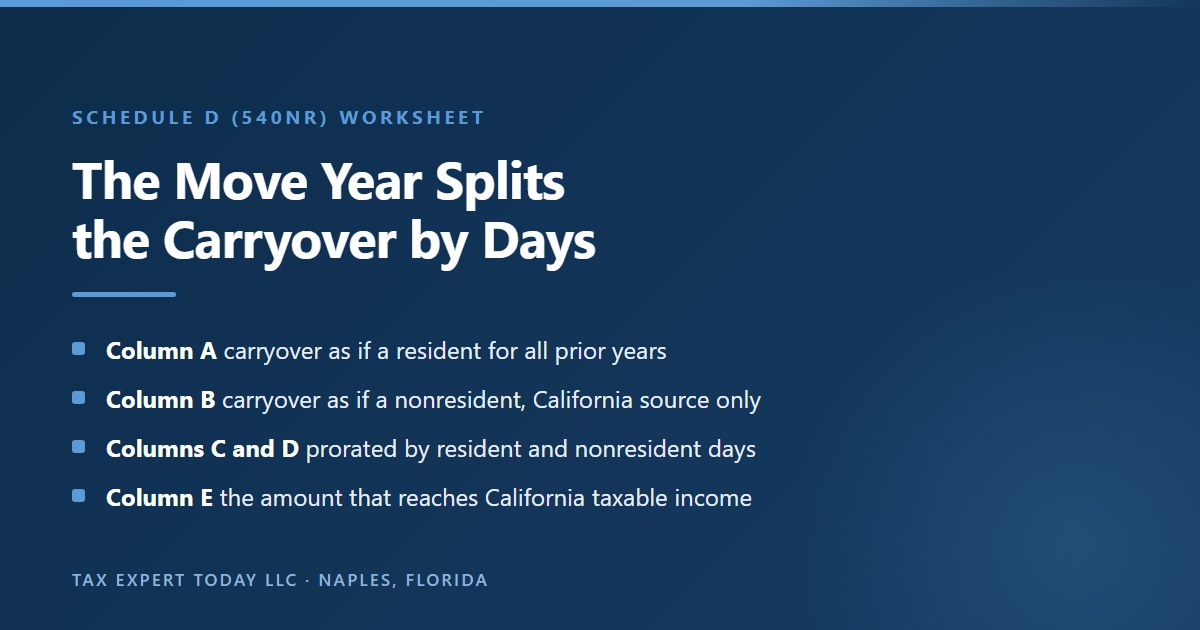
The Schedule D (540NR) Worksheet for Nonresidents and Part-Year Residents has five columns. Column A is everything as if you were a resident all year, column B is California source items as if you were a nonresident all year, column C is the resident period, column D is California source items in the nonresident period, and column E combines C and D.
- Column A: total as if a California resident for the entire year; carryover as if a resident for all prior years.
- Column B: California source amounts as if a nonresident for the entire year; carryover as if a nonresident for all prior years.
- Column C: amounts during the resident period, with column A carryover prorated by resident days.
- Column D: California source amounts during the nonresident period, with column B carryover prorated by nonresident days.
- Column E: column C plus column D; this flows to Schedule CA (540NR).
The worksheet appears in the 2025 Schedule D (540NR) instructions and on the 2025 Schedule D (540NR) form package. Full-year nonresidents complete only columns A and B and enter column B on Schedule CA (540NR), Part II, Section A, line 7a, column E. Part-year residents complete all five columns and carry column E to the Schedule CA (540NR) Part-Year Resident Worksheet.
| Column | Who it describes | Which items | Which carryover |
|---|---|---|---|
| A | You, as if a resident all year | All gains and losses, any source | As if a resident for all prior years |
| B | You, as if a nonresident all year | California source only | As if a nonresident for all prior years |
| C | Resident period | All items dated in the resident period | Column A carryover times resident days over 365 |
| D | Nonresident period | California source items dated in the nonresident period | Column B carryover times nonresident days over 365 |
| E | The actual year | C plus D | Combined |
Line 5 of the worksheet applies the $3,000 limit, and a separate Capital Loss Carryover Worksheet then computes the carryover to the next year. That second worksheet contains the rule that decides what a mover keeps: complete it only if at the end of the year you were a resident and line 4, column A, shows a loss, or at the end of the year you were a nonresident and line 4, column B, shows a loss. If you were a resident at the end of the year, use the column A amounts; if you were a nonresident, use the column B amounts.
For someone who moves out of California, the year ends with Florida residency, so the carryover to the next California return is built from column B. That single instruction is where a stock-based California capital loss carryover is set aside for good, unless and until you become a resident again. Our guide to the nonresident state tax return explains how this fits into the broader filing obligations after a move.
Worked Example: How Much of an $80,000 Carryover Can a Mid-Year Mover Use?
In this hypothetical, a single filer with an $80,000 California capital loss carryover from stock losses moves to Naples on July 1, 2026. Only the resident-day share of the carryover, about $39,671, is available on the California side in 2026, and nothing carries into 2027 for California purposes because the nonresident-basis carryover is zero.
- Carryover into 2026: $80,000 as if a resident for all prior years; $0 as if a nonresident, because every loss was on stock.
- Move: residency ends June 30, 2026, giving 181 resident days and 184 nonresident days.
- Gains: a $30,000 stock gain in March 2026 and a $50,000 stock gain in October 2026.
- California result: the March gain is fully sheltered and $3,000 of other income is offset.
- Carryover to 2027: $0 for California taxable income; the federal carryover is also used up by the $80,000 of gains.
Every figure below is hypothetical and is built from the rules in FTB Publication 1100, Example 24, and the 2025 Schedule D (540NR) worksheet. The example ignores every other item on the return and assumes enough other California income that the worksheet does not preserve more of the loss. It is an illustration of the mechanics, not a prediction of anyone’s tax.
The October gain is realized while the taxpayer is a Florida resident. Under R&TC section 17952, gain on stock is not California source for a nonresident, so it appears in column A, which treats the taxpayer as a resident all year, but not in column B or column D. The March gain is realized during the resident period, so it appears in column A and column C.
| Worksheet line | Column A (resident all year) | Column B (nonresident all year) | Column C (resident period) | Column D (nonresident period) | Column E (C plus D) |
|---|---|---|---|---|---|
| 1. Gains | $80,000 | $0 | $30,000 | $0 | $30,000 |
| 2. Losses | $0 | $0 | $0 | $0 | $0 |
| 3. Prior year carryover | ($80,000) | $0 | ($39,671) = $80,000 x 181/365 | $0 = $0 x 184/365 | ($39,671) |
| 4. Combine | $0 | $0 | ($9,671) | $0 | ($9,671) |
| 5. Smaller of loss or $3,000 | Not applicable | Not applicable | ($3,000) |
Column E shows a $9,671 net loss, limited to $3,000 on line 5. On our reading of the worksheet, that $3,000 loss is what reaches the California computation through the Schedule CA (540NR) Part-Year Resident Worksheet. The March gain of $30,000 is fully absorbed, and $3,000 of other income is offset. The remaining $6,671 of the prorated resident-basis carryover does not carry into 2027, because the Capital Loss Carryover Worksheet tells a taxpayer who is a nonresident at year end to use the column B amounts, and column B shows no loss.
| Measure | Result |
|---|---|
| Carryover entering 2026, resident basis | $80,000 |
| Carryover available on the California side in 2026 | $39,671 |
| Used against the March gain | $30,000 |
| Used against other income | $3,000 |
| Not used for California and not carried forward | $6,671 |
| California carryover into 2027 (nonresident basis) | $0 |
| Federal carryover into 2027 | $0 (the $80,000 of gains absorbed it) |
Nothing in the example was lost in any meaningful sense. The October gain was never going to be taxed by California, so the unused part of the carryover had nothing California-taxable left to shelter. The example matters because it shows what happens when the facts are slightly different, which the next section takes up.
The same computation also produces the total taxable income used to set the Form 540NR tax rate. In column A, the $80,000 of gains is fully offset by the $80,000 resident-basis carryover, so the capital items add nothing to total taxable income for the rate. Our guide to the California part-year resident tax return shows how the rate and the California taxable income come together on Form 540NR.
Does the Timing of a Stock Sale Around the Move Date Matter?
Yes. A stock gain realized while you are still a California resident is taxed by California and can use only the resident-day share of the carryover in the move year. The same gain realized after residency ends is generally not taxed by California at all. A gain realized in a full resident year before the move can use the entire carryover.
- Before the move year: a full resident year lets the whole California carryover absorb California-taxed gains.
- Move year, resident period: the gain is taxed, but only the prorated resident-basis carryover offsets it.
- Move year, nonresident period: the stock gain is not California source and is not taxed by California.
- After the move: stock gains are not taxed by California; the stock-based carryover is not available either.
Change one fact in the worked example. Suppose the $50,000 gain had been realized in May 2026, while the taxpayer was still a resident, instead of October. Column C would show gains of $80,000 against the same prorated carryover of $39,671, leaving a $40,329 California capital gain. At a 9.3 percent marginal rate that is roughly $3,751 of California tax, and the actual figure on Form 540NR depends on the rate computed from total taxable income.
| Timing of the $50,000 gain | Gain taxed by California | Carryover applied on the California side | California capital result |
|---|---|---|---|
| October 2026 (after residency ends) | $30,000 (March gain only) | $39,671 prorated | $3,000 net loss allowed |
| May 2026 (before residency ends) | $80,000 | $39,671 prorated | $40,329 gain taxed |
| Both gains in December 2025 (full resident year) | $80,000 | $80,000 in full | $0 gain taxed |
The comparison carries two lessons. First, if you must realize a gain that California will tax, such as a sale you need to make before the move, a full resident year is a better home for it than the resident part of the move year, because the full carryover is available. Second, a stock gain that can wait until after residency genuinely ends is generally outside California’s reach regardless of the carryover.
The second lesson comes with a caution that matters more than the arithmetic. Large sales shortly after a claimed move are exactly what prompts the Franchise Tax Board to test whether residency really ended. If the move is not real and complete, the gain is taxed in full as resident income. Our guides to a California residency audit and how to establish Florida residency explain what the facts need to show before a sale is timed around a move.
Timing also interacts with the federal return, which is unaffected by the move. Federally, the $80,000 carryover offsets $80,000 of gain whenever the gains are realized in 2025 or 2026. The California and federal analyses therefore point in the same direction only if the California-taxed gains are matched with the California carryover while it is fully available.
Worked Example: Does a Loss on California Land Carry Into Florida Residency?
Yes. In this hypothetical, a $25,000 loss on Sacramento investment land is California source, so it survives the nonresident restatement and is still available after the move. When the taxpayer sells a Fresno investment lot as a Florida resident in 2027, the remaining California carryover reduces the California source gain.
- 2024: as a California resident, sells Sacramento land held for investment at a $25,000 loss; no other capital items.
- 2024 and 2025: $3,000 allowed each year against other income; the carryover falls to $19,000.
- 2026: moves to Florida on July 1; no capital items; $3,000 allowed; carryover to 2027 is $16,000 on both bases.
- 2027: as a Florida resident, sells a Fresno investment lot at a $40,000 gain, which is California source.
- Result: California source gain after the carryover is $24,000.
Because the land is in California, the loss is California source whether the taxpayer is treated as a resident or as a nonresident. The resident-basis and nonresident-basis carryovers are therefore the same in every year, and the move-year proration has no effect: $19,000 times 181 over 365 is $9,422, $19,000 times 184 over 365 is $9,578, and the two add back to $19,000. The example assumes enough California income in 2024, 2025 and 2026 that the worksheet allows the full $3,000 in each of those years.
| Year | Status | Capital items | Allowed | California carryover out |
|---|---|---|---|---|
| 2024 | Resident | ($25,000) Sacramento land | $3,000 | $22,000 |
| 2025 | Resident | None | $3,000 | $19,000 |
| 2026 | Part-year, moved July 1 | None; carryover prorated $9,422 plus $9,578 | $3,000 | $16,000 |
| 2027 | Nonresident | $40,000 Fresno lot gain, California source | $16,000 against the gain | $0 |
The Fresno sale also triggers California withholding at closing in most cases, typically on Form 593, because the seller is a nonresident. Our guides to California nonresident withholding and California Form 593 explain how to claim the withholding back on Form 540NR. The carryover reduces the tax on the return; it does not reduce the withholding at closing, which is based on the sale price or an elected computation.
The contrast with the stock example is the whole point. A California source loss behaves like a California asset: it stays with California even after you leave. A loss on intangible property behaves like your residence: it follows you to Florida, where it no longer has any state income tax value.
Why Does the Resident-Basis Carryover Still Matter on Form 540NR?
Because California sets a nonresident’s tax rate from total taxable income computed as if you were a resident for the whole year and for all prior years for carryover items. The resident-basis capital loss carryover lowers that total, which lowers the rate applied to your California source income, even when it does not reduce the California source income itself.
- Statute: R&TC section 17041(b)(2) computes the rate on the entire taxable income as if a resident for the taxable year and for all prior years for carryover items.
- Base: the rate is applied to California taxable income, which uses the nonresident-basis carryover.
- Effect: a resident-basis carryover absorbs non-California gains in the rate computation and can reduce the rate.
- Who it helps: Florida residents who still have California source income, such as California rental income or deferred compensation.
R&TC section 17041(b)(2) provides that the tax on a nonresident or part-year resident is calculated by multiplying the taxable income of the nonresident or part-year resident by a rate equal to the tax on the entire taxable income as if the person were a resident for the taxable year and for all prior taxable years for any carryover items, divided by that income. FTB Publication 1100 restates it as a formula: prorated tax equals California taxable income times tax on total taxable income divided by total taxable income.
That formula is why Publication 1100, Example 23, shows two columns for every year. The Total Taxable Income column carries the resident-basis computation, and the California Taxable Income column carries the nonresident-basis computation. For a Florida resident with California source income, both are needed every year. The resident-basis carryover keeps doing work in the rate computation for as long as you have gains anywhere to absorb.
| Figure on Form 540NR | Which carryover it uses | Effect of a larger carryover |
|---|---|---|
| Total taxable income (rate computation) | Resident basis, all sources | Lower total income, lower rate |
| California taxable income (base) | Nonresident basis, California source only | Lower base, only if California source losses exist |
| California tax | Both, through rate times base | Lower tax in either case |
A simple way to see the effect: imagine a Florida resident with $60,000 of California source rental income and $150,000 of gains from selling stock in Florida during the year. Without a resident-basis carryover, the stock gains raise total taxable income and push up the rate applied to the $60,000 of rental income. With a $150,000 resident-basis carryover, the stock gains are offset in the rate computation, total taxable income falls, and the rate on the rental income falls with it. California does not tax the stock gains in either case; the carryover changes only the rate.
The rental example is hypothetical, and the size of the rate effect depends on the brackets in the 2025 California tax rate schedules and every other item on the return. The structural point holds generally: abandoning the resident-basis worksheet after a move can overstate California tax for anyone who still files Form 540NR.
What Happens to the Federal Carryover After You Move to Florida?
Nothing changes. The federal capital loss carryover is a federal attribute under IRC section 1212, and it continues on your Form 1040 exactly as before, with its short-term and long-term character. Florida has no personal income tax, so after the move the federal carryover is the only one that affects most of your investment gains.
- No restatement: federal law has no residency concept for this purpose.
- Character kept: short-term and long-term carryovers continue separately.
- No expiration: the federal carryover lasts for life.
- Florida: no state income tax on individuals under Article VII, section 5, of the Florida Constitution.
The federal rules in IRC section 1212(b) carry a net capital loss of an individual forward to the next year and treat it as a short-term or long-term loss according to its origin. IRS Publication 550 explains the carryover worksheet. None of that depends on which state you live in.
After the move, the federal value of a carryover depends on the rate it saves. A long-term carryover that offsets long-term gain saves tax at 15 or 20 percent, plus the 3.8 percent net investment income tax where it applies. A carryover that offsets short-term gain or the $3,000 of ordinary income saves tax at ordinary rates. For a Naples, Florida household with a large federal carryover, the planning question becomes purely federal: which gains to realize, and when, to use the carryover at the highest rate.
| Attribute | Before the move | After the move to Florida |
|---|---|---|
| Federal carryover | Full, with character | Full, with character, unchanged |
| California carryover for California taxable income | Full, resident basis | California source only, nonresident basis |
| California carryover for the 540NR rate | Not applicable | Resident basis, still tracked |
| Florida carryover | Not applicable | Not applicable; no personal income tax |
The practical consequence is that a household that relocates to Florida should keep two separate files after the move: the federal carryover history, which will be used for years, and the California two-basis history, which matters only if California source income or a return to California is possible. Our guide to retiring to Florida taxes covers the broader federal picture for new residents.
Should You Harvest Losses or Gains Before Leaving California?
It depends on what California will tax. Harvesting stock losses after the move produces no California benefit, because those losses are not California source to a nonresident. Harvesting gains before the move makes them California-taxable, though a carryover can absorb them. The right answer turns on the size of the carryover and on any California source property you still own.
- Large stock-based carryover, no California property: the California value is in gains you must realize while a resident; otherwise it lapses harmlessly.
- Large carryover and California investment property to sell: selling that property while a resident may let the full carryover absorb the gain.
- No carryover and large stock gains: a real move before the sale generally keeps the gain outside California, subject to residency scrutiny.
- Wash sales: California generally follows the federal wash sale rule, so a harvested loss can be deferred on both returns.
Harvesting is covered generally in our guide to tax gain harvesting. For a California mover, the main point is that the two governments value a loss or gain differently on each side of the move date. A stock loss harvested in December of the move year, after residency has ended, is valuable federally and worthless for California. The same loss harvested in March of the move year, while still a resident, offsets California-taxed gains of the resident period, if there are any.
The planning case that comes up most often involves California real estate. Consider an investor with an $80,000 stock-based California carryover who also owns California investment land with an $80,000 built-in gain. If the land is sold in a full resident year, the carryover can absorb the gain completely. If the land is sold after the move, the gain is California source, but the stock-based carryover has been restated to zero, so the full $80,000 is taxed by California. At a 9.3 percent rate that difference is roughly $7,440 of California tax, before the Form 540NR rate computation is applied.
| Plan | California gain taxed | Carryover used for California | Federal result |
|---|---|---|---|
| Sell California land in a full resident year | $80,000 | $80,000 | Gain offset by the federal carryover |
| Sell California land after the move | $80,000, California source | $0 (stock losses restated away) | Gain offset by the federal carryover |
| Sell California land in the resident part of the move year | $80,000 | Resident-day share only | Gain offset by the federal carryover |
California’s wash sale treatment follows the federal rule because R&TC section 18031 applies Subchapter O of the Internal Revenue Code, relating to gain or loss on disposition of property, except as otherwise provided, and the federal rule is in IRC section 1091. A loss disallowed as a wash sale is added to the basis of the replacement shares. If those replacement shares are sold after the move, the deferred loss is realized as a Florida resident and generally has no California value.
None of this is a reason to sell an investment you would otherwise hold. Transaction costs, federal tax, and the residency facts all matter more than the California carryover in most cases. The carryover becomes the deciding factor only when the numbers are large and a California-taxable gain is going to be realized anyway.
How Does a Capital Loss Carryover Work if You Move Back to California?
If you become a California resident again, the carryover is restated as if you had been a California resident for all prior years. That brings the stock losses back into the California computation, net of any gains that the resident-basis history would have absorbed. A carryover set aside on the way out can return on the way back.
- Rule: FTB Publication 1100 says carryovers of someone moving in are restated as if a resident for all prior years.
- Example: Publication 1100, Example 22, restates a former nonresident’s carryover when the taxpayer becomes a resident.
- History matters: gains realized in Florida years still absorb the resident-basis carryover in the restatement.
- Records: without the resident-basis worksheet for the Florida years, the restatement is hard to rebuild.
Publication 1100 states the move-in rule under Change of Residency to California: if you have capital loss carryovers and were a nonresident in prior years, the carryovers need to be restated as if you had been a California resident for all prior years. In Example 22, the New York resident from Example 21 becomes a California resident on January 1, 2023. The 2022 restatement nets every 2022 item, California and New York alike, producing a $1,000 loss that was fully allowed and no carryover into 2023.
For a Florida household, the restatement on the way back would include every gain and loss realized during the Florida years. A $100,000 stock-based carryover set aside on the move out could be largely used up, in the resident-basis history, by gains realized in Florida that California never taxed. Whatever is left after that hypothetical history comes back into the California computation.
| Event | Resident-basis carryover | Nonresident-basis carryover |
|---|---|---|
| Leave California with $100,000 of stock losses carried forward | $100,000 | $0 |
| Realize $60,000 of stock gains as a Florida resident | $40,000 (gains absorbed in the restated history) | $0 |
| Return to California as a resident | $40,000 becomes the California carryover | No longer the governing figure |
The table is hypothetical and ignores the $3,000 annual allowance in the resident-basis history to keep the arithmetic visible. It illustrates why the resident-basis worksheet should be maintained through the Florida years for anyone who might return, and why the Franchise Tax Board can test a returning taxpayer’s carryover against the gains on the federal returns for the years away.
Returning residents also face the question of when residency resumed, which affects every other item on the return. Our guide to dual state residency explains how two states can each claim the same year.
What Happens to a California Capital Loss Carryover at Death?
It generally ends. A capital loss carryover can be used on the decedent’s final individual return, and any unused balance does not pass to the estate. The 2025 Schedule D (541) instructions say there is no capital loss carryover from a decedent to an estate, and the federal rule is the same.
- Final return: the carryover and any current year loss can offset gains and up to $3,000 of other income on the final Form 540 or 540NR.
- Estate: no carryover passes to the estate under the Schedule D (541) instructions.
- Surviving spouse: the deceased spouse’s share of a joint carryover generally cannot be used after the year of death.
- Planning: realizing gains on the decedent’s own assets before death can use a carryover that would otherwise lapse.
The 2025 Schedule D (541) instructions say it in one sentence under line 7: there is no capital loss carryover from a decedent to an estate. Federally, IRS Publication 559 says a decedent’s capital losses, including capital loss carryovers, can be deducted only on the decedent’s final income tax return, and that you cannot deduct any unused capital loss on the estate’s income tax return.
For married couples, a joint carryover has to be traced to the spouse who generated it. In community property states such as California, community losses are generally attributed half to each spouse. The deceased spouse’s share can be used on the final joint return for the year of death, and the surviving spouse’s share continues. The tracing can be complex when assets were a mix of separate and community property, and it is one place where professional help usually pays for itself.
| Situation | Federal treatment | California treatment |
|---|---|---|
| Carryover of a single decedent | Used on the final return; any excess lapses | Same; no carryover to the estate |
| Joint carryover, one spouse dies | Decedent’s share usable in the year of death only | Generally the same, with community property attribution |
| Losses realized by the estate after death | Estate’s own carryover; may pass to beneficiaries on termination | Reported on Schedule D (541) |
| Inherited assets | Basis generally stepped to fair market value at death | Generally the same |
The step-up in basis at death interacts with this in a way that surprises families. Assets that had unrealized losses at death are also adjusted to fair market value, which means the built-in loss disappears along with the carryover. For an elderly taxpayer with both a large carryover and appreciated assets, realizing gains during life is often the only way to get value from the carryover, and our guide to Florida estate planning for new residents covers the broader planning around it.
How Do Married Couples and RDPs Handle the Carryover?
California treats registered domestic partners like spouses, so married couples and RDPs filing jointly share one carryover and one $3,000 allowance, while those filing separately are limited to $1,500 each. If you switch between joint and separate filing, the carryover has to be allocated to the spouse or partner whose losses created it.
- Joint return: one combined carryover and one $3,000 annual allowance.
- Separate returns: $1,500 each, and each spouse uses only the loss that is his or her own.
- Registered domestic partners: treated as spouses for California purposes under the Schedule D (540) instructions.
- Different filing status for federal and California: can produce different carryovers for the same couple.
- Spouses who move at different times: each spouse’s residency period matters on a joint Form 540NR.
The Schedule D (540) instructions note that, for purposes of California income tax, references to a spouse also refer to a California registered domestic partner unless otherwise specified. Federally, registered domestic partners are not spouses, so a couple in an RDP files separate federal returns but may file jointly in California. That alone can make the California carryover differ from either partner’s federal carryover, because the California netting is done on the combined figures.
Couples who move at different times create a harder problem. When one spouse becomes a Florida resident in March and the other follows in August, a joint Form 540NR has to reflect each spouse’s residency period, and the carryover proration for each spouse’s share follows that spouse’s days. Many couples avoid the complexity by moving together on the same date, which also simplifies the residency evidence.
| Filing pattern | California annual allowance | Carryover tracking |
|---|---|---|
| Married or RDP filing jointly | $3,000 | Combined |
| Married or RDP filing separately | $1,500 each | Each spouse’s own losses |
| Joint one year, separate the next | Changes with filing status | Allocate the joint carryover to the spouse who generated it |
| Spouses with different move dates | Per the joint or separate return filed | Prorate each spouse’s share by that spouse’s days |
Divorce adds a further layer, since the carryover has to be allocated between the former spouses based on whose property produced the losses. Our guide to dividing stock options in divorce touches on how investment attributes are split.
Do Pass-Through K-1 Capital Losses Follow the Same Rules?
Yes, with one extra step. Capital gains and losses from partnerships, LLCs, S corporations and trusts reach Schedule D (540) or (540NR) on line 2 from the California Schedule K-1, which can differ from the federal K-1. For a nonresident, only the California source share of those items counts in the nonresident-basis computation.
- California K-1: use the California figures from Schedule K-1 (100S, 541, 565 or 568), not the federal K-1.
- Line 2: net the K-1 gains and losses and enter the result on Schedule D, line 2.
- Source: a pass-through item can be California source if the underlying activity or property is in California.
- Basis: California basis in the interest can differ from federal basis, which changes gain or loss on a sale of the interest.
The Schedule D (540) instructions for line 2 tell you to combine gains and losses from all California Schedules K-1 (100S, 541, 565 and 568) and to see the K-1 instructions for more information. The California K-1 reflects California law, so an S corporation that took federal bonus depreciation will report a different California gain on the sale of the same equipment. Those differences feed straight into the California capital loss carryover.
For a Florida resident, the source question can be harder with pass-through items than with portfolio stock. Gain from the sale of an interest in a business with California operations is not always treated like gain on publicly traded stock. Our guide to moving to Florida before selling a business explains the issues, and our guide to California PTET covers the entity-level elections that can also differ between the K-1s.
| K-1 item | Where it goes on California Schedule D | Source question for a nonresident |
|---|---|---|
| Capital gain or loss from a partnership | Line 2 | California source if from California property or activity |
| Capital gain or loss from an S corporation | Line 2 | Depends on the corporation’s California apportionment and the item |
| Capital gain or loss distributed by a trust or estate | Line 2 | Depends on the source of the trust’s gain |
| Gain or loss on sale of the interest itself | Line 1 | Intangible property, but facts can make part California source |
Owners of pass-through interests who move to Florida should ask the entity for the California K-1 every year, even after the move. The K-1 shows the California source amounts that drive the nonresident-basis computation and the total amounts that drive the resident-basis computation.
What About Installment Sales and Carryovers After a Move?
For an installment sale, the source of the gain and the residency at the time of sale decide whether California taxes each later payment. A carryover used against those payments follows the same two-basis rules: the resident-basis figure for the rate and the nonresident-basis figure for California taxable income once you are a nonresident.
- Stock sold while a resident: Publication 1100 says the capital gain in later installments is taxable by California even after a move.
- Interest on the installments: not taxable by California once you are a nonresident.
- California real property: installment gain remains California source wherever you live.
- Carryover: only a nonresident-basis carryover reduces the California taxable installment gain after the move.
FTB Publication 1100 includes an example in which a California resident sells stock in an installment sale in September 2022, becomes a Florida resident on February 1, 2023, and receives a payment on May 1, 2023. The capital gain is taxable by California because the taxpayer was a resident when the stock was sold, and the interest is not taxable because the taxpayer was a nonresident when the payment was received. The 2025 FTB 3805E instructions cover the installment computation itself.
That example produces an awkward combination. The installment gain remains California-taxable after the move, but a stock-based carryover has been restated to zero for California taxable income. A mover who sold stock on the installment method before leaving, and who expected a carryover to absorb the later payments, may find that the carryover is no longer available for California purposes when the payments arrive. Electing out of the installment method in the year of sale, which the Schedule D (540) instructions say you may do by reporting the entire gain in that year on a timely return, can match the gain with the carryover while it is fully available.
| Installment scenario | California tax on later gain | Carryover available on the California side |
|---|---|---|
| Stock sold while a resident, payments after the move | Yes, taxable | Nonresident basis only, usually $0 for stock losses |
| Stock sold while a resident, election out of the installment method | Taxed in the year of sale | Full resident-basis carryover in that year |
| California real property sold after the move | Yes, California source | Nonresident basis, includes California source losses |
| Stock sold after the move | Generally no | Not needed |
The election out of the installment method is made by reporting the full gain, so it has a cash cost: tax on the entire gain in the year of sale. It is attractive mainly when a carryover can absorb most of the gain in that year. Run the numbers both ways before choosing.
Can You Fix a Wrong California Carryover on a Prior Return?
Often yes, for open years. A carryover error is corrected by restating the carryover on the current return, and an amended return is needed only if the error changed the tax on a filed return. Refund claims are generally limited to four years from the original due date or one year from payment, whichever is later.
- Carryover-only error: correct the figure on the next return and keep a reconstruction workpaper.
- Tax-changing error: amend open years; a refund is limited by R&TC section 19306.
- Closed years: no refund, but the corrected carryover still flows into open years.
- Move-year errors: a 540NR that used one carryover for both columns is a common candidate for correction.
A common move-year error is a Form 540NR on which the full resident carryover was used against California taxable income for the whole year, without proration and without the nonresident restatement. That understates California tax in the move year, and if the same carryover was used again on the next year’s 540NR, it understates tax again. Correcting it voluntarily is usually better than waiting for a notice.
The opposite error also occurs: a mover who ignored the resident-basis carryover in the 540NR rate computation and overstated the rate on California source income. That is a refund candidate for open years. Our guide to the California amended tax return explains the mechanics, and our guide to FTB power of attorney explains how a representative can deal with the Franchise Tax Board for you.
| Error | Direction | Fix |
|---|---|---|
| Federal carryover used on the California return when California was smaller | California tax understated | Amend open years if tax changed |
| Federal carryover used when California was larger | California tax overstated | Refund claim within R&TC 19306 |
| Full resident carryover used for the whole move year | California tax understated | Amend the move year |
| Stock carryover used against California source gain after the move | California tax understated | Amend the affected year |
| Resident-basis carryover omitted from the 540NR rate | California tax overstated | Refund claim within R&TC 19306 |
If the Franchise Tax Board finds the error first, the result is usually a notice of proposed assessment with interest and possibly an accuracy-related penalty. Our guide to the California late payment penalty covers what is added when tax is paid late.
What Records Should You Keep to Support the Carryover?
Keep every California return and every federal Schedule D from the first year that generated any part of the carryover, the California Capital Loss Carryover Worksheets, the Schedule D (540NR) worksheets after a move, broker statements showing the source of each item, and documents showing your residency change date.
- Returns: California Form 540 or 540NR and federal Form 1040 with Schedule D for every carryover year.
- Worksheets: California Capital Loss Carryover Worksheet and the Schedule D (540NR) worksheets.
- Source evidence: closing statements for California real property and K-1s showing California source amounts.
- Residency evidence: the documents that establish when California residency ended.
- Two-basis log: a running schedule of the resident-basis and nonresident-basis carryovers.
A capital loss carryover has no expiration date, which means its support has no expiration date either. The Franchise Tax Board can examine a carryover in the year it is used, even if the loss arose fifteen years earlier, because the year of use is the open year. If the records behind an old loss are gone, the carryover is hard to defend. The FTB residency status page lists the factors that matter for the residency date, which drives the proration.
| Record | Why you need it | How long to keep it |
|---|---|---|
| California returns with Schedule D (540) or (540NR) | Shows what California actually computed | Until the carryover is used up, plus the assessment period |
| Federal Schedule D and carryover worksheet | Starting point for reconciling the two carryovers | Same |
| Broker statements and closing statements | Basis and source of each item | Same |
| California K-1s | California amounts and California source amounts | Same |
| Residency change evidence | Supports the resident and nonresident day counts | At least as long as any 540NR year is open |
| Two-basis carryover log | Needed every year you file Form 540NR | Permanently while any California filing is possible |
The two-basis log is the single most useful document for a mover. It is a simple table with one row per year and two columns, the resident-basis carryover and the nonresident-basis carryover, plus a note of the gains and losses that changed each figure. Kept from the move year forward, it turns a painful reconstruction into a two-minute lookup.
What Mistakes Do People Make With the California Capital Loss Carryover?
The most common mistakes are copying the federal carryover onto the California return, using the full resident carryover for the entire move year, applying stock losses against California source gains after the move, dropping the resident-basis figure from the Form 540NR rate computation, and losing the records needed to support an old loss.
- Federal number on the state return: wrong whenever QSBS, opportunity zone, basis or residency differences exist.
- No move-year proration: the full resident carryover used against a part-year return.
- Stock losses after the move: used against California real estate gains, which the restatement does not allow.
- Missing rate effect: resident-basis carryover ignored in total taxable income.
- Lost records: no way to prove an old loss or a basis difference.
Each of these mistakes is easy to make because tax software, and many preparers, treat the carryover as a single number that rolls forward. For a lifelong California resident with no differences, that is fine. For anyone who has moved or who has held the kinds of investments that California treats differently, the single-number approach produces the wrong answer.
| Mistake | Rule it breaks | Source |
|---|---|---|
| Federal carryover typed into California | California computes its own gains and losses | Schedule D (540) instructions, Purpose |
| Full carryover in the move year | Both carryovers are prorated by days | FTB Pub. 1100, Part-Year Resident |
| Stock losses used after the move | Nonresident carryovers are California source only | R&TC 17041(i)(3) and 17952 |
| Rate computed without the resident-basis carryover | Rate uses resident-basis carryover items | R&TC 17041(b)(2) |
| QSBS gain left off the California return | California does not apply IRC 1202 | R&TC 18152 |
| Opportunity zone gain taxed twice in 2026 | Gain California already included is not included again | Schedule D (540) instructions, column (e) |
| Carryover used by an estate | No carryover passes from a decedent to an estate | Schedule D (541) instructions |
Most of these mistakes are fixable for open years, and some of them run in the taxpayer’s favor. A careful reconciliation of the federal and California carryovers is worth doing in the year of a move, because that is the year the rules change and the year the Franchise Tax Board is most likely to look closely at the return.
California Capital Loss Carryover Help in Naples & Southwest Florida
California capital loss carryover help Naples FL: Tax Expert Today LLC serves clients from our office at 11983 Tamiami Trail N, Naples FL 34110, in Naples, Florida. We are a multidisciplinary firm of tax advisors, enrolled agents, CPAs and attorneys handling state residency and tax matters nationwide, and we prepare California Form 540NR returns, Schedule D (540NR) worksheets and the two-basis carryover restatement for people who have moved from California to Southwest Florida. Call (239) 441-2005, Monday through Friday, 10:00 to 5:00 Eastern Time.
- Move-year review: resident and nonresident day counts, carryover proration and the Schedule D (540NR) columns.
- Carryover reconstruction: rebuilding the California figure from prior returns when it was never computed.
- Federal and California reconciliation: QSBS, opportunity zone and basis differences explained line by line.
- California real estate planning: timing sales of California investment property around the residency change.
- Ongoing Form 540NR filings: the resident-basis and nonresident-basis log kept every year.
California returns are filed electronically with the Franchise Tax Board, so the work does not require a California office. Many of the people we help left the Bay Area, Los Angeles or San Diego for Naples, Bonita Springs, Marco Island or Fort Myers, and still have a California filing obligation for a year or more after the move. Our Naples, FL tax planning page and our California tax services page describe the broader engagements, and our Fort Myers tax advisor page covers clients in Lee County.
Local FAQ: I moved from San Jose to Naples in 2025 with a large stock loss carryover. Does it still help me on my California return? Probably not against California taxable income, unless you have California source gains. When you became a Florida resident, California restated the carryover as if you had always been a nonresident, and losses on stocks and funds are not California source for a nonresident. The resident-basis figure can still lower the rate on any California source income you report on Form 540NR, and the full federal carryover continues on your Form 1040. Bring your 2023 to 2025 California returns and we can rebuild both figures from our Naples office.
When to Engage a Professional
A California capital loss carryover is simple when nothing ever differed between your federal and California returns and you never moved. It becomes a professional question in any of the following situations, because the rules depend on facts and records that software cannot see.
- You moved out of California this year or last year and had a capital loss carryover, California real estate, or California K-1 income.
- Your federal and California carryovers should differ because of small business stock, an opportunity zone fund, inherited property, S corporation stock, or depreciation differences.
- You still own California investment property and expect to sell it after becoming a Florida resident.
- You sold stock on the installment method before the move and expect payments after it.
- You received an FTB notice questioning a capital loss or a Form 540NR computation.
- A spouse died and a joint carryover has to be traced and allocated.
Our role is to compute the carryover correctly, document how it was built, and file the California return that reflects it. We do not promise any particular tax result, and the examples in this guide are hypothetical illustrations of the published rules, not descriptions of any client’s situation. To start, gather your last three California returns, your federal Schedule D for the same years, and the date your California residency ended, and contact us through our contact page or at (239) 441-2005.
For broader planning around the move, see our guides to the California exit tax proposals, the Florida residency audit questions that follow a move, and Florida domicile for executives.
Frequently Asked Questions
Is a California capital loss carryover the same as the federal carryover?
Not always. California follows the federal $3,000 limit and unlimited carryforward, but it computes gains and losses under California law. California taxes QSBS gain excluded federally, does not follow opportunity zone deferral, can use a different basis, and restates carryovers after a change of residency, so the two figures often differ.
How much capital loss can I deduct in California each year?
A net capital loss offsets all capital gains, plus up to $3,000 of other income, or $1,500 if married or an RDP filing separately. Any excess becomes the California capital loss carryover. The California Capital Loss Carryover Worksheet can preserve more of the loss in a year with very low taxable income.
Does a California capital loss carryover expire?
No, not during the taxpayer’s lifetime. California applies IRC section 1212 through R&TC section 18151, and an individual’s capital loss carries forward until it is used. It ends at death: the 2025 Schedule D (541) instructions say there is no capital loss carryover from a decedent to an estate.
Where do I find my California capital loss carryover?
On the California Capital Loss Carryover Worksheet from your prior year California return, which is separate from the federal worksheet. If you never filed a California Schedule D (540), your California figure usually equals the federal carryover, but only if no gain, loss or basis ever differed and you were always a resident.
What happens to my California capital loss carryover when I move to Florida?
California restates it as if you had been a nonresident for all prior years, keeping only California source losses under R&TC section 17041(i)(3). Losses on stocks and funds are not California source for a nonresident under R&TC section 17952, so for most movers the California carryover used for California taxable income falls to zero.
How is the carryover prorated in the year I move?
You compute one carryover as if a resident for all prior years and one as if a nonresident for all prior years. FTB Publication 1100 multiplies the first by resident days and the second by nonresident days, each divided by 365, or 366 in a leap year, and uses both prorated amounts.
Can a stock loss carryover offset gain on California real estate after I move?
Generally no. After the move, California taxable income uses the nonresident-basis carryover, which includes only California source losses. Stock losses drop out, so a later sale of California investment property can be fully taxed by California even though the federal carryover offsets the gain.
Does the California NOL suspension apply to capital loss carryovers?
No. The suspension for taxable years 2024 through 2026 applies to the net operating loss carryover deduction of taxpayers with net business income or modified adjusted gross income of $1,000,000 or more. A capital loss carryover is a separate Schedule D attribute and keeps working through the suspension.
Does California separate short-term and long-term capital loss carryovers?
No. California taxes all capital gains as ordinary income, so Schedule D (540) produces a single carryover figure. The federal return keeps short-term and long-term carryovers separately under IRC section 1212(b), so compare the federal total with the California figure when reconciling.
Can a Naples, Florida advisor prepare my California Form 540NR?
Yes. California part-year and nonresident returns, including Schedule D (540NR) and its worksheets, are filed electronically with the Franchise Tax Board, so the preparer does not need to be in California. A Naples, Florida advisor can compute both carryover figures and the move-year proration.
This guide is general information about California and federal tax rules as published by the Franchise Tax Board and the IRS as of November 14, 2026, using the 2025 California forms and instructions. It is not tax or legal advice for any specific situation. All examples are hypothetical. Tax Expert Today LLC is a multidisciplinary firm of tax advisors, enrolled agents, CPAs and attorneys.
Published November 14, 2026 by Dr. Pellumb Kabashi « Back to Learning Center
Have a question this article touches on?
Tax Expert Today LLC, based in Naples, Florida and serving clients across the United States.
Schedule a Consultation (239) 441-2005