
By Dr. Pellumb Kabashi, DBA, MBA, CES, CFE, EA
Founder, Tax Expert Today LLC · Tax advisors, enrolled agents, CPAs, and attorneys · Serving clients in all 50 states
Quick Answer: The California mental health tax is an additional 1 percent imposed by Revenue and Taxation Code section 17043 on the portion of taxable income above $1,000,000. For a resident it applies to worldwide taxable income. For someone who has moved away, the Form 540NR instructions compute it on California taxable income only, which is why the year you leave changes the answer far more than the address on your return does. Call (239) 441-2005 for a free consultation.
What is the California mental health tax?
The California mental health tax is an additional 1 percent state income tax imposed by Revenue and Taxation Code section 17043 on the portion of a taxpayer’s taxable income that exceeds $1,000,000. California voters created it through Proposition 63 in November 2004, and it has been operative for taxable years beginning on or after January 1, 2005. It is a flat surcharge, not a bracket.
- Rate: a flat 1 percent, with no graduated steps above the threshold.
- Base: taxable income, not adjusted gross income and not gross receipts.
- Threshold: $1,000,000, applied only to the excess above that figure.
- Statutory home: section 17043, sitting alongside the regular rate schedule in section 17041.
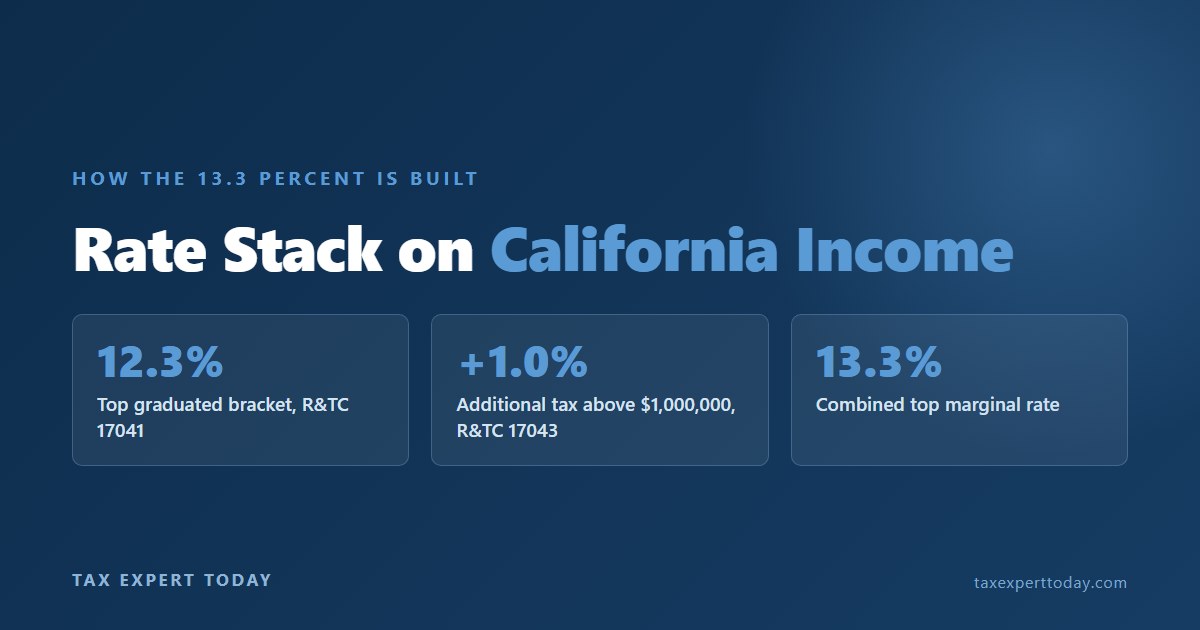
- Practical effect: it raises the top marginal California rate from 12.3 percent to 13.3 percent.
The surcharge is the reason the widely quoted California top rate is 13.3 percent rather than the 12.3 percent that appears in the rate schedule itself. Section 17041 sets the graduated brackets that end at 12.3 percent, and section 17043 adds the separate 1 percent on top of the highest slice of income. Because the two live in different statutes and are reported on different lines of the return, taxpayers frequently plan around the bracket and forget the surcharge until the return is prepared.
| Component | Rate | Authority | Applies to |
|---|---|---|---|
| Graduated rate schedule | 1 percent to 12.3 percent | R&TC section 17041 | All taxable income, in brackets |
| Additional tax (mental health surcharge) | 1 percent flat | R&TC section 17043 | Only the portion of taxable income above $1,000,000 |
| Combined top marginal rate | 13.3 percent | Sections 17041 and 17043 together | Income in the highest bracket above the threshold |
For a taxpayer planning a departure, the surcharge matters out of proportion to its rate. One percentage point is small against a salary. It is not small against a liquidity event, and the liquidity event is usually the thing that prompted the move in the first place.
Why is the California mental health tax now called the Behavioral Health Services Tax?
California voters passed Proposition 1 in March 2024, which amended the Mental Health Services Act and renamed it the Behavioral Health Services Act. The Franchise Tax Board followed for taxable years beginning on or after January 1, 2025, so the line on the 2025 return reads Behavioral Health Services Tax. The rate, the threshold and the statute did not change.
- Same statute: section 17043 still carries its original Proposition 63 text.
- Same rate: 1 percent, unchanged since 2005.
- Same threshold: $1,000,000, and it has never been indexed for inflation.
- New label: Behavioral Health Services Tax on the 2025 Form 540 and Form 540NR.
- What actually changed: how counties may spend the money, not who owes it.
Both the 2025 Form 540 Booklet and the 2025 Form 540NR Booklet carry the same notice under their What is New headings, stating that for taxable years beginning on or after January 1, 2025 the Mental Health Services Act has been renamed the Behavioral Health Services Act, and that references to the Mental Health Services Tax have accordingly been renamed the Behavioral Health Services Tax. Anyone searching for the old label on a current return will not find it, which is a real source of confusion in the 2025 filing season.
| Date | Event | Effect on the tax |
|---|---|---|
| November 2, 2004 | Proposition 63 adopted, adding R&TC section 17043 | Creates the 1 percent additional tax |
| Taxable years beginning on or after January 1, 2005 | Section 17043 operative | Surcharge first applies |
| March 5, 2024 | Proposition 1 amends the Mental Health Services Act | Renames the framework to the Behavioral Health Services Act and redirects county spending |
| Taxable years beginning on or after January 1, 2025 | FTB renames the return line | Form 540 line 62 and Form 540NR line 72 read Behavioral Health Services Tax |
| Current | Rate and threshold | Still 1 percent above $1,000,000, still not indexed |
The rename is worth noting for a second reason. A taxpayer amending an older year, or reconstructing a prior return during a residency examination, will see the earlier label on those forms. The line numbers have also moved over the years, so matching a figure across returns means matching the description rather than the line number.
What does Revenue and Taxation Code section 17043 actually say?
Section 17043 imposes the 1 percent in subdivision (a), then does something unusual in subdivision (c). It expressly switches off three provisions that would otherwise apply: section 17039 on the allowance of credits, section 17041 on filing status and bracket recomputation, and section 17045 on joint returns. Each exclusion has a practical consequence.
- Credits excluded: the credit allowance rules of section 17039 do not apply to the surcharge.
- Brackets excluded: section 17041 filing status and bracket recomputation do not apply, so the 1 percent stays flat.
- Joint return splitting excluded: section 17045 does not apply, so the threshold does not double.
- Administration preserved: subdivision (b) treats the tax as if imposed under section 17041 for administrative purposes, so estimates, payments and assessment procedures still reach it.
Subdivision (b) is easy to skip and should not be. By deeming the surcharge to be imposed under section 17041 for purposes of the administration provisions beginning at section 18401, the statute keeps the surcharge inside the ordinary machinery of estimated tax, withholding credit and assessment. In other words, the tax is separate for computation and ordinary for collection.
| Excluded provision | What it normally does | Consequence for the surcharge |
|---|---|---|
| Section 17039 | Governs the allowance and ordering of credits | Personal credits generally do not reduce the 1 percent; it sits in the other taxes section of the return, after the credit lines |
| Section 17041 | Sets the graduated brackets and filing status computation | The surcharge is a flat 1 percent and is not recomputed by filing status |
| Section 17045 | Doubles the bracket amounts on a joint return by splitting income | The $1,000,000 threshold does not become $2,000,000 for a married couple filing jointly |
Does the $1,000,000 threshold double for a married couple filing jointly?
No. Section 17043(c)(3) removes section 17045, which is the provision that would otherwise compute the tax on a joint return as twice the tax on half the income. Without that splitting mechanism the surcharge simply applies to the couple’s combined taxable income above a single $1,000,000 threshold, exactly as it would for a single filer.
- Single filer: 1 percent on taxable income above $1,000,000.
- Married filing jointly: 1 percent on combined taxable income above the same $1,000,000.
- Married filing separately: each spouse tests separately against $1,000,000 on that spouse’s own return.
- No inflation indexing: the threshold has stood at $1,000,000 since 2005 while the brackets have been indexed annually.
The absence of indexing is quietly significant. California indexes its regular brackets and its standard deduction each year, so the graduated schedule keeps pace with inflation while the surcharge threshold does not. A dollar figure fixed in 2005 reaches steadily further down the income distribution each year, which is why the surcharge now catches taxpayers who would not describe themselves as the intended target of a measure aimed at millionaires.
How is the California mental health tax computed on a resident Form 540?
The 2025 Form 540 instructions for line 62 give a four step computation. Start with taxable income from Form 540, line 19. Subtract $1,000,000. Multiply the remainder by 1 percent. Enter the result on line 62, using whole dollars only. For a full-year resident, line 19 is worldwide taxable income, so the base is everything.
- Step one: taxable income from Form 540, line 19.
- Step two: subtract $1,000,000.
- Step three: multiply the subtotal by .01.
- Step four: enter the result on Form 540, line 62.
- Rounding: the instructions direct whole dollars only.
Line 62 sits in the other taxes block of the return, below the credit lines rather than above them. That placement is the visible expression of the section 17039 exclusion discussed above. A resident with substantial credits will see those credits reduce the tax computed on the rate schedule and then watch the surcharge get added back underneath, which is frequently the moment a taxpayer notices the surcharge for the first time.
How does the California mental health tax work on Form 540NR after you move?
This is where the corridor question is actually decided. The 2025 Form 540NR instructions for line 72 apply a threshold test to either total taxable income or nonresident California source taxable income, and then compute the tax on a different figure entirely: California taxable income from Form 540NR, line 35, less $1,000,000, times 1 percent.
- Threshold test: taxable income or nonresident California source taxable income above $1,000,000 triggers the computation.
- Computation base: California taxable income from Form 540NR, line 35.
- Not the base: total taxable income, which appears separately on Form 540NR, line 19.
- Result: a departed Californian is measured on the California slice, not on the worldwide figure.
The distinction between line 19 and line 35 on Form 540NR is not incidental, and the form itself confirms it. The line 38 instructions direct the taxpayer to compute the exemption credit percentage by dividing California Taxable Income, which is line 35, by Total Taxable Income, which is line 19. Those are two different numbers by design. The surcharge computation reaches for line 35.
That design follows the structure of section 17041(b)(2), which computes the nonresident tax by multiplying the taxable income of a nonresident or part-year resident by a rate derived from what the taxpayer would have owed as a full-year resident. The rate looks at the whole picture; the base looks only at California. Because section 17043(c)(2) switches off the section 17041 bracket apparatus, the surcharge does not borrow the rate mechanic at all. It just applies a flat 1 percent to the California figure.
| Question | Form 540, resident | Form 540NR, nonresident or part-year resident |
|---|---|---|
| Line reporting the surcharge | Line 62 | Line 72 |
| What triggers the computation | Taxable income above $1,000,000 | Taxable income or nonresident California source taxable income above $1,000,000 |
| Figure the 1 percent is applied to | Form 540, line 19, total taxable income | Form 540NR, line 35, California taxable income |
| Effective reach | Worldwide taxable income | The California portion only |
| Amount subtracted before the 1 percent | $1,000,000 | $1,000,000 |
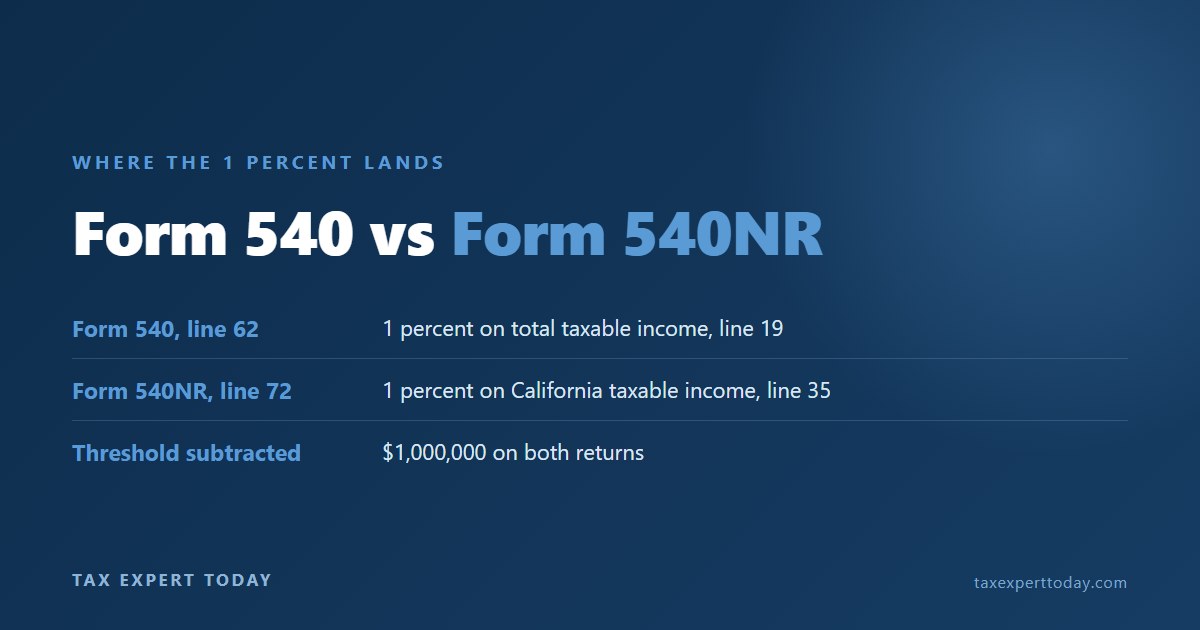
Read that table one more time, because the practical consequence is larger than it looks. A nonresident whose total taxable income is far above $1,000,000 but whose California taxable income on line 35 is modest will run the computation the instructions describe and arrive at a subtotal that is not positive. The $1,000,000 subtraction is applied against the California figure, not against the worldwide figure that satisfied the threshold test. That reading is what the line 72 worksheet directs on its face, and it is the single most consequential mechanical detail in this area for anyone who has genuinely left the state.
What happens to the surcharge in the year you actually move?
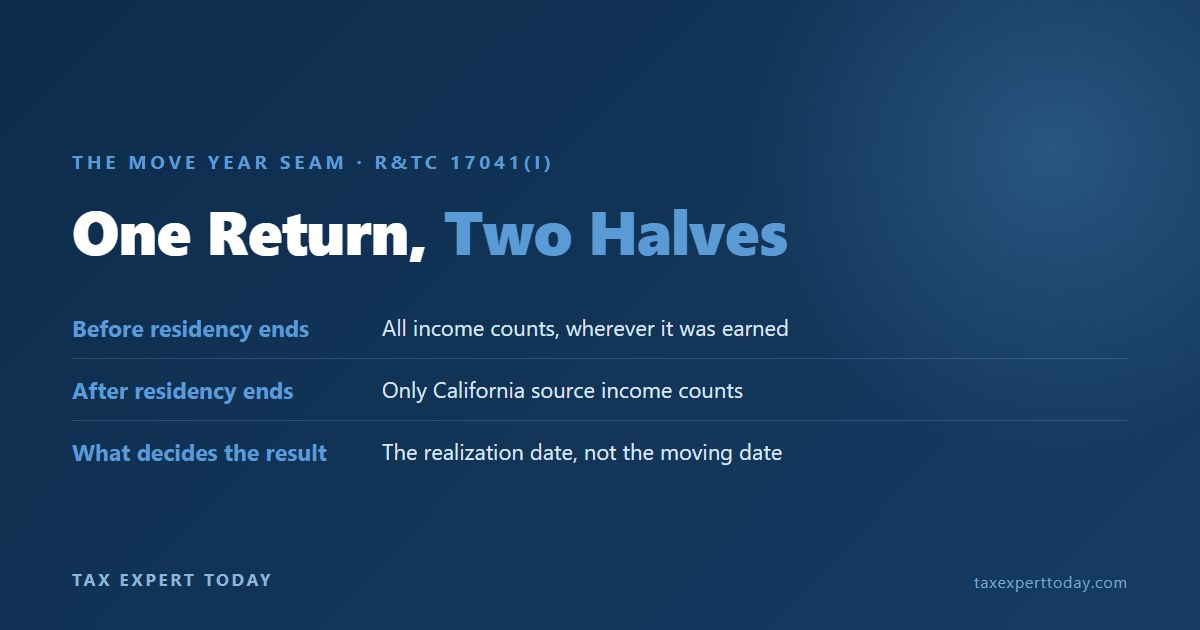
The move year is the expensive one, because Form 540NR, line 35 is built from two different halves. Section 17041(i)(1) includes all items of gross income and deduction regardless of source for the part of the year you were a resident, and only California source income and deductions for the part of the year you were not. The residency change date is the seam.
- Before the residency change date: everything counts, wherever it came from.
- After the residency change date: only California source items count.
- The seam: the date residency actually ended, which FTB Publication 1031 addresses and which is a factual question, not an election.
- The lever: when a large item is realized relative to that date.
- The trap: some items remain California source after the move regardless of timing.
This is why the surcharge is a timing question far more than a residency question. Consider three hypothetical taxpayers with identical $2,400,000 of total taxable income for 2025. The figures below are illustrative arithmetic only, and any real return depends on the specific facts.
| Facts | Total taxable income (line 19) | California taxable income (line 35) | Surcharge base | Surcharge at 1 percent |
|---|---|---|---|---|
| Full-year California resident, Form 540 | $2,400,000 | Not applicable | $1,400,000 | $14,000 |
| Moved to Florida on July 1; stock sale closed in March while still a resident | $2,400,000 | $2,150,000 | $1,150,000 | $11,500 |
| Moved to Florida on July 1; same sale closed in September, gain not California source | $2,400,000 | $250,000 | Not positive | $0 |
The third row is not a loophole and it is not aggressive planning. It is the ordinary operation of section 17041(i)(1)(B) combined with the line 72 worksheet. The taxpayer in the third row genuinely ceased to be a California resident before realizing the gain, and the gain was not California source income in the hands of a nonresident. What the row does illustrate is how much the calendar matters, and how little the mailing address matters on its own.
The critical qualifier sits in that phrase “not California source.” Whether a post-move item escapes depends entirely on what the item is. Our guide to the California exit tax covers the trailing income categories that follow a former resident, and the companion piece on moving to Florida before selling a business works the timing question from the Florida side.
Which income items still feed the surcharge after you leave California?
A nonresident’s California taxable income on line 35 is not zero by default. Real property located in California, compensation for services performed inside California, income from a California business, and certain deferred or installment items sourced before the move all continue to land in that figure and can therefore push a former resident back over the threshold.
- California real property: gain on a sale remains California source regardless of where the seller now lives.
- California workdays: compensation for services physically performed in California stays California source.
- California business income: apportioned income from a trade or business carried on in the state.
- Equity compensation: the portion allocable to California services under the workday allocation method.
- Installment obligations: payments received after the move can carry the original California character.
| Item realized after the move | Generally in California taxable income? | Where we cover it in depth |
|---|---|---|
| Gain on a former California residence | Yes, real property is California source | California capital gains tax on a home sale |
| Restricted stock units vesting after the move | Partly, by workday allocation | California RSU tax when leaving |
| Wages for days worked inside California | Yes, for those days | California remote work tax |
| Gain on stock in a company, sold as a nonresident | Generally no, intangibles source to residence | California exit tax |
| Payments on a California business sale structured as an installment sale | Often yes, the trailing character can persist | Moving from California to Florida |
The pattern is consistent. Income tied to a physical thing in California, or to services performed in California, keeps its California character. Income from an intangible generally follows the owner. That single distinction explains most of the surcharge outcomes we see in corridor engagements, and it is why the surcharge question and the residency question have to be worked together rather than in sequence.
Which one-time events push an ordinary earner over $1,000,000?
Very few people reach $1,000,000 of taxable income on salary alone, and the surcharge was not really designed around salary. It is triggered overwhelmingly by single events that compress years of accumulated value into one tax year, which is also the class of event that most often prompts a move out of California in the first place.
- Sale of a closely held business after decades of ownership.
- A large equity vest or option exercise following an acquisition or a liquidity event.
- Sale of appreciated California real estate held since a much lower basis year.
- A lump sum retirement distribution or a deferred compensation payout.
- A legal settlement or judgment received in a single year.
Each of these shares two features that make the surcharge bite. First, the income arrives in one taxable year rather than spread across several, so it clears a threshold that recurring income never would. Second, the taxpayer usually has some control over the timing, which is precisely why the interaction with a planned relocation deserves attention well before the transaction closes rather than in the following filing season.
| Event | Typical timing flexibility | Does the California character usually survive a move? |
|---|---|---|
| Sale of stock in a private company | High, the closing date is negotiated | Generally no if the seller is a genuine nonresident at closing |
| Sale of California real property | Moderate | Yes, the location of the property controls |
| Equity vesting on a fixed schedule | Low | Partly, by allocation to California workdays |
| Deferred compensation payout | Depends on the plan | Federal law limits state taxation of certain qualified retirement income |
| Legal settlement | Low | Depends on what the settlement replaces |
How does the $1,000,000 threshold interact with California estimated tax rules?
Crossing $1,000,000 does two things at once, and the second one surprises people. It triggers the surcharge, and under Revenue and Taxation Code section 19136.3 it also removes the prior year safe harbor. Once adjusted gross income reaches $1,000,000, or $500,000 for a married individual filing separately, paying based on last year’s tax no longer protects against the underpayment penalty.
- What section 19136.3 does: it modifies the federal prior year safe harbor so that it does not apply at that income level.
- Threshold: $1,000,000 of adjusted gross income, or $500,000 for married filing separately.
- Effective: taxable years beginning on or after January 1, 2009.
- Consequence: the current year figure becomes the only reliable basis for estimates.
- Compounding factor: California front loads its quarterly installment schedule, so the exposure lands early.
The two rules use different measures, which is worth pausing on. The surcharge is measured against taxable income, and the safe harbor rule is measured against adjusted gross income. A taxpayer can therefore lose the prior year safe harbor at a level of adjusted gross income that, after deductions, produces taxable income below the surcharge threshold. In a big transaction year both usually fire together, but they are not the same test.
California’s quarterly installment percentages and the mechanics of the underpayment penalty are covered in detail in our California estimated tax penalty guide, which is the right place to work the payment schedule itself. If a balance from a transaction year went unpaid, the separate California late payment penalty analysis applies on top.
Can credits or withholding reduce the California mental health tax?
Credits and payments are treated differently, and the distinction is easy to miss. Section 17043(c)(1) switches off the section 17039 credit allowance rules, so personal credits generally do not reduce the surcharge. Payments are another matter, because subdivision (b) keeps the surcharge inside the ordinary administration provisions, so withholding and estimated payments do apply against it.
- Personal credits: generally do not offset the surcharge, which is reported below the credit lines.
- Withholding: applies as a payment against total tax, including the surcharge.
- Estimated payments: likewise apply, and should be sized to include the surcharge.
- Other state tax credit: raises its own questions and depends on the other state’s tax and the residency facts.
- Practical result: flat supplemental withholding rates rarely cover a large transaction year.
The gap between flat withholding and actual liability is the usual source of an unexpected balance due. California withholds on supplemental wages such as bonuses and equity vests at flat percentages that sit well below the combined 13.3 percent top rate. In a year with a large vest, the shortfall is structural rather than an error, and it is compounded by the loss of the prior year safe harbor described above.
Does moving to Florida eliminate the California mental health tax going forward?
For income earned after residency genuinely ends and that is not California source, yes. Florida imposes no personal income tax, so once the residency change is complete and the income has no California source, the 1 percent surcharge has nothing to attach to. The qualifier carries all the weight: residency has to actually end, and the income has to actually be non-California source.
- Florida side: no state personal income tax, so no comparable surcharge.
- California side: the surcharge follows California taxable income, not the taxpayer’s address.
- Requirement one: a defensible residency change date supported by facts, not by a filing position.
- Requirement two: income that is genuinely outside the California source rules.
- Common failure: a claimed move that the closest connections analysis does not support.
A residency change that cannot be defended does not merely fail on the surcharge. It reopens the entire year on the resident basis, which means the surcharge is computed on worldwide taxable income rather than the California slice. That is the practical reason the surcharge and the residency file belong in the same engagement. Our guides to leaving California taxes and the California residency audit set out the closest connections factors the Franchise Tax Board weighs, and on the Florida side the Florida 183 day rule calculator is a useful starting point for day counting.
What records support the surcharge position in the move year?
The surcharge computation rests on two facts that have to be provable years later: the date residency ended, and the date each significant income item was realized. Neither is a matter of assertion. Both are ordinary documentary questions, and both are far easier to assemble contemporaneously than to reconstruct during an examination.
- Residency date evidence: lease or closing documents, moving invoices, driver license and voter registration dates, and the closest connections file.
- Realization date evidence: closing statements, brokerage confirmations, vesting schedules and plan records.
- Allocation support: a workday calendar for the year, with California days identified.
- Return consistency: the residency date claimed on Schedule CA (540NR) should match every other document in the file.
- Retention: keep the file for the full California assessment window, which runs longer than many taxpayers expect.
| Fact to prove | Best evidence | Why it matters to the surcharge |
|---|---|---|
| Residency ended on a specific date | Closing or lease documents, utility start dates, license and registration dates | Sets the seam between the two halves of Form 540NR, line 35 |
| A gain was realized after that date | Settlement statement, trade confirmation, escrow closing date | Determines whether the item enters the surcharge base |
| The item was not California source | Asset description, entity records, situs of the underlying property | Determines whether a post-move item still counts |
| California workdays in the year | Contemporaneous calendar, travel records, expense reports | Drives the allocated compensation inside line 35 |
Do you still file a California return if the surcharge computes to zero?
Frequently yes. The filing obligation and the surcharge are separate questions. A nonresident with any California source income above the filing thresholds generally files Form 540NR regardless of whether line 72 produces a number, and filing is also the mechanism for recovering California tax that was withheld during a transition year.
- Filing is driven by California source income, not by the surcharge result.
- A zero on line 72 is a computed result that belongs on a filed return, not a reason to skip filing.
- Withholding recovery generally requires the return, since there is no standalone refund route for wage withholding.
- The move year almost always requires a return, because the resident period produces California taxable income by definition.
- Not filing leaves the assessment window open rather than closing it.
That last point deserves emphasis. A filed return starts the clock on California’s assessment period. An unfiled year does not, which means a taxpayer who decided the surcharge did not apply and therefore filed nothing has preserved the Franchise Tax Board’s ability to examine that year indefinitely. The return is the thing that eventually makes the question go away.
California mental health tax help Naples and Southwest Florida
The California mental health tax help Naples clients ask for almost always arrives attached to a transaction rather than to a filing question. Either a business sale or a large vest is being scheduled around a relocation and the client wants to understand what the calendar actually controls, or the transaction has already closed and a Form 540NR has to be prepared for a year that contains both a resident period and a nonresident period. Our office in Naples, Florida works the residency file and the sourcing analysis together, because the surcharge base on line 35 is only as defensible as the residency change date it is measured from.
Tax Expert Today LLC
11983 Tamiami Trail N, Naples, FL 34110
Phone: (239) 441-2005
Hours: Monday through Friday, 10:00 to 5:00 ET
We closed on the sale of our company two months after moving to Naples, and California withheld nothing. Do we still have a mental health tax exposure? The answer depends on two things that have to be established rather than assumed. The first is whether California residency genuinely ended before the closing date, which is a facts and circumstances question governed by the closest connections analysis rather than by the date of the move itself. The second is whether the gain was California source income in the hands of a nonresident, which depends on what was actually sold. If both answers hold, the gain sits outside Form 540NR, line 35 and does not enter the surcharge base. A move year return is still generally required for the resident portion of the year. Our California tax services page and our Naples tax planning page describe how we handle both ends of the corridor.
When to Engage a Professional
A California surcharge question is worth professional review whenever the amounts or the timing are not clean. Consider engaging an advisor when a transaction that will produce more than $1,000,000 of taxable income is being scheduled near a planned relocation, when a move happened mid-year and the residency change date drives the allocation on Form 540NR, when equity granted in California is still vesting after the move, when California real property or a California business remains in the picture, when estimated payments were built on a prior year safe harbor that section 19136.3 has removed, or when a Franchise Tax Board notice has already raised the residency question. Outcomes depend on the specific facts, and the analysis generally requires the closing documents, the vesting records, the workday calendar and the residency file rather than a general rule.
Related reading on the corridor includes our complete guide to moving from California to Florida, the California part year resident return mechanics for the move year itself, our guide to California nonresident withholding when California source payments continue after the move, and the dual state residency trap for anyone whose facts point in two directions at once.
Frequently Asked Questions
What is the California mental health tax rate? It is a flat 1 percent imposed by Revenue and Taxation Code section 17043 on the portion of taxable income above $1,000,000. It sits on top of the graduated rate schedule in section 17041, which is why the combined California top marginal rate is 13.3 percent rather than 12.3 percent.
Is the California mental health tax the same as the Behavioral Health Services Tax? Yes. Proposition 1 renamed the Mental Health Services Act to the Behavioral Health Services Act, and for taxable years beginning on or after January 1, 2025 the Franchise Tax Board renamed the return line accordingly. The statute, the 1 percent rate and the $1,000,000 threshold are unchanged.
Does the $1,000,000 threshold double if we file jointly? No. Section 17043(c)(3) excludes section 17045, the joint return income splitting provision, so a married couple filing jointly applies the 1 percent to combined taxable income above a single $1,000,000 threshold rather than $2,000,000.
Do I owe the California mental health tax as a nonresident? Only to the extent of your California taxable income. The Form 540NR line 72 instructions compute the tax on California taxable income from line 35 less $1,000,000, so a nonresident whose California taxable income does not exceed $1,000,000 arrives at no surcharge even when total taxable income is much higher.
What line is the mental health tax on the California return? On the 2025 Form 540 it is line 62, and on the 2025 Form 540NR it is line 72. Both are now labelled Behavioral Health Services Tax. Line numbers have moved between years, so match by description rather than by number when comparing returns.
Can credits reduce the California mental health tax? Generally no. Section 17043(c)(1) excludes the section 17039 credit allowance rules from the surcharge, and the return reflects that by reporting it in the other taxes section below the credit lines. Withholding and estimated payments do apply against it, because subdivision (b) keeps the surcharge inside the ordinary administration provisions.
If I move to Florida mid-year, is the surcharge prorated? Not by a time formula. The move year result comes from what lands in California taxable income on Form 540NR, line 35, which under section 17041(i)(1) includes all income for the resident period and only California source income for the nonresident period. The result depends on when items were realized, not on how many months you lived in each state.
This article is educational and general in nature. It does not constitute tax advice for any particular taxpayer, and outcomes depend on individual facts and circumstances.
Published August 27, 2026 by Dr. Pellumb Kabashi « Back to Learning Center
Have a question this article touches on?
Tax Expert Today LLC, based in Naples, Florida and serving clients across the United States.
Schedule a Consultation (239) 441-2005