
By Dr. Pellumb Kabashi, DBA, MBA, CES, CFE, EA
Founder, Tax Expert Today LLC · Tax advisors, enrolled agents, CPAs, and attorneys · Serving clients in all 50 states
Quick Answer
A qualified opportunity fund is a corporation or partnership that holds at least 90 percent of its assets in opportunity zone property and lets investors defer eligible capital gains. Gains deferred under the original rules are taxed on December 31, 2026. Investments made after that date follow new permanent rules with a rolling five-year deferral. Call (239) 441-2005 for a free consultation.
What is a qualified opportunity fund?
A qualified opportunity fund is an investment vehicle organized as a corporation or a partnership for the purpose of investing in qualified opportunity zone property. It must hold at least 90 percent of its assets in that property, and it certifies itself each year by filing Form 8996 with its federal income tax return.
The definition sits in IRC section 1400Z-2(d)(1). There is no application and no IRS approval letter. A fund becomes a qualified opportunity fund by organizing for the right purpose and attaching Form 8996 to a timely filed return. That is why funds range from large sponsored real estate vehicles to a two-member partnership that one family forms to develop a single parcel.
The zones themselves are population census tracts that qualify as low-income communities and were nominated by a state governor and designated by the Treasury Department under IRC section 1400Z-1. The program was created by the Tax Cuts and Jobs Act in 2017 with a built-in end date. Public Law 119-21 removed that end date in 2025, which is why a guide written before mid-2025 is likely to describe a program that no longer exists in the form it describes.
- Entity type. A corporation or a partnership for federal tax purposes, including a multi-member LLC.
- Purpose. Organized to invest in qualified opportunity zone property, not in another fund.
- Asset test. At least 90 percent of assets in qualifying property, measured twice a year.
- Certification. Self-certified on Form 8996, filed with the fund’s own return.
- Investor benefit. Available only for eligible gains invested within 180 days, in exchange for an equity interest.
How does a qualified opportunity fund investment work?
An investor with an eligible capital gain invests an amount up to that gain in a qualified opportunity fund within 180 days and elects deferral on Form 8949. The gain is taxed later on a date the statute fixes. If the investment is held at least 10 years, appreciation in the fund interest itself can be excluded from income.
| Step | What happens | Governing rule |
|---|---|---|
| 1. Realize a gain | A capital gain or a qualified section 1231 gain from a sale to an unrelated person | Treas. Reg. section 1.1400Z2(a)-1(b)(11) |
| 2. Invest | Cash or property goes into the fund for an equity interest within the 180-day period | IRC section 1400Z-2(a)(1)(A) |
| 3. Elect | The deferral is reported on Form 8949 with code Z, and Form 8997 is attached | Instructions for Form 8949 |
| 4. Report annually | Form 8997 is filed every year the investment is held | Form 8997 |
| 5. Include the deferred gain | The deferred gain is taxed on the statutory date or an earlier inclusion event | IRC section 1400Z-2(b) |
| 6. Exit after 10 years | An election steps basis up to fair market value, excluding the appreciation | IRC section 1400Z-2(c) |
Two features set this apart from other deferral tools. First, only the gain has to be invested, not the full sale proceeds, so the investor keeps the original basis in hand. Second, the investment must be an equity interest. The IRS states on its page on investing in a Qualified Opportunity Fund that a debt interest does not qualify. If an investor contributes more than the eligible gain, section 1400Z-2(e)(1) splits the interest into two investments, and only the portion funded with deferred gain receives the tax benefits.
The related person rule is stricter than most investors expect. Under section 1400Z-2(e)(2), persons are related if they are described in section 267(b) or 707(b)(1) with 20 percent substituted for 50 percent. A gain from a sale to a family partnership in which the seller holds more than a 20 percent interest generally is not an eligible gain at all.
What changed for qualified opportunity funds under Public Law 119-21?
Section 70421 of Public Law 119-21 made the program permanent for amounts invested after December 31, 2026. It replaced the fixed 2026 inclusion date with a rolling five-year deferral, kept a 10 percent basis increase, added a 30 percent increase for rural funds, capped the 10-year exclusion at 30 years, and added reporting with penalties.
Practitioners have started calling the original program OZ 1.0 and the amended program OZ 2.0. Those labels do not appear in the statute, but the dividing line does. Section 70421(c)(5)(A) applies the new capital gain rules to “amounts invested in qualified opportunity funds after December 31, 2026.” Everything invested on or before that date stays under the prior text of section 1400Z-2, which is the version still shown in the published Code today.
| Feature | Invested on or before December 31, 2026 | Invested after December 31, 2026 |
|---|---|---|
| When deferred gain is taxed | Earlier of an inclusion event or December 31, 2026 | Earlier of a sale or exchange, or five years after the investment date |
| Basis increase at 5 years | 10 percent of the deferred gain, if reached by December 31, 2026 | 10 percent of the deferred gain |
| Basis increase at 7 years | A further 5 percent, if reached by December 31, 2026 | None |
| Rural fund increase | None | 30 percent in place of 10 percent |
| 10-year exclusion | Basis equals fair market value at sale, for sales through December 31, 2047 | Basis equals fair market value at sale, frozen at the 30-year value |
| Zone designations | Expire December 31, 2028 (December 31, 2027 for Puerto Rico) | New 10-year periods, the first running January 1, 2027 through December 31, 2036 |
| Fund information return | Form 8996 | Form 8996 plus the section 6039K return, with section 6726 penalties |
Every row in that table comes from the enrolled text of Public Law 119-21 or from Notice 2026-40. The practical consequence is that 2026 and 2027 returns will carry both regimes at once. A taxpayer can hold a 2020 investment that is taxed on December 31, 2026 and make a 2027 investment that is taxed in 2032, and each one follows its own rule set.
What happens to a qualified opportunity fund investment on December 31, 2026?
On December 31, 2026, every investor who still holds a qualifying investment made under the original rules must include the remaining deferred gain in income for the tax year that includes that date. No sale is required and no cash is distributed. The investment itself continues, and the 10-year holding period keeps running.
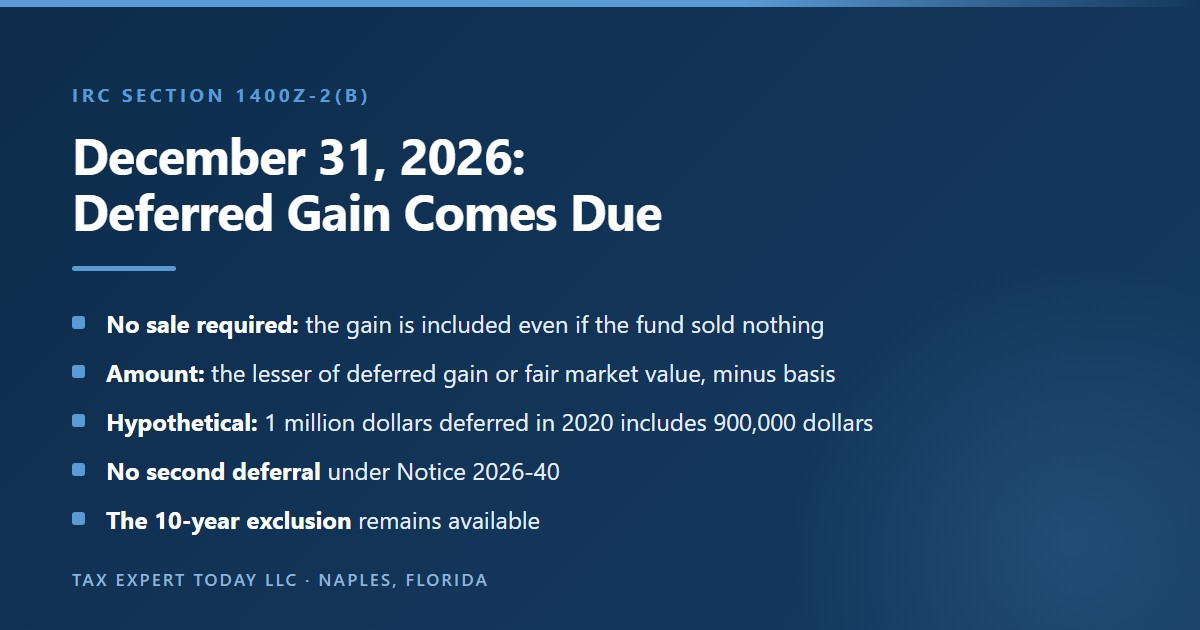
The rule is in the prior text of section 1400Z-2(b)(1) and in Treas. Reg. section 1.1400Z2(b)-1(b): the deferred gain is included in the taxable year that includes the earlier of an inclusion event or December 31, 2026. Notice 2026-40 calls the amount “deemed included gain.” For a calendar-year individual, it lands on the 2026 Form 1040 that is due April 15, 2027.
This is the date the entire first generation of opportunity zone investors has been moving toward since 2018, and it arrives whether or not the fund has sold anything. A family that deferred a gain from a 2019 business sale and has received no distributions since will owe tax on that gain for 2026 with no liquidity event to fund it. The sections below cover how much is included, what rate applies, whether it can be deferred again, and how the payment is handled.
- No election out. The inclusion is automatic for every qualifying investment still held on that date.
- No sale needed. The gain is recognized even though the fund interest has not been sold.
- Investment continues. The interest remains a qualifying investment after the inclusion.
- Basis goes up. Basis in the fund interest increases by the gain recognized.
How much deferred gain is included on December 31, 2026?
The amount included is the lesser of the remaining deferred gain or the fair market value of the investment on December 31, 2026, reduced by the investor’s basis. Basis starts at zero and rises by 10 percent of the deferred gain after five years and another 5 percent after seven years, if those marks were reached by that date.
Because the holding period has to be complete by December 31, 2026 to count, the investment date decides which increase applies. The IRS opportunity zones questions and answers describe the result as a 10 percent exclusion of the deferred gain at five years that becomes 15 percent at seven years.
| Investment date | Holding period by December 31, 2026 | Basis increase | Gain included | Federal tax at 23.8 percent |
|---|---|---|---|---|
| On or before December 31, 2019 | At least 7 years | $150,000 | $850,000 | $202,300 |
| January 1, 2020 through December 31, 2021 | At least 5 years | $100,000 | $900,000 | $214,200 |
| January 1, 2022 through December 31, 2026 | Less than 5 years | $0 | $1,000,000 | $238,000 |
These figures are an illustration of the arithmetic, not a projection for any taxpayer. The 23.8 percent rate combines the 20 percent maximum long-term capital gain rate with the 3.8 percent net investment income tax, and many investors will fall in a lower bracket. The point of the table is that an investor who entered in 2022 or later receives the deferral and nothing else on the original gain, and the partial exclusion was only ever available to those who invested by the end of 2021.
What if the qualified opportunity fund investment has lost value?
If the investment is worth less than the remaining deferred gain on December 31, 2026, the inclusion is measured from the lower fair market value instead. The statute taxes the lesser of the deferred gain or the fair market value, minus basis. A documented valuation as of that date therefore matters for any fund that has declined.
| Fair market value on December 31, 2026 | Gain included with a $100,000 basis increase | Tax | Gain included with no basis increase | Tax |
|---|---|---|---|---|
| $1,400,000 | $900,000 | $214,200 | $1,000,000 | $238,000 |
| $1,000,000 | $900,000 | $214,200 | $1,000,000 | $238,000 |
| $700,000 | $600,000 | $142,800 | $700,000 | $166,600 |
| $400,000 | $300,000 | $71,400 | $400,000 | $95,200 |
The fair market value rule is the only relief the original program offers for an investment that has done poorly, and it is not automatic in practice. A publicly traded price does not exist for an interest in a private fund. The investor needs a value as of December 31, 2026 that would hold up if examined, which usually means a statement from the fund sponsor supported by an appraisal of the underlying property. Investors in funds that have struggled may want to request that valuation well before the 2026 return is prepared, because a fund that has not planned for the request may not be able to produce one quickly.
Upside is treated differently. If the investment is worth more than the deferred gain, the inclusion is capped at the deferred gain. Appreciation in the fund interest is not taxed on December 31, 2026 and remains eligible for the 10-year election.
What tax rate applies to the deferred gain in 2026?
The deferred gain keeps the character it had when it was deferred, but it is taxed at the rates in effect for the year of inclusion. A long-term gain deferred in 2019 is a long-term gain in 2026, taxed at 2026 rates. A short-term gain stays short-term and is taxed at ordinary rates.
Treas. Reg. section 1.1400Z2(a)-1(c)(1) sets out both halves of the rule. The gain “has the same attributes in the taxable year of inclusion that the gain would have had” without the deferral, and it is “subject to the same Federal income tax provisions and rates” as other gains recognized at the same time. Form 8997 tracks short-term and long-term deferred gain in separate columns for this reason.
| Character of the deferred gain | Highest federal rate in 2026 | Tax on $1,000,000 |
|---|---|---|
| Long-term capital gain | 20 percent plus 3.8 percent | $238,000 |
| Unrecaptured section 1250 gain | 25 percent plus 3.8 percent | $288,000 |
| Collectibles gain | 28 percent plus 3.8 percent | $318,000 |
| Short-term capital gain | 37 percent plus 3.8 percent | $408,000 |
For 2026, Rev. Proc. 2025-32 sets the upper limit of the 15 percent capital gain bracket at $613,700 of taxable income for married couples filing jointly and $545,500 for single filers. Gain above those amounts is taxed at 20 percent under IRC section 1(h). The net investment income tax under IRC section 1411 applies above modified adjusted gross income of $250,000 for joint filers and $200,000 for single filers, and those thresholds are not indexed.
The bunching effect deserves attention. A large deemed inclusion can push other income into higher brackets for the year, raise the capital gain rate on unrelated sales, and reduce deductions and credits that phase out with income. An owner who is also planning a business sale may want to look at whether closing in 2026 or in 2027 changes the combined result.
Can the gain recognized on December 31, 2026 be deferred again?
No. Notice 2026-40 states that deemed included gain recognized on December 31, 2026 cannot be deferred again under either the prior or the current statute. The original deferral election remains in effect for that gain, and section 1400Z-2(a)(2) bars a second election for a sale when one is already in effect.
This is the question most first-generation investors will ask in 2026, and the answer was unsettled until the IRS addressed it. The reasoning in section 4.01(2) of Notice 2026-40 is that the taxpayer continues to hold a qualifying investment for which an election is still in effect, so “no amount of deemed included gain can be eligible gain” for a new election. Investing fresh cash in a new fund in early 2027 does not shelter the 2026 inclusion.
The notice announces rules that the Treasury Department and the IRS intend to include in forthcoming proposed regulations. It is guidance, not a final regulation, and details may change when the regulations are issued. On this point, though, the conclusion follows directly from the statutory text, which makes a different final answer unlikely.
- Deemed included gain. Taxed for the year that includes December 31, 2026, with no further deferral.
- New gains in 2026 or 2027. Still eligible for a new election if invested within 180 days.
- Existing investment. Continues as a qualifying investment with a higher basis.
Can a sale before December 31, 2026 be rolled into a new fund?
Generally yes, but at a cost. Gain triggered by an inclusion event, such as selling the fund interest during 2026, can be deferred again if a new qualifying investment is made within 180 days of the event. The portion that was sold stops being a qualifying investment, so its 10-year exclusion is lost.
The rule comes from Treas. Reg. section 1.1400Z2(a)-1(b)(11)(iv), which Notice 2026-40 restates in section 4.03. Inclusion event gain is treated as realized on the date of the inclusion event, which starts a new 180-day period. If the new investment is made on or after January 1, 2027, it is an amount invested after December 31, 2026 and falls under the new rules, with inclusion five years after the new investment date.
| Approach | Deferred gain | 10-year exclusion on the original investment |
|---|---|---|
| Hold through December 31, 2026 | Taxed for 2026, no further deferral | Preserved, with the original holding period |
| Sell in 2026 and reinvest within 180 days, before 2027 | Deferred again, but only until December 31, 2026 | Lost on the portion sold; a new period starts |
| Sell in late 2026 and reinvest within 180 days, in 2027 | Deferred up to five years from the new investment date | Lost on the portion sold; a new period starts |
Selling a 2019 investment to gain five more years of deferral means giving up seven years of progress toward a tax-free exit and restarting the clock. For an investment that has appreciated well, the exclusion usually carries more value than the deferral. For one that is flat or down, the comparison can run the other way. Any sale of the fund interest also produces its own gain or loss on the interest itself, separate from the deferred gain. The decision is fact-specific and should be modeled before any sale.
Is the 10-year exclusion still available after the 2026 inclusion?
Yes. Notice 2026-40 confirms that a taxpayer who recognizes deemed included gain on December 31, 2026 continues to hold a qualifying investment and remains potentially eligible for the section 1400Z-2(c) election on a later sale, provided the 10-year holding period and the other requirements are met through the disposition date.
Paying the deferred tax in 2026 does not end the investment. The gain recognized increases basis in the fund interest, and the holding period continues from the original investment date. An investor who entered in June 2019 reaches the 10-year mark in June 2029 and can then sell with basis stepped up to fair market value.
Two dates limit the window for original-regime investments. Zone designations made in 2018 expire on December 31, 2028, and Treas. Reg. section 1.1400Z2(c)-1(c) provides that the expiration does not impair the election, but only for dispositions on or before December 31, 2047. An investor who holds past 2047 under the original rules would lose the election.
How is the December 31, 2026 tax paid without a sale?
The tax on deemed included gain is due with the 2026 return, generally April 15, 2027 for individuals, and it counts toward 2026 estimated tax requirements. Because the fund is not required to distribute cash, investors need to plan the payment from other sources, such as a fund distribution, other liquid assets, or borrowing.
| Date | Event | Amount |
|---|---|---|
| December 31, 2026 | Deferred gain is included in 2026 income | $900,000 of gain |
| January 15, 2027 | Fourth quarter 2026 estimated tax payment is due | Depends on the safe harbor used |
| April 15, 2027 | 2026 return and any balance are due | About $214,200 of federal tax on the gain |
| April 15, 2027 | First quarter 2027 estimated payment is due | 2026 liability may raise the 2027 safe harbor |
Estimated tax is the piece that catches investors off guard. Under IRC section 6654, an individual generally avoids the underpayment penalty by paying 100 percent of the prior year’s tax through withholding and estimates, or 110 percent if prior-year adjusted gross income exceeded $150,000. An investor who relies on the prior-year safe harbor for 2026 can pay the tax on the inclusion in April 2027 without an underpayment penalty. The inflated 2026 liability then becomes the base for the 2027 safe harbor. Our quarterly estimated tax calculator shows how the safe harbors work.
Some fund agreements allow or require a distribution to help investors cover the tax. A distribution can itself be an inclusion event to the extent it exceeds basis, and a debt-financed distribution from a partnership fund raises its own questions, which Notice 2026-55 lists among the issues on which the IRS has requested comments. Investors may want to ask the sponsor in writing how the fund intends to handle 2026.
Which rules apply to a gain realized in 2026 but invested in 2027?
The new rules apply. Notice 2026-40 provides that a taxpayer with eligible gain realized on, before, or after December 31, 2026 who timely invests in a qualified opportunity fund on or after January 1, 2027 may elect deferral, and the gain is included five years after the investment date.
The investment date controls, not the sale date. That creates a planning window for gains realized in the second half of 2026. The 180-day period counts the day of the sale as day one, so a gain realized on or after July 6, 2026 has a window that reaches January 1, 2027 or later.
| Date the gain is realized | Last day of the 180-day period | Can the investment be made in 2027? |
|---|---|---|
| June 30, 2026 | December 26, 2026 | No |
| July 6, 2026 | January 1, 2027 | Yes, on one day only |
| September 29, 2026 | March 27, 2027 | Yes |
| November 15, 2026 | May 13, 2027 | Yes |
| December 31, 2026 | June 28, 2027 | Yes |
| Choice | Rules that apply | Gain included | When | Federal tax |
|---|---|---|---|---|
| Invest by December 31, 2026 | Original rules | $1,000,000 | December 31, 2026 | $238,000 |
| Invest in January 2027 | New rules | $900,000 | January 2032 | $214,200 |
Investing in late 2026 under the original rules produces almost no deferral, because the gain is included days or weeks later, though the investment still starts a 10-year holding period. Waiting until 2027 brings the five-year deferral and the 10 percent basis increase. The trade-off is on the fund side. Under section 5.01 of Notice 2026-40, property a fund acquires after December 31, 2026 generally qualifies only if it is in a zone designated after July 4, 2025, unless a transition exception applies. An investor placing money in 2027 should confirm that the fund has a path to deploy it in qualifying property.
How does the 180-day window work?
The 180-day period generally begins on the day the gain would be recognized for federal income tax purposes without the election. The investment must be made within that period. Special starting dates apply to section 1231 gains, installment sale payments, capital gain dividends from mutual funds and REITs, and gains passed through from partnerships and S corporations.
The general rule is in Treas. Reg. section 1.1400Z2(a)-1(b)(7). The Instructions for Form 8949 add a point that simplifies compliance: an investor does not need to trace the dollars invested to the specific sale, as long as the investment falls within the 180-day period for the gain being deferred.
- Direct sale of a capital asset. The period starts on the date of the sale.
- Qualified section 1231 gain. The gain is eligible to the extent it exceeds section 1245 and 1250 ordinary income recapture, and the period follows the general rule.
- Installment sale. The investor may start the period on the date each payment is received or on the last day of the tax year.
- Capital gain dividends. The period generally starts on the last day of the shareholder’s tax year, with an election to use the dividend date.
- Pass-through gain. Partners and S corporation shareholders have three possible starting dates, covered in the next section.
The installment sale rule matters for business sellers. A seller who receives payments over several years can treat each year’s gain as a separate eligible gain with its own 180-day period. Payments received in 2027 and later would fall under the new rules if invested. Owners comparing deferral tools may also want to read our guide to 1031 exchange rules, which covers the other 180-day clock in the Code.
When does the 180-day window start for a partner or S corporation shareholder?
When a partnership or S corporation realizes an eligible gain and does not defer it, each owner may defer their share. The owner’s 180-day period generally begins on the last day of the entity’s tax year, or the owner may elect the entity’s own sale date or the unextended due date of the entity’s return.
The three options appear in Treas. Reg. section 1.1400Z2(a)-1(c)(8)(iii) for partnerships, and the regulations apply similar rules to S corporations, estates, and trusts. For a calendar-year partnership with a 2026 sale, the choice of starting date determines whether the owner can invest under the original rules, the new rules, or either.
| Starting date the partner uses | 180-day period | Rules that would apply to the investment |
|---|---|---|
| The partnership’s sale date | March 10, 2026 through September 5, 2026 | Original rules |
| Last day of the partnership year | December 31, 2026 through June 28, 2027 | Original rules if invested December 31, 2026; new rules if invested in 2027 |
| Unextended due date of the partnership return | March 15, 2027 through September 10, 2027 | New rules |
This is the quiet advantage of receiving a gain on a Schedule K-1. A partner whose share of a March 2026 gain arrives on a K-1 in early 2027 has not missed the window. The partner can still invest as late as September 10, 2027 and receive the five-year deferral under the new rules. The partner needs to know the date and character of the gain, which the partnership should report with the K-1.
How do the 2027 rules defer and reduce gain?
For amounts invested after December 31, 2026, deferred gain is included in the year of the earlier of a sale or exchange, or the date five years after the investment. Basis starts at zero and increases by 10 percent of the deferred gain at five years, so 90 percent of the gain is taxed.
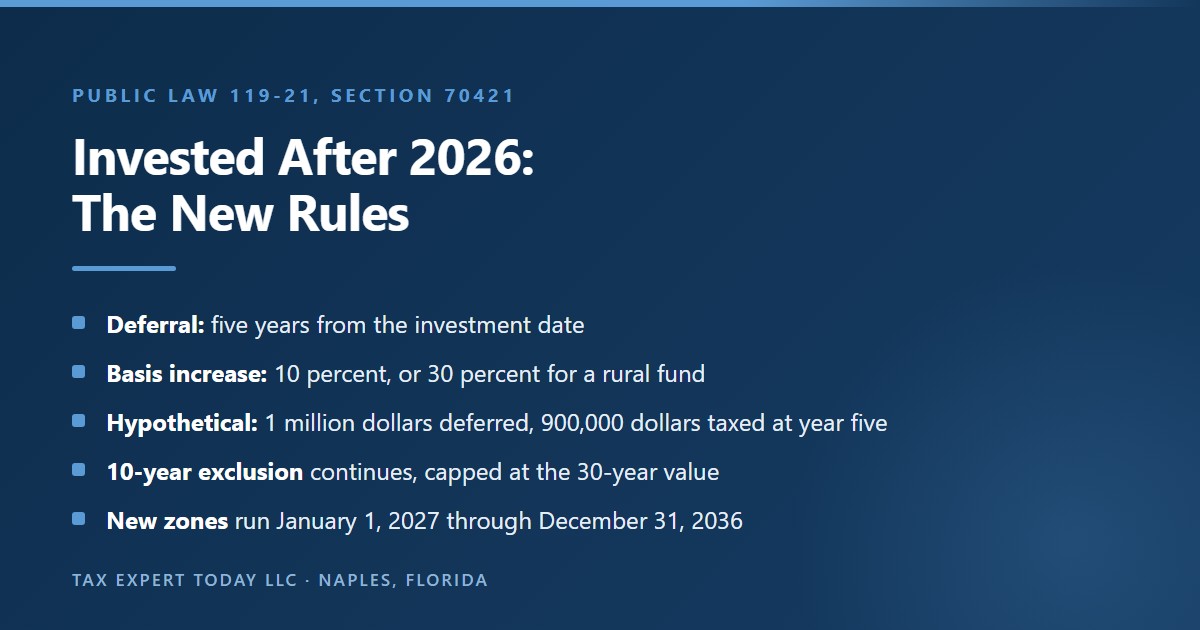
New section 1400Z-2(b)(2)(B)(iii)(II) adds a timing rule that makes the increase usable: the basis increase is “treated as occurring before” the five-year inclusion date. Under the original program, an investor who entered after 2021 reached the inclusion date before the five-year mark. Under the new program every investor who holds for five years receives the increase.
| Item | Qualified opportunity fund | Qualified rural opportunity fund |
|---|---|---|
| Basis increase at five years | $100,000 | $300,000 |
| Gain included at five years | $900,000 | $700,000 |
| Tax at the assumed rate | $214,200 | $166,600 |
| Tax if paid at the time of the sale instead | $238,000 | $238,000 |
| Nominal reduction | $23,800 | $71,400 |
| Present value of the tax at a 6 percent discount rate | $160,063 | $124,493 |
| Present value benefit compared with paying at the sale | $77,937 | $113,507 |
The tax rate in the inclusion year is unknown today. The deferred gain is taxed at whatever rates are in force five years after the investment, under the same attribute rule that governs the 2026 inclusion. The present value figures assume the investor could earn 6 percent on the deferred tax in the meantime. At a 4 percent discount rate the benefit for a standard fund is about $61,943, and at 8 percent it is about $92,219.
The lesser-of rule carries over. If the investment is worth less than the deferred gain at the five-year date, the inclusion is measured from fair market value. The liquidity issue carries over as well. The tax comes due at year five, while the exclusion of appreciation requires holding through year ten, so an investor should plan at the outset for a payment in the middle of the holding period.
What is a qualified rural opportunity fund?
A qualified rural opportunity fund is a qualified opportunity fund that holds at least 90 percent of its assets in property used in zones comprised entirely of a rural area. Investors receive a 30 percent basis increase at five years in place of 10 percent. A rural area excludes cities over 50,000 people and adjacent urbanized areas.
The definition is in new section 1400Z-2(b)(2)(C). A rural area is any area other than a city or town with a population greater than 50,000 and any urbanized area contiguous and adjacent to such a city or town. Notice 2025-50 applied that definition to the 2018 zones using 2020 Census data and identified 3,309 existing zones that are comprised entirely of a rural area.
One rural benefit is already in effect. For property in a zone comprised entirely of a rural area, the substantial improvement test requires additions to basis of more than 50 percent of the adjusted basis of the property, in place of more than 100 percent. Section 70421(c)(5)(C) made that change effective on July 4, 2025, and Notice 2025-50 applies it to determinations made on or after that date.
| Location of the property | Additions to basis required within 30 months |
|---|---|
| Zone that is not entirely rural | More than $800,000 |
| Zone comprised entirely of a rural area | More than $400,000 |
How much is the 10-year exclusion worth?
The 10-year exclusion removes federal income tax on the appreciation of the fund interest itself. If the investor holds at least 10 years and makes the election under section 1400Z-2(c), basis equals fair market value on the date of sale. The value depends entirely on how much the investment grows.
| Annual growth | Value at 10 years | Appreciation excluded | Tax avoided |
|---|---|---|---|
| 4 percent | $1,480,244 | $480,244 | $114,298 |
| 6 percent | $1,790,848 | $790,848 | $188,222 |
| 8 percent | $2,158,925 | $1,158,925 | $275,824 |
| 10 percent | $2,593,742 | $1,593,742 | $379,311 |
The exclusion is the larger of the two benefits in most scenarios. In the 8 percent row it is worth more than three times the present value of the five-year deferral. It is also the benefit that depends on the investment performing. An exclusion of zero appreciation is worth nothing, and growth rates in the table are assumptions chosen to show the arithmetic, not forecasts for any fund.
The election is made on the return for the year of the sale. Real estate funds usually hold depreciable property, often with accelerated deductions from a cost segregation study or bonus depreciation. How those deductions interact with the exit depends on whether the investor sells the fund interest or the fund sells its assets, and on the rules in Treas. Reg. section 1.1400Z2(c)-1 for pass-through funds. That analysis belongs in the hands of the fund’s tax advisers well before the exit.
What is the 30-year rule for a qualified opportunity fund?
For amounts invested after December 31, 2026, the basis step-up is capped at the 30-year mark. If the investment is sold before 30 years, basis equals fair market value at the sale. If it is held longer, basis is fixed at fair market value on the date 30 years after the investment.
| Year of sale | Value at sale | Basis after the election | Taxable gain | Tax |
|---|---|---|---|---|
| Year 30 | $7,612,255 | $7,612,255 | $0 | $0 |
| Year 35 | $10,676,581 | $7,612,255 | $3,064,326 | $729,310 |
| Year 40 | $14,974,458 | $7,612,255 | $7,362,203 | $1,752,204 |
The rule replaces the fixed 2047 cutoff that applies to original-regime investments with a rolling limit tied to each investment date. The mechanics are not settled. In Notice 2026-55 the IRS asked for comments on how the election is made when an investment has not been sold by the 30-year date, what valuation and substantiation rules should apply on that date, and how later appreciation or depreciation should be treated. Families using a fund interest as a multigenerational holding, perhaps inside a dynasty trust, should treat the 30-year date as a planned valuation event.
Where will the new opportunity zones be?
New zones are nominated by each governor and designated by the Treasury Department every 10 years. The first determination date was July 1, 2026, and zones designated during 2026 take effect January 1, 2027 and run through December 31, 2036. Tracts must meet a tighter low-income test than the 2018 zones did.
| Rule | 2018 designations | Designations after July 4, 2025 |
|---|---|---|
| Median family income test | Low-income community under section 45D(e), generally 80 percent of the area or statewide median | Does not exceed 70 percent of the metropolitan area or statewide median |
| Poverty rate test | Poverty rate of at least 20 percent | Poverty rate of at least 20 percent, and median family income not above 125 percent of the median |
| Contiguous tracts that are not low-income | Eligible in limited numbers | Repealed |
| Puerto Rico | All low-income tracts deemed designated | Special rule repealed effective December 31, 2026 |
| Limit per state | 25 percent of low-income tracts | 25 percent of low-income tracts for each designation period |
| Designation period | Through December 31, 2028 | January 1, 2027 through December 31, 2036 |
Rev. Proc. 2026-14 gives governors the nomination procedure, and the statute sets a 90-day determination period beginning on the decennial determination date. As of September 29, 2026, the IRS opportunity zones page did not yet list a notice designating the new zones. Until that list is published, no one can confirm that a given tract will be a zone in 2027, and the HUD map shows the 2018 designations.
The tighter income test means that some 2018 zones will not qualify again. A project located in a current zone is not assured of being in a new one. Investors who are offered a 2027 fund should ask which census tracts the fund expects to use and whether those tracts have been designated.
What happens to existing zones after 2028?
The 2018 designations expire on December 31, 2028, and on December 31, 2027 in Puerto Rico. Notice 2026-40 describes safe harbors that would let existing funds and businesses keep treating an expired zone as a zone through December 31, 2047 for property and operations already in place.
The notice draws a line at December 31, 2026 for new acquisitions. Property acquired by a fund or a zone business after that date generally cannot be qualified opportunity zone business property unless it is acquired for use in a zone designated after July 4, 2025. Two exceptions are described for property in previously designated zones.
- Working capital plans. Property acquired under a written working capital safe harbor plan adopted on or before December 31, 2026 may qualify, if at least 10 percent of the planned capital was received and at least 5 percent was expended by that date.
- Ordinary course replacements. Replacement or modernization of existing property needed to continue the business may qualify.
- Expansions do not qualify. The notice gives the example of a new warehouse bought in 2028 to expand into a new product, which is not qualifying property.
For an investor in an existing fund, the practical question is whether the project is finished. A fund that has completed construction and is operating an apartment building fits within the safe harbors as described. A fund that is still raising capital for a later phase needs a written plan that meets the December 31, 2026 tests. These are anticipated rules in a notice, and the proposed regulations may differ.
How is a qualified opportunity fund election reported on Form 8949?
The investor reports the sale normally, then reports the deferral on its own row of Form 8949 with the fund’s employer identification number in column (a), the investment date in column (b), code Z in column (f), and the deferred gain as a negative number in column (g). The later inclusion uses code Y.
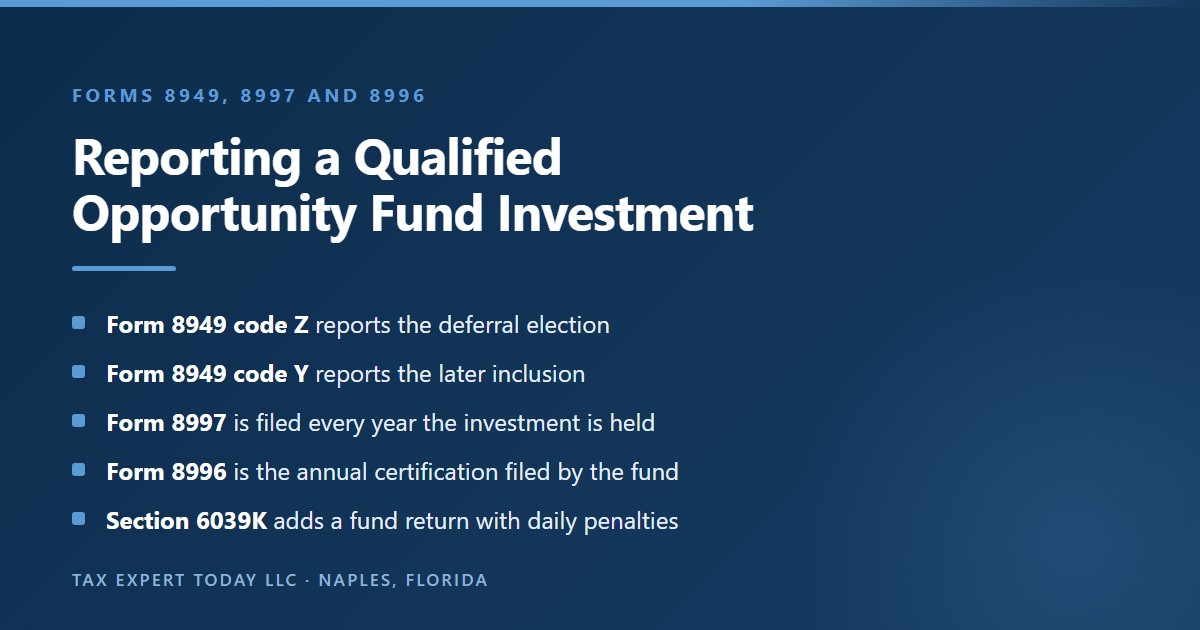
| Form 8949 entry | Deferral election (code Z) | Inclusion of deferred gain (code Y) |
|---|---|---|
| Part and box | Part I with box C or I, or Part II with box F or L | Part I with box C or I, or Part II with box F or L |
| Column (a) | Only the fund’s employer identification number | The fund’s employer identification number |
| Column (b) | Date of the investment in the fund | Completed |
| Columns (c), (d), (e) | Left blank | Completed for a sale of the fund interest |
| Column (f) | Z | Y |
| Column (g) | Deferred gain as a negative number | Previously deferred gain as a positive number |
The Instructions for Form 8949 require a separate row for each investment and ask that any Form 8949 listing code Z be attached first. Section 1231 gains are different because they start on Form 4797. The instructions call for two rows, one with code O that carries the amount from Form 4797 and one with code Z for the deferral.
An election that was missed on the original return can generally be made on an amended return or an administrative adjustment request, according to the IRS page on investing in a fund. The investment itself still had to be made within the 180-day period. Filing late does not extend that window.
What is Form 8997 and who files it?
Form 8997 is the annual investor statement. Any eligible taxpayer who holds a qualifying investment in a qualified opportunity fund at any point during the tax year must attach it to a timely filed federal return, including extensions. It reports beginning holdings, new deferrals, inclusion events, and year-end holdings.
| Part of Form 8997 | What it reports | What to watch for the 2026 tax year |
|---|---|---|
| Part I | Investments and deferred gain held at the start of the year | Should match the prior year’s Part IV, or an explanation is attached |
| Part II | Gains deferred during the year by new investments | Investments made during 2026 under the original rules |
| Part III | Inclusion events and deferred gain now taxed | Sales and other inclusion events, with special gain codes G and H for the 5-year and 7-year basis adjustments |
| Part IV | Investments and deferred gain held at year end | Remaining deferred gain after the December 31, 2026 inclusion |
The form is filed every year, including years when nothing happens. That is the requirement investors miss most often, because a fund interest that pays no distributions and issues a K-1 with little activity is easy to overlook. The current revision of Form 8997 is the 2025 form. The 2026 revision, which will have to accommodate the December 31, 2026 inclusion, had not been released when this guide was written, so the line-by-line treatment of deemed included gain should be confirmed against the 2026 instructions.
- Who files. Individuals, corporations, partnerships, S corporations, estates, and non-grantor trusts that hold a qualifying investment.
- When. With the timely filed federal return, including extensions, for every year the investment is held.
- Character tracking. Short-term deferred gain in column (e), long-term in column (f).
- Foreign investors. A foreign eligible taxpayer must waive treaty benefits on the deferred gain to make the election.
What does the fund itself have to file?
The fund files Form 8996 each year to certify its status and test the 90 percent standard. For tax years beginning after July 4, 2025, new section 6039K also requires an annual information return listing assets, census tracts, industry codes, employment, residential units, and each investor who disposed of an interest.
| Situation | Penalty per day | Maximum per return |
|---|---|---|
| Fund with gross assets of $10,000,000 or less | $500 | $10,000 |
| Fund with gross assets over $10,000,000 | $500 | $50,000 |
| Intentional disregard, smaller fund | $2,500 | $50,000 |
| Intentional disregard, larger fund | $2,500 | $250,000 |
At $500 a day, a small fund reaches the $10,000 maximum in 20 days. The statute indexes these amounts for returns required to be filed after 2025, so the figures in force will be somewhat higher than the base amounts shown. The return must be filed electronically under section 6011(e)(8). New section 6039L requires each zone business to give the fund the information the fund needs to complete its own return.
On September 11, 2026 the Treasury Department and the IRS published proposed regulations (REG-116506-25) on the new information reporting, the penalties, and updated certification and decertification procedures, including a way for a fund to revoke an inadvertent certification. These are proposed rules with a comment period, not final requirements. Family-owned funds with one project are subject to the same return as large sponsored funds, and the owners of those small funds are the ones most likely to be unaware of it.
What tests must a qualified opportunity fund meet?
A fund must hold at least 90 percent of its assets in qualified opportunity zone property, measured on the last day of the first six months of its tax year and on the last day of the year. Most funds invest through a zone business, which must meet its own tangible property, income, and financial asset tests.
| Test | Requirement | Source |
|---|---|---|
| Fund asset test | At least 90 percent of assets in qualified opportunity zone property, averaged over two testing dates | IRC section 1400Z-2(d)(1) |
| Zone business tangible property | At least 70 percent of tangible property owned or leased is zone business property | Treas. Reg. section 1.1400Z2(d)-1(d)(2) |
| Gross income | At least 50 percent from the active conduct of a business in the zone | IRC section 1400Z-2(d)(3)(A)(ii) |
| Nonqualified financial property | Less than 5 percent of average aggregate unadjusted bases | IRC section 1397C(b)(8), by reference |
| Working capital safe harbor | Written plan and schedule, with amounts spent within 31 months | Treas. Reg. section 1.1400Z2(d)-1(d)(3)(v) |
| Original use or substantial improvement | Additions to basis exceed adjusted basis within 30 months, or 50 percent of it in an entirely rural zone | IRC section 1400Z-2(d)(2)(D) |
| Excluded businesses | Golf courses, country clubs, massage parlors, hot tub and suntan facilities, racetracks and gambling facilities, and liquor stores | IRC section 144(c)(6)(B), by reference |
A fund that misses the 90 percent standard pays a monthly penalty under section 1400Z-2(f) equal to the shortfall multiplied by the underpayment rate for the month. As a hypothetical, a fund with $10,000,000 of assets and $8,000,000 of qualifying property has a $1,000,000 shortfall, and at an assumed 7 percent annual underpayment rate the penalty would be about $5,833 for each month. The penalty does not apply if the failure is due to reasonable cause, and a partnership fund passes it through to the partners.
Investors in a sponsored fund do not run these tests, but they bear the result. If a fund loses its status, every investor has an inclusion event. The fund’s Form 8996 history and its compliance process are reasonable items to request before investing.
What events end the deferral early?
An inclusion event ends the deferral before the statutory date. In general, an event is an inclusion event if it reduces the investor’s direct equity interest, if the investor receives a distribution of property, if the investor claims a worthlessness deduction, or if the fund loses its status. Gifts and divorce transfers are included.
| Event | Inclusion event? | Note |
|---|---|---|
| Sale or exchange of the fund interest | Yes | To the extent of the portion sold |
| Gift, outright or in trust | Yes | Even if the gift is incomplete for gift tax purposes |
| Transfer to a spouse incident to divorce | Yes | Section 1041 nonrecognition does not prevent inclusion |
| Contribution to the investor’s own grantor trust | No | The investor remains the deemed owner |
| Transfer by reason of death | No | The recipient takes over the deferred gain |
| Fund converts from partnership to corporation, or the reverse | Yes | The fund ceases to exist for tax purposes |
| Fund loses qualified opportunity fund status | Yes | Applies to every investor |
The gift rule in Treas. Reg. section 1.1400Z2(b)-1(c)(3) is the one that collides with estate planning. Moving a fund interest into an irrevocable non-grantor trust for children triggers the deferred gain. Moving it into a grantor trust does not, which is why fund interests are often paired with grantor trust structures. Families using the lifetime gift tax exemption should identify any fund interest before it is included in a gifting plan.
Form 8997 asks for these events even when no gain is included. For a transfer that falls under an exception, the instructions call for the word “Exception” and a citation to the regulation paragraph in Part III, with special gain code F used for non-inclusion transfers.
What happens to a qualified opportunity fund investment at death?
A transfer by reason of death is not an inclusion event, and the heir continues to hold a qualifying investment. The deferred gain is not forgiven. It is income in respect of a decedent under section 691, taxed to the recipient when the inclusion date arrives, with no basis step-up for that amount.
Section 1400Z-2(e)(3) and Treas. Reg. section 1.1400Z2(b)-1(c)(4) provide the rule. Transfers to the estate, distributions from the estate or a revocable trust to beneficiaries, and the passing of jointly owned interests by operation of law all qualify as transfers by reason of death. A later sale by the estate or the heir is an inclusion event.
- Deferred gain carries over. The heir reports it on the statutory inclusion date or an earlier inclusion event.
- Holding period continues. The qualifying investment keeps its status in the heir’s hands.
- No step-up for the deferred gain. Income in respect of a decedent does not receive a basis adjustment under section 1014.
- Estate tax still applies. The interest is included in the gross estate at fair market value.
For investors with original-regime investments, the 2026 inclusion will already have occurred for deaths after that date. For investments made in 2027 and later, the heir of an investor who dies in year three would owe the income tax at year five. Executors should find every Form 8997 in the decedent’s files, because the form is the only record most families will have of the amount still deferred.
How does a qualified opportunity fund compare with a 1031 exchange?
A 1031 exchange defers gain on real property only, requires the full proceeds to be reinvested through a qualified intermediary, and can defer indefinitely. A qualified opportunity fund accepts gain from any capital asset, requires only the gain to be invested, and defers for a fixed period while offering an exclusion on new appreciation.
| Feature | Qualified opportunity fund | Section 1031 exchange | Installment sale |
|---|---|---|---|
| Eligible gain | Capital gains and qualified section 1231 gains from any asset | Real property held for business or investment | Most property other than inventory and publicly traded securities |
| Amount to reinvest | The gain only | Full proceeds to defer all gain | None |
| Deadline | 180 days | 45 days to identify and 180 days to close | Set by the contract |
| Intermediary needed | No, the seller may hold the cash | Yes | No |
| Length of deferral | Five years under the new rules | Until a taxable sale, possibly until death | As payments are received |
| Exclusion of later growth | Yes, after 10 years | No, though heirs may receive a basis step-up | No |
| Location limit | Designated low-income census tracts | Any United States real property | None |
The tools are not mutually exclusive across a portfolio, and a failed exchange can sometimes be redirected. When a seller receives cash from a qualified intermediary because no replacement property was acquired, the gain is recognized, and that recognized gain may be an eligible gain for a fund investment if the 180-day period is still open. The timing is tight and fact-specific. IRC section 1031 and section 453 govern the other two columns.
Sellers of company stock have other provisions to consider first, including the section 1202 exclusion discussed in our guide to selling a business. Employees holding appreciated employer stock in a plan face a different set of rules covered in our net unrealized appreciation guide. Owners with charitable goals may find that a charitable remainder trust fits an appreciated asset better than any deferral tool.
Is a qualified opportunity fund worth it compared with paying the tax?
It depends on the investment more than the tax. If a fund earns a return comparable to what the investor would earn elsewhere, the tax benefits add meaningful value over 10 years. If the fund underperforms by a few points a year, the tax benefits may not make up the difference.
| Scenario | Amount invested | Value at year 10 | Tax cost, stated at year 10 | Net at year 10 |
|---|---|---|---|---|
| Pay the tax, invest the rest in a taxable portfolio at 8 percent | $762,000 | $1,645,101 | $210,178 on the new gain | $1,434,923 |
| Fund earning 8 percent | $1,000,000 | $2,158,925 | $314,730, the year-five tax carried forward at 8 percent | $1,844,195 |
| Fund earning 4 percent | $1,000,000 | $1,480,244 | $314,730 | $1,165,514 |
| Fund earning 0 percent | $1,000,000 | $1,000,000 | $314,730 | $685,270 |
On these assumptions the fund comes out about $409,272 ahead when it matches the 8 percent alternative and about $269,409 behind when it earns 4 percent. The breakeven is a fund return of roughly 5.75 percent a year against an 8 percent taxable alternative. That gap of a little over two points a year is the cushion the tax benefits provide, and it is an output of these assumptions, not a rule.
The model leaves out several things that matter. Fund fees and promoted interests reduce the investor’s return. The investment is concentrated in one or a few projects in low-income census tracts and is illiquid for a decade. The year-five tax has to be paid from somewhere. State income tax may apply on a different schedule. None of this makes the program a poor choice, but it does mean the investment should be evaluated on its own merits first, with the tax benefits treated as an addition and not as the reason to invest.
What are the common qualified opportunity fund mistakes?
The recurring errors are procedural: missing the 180-day period, skipping Form 8997 in a quiet year, investing more than the eligible gain without tracking the split, gifting the interest to a non-grantor trust, and assuming the December 31, 2026 inclusion can be rolled forward. Each one is avoidable with a calendar and a file.
| Mistake | Consequence | Prevention |
|---|---|---|
| Investing after the 180-day period ends | No deferral, and no exclusion on that investment | Calendar day 180 on the sale date; confirm special start dates for K-1 gains |
| Omitting Form 8997 in a year with no activity | An incomplete return and possible IRS correspondence | Add the form to the annual return checklist for every year held |
| Contributing more than the eligible gain | A mixed investment, with part receiving no benefits | Track the qualifying and non-qualifying portions separately from day one |
| Gift to a non-grantor trust or a child | Immediate inclusion of the deferred gain | Review every transfer against the inclusion event rules first |
| Expecting to re-defer the 2026 inclusion | Tax due for 2026 with no cash set aside | Plan the April 2027 payment during 2026 |
| No valuation for a fund that has declined | Inclusion at the full deferred gain by default | Request a December 31, 2026 valuation from the sponsor |
| Small fund unaware of the section 6039K return | Daily penalties under section 6726 | Confirm the fund’s filing requirements for tax years beginning after July 4, 2025 |
| Investing in 2027 without checking the census tract | The fund may be unable to acquire qualifying property | Confirm the tract is designated for the period beginning January 1, 2027 |
Most of these come from treating the fund as an investment that needs attention only at entry and exit. The program has annual reporting, fixed dates, and rules that attach to ordinary family transactions such as gifts and divorce settlements. A one-page summary in the permanent tax file, listing each investment date, the deferred amount and its character, and the five-year, seven-year, and ten-year dates, prevents most of the problems in the table.
Do states follow the federal opportunity zone rules?
Not uniformly. State income tax treatment depends on whether the state conforms to section 1400Z-2, and on which version of the Internal Revenue Code it has adopted. Some states follow the federal deferral and exclusion, some do not, and states with no personal income tax, such as Florida, impose no state tax on the gain.
Conformity matters in two directions. A resident of a state that does not follow the federal rules may owe state tax on the original gain in the year of the sale, even though the federal tax is deferred. And a state that conforms to the Code as of a fixed date before July 4, 2025 may follow the original program but not the 2025 amendments until its legislature acts. The answer has to be checked state by state, for both the state of residence and the state where the property sits.
For Florida residents, the federal rules are the whole story for individual income tax purposes. Taxpayers who are relocating should be aware that the state of residence on the inclusion date, not on the original sale date, may affect which state taxes the deferred gain, and that some states assert a claim on gain deferred while the taxpayer lived there. Our guides to establishing Florida residency and moving to Florida before selling a business cover the residency side of that question.
Qualified Opportunity Fund Help in Naples & Southwest Florida
Qualified opportunity fund help Naples investors ask for in 2026 usually concerns the December 31 inclusion: how much gain is taxed, what rate applies, and how to plan the payment. Our office in Naples, Florida reviews the Form 8997 history, models the 2026 liability, and compares the original and new rules for any gain still inside its 180-day window.
Southwest Florida has many residents who sold a business or investment property before or after moving here and deferred the gain into a fund between 2018 and 2021. Many of those investments were arranged by an adviser in another state, and the annual Form 8997 has sometimes been dropped in the move from one preparer to the next. Florida has no personal income tax, so the federal calculation is the one that matters for residents, but a former state of residence may still have a claim. The federal rules described above apply everywhere.
- 2026 inclusion modeling. The deferred gain, the basis increase, the fair market value limit, and the bracket effect on other income.
- Form 8997 and Form 8949 review. Reconstructing the reporting history and correcting gaps.
- Timing analysis for 2026 gains. Comparing an investment before year end with one made in 2027.
- Estimated tax planning. Safe harbor choices for 2026 and 2027.
- Fund-level compliance. Form 8996 and the new information return for family-owned funds.
Tax Expert Today LLC
11983 Tamiami Trail N, Naples FL 34110
Phone: (239) 441-2005
Hours: Monday to Friday, 10:00 to 5:00 ET
Where can I get help with a qualified opportunity fund in Naples, FL? Tax Expert Today LLC, at 11983 Tamiami Trail N in Naples, Florida, works with investors and family-owned funds on the tax side of opportunity zone investments: modeling the December 31, 2026 inclusion, preparing Forms 8949, 8997, and 8996, planning estimated tax, and comparing the original and new rules. The firm includes tax advisors, enrolled agents, CPAs, and attorneys, and serves clients in all 50 states. Results depend on each taxpayer’s facts.
When to Engage a Professional
A qualified opportunity fund investment should be reviewed with professional help when a fixed date or an irreversible step is approaching. In 2026 that includes nearly every investor in the original program. The situations below are ones in which a missed date or an unplanned transfer is difficult to correct afterward.
- An original-regime investment held into 2026. The inclusion amount, the valuation, and the payment should be planned before year end.
- A gain realized after July 5, 2026. The choice between investing in 2026 and investing in 2027 changes the rules that apply.
- A gain reported on a Schedule K-1. The starting date for the 180-day period is an election with real consequences.
- A planned gift, trust transfer, or divorce. Each can trigger the deferred gain.
- A fund interest that has lost value. The fair market value limit requires support.
- A family-owned fund. The new information return and its penalties apply regardless of size.
- Missing Forms 8997. Gaps in prior years should be addressed before the 2026 return is filed.
Tax Expert Today LLC is a multidisciplinary practice of tax advisors, enrolled agents, certified public accountants, and attorneys serving clients in all 50 states. To discuss how a qualified opportunity fund fits within a broader Naples tax planning approach, our tax planning services, or our business consulting work for owners preparing a sale, call (239) 441-2005. Real estate investors may also find our guides to the short-term rental tax loophole and the qualified business income deduction useful.
This article is general information about federal tax provisions and is not tax, legal, or investment advice for any specific taxpayer. Figures were verified against primary sources on September 29, 2026 and are hypothetical illustrations, not client outcomes. Notice 2026-40 and the proposed regulations described here are not final rules and may change. Tax laws apply differently to each person’s facts, and results always vary. Consult a qualified professional about your situation before taking any action.
Published September 29, 2026 by Dr. Pellumb Kabashi « Back to Learning Center
Have a question this article touches on?
Tax Expert Today LLC, based in Naples, Florida and serving clients across the United States.
Schedule a Consultation (239) 441-2005