
By Dr. Pellumb Kabashi, DBA, MBA, CES, CFE, EA
Founder, Tax Expert Today LLC · Tax advisors, enrolled agents, CPAs, and attorneys · Serving clients in all 50 states
Quick Answer
Tax gain harvesting means selling appreciated investments held more than one year in a year when the gain falls in the 0 percent long-term capital gains band, then buying back to reset basis. For 2026 the band ends at $98,900 of taxable income for joint filers and $49,450 for single filers, and ordinary income fills it first. Call (239) 441-2005 for a free consultation.
What is tax gain harvesting?
Tax gain harvesting is the deliberate sale of appreciated investments in a taxable account during a year when some or all of the long-term gain is taxed at the 0 percent federal rate. The investor usually buys the same or a similar holding right away, so the position stays invested but carries a higher cost basis going forward.
- What is sold: stocks, funds, or other capital assets held more than one year in a taxable brokerage account.
- Why now: the gain lands inside the 0 percent long-term capital gains band for the year.
- What is gained: a higher basis, so a later sale produces less taxable gain.
- What it is not: tax loss harvesting, which sells losers to offset gains.
Tax gain harvesting is sometimes called capital gains harvesting, and the idea runs against instinct. Most investors spend their careers trying not to realize gains, because every realized gain usually means a tax bill. Tax gain harvesting turns that around for one specific situation: a year in which the federal tax rate on long-term capital gain is zero for some slice of income. In that year, realizing gain costs nothing at the federal level, and the gain that is realized can never be taxed again. The basis of the repurchased shares equals what was paid for them, which is the current market price, so the built-in gain has effectively been cleared.
The mechanics come from two parts of the Internal Revenue Code. The first is the capital gains rate structure in IRC section 1(h), which taxes adjusted net capital gain at 0, 15, or 20 percent depending on where the gain falls within taxable income. The second is the basis rule in IRC section 1012, which says the basis of property is generally its cost. Sell and repurchase, and the new cost becomes the new basis. The sale itself is a realization event under IRC section 1001, which measures gain as the amount realized minus adjusted basis.
This guide explains how the 0 percent band is measured for 2026, why the amount that can be harvested is usually far smaller than the threshold people quote, which costs a federally untaxed gain can still carry, and how the decision interacts with Roth conversions, Social Security, Medicare premiums, the premium tax credit, and the step-up in basis at death. It is written from the filing side: what shows up on the return, and which numbers to check before a trade is placed. It does not recommend buying or selling any investment.
| Element | General rule | Source |
|---|---|---|
| Holding period needed | More than one year for long-term treatment | IRC 1222 |
| 0 percent band, married filing jointly | Taxable income up to $98,900 | Rev. Proc. 2025-32 |
| 0 percent band, single | Taxable income up to $49,450 | Rev. Proc. 2025-32 |
| 0 percent band, head of household | Taxable income up to $66,200 | Rev. Proc. 2025-32 |
| Order of stacking | Ordinary income first, long-term gain above it | IRC 1(h)(1) |
| Repurchase waiting period | None required for gains; the wash sale rule covers losses | IRC 1091(a) |
| Basis of repurchased shares | Cost of the new purchase | IRC 1012 |
| Reporting | Form 8949 and Schedule D, matched to Form 1099-B | Form 8949 instructions |
How does tax gain harvesting differ from tax loss harvesting?
Tax loss harvesting sells investments below their basis to create losses that offset gains or up to $3,000 of ordinary income. Tax gain harvesting sells investments above their basis to realize gain while the rate on that gain is zero. One lowers this year’s tax; the other lowers future tax by raising basis.
- Loss harvesting: produces a deduction now, subject to the wash sale rule.
- Gain harvesting: produces no deduction and no federal tax inside the 0 percent band.
- Timing effect: loss harvesting lowers basis going forward; gain harvesting raises it.
- Who benefits: loss harvesting suits high earners; gain harvesting suits low taxable income years.
Much of what ranks for this search is written about the other strategy. That is understandable, because tax loss harvesting is the more familiar tool and it helps the larger group of investors with high income. But the two strategies point in opposite directions, and treating them as variations of one idea causes real mistakes. A loss harvest that is followed by a repurchase within 30 days can lose the deduction under the wash sale rule. A gain harvest that is followed by an immediate repurchase loses nothing, because the wash sale rule in IRC section 1091(a) applies only to “any loss claimed to have been sustained.”
The capital loss limit is the other point of contrast. Under IRC section 1211(b), an individual can deduct capital losses only to the extent of capital gains plus up to $3,000 of other income each year, with the rest carried forward under IRC section 1212(b). Gains have no such limit. Every dollar of harvested gain is reported, and the only question is what rate applies to it.
A household can use both strategies in different years, and sometimes both in the same year, but they should be planned together. A loss carryforward from an earlier year will absorb harvested gain before any of that gain reaches the 0 percent band, which is discussed later in this guide. Households that also hold appreciated real estate may find our guide to 1031 exchange rules useful, because a like-kind exchange defers gain on real property rather than harvesting it.
| Question | Tax gain harvesting | Tax loss harvesting |
|---|---|---|
| What is sold | Positions worth more than basis | Positions worth less than basis |
| Tax effect this year | No federal tax inside the 0 percent band | A loss that offsets gains and up to $3,000 of other income |
| Basis after repurchase | Higher | Lower |
| Wash sale rule | Does not apply to gains | Applies; 30 days before or after |
| Typical household | Low taxable income year | High taxable income year |
| Main risk | Pushing income past a threshold | A disallowed loss from a repurchase |
What is the 0 percent long-term capital gains rate for 2026?
For 2026, long-term capital gain and qualified dividends are taxed at 0 percent to the extent taxable income does not exceed $98,900 for married couples filing jointly, $49,450 for single filers and married filing separately, and $66,200 for heads of household, under Rev. Proc. 2025-32. Above those amounts the 15 percent rate generally applies.
- Married filing jointly: 0 percent band to $98,900; 15 percent band to $613,700.
- Single: 0 percent band to $49,450; 15 percent band to $545,500.
- Head of household: 0 percent band to $66,200; 15 percent band to $579,600.
- Married filing separately: 0 percent band to $49,450; 15 percent band to $306,850.
These amounts are the “maximum zero rate amounts” in section 3.03 of Rev. Proc. 2025-32, which sets the inflation-adjusted figures for taxable years beginning in 2026. They were checked against the text of the revenue procedure on the day this guide was published. For comparison, the IRS’s Topic 409 page still shows the 2025 amounts of $96,700 joint and $48,350 single, which is a reminder that a figure found online may be a year out of date. Tax gain harvesting projections should always use the table for the year of the sale.
The thresholds are measured against taxable income, not adjusted gross income and not total income. Taxable income is what remains after the standard deduction or itemized deductions and certain other deductions. For 2026 the standard deduction is $32,200 for married couples filing jointly, $16,100 for single filers, and $24,150 for heads of household, with an additional $1,650 for each spouse who is 65 or older or blind, under section 3.14 of Rev. Proc. 2025-32. A couple with no ordinary income at all could therefore have gross income well above $98,900 and still fall inside the band, because the deduction comes off first.
The 0 percent rate applies only to “adjusted net capital gain,” which generally means net long-term capital gain plus qualified dividends, minus certain categories taxed at other rates. Short-term gain is ordinary income and is taxed at the regular rates. Collectibles gain and unrecaptured section 1250 gain have their own maximum rates and do not share the 0 percent treatment in the same way.
| Filing status | 0 percent up to | 15 percent up to | 20 percent above |
|---|---|---|---|
| Married filing jointly and surviving spouse | $98,900 | $613,700 | $613,700 |
| Head of household | $66,200 | $579,600 | $579,600 |
| Single | $49,450 | $545,500 | $545,500 |
| Married filing separately | $49,450 | $306,850 | $306,850 |
| Estates and trusts | $3,300 | $16,250 | $16,250 |
How does the stacking rule limit how much gain can be harvested at 0 percent?
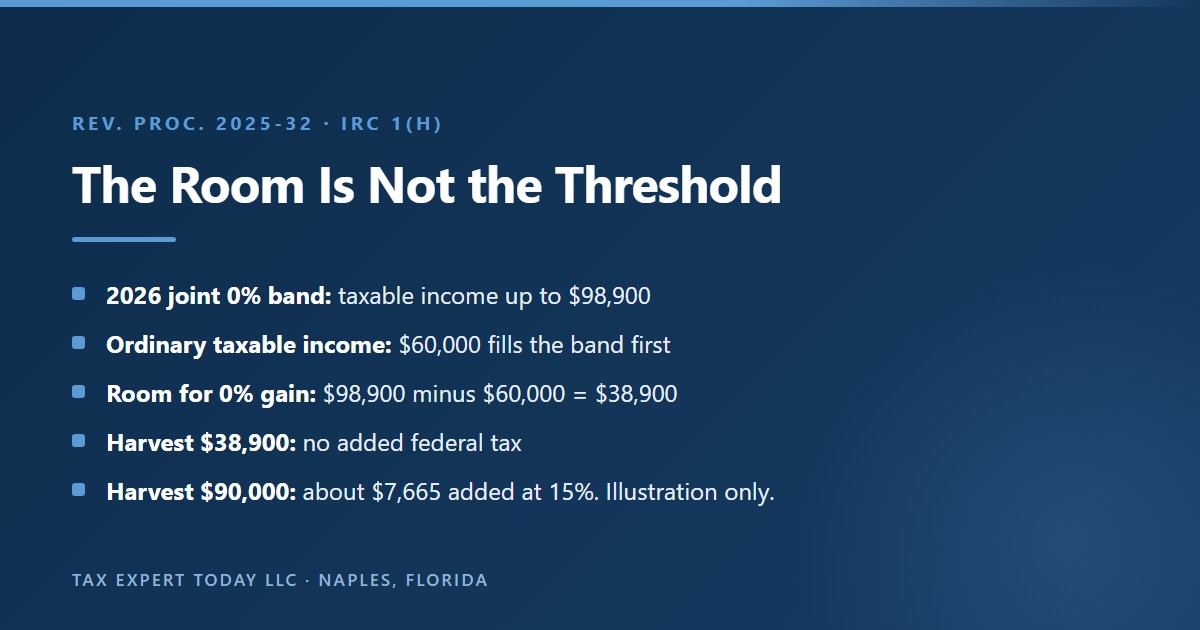
Long-term gain is stacked above ordinary taxable income, so ordinary income fills the 0 percent band first. The gain that can be harvested at 0 percent is the room left between ordinary taxable income and the threshold, not the threshold itself. A couple with $60,000 of ordinary taxable income has $38,900 of room in 2026.
- Step one: compute ordinary taxable income without any harvested gain.
- Step two: subtract it from the 0 percent threshold for the filing status.
- Step three: the result is the most gain that can land at 0 percent.
- Step four: any gain above that room is taxed at 15 percent or more.
This is the single most misunderstood part of the strategy, and it is the part the advisor pages ranking for this search tend to skip. The statement “the 0 percent rate applies up to $98,900” is true, but it is incomplete. The rate applies to the portion of capital gain that falls below $98,900 after ordinary income has already been counted. Wages, pension income, traditional IRA distributions, Roth conversions, interest, nonqualified dividends, short-term gains, and the taxable part of Social Security all sit below the gain in the stack.
The statutory mechanism sits in IRC section 1(h)(1). In simplified form, it first computes tax on taxable income reduced by net capital gain at the regular rates. It then applies 0 percent to the part of adjusted net capital gain that fits beneath the zero rate amount once the ordinary portion is in place, 15 percent to the next layer, and 20 percent to the rest. The Qualified Dividends and Capital Gain Tax Worksheet in the Form 1040 instructions walks through the same arithmetic line by line.
The practical consequence is that two households with the same total income can have very different harvesting room. A retired couple living on $150,000 a year from a brokerage account that produces mostly long-term gain may have little ordinary income and plenty of room. A couple with the same spending funded by a $150,000 pension has no room at all.
| Ordinary taxable income before gains | 0 percent threshold | Room for 0 percent gain |
|---|---|---|
| $0 | $98,900 | $98,900 |
| $20,000 | $98,900 | $78,900 |
| $40,000 | $98,900 | $58,900 |
| $60,000 | $98,900 | $38,900 |
| $80,000 | $98,900 | $18,900 |
| $98,900 or more | $98,900 | $0 |
How much gain can a couple harvest at 0 percent in 2026?
In a hypothetical case, a married couple with $92,200 of ordinary income, the $32,200 standard deduction, and $60,000 of ordinary taxable income can harvest $38,900 of long-term gain at 0 percent in 2026. Harvesting all $90,000 of their gain would add about $7,665 of federal tax, because $51,100 would fall in the 15 percent band.
- Room in the band: $98,900 minus $60,000 equals $38,900.
- Federal tax on $38,900 of harvest: $0 added to the $6,704 of tax on ordinary income.
- Federal tax on a $90,000 harvest: about $7,665 more, at 15 percent on $51,100.
- Illustration only: actual results depend on each household’s full return.
The worked example used throughout this guide is a hypothetical married couple in an early retirement year. Both spouses are under 65. Their ordinary income, mostly a pension and interest, is $92,200. After the 2026 standard deduction of $32,200, their ordinary taxable income is $60,000, and their regular federal income tax on that amount is about $6,704 under the 2026 joint rate table in Rev. Proc. 2025-32. They also hold a $200,000 brokerage position with a cost basis of $110,000, so it carries $90,000 of long-term gain. They live in Florida, which has no personal income tax, so the state layer is zero for them.
Their 0 percent room is $38,900. If they sell enough of the position to realize exactly $38,900 of gain and buy it back, their federal income tax does not change at all. Their taxable income rises to $98,900, which is the upper edge of the band, and the entire gain is taxed at 0 percent. If they instead sell the whole position and realize $90,000 of gain, the first $38,900 is taxed at 0 percent and the remaining $51,100 is taxed at 15 percent, which adds about $7,665 of federal tax.
None of these numbers is a prediction for any real household. They are computed from the published 2026 rate tables to show how the stacking rule works. A real return can include other items, such as qualified dividends already in the stack, a capital loss carryforward, or a credit that phases out with income, that change the result.
| Gain harvested | Gain taxed at 0 percent | Gain taxed at 15 percent | Total federal tax | Added by the harvest |
|---|---|---|---|---|
| $0 | $0 | $0 | about $6,704 | $0 |
| $20,000 | $20,000 | $0 | about $6,704 | $0 |
| $38,900 | $38,900 | $0 | about $6,704 | $0 |
| $50,000 | $38,900 | $11,100 | about $8,369 | about $1,665 |
| $70,000 | $38,900 | $31,100 | about $11,369 | about $4,665 |
| $90,000 | $38,900 | $51,100 | about $14,369 | about $7,665 |
What does tax gain harvesting save in the future?
The saving is the tax that would otherwise be due when the higher-basis shares are sold later. In the hypothetical, $38,900 of gain harvested at 0 percent removes $38,900 of future taxable gain, which is worth about $5,835 at a 15 percent rate, or about $7,313 if the 3.8 percent net investment income tax also applies.
- Saving at 15 percent later: about $5,835 on $38,900 of reset basis.
- Saving at 18.8 percent later: about $7,313, if the net investment income tax applies.
- Saving at 0 percent later: nothing, if the shares would have been sold inside the band anyway.
- Saving if held until death: usually nothing, because of the step-up in basis.
Tax gain harvesting does not produce a refund or a deduction. Its value is entirely in the future, and it depends on what would have happened to the shares otherwise. If the couple in the example later sells the position during a year when they are in the 15 percent capital gains band, the $38,900 of basis they added through the harvest means $38,900 less taxable gain in that year. At 15 percent, that is about $5,835 of tax that is never paid.
The saving grows if the later sale happens when the net investment income tax applies. That tax, under IRC section 1411, adds 3.8 percent on the lesser of net investment income or the amount by which modified adjusted gross income exceeds $250,000 for joint filers. Those thresholds are written into the statute and are not adjusted for inflation, so more households cross them over time. A tax gain harvesting plan for a household that expects large future sales should count that 3.8 percent in the value of the reset basis.
The saving shrinks, or disappears, in two cases. First, if the shares would have been sold later in a year that also had 0 percent room, the harvest only moved a 0 percent gain from one year to another. Second, if the shares will be held until death, the heirs generally receive a basis equal to fair market value at death under IRC section 1014, and the built-in gain would have disappeared without any harvest. Both cases are discussed in more detail below.
| What happens to the shares later | Rate on the gain at that time | Tax avoided by the earlier harvest |
|---|---|---|
| Sold in a later year inside the 0 percent band | 0 percent | $0 |
| Sold in the 15 percent band | 15 percent | about $5,835 |
| Sold in the 15 percent band with the net investment income tax | 18.8 percent | about $7,313 |
| Sold in the 20 percent band with the net investment income tax | 23.8 percent | about $9,258 |
| Held until death and stepped up | Not applicable | generally $0 |
| Given to a charity or a donor-advised fund | Not applicable | generally $0 |
Does the wash sale rule apply to tax gain harvesting?
No. The wash sale rule in IRC section 1091 disallows a loss when substantially identical stock is bought within 30 days before or after the sale. It does not mention gains. An investor who sells at a gain can generally repurchase the same security immediately, and the gain is still recognized and the new basis is still the new cost.
- Statutory text: section 1091(a) applies to “any loss claimed to have been sustained.”
- Same-day repurchase: allowed for a gain sale, with no waiting period.
- Mixed lots: a loss lot sold in the same trade can still trigger a wash sale.
- Retirement accounts: purchases in an IRA can matter for loss lots, not gain lots.
The statute is short and specific. Section 1091(a) disallows “any loss claimed to have been sustained from any sale or other disposition of shares of stock or securities” when the taxpayer acquires substantially identical stock or securities within the 61-day window around the sale. A gain is not a loss, so the rule does not reach it. This is why the repurchase in a gain harvest can happen in the same minute as the sale.
The one practical trap is a position held in several lots, some at a gain and some at a loss. If an investor sells the whole position, the loss lots are subject to the wash sale rule when the shares are bought back within 30 days, even though the overall sale produced a net gain. The disallowed loss is added to the basis of the replacement shares rather than lost permanently, but it can no longer offset the gain in the current year. That can push more gain out of the 0 percent band than planned. Selecting only the gain lots, as described later, avoids the problem.
Some investors choose to buy a similar fund rather than the identical one, out of habit or to change their holdings. That is a portfolio decision, not a tax requirement, for a pure gain harvest.
| Lots sold | Repurchase within 30 days | General tax result |
|---|---|---|
| Only lots with gains | Yes | Gain recognized in full; new basis equals new cost |
| Only lots with losses | Yes | Loss disallowed under section 1091; added to new basis |
| Gain lots and loss lots together | Yes | Gain recognized; loss on the loss lots generally disallowed |
| Gain lots and loss lots together | No | Gain and loss both recognized and netted |
What holding period is required for tax gain harvesting?
The shares must be held more than one year on the sale date for the gain to be long-term and eligible for the 0 percent rate under IRC section 1222. Gain on shares held one year or less is short-term, is taxed as ordinary income, and also uses up 0 percent room for any long-term gain in the same year.
- Long-term: held more than one year, measured from the day after purchase.
- Short-term: held one year or less, taxed at ordinary rates.
- Reinvested dividends: each reinvestment starts a new lot with its own holding period.
- Repurchased shares: a new holding period starts the day after the repurchase.
IRC section 1222 defines short-term capital gain as gain from the sale of a capital asset “held for not more than 1 year.” Long-term gain is the rest. The holding period generally begins the day after the purchase date and includes the sale date, so a share bought on March 10, 2025 becomes long-term on March 11, 2026.
Under IRS Publication 550, the holding period of stock bought on an exchange generally begins the day after the trade date. Holding period matters in two ways for a harvest. The first is obvious: only long-term gain can be taxed at 0 percent. The second is easy to miss. A sale that includes short-term lots produces ordinary income, and ordinary income sits beneath long-term gain in the stack. A $5,000 short-term gain inside a harvest does not just fail to qualify for 0 percent; it also pushes $5,000 of long-term gain from the 0 percent band into the 15 percent band.
Investors who reinvest dividends in a fund often hold dozens of small lots, some of them recent. A sale of a round number of shares under the default first-in, first-out method may reach the older lots only, which is usually fine, but a specific identification of lots can sweep in recent purchases by accident. The confirmation should be checked before the year closes.
After the repurchase, the new shares start a new holding period. If they are sold again within a year, any later gain is short-term. For most long-term investors this changes nothing, but it is worth noting for anyone who expects to need the cash soon.
| Purchase date | Sale date | Holding period result | Rate class |
|---|---|---|---|
| March 10, 2025 | March 10, 2026 | One year or less | Short-term, ordinary rates |
| March 10, 2025 | March 11, 2026 | More than one year | Long-term, 0, 15, or 20 percent |
| Dividend reinvested June 2026 | December 2026 | One year or less | Short-term, ordinary rates |
| Repurchase December 2026 | Sale in June 2027 | One year or less | Short-term, ordinary rates |
How do you choose which lots to sell in a tax gain harvest?
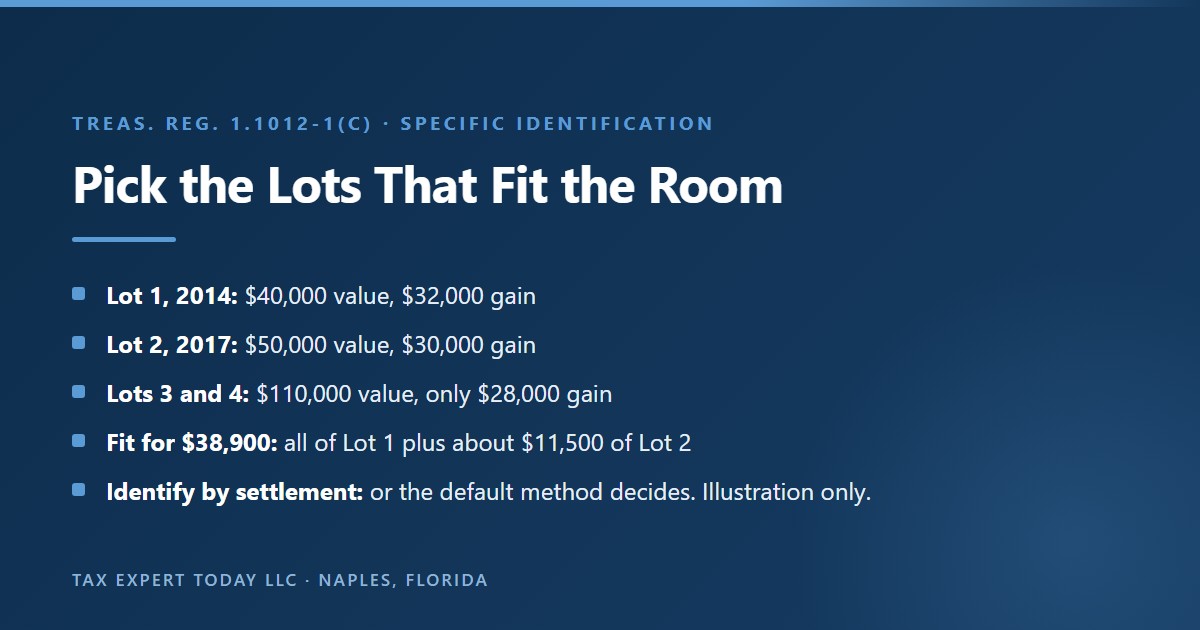
Specific identification under Treas. Reg. 1.1012-1(c) lets an investor tell the broker which lots are sold, so the realized gain matches the 0 percent room. Without an adequate identification by the settlement date, the broker generally uses its default method, often first-in, first-out, which tends to sell the oldest, lowest-basis shares first.
- Specific identification: named lots, confirmed in writing by the broker.
- First-in, first-out: the usual default, which sells the oldest shares first.
- Timing: the identification must be made no later than the settlement date.
- Standing orders: a standing instruction for specific identification is treated as adequate.
The amount of gain a sale produces depends on which shares are treated as sold. Treas. Reg. 1.1012-1(c) sets the rules. In general, if a taxpayer sells shares of stock acquired at different times or prices and does not adequately identify the lots, the shares sold are treated as the earliest acquired. For shares held with a broker, an adequate identification is made when the taxpayer specifies the particular shares to be sold no later than the settlement date, and the broker confirms the identification in writing. The regulation also provides that a standing order or instruction for the specific identification of stock is treated as an adequate identification made at the time of sale.
For a gain harvest, specific identification is the tool that turns a target number into a trade. The couple in the example holds their $200,000 position in four lots bought between 2014 and 2023. Selling the four lots in different combinations produces gains ranging from $10,000 to $90,000. To land close to $38,900, they can name the lots that add up to the right amount, or sell part of one lot.
Tax gain harvesting with specific identification works only if the confirmation shows the named lots. Mutual funds can use the average cost method, and once a shareholder elects it, changing methods has rules of its own. Each account should be checked to see which method is in effect before a sale is placed.
| Lot | Value | Basis | Unrealized gain | Gain as share of value |
|---|---|---|---|---|
| Lot 1, bought 2014 | $40,000 | $8,000 | $32,000 | 80 percent |
| Lot 2, bought 2017 | $50,000 | $20,000 | $30,000 | 60 percent |
| Lot 3, bought 2020 | $60,000 | $42,000 | $18,000 | 30 percent |
| Lot 4, bought 2023 | $50,000 | $40,000 | $10,000 | 20 percent |
| Total | $200,000 | $110,000 | $90,000 | 45 percent |
Which lot combination fits a $38,900 harvest target?
In the hypothetical, selling Lot 1 alone realizes $32,000 of gain on $40,000 of proceeds, and adding about $11,500 of Lot 2 brings the total to about $38,900. Selling Lots 3 and 4 instead would require $110,000 of proceeds to realize only $28,000, which leaves room unused. The closest fit generally starts with the highest-gain lots.
- High-gain lots first: more basis is reset per dollar of proceeds.
- Partial lots: most brokers allow a sale of part of a named lot.
- Small cushion: some households end a little short of the full room.
- Check the confirmation: the realized gain should match the plan before year end.
The choice of lots changes how much basis is reset for a given amount of 0 percent room. Lot 1 has a gain equal to 80 percent of its value, so selling it resets $32,000 of basis while turning over only $40,000 of the position. Lot 4 has a gain equal to 20 percent of its value, so the same $40,000 of proceeds would reset only $8,000. Because the 0 percent room is the scarce resource, the highest-gain lots usually make the most of it.
In this example, the couple can sell all of Lot 1, which realizes $32,000 of gain, and then sell part of Lot 2 to realize the remaining $6,900. Because 60 percent of every dollar of Lot 2 is gain, the slice needed is $6,900 divided by 0.60, or about $11,500 of value, carrying about $4,600 of basis. Total proceeds are about $51,500, total basis sold is about $12,600, and the realized gain is about $38,900. A common error is to treat the slice of Lot 2 as if every dollar sold were gain, which would leave room unused, or to sell $11,500 more than intended by entering the gain target as the share amount, which would overshoot the band. Arithmetic like this is easy to get wrong, which is one reason many households leave a small cushion below the threshold.
A cushion of a few hundred or a few thousand dollars protects against items that are not known until the Forms 1099 arrive in January, such as a year-end capital gain distribution from a mutual fund or a larger than expected interest payment.
| Lots sold | Proceeds | Basis | Gain realized | Fits within $38,900? |
|---|---|---|---|---|
| Lot 4 only | $50,000 | $40,000 | $10,000 | Yes, $28,900 of room unused |
| Lots 3 and 4 | $110,000 | $82,000 | $28,000 | Yes, $10,900 of room unused |
| Lot 1 only | $40,000 | $8,000 | $32,000 | Yes, $6,900 of room unused |
| Lot 1 plus about $11,500 of Lot 2 | about $51,500 | about $12,600 | about $38,900 | Yes, room used |
| Lots 1 and 2 | $90,000 | $28,000 | $62,000 | No, $23,100 taxed at 15 percent |
| All four lots | $200,000 | $110,000 | $90,000 | No, $51,100 taxed at 15 percent |
How is a tax gain harvest reported on the tax return?
Each sale is reported on Form 8949 and carried to Schedule D, using the proceeds and basis shown on Form 1099-B. Long-term sales go in Part II of Form 8949. The 0 percent rate is applied through the Qualified Dividends and Capital Gain Tax Worksheet or the Schedule D Tax Worksheet, not on Form 8949 itself.
- Form 1099-B: the broker reports proceeds and, for covered securities, basis.
- Form 8949, Part II: long-term sales, sorted by whether basis was reported to the IRS.
- Schedule D: totals from Form 8949 and the net long-term gain.
- Worksheet: applies the 0 percent, 15 percent, and 20 percent rates.
A harvest does not use a special form. It is an ordinary sale, and it is reported the same way as any other sale of stock or fund shares. The Instructions for Form 8949 explain that sales of capital assets are reported on Form 8949, with totals carried to Schedule D. Long-term transactions go in Part II, and each part has boxes that sort transactions by whether the broker reported basis to the IRS on Form 1099-B. In many cases, when basis was reported and no adjustment is needed, the totals can go directly on Schedule D without listing each sale on Form 8949.
The 0 percent rate shows up in the tax computation. Most individual returns with long-term gain use the Qualified Dividends and Capital Gain Tax Worksheet in the Form 1040 instructions, while returns with collectibles gain or unrecaptured section 1250 gain use the Schedule D Tax Worksheet in the Schedule D instructions. Either worksheet carries out the stacking described earlier. A review of the worksheet is the quickest way to confirm that a tax gain harvesting trade landed where it was meant to. The rate structure the worksheet applies is the one in IRC section 1(h).
The repurchase is not reported in the year it happens. It simply becomes a new lot in the account with a new basis, which the broker will report when those shares are later sold. Keeping the trade confirmation is still sensible, in case the broker’s records need to be checked against the investor’s own.
| Item | Where it appears |
|---|---|
| Proceeds and basis of each lot sold | Form 1099-B from the broker |
| Long-term sales with basis reported to the IRS | Form 8949, Part II, or directly on Schedule D line 8a when no adjustment is needed |
| Long-term sales with basis not reported | Form 8949, Part II, with basis from the investor’s records |
| Net long-term gain | Schedule D, Part II |
| Rate applied to the gain | Qualified Dividends and Capital Gain Tax Worksheet or Schedule D Tax Worksheet |
| Repurchased shares | Not reported until they are later sold |
How does a capital loss carryforward affect tax gain harvesting?
A capital loss carryforward must be netted against current-year capital gains before any gain reaches the 0 percent band. Harvested gain therefore absorbs the carryforward first. That uses a loss that could later have offset gain taxed at 15 percent or more, so a harvest can cost value even when no tax is shown.
- Netting is mandatory: carryforward losses offset current gains automatically.
- Effect on the band: gain absorbed by losses never reaches the 0 percent rate.
- Hidden cost: the carryforward is spent against gain that would have been taxed at 0 percent.
- Alternative: keep the carryforward for a year with gains in a higher band.
Under IRC section 1212(b), an individual’s net capital loss that exceeds the annual limit carries forward indefinitely and is treated as a capital loss in the next year. The carryforward is netted against that year’s capital gains. There is no election to leave it unused while gains are recognized. IRC section 1211(b) sets the $3,000 annual limit against other income, which is the only part of the carryforward that can be used without gains.
Suppose the couple in the example had a $20,000 long-term capital loss carryforward from an earlier year. If they harvest $38,900 of gain, the first $20,000 is absorbed by the loss, leaving $18,900 of net gain. That net gain falls in the 0 percent band, and their tax is unchanged. But they have spent a $20,000 loss on gain that would otherwise have been taxed at 0 percent. If they had kept the loss until a later year with gain in the 15 percent band, it would have saved about $3,000 of tax at that time.
Where a carryforward exists, the household can harvest more gain to use both the loss and the 0 percent room. In the example, harvesting $58,900 of gain would absorb the $20,000 loss and still leave $38,900 of net gain inside the band. The point is that the carryforward and the band should be planned together.
| Gain harvested | Absorbed by carryforward | Net gain at 0 percent | Unused 0 percent room | Carryforward left |
|---|---|---|---|---|
| $0 | $0 | $0 | $38,900 | $20,000 |
| $20,000 | $20,000 | $0 | $38,900 | $0 |
| $38,900 | $20,000 | $18,900 | $20,000 | $0 |
| $58,900 | $20,000 | $38,900 | $0 | $0 |
Do qualified dividends and fund distributions use up the 0 percent band?
Yes. Qualified dividends and capital gain distributions from mutual funds are taxed under the same rate structure as long-term gain, so they occupy part of the 0 percent band before a harvest is measured. Year-end fund distributions, often declared in December, can push a planned harvest partly into the 15 percent band.
- Qualified dividends: share the 0 percent band with long-term gain.
- Capital gain distributions: reported on Form 1099-DIV and treated as long-term gain.
- Nonqualified dividends and interest: ordinary income, below the gain in the stack.
- Timing: many funds announce estimates in November and pay in December.
Adjusted net capital gain under IRC section 1(h)(11) includes qualified dividend income. Capital gain distributions from mutual funds are reported on Form 1099-DIV and treated as long-term capital gain regardless of how long the fund shares were held. Both of these items fill the 0 percent band in the same way that harvested gain does.
A household planning a harvest in November should estimate the rest of the year’s dividends and the funds’ expected year-end distributions. Many fund families publish estimated distributions before they are paid. A $6,000 distribution that was not in the plan would push $6,000 of harvested gain into the 15 percent band, adding about $900 of tax in the example. Waiting until the distribution is known, or leaving a cushion, protects against that. The 2026 zero rate amount in Rev. Proc. 2025-32 is the ceiling for all of these items together, not for harvested gain alone.
Interest income and nonqualified dividends are ordinary income. They sit beneath the gain in the stack and reduce the room directly.
| Item | Character | Effect on 0 percent room |
|---|---|---|
| Interest from bonds or bank accounts | Ordinary income | Reduces room dollar for dollar |
| Nonqualified dividends | Ordinary income | Reduces room dollar for dollar |
| Qualified dividends | Taxed at capital gains rates | Shares the band with harvested gain |
| Mutual fund capital gain distributions | Long-term capital gain | Shares the band with harvested gain |
| Short-term capital gain | Ordinary income | Reduces room dollar for dollar |
Should a Roth conversion or tax gain harvesting come first?
A Roth conversion is ordinary income, so it fills the stack beneath any long-term gain. Every dollar converted removes a dollar of 0 percent room. In the hypothetical, a $38,900 conversion adds about $4,668 of tax on the conversion and pushes the whole $38,900 harvest into the 15 percent band, adding about $5,835 more.
- Same space: conversions and harvested gains compete for the same low-income years.
- Conversion first in the stack: ordinary income always sits below capital gain.
- Trade-off: lower future tax on IRA withdrawals versus lower future tax on brokerage sales.
- No universal answer: it depends on account sizes, future rates, and heirs.
Early retirement years are prized for both strategies. Our guide to the Roth conversion ladder explains how conversions in those years fill the low ordinary brackets. Tax gain harvesting wants the same years for the 0 percent band. Because a conversion is ordinary income, the two cannot both use the same space. A conversion that fills the 12 percent bracket also eliminates the 0 percent capital gains room.
The hypothetical couple shows the trade. With no conversion, they can harvest $38,900 of gain at no cost. With a $20,000 conversion, their tax on ordinary income rises by about $2,400, and $20,000 of the harvest moves into the 15 percent band, adding about $3,000 more. With a $38,900 conversion, the tax on the conversion is about $4,668, and the entire harvest is taxed at 15 percent, adding about $5,835. In that last case, harvesting gain this year saves nothing compared with harvesting it later, because the rate is the same.
Which use of the space is worth more depends on facts that differ for each household: the size of the traditional IRA compared with the brokerage account, the expected tax rate on future required minimum distributions, whether the brokerage shares will be held until death, and whether the heirs are likely to inherit the IRA. Our guide to the backdoor Roth IRA covers the pro-rata rule that applies when other pre-tax IRA money exists. A conversion locks in tax now to avoid it later; a harvest locks in 0 percent now to avoid 15 percent or more later. Many households split the space across years rather than choosing one strategy forever. Business owners with retirement plans that create deductions, such as a cash balance plan or a safe harbor 401(k), can also lower ordinary taxable income and widen the room for tax gain harvesting in a working year.
| Roth conversion | Ordinary tax | Harvest at 0 percent | Harvest at 15 percent | Total federal tax |
|---|---|---|---|---|
| $0 | about $6,704 | $38,900 | $0 | about $6,704 |
| $20,000 | about $9,104 | $18,900 | $20,000 | about $12,104 |
| $38,900 | about $11,372 | $0 | $38,900 | about $17,207 |
Can a 0 percent capital gain still raise the tax on Social Security benefits?
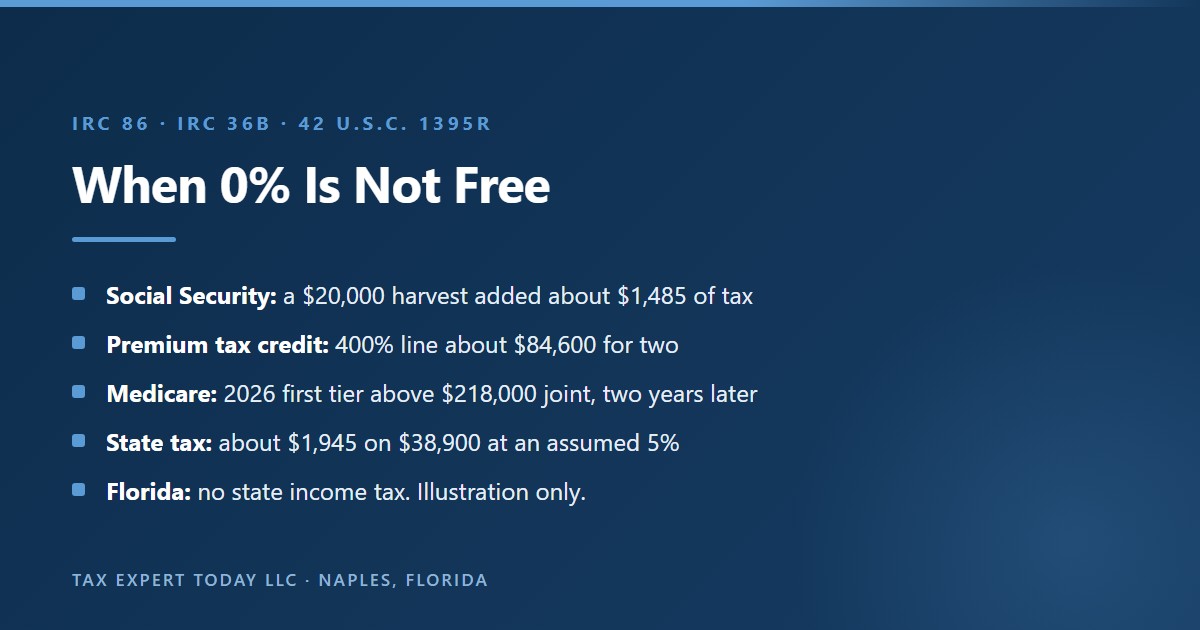
Yes. Harvested gain counts in the provisional income test under IRC section 86, so it can make more Social Security benefits taxable. Those benefits are ordinary income and fill the 0 percent band from below. In a hypothetical, a $20,000 harvest by a retired couple raised federal tax from $0 to about $1,485.
- Provisional income: modified adjusted gross income plus half of Social Security benefits.
- Base amounts for joint filers: $32,000 and $44,000, not adjusted for inflation.
- Effect of gain: each added dollar can make up to $0.85 of benefits taxable.
- Result: part of the “0 percent” harvest is taxed through the benefits.
IRC section 86 decides how much of a Social Security benefit is included in gross income. The test compares modified adjusted gross income plus one-half of the benefits with a base amount, which for a joint return is $32,000, and an adjusted base amount of $44,000. Capital gains are part of adjusted gross income, so a harvest raises the test figure even when the gain itself is taxed at 0 percent. Once the test figure passes the adjusted base amount, each additional dollar of income can add 85 cents of taxable benefits, until 85 percent of the benefits is taxable.
The added taxable benefits are ordinary income. They sit beneath the capital gain in the stack and are taxed at the regular rates. They also use up 0 percent room, which means a harvest can move both itself and some benefits into taxable territory.
The hypothetical below is a retired couple, both 66, with $50,000 of combined Social Security benefits and $30,000 of traditional IRA distributions. With no harvest, $15,350 of their benefits is taxable, their adjusted gross income is $45,350, and after the standard deduction, the extra $1,650 for each spouse over 65, and the $6,000 senior deduction for each spouse, they owe no federal income tax. A $20,000 harvest makes $17,000 more of their benefits taxable. Their taxable income rises to $34,850, of which $14,850 is ordinary income taxed at 10 percent, and their federal tax becomes about $1,485. The gain itself was taxed at 0 percent; the cost came through the benefits. IRS Publication 915 includes worksheets that show the same computation for a real return.
| Gain harvested | Taxable Social Security | Adjusted gross income | Taxable income | Federal tax |
|---|---|---|---|---|
| $0 | $15,350 | $45,350 | $0 | $0 |
| $10,000 | $23,850 | $63,850 | $16,350 | about $635 |
| $20,000 | $32,350 | $82,350 | $34,850 | about $1,485 |
| $30,000 | $40,850 | $100,850 | $53,350 | about $2,335 |
Why is the effective rate on a harvest sometimes higher than 0 percent?
The effective rate is the total change in tax divided by the gain harvested. When a harvest also makes Social Security taxable, reduces a deduction, or ends a credit, that change can be well above zero even though the capital gains line shows 0 percent. In the Social Security example, the first $10,000 cost about 6.4 percent.
- Measure the change: compare total federal tax with and without the harvest.
- Look beyond the gain line: benefits, deductions, credits, and premiums can all move.
- Test in slices: the cost of each added $10,000 can differ.
- Use the full return: a quick estimate of one line is not enough.
The simplest test for any harvest is to run the return twice, once with the gain and once without it, and compare the total tax. Software projections make this straightforward, and it catches interactions that a rate table cannot show. In the Social Security example, the first $10,000 of harvest added about $635 of tax, an effective rate of about 6.4 percent. The second $10,000 added about $850, or 8.5 percent. The third added another $850.
Those effective rates are still far below 15 percent, and for many households the harvest still makes sense on its own terms. The point is that “0 percent” in tax gain harvesting describes one line of the computation. It does not describe the whole return. A harvest that looks free can carry a modest cost, and a harvest that looks modest can occasionally carry a large one, as the premium tax credit section below shows.
| Slice of gain | Added federal tax | Effective rate on the slice |
|---|---|---|
| First $10,000 | about $635 | about 6.4 percent |
| Second $10,000 | about $850 | about 8.5 percent |
| Third $10,000 | about $850 | about 8.5 percent |
| Total $30,000 | about $2,335 | about 7.8 percent |
How does tax gain harvesting interact with the senior deduction?
For 2025 through 2028, IRC section 151(d)(5)(C) allows a $6,000 deduction for each taxpayer age 65 or older, reduced by 6 percent of modified adjusted gross income above $150,000 for joint filers or $75,000 for others. Harvested gain raises modified adjusted gross income, so a large harvest can shrink this deduction.
- Amount: $6,000 per qualifying spouse, $12,000 for a couple both 65 or older.
- Phase-out start: $150,000 joint, $75,000 single.
- Rate: 6 percent of the excess, gone at $250,000 joint.
- Years: taxable years beginning before January 1, 2029.
The senior deduction was added by Public Law 119-21 and appears in IRC section 151(d)(5)(C). The statute allows $6,000 for each qualified individual, meaning the taxpayer and, on a joint return, a spouse who has reached age 65 by the close of the year. Each $6,000 amount is reduced, but not below zero, by 6 percent of modified adjusted gross income above $75,000, or $150,000 on a joint return. Modified adjusted gross income for this purpose is adjusted gross income with a few foreign exclusions added back, so capital gains count in full.
Most households using the 0 percent band will have modified adjusted gross income below $150,000, and the deduction is unaffected. But the deduction lowers taxable income, which means it also widens the 0 percent room. For a couple near the phase-out, a harvest that pushes income above $150,000 reduces the deduction, which raises ordinary taxable income, which in turn narrows the room the harvest was counting on. The effect is small for each dollar but worth checking in a projection. The standard deduction amounts that sit beside the senior deduction are in section 3.14 of Rev. Proc. 2025-32.
| Modified adjusted gross income | Deduction per spouse | Deduction for the couple |
|---|---|---|
| $150,000 or less | $6,000 | $12,000 |
| $170,000 | $4,800 | $9,600 |
| $200,000 | $3,000 | $6,000 |
| $250,000 or more | $0 | $0 |
Can tax gain harvesting raise Medicare premiums?
Yes, two years later. Medicare Part B and Part D premiums include an income-related monthly adjustment amount based on modified adjusted gross income from the second preceding year. A 2026 harvest that lifts a joint return above $218,000, the 2026 first tier, can add a surcharge to 2028 premiums if the tiers are similar then.
- Lookback: the second calendar year before the premium year, under 42 U.S.C. 1395r(i).
- 2026 first tier: above $109,000 single or $218,000 joint.
- 2026 first-tier surcharge: $81.20 a month for Part B plus $14.50 for Part D, per person.
- Cliff effect: one dollar over a tier triggers the full tier amount.
Under 42 U.S.C. 1395r(i), the modified adjusted gross income used for a beneficiary’s premium is generally the income for the last taxable year beginning in the second calendar year preceding the premium year. A gain realized in 2026 therefore affects premiums for 2028. The tiers themselves are published each year. The CMS fact sheet for 2026 shows a standard Part B premium of $202.90 and a first income tier that starts above $109,000 for individuals and $218,000 for joint filers, with a total Part B premium of $284.10 a month and a Part D adjustment of $14.50 a month in that tier.
Because each tier applies in full once income passes its threshold, the surcharge works like a cliff. For a married couple both on Medicare, crossing the first tier by a single dollar adds about $95.70 a month per person at 2026 amounts, or about $2,297 a year for the two of them. Future tiers will differ, so this is an estimate based on 2026 figures, not a forecast.
The IRMAA question usually applies to larger harvests than the 0 percent band allows, because a couple whose taxable income stays inside the band is almost always well below $218,000 of modified adjusted gross income. It matters more for a household that harvests gain at 15 percent on purpose, for example to reset basis before a planned move or a large purchase. Those households should check the tier thresholds before choosing the amount. The Social Security Administration also allows a beneficiary to ask for a new determination after certain life-changing events, such as retirement, using Form SSA-44.
| Joint modified adjusted gross income | Part B total monthly premium per person | Part D adjustment per person |
|---|---|---|
| $218,000 or less | $202.90 | $0.00 |
| Above $218,000 to $274,000 | $284.10 | $14.50 |
| Above $274,000 to $342,000 | $405.80 | $37.50 |
| Above $342,000 to $410,000 | $527.50 | $60.40 |
| Above $410,000 to below $750,000 | $649.20 | see CMS fact sheet |
| $750,000 or more | $689.90 | see CMS fact sheet |
How does tax gain harvesting affect the premium tax credit?
For early retirees buying Marketplace coverage, the premium tax credit under IRC section 36B depends on household income as a percent of the poverty line. As the statute reads for 2026, eligibility ends above 400 percent of the poverty line, about $84,600 for a couple. A harvest that crosses that line can cost the entire credit.
- Income measure: household income, which generally includes capital gains.
- 2026 coverage: uses the 2025 poverty guidelines, $21,150 for a household of two.
- 400 percent line: about $84,600 for a household of two.
- Cliff: crossing the line can end eligibility, not just reduce the credit.
IRC section 36B defines an applicable taxpayer as one whose household income is at least 100 percent but does not exceed 400 percent of the poverty line for the family size. A temporary rule in section 36B(c)(1)(E) removed the 400 percent ceiling for taxable years beginning after December 31, 2020 and before January 1, 2026. As the statute reads on the date this guide was published, that temporary rule does not apply to 2026, so the ceiling is back in force. Readers should confirm whether Congress has changed this before acting, because the rule has been extended before.
For coverage in 2026, the Marketplace uses the prior year’s poverty guidelines. HealthCare.gov lists $21,150 for a household of two in 2025, so 400 percent is $84,600. For a couple aged 60 with Marketplace coverage and household income of $70,000, a $14,600 harvest brings them exactly to the line. A harvest of $15,000 would put them $400 over it. Depending on their premiums and age, the credit lost could be large, and any advance credit already paid during the year may have to be repaid on Form 8962.
The IRS overview of the premium tax credit explains the reconciliation process. For early retirees, the interaction between the credit and tax gain harvesting is often the deciding factor. Self-employed early retirees should also read our guide to the self-employed health insurance deduction, which interacts with the same household income figure. A household on Marketplace coverage may find that harvesting is only attractive in a year with employer coverage, Medicare, or income already well below the line.
| Gain harvested | Household income | Percent of poverty line (2025 guideline, $21,150) | Eligible for the credit as the statute reads? |
|---|---|---|---|
| $0 | $70,000 | about 331 percent | Yes |
| $10,000 | $80,000 | about 378 percent | Yes, with a smaller credit |
| $14,600 | $84,600 | 400 percent | Yes, at the line |
| $15,000 | $85,000 | about 402 percent | No |
| $28,900 | $98,900 | about 468 percent | No |
Does the 3.8 percent net investment income tax apply to harvested gains?
Capital gains are net investment income, but the 3.8 percent tax applies only to the extent modified adjusted gross income exceeds $250,000 for joint filers or $200,000 for single filers. A household inside the 0 percent band is far below those thresholds, so a 0 percent harvest generally carries no net investment income tax.
- Thresholds: $250,000 joint, $200,000 single, $125,000 married filing separately.
- Not indexed: the statutory thresholds do not rise with inflation.
- Base: the lesser of net investment income or the excess over the threshold.
- Relevance: mostly to larger harvests taxed at 15 or 20 percent.
Under IRC section 1411, an individual pays 3.8 percent on the lesser of net investment income or the excess of modified adjusted gross income over the threshold amount. The IRS page on the net investment income tax confirms that capital gains are included and that the thresholds are not indexed. The rate on the gain itself still follows IRC section 1(h). The tax is computed on Form 8960.
For households within the 0 percent band, the net investment income tax is not an issue in the harvest year. It matters for the future value of the harvest. If the reset basis lets the household avoid gain in a later year when they are above the thresholds, the saving includes the 3.8 percent as well as the capital gains rate, as the table in the future savings section showed.
| Filing status | Threshold | Typical 0 percent harvest household |
|---|---|---|
| Married filing jointly or surviving spouse | $250,000 | Well below the threshold |
| Married filing separately | $125,000 | Below the threshold |
| Single or head of household | $200,000 | Well below the threshold |
Do states tax a gain that is taxed at 0 percent federally?
Most states with an income tax start from federal adjusted gross income and tax capital gains as ordinary income, with no 0 percent band of their own. A gain that is free federally can still carry state tax. In the hypothetical, a $38,900 harvest at an assumed 5 percent state rate costs about $1,945.
- Florida: no personal income tax, so no state tax on the harvest.
- Most income tax states: tax the gain at their regular rates.
- A few states: have partial exclusions or special rates for capital gains.
- Planning point: the federal saving must be weighed against the state cost.
The federal 0 percent band does not carry over to state returns. A state that taxes income generally includes capital gains in its base, and most apply the same graduated rates used for wages. For a household in such a state, a harvest is a trade: pay state tax now on the gain to avoid federal tax, and possibly state tax, later.
Whether that trade is worthwhile depends on where the household expects to be when the shares are eventually sold. If the household expects to stay in the same state, the harvest pays state tax now on gain that would have been taxed by the same state later, at perhaps a similar rate. The main benefit is the federal saving. If the household expects to move to a state with no income tax before selling, harvesting in the current state may pay state tax that would otherwise never have been owed.
Florida residents do not face this trade, which makes tax gain harvesting simpler there. Article VII, section 5 of the Florida Constitution bars a state income tax on natural persons who are residents, so a Florida household’s harvest decision is purely federal.
| Assumed state rate on the gain | State tax on the harvest | Federal tax on the harvest |
|---|---|---|
| 0 percent (for example, Florida) | $0 | $0 |
| 3 percent | about $1,167 | $0 |
| 5 percent | about $1,945 | $0 |
| 9.3 percent | about $3,618 | $0 |
Should someone moving to Florida harvest gains before or after the move?
A capital gain is generally taxed by the state of residence on the date of the sale. A household moving from an income tax state to Florida will often wait until Florida residency is established before harvesting, because the same gain realized after the move carries no state tax. Residency must be real and documented.
- Sourcing rule: gain on intangible property generally follows the seller’s residence.
- Part-year returns: the former state taxes gain realized while a resident.
- Proof of move: domicile, home, driver license, voter registration, and time spent.
- Audit risk: large sales shortly after a move draw attention from the former state.
Gains on stocks and funds are usually treated as income from intangible property, which states generally source to the owner’s state of residence. A part-year resident files in the former state for the period of residency and reports income received while a resident there. A sale after a genuine change of domicile to Florida is generally outside the former state’s reach, although each state applies its own rules and some look closely at sales made shortly after a move.
For a household planning a move, this changes the harvesting calendar. Harvesting in the last year before the move pays the former state’s tax; harvesting in the first year after the move does not. Our guide to moving from California to Florida explains how one high-tax state examines a change of residency, and the guide to Florida domicile for executives covers the documentation that supports it. A business owner planning both a move and a sale should also review moving to Florida before selling a business, and an employee with equity compensation should read RSU taxes when leaving California.
| When the harvest happens | Federal tax at 0 percent band | Former state tax | Florida tax |
|---|---|---|---|
| While still a resident of the former state | $0 | about $3,618 | $0 |
| After Florida domicile is established | $0 | generally $0 | $0 |
Does tax gain harvesting make sense if the shares will be held until death?
Often not. Under IRC section 1014, property included in a decedent’s estate generally takes a basis equal to fair market value at death, which erases built-in gain for the heirs. Shares that will be held for life get that reset anyway, so a harvest adds value only if a sale before death is reasonably likely.
- Step-up rule: basis generally equals fair market value on the date of death.
- Effect: gain accrued during life is never taxed to the heirs.
- Harvest value for a lifelong holder: usually close to zero.
- Exceptions: a likely sale for cash needs, a move into care, or a gift during life.
IRC section 1014(a) provides that the basis of property acquired from a decedent is generally its fair market value at the date of death, or on the alternate valuation date if that election is made. For appreciated stock, this means the heirs can sell immediately after inheriting without reporting the gain that built up during the decedent’s life.
That rule changes the arithmetic of harvesting for older investors. Consider an 82-year-old widow who holds the same $200,000 position with $90,000 of gain and expects to leave it to her children. If she harvests $38,900 of gain at 0 percent, her basis rises by $38,900. If she then holds the shares until death, the children receive a basis equal to the value at death either way. The harvest produced no benefit, and it may have carried a cost if it raised the taxable part of her Social Security or pushed her into a higher Medicare tier two years later.
The calculation changes if a sale during life is likely. A move into assisted living, a large medical expense, a gift to a grandchild’s education fund, or a desire to diversify a concentrated holding may all require selling shares before death. In those cases, basis that was reset at 0 percent reduces the tax on the later sale. The step-up topic is covered in more depth in our guide to the intentionally defective grantor trust, which explains how assets outside the estate lose the step-up, and the net unrealized appreciation guide, which covers the one major exception for employer stock distributed from a retirement plan.
| What happens to the shares | Basis without harvest | Basis with harvest | Tax effect of the harvest |
|---|---|---|---|
| Held until death, inherited | Stepped up to value at death | Stepped up to value at death | None |
| Sold during life at 15 percent | $110,000 | $148,900 | about $5,835 less tax at sale |
| Given to children during life | $110,000 carries over | $148,900 carries over | Children report $38,900 less gain when they sell |
| Given to charity | Not relevant to the charity | Not relevant to the charity | Generally none |
How does tax gain harvesting compare with gifting appreciated shares?
A gift of appreciated shares to a person generally passes the donor’s basis to the recipient under IRC section 1015, so the gain is not erased. A harvest before the gift raises the basis the recipient takes. A gift to charity avoids the gain entirely, so harvesting shares that will be given to charity wastes 0 percent room.
- Gift to an individual: carryover basis, so a harvest first helps the recipient.
- Gift to a child: the child’s own rate and the kiddie tax may apply when sold.
- Gift to charity: the charity sells without tax, so keep low-basis shares for giving.
- Donor-advised fund: same general treatment as a direct charitable gift of shares.
Under IRC section 1015, property acquired by gift generally keeps the donor’s basis for computing gain. If the donor’s basis is $8,000 and the shares are worth $40,000, the recipient who sells reports $32,000 of gain. Gifts above the annual exclusion are reported on Form 709, as our guide to the lifetime gift tax exemption explains. A harvest by the donor before the gift raises that basis and reduces the recipient’s later gain. Whether that helps depends on the recipient’s tax rate when they sell. If the recipient will be in the 0 percent band anyway, the donor’s harvest adds little.
Charitable giving works the other way. A charity that receives appreciated shares sells them without income tax, and a donor who itemizes can generally deduct the fair market value of long-term appreciated stock, subject to the percentage limits in IRC section 170. A larger gift can also go to a charitable remainder trust, which sells appreciated shares without immediate tax and pays an income stream back. The lowest-basis shares are therefore usually the ones most suited for giving, and the harvest is better applied to shares the household plans to keep. Our guides to the donor-advised fund tax deduction and the qualified charitable distribution cover the giving side. A qualified charitable distribution from an IRA also reduces ordinary income, which can widen the 0 percent room for a household over 70 and a half, because a distribution that meets IRC section 408(d)(8) is excluded from gross income.
| Intended use of the shares | Harvest first? | Reason |
|---|---|---|
| Keep and sell later during life | Often yes | Reset basis lowers future tax |
| Give to charity or a donor-advised fund | Generally no | The charity avoids the gain anyway |
| Give to an adult child in a higher bracket | Sometimes | Higher carryover basis lowers the child’s tax |
| Give to an adult child in the 0 percent band | Usually not needed | The child can harvest at 0 percent |
| Hold until death | Usually no | The step-up resets basis |
Which years are good candidates for tax gain harvesting?
The strongest candidates are years with low ordinary taxable income: the gap between retirement and Social Security or required minimum distributions, a sabbatical or job change, a year with a business loss, or a year of large deductions. In each, ordinary income leaves more of the 0 percent band open for gain.
- Early retirement: before pensions, Social Security, and required minimum distributions begin.
- Career gap: a sabbatical, a layoff, or time between jobs.
- Business loss year: a loss reduces ordinary taxable income, within the limits that apply.
- Large deduction year: major medical expenses or a large charitable gift.
The common thread is a year in which ordinary taxable income is unusually low. For a married couple, that means less than $98,900 of taxable income after deductions, and ideally much less. Early retirement is the most frequent example. A couple who retires at 58 and lives on brokerage withdrawals until Social Security starts at 67 may have nine years in which their ordinary income consists mostly of interest and dividends. Each year offers a fresh slice of 0 percent room, which they can divide between gain harvesting and Roth conversions.
Business owners can see similar years. A year with a business loss, a large depreciation deduction, or a sale that is taxed in a later year can leave little ordinary income. Owners should check whether the loss is limited, for example under the passive activity rules or the excess business loss rules, before counting on it to open the band. Our guide to real estate professional status covers one of those limits, and the guide to bonus depreciation explains how a large deduction in one year can lower ordinary income. Executives with deferred pay should check whether nonqualified deferred compensation payouts will fill the band first.
Because the band resets each year, a household with a long low-income window may harvest a moderate amount every year rather than a large amount once. That approach also avoids crossing cliffs such as the premium tax credit line.
| Situation | Why the band may be open | What to check first |
|---|---|---|
| Retired, before Social Security | Little wage or benefit income | Premium tax credit, Roth conversion plans |
| Retired, before required minimum distributions | Traditional IRA not yet forced out | Social Security taxation, Medicare tiers |
| Sabbatical or job loss | Wages end part way through the year | Unemployment benefits, severance timing |
| Business loss year | Loss reduces ordinary income | Passive and excess business loss limits |
| Large medical or charitable deduction year | Itemized deductions exceed the standard deduction | Whether the deduction is fully usable |
How does tax gain harvesting work for a single filer?
A single filer has a 2026 band of $49,450 of taxable income and a $16,100 standard deduction. In a hypothetical, a single retiree with $40,000 of ordinary income has $23,900 of ordinary taxable income and $25,550 of room for 0 percent gain, half the joint threshold but the same mechanics.
- 2026 band: taxable income up to $49,450.
- Standard deduction: $16,100, plus $2,050 if 65 or older and unmarried.
- Senior deduction: $6,000 if 65 or older, phasing out above $75,000.
- Same stacking: ordinary income fills the band first.
The single filer’s band is exactly half the joint band, and the same is true of most of the thresholds that interact with it. The Social Security base amounts are $25,000 and $34,000 for single filers under IRC section 86(c), and the Medicare first tier for 2026 starts above $109,000. Tax gain harvesting for a single filer follows the same steps. Because the single-filer band is narrower, the interaction with Social Security often appears sooner.
Surviving spouses deserve a specific note. In the year a spouse dies, the survivor can generally still file a joint return, and IRC section 2(a) defines the surviving spouse status that can follow, which keeps the $98,900 band for that year. A surviving spouse with a dependent child may qualify as a surviving spouse for two more years and keep the joint rates. After that, the survivor files as single, and the band drops to $49,450. A household that has been harvesting each year should plan for that change, often called the widow’s penalty, because both the band and the rate brackets shrink while income may not.
| Item | Amount |
|---|---|
| Ordinary income | $40,000 |
| Standard deduction | $16,100 |
| Ordinary taxable income | $23,900 |
| 0 percent threshold for single filers | $49,450 |
| Room for 0 percent gain | $25,550 |
What is the deadline for tax gain harvesting in 2026?
A sale of publicly traded stock or fund shares is generally reported in the year of the trade date, so a sale executed on or before December 31, 2026 counts for 2026 even if it settles in January. Mutual fund orders must be placed before the fund’s daily cutoff on the last business day to receive that day’s price.
- Trade date rule: gain on a market sale is generally reported in the trade date year.
- Last trading day: December 31, 2026 is a Thursday.
- Fund cutoffs: mutual fund orders usually price at the market close.
- Practical buffer: many households trade in mid-December after fund distributions are known.
For sales of stock and securities on an established market, a cash method taxpayer generally reports the gain in the year of the trade date. IRS Publication 550 explains that gain or loss on these sales is reported in the year of the trade, not the year of settlement. A sale on December 31 therefore counts for that year. Tax gain harvesting trades placed on the last trading day still need a confirmation that shows the right lots.
Most households do not wait until the last day. Mid-December is often a better time, because by then most mutual funds have announced their year-end capital gain distributions, and the household has a clearer picture of the year’s ordinary income. Trading in the final days of the year also leaves no time to correct an error, such as a wrong lot identification, before the year closes.
| Date | Step |
|---|---|
| Early November | Project 2026 ordinary income and the 0 percent room |
| Mid November to early December | Collect estimated fund distributions and interest |
| Mid December | Identify lots, place the sale, and repurchase |
| Within a few days | Check the confirmation for lots and realized gain |
| December 31, 2026 | Last trade date for 2026 reporting |
| Early 2027 | Compare Form 1099-B with the plan before filing |
Do mutual funds and ETFs work differently for tax gain harvesting?
The basic rule is the same, but mutual funds may use the average cost method and pay year-end capital gain distributions, while exchange-traded funds trade during the day and usually distribute fewer gains. The method in effect on the account decides which basis is used for the sale.
- Average cost: available for regulated investment company shares and some dividend reinvestment plans.
- Specific identification: available if elected and properly communicated.
- Fund distributions: add to the 0 percent stack before the harvest.
- ETF trading: intraday prices make a target gain easier to hit.
Treas. Reg. 1.1012-1(e) permits the average basis method for shares of a regulated investment company and certain dividend reinvestment plan stock. Under that method, each share sold has the same average basis, so selling a given number of shares produces a predictable gain but does not allow the investor to choose high-gain lots. An investor who prefers specific identification needs to check how the account is set up and what notice the broker requires to change methods.
For tax gain harvesting, exchange-traded funds behave like stocks for lot selection. They also tend to distribute fewer capital gains than traditional mutual funds, which makes the year-end stack easier to predict. These are general differences; specific funds vary.
| Holding | Common basis method | Harvest planning note |
|---|---|---|
| Individual stocks | First-in, first-out unless specific identification is used | Name lots to control the gain |
| Exchange-traded funds | First-in, first-out unless specific identification is used | Intraday trading helps hit a target |
| Mutual funds | Often average cost | Every share sold carries the same average basis |
| Dividend reinvestment plans | Average cost may be available | Small recent lots can be short-term |
Does tax gain harvesting work inside an IRA or 401(k)?
No. Sales inside a traditional IRA, Roth IRA, or 401(k) are not taxed when they occur, and the accounts do not track basis in individual holdings for capital gains purposes. Tax gain harvesting applies only to taxable brokerage accounts, where a sale is reported and the new purchase sets a new basis.
- Traditional accounts: withdrawals are ordinary income regardless of gains inside.
- Roth accounts: qualified withdrawals are tax-free regardless of gains inside.
- Employer stock in a plan: the separate net unrealized appreciation rules may apply.
- Taxable accounts only: joint, individual, and revocable trust brokerage accounts.
Retirement accounts already shelter gains, so there is nothing to harvest inside them. A distribution from a traditional IRA is ordinary income, taxed at regular rates and stacked below capital gains. A qualified distribution from a Roth IRA is excluded from income. The backdoor Roth IRA and mega backdoor Roth guides explain how money reaches those accounts, and neither involves capital gains on the holdings inside.
A revocable living trust that holds a brokerage account is generally a grantor trust, and its sales are reported on the grantor’s own return. Harvesting in that account works the same way as in an individual account. An irrevocable non-grantor trust is a separate taxpayer with its own, much narrower 0 percent band of $3,300 for 2026, as the rate table earlier in this guide shows and as section 3.03 of Rev. Proc. 2025-32 sets out.
| Account type | Harvest possible? | Reason |
|---|---|---|
| Individual or joint brokerage | Yes | Sales are reported; basis resets |
| Revocable living trust brokerage | Yes | Reported on the grantor’s return |
| Irrevocable non-grantor trust | Yes, with a $3,300 band for 2026 | The trust is its own taxpayer |
| Traditional IRA or 401(k) | No | Gains inside are not taxed when realized |
| Roth IRA or Roth 401(k) | No | Gains inside are not taxed when realized |
Does a tax gain harvest require estimated tax payments?
A harvest that stays inside the 0 percent band and changes nothing else on the return adds no federal tax, so no estimated payment is needed. If it makes Social Security taxable, triggers state tax, or spills into the 15 percent band, the added tax may need withholding or a fourth-quarter estimate due January 15, 2027.
- Pure 0 percent harvest: no added federal tax to prepay.
- Spillover or side effects: added tax may trigger an underpayment penalty.
- Safe harbor: paying enough through withholding or estimates based on the prior year.
- State estimates: income tax states have their own payment rules.
The federal underpayment rules under IRC section 6654 generally charge an addition to tax when withholding and estimated payments fall short of the required amount. A harvest that adds no tax does not change the required amount. A harvest that adds tax, even indirectly through Social Security, can. A household that relies on safe harbor payments based on the prior year’s tax may already be protected, but that should be confirmed rather than assumed. A household in an income tax state should check the state’s rules separately, because a gain that is free federally can create a state balance due.
The fourth-quarter federal estimate for 2026 is due January 15, 2027. Withholding from an IRA distribution late in the year is treated as paid evenly through the year, which some retirees use to cover an unexpected balance.
| Harvest outcome | Added federal tax? | Payment consideration |
|---|---|---|
| Entirely inside the 0 percent band, no side effects | No | None |
| Makes more Social Security taxable | Yes, usually modest | Check safe harbor; consider a January 15 estimate |
| Part of the gain taxed at 15 percent | Yes | Check safe harbor; consider a January 15 estimate |
| Resident of an income tax state | No federal; yes state | Check the state’s estimated payment rules |
What are the most common tax gain harvesting mistakes?
The most common mistakes are treating the threshold as the room, forgetting dividends and fund distributions, selling short-term lots, ignoring a loss carryforward, missing the Social Security and premium tax credit effects, and letting the broker’s default method choose the lots. Each one moves gain out of the 0 percent band or adds a hidden cost.
- Threshold mistaken for room: harvesting $98,900 of gain when ordinary income already fills part of the band.
- Distributions forgotten: December fund distributions push the harvest over.
- Wrong lots: the default method sells different shares than planned.
- Cliffs ignored: the premium tax credit line or a Medicare tier is crossed.
Most tax gain harvesting mistakes come from looking at one number in isolation. The IRS Topic 409 page, for example, can show the prior year’s thresholds. The threshold, the gain, and the rate are all correct on their own, but the result depends on how they interact with the rest of the return. A harvest planned in a projection that includes every income item, every deduction, and every credit is far less likely to go wrong than one planned from a rate chart.
Another frequent issue is treating the harvest as a portfolio change. The purpose of a harvest is to reset basis, not to change the investments. A household that sells a concentrated position and buys something different is making an investment decision that should be considered on its own merits. This guide does not address which investments to hold.
| Mistake | Effect | Usual safeguard |
|---|---|---|
| Harvesting up to the threshold, not the room | Gain taxed at 15 percent | Compute ordinary taxable income first |
| Ignoring year-end fund distributions | Gain pushed over the band | Wait for estimates or leave a cushion |
| Selling short-term lots | Ordinary income that also fills the band | Check holding periods by lot |
| Ignoring a loss carryforward | Loss spent on 0 percent gain | Plan the carryforward and the band together |
| Missing the Social Security effect | Hidden ordinary income | Run the full return twice |
| Crossing the premium tax credit line | Loss of the credit | Check household income against 400 percent of the poverty line |
| Default lot method | Unexpected gain amount | Use specific identification by settlement |
What are the risks of tax gain harvesting?
The main risks are a law change that lowers future capital gains rates, a planned sale that never happens because the shares are held until death, small price moves between the sale and the repurchase, and record errors that leave the new basis wrong. None is a tax penalty, but each can reduce the value of the harvest.
- Law change: a future rate cut lowers the value of reset basis.
- Step-up at death: erases the benefit if the shares are never sold.
- Market gap: prices can move between sale and repurchase.
- Record errors: broker basis must reflect the new purchase.
A harvest is a bet that the reset basis will be worth something later. If future capital gains rates fall, the saving shrinks. If the shares are held until death, the saving usually disappears under IRC section 1014. If the household later falls into the 0 percent band again in the year it sells, the harvest moved gain from one 0 percent year to another without saving anything. None of these outcomes makes the harvest harmful in itself, because the gain was taxed at 0 percent, but they explain why a harvest that carries any cost, through state tax, Social Security, or premiums, should be weighed carefully.
Practical risks are smaller. A sale and repurchase placed at the same time usually happen at nearly the same price, but trading costs, bid and ask spreads, and fund pricing differences exist. Most brokers now report basis for covered securities on Form 1099-B, which reduces record errors, but older shares and transferred accounts can still carry incorrect basis.
| Risk | Effect on the harvest |
|---|---|
| Future capital gains rates fall | Smaller saving at the later sale |
| Shares held until death | Step-up makes the harvest unnecessary |
| Later sale also inside the 0 percent band | No saving |
| State tax paid now on a gain that would have escaped state tax later | Net cost |
| Price movement between sale and repurchase | Small gain or loss in position value |
| Incorrect basis records | Wrong gain on the later sale |
What records should be kept for a tax gain harvest?
Keep the trade confirmations for the sale and the repurchase, the written lot identification, the year-end Form 1099-B, and a copy of the projection used to size the harvest. These records support the gain reported for 2026 and the higher basis that will be reported when the repurchased shares are sold.
- Sale confirmation: trade date, lots sold, proceeds.
- Lot identification: written confirmation from the broker.
- Repurchase confirmation: new cost and date, which become the new basis and holding period.
- Projection: the calculation showing the room and the target gain.
IRS Publication 551 explains that taxpayers should keep records that show the basis of property. For a harvest, the repurchased shares are the property whose basis matters later. Brokers report basis for covered securities, but a household that changes brokers, inherits accounts, or holds older shares should keep its own records as well. The sale should match the Form 8949 entry and the trade date rule in Publication 550. The projection used to size the harvest is not required by law, but it explains the decision if questions arise later, and it is the starting point for the next year’s plan.
| Record | Why it matters |
|---|---|
| Sale confirmation | Shows proceeds, trade date, and lots |
| Lot identification confirmation | Supports the basis used for the gain |
| Repurchase confirmation | Establishes the new basis and holding period |
| Form 1099-B for 2026 | Matches the return to the broker’s report |
| Form 1099-DIV for 2026 | Shows distributions that shared the band |
| Projection or worksheet | Shows how the harvest amount was chosen |
Who is a candidate for tax gain harvesting?
Candidates generally hold appreciated shares in a taxable account, expect to sell some of them during life, and have a year with ordinary taxable income well below the 0 percent threshold. Early retirees, career-gap households, and owners in a loss year are common examples. Households on Marketplace coverage or near a Medicare tier need extra care.
- Strong fit: taxable account, long-term gains, low income year, likely future sale.
- Weaker fit: shares meant for charity or likely to be held until death.
- Extra care: premium tax credit recipients, Social Security recipients, and Medicare enrollees.
- State factor: residents of income tax states weigh the state cost.
The strategy suits households whose ordinary income is lower than their investment wealth would suggest, at least for a time. Owners holding qualified small business stock or interests in a qualified opportunity fund should note that those gains follow their own rules. It suits less well households whose income is high every year, who have no taxable account, or whose appreciated shares are earmarked for giving or for heirs. Tax gain harvesting Naples households often fall in the first group: retirees who moved to Florida with a brokerage account, live partly on that account, and have years before required minimum distributions begin.
| Factor | Favors harvesting | Weighs against harvesting |
|---|---|---|
| Ordinary taxable income | Well below the 0 percent threshold | At or above the threshold |
| Intended use of shares | Likely sold during life | Held until death or given to charity |
| State of residence | No income tax, such as Florida | High income tax, with a move planned |
| Health coverage | Employer plan or Medicare below tiers | Marketplace coverage near 400 percent |
| Competing uses of the band | No Roth conversion planned | Large traditional IRA to convert |
Tax Gain Harvesting Help in Naples & Southwest Florida
Tax Expert Today LLC, based in Naples, Florida, helps retirees and families size a tax gain harvest from a full projection of the 2026 return: ordinary income, fund distributions, Social Security, the premium tax credit, Medicare tiers, and any planned Roth conversion, so the gain lands where it was meant to.
- Tax gain harvesting Naples: a year-end projection of the room in the 0 percent band.
- Roth conversion coordination: deciding how the low-income years are divided.
- Retirement income planning: Social Security, required minimum distributions, and Medicare tiers.
- Return preparation: Form 8949, Schedule D, and the capital gains worksheet.
Southwest Florida has a large population of retirees and people who moved from income tax states with taxable brokerage accounts that carry decades of gain. Because Florida has no personal income tax, a Florida resident’s harvest decision is purely federal, which makes the 0 percent band unusually clean to use. Households in Naples, Bonita Springs, Fort Myers, Estero, and Marco Island often have exactly the low-income window this strategy needs. The firm’s Naples tax planning practice and its tax planning services handle these projections each fall, alongside each client’s investment advisor, who remains responsible for investment decisions.
Tax Expert Today LLC
11983 Tamiami Trail N, Naples FL 34110
Phone: (239) 441-2005
Hours: Monday to Friday, 10:00 to 5:00 ET
Where can I get help with tax gain harvesting in Naples, FL? Tax Expert Today LLC, at 11983 Tamiami Trail N in Naples, Florida, helps individuals and families project the 0 percent long-term capital gains room for the year, check the Social Security, premium tax credit, and Medicare effects of a harvest, coordinate it with Roth conversions, and report the sales correctly on Form 8949 and Schedule D. The firm includes tax advisors, enrolled agents, CPAs, and attorneys, and serves clients in all 50 states. Results depend on each person’s facts.
| Item | Why it helps |
|---|---|
| Year-to-date brokerage statements with lot detail | Shows basis, holding periods, and realized gains so far |
| Prior year federal return | Shows carryforwards and the safe harbor base |
| Estimated year-end fund distributions | Fills in the qualified income already in the band |
| Social Security and pension statements | Needed for the provisional income test |
| Marketplace or Medicare information | Shows any credit or premium thresholds at stake |
| Any planned Roth conversion or IRA distribution | These compete for the same room |
When to Engage a Professional
Tax gain harvesting looks simple, but the room in the 0 percent band depends on every other item on the return, and several thresholds act as cliffs. A professional projection is worthwhile before any year-end sale, whenever Social Security, Marketplace coverage, or Medicare is involved, and in any year a Roth conversion is also planned.
- Before the sale, to measure the room after all ordinary income and distributions.
- When Social Security is being received, to price the provisional income effect.
- When on Marketplace coverage, to check the 400 percent line.
- When on Medicare or within two years of it, to check the income tiers.
- When a Roth conversion is planned, to divide the low brackets between the two.
- When moving states, to time the harvest around the change in residence.
Tax Expert Today LLC is a multidisciplinary practice of tax advisors, enrolled agents, certified public accountants, and attorneys serving clients in all 50 states. To discuss how tax gain harvesting fits into a retirement income plan, contact our Naples, Florida tax planning team or review our tax planning services, or call (239) 441-2005. Households planning their low-income years may also find our guides to the Roth conversion ladder, net unrealized appreciation, the qualified charitable distribution, and the self-employed health insurance deduction useful.
This article is general information about federal and Florida tax provisions affecting the sale of appreciated investments and is not tax, legal, or investment advice for any specific person or family, and it is not a recommendation to buy, sell, or hold any security. Statutory and regulatory references were checked against the text of IRC sections 1(h), 1(j)(5), 36B, 86, 151(d)(5)(C), 1012, 1014, 1015, 1091, 1211, 1212, 1222, and 1411, Treasury Regulation section 1.1012-1, 42 U.S.C. 1395r(i), Rev. Proc. 2025-32, the CMS fact sheet on 2026 Medicare premiums, the HealthCare.gov federal poverty level table, IRS Publications 550 and 551, the Instructions for Form 8949, Schedule D, Form 8960, and Form 8962, and the Florida Constitution on November 1, 2026. The premium tax credit discussion reflects the statute as published on that date; Congress has changed that rule before, so confirm the current rule before acting. Medicare income tiers are set each year and the 2026 amounts are used only as an illustration. All dollar examples, including income, gains, lots, Social Security amounts, state rates, and premiums, are hypothetical illustrations, not client outcomes and not predictions for any person. Tax laws apply differently to each person’s facts. Consult a qualified professional about your situation before taking any action.
Published November 1, 2026 by Dr. Pellumb Kabashi « Back to Learning Center
Have a question this article touches on?
Tax Expert Today LLC, based in Naples, Florida and serving clients across the United States.
Schedule a Consultation (239) 441-2005