
By Dr. Pellumb Kabashi, DBA, MBA, CES, CFE, EA
Founder, Tax Expert Today LLC · Tax advisors, enrolled agents, CPAs, and attorneys · Serving clients in all 50 states
Quick Answer
Qualified small business stock is C corporation stock that can exclude federal gain under IRC section 1202. For stock acquired after July 4, 2025, the exclusion is 50 percent at three years, 75 percent at four, and 100 percent at five, capped per issuer at $15,000,000 or 10 times basis. Older stock keeps the five-year, $10,000,000 rules. Call (239) 441-2005 for a free consultation.
What is qualified small business stock?
Qualified small business stock is stock in a domestic C corporation that a noncorporate holder acquired at original issuance while the company had aggregate gross assets under the statutory ceiling and used at least 80 percent of its assets in a qualified business. Gain on its sale can be partly or fully excluded under section 1202.
- Who can claim it: individuals, trusts, estates, and partners through a partnership, but not a C corporation shareholder.
- What must be true at issuance: C corporation status and the gross assets ceiling.
- What must be true while it is held: the active business test for substantially all of the holding period.
- What the holder must do: hold long enough and report the exclusion correctly.
The rule lives in IRC section 1202, which Congress added in 1993 to steer capital toward young operating companies. For most of its life the provision was a footnote, because the exclusion was 50 percent and the remaining gain was taxed at a 28 percent rate that left little benefit compared with the ordinary capital gain rate. That changed in 2010, when the exclusion became 100 percent for stock acquired after September 27, 2010, and changed again on July 4, 2025, when Public Law 119-21 added a tiered schedule, raised the per-issuer cap, and raised the gross assets ceiling for newly issued stock.
The phrase “qualified small business stock” describes the shares, not the company. A company can issue some shares that qualify and some that do not. Shares bought from another shareholder never qualify, because they were not acquired at original issuance. Shares issued while the company was an S corporation never qualify, because the company was not a C corporation at issuance. Shares issued after the company crossed the gross assets ceiling never qualify, even though earlier shares in the same company still can. Each tranche a shareholder holds is tested on its own facts, which is why a founder with shares from several dates often holds stock under two different rule sets at once.
| Test | What it requires | When it is measured | Statute |
|---|---|---|---|
| C corporation | Domestic C corporation, not a DISC, RIC, REIT, REMIC, or cooperative | At issuance and during substantially all of the holding period | 1202(c)(1), (c)(2), (e)(4) |
| Gross assets | $75,000,000 or less for stock issued after July 4, 2025; $50,000,000 or less for earlier stock | At all times before issuance and immediately after it | 1202(d)(1) |
| Original issuance | Acquired from the corporation for money, property other than stock, or services | At acquisition | 1202(c)(1)(B) |
| Active business | At least 80 percent of assets by value used in a qualified trade or business | Substantially all of the holding period | 1202(c)(2), (e)(1) |
| Holding period | At least 3 years for stock acquired after July 4, 2025; more than 5 years for earlier stock | At sale | 1202(a)(1), (b)(2) |
None of these tests is self-certifying. The company does not file an election, and the IRS does not issue a determination. The shareholder claims the exclusion on Form 8949 and carries the burden of showing that every test was met, often many years after the facts that matter. That is the practical reason qualified small business stock planning is mostly a records exercise, covered later in this guide.
What changed for qualified small business stock under the 2025 law?
Public Law 119-21, signed July 4, 2025, made three changes for qualified small business stock acquired after that date: a partial exclusion becomes available after three years instead of five, the per-issuer dollar cap rises from $10,000,000 to $15,000,000 with inflation indexing after 2026, and the gross assets ceiling rises from $50,000,000 to $75,000,000.
- Earlier access: 50 percent at three years and 75 percent at four years.
- Larger cap: $15,000,000 per issuer, indexed for years after 2026.
- Larger companies: a $75,000,000 gross assets ceiling, also indexed after 2026.
- Unchanged: the excluded industries, the 80 percent active business test, and the redemption rules.
The amended statute keeps both regimes side by side. Section 1202(a)(1)(A) still covers stock “acquired on or before the applicable date and held for more than 5 years,” and section 1202(a)(1)(B) covers stock “acquired after the applicable date and held for at least 3 years.” Section 1202(a)(6)(A) defines the applicable date as the date of enactment of the new paragraph, which was July 4, 2025. Nothing in the 2025 law converts older stock into the new regime, so shares acquired in 2018 or in early 2025 are measured under the old rules for as long as the holder owns them.
| Feature | Acquired Sept. 28, 2010 to July 4, 2025 | Acquired after July 4, 2025 |
|---|---|---|
| Minimum holding period | More than 5 years | At least 3 years |
| Exclusion percentage | 100 percent | 50, 75, or 100 percent by years held |
| Per-issuer dollar cap | $10,000,000, less prior excluded gain from the issuer | $15,000,000, less prior and certain same-year gain from the issuer |
| Inflation indexing of the cap | None | Taxable years beginning after 2026 |
| Gross assets ceiling at issuance | $50,000,000 | $75,000,000, indexed after 2026 |
| 10 times basis alternative | Yes | Yes |
| Alternative minimum tax preference | None | None |
The change that matters most in planning is the tier schedule, because it turns the holding period from a single cliff at five years into a staircase. Under the old rules, a sale at four years and eleven months produced no exclusion at all. Under the new rules, the same sale of newly acquired stock produces a 75 percent exclusion. That softens the cost of an acquisition offer that arrives before year five, but it also creates a new decision for every founder and investor: whether the tax saved by waiting for the next tier is worth the deal risk of waiting.
Timing also limits how much of this is live today. Stock acquired on July 5, 2025 reaches three years on July 5, 2028. No taxpayer can claim a partial exclusion under the new schedule before then, and the 2025 IRS forms and instructions still describe only the older percentages. The planning decisions, however, are being made now, at issuance, in stock purchase agreements, and in conversions from LLCs and S corporations.
How much gain can qualified small business stock exclude?
For qualified small business stock acquired after July 4, 2025, the exclusion is 50 percent of eligible gain after three years, 75 percent after four years, and 100 percent after five years or more. Stock acquired from September 28, 2010 through July 4, 2025 excludes 100 percent after more than five years, within the per-issuer cap.
- Under three years, new stock: no exclusion; ordinary long-term capital gain rules apply.
- Three years: half excluded; the other half is taxed at up to 28 percent.
- Four years: three quarters excluded; one quarter taxed at up to 28 percent.
- Five years or more: fully excluded, up to the cap.
The percentages come from the table in section 1202(a)(5), which reads simply “3 years 50%, 4 years 75%, 5 years or more 100%.” The percentage applies to eligible gain, which section 1202(b)(2) defines as gain from qualified small business stock held for at least three years, or more than five years for older stock. Gain above the per-issuer cap is not eligible gain for the exclusion, and it is taxed like any other long-term capital gain.
| Acquired | Held under 3 years | 3 years | 4 years | More than 5 years |
|---|---|---|---|---|
| Aug. 11, 1993 to Feb. 17, 2009 | 0% | 0% | 0% | 50% |
| Feb. 18, 2009 to Sept. 27, 2010 | 0% | 0% | 0% | 75% |
| Sept. 28, 2010 to July 4, 2025 | 0% | 0% | 0% | 100% |
| After July 4, 2025 | 0% | 50% | 75% | 100% |
Two details in that table are easy to miss. First, the older stock needs more than five years, while the new stock reaches the 100 percent tier at five years or more, so the two regimes measure the final day slightly differently. Second, the 50 percent and 75 percent rows for stock acquired before September 28, 2010 are historical: that stock has long since passed five years, and any remaining sales of it carry the 7 percent alternative minimum tax preference discussed later.
When does a tranche count as acquired before or after July 4, 2025?
The acquisition date is the first day the taxpayer held the stock, determined after applying the holding period rules of IRC section 1223. Stock received by gift, at death, on conversion of other qualified stock, or in a section 1045 rollover generally keeps the earlier date, so it stays under the rules that applied to the original shares.
- Cash purchase at issuance: the date the shares were issued.
- Stock for property: the date of the exchange, under section 1202(i)(1)(A).
- Gift or inheritance: the transferor’s date carries over under section 1202(h).
- Rollover replacement stock: the holding period of the sold stock generally tacks.
The rule is in section 1202(a)(6)(B): for stock that would otherwise be treated as acquired before, on, or after the applicable date, “the acquisition date for purposes of this section shall be the first day on which such stock was held by the taxpayer determined after the application of section 1223.” Section 1223 is the general tacking rule for holding periods, and it is the reason a new certificate does not always mean a new start.
This matters most in three situations. A founder who exchanges old preferred stock for new common stock in a recapitalization generally keeps the old date, so the new certificate does not move the shares into the 2025 regime. A shareholder who rolls proceeds from a pre-2025 sale into new qualified small business stock under section 1045 generally carries the old holding period into the replacement shares, which on the statute’s wording appears to keep the replacement shares under the older $10,000,000 regime rather than the $15,000,000 regime. And a parent who gives older shares to a child passes along the older date, not a fresh one.
| Event | Acquisition date used | Likely regime if the original shares predate July 5, 2025 |
|---|---|---|
| New shares bought for cash at issuance in 2026 | 2026 issuance date | New regime |
| Shares received for services in 2026 | Generally the date the shares are included in income | New regime |
| Conversion of preferred to common in the same company | Date of the converted stock | Old regime |
| Gift of shares from a parent | Parent’s acquisition date | Old regime |
| Shares inherited at death | Decedent’s acquisition date | Old regime |
| Section 1045 replacement shares bought in 2026 | Generally the sold shares’ date after tacking | Old regime, pending guidance |
Treasury has not issued regulations on how the 2025 changes interact with tacking, so the rollover row is a reading of the statute rather than settled law. A shareholder planning a rollover into a company where the larger cap matters should have the question reviewed before the replacement shares are bought, not after.
What is the per-issuer cap on qualified small business stock gain?
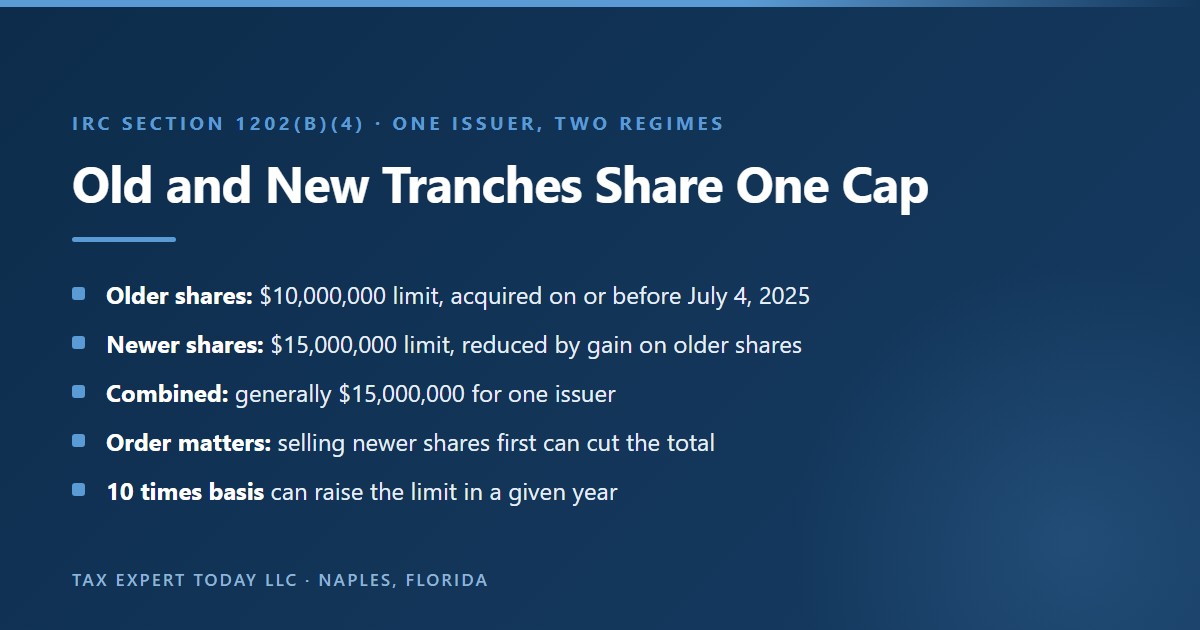
Eligible gain from one issuer is capped each year at the greater of the applicable dollar limit or 10 times the adjusted basis of the shares sold that year. The dollar limit is $10,000,000 for stock acquired on or before July 4, 2025 and $15,000,000 for later stock, each reduced by gain from that issuer already taken into account.
- The cap is per taxpayer, per issuer. Two companies mean two caps; two holders mean two caps.
- The dollar limit is lifetime per issuer. It shrinks as excluded gain is used.
- The 10 times basis limit is annual. It is measured against the shares sold that year.
- Indexing: the $15,000,000 figure rises for taxable years beginning after 2026.
The mechanics sit in section 1202(b). Paragraph (b)(1) sets the annual limit at the greater of the “applicable dollar limit for the taxable year” or “10 times the aggregate adjusted bases of qualified small business stock issued by such corporation and disposed of by the taxpayer during the taxable year.” Paragraph (b)(4) then defines the dollar limit separately for old and new stock. For older stock, the $10,000,000 is reduced by eligible gain taken into account in prior years from stock of that issuer acquired at any time. For newer stock, the $15,000,000 is reduced by that same prior-year amount plus any eligible gain taken into account in the current year from older stock of the same issuer.
The basis used for the 10 times test ignores any addition to basis after the shares were originally issued, so a later capital contribution does not raise the multiplier. Basis for stock received for property is the fair market value of the property at contribution under section 1202(i), which matters a great deal for conversions and is covered below.
| Component | Older stock (on or before July 4, 2025) | Newer stock (after July 4, 2025) |
|---|---|---|
| Dollar limit | $10,000,000 | $15,000,000, indexed after 2026 |
| Reduced by prior-year excluded gain from the issuer | Yes, from any of its stock | Yes, from any of its stock |
| Reduced by same-year gain from older stock of the issuer | No | Yes |
| Alternative limit | 10 times basis of shares sold that year | 10 times basis of shares sold that year |
| Married filing separately | $5,000,000 | One half of the dollar limit then in effect |
Because the cap applies per taxpayer and per issuer, a founder who sells two different companies has two separate caps, and an investor who holds stock in twenty portfolio companies has twenty. The cap does not stack across the regimes for the same company, however, which is the subject of the mixed tranche discussion below.
How does the 10 times basis alternative work?
The 10 times basis alternative lets a holder exclude up to ten times the original adjusted basis of the qualified small business stock sold during the year, when that figure exceeds the dollar limit. It rarely helps founders, whose basis is usually nominal, but it can matter for investors who paid significant cash for their shares.
- Measured annually: only the basis of shares sold in that taxable year counts.
- Original basis only: later contributions to capital are ignored.
- Property contributions: basis is at least fair market value at contribution.
- Greater of: the holder uses whichever limit is larger, never both.
Consider two hypothetical holders of newly issued stock in the same company, both selling after five years and both in the highest federal bracket. The investor paid $3,000,000 in cash for preferred stock and realizes $37,000,000 of gain. Ten times basis is $30,000,000, which exceeds the $15,000,000 dollar limit, so $30,000,000 is excluded and $7,000,000 is taxed as ordinary long-term capital gain. The founder paid $10,000 for common stock and realizes $39,990,000 of gain. Ten times basis is only $100,000, so the founder is held to the $15,000,000 dollar limit and $24,990,000 is taxable.
| Holder | Basis | Gain | Applicable cap | Excluded | Taxable | Approximate federal tax |
|---|---|---|---|---|---|---|
| Investor | $3,000,000 | $37,000,000 | $30,000,000 (10 times basis) | $30,000,000 | $7,000,000 | $1,666,000 |
| Founder | $10,000 | $39,990,000 | $15,000,000 (dollar limit) | $15,000,000 | $24,990,000 | $5,947,620 |
Because the alternative is measured year by year, a holder with substantial basis can sometimes increase total exclusions by spreading sales of the same company’s stock across taxable years, so that each year’s sales carry their own ten times basis limit. Whether that is possible depends on the deal: most acquisitions buy every share at once, and an installment sale spreads the gain but not the shares sold, as explained in the reporting section. These are illustrations, not projections, and the right answer depends on each holder’s facts.
What happens when one founder holds old and new tranches?
A founder holding qualified small business stock from before and after July 4, 2025 in the same company does not get two full caps. As the statute reads, gain on the older shares reduces the $15,000,000 limit for the newer shares, so the combined cap is generally $15,000,000, and sale order can change the total.
- Older shares first or in the same year: up to $10,000,000 old plus $5,000,000 new.
- Newer shares in an earlier year: their gain reduces the older shares’ $10,000,000 limit.
- Same-year sale: section 1202(b)(4)(B)(ii) charges older-share gain against the new limit first.
- 10 times basis: can still raise the limit in a year with substantial basis.
This is the founder problem the 2025 law created. Many companies will issue shares on both sides of July 4, 2025: founder common in 2022, an option exercise in 2024, and a new grant or purchase in 2026. Each tranche is qualified small business stock if its own tests are met, but they share one issuer. Under section 1202(b)(4)(A), the $10,000,000 limit for older shares is reduced by eligible gain from prior years “attributable to dispositions of stock issued by such corporation and acquired by the taxpayer before, on, or after the applicable date.” Under section 1202(b)(4)(B), the $15,000,000 limit for newer shares is reduced by the same prior-year gain and by same-year gain from older shares.
The hypothetical below assumes a founder with $12,000,000 of gain on older shares (tranche A) and $8,000,000 of gain on newer shares (tranche B), both past five years and both with nominal basis, in the highest federal bracket.
| Sale order | Excluded on A | Limit left for B | Excluded on B | Total excluded | Taxable gain | Approximate federal tax |
|---|---|---|---|---|---|---|
| A and B in the same year | $10,000,000 | $5,000,000 | $5,000,000 | $15,000,000 | $5,000,000 | $1,190,000 |
| A in year one, B in year two | $10,000,000 | $5,000,000 | $5,000,000 | $15,000,000 | $5,000,000 | $1,190,000 |
| B in year one, A in year two | $2,000,000 | Not applicable | $8,000,000 | $10,000,000 | $10,000,000 | $2,380,000 |
In the third row, the founder sells the newer shares first and excludes all $8,000,000 under the $15,000,000 limit. The following year, the older shares’ $10,000,000 limit is reduced by that $8,000,000 of prior eligible gain, leaving $2,000,000. The total exclusion falls by $5,000,000 compared with the other orders. Most acquisitions buy every share in one closing, which produces the first row, but secondary sales, partial tender offers, and staged buyouts can produce the third. Treasury has not issued guidance on this ordering, and the result shown is a reading of the statutory text, so any staged sale with mixed tranches deserves a calculation before the first closing.
Which corporations can issue qualified small business stock?
Only a domestic C corporation can issue qualified small business stock, and only while its aggregate gross assets stay at or below the ceiling before and immediately after the issuance: $75,000,000 for stock issued after July 4, 2025, and $50,000,000 for earlier stock. The company must also remain a C corporation for substantially all of the holder’s holding period.
- Domestic: a foreign corporation cannot issue it, even with a United States business.
- C corporation: an S corporation, partnership, or LLC taxed as a partnership cannot.
- Not a special entity: DISCs, RICs, REITs, REMICs, and cooperatives are excluded.
- Under the ceiling: at every point before the issuance and immediately after it.
The definition is in section 1202(d)(1), which requires that the corporation’s aggregate gross assets “at all times on or after the date of the enactment of the Revenue Reconciliation Act of 1993 and before the issuance did not exceed $75,000,000” and that they “immediately after the issuance (determined by taking into account amounts received in the issuance) do not exceed $75,000,000.” The $75,000,000 figure applies to stock issued after July 4, 2025, and section 1202(d)(4) indexes it for taxable years beginning after 2026. Stock issued earlier was tested against the $50,000,000 ceiling in effect at the time.
The “at all times” language means that once a company has crossed the ceiling, it can never issue qualified small business stock again, even if its assets later fall. Shares issued before the crossing remain eligible, because the test is applied at each issuance. This is why a company preparing a large round often sequences the closing so that the founders’ and earlier investors’ shares are issued first and the round that pushes assets over the ceiling closes last.
| Entity | Can issue qualified small business stock? | Note |
|---|---|---|
| Domestic C corporation | Yes, if the other tests are met | The only eligible issuer |
| S corporation | No, while the S election is in effect | Shares issued during S status never qualify |
| LLC taxed as a partnership | No | Can convert, with the pre-conversion gain excluded from the benefit |
| Single-member LLC taxed as a disregarded entity | No | Can elect corporate status or convert |
| Foreign corporation | No | Must be domestic |
| REIT, RIC, REMIC, cooperative, DISC | No | Excluded by section 1202(e)(4) |
The company’s own tax status during the holding period is just as important as at issuance. If a C corporation later elects S status, its existing shares can lose qualified small business stock treatment, because section 1202(c)(2)(A) requires C corporation status during substantially all of the holder’s holding period. Owners who are weighing an S election for payroll reasons, discussed in our guide to S corp reasonable compensation, should test the cost to existing shares before filing it.
How is the aggregate gross assets test measured?
Aggregate gross assets means cash plus the adjusted tax basis of every other asset the corporation holds, not market value or enterprise value. Property contributed to the company counts at its fair market value when contributed, and all corporations in a more-than-50-percent parent-subsidiary group are tested together as one corporation.
- Cash counts in full, including the cash raised in the issuance being tested.
- Other assets count at tax basis, so self-created goodwill and IP are usually near zero.
- Contributed property counts at value on the date of contribution.
- Subsidiaries count: a parent and its more-than-50-percent subsidiaries are aggregated.
Section 1202(d)(2)(A) defines aggregate gross assets as “the amount of cash and the aggregate adjusted bases of other property held by the corporation.” Section 1202(d)(2)(B) then overrides basis for contributed property: its basis is treated as equal to fair market value immediately after the contribution. Section 1202(d)(3) aggregates all members of the same parent-subsidiary controlled group, substituting “more than 50 percent” for the usual 80 percent threshold.
The basis rule is what lets a company valued at several hundred million dollars still issue qualified small business stock. A software company that built its code internally carries that code at little or no tax basis, so a high valuation does not by itself push it over the ceiling. Cash is different: every dollar of a funding round counts the day it arrives, including the dollars that buy the shares being tested.
| Item | Amount counted | Why |
|---|---|---|
| Cash on hand | $20,000,000 | Cash counts in full |
| Equipment and leasehold improvements | $8,000,000 | Adjusted tax basis |
| Patents contributed by a founder at formation | $30,000,000 | Fair market value at contribution, not the founder’s zero basis |
| Internally developed software | $0 | No tax basis |
| Total before the round | $58,000,000 | |
| After a $20,000,000 round | $78,000,000 | Exceeds the ceiling: the round’s shares fail |
| After a $17,000,000 round | $75,000,000 | At the ceiling: the round’s shares can qualify |
Section 1202(d)(1)(C) also requires the corporation to agree to submit any reports the Treasury requires. In practice, investors ask for a gross assets representation in the stock purchase agreement and a balance sheet at each closing, and holders should keep both. A company that cannot reconstruct its tax basis balance sheet for the closing date years later leaves its shareholders with a burden they cannot carry.
What is the active business requirement?
During substantially all of the holder’s holding period, at least 80 percent of the corporation’s assets by value must be used in the active conduct of one or more qualified trades or businesses. Large cash reserves, investment portfolios, and real estate not used in the business can cause a company to fail, even if its operations clearly qualify.
- Measured by value, unlike the gross assets test, which uses basis.
- Working capital counts as active, within the 50 percent limit in section 1202(e)(6).
- Start-up and research activity counts as active under section 1202(e)(2).
- Portfolio stock and real estate are subject to the 10 percent limits in section 1202(e)(5) and (e)(7).
The rule appears in section 1202(e)(1). Section 1202(e)(2) treats assets used in start-up activities, research and experimental activities under section 174 or section 174A, and in-house research as used in a qualified trade or business, “without regard to whether a corporation has any gross income from such activities at the time of the determination.” That protects pre-revenue companies. Section 1202(e)(6) treats assets held as working capital, or held for investment but expected to be used within two years for research or the business, as active. Once the company has existed for at least two years, no more than 50 percent of its assets can qualify as active by reason of that working capital rule.
The test is applied “during substantially all” of the holding period, a phrase the statute does not define. Holders generally read it as a high percentage of the time, which means a company that sold its operating assets and sat on the proceeds for a year before a merger, or that drifted into investing its cash for several years, can put the exclusion at risk even though it was clearly active when the shares were issued.
| Asset | Usually counted as active? | Limit or condition |
|---|---|---|
| Operating equipment, inventory, receivables | Yes | Used in the qualified business |
| Working capital needs | Yes | Reasonably required for the business |
| Cash held for research or expansion | Yes, within limits | Expected use within two years; after the company’s second year, no more than 50 percent of assets can qualify this way |
| Stock and securities of companies that are not subsidiaries | No, beyond limits | More than 10 percent of asset value in excess of liabilities fails |
| Real estate not used in the business | No, beyond limits | More than 10 percent of total asset value fails |
| Stock of a more-than-50-percent subsidiary | Looked through | Parent is treated as owning the subsidiary’s assets |
The active business test is the one most often overlooked at exit, because it depends on the company’s balance sheet over years rather than on any single document. A shareholder can ask the company’s finance team for year-end balance sheets across the holding period and keep them with the stock records.
Which industries are excluded from qualified small business stock?
Section 1202(e)(3) excludes service businesses in health, law, engineering, architecture, accounting, actuarial science, performing arts, consulting, athletics, financial services, and brokerage, plus any business whose principal asset is the reputation or skill of its employees, banking and similar financing, farming, extraction, and hotels and restaurants.
- Professional services: health, law, accounting, engineering, architecture, consulting.
- Financial businesses: banking, insurance, financing, leasing, investing.
- Resource businesses: farming and oil, gas, or mineral extraction.
- Hospitality: hotels, motels, restaurants, and similar businesses.
The list in section 1202(e)(3) was not changed by the 2025 law. Many of the words are familiar from the qualified business income deduction under section 199A, and our guide to the qualified business income deduction discusses those fields. The two lists are not identical, however: engineering and architecture are excluded for qualified small business stock purposes but not for the specified service trade or business definition in section 199A, and the reputation or skill clause is read differently in each place.
| Group | Fields named in the statute |
|---|---|
| Professional services (e)(3)(A) | Health, law, engineering, architecture, accounting, actuarial science, performing arts, consulting, athletics, financial services, brokerage services |
| Reputation or skill (e)(3)(A) | Any trade or business where the principal asset is the reputation or skill of one or more employees |
| Finance (e)(3)(B) | Banking, insurance, financing, leasing, investing, or similar businesses |
| Farming (e)(3)(C) | Farming, including raising or harvesting trees |
| Extraction (e)(3)(D) | Production or extraction of products eligible for percentage depletion |
| Hospitality (e)(3)(E) | Operating a hotel, motel, restaurant, or similar business |
Because the active business test looks at assets, not labels, a company whose assets are mostly used in an excluded field fails even if its marketing describes it as a technology company. A clinic with a software platform, an engineering firm that sells a product, or a financial adviser with an app all raise classification questions that turn on facts.
How do the excluded fields apply to companies that mix products and services?
The test is applied to the corporation’s assets, not to how the company describes itself. A company with a product business and a service business must show that at least 80 percent of its assets by value are used in the qualified part. Where service revenue drives the business, the company risks failing even if it also sells software.
- Look at assets, not revenue alone: the statute measures asset use.
- Health technology: software sold to providers differs from providing care.
- Financial technology: a platform differs from a lending or investing business.
- Engineering products: a manufactured product differs from engineering services.
There is little formal guidance on mixed businesses. The IRS has issued private letter rulings that apply to the taxpayers who requested them, and those rulings generally ask whether the company’s value comes from the skills of its employees providing services to customers or from a product, process, or platform that the company owns. A private letter ruling cannot be relied on by anyone other than the taxpayer who received it, so these rulings describe how the IRS has approached the question without settling it.
| Pattern | Points that tend to support qualification | Points that tend to raise risk |
|---|---|---|
| Health software | Licenses software; does not provide care | Employs clinicians who treat patients |
| Financial platform | Sells technology to institutions | Lends, invests, or earns brokerage fees |
| Engineering company | Manufactures and sells a product | Bills hours for design services |
| Consulting firm with a tool | Tool revenue and assets dominate | Advisory engagements drive revenue |
| Restaurant technology | Sells ordering software to restaurants | Operates its own restaurants |
A founder who expects to rely on the exclusion can ask counsel to document the business classification at formation and at each funding round. Documentation does not change the facts, but it records why the company was believed to qualify while those facts were still current.
What does original issuance mean for qualified small business stock?
Qualified small business stock must be acquired directly from the issuing corporation, or through an underwriter, in exchange for money, property other than stock, or services provided to the corporation. Shares bought from another shareholder, from a fund, or on a secondary market do not qualify, even if they were qualified small business stock in the seller’s hands.
- Money: cash paid to the company in a priced round or a SAFE that converts.
- Property: assets contributed, with basis at least equal to fair market value.
- Services: shares granted as compensation for work for the company.
- Not stock: shares received in exchange for other stock generally need a specific exception.
The rule is in section 1202(c)(1)(B). The statute has its own exceptions for transfers that are not purchases: section 1202(h) lets a recipient by gift, at death, or in a qualifying partnership distribution step into the transferor’s position, and section 1202(f) treats stock acquired on conversion of other qualified small business stock of the same corporation as qualified. Section 1202(h)(4) also preserves qualified status, within limits, when qualified stock is exchanged for other stock in a section 351 transaction or a reorganization.
| How the shares were acquired | Original issuance? | Comment |
|---|---|---|
| Bought from the company in a priced round | Yes | The standard case |
| SAFE or convertible note converting to stock | Generally yes | Acquisition date can depend on how the instrument is characterized |
| Bought from a departing founder | No | Secondary purchase |
| Received as a gift from a qualified holder | Treated as yes | Section 1202(h) carryover |
| Received on option exercise | Yes | Holding period generally starts at exercise |
| Received in a merger for qualified shares | Can be preserved | Gain limited to the value at the exchange if the new shares are not qualified |
Investors who buy shares in a secondary transaction sometimes assume the benefit travels with the shares. It does not. A secondary buyer pays a price that may reflect the seller’s expected exclusion and receives shares that carry none, which is worth knowing before negotiating.
Can stock received for services or through options qualify?
Yes. Section 1202(c)(1)(B)(ii) covers stock issued as compensation for services, and stock acquired by exercising an option is acquired at exercise. For restricted stock, the holding period generally starts when the shares are included in income, which with a timely section 83(b) election is the grant date rather than the vesting date.
- Restricted stock with an 83(b) election: holding period generally starts at grant.
- Restricted stock without one: generally starts as each tranche vests.
- Stock options: the option itself is not stock; the clock starts at exercise.
- Restricted stock units: generally start when the shares are delivered.
IRC section 83 governs property received for services. Without an election, restricted shares are not treated as owned for tax purposes until they vest, so each vesting tranche starts its own holding period and is tested for qualification on its own vesting date. With a timely section 83(b) election, filed within 30 days of the grant, the shares are treated as received at grant. That earlier date can be the difference between a tranche falling before or after July 4, 2025, or reaching the five-year tier before a sale.
| Award | Clock generally starts | Gross assets tested at |
|---|---|---|
| Restricted stock, 83(b) election filed | Grant date | Grant date |
| Restricted stock, no election | Each vesting date | Each vesting date |
| Incentive or nonqualified stock option | Exercise date | Exercise date |
| Early exercise with 83(b) election | Exercise date | Exercise date |
| Restricted stock units | Share delivery date | Share delivery date |
Because the gross assets test is applied at issuance, employees who exercise options late in a company’s growth may receive shares after the company has crossed the ceiling, so those shares never qualify, while shares exercised years earlier do. Our guide to dividing stock options in divorce covers related timing issues for option holders.
How do redemptions disqualify qualified small business stock?
Two redemption rules in section 1202(c)(3) can disqualify shares. Stock is tainted if the company bought back stock from the same holder or a related person within two years before or after the issuance, or if it made buybacks exceeding 5 percent of its total stock value within one year before or after the issuance.
- Related-party window: four years, from two years before issuance to two years after.
- Significant redemption window: two years, from one year before to one year after.
- Section 304 transactions: treated as purchases of the company’s own stock.
- De minimis rules: Treasury Regulation section 1.1202-2 sets thresholds.
Under section 1202(c)(3)(A), stock is not qualified “if, at any time during the 4-year period beginning on the date 2 years before the issuance of such stock, the corporation issuing such stock purchased (directly or indirectly) any of its stock from the taxpayer or from a person related” to the taxpayer. Under section 1202(c)(3)(B), stock is not qualified if, during the two-year period beginning one year before issuance, the corporation made purchases of its stock “with an aggregate value … exceeding 5 percent of the aggregate value of all of its stock” at the start of that period. Treasury Regulation section 1.1202-2 disregards related-party purchases that do not exceed both $10,000 and 2 percent of the holder’s stock, and disregards purchases incident to an employee’s or director’s termination of services, death, disability, or divorce.
| Event | Timing | Effect |
|---|---|---|
| Company repurchases $2,500,000 of shares from a departing co-founder | Eight months before a new round | Exceeds 5 percent of $40,000,000 (6.25 percent) |
| New round closes | Within the two-year window | Round’s shares can fail the significant redemption test |
| Same repurchase funded by a new investor buying the co-founder’s shares directly | Same timing | Not a corporate redemption; the company’s new shares are not affected |
Redemptions are the qualification failure that is easiest to cause by accident, because they often happen for ordinary business reasons: a founder leaves, an early investor wants liquidity, or a key employee’s shares are bought back. Structuring the liquidity as a direct purchase by another investor, rather than a company buyback, is one common way to keep the company’s own issuances clean, subject to counsel’s review.
Can an LLC or S corporation convert and use qualified small business stock?
An LLC taxed as a partnership can convert to a C corporation and issue qualified small business stock, but only appreciation after conversion is eligible, because the stock’s section 1202 basis is at least the fair market value contributed. An S corporation’s existing shares do not qualify; shares issued after it becomes a C corporation can.
- Pre-conversion gain stays taxable at sale under section 1202(i)(1).
- The clock starts at conversion, not at the LLC’s formation.
- A higher basis raises the 10 times basis alternative.
- S corporation shares issued during S status cannot become qualified later.
Section 1202(i)(1) says that when a taxpayer transfers property, other than money or stock, to a corporation for its stock, the stock is treated as acquired on the date of the exchange, and its basis “shall in no event be less than the fair market value of the property exchanged.” The result is a split: the built-in gain at conversion is taxed normally when the shares are sold, and only the growth after conversion is eligible for exclusion. The flip side is that the fair market value basis feeds the 10 times basis test, which can produce a cap far above $15,000,000.
| Piece of the gain | Amount | Treatment | Approximate federal tax |
|---|---|---|---|
| Gain built in before conversion | $5,000,000 | Taxable long-term capital gain | $1,190,000 |
| Gain after conversion | $44,000,000 | Eligible; cap is $60,000,000 (10 times $6,000,000) | $0 |
| Total | $49,000,000 | $44,000,000 excluded | $1,190,000 |
Conversion is not free. A C corporation pays its own tax on profits, distributions are taxed again as dividends, and an asset sale later can be far more expensive than a stock sale. Our guide to selling a business taxes compares asset and stock sales, and our business consulting services page describes how entity choice is reviewed. The conversion question is a multi-year projection, not a single rule, and it depends heavily on how and when the owners expect to exit.
How is the gain taxed when only 50 or 75 percent is excluded?
The part of eligible gain that is not excluded is called section 1202 gain and is taxed at a maximum 28 percent rate under IRC section 1(h), not the 20 percent rate that applies to most long-term capital gain. With the 3.8 percent net investment income tax, that slice can face 31.8 percent.
- 50 percent tier: half the eligible gain is taxed at up to 28 percent.
- 75 percent tier: one quarter is taxed at up to 28 percent.
- 100 percent tier: no section 1202 gain remains.
- Gain above the cap: taxed at the ordinary long-term rates of up to 20 percent.
Section 1(h)(7) defines section 1202 gain as the excess of “the gain which would be excluded from gross income under section 1202 but for the percentage limitation in section 1202(a)” over “the gain excluded from gross income under section 1202.” Section 1(h)(4) places that amount in the 28 percent rate group with collectibles gain. The 28 percent rate is a maximum: a holder whose ordinary rate is lower pays the lower rate on that slice, as IRS Publication 550 explains in its table of maximum capital gain rates.
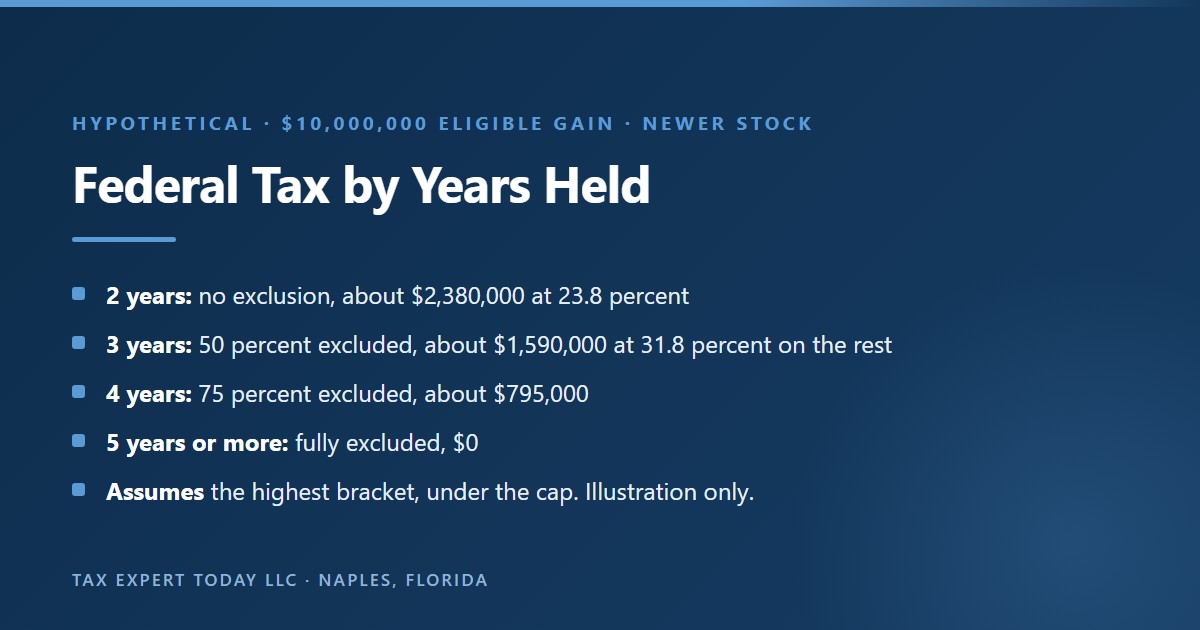
The higher rate on the non-excluded slice is why a partial exclusion is worth less than its headline percentage. A 50 percent exclusion does not cut the tax in half compared with an ordinary long-term sale, because the remaining half is taxed at 28 percent rather than 20 percent. The table below shows the effect on a hypothetical $10,000,000 of eligible gain.
| Years held | Excluded | Taxable | Rate on taxable part | Approximate federal tax | Effective rate on the whole gain |
|---|---|---|---|---|---|
| 2 years | $0 | $10,000,000 | 23.8% | $2,380,000 | 23.80% |
| 3 years | $5,000,000 | $5,000,000 | 31.8% | $1,590,000 | 15.90% |
| 4 years | $7,500,000 | $2,500,000 | 31.8% | $795,000 | 7.95% |
| 5 years or more | $10,000,000 | $0 | Not applicable | $0 | 0.00% |
In this illustration, the 50 percent tier saves about $790,000 against a sale before three years, the 75 percent tier saves another $795,000, and the final year saves the last $795,000. Each step is roughly equal in dollars, which is a useful way to frame an offer that arrives in year three or four: the question is whether one more year of holding is worth about one third of the remaining tax at stake, given the risk that the offer, the company, or the market changes.
What does the tier schedule mean for the timing of a sale?
For newer stock, each anniversary from year three to year five can change the federal tax on a sale by a large amount, so the closing date matters. A sale one day before an anniversary falls into the lower tier. Holders can weigh the tax saved by waiting against the deal risk of waiting.
- Count from the acquisition date determined after section 1223, not from the grant letter.
- Each tranche has its own date, so one sale can mix tiers.
- Earnouts and holdbacks may be reported differently from the closing payment.
- Waiting has a cost: buyers, financing, and valuations can change.
Because each tranche is measured separately, a founder who received shares at formation in 2026 and more shares in a 2027 grant will hold stock in different tiers on any given closing date. A 2030 sale might put the first tranche in the 75 percent tier and the second in the 50 percent tier. A closing date set by the buyer’s financing calendar rather than the sellers’ tax calendar can move a significant amount of tax between tiers.
| Acquired | 50 percent from | 75 percent from | 100 percent from |
|---|---|---|---|
| July 5, 2025 | July 5, 2028 | July 5, 2029 | July 5, 2030 |
| January 15, 2026 | January 15, 2029 | January 15, 2030 | January 15, 2031 |
| October 15, 2026 | October 15, 2029 | October 15, 2030 | October 15, 2031 |
| June 1, 2027 | June 1, 2030 | June 1, 2031 | June 1, 2032 |
The statute says “held for at least 3 years” and “5 years or more” for newer stock, while the older regime says “more than 5 years.” Holders and their advisers commonly add a margin of a day or more rather than closing on the exact anniversary, because the cost of being one day short is the full difference between tiers. Our guide to moving to Florida before selling a business covers the separate question of state residence on the closing date.
Does qualified small business stock gain trigger the alternative minimum tax?
Not for stock acquired after September 27, 2010. Section 57(a)(7) now treats 7 percent of the excluded gain as an alternative minimum tax preference only for stock acquired on or before that date. Excluded gain on stock acquired later, including all stock under the 2025 tiers, is not a preference item.
- Acquired on or before Sept. 27, 2010: 7 percent of the exclusion is a preference.
- Acquired after Sept. 27, 2010: no preference.
- Partial tiers after July 4, 2025: no preference on the excluded part.
- Taxable slice: still part of income for alternative minimum tax purposes.
The current text of section 57(a)(7) reads: “In the case of stock acquired on or before the date of the enactment of the Creating Small Business Jobs Act of 2010, an amount equal to 7 percent of the amount excluded from gross income for the taxable year under section 1202.” The Creating Small Business Jobs Act of 2010 was enacted September 27, 2010. The 2025 law did not add a new preference for the partial tiers, so the excluded portion of a 50 percent or 75 percent exclusion is outside the alternative minimum tax computation.
| Acquired | Exclusion percentage | AMT preference |
|---|---|---|
| Aug. 11, 1993 to Feb. 17, 2009 | 50% | 7 percent of the excluded amount |
| Feb. 18, 2009 to Sept. 27, 2010 | 75% | 7 percent of the excluded amount |
| Sept. 28, 2010 to July 4, 2025 | 100% | None |
| After July 4, 2025 | 50%, 75%, or 100% | None |
Older guides written before 2010 often warn about the alternative minimum tax on qualified small business stock. For stock issued in the last fifteen years, that warning no longer applies to the excluded gain, although a large taxable gain from any source can still interact with the alternative minimum tax through other items.
Is excluded gain subject to the net investment income tax?
No. The 3.8 percent net investment income tax under IRC section 1411 applies to gain taken into account in computing taxable income, and excluded section 1202 gain is not included in gross income. The taxable portion of a partial exclusion, and any gain above the per-issuer cap, can be subject to the tax.
- Excluded gain: outside gross income, so outside net investment income.
- Section 1202 gain at 28 percent: generally net investment income.
- Gain above the cap: generally net investment income.
- Thresholds: $250,000 for joint filers and $200,000 for single filers, not indexed.
Section 1411 imposes the tax on the lesser of net investment income or the excess of modified adjusted gross income over the threshold. Net gain from property is included “to the extent taken into account in computing taxable income,” which excluded gain is not. A founder who is active in the business may argue that gain on the sale of stock in a C corporation is still investment income, because the trade or business exception in section 1411 applies to pass-through businesses, not to C corporation stock, so the tax generally applies to the taxable slice regardless of the founder’s role.
| Tier | Gain in net investment income | Net investment income tax at 3.8% |
|---|---|---|
| No exclusion | $10,000,000 | $380,000 |
| 50 percent | $5,000,000 | $190,000 |
| 75 percent | $2,500,000 | $95,000 |
| 100 percent | $0 | $0 |
These figures are already included in the effective rates shown earlier. They are broken out here because the net investment income tax is computed on Form 8960, separately from the capital gain worksheets, and holders sometimes overlook it when they estimate the tax on a partial exclusion.
What is the Section 1045 rollover for qualified small business stock?
Section 1045 lets a noncorporate holder who sells qualified small business stock held more than six months elect to defer the gain by buying other qualified small business stock within 60 days. Gain is recognized only to the extent the sale proceeds exceed the cost of the replacement stock, and the deferred gain reduces the replacement stock’s basis.
- Holding period: more than six months for the stock sold.
- Window: replacement stock purchased within 60 days of the sale.
- Election: made on the return for the year of the sale.
- Replacement stock: must be qualified small business stock in its own right.
The text of section 1045(a) provides that gain “shall be recognized only to the extent that the amount realized on such sale exceeds the cost of any qualified small business stock purchased by the taxpayer during the 60-day period beginning on the date of such sale.” Section 1045(b)(3) reduces the basis of the replacement stock by the deferred gain. Section 1045(b)(4)(B) adds that only the first six months of the replacement stock’s holding period count for the active business requirement, which gives a new company time to deploy cash.
The rollover is most useful for stock that has not reached the minimum holding period for the exclusion: under three years for newer stock or five years for older stock. A holder who sells at year two, rolls the proceeds into a new company, and holds the replacement shares long enough can generally count the combined holding period toward the exclusion on the replacement shares.
| Reinvested within 60 days | Gain recognized now | Gain deferred | Basis in replacement stock |
|---|---|---|---|
| $6,000,000 | $0 | $4,000,000 | $2,000,000 |
| $5,000,000 | $1,000,000 | $3,000,000 | $2,000,000 |
| $2,000,000 or less | $4,000,000 | $0 | Equal to cost |
The 60-day window is short, and finding qualified replacement stock in a company that meets every test, at the right price, within two months is the practical limit on the rollover. Some holders invest through funds designed to purchase qualified small business stock for rollover purposes, which raises separate pass-through questions under section 1202(g).
How does a Section 1045 rollover affect the holding period and tier?
The replacement stock generally takes the holding period of the stock sold under section 1223, and section 1202(a)(6) fixes the acquisition date after applying section 1223. As the statute reads, replacement shares bought in 2026 with proceeds from stock acquired before July 5, 2025 appear to stay under the older five-year, $10,000,000 regime.
- Tacking helps the holder reach the minimum holding period sooner.
- Tacking also carries the old date, which may keep the older rules.
- The older regime needs more than five years and has no partial tiers.
- No regulations yet address this interaction after the 2025 law.
Section 1223 generally tacks the holding period of property whose basis is determined by reference to other property, and section 1045 replacement stock is that kind of property. Section 1202(a)(6)(B) then says the acquisition date “shall be the first day on which such stock was held by the taxpayer determined after the application of section 1223.” The combination suggests that rolled-over shares inherit both the old holding period and the old acquisition date.
| Stock sold | Replacement stock bought | Likely regime for replacement stock | Practical effect |
|---|---|---|---|
| Acquired 2023, sold 2026 | 2026 | Older regime | Needs more than 5 years combined; $10,000,000 cap; no 50 or 75 percent tier |
| Acquired 2026, sold 2027 | 2027 | Newer regime | Tiers from 3 years combined; $15,000,000 cap |
| No rollover; new cash investment in 2026 | 2026 | Newer regime | Clock starts at purchase |
The trade-off is real. Tacking may get a holder to an exclusion sooner, but it may also forgo the partial tiers and the larger cap. A holder deciding between rolling over gain and paying tax now to start a fresh clock under the newer regime can model both paths before the 60-day window closes.
What happens to qualified small business stock given as a gift or inherited?
Under section 1202(h), a person who receives qualified small business stock by gift or at death is treated as having acquired it in the same manner as the transferor and as having held it during the transferor’s holding period. The exclusion travels with the shares, but inherited shares usually also receive a basis adjustment to fair market value at death.
- Gift: the donee steps into the donor’s acquisition date and holding period.
- Death: the heir steps into the decedent’s date, and basis generally adjusts under section 1014.
- Partnership distribution: can carry over if section 1202(g) conditions are met.
- Sale to family: a purchase, not a gift, so the buyer gets no exclusion.
Section 1202(h)(1) treats the transferee as “having acquired such stock in the same manner as the transferor” and as “having held such stock during any continuous period immediately preceding the transfer during which it was held” by the transferor. Section 1202(h)(2) limits this to transfers by gift, at death, or from a partnership to a partner. For inherited shares, section 1014 generally resets basis to fair market value, which can eliminate most of the gain without the exclusion.
| Transfer | Exclusion carries over? | Basis in recipient’s hands |
|---|---|---|
| Lifetime gift | Yes | Donor’s basis, generally |
| Inheritance | Yes | Generally fair market value at death |
| Gift to a grantor trust | Grantor generally treated as the holder | Unchanged for income tax purposes |
| Gift to a non-grantor trust | Yes, trust is the holder | Donor’s basis, generally |
| Sale to a family member | No | Purchase price |
A lifetime gift is also a gift for gift tax purposes. Our guide to the lifetime gift tax exemption explains how a gift of stock uses exemption and when a Form 709 is required, and the value reported should come from a qualified appraisal when the company is closely held.
Can gifts to family members multiply the per-issuer cap?
Because the cap applies per taxpayer, a holder who gives qualified small business stock to children or to separate non-grantor trusts before a sale may create additional caps, each up to $15,000,000 for newer stock. The planning is widely discussed, but section 1202(k) authorizes rules against avoidance, and gift tax, valuation, and trust status all have to be right.
- Separate taxpayers: each donee or non-grantor trust is tested on its own.
- Grantor trusts do not stack: the grantor is generally treated as the holder.
- Gift tax applies: the transfer uses exemption at current value.
- Timing: gifts made after a sale is agreed can be challenged.
The idea follows directly from the structure of section 1202(b), which limits gain “for the taxable year from 1 or more dispositions of stock issued by any corporation” for each taxpayer. Section 1202(k) directs Treasury to prescribe regulations “to prevent the avoidance of the purposes of this section through split-ups, shell corporations, partnerships, or otherwise.” No regulation specifically addresses gifts to multiple trusts, and practitioners differ on how far the technique can be pushed. Our guides to the NING trust and the dynasty trust describe non-grantor trust structures that are often discussed alongside this planning.
| Holder | Dollar cap | Note |
|---|---|---|
| Founder | $15,000,000 | Retained shares |
| Non-grantor trust for child one | $15,000,000 | Separate taxpayer, if properly structured |
| Non-grantor trust for child two | $15,000,000 | Separate taxpayer, if properly structured |
| Non-grantor trust for child three | $15,000,000 | Separate taxpayer, if properly structured |
| Combined | Up to $60,000,000 | Subject to section 1202(k), gift tax, and valuation |
The hypothetical shows the arithmetic, not an outcome. Each trust needs real independence, its own trustee decisions, and its own tax identity, and a gift timed after a buyer has signed a letter of intent invites an assignment of income argument. This is planning that is done years before a sale, with the estate plan, the gift tax return, and the trust documents prepared together.
How do married couples apply the qualified small business stock cap?
A married couple filing jointly is generally treated as having one per-issuer dollar limit, with the excluded gain allocated equally between the spouses for later years. A spouse filing separately has a $5,000,000 limit for older stock and one half of the current limit, $7,500,000 before indexing, for newer stock.
- Joint return: generally one limit per issuer for the couple.
- Allocation: excluded gain is split equally for future years.
- Separate returns: half the dollar limit each.
- Marital status: determined under section 7703 at year end.
Section 1202(b)(3) provides that on a separate return, the dollar limit is $5,000,000 for older stock and “one-half of the dollar amount in effect” for newer stock, and that on a joint return, “the amount of gain taken into account under subsection (a) shall be allocated equally between the spouses for purposes of applying this subsection to subsequent taxable years.” Some commentators argue that spouses who each hold their own shares have separate limits even on a joint return. That position is not settled, and couples relying on it are taking a position that should be disclosed and supported.
| Filing status | Older stock | Newer stock |
|---|---|---|
| Single | $10,000,000 | $15,000,000 |
| Married filing jointly | $10,000,000, generally per couple | $15,000,000, generally per couple |
| Married filing separately | $5,000,000 each | $7,500,000 each |
Divorce adds its own layer. Shares transferred between spouses incident to divorce carry over basis under section 1041, and the allocation rule determines how much of the limit each former spouse has used. Our guide to business owner divorce taxes covers the broader property division questions.
How is qualified small business stock reported on Form 8949?
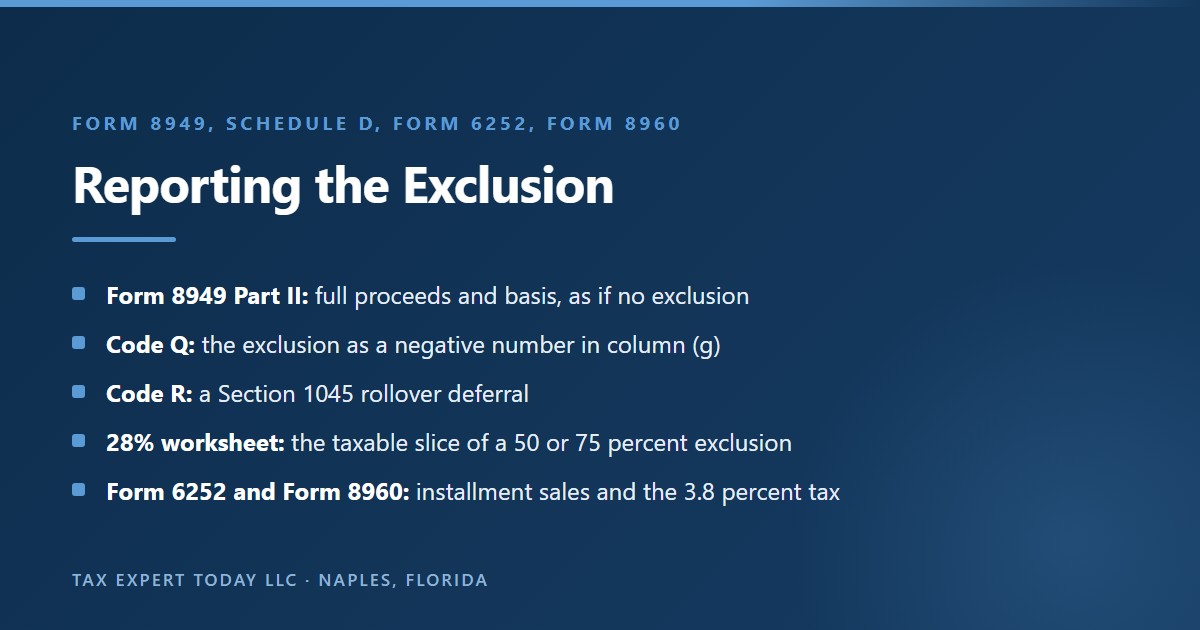
The sale is reported on Form 8949, Part II, exactly as if no exclusion applied, with the full proceeds and basis. The holder then enters code Q in column (f) and the excluded amount as a negative number in column (g). A Section 1045 rollover uses code R in the same way, with the deferred gain as the negative adjustment.
- Part II: long-term transactions, with the box matching the Form 1099-B.
- Column (f): code Q for the exclusion, code R for a rollover.
- Column (g): the exclusion or deferral as a negative number.
- Column (h): the gain that remains taxable after the adjustment.
The Instructions for Form 8949 describe code Q as follows: report the sale “as you would if you weren’t taking the exclusion and enter the amount of the exclusion as a negative number (in parentheses) in column (g).” The broker’s Form 1099-B will almost never show the exclusion, because the broker does not know whether the shares qualify, so the adjustment is the holder’s own claim. That is why the supporting records described below matter: the return shows a large gain reduced by a large adjustment, and the holder must be able to support every dollar of it.
| Column | Entry |
|---|---|
| (a) Description | Shares of the issuing corporation |
| (b) Date acquired | Acquisition date after section 1223 |
| (c) Date sold | Closing date |
| (d) Proceeds | $8,010,000 |
| (e) Cost or other basis | $10,000 |
| (f) Code | Q |
| (g) Adjustment | ($6,000,000) |
| (h) Gain | $2,000,000 |
A sale reported to the holder on a Form 1099-DIV or a Schedule K-1 from a fund follows the special rules in the Schedule D instructions, which still require a Form 8949 line with code Q for the exclusion. Holders who receive their shares through a partnership should confirm that the partnership reports the section 1202 information on the Schedule K-1, because the holder cannot claim the exclusion without it.
How does the 28 percent rate gain worksheet treat a partial exclusion?
When only part of the gain is excluded, the taxable slice goes into the 28% Rate Gain Worksheet in the Schedule D instructions. Line 2 takes the full exclusion when 50 percent was excluded and one third of the exclusion when 75 percent was excluded; nothing is entered for a 100 percent exclusion. Each figure equals the non-excluded slice.
- 50 percent exclusion: enter the full exclusion, which equals the taxable half.
- 75 percent exclusion: enter one third, which equals the taxable quarter.
- 100 percent exclusion: no entry.
- Result: the taxable slice is taxed at up to 28 percent.
The Schedule D instructions tell the filer to enter on line 2 of the worksheet “any section 1202 exclusion you reported in column (g) of Form 8949, Part II, with code ‘Q’ in column (f), that is 50% of the gain,” then two thirds of a 60 percent exclusion, then “1/3 of any section 1202 exclusion … that is 75% of the gain,” and to make no entry for a 100 percent exclusion. The 2025 instructions were written before any newer stock could reach three years, and they describe the percentages by the old acquisition windows, but the arithmetic of the worksheet already fits the new 50 percent and 75 percent tiers.
| Exclusion percentage | Exclusion in column (g) | Fraction entered on line 2 | Line 2 amount | Equals taxable slice? |
|---|---|---|---|---|
| 50% | $4,000,000 | All of it | $4,000,000 | Yes |
| 75% | $6,000,000 | One third | $2,000,000 | Yes |
| 100% | $8,000,000 | None | $0 | Yes |
Tax software generally handles the worksheet once code Q is entered, but it relies on the exclusion percentage being right. A filer who enters a 100 percent exclusion for a sale at four years, or who applies the newer tiers to older stock, will produce a return that understates tax even though every form is filled in. Because the IRS may revise its forms once the first newer stock reaches three years in July 2028, filers should use the instructions for the year of the sale rather than these 2025 references.
How is an installment sale of qualified small business stock reported?
When the buyer pays over time and the shares are not publicly traded, the sale is generally an installment sale reported on Form 6252. The exclusion for each year is the total exclusion multiplied by the share of total eligible gain recognized that year, and that amount is entered with code Q on Form 8949.
- Form 6252: computes the gain recognized each year.
- Proration: exclusion follows the gain, year by year.
- Cap and tier: fixed by the sale, not by the payment dates.
- Election out: available, which recognizes all gain in the year of sale.
The Schedule D instructions say to “figure the allowable section 1202 exclusion for the year by multiplying the total amount of the exclusion by a fraction, the numerator of which is the amount of eligible gain to be recognized for the tax year and the denominator of which is the total amount of eligible gain.” The holding period and the tier are set on the date of sale, so payments received years later do not move the stock into a higher tier. Form 6252 is described on the About Form 6252 page.
| Year | Gain recognized | Fraction of total gain | Exclusion for the year | Taxable at up to 28% |
|---|---|---|---|---|
| Year of sale | $2,000,000 | 25% | $1,000,000 | $1,000,000 |
| Following year | $6,000,000 | 75% | $3,000,000 | $3,000,000 |
| Total | $8,000,000 | 100% | $4,000,000 | $4,000,000 |
Earnouts and escrow holdbacks often produce installment treatment by default. A holder who would prefer to recognize everything in the year of sale, for example to use a year with lower other income, can elect out of installment reporting on a timely filed return. Our article on selling a business taxes discusses installment sales in the broader context of a business exit.
What records prove qualified small business stock status?
The holder needs records showing the issuance date and price, the company’s C corporation status, its gross assets before and after the issuance, its active business use of assets across the holding period, the absence of disqualifying redemptions, and the computation of the cap. Many companies provide a written representation, but the claim belongs to the holder.
- Issuance: stock purchase agreement, board consent, and certificate or ledger entry.
- Gross assets: a tax basis balance sheet as of each issuance.
- Active business: year-end balance sheets across the holding period.
- Redemptions: the company’s record of buybacks around each issuance.
- Elections: any section 83(b) election, with proof of timely filing.
Section 1202(d)(1)(C) requires the issuing corporation to agree to submit reports that Treasury may require, and the IRS Publication 550 discussion lists the tests a holder must meet. No reporting form currently requires the company to certify qualified small business stock status to the IRS, so the holder assembles the file. The table below is a practical checklist; the specific documents vary by company.
| Test | Document | Who usually has it |
|---|---|---|
| Original issuance | Stock purchase agreement, board consent, cap table entry | Company counsel |
| Acquisition date | Issuance date, 83(b) election, exercise notice | Holder and company |
| Gross assets | Tax basis balance sheet at each issuance | Company finance team or CPA |
| Active business | Annual balance sheets, description of operations | Company finance team |
| C corporation status | Formation documents, absence of an S election | Company counsel |
| Redemptions | Record of any buybacks with dates and amounts | Company counsel |
| Cap computation | Basis records and prior-year exclusions from the issuer | Holder and preparer |
The easiest time to collect these records is at each issuance, when the people and systems that produced them are still in place. Asking for a qualified small business stock representation and a gross assets figure at closing costs little, and it avoids reconstructing a balance sheet for a company that may have been acquired, merged, or dissolved by the time of the sale.
When should a founder check qualified small business stock status before a sale?
The useful time to check is before a letter of intent is signed, because the structure of the deal, the closing date, the tranche order, and any gifts to family all affect the result, and most of those cannot be changed once terms are agreed. A second check before closing confirms the records and the computation.
- Before the letter of intent: confirm qualification and the tier for each tranche.
- During negotiation: stock sale versus asset sale, and the closing date.
- Before closing: collect the records file and compute the cap.
- After closing: report with code Q and keep the file with the return.
Most of the decisions that change the exclusion are commercial terms: whether the buyer purchases stock or assets, whether part of the price is paid in buyer stock, whether there is an earnout, and when the deal closes. Once those terms are in a signed agreement, the tax analysis describes the result rather than shaping it. Our Naples tax planning page describes how pre-sale planning is approached, and our tax planning services page outlines the engagement.
| Stage | Question | Why it matters |
|---|---|---|
| 12 to 24 months before a likely sale | Which tranches qualify, and at what tier on likely dates? | Leaves time for gifts, records, and corrections |
| Before the letter of intent | Stock or asset sale? Cash or buyer stock? | An asset sale by the company produces no exclusion for shareholders |
| Negotiation | Closing date relative to anniversaries | A tier change can move a large amount of tax |
| Before closing | Is the records file complete? What is the cap? | The holder must support the claim |
| Tax return | Form 8949 code Q, worksheet, Form 8960 | Correct reporting of each piece |
A founder who receives a significant part of the price in the buyer’s stock, in a reorganization, may keep qualified status on the new shares only to the extent of the gain at the time of the exchange under section 1202(h)(4). That limit is easy to miss when the buyer’s shares later rise in value.
How does a stock sale compare with an asset sale for qualified small business stock?
The exclusion applies only when a shareholder sells or exchanges stock. If the company sells its assets and then distributes the proceeds, the company pays corporate tax on the asset gain, and the shareholders’ later gain on liquidation may be eligible only on their own stock. Buyers often prefer assets for depreciation, so the structure is a negotiated term.
- Stock sale: shareholder gain can be excluded; no corporate tax on the sale.
- Asset sale: 21 percent corporate tax on asset gain, then shareholder tax on the distribution.
- Liquidation: treated as an exchange of stock, so remaining gain may be eligible.
- Buyer preference: asset purchases give the buyer a stepped-up basis.
The asset versus stock question is covered in depth in our guide to selling a business taxes, which works through purchase price allocation and the buyer’s perspective. For qualified small business stock, the essential point is that the exclusion lives at the shareholder level. A corporate asset sale is taxed at the corporate level under IRC section 11 regardless of the shareholders’ status, and only the shareholder-level gain on the later liquidation can be eligible.
| Step | Stock sale | Asset sale and liquidation |
|---|---|---|
| Corporate gain | None | $19,000,000 |
| Corporate tax at 21% | $0 | $3,990,000 |
| Amount reaching the shareholder | $20,000,000 | $16,010,000 |
| Shareholder gain | $20,000,000 | $16,010,000 |
| Excluded (cap $15,000,000) | $15,000,000 | $15,000,000 |
| Shareholder tax at 23.8% on the rest | $1,190,000 | $240,380 |
| Total federal tax | $1,190,000 | $4,230,380 |
The difference in the illustration is driven by the corporate-level tax, which the exclusion does not reach. A buyer that insists on an asset purchase may be willing to pay more to compensate, and the comparison should be made on after-tax proceeds rather than on headline price. This analysis is a simplified model and leaves out state tax, transaction costs, and the details of allocation.
Does Florida tax qualified small business stock gain?
Florida does not impose a personal income tax, so a Florida resident who sells qualified small business stock generally owes no state tax on the gain, whether or not it is excluded federally. A holder who recently moved from a state that taxes the gain, or that does not follow the federal exclusion, may still face that state’s claim.
- Florida residents: no state personal income tax on the gain.
- Recent movers: the former state may test residence on the sale date.
- California: does not follow the federal exclusion.
- Trusts: state taxation can depend on where the trust is administered.
The federal exclusion is only half the analysis for holders who live in, or recently left, a state with an income tax. California is the most common example, and our guide to California QSBS explains how that state treats the gain. Owners who are considering a move before a sale should read our guide to moving to Florida before selling a business and the related guide on how to establish Florida residency, because a former state may look closely at a change of domicile shortly before a large gain.
| Holder’s situation | State income tax on the gain | Point to check |
|---|---|---|
| Long-time Florida resident | None | Federal reporting only |
| Moved to Florida shortly before the sale | Possibly the former state | Domicile on the sale date and the former state’s audit approach |
| Resident of a state that follows the federal exclusion | Generally follows the federal result | Whether the state adopted the 2025 changes |
| Resident of a state that does not follow it | Full gain may be taxed | State law for the year of sale |
| Non-grantor trust holding the shares | Depends on trust residence rules | Trustee location and the beneficiaries’ states |
State conformity to the 2025 changes is not uniform. Some states conform to the Internal Revenue Code as of a fixed date, so they may follow the older version of section 1202 for some years. A holder with any state exposure should confirm the state’s conformity date for the year of the sale.
What mistakes cost holders the qualified small business stock exclusion?
The most common failures are factual, not legal: an S corporation election that disqualified shares, a buyback that tainted a round, a gross assets figure nobody recorded, a sale closed a few days before a tier anniversary, an asset sale where a stock sale was possible, or a newer tranche sold before an older one.
- Entity status: S elections and LLC structures during the holding period.
- Redemptions: company buybacks around an issuance.
- Records: no gross assets or active business evidence.
- Timing: closings before an anniversary.
- Sequencing: mixed tranches sold in a costly order.
Each of these failures has a statutory source covered above, and most of them happen years before the sale, when nobody is thinking about it. The table below collects them with the section that governs each and the point at which it can still be prevented.
| Mistake | Rule | Last point to prevent it |
|---|---|---|
| Shares issued while an S corporation | 1202(c)(1) | Before issuance |
| Company buyback near a round | 1202(c)(3) | Before the buyback |
| Round pushes assets over the ceiling | 1202(d)(1) | Before the round closes |
| Excess cash or portfolio investments | 1202(e)(5), (e)(6) | During the holding period |
| Missed 83(b) election | Section 83 | 30 days after grant |
| Closing one day short of a tier | 1202(a)(5) | Before the closing date is fixed |
| Newer tranche sold before older tranche | 1202(b)(4) | Before the first sale |
| Rollover replacement not purchased within 60 days | 1045(a) | Day 60 after the sale |
| Exclusion not claimed on Form 8949 | Form 8949 code Q | Before the return is filed, or by amendment |
A missed exclusion can sometimes be claimed on an amended return within the refund statute of limitations, generally three years from filing, if the shares in fact qualified. The other mistakes cannot be repaired after the fact, which is why qualified small business stock planning is mostly about decisions made long before a buyer appears.
Qualified Small Business Stock Help in Naples & Southwest Florida
QSBS tax help Naples founders and investors ask for usually starts with three questions: whether each tranche qualifies, which tier and cap apply on a likely sale date, and how a sale, gift, or rollover would be reported. Our office in Naples, Florida reviews the records, the computation, and the return.
Southwest Florida has a growing population of founders, early employees, and angel investors, many of whom moved from states with an income tax and still hold stock in companies formed elsewhere. A qualified small business stock review is usually part of a wider Naples tax planning engagement that also covers the timing of a move, the estate plan, and gifts of shares to family or trusts. The tax side of that work, including the per-issuer cap computation, the tier analysis for each tranche, the Form 8949 and Schedule D reporting, and any Section 1045 rollover, is where most holders benefit from a second look before a deal is signed.
- Qualification review. C corporation status, gross assets, active business, and redemptions for each tranche.
- Tier and cap analysis. Acquisition dates, tiers on likely closing dates, and mixed tranche sequencing.
- Sale structure review. Stock versus asset sale, earnouts, and buyer stock, in coordination with deal counsel.
- Return preparation. Form 8949 code Q and code R, the 28% Rate Gain Worksheet, Form 6252, and Form 8960.
- Family and trust planning. Gifts of shares, Form 709, and coordination with the estate planning attorney.
Tax Expert Today LLC
11983 Tamiami Trail N, Naples FL 34110
Phone: (239) 441-2005
Hours: Monday to Friday, 10:00 to 5:00 ET
Where can I get help with qualified small business stock in Naples, FL? Tax Expert Today LLC, at 11983 Tamiami Trail N in Naples, Florida, helps founders, employees, and investors with the tax side of qualified small business stock: reviewing whether each tranche qualifies, computing the per-issuer cap and the tier on a likely sale date, planning gifts and Section 1045 rollovers, and reporting the exclusion on Form 8949 and Schedule D. The firm includes tax advisors, enrolled agents, CPAs, and attorneys, and serves clients in all 50 states. Results depend on each holder’s facts.
| Item | Why it helps |
|---|---|
| Cap table or stock ledger showing each tranche | Establishes acquisition dates and the regime for each |
| Stock purchase agreements and any 83(b) elections | Shows original issuance and the start of the clock |
| Company representation on qualified small business stock status, if any | Records the company’s view at issuance |
| Prior returns showing any earlier exclusions from the same issuer | Reduces the remaining cap |
| A draft letter of intent or term sheet, if one exists | Shows structure, timing, and consideration |
When to Engage a Professional
Qualified small business stock rules reward decisions made early and punish mistakes that cannot be undone. A professional review is worthwhile before converting an LLC or S corporation, before a company buyback, before a funding round near the gross assets ceiling, before gifting shares, before a letter of intent, and before reporting any sale.
- Before converting an entity, to weigh the corporate tax cost against the exclusion.
- Before any company buyback, to avoid tainting nearby issuances.
- Before a large funding round, to test the gross assets ceiling.
- Before gifting shares, to coordinate the cap, the gift tax return, and trust status.
- Before signing a letter of intent, to confirm tiers, sequencing, and structure.
- Before filing the return, to support the exclusion with a complete records file.
Tax Expert Today LLC is a multidisciplinary practice of tax advisors, enrolled agents, certified public accountants, and attorneys serving clients in all 50 states. To discuss how qualified small business stock fits within a broader Naples tax planning approach, our tax planning services, or our business consulting services, call (239) 441-2005. Readers working through related decisions may also find our guides to selling a business taxes, the qualified business income deduction, and S corp reasonable compensation useful.
This article is general information about federal tax provisions and is not tax, legal, or investment advice for any specific person. Statutory figures were verified against the text of IRC sections 1202, 1045, 1(h), 57, and 1411 and the IRS Schedule D and Form 8949 instructions on October 15, 2026. All dollar examples are hypothetical illustrations, not client outcomes. Treasury has not issued regulations on several of the questions discussed, including the sequencing of mixed tranches and the effect of a Section 1045 rollover on the 2025 regime, and those discussions reflect a reading of the statute that could change. Tax laws apply differently to each person’s facts, and results always vary. Consult a qualified professional about your situation before taking any action.
Published October 15, 2026 by Dr. Pellumb Kabashi « Back to Learning Center
Have a question this article touches on?
Tax Expert Today LLC, based in Naples, Florida and serving clients across the United States.
Schedule a Consultation (239) 441-2005