
By Dr. Pellumb Kabashi, DBA, MBA, CES, CFE, EA
Founder, Tax Expert Today LLC · Tax advisors, enrolled agents, CPAs, and attorneys · Serving clients in all 50 states
Quick Answer
California capital gains tax on home sale proceeds still reaches a former resident. California sources gain from real property to the state where the property sits, so selling the house after you move to Florida does not remove the state’s claim. The federal section 121 exclusion applies for California purposes as well, and escrow withholds 3 1/3 percent of the gross sales price on Form 593 unless you certify an exemption. Call (239) 441-2005 for a free consultation.
Does California tax the capital gain on a home sale after you move away?
Yes. California capital gains tax on home sale gain applies to a former California residence no matter where you live when the escrow closes. Under Revenue and Taxation Code section 17951, a nonresident’s gross income includes income from sources within California, and gain from real property is sourced to the state where the land sits. Moving changes your residency, not the property’s location.
This is the single point that separates a California home sale from almost every other item on a departing resident’s return. Wages follow workdays. Interest and dividends follow the person. Retirement income is protected from state claims by 4 U.S.C. section 114 once you are a nonresident. Real property is different, and it is different permanently. The house does not move to Florida with you.
- Residency changes the rest of the return, not this line. Establishing Florida domicile removes California’s claim on your wages, your portfolio, and your pension. It does nothing to the gain on California dirt.
- The sourcing rule is location based. Section 17951 limits a nonresident to California source income, and gain on California real property is California source income by definition.
- Timing the sale does not help the way people expect. Selling after the move does not shift the gain out of California, which is exactly the opposite of how deferred compensation and business sale proceeds behave.
- It also does not get worse. Once you are a nonresident, only the California source items appear on the return, so the sale is taxed on its own rather than pushing your Florida income into a California bracket.
Readers who are still working through the move itself should start with our California departure checklist and the broader California to Florida corridor guide, both of which cover the residency side that this article assumes is already settled.
What California can and cannot reach after your move
| Income item | Taxable to California after the move? | Why |
|---|---|---|
| Gain on a former California residence | Yes, in full | Real property gain is sourced to California under R&TC section 17951 |
| Rent from a California property you kept | Yes | Same real property sourcing rule |
| Wages for work performed in Florida | No | Compensation follows the location of the services |
| Interest, dividends, and portfolio gains | No | Intangible income follows the residence of the owner |
| Pension and qualified retirement distributions | No | Barred by 4 U.S.C. section 114 once you are a nonresident |
| Gain on a Florida home bought after the move | No | Property is outside California and you are a nonresident |
How does the section 121 exclusion apply to a former California residence?
California conforms to the federal exclusion. Revenue and Taxation Code section 17131 applies Part III of Subchapter B of the Internal Revenue Code, which contains section 121, so the same $250,000 single and $500,000 joint exclusion that removes gain from your federal return also removes it from the California computation. The Franchise Tax Board states this conformity directly on its own guidance page.
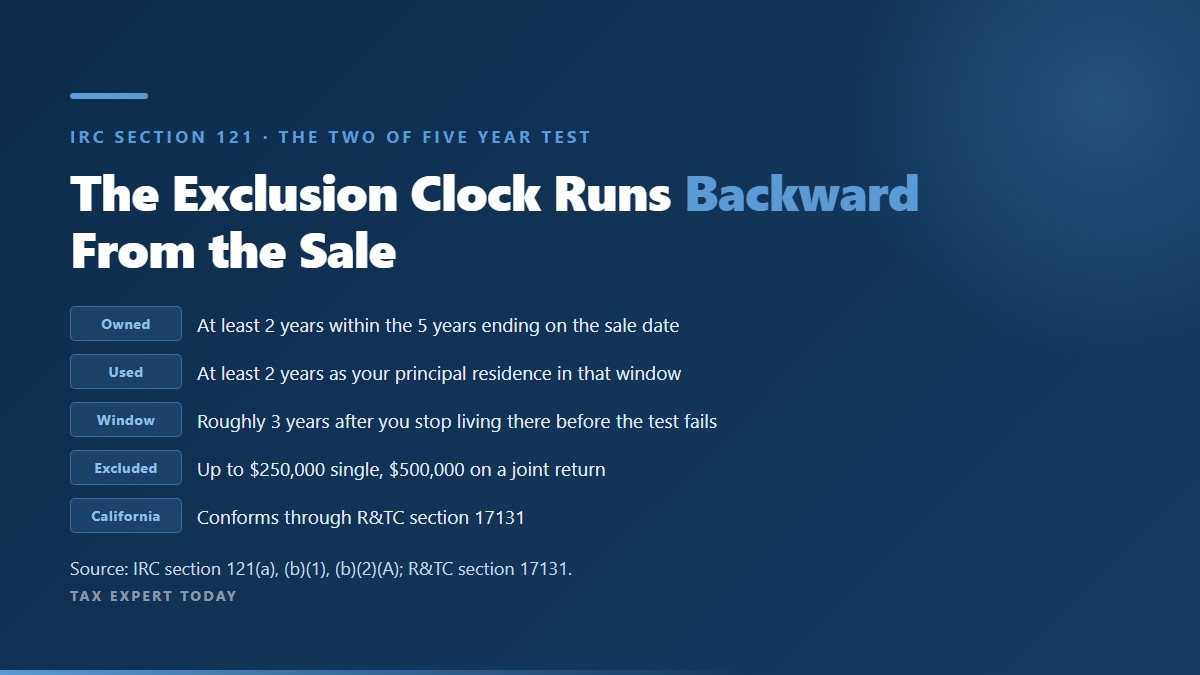
The Franchise Tax Board page on income from the sale of your home, last updated January 7, 2026, puts it in one sentence: the state conforms to the federal rules and allows the exclusion. Section 121(a) requires that during the five year period ending on the sale date, the property was owned and used as your principal residence for periods aggregating two years or more. Ownership and use do not have to occur at the same time. Section 121(b)(1) caps the exclusion at $250,000, and section 121(b)(2)(A) raises it to $500,000 on a joint return when either spouse meets the ownership test and both spouses meet the use test.
- The clock runs backward from the sale, not forward from the move. If you lived in the house as your principal residence for the two years before you left, you can move to Florida and still sell up to three years later while satisfying the two of five year test.
- One sale every two years. Section 121(b)(3) denies the exclusion if you already used it on another sale within the two years ending on this sale date, which matters when a Florida house is bought and flipped quickly.
- Conformity is not automatic on everything. Section 17131 applies the federal exclusions “except as otherwise provided,” so conformity should be confirmed item by item rather than assumed across the whole return.
- The exclusion is a gain rule, not a sourcing rule. Excluded gain is excluded for both governments. Gain above the cap remains California source income and lands on a nonresident return.
The section 121 clock after a California move
| Fact pattern | Use in the 5 years before sale | Exclusion available? |
|---|---|---|
| Lived in the home 6 years, moved to Florida, sold 18 months later | 2 years or more | Yes, full exclusion |
| Lived in the home 4 years, moved, sold at the 2 year 11 month mark | Just over 2 years | Yes, but the margin is thin |
| Lived in the home 5 years, moved, sold after 3 years and 2 months | Under 2 years | No, the test fails |
| Lived in the home 14 months, moved for a new job, sold | Under 2 years | Partial, under the reduced exclusion for a change in employment |
| Bought and sold a Florida home in between | May still qualify | Blocked if the other sale used section 121 within 2 years |
The three year window is the practical headline. A departing Californian who wants the exclusion has roughly three years from the day the house stops being the principal residence before the two of five year test starts to fail. That window is the reason the sale timing conversation belongs in the move planning, not after it.
What is Form 593 withholding and how much is taken at closing?
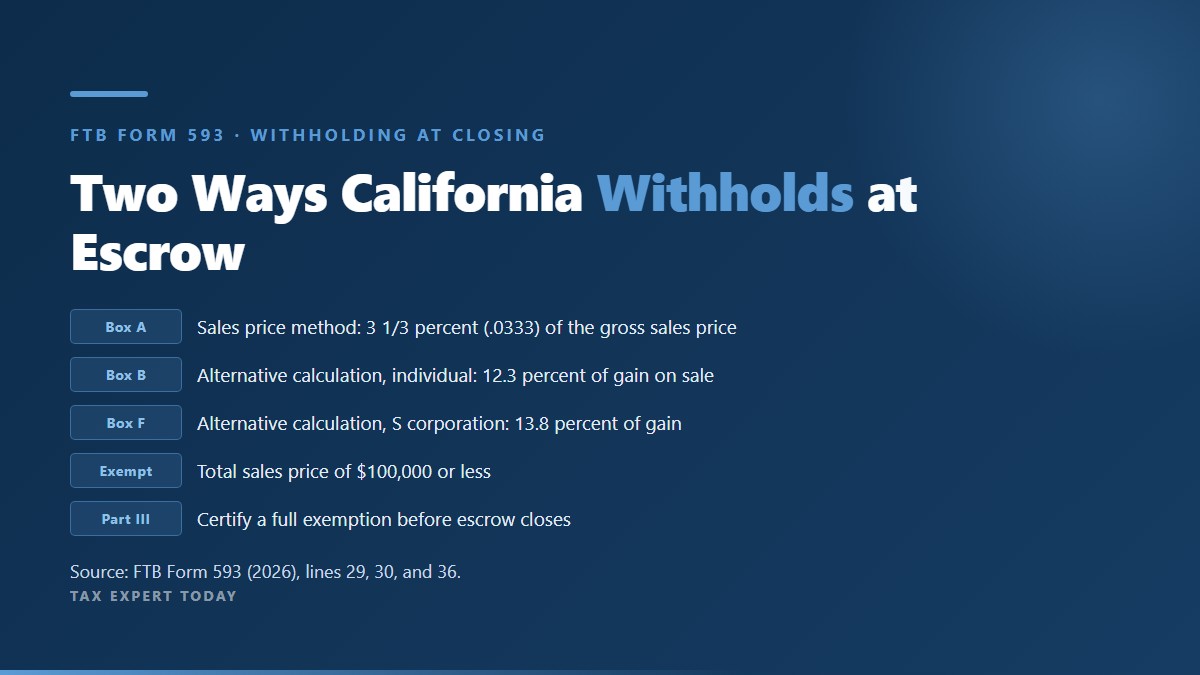
Form 593 is the Real Estate Withholding Statement that California requires on essentially every transfer of California real property. Under the default sales price method on line 36 box A, the remitter withholds 3 1/3 percent, stated on the form as .0333, of the gross sales price. Note that this is a percentage of the price, not of the gain. The form itself, the nine Part III certifications and the crossover between the two withholding methods are walked through line by line in our dedicated guide to California Form 593.
The authority is Revenue and Taxation Code section 18662, which lets the Franchise Tax Board require withholding at source, implemented through California Code of Regulations title 18, sections 18662-0 through 18662-6 and section 18662-8. As the Franchise Tax Board explains on its real estate withholding page, those regulations were revised effective November 2019, and since January 1, 2020 a single Form 593 covers every real estate transaction. FTB Publication 1016, revised February 2026, is the operating manual.
- Withholding is a prepayment, not a separate tax. Publication 1016 says so in plain terms. It is credited against the tax you actually owe when you file.
- Gross price is the base under the default method. On a property with a large mortgage or a modest gain, 3 1/3 percent of the price can far exceed the real tax.
- Sales of $100,000 or less are exempt. Multiple parcels sold in one escrow are aggregated for that test, so three parcels at $50,000, $10,000, and $60,000 trigger withholding on the combined price.
- The paperwork has a deadline. Form 593 goes to the Franchise Tax Board and to the seller by the 20th day of the month following the close of escrow.
Be careful with the numbers circulating online. Several widely cited pages describe this as “3.3 percent” or “3.33 percent.” The form itself says 3 1/3 percent (.0333), and on a seven figure sale the rounding difference is not trivial.
Can you avoid Form 593 withholding after you have already moved out?
Often yes, and this is the provision the competing guides omit. Form 593 Part III line 2 certifies that the seller last used the property as a principal residence under section 121 “without regard to the two-year time period.” A departed owner who has moved out can certify to a full withholding exemption even when the two of five year test would not be met.
Publication 1016 describes the same certification under the heading “Property Last Used as a Principal Residence,” and it adds a qualifier that deserves emphasis: the relief applies “for withholding purposes only.” That phrase is the whole point. Certifying line 2 stops the cash from leaving escrow. It does not decide whether the gain is taxable. Those are two different questions and confusing them is how a seller ends up with an unexpected balance due in April.
- Line 1 is the ordinary principal residence certification for a seller who meets section 121 outright.
- Line 2 is the departed owner’s provision, available when the home was last used as your principal residence, without the two year test.
- Line 3 covers a loss or zero gain, which requires completing the Part VI computation rather than simply checking a box.
- A false certification carries a penalty. Publication 1016 sets it at the greater of $1,000 or 20 percent of the required withholding for a certificate the seller knowingly signs falsely.
- Timing is strict. The completed and signed Form 593 must reach the buyer or the escrow person before the transaction closes, or withholding happens regardless.
Form 593 Part III full exemption certifications
| Part III line | Certification | Typical departing seller |
|---|---|---|
| 1 | Property qualifies as the seller’s principal residence under IRC section 121 | Sold within the two of five year window |
| 2 | Seller last used the property as a principal residence, without regard to the two year period | Moved out first, sold later, window has closed |
| 3 | Loss or zero gain for California purposes, computed in Part VI | Bought near the top of the market |
| 4 | Compulsory or involuntary conversion with replacement intended under IRC section 1033 | Fire, condemnation, or threat of condemnation |
| 5 | Nonrecognition under IRC section 351 or section 721 | Contribution to a controlled entity |
| 6 to 9 | Entity and tax exempt seller certifications | Corporations, partnerships, exempt entities, certain trusts and plans |
Sellers who kept the property and rented it out instead of selling should read our companion piece on the California part year resident return, since rental income raises the same nonresident filing question every year rather than once.
How is the alternative withholding calculation different from the 3 1/3 percent method?
The alternative calculation on Form 593 line 29 withholds a percentage of the estimated gain rather than of the sales price. For an individual the rate is 12.3 percent applied to gain on sale. On a property with a large mortgage, heavy selling costs, or a modest gain, electing the alternative method usually leaves far less cash sitting with the state.
Part VI of the form walks the computation: selling price, less selling expenses, gives amount realized; purchase price adjusted for points, depreciation, other decreases, additions and improvements, and other increases gives adjusted basis; suspended passive activity losses from that property are added; the difference is the estimated gain. Line 29 then applies the rate for the filing type, and line 36 records which method was chosen.
- The election is the seller’s to make, but it requires actually completing the Part VI computation rather than checking a box.
- The individual rate is 12.3 percent, not 13.3 percent. The additional 1 percent mental health services tax on income above $1,000,000 under Revenue and Taxation Code section 17043 is outside the withholding rate, so a large gain can be under-withheld even after electing the alternative method.
- Either method is a prepayment. Choosing one over the other changes the cash flow and the size of the refund, never the final liability.
- Escrow cannot advise you. The form states plainly that title and escrow persons are not authorized to give legal or accounting advice on determining withholding amounts.
Form 593 withholding methods compared
| Method | Form 593 box | Rate | Applied to |
|---|---|---|---|
| Sales price method (default) | Line 36, box A | 3 1/3 percent (.0333) | Sales price, boot, or installment payment |
| Alternative, individual | Line 36, box B | 12.3 percent | Gain on sale |
| Alternative, non-California partnership | Line 36, box C | 12.3 percent | Gain on sale |
| Alternative, corporation | Line 36, box D | 8.84 percent | Gain on sale |
| Alternative, bank and financial corporation | Line 36, box E | 10.84 percent | Gain on sale |
| Alternative, S corporation | Line 36, box F | 13.8 percent | Gain on sale |
| Alternative, financial S corporation | Line 36, box G | 15.8 percent | Gain on sale |
| Alternative, trust | Line 36, box H | 12.3 percent | Gain on sale |
What happens if you rented the California house out after you moved?
Renting the house out after you move generally does not reduce the section 121 exclusion. Section 121(b)(5)(C)(ii)(I) excludes from “period of nonqualified use” any portion of the five year period that falls after the last date the property was used as your principal residence. The rental period that follows your departure sits inside that carve out.
This is the most commonly misunderstood interaction in the entire departing homeowner analysis, and it is missing from every result currently ranking for this topic. The nonqualified use rule in section 121(b)(5) was written to stop taxpayers from converting a long held rental into a residence at the end and excluding all of the appreciation. It was not written to punish someone who lived in a home, moved, and rented it out while the house was listed or while the market recovered.
- Order matters more than duration. Rental use that comes after the residential use is carved out. Rental use that comes before it is generally nonqualified use.
- The pre 2009 shield. Section 121(b)(5)(C)(i) excludes any period before January 1, 2009 from nonqualified use entirely, which protects long held properties.
- The five year test still governs. The carve out preserves the exclusion percentage. It does not extend the two of five year window, so a long rental period after the move eventually fails the underlying test in section 121(a).
- Depreciation is handled separately. Section 121(b)(5)(D)(i) applies the nonqualified use allocation after the depreciation rule in section 121(d)(6), so the two provisions do not overlap.
Owners who intend to hold the California property rather than sell it should also review the California residency audit guide, because a retained California home is one of the closest connection factors the Franchise Tax Board weighs most heavily.
How does depreciation change California capital gains tax on home sale results?
Depreciation claimed while the property was a rental is not eligible for the exclusion. Section 121(d)(6) provides that the exclusion does not apply to gain up to the depreciation adjustments, as defined in section 1250(b)(3), attributable to periods after May 6, 1997. That amount is taxable on both returns even when the rest of the gain is fully excluded.
Those adjustments are measured under Internal Revenue Code section 1250(b)(3), and the IRS walks the same computation in Publication 523, Selling Your Home. The practical consequence for a departing Californian who rented the house out is a smaller than expected exclusion benefit and a California source item that survives even a clean section 121 position. Because California conforms to section 121 through section 17131, it inherits the section 121(d)(6) limitation along with the exclusion itself.
- The May 6, 1997 date is a hard boundary. Depreciation adjustments before it are outside the rule.
- Allowed or allowable. Depreciation adjustments are measured under section 1250(b)(3), so failing to claim depreciation does not avoid the recapture.
- Form 593 accounts for it too. Part VI line 18 subtracts depreciation from basis, so the estimated gain used for the alternative withholding election already reflects it.
- Report it as California source. The recaptured portion is gain on California real property and belongs on the nonresident return.
How do you report the sale and claim the withholding credit on Form 540NR?
A nonresident reports the California source gain on Form 540NR, the California Nonresident or Part-Year Resident Income Tax Return, and claims the amount already withheld on line 83, captioned “Withholding (Form 592-B and/or Form 593).” Without that entry the withheld cash simply sits with the Franchise Tax Board and is never refunded.
That caption and line number come from the 2025 Form 540NR itself, and the residency definitions that decide which return you file are set out in FTB Publication 1031, Guidelines for Determining Resident Status. This is the step that turns escrow withholding back into money. The Form 593 that the remitter files creates the credit, and the copy you receive is your documentation. Sellers who close in the same year they move will file a part year return rather than a pure nonresident return, which changes the allocation columns but not the line 83 credit claim.
- File even when the exclusion covers everything. If withholding occurred, a return is the only mechanism to recover it.
- Keep the Form 593 copy. Publication 1016 directs sellers to retain a copy for five years.
- Move year sales file differently. A sale in the year of the move goes on a part year return, where the Schedule CA allocation columns matter.
- Federal reporting continues in parallel. The federal side uses Schedule D and, where state and federal amounts differ, California Schedule D (540) reconciles them.
The mechanics of that move year return, including the effective rate method and the Schedule CA column structure, are covered in detail in our Form 540NR part year resident guide. Sellers whose equity compensation vested around the same move should also see the California RSU allocation guide.
Does moving to Florida change California capital gains tax on home sale outcomes?
Florida adds nothing to the bill. The Florida Constitution, Article VII, section 5(a), bars a state income tax on the income of natural persons, so the Florida side of a California home sale is zero. What the move changes is everything else on the return, which is why the corridor planning conversation is about the other income items rather than about the house.
The asymmetry is worth stating plainly, because it is the source of most of the disappointment. A client who moves to Naples, Florida in March and sells the Los Angeles house in September often expects the sale to be tax free because Florida has no income tax. Florida charges nothing. California still charges its full amount on the gain above the exclusion, at ordinary rates, because California does not give capital gains a preferential rate the way the federal system does.
- No preferential state rate. California taxes capital gain as ordinary income, so the gain stacks on top of other California source income.
- Florida contributes zero. There is no Florida capital gains tax and no Florida income tax on individuals.
- No credit to claim. Because Florida imposes no tax on the gain, there is no other state tax credit to offset the California liability.
- The real savings are elsewhere. Wages, portfolio income, and retirement distributions are where a Florida move pays for itself, not on the California house.
- Document the Florida side anyway. A declaration of domicile under Florida Statutes section 222.17 strengthens the residency record that the rest of the return depends on.
California and Florida on the same sale
| Question | California | Florida |
|---|---|---|
| State tax on the gain? | Yes, at ordinary income rates | No individual income tax |
| Preferential long term capital gains rate? | No | Not applicable |
| Withholding at closing? | Yes, Form 593 | None for a state income tax |
| Does the section 121 exclusion apply? | Yes, via R&TC section 17131 | Not applicable |
| Return required for a nonresident seller? | Form 540NR | None |
Readers weighing the whole picture should start with the complete California to Florida tax guide and, if a business entity is also making the move, the California LLC franchise tax analysis. The Florida side of a home sale, including the section 121 clock as it looks from a Florida residence, is covered in selling your home after moving to Florida.
What records should you keep before selling a former California home?
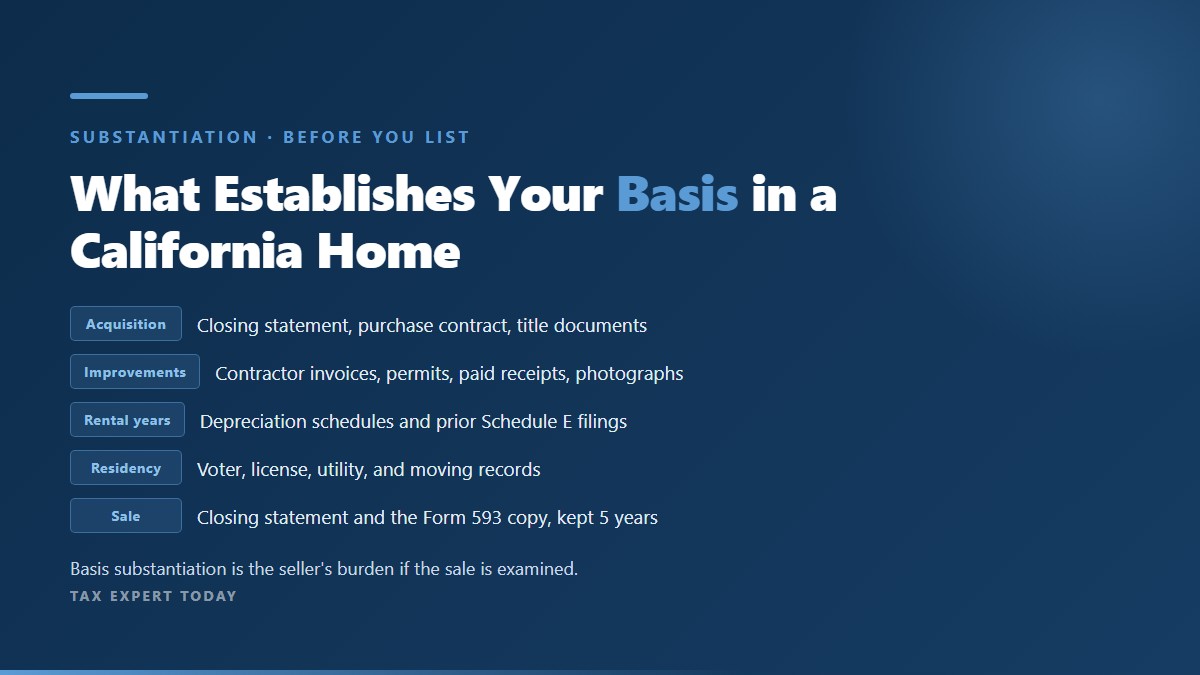
Basis documentation is the difference between a defensible number and an estimate. California will accept the gain you report, but if the Franchise Tax Board examines the sale, the burden of substantiating basis sits with you. Improvement receipts spanning decades are the item taxpayers most often cannot produce, and reconstructing them after closing is far harder than assembling them before.
- Purchase and sale documents establish the endpoints of the computation.
- Improvement receipts raise basis and directly reduce the gain, which is the highest value category to preserve.
- Depreciation schedules from any rental years drive the section 121(d)(6) amount.
- Residency evidence supports the section 121 use test and the date the property stopped being your principal residence.
Records by category
| Category | Documents to retain | Why it matters |
|---|---|---|
| Acquisition | Closing statement, purchase contract, title documents | Establishes original basis |
| Improvements | Contractor invoices, permits, paid receipts, before and after photographs | Increases basis and reduces taxable gain |
| Rental period | Depreciation schedules, prior Schedule E filings, lease agreements | Drives the section 121(d)(6) amount and the nonqualified use analysis |
| Residency | Voter registration, driver license history, utility records, moving records | Fixes the last date of principal residence use |
| Sale | Closing statement, Form 593 copy, escrow instructions | Establishes amount realized and supports the line 83 credit |
| Retention period | Keep the Form 593 copy for five years per Publication 1016 | Meets the Franchise Tax Board’s stated recordkeeping expectation |
California home sale tax help Naples and Southwest Florida
Tax Expert Today LLC works with clients who have relocated from California to Naples, Florida and across Southwest Florida, and the former California residence is one of the most frequent open items in that first filing season. The questions are practical: whether to certify a Form 593 exemption or elect the alternative withholding calculation, how the section 121 clock looks measured from the actual move date, and how the sale interacts with the rest of a move year return.
Our office is at 11983 Tamiami Trail N, Naples, FL 34110. Call (239) 441-2005, Monday through Friday, 10:00 a.m. to 5:00 p.m. Eastern. We are a multidisciplinary firm of tax advisors, enrolled agents, CPAs, and attorneys handling state residency and tax matters nationwide, including California Franchise Tax Board matters for clients who have relocated to Florida.
Related planning resources include our California tax services page, Naples tax planning, the California exit tax explainer, and the Florida 183 day rule calculator.
Local FAQ: I moved to Naples last year and still own my California house. Should I sell now?
The timing question usually turns on the section 121 clock rather than on the market. If the house was your principal residence for at least two of the five years ending on a prospective sale date, the exclusion is available, and that window generally runs about three years from the date you stopped living there. Waiting past that point can convert an excludable gain into a fully taxable California source item. Whether waiting is still the right call depends on your rental income, your basis, and the rest of your move year return, so the analysis should be run before you list rather than after you are in escrow.
When to Engage a Professional
A California home sale after a move crosses two tax systems and one withholding regime at the same time, and the decisions that matter most are made before escrow closes rather than at filing. Professional review is worth considering when any of the following apply:
- The gain may exceed the exclusion. Amounts above $250,000 single or $500,000 joint are California source income and taxed at ordinary rates.
- The property was rented at any point. Depreciation under section 121(d)(6) and the nonqualified use ordering rules require a computation, not an assumption.
- The two of five year window is close. A few months in either direction can change the entire outcome.
- The default withholding looks wrong. Where 3 1/3 percent of the price greatly exceeds the likely tax, the alternative calculation or a Part III certification may be appropriate.
- The sale falls in the move year. A part year return brings allocation questions that a pure nonresident return does not.
- Your residency position could be examined. A retained California home is a closest connection factor, and the sale sits inside that record.
Outcomes depend on individual facts, and nothing in this article is a prediction about any particular sale. To review your situation, call (239) 441-2005 or visit our California tax services page.
Frequently Asked Questions
Does California tax capital gains at a lower rate than ordinary income?
No. California has no preferential rate for long term capital gains. Gain from a home sale is taxed as ordinary income at the same graduated rates as wages, which is why the state figure often surprises sellers who are used to the federal long term rate.
Is Form 593 withholding an extra tax on selling a California home?
No. FTB Publication 1016 describes real estate withholding as a prepayment of income tax due on the gain, not an additional tax. It is credited on Form 540NR line 83 and refunded to the extent it exceeds the actual liability.
Can I claim the section 121 exclusion on my California return as a nonresident?
Yes. California conforms to the federal exclusion through Revenue and Taxation Code section 17131, so gain excluded federally is excluded for California as well. Gain above the exclusion remains California source income reportable on a nonresident return.
What if I sell the California house for less than I paid?
A loss or zero gain can be certified on Form 593 Part III line 3, which requires completing the Part VI computation. For California purposes a loss or zero gain means adjusted basis is greater than or equal to the selling price less selling expenses.
Does escrow have to withhold if the sale price is small?
Withholding is not required when the total sales price is $100,000 or less. Where multiple parcels sell in a single escrow, the combined price controls, so several small parcels together can exceed the threshold. If a California entity is also part of the picture, our guide to California LLC vs S corp covers the entity level charges that continue after a move.
Published August 11, 2026 by Dr. Pellumb Kabashi « Back to Learning Center
Have a question this article touches on?
Tax Expert Today LLC, based in Naples, Florida and serving clients across the United States.
Schedule a Consultation (239) 441-2005