
By Dr. Pellumb Kabashi, DBA, MBA, CES, CFE, EA
Founder, Tax Expert Today LLC · Tax advisors, enrolled agents, CPAs, and attorneys · Serving clients in all 50 states
Quick Answer: There is no California inheritance tax and no California estate tax. A California heir owes the state nothing for the act of receiving money or property. The bill that does arrive comes from somewhere else, because an inheritance tax follows the decedent and the property, never the beneficiary. Six states still levy one, and a California address does not shield an heir from any of them. Call (239) 441-2005 for a free consultation.
Does California Have an Inheritance Tax?
No. California does not impose an inheritance tax on a beneficiary, and it does not impose a state estate tax on a decedent. A California heir owes the state no tax for receiving cash, securities, a house, or a share of a trust. The State Controller confirms that for decedents dying on or after January 1, 2005, no California Estate Tax Return is required at all.
- No inheritance tax on the beneficiary. Receiving an inheritance is not, by itself, a taxable event in California.
- No state estate tax on the estate. California repealed its own inheritance and gift taxes effective June 8, 1982, and the State Controller still collects those older taxes only for decedents who died before that date.
- The pick-up tax died with the federal credit. California once collected an estate tax equal to the federal state death tax credit. The Economic Growth and Tax Relief Reconciliation Act of 2001 phased that credit out over four years beginning in January 2002, and the State Controller records that the credit was eliminated effective January 1, 2005.
- No California generation-skipping transfer tax. The State Controller states that the California generation-skipping transfer tax does not apply to generation-skipping transfers after December 31, 2004.
- The residence form still exists. The State Controller continues to provide a Declaration Concerning Residence form for decedents who owned property in California but were not California residents, which is a useful reminder that the state still asks where a decedent lived.
That is the whole of the in-state answer, and it is where nearly every other guide stops. It is also the answer least likely to fit the situation of the person asking. Heirs who search for a California inheritance tax are usually not asking an abstract question about California law. They are holding a letter, an executor email, or a form from a state on the other side of the country, and they want to know whether a California address changes anything. It does not.
What Is the Difference Between an Estate Tax and an Inheritance Tax?
An estate tax is charged to the estate before anything is distributed, and it is measured by the total size of what the decedent owned. An inheritance tax is charged on each beneficiary share, and it is measured by who is receiving it. California levies neither, which is why the phrase California inheritance tax describes a tax that does not exist, while the underlying question usually still has a real answer.
- Different taxpayer. The estate pays an estate tax. The beneficiary bears an inheritance tax, even where the executor writes the check out of estate funds.
- Different measure. An estate tax looks at one total. An inheritance tax looks at each share separately, which is why a single estate can produce six different rates for six heirs.
- Different exemption logic. Estate tax exemptions are large and apply once. Inheritance tax exemptions are small, apply per beneficiary, and turn on the family relationship.
- They can both apply. Nothing prevents a federal estate tax and a state inheritance tax from reaching the same estate.
- Iowa states the contrast plainly. Its revenue department describes its inheritance tax as based on the right of a beneficiary to receive property, in contrast to the federal estate tax, which is a tax upon the entire amount of property owned by the decedent at the time of death.
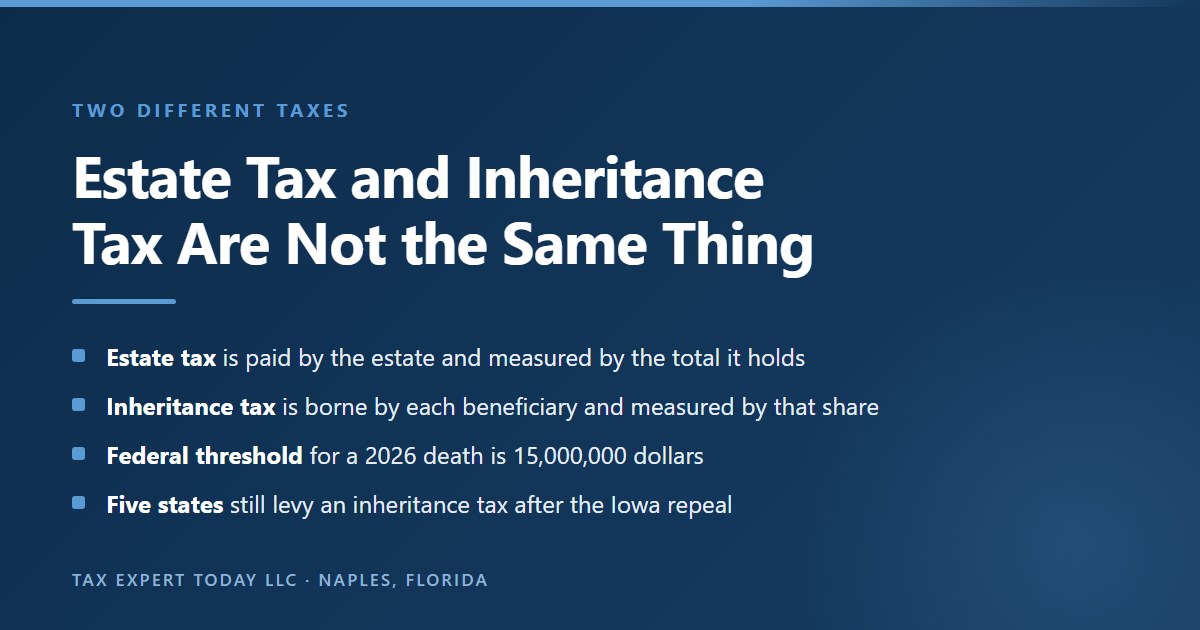
| Feature | Estate tax | Inheritance tax |
|---|---|---|
| Who is taxed | The estate as a whole | Each beneficiary on that beneficiary share |
| What sets the amount | Total value of the estate | Relationship of the heir to the decedent |
| Where it exists for a 2026 death | Federal, plus a minority of states | Pennsylvania, New Jersey, Kentucky, Maryland, Nebraska |
| California version | None since the pick-up tax ended January 1, 2005 | None for deaths on or after June 8, 1982 |
| Typical exemption size | Large, 15,000,000 dollars federally for 2026 | Small, and often measured in tens of thousands per person |
| Does the heir residence matter | No | No |
Did California Ever Have an Inheritance Tax?
Yes, and the repeal date still matters for old estates. The State Controller continues to collect the California inheritance tax for decedents who died before June 8, 1982, and the California gift tax for gifts made before that same date. For every death since, there has been no California inheritance tax at all.
- June 8, 1982 is the dividing line. Deaths before that date remain within the old inheritance tax system administered by the State Controller.
- A second system ran until 2005. Between June 8, 1982 and January 1, 2005, California required an estate tax return whenever a federal Form 706 was filed, because the state collected an amount equal to the federal state death tax credit.
- The federal credit is what ended it. The 2001 federal act phased out the state death tax credit over four years from January 2002, and its elimination on January 1, 2005 removed the California tax with it.
- Generation-skipping transfers followed. The California generation-skipping transfer tax stopped applying to transfers after December 31, 2004.
- Nothing has replaced it. Proposals to introduce a new California death tax or wealth tax have been advanced from time to time, but none of them is law, and an heir today is governed by what is enacted rather than what is proposed.
The distinction between a proposal and an enacted statute causes real confusion in this area, and it is the same confusion that surrounds the wealth tax bills discussed in our guide to the California exit tax. A bill that is introduced, reported in the press, and never passed does not create an obligation.
Why Can a California Heir Still Get an Inheritance Tax Bill?
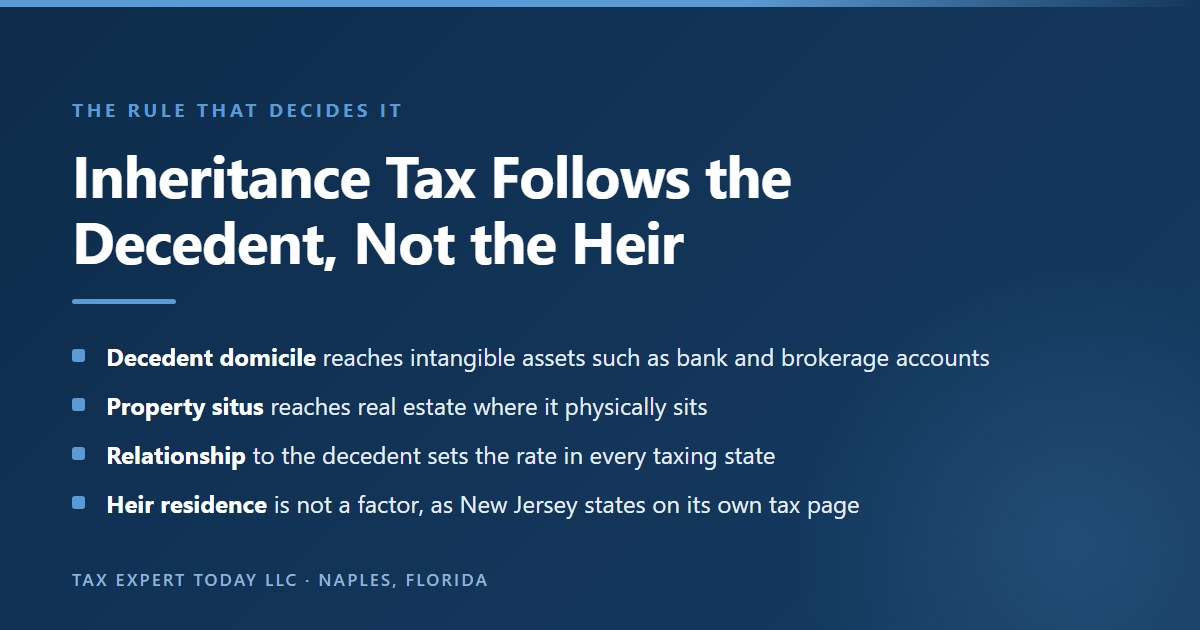
Because an inheritance tax follows the decedent and the property, not the heir. Six states still levy one, and each measures the tax by where the decedent was domiciled and where the assets sat, not by where the beneficiary lives. New Jersey states the rule in a single sentence on its own tax page: where the beneficiaries lived is not a factor.
- An heir address is not the test. Moving to California, or living there for a lifetime, does nothing to an inheritance tax imposed by the state where the decedent lived.
- The decedent domicile is the first trigger. A person who died domiciled in an inheritance tax state generally exposes the whole estate to that state tax, with real estate located elsewhere usually carved out.
- Property location is the second trigger. Even when the decedent lived somewhere with no inheritance tax, real property physically located in a taxing state can pull the estate back in.
- The family relationship sets the rate. Every one of these states taxes by closeness of kin. A surviving spouse usually pays nothing, while a niece, a nephew, or a friend pays the most.
- The clock runs from the date of death. These are not April deadlines. Pennsylvania treats the tax as due at the death of the decedent and delinquent nine months later.
The Six States That Still Levy an Inheritance Tax
| State | Rate structure for deaths in 2026 | What can reach a California heir |
|---|---|---|
| Pennsylvania | 0 percent to a surviving spouse, and to a parent from a child aged 21 or younger; 4.5 percent to direct descendants and lineal heirs; 12 percent to siblings; 15 percent to other heirs | A decedent domiciled in Pennsylvania, or Pennsylvania real property. The tax is due at death and delinquent after nine months, with a 5 percent discount if paid within three months. |
| New Jersey | Graduated by beneficiary class, with the closest relatives in Class A exempt and remoter classes taxed | A resident decedent is reached on almost everything owned. A non-resident decedent is reached on New Jersey property, usually real estate. New Jersey imposes no estate tax for deaths on or after January 1, 2018. |
| Kentucky | Graduated by beneficiary class, with the closest relatives receiving the largest exemptions and the smallest rates | All property of a Kentucky resident except real estate located in another state, plus Kentucky real and personal property owned by a nonresident. A 5 percent discount applies if the tax is paid within nine months. |
| Maryland | 10 percent of the clear value of the property that passes, with close relatives exempt | Maryland decedents and Maryland property. Clear value means fair market value minus expenses under Tax-General section 7-204. |
| Nebraska | For deaths on or after January 1, 2023: 1 percent above 100,000 dollars for immediate relatives; 11 percent above 40,000 dollars for remote relatives; 15 percent above 25,000 dollars for all others | Administered at the county level. The exempt amounts apply to each person receiving property, not once per estate. |
| Iowa | Repealed | Nothing, for a recent death. The Iowa Department of Revenue states that Iowa inheritance tax is not applicable for deaths occurring on or after January 1, 2025. |
Iowa appears on this list because the repeal is recent enough that older guidance still describes the tax as live. If the decedent died before January 1, 2025, the Iowa tax can still apply to that estate, which is one of several reasons the date of death matters far more than the date an heir found out.
Which State Can Actually Tax a California Heir?
Two facts decide it, and neither is the heir residence. The first is where the decedent was domiciled at death. The second is where the property was physically located. Kentucky states the combined rule directly: all property belonging to a Kentucky resident is subject to the tax except real estate located in another state, and real estate and personal property located in Kentucky and owned by a nonresident is subject to being taxed.
- Domicile reaches intangibles. Bank accounts, brokerage accounts, and business interests generally follow the decedent domicile, wherever the institution happens to be chartered.
- Situs reaches real property. Land and buildings are taxed where they sit, which is why a taxing state carves out the out-of-state real estate of its own residents and taxes nonresidents on in-state real estate at the same time.
- Tangible personal property usually follows location. A vehicle, farm equipment, or the contents of a house are commonly sourced to the place where the item physically was.
- Two states can both be involved. A Pennsylvania decedent who owned a Kentucky farm can produce filings in both places, and the two systems do not coordinate on behalf of the family.
- The estate usually pays before an heir sees the money. In most of these states the executor settles the tax out of estate assets, so a California heir often experiences the tax as a smaller distribution rather than as a separate bill.
New Jersey is the instance readers raise most often, because a great many California residents have New Jersey parents. The rules for a nonresident decedent, the four filing methods, the ratio formula and the lien period are set out in our guide to New Jersey inheritance tax nonresident rules, which handles that state from the estate side in the detail it deserves.
What If the Decedent Owned California Property but Lived Elsewhere?
California still wants the residence question answered, even though it collects no inheritance tax. The State Controller provides a Declaration Concerning Residence form specifically for decedents who had property located in California but were not California residents. The form does not create a tax. It establishes, for the record, that the decedent was domiciled elsewhere.
- The form exists for a reason. Where a decedent held California real property while living in another state, someone eventually has to document which state was home.
- Domicile is a question of fact. It is decided on the whole pattern of a life rather than on a single document, which is the same standard the Franchise Tax Board applies to living taxpayers.
- The answer can point both ways. A decedent treated as a California resident may create California fiduciary filing obligations for the estate under section 17742(a).
- Other states ask the mirror question. An inheritance tax state needs to know whether the decedent was its resident, because that determines whether it reaches everything or only in-state property.
- Documentation gathered during life is worth more. Records assembled after a death are harder to obtain and easier to challenge.
Families who moved out of California and kept a property there are the most common version of this fact pattern, and the residency evidence the Franchise Tax Board weighs is set out in our guide to the California residency audit. Where a move happened partway through a year, the filing mechanics are covered in our guide to California part year resident tax and Form 540NR.
When Are These Inheritance Taxes Actually Due?
The deadlines run from the date of death, not from the end of a tax year, and several states pay a discount for early settlement. This is the single most common procedural surprise for a California heir, because the familiar April rhythm of income tax filing does not apply anywhere in this area.
- The clock starts at death. Pennsylvania treats the tax as due upon the death of the decedent, with delinquency at nine months.
- Early payment can be rewarded. Pennsylvania allows a 5 percent discount for payment within three months, and Kentucky allows a 5 percent discount for payment within nine months.
- Instalment relief exists in places. Kentucky permits an election to pay in 10 equal annual instalments where a beneficiary net liability exceeds 5,000 dollars and the return is filed on time, with interest running from 18 months after the date of death.
- Interest is not the same as a penalty. A deferral that is properly elected still carries interest, which is a cost rather than a sanction.
- An heir rarely controls the timetable. The executor files, so a beneficiary who wants the discount has to raise it early.
| State | When the tax is due | Early payment or deferral relief |
|---|---|---|
| Pennsylvania | Due at the death of the decedent, delinquent nine months later | 5 percent discount if paid within three months of death |
| Kentucky | Payable when the return is filed | 5 percent discount if paid within nine months. Election to pay in 10 equal annual instalments where liability exceeds 5,000 dollars, interest from 18 months after death |
| New Jersey | Set by the Division of Taxation, running from the date of death | Handled through the estate filing, with four available filing methods for a nonresident decedent |
| Maryland | Administered through the Register of Wills during estate administration | Settled as part of the probate process |
| Nebraska | Administered at the county level during estate administration | Per-beneficiary exempt amounts apply before any tax is calculated |
| Federal estate tax | Form 706 generally due nine months after death | Extension of time to file is available, which is not an extension of time to pay |
How Is an Inherited Retirement Account Taxed in California?
An inherited traditional retirement account is the item most likely to produce a real California tax bill, because the account holds dollars that were never taxed. There is no California inheritance tax on receiving it, and there is ordinary California income tax on every dollar distributed out of it while the beneficiary is a California resident.
- Receipt is not the taxable event. Becoming the beneficiary of an account does not itself create income.
- Distributions are ordinary income. Amounts taken out of an inherited traditional IRA or 401(k) are taxed at ordinary rates federally and by California for a California resident.
- Most beneficiaries face a 10 year window. The IRS provides that distributions to a designated beneficiary who is not an eligible designated beneficiary must be completed within 10 years of the death of the owner.
- Eligible designated beneficiaries are treated differently. The IRS defines that group as the surviving spouse, a minor child of the owner, a disabled individual, a chronically ill individual, and any other individual not more than 10 years younger than the owner.
- Residency during the withdrawal window is what matters. Because the tax attaches to the distribution rather than to the inheritance, the state an heir lives in during those 10 years drives the state result.
That last point is where an inheritance and a residency change intersect most sharply. A beneficiary with a 10 year window and a planned move has some genuine control over the state tax outcome, and the sequencing question is the same one that arises in our guide to moving to Florida before selling a business. Where a household is split across two states during the same period, the trap described in our guide to dual state residency can apply as well.
What Does a California Heir Actually Owe on an Inheritance?
Nothing on the inheritance itself, and something on what the inherited assets earn afterward. The transfer is not income. The income the property produces after the date of death is income, and so is any item the decedent had earned but not yet been taxed on. That second category, income in respect of a decedent under IRC section 691, is where most unexpected California bills originate.
- The corpus is not taxable income. A 400,000 dollar bequest is not reported as income on a federal or California return.
- Post-death earnings are taxable. Interest, dividends, and rent generated after the date of death belong to whoever owns the asset, and a California resident reports them to California.
- Inherited traditional retirement accounts are ordinary income when distributed. A traditional IRA or 401(k) carries untaxed dollars, and distributions to the beneficiary are taxed as ordinary income for both federal and California purposes.
- Income in respect of a decedent keeps its character. Under IRC section 691, amounts the decedent had a right to receive but never included in income are taxed to the person who acquires that right by bequest, devise, or inheritance.
- Selling later is a capital gain question, not an inheritance question. Gain is measured against the new basis, which is the subject of the next section.
This distinction is the practical heart of the matter. An heir who receives a house and a brokerage account pays no California inheritance tax on either, then finds that the rental income from the house and the dividends from the account are fully taxable in California from the date of death forward. Nothing about that is a death tax. It is ordinary income taxation applied to newly owned assets, and it starts immediately.
How Does the Step-Up in Basis Work for a California Heir?
IRC section 1014 resets the basis of inherited property to its fair market value at the date of the decedent death. That single rule usually matters far more to a California heir than any inheritance tax question, because it can erase decades of appreciation before a sale. California conforms to it, and community property receives treatment that is better still.
- The general rule. Basis becomes the fair market value of the property at the date of death, under IRC section 1014(a)(1).
- Alternate valuation. If the executor elects under section 2032, the basis is the value at the alternate valuation date instead.
- Community property gets a full adjustment. Section 1014(b)(6) treats the surviving spouse one-half share of community property as having been acquired from the decedent, provided at least one-half of the whole community interest was includible in the decedent gross estate.
- That is a genuine California advantage. In a community property state, the death of one spouse can adjust the basis of the entire asset rather than only the deceased spouse half.
- Losses adjust too. The rule is a reset, not a discount. Property that fell in value receives a lower basis.
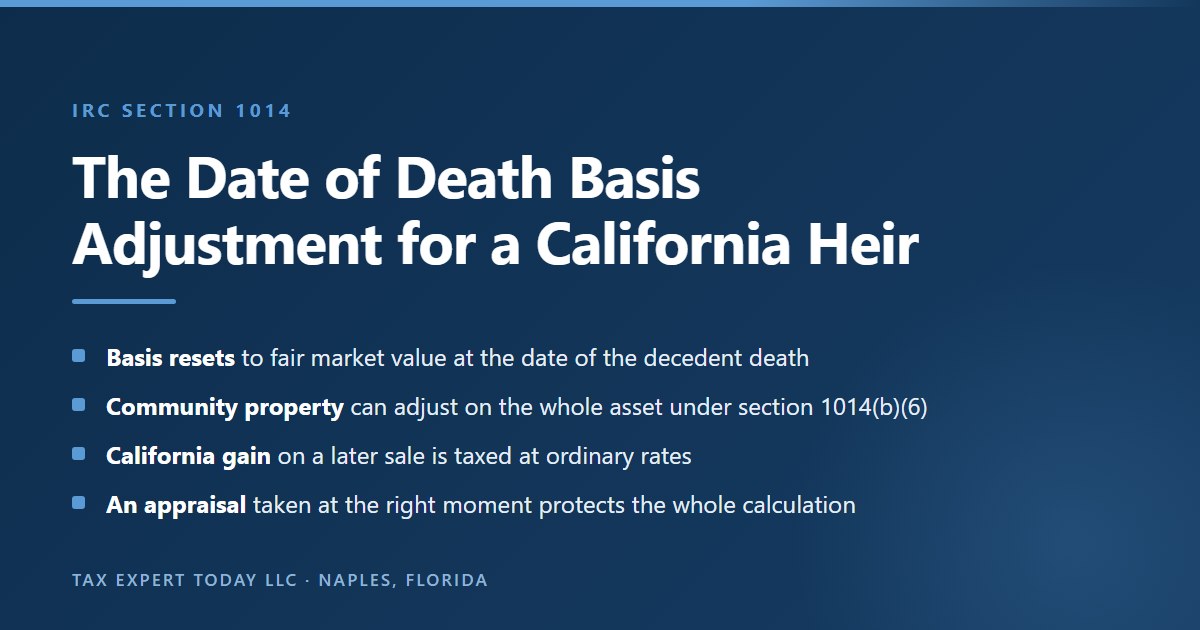
The community property point deserves emphasis because it is where California treatment diverges from most of the country and where the arithmetic is largest. A couple who bought a home in California decades ago at a low price, and held it as community property, can see the basis of the whole property adjust to date of death value when the first spouse dies. A couple who held the identical asset as joint tenants in a separate property state generally adjusts only the decedent half. The planning consequence is real, and it is a question worth settling before a sale rather than after one.
What happens next, when a California heir sells inherited real property, is a separate calculation and one we cover for a related fact pattern in our guide to selling your home after moving to Florida.
When Does the Federal Estate Tax Apply?
Only to large estates, and it is paid by the estate rather than by the heir. The IRS filing threshold is tied to the year of the decedent death, and for a death in 2026 the threshold is 15,000,000 dollars. Below that figure, with no lifetime taxable gifts to add back, there is no federal estate tax return and no federal estate tax.
- The estate is the taxpayer. A beneficiary does not pay the federal estate tax out of pocket.
- Lifetime gifts count. The IRS measures the gross estate increased by adjusted taxable gifts and the specific gift tax exemption against the threshold for the year of death.
- The threshold moves every year. Use the figure for the year the decedent died, not the year the estate is settled.
- There is no California layer. California adds no state estate tax on top of the federal calculation.
Federal Estate Tax Filing Thresholds by Year of Death
| Year of death | Filing required if the amount exceeds |
|---|---|
| 2022 | 12,060,000 dollars |
| 2023 | 12,920,000 dollars |
| 2024 | 13,610,000 dollars |
| 2025 | 13,990,000 dollars |
| 2026 | 15,000,000 dollars |
The lifetime exemption side of the same system, including how a surviving spouse preserves an unused amount, is covered in our guide to the lifetime gift tax exemption for 2026.
Does California Tax the Income of the Estate Itself?
Yes, and the rule is written in a way that catches families off guard. Revenue and Taxation Code section 17742(a) provides that the tax applies to the entire taxable income of an estate if the decedent was a resident, regardless of the residence of the fiduciary or beneficiary. The estate of a California decedent files with California even when the executor and every heir live elsewhere.
- The decedent residence controls for an estate. A California decedent produces a California fiduciary filing obligation for the estate.
- The executor location is irrelevant. Section 17742(a) says so expressly.
- The beneficiary location is irrelevant as well. This is the mirror image of the inheritance tax rule, and it points the other way.
- Trusts are governed by a different clause of the same section. For a trust, the statute looks to whether a fiduciary or a non-contingent beneficiary is a California resident, regardless of where the settlor lived.
That trust clause is the reason a California beneficiary can pull a trust into California taxation even when nothing else about the trust is Californian, and it is a large enough subject to stand on its own. We treat it in full, including the Kaestner decision and what a change of situs does and does not fix, in our guide to trust situs after moving to Florida.
What Changes If the Heir Moves to Florida?
The inheritance tax exposure does not change, because it never depended on the heir residence in the first place. What changes is everything on the income side. Florida imposes no state income tax, no inheritance tax and no estate tax, so the ongoing tax on what the inherited assets earn can fall substantially once California residency genuinely ends.
- The decedent state tax is unaffected. A Pennsylvania or Maryland inheritance tax bill is the same whether the heir lives in Los Angeles or Naples.
- Post-death investment income is affected. Interest, dividends and capital gains on inherited intangible assets follow the owner residence.
- Inherited retirement distributions are affected. A distribution taken as a Florida resident is generally outside California reach, while the same distribution taken as a California resident is not.
- Inherited California real property is not affected. Real property stays sourced to California no matter where the owner lives.
- The move has to be real. A change of address does not end California residency by itself, and the Franchise Tax Board examines the question on the facts.
Timing an inheritance against a residency change is one of the more consequential decisions in this area, and it is easy to get backwards. The mechanics of what California keeps taxing after a move are set out in our guide to California source income, and the residency change itself is covered in our departure checklist for leaving California. Households planning the whole corridor may prefer the combined overview in moving from California to Florida taxes.
What Does a California Heir Owe at Each Stage?
Reading the answer as a timeline resolves most of the confusion. There are three moments that matter: the transfer itself, the period of holding the asset, and the eventual sale. California takes nothing at the first, taxes ordinary income at the second, and taxes gain above the stepped-up basis at the third.
| Stage | California result | Federal result | What decides it |
|---|---|---|---|
| Receiving the inheritance | No tax. There is no California inheritance tax. | No income tax on the transfer. Federal estate tax possible above 15,000,000 dollars for a 2026 death, paid by the estate. | The size of the estate, not the heir |
| A bill from another state | Not a California matter | Not a federal matter | The decedent domicile and where the property sat |
| Holding the asset | Ordinary income tax on interest, dividends and rent for a California resident | Ordinary income tax on the same items | Where the owner lives, except for real property |
| Taking a retirement distribution | Ordinary income tax while a California resident | Ordinary income tax, generally within a 10 year window | Residency at the time of the distribution |
| Selling the asset | Gain above the section 1014 basis, taxed as ordinary income by California | Capital gain above the section 1014 basis | Date of death value and community property status |
California is worth a separate note in the final row, because it does not apply a preferential capital gains rate. Gain on a sale is taxed at ordinary California rates, which makes the date of death valuation more valuable to a California heir than it would be in a state with a preferential rate. Getting an appraisal at the right moment is not a formality.
Households running the whole sequence at once, an inheritance alongside a residency change, may find the combined view in our guide to establishing Florida residency useful, and the day counting that supports it is set out in our Florida 183 day rule calculator. Where a former California employer is still delivering equity into the same period, the sourcing question is covered in our guide to California RSU tax after leaving the state.
What Is Commonly Mistaken for a California Inheritance Tax?
Several real taxes get called an inheritance tax because they arrive at roughly the same time. None of them is one. Sorting them apart matters, because the deadlines, the taxpayer, and the available planning are different in every row below.
| What people call it | What it actually is | Who pays it |
|---|---|---|
| California inheritance tax | Does not exist. Repealed effective June 8, 1982. | No one |
| Tax on the sale of an inherited home | Capital gains tax measured against the stepped-up basis under IRC section 1014 | The heir, on sale |
| Tax on an inherited IRA withdrawal | Ordinary income tax on a distribution of untaxed retirement dollars | The beneficiary, when distributed |
| The estate tax | Federal estate tax, above 15,000,000 dollars for a 2026 death | The estate |
| Property tax reassessment on an inherited home | A county property tax matter governed by Proposition 19, outside the scope of this guide | The heir, going forward |
| The bill from another state | That state inheritance tax, following the decedent domicile and property location | Usually the estate, sometimes the beneficiary |
The property tax row is listed only so it is not mistaken for the subject of this guide. Reassessment is a county assessor matter rather than an income or transfer tax question, and an heir facing it should raise it with a California property tax specialist or the county assessor directly.
What Records Should a California Heir Gather?
Five documents answer most of the questions above, and gathering them early is cheaper than reconstructing them later. The decisive items are the ones that fix the date of death, the decedent domicile, and the value of each asset on that date, because those three facts drive both the inheritance tax analysis and the basis calculation.
- The death certificate. It fixes the date that controls every threshold and every valuation.
- Evidence of the decedent domicile. The last tax return filed, the voter registration, and the address of record all bear on which state can tax the estate.
- Date of death valuations. An appraisal for real property, and account statements for securities, establish the new basis under section 1014.
- A schedule of assets by location. Real property and tangible items should be listed by the state where they sit, because situs decides several of the questions above.
- Any state inheritance tax return the estate filed. It shows what has already been paid and by whom.
Community property status deserves its own note in the file. Whether an asset was held as community property, separate property, or joint tenancy changes the basis outcome materially, and the answer is often clearer in the deed and the original purchase records than in the recollection of a family member years later.
California Inheritance Tax Help Naples and Southwest Florida
Our office is in Naples, Florida, and a substantial part of the practice is the California to Florida corridor: people who have moved, or are planning to, and who need the California side handled with the same care as the Florida side. Inheritance questions arrive in the middle of that corridor more often than any other single event, because a death in the family is frequently what prompts the move in the first place.
Tax Expert Today LLC is a multidisciplinary firm of tax advisors, enrolled agents, CPAs and attorneys handling state residency and tax matters nationwide. On these engagements the work is usually the same three items: establishing which state can tax the transfer, fixing the date of death basis correctly so a later sale is not overtaxed, and coordinating the California income tax consequences with a residency change if one is planned.
Tax Expert Today LLC
11983 Tamiami Trail N, Naples, FL 34110
Phone: (239) 441-2005
Hours: Monday through Friday, 10:00 a.m. to 5:00 p.m. ET
I inherited from a parent in another state and I live in Southwest Florida. Do I need a California analysis at all? Possibly, and the trigger is usually one of two things. If the decedent was a California resident, the estate itself may have a California filing obligation under section 17742(a) regardless of where the heirs live. If the heir was a California resident during any part of the year of the distribution, the income side may still touch California even after a move. Many Naples clients arrive believing the California chapter closed when they changed address and find that an inherited asset reopened it.
Broader planning for new and prospective Florida residents is described on our Naples tax planning page, and the California side of the engagement is outlined on our California tax services page.
When to Engage a Professional
Most inheritances involving a California heir need no specialist attention, because there is no California inheritance tax to plan around and the estate settles without a state transfer tax question. The situations below are the ones where an early review tends to be worth the cost.
- The decedent was domiciled in Pennsylvania, New Jersey, Kentucky, Maryland or Nebraska. A return is likely due in that state on a clock that runs from the date of death.
- The estate holds real property in more than one state. Situs rules can create filings in several places at once.
- The inherited assets include a traditional retirement account. The distribution timing interacts with the heir residency and with the applicable distribution period.
- The property was California community property. The basis outcome under section 1014(b)(6) is materially different from the joint tenancy result, and the difference is easiest to document early.
- A residency change is planned near the same time. Sequencing a move against a distribution or a sale changes the California result.
- The estate approaches the federal threshold. Adjusted taxable gifts are added back, so an estate below 15,000,000 dollars on paper can still require a return.
Every situation turns on its own facts, and the summaries above are general information rather than advice on any particular estate. A short conversation is usually enough to establish whether a matter needs more than the executor is already handling. Call (239) 441-2005 to arrange a consultation.
Frequently Asked Questions
Is there a California inheritance tax in 2026?
No. California imposes no inheritance tax and no state estate tax. The State Controller confirms that no California Estate Tax Return is required for decedents dying on or after January 1, 2005, and the state collects the older inheritance tax only for deaths before June 8, 1982.
How much can I inherit in California without paying tax?
There is no California limit, because there is no California inheritance tax at any amount. The federal estate tax is a separate matter paid by the estate, and for a death in 2026 it applies only above 15,000,000 dollars.
I live in California and inherited from a Pennsylvania relative. Do I owe Pennsylvania tax?
Very likely, because Pennsylvania taxes by the relationship of the heir to the decedent rather than by the heir residence. The rate is 4.5 percent for direct descendants and lineal heirs, 12 percent for siblings, and 15 percent for other heirs, with a surviving spouse exempt.
Does moving to Florida remove an inheritance tax bill?
No. Inheritance tax follows the decedent domicile and the location of the property, so a change in the heir residence does not affect it. A move can materially change the tax on income the inherited assets produce afterward.
Do I pay tax when I sell a house I inherited in California?
You pay capital gains tax on the appreciation after the date of death, not on the full sale price. IRC section 1014 resets the basis to fair market value at death, and community property may receive an adjustment on the entire asset rather than half.
Is an inherited IRA taxable to a California resident?
The account itself is not taxed on receipt, but distributions from a traditional inherited IRA are ordinary income for both federal and California purposes. A Roth account inherited under the usual conditions is treated differently.
Does the estate of a California decedent file a California return even if all heirs live elsewhere?
Yes for income tax purposes. Revenue and Taxation Code section 17742(a) applies the tax to the entire taxable income of an estate if the decedent was a resident, regardless of where the fiduciary or the beneficiary lives.
Published September 5, 2026 by Dr. Pellumb Kabashi « Back to Learning Center
Have a question this article touches on?
Tax Expert Today LLC, based in Naples, Florida and serving clients across the United States.
Schedule a Consultation (239) 441-2005