
By Dr. Pellumb Kabashi, DBA, MBA, CES, CFE, EA
Founder, Tax Expert Today LLC · Tax advisors, enrolled agents, CPAs, and attorneys · Serving clients in all 50 states
Quick Answer: The California NOL suspension denies the net operating loss deduction for tax years 2024, 2025, and 2026 when both net business income and modified adjusted gross income reach $1 million. The loss is not forfeited: carryover periods are extended, and 2027 is the first open year. After a move to Florida, the carryover is restated to California source amounts and offsets only later California source income. Call (239) 441-2005 for a free consultation.
The California NOL suspension is easy to summarize and surprisingly easy to misapply. The summary is one sentence: for taxable years beginning in 2024, 2025, and 2026, a California taxpayer whose net business income and modified adjusted gross income both reach $1,000,000 cannot deduct a net operating loss carryover on the California return. The misapplication starts with the second sentence, because most of what is written about the suspension is written for corporations, and an individual business owner, a partner, or an S corporation shareholder measures the threshold differently, carries the loss on a different form, and faces a question the corporate summaries never reach: what happens to a suspended California loss when the owner stops being a California resident.
This guide is written for that owner. It explains how the suspension works under Revenue and Taxation Code section 17276.24, whether anything ended it early, how the two $1,000,000 tests are measured on Form FTB 3805V, how long the suspended losses are extended, and what changed in the 2026 budget. It then turns to the move: how a California NOL carryover is restated when you become a Florida resident, how the move year is split, what the restated loss can still offset, and why the answer depends almost entirely on whether you will have California source income after you leave. Every example is a hypothetical illustration, not a description of any client.
The suspension is a state rule administered by the Franchise Tax Board. It has no effect on the federal net operating loss deduction under Internal Revenue Code section 172, which continues on its own terms on the federal return. Where federal and California treatment are compared below, the comparison is there to keep a federal assumption from shaping a California number.
What is the California NOL suspension?
The California NOL suspension is a temporary rule that disallows the net operating loss carryover deduction on California returns for taxable years beginning on or after January 1, 2024, and before January 1, 2027. It applies only when the taxpayer meets both $1,000,000 tests, and the disallowed losses carry forward with an extended life.
- Years covered: taxable years beginning in 2024, 2025, and 2026.
- Who is affected: individuals, estates, and trusts with net business income and modified AGI of $1,000,000 or more.
- What is denied: the deduction, not the loss itself; you keep computing and carrying it over.
- What you get back: a one to three year extension of the carryover period, depending on the loss year.
For individuals, the governing statute is Revenue and Taxation Code section 17276.24, in the Personal Income Tax Law. Subdivision (a) states that “a net operating loss deduction shall not be allowed” for the covered years, notwithstanding the general NOL rules in section 17276 and Internal Revenue Code section 172. The parallel rule for corporations is section 24416.24 in the Corporation Tax Law, which uses a single test of $1,000,000 of income subject to tax rather than the two tests that apply to individuals.
Both sections were added by SB 167 and amended by SB 175 as part of the 2024 budget. Section 17276.24 was amended again by SB 1435, the 2026 federal conformity bill (Stats. 2026, ch. 236, effective September 14, 2026). The September 2026 text keeps the same covered years, the same thresholds, and the same extension schedule.
California has done this before. The FTB net operating loss page describes the earlier suspension for 2020 and 2021, which was repealed for 2022, and the 2025 Form FTB 3805V instructions list suspensions for 2008 through 2011 as well. Each round used the same basic structure: deny the deduction, preserve the loss, extend its life.
| Suspension period | Individual threshold | Statute | Status |
|---|---|---|---|
| 2008 and 2009 | Net business income of $500,000 or more | Former suspension provisions (see FTB Legal Ruling 2011-04) | Ended |
| 2010 and 2011 | Modified AGI of $300,000 or more | Former suspension provisions | Ended |
| 2020 and 2021 | Net business income or modified AGI test at $1,000,000 | R&TC section 17276.23 | Ended; repealed for 2022 |
| 2024, 2025, and 2026 | Both net business income and modified AGI of $1,000,000 or more | R&TC section 17276.24 | In effect through taxable years beginning before January 1, 2027 |
Is the California NOL suspension still in effect for 2026?
Yes. The suspension applies to taxable years beginning in 2026. The statute allowed an early end only if the Director of Finance found the General Fund sufficient by May 14, 2026, and the Budget Act included legislation turning the section off. The 2026 budget tax bill did not do that, and the September 2026 statute still runs through 2026.
- The condition had two parts: a Director of Finance determination and Budget Act legislation.
- The 2026 budget: SB 122 extended the credit limitation and left the NOL end date alone.
- The FTB position: its NOL page still describes the suspension as covering 2024 through 2026.
- The reopening: taxable years beginning on or after January 1, 2027.
Subdivision (e) of section 17276.24 is the provision behind the many articles that describe an “escape valve.” It reads, for 2026, that the section “shall not apply if, by May 14, 2026, the Director of Finance determines that General Fund money over the multiyear forecast is sufficient without the revenue impact of the net operating loss suspension and credit limitation, and pursuant to legislation in the annual Budget Act to not apply this section of law.” Subdivision (e)(1) contains the same condition for 2025 with a May 14, 2025 date. The language is conjunctive. A favorable forecast alone was never enough; the Budget Act also had to carry the legislation.
The 2025 condition was not met, which is why the 2025 Form FTB 3805V instructions state that the deduction “is suspended for the 2024, 2025, and 2026 taxable years” for taxpayers above the thresholds. For 2026, the evidence points the same way. The 2026 budget tax trailer bill, SB 122 (Stats. 2026, ch. 23, effective June 29, 2026), amended the business credit limitation in section 17039.4 and the refundable credit election in section 17039.5 to run through taxable years beginning before January 1, 2030. It did not amend section 17276.24. Then SB 1435 re-enacted section 17276.24 in September 2026 with the January 1, 2027 end date intact and the 2026 condition still in the text.
We found no published determination by the Director of Finance and no Budget Act provision declaring that section 17276.24 does not apply to 2026. That is a reading of the enacted statutes and the FTB guidance available on the date of this article, not an FTB ruling. Because the credit limitation was extended and the NOL suspension was not, the safer planning assumption is the one the statute states on its face: suspended for 2026, available again for taxable years beginning in 2027.
| Event | Date | Effect on the NOL suspension |
|---|---|---|
| SB 167 and SB 175 enacted | June 2024 | Suspension created for 2024 through 2026 with the two part early end condition |
| 2025 condition deadline | May 14, 2025 | Not met; FTB instructions treat 2025 as suspended |
| 2026 condition deadline | May 14, 2026 | No determination or Budget Act provision located |
| SB 122 chaptered | June 29, 2026 | Credit cap and refund election extended to 2029; NOL section untouched |
| SB 1435 chaptered | September 14, 2026 | Section 17276.24 re-enacted with the same years and thresholds |
| First open year | Taxable years beginning January 1, 2027 | NOL carryover deduction allowed again, subject to the normal rules |
Who does the California NOL suspension apply to?
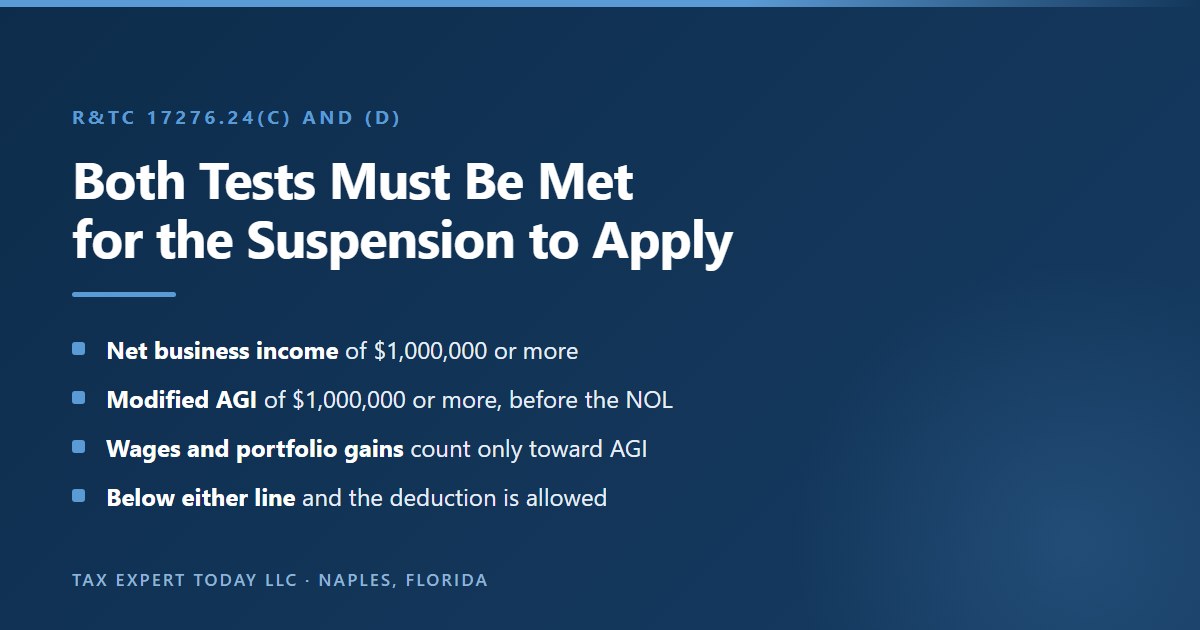
For individuals, estates, and trusts, the suspension applies only when net business income and modified adjusted gross income are each $1,000,000 or more for the year. If either figure is below $1,000,000, section 17276.24(c) says the section does not apply, and the carryover deduction is allowed normally.
- Two tests, both required: falling under either one takes you out of the suspension.
- Measured each year: a taxpayer can be suspended in 2024, free in 2025, and suspended again in 2026.
- Corporations differ: one test, $1,000,000 of income subject to tax under section 24416.24(c).
- Disaster loss carryovers: outside the suspension entirely.
The wording matters, and it has been paraphrased loosely. Section 17276.24(c) provides that the section “shall not apply to a taxpayer that has either of the following”: net business income of less than $1,000,000, or modified adjusted gross income of less than $1,000,000. Turned around, the deduction is denied only when both figures are at or above $1,000,000. The Form FTB 3805V instructions say the same thing in affirmative form: the deduction is suspended “if your net business income is $1,000,000 or more and modified AGI is $1,000,000 or more.”
Several widely read summaries describe the individual test as net business income alone, or as either test alone. A hypothetical owner with $1,400,000 of modified AGI but only $700,000 of net business income is not suspended, even though the AGI figure is well above the line. The reverse case is rarer, because business income usually flows into AGI, but it can occur when large nonbusiness losses pull AGI below $1,000,000.
| Hypothetical owner | Net business income | Modified AGI | Suspended? |
|---|---|---|---|
| S corporation owner with a large K-1 | $1,200,000 | $1,550,000 | Yes, both tests met |
| Same owner, smaller K-1 | $850,000 | $1,200,000 | No, business income below $1,000,000 |
| Executive with stock sale gains and a small consulting practice | $200,000 | $2,000,000 | No, business income below $1,000,000 |
| Owner with large business income and large nonbusiness capital losses | $1,100,000 | $950,000 | No, modified AGI below $1,000,000 |
| Real estate investor with rental income and a partnership K-1 | $1,050,000 | $1,050,000 | Yes, both tests met |
A joint return is one return with one set of figures. The statute states a single $1,000,000 figure for each test and, unlike the estimated tax rule in section 19136.3, does not set a separate lower figure for a married person filing separately. The tests are applied to the taxpayer on the return as filed.
What counts as net business income for the $1 million test?
Section 17276.24(d) defines business income as income from a trade or business, whether conducted directly or through a partnership or S corporation you own, income from rental activity, and farming income. The FTB instructions measure it from the business, rental, pass-through, and business property lines of the return, using California amounts.
- Sole proprietorship income: the Schedule C line, as adjusted for California differences.
- Rental income: included even when the rental is passive or not a trade or business.
- Partnership and S corporation income: included, directly or indirectly owned.
- Business property gains: the Form 4797 line, using California amounts.
The statutory definition is short. “Business income” means income from a trade or business, “whether conducted by the taxpayer or by a passthrough entity owned directly or indirectly by the taxpayer,” income from rental activity, and income attributable to a farming business. “Passthrough entity” means a partnership or an S corporation. Because the definition reaches indirect ownership, a tiered structure, such as an individual who owns a holding partnership that owns an operating LLC, does not move income outside the test.
The Form FTB 3805V instructions translate the definition into return lines. Net business income “is reflected, respectively, on Schedule CA (540/540NR), Section B, line 3, line 4, and line 6 as adjusted by Column B (subtractions) and Column C (additions); the federal Schedule E (Form 1040), Supplemental Income and Loss, line 26, line 32, and line 40, using California amounts; and the federal Form 4797, Sales of Business Property, line 9, using California amounts.” In practical terms that is Schedule C business income, other gains from business property, farm income, rental and royalty income, partnership and S corporation income, and farm rental income, each after California adjustments.
The word “net” also matters. Losses on the listed lines reduce the figure. A hypothetical owner with $1,300,000 of S corporation income and a $350,000 rental loss that is allowed for California purposes has $950,000 of net business income and is outside the suspension. A rental loss that is suspended under the passive activity rules does not reduce the figure in the year it is suspended, because it is not part of the California amount on the Schedule E line for that year. Our guide to real estate professional status explains when rental losses are treated as nonpassive.
| Income item | Counted as business income? | Where the FTB measures it |
|---|---|---|
| Schedule C profit or loss | Yes | Schedule CA, Section B, business income line, as adjusted |
| Gain or loss on business property | Yes | Form 4797, line 9, California amounts |
| Rental real estate and royalties | Yes | Schedule E, line 26, California amounts |
| Partnership and S corporation income | Yes | Schedule E, line 32, California amounts |
| Farm income and farm rental | Yes | Schedule CA farm line and Schedule E, line 40 |
| W-2 wages, including wages from your own S corporation | No | Not on the list |
| Interest, dividends, and portfolio capital gains | No | Not on the list |
How is modified adjusted gross income measured for the suspension?
Modified adjusted gross income for the suspension is adjusted gross income as defined in section 17024.5(h)(2), figured without the net operating loss deduction. The FTB instructions point to Form 540, line 13, or Form 540NR, line 13, without regard to the federal NOL carryover deduction.
- Starting point: adjusted gross income on the California return.
- Key modification: add back any NOL deduction, so the loss cannot pull you under the line.
- Includes: wages, investment income, retirement distributions, and business income.
- Form 540NR filers: line 13 reflects income from all sources, not only California sources.
The definition in section 17276.24(d)(2) deliberately closes a loop. A taxpayer cannot use the NOL deduction to reduce AGI below $1,000,000 and then claim the NOL deduction because AGI is below $1,000,000. The figure is “determined without regard to the deduction allowed under Section 172 of the Internal Revenue Code.” Everything else that normally sits in AGI stays in, including wages, interest, dividends, capital gains, retirement distributions, and the business and rental income already counted for the first test.
That is why the two tests behave differently. Modified AGI is broad, so most taxpayers with $1,000,000 of net business income will also have $1,000,000 of modified AGI. Net business income is narrow, so the business test is usually the one that decides the case. An owner whose income is mostly wages from an S corporation and dividends, with a modest K-1, can have modified AGI far above $1,000,000 and still sit outside the suspension.
| Hypothetical owner (resident, 2026) | Amount | Net business income | Modified AGI |
|---|---|---|---|
| S corporation K-1, ordinary income | $1,250,000 | $1,250,000 | $1,250,000 |
| Rental real estate, allowed loss | ($50,000) | ($50,000) | ($50,000) |
| W-2 wages from the same S corporation | $250,000 | Not counted | $250,000 |
| Interest and dividends | $100,000 | Not counted | $100,000 |
| Totals | $1,200,000 | $1,550,000 | |
| Result | Both tests met; an $800,000 NOL carryover from 2023 is not deductible in 2026 | ||
Do wages, capital gains, and investment income count toward the threshold?
They count toward modified AGI but not toward net business income. Because the suspension needs both tests, a taxpayer whose income is mostly wages, portfolio gains, interest, or dividends will usually stay outside it, even with a very large AGI, unless business, rental, and pass-through income separately reach $1,000,000.
- Wages: AGI only, including reasonable compensation from your own S corporation.
- Stock and fund gains: AGI only, unless the gain is from a trade or business.
- Sale of a pass-through interest: the character of the gain needs analysis.
- Retirement distributions: AGI only.
The business income list in the FTB instructions does not include the wage line, the interest and dividend lines, or Schedule D. That has a planning consequence for S corporation owners, whose income is split between W-2 wages and the K-1. The split is governed by reasonable compensation principles, not by the suspension, and nothing in section 17276.24 suggests that recharacterizing K-1 income as wages to escape the test would be respected if the compensation were not reasonable. It is still worth knowing that the two pieces are treated differently.
Gains on the sale of a business interest require more care. Gain on the sale of S corporation stock or a partnership interest is generally reported on Schedule D, but a sale of assets by the entity, or a deemed asset sale, flows through the K-1 and Form 4797 and can land on the business income lines. Partnership interest sales can also carry ordinary income under Internal Revenue Code section 751. A hypothetical owner planning a sale in 2026 should map where each piece of the gain will be reported before assuming which side of the $1,000,000 line the year will fall on.
| Income type | Modified AGI | Net business income |
|---|---|---|
| W-2 wages | Counted | Not counted |
| Interest and dividends | Counted | Not counted |
| Portfolio capital gains (Schedule D) | Counted | Not counted |
| Entity asset sale gain flowing through a K-1 | Counted | Often counted, depending on the line |
| Section 751 ordinary income on a partnership interest sale | Counted | Analysis required |
| IRA and pension distributions | Counted | Not counted |
How do S corporation and partnership owners apply the test?
Pass-through owners apply the test at the individual level, using their share of entity income as reported on the California Schedule K-1. The NOL itself usually belongs to the owner, not the entity, so the suspension is decided on the owner’s own return, combining every pass-through, rental, and business line together.
- Losses pass through: an S corporation or partnership loss becomes part of the owner’s NOL.
- Income is aggregated: K-1s from several entities are added together for the test.
- California K-1 amounts: use the California figures, which can differ from federal.
- Entity level tax: a corporation follows section 24416.24, and an S corporation with its own loss for the 1.5 percent entity tax generally looks there too.
Partnerships and S corporations do not usually have net operating losses of their own for personal income tax purposes; their losses flow through to the owners. The owner who absorbs those losses builds an NOL carryover on Form FTB 3805V, and the 3805V instructions ask the owner to identify a pass-through loss by entering “the partnership’s FEIN, the California corporation number, or the LLC’s California Secretary of State file number” from the California K-1. The suspension then operates on that owner’s return in later years.
Because the definition of business income covers income from a trade or business conducted “by a passthrough entity owned directly or indirectly by the taxpayer,” all K-1s count. A hypothetical owner with $600,000 from one S corporation, $300,000 from a real estate partnership, and $150,000 of net rental income has $1,050,000 of net business income. No single source reaches the threshold, and the suspension applies anyway.
California K-1 amounts are not always the same as federal amounts. California does not conform to every federal depreciation rule, for example, so the California K-1 can show more income than the federal K-1 in a year with large bonus depreciation. Our guide to bonus depreciation in 2026 explains the federal side, and the California LLC versus S corporation guide covers how entity choice shapes the California figures. For owners who also make the elective pass-through entity tax election, the California PTET guide explains that election, which is separate from the suspension. The California LLC franchise tax guide covers the annual tax and fee an LLC owes regardless of its income or losses.
| Owner type | Where the loss lives | Test applied | Form |
|---|---|---|---|
| Sole proprietor | Individual | Two $1,000,000 tests, section 17276.24 | FTB 3805V |
| Partner or LLC member | Individual, from the K-1 | Two $1,000,000 tests | FTB 3805V |
| S corporation shareholder | Individual, from the K-1 | Two $1,000,000 tests | FTB 3805V |
| Estate or trust | Fiduciary return | Two $1,000,000 tests | FTB 3805V |
| C corporation | Corporation | One test, $1,000,000 of income subject to tax, section 24416.24 | FTB 3805Q |
How long are suspended NOL carryovers extended?
Section 17276.24(b) extends the carryover period of a loss whose deduction is denied: by three years for losses from taxable years beginning before 2024, by two years for 2024 losses, and by one year for 2025 losses. A 2026 loss gets no extension, because it is never carried into a suspended year.
- Pre-2024 losses: three extra years.
- 2024 losses: two extra years.
- 2025 losses: one extra year.
- Base period: 20 taxable years for losses incurred in taxable years beginning on or after January 1, 2008.
The extension compensates for the years the loss could not be used. A loss from 2022 that would have been usable against 2024, 2025, and 2026 income gets three years back. A 2024 loss could first have been used in 2025, so it loses two years and gets two back. A 2025 loss could first have been used in 2026, so it gets one back. The 2025 Form FTB 3805V instructions confirm the 20 year base period: “California has extended the NOL carryover period from 10 taxable years to 20 taxable years following the year of the loss” for losses from 2008 forward.
| Loss year (calendar year taxpayer) | Base expiration | Extension | Extended expiration |
|---|---|---|---|
| 2015 | 2035 | 3 years | 2038 |
| 2020 | 2040 | 3 years (plus any extension from the 2020 and 2021 suspension) | 2043 or later |
| 2022 | 2042 | 3 years | 2045 |
| 2023 | 2043 | 3 years | 2046 |
| 2024 | 2044 | 2 years | 2046 |
| 2025 | 2045 | 1 year | 2046 |
| 2026 | 2046 | None | 2046 |
The table assumes the deduction of each loss was actually denied in a suspended year. The statute extends the carryover period “for any net operating loss or carryover of a net operating loss for which a deduction is denied.” The FTB applied the same phrase in Legal Ruling 2011-04 to the earlier suspension and concluded that a later loss that would not have been reached in a suspended year, because an older loss absorbed all of that year’s income, did not get the extension. A taxpayer with several loss years should map, year by year, which losses would have been deducted absent the suspension. That map determines which losses carry the longer life.
Does a suspended year use up part of the NOL?
No. During a suspended year you continue to compute and carry the NOL forward, and the year’s income does not absorb any of it. The FTB states that taxpayers “may continue to compute and carryover an NOL during the suspension period.” The carryover entering 2027 is the carryover that entered 2024, plus any new losses.
- No absorption: suspended year income does not consume the carryover.
- New losses still count: a 2024, 2025, or 2026 loss is computed and added.
- Tracking still required: Form FTB 3805V is completed each year to keep the schedule.
- Ordering resumes in 2027: oldest losses first, under the normal rules.
This is the feature that makes the suspension a timing rule rather than a tax increase in the long run, at least for a taxpayer who stays in California and keeps generating California income. In FTB Legal Ruling 2011-04, Situation 1, a corporation with $500,000 of income in each of two suspended years carried forward after the suspension the same NOL balances it held before it. The ruling separately tracked the amount of the carryover “suspended” each year, which is the amount that would have been deducted without the suspension, because that amount determines which losses receive the extension.
For an owner who leaves California, the same feature has a different meaning. The carryover is preserved, but it is preserved as a California tax attribute. Whether it is worth anything later depends on whether there will be California taxable income for it to offset, which is the question the rest of this guide addresses.
| Hypothetical year | California income before NOL | Both tests met? | NOL deducted | Carryover at year end |
|---|---|---|---|---|
| Start of 2024 | $900,000 (from 2022 and 2023) | |||
| 2024 | $1,600,000 | Yes | $0 | $900,000 |
| 2025 | $1,400,000 | Yes | $0 | $900,000 |
| 2026 | $1,500,000 | Yes | $0 | $900,000 |
| 2027 | $1,200,000 | Suspension ended | $900,000 | $0 |
How does the California NOL differ from the federal NOL?
California starts from the federal computation but changes the rules for using it. A California NOL from 2008 forward carries over 20 years rather than indefinitely, is not limited to 80 percent of taxable income, cannot be carried back after 2018, and is subject to the 2024 through 2026 suspension, which has no federal counterpart.
- Carryover period: 20 years in California; indefinite federally for post-2017 losses.
- Percentage limit: none in California; 80 percent of taxable income federally.
- Carryback: none in California for losses from 2019 forward.
- Suspension: California only; the federal deduction is unaffected.
The Form FTB 3805V instructions state that “the California NOL is generally figured the same way as the federal NOL,” but that carryover periods and percentages vary. Revenue and Taxation Code section 17276 provides that the 2017 Tax Cuts and Jobs Act amendment to Internal Revenue Code section 172(a), which introduced the 80 percent limitation, “shall not apply.” So once the suspension ends, a California NOL can offset all of a year’s taxable income, while the federal NOL for the same loss can offset only 80 percent.
The result is that the two carryovers drift apart. A hypothetical owner with a $900,000 federal and California NOL from 2023 may use part of it federally in 2024 through 2026, subject to the 80 percent limit, while the California carryover sits untouched. By 2027 the federal carryover may be partly or fully used and the California carryover may be intact. Keeping separate federal and California schedules is not optional during the suspension.
| Rule | Federal (IRC section 172) | California |
|---|---|---|
| Carryforward period, losses after 2017 (federal) or 2008 (California) | Indefinite | 20 taxable years |
| Limit on the deduction | 80 percent of taxable income for post-2017 losses | No percentage limit (R&TC 17276) |
| Carryback | Generally none, with limited exceptions such as farming losses | None for losses from 2019 forward |
| 2024 through 2026 suspension | Does not exist | Applies when both $1,000,000 tests are met |
| Form | Computed on federal worksheets and Form 172 | Form FTB 3805V |
| Residency change | Not relevant | Carryover restated to the new residency status |
What happens to a California NOL when you move to Florida?
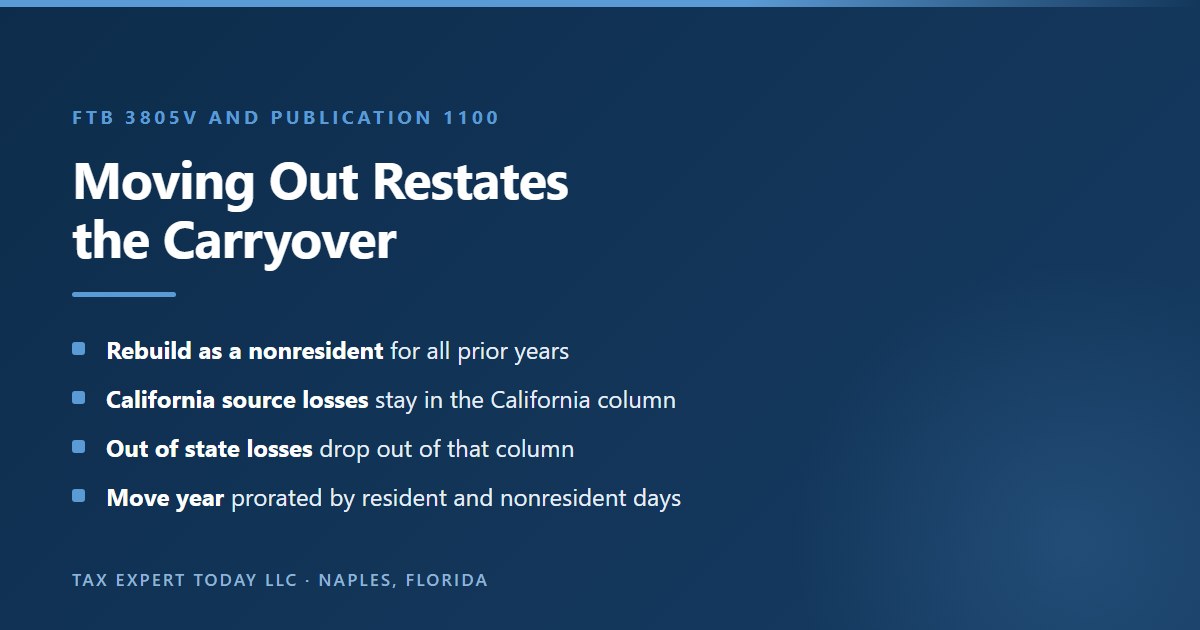
When you become a California nonresident, your NOL carryovers must be restated as if you had been a nonresident for all prior years. Only California source income and losses count in that restatement, so any part of the loss that came from non-California activity drops out of the California carryover, while California source losses remain.
- Restatement is mandatory: the FTB instructions require it on a change of residency.
- California source losses survive: losses from a business conducted in California remain.
- Other losses drop out: a resident’s loss from a business or property outside California does not carry into the nonresident column.
- Two carryovers result: a total income carryover and a California source carryover.
The rule is stated twice by the FTB. The Form FTB 3805V instructions provide, under Change of Residency from California: “if you have NOL carryovers and you become a nonresident of California, your NOL carryovers must be restated as if you had been a nonresident of California for all prior years.” FTB Publication 1100 repeats it and adds a worked example in which the restated California carryover is built “by netting business income and losses from California sources only.”
The logic follows the way California taxes nonresidents. A nonresident is taxed only on California source income, so a nonresident’s NOL can only be a California source NOL. The 3805V instructions state that for nonresidents and part-year residents, “only your California sourced income and losses are considered in determining if you have a California NOL.” A loss you incurred while living in California on an investment in Arizona was deductible against your California income while you were a resident, but it was never California source. Once you are a nonresident, it has no place in the California carryover.
The restatement does not erase anything from the federal return, and it does not erase the loss from the California rate computation, which uses income from all sources. Our guide to California source income explains how sourcing works for business, rental, and investment income, and the leaving California taxes checklist places the NOL restatement among the other attributes to review before a move.
| Loss incurred while a California resident | California source? | Survives the move out restatement? |
|---|---|---|
| Loss from a business operated entirely in California | Yes | Yes |
| K-1 loss from an S corporation with California operations | The California apportioned share | The California share |
| Loss from a rental property located in California | Yes | Yes |
| Loss from a rental property located in Arizona or Florida | No | No |
| K-1 loss from a partnership operating only outside California | No | No |
| Loss from the sale of business property located in California | Yes | Yes |
How is an NOL restated for a former California resident?
You rebuild the carryover year by year as if you had always been a nonresident, keeping only California source business income and losses and applying each year’s actual rules, including suspended years. The result is a California source carryover, kept alongside a total carryover computed as if you had always been a resident.
- Start with each loss year: identify which part of the loss was California source.
- Roll forward: apply each later year’s California source income, percentages, and suspensions.
- Keep two columns: total taxable income and California taxable income, as Publication 1100 does.
- Document sourcing: the restatement is only as good as the records behind each year.
Publication 1100 lays out the method in its Examples 31 and 32, in which a taxpayer with a Texas business and a California business moves into California and later moves out. For the move out, the publication restates each year with two columns, “Total Taxable Income” and “CA Taxable Income,” and shows that a large out-of-state loss carried in the total column contributes nothing to the California column. The example also shows a suspended year in the restatement: where net business income exceeded $1,000,000, “you cannot use your NOL carryover.”
The hypothetical below follows the same approach for an owner who leaves California for Naples, Florida. The figures are simplified, and the owner is assumed to have met both $1,000,000 tests in 2024 and 2025 so that no carryover was absorbed in either year under either column.
| Hypothetical item | Total column (as if always a resident) | California column (as if always a nonresident) |
|---|---|---|
| 2022 loss, restaurant group S corporation operating only in California | ($500,000) | ($500,000) |
| 2023 loss, partnership owning apartments in Arizona | ($300,000) | $0, not California source |
| 2024, suspended (both tests met) | No deduction | No deduction |
| 2025, suspended (both tests met) | No deduction | No deduction |
| Carryover entering 2026 | ($800,000) | ($500,000) |
The $300,000 Arizona loss reduced California tax only in the sense that it was available to a resident. It was never usable against California source income, so it is gone from the California column. The $500,000 California restaurant loss remains, and because its deduction was denied in suspended years, it carries the three year extension. Whether that $500,000 will reduce California tax after the move depends on what California source income the owner has from 2027 forward.
How does Form FTB 3805V handle a part-year resident in the move year?
In the year you move, you compute the NOL using resident rules for the resident period and nonresident rules for the nonresident period, and you prorate the two restated carryovers by days. In 2026, though, the proration matters only if you fall under one of the $1,000,000 tests, because otherwise the deduction is denied regardless.
- Two carryovers: one as if always a resident, one as if always a nonresident.
- Day count: resident days and nonresident days, over 365 or 366.
- Current year loss: all-source for the resident period, California source for the nonresident period.
- 2026 overlay: the suspension still applies in a part-year 2026 if both tests are met.
Publication 1100 instructs part-year residents to “compute any NOL carryovers as if you were a California resident for all prior years and as if you were a nonresident for all prior years,” and to “prorate both NOL carryover amounts based upon the period of California residency and the period of nonresidency during the year.” On Form FTB 3805V, Part I, Section B, a part-year resident completes column (a) as if a resident all year, column (b) as if a nonresident all year, and columns (c) and (d) using the actual dates of transactions or, where dates are unknown, a prorated amount based on days.
Continuing the hypothetical, assume the owner became a Florida resident on July 1, 2026. That leaves 181 resident days and 184 nonresident days in 2026. If the owner did not meet both tests for 2026, the prorated carryover available would be computed as follows.
| Hypothetical computation, move on July 1, 2026 | Amount |
|---|---|
| Carryover as if always a resident | $800,000 |
| Resident period share, 181 of 365 days | $396,712 |
| Carryover as if always a nonresident | $500,000 |
| Nonresident period share, 184 of 365 days | $252,055 |
| Prorated carryover for 2026 | $648,767 |
| If both $1,000,000 tests are met for 2026 | Deduction denied; carryover preserved |
For a high-income owner leaving in 2026, the second line is the likely outcome. The move year is also the last suspended year, so the prorated figure is computed and then denied. The figure that matters for the future is the one computed in 2027, the first year as a full-year nonresident, when the carryover is restated entirely as if the owner had always been a nonresident. Our guide to the California part-year resident return on Form 540NR explains the rest of the move year computation.
What can a suspended NOL offset after you become a Florida resident?
After the move, the restated California carryover can offset only California source income reported on a nonresident return, starting in 2027. Typical examples are California apportioned K-1 income, rent from California property, gain on California real property, and California source compensation. Florida income, and most investment income of a Florida resident, is outside its reach.
- Pass-through income: the California apportioned share of K-1 income from a business that still operates there.
- California real estate: rental income and gain on sale, which is sourced where the property is.
- Deferred California income: installment gain or deferred compensation that remains California source.
- Not reached: wages earned in Florida, Florida business income, and most interest, dividends, and stock gains.
California taxes a nonresident on income from California sources. Intangible income such as interest, dividends, and gain on stock is generally sourced to the owner’s residence, so a Florida resident’s portfolio income is not California source. Real property income is sourced where the property is located. Business income from a pass-through that operates in California is apportioned, and the California share flows to the nonresident owner. That is the income a restated NOL is waiting for. Equity compensation earned in California is a common example, and our guide to California RSU tax when you leave the state explains how it is allocated after a move.
In the hypothetical above, suppose the owner keeps the restaurant group S corporation after the move and it earns $200,000 of California apportioned income in 2027. The restated $500,000 carryover offsets that $200,000, and $300,000 carries to 2028. If the owner also sells a California rental property in 2028 at a $400,000 gain, the remaining $300,000 offsets most of it. If instead the owner sold the S corporation stock in 2026 while a resident and has no California income after the move, the $500,000 carryover simply sits until it expires in 2045.
| Hypothetical post-move income (2027 or later) | California source? | Can the restated NOL offset it? |
|---|---|---|
| California apportioned K-1 income from a California operating business | Yes | Yes |
| Rent from a condominium in San Diego | Yes | Yes |
| Gain on sale of California real property | Yes | Yes |
| Deferred gain from a California 1031 exchange reported later | Yes | Yes |
| Salary for work performed in Florida | No | No |
| Dividends and stock gains of a Florida resident | Generally no | No |
| Income of a business operating only in Florida | No | No |
Former residents who exchanged California property often have exactly the kind of deferred California source gain a restated NOL can absorb. Our guide to the California 1031 exchange clawback and Form 3840 explains why that gain remains California source after you leave, and the guide to selling rental property after a move covers the sale itself.
Does a California NOL still matter if you have no California income after the move?
Only marginally. With no California source income, a restated NOL has nothing to offset and no nonresident return may even be required. The total income carryover can still lower the rate used on any future California income, because California computes a nonresident’s tax rate on income from all sources.
- No California income: the California column carryover has nothing to reduce.
- Rate computation: the total column carryover lowers total taxable income used to set the rate.
- Expiration: the clock keeps running whether or not you file.
- Records: keep the schedule anyway; a later California sale can revive its value.
California computes a nonresident’s tax under Revenue and Taxation Code section 17041 by first computing tax on total taxable income as if the taxpayer were a resident, then multiplying it by the ratio of California taxable income to total taxable income. In practice, that means the average rate on worldwide income is applied to the California source amount. The NOL computed in the total column reduces total taxable income and therefore the average rate, even when the California column carryover is small or zero.
That effect exists only in a year with some California source income. A Florida resident with no California income has no California tax to compute, and generally no California return to file. The NOL schedule should still be kept, because the facts can change. A former resident who later sells inherited California property, receives California source deferred compensation, or invests in a California operating business may find that a carryover thought to be worthless reduces tax a decade later.
| Post-move situation | Value of the restated California NOL |
|---|---|
| Ongoing California K-1 or rental income | Direct offset of California source income from 2027 |
| A planned sale of California real property | Offset of the gain in the year of sale |
| Small or occasional California income | Partial offset, plus a lower average rate from the total column |
| No California income at all | Little or none unless circumstances change before expiration |
Is the $1 million test measured on all income or only California income for a nonresident?
On our reading of the 2025 Form FTB 3805V instructions, the tests use amounts figured under California law from income from all sources. They point to Schedule CA (540NR) business lines as adjusted, and to Form 540NR, line 13, not to the California source column. A nonresident with large Florida income can therefore still be inside the suspension in 2024 through 2026.
- Net business income: Schedule CA (540NR) business lines after the California adjustments in columns B and C.
- Modified AGI: Form 540NR, line 13, without the NOL deduction.
- Not the California column: the instructions do not direct you to the California source amounts.
- Practical effect: a small California loss carryover can be suspended for a nonresident with large outside income.
The instructions describe net business income by reference to Schedule CA (540/540NR) lines “as adjusted by Column B (subtractions) and Column C (additions),” and Schedule E and Form 4797 lines “using California amounts.” Columns B and C of Schedule CA adjust federal amounts to California law; the California source amounts of a nonresident are reported separately in column E of Schedule CA (540NR). Modified AGI is taken from “Form 540NR, line 13,” which carries federal adjusted gross income from all sources. Neither reference is to the California source column.
The statute supports that reading. Section 17276.24(c) applies to “a taxpayer” with net business income or modified AGI of less than $1,000,000 “for the taxable year,” and it does not limit the measurement to California source income. The practical consequence is that a hypothetical Florida resident who owns a large Florida operating business and a small California rental with a California source NOL carryover may find that carryover suspended in 2026, even though the California income involved is modest. Because the instructions are not explicit on this point for nonresidents, the reading should be confirmed for the specific return. It matters only through 2026; from 2027 the suspension no longer applies.
| Hypothetical 2026 nonresident | All-source figure | California source figure | Likely result |
|---|---|---|---|
| Florida business K-1 $1,500,000; California rental income $60,000 | Net business income $1,560,000 | $60,000 | Suspended on the all-source reading |
| Same, with modified AGI of $1,700,000 | Modified AGI $1,700,000 | Not used | Both tests met |
| Florida wages $900,000; California rental income $150,000 | Net business income $150,000 | $150,000 | Not suspended |
What is the $5 million credit cap and how long does it last?
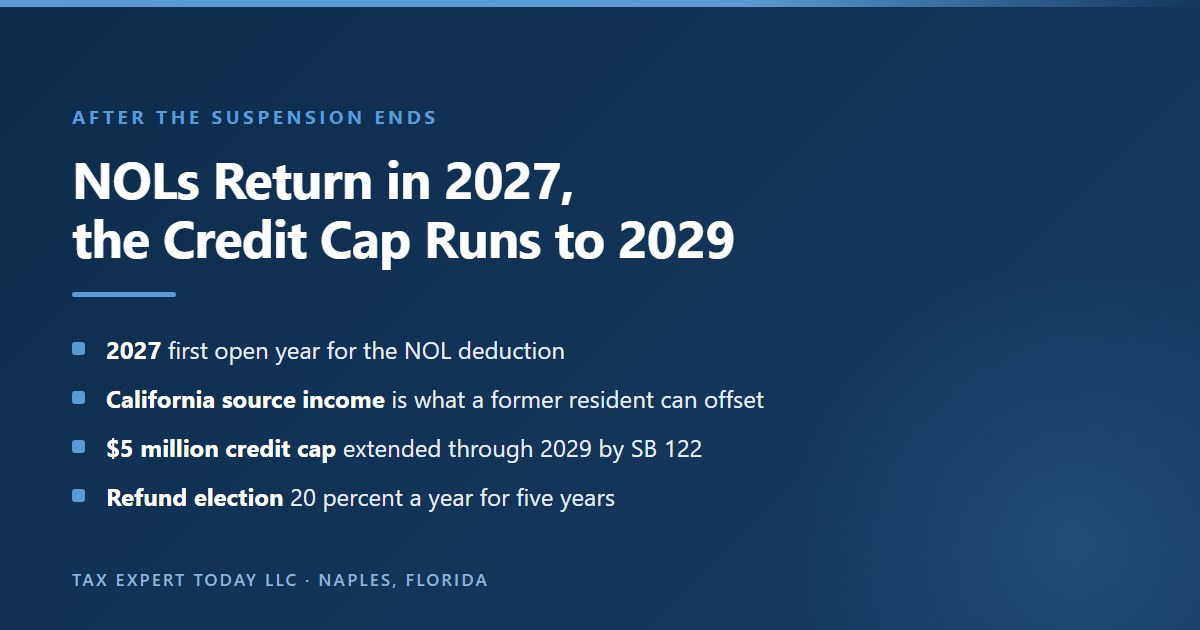
Section 17039.4 limits the total reduction of net tax from business credits to $5,000,000 a year. SB 122 extended that cap from 2026 to taxable years beginning before January 1, 2030, so it now outlasts the NOL suspension by three years. Excluded credits include the PTET credit, the earned income credit, and the renter’s credit.
- Cap: business credits cannot reduce net tax by more than $5,000,000 a year.
- Now through 2029: extended by SB 122 in the 2026 budget.
- Disallowed credits carry over: with the carryover period extended for each year denied.
- Excluded credits: include the elective PTET credit under sections 17052.10 and 17052.11.
Section 17039.4(a) provides that, for each taxable year beginning on or after January 1, 2024, and before January 1, 2030, “the total of all business credits otherwise allowable” shall not reduce net tax “by more than five million dollars ($5,000,000).” Subdivision (c) lists the credits that are not business credits, including the earned income tax credit, the young child and foster youth credits, the dependent care credit, the elective tax credit “under the Small Business Relief Act” in sections 17052.10 and 17052.11, the renter’s credit, the personal exemption credits, the low-income housing credit, and the credit for excess unemployment insurance code payments.
Credits denied by the cap “remain a credit carryover amount,” and subdivision (i) increases the carryover period “by the number of taxable years the credit or any portion thereof was not allowed.” The Legislative Counsel’s Digest for SB 122 also describes a different limit for taxable years beginning on or after January 1, 2030: business credits limited to 70 percent of total taxes or $5,000,000, whichever is greater. Few individual owners reach $5,000,000 of business credits in a year, but founders of research-intensive companies with large research credits flowing through an S corporation can.
Many 2024 and 2025 articles state that the credit cap ends with the 2026 tax year, along with the NOL suspension. That was true when they were written and is no longer true. A business owner modeling 2027 should treat the NOL as available again and the credit cap as still in place.
| Provision | Original end | Current end | Change made by |
|---|---|---|---|
| NOL suspension (R&TC 17276.24) | Taxable years beginning before January 1, 2027 | Unchanged | Not amended by SB 122 |
| $5,000,000 business credit cap (R&TC 17039.4) | Before January 1, 2027 | Before January 1, 2030 | SB 122, Stats. 2026, ch. 23 |
| Refundable credit election (R&TC 17039.5) | Before January 1, 2027 | Before January 1, 2030 | SB 122, Stats. 2026, ch. 23 |
| Limit from 2030 forward | None | 70 percent of tax or $5,000,000, whichever is greater, per the bill digest | SB 122, Stats. 2026, ch. 23 |
How does the refundable credit election work?
Section 17039.5 lets a taxpayer whose credits are limited by the $5,000,000 cap make an irrevocable election, on an original timely return, to receive 20 percent of the limited credit amount each year for five years. The refundable period starts in the third taxable year after the election year, and any excess over tax due is paid out.
- Annual amount: 20 percent of the credit amount disallowed by the cap.
- Timing: five consecutive years starting the third taxable year after the election.
- Irrevocable: made on an original, timely filed return.
- Pass-through owners: the credit amount is the owner’s distributive or pro rata share.
Section 17039.5, as amended by SB 122, allows the election “for each taxable year beginning on or after January 1, 2024, and before January 1, 2030.” The annual refundable credit amount “means 20 percent of the credit amount,” and the credit amount is the qualified credits “that would have otherwise been available to reduce net tax in the taxable year of the election but for the limitation.” The amount is first credited against net tax, then against other amounts due, “and the balance, if any, shall be paid” to the taxpayer.
Take a hypothetical owner whose S corporation passes through $7,000,000 of research credits for 2026 and whose net tax is large enough to use all of them absent the cap. The cap allows $5,000,000 and leaves $2,000,000 limited. If the owner elects for 2026, the annual refundable amount is $400,000, received over the five years beginning with 2029, the third taxable year after 2026. The refund feature matters to a former resident, who may have little California tax left in 2029 to absorb an ordinary carryover. The election is irrevocable, and it should be modeled against the owner’s expected California tax in those later years before the 2026 return is filed.
| Hypothetical 2026 election | Amount or year |
|---|---|
| Business credits otherwise usable | $7,000,000 |
| Allowed under the cap | $5,000,000 |
| Credit amount limited | $2,000,000 |
| Annual refundable credit amount (20 percent) | $400,000 |
| Refundable period | 2029 through 2033 |
| Alternative without the election | $2,000,000 carryover with an extended period |
How do estimated tax payments change during the California NOL suspension?
Estimates for a suspended year must be computed without the NOL deduction. A taxpayer with adjusted gross income of $1,000,000 or more also cannot use the prior year safe harbor in California, so 2026 installments generally have to cover 90 percent of the 2026 tax as actually computed, with no carryover.
- No NOL in the estimate: a suspended carryover cannot reduce the projected tax.
- No prior year safe harbor: section 19136.3 removes it at $1,000,000 of AGI.
- California installment pattern: 30, 40, 0, and 30 percent across the four due dates.
- Move year: estimate the part-year tax, including any California source income after the move.
The suspension and the estimated tax rules interact for the same reason: both are aimed at high earners. Under Revenue and Taxation Code section 19136.3, an individual with adjusted gross income of $1,000,000 or more ($500,000 for a married person filing separately) cannot base the required annual payment on the prior year’s tax. Every taxpayer inside the NOL suspension has modified AGI of at least $1,000,000, so in practice every one of them is also outside the prior year safe harbor.
An owner who planned around a carryover that would wipe out 2026 California tax, and who paid estimates on that assumption, may face an underpayment penalty as well as the tax. The penalty is computed installment by installment, so catching the problem by the June installment is better than catching it on the return. Our guide to the California late payment penalty explains the penalty framework, and the FTB summarizes the installment rules on its estimated tax payments page.
| 2026 California estimate, calendar year individual | Due date | Share of required annual payment |
|---|---|---|
| First installment | April 15, 2026 | 30 percent |
| Second installment | June 15, 2026 | 40 percent |
| Third installment | September 15, 2026 | 0 percent |
| Fourth installment | January 15, 2027 | 30 percent |
What planning questions does the 2027 reopening raise?
The main question is timing. California source income recognized in 2026 cannot be sheltered by a suspended carryover if both tests are met, while the same income recognized in 2027 generally can. For an owner leaving California, it also matters whether that income will still be California source after the move.
- Timing a California sale: the year of sale can decide whether the NOL is usable.
- Installment reporting: spreading California source gain into open years.
- Staying under a test in 2026: legitimately falling below $1,000,000 of business income reopens the deduction.
- Residency evidence: a move must be genuine on the facts, not timed on paper.
For a taxpayer staying in California, the reopening is mostly a question of when income lands. For a taxpayer leaving, it is more complicated, because the California carryover becomes a California source carryover after the move, and only California source income will use it. A hypothetical owner with a $500,000 California source carryover who plans to sell a California rental property has a clear interaction to model: a sale closing in December 2026, in a year in which both tests are met, produces California gain with no NOL offset; the same sale closing in January 2027, after the owner has become a Florida resident, produces California source gain that the carryover can offset. The difference is a function of the statute, not of any election.
The planning has limits. The tax result of a residency change depends on the facts of the move, and the FTB examines changes of residency closely. Shifting the paper date of a move to manage the NOL, without a genuine change of domicile, invites exactly the review described in our guide to the California residency audit. Income timing should also be weighed against other factors, including federal tax, the California sourcing of the specific item, and the business reasons for the transaction. The point of modeling is to see the interaction, not to let the NOL drive a transaction.
| Hypothetical transaction | Recognized in 2026 (both tests met) | Recognized in 2027 as a Florida resident |
|---|---|---|
| Sale of a California rental, $400,000 gain | Taxed by California; NOL denied | California source; NOL can offset it |
| Asset sale by a California S corporation | Flows through as business income; NOL denied | California apportioned share flows to the nonresident; NOL can offset it |
| Sale of stock in the S corporation by the owner | Taxed by California as a resident | Generally not California source after a genuine move; NOL irrelevant |
| Bonus for work performed in California in 2026 | California wages; NOL denied | Still California source if earned there; NOL can offset it |
The third row shows why the NOL is often a secondary issue. Gain on intangible property sold after a genuine change of residence is generally not California source at all, so the question is not whether the carryover can shelter it but whether California has any claim to it. Our guide to moving to Florida before selling a business covers that analysis, and the California QSBS guide explains a related California conformity gap for founders.
Do disaster losses escape the California NOL suspension?
Yes. An NOL attributable to a qualified disaster loss is outside the suspension. The FTB instructions state that taxpayers “with disaster loss carryovers are not affected by the NOL suspension rules,” and the disaster loss provisions override any law that suspends or reduces the NOL deduction for those losses.
- Qualified disasters: those declared by the President or proclaimed by the Governor.
- Recent examples: the January 2025 Los Angeles and Ventura County fires and windstorms are on the FTB list.
- Separate tracking: disaster loss carryovers are shown separately on Form FTB 3805V, Part III.
- Coding: the disaster code from the Declared Disasters list is entered with the loss.
The 2025 Form FTB 3805V instructions explain that for Governor-declared disasters from 2014 through 2028, “any law that suspends, defers, reduces, or otherwise diminishes the deduction of an NOL shall not apply to an NOL attributable to these specified disaster losses,” citing Revenue and Taxation Code section 17207.14. The instructions list the January 2025 Fires and Windstorms in Los Angeles and Ventura Counties as disaster code 157. A former California resident whose business or rental property was damaged in a listed disaster should separate any disaster-attributable NOL from the ordinary carryover, because the two follow different rules during 2024 through 2026.
| Carryover type | Suspended in 2024 through 2026? | Where tracked |
|---|---|---|
| Ordinary NOL carryover | Yes, if both tests are met | Form FTB 3805V, Part III, NOL lines |
| NOL attributable to a qualified disaster loss | No | Form FTB 3805V, with the disaster code |
| Disaster loss carryover | No | Form FTB 3805V, Part III, disaster loss lines |
What records should an owner keep for a suspended California NOL?
Keep every year’s Form FTB 3805V, the California K-1s and Schedule CA figures used for the two $1,000,000 tests, a sourcing workpaper for each loss year, and both restated carryover schedules after a move. The FTB instructions say to keep Form FTB 3805V until all losses are used or expire, which can be 20 years or more.
- Form FTB 3805V for every year: including the suspended years with no deduction taken.
- Test workpapers: the net business income and modified AGI computations for 2024, 2025, and 2026.
- Sourcing support: apportionment data and K-1 California amounts for each loss year.
- Residency file: the move date evidence that sets the part-year split.
The 3805V instructions are direct: “Keep a copy of form FTB 3805V with your records until you use all losses or they expire.” A carryover from 2022 that is extended to 2045 may be examined in a year two decades after the loss, by which time the preparer, the business records, and the K-1s may be gone. The FTB can examine the amount of a carryover in the year it is used, not only in the year it arose, so the loss year support needs to survive as long as the carryover does.
For a former resident, the most important records are the ones that support sourcing. The California column of the restatement is built from California source amounts, and a later examiner will ask how the California share of each loss was determined. Apportionment schedules from the entity, the California K-1s showing California source amounts, and property location records for rental losses are the documents that make the restated carryover defensible.
| Record | Why it matters | How long to keep it |
|---|---|---|
| Form FTB 3805V, each year | Shows the carryover, the suspended amounts, and expirations | Until the last loss is used or expires |
| California K-1s for loss years | Supports the California amount and the source of each loss | Same as the carryover |
| Net business income and modified AGI workpapers | Shows whether each year was suspended | Same as the carryover |
| Restatement schedules after the move | Separates the total column and the California column | Same as the carryover |
| Residency change evidence | Fixes the move date and the day count | At least until the move year is closed |
What mistakes do owners make with the California NOL suspension?
The common mistakes are applying the wrong test, deducting a suspended carryover, failing to track the carryover during suspended years, assuming the credit cap ends with the suspension, and carrying a resident NOL schedule onto a nonresident return without restating it to California source amounts.
- Wrong test: treating modified AGI alone, or business income alone, as decisive.
- Silent carryover: skipping Form FTB 3805V in a year with no deduction.
- Stale assumptions: relying on a 2024 article that said the credit cap ends in 2026.
- No restatement: using the all-source carryover against California source income after a move.
- Federal carryover used for California: the two schedules diverge during the suspension.
The restatement error is the one most specific to former residents, and it usually runs in the taxpayer’s favor on the return and against the taxpayer on examination. A hypothetical owner who carries an $800,000 all-source California carryover onto a 2027 Form 540NR and deducts it against $500,000 of California source gain has overstated the California deduction if only $500,000 of the carryover was California source and some of that was already used. The fix after the fact is an assessment with interest. The fix before filing is a restatement schedule.
The second most common error is quieter. A taxpayer in a suspended year, seeing no deduction to claim, does not complete Form FTB 3805V. Three years later the carryover schedule has a gap, a new loss year has not been recorded, and nobody can show which losses received the extension. Completing the form every year, including the years when the answer is zero, avoids that gap.
| Mistake | Consequence | Prevention |
|---|---|---|
| Applying one test instead of both | NOL wrongly denied or wrongly claimed | Compute both figures every year |
| Deducting in a suspended year | Assessment, interest, and possible penalty | Check both tests before claiming |
| Skipping 3805V in suspended years | Gaps in the carryover and extension record | File the form every year |
| Assuming the credit cap ends in 2026 | Wrong 2027 through 2029 projections | Model the cap through 2029 |
| No restatement after the move | Overstated California deduction | Rebuild the California column from California source amounts |
Frequently Asked Questions About the California NOL Suspension
What is the California NOL suspension?
The California NOL suspension is a temporary rule under Revenue and Taxation Code section 17276.24 that disallows the net operating loss carryover deduction for taxable years beginning in 2024, 2025, and 2026 for taxpayers whose net business income and modified adjusted gross income are both $1,000,000 or more. The loss is carried forward with an extended carryover period.
Is the California NOL suspension in effect for 2026?
Yes. The early end condition required both a Director of Finance determination by May 14, 2026, and Budget Act legislation. The 2026 budget tax bill, SB 122, did not turn the section off, and the statute as amended in September 2026 still covers taxable years beginning before January 1, 2027.
When can I use a suspended California NOL again?
For calendar year taxpayers, the carryover deduction is available again on the 2027 return, for taxable years beginning on or after January 1, 2027. The carryover entering 2027 is the same carryover that entered 2024, plus any losses from 2024 through 2026, because suspended years do not absorb it.
Does the $1 million threshold apply to business income or AGI?
Both. Section 17276.24(c) states that the suspension does not apply to a taxpayer with either net business income or modified adjusted gross income of less than $1,000,000. The deduction is denied only when both figures are at or above $1,000,000 for the year.
How long are suspended California NOLs extended?
Section 17276.24(b) extends the carryover period by three years for losses from taxable years beginning before 2024, two years for 2024 losses, and one year for 2025 losses. The extension applies to a loss whose deduction was actually denied in a suspended year.
What happens to my California NOL if I move to Florida?
Your carryover is restated as if you had been a California nonresident for all prior years, keeping only California source income and losses. The restated carryover can offset California source income on a nonresident return, such as California apportioned K-1 income or gain on California real property, but not Florida income.
Does the $5 million California credit cap end in 2026?
No. SB 122, the 2026 budget tax bill, extended the $5,000,000 business credit limitation in section 17039.4 and the refundable credit election in section 17039.5 to taxable years beginning before January 1, 2030. The NOL suspension was not extended and still ends after 2026.
Can a Naples, Florida advisor help with a California NOL?
Yes. The suspension tests, the carryover restatement, and California sourcing apply the same way wherever the advisor works. A Naples, Florida advisor can review the Form FTB 3805V history, rebuild the total and California carryover columns after a move, and prepare the part-year or nonresident California return.
California NOL Suspension Help in Naples & Southwest Florida
California NOL suspension help Naples owners can use starts with the two $1,000,000 computations, the carryover schedule, and the residency dates, not with the deduction itself. Tax Expert Today LLC advises on state residency and tax matters nationwide, including California carryover and sourcing questions for owners who now live in Florida, from our office in Naples, Florida. Our team of tax advisors, enrolled agents, CPAs, and attorneys reviews the Form FTB 3805V history, rebuilds the total and California carryover columns after a move, and models when a California source item may meet an open year.
We are located at 11983 Tamiami Trail N, Naples FL 34110. Call (239) 441-2005, Monday through Friday, 10:00 to 5:00 Eastern Time. Clients across Naples, Bonita Springs, Estero, Fort Myers, Marco Island, and the wider Southwest Florida region engage us on California returns after a move. Our California tax services page describes the state work we do for former California residents, our Naples tax planning page covers planning for owners who have relocated, and our tax planning services and business consulting pages explain how an engagement is structured. For the residency side of the move, see our guides to establishing Florida residency, moving from California to Florida, and the Florida 183 day rule calculator.
- California NOL review Naples FL: confirming both tests for 2024, 2025, and 2026.
- Carryover restatement: rebuilding the California column after a move to Florida.
- Move year return: the part-year Form 540NR and Form FTB 3805V proration.
- Credit cap modeling: the $5,000,000 limit and refund election through 2029.
Local FAQ: I moved from Orange County to Naples this year and carry a California NOL from my old business. Can a Naples advisor handle the California side? Yes. The suspension tests, the restatement, and the sourcing rules depend on your California returns, the K-1s, and your residency dates, not on where your advisor is located. Bring your Forms FTB 3805V for every year you have them, the California K-1s for the loss years, your 2024 and 2025 California returns, and evidence of your move date, and we can rebuild both carryover columns and identify which California source income, if any, the loss can still offset.
When to Engage a Professional
Engage a professional when your business and AGI figures sit near $1,000,000, when you carry a California NOL and are moving or have moved, when a California sale is planned for late 2026 or 2027, when business credits approach $5,000,000, or when years of Form FTB 3805V are missing.
- You are close to a threshold and one of the two tests may decide the year.
- You have moved to Florida with a California carryover that has never been restated.
- A California property or business sale is scheduled near the 2027 reopening.
- Your credits exceed the cap and the refund election must be made on a timely original return.
- Your carryover schedule has gaps for the suspended years.
This article explains California law as it stands in October 2026. It is not legal or tax advice for any specific situation, and outcomes depend on the facts of each return, the sourcing of each item, the residency evidence, and determinations that rest with the Franchise Tax Board. The examples are hypothetical illustrations, not client results. Call (239) 441-2005 to arrange a review.
Published October 17, 2026 by Dr. Pellumb Kabashi « Back to Learning Center
Have a question this article touches on?
Tax Expert Today LLC, based in Naples, Florida and serving clients across the United States.
Schedule a Consultation (239) 441-2005