
By Dr. Pellumb Kabashi, DBA, MBA, CES, CFE, EA
Founder, Tax Expert Today LLC · Tax advisors, enrolled agents, CPAs, and attorneys · Serving clients in all 50 states
Quick Answer: California Form 593 is the Real Estate Withholding Statement that escrow files when California real property is sold. The default withholding is 3 1/3 percent of the gross sales price, taken at closing whether or not the seller has a gain. A seller may instead elect a gain based calculation, but only by certifying it before escrow closes. Call (239) 441-2005 for a free consultation.
What Is California Form 593 and When Does It Apply?
California Form 593 is the Real Estate Withholding Statement that reports and remits tax withheld when California real property changes hands. It is not a tax and it is not a return. It is a prepayment collected at closing under Revenue and Taxation Code section 18662, and it reaches every sale of California real property above 100,000 dollars unless the seller certifies to a listed exemption before escrow closes.
- The property triggers it, not the seller. Publication 1016 states that California residents, nonresident individuals and non-California business entities are all subject to the requirement.
- The remitter files it, usually escrow. The real estate escrow person sends the form and the money to the Franchise Tax Board.
- It is due by the 20th day of the month after closing. That clock runs on the transaction, not on the seller tax year.
- It is a credit, not a settlement of the liability. The seller still has to file a California return to reconcile it.
- The threshold is 100,000 dollars of sales price. At or below that figure, no withholding is required at all.
The confusion that brings most sellers to this page is structural. A form arrives from the title company two weeks before closing, it is signed under penalty of perjury, it asks about depreciation and adjusted basis in a hurry, and nothing on its face signals that some boxes matter far more than others. Several of them matter a great deal, and one of the choices becomes effectively irreversible the moment escrow closes.
This guide covers the real property withholding channel only. Tax on the gain itself is a separate subject, handled in our guide to California capital gains tax on a home sale. The 7 percent withholding on non real estate California source payments to nonresident payees runs on the Form 592 series and is covered in California nonresident withholding.
Who Actually Files California Form 593, the Seller or the Escrow Company?
Both parties have a role, and the split is what sellers most often get wrong. The seller completes and signs the certifications and the gain computation, then hands the form to escrow before closing. The remitter, normally the escrow or title company, files the form with the Franchise Tax Board and sends the withheld money. Only the remitter can later amend it.
The instructions define the real estate escrow person, or REEP, broadly: any attorney, escrow company, title company, qualified intermediary, or anyone else who receives and disburses payment for the sale of real property. The remitter is the party that actually transmits the withheld tax and files the prescribed forms with the state.
| Party | What they do | Deadline |
|---|---|---|
| Seller or transferor | Completes Part II, the Part III or Part IV certifications, and Part VI if electing the gain based calculation; signs the perjury statement | Before the close of the real estate transaction |
| Real estate escrow person | Notifies the buyer in writing of the withholding requirements and collects Form 593 from the seller | Before closing |
| Remitter | Files the original Form 593 with Form 593-V and the payment, provides one copy to the seller, retains one copy for five years | Within 20 days following the end of the month in which the transaction closed |
| Buyer or transferee | Withholds on the principal portion of each installment payment after closing and signs subsequent forms | Each installment payment |
| Qualified intermediary | Withholds on boot above 1,500 dollars, and on the full sales price if a deferred exchange fails | On receipt of boot or on failure of the exchange |
- The seller owns the certifications. Nobody at the closing table can decide on the seller behalf which exemption applies.
- The escrow company owns the notice. A REEP that fails to notify the buyer in writing bears its own penalty for that omission.
- The buyer only becomes an agent on installment sales. On a conventional closing the buyer signs nothing when no exemption is claimed.
- Electronic filing does not change the copy rule. Even when the REEP files through the state secure transfer system, the seller must still receive a copy.
Two consequences follow from that division of labor. First, a seller who does nothing has still made a choice, because escrow will withhold 3 1/3 percent of the gross sales price by default. Second, a seller who spots an error cannot fix it directly. The instructions state that an amended Form 593 can only be filed by the REEP, and that a seller who notices a mistake must contact the REEP.
How Much Is Withheld at Closing on California Form 593?
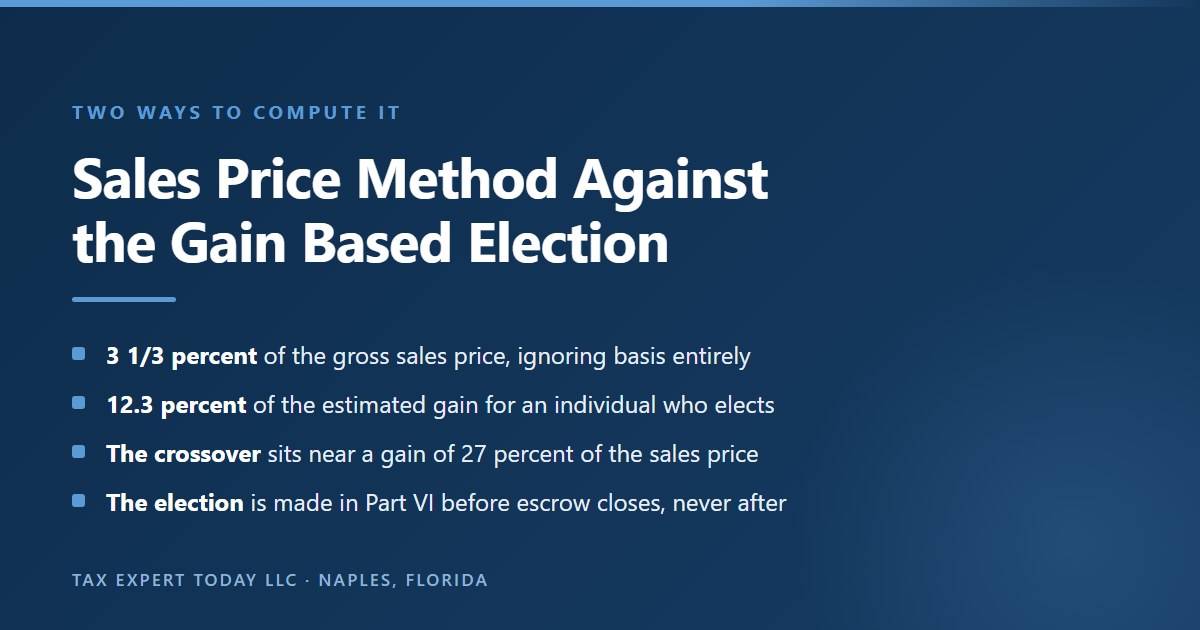
The default is 3 1/3 percent, expressed on the form as .0333, of the gross sales price multiplied by the seller ownership percentage. That is the Sales Price Method, and it ignores basis, selling costs and whether the sale produced a gain at all. The alternative is a gain based calculation at the applicable rate for the filing type, which for an individual is 12.3 percent of the estimated gain.
The arithmetic difference is rarely marginal. On a 1,200,000 dollar sale the Sales Price Method takes 39,960 dollars out of the proceeds regardless of what the seller paid for the property. A seller who bought at 900,000 dollars, spent 72,000 dollars on selling expenses and therefore has an estimated gain of 228,000 dollars would be withheld 28,044 dollars under the gain based election, a difference of nearly 12,000 dollars at the closing table.
| Filing type | Alternative withholding rate | Applied to |
|---|---|---|
| Individual | 12.3 percent | Estimated gain from Part VI, line 28 |
| Non-California partnership | 12.3 percent | Estimated gain |
| Trust, grantor and nongrantor | 12.3 percent | Estimated gain |
| Corporation | 8.84 percent | Estimated gain |
| Bank and financial corporation | 10.84 percent | Estimated gain |
| S corporation | 13.8 percent | Estimated gain |
| Financial S corporation | 15.8 percent | Estimated gain |
| Any filing type, Sales Price Method | 3 1/3 percent | Gross sales price times ownership percentage |
- The default ignores what the seller paid. Basis, improvements and selling costs have no effect on the Sales Price Method at all.
- Ownership percentage is applied first. Two owners at 50 percent each file separate forms unless they are spouses filing jointly.
- A loss still gets withheld under the default. Without a Part III line 3 certification, a seller with a real economic loss is withheld 3 1/3 percent of the price.
- The election is per seller, not per transaction. One seller can elect the gain based calculation while a co-owner takes the default.
Which method produces the smaller number depends entirely on the ratio of gain to price. As a working guide, the gain based election beats the 3 1/3 percent default for an individual whenever the estimated gain is less than roughly 27 percent of the sales price. Above that ratio the default is the cheaper figure and the election works against the seller. That crossover is worth computing before anything is signed, because the election is made on the form and not later on the return.
What Is the Alternative Withholding Calculation Election?
The alternative withholding calculation is a statutory election under section 18662(e)(2)(B) that replaces the flat 3 1/3 percent of price with the seller applicable tax rate applied to the estimated gain. The seller certifies the gain in Part VI of Form 593 under penalty of perjury, then checks one of boxes B through H in Part VII. Escrow cannot make this election for the seller.
Part VI walks the computation in a sequence that mirrors an adjusted basis worksheet. Selling price less selling expenses gives the amount realized. Purchase price plus seller paid points, less depreciation and other decreases to basis, plus additions and improvements and other increases to basis, gives the adjusted basis. The difference, reduced by any suspended passive activity losses that relate directly to this property, is the estimated gain on line 28.
- Estimates are permitted, within a limit. The instructions allow estimates in Part VI but state that they must not produce a calculated loss when the seller actually has a gain.
- Depreciation must be included even if it was never claimed. The seller enters depreciation deducted or that could have been deducted, and the instructions supply a 27.5 year estimating method for sellers who do not know the figure.
- Only directly related passive losses count. Net operating losses, capital loss carryforwards, stock losses and passive losses from other properties cannot be used on line 26.
- The election is certified under penalty of perjury. A knowingly false certificate made to avoid withholding carries a penalty of 1,000 dollars or 20 percent of the required withholding, whichever is greater.
- Keep the form for five years. The instructions direct the seller to retain Form 593 to document the calculation.
The statute also anticipates that the people handling the closing are not qualified to run this analysis. Section 18662(e)(2)(C)(i) requires the certification form to carry a specific warning: that title and escrow persons and exchange accommodators are not authorized to provide legal or accounting advice for purposes of determining withholding amounts, and that transferors are strongly encouraged to consult a competent tax professional. That sentence is in the law itself, not in a disclaimer someone added afterward.
Why Is the Elected Rate 12.3 Percent When the California Top Rate Is 13.3 Percent?
Because the statute fixes the withholding rate to the highest rate specified in section 17041 and then expressly excludes every other rate in the income tax law. The 1 percent Mental Health Services Tax sits in a different section, so it is left out of the withholding rate even though it applies to the same income on the return. The elected rate therefore under-withholds a top bracket seller by one full percentage point of gain, by design.
Section 18662(e)(2)(B)(i) states that the highest rate specified in section 17041 is determined without regard to any other tax rate specified under Part 10, irrespective of whether the applicable statute provides that the tax shall be treated as if imposed under section 17041. That last clause is doing the work. The Mental Health Services Tax is drafted so that it operates as if imposed under section 17041, and the withholding statute deliberately overrides that fiction for this purpose.
| Rate | Where it comes from | In the 593 rate? |
|---|---|---|
| 12.3 percent | Highest marginal rate specified in R&TC section 17041 | Yes, this is the individual rate on the form |
| 1 percent Mental Health Services Tax | A separate section of Part 10, excluded by 18662(e)(2)(B)(i) | No, excluded from the withholding rate |
| 13.3 percent | 12.3 percent plus the 1 percent surcharge, the true top marginal rate | No, this rate never appears on Form 593 |
| 13.8 percent, S corporation | The 1.5 percent rate under section 23802(b) added to the 12.3 percent figure | Yes, and the arithmetic is visible in the statute |
| 15.8 percent, financial S corporation | The 3.5 percent financial S corporation rate added to 12.3 percent | Yes |
The practical significance is that even a correctly elected gain based withholding is not a full prepayment for a seller in the top bracket. A high income seller with a 500,000 dollar gain who elects the alternative calculation is withheld 61,500 dollars, while the state tax on that gain at the full top marginal rate is 66,500 dollars. The 5,000 dollar shortfall is not an error by escrow. It is what the statute specifies, and it becomes a balance due the following spring. Our guide to the California mental health services tax covers how that 1 percent applies.
Which Certifications Fully Exempt a Sale From California Form 593 Withholding?
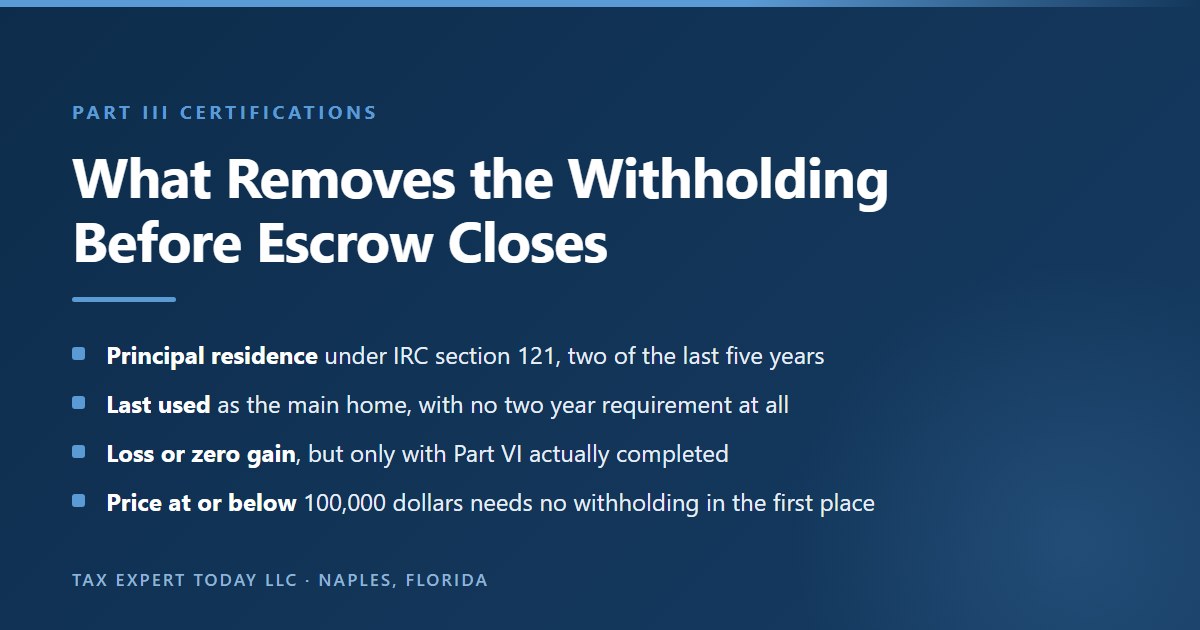
Part III of Form 593 contains nine certifications, and checking any one of them that genuinely applies removes the withholding entirely. They are certified under penalty of perjury and must reach escrow before closing. The two that matter most to individual sellers are the principal residence certification on line 1 and the property last used as a principal residence certification on line 2.
| Part III line | Certification | Core condition |
|---|---|---|
| 1 | Principal residence | Owned and lived in as the main home for at least two years of the five year period ending on the sale date, under IRC section 121 |
| 2 | Property last used as principal residence | Last use was as the main home, without regard to the two year period; a vacation home, second home or rental does not qualify |
| 3 | Loss or zero gain | Amount realized is less than or equal to adjusted basis; Part VI must be completed and show zero or a loss on line 28 |
| 4 | Involuntary conversion | Property seized, destroyed or condemned under IRC section 1033, and the seller intends to acquire similar property |
| 5 | Non-recognition under IRC 351 or 721 | Transfer to a controlled corporation or contribution to a partnership for a partnership interest |
| 6 | Corporation | Corporation with a permanent place of business in California |
| 7 | Partnership or LLC | Title recorded in the name of a California partnership, or an LLC classified as a partnership that is not a disregarded single member LLC |
| 8 | Tax-exempt entity | Seller is exempt under California or federal law |
| 9 | Insurance company, IRA, qualified plan or charitable remainder trust | Seller is one of those entities |
- Line 1 and line 2 are not interchangeable. Line 1 needs two years of ownership and use, line 2 needs only that the last use was as the main home.
- Line 3 requires the full computation. A loss or zero gain certification is invalid unless Part VI is completed and line 28 actually shows zero or a loss.
- Line 6 is about presence, not incorporation alone. A corporation qualifies through California organization, Secretary of State qualification, or a permanently staffed California office after the sale.
- Certifications reach escrow, not the state. The seller gives the signed form to the REEP before closing, and the REEP forwards it.
Three traps sit inside that table. A single member LLC that is disregarded is looked through, so the single member is treated as the seller and line 7 does not apply. A nongrantor trust cannot use the principal residence certification unless it was a grantor trust before the grantor died, a point that matters when a family home passes through a trust and is described further in our guide to trust situs after moving to Florida. And Publication 1016 states plainly that the law does not provide an exemption to an estate merely because the decedent was a California resident.
Line 3 deserves separate mention because it is the one sellers most often assume without documenting. A loss or zero gain certification requires Part VI to be completed and to show a loss or zero on line 28. The instructions specifically warn that a seller may not certify a loss just because no proceeds are received at closing, or because the seller feels the property sold for less than it is worth.
Does Moving Out of California Exempt You From Form 593 Withholding?
No. Residency has nothing to do with whether Form 593 withholding applies. Publication 1016 states that California residents, nonresident individuals and non-California business entities are all subject to the requirement. The property is in California, the gain is California source income, and the state collects a prepayment on it whether the seller lives in Sacramento or in Naples, Florida.
This is the single most common misunderstanding among sellers on the California to Florida corridor. A change of domicile is genuinely powerful for wages, for portfolio income, for retirement distributions and for the sale of most intangible assets. It does nothing at all for California real property. Real property is sourced where it sits, permanently, and no amount of Florida residency changes that.
- The withholding applies to residents and nonresidents alike. A California resident selling a rental in Fresno is withheld on the same terms as a Florida resident selling the same house.
- Moving does change the reporting form. A former resident reports the sale on Form 540NR rather than Form 540, and our guide to California part-year resident tax covers that transition.
- Moving does not change the source of the gain. Gain on California real property stays California source income under the same principles described in California source income.
- Timing the move can still matter enormously. Not for this property, but for everything else sold in the same year, as discussed in moving to Florida before selling a business.
- Other California assets follow different rules entirely. Equity compensation, for example, is sourced by workdays rather than by location, as set out in California RSU tax after leaving.
- Establishing the new domicile is still the priority. The steps are covered in how to establish Florida residency.
The corollary is more encouraging. Because the withholding is a prepayment and not a tax, a former California resident who correctly reports the sale generally recovers any excess. What a departing seller loses to a badly handled Form 593 is time and liquidity rather than tax, and that is a solvable problem if it is addressed before closing.
Can You Get Over-Withheld Money Back Before You File?
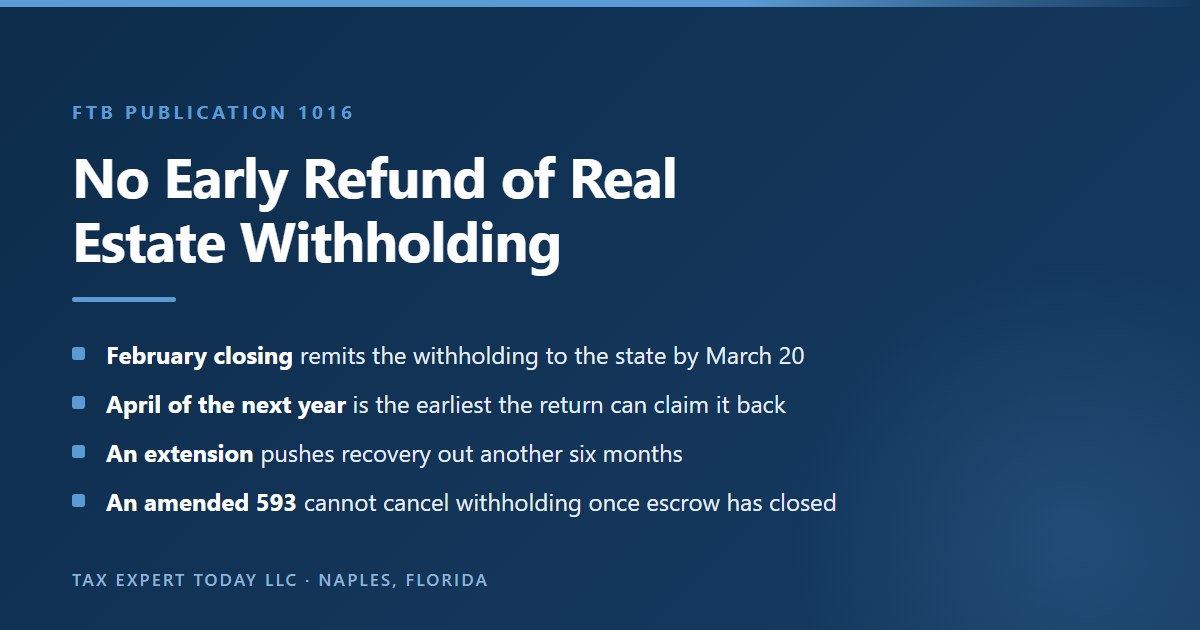
No, and this is the consequence almost no one is told at the closing table. Publication 1016 states that if the withholding payment is more than the tax liability, California law does not provide for early refunds of taxes withheld on sales of real estate. The money is recovered only by filing the California return for the year of the sale and claiming the withholding as a credit.
Consider the timing. A sale closing in February 2026 has its withholding remitted to the Franchise Tax Board by March 20, 2026. The seller reconciles it on a 2026 California return that is not due until April 2027, and the refund arrives after that return is processed. An over-withheld seller is therefore out of pocket for well over a year, on money that was never owed.
| Event | Timing on a February 2026 closing | Elapsed |
|---|---|---|
| Escrow closes and withholding is taken | February 2026 | Day zero |
| Remitter files Form 593 and sends the money | By March 20, 2026 | About one month |
| Seller files the 2026 California return | April 2027, or October 2027 on extension | 14 to 20 months |
| Refund of the excess is processed | After the return is processed | 15 to 21 months |
| Amended Form 593 to cancel the withholding | Not available after closing | Never |
- No interest runs in the seller favor. The state holds the money without compensating the seller for the delay.
- An extension makes the wait longer. Filing in October rather than April pushes the refund out by another six months.
- Estimated payments do not offset it. The withholding is credited on the return, not applied against an earlier quarter.
- The only lever is before closing. Once the money is remitted, the choice of method is fixed for that transaction.
The instructions close the obvious escape route explicitly: do not file an amended Form 593 to cancel the withholding amount after the close of the real estate transaction, because after escrow has closed amounts withheld may be recovered only by claiming the withholding as a credit on the appropriate year return. The window for getting this right is the days before closing, not the weeks after it.
That single rule is the reason the gain based election exists and the reason it is worth the trouble of completing Part VI properly. For a seller with a modest gain on an expensive property, the difference between the two methods is not tax. It is a year and a half of cash flow.
What Happens When the Property Was Last Used as Your Principal Residence?
Line 2 of Part III exempts the sale entirely if the property was last used as the seller principal residence within the meaning of IRC section 121, without regard to the two year period. It is the certification that rescues a departing Californian who moved out, left the house empty and sold it later. It fails immediately if the last use was as a rental, a vacation home or a second home.
The distinction between line 1 and line 2 is worth stating precisely, because the two are routinely confused. Line 1 asks whether the property meets the ordinary section 121 test of two years of ownership and use in the five years ending on the sale date. Line 2 drops the two year requirement and asks only about the character of the last use. A seller who lived in a house for eight months, moved to Florida and sold it fourteen months later fails line 1 and passes line 2.
- A tenant after the move breaks line 2. Once the property is rented, the last use is no longer as a principal residence and the certification is unavailable.
- Only one main home at a time. The instructions state that if a seller owns two homes and lives in both, the main home is the one lived in most of the time.
- Mixed use requires two forms. If only part of the property qualifies, a second Form 593 certifies the exemption on the qualifying portion, allocated the same way the seller allocated depreciation.
- Multi-unit buildings withhold on the non-residence units. Publication 1016 requires withholding on the portion of the price allocable to the units that were not the principal residence.
- The exemption does not remove the filing duty. Publication 1016 states that qualifying for an exemption does not relieve the seller of the obligation to file a California return and pay any tax due.
That last point is the one that turns into a notice eighteen months later. A seller who certifies an exemption, has no withholding taken, and then assumes the matter is closed has in fact taken on the whole liability with nothing prepaid against it. If the sale produced a taxable gain above the section 121 exclusion, the tax is due with the return and interest runs from the original due date. Our guide to the California late payment penalty covers what accrues from there.
How Does Form 593 Work in a 1031 Exchange or a Failed Exchange?
A qualifying simultaneous or deferred like-kind exchange under IRC section 1031 is exempt from withholding at the time of the initial transfer, and it is certified on line 10 of Part IV. Two things break that exemption. Boot exceeding 1,500 dollars triggers withholding on the boot, and an exchange that fails or does not qualify for non-recognition triggers withholding at 3 1/3 percent of the full sales price.
| Scenario | Who withholds | Amount withheld |
|---|---|---|
| Simultaneous exchange, no boot | No one | Zero, certified on Part IV line 10 |
| Deferred exchange, no boot | No one at initial transfer | Zero at the time of the initial transfer |
| Boot above 1,500 dollars received | REEP on a simultaneous exchange, QI on a deferred exchange | 3 1/3 percent of the boot, or the elected gain based amount |
| Exchange fails or does not qualify | The intermediary or accommodator | 3 1/3 percent of the sales price |
| Cash poor transaction | QI, limited to available funds | The shortfall reported on line 34 and certified on Side 3 |
| California property exchanged for out-of-state property | Not a withholding event by itself | Zero, but Form 3840 is required annually |
The last row is where California differs sharply from every other state and where an exchange out of California quietly creates a permanent filing obligation. Under R&TC sections 18032 and 24953, a taxpayer who exchanges California property for like-kind replacement property outside California must file Form 3840 for the year of the exchange and for every subsequent year in which the deferred gain has not been recognized. Publication 1016 warns that if the taxpayer fails to file Form 3840, the state can estimate the net income from any available information and propose an assessment.
Timing of the credit also shifts on a failed exchange. If a qualified intermediary withholds for a failed exchange or on boot in the year after the sale, the withholding is generally reported in the second year. A seller who instead elects to report the gain in the year of sale must contact Withholding Services and Compliance before filing to have the credit moved to the earlier year.
How Is an Installment Sale Handled on California Form 593?
An installment sale is certified on line 11 of Part IV, and it splits the withholding across time. Escrow withholds 3 1/3 percent of the down payment at closing, and the buyer then withholds on the principal portion of every subsequent payment. The buyer, not escrow, becomes the responsible withholding party once escrow closes, which surprises most private note buyers.
At closing the remitter submits Form 593 with Part V completed, Form 593-V with the amount withheld on the down payment, and a copy of the promissory note. For each later payment the buyer files a current year Form 593 and Form 593-V with the withholding. The promissory note and the seller signature are not required again on subsequent payments, but the buyer must sign each one.
- The buyer inherits an ongoing obligation. Withholding continues on the principal portion of every payment, including payoff and balloon payments.
- Zero down payment is still reported. If no down payment is received, Form 593 goes in with the installment sale box checked and zero on line 37.
- The seller can elect out, but not unilaterally. The seller must file a California return reporting the entire gain, then send the state a written request to release the buyer.
- The buyer keeps withholding until approval arrives. The Franchise Tax Board approves or denies within 30 days of receipt, and until then the buyer must continue.
- Each year needs its own return. Publication 1016 requires the seller to file a California return claiming the related withholding credit in each year installment payments are received.
The elect-out route exists because the arithmetic of an installment sale can be unattractive to a seller who has already left the state. Reporting the entire gain in the year of sale accelerates the tax but ends the annual California filing chain, which for a seller building a clean Florida record has value beyond the tax itself. Our guide to leaving California taxes covers why a clean break matters to the residency record, and the California residency audit explains what the state examines when that record is tested.
When Is California Form 593 Due and What Are the Penalties?
Form 593 and the withheld money are due to the Franchise Tax Board by the 20th day of the calendar month following the month escrow closes, and a copy goes to the seller on the same deadline. Penalties fall almost entirely on the REEP and the buyer rather than on the seller, with one significant exception: a knowingly false certification by the seller carries a penalty of 1,000 dollars or 20 percent of the required withholding.
| Failure | Penalty | Who bears it |
|---|---|---|
| REEP does not notify the buyer in writing of the requirements | Greater of 500 dollars or 10 percent of the required withholding | REEP |
| Buyer does not withhold after notification | Greater of 500 dollars or 10 percent of the required withholding | Buyer or transferee |
| Complete and correct copies not furnished to the seller by the due date | Up to 340 dollars per Form 593 | Buyer or REEP |
| Information return filed 1 to 30 days late | 60 dollars per seller | Filer, under R&TC section 19183 |
| Information return filed 31 days to 6 months late | 130 dollars per seller | Filer |
| Information return filed more than 6 months late | 340 dollars per seller | Filer |
| Intentional disregard of the requirement | Greater of 680 dollars or 10 percent of the required withholding | Filer |
| Knowingly false certificate to avoid withholding | Greater of 1,000 dollars or 20 percent of the required withholding | Seller or transferor |
- Reasonable cause is a defense across the schedule. The instructions state the penalties apply unless the failure is shown to be due to reasonable cause.
- The information return penalties are per seller. A closing with several sellers multiplies the exposure.
- Interest runs separately from penalty. Late withholding payments accrue interest from the due date to the date paid.
- The seller exposure is the certification, not the timing. Deadline penalties sit with the filer, while the seller risk is signing a certificate that is not true.
The 2026 instructions open with a new item stating that for taxable years beginning on or after January 1, 2026 the penalties related to failure to file information returns have increased. Interest is assessed on late withholding payments from the due date to the date paid. All of these penalties are stated to apply unless it is shown that the failure to notify, withhold or timely furnish returns was due to reasonable cause.
Sellers should note what is not on that list. There is no penalty on a seller for being over-withheld, and none for choosing the default method when the election would have been better. Those are pure cash flow costs, which is precisely why they are so easy to overlook until the money is gone.
How Do You Claim the Form 593 Withholding Credit on Your Return?
The seller enters the amount from Form 593, line 37, on the California return as withholding from Form 592-B or 593, and attaches a copy of the form to the lower front of the return. A former California resident claims it on Form 540NR, a continuing resident on Form 540, and entities on the return matching their filing type.
| Seller type | Return that claims the credit |
|---|---|
| Individual, still a California resident | Form 540, California Resident Income Tax Return |
| Individual who moved out during or before the year | Form 540NR, California Nonresident or Part-Year Resident Income Tax Return |
| Estate or trust | Form 541, California Fiduciary Income Tax Return |
| C corporation | Form 100, or Form 100W for water’s-edge filers |
| S corporation | Form 100S |
| Partnership or LLC | Form 565 or Form 568 |
- Attach the form to the return. A copy of each Form 593 goes to the lower front of the California return being filed.
- The credit is entered as withholding. Line 37 of Form 593 is reported alongside any Form 592-B withholding, not as an estimated payment.
- The credit follows the year of withholding. On a like-kind exchange the credit belongs to the taxable year in which the withholding actually occurred.
- MyFTB confirms application. A seller can verify the credit posted to the account through the state online account or by calling the withholding unit.
Two administrative wrinkles cause most of the credit problems that reach a practitioner. A seller whose filing status changed between the close of escrow and the filing of the return has to call Withholding Services and Compliance before filing to get instructions on how to claim the credit, because the form no longer matches the return. And a seller who could not obtain a taxpayer identification number before closing is in a worse position than merely being withheld upon: Publication 1016 states that in that case Parts III and IV are void, withholding is required, and failure to provide a valid identification number results in denial of the real estate withholding credit when the return is filed.
Trusts have their own mechanism. If a trust distributes the income from the gain, it must also distribute the withholding, and it does so on Form 592 rather than on a Schedule K-1. The instructions are explicit that the K-1 is not used to pass through this withholding, which is a common preparer error on fiduciary returns.
What Goes Wrong Most Often With California Form 593?
The recurring failures are timing failures rather than technical ones. The election that had to be made before closing was not made, the certification that would have applied was never claimed, the parcels were looked at individually instead of together, or the form went out with an identification number that was not yet valid. Each of these costs money that cannot be recovered by amending anything.
| Mistake | What it costs | When it can still be fixed |
|---|---|---|
| Signing the form without running the crossover calculation | Excess withholding locked up until the return is filed | Before escrow closes only |
| Assuming a move out of California ends the withholding | Full 3 1/3 percent taken by surprise at closing | Before escrow closes only |
| Treating parcels in one escrow separately for the 100,000 dollar test | Missed withholding and a penalty on the REEP | Before escrow closes |
| Certifying a loss without completing Part VI | Exposure to the 1,000 dollar or 20 percent false certificate penalty | Before signing |
| Using the wrong taxable year form | The form cannot be processed at all | By filing the correct year form |
| Closing without a valid identification number | Parts III and IV void, and the credit denied on the return | By contacting the state once a number is obtained |
| Filing an amended 593 to cancel withholding after closing | Wasted effort, the instructions prohibit it | Not fixable, claim the credit instead |
The parcel aggregation rule deserves a sentence of its own because it is genuinely counterintuitive. Publication 1016 gives the example directly: sales of multiple parcels or family units within the same escrow agreement constitute one transaction, and withholding is required when the combined sales price of all parcels exceeds 100,000 dollars even though each separate parcel is under 100,000 dollars. Sellers unloading several small lots in one closing routinely assume the opposite.
How Does California Form 593 Compare With FIRPTA Withholding?
They are two independent systems that can both apply to the same closing. FIRPTA is federal withholding on a foreign person disposition of a United States real property interest, collected by the buyer for the Internal Revenue Service. Form 593 is California state withholding collected by escrow for the Franchise Tax Board. Neither one credits against the other, and a foreign seller of California property is withheld twice.
- Different triggers. FIRPTA turns on whether the seller is a foreign person. Form 593 turns on whether the property is in California, and reaches United States citizens and residents alike.
- Different collectors. The buyer is the federal withholding agent under FIRPTA. The remitter, normally escrow, is the state withholding agent under section 18662.
- Different thresholds. The California threshold is a 100,000 dollar sales price. The federal rules carry their own residence use exceptions at different price points.
- Different reduction mechanisms. FIRPTA relief runs through a federal withholding certificate application. California relief runs through the Part III certifications and the Part VI gain based election on the form itself.
- Different recovery timelines. Both are recovered by filing a return, one federal and one state, and the two returns are separate filings with separate processing times.
A seller in that position is looking at combined withholding that can exceed the entire gain on a low basis property, which is why the analysis belongs in front of the closing rather than behind it. The federal side is covered separately in our guide to FIRPTA withholding, and the interaction with a change of residency is discussed in the California exit tax.
What Should a Seller Gather Before Escrow Closes?
Everything that feeds Part VI, and it should be assembled before the form arrives rather than after. The gain based election is only as good as the basis documentation behind it, and the certification is signed under penalty of perjury. A seller who cannot substantiate the numbers is better served by the 3 1/3 percent default and a correct return later.
- The original closing statement. Purchase price, settlement fees and closing costs all belong in the basis computation on lines 16 and 23.
- Records of additions and improvements. Room additions, a new roof, a remodel or landscaping increase basis on line 22. Repairs do not.
- Depreciation schedules for any rental period. Depreciation allowed or allowable comes off basis on line 18 whether or not it was ever claimed on a return.
- Prior year California returns showing suspended losses. Only passive activity losses that relate directly to this property can be used on line 26.
- The estimated settlement statement for this sale. Commissions, advertising, legal fees and loan charges reduce the amount realized on line 14.
- A valid taxpayer identification number for every seller on title. Without one, Parts III and IV are void and the withholding credit is denied on the return.
Sellers who kept a California property as a rental after moving are the group most often caught short here, because the depreciation figure is mandatory and the records are frequently with a former preparer in another state. The instructions do supply an estimating method for that case, dividing the purchase price plus improvements by 27.5 and multiplying by the years of business use, but an estimate that understates depreciation overstates basis and understates the certified gain, which is the direction the perjury statement is aimed at. Sellers in that situation should also review selling your home after moving to Florida and, if the property is held in an entity, the California LLC franchise tax, which continues to run while the entity holds the property.
California Form 593 Help Naples and Southwest Florida
Our office is in Naples, Florida, and a substantial part of the practice runs along the California to Florida corridor: people who have moved, or are moving, and who still hold California real property. Selling that property is usually the last California event in the file, and Form 593 is the piece of it that has a deadline measured in days rather than months.
Tax Expert Today LLC is a multidisciplinary firm of tax advisors, enrolled agents, CPAs and attorneys handling state residency and tax matters nationwide. On a California real estate withholding engagement the work is normally three items: running the crossover between the 3 1/3 percent default and the gain based election before escrow closes, confirming whether a Part III certification is genuinely available, and lining the withholding up with the Form 540NR that will claim it the following year.
Tax Expert Today LLC
11983 Tamiami Trail N, Naples, FL 34110
Phone: (239) 441-2005
Hours: Monday through Friday, 10:00 a.m. to 5:00 p.m. ET
I already live in Southwest Florida and my California house is in escrow next month. Is it too late to do anything? Usually not, but the useful window is now rather than after closing. If the estimated gain is small relative to the price, the gain based election can free up a substantial amount of the proceeds, and it has to be certified in Part VI before escrow closes. If the property was last used as a residence rather than as a rental, the Part III line 2 certification may remove the withholding entirely. Both of those decisions expire at closing, and neither can be recovered by amending the form afterward.
Broader planning for new and prospective Florida residents is described on our Naples tax planning page, and the California side of the engagement is outlined on our California tax services page. Sellers still working out the residency date should also read moving from California to Florida taxes and our Florida 183 day rule calculator.
When to Engage a Professional
Most California home sales need no specialist attention on the withholding question, because the seller lived in the house, certifies the principal residence exemption on Part III line 1, and no withholding is taken. The situations below are the ones where a review before closing tends to pay for itself.
- The property was a rental at any point. Depreciation that was allowed or allowable has to be entered on line 18 whether or not it was ever deducted, and it can move the estimated gain substantially.
- The gain is small relative to a high sales price. This is where the alternative withholding calculation election is worth the most, and where doing nothing costs the most.
- The seller has already left California. The sale runs through a Form 540NR, and the withholding, the residency date and any other income sold in the same year need to be looked at together.
- Title is in a trust, an estate or a single member LLC. The look-through rules decide which certifications are available and whose identification number belongs on the form.
- The sale is structured as an installment sale or a 1031 exchange. Both create obligations that continue for years after the closing, including the annual Form 3840 for an exchange into out-of-state property.
- Several parcels are closing in one escrow. The 100,000 dollar threshold is tested on the combined price, not parcel by parcel.
Every transaction turns on its own facts, and the summaries above are general information rather than advice on any particular sale. A short conversation before escrow closes is usually enough to establish whether the default method or the election is the better route. Call (239) 441-2005 to arrange a consultation.
Frequently Asked Questions
What is California Form 593 used for?
Form 593 is the Real Estate Withholding Statement. It reports and remits tax withheld on the sale or transfer of California real property under Revenue and Taxation Code section 18662, and it is also the form on which a seller certifies to an exemption or elects the gain based withholding calculation.
How much is withheld on California Form 593?
The default is 3 1/3 percent of the gross sales price multiplied by the seller ownership percentage. A seller who elects the alternative withholding calculation is instead withheld at the rate for the filing type applied to the estimated gain, which is 12.3 percent for an individual and 8.84 percent for a corporation.
Who is exempt from filing Form 593?
No withholding is required when the sales price is 100,000 dollars or less, when the property is in foreclosure, when the transferor is a bank acting as trustee other than under a deed of trust, or when the seller certifies to one of the nine exemptions in Part III. A seller who qualifies for a full, partial or no withholding exemption still files Form 593 to make that certification.
Do I still owe California tax if I moved to Florida before selling?
Yes on the real property. Gain on California real estate is California source income no matter where the seller lives, and Publication 1016 confirms that residents and nonresidents alike are subject to the withholding. The move changes the return used, from Form 540 to Form 540NR, not the source of the gain.
Can I get the withholding refunded before I file my return?
No. Publication 1016 states that California law does not provide for early refunds of taxes withheld on sales of real estate. Excess withholding is recovered only by filing the California return for the year of the sale and claiming the amount as a credit, which for a sale early in the year means waiting more than a year.
When is Form 593 due to the Franchise Tax Board?
By the 20th day of the calendar month following the month in which escrow closes. The remitter files the original with Form 593-V and the payment, provides a copy to the seller on the same deadline, and keeps a copy for five years.
Can I amend Form 593 after escrow closes to cancel the withholding?
No. Only the REEP can file an amended Form 593, and the instructions state directly that an amended form must not be filed to cancel the withholding amount after closing. Once escrow has closed, the amount withheld is recovered only as a credit on the appropriate year return.
Published September 8, 2026 by Dr. Pellumb Kabashi « Back to Learning Center
Have a question this article touches on?
Tax Expert Today LLC, based in Naples, Florida and serving clients across the United States.
Schedule a Consultation (239) 441-2005