
By Dr. Pellumb Kabashi, DBA, MBA, CES, CFE, EA
Founder, Tax Expert Today LLC · Tax advisors, enrolled agents, CPAs, and attorneys · Serving clients in all 50 states
Quick Answer
The excess business loss limitation in IRC section 461(l) stops individuals, trusts, and estates from deducting net business losses above a yearly threshold against wages and investment income. For 2026 the threshold is $256,000, or $512,000 on a joint return. The disallowed excess becomes a net operating loss carryforward. Call (239) 441-2005 for a free consultation.
What is the excess business loss limitation?
The excess business loss limitation is a federal cap on how much net loss from all of a noncorporate taxpayer’s trades or businesses can be deducted in one year. Losses up to the threshold offset wages, interest, dividends, and other income. Any net business loss above the threshold is disallowed for that year and carried forward instead.
- Where it lives: IRC section 461(l), added by the 2017 tax law and made permanent in 2025.
- Who it applies to: individuals, partners, S corporation shareholders, trusts, and estates.
- What it measures: aggregate business deductions minus aggregate business income and gains.
- What happens to the excess: it is treated as a net operating loss carryforward.
Most business owners meet the excess business loss limitation, often shortened to the EBL limitation, only after they have already done something that produces a very large loss: a cost segregation study on a newly purchased property, a year of bonus depreciation on heavy equipment, a start-up year with large launch costs, or a pass-through investment that allocates a big first-year depreciation loss. Before 2018, a loss of that size from an active business could offset a spouse’s salary, a large bonus, or a portfolio’s income in full in the year it arose. Since 2018 (with a pause for 2018 through 2020 that is explained later), it cannot, at least not above the threshold.
The rule is written in IRC section 461(l). Paragraph (1) disallows any excess business loss of a taxpayer other than a corporation. Paragraph (2) says the disallowed loss is treated as a net operating loss for purposes of determining any carryover under section 172(b). Paragraph (3) defines the excess business loss, paragraph (4) sends the computation to the partner or shareholder level for pass-through entities, and paragraph (6) says the rule applies after the passive activity rules of section 469. The IRS computes the result on Form 461, Limitation on Business Losses.
The important word is “net.” The limitation is not a cap on any one deduction, and it does not stop a business owner from claiming depreciation, wages, rent, or any other expense. It looks at the total of all business deductions for the year, subtracts the total of all business income and gains for the year, and asks whether the difference is larger than the threshold. Only the part of the net loss above the threshold is pushed into a later year. This guide is written for owners and investors who want to understand that arithmetic before a planning decision is locked in, and it pairs with our broader Naples, Florida tax planning overview.
| Item | Rule | Source |
|---|---|---|
| Who is limited | Taxpayers other than corporations | IRC 461(l)(1) |
| 2026 threshold, single and most other filers | $256,000 | Rev. Proc. 2025-32, sec. 4.31 |
| 2026 threshold, joint return | $512,000 | Rev. Proc. 2025-32, sec. 4.31 |
| Employee wages | Excluded from the computation | IRC 461(l)(3)(A), last sentence |
| Disallowed excess | Treated as a net operating loss carryforward | IRC 461(l)(2) |
| Order of application | After basis, at-risk, and passive activity limits | IRC 461(l)(6); Form 461 instructions |
| Form | Form 461, attached to the return | Form 461 instructions |
What is the excess business loss threshold for 2026?
For taxable years beginning in 2026, the excess business loss threshold is $256,000 for single filers, heads of household, and married individuals filing separately, and $512,000 for married couples filing a joint return. Rev. Proc. 2025-32, section 4.31, sets those amounts under IRC section 461(l)(3)(A)(ii)(II), as adjusted for inflation.
- Single, head of household, married filing separately: $256,000.
- Married filing jointly: $512,000, which is 200 percent of the base amount.
- 2025, for comparison: $313,000 and $626,000.
- 2027: indexed again, and not yet published when this guide was written.
The 2026 figures come from Rev. Proc. 2025-32, the annual revenue procedure that publishes inflation-adjusted amounts for the year. Section 4.31 of that revenue procedure reads, in substance, that for taxable years beginning in 2026, in determining a taxpayer’s excess business loss, the amount under section 461(l)(3)(A)(ii)(II) is $256,000 ($512,000 for joint returns). The 2025 amounts of $313,000 and $626,000 come from section 2.32 of Rev. Proc. 2024-40, and the 2025 Form 461 instructions repeat them.
The statute only distinguishes a joint return from every other return. Section 461(l)(3)(A)(ii)(II) uses “$250,000 (200 percent of such amount in the case of a joint return).” A married person filing separately therefore uses the single amount, which is not half of the joint amount. That is a mechanical point, but it matters when a couple compares joint and separate filing in a year with a large loss, as discussed in the married couples section later in this guide.
The 2027 threshold will be published in the inflation-adjustment revenue procedure for 2027, which the IRS generally releases in the fall of the prior year. When this guide was checked, that figure had not been released, so no 2027 amount is used here. Where the worked examples below need a 2027 tax computation, they use the 2026 brackets as a stated assumption and say so in each caption.
| Filing status | 2025 threshold | 2026 threshold | Change |
|---|---|---|---|
| Single | $313,000 | $256,000 | Down $57,000 |
| Head of household | $313,000 | $256,000 | Down $57,000 |
| Married filing separately (each spouse) | $313,000 | $256,000 | Down $57,000 |
| Married filing jointly | $626,000 | $512,000 | Down $114,000 |
| Source | Rev. Proc. 2024-40, sec. 2.32 | Rev. Proc. 2025-32, sec. 4.31 | P.L. 119-21, sec. 70601(b) |
Why is the 2026 threshold lower than the 2025 threshold?
The threshold fell because P.L. 119-21 changed the year from which the $250,000 base amount is indexed. Before 2026, the base was indexed from 2017, which had grown it to $313,000. Starting in 2026, the base is indexed from 2024, so the clock on inflation growth restarted and the amount dropped to $256,000.
- Old rule: cost-of-living adjustment measured from a 2017 base year.
- New rule: cost-of-living adjustment measured from a 2024 base year.
- Effective date: taxable years beginning after December 31, 2025.
- Practical result: about $57,000 less room for single filers and $114,000 less for couples.
Section 70601(b) of P.L. 119-21, the law commonly called the One Big Beautiful Bill Act, amended section 461(l)(3)(C) in two places. It changed the first year of indexing from taxable years beginning after December 31, 2018 to taxable years beginning after December 31, 2025, and it changed the reference year in the cost-of-living formula from 2017 to 2024. Section 70601(c)(2) makes both changes effective for taxable years beginning after December 31, 2025.
Under the formula as it now reads in section 461(l)(3)(C), the $250,000 amount is increased by $250,000 multiplied by the cost-of-living adjustment under section 1(f)(3) for the calendar year in which the taxable year begins, “determined by substituting ‘2024’ for ‘2016’” in the inflation formula, and rounded to the nearest $1,000. Measured from 2024, two years of inflation added only about $6,000, which produces $256,000. Measured from 2017, eight years of inflation had produced $313,000 for 2025. Nothing about the rule’s structure changed. The base amount simply started growing again from a later year.
Several of the pages that rank for this topic still show $313,000 or an even older figure, and some summaries describe the 2026 number as an error. It is not an error. It is the arithmetic result of the 2025 law. For a high-income couple planning a cost segregation study or a year-end equipment purchase, the change means the same loss that fit under the 2025 cap may now produce a carryforward, which is the main reason this topic deserves a fresh look before the end of 2026.
| Feature | Before P.L. 119-21 | After P.L. 119-21 |
|---|---|---|
| Base amount in the statute | $250,000 ($500,000 joint) | $250,000 ($500,000 joint), unchanged |
| First year indexing applies | Taxable years beginning after Dec. 31, 2018 | Taxable years beginning after Dec. 31, 2025 |
| Inflation reference year | 2017 | 2024 |
| Resulting threshold | $313,000 for 2025 | $256,000 for 2026 |
| Rounding | Nearest $1,000 | Nearest $1,000 |
Is the excess business loss limitation permanent?
Yes. Section 70601(a) of P.L. 119-21 struck the phrase that would have ended the limitation for taxable years beginning after December 31, 2028, effective for taxable years beginning after December 31, 2026. Before that change, the rule was temporary and had already been extended twice, so many older articles describe an expiration date that no longer exists.
- 2017 law: created the rule for 2018 through 2025.
- CARES Act, 2020: suspended it retroactively for 2018, 2019, and 2020.
- American Rescue Plan Act, 2021: extended it through 2026.
- Inflation Reduction Act, 2022: extended it through 2028.
- P.L. 119-21, 2025: made it permanent.
The history explains why so much of what is written about the limitation is out of date. The Tax Cuts and Jobs Act created section 461(l) for taxable years beginning after December 31, 2017 and before January 1, 2026. The CARES Act in 2020 then changed the start date to taxable years beginning after December 31, 2020, which removed the limitation for 2018, 2019, and 2020 and allowed amended returns for those years. The American Rescue Plan Act moved the end date to 2026, and the Inflation Reduction Act moved it to 2028. The 2025 law removed the end date altogether.
The text of section 70601(a) reads that section 461(l)(1) is amended by striking “and before January 1, 2029,” each place it appears. Some online copies of the Code had not yet been updated to show every change when this guide was checked, so the public law itself is the more reliable reference for the permanence point. The 2025 Form 461 instructions confirm the IRS reading in their section on new developments: the law “permanently extended the disallowance of a deduction for excess business losses.”
Permanence changes planning in a subtle way. When the rule was scheduled to expire, a carryforward created in a limited year could sometimes be used in a later year when no limitation applied at all, and some owners timed large losses with that in mind. With a permanent rule and a lower threshold, the planning question is no longer how to wait out the rule. It is how to manage the size and timing of business losses year by year, and how to make sure the resulting carryforward is actually used.
| Law | Year enacted | Effect on the limitation |
|---|---|---|
| Tax Cuts and Jobs Act, P.L. 115-97 | 2017 | Created the rule for 2018 through 2025 |
| CARES Act, P.L. 116-136 | 2020 | Suspended it for 2018, 2019, and 2020 |
| American Rescue Plan Act, P.L. 117-2 | 2021 | Extended it through 2026 |
| Inflation Reduction Act, P.L. 117-169 | 2022 | Extended it through 2028 |
| P.L. 119-21, sec. 70601 | 2025 | Made it permanent and re-based indexing to 2024 |
Who is subject to the excess business loss limitation?
Every taxpayer other than a corporation can be subject to the limitation. That includes sole proprietors filing Schedule C, farmers filing Schedule F, landlords whose rentals rise to a trade or business, partners and LLC members receiving Schedule K-1 losses, S corporation shareholders, and trusts and estates. C corporations are not subject to it.
- Individuals: Schedule C, Schedule F, and business activity on Schedule E.
- Pass-through owners: tested at the partner or shareholder level, not the entity level.
- Trusts and estates: including trusts taxed under section 511, per the Form 461 instructions.
- Not covered: C corporations, which have their own net operating loss rules.
Section 461(l)(1) applies “in the case of a taxpayer other than a corporation.” The IRS explanation of excess business losses describes the scope as noncorporate taxpayers and says a trade or business can include, but is not limited to, Schedule F and Schedule C activities and other business activities reported on Schedule E. Business gains and losses reported on Form 4797 can be included, as can pass-through income and losses attributable to a trade or business.
In practice, the limitation reaches three kinds of taxpayers most often. The first is the high-income couple with large wages or portfolio income who invests in real estate or a business that produces a large depreciation loss, and who has done the work to make that loss non-passive. The second is the business owner in a start-up or expansion year whose own company produces a loss larger than the threshold. The third is the investor in a pass-through entity, often an operating business or a real estate fund, whose Schedule K-1 shows a large allocated loss. The common thread is a net business loss larger than $256,000 or $512,000, after the earlier loss limits have already done their work.
Corporations are outside the rule, but owners of a corporation are not automatically outside it. A shareholder in an S corporation is tested on their share of the corporation’s items, and the Shareholder’s Instructions for Schedule K-1 (Form 1120-S) say so directly. Only a C corporation’s own losses, which stay inside the corporation and do not flow to the owners, fall outside section 461(l). Readers comparing entity choices for a loss-heavy venture can see how the pieces fit in our guide to the qualified business income deduction, which also turns on whether income is from a trade or business.
| Taxpayer | Subject to 461(l)? | Where the test is applied |
|---|---|---|
| Sole proprietor (Schedule C) | Yes | Individual return |
| Farmer (Schedule F) | Yes, with farm loss coordination | Individual return |
| Partner or LLC member taxed as a partnership | Yes | Partner level, IRC 461(l)(4) |
| S corporation shareholder | Yes | Shareholder level, IRC 461(l)(4) |
| Trust or estate | Yes | Fiduciary return (Form 1041) |
| C corporation | No | Not applicable |
How is an excess business loss calculated?
Add up all deductions attributable to every trade or business for the year, without the net operating loss deduction or the qualified business income deduction. Subtract all business gross income and gains. Then subtract the threshold. If deductions still exceed income plus the threshold, that excess is the excess business loss.
- Step 1: total business deductions, ignoring sections 172 and 199A.
- Step 2: total business gross income and gains, with the capital gain cap applied.
- Step 3: add the threshold, $256,000 or $512,000 for 2026.
- Step 4: any deductions above Step 2 plus Step 3 are disallowed and carried forward.
Section 461(l)(3)(A) defines the excess business loss as the excess of (i) the aggregate deductions of the taxpayer for the taxable year attributable to trades or businesses of the taxpayer, determined without regard to whether those deductions are disallowed under paragraph (1) and without regard to any deduction allowable under section 172 or 199A, over (ii) the sum of the aggregate gross income or gain attributable to those trades or businesses plus the threshold amount. Because the test aggregates every business the taxpayer has, profits in one business offset losses in another before the threshold is applied.
The 2025 Form 461 follows a slightly different path to the same result. Part I totals all income and loss items from the return that might be business items: Schedule 1 business income or loss, capital gain or loss, other gains or losses, Schedule E supplemental income or loss, farm income or loss, and any other trade or business income or loss. Part II backs out the amounts on those lines that are not from a trade or business. Part III adds the threshold. If the result is still negative, that negative amount is the excess business loss.
The aggregation point deserves emphasis because it is where planning begins. An owner with a $900,000 depreciation loss from a new property and a $400,000 profit from an operating company has a net business loss of only $500,000, which is under the 2026 joint threshold. The same owner without the operating company profit has a $388,000 excess business loss. Every business item counts, and that includes gains on the sale of business property, which the IRS explanation confirms can be included in the computation. The worked examples later in this guide build on this simple structure.
| Line | Item | Amount |
|---|---|---|
| A | Business deductions, all trades or businesses | $1,100,000 |
| B | Business gross income and gains | $400,000 |
| C | Net business loss (A minus B) | $700,000 |
| D | 2026 joint threshold | $512,000 |
| E | Excess business loss (C minus D) | $188,000 |
| F | Business loss allowed in 2026 (C minus E) | $512,000 |
| G | Carried forward as a net operating loss | $188,000 |
Do W-2 wages count as business income for section 461(l)?
No. The last sentence of section 461(l)(3)(A) says the excess is determined without regard to any deductions, gross income, or gains attributable to any trade or business of performing services as an employee. Wages cannot absorb a business loss inside the computation, although an allowed loss up to the threshold can still offset wages on the return.
- Inside the 461(l) test: wages are ignored, on both the income and deduction side.
- On the return: the allowed loss reduces adjusted gross income, which includes wages.
- Common confusion: an early IRS alert suggested wages could count; the statute now says plainly they do not.
- S corporation owners: salary from their own S corporation is wages, and is excluded too.
The wage question was one of the most debated issues when the rule first appeared. As The Tax Adviser reported in 2019, the Joint Committee on Taxation’s general explanation said wages were not taken into account, while an IRS alert from December 2018 listed “the activity of being an employee” as a trade or business. The CARES Act settled the question in 2020 by adding the sentence now at the end of section 461(l)(3)(A), and the current Form 461 instructions repeat it: excess losses should be determined without regard to any deductions, gross income, or gains attributable to any trade or business of performing services as an employee.
The distinction between “inside the test” and “on the return” is the source of most misunderstandings. The limitation does not say a business loss cannot offset wages. It says that wages do not count as business income when measuring whether the net business loss exceeds the threshold. Up to $512,000 of net business loss on a joint return can still reduce adjusted gross income that consists entirely of wages. Only the part above $512,000 is pushed to a later year. The short-term rental tax loophole depends on exactly this: a non-passive rental loss offsetting wages, up to the threshold.
The wage exclusion has a second, less obvious consequence for owners of S corporations. A shareholder-employee’s salary from their own company is wages for this purpose, so it is excluded from the business income side of the test, while the salary deduction remains inside the corporation’s ordinary loss that flows through to the owner. That interaction is worked through in numbers in the S corporation section later in this guide, and it connects directly to the rules on S corporation reasonable compensation, which still require a fair salary whatever the loss limitation says.
| Question | Answer | Source |
|---|---|---|
| Do wages increase business income in the 461(l) test? | No | IRC 461(l)(3)(A), last sentence |
| Can an allowed business loss reduce AGI that includes wages? | Yes, up to the threshold | IRC 461(l)(1) applies only to the excess |
| Are unreimbursed employee expenses counted as business deductions? | No, employee items are excluded | IRC 461(l)(3)(A), last sentence |
| Is an S corporation owner’s own salary treated as wages? | Yes, excluded from the test | IRC 461(l)(3)(A); Form W-2 wages |
| Did the IRS once suggest otherwise? | Yes, a December 2018 alert, before the 2020 amendment | The Tax Adviser, May 2019 |
How do capital gains and losses enter the calculation?
Capital losses are left out of business deductions entirely. Capital gains count as business income only up to the lesser of capital gain net income from business assets alone or total capital gain net income. Portfolio gains from stocks and funds therefore do not reduce an excess business loss, even though they appear on the same return.
- Capital losses: never treated as business deductions in the 461(l) test.
- Capital gains: counted only to the extent of business capital gain net income, and never more than total capital gain net income.
- Form 4797 gains: gains on business property can be included, according to the IRS.
- Investment gains: backed out on Form 461, line 10.
Section 461(l)(3)(B) contains two rules. Clause (i) says deductions for losses from sales or exchanges of capital assets are not taken into account as business deductions. Clause (ii) says the amount of capital gains counted as business income cannot exceed the lesser of (I) the capital gain net income determined by taking into account only gains and losses attributable to a trade or business, or (II) the capital gain net income. Both rules were added by the CARES Act in 2020, and both appear in the current Form 461 instructions under the heading “Treatment of capital gains and losses.”
The practical effect is that a large stock sale does nothing to absorb a large business loss inside the computation. An owner who sells appreciated shares in December, hoping the gain will “use up” a depreciation loss, finds that the gain is backed out on Form 461, line 10, as income not attributable to a trade or business. The gain still increases adjusted gross income on the return, so the allowed part of the business loss can still offset it there, but it does not shrink the excess business loss itself. Our guide to tax gain harvesting covers why realizing portfolio gains in a low-income year can still make sense for other reasons.
Business gains are different. The IRS explanation says business gains and losses reported on Form 4797 can be included in the excess business loss calculation. A gain on the sale of equipment, a building used in the business, or another business asset is therefore part of the business income total and can reduce the excess. The second clause of section 461(l)(3)(B)(ii) adds a ceiling: even business capital gains count only up to total capital gain net income, so a taxpayer with business capital gains and larger portfolio capital losses may find that less of the business gain counts than expected.
| Item | Counted in the 461(l) test? | Source |
|---|---|---|
| Capital loss on stock or fund shares | No | IRC 461(l)(3)(B)(i) |
| Capital loss on a business capital asset | No, capital losses are excluded from deductions | IRC 461(l)(3)(B)(i) |
| Capital gain on stock or fund shares | No, backed out as nonbusiness income | IRC 461(l)(3)(B)(ii); Form 461, line 10 |
| Capital gain attributable to a trade or business | Yes, up to the lesser-of cap | IRC 461(l)(3)(B)(ii) |
| Gain on business property reported on Form 4797 | Can be included | IRS, Excess business losses |
| Interest and dividends from a portfolio | No | Form 461, Part II |
In what order do the loss limitations apply?
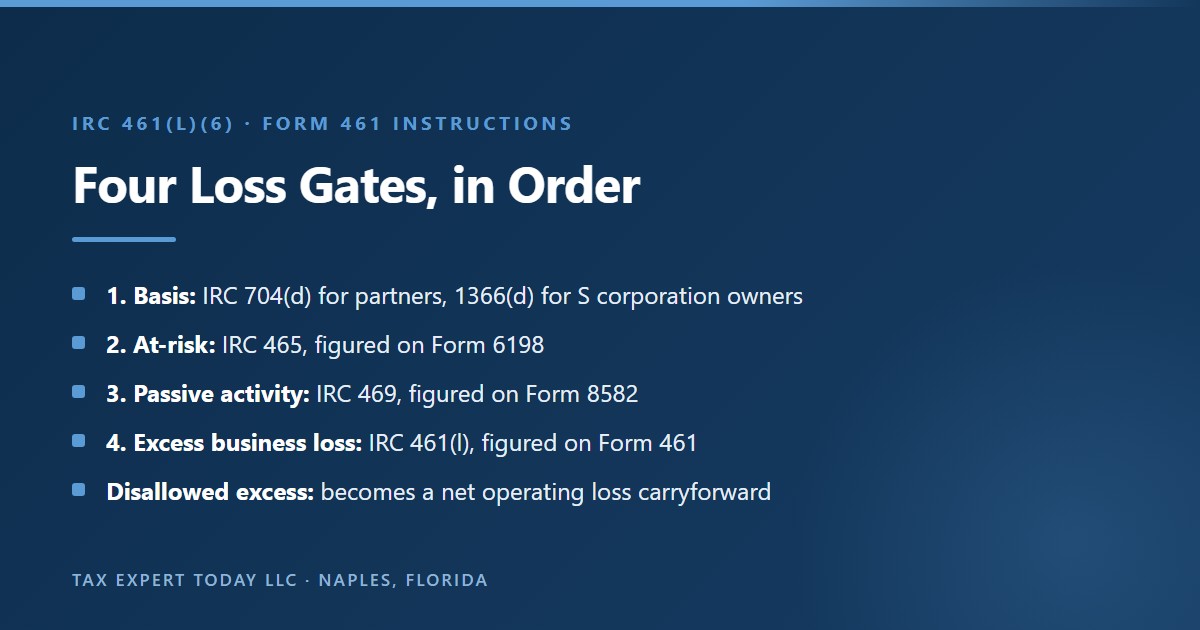
A business loss must pass four tests in order. First the basis limits for partners and S corporation shareholders, then the at-risk rules of section 465, then the passive activity rules of section 469, and only then the excess business loss limitation of section 461(l). A loss suspended at an earlier step never reaches the 461(l) test that year.
- Step 1, basis: IRC 704(d) for partners and IRC 1366(d) for S corporation shareholders.
- Step 2, at-risk: IRC 465, figured on Form 6198.
- Step 3, passive activity: IRC 469, figured on Form 8582.
- Step 4, excess business loss: IRC 461(l), figured on Form 461.
The Partner’s Instructions for Schedule K-1 (Form 1065) state the order plainly: the basis limitations, the at-risk limitations, the passive activity limitations, and the excess business loss limitations. The S corporation shareholder instructions use the same sequence. IRS Publication 925 repeats it for individuals: if a noncorporate taxpayer has allowable business losses after taking into account the basis limitations, the at-risk limitations, and then the passive loss limitations, those losses may be subject to the excess business loss limitation.
The statute builds in only the last link of the chain. Section 461(l)(6) says the subsection shall be applied after the application of section 469. The Form 461 instructions describe the rest of the ordering: first the at-risk rules, next the passive activity loss rules, and then the excess business loss rules. Basis comes before all of them because a partner or shareholder cannot deduct a loss at all beyond basis under section 704(d) or section 1366(d), as the K-1 instructions explain.
The order matters because each step changes what the next step sees. A loss that is passive and suspended under section 469 is not part of the excess business loss computation for the year it is suspended. It enters the 461(l) test in the year it is freed, for example when the taxpayer has passive income or disposes of the activity. That means a large passive loss released on a sale can trigger an excess business loss in the year of sale, years after the depreciation that created it, which is a point many planning summaries miss.
| Order | Limitation | Code section | Form | What a suspended loss waits for |
|---|---|---|---|---|
| 1 | Basis | IRC 704(d), 1366(d) | Basis worksheets; Form 7203 for S corporations | More basis from income or contributions |
| 2 | At-risk | IRC 465 | Form 6198 | More amount at risk |
| 3 | Passive activity | IRC 469 | Form 8582 | Passive income or a full disposition |
| 4 | Excess business loss | IRC 461(l) | Form 461 | Becomes a net operating loss carryforward |
How do basis limits under sections 704(d) and 1366(d) interact with 461(l)?
A partner or S corporation shareholder can deduct a pass-through loss only to the extent of basis. Any loss above basis is suspended and carried forward until basis is restored. Only the basis-allowed portion moves on, so low basis can keep a loss from reaching section 461(l) this year.
- Partners: section 704(d) limits the loss to the adjusted basis of the partnership interest.
- S corporation shareholders: section 1366(d) limits it to stock basis plus loans made to the corporation.
- Suspended basis losses: carry forward indefinitely at the owner level.
- Interaction: a basis-suspended loss is not an excess business loss and is not a net operating loss.
Basis is the first gate. Under section 704(d), a partner’s distributive share of partnership loss is allowed only to the extent of the adjusted basis of the partner’s interest at the end of the partnership year, and any excess is allowed as a deduction at the end of a later year to the extent basis then exceeds zero. Section 1366(d) is the S corporation counterpart, measured by the shareholder’s stock basis plus the basis of any debt the corporation owes the shareholder.
The distinction between a basis-suspended loss and an excess business loss is more than a label. A basis-suspended loss stays with the interest and waits for future basis, while an excess business loss becomes a net operating loss that is no longer tied to the entity at all. The first can be lost if the owner sells or gives away the interest before basis is restored, depending on the facts. The second follows the taxpayer and can offset any kind of income in later years, subject to the 80 percent limit discussed below. Owners who expect a large first-year loss from a pass-through investment should know which of the two they are likely to end up holding.
For S corporation shareholders, the IRS requires Form 7203 to track stock and debt basis when a loss is claimed, and the shareholder K-1 instructions walk through the basis limitation before the at-risk and passive rules. Contributions of cash or property and direct loans from the shareholder to the corporation increase basis. Personally backing a bank loan made to the corporation generally does not, which surprises many owners who financed an expansion with bank debt they personally backed and expected the full loss to pass through.
| Item | Partner A | Partner B | Partner C |
|---|---|---|---|
| K-1 loss allocated | $700,000 | $700,000 | $700,000 |
| Adjusted basis at year end | $900,000 | $450,000 | $150,000 |
| Loss allowed by basis | $700,000 | $450,000 | $150,000 |
| Loss suspended under 704(d) | $0 | $250,000 | $550,000 |
| Amount that moves on to at-risk test | $700,000 | $450,000 | $150,000 |
How do the at-risk rules interact with section 461(l)?
After basis, section 465 allows a loss only to the extent the taxpayer is economically at risk in the activity, generally cash and property contributed plus debt the taxpayer is personally liable for, with an exception for qualified nonrecourse real estate financing. A loss above the amount at risk is suspended and does not reach the 461(l) test.
- At risk: money and adjusted basis of property contributed to the activity.
- Also at risk: amounts borrowed for which the taxpayer is personally liable.
- Real estate exception: qualified nonrecourse financing from a commercial lender.
- Not at risk: other nonrecourse debt, and amounts protected against loss by stop-loss or similar arrangements.
The at-risk rules in IRC section 465 apply to individuals, estates, trusts, and certain closely held C corporations, and they are computed activity by activity on Form 6198. Their purpose is to stop a taxpayer from deducting losses financed with money the taxpayer could never be required to repay. For most real estate investors, section 465(b)(6) treats qualified nonrecourse financing secured by real property, typically a mortgage from a bank or other commercial lender, as an amount at risk, so the at-risk rules rarely suspend losses from a conventional rental purchase.
Where the at-risk rules do bite is in leveraged pass-through investments with seller financing, related-party nonrecourse loans, or loans where someone else has agreed to cover the loss. A partner who contributed $150,000 of cash to an equipment-leasing partnership financed with nonrecourse debt from the seller may have $150,000 at risk even if basis is far higher. The loss allowed by the at-risk rules is what moves on to the passive activity test and, if it survives that, to the excess business loss test. Publication 925 covers the details, including recapture when the amount at risk later falls below zero.
For the excess business loss computation itself, the important point is that losses suspended under the at-risk rules are not part of the year’s business deductions for section 461(l). The Form 461 instructions add a transition rule in the other direction: losses or deductions limited under other provisions in prior years are included in figuring the excess business loss in the year they become allowed. A suspended loss that is freed in a later year therefore joins that later year’s business deductions and is tested against that year’s threshold.
| Source of funds | Generally at risk? | Note |
|---|---|---|
| Cash contributed | Yes | IRC 465(b)(1)(A) |
| Adjusted basis of property contributed | Yes | IRC 465(b)(1)(A) |
| Recourse loan the taxpayer is personally liable for | Yes | IRC 465(b)(2)(A) |
| Qualified nonrecourse financing on real property | Yes | IRC 465(b)(6) |
| Other nonrecourse debt | Generally no | IRC 465(b)(2)(B) |
| Amounts protected against loss by stop-loss or similar agreements | No | IRC 465(b)(4) |
How does the passive activity loss limitation interact with 461(l)?
A passive loss can offset only passive income, so a large depreciation loss from a rental the owner does not materially participate in is usually suspended under section 469 and never reaches the excess business loss test. Section 461(l) matters most once the owner makes the loss non-passive, which is when it offsets wages.
- Passive loss: suspended under IRC 469 unless there is passive income to absorb it.
- Non-passive loss: material participation, real estate professional status, or the short-term rental exception.
- Released passive loss: enters the 461(l) test in the year it is freed.
- Section 469(i): the $25,000 active participation allowance phases out by $150,000 of modified AGI.
The passive activity rules in IRC section 469 are the third gate. Rental activities are passive by default, and a trade or business is passive unless the taxpayer materially participates in it. Passive losses can offset passive income only. Any excess is suspended and carried forward until the taxpayer has passive income or disposes of the entire interest in the activity in a fully taxable transaction. Section 461(l)(6) puts the excess business loss test after all of that.
That ordering is why section 461(l) is a problem mostly for owners who are good at the earlier steps. A doctor who buys a long-term rental and lets a property manager run it usually has a passive loss that sits suspended, so the excess business loss rule never applies to it in the current year. The same doctor who buys a short-term rental with an average guest stay of seven days or less and materially participates, or whose spouse qualifies under the real estate professional rules, converts the loss into a non-passive loss that can offset wages, and that is exactly the loss the threshold then caps. Our guides to real estate professional status and the short-term rental tax loophole explain those first steps.
The release of suspended passive losses on a sale is the other common trigger. Suppose an investor accumulates $900,000 of suspended passive losses over several years and then sells the property in 2026. Section 469(g) frees those losses in the year of disposition, and they become business deductions in that year for section 461(l) purposes. If the sale itself produces a large business gain, the gain may absorb much of the freed loss. If the gain is small, or is treated as capital gain that does not count in the computation, the release can create an excess business loss in the sale year, which is then carried forward as a net operating loss.
| Situation | Rental loss | Passive? | Loss reaching 461(l) | Excess business loss |
|---|---|---|---|---|
| Long-term rental, no material participation, no passive income | $700,000 | Yes, suspended | $0 | $0 |
| Short-term rental, material participation | $700,000 | No | $700,000 | $188,000 |
| Long-term rental, spouse qualifies as real estate professional and materially participates | $700,000 | No | $700,000 | $188,000 |
| Passive losses of $700,000 freed on a sale with a $100,000 business gain | $700,000 freed | Released | $600,000 net | $88,000 |
What happens to a disallowed excess business loss?
Section 461(l)(2) treats the disallowed loss as a net operating loss for purposes of determining any net operating loss carryover under section 172(b) to later years. It is not lost. It carries forward indefinitely, it can offset any type of income in later years, and its use is subject to the 80 percent of taxable income limit.
- Character: becomes a net operating loss carryover, not a business loss.
- Life: carried forward indefinitely for losses arising after 2017.
- Use: may offset wages, investment income, and business income in later years.
- Limit: net operating loss deductions are capped at 80 percent of taxable income.
The carryover rule is short. Section 461(l)(2) says any loss disallowed under paragraph (1) shall be treated as a net operating loss for the taxable year for purposes of determining any net operating loss carryover under section 172(b) for subsequent taxable years. The Form 461 instructions say the same thing in plain terms: you cannot deduct an excess business loss in the current year, but it is treated as a net operating loss carryover for subsequent years.
Under section 172(b)(1)(A), a net operating loss arising in a taxable year beginning after December 31, 2017 is carried forward to each taxable year following the year of the loss, with no expiration, and carrybacks are generally not allowed except for farming losses and a few special cases. The excess business loss joins any other net operating loss the taxpayer has for that year. For individuals, the IRS now publishes a dedicated form for this computation, Form 172, Net Operating Losses (NOLs) for Individuals, Estates, and Trusts, which covers how to figure a net operating loss, when to use it, how to claim the deduction, and how to figure the carryover.
Converting a business loss into a net operating loss changes its character in a way that is usually favorable in the next year. A business loss can only be used as a business deduction. A net operating loss deduction under section 172 reduces taxable income regardless of where the income comes from, so in the following year it can offset wages, a large capital gain, interest, or business profits. It is also outside the next year’s section 461(l) computation, because that computation is made without regard to any deduction allowable under section 172. That point is covered in its own section below because it is the key to why the limitation is often a timing cost rather than a permanent one.
| Feature | Business loss in the year incurred | Excess business loss carried forward |
|---|---|---|
| Code section governing use | IRC 162, 167, 168 and others, then 461(l) | IRC 172 |
| Can offset wages and portfolio income | Only up to the threshold | Yes, subject to the 80 percent limit |
| Tested again under 461(l) | Yes, in the year incurred | No, 172 deductions are excluded |
| Expiration | Not applicable | None for losses arising after 2017 |
| Carryback | Not applicable | Generally none, except farming losses |
| Form | Schedules C, E, F; Form 461 | Form 172 |
How does the 80 percent limit affect the carryforward?
For taxable years beginning after 2020, the deduction for net operating losses arising after 2017 is limited to 80 percent of taxable income computed without the net operating loss, qualified business income, and section 250 deductions. A carried excess business loss therefore can reduce taxable income in a later year, but generally not to zero.
- Cap: 80 percent of taxable income before the NOL, 199A, and 250 deductions.
- Effect: at least 20 percent of taxable income stays taxable in a year the NOL is used.
- Unused amount: carries forward again with no expiration.
- Pre-2018 losses: not subject to the 80 percent cap and used first.
The limit is in section 172(a)(2). For a taxable year beginning after December 31, 2020, the net operating loss deduction equals the aggregate of losses arising in taxable years beginning before January 1, 2018, plus the lesser of the aggregate losses arising after December 31, 2017, or 80 percent of the excess of taxable income computed without regard to the deductions under sections 172, 199A, and 250, over the pre-2018 amount. In plain terms, newer losses can absorb at most 80 percent of the year’s taxable income, measured before the net operating loss deduction itself and before the qualified business income deduction.
For most taxpayers with a carried excess business loss, the 80 percent cap is not the binding constraint in the very next year, because the same high income that made the limitation bite in the first place usually means taxable income is large enough to absorb the carryforward. A couple with $927,800 of taxable income before the carryforward can deduct up to $742,240 of post-2017 net operating losses, which is far more than a $188,000 carryforward. The cap becomes binding when income falls sharply in the following year, for example after a retirement, a business sale that produced capital gains in an earlier year, or a second large loss year in a row.
The cap also explains why the timing cost of the limitation can grow when losses repeat. A business owner who produces a large loss every year, such as a developer placing a new property in service annually with a cost segregation study, can see the carryforward pile up, because each year’s excess adds to the pool and the 80 percent cap limits how much of the pool can be used whenever there is income to use it against. Our quarterly estimated tax calculator is useful in those years, because a carryforward that cannot be used in full changes how much tax is due in each quarter.
| Taxable income before the NOL deduction | 80 percent limit | Carryforward used | Carryforward remaining |
|---|---|---|---|
| $927,800 | $742,240 | $188,000 | $0 |
| $327,800 | $262,240 | $188,000 | $0 |
| $200,000 | $160,000 | $160,000 | $28,000 |
| $100,000 | $80,000 | $80,000 | $108,000 |
| $0 | $0 | $0 | $188,000 |
Is a carried forward excess business loss tested again under section 461(l)?
No. Section 461(l)(3)(A)(i) measures business deductions without regard to any deduction allowable under section 172. Once an excess business loss becomes a net operating loss carryover, the following year’s deduction for it is a section 172 deduction and is outside that year’s excess business loss computation, so it is not capped by the threshold a second time.
- Statutory basis: 461(l)(3)(A)(i) excludes section 172 deductions from business deductions.
- Result: the carryforward is limited only by the 80 percent rule, not by the threshold.
- Exception in practice: a new business loss in the next year is tested on its own.
- Why it matters: the limitation is generally a one-year deferral, not a recurring cap on the same dollars.
This is one of the most useful and least discussed features of the rule. The definition of excess business loss in section 461(l)(3)(A)(i) uses the aggregate deductions attributable to trades or businesses “without regard to any deduction allowable under section 172 or 199A.” Because the carried excess business loss is, by paragraph (2), a net operating loss for purposes of section 172(b), the deduction for it in the next year is a section 172 deduction. It does not count as a business deduction in that year’s section 461(l) test.
Consider a couple who has a $188,000 excess business loss in 2026 and no new business loss in 2027. In 2027 the $188,000 is deducted as a net operating loss, limited only by 80 percent of taxable income. It can offset wages, interest, and capital gains, and the threshold plays no part. That is a meaningful difference from a rule that simply suspended business losses and kept testing them year after year, which was the design some proposals in Congress had considered before 2025. The enacted law kept the net operating loss treatment, and the 2025 Form 461 instructions continue to describe the result that way.
A new business loss in the following year is a different matter. If the same couple places another property in service in 2027 with another large first-year loss, that new loss is tested under section 461(l) in 2027 against the 2027 threshold, and any new excess joins the net operating loss pool. Planning that spreads large losses across years therefore works well when it is coordinated with the carryforward, so that a year with a big net operating loss deduction is not also a year with a big new business loss that the threshold caps. The worked examples below put dollar amounts on both patterns.
| Year | Item | Treatment | Source |
|---|---|---|---|
| Year 1 | Net business loss above threshold | Disallowed as an excess business loss | IRC 461(l)(1) |
| Year 1 | Disallowed amount | Treated as a net operating loss for carryover purposes | IRC 461(l)(2) |
| Year 2 | Deduction of the carryover | A section 172 deduction | IRC 172(a) |
| Year 2 | Excess business loss computation | Excludes section 172 deductions | IRC 461(l)(3)(A)(i) |
| Year 2 | Limit on the carryover | 80 percent of taxable income only | IRC 172(a)(2) |
Why can cost segregation and bonus depreciation trigger the limitation?
A cost segregation study reclassifies parts of a building into 5, 7, and 15 year property, and 100 percent bonus depreciation lets that property be deducted in the first year. Together they can turn a profitable property into a large first-year loss, and once that loss is non-passive, section 461(l) caps how much of it offsets other income.
- Cost segregation: moves building components out of 27.5 or 39 year recovery.
- Bonus depreciation: 100 percent for qualified property acquired after January 19, 2025.
- Result: a large first-year loss on a property that may be cash-flow positive.
- The cap: net business loss above $512,000 joint, or $256,000 single, is deferred.
Section 70301 of P.L. 119-21 made 100 percent bonus depreciation permanent for qualified property acquired after January 19, 2025, by amending IRC section 168(k). A cost segregation study identifies the parts of a building that are not structural, such as certain electrical and plumbing serving specific equipment, cabinetry, carpeting, and land improvements like paving and landscaping, and assigns them shorter recovery periods. Property with a recovery period of 20 years or less is generally eligible for bonus depreciation, so the reclassified components can be written off in the year the property is placed in service.
On a $2,000,000 property, a study might move 25 to 35 percent of the depreciable basis into short-lived classes, which can produce a first-year deduction of several hundred thousand dollars. That deduction does not depend on whether the property made money. It is the reason cost segregation pairs so closely with real estate professional status and the short-term rental strategy: those strategies make the loss non-passive, and the depreciation makes it large. Our guides to the cost segregation study and bonus depreciation in 2026 explain how those first-year figures are produced.
The excess business loss limitation is the step that comes after them. A study that produces a $700,000 non-passive loss for a married couple filing jointly allows $512,000 against other income in 2026 and pushes the remaining $188,000 into a net operating loss carryforward. That outcome may still be attractive, and it may even be better than an unlimited deduction in some cases, as the worked examples show. The point is that the 2026 return will not look like the summary many investors were shown when the study was sold to them, and the difference should be modeled before the property is placed in service, not after the study is delivered.
| Item | Without cost segregation | With cost segregation and 100% bonus |
|---|---|---|
| Purchase price | $2,000,000 | $2,000,000 |
| Land, not depreciable | $400,000 | $400,000 |
| Depreciable basis | $1,600,000 | $1,600,000 |
| Short-life property identified | $0 | $480,000 (30 percent) |
| First-year depreciation, short-life property | $0 | $480,000 |
| First-year depreciation, building (39 year, partial year) | About $29,000 | About $20,000 |
| Operating loss before depreciation (start-up year) | $0 | $0 |
| Approximate first-year tax loss | About $29,000 | About $500,000 |
The table assumes a short-term rental treated as nonresidential real property with a 39 year recovery period, which is common for rentals with average stays of seven days or less, the mid-month convention, and a property placed in service in April 2026, so the building claims eight and a half months of depreciation in the first year. Recovery periods, conventions, and the percentage identified in a study vary with the property and the engineer’s report. A larger property or a second property in the same year can push the loss well past the joint threshold.
Does section 179 expensing create an excess business loss?
Usually not. The section 179 deduction cannot exceed the taxpayer’s taxable income from the active conduct of trades or businesses, so it cannot by itself create a loss. Treasury regulations count wages earned as an employee as business income for that limit, so section 179 is constrained differently from bonus depreciation, which can create or increase a loss.
- 2026 section 179 limit: $2,560,000, phased out above $4,090,000 of qualifying purchases.
- Taxable income limit: the deduction cannot exceed active business taxable income.
- Wages count for 179: Treas. Reg. 1.179-2(c)(6)(iv) treats employee compensation as business income.
- Disallowed 179 amount: carries forward under section 179, not as a net operating loss.
IRC section 179 lets a taxpayer elect to expense the cost of qualifying property instead of depreciating it. For taxable years beginning in 2026, section 4.24 of Rev. Proc. 2025-32 sets the maximum at $2,560,000. That maximum is then lowered dollar for dollar once the cost of section 179 property placed in service exceeds $4,090,000. Section 179(b)(3) then limits the deduction to the taxable income derived from the active conduct of any trade or business, with any excess carried forward to later years under the section 179 rules.
The definition of business income for section 179 is broader than for section 461(l). Treas. Reg. 1.179-2(c)(6)(iv) says employees are considered to be engaged in the active conduct of the trade or business of their employment, so wages, salaries, tips, and other compensation are included in the taxable income limit. A couple with $450,000 of wages and a small business can therefore expense a large equipment purchase under section 179 up to their combined wage and business income. Because the section 179 deduction is still a business deduction, it is counted in the section 461(l) test in the year it is allowed, but because it cannot exceed business taxable income including wages, it rarely produces a large net business loss on its own.
Bonus depreciation works differently. It has no taxable income limit, so it can create a loss or make an existing loss larger, and that loss then goes through basis, at-risk, passive, and excess business loss testing. The choice between section 179 and bonus depreciation, and the decision to elect out of bonus depreciation for a class of property under section 168(k)(7), are therefore two of the main levers for keeping a first-year loss near the threshold. The year-end planning section later in this guide lays out how those elections fit together.
| Feature | Section 179 expensing | Bonus depreciation, 168(k) |
|---|---|---|
| 2026 dollar limit | $2,560,000 | None |
| Phase-out | Above $4,090,000 of purchases | None |
| Limited to business taxable income | Yes, including wages | No |
| Can create a net business loss | Generally no | Yes |
| Excess carried forward as | Section 179 carryover | Part of the loss, then 461(l) |
| Can be turned off | Elective, property by property | Election out by class of property |
How does the short-term rental strategy run into section 461(l)?
A rental with an average guest stay of seven days or less is not a rental activity under the passive loss regulations, so its loss is non-passive if the owner materially participates. Paired with a cost segregation study, that can produce a large loss that offsets wages, and section 461(l) then caps the offset at the threshold for the year.
- Seven-day test: average customer use of seven days or less removes the rental classification.
- Material participation: usually met through one of the hour-based tests in the regulations.
- Result: a non-passive loss that can reduce wage income on the return.
- The cap: any net business loss above the 2026 threshold becomes a carryforward.
The short-term rental approach relies on the definition of a rental activity in the temporary passive activity regulations, which excludes an activity where the average period of customer use is seven days or less. If the activity is not a rental activity, it is a trade or business, and its loss is non-passive if the owner materially participates under one of the tests in the regulations, such as more than 100 hours and more than anyone else, or more than 500 hours. The full mechanics, including the order in which the statutory gates apply, are in our guide to the short-term rental tax loophole.
For a high-income household, the strategy succeeds at the passive step and then meets section 461(l). That is the scenario that the Planning Wave track was built to explain. The owner has done the hard part, the property is in service, the cost segregation study is complete, and the material participation log is in good order. The question left is how much of the resulting loss actually offsets income in 2026. On a joint return the answer is the first $512,000 of net business loss, after netting any other business income the couple has. On a single return it is the first $256,000.
Florida owners see this often because short-term rentals along the Gulf coast can have very high purchase prices relative to their land value, which makes the cost segregation result larger. Naples, Marco Island, Bonita Springs, and Fort Myers Beach properties in the $1,500,000 to $4,000,000 range can each produce first-year losses near or above the joint threshold on their own. Buying two properties in the same year, or buying a property in December and another in January of the next year, produces very different results under the cap. Those timing choices are discussed in the year-end planning section.
| Gate | Question | Hypothetical answer | Loss remaining |
|---|---|---|---|
| Depreciation | What is the first-year tax loss? | Cost segregation and bonus produce a $700,000 loss | $700,000 |
| Basis and at-risk | Is the owner’s investment and debt enough? | Yes, cash plus a bank mortgage | $700,000 |
| Rental definition | Is average stay seven days or less? | Yes | $700,000 |
| Passive activity | Does the owner materially participate? | Yes, over 100 hours and more than anyone else | $700,000 non-passive |
| Excess business loss | Is the net business loss above $512,000? | Yes, by $188,000 | $512,000 allowed now; $188,000 carried forward |
How does real estate professional status interact with the limitation?
Real estate professional status under section 469(c)(7) lets a qualifying taxpayer treat rental real estate in which they materially participate as non-passive. That is often what makes a cost segregation loss usable against a spouse’s salary, and it is also what exposes the loss to section 461(l), because only non-passive business losses reach the excess business loss test.
- Qualification: more than half of personal services and more than 750 hours in real property trades or businesses.
- Joint returns: one spouse must qualify alone, but participation of both spouses counts toward material participation.
- Effect: rental losses become non-passive and can offset wages.
- The cap still applies: real estate professionals get no exemption from section 461(l).
Under section 469(c)(7), a taxpayer who performs more than half of their personal services in real property trades or businesses in which they materially participate, and more than 750 hours of services in those trades or businesses, is not subject to the automatic passive treatment of rental real estate. Each rental is then tested for material participation separately unless the taxpayer elects to treat all interests in rental real estate as a single activity. Our guide to real estate professional status covers the hour tests, the election to aggregate, and the documentation the IRS expects.
Real estate professionals often assume that once the status is established, every dollar of rental loss offsets the other spouse’s wages. Section 461(l) has no exception for them. A couple in which one spouse is a full-time real estate professional and the other earns $600,000 in wages, and who place a property in service with a $900,000 first-year loss, will deduct $512,000 of that loss in 2026 and carry $388,000 forward. Any rental income from their other properties counts as business income in the computation and reduces the excess, which is one reason aggregating all rentals into a single activity can change the 461(l) result as well as the material participation result.
There is one additional subtlety for real estate professionals. Rental real estate income generally counts as business income in the section 461(l) test if the rental rises to a trade or business, and the IRS explanation refers to business activities reported on Schedule E. A single triple-net leased property may not be a trade or business at all, so its income might not offset a business loss in the computation. Whether each rental is a trade or business is a facts and circumstances question, and the Form 461 instructions note that for a partnership or S corporation the determination is made at the entity level.
| Item | Amount |
|---|---|
| Spouse A wages (excluded from the 461(l) test) | $600,000 |
| Spouse B qualifies as a real estate professional | Yes |
| New property first-year loss, non-passive | $900,000 |
| Net income from other rentals treated as a trade or business | $0 |
| Net business loss | $900,000 |
| 2026 joint threshold | $512,000 |
| Excess business loss carried forward | $388,000 |
| Same facts with $150,000 of net income from other trade or business rentals | Excess falls to $238,000 |
Worked example: what happens to a $700,000 loss with $450,000 of wages?
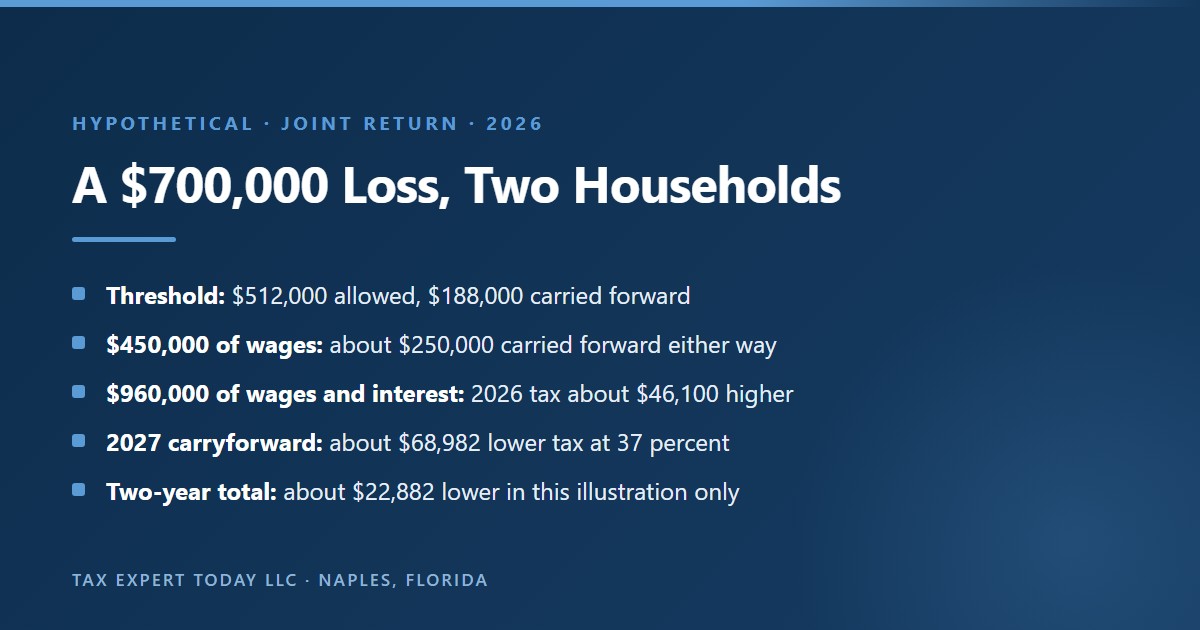
In this hypothetical, the limitation changes the label of part of the loss but not the total carried forward. The couple deducts $512,000 in 2026, which more than wipes out $450,000 of wages, and carries forward $250,000 either way: $188,000 as an excess business loss and $62,000 as an ordinary net operating loss.
- Facts: married filing jointly, $450,000 of W-2 wages, no other income, $700,000 non-passive loss.
- Excess business loss: $700,000 minus $512,000, or $188,000.
- Allowed loss: $512,000, which leaves adjusted gross income of negative $62,000.
- Total carryforward: $250,000, the same as if section 461(l) did not exist.
This is the example that most summaries of the rule would use to show the limitation hurting a household, and in this specific set of facts it does very little. With only $450,000 of wages and no other income, the couple could not have used more than $450,000 of loss in 2026 anyway. Under the section 461(l) computation, $512,000 is allowed and $188,000 is an excess business loss. The allowed $512,000 exceeds wages by $62,000, which produces negative adjusted gross income. Under the modifications in section 172(d), nonbusiness deductions such as the standard deduction are allowed only to the extent of nonbusiness income, which is zero here, so the ordinary net operating loss for the year is about $62,000.
Add the two together and the carryforward to 2027 is $250,000. Without section 461(l), the $700,000 loss against $450,000 of wages would also produce a $250,000 net operating loss. Either way, 2026 regular income tax is zero, the standard deduction is wasted, and $250,000 moves to 2027 as a net operating loss. The label changes, the total does not. Whether wages are business income for purposes of section 172(d)(4) is the reason the $62,000 ordinary net operating loss arises in this illustration, and the treatment of employee compensation in net operating loss computations should be confirmed with a professional on actual facts. The broader point does not depend on it: the limitation bites when nonbusiness income is large enough to absorb more than the threshold.
| Line | With section 461(l) | If section 461(l) did not apply |
|---|---|---|
| Wages | $450,000 | $450,000 |
| Business loss deducted in 2026 | $512,000 | $700,000 |
| Adjusted gross income | Negative $62,000 | Negative $250,000 |
| 2026 regular income tax | $0 | $0 |
| Excess business loss carried forward | $188,000 | $0 |
| Ordinary net operating loss carried forward | About $62,000 | About $250,000 |
| Total carried to 2027 | About $250,000 | About $250,000 |
Worked example: what happens to a $700,000 loss with $900,000 of wages?
Here the limitation does bite. With $900,000 of wages and $60,000 of interest, the couple could absorb the full $700,000 loss in 2026, but section 461(l) allows only $512,000. In this hypothetical, 2026 regular income tax rises by about $46,100, and the $188,000 excess becomes a 2027 net operating loss.
- Facts: joint return, $900,000 wages, $60,000 interest, $700,000 non-passive loss, standard deduction.
- 2026 with the cap: taxable income $415,800, tax about $85,968.
- 2026 without the cap: taxable income $227,800, tax about $39,868.
- 2027: the $188,000 carryforward is fully usable under the 80 percent limit.
The numbers use the 2026 married filing jointly brackets and the $32,200 standard deduction from Rev. Proc. 2025-32, and they show regular income tax only. They ignore the net investment income tax, the additional Medicare tax, itemized deductions, credits, and state tax, all of which would change the totals for a real household. With section 461(l), adjusted gross income is $960,000 minus $512,000, or $448,000, and taxable income is $415,800. Without it, adjusted gross income would be $260,000 and taxable income $227,800. The difference in 2026 regular tax is about $46,100.
The carryforward then reverses much of that difference. In 2027, assuming the same wages and interest, no new business loss, and the 2026 brackets as a stand-in for 2027 brackets that had not been published, taxable income before the net operating loss deduction is $927,800. The 80 percent limit is $742,240, so the full $188,000 is deductible. Regular tax falls from about $265,450 to about $196,468, a reduction of about $68,982. The two-year comparison is in the next section, and it holds a result that surprises most readers.
| Line | With section 461(l) | If section 461(l) did not apply |
|---|---|---|
| Wages and interest | $960,000 | $960,000 |
| Business loss deducted in 2026 | $512,000 | $700,000 |
| Adjusted gross income | $448,000 | $260,000 |
| Standard deduction | $32,200 | $32,200 |
| Taxable income | $415,800 | $227,800 |
| 2026 regular income tax | About $85,968 | About $39,868 |
| Excess business loss carried to 2027 | $188,000 | $0 |
| Line | Amount |
|---|---|
| Wages and interest, 2027 | $960,000 |
| Standard deduction (2026 figure assumed) | $32,200 |
| Taxable income before the NOL deduction | $927,800 |
| 80 percent limit | $742,240 |
| Net operating loss deduction | $188,000 |
| Regular tax without the carryforward | About $265,450 |
| Regular tax with the carryforward | About $196,468 |
| Reduction in 2027 tax | About $68,982 |
Can deferring the loss ever lower total tax?
It can, in some hypothetical fact patterns. When a large loss would push income into lower brackets, deferring part of it to a year taxed at the highest rate can produce a larger deduction value. In the $900,000 wage example, two-year regular tax is about $22,900 lower with the cap than without it.
- Why: the deferred $188,000 is deducted at 37 percent in 2027 instead of mostly 24 and 32 percent in 2026.
- Two-year total with the cap: about $282,436.
- Two-year total without the cap: about $305,318.
- The reverse case: if 2027 income falls sharply, the cap costs money instead.
The result follows directly from progressive rates. Without the cap, the last $188,000 of the 2026 loss would reduce taxable income from $415,800 to $227,800, which is income taxed at 22 and 24 percent under the 2026 joint brackets. With the cap, that $188,000 is deducted instead in 2027, when it reduces taxable income from $927,800, income taxed at 37 percent. Spreading a large deduction over two high-income years generally produces more tax benefit than concentrating it in one year, and the limitation forces some of that spreading.
This is not a reason to welcome the limitation, and it is not a recommendation. It is a reason to model the actual household rather than assume the cap is a cost. Present value narrows the gap a little, because a dollar saved in 2027 is worth slightly less than a dollar saved in 2026, but in this hypothetical the deferral still comes out ahead at discount rates of 4, 6, and 8 percent. The comparison flips when the following year’s income is low. If 2027 wages fell to $300,000 with the same $60,000 of interest, the $188,000 carryforward would be deducted at 22 and 24 percent, and the two-year total would be about $2,400 higher with the cap than without it.
| Scenario | 2026 tax | 2027 tax | Two-year total |
|---|---|---|---|
| 2027 income stays at $960,000, with the cap | About $85,968 | About $196,468 | About $282,436 |
| 2027 income stays at $960,000, without the cap | About $39,868 | About $265,450 | About $305,318 |
| Difference | About $22,882 lower with the cap | ||
| 2027 income falls to $360,000, with the cap | About $85,968 | About $20,180 | About $106,148 |
| 2027 income falls to $360,000, without the cap | About $39,868 | About $63,868 | About $103,736 |
| Difference | About $2,412 higher with the cap | ||
| Discount rate | With the cap | Without the cap | Cap lower by |
|---|---|---|---|
| 4 percent | About $274,880 | About $295,108 | About $20,229 |
| 6 percent | About $271,315 | About $290,293 | About $18,977 |
| 8 percent | About $267,883 | About $285,655 | About $17,772 |
How does section 461(l) apply to S corporation owners who take a salary?
An S corporation owner’s salary is wages, so it is excluded from the excess business loss computation, while the salary deduction stays inside the corporation’s loss that flows to the owner. In a loss year, paying a salary from a loss-making S corporation can make the owner’s excess business loss larger, although reasonable compensation rules still apply.
- Salary: W-2 wages, excluded from the 461(l) test.
- K-1 loss: includes the corporation’s deduction for that salary.
- Effect: the K-1 loss rises by the salary paid, while the wage income does not count.
- Constraint: a shareholder-employee who performs services generally must receive reasonable compensation.
The interaction comes from two rules working together. Section 461(l)(3)(A) excludes gross income attributable to the trade or business of performing services as an employee, which includes a shareholder-employee’s salary. Section 461(l)(4) then tests the shareholder on their pro rata share of the corporation’s items, which include the deduction the corporation took for that same salary. The shareholder K-1 instructions describe code AJ in box 17 as the statement of the shareholder’s share of aggregate business gross income or gain and aggregate business deductions, which is the information needed to apply the test.
Suppose an owner’s S corporation has a $500,000 ordinary loss before paying the owner any salary, from a large equipment purchase with bonus depreciation. If the owner takes no salary, the K-1 loss is $500,000, which is under the 2026 joint threshold of $512,000, and there is no excess business loss. If the owner takes a $200,000 salary, the K-1 loss becomes $700,000, the $200,000 of wages is excluded from the test, and the excess business loss is $188,000. In both cases the owner’s household economics before tax are similar, but the second pattern defers $188,000 of deduction to a later year.
That does not mean an owner should skip salary in a loss year. An S corporation owner who performs services for the business is generally expected to receive reasonable compensation, and the IRS can recharacterize distributions as wages when it is not paid. A loss year with no distributions may support a lower salary, but the answer depends on the facts. Our guide to S corporation reasonable compensation covers those rules. The point here is narrower: salary decisions in a large loss year affect the excess business loss computation and should be modeled before payroll for the year is finalized.
| Item | No salary to owner | $200,000 salary to owner |
|---|---|---|
| S corporation loss before owner salary | $500,000 | $500,000 |
| Owner salary deducted by the corporation | $0 | $200,000 |
| K-1 ordinary loss to the owner | $500,000 | $700,000 |
| Owner wages counted in the 461(l) test | $0 | $0, excluded |
| Net business loss for 461(l) | $500,000 | $700,000 |
| Excess business loss | $0 | $188,000 |
| Reasonable compensation review needed | Yes | Yes |
How does the limitation apply to partners and K-1 code AJ?
Section 461(l)(4) applies the limitation at the partner or shareholder level. Each owner takes their allocable share of the entity’s business income, gains, deductions, and losses into their own computation. The partnership reports that information on Schedule K-1, box 20, code AJ, and an S corporation reports it in box 17, code AJ.
- Entity level: no excess business loss is computed by the partnership or S corporation.
- Owner level: each partner or shareholder combines K-1 items with their other businesses.
- Partnership K-1: box 20, code AJ, excess business loss limitation information.
- S corporation K-1: box 17, code AJ, the same information.
Under section 461(l)(4), in the case of a partnership or S corporation, the subsection is applied at the partner or shareholder level, and each partner’s or shareholder’s allocable share of items from trades or businesses attributable to the entity is taken into account in the owner’s taxable year with or within which the entity’s year ends. For an S corporation, the allocable share is the shareholder’s pro rata share of each item. The owner then adds those items to any other business items on the return before applying the threshold.
The Partner’s Instructions for Schedule K-1 (Form 1065) describe code AJ in box 20: if the partnership has deductions attributable to a business activity, it provides a statement showing the partner’s distributive share of the aggregate gross income or gain, and aggregate deductions, from the business activity of all of the partnership’s trades or businesses, which the partner can use with other information to figure any excess business loss limitation. The S corporation instructions contain matching language for code AJ in box 17. Owners who receive a K-1 with a large loss should look for that statement, because it separates business items from portfolio items that do not count.
Because the test is applied at the owner level, the same K-1 loss can produce very different results for different partners. A partner with other business profits may have no excess business loss at all, while a partner whose only business item is the K-1 loss may have a large one. A partner in one fund with a large depreciation loss and another fund with operating profits can net the two, as long as both are trades or businesses and both losses survive the basis, at-risk, and passive rules. Investors reviewing a fund offering that advertises large first-year losses should run their own numbers rather than rely on the fund’s projections, which cannot know the investor’s other business items.
| Entity | K-1 box | Code | What the statement shows |
|---|---|---|---|
| Partnership (Form 1065) | Box 20, Other information | AJ | Partner’s share of aggregate business gross income or gain and aggregate business deductions |
| S corporation (Form 1120-S) | Box 17, Other information | AJ | Shareholder’s share of aggregate business gross income or gain and aggregate business deductions |
| Trust or estate (Form 1041) | Not a separate code | Not applicable | Beneficiary items flow through under the trust rules |
| Partner | K-1 business loss | Other net business income | Net business loss | Excess business loss |
|---|---|---|---|---|
| Partner 1, physician employee | $800,000 | $0 | $800,000 | $288,000 |
| Partner 2, owns a profitable practice | $800,000 | $450,000 | $350,000 | $0 |
| Partner 3, owns a second loss fund | $800,000 | Loss of $100,000 | $900,000 | $388,000 |
How do married couples apply the threshold?
On a joint return, both spouses’ business items are combined on one Form 461 and the $512,000 joint threshold applies. Filing separately, each spouse uses the $256,000 amount and tests only their own business items. A business profit of one spouse can offset the other spouse’s business loss only on a joint return.
- Joint return: one Form 461 with both spouses’ items, $512,000 threshold.
- Separate returns: each spouse files their own Form 461 with a $256,000 threshold.
- Offsetting spouses: one spouse’s business profit offsets the other’s loss only if filing jointly.
- Other costs: filing separately has many other consequences that usually outweigh this one.
The Form 461 instructions say that for joint returns, one Form 461 contains all the information for both spouses. The statute sets the joint threshold at 200 percent of the base amount. A married person filing separately is not filing a joint return, so the single amount of $256,000 applies to each spouse separately, and each spouse’s computation includes only their own business items and their own share of any jointly owned business.
For most couples the joint return is better for section 461(l), because it lets one spouse’s business income absorb the other spouse’s business loss before the threshold is even reached. If one spouse runs a profitable consulting practice earning $200,000 and the other places a short-term rental in service with a $600,000 loss, a joint return shows a $400,000 net business loss, which is under the threshold. Separate returns would leave the second spouse with a $600,000 loss against a $256,000 threshold, and a $344,000 excess business loss.
When both spouses have losses, the joint and separate results converge. Two $300,000 losses produce a $600,000 joint net loss and an $88,000 excess on a joint return. Filed separately, each spouse has a $300,000 loss against $256,000, or a $44,000 excess each, which is also $88,000. Filing status therefore rarely improves the excess business loss result, and separate filing brings its own costs, from higher rates to lost credits. It should be evaluated only as part of a complete comparison of both returns.
| Facts | Joint return excess | Separate returns excess, combined |
|---|---|---|
| Spouse A business profit $200,000; Spouse B business loss $600,000 | $0 (net loss $400,000) | $344,000 (Spouse B only) |
| Spouse A loss $300,000; Spouse B loss $300,000 | $88,000 | $88,000 ($44,000 each) |
| Spouse A loss $700,000; Spouse B wages only | $188,000 | $444,000 (Spouse A only) |
| Spouse A loss $250,000; Spouse B loss $250,000 | $0 | $0 |
How is Form 461 completed?
Form 461 has three parts. Part I totals income and loss items from the return that may relate to a business. Part II backs out the amounts that are not from a trade or business, including portfolio capital gains and losses. Part III adds the threshold, and a negative result on line 16 is the excess business loss.
- Part I, lines 1 to 9: business income, capital gain or loss, other gains, Schedule E, farm, and other business items.
- Part II, lines 10 to 12: removes nonbusiness income, gains, losses, and deductions.
- Part III, lines 13 to 16: combines the results and adds the threshold.
- Who must file: for 2025, net business losses above the threshold or a loss of more than $156,500 on any one line from 1 to 8.
The 2025 Form 461 asks for the amount from Schedule 1, line 3 (business income or loss) on line 2, the amount from Form 1040, line 7a (capital gain or loss) on line 3, Schedule 1, line 4 (other gains or losses) on line 4, Schedule 1, line 5 (rental real estate, royalties, partnerships, S corporations, trusts) on line 5, Schedule 1, line 6 (farm income or loss) on line 6, and any other trade or business income or loss on line 8. Lines 1 and 7 are reserved. Line 9 combines lines 1 through 8. Part II then removes everything on those lines that is not from a trade or business, and Part III adds the threshold amount on line 15.
The 2025 instructions require Form 461 when net losses from all trades or businesses are more than $313,000 ($626,000 for a joint return), or when the taxpayer would report a loss of more than $156,500 on any one of lines 1 through 8. The second test catches taxpayers whose losses on one line are offset by gains on another, so that the IRS can see the computation. The 2026 form and instructions had not been released when this guide was checked, so the 2026 line references and the second filing test amount should be confirmed when the form is published. Using the 2026 threshold, the comparable single-line amount would be expected to change, but no figure is used here until the IRS publishes it.
| Form 461 line | Description | Amount |
|---|---|---|
| 2 | Schedule 1, line 3 (business income or loss) | $0 |
| 3 | Form 1040, line 7a (capital gain or loss) | $0 |
| 5 | Schedule 1, line 5 (short-term rental loss reported on Schedule E) | ($700,000) |
| 9 | Combine lines 1 through 8 | ($700,000) |
| 10 to 12 | Nonbusiness amounts included above | $0 |
| 13 | Line 12 with sign reversed | $0 |
| 14 | Add lines 9 and 13 | ($700,000) |
| 15 | Threshold (2026 joint amount) | $512,000 |
| 16 | Add lines 14 and 15; excess business loss | ($188,000) |
Wages and interest do not appear on Form 461 at all in this example, because they are not on any of the lines the form draws from. Wages are on Form 1040, line 1, and interest is on line 2b. That is the form’s way of carrying out the wage exclusion: the computation starts only from lines where business income and loss are reported.
Where does the excess business loss adjustment go on Form 1040?
The excess business loss is reported as a positive number on Schedule 1 (Form 1040), line 8p, with “ELA” written on the dotted line. That adds the disallowed loss back to income, so the business schedules can still show the full loss while adjusted gross income reflects only the allowed portion.
- Schedule 1, line 8p: excess business loss adjustment, entered as a positive number.
- Label: “ELA” on the dotted line.
- Trusts and estates: Form 1041, line 8.
- Records: keep each year’s excess business loss, because it becomes the net operating loss carryover.
The line 16 instructions explain the mechanics: if the result on line 16 is negative, it is the excess business loss, and although it is a loss, the excess business loss adjustment is reported as a positive number on the “Other income” line of the return with “ELA” entered on the dotted line. For Schedule 1 (Form 1040), that is line 8p. For Form 1041, it is line 8. Other fiduciary and exempt organization returns have their own “Other income” lines, which the instructions list.
Reporting the adjustment as other income, instead of reducing the loss on Schedule C or Schedule E, keeps the business schedules accurate. The rental or business still reports its full loss, which matters for basis, for state returns that may not follow the federal limitation, and for the record of the activity’s history. The adjustment then adds back the disallowed part so that adjusted gross income reflects only the allowed loss. A reviewer looking at a return with a large Schedule E loss and an offsetting “ELA” entry on Schedule 1 can see at a glance that the limitation was applied.
The instructions also include a reminder that is easy to overlook: keep a record of the excess business loss from each tax year, because it is treated as a net operating loss carryover for subsequent years. Software usually carries the figure forward, but a change in preparer or software, or a return prepared by hand, can drop it. The carryforward should be visible in the workpapers every year until it is used up.
| Return location | Entry | Amount |
|---|---|---|
| Schedule E | Short-term rental loss, full amount | ($700,000) |
| Schedule 1, line 5 | Rental real estate and pass-through total | ($700,000) |
| Form 461, line 16 | Excess business loss | ($188,000) |
| Schedule 1, line 8p | “ELA” adjustment, positive | $188,000 |
| Net effect on adjusted gross income | Allowed loss | ($512,000) |
| Workpapers and Form 172 records | Carryforward to 2027 | $188,000 |
How is the carryforward tracked on Form 172?
The excess business loss joins the taxpayer’s net operating loss for the year and is carried forward using Form 172, the IRS form for net operating losses of individuals, estates, and trusts. Form 172 figures the net operating loss, the deduction allowed in a later year, and the amount that still carries forward after the 80 percent limit.
- Form 172 covers: how to figure an NOL, when to use it, how to claim it, and how to figure the carryover.
- Applies to: individuals, estates, and trusts.
- Pointed to by: the Form 461 instructions, for carryovers and future-year reporting.
- Records: track the year each loss arose, because pre-2018 losses follow different rules.
The IRS describes Form 172 as covering net operating losses for individuals, estates, and trusts, including how to figure a net operating loss, when to use it, how to claim a net operating loss deduction, and how to figure a net operating loss carryover. The Form 461 instructions point to Form 172 for more information on carryovers and on reporting net operating losses on future returns.
Tracking matters because the carryforward can be made up of losses from different years with different rules. Losses arising in taxable years beginning before 2018 carry forward for 20 years and are not subject to the 80 percent limit. Losses arising after 2017, including every excess business loss, carry forward indefinitely and are subject to the 80 percent limit. Section 172(a) uses the pre-2018 losses first and then the newer losses up to the limit. A taxpayer with both kinds needs a schedule that shows each year’s loss, how much has been used, and how much remains.
The excess business loss is not tracked separately from the rest of the net operating loss once it is carried forward. It is part of that year’s net operating loss, which is why the worked example with $450,000 of wages produced a single $250,000 carryforward made of two pieces. For a household with recurring large losses, the schedule can grow quickly, and an annual review of how much of the carryforward the next year’s income can absorb is a natural part of fall planning.
| Year | New business loss | New excess business loss | NOL used | NOL carried to next year |
|---|---|---|---|---|
| 2026 | $700,000 | $188,000 | $0 | $188,000 |
| 2027 | $100,000 (under the threshold) | $0 | $188,000 | $0 |
| 2028 | $0 | $0 | $0 | $0 |
In this hypothetical the couple has $960,000 of wages and interest each year. In 2027 the new $100,000 business loss is allowed in full because it is under the threshold, and taxable income before the net operating loss deduction is $827,800, so the 80 percent limit of $662,240 does not restrict the $188,000 carryforward. A household with lower income or larger repeated losses would see the carryforward last longer.
How does the limitation apply to trusts and estates?
Trusts and estates are noncorporate taxpayers, so section 461(l) applies to business losses they report on Form 1041, using the $256,000 non-joint threshold for 2026. A grantor trust is generally disregarded for income tax, so its business items are reported on the grantor’s return and tested there instead.
- Nongrantor trusts and estates: file Form 461 with Form 1041 when required.
- Threshold: $256,000 for 2026, because a fiduciary return is not a joint return.
- Grantor trusts: items are reported by the grantor and tested on the grantor’s return.
- Exempt trusts: trusts taxed under section 511 also file Form 461, per the instructions.
The Form 461 instructions list Form 1041, Form 1041-QFT, Form 1041-N, and Form 990-T among the returns to which Form 461 may be attached, and they include trusts subject to tax under section 511 among noncorporate taxpayers. For a nongrantor trust or an estate that owns an operating business or a large rental, the limitation is applied at the fiduciary level to the business items the trust or estate itself reports.
Trusts often hold business interests in estate planning structures, which raises a planning point. A large first-year loss inside a nongrantor trust is tested against a $256,000 threshold, not $512,000, and the trust may have little nonbusiness income to absorb even the allowed portion. If the same property were held in a grantor trust, the loss would be tested on the grantor’s joint return, with the grantor’s other business items and the joint threshold. That difference is one more input into the choice between grantor and nongrantor structures, which our guide to the intentionally defective grantor trust covers from the estate tax side.
Estates face a timing issue as well. An estate that continues to operate a business after the owner’s death can have a large loss in a short first fiscal year, for example from depreciation or wind-down costs. The excess becomes a net operating loss of the estate, and special rules may allow unused losses in the estate’s final year to pass to beneficiaries. Those rules are separate from section 461(l) and depend on the facts, so an estate with a business should have the computation reviewed before the final return is filed.
| Entity | Who applies the test | Threshold | Return |
|---|---|---|---|
| Nongrantor trust | The trust | $256,000 | Form 1041 with Form 461 |
| Estate | The estate | $256,000 | Form 1041 with Form 461 |
| Grantor trust | The grantor | Grantor’s threshold, $512,000 if filing jointly | Grantor’s Form 1040 |
| Trust taxed under section 511 | The trust | $256,000 | Form 990-T with Form 461 |
How are farming losses treated?
Farm losses count in the excess business loss computation, and the older excess farm loss rule in section 461(j) does not apply while section 461(l) does. A farming loss can still be carried back two years under section 172, but the Form 461 instructions require the excess business loss limitation to be applied before any carryback.
- Section 461(j): switched off by section 461(l)(1)(A).
- Carryback: farming losses may be carried back 2 years under section 172(b)(1)(B).
- Ordering: apply the excess business loss limitation before the carryback.
- Mixed losses: allocate the threshold first to farming losses to the extent there is an NOL.
Section 461(l)(1)(A) provides that subsection (j), the excess farm loss rule, shall not apply while the excess business loss limitation applies. Farming losses are business losses like any other for section 461(l), and they are reported on Schedule F and flow to Form 461, line 6. The IRS explanation notes that the computation includes farming losses from casualty losses or losses by reason of disease or drought.
The carryback is the main difference for farmers. Section 172(b)(1)(B) allows the portion of a net operating loss that is a farming loss to be carried back to each of the 2 taxable years preceding the loss year. The Form 461 instructions say taxpayers with losses from a farming business must apply the excess business loss limitation before carrying any net operating losses back 2 years, and that taxpayers with both farming and nonfarming business losses above the threshold must allocate the threshold amount first to the farming losses to the extent they have a net operating loss. IRS Publication 225, the Farmer’s Tax Guide, has more detail.
Southwest Florida has a meaningful agricultural sector, from citrus and vegetables in the inland counties to cattle and nursery operations. A grower with a hurricane or disease year, or a large equipment purchase with bonus depreciation, can face the excess business loss limitation and the farm loss carryback at the same time. The order of the two rules decides how much of the loss can reach prior years’ returns and how much is carried forward instead.
| Rule | Treatment | Source |
|---|---|---|
| Excess farm loss rule, 461(j) | Does not apply while 461(l) applies | IRC 461(l)(1)(A) |
| Farm loss in the 461(l) test | Included as a business loss | Form 461, line 6 |
| Carryback of a farming loss | 2 years | IRC 172(b)(1)(B) |
| Order of operations | Apply 461(l) first, then the carryback | Form 461 instructions |
| Farm and nonfarm losses together | Threshold allocated first to farming losses | Form 461 instructions |
What happens to an unused carryforward at death?
A net operating loss, including one created by the excess business loss limitation, can generally be used on the decedent’s final individual return but generally cannot be carried to the estate or to heirs. An unused carryforward can therefore expire when the taxpayer dies, which makes the limitation more costly for older owners.
- Final return: the carryforward may offset income through the date of death.
- After death: generally not transferred to the estate, a trust, or beneficiaries.
- Joint returns: a surviving spouse may keep the portion attributable to their own losses.
- Planning: large losses late in life deserve a use-it projection.
Net operating losses belong to the taxpayer who incurred them. The general rule, reflected in long-standing IRS guidance, is that a decedent’s net operating loss can be deducted on the decedent’s final return, but any amount not used there is not carried to the estate’s fiduciary return or to the heirs. On a joint return, the loss must be traced to the spouse who incurred it, and the surviving spouse may continue to carry forward the portion attributable to their own activities. The tracing can be complicated when both spouses owned the business or the property that produced the loss.
That makes the excess business loss limitation a different kind of planning issue for an owner in their seventies or eighties. A younger owner with a carryforward will almost always use it within a year or two. An older owner who places a property in service with a large cost segregation loss, receives only $512,000 of benefit in the first year, and then dies before the carryforward is used may lose the deferred part entirely. The worked example earlier in this guide shows how deferral can sometimes lower total tax. This is the case where it does the opposite.
For older owners, the planning response is usually to size first-year losses to fit under the threshold, for example by electing out of bonus depreciation for a class of property, spreading acquisitions across years, or accelerating income into the loss year so more of the loss is used currently. These decisions interact with estate planning, including the basis adjustment at death under section 1014, which our Florida estate planning guide discusses for new residents.
| Event | Spouse who owned the property | Result for the carryforward |
|---|---|---|
| Owner spouse dies in 2027, carryforward unused on final joint return | Decedent | Generally expires |
| Non-owner spouse dies in 2027 | Survivor | Generally continues for the survivor |
| Property owned jointly | Both | Allocation needed; the decedent’s share generally expires |
| Carryforward fully used on the 2026 or 2027 return | Either | No loss of benefit |
How do states treat the excess business loss limitation?
State treatment varies. Florida has no personal income tax, so a Florida resident’s excess business loss matters only on the federal return. Many states start from federal adjusted gross income and follow the limitation, while others decouple from it or apply their own net operating loss rules, so a multistate owner should check each state.
- Florida: no personal income tax, so no state computation for individuals.
- States that follow federal AGI: often follow section 461(l), subject to each state’s conformity date.
- States with their own rules: may decouple, or may limit net operating loss deductions separately.
- Nonresidents: a Florida resident with a business or rental in another state may still file there.
For a Florida resident, the excess business loss limitation is almost always a federal question. Florida does not tax individual income, a point covered in our Florida tax services overview, so there is no state version of Form 461 to complete for income earned as a resident. That simplicity is one reason the federal arithmetic in this guide comes close to the full answer for a Southwest Florida household.
It is different for owners who live in, came from, or do business in another state. A state that uses federal adjusted gross income as its starting point will generally carry the federal limitation onto the state return unless it has decoupled, and each state’s conformity to the Internal Revenue Code is tied to a date that may or may not include P.L. 119-21. Some states have also limited or suspended net operating loss deductions on their own for certain years, which can affect how the carryforward from an excess business loss is used. Our guides to California’s NOL suspension and the Georgia net operating loss rules explain two examples.
New Florida residents who moved during the loss year are the most common multistate case. A household that moved from a high-tax state midyear may have a part-year resident return in the former state that includes some or all of a large business loss, depending on when the property was placed in service and how the state sources the loss. Our guide to moving from California to Florida discusses part-year residency more broadly. The state treatment of the excess business loss and its carryforward should be confirmed for each state involved before the return is filed.
| Question | Why it matters |
|---|---|
| Does the state tax individual income at all? | Florida, Texas, and several other states do not |
| Does the state start from federal AGI? | If so, the federal limitation usually carries over |
| What is the state’s IRC conformity date? | Determines whether P.L. 119-21 changes apply |
| Has the state decoupled from section 461(l)? | A decoupled state may allow the full loss |
| Does the state limit or suspend NOL deductions? | Affects when the carryforward can be used |
| Was the taxpayer a part-year resident? | Sourcing of the loss and carryforward may differ |
What year-end moves can reduce an excess business loss?
The main levers are the size of the loss, the business income it nets against, and the year it lands in. Owners can elect out of bonus depreciation for a class of property, use section 179, time when property is placed in service, accelerate business income into the loss year, and coordinate salary and acquisitions.
- Shrink the loss: elect out of bonus depreciation by class under section 168(k)(7), or choose section 179 where it fits.
- Add business income: accelerate business receipts or sell business assets with a gain in the loss year.
- Move the loss: place a second property in service in January instead of December.
- Use the allowed loss well: consider whether a Roth conversion or portfolio gain belongs in a low-income year.
The election out of bonus depreciation is the most precise tool. Section 168(k)(7) lets a taxpayer elect not to apply bonus depreciation to all property in a class placed in service during the year, for example all 15 year land improvements, while keeping it for 5 and 7 year property. That can bring a cost segregation loss closer to the threshold, with the remaining basis recovered through ordinary depreciation in later years, which are deductions that will again be tested under section 461(l) in those years but are spread out. The election is made on a timely filed return, including extensions, and it applies to the whole class for the year.
Adding business income works because section 461(l) nets all trades or businesses. An owner whose operating company can accelerate collections or defer a discretionary expense into January may increase business income in the loss year and reduce the excess dollar for dollar. A sale of business equipment or a business property with a gain reported on Form 4797 can do the same, as the IRS explanation confirms. Portfolio gains and interest do not reduce the excess, but they do absorb the allowed portion of the loss on the return, which is why some owners choose a large business loss year to realize gains or to convert traditional IRA money to a Roth IRA. Our guides to the Roth conversion ladder and tax gain harvesting discuss those decisions on their own terms.
Timing acquisitions may be the simplest lever. Two properties placed in service in the same year can produce a combined loss well above the threshold. The same two properties placed in service in December and January can each fit under a separate year’s threshold. The trade-off is that a property placed in service in January earns no depreciation in the earlier year and may earn less rental income, so the decision should be modeled with cash flow, financing, and the short-term rental material participation calendar in mind. For larger acquisitions, our 1031 exchange rules guide explains how carryover basis from an exchange can reduce the depreciable basis available for a new cost segregation study.
| Lever | Effect on the 461(l) test | Trade-off to model |
|---|---|---|
| Elect out of bonus for a class, IRC 168(k)(7) | Reduces business deductions this year | Deductions move to later years |
| Use section 179 instead of bonus where possible | Cannot exceed business taxable income including wages | Section 179 carryover if limited |
| Place a second property in service next year | Splits the loss across two thresholds | Less depreciation and income this year |
| Accelerate business receipts into the loss year | Increases business income, reducing the excess | Higher tax if the loss is smaller than expected |
| Sell a business asset with a Form 4797 gain | Increases business gain, reducing the excess | Recapture character and the reason for the sale |
| Realize portfolio gains or a Roth conversion | Does not change the excess; uses the allowed loss | Character of income and future brackets |
| Review owner salary from a loss-making S corporation | Wages are excluded; salary deduction increases K-1 loss | Reasonable compensation rules |
| Item | Full bonus on all classes | Elect out for 15 year property |
|---|---|---|
| 5 and 7 year property expensed | $420,000 | $420,000 |
| 15 year land improvements | $280,000 expensed | About $14,000 first-year depreciation (half-year, 150 percent declining balance) |
| First-year business loss | $700,000 | About $434,000 |
| Excess business loss | $188,000 | $0 |
| Remaining 15 year basis to depreciate in later years | $0 | About $266,000 |
What are common mistakes with the excess business loss limitation?
The most common mistakes are using an outdated threshold, counting wages or portfolio gains as business income, forgetting that the limitation applies only after basis, at-risk, and passive rules, losing track of the carryforward, and assuming a fund’s projected first-year loss will be fully usable by every investor.
- Outdated figures: using $313,000 or $626,000 for 2026, or older amounts from 2018 articles.
- Wrong inputs: treating wages, interest, or stock gains as business income in the test.
- Wrong order: applying 461(l) to a loss that is still suspended as passive or by basis.
- Lost carryforward: failing to carry the net operating loss to the next return.
The threshold error is the most frequent because so many published pages predate the 2025 law. A projection prepared in 2025 for a property to be placed in service in 2026 may still show the $626,000 joint figure, which overstates the usable loss by $114,000. The second most frequent is treating every item on the return as if it were business income. Section 461(l)(3)(A) and (B) are specific: employee wages are excluded, capital losses are excluded from deductions, and capital gains count only to the extent attributable to a trade or business and limited by total capital gain net income. Form 461 builds those rules into its line structure, which is a good reason to prepare the form even when it seems obvious that no limitation applies.
The ordering mistake shows up most with pass-through investors. A K-1 showing a $900,000 loss does not mean the investor has $900,000 to test under section 461(l). Basis, the at-risk rules, and the passive activity rules come first, and a loss suspended at any of those steps is not tested under section 461(l) until a later year. The release of a large suspended passive loss on a sale is the mirror image: it can create an excess business loss years after the depreciation that produced it.
| Mistake | Correct treatment | Source |
|---|---|---|
| Using the 2025 threshold for 2026 | $256,000, or $512,000 joint | Rev. Proc. 2025-32, sec. 4.31 |
| Counting wages as business income | Wages are excluded | IRC 461(l)(3)(A) |
| Counting stock gains as business income | Only business capital gains, with a cap | IRC 461(l)(3)(B) |
| Testing a passive-suspended loss | Test only after section 469 | IRC 461(l)(6) |
| Testing the carryforward again next year | Section 172 deductions are excluded | IRC 461(l)(3)(A)(i) |
| Reducing the Schedule E loss directly | Report “ELA” on Schedule 1, line 8p | Form 461 instructions |
| Assuming the rule expires | Permanent | P.L. 119-21, sec. 70601(a) |
| Relying on a fund’s projected loss | Test at the investor level with all business items | IRC 461(l)(4) |
How has the threshold changed since 2018?
The base amount has always been $250,000, or $500,000 for joint returns, adjusted for inflation each year. The indexed threshold rose from $250,000 in 2018 to $313,000 in 2025, then fell to $256,000 in 2026 when P.L. 119-21 re-based the inflation adjustment to 2024. The rule did not apply for 2018 through 2020.
- 2018 to 2020: suspended retroactively by the CARES Act.
- 2021 to 2025: indexed from a 2017 base, rising each year.
- 2026: indexed from a 2024 base, so the amount reset lower.
- 2027 and later: indexed from the 2024 base, published each fall.
The thresholds below come from each year’s inflation-adjustment revenue procedure. The 2019 amount appears in Rev. Proc. 2018-57, 2020 in Rev. Proc. 2019-44, 2021 in Rev. Proc. 2020-45, 2022 in Rev. Proc. 2021-45, 2023 in Rev. Proc. 2022-38, 2024 in Rev. Proc. 2023-34, 2025 in Rev. Proc. 2024-40, and 2026 in Rev. Proc. 2025-32. The 2018 amount is the base in the statute. The IRS explanation page still quotes the 2021 amounts, so it should not be used for a current-year figure.
Taxpayers with amended returns or carryforwards from earlier years should use the threshold for the year the loss arose. A taxpayer who amended 2018 through 2020 returns after the CARES Act suspension may have created net operating losses in those years that interact with the 80 percent limit differently, because the 80 percent limit applies only for taxable years beginning after 2020. Those older computations are worth reviewing when a new excess business loss is added to an existing carryforward.
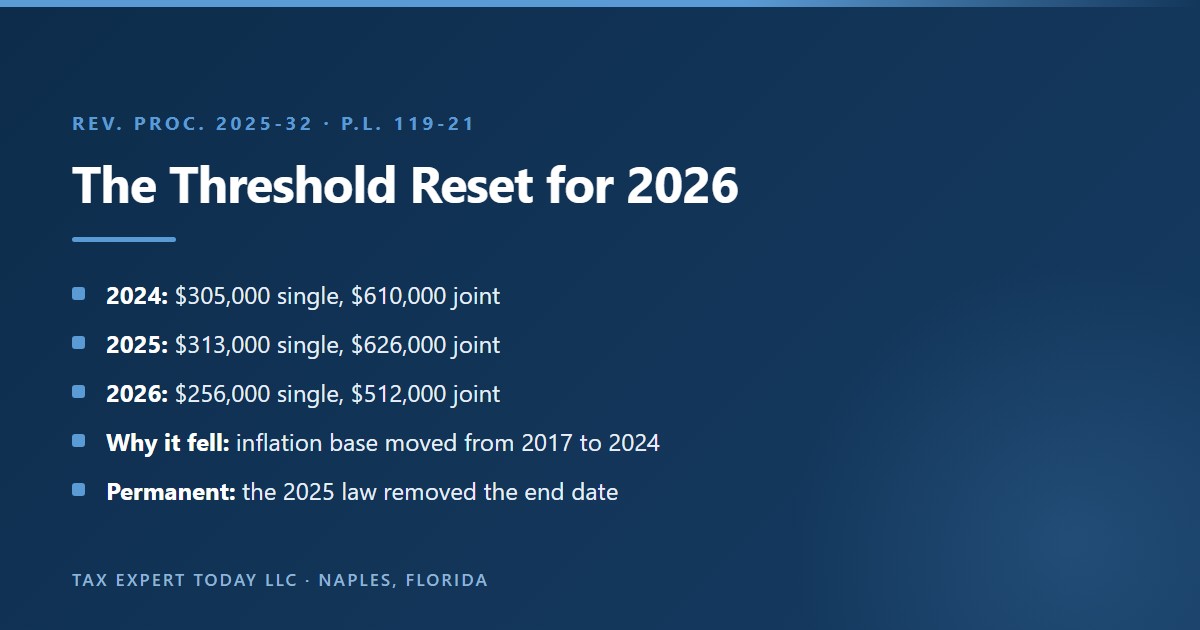
| Taxable year | Single and other filers | Joint return | Applied? | Source |
|---|---|---|---|---|
| 2018 | $250,000 | $500,000 | No, suspended by the CARES Act | IRC 461(l)(3)(A) |
| 2019 | $255,000 | $510,000 | No, suspended by the CARES Act | Rev. Proc. 2018-57 |
| 2020 | $259,000 | $518,000 | No, suspended by the CARES Act | Rev. Proc. 2019-44 |
| 2021 | $262,000 | $524,000 | Yes | Rev. Proc. 2020-45 |
| 2022 | $270,000 | $540,000 | Yes | Rev. Proc. 2021-45 |
| 2023 | $289,000 | $578,000 | Yes | Rev. Proc. 2022-38 |
| 2024 | $305,000 | $610,000 | Yes | Rev. Proc. 2023-34 |
| 2025 | $313,000 | $626,000 | Yes | Rev. Proc. 2024-40 |
| 2026 | $256,000 | $512,000 | Yes | Rev. Proc. 2025-32 |
| Net business loss | Excess, single filer ($256,000) | Excess, joint return ($512,000) |
|---|---|---|
| $300,000 | $44,000 | $0 |
| $512,000 | $256,000 | $0 |
| $600,000 | $344,000 | $88,000 |
| $700,000 | $444,000 | $188,000 |
| $900,000 | $644,000 | $388,000 |
| $1,200,000 | $944,000 | $688,000 |
Excess Business Loss Help in Naples & Southwest Florida
Tax Expert Today LLC, based in Naples, Florida, helps business owners and real estate investors project whether a first-year loss will exceed the section 461(l) threshold, model cost segregation, bonus depreciation, and section 179 choices before a property is placed in service, prepare Form 461, and track the net operating loss carryforward through later returns.
- Excess business loss help Naples: a before-and-after projection of the 2026 and 2027 returns.
- Real estate investors: short-term rental, real estate professional, and cost segregation coordination.
- Business owners: S corporation salary, equipment timing, and Form 461 preparation.
- Carryforward tracking: Form 172 schedules and annual use projections.
Southwest Florida has an unusual concentration of the households the limitation reaches: physicians, executives, and business owners with large wage or business income who buy coastal rental property, and new residents who sold a business or a home elsewhere and are reinvesting. Because Florida has no personal income tax, the federal arithmetic in this guide is close to the full answer for a resident household, which makes the projection unusually clean. Owners in Naples, Bonita Springs, Estero, Fort Myers, and Marco Island who are considering a cost segregation study or a year-end equipment purchase can find the broader planning context on our Naples tax planning page, and those with an operating company can review our business consulting services.
Tax Expert Today LLC
11983 Tamiami Trail N, Naples FL 34110
Phone: (239) 441-2005
Hours: Monday to Friday, 10:00 to 5:00 ET
Where can I get help with the excess business loss limitation in Naples, FL? Tax Expert Today LLC, at 11983 Tamiami Trail N in Naples, Florida, helps business owners and real estate investors project section 461(l) results before year end, coordinate cost segregation and bonus depreciation elections, prepare Form 461 and the Schedule 1 “ELA” adjustment, and track the resulting net operating loss carryforward. The firm includes tax advisors, enrolled agents, CPAs, and attorneys, and serves clients in all 50 states. Results depend on each taxpayer’s facts.
| Item | Why it helps |
|---|---|
| Prior two years’ returns, including any Form 461 and NOL schedules | Shows existing carryforwards and prior limitations |
| Cost segregation study or engineer’s draft | Supports the projected first-year depreciation by class |
| Closing statements and placed-in-service dates | Determines the year and amount of depreciation |
| Schedule K-1s with code AJ statements | Separates business from portfolio items |
| Year-to-date business profit and loss statements | Measures business income that offsets the loss |
| Material participation logs for rentals | Confirms whether the loss is non-passive |
| Payroll records for S corporation owners | Shows wages excluded from the test |
When to Engage a Professional
A professional review is worthwhile before buying or placing in service a property with a cost segregation study, before a large year-end equipment purchase, when a K-1 shows a large first-year loss, when a passive property with suspended losses is about to be sold, and whenever a carryforward from an earlier excess business loss exists.
- Before closing, to project the first-year loss against the 2026 threshold.
- Before year end, to choose between full bonus, an election out, and section 179.
- When a K-1 arrives, to test the loss through basis, at-risk, passive, and 461(l).
- Before a sale, when suspended passive losses will be released.
- When an IRS letter arrives about a loss or carryforward; see our IRS audit help page.
Tax Expert Today LLC is a multidisciplinary practice of tax advisors, enrolled agents, certified public accountants, and attorneys serving clients in all 50 states. To discuss how the excess business loss limitation affects a planned investment or a business loss year, contact our Naples, Florida tax planning team, review our tax planning services, or call (239) 441-2005. Owners may also find our guides to the cost segregation study, bonus depreciation in 2026, the short-term rental tax loophole, real estate professional status, the qualified business income deduction, and the cash balance plan for business owners useful, along with the full learning center.
This article is general information about the federal excess business loss limitation and related loss rules and is not tax, legal, or investment advice for any specific business or person. It does not recommend any property, fund, cost segregation provider, or transaction. Statutory and regulatory references were checked against the text of IRC sections 168, 172, 179, 461, 465, 469, 704, and 1366, Treasury Regulation section 1.179-2, section 70301 and section 70601 of P.L. 119-21, Rev. Procs. 2018-57, 2019-44, 2020-45, 2021-45, 2022-38, 2023-34, 2024-40, and 2025-32, the 2025 Form 461 and its instructions, the Partner’s and Shareholder’s Instructions for Schedule K-1, IRS Publication 925, and the IRS Form 172 information page on November 5, 2026. The 2027 threshold and the 2026 Form 461 had not been published on that date. All dollar examples, including wages, losses, property values, depreciation percentages, salaries, and tax amounts, are hypothetical illustrations computed with the 2026 federal rates and standard deduction, show regular income tax only, and are not client outcomes or predictions for any taxpayer. Tax laws apply differently to each person’s facts. Consult a qualified professional about your situation before taking any action.
Published November 5, 2026 by Dr. Pellumb Kabashi « Back to Learning Center
Have a question this article touches on?
Tax Expert Today LLC, based in Naples, Florida and serving clients across the United States.
Schedule a Consultation (239) 441-2005